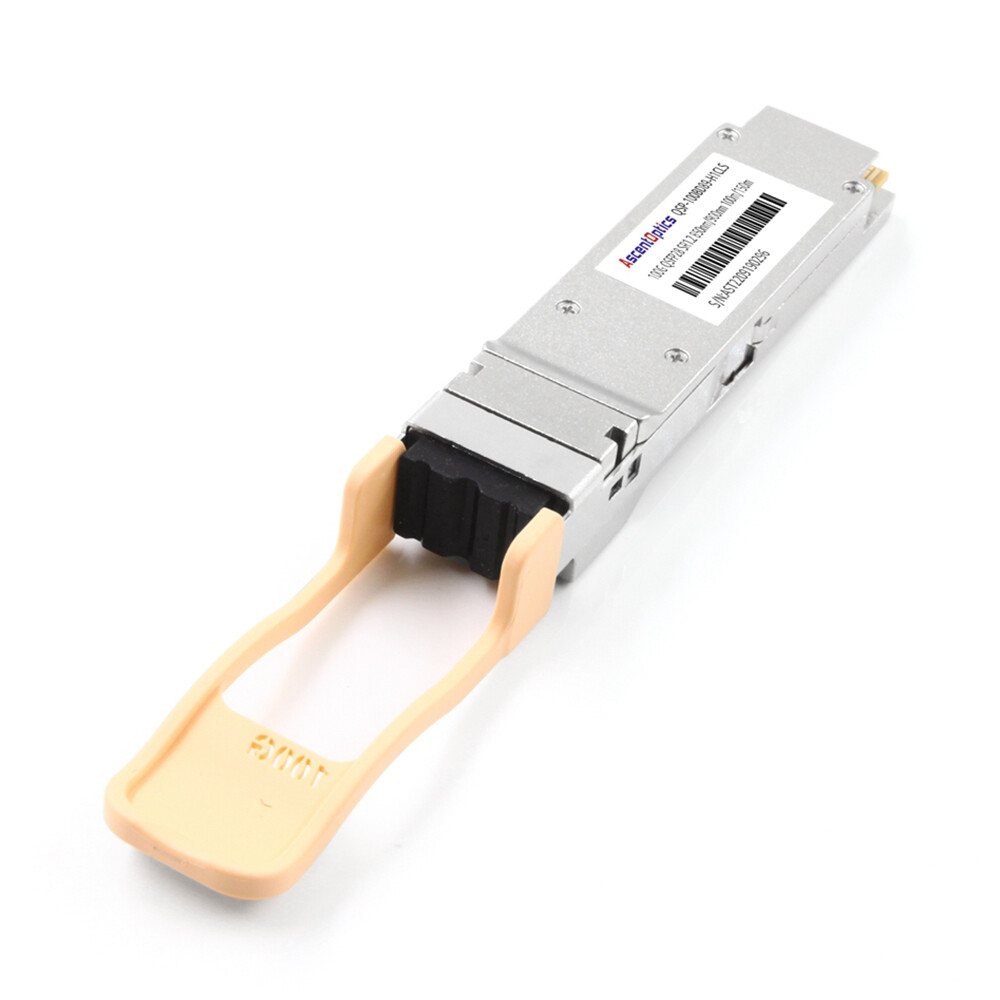
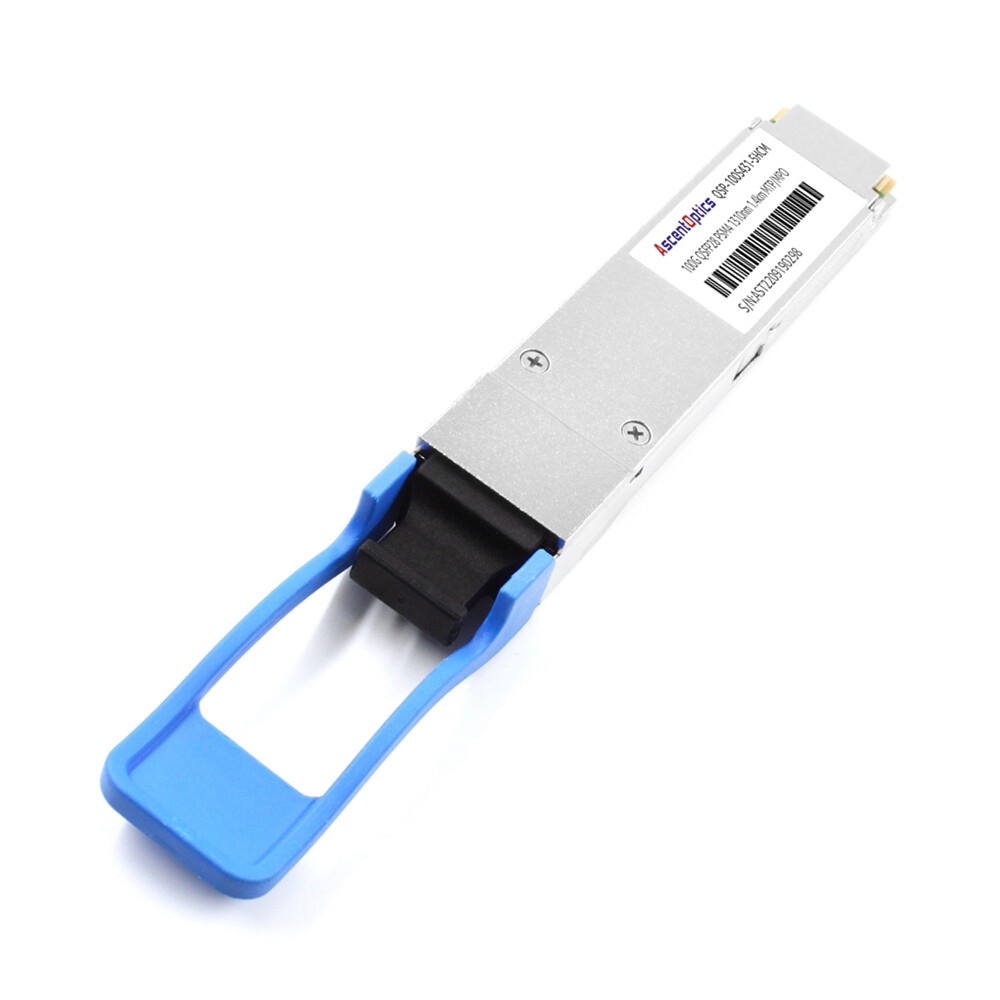
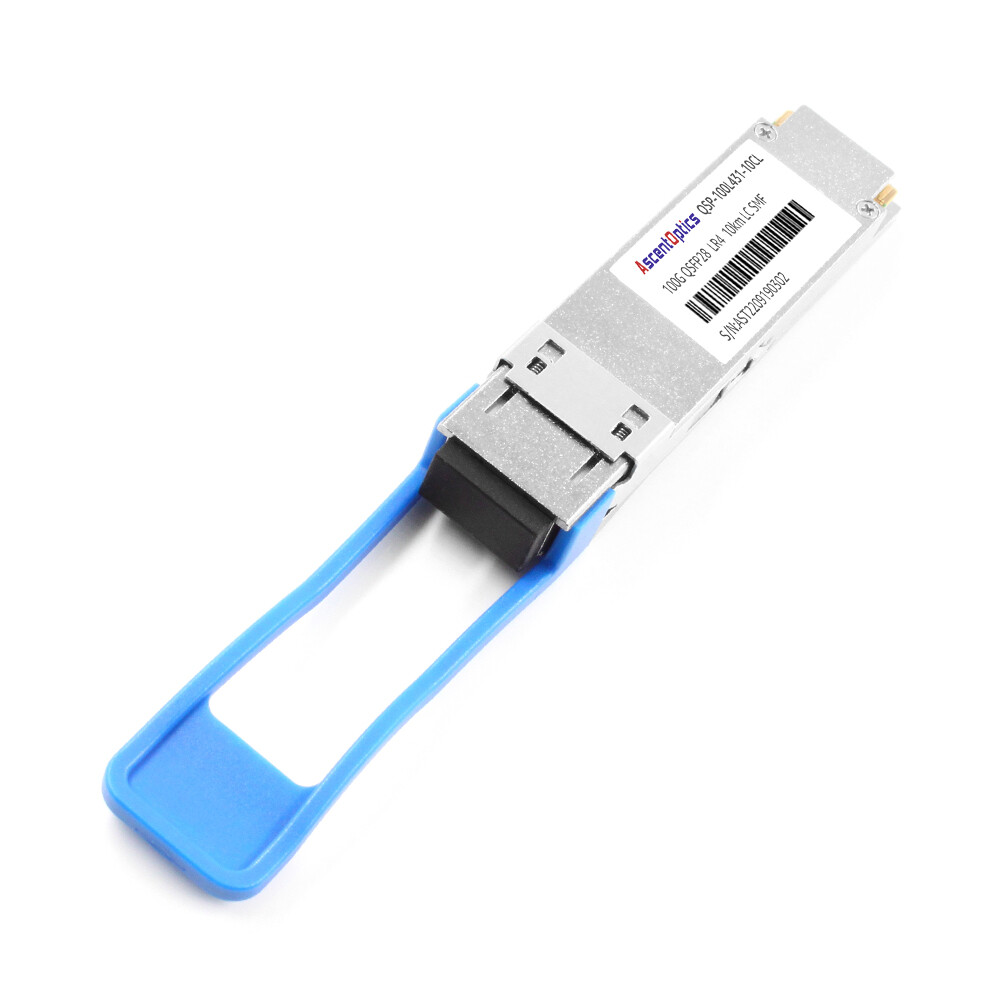
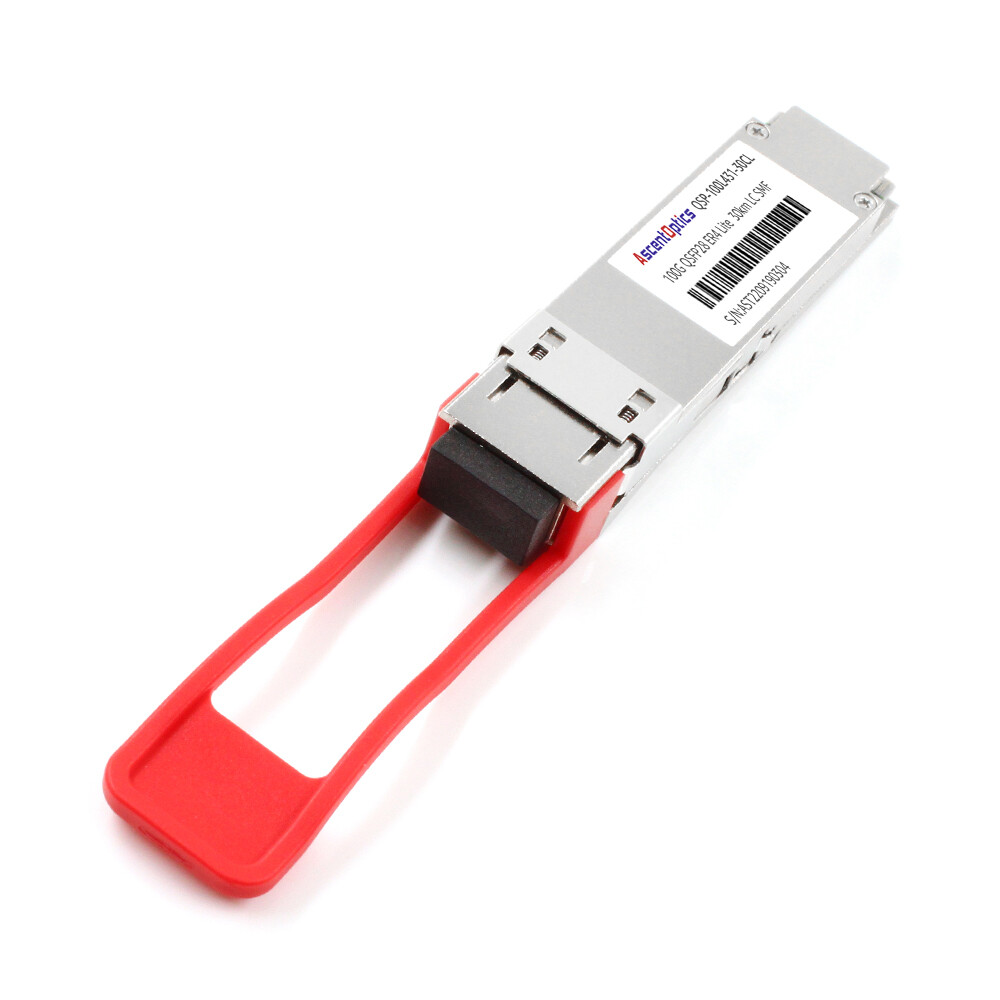
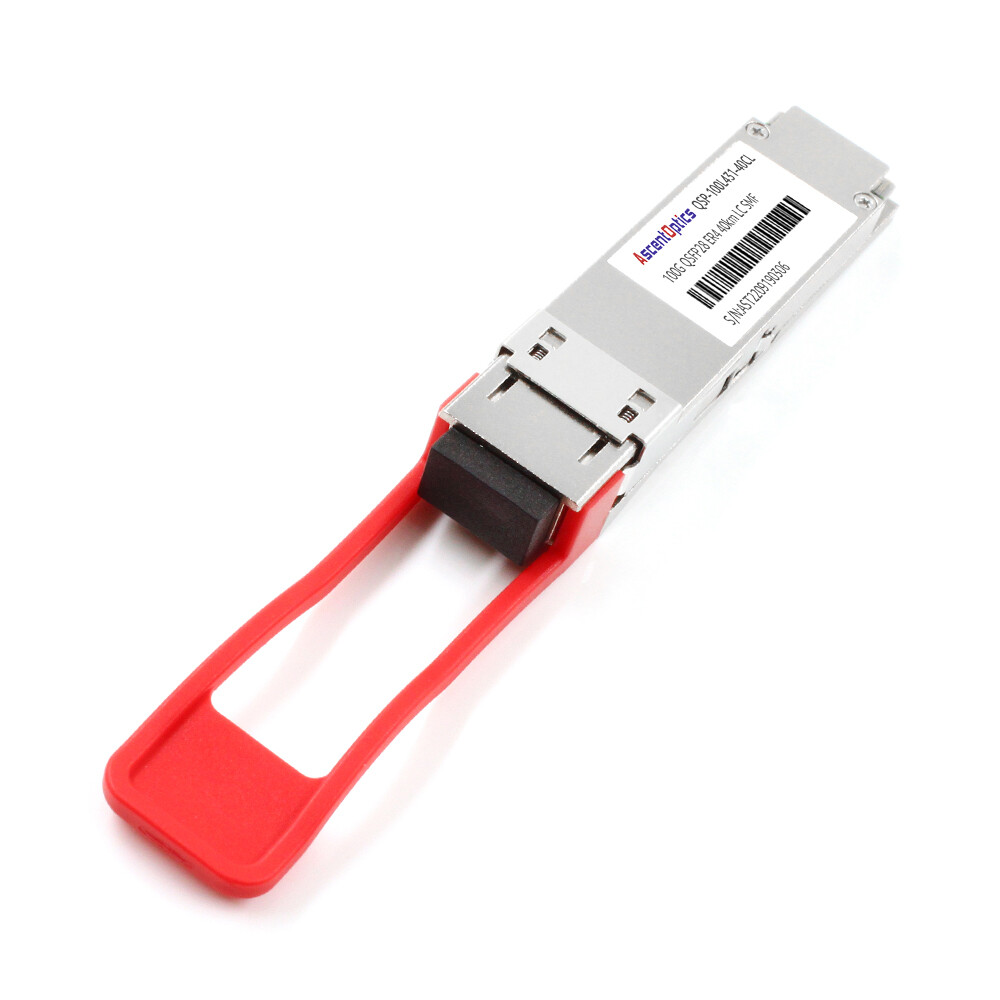
As modern networks continue evolving toward higher bandwidth, lower latency, and greater scalability, optical transceiver technologies have become critical components in data center and enterprise infrastructure. Among the most widely deployed form factors are QSFP and QSFP28. Although they look physically similar, their performance capabilities, transmission architectures, and application scenarios differ significantly.
Understanding the differences between QSFP and QSFP28 is essential for network architects, data center operators, and IT teams planning upgrades from 40G to 100G environments. This article explains how QSFP and QSFP28 work, compares their technical characteristics, and explores their roles in modern Ethernet, InfiniBand, cloud computing, and AI networking deployments.
Explore Ascent Optics’ QSFP28 module portfolio →
What Is QSFP?
QSFP (Quad Small Form-factor Pluggable) is a compact, hot-swappable transceiver form factor designed for high-density networking applications. Traditional QSFP modules are primarily used for 40G Ethernet and InfiniBand connectivity.
A standard QSFP module typically operates using:
- •4 transmission lanes
- •10Gbps per lane
- •Aggregate bandwidth up to 40Gbps
Because of their compact size and relatively low power consumption, QSFP modules became widely adopted in early cloud data centers, enterprise aggregation layers, and HPC environments.
Common QSFP Standards
| Standard |
Speed
|
Fiber Type |
Typical Distance
|
| QSFP+ SR4 |
40G
|
MMF |
100m (OM3)
|
| QSFP+ LR4 |
40G
|
SMF |
10km
|
| QSFP+ ER4 |
40G
|
SMF |
40km
|
| QSFP+ DAC |
40G
|
Copper |
1–7m
|
QSFP remains relevant in legacy 40G infrastructures where upgrading to 100G is not yet necessary.
What Is a QSFP28?
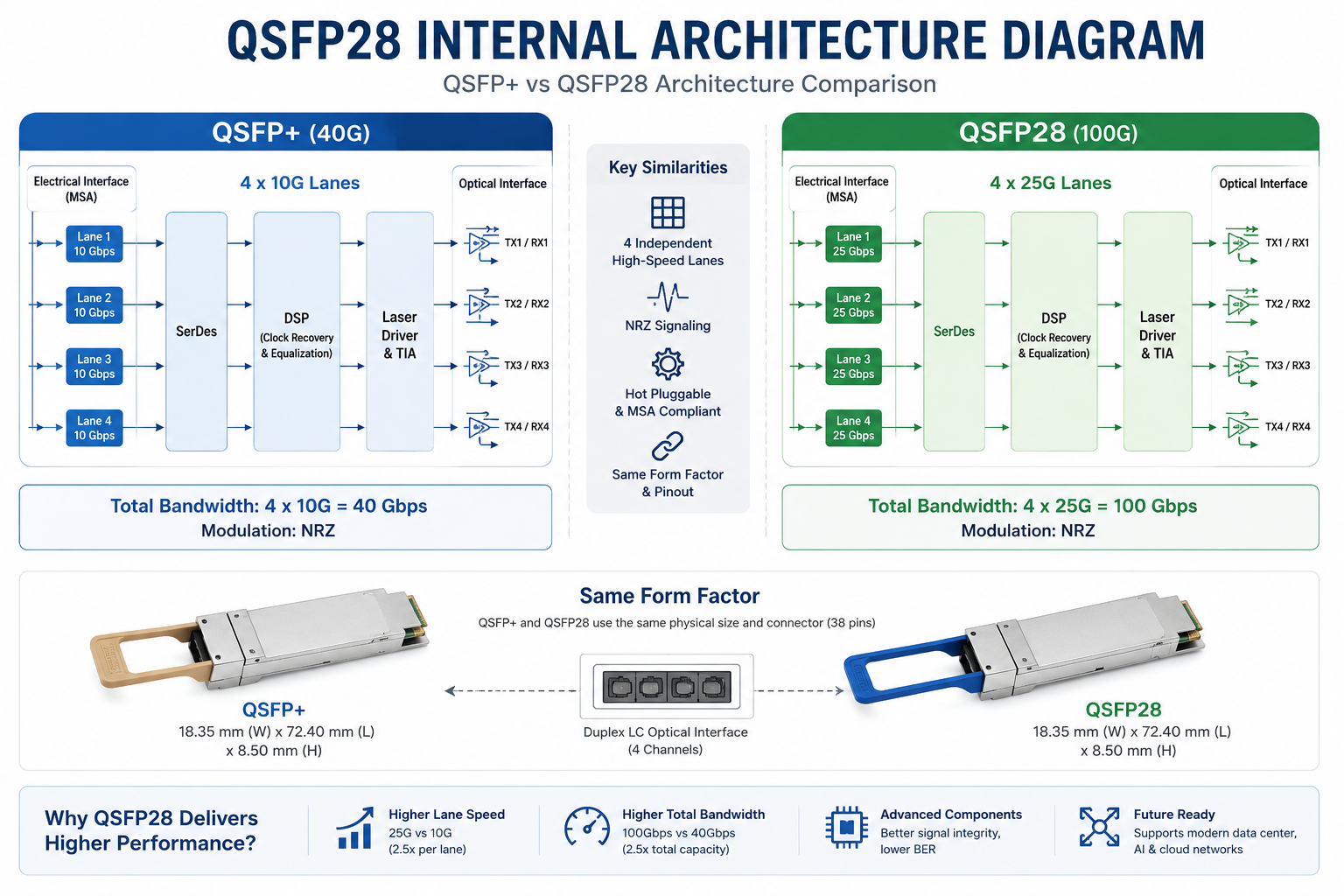
Criteria for Understanding the Form Factor of QSFP28
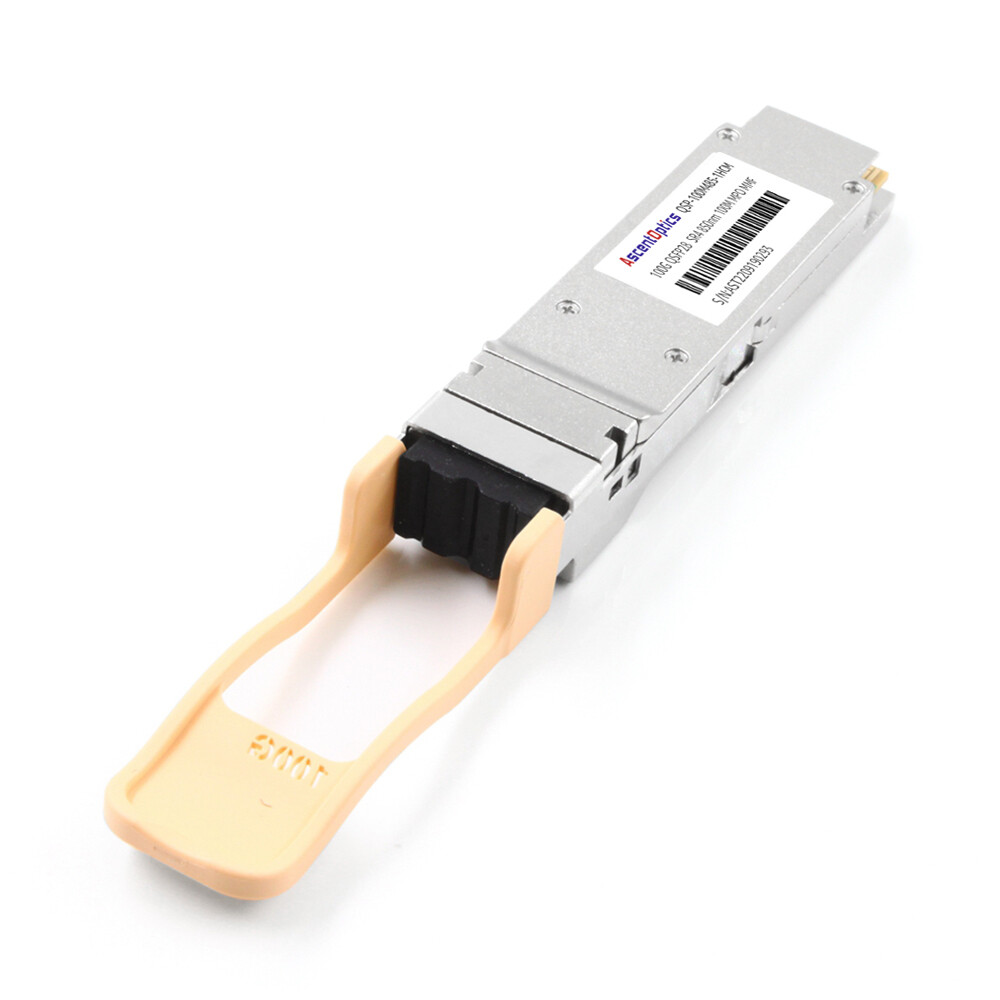
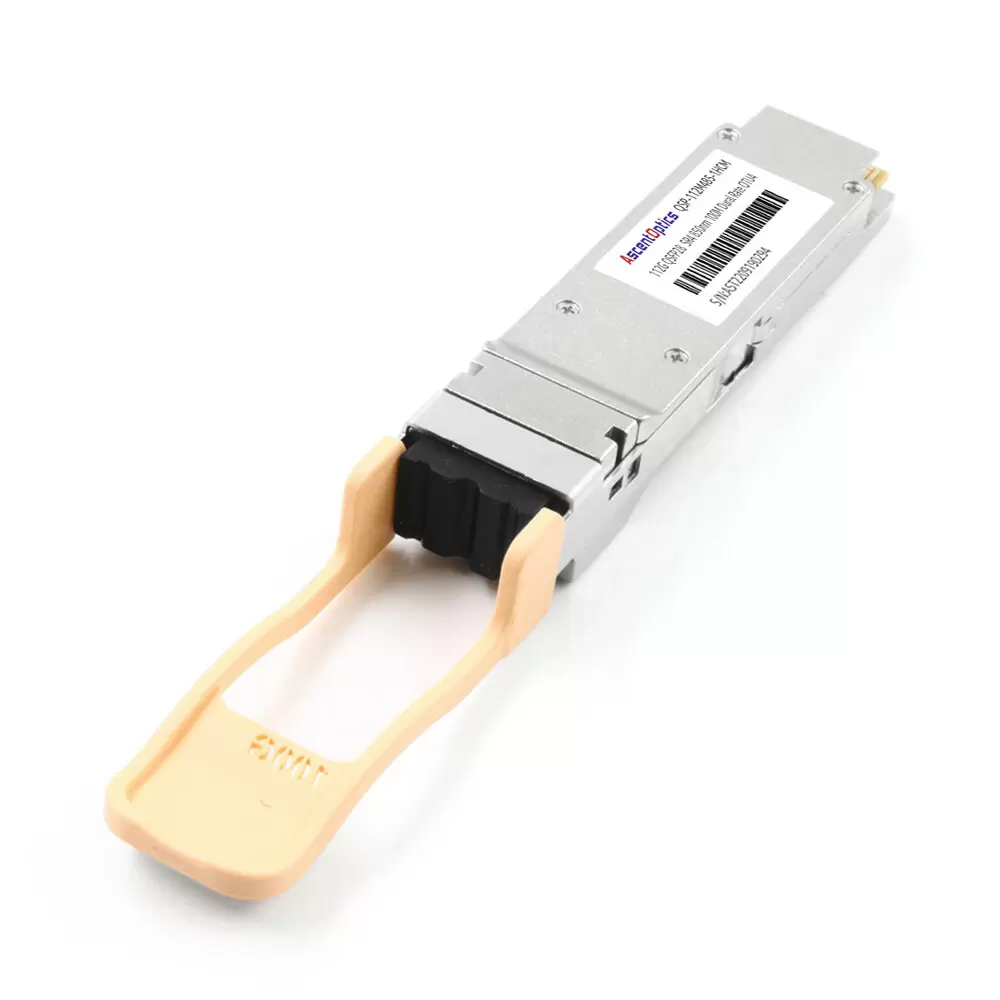
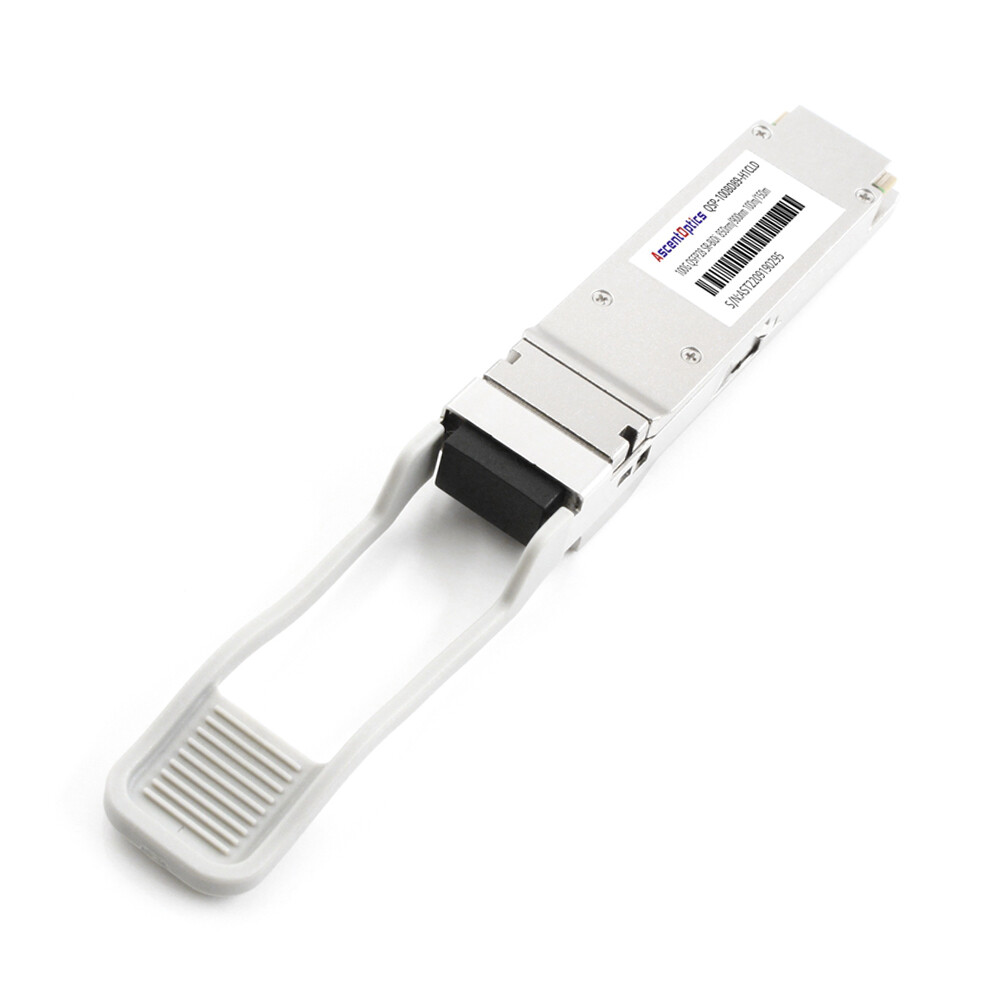
The latest achievement in optical networking, the QSFP28 (Quad Small Form-Factor Pluggable 28), received a major boost as it allows data transmission rates of up to 100 Gbps. Its small size enables it to be used in high-density situations in data centers and enterprise networks. Its external dimensions are roughly equal to 18.35 mm and 72.4 mm in width and length, respectively, making it possible to reduce the form factor of switches and routers as well as other network devices, making their use more space efficient.
The QSFP28 modems operate on different protocols and on different distances, including the 100GBASE-SR4 for connections covering short range and links with long reach connected by the LR4. They are designed in a way that allows the use of previous standards of QSFP, providing chances for expansion without catastrophic changes in the infrastructure (Commentator A, 2016). Furthermore, the fact that these components are hot-pluggable also enhances the smooth running and efficiency of the QSFP28. By employing four banks’ parallel optical lanes with a modulation speed of 25Gbps per lane, QSFP28 meets modern networking requirements satisfactorily.
Key Data Rate Capabilities of QSFP28
In summary, several key data rate capabilities supported by the QSFP28 enhance its usability for networking performance. These include the following requirements: 100 Gbps Transmission: This is achievable by combining four 25 Gbps lanes, making it easy to use 100 Gigabit Ethernet applications.
- •25 Gbps Per Lane: Each optical lane works at a 25 Gbps rate, making it scalable for the next generation of network needs.
- •Lower Data Rates: According to support for QSFP+ usage, backward compatibility is maintained with a 40 Gbps Ethernet wireless adapter, thereby ensuring the applicability of the wireless adapter in a mixed network environment.
This functionality makes network migrations very easy while at the same time providing very high bandwidth and being cost-effective.
Compatibility Issues with QSFP28
One of the broad objectives that QSFP28 modules will accomplish is to interconnect advanced segments of the network. However, there are several compatibility issues that must be dealt with. First of all, compatibility is no issue for full-turn trunk QSFP28 layouts. However, full compatibility when interfacing with older cabling can become an issue. The use of differing data rates and power requirements in the older QSFP+ or QSFP modules may cause the modules to fail.
Furthermore, if QSFP28 modules are deployed into a legacy device, intermediate appliances might need to be replaced with new configurations. The hardware being used should be checked for port compatibility in terms of their specifications, and appropriate firmware should be combined with the hardware to prevent any integration failures. These possible issues can be effectively alleviated with good design and network infrastructure compliance.
For detailed switch platform guidance, see our QSFP28 compatible switches guide.
Why QSFP28 Became Popular
QSFP28 quickly became the dominant 100G interface because it offers:
- •Higher bandwidth density
- •Lower cost per bit
- •Better power efficiency
- •Seamless migration from 40G architectures
- •Compatibility with modern cloud and AI networks
Today, QSFP28 is widely deployed in:
- •Hyperscale data centers
- •Spine-leaf architectures
- •Data center interconnects (DCI)
- •High-performance computing (HPC)
- •AI clusters
Need help selecting QSFP28 modules? Contact our engineers →
What is the Key Difference Between QSFP and QSFP28?
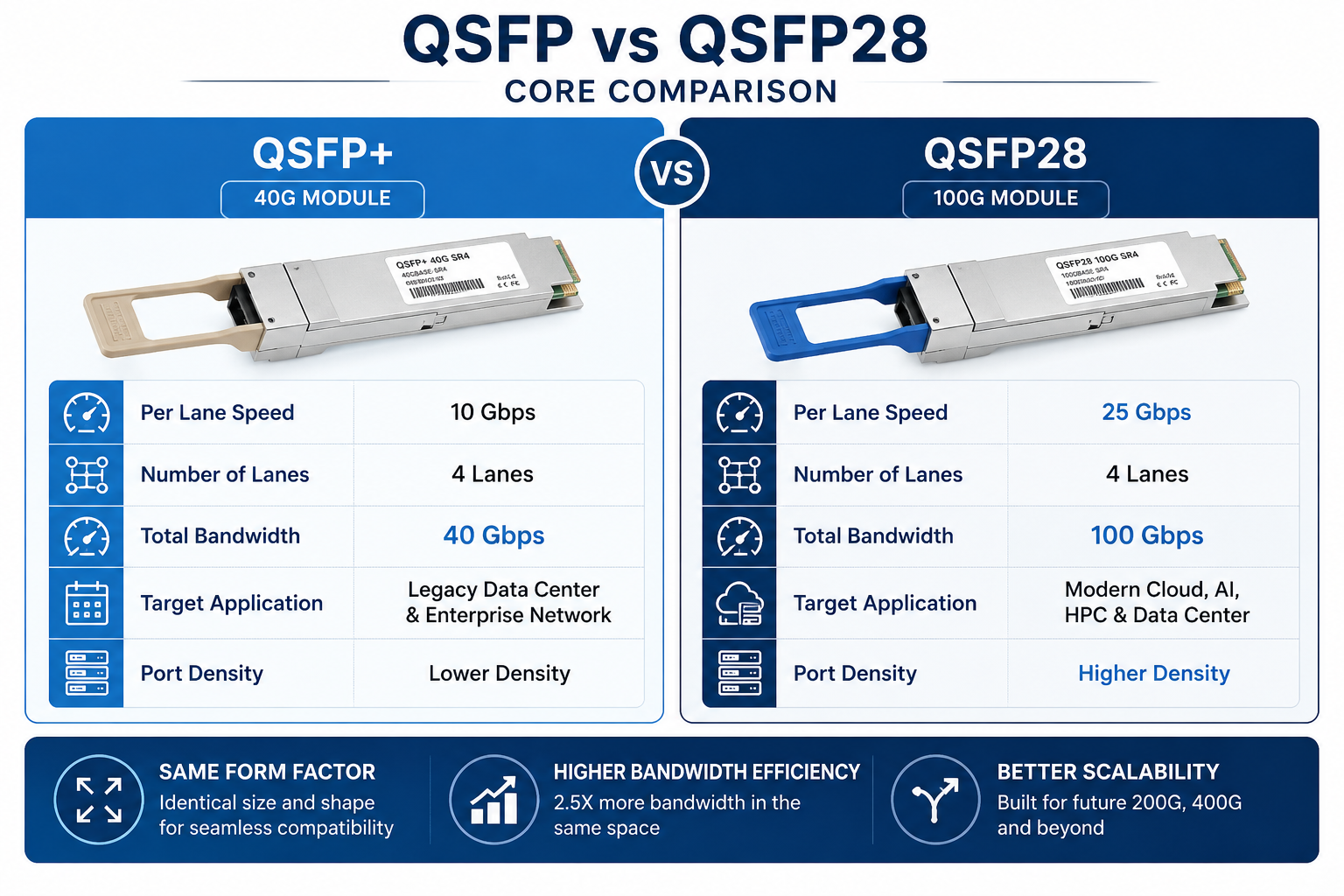
Although QSFP and QSFP28 share nearly identical physical dimensions, they are designed for different generations of networking infrastructure. Their differences go far beyond transmission speed and also include internal architecture, signal processing capability, power efficiency, cabling requirements, and long-term scalability.
For enterprises planning data center upgrades, cloud deployments, or AI networking infrastructure, understanding the differences between QSFP and QSFP28 is essential for making the right investment and architecture decisions.
1. Data Rate and Bandwidth Capacity
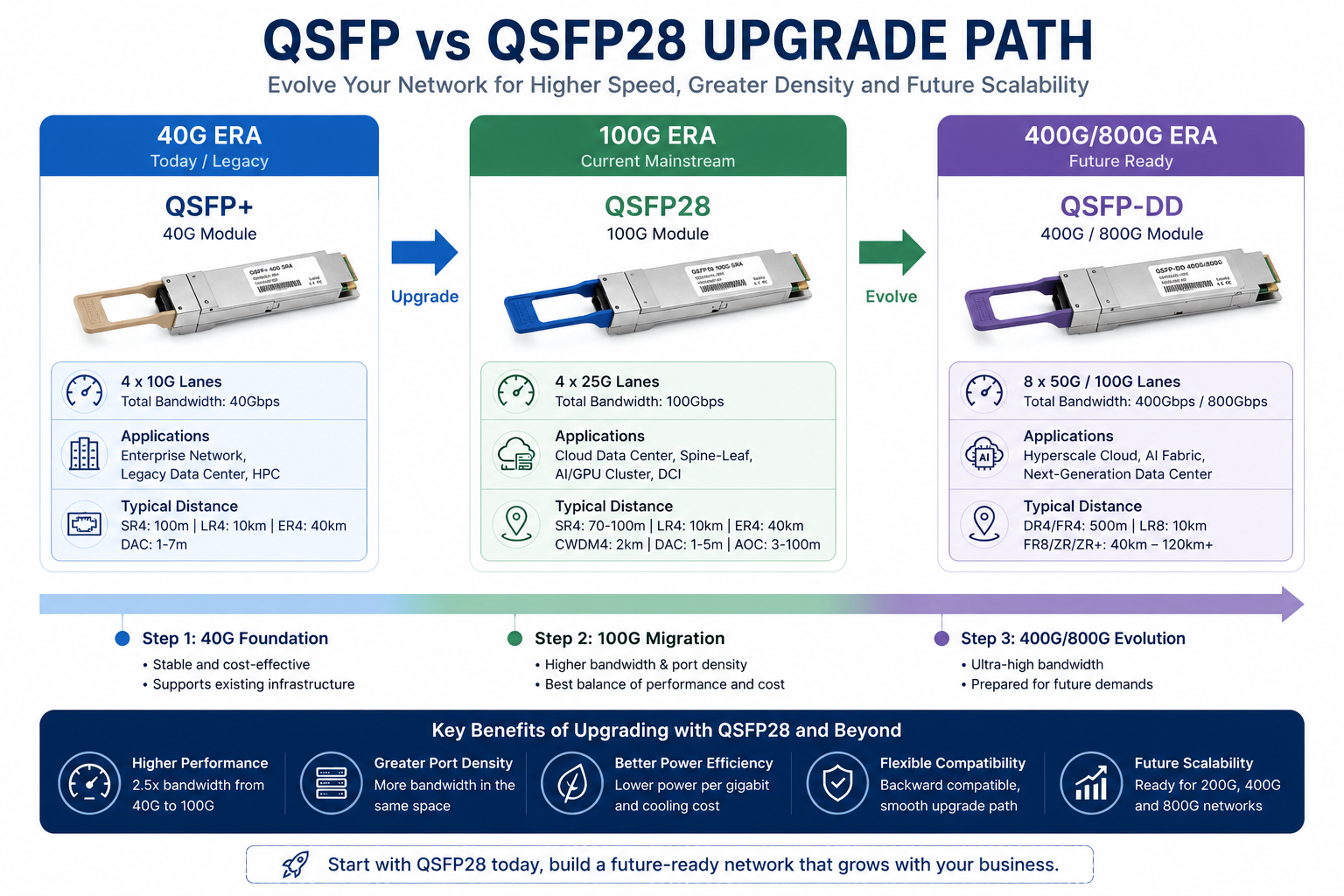
The most significant difference between QSFP and QSFP28 is transmission speed. Traditional QSFP+ modules are primarily designed for 40G networking and typically operate with:
- •4 independent lanes
- •10Gbps per lane
- •Total bandwidth of 40Gbps
QSFP28, by comparison, is specifically designed for 100G networking and operates with:
- •4 high-speed lanes
- •25Gbps per lane
- •Total bandwidth of 100Gbps
This means QSFP28 delivers 2.5× the bandwidth of QSFP+ while using the same switch port footprint and physical space.
In modern data centers, where east-west traffic continues to grow rapidly, 100G networking has become the mainstream standard, while traditional 40G infrastructure is gradually being phased out from core network environments.
2. Internal Architecture and Signal Processing
Although QSFP and QSFP28 use the same form factor, their internal electrical and optical architectures are significantly different.
QSFP+ is mainly based on:
- •10G NRZ signaling
- •Lower-frequency electrical design
- •Relatively simple DSP architecture
QSFP28, however, uses:
- •25G NRZ high-speed signaling
- •More advanced SerDes technology
- •Improved signal integrity design
- •Enhanced clock recovery and error control mechanisms
Because the lane speed increases to 25G, QSFP28 places higher demands on PCB trace design,EMI control,FEC (Forward Error Correction) and Optical component quality.
These architectural improvements allow QSFP28 to maintain stable high-speed transmission with lower bit error rates, making it more suitable for modern high-density switching environments.
3. Power Consumption and Thermal Efficiency
In early high-speed networks, higher bandwidth often resulted in significantly increased power consumption. QSFP28, however, was designed with much better power efficiency per transmitted bit.
Although the total power consumption of a QSFP28 module may be slightly higher than that of a QSFP+ module, the bandwidth increase is substantially greater.
For example: A 100G QSFP28 module does not consume 2.5× the power of a 40G QSFP+ module. Yet it delivers 2.5× the bandwidth. As a result, QSFP28 provides:
- •Lower power consumption per Gbps
- •Reduced cooling requirements
- •Better rack-level power efficiency
This is one of the major reasons hyperscale cloud providers and AI data centers widely adopt QSFP28 technology.
Read our complete QSFP28 Power consumption Guide→
4. Different Deployment Scenarios
QSFP+ was mainly developed for the 40G networking era, while QSFP28 has become the standard interface for modern 100G infrastructure.
Common QSFP+ Applications
- •Legacy enterprise core networks
- •Older data center environments
- •40G spine-leaf architectures
- •Small and mid-sized HPC clusters
For organizations still operating 40G infrastructure, QSFP+ may remain a cost-effective option.
Common QSFP28 Applications
- •Next-generation cloud data centers
- •AI and GPU clusters
- •Hyperscale networking environments
- •High-performance computing (HPC)
- •Data center interconnects (DCI)
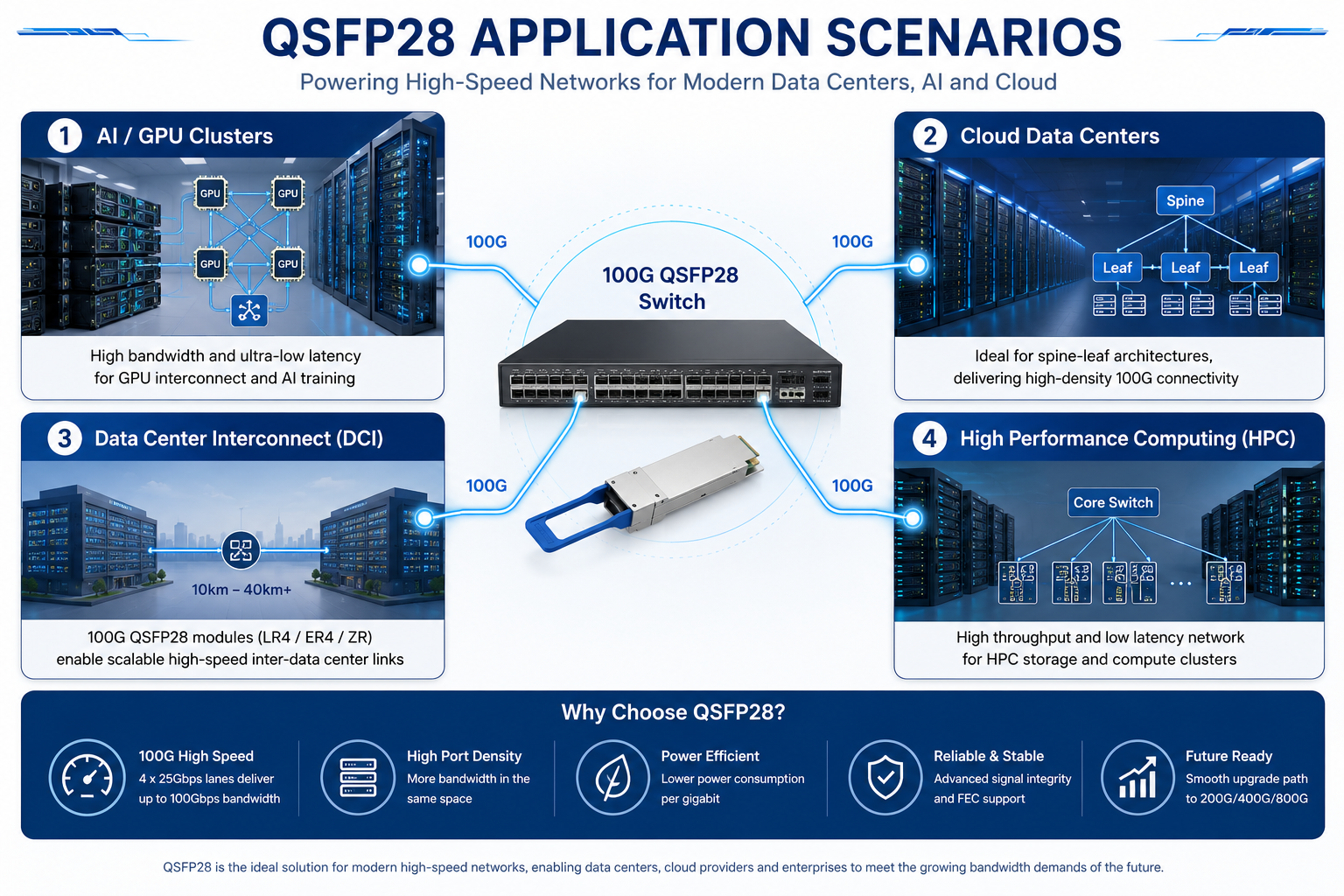
In AI training environments and large-scale distributed computing systems, networks must handle massive east-west GPU communication traffic. QSFP28 provides the higher throughput and lower network bottlenecks required for these workloads.
5. Cabling and Fiber Infrastructure
Both QSFP and QSFP28 support multiple transmission media types, but QSFP28 generally requires higher-quality cabling and signal integrity.
Common QSFP28 module types include:
| Module Type |
Fiber Type
|
Distance
|
| SR4 |
Multimode Fiber
|
70–100m
|
| CWDM4 |
Single-Mode Fiber
|
2km
|
| LR4 |
Single-Mode Fiber
|
10km
|
| ER4 |
Single-Mode Fiber
|
40km
|
QSFP28 also widely supports:
- •DAC (Direct Attach Copper)
- •AOC (Active Optical Cable)
- •Breakout connectivity
In modern high-density data centers, QSFP28 enables more flexible cabling architectures and higher port utilization efficiency.
6. Compatibility and Upgrade Flexibility
One major advantage of QSFP28 is that it maintains the same physical form factor as QSFP+, allowing partial backward compatibility in many environments.
For example:
- •QSFP28 ports can often support QSFP+ modules
- •Many switches support 100G to 4×25G breakout configurations
- •Organizations can gradually migrate from 40G to 100G
This helps enterprises:
- •Protect existing investments
- •Upgrade networks in phases
- •Reduce migration costs
However, compatibility is not always guaranteed. Before deployment, organizations should still verify:
- •ASIC capabilities
- •Firmware versions
- •Vendor compatibility lists
Overall, QSFP28 has become the mainstream solution for modern high-speed networking environments, offering significant advantages in bandwidth density, efficiency, scalability, and long-term infrastructure planning compared to traditional QSFP+.
What is the Role of SFP in the Context of QSFP28?
Engaging the SFP28 vs QSFP28 Discussion
Regarding role allocation, SFP28 and QSFP28 modules are used for different functions depending on the network’s tailoring. SFP28 operates on a single lane, not exceeding data rates of 25Gbps. It has been deployed for connections of low-bandwidth applications such as servers and storage systems in high-traffic environments.
In contrast, QSFP28 has four lanes, allowing it to operate at a bandwidth ceiling of 100Gbps. This makes it highly rated as the best for switching high- and core networks with aggregation. The data rates per port are high, so scalability is highly flexible in a data center or cloud connection.
When a user decides on SFP28 over QSFP28, several factors should be considered: the data rate needed, the density of ports required, and the room for future expansion. SFP28 will be ideal for deployment in scenarios where cost is the primary target compared to lower bandwidth. However, QSFP28 will be ideal in high-capacity networking technologies with high and flexible throughput requirements.
The Advancements the 25G SFP28 Brings Along the Network Configurations
The SFP28 25G, in a way, is the game changer in the landscape of network configurations as it serves more than one purpose and helps deploy networks across various scenarios. It especially helps monitor 25 Gbps servers and Top Of Rack (ToR) Switch interconnections, helping to use optimized bandwidth cheaply. Based on the application, the 25G SFP26 module helps in technological advancement. It provides extended reach options, such as up to 100 m over OM4 multimode fiber or even higher than single-mode fibers.
Moreover, this configuration is fully compatible with the existing 10G SFP+ systems, eliminating the worry about plugging in the older systems and allowing room for future high-bandwidth requirements. Given the low power contour and complexity of the design, the 25G SFP28 is the perfect solution in high-density data center cases. The module coverage’s importance in reducing network bottlenecks and high-speed interconnects prominently highlights the 25G SFP26’s role in the post-networking generations’ transition.
What are the Uses of QSFP28 Transceivers?
Implementing 100G Standards within Ethernet Networks
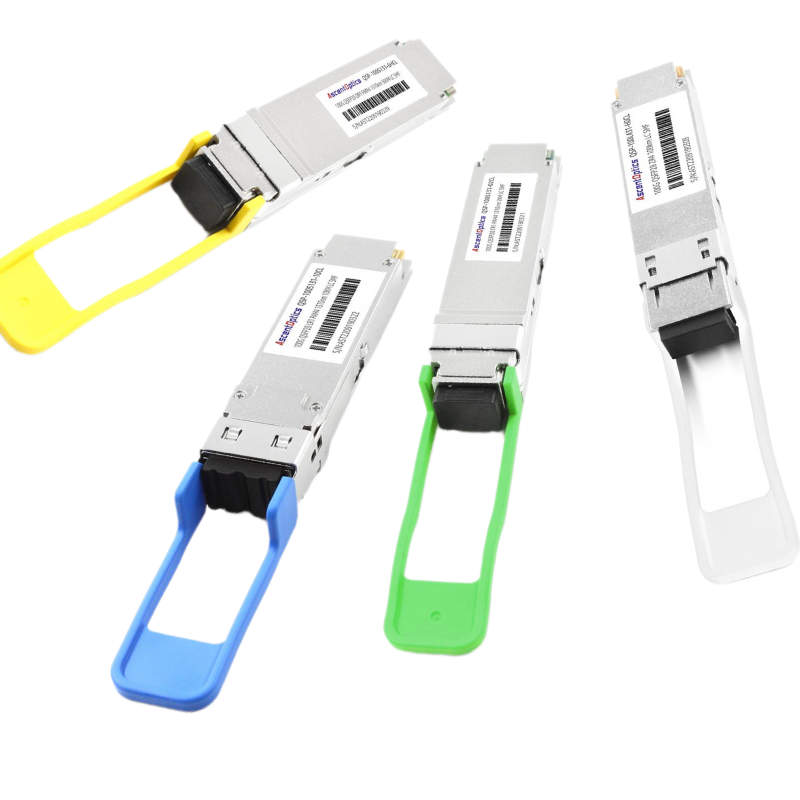
The 100G QSFP28 optical transceivers are mainly seen in high-speed ethernet networks in response to the rising need for high-speed data transfers. They are used in numerous cases, such as data center interconnect links, high-performance computing cluster systems, and companies’ core networks. Such transceivers open up a whole new range of possibilities by increasing the network’s available bandwidth. Enabling faster data handover and communication, they incorporate a small form factor. They are compatible with switches, routers, and various other networking devices making them suitable for enhancing the networking capabilities of enormous cloud structures or departments of numerous organizations.
Infiniband Use Cases for QSFP28
I can confidently state that Qsfp28 connectors are likely to be the crown’s jewels regarding the expansion of high-speed connections on InfiniBand networks. Their applications are quite broad in the areas that require low latency and very high throughput, such as high-performance computing HPC or machine learning applications. These transceivers allow for effective data transfers between servers, storage, and compute nodes, thus helping complex computing clusters operate. Due to their high-performance level, they are ideal for expanding the InfiniBand applications in research and industry activities, especially using QSFP28 connectors.
What is the difference between QSFP-DD and QSFP28?
Evaluating the Mtach Technology for QSFP-DD Transceivers
The QSFP-DD (Quad Small Form-factor Pluggable Double Density) transceiver technology was formulated to increase data rates and scalability over QSFP28. In this regard, the QSFP-DD enhances the structural bandwidth of its transmission by supporting up to 400Gbps through 8 lanes. Its application seems ideal for today’s dense data centers, cloud, and AI workloads. This transceiver’s backward compatibility with the older QSFP28 facilitates its incorporation into legacies and paves an avenue for escalating future networks. QSFP-DD is designed to support dense port configuration of networking devices and equipment, hence reducing the space and power needed per bit of data transferred, which is important for economic purposes, particularly for large-scale infrastructures.
Implication for Modern Applications and Scenarios
As noted earlier, a single QSFP28 connection can support a data bandwidth rate of up to 100 Gbps. Such speeds are made possible through a design incorporating four lanes at 25 Gbps each. Of course, this limit is acceptable only for moderate bandwidth requirements, such as networking on an enterprise level and even to an extent, smaller data centers. A more important development structurally is that QSFP-DD expands that capability to as much as 400 Gbps albeit through eight lanes operating at 50 Gbps each. This technological advancement makes QSFP-DD suitable for even the most demanding of environments, including hyperscale data centers and data processing applications. The bulk of this capability is, however, useful when one wants to consider the requirements that modern networks have and the traffic thereof because QSFP-DD encompasses high data rates and, within those high data rates, high scalability.
Ensuring Longevity with QSFP-DD and QSFP28
These options, QSFP-DD and QSFP28, provide alternative options for ensuring a strong network backbone based on the deployment needs. The case of QSFP28 is best suited for organizations with more of a deployment-centered approach in building their networks where 100GB PS links are adequate to provide sufficient connectivity more cost-effectively. For those enterprises that, in the long run, plan to add on to their capacity, investing in QSFP-DD is a much better bet as it delivers on throughput levels of 400gbps and so will be able to support developing high-definition use cases with many applications and lots of data. The reverse compatibility to the QSFP28 provides further parameters for decision, easing the shift when the need arises. This way, when properly utilized, the case of adopting QSFP-DD facilitates companies’ remaining competitive within their market while justifying the costs of deploying new technologies.
Conclusion
QSFP and QSFP28 may share a similar physical appearance, but they target different generations of networking infrastructure.
QSFP+ was designed for the 40G era and remains useful in legacy deployments, while QSFP28 has become the standard for modern 100G networking due to its superior bandwidth density, efficiency, and scalability.
As cloud computing, AI workloads, and hyperscale networking continue expanding, QSFP28 provides the performance foundation needed for high-speed data center architectures. Meanwhile, emerging technologies such as QSFP-DD are extending these capabilities even further into the 400G and 800G era.
Understanding the differences between QSFP, QSFP28, SFP28, and QSFP-DD enables organizations to make smarter infrastructure decisions and build networks ready for future growth.
Request a quote for QSFP28 transceivers tailored to your network →
Frequently Asked Questions (FAQs)
Q: What are the two modules’ main differences between the QSFP and the QSFP28?
A: The main differences between the QSFP and the QSFP28 modules lie in the portability and compatibility. A kQSFP has a maximum data rate of 40G, while a kQSFP28 has a maximum data rate of 100. The kQSFP28 enhances the kQSFP as it has a higher capacity. Furthermore, the kQSFP28 has 4x25G lanes while the kQSFP has 4x10G lanes. The greater the k QSFP to kQSFP28 enhancement stage, the greater the number of these optical modules’ lanes per port.
Q: Can a QSFP28 transceivers operate in a 40G QSFP port?
A: Generally, kQSFP28 modules generally work back on kQSFP ports because they are backward compatible. This means if I have a kQSFP28 optical transceiver, I can still use it in a kQSFP port, but it will have a maximum output of 40G instead of 100G. However, it is recommended to consult the specific module and switch parameters and specifications to determine compatibility.
Q: What is the difference between QSFP and standard SFP modules?
A: Essentially, the SFP concept forms the basis of a QSFP module. A QSFP interconnect device can replace four “normal” SFP interconnects in a single port. This change results in higher port density and lower power consumption per gigabit. However, the form factors and electrical interfaces are different; thus, QSFP cannot be inserted into an SFP port.
Q: What are the main characteristics of optical transceivers of type QSFP28?
A: Optical transceivers of type QSFP28 have several interesting features, such as: 1. They can support 100G data rates and protocols 2. Ports implemented with 40g QSFP are utilized as well 3. Its design is high-density, including four channels in one module. 4. Power consumption is significantly lowered compared to using four independent SFP28 transceivers. 5. There is support for a wide range of transmission media, including short-reach transmission, long-reach transmission, and active optical cables.
Q: What is the difference between QSFP, QSFP28 and SFP28 transceivers?
A: The SFP28 transceiver is a single-channel module categorized for 25G data rates, whereas QSFP and QSFP28 categorize 4-channel modules. SFP28 is simply a progression of the SFP+ standard, whereas QSFP28 is a progression of the QSFP standard. The three main differences consist of: 1. Form factor: SFP28 – smaller than QSFP/QSFP28 2. Channel count: SFP28 has a single channel, and QSFP/QSFP28 has four channels. 3. Total bandwidth: SFP28 working bandwidth reaches 25G, QSFP working bandwidth reaches 40G, while QSFP28 working bandwidth reaches 100G.
Q: Do SFP ports accept the insertion of QSFP or QSFP28 modules?
A: No, there are significant variances in the form factors and electrical interfaces, so inserting SFP ports directly into QSFP and QSFP28 modules is impossible. Yet some other switches include QSFP ports, which allow SFP optics to be installed through attachments of special adapters or breakout cables. However, not all switches with QSFP ports can work with SFP optics, so it is best to research your switch specifications before purchasing them.
Q: Why is there a need to change QSFP28 to 4 separate SFP28 transceivers?
A: Utilizing a single QSFP28 module in place of 4 SFP28 transceivers has several benefits, including 1. Higher port density, therefore saving space in network devices 2. Overall power consumption is less than 3. Easier communication with cables since fewer attachments are required 4. An economical approach in dealing with many high bandwidths needs 5—ability to work at 40G or 100G based on network requirements.
Q: When did the transition from QSFP to QSFP28 occur, and how did it affect modern networking growth?
A: The change from QSFP to QSFP28 improved modern networking in many ways. For instance, 1—deployment of up to 100G band with the same appearance 2. Provided means to upgrade the network specifications slowly as the earlier installment remains supported 3, accelerating the demand for improved performance for data center and enterprise networks 4. Advanced the development of 400G networks using the QSFP-DD, the following generation of the QSFP28 5. Developed an affordable means to provide a high-speed and high-density network.
Reference Sources
- Integrated Silicon Photonics Transmitter in 400GBASE-DR4 QSFP-DD Transceiver
- Authors: Xingyu Zhang et al.
- Publication Date: 2021-06-01
- Key Findings: This paper presents the design and characterization of a 4-channel silicon photonics transmitter for 400Gbps DR4 data-center applications. The QSFP-DD transceiver module demonstrated reliable performance in real-time operation across a temperature range of 0 to 70 °C. The study emphasizes the importance of silicon photonics in enhancing the data transmission capabilities of QSFP modules.
- Methodology: The authors conducted design and performance evaluations of the silicon photonics transmitter, focusing on its integration into the QSFP-DD form factor and its operational reliability under varying conditions(Zhang et al., 2021, pp. 1–3).
- A record energy-efficient QSFP ELS for co-packaged optics demonstrates the advancements in optical module technology.
- Authors: K. Nagai et al.
- Publication Date: 2023
- Key Findings: This study demonstrates an uncooled pigtailed-QSFP ELS (External Laser Source) employing an 8-channel CWDM (Coarse Wavelength Division Multiplexing) TOSA (Transmitter Optical Sub-Assembly) for co-packaged optics. The ELS achieves a high power conversion efficiency of 14.3% at a housing temperature of 55 ºC, showcasing advancements in energy efficiency for QSFP modules.
- Methodology: The authors performed experimental evaluations to assess the energy efficiency and operational performance of the QSFP ELS under practical conditions(Nagai et al., 2023).
- 1800 km 16QAM transmission with a 400G QSFP-DD coherent pluggable
- Authors: W. Sande et al.
- Publication Date: 2023
- Key Findings: This paper reports on real-time long-haul transmission using a 400G digital subcarrier-multiplexed QSFP-DD coherent pluggable in a live production network, achieving a record post-FEC (Forward Error Correction) error-free reach of 1800 km with 400G-16QAM. This demonstrates the capabilities of QSFP-DD technology in high-performance networking.
- Methodology: The authors conducted field tests to evaluate the transmission performance of the QSFP-DD module over long distances, analyzing the error rates and overall network performance(Sande et al., 2023).
Post Views: 5,029