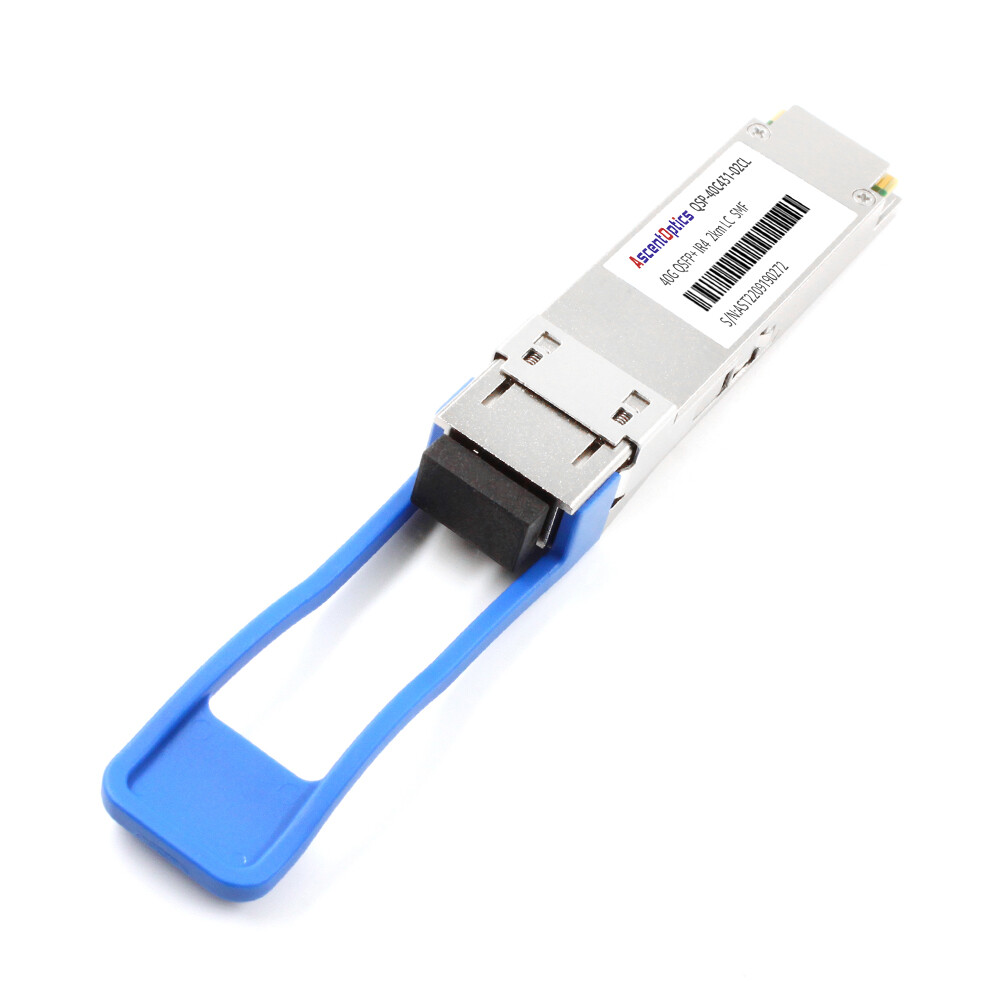
As modern data centers continue migrating from 40G to 100G networking, many network engineers and IT administrators face a common question: can a QSFP+ module work inside a QSFP28 port?
The short answer is yes. In many cases, QSFP28 ports are backward compatible with QSFP+ optics and cables. However, compatibility does not always mean full performance or feature support. Understanding the physical interface, electrical lane design, switch compatibility, and deployment limitations is essential before mixing 40G and 100G optics.
This article explains how QSFP+ and QSFP28 compatibility works, what limitations to expect, and how to deploy these transceivers correctly in modern Ethernet and AI networking environments.
What is QSFP+?
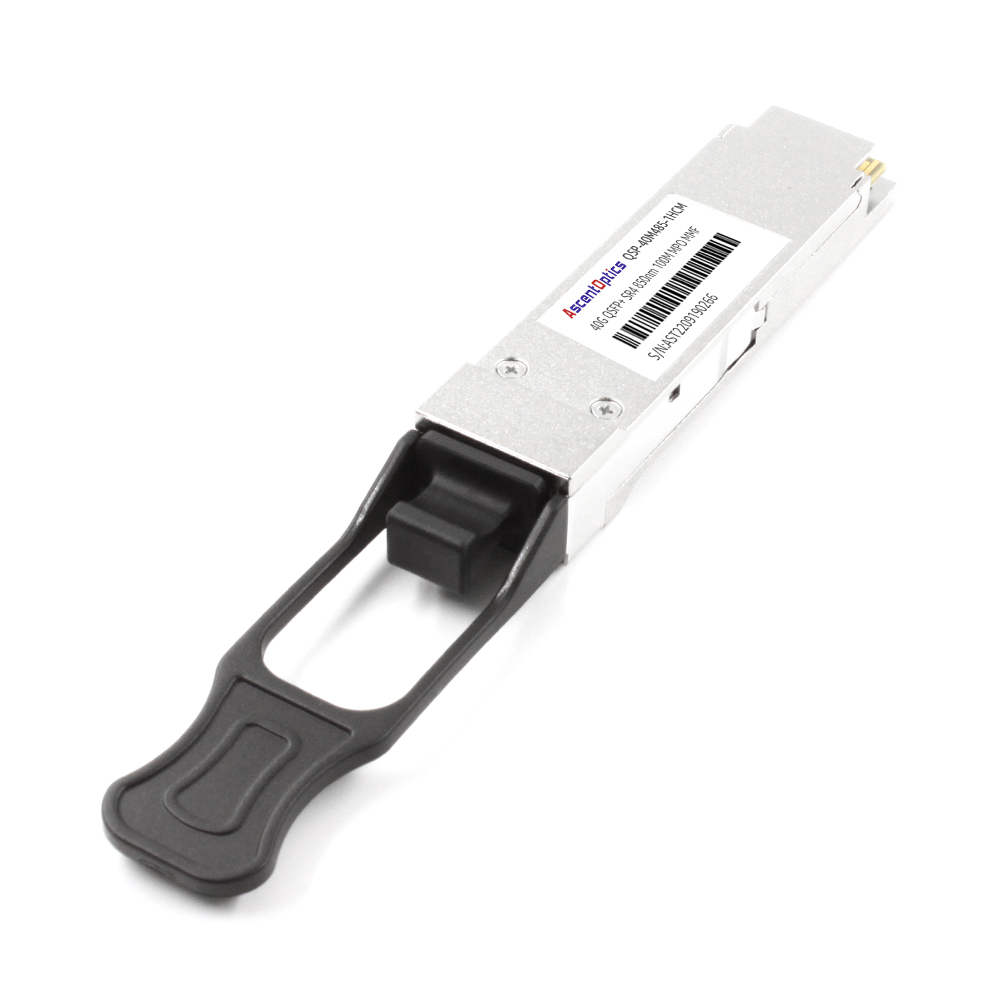
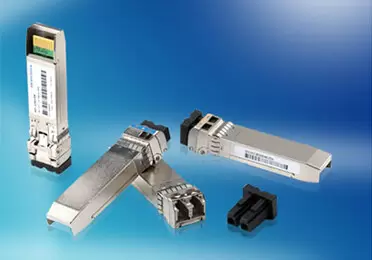
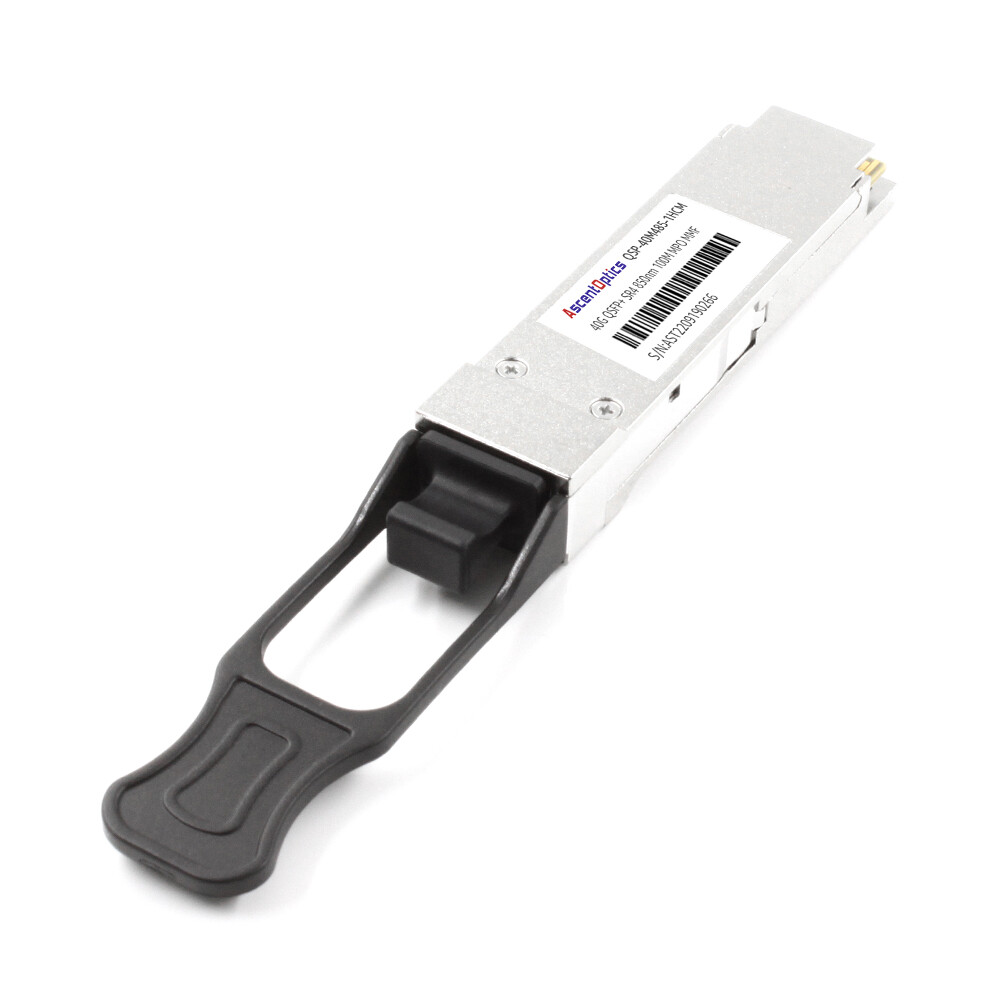
QSFP+ (Quad Small Form-factor Pluggable Plus) is a widely used 40G optical transceiver form factor designed for high-speed networking applications such as data centers, enterprise core networks, and HPC environments. A QSFP+ module typically uses four electrical lanes running at 10Gbps each, providing an aggregate bandwidth of 40Gbps.
Common QSFP+ optics include:
QSFP+ became one of the dominant interfaces during the transition from 10G to 40G Ethernet and remains widely deployed in legacy spine-leaf architectures.
What Is QSFP28?
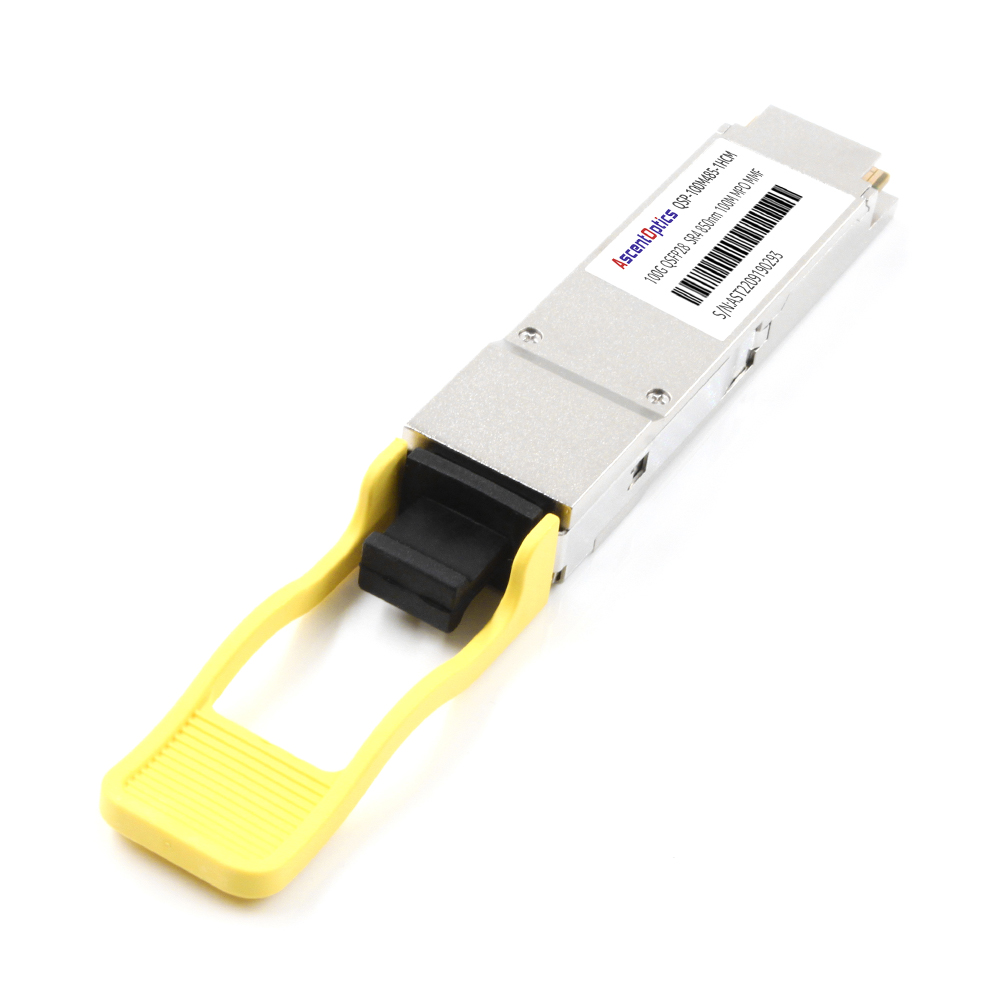
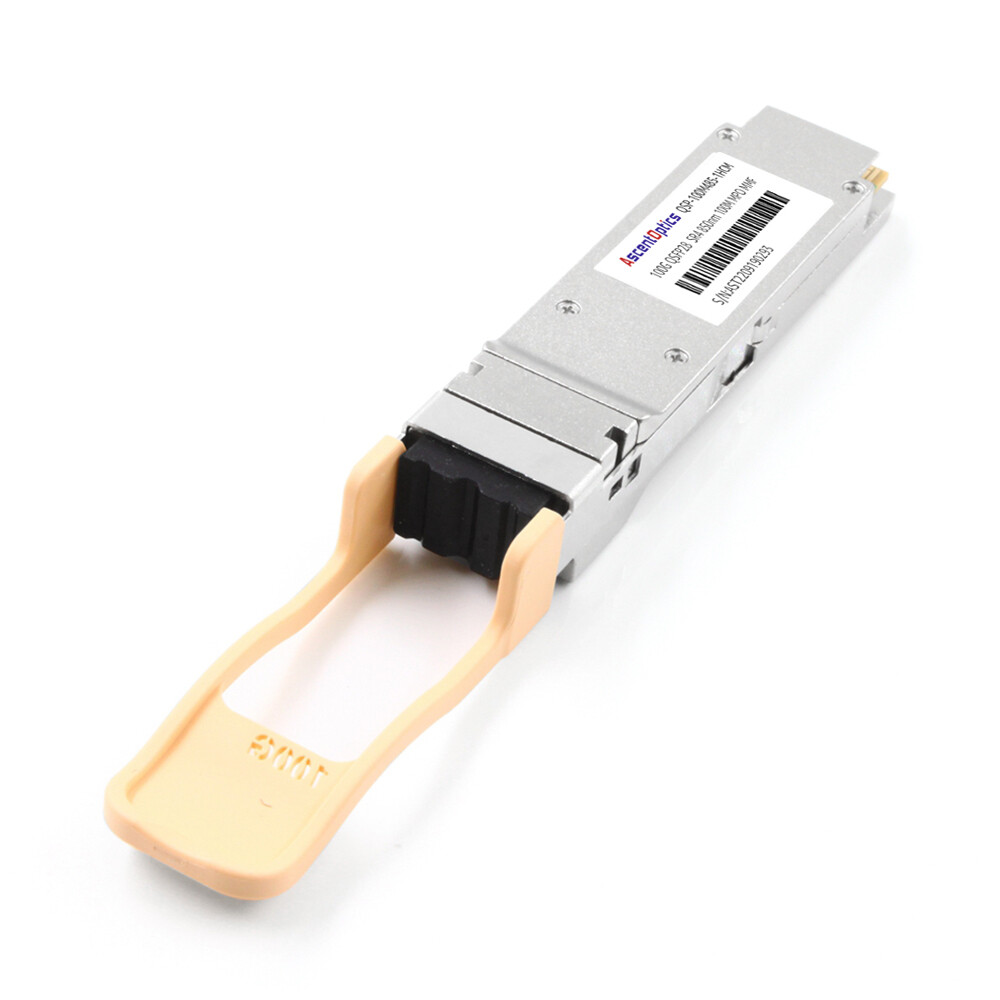
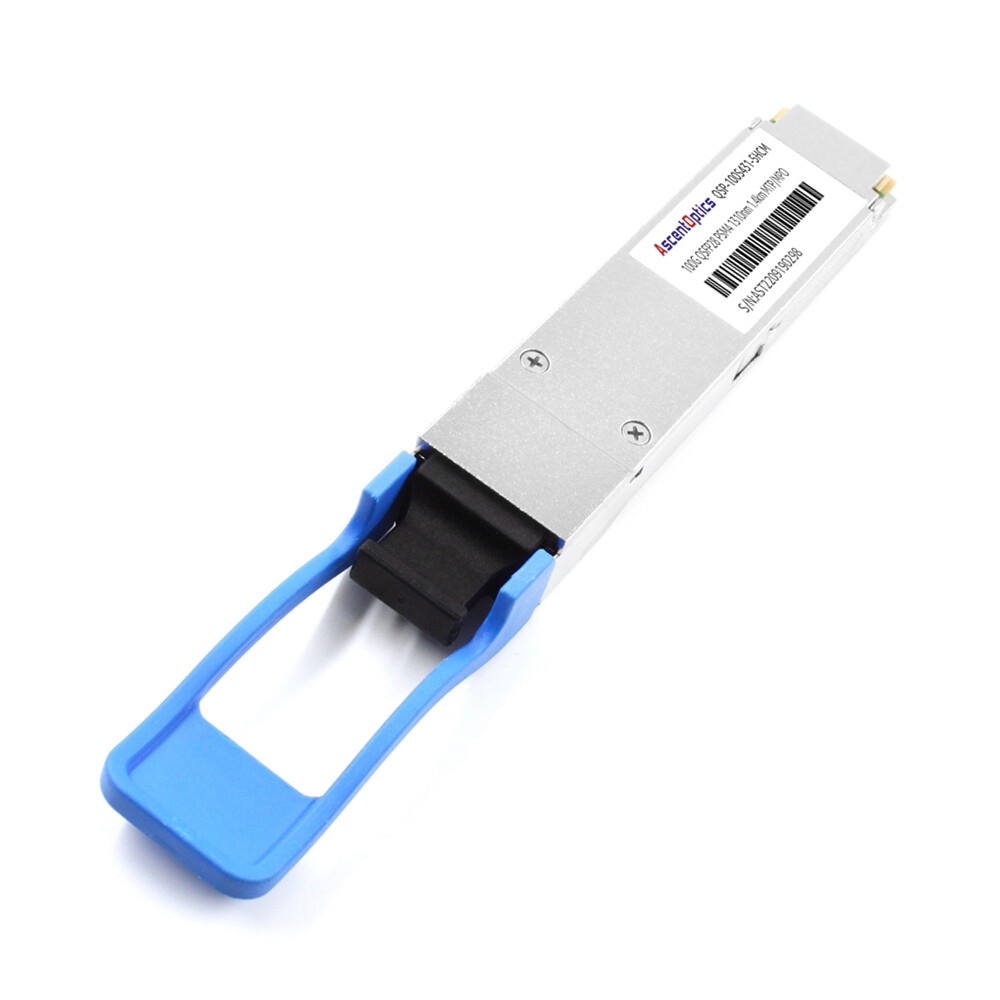
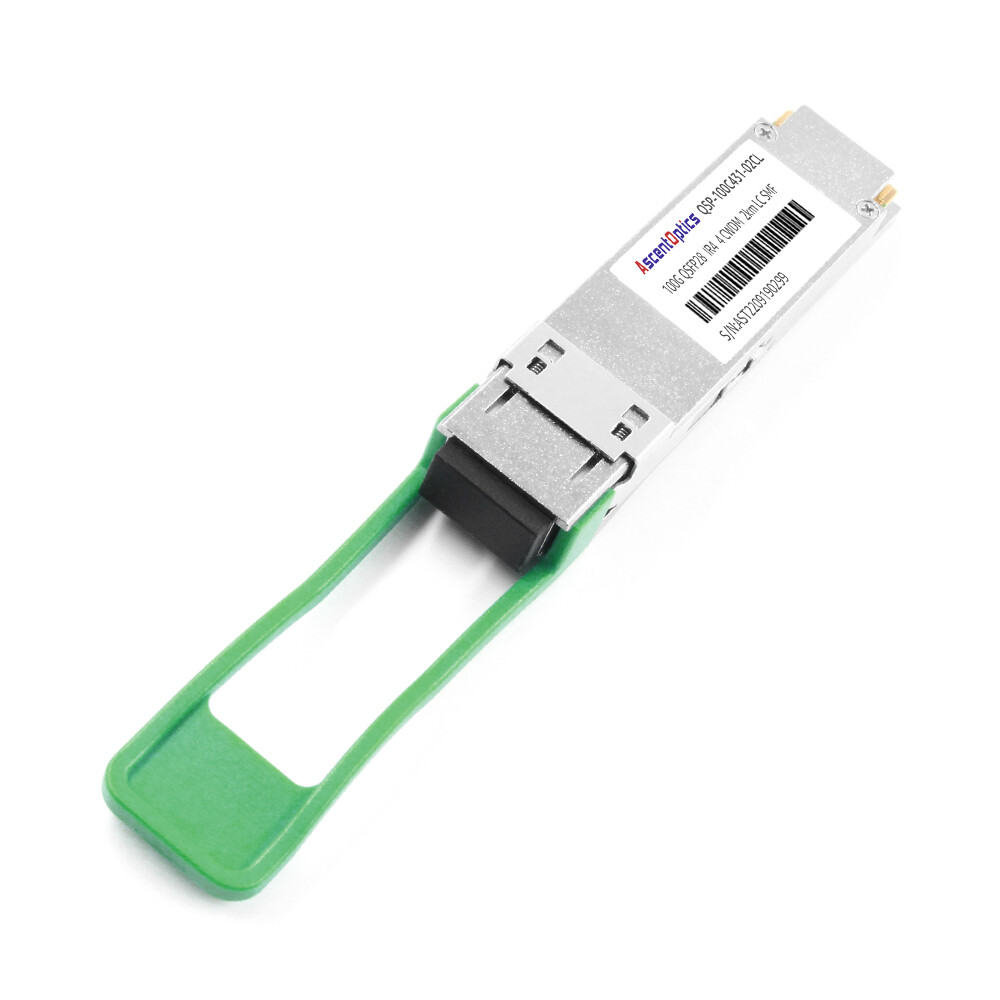
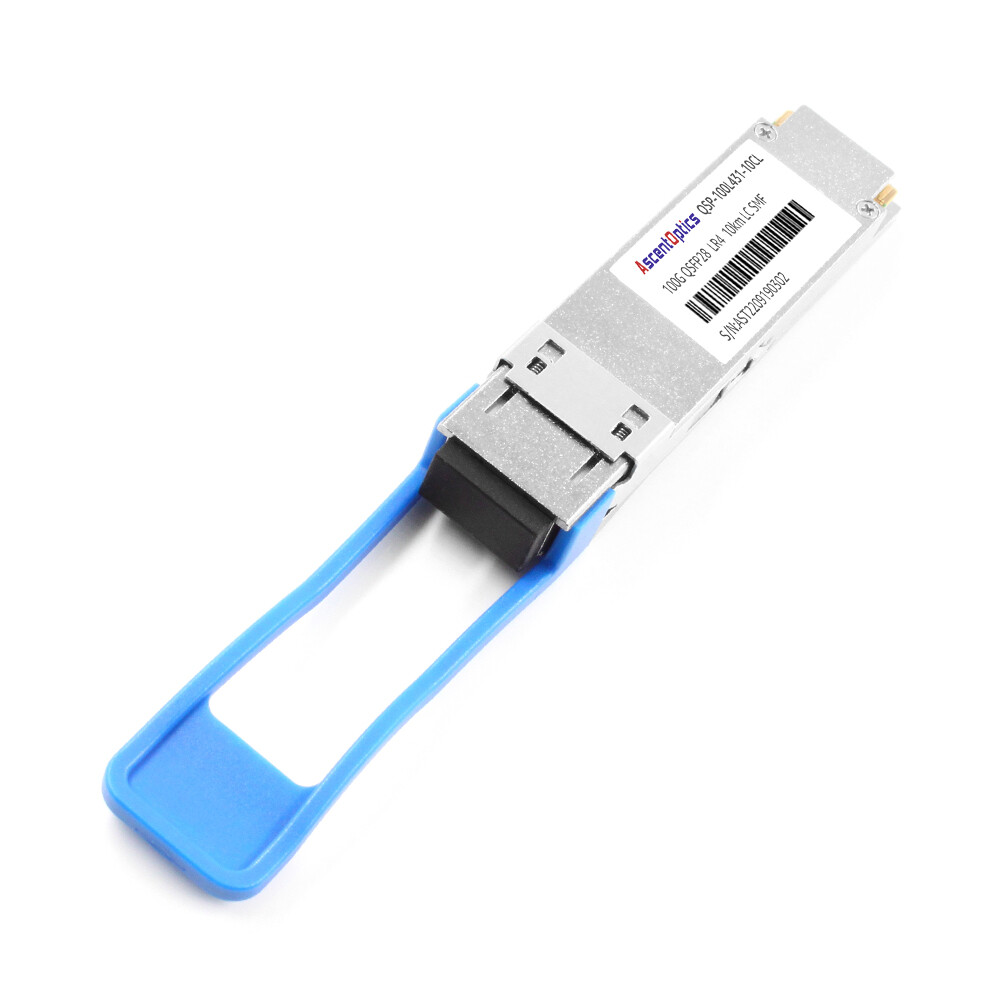
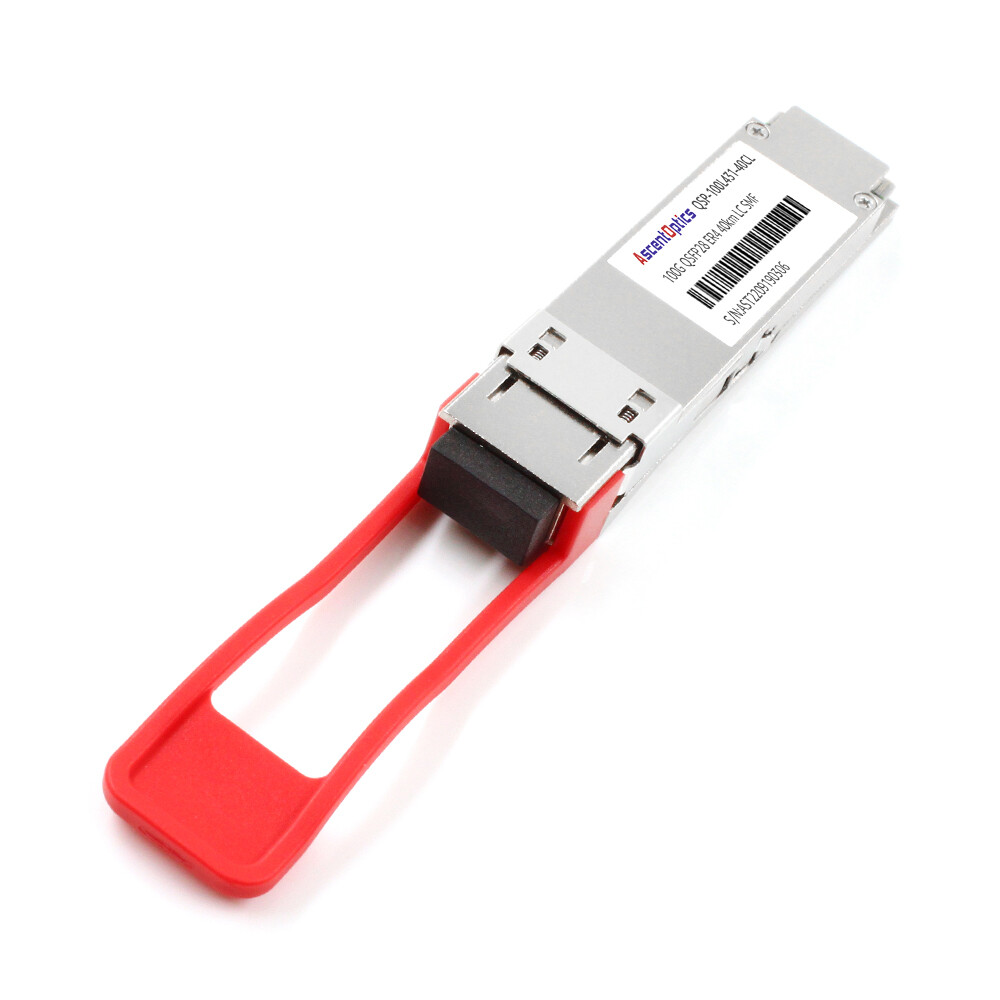
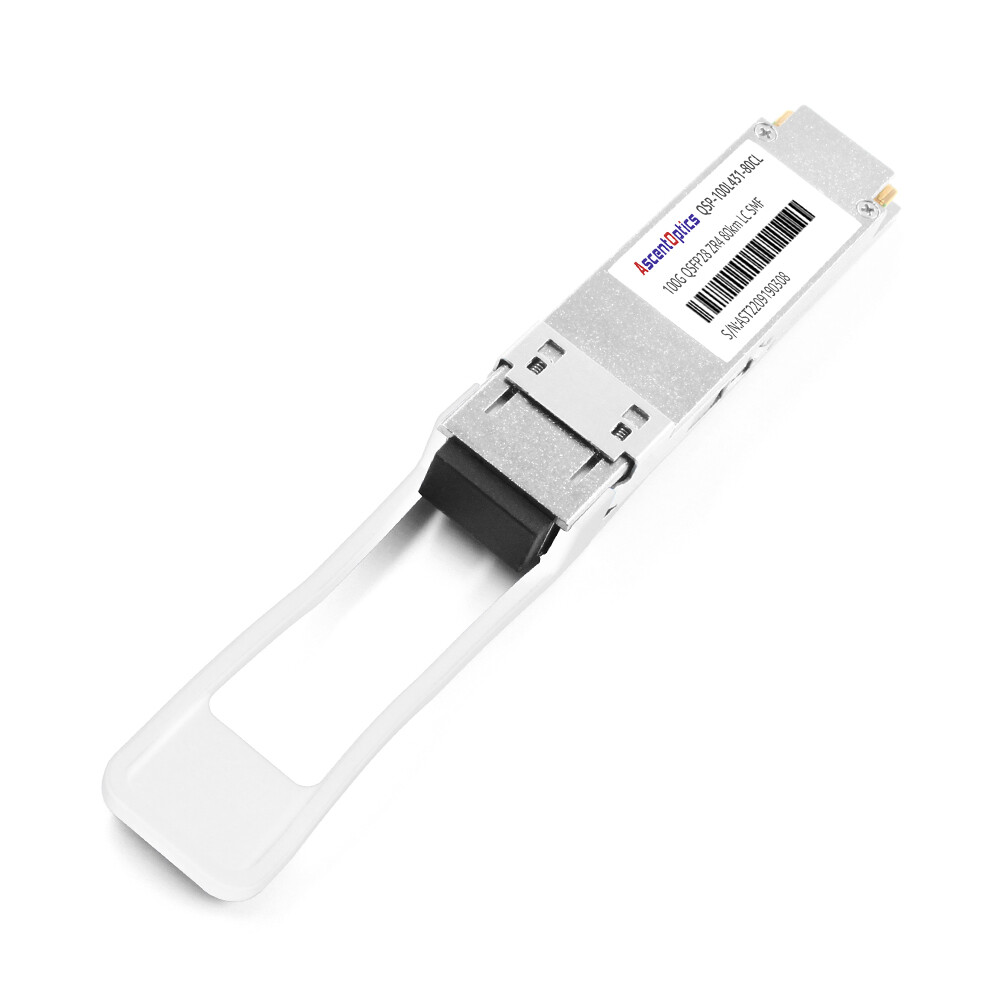
QSFP28 (Quad Small Form-factor Pluggable 28) is the next-generation evolution of the QSFP form factor designed for 100G networking.
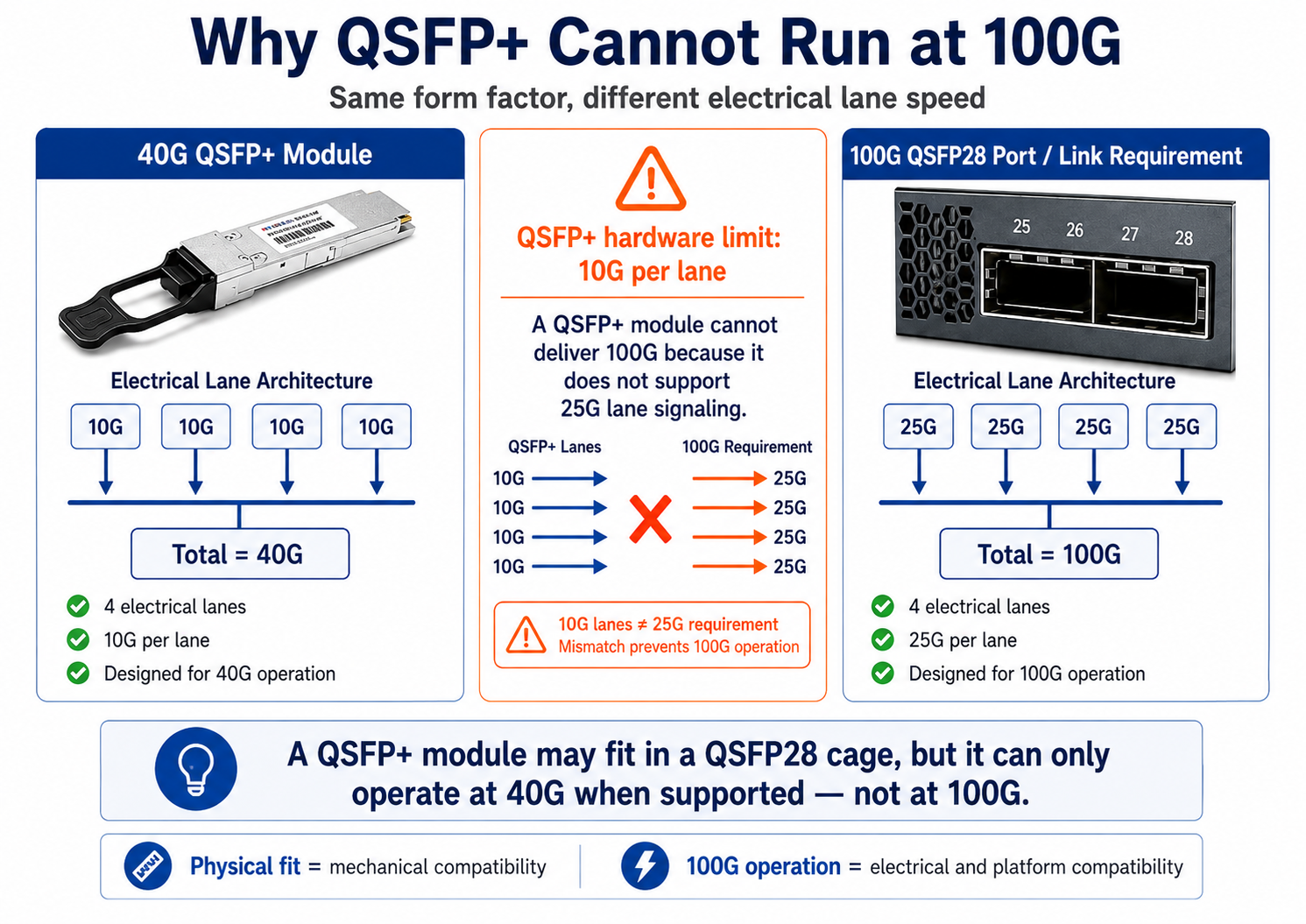
Although QSFP28 uses the same physical dimensions as QSFP+, it significantly increases bandwidth by operating four electrical lanes at 25Gbps each, enabling a total data rate of 100Gbps.
Compared with QSFP+, QSFP28 offers:
- •Higher bandwidth density
- •Improved switch port scalability
- •Lower power consumption per gigabit
- •Better support for cloud, AI, and hyperscale workloads
- •Compatibility with modern 100G Ethernet standards
Common QSFP28 module types include:
QSFP28 modules are now standard in 100G Ethernet switches, AI clusters, hyperscale data centers, and high-performance computing networks.
Need help selecting QSFP28 modules? Contact our engineers →
Comparison of QSFP and QSFP28 Modules
When compared to QSFP28 modules, QSFP modules exhibit only slight variation in their application in contemporary networks. In most cases, QSFP modules are capable of reaching a total data rate of 40 Gbps through the use of four 10 Gbps lanes. Due to this, QSFP becomes suitable for any legacy systems or networks that require up to an aggregate rate of 40 Gbps.
On the contrary, for advanced networks that require even greater bandwidths, QSFP28 modules become suitable as they are able to reach up to 100 Gbps of data bandwidth through the use of four 25 Gbps lanes. Additionally, the forward compatibility of the QSFP28 enables it to utilize additional cutting edge features, such as breakout configurations that allow a single link to be divided into individual 25 Gbps lines. Due to these features, QSFP28 emerges as the go to option for improved data center and backbone based applications and rapidly becomes the standard for current modern networking systems.
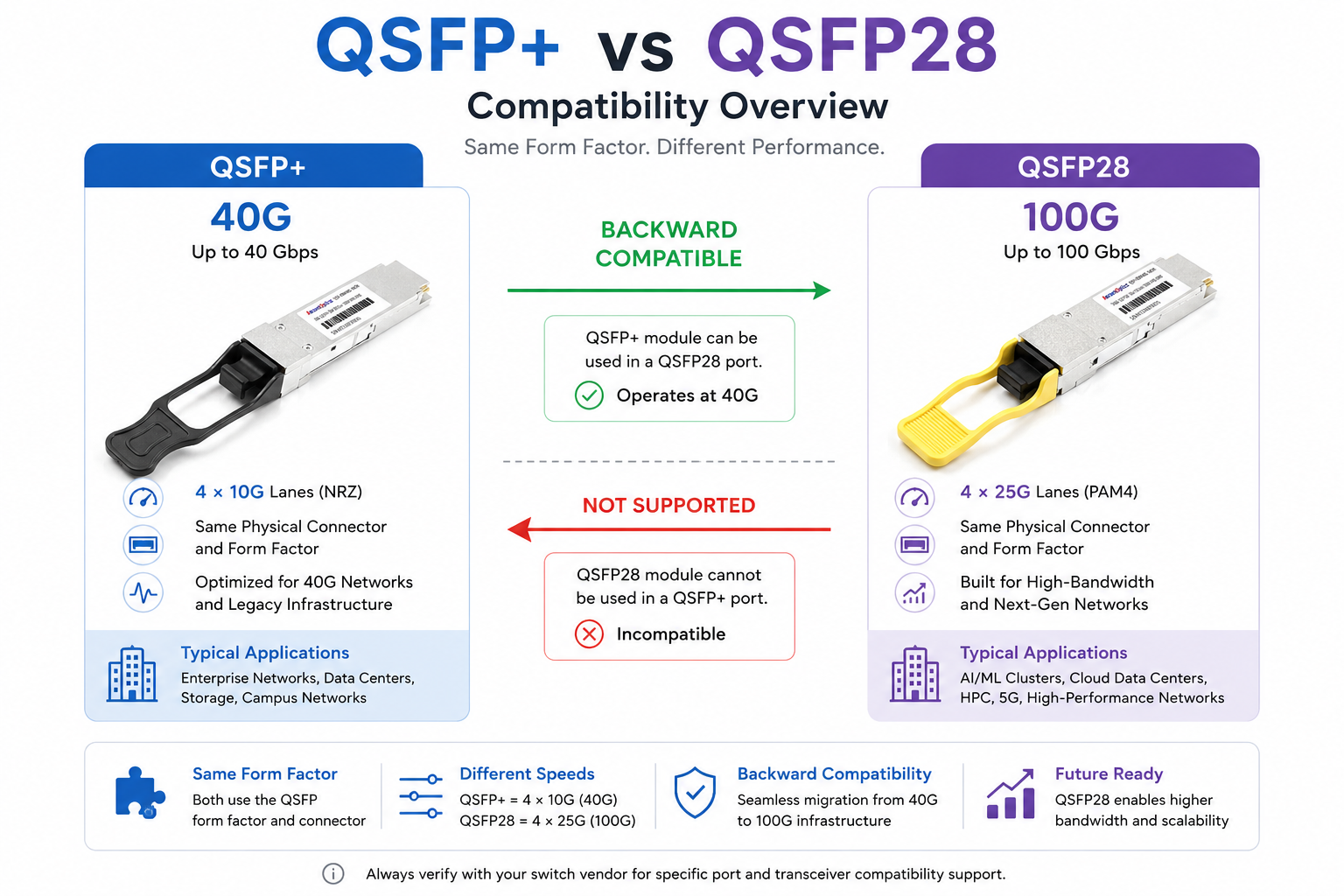
Understanding Lane Architecture
One of the most important differences between QSFP+ and QSFP28 is lane speed.
| Interface |
Lane Count
|
Lane Speed
|
| QSFP+ |
4
|
10Gbps
|
| QSFP28 |
4
|
25Gbps
|
Both interfaces use four electrical lanes, but QSFP28 dramatically increases per-lane throughput. This is why QSFP+ modules can downshift inside QSFP28 ports while QSFP28 modules cannot operate correctly in QSFP+ hardware.The underlying electrical architecture is fundamentally different.
Are QSFP+ and QSFP28 Physically Compatible?
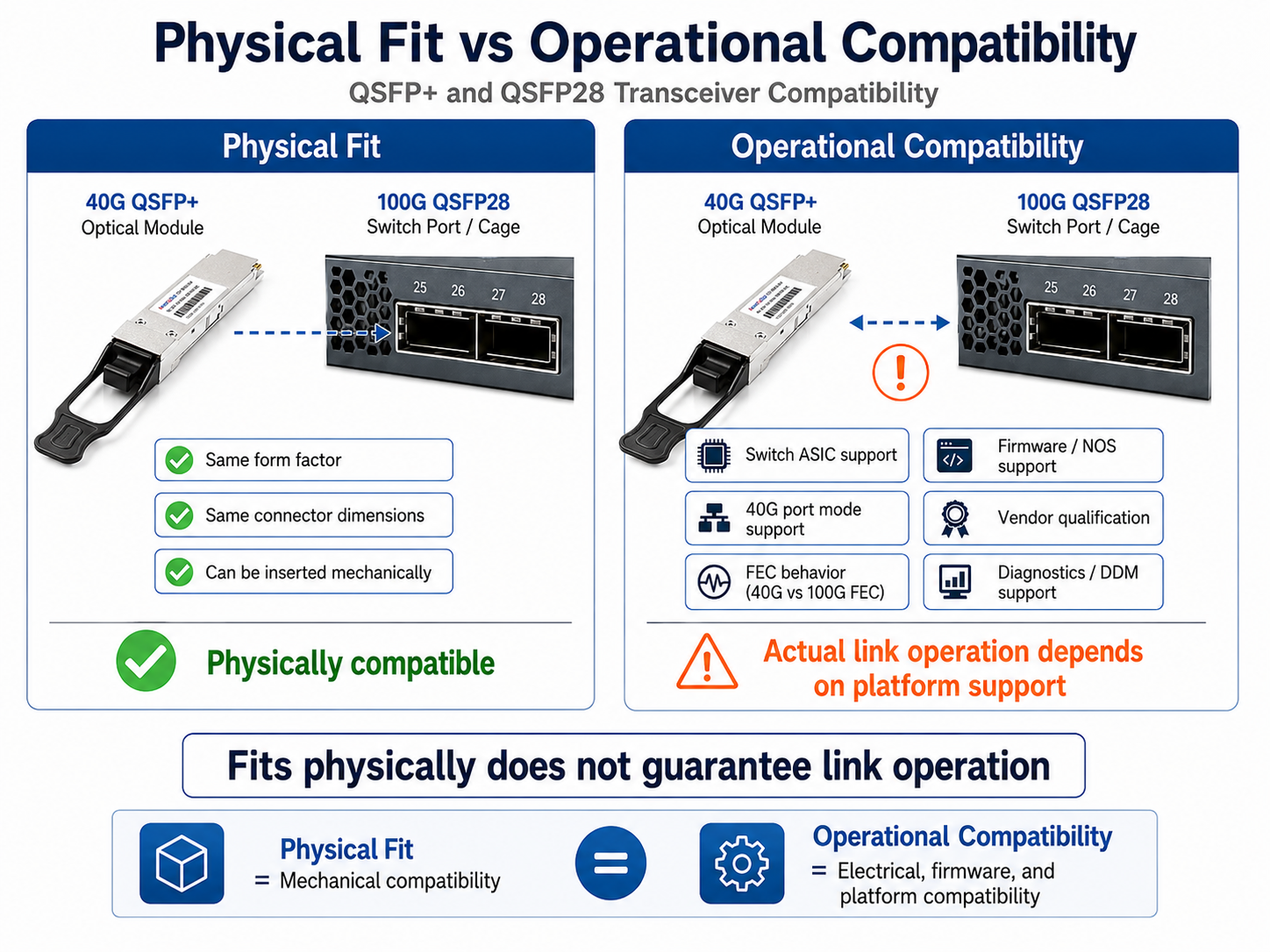
Yes. QSFP+ and QSFP28 share the same physical form factor and connector dimensions, which means a QSFP+ module can physically fit into a QSFP28 port and a QSFP28 module can also fit into a QSFP+ port. The cage design and connector interface are mechanically compatible, making mixed deployments possible in many environments.
However, physical compatibility does not automatically guarantee operational compatibility. The two standards differ in electrical signaling speed, ASIC requirements, signal integrity design, FEC behavior, firmware support, and thermal characteristics. As a result, actual compatibility depends heavily on the switch platform, operating system, firmware version, and vendor qualification.
Can a QSFP+ Module Work in a QSFP28 Port?
In most cases, yes. QSFP28 ports are generally designed with backward compatibility in mind, allowing many 40G QSFP+ modules and DAC/AOC cables to operate correctly inside 100G QSFP28 ports.
When a QSFP+ module is inserted into a QSFP28 port:
- •The link operates at 40Gbps instead of 100Gbps
- •The port typically switches to 4×10G lane operation
- •The switch detects the lower-speed module automatically
- •Power consumption usually remains within safe operating limits
This compatibility allows organizations to upgrade networks gradually instead of replacing all optics and switches simultaneously. For example, a data center may deploy new 100G-capable switches while continuing to use existing 40G QSFP+ optics during a phased migration.
Why QSFP28 Modules Usually Cannot Work in QSFP+ Ports
Although the physical dimensions are identical, QSFP28 modules generally cannot operate correctly inside QSFP+ ports. The main reason is that QSFP+ hardware was designed for 10Gbps electrical lanes, while QSFP28 requires 25Gbps lanes.
A QSFP+ port lacks:
- •Sufficient electrical bandwidth
- •Required signal integrity design
- •100G PHY support
- •Modern FEC handling capabilities
- •Proper ASIC support for 25G lane operation
As a result, inserting a QSFP28 module into a QSFP+ port usually results in:
- •No link establishment
- •Module detection failure
- •Unsupported transceiver alarms
- •Link instability
In practical deployments, QSFP28 optics should only be used in native 100G-capable QSFP28 ports.
Common Deployment Scenarios
Gradual 40G to 100G Migration
Many enterprises upgrade switches before replacing optics.In this scenario:
- •Existing 40G QSFP+ optics continue operating
- •New QSFP28-capable switches are installed
- •Optics are upgraded gradually over time
This reduces capital expenditure and simplifies migration planning.
Mixed-Speed Data Centers
Some modern data centers operate both 40G and 100G infrastructure simultaneously.
Typical examples include:
- •Legacy spine-leaf environments
- •Enterprise core networks
- •AI cluster expansion phases
- •HPC interconnect upgrades
Backward compatibility allows flexible coexistence during infrastructure transitions.
AI and HPC Network Expansion
In AI fabrics and GPU clusters, organizations often upgrade to 100G or 400G networking incrementally.
Temporary mixed deployments may include:
- •40G storage uplinks
- •100G GPU fabric interconnects
- •Legacy aggregation switches
- •Hybrid Ethernet and InfiniBand environments
QSFP28 backward compatibility helps simplify these staged deployments.
Breakout Cable Compatibility
Breakout connectivity is another important consideration when deploying QSFP+ and QSFP28 interfaces in modern data centers. The breakout cables allow a single high-speed QSFP port to be divided into multiple lower-speed connections, improving port utilization and providing greater flexibility in network design.
For example, a QSFP28 port can often support breakout configurations such as:
- •1×100G to 4×25G SFP28
- •100G DAC breakout cables
- •100G AOC breakout assemblies
Similarly, QSFP+ ports commonly support: 1×40G to 4×10G SFP+.
These breakout configurations are widely used in spine-leaf architectures, top-of-rack switching, storage networks, and GPU cluster deployments where multiple server connections are required from a single uplink port. In AI and hyperscale environments, breakout cabling is also frequently used to maximize switch density while reducing hardware costs and simplifying cable management.
However, breakout compatibility depends heavily on the switch ASIC, port configuration, NOS support, and vendor firmware policies. Some switches only allow breakout on specific ports or port groups, while others may support either 40G or 100G breakout modes but not both simultaneously. In addition, passive DAC breakouts, active optical cables, and optical transceiver breakouts may each have different compatibility requirements.
Because implementation behavior can vary significantly between vendors and switch generations, it is always recommended to verify breakout support using official platform documentation before deployment.
Read our complete QSFP28 Breakout Cable Guide →
Limitations of Using QSFP+ in QSFP28 Ports
Although compatibility is commonly supported, several limitations still need to be considered in real-world deployments. A QSFP+ module restricts the port to 40Gbps operation, meaning the switch cannot achieve native 100G performance while legacy optics are installed.
In addition, some advanced 100G features such as FEC behavior, link training, diagnostics reporting, telemetry, or breakout functionality may behave differently depending on the platform design and firmware implementation. Compatibility policies can also vary between switch vendors, and unsupported optics may trigger warning messages, unsupported transceiver alarms, or even port shutdowns on certain systems.
Furthermore, QSFP28 platforms are optimized for higher-speed electrical signaling, so older QSFP+ modules may not fully match the signal integrity characteristics of native 100G optics, which can occasionally affect link stability and troubleshooting efficiency in large-scale environments.
Fiber and Connector Considerations
Choosing the correct fiber type and connector interface is essential for stable QSFP+ and QSFP28 operation. Fiber selection directly affects transmission distance, signal quality, deployment cost, and overall network scalability.
Multimode Fiber (MMF)
Multimode fiber is typically used for short-distance connections inside data centers and enterprise networks. Common applications include 40G SR4 and 100G SR4 deployments, which are widely used for top-of-rack to spine switching and short-reach server aggregation.
Typical transmission distances include:
| Fiber Type |
40G/100G SR4 Reach |
| OM3 |
70m |
| OM4 |
100m |
| OM5 |
150m |
SR4 modules generally use MPO/MTP multi-fiber connectors to support parallel optical transmission. These connectors enable high-density cabling but require careful polarity management and proper cleaning procedures to maintain signal integrity.
Single-Mode Fiber (SMF)
Single-mode fiber is used for longer-distance connectivity and higher-bandwidth applications. Common QSFP28 optics such as CWDM4, LR4, ER4, and ZR are designed for single-mode deployments in campus networks, metro links, DCI environments, and hyperscale infrastructure.
Typical reaches include:
Most single-mode QSFP modules use duplex LC connectors, which simplify cabling and are commonly deployed in structured fiber environments.
Compared with multimode fiber, SMF offers lower attenuation and better scalability for future high-speed upgrades, although deployment costs are typically higher.
Connector Selection Considerations
Connector type is another important factor when selecting QSFP optics and cabling. MPO/MTP connectors are commonly used in parallel optics such as SR4 and DR4 modules, while LC duplex connectors are more common in duplex single-mode applications such as LR4 and CWDM4.
When planning deployments, network engineers should verify:
- •Fiber type compatibility
- •Connector polarity
- •Patch panel design
- •Breakout cabling requirements
- •Future upgrade scalability
Proper fiber and connector planning can significantly reduce insertion loss, simplify maintenance, and improve long-term network reliability, especially in large-scale AI clusters and hyperscale data centers.
How to Choose the Right Optics
Selecting the correct optical module depends on factors such as bandwidth requirements, transmission distance, fiber infrastructure, thermal design, and vendor interoperability. In general, QSFP+ is suitable for 40G networking, while QSFP28 is designed for native 100G deployments, and newer architectures may require QSFP-DD or OSFP for 400G connectivity.
Transmission distance also plays a major role in module selection, with SR optics typically used for short-range multimode fiber connections and LR, ER, or ZR optics designed for longer single-mode fiber links. Network engineers should also verify whether the existing cabling infrastructure uses MMF or SMF and whether the environment requires MPO/MTP or LC connectivity.
In high-density AI clusters and hyperscale environments, power consumption and thermal performance become increasingly important, making proper airflow and switch cooling essential. Finally, confirming compatibility between the transceiver vendor, switch platform, firmware version, and network operating system can significantly reduce deployment risks and troubleshooting complexity.
Conclusion
QSFP+ and QSFP28 share the same physical form factor, making backward compatibility possible in many networking environments. In most cases, a QSFP+ module can operate inside a QSFP28 port at 40Gbps, helping organizations migrate gradually from 40G to 100G infrastructure.
However, compatibility is not purely mechanical. Electrical signaling, ASIC support, firmware behavior, and switch design all influence real-world operation.
For stable and scalable deployments, network engineers should always verify platform compatibility, breakout support, optical specifications, and vendor recommendations before mixing 40G and 100G transceivers.
As AI clusters, hyperscale data centers, and cloud networks continue expanding, understanding QSFP+ and QSFP28 interoperability remains essential for building flexible and cost-efficient high-speed infrastructure.
For more guidance on the 100G ecosystem, read our QSFP28 transceiver guide. If you are considering a jump to 400G, see our how to choose QSFP-DD modules guide for the next-generation comparison.
Frequently Asked Questions (FAQs)
Q1: Can you plug a QSFP+ module into a QSFP28 port?
A: Yes. Most QSFP28 ports support backward compatibility with QSFP+ optics and cables. However, the port will operate at 40Gbps instead of 100Gbps.
Q2: Can a QSFP28 module work in a QSFP+ port?
Generally no. QSFP+ ports lack the electrical and hardware requirements necessary for 100G QSFP28 operation.
Q3: Do QSFP+ and QSFP28 use the same connector?
Yes. Both interfaces share the same physical QSFP form factor and connector dimensions.
Q4: Can QSFP28 ports support breakout cables?
Yes. Many QSFP28 ports support breakout configurations such as 4×25G SFP28, depending on switch capabilities.
Q5: Are DAC and AOC cables also compatible?
In many cases, yes. QSFP+ DAC and AOC cables may operate correctly in QSFP28 ports if supported by the switch platform.
Q6: Does backward compatibility guarantee full functionality?
No. Physical compatibility does not always guarantee support for all features, diagnostics, or breakout configurations.
Router (computing)
10 Gigabit Ethernet
Everything You Need to Know About 100G QSFP28 Transceivers
Post Views: 6,087