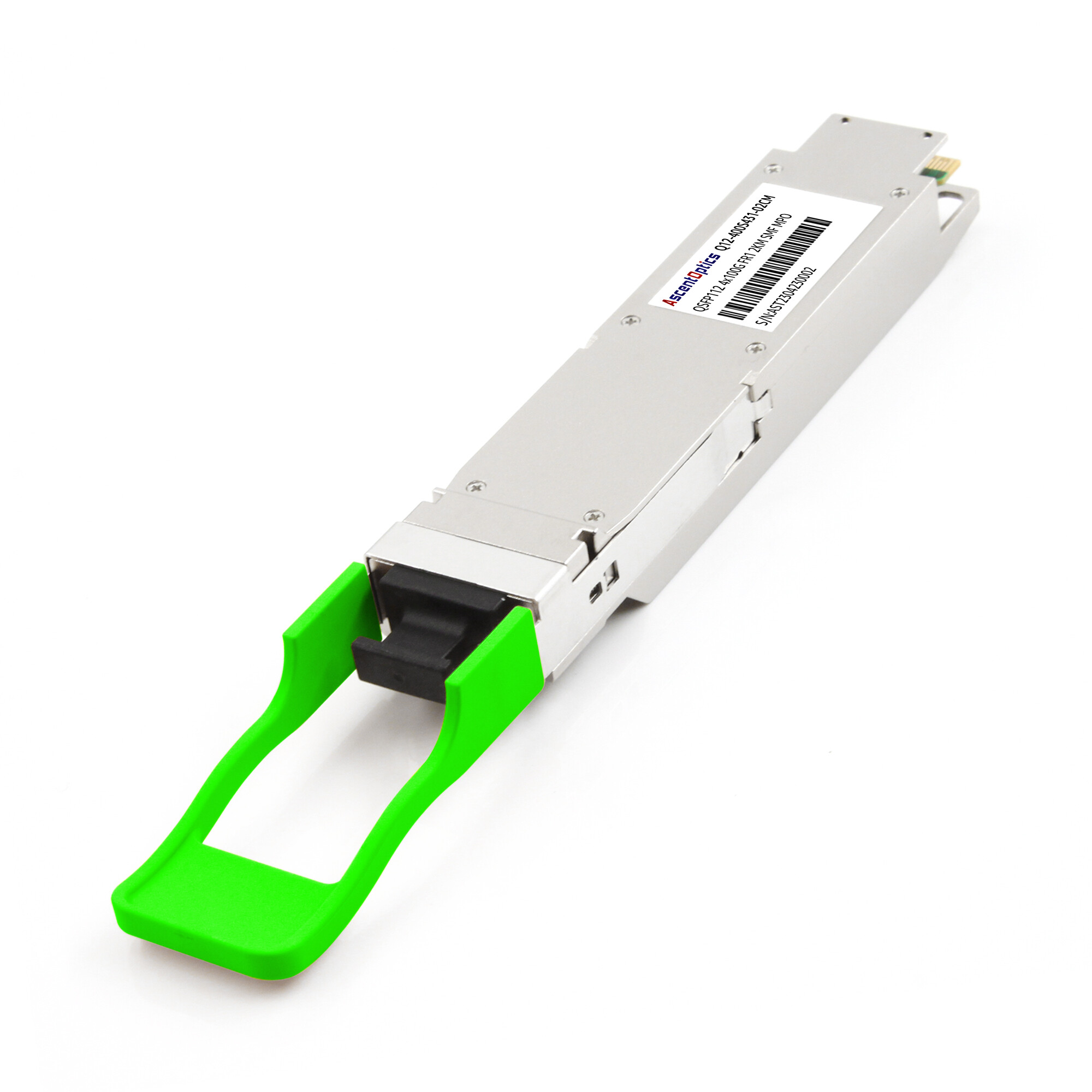
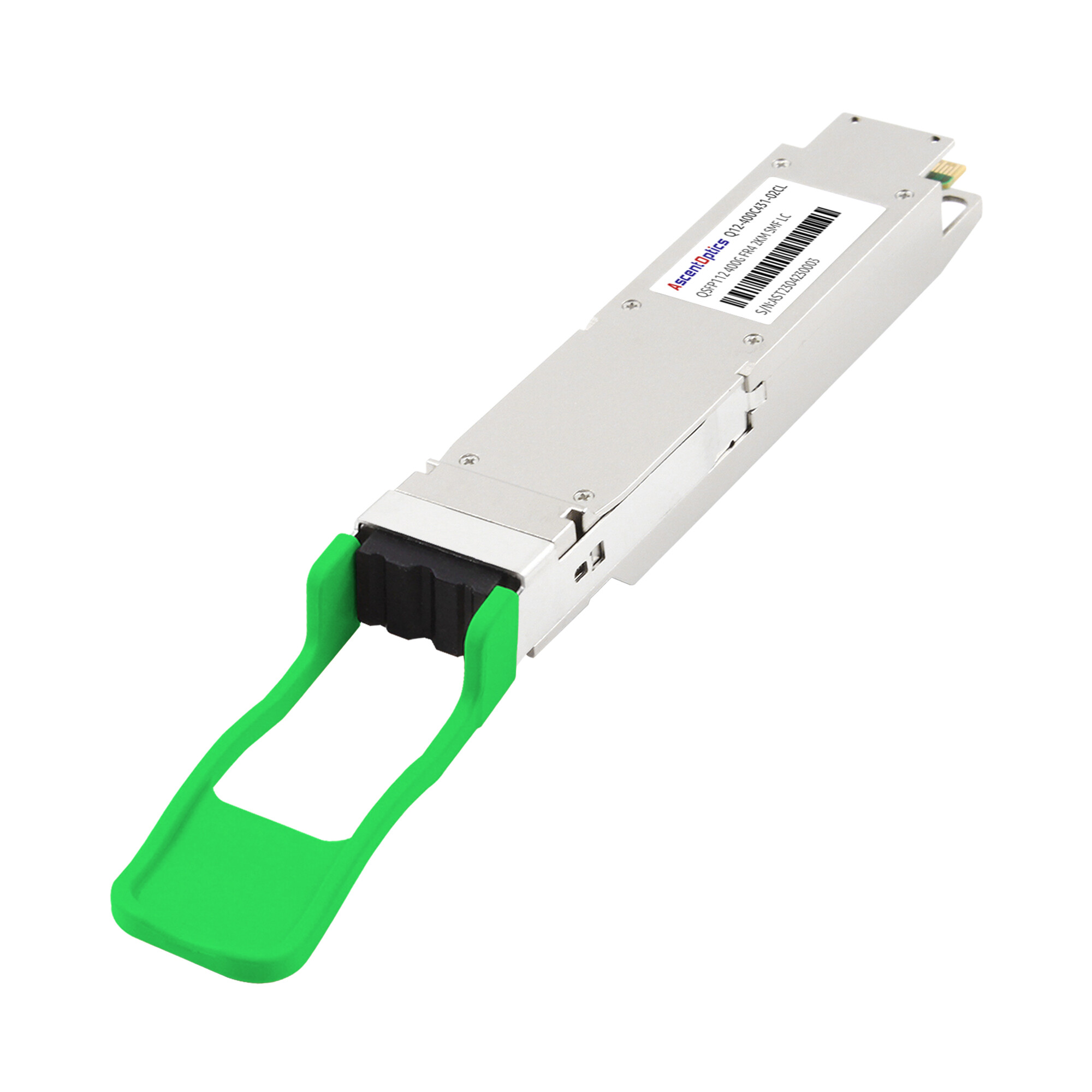
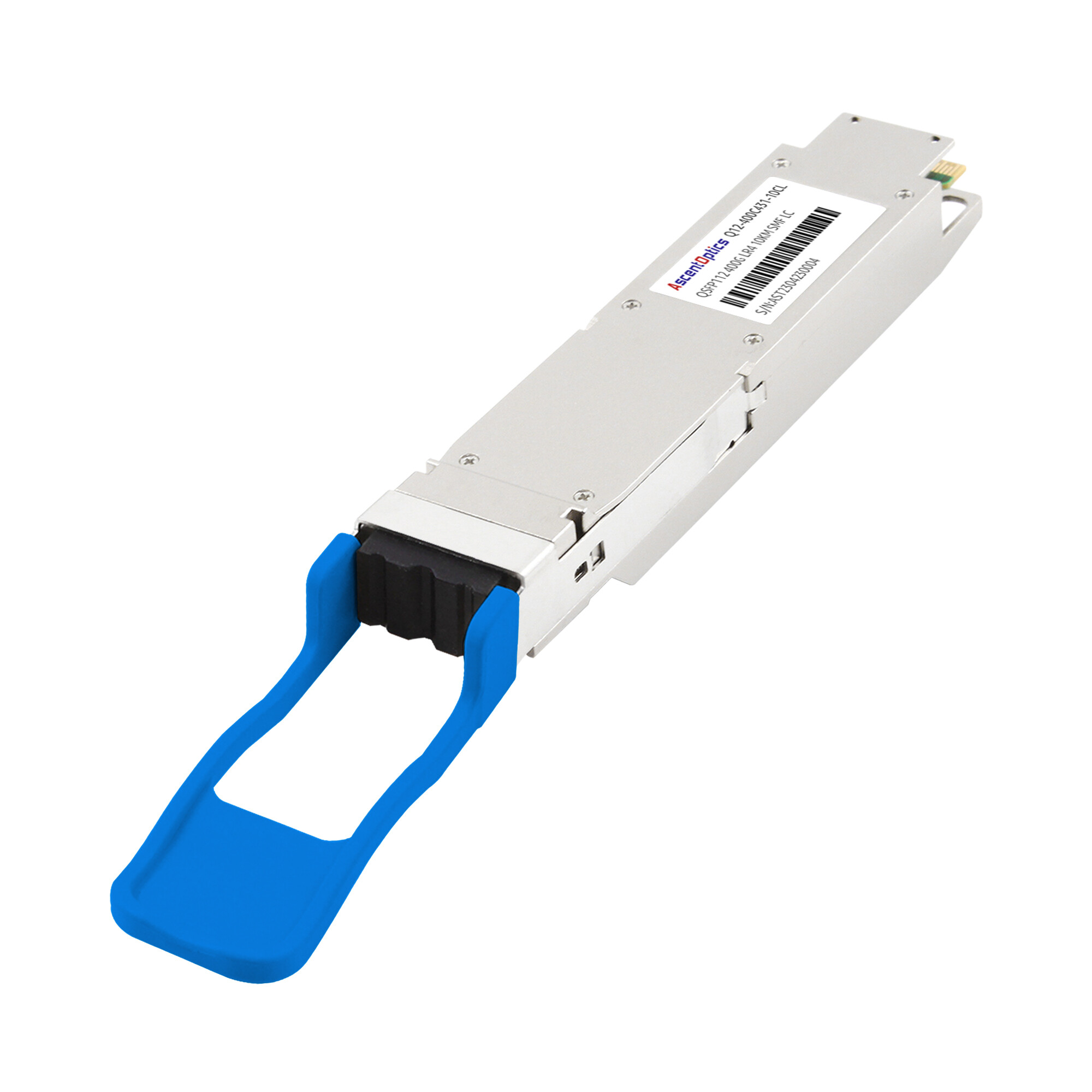
QSFP112 compatibility is not a simple “yes” or “no” question. Physical interface matching does not guarantee proper electrical functionality. Even if the module is plugged into a port, it may still fail to function correctly if the host switch, network interface card (NIC), firmware, or network operating system does not support the required signal rate.
Understanding QSFP112 Compatibility: Physical vs Electrical
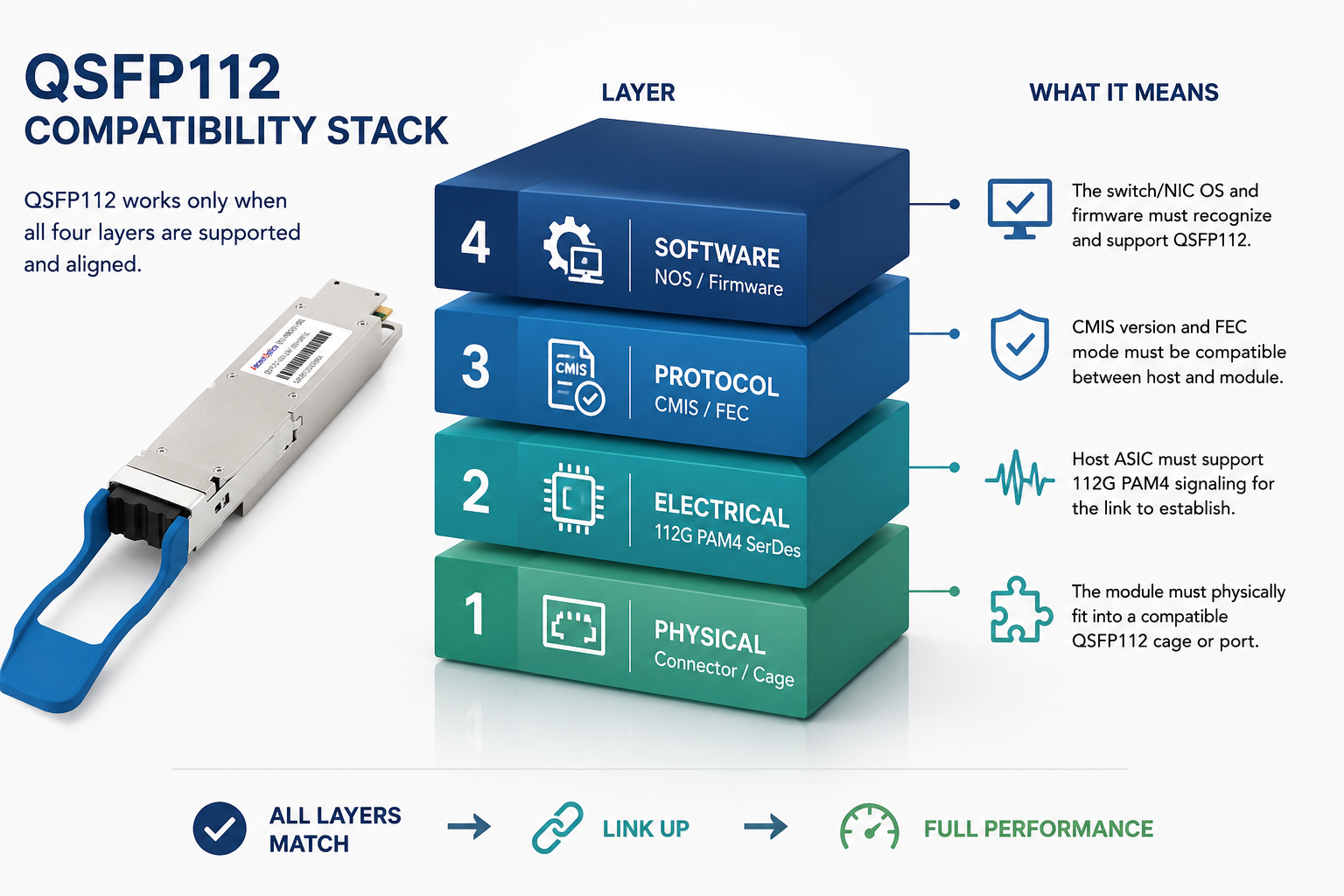
The most common misconception about QSFP112 compatibility is that physical fit equals functionality. It does not. QSFP112 compatibility operates across four distinct layers, and failure at any layer prevents the module from working.
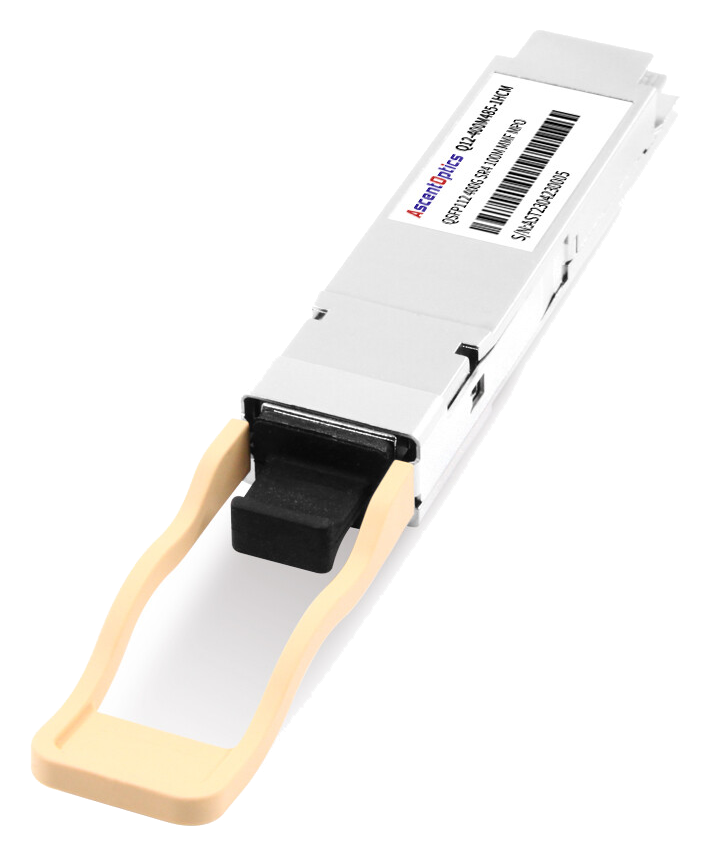
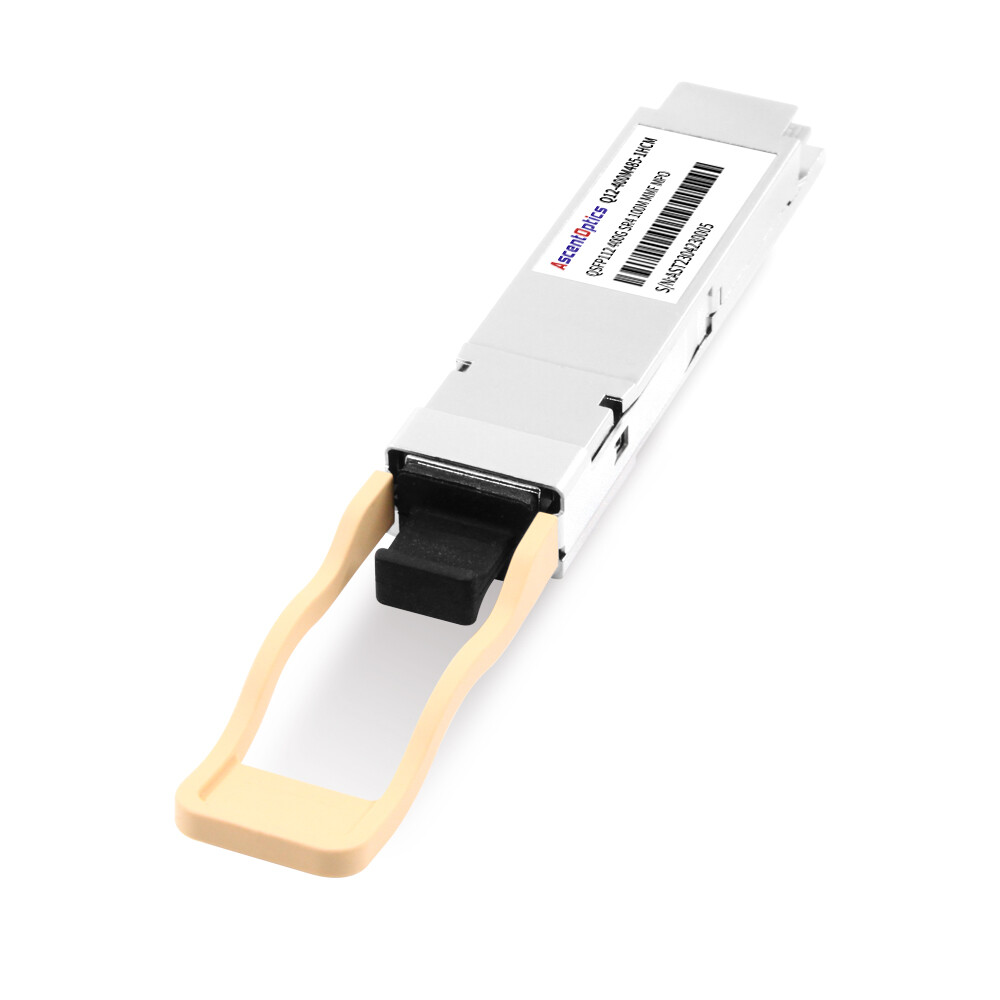
400G QSFP112 4x100G SR4
Physical Form Factor Compatibility
QSFP112 modules use the same physical dimensions as QSFP28 and QSFP56: 18.4 × 89.4 × 8.5 mm. They share the same cage and connector design defined by the QSFP112 MSA specification. This means a QSFP112 optical transceiver module will physically fit into any cage designed for QSFP28, QSFP56, or QSFP-DD modules.
However, physical compatibility with QSFP-DD cages depends on the specific cage design. QSFP-DD uses a slightly wider connector footprint in some implementations. Always verify cage dimensions before assuming physical interchangeability.
This is where most compatibility issues arise. QSFP112 modules require 112 Gbps PAM4 SerDes (serializer/deserializer) at the host side. Pre-2024 switch ASICs typically support 25G NRZ (for QSFP28) or 50G PAM4 (for QSFP56) SerDes, but not 112G PAM4.
A QSFP112 module plugged into a QSFP28 port will be detected at the physical layer, but the electrical link will not establish because the host SerDes cannot generate or receive 112G PAM4 signals. The module may show up in the switch’s inventory, but no data transmission will occur.
The Compatibility Stack
QSFP112 compatibility requires alignment across four layers:
1. Physical layer: Connector and cage dimensions must match
2. Electrical layer: Host ASIC must support 112G PAM4 SerDes
3. Protocol layer: CMIS version and FEC mode must be compatible
4. Software layer: NOS and firmware must recognize and support QSFP112 modules
QSFP112 Switch Compatibility by Vendor
Switch compatibility depends on the underlying ASIC, not just the switch model name. Two switches from the same product line may have different ASICs depending on the generation, which directly affects QSFP112 support.
NVIDIA Switches
NVIDIA has been among the earliest and most aggressive adopters of QSFP112, driven by AI networking demands.
Spectrum-4 (SN4000 series): Native QSFP112 support for 400G Ethernet. The SN4700 and SN4600C models use the Spectrum-4 ASIC with 112G PAM4 SerDes. Minimum Cumulus Linux version: 5.x. Minimum MLNX-OS version: 3.10.x.
Quantum-2 (QM8700 series): Certain NVIDIA networking platforms share similar 112G SerDes technology across InfiniBand and Ethernet ecosystems, but Quantum-2 itself is primarily designed for InfiniBand NDR fabrics. Minimum MLNX-OS version: 3.9.x.
Need NVIDIA-compatible QSFP112 modules? Contact our optical engineers for SKU cross-references and platform validation.
Cisco Switches
Cisco’s QSFP112 support is tied to the Silicon One G200 ASIC, which powers their latest high-density platforms.
Nexus 9000 series: Selected Cisco platforms based on Silicon One ASICs support QSFP112 interfaces. Compatibility depends on the specific chassis, line card, and software release. Minimum NX-OS version: 10.2(1) or later. Older Nexus 9000 platforms with earlier ASICs do not support 112G SerDes and cannot use QSFP112 modules at full speed.
Catalyst 9000 series: Support varies by model and ASIC generation. The Catalyst 9600 series with newer line cards may support QSFP112, but verify the specific ASIC on your line card before ordering.
Arista Switches
Arista builds many of its high-performance switches on Broadcom ASICs, making QSFP112 support straightforward on Tomahawk 5-based platforms.
7060X6 series: Based on Broadcom Tomahawk 5, these switches provide native QSFP112 support for 400G connectivity. Minimum EOS version: 4.31.x or later.
7800R4 series: Modular switches with Tomahawk 5 line cards. QSFP112 support requires matching line card ASICs. Minimum EOS version: 4.31.x.
Juniper Switches
Juniper has integrated QSFP112 support into its latest switching platforms.
QFX series: The QFX5230-64CD and newer QFX models with 112G SerDes support QSFP112 modules. Minimum Junos version: 23.2R1 or later.
PTX series: PTX10002 and PTX10004 platforms with appropriate line cards support QSFP112 for core and backbone applications. Minimum Junos version: 23.2R1.
Dell and Whitebox Switches
Dell and whitebox switch vendors relying on Broadcom Tomahawk 5 ASICs can support QSFP112 with appropriate NOS versions.
Dell PowerSwitch: The Z9664F and similar Tomahawk 5-based models support QSFP112. Minimum OS10 version: 10.5.6.x or later.
Whitebox platforms: Tomahawk 5-based whitebox switches running SONiC, Cumulus Linux, or other open NOS versions with 112G SerDes support can use QSFP112 modules. Verify NOS compatibility with the switch vendor.
Vendor
Switch Model
ASIC
Minimum NOS
QSFP112 Support
NVIDIA
SN4700 / SN4600C
Spectrum-4
Cumulus 5.x
Native
NVIDIA
QM8700
Quantum-2
MLNX-OS 3.9.x
Native (NDR)
Cisco
Nexus 9400 / 9500
Silicon One G200
NX-OS 10.2(1)
Native
Arista
7060X6
Broadcom TH5
EOS 4.31.x
Native
Arista
7800R4
Broadcom TH5
EOS 4.31.x
Native (line card dependent)
Juniper
QFX5230
Custom / TH5
Junos 23.2R1
Native
Dell
Z9664F
Broadcom TH5
OS10 10.5.6.x
Native
Whitebox
Various
Broadcom TH5
SONiC / Cumulus
Platform-dependent
QSFP112 NIC Compatibility
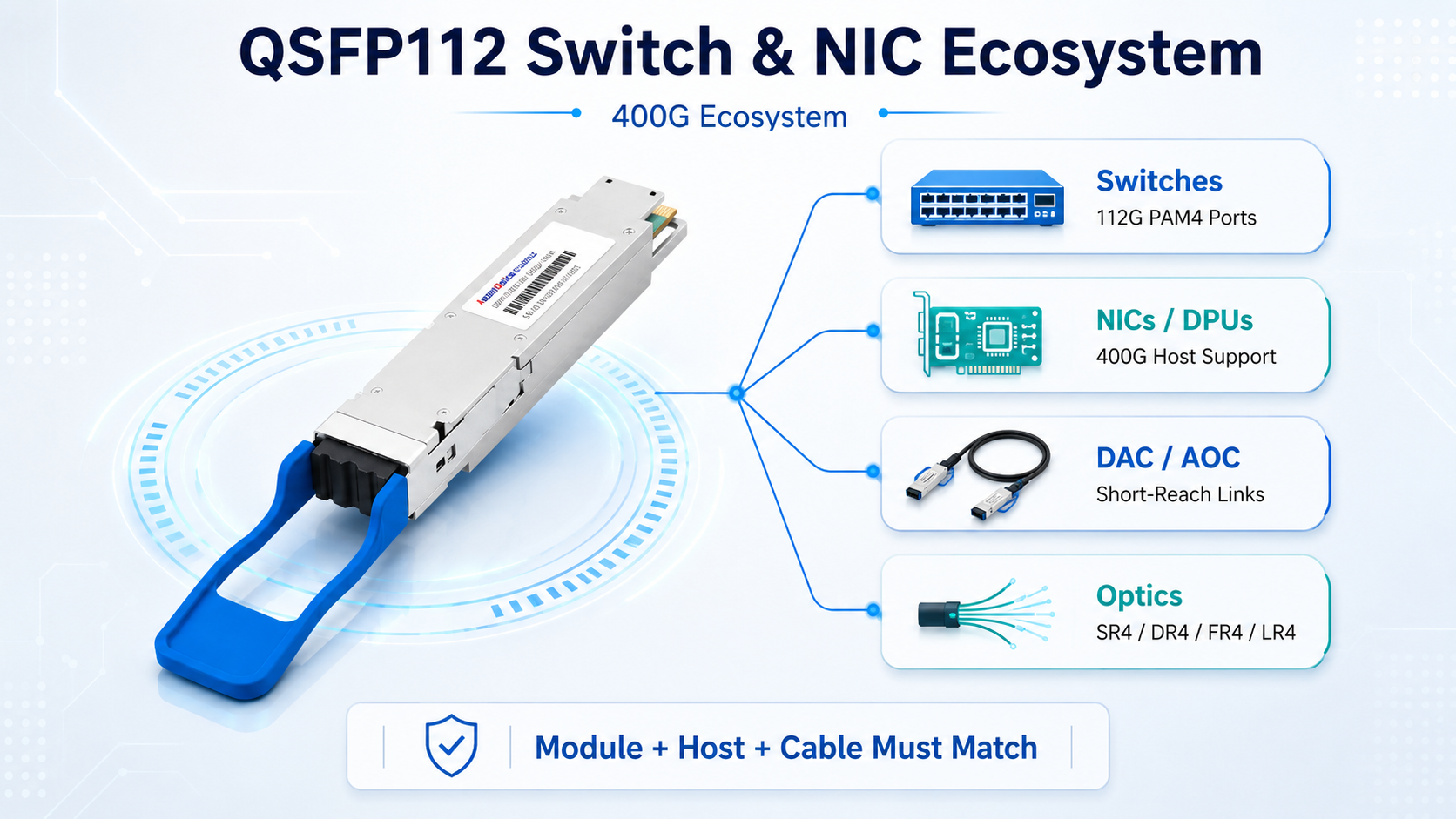
Switch compatibility is only half the equation. The network interface card on the server or storage system must also support QSFP112 signaling.
NVIDIA ConnectX-7 and ConnectX-8
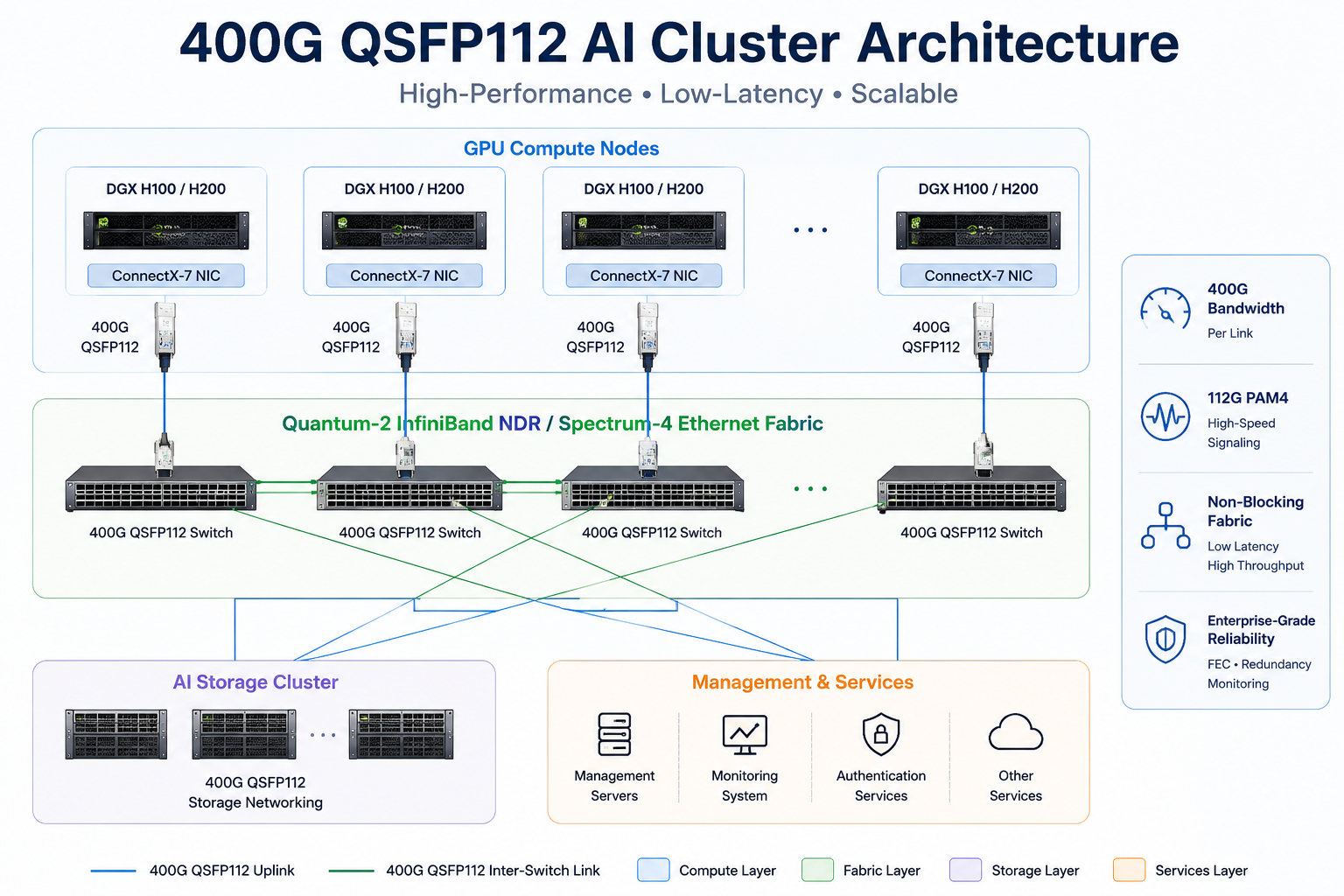
NVIDIA’s ConnectX-7 NIC is the most widely deployed QSFP112-capable network adapter. It supports both 400G Ethernet (RoCEv2) and 400G InfiniBand NDR through QSFP112 ports.
•ConnectX-7 (MCX75310AAS-NEAT): Single-port QSFP112, 400GbE or NDR InfiniBand
•ConnectX-8: Next-generation NIC with QSFP112 support (check availability)
•Minimum firmware: 28.39.x or later
•Minimum driver: MLNX_OFED 23.10 or later for Linux
The ConnectX-7 also supports QSFP112 DAC cables and AOC cables for short-reach connections within data center racks.
Intel and Broadcom NICs
Intel’s E810 series NICs support up to 100G per port using QSFP28. As of early 2026, Intel has not released a mainstream NIC with native QSFP112 400G support. For Intel-based servers requiring 400G connectivity, third-party QSFP112 NICs or NVIDIA ConnectX-7 adapters are the primary options.
Broadcom’s P-series NICs are transitioning to 112G SerDes, with QSFP112 support expected in upcoming product generations. Verify the specific NIC model and firmware version before deployment.
SmartNIC and DPU Compatibility
NVIDIA BlueField-3 DPUs include QSFP112 ports for 400G data processing and network offload. These devices support both Ethernet and InfiniBand modes through QSFP112 connectivity. AMD Pensando DPUs are transitioning to higher-speed interfaces, but QSFP112 support varies by model.
QSFP112 Backward Compatibility: What Works and What Doesn’t
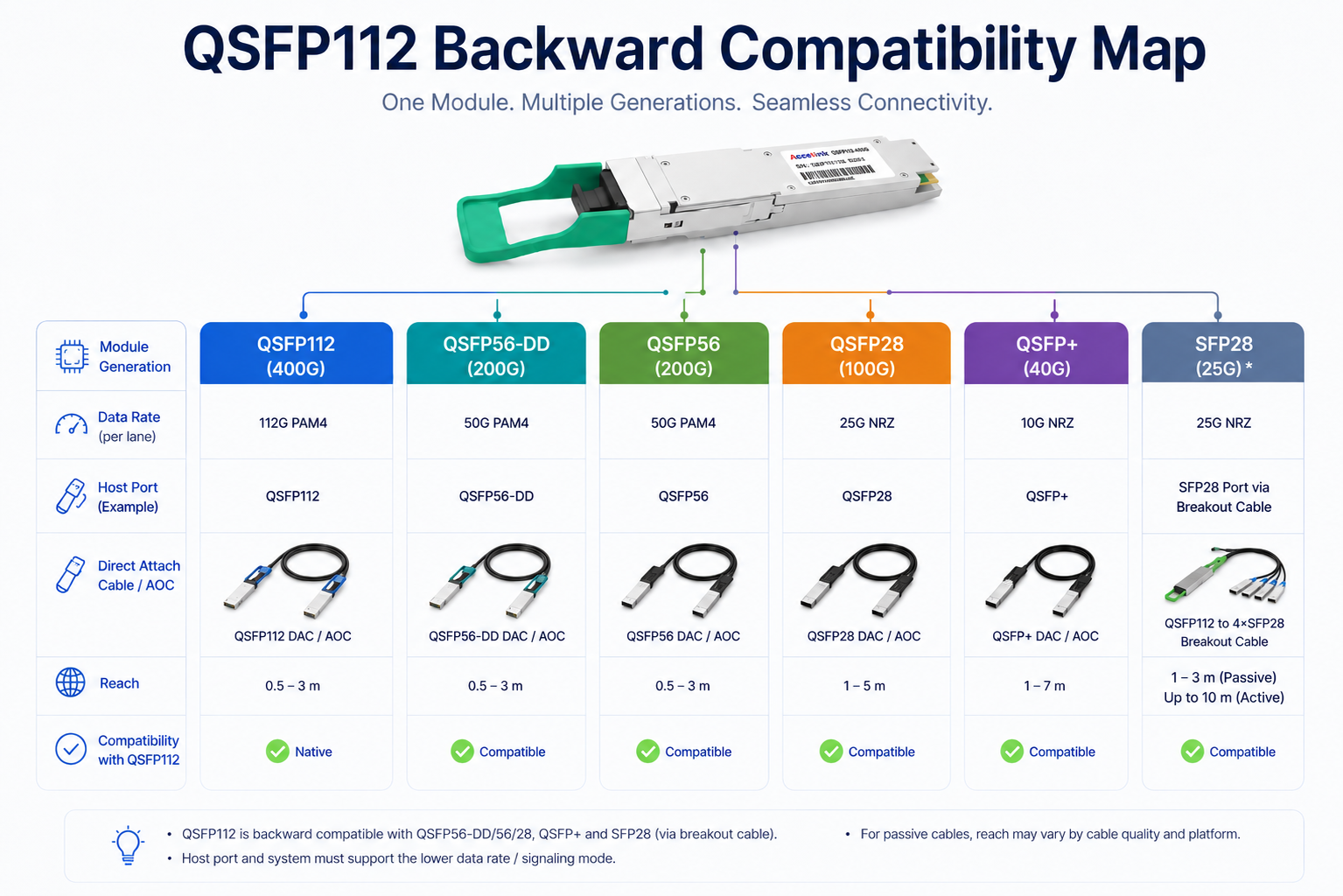
Backward compatibility is the most misunderstood aspect of QSFP112 deployment. Physical fit across the QSFP family does not mean electrical interoperability.
QSFP112 in QSFP28 (100G) Ports
Physical fit: Yes. QSFP112 uses the same 18.4 × 89.4 mm form factor as QSFP28.
Electrical operation: No, unless the host switch has 112G PAM4 SerDes. A QSFP112 module in a QSFP28 port with 25G NRZ SerDes will not establish a link. The module may appear in the switch inventory (CMIS detection works at lower speeds), but no data transmission will occur.
Speed negotiation: On some platforms with multi-rate SerDes, a QSFP112 module may negotiate down to lower speeds, but this is not guaranteed and depends on the specific ASIC and firmware.
QSFP112 in QSFP56 (200G) Ports
Physical fit: Yes.
Electrical operation: Platform-dependent. QSFP56 uses 50G PAM4 SerDes, while QSFP112 requires 112G PAM4. The signaling rates are incompatible unless the host ASIC supports both rates. Some Broadcom Tomahawk 4 and later ASICs support rate negotiation that may allow partial operation.
QSFP112 in QSFP-DD (400G/800G) Ports
Physical fit: QSFP-DD uses a wider connector in some implementations. QSFP112 modules may not physically fit in all QSFP-DD cages. Verify cage dimensions before attempting insertion.
Electrical operation: Not compatible. QSFP-DD uses 8 electrical lanes (8 × 50G for 400G or 8 × 112G for 800G), while QSFP112 uses 4 lanes (4 × 112G). The lane architectures are fundamentally different.
Forward Compatibility: Lower-Speed Modules in QSFP112 Ports
QSFP28 and QSFP56 modules can typically operate in QSFP112-native ports through rate negotiation. A QSFP28 100G module in a QSFP112 400G port will negotiate to 100G if the host ASIC supports multi-rate SerDes. This enables incremental upgrades where lower-speed modules serve legacy connections while QSFP112 modules handle new 400G links. For broader context on backward compatibility, see our QSFP28 compatible switches guide.
CMIS, Firmware, and NOS Requirements
Beyond hardware compatibility, QSFP112 modules require specific software versions for proper detection, management, and diagnostics.
CMIS Version Requirements
QSFP112 modules use the Common Management Interface Specification (CMIS) for host-module communication. CMIS 5.0 is the minimum version required for basic QSFP112 support, including module detection, power management, and basic diagnostics.
CMIS 5.2 adds enhanced monitoring capabilities, including detailed lane-by-lane signal quality metrics, extended DOM (digital optical monitoring) data, and advanced power management features. For production deployments where monitoring and troubleshooting matter, CMIS 5.2 is recommended.
Firmware Requirements by Platform
Switch firmware must be updated to recognize QSFP112 modules. Many older firmware versions detect the module but cannot configure the 112G SerDes, resulting in a “module detected, no link” state.
Key firmware requirements:
•NVIDIA: Cumulus Linux 5.x or MLNX-OS 3.9.x minimum
•Cisco: NX-OS 10.2(1) minimum for Nexus 9000
•Arista: EOS 4.31.x minimum for Tomahawk 5 platforms
•Juniper: Junos 23.2R1 minimum for QFX/PTX series
•Dell: OS10 10.5.6.x minimum for Tomahawk 5 platforms
NOS Compatibility
The network operating system must support QSFP112 module management through CMIS. Cisco NX-OS, Arista EOS, and Juniper Junos all support QSFP112 on compatible hardware. SONiC (Software for Open Networking in the Cloud) supports QSFP112 on validated Tomahawk 5 platforms, but specific SONiC versions and platform support vary. Verify with your switch or SONiC distribution vendor.
FEC and Signal Integrity Considerations
At 112 Gbps per lane using PAM4 signaling, forward error correction (FEC) is not optional. It is mandatory to maintain acceptable bit error rates.
FEC Mode Requirements
Reed-Solomon FEC (RS-FEC) is required at 112G PAM4 lane rates as defined by IEEE 802.3ck. RS-FEC adds approximately 5-10% overhead to the data stream but corrects errors that would otherwise cause link failures at these signaling rates.
Some platforms also support KP-FEC (Kr-FEC), which offers lower latency but reduced error correction capability. The choice between RS-FEC and KP-FEC depends on the application: data center applications prioritizing latency may prefer KP-FEC, while applications requiring maximum reliability use RS-FEC.
FEC configuration is typically automatic on modern switches, but verify that FEC is enabled and set to the correct mode after installing QSFP112 modules.
Signal Integrity at 112G per Lane
PAM4 signaling at 112G per lane is significantly more sensitive to noise, insertion loss, and crosstalk than lower-speed NRZ signaling. This affects compatibility in several ways:
•Cable quality matters more: Substandard cables that worked fine at 25G (QSFP28) may cause link failures at 112G (QSFP112)
•Connector cleanliness is critical: Contaminated fiber connectors cause higher loss at 112G, leading to FEC errors or link failures
•Distance limitations are stricter: The same cable type may support shorter reach at 112G than at 25G or 50G
Conclusion
QSFP112 is becoming the preferred optical interface for next-generation 400G networking, particularly in AI clusters, cloud data centers, and high-performance computing environments. However, QSFP112 compatibility extends far beyond the physical connector. Successful deployment requires alignment across hardware, electrical signaling, firmware, operating systems, and FEC configurations.
When evaluating QSFP112 compatibility, focus first on whether the host platform supports 112G PAM4 SerDes, as physical insertion alone does not guarantee link operation. Modern platforms based on NVIDIA Spectrum-4 and Quantum-2, Broadcom Tomahawk 5, and other 112G-capable ASICs are designed to fully support QSFP112 transceivers, DACs, and AOCs. In contrast, older QSFP28 and QSFP56 systems may offer physical compatibility but typically cannot support native QSFP112 operation.
Before purchasing or deploying QSFP112 optics, verify switch ASIC specifications, NIC capabilities, firmware versions, CMIS support, and cable compatibility. Taking these factors into account will help ensure reliable 400G connectivity and provide a smoother migration path toward future 800G network architectures.
Need Help Choosing Compatible QSFP112 Transceivers?
AscentOptics offers a full portfolio of 400G QSFP112 optical transceivers, DACs, and AOCs compatible with leading platforms from NVIDIA, Cisco, Arista, Juniper, Dell, and other major vendors. Contact our technical team for compatibility verification, deployment recommendations, or customized networking solutions for AI, cloud, and HPC environments.
Frequently Asked Questions
Is QSFP112 backward compatible with QSFP28?
QSFP112 modules are physically backward compatible with QSFP28 cages because they use the same form factor dimensions (18.4 × 89.4 mm). However, electrical operation requires 112G PAM4 SerDes at the host. A QSFP112 module will plug into a QSFP28 port but will not function unless the switch ASIC supports 112G signaling.
Can I plug QSFP112 into a QSFP-DD port?
Physical compatibility depends on the specific cage design. QSFP-DD uses a wider connector in some implementations, so QSFP112 modules may not fit all QSFP-DD cages. Electrically, QSFP-DD uses 8 lanes while QSFP112 uses 4 lanes, making them incompatible even if the physical connection works.
What switches support QSFP112?
Switches with 112G PAM4 SerDes ASICs support QSFP112. These include NVIDIA Spectrum-4 (SN4000 series), Cisco Nexus 9000 with Silicon One G200, Arista 7060X6 and 7800R4 (Broadcom Tomahawk 5), Juniper QFX and PTX series, and Dell PowerSwitch models with Tomahawk 5 ASICs.
Does QSFP112 work with Cisco Nexus?
Yes, QSFP112 works with Cisco Nexus 9000 series switches that use the Silicon One G200 ASIC. Minimum NX-OS version is 10.2(1). Older Nexus 9000 platforms with earlier ASICs do not support 112G SerDes.
What firmware do I need for QSFP112?
Firmware requirements vary by vendor. Minimum versions include: NVIDIA Cumulus Linux 5.x, Cisco NX-OS 10.2(1), Arista EOS 4.31.x, Juniper Junos 23.2R1, and Dell OS10 10.5.6.x. Always check your specific platform documentation for exact requirements.