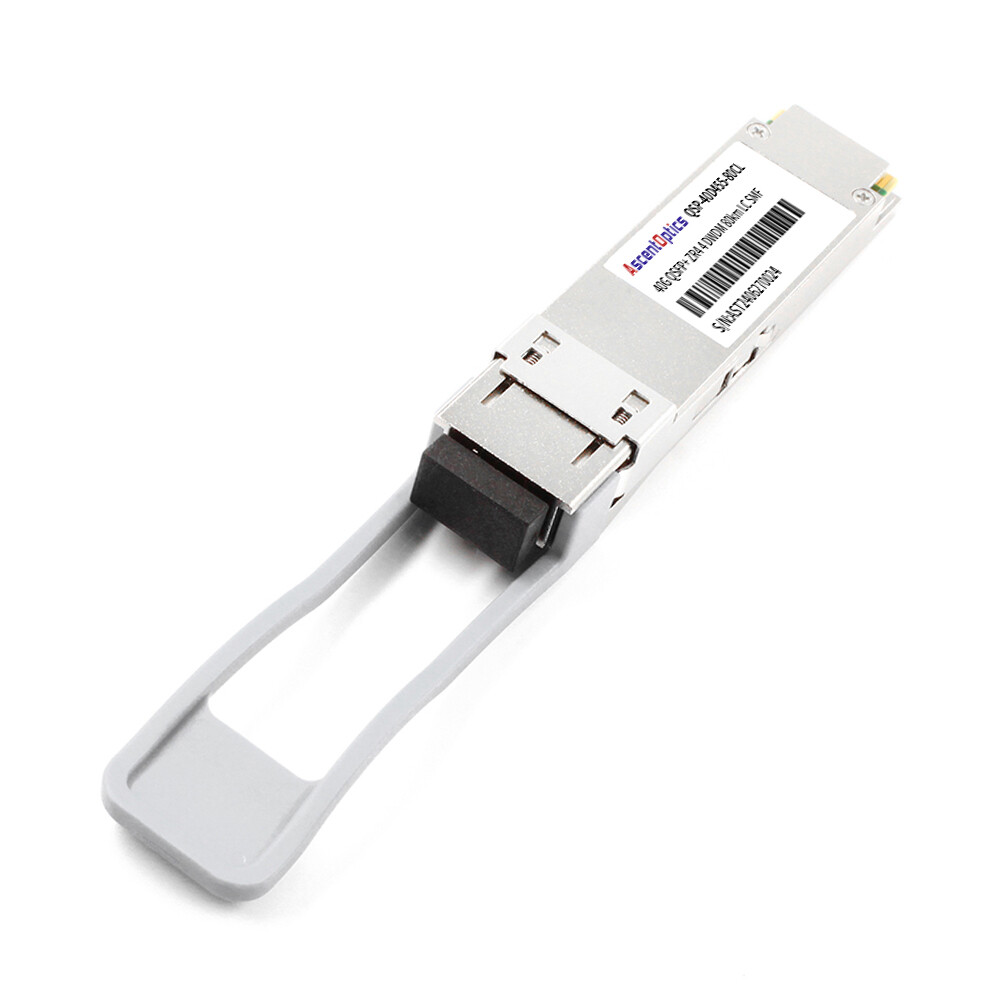
If comparing QSFP+ and QSFP28 for data center, telecom, or enterprise upgrade projects, the pros and cons are obvious. Both modules use the same physical chassis and interface specifications. However, they differ by an entire generation in terms of electrical signal transmission, power requirements, and infrastructure costs.
What QSFP+ and QSFP28 Actually Are
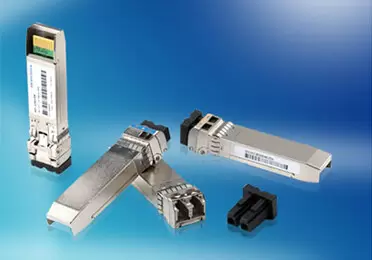
QSFP+ and QSFP28 are both hot-pluggable optical transceiver modules built around the Quad Small Form-factor Pluggable (QSFP) mechanical envelope. The “Q” stands for quad, meaning each module uses four electrical lanes to transmit and receive data simultaneously. The difference is the data transmission rate per lane.
QSFP+ (40G): The 10 Gbps-per-Lane Generation
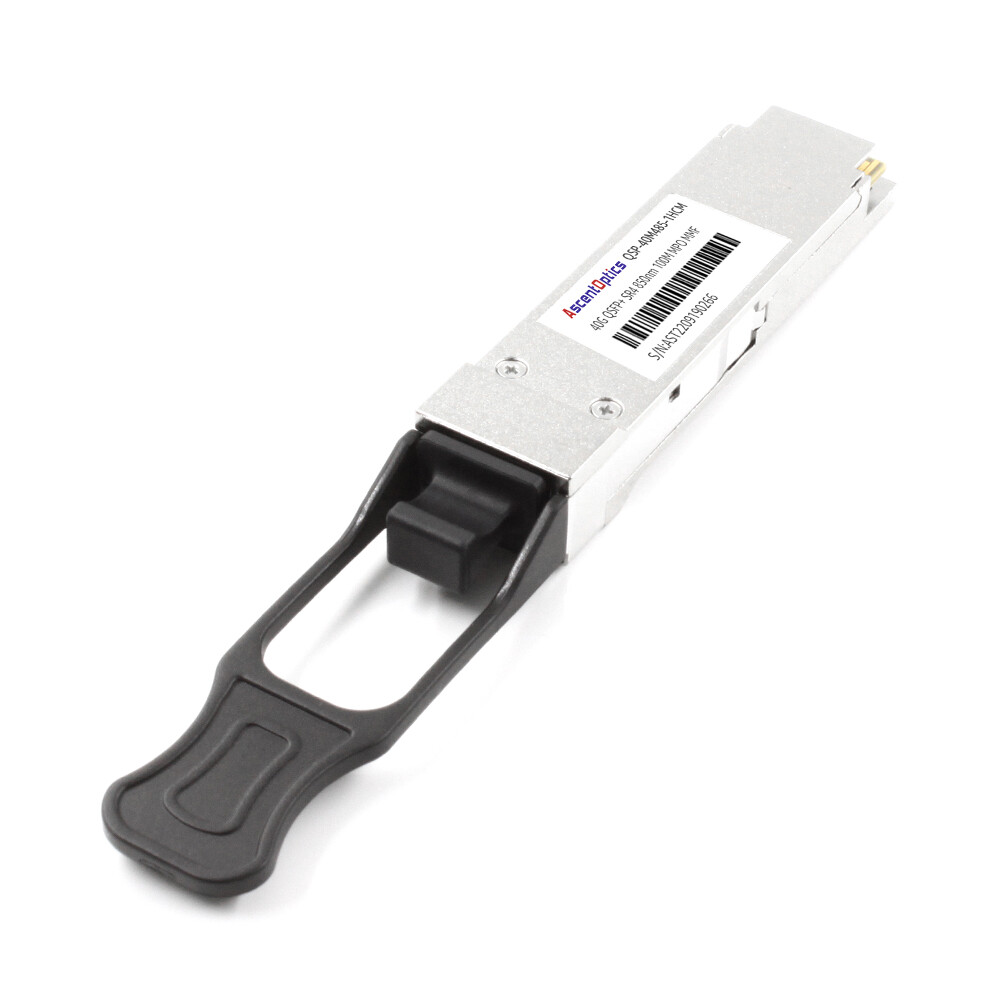
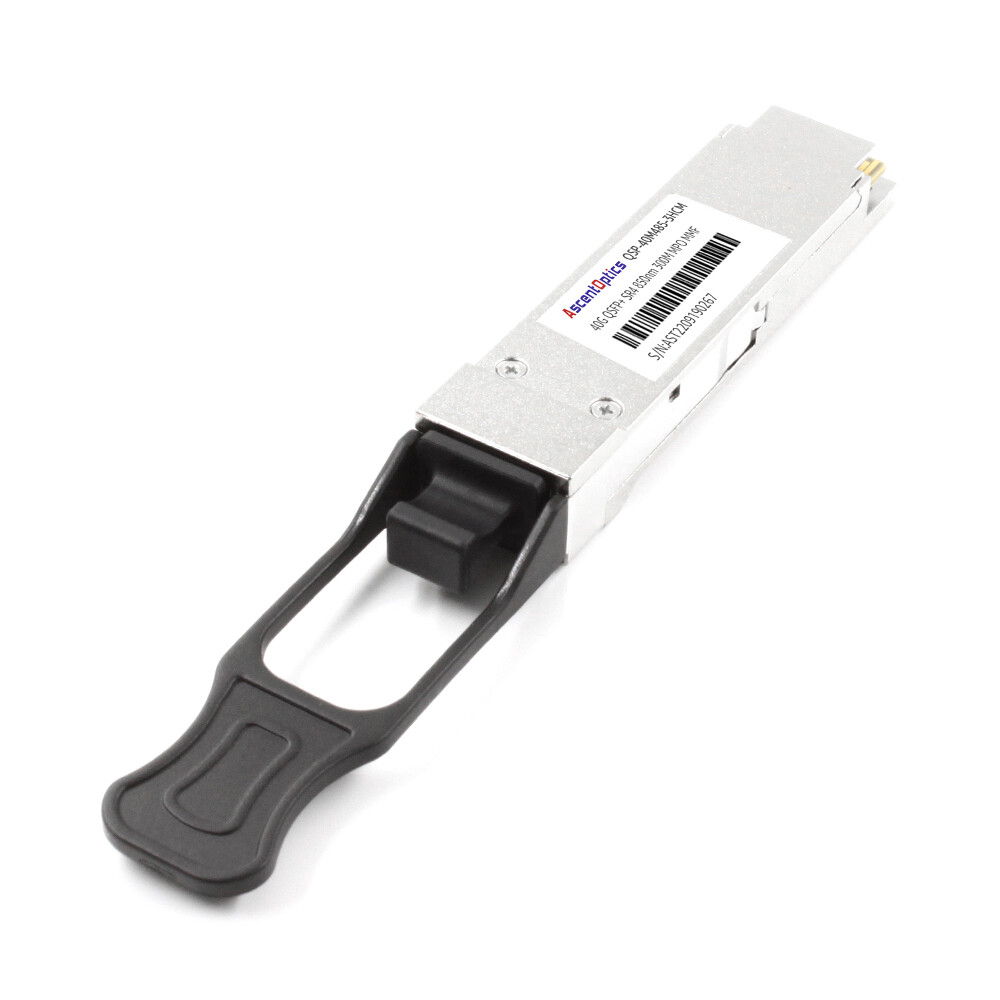
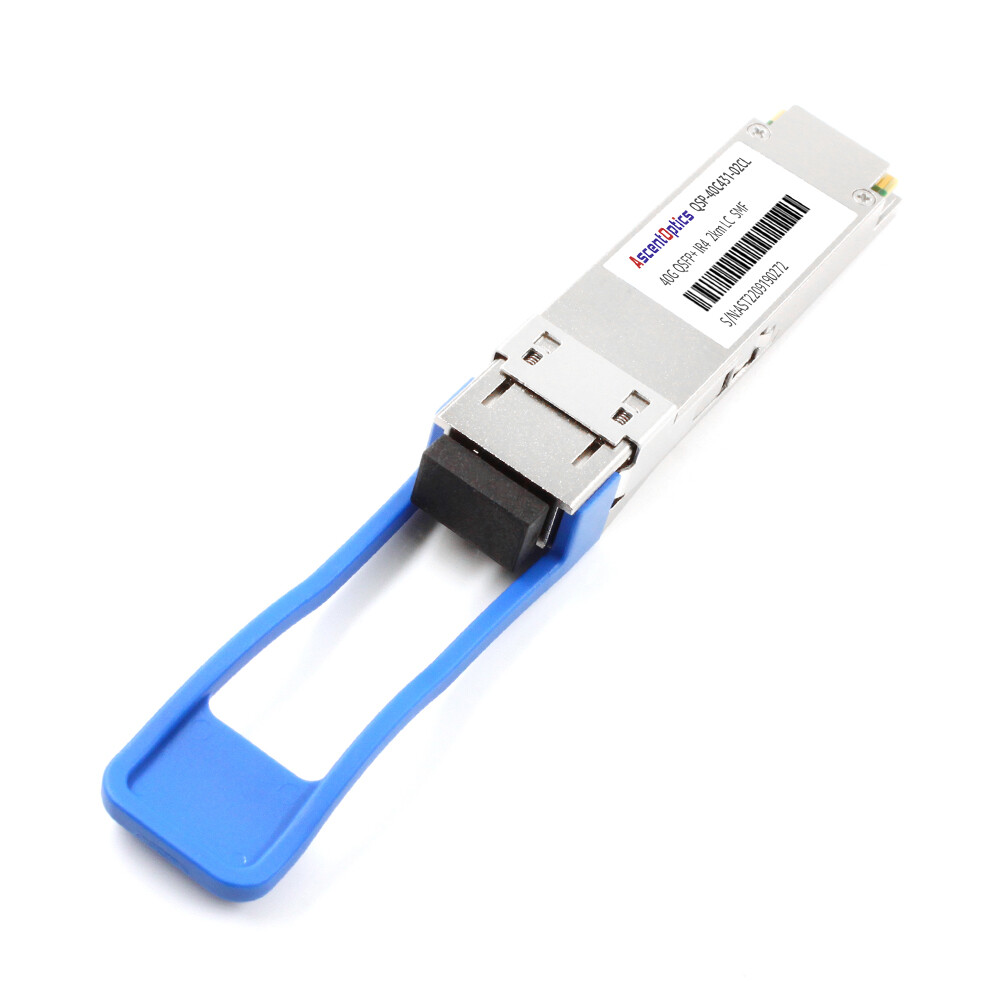
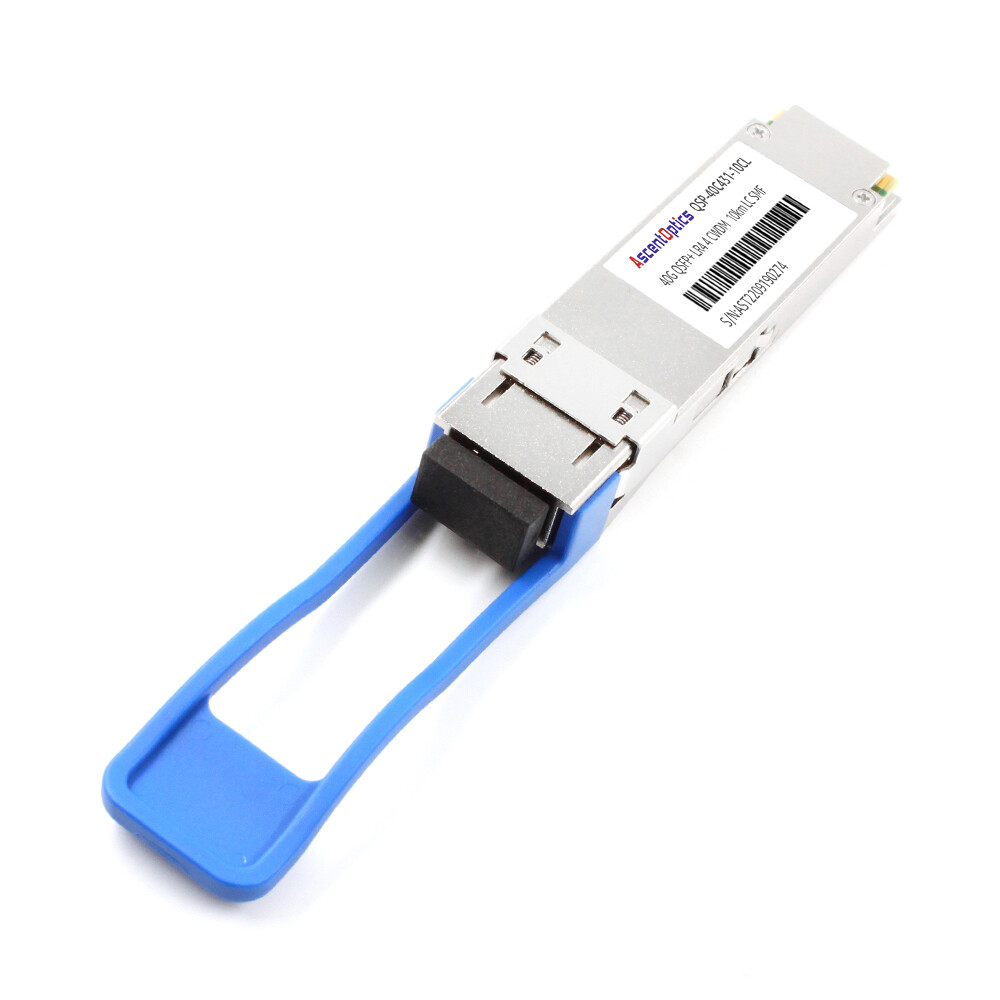
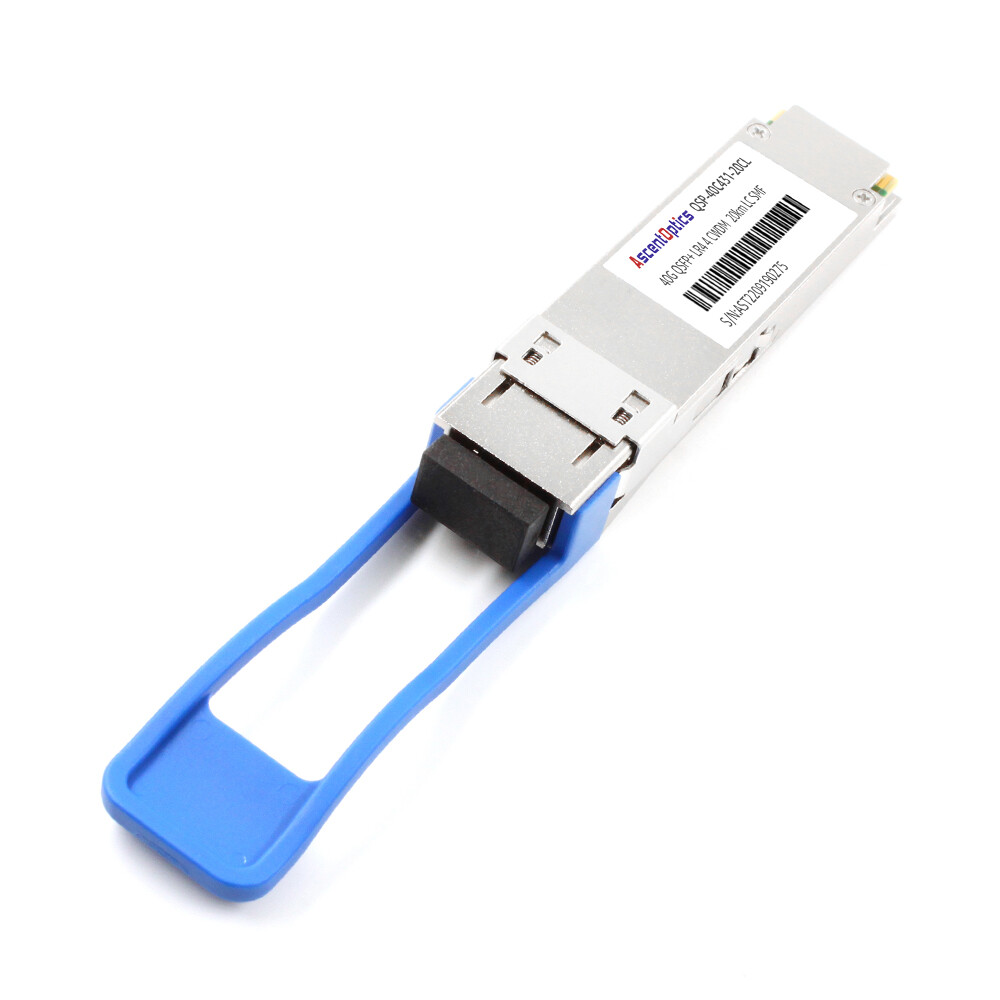
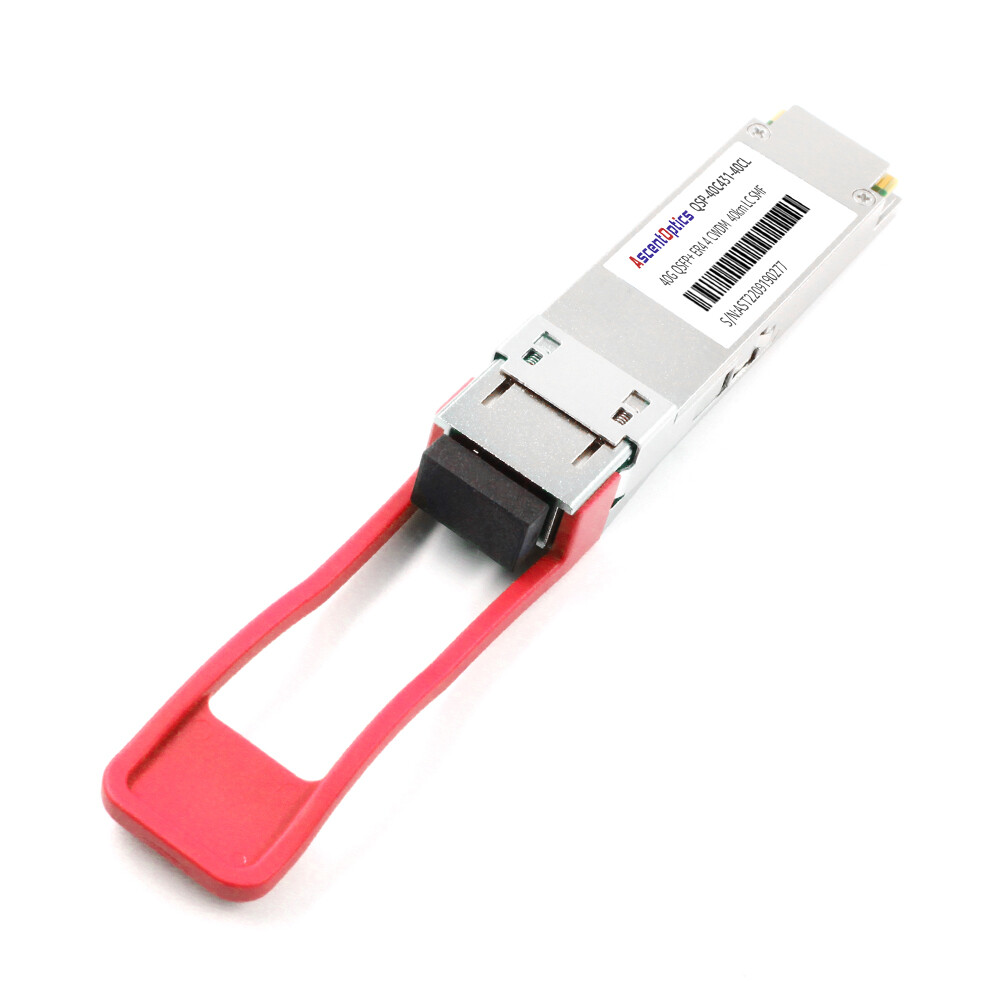
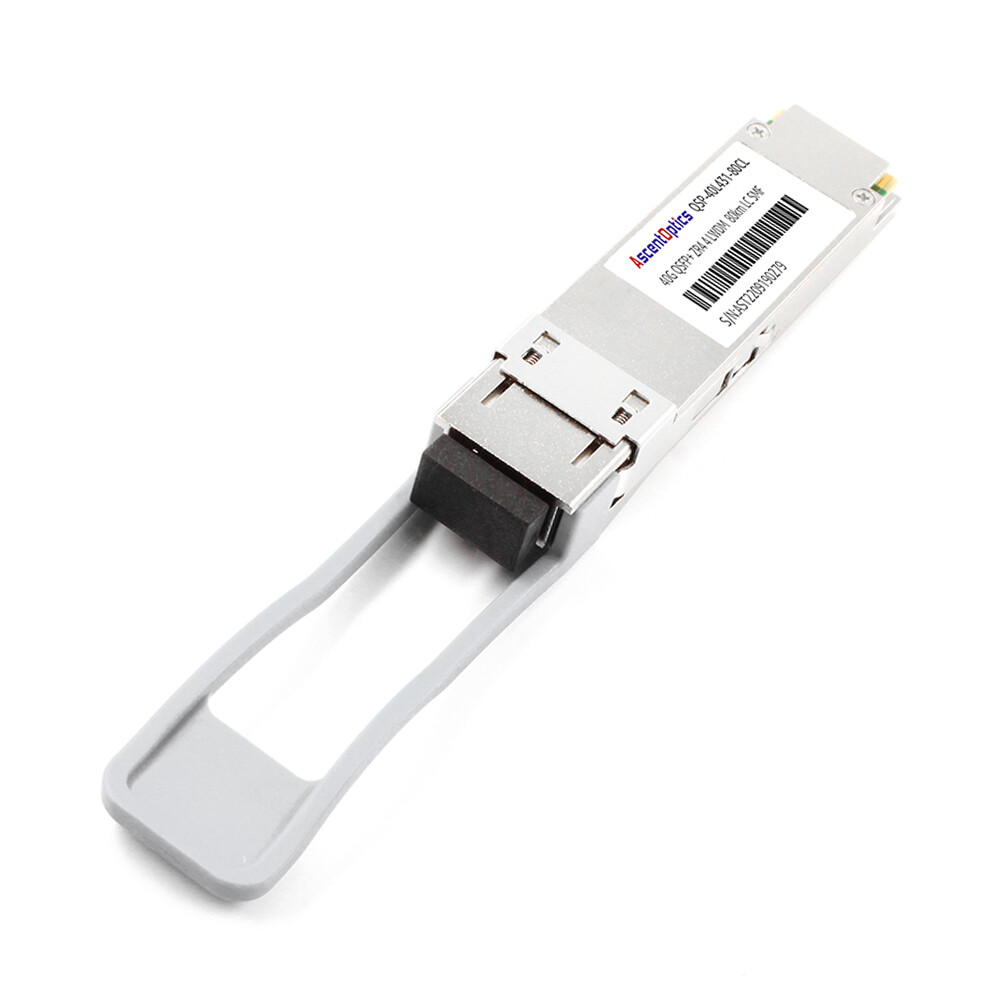
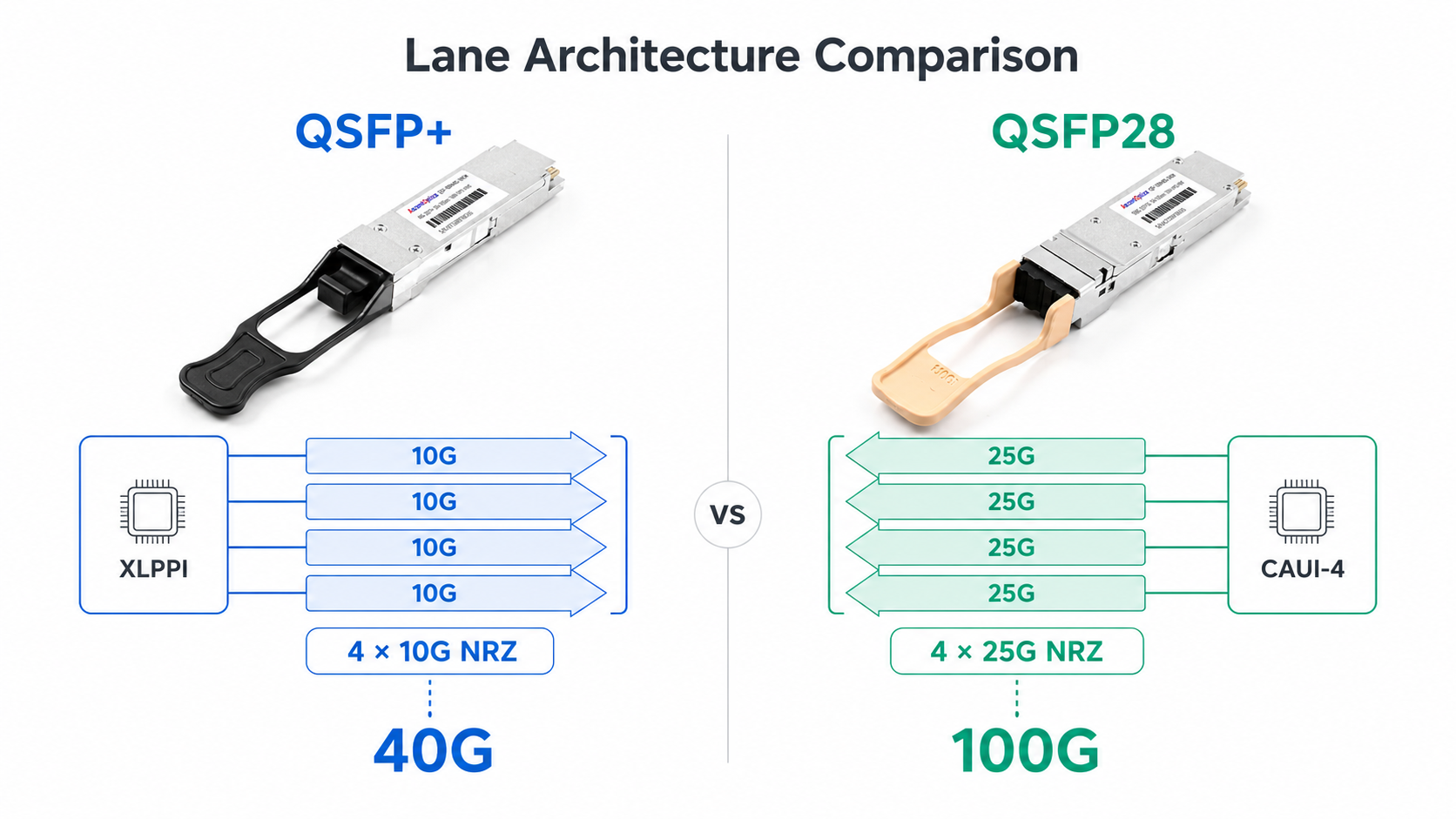
QSFP+ modules operate at four lanes of approximately 10 Gbps each, delivering a total data transmission rate of 40 Gbps. The electrical interface follows the XLPPI specification, and the form factor is governed by the QSFP+ MSA and SFF-8436. IEEE 802.3ba defines the most common optical standards, including 40GBASE-SR4 for short-reach multimode fiber and 40GBASE-LR4 for 10 km single-mode links.
Common QSFP+ module variants include:
- •40GBASE-SR4: 850 nm VCSEL, MPO/MTP-12 connector, up to 100 m on OM3 multimode fiber
- •40GBASE-LR4: 1310 nm LAN-WDM, LC duplex, up to 10 km on single-mode fiber
- •40GBASE-ER4: Extended reach, up to 40 km on single-mode fiber
- •40GBASE-BiDi: Duplex LC multimode, reuses existing 10G fiber infrastructure
QSFP+ became the dominant 40G form factor in the early 2010s and remains common in legacy data centers, enterprise aggregation switches, and telecom access nodes.
QSFP28 (100G): The 25 Gbps-per-Lane Generation
QSFP28 modules use four 25G NRZ electrical lanes (25.78125 Gbps line rate per lane), delivering an aggregate Ethernet bandwidth of 100 Gbps. The electrical interface is CAUI-4, and the form factor is governed by the QSFP28 MSA, SFF-8665, SFF-8679, and SFF-8636. 100GBASE-SR4 and the CAUI-4 electrical interface are defined in IEEE 802.3bm, while 100GBASE-LR4 and 100GBASE-ER4 trace back to IEEE 802.3ba.
Common QSFP28 module variants include:
- •100GBASE-SR4: 850 nm VCSEL, MPO/MTP-12, up to 70 m on OM3 / 100 m on OM4
- •100GBASE-LR4: 1310 nm LAN-WDM, LC duplex, up to 10 km on single-mode fiber
- •100GBASE-ER4: Extended reach, up to 40 km on single-mode fiber
- •100GBASE-CWDM4: 2 km over single-mode fiber using coarse WDM
- •100GBASE-PSM4: 500 m to 2 km over single-mode fiber with parallel optics
QSFP28 is now the mainstream 100G form factor for data center spine-leaf architectures, cloud aggregation, telecom backhaul, and high-performance computing clusters.
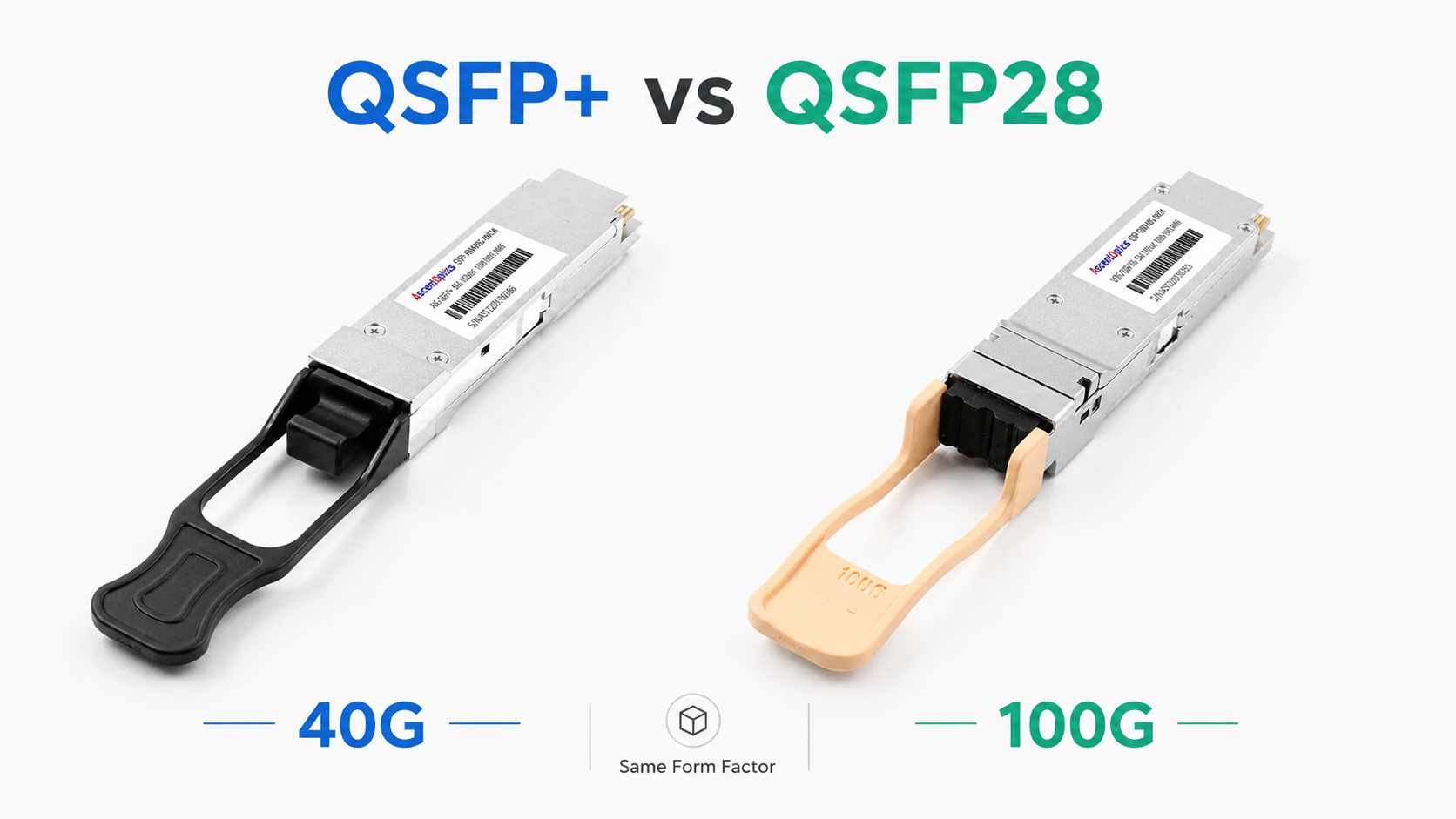
QSFP+ vs QSFP28: Technical Specification Comparison
The following table summarizes the key technical differences between the two form factors.
| Specification |
QSFP+ (40G) |
QSFP28 (100G) |
| Aggregate data transmission rate |
40 Gbps |
100 Gbps |
| Lane configuration |
4 × 10 Gbps |
4 × 25 Gbps |
| Electrical interface |
XLPPI |
CAUI-4 |
| Modulation |
NRZ |
NRZ |
| Typical power consumption |
1.5 – 3.5 W |
3.5 – 5.5 W |
| Power efficiency (typical) |
0.038 – 0.088 W/Gbps |
0.035 – 0.055 W/Gbps |
| Common connector (SR4) |
MPO/MTP-12 |
MPO/MTP-12 |
| Common connector (LR4) |
LC duplex |
LC duplex |
| Breakout option |
4 × SFP+ (10G) |
4 × SFP28 (25G) |
| Key standards |
IEEE 802.3ba, QSFP+ MSA, SFF-8436 |
IEEE 802.3ba / 802.3bm, QSFP28 MSA, SFF-8665/8679/8636 |
| Primary use case |
Legacy aggregation, 40G links |
Modern spine-leaf, 100G aggregation |
The most important takeaway from this table is that the physical envelope is nearly identical, but the electrical signaling is not. QSFP28 delivers 2.5× the bandwidth using the same four-lane architecture, which makes it more efficient per gigabit but also more demanding on host switch ASICs, power budgets, and thermal design.
Compatibility: The Question Every Engineer Asks First
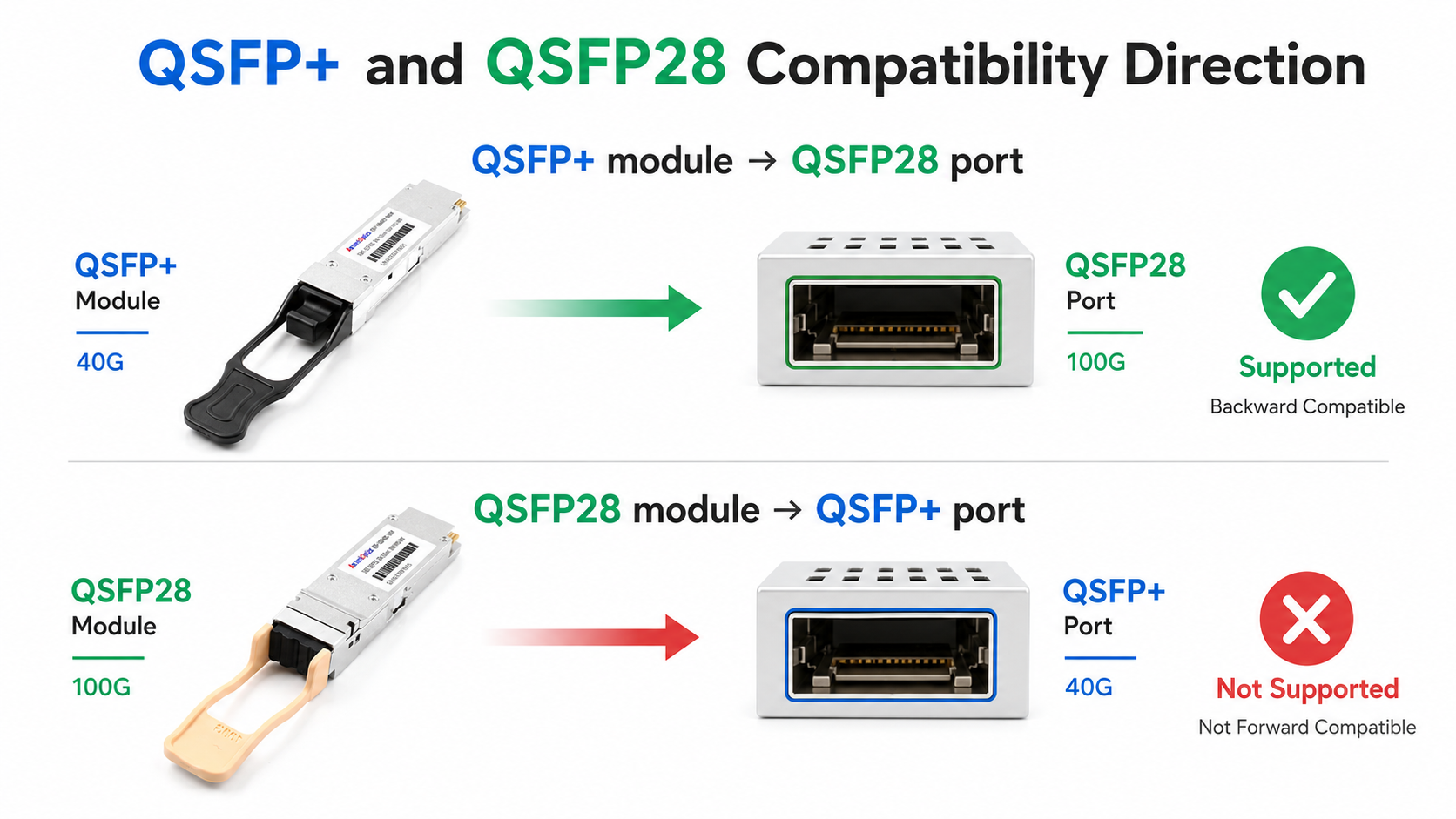
Compatibility between QSFP+ and QSFP28 is not symmetrical. Understanding the directionality will prevent expensive procurement mistakes.
Can a QSFP+ Module Work in a QSFP28 Port?
Yes. QSFP28 ports are backward compatible with QSFP+ modules. Backward compatibility depends on switch ASIC support and operating system firmware. Some platforms require manual speed configuration or may not support 40G operation on every 100G port. When you insert a QSFP+ module into a QSFP28 port, the switch typically auto-negotiates the link down to 40 Gbps. Some platforms require a manual speed configuration, so always verify the switch data sheet and firmware release notes.
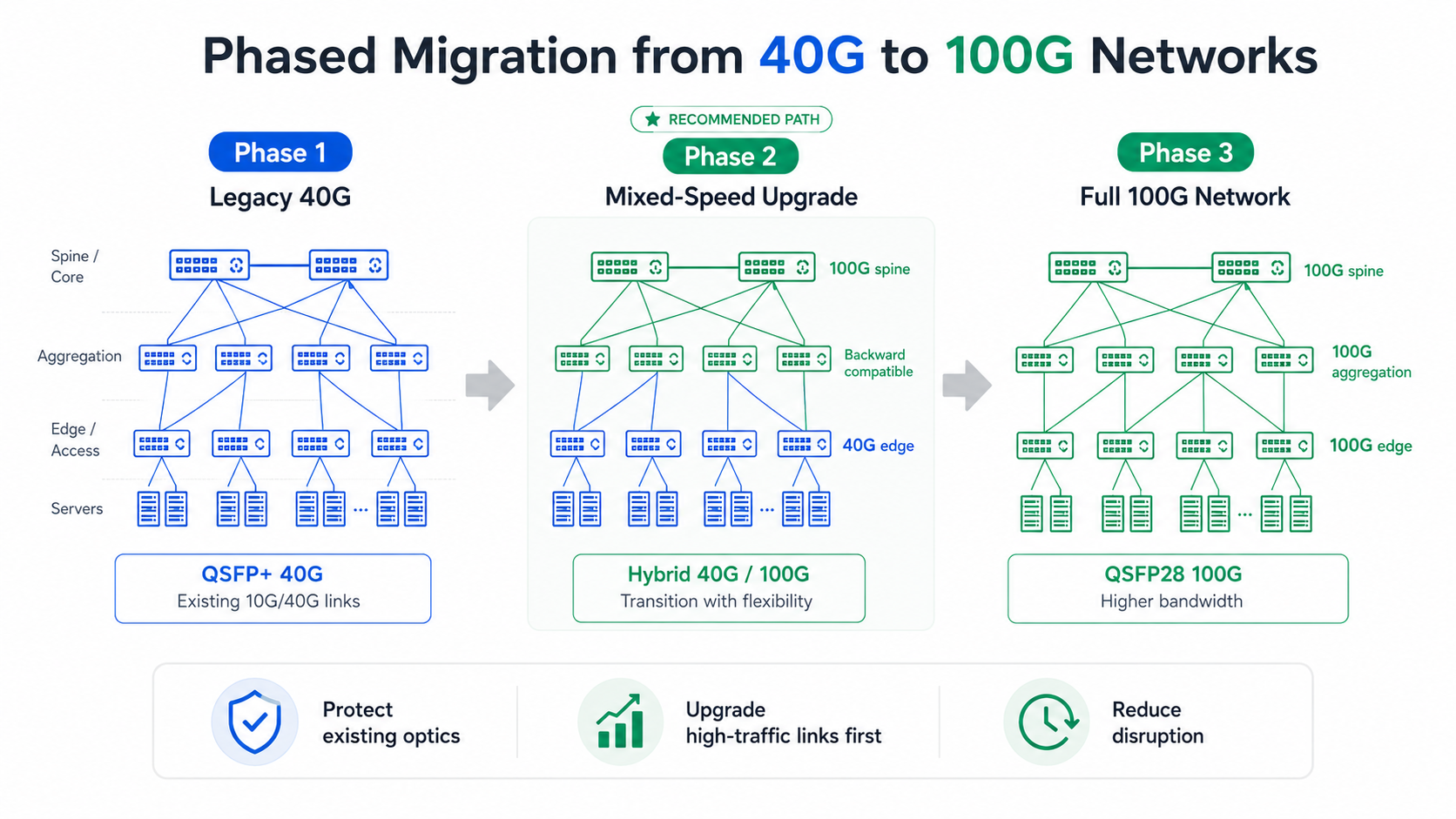
This backward compatibility is the foundation of a phased migration strategy. You can install QSFP28-capable switches today, continue running existing QSFP+ optics where 40 Gbps is sufficient, and upgrade individual links to QSFP28 later without replacing the switch.
Can a QSFP28 Module Work in a QSFP+ Port?
No. A QSFP+ port uses 10 Gbps-per-lane signaling and cannot support the 25 Gbps-per-lane electrical interface required by QSFP28. The module may fit mechanically, but the link will not come up. In some cases, the switch may log DOM errors or simply report the port as down.
This is the error that stranded the engineer in our opening scenario. The lesson is simple: physical fit does not guarantee electrical compatibility.
Breakout Cable Compatibility
Breakout cables are also generation-specific:
- •A QSFP+ breakout splits one 40G port into four 10G SFP+ connections.
- •A QSFP28 breakout splits one 100G port into four 25G SFP28 connections.
The pinouts and electrical signaling differ, so a QSFP28 breakout cable cannot be used in a QSFP+ port and vice versa. Fiber patch cables are generally interchangeable at the physical layer, but the attached transceiver and host port must match.
Power, Thermal, and Rack-Level Planning
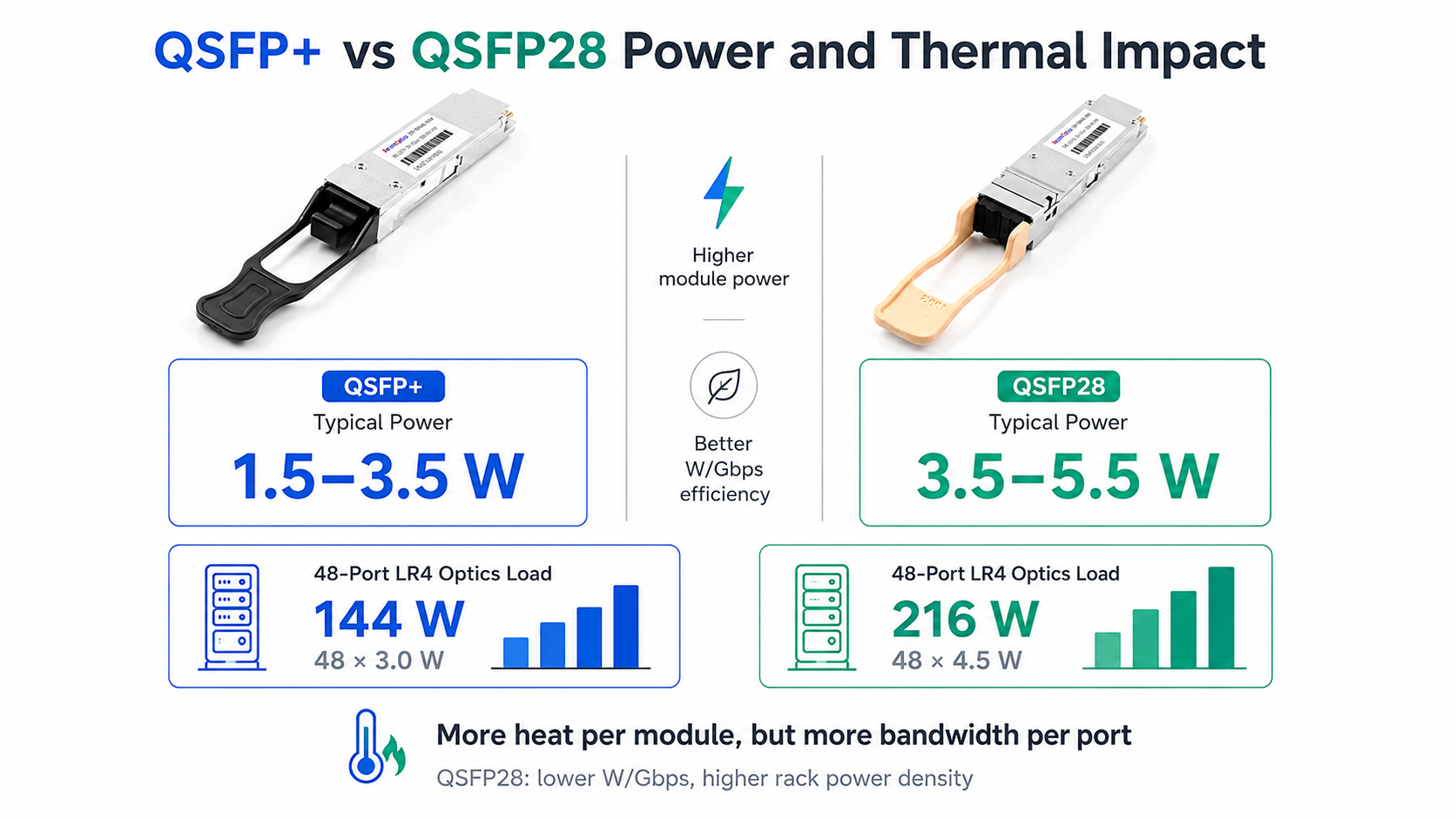
Power consumption is often the deciding factor in high-density deployments. QSFP28 modules draw more power per module than QSFP+, but they are more efficient per gigabit.
Per-Module Power Comparison
Typical power draw varies by reach and optical technology:
- •QSFP+ SR4: 1.5 – 2.5 W
- •QSFP+ LR4: 2.5 – 3.5 W
- •QSFP28 SR4 / BiDi: 3.0 – 3.5 W
- •QSFP28 CWDM4 / PSM4: 3.5 – 4.0 W
- •QSFP28 LR4: 4.0 – 5.0 W
- •QSFP28 ER4: 4.5 – 5.5 W
A single QSFP28 LR4 module might draw 1.0–1.5 W more than a comparable QSFP+ LR4 module. That difference seems small until you scale it across a full switch.
Rack-Level Thermal Impact
Consider a 48-port aggregation switch fully populated with LR4 optics:
- •QSFP+ LR4: 48 ports × 3.0 W = 144 W for optics alone
- •QSFP28 LR4: 48 ports × 4.5 W = 216 W for optics alone
Add the switch base power of roughly 450–500 W, and a fully loaded QSFP28 switch can approach 700–720 W. Eight such switches in a single rack push the cabinet toward 6 kW just for networking equipment. Cooling load converts at approximately 3.412 BTU/hr per watt, so a 700 W switch adds roughly 2,390 BTU/hr of heat.
Before you standardize on QSFP28, model your rack power and cooling budgets.
Cost and Cost-Per-Gbps Analysis
Unit price is not the right metric for comparing QSFP+ and QSFP28. The relevant metric is cost per Gbps of usable bandwidth.
Unit Price vs. Bandbang Efficiency
QSFP+ modules generally cost less per unit than QSFP28 modules. However, because QSFP28 delivers 2.5× the bandwidth in the same port, the cost per Gbps is usually lower for QSFP28 in new deployments. This is especially true when you account for switch port costs, cabling, and rack space.
For example, if a QSFP+ LR4 module costs 120 and a QSFP28 LR4 module costs 120 and a QSFP28 LR4 module costs 200, the cost per Gbps is:
- •QSFP+: 120÷40Gbps=120÷40Gbps=3.00 per Gbps
- •QSFP28: 200÷100Gbps=200÷100Gbps=2.00 per Gbps
Actual pricing fluctuates with volume, vendor, and market conditions, but the directional advantage of QSFP28 is well established. OEM-branded modules carry a significant premium, while MSA-compatible third-party optics can reduce cost by 30–70% without sacrificing performance.
Total Cost of Ownership
TCO includes more than the module price. A complete comparison should include:
- •Switch port cost per Gbps
- •Power and cooling over the equipment lifecycle
- •Cabling and patch panel infrastructure
- •Migration and labor costs
- •Future upgrade flexibility
When Marcus Chen upgraded his enterprise data center in 2024, he initially planned to buy more 40G switches because the upfront hardware cost was lower. After modeling five-year TCO, he found that QSFP28 spine switches would actually cost 18% less per Gbps when power, cooling, and avoided future forklift upgrades were included. His team deployed QSFP28 for aggregation and reused existing QSFP+ modules in backward-compatible edge switches, preserving budget for the next growth phase.
When to Choose QSFP+ vs QSFP28
The decision depends on where you are in the network lifecycle.
Choose QSFP+ When
- •You are maintaining an existing 40G network with stable bandwidth demand.
- •Budget constraints prevent a switch to a platform refresh.
- •You need short-term compatibility with legacy SFP+ server ports through a 4×10G breakout.
- •Your data center has a surplus of 40G optics and cabling already in inventory.
- •Power and cooling headroom are severely limited.
Choose QSFP28 When
- •You are building or refreshing a modern spine-leaf architecture.
- •Bandwidth demand per link exceeds 40 Gbps or is projected to grow.
- •You want lower cost-per-Gbps and better future scalability.
- •Your switch platforms support 100G and offer backward compatibility for existing QSFP+ optics.
- •You need a 4×25G breakout to connect newer servers with SFP28 interfaces.
The Mixed-Speed Middle Ground
Most real-world migrations are not binary. A common pattern is to deploy QSFP28-capable switches at the spine and aggregation layers while continuing to run QSFP+ at the edge. This staged approach lets you:
- •Preserve existing 40G optics investment
- •Upgrade high-bandwidth links first
- •Avoid a disruptive forklift replacement
- •Maintain operational consistency across the transition
Deployment Scenarios and Migration Strategy
Different network environments favor different form factors. Here is how the decision plays out in practice.
Enterprise Data Center Upgrade
Enterprise data centers often have a mix of 10G server access, 40G aggregation, and emerging 100G spine requirements. In this environment, QSFP28 at the spine layer provides headroom for east-west traffic growth, while QSFP+ can remain viable at the aggregation layer until utilization justifies replacement.
Hyperscale and Cloud Infrastructure
Hyperscale operators have largely standardized on 100G and 400G for new builds. QSFP28 remains the dominant 100G form factor, though QSFP-DD and OSFP are now taking over at 400G and above. For cloud providers, QSFP28 offers the best balance of ecosystem maturity, cost, and density.
Telecom and Service Provider Backhaul
Telecom networks value reach and reliability over raw density. QSFP28 LR4 and ER4 modules support 10 km and 40 km backhaul links, respectively, making them suitable for metro aggregation and mobile fronthaul/backhaul. QSFP+ still appears in older access nodes where 40G capacity is sufficient.
High-Performance Computing and AI Clusters
AI and HPC clusters generate massive east-west traffic between GPUs and storage. QSFP28 provides the bandwidth density needed for 100G server and storage connections, with a clear upgrade path to 200G QSFP56 and 400G QSFP-DD as budgets allow.
Modern AI clusters based on NVIDIA HGX and DGX platforms commonly use 100G, 200G, 400G, and 800G interconnects. While 400G and 800G are becoming mainstream in hyperscale AI environments, QSFP28 remains widely deployed for storage networks, management fabrics, and legacy GPU cluster interconnects.
Market Context: Why the 40G-to-100G Transition Matters in 2026
The optical transceiver market is undergoing a clear generational shift. According to Mordor Intelligence, the global optical transceiver market reached approximately USD 15.42 billion in 2026 and is projected to grow at a 13.67% CAGR to USD 29.26 billion by 2031. QSFP28 and QSFP-DD together accounted for roughly 38.7% of the market in 2025, underlining the continued importance of the QSFP form-factor family.
Verified Market Reports estimates the 100G optical module market at USD 3.2 billion in 2025, with a projected CAGR of 11.5% through 2033. While 400G and 800G modules are growing faster, 100G QSFP28 remains the workhorse for enterprise aggregation, DCI edge links, and legacy server uplinks.
For network planners, the implication is clear: 100G is no longer an emerging standard. It is the mainstream default for new aggregation and spine deployments, while 40G is increasingly a maintenance technology.
If you are evaluating migration options beyond 100G, you may also compare QSFP28 and QSFP56 architectures.
Conclusion
Although QSFP+ and QSFP28 share the same physical form factor, they represent two distinct generations of Ethernet networking. QSFP+ remains a practical solution for maintaining existing 40G infrastructure, while QSFP28 delivers significantly higher bandwidth, better cost efficiency per gigabit, and a clear path toward modern 100G architectures.
For most new deployments, QSFP28 is the preferred choice due to its widespread ecosystem support and scalability. Organizations operating legacy 40G environments can adopt a phased migration strategy by leveraging the backward compatibility of QSFP28-capable switches, enabling a smooth transition from 40G to 100G without immediate infrastructure replacement.
Frequently Asked Questions
Q1. Can I use a QSFP28 module in a QSFP+ port?
No. QSFP28 modules require a CAUI-4 electrical interface running 25 Gbps per lane. QSFP+ ports only support XLPPI at 10 Gbps per lane, so the module will not establish a link.
Q2. Can I use a QSFP+ module in a QSFP28 port?
Yes, in most cases. QSFP28 ports are backward compatible with QSFP+ modules and will negotiate down to 40 Gbps operation.
Q3. Are QSFP+ and QSFP28 the same size?
Yes. They share the same mechanical form factor, cage size, and thermal requirements. The difference is electrical, not physical.
Q4. Do QSFP+ breakout cables work with QSFP28?
No. QSFP+ breakout cables split 40G into four 10G SFP+ links. QSFP28 breakout cables split 100G into four 25G SFP28 links. The lane speeds and pin assignments differ.
Q5. Does QSFP28 require FEC?
Some 100G Ethernet deployments, particularly those using passive copper DAC cables or specific switch ASICs, may require FEC. Optical QSFP28 interfaces such as SR4, LR4, and CWDM4 typically operate without mandatory FEC requirements.
Q6. What comes after QSFP28?
QSFP56 doubles the lane speed to 50 Gbps for 200 Gbps total, while QSFP-DD uses eight electrical lanes and can support 200G, 400G, and 800G Ethernet depending on the lane speed generation. QSFP-DD retains backward compatibility with QSFP+ and QSFP28 modules.
Post Views: 1,956