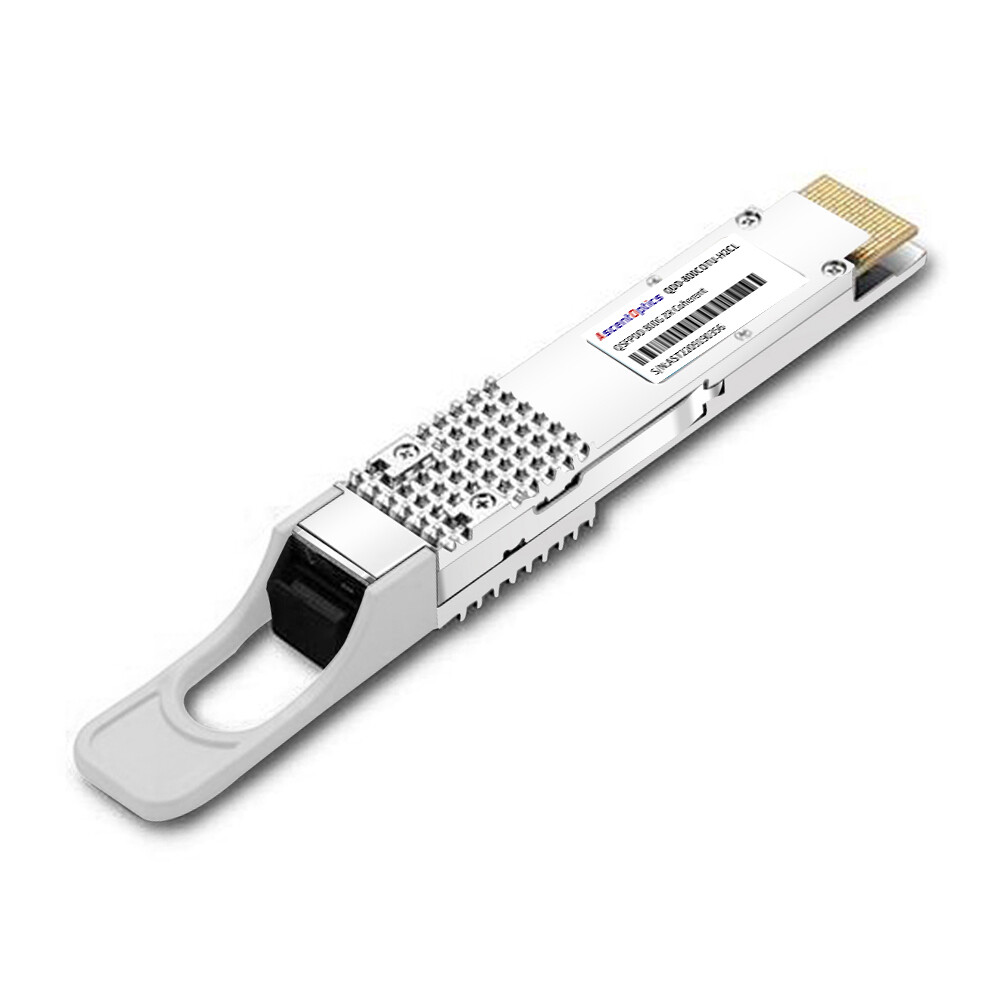
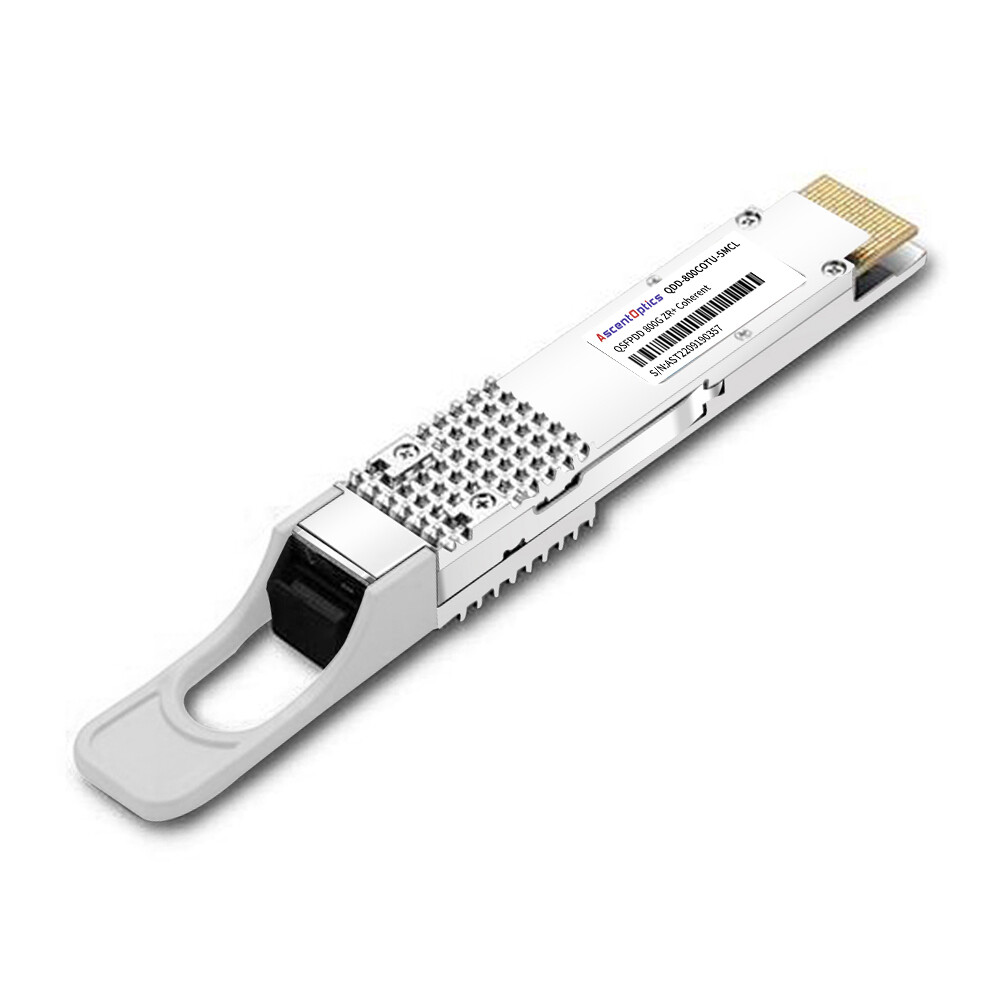
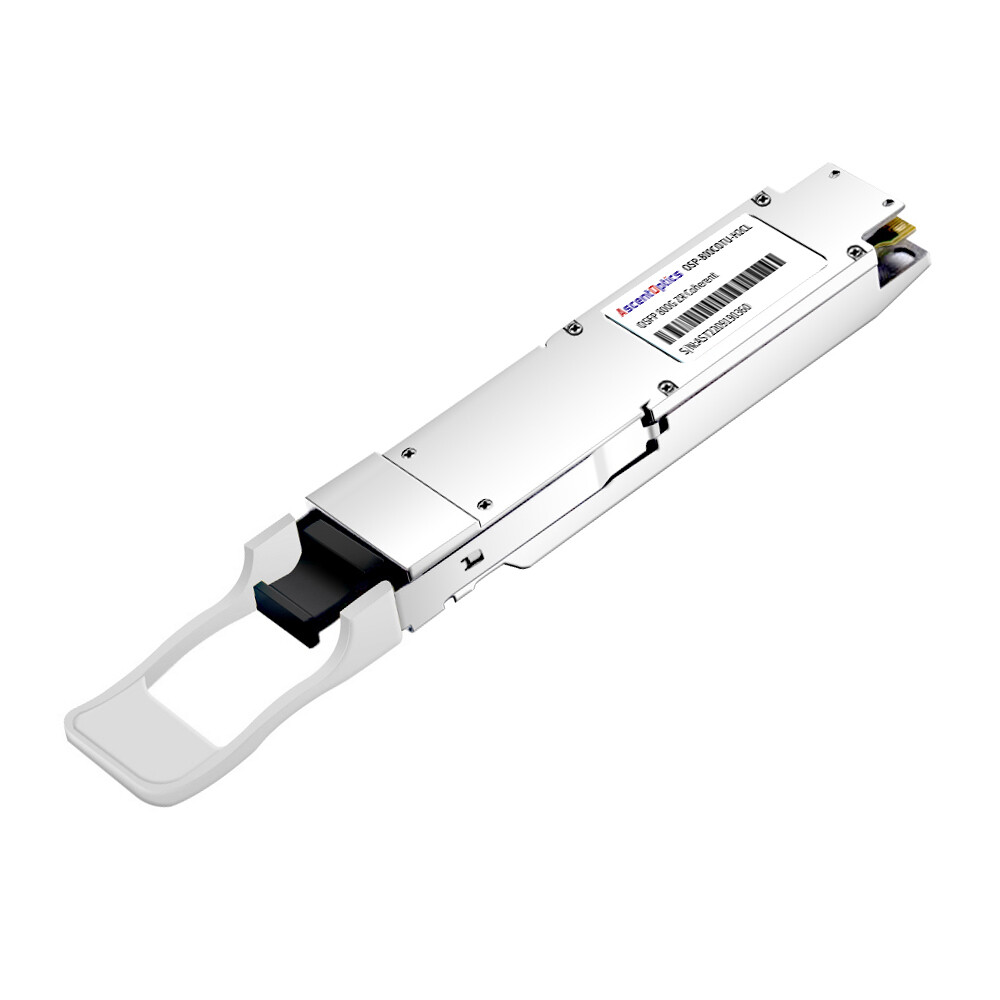
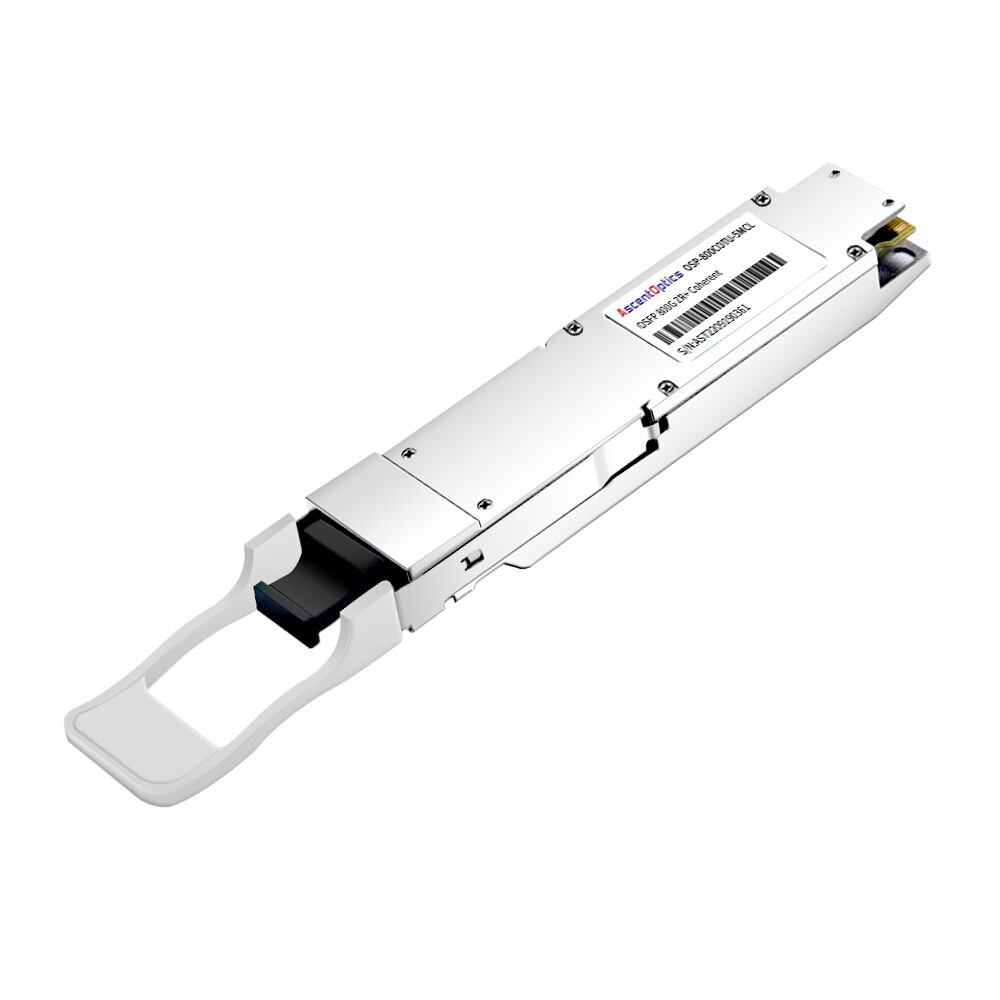
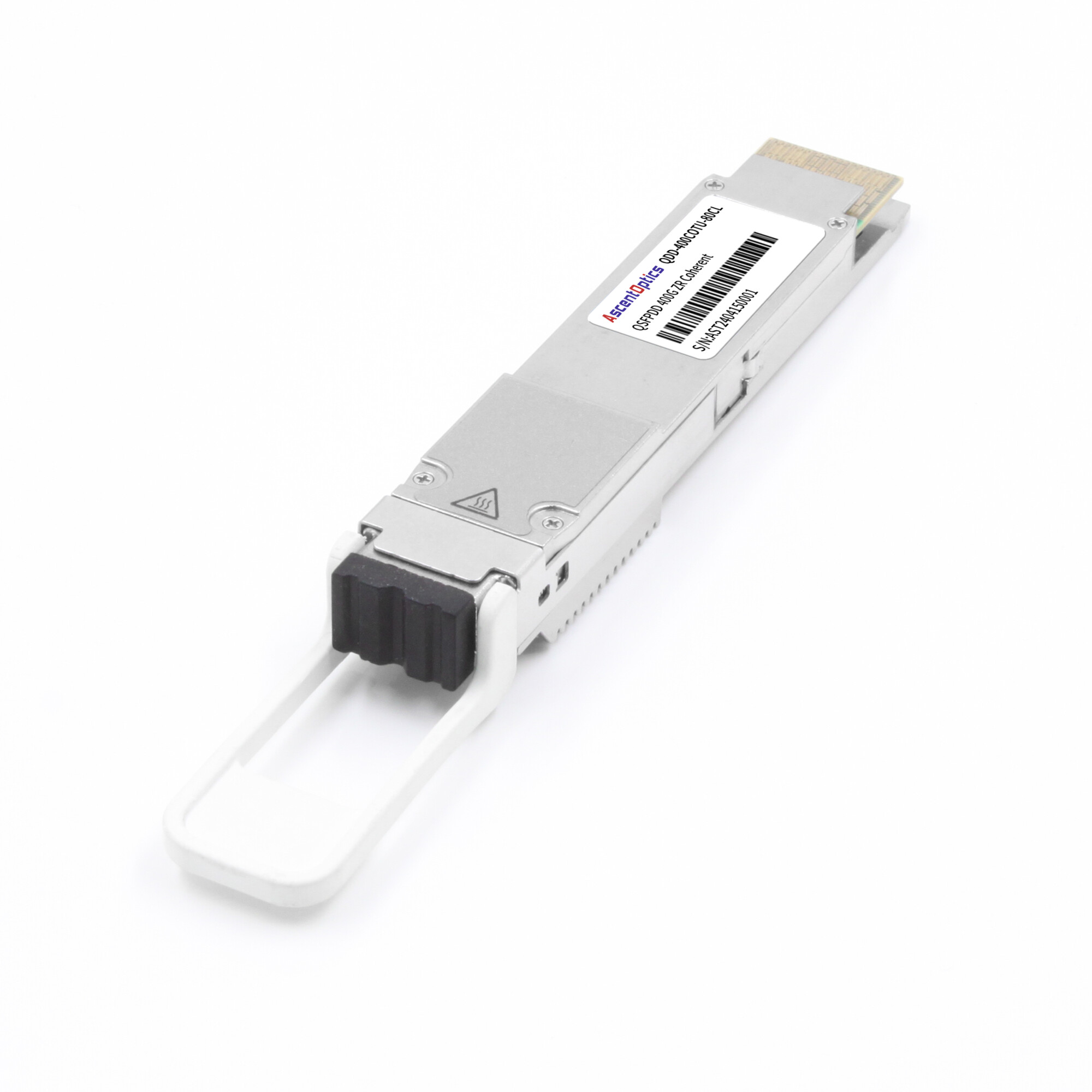
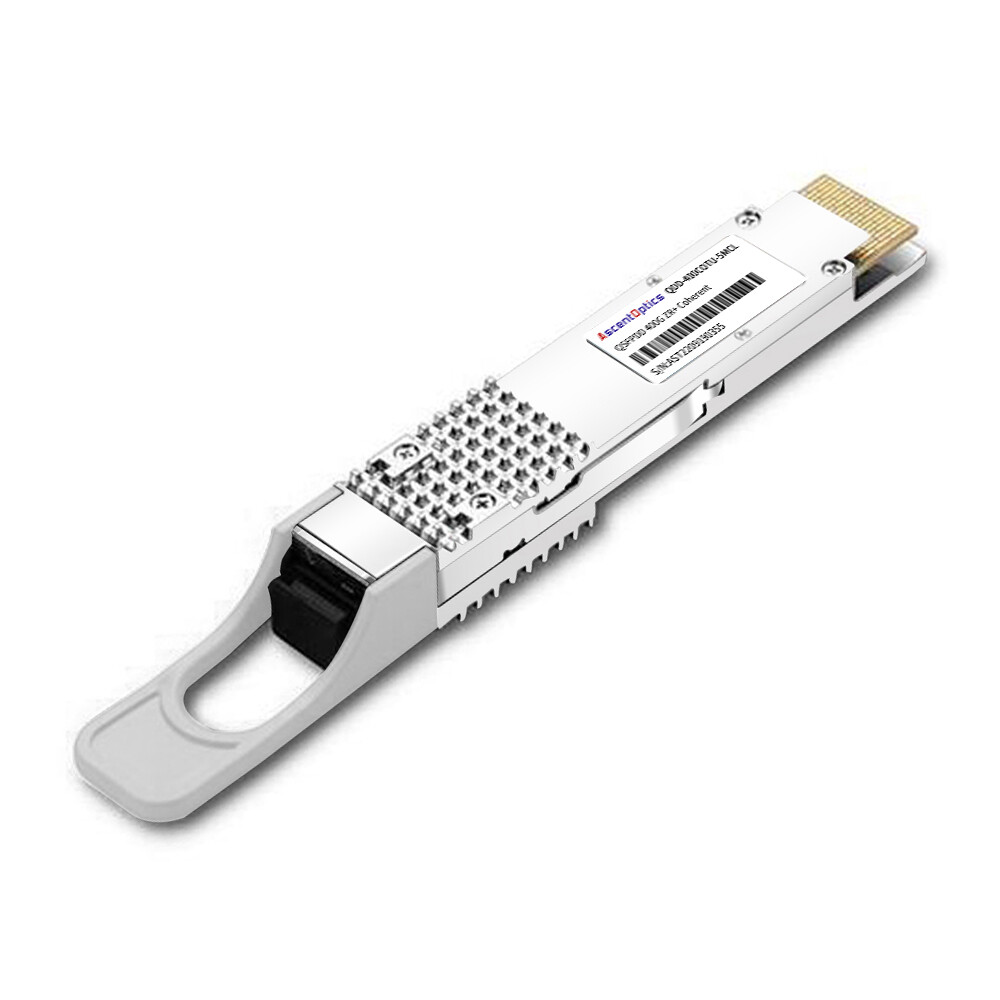
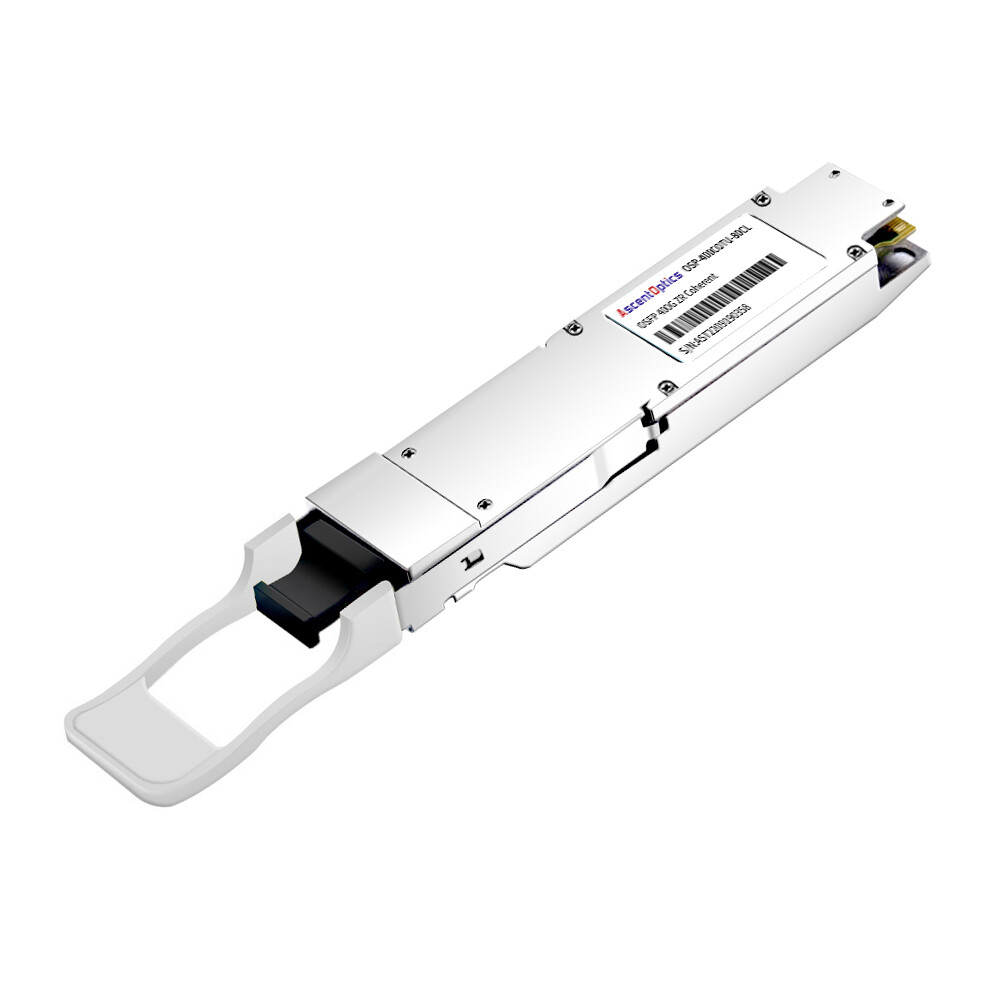
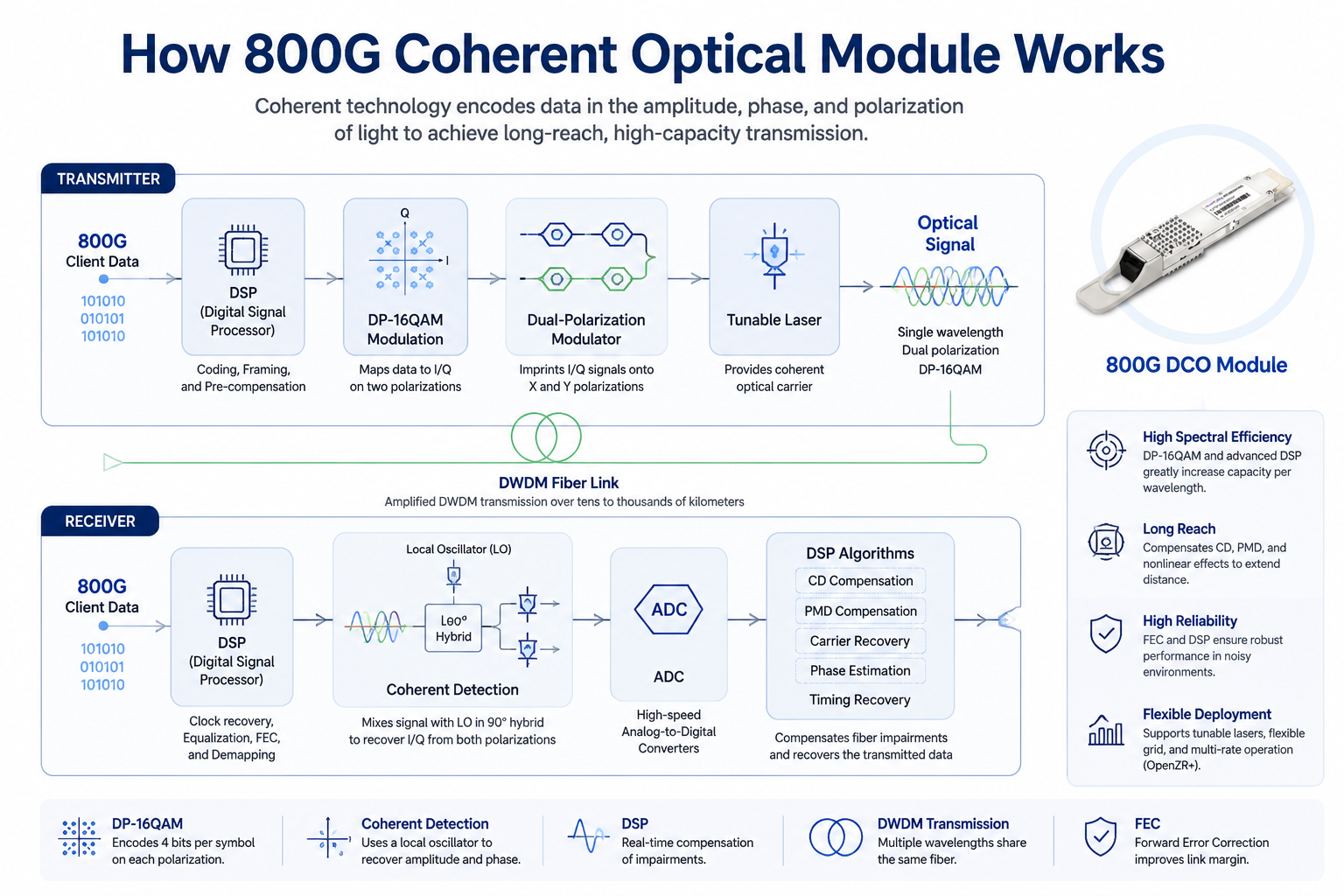
800G coherent optical modules are emerging as the core engine for upgrading Data Center Interconnect (DCI) and metro networks. Leveraging dual-polarization coherent modulation, high-speed DSP, and advanced FEC, 800G coherent modules enable 800Gb/s transmission over a single wavelength while improving spectral efficiency for metro and DCI networks.
High-performance FEC and dispersion compensation algorithms effectively mitigate impairments associated with long-distance transmission, while support for flexible grids and tunable baud rates ensures adaptability to diverse link scenarios.
What Is an 800G Coherent Optical Module?
An 800G coherent optical module is a pluggable transceiver that transmits and receives 800 Gbps over a single optical wavelength using coherent detection. Unlike direct-detect modules, which encode data only as light intensity, coherent modules also encode information in the phase and polarization of light. This approach dramatically increases spectral efficiency and allows a single wavelength to travel much farther.
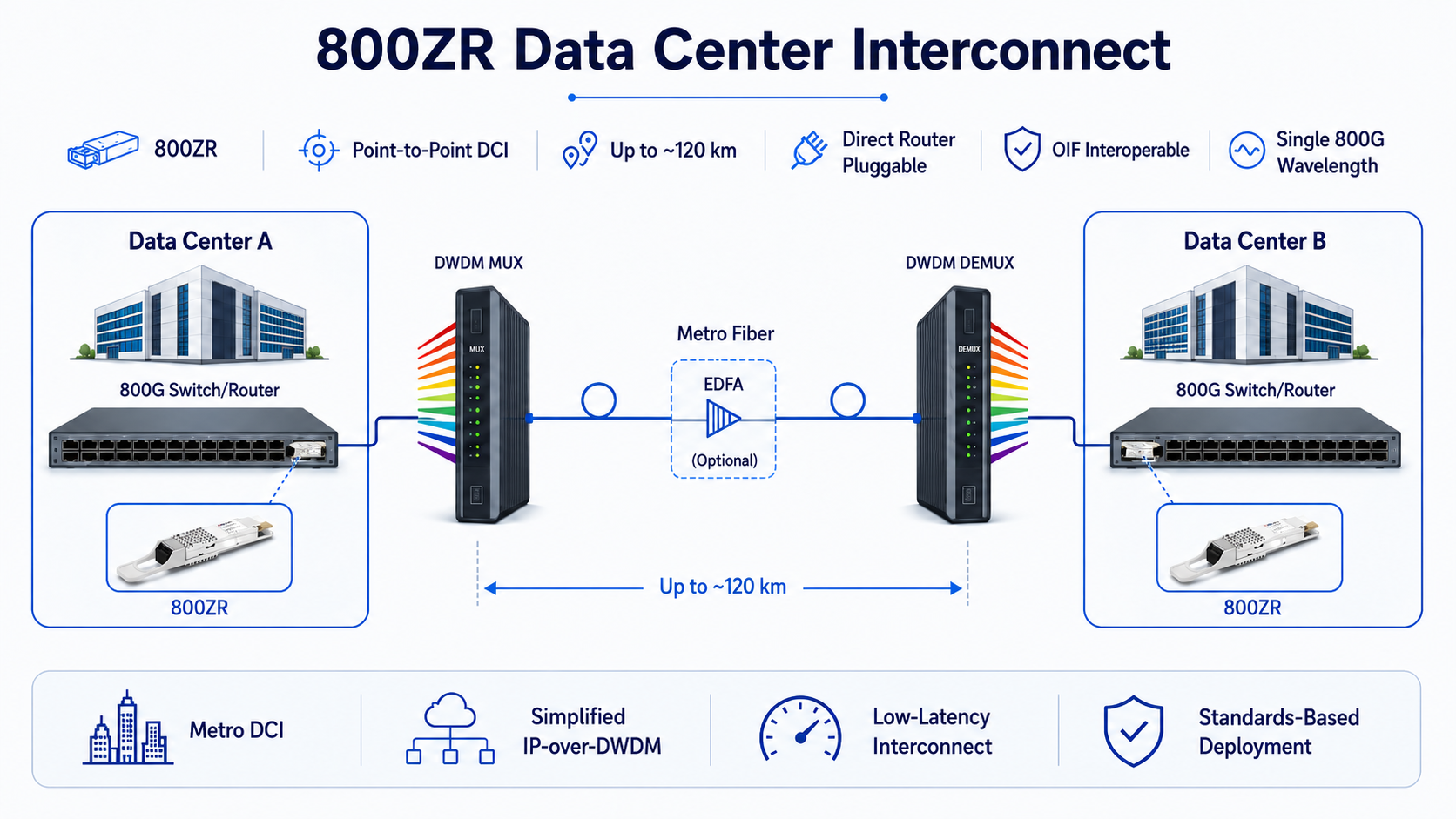
The most common implementation is 800G DCO (Digital Coherent Optics). In a DCO module, the coherent digital signal processor (DSP), tunable laser, modulator, and receiver are all integrated inside the pluggable. The host switch or router sees a standard digital electrical interface, while the module handles the complex optical modulation internally. That integration is what makes IP-over-DWDM possible: a router port can emit a DWDM-ready wavelength without a separate transponder shelf.
How Coherent Detection Works
Coherent detection encodes data in four dimensions:in-phase (I) and quadrature (Q) components on each of two polarizations. This dual-polarization architecture effectively doubles the information capacity compared with single-polarization transmission. The transmitter uses a tunable laser and a high-speed modulator to imprint the electrical signal onto the optical carrier. At the receiver, a local oscillator laser mixes with the incoming signal in a 90° optical hybrid, and balanced photodetectors recover both amplitude and phase information.
The real-time DSP inside the module then compensates for impairments such as:
- •Chromatic dispersion (CD)
- •Polarization-mode dispersion (PMD)
- •Optical signal-to-noise ratio (OSNR) degradation
- •Nonlinear effects in the fiber
Because the DSP can reverse many fiber impairments, coherent modules can operate over amplified DWDM links ranging from tens to thousands of kilometers.
800G DCO vs Direct-Detect Modules
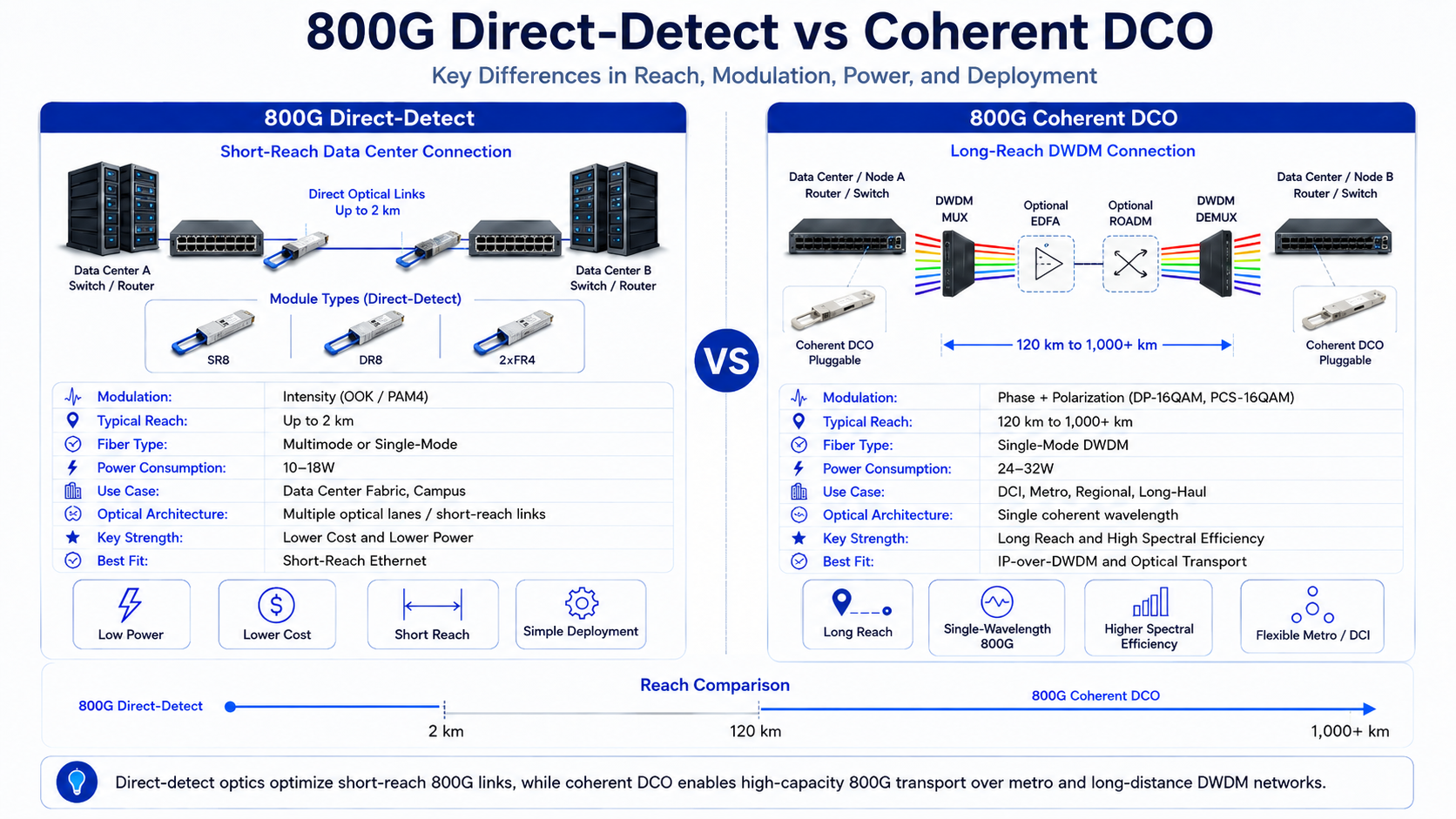
Direct-detect 800G modules, such as SR8, DR8, and 2×FR4 variants, modulate only light intensity. They are lower cost and lower power, but their reach is limited to meters or a few kilometers. An 800G DCO coherent optical module trades some power efficiency for reach: it can transmit 120 km in 800ZR mode and 1,000+ km in 800ZR+ mode.
| Attribute |
Direct-Detect 800G |
800G Coherent DCO |
| Modulation |
Intensity (OOK/PAM4) |
Phase + polarization (DP-16QAM, PCS-16QAM) |
| Typical reach |
Up to 2 km |
120 km to 1,000+ km |
| Fiber type |
Multimode or single-mode |
Single-mode DWDM |
| Power consumption |
10–18W |
24–32W |
| Use case |
Data center fabric, campus |
DCI, metro, regional, long-haul |
800G Coherent Standards and Variants
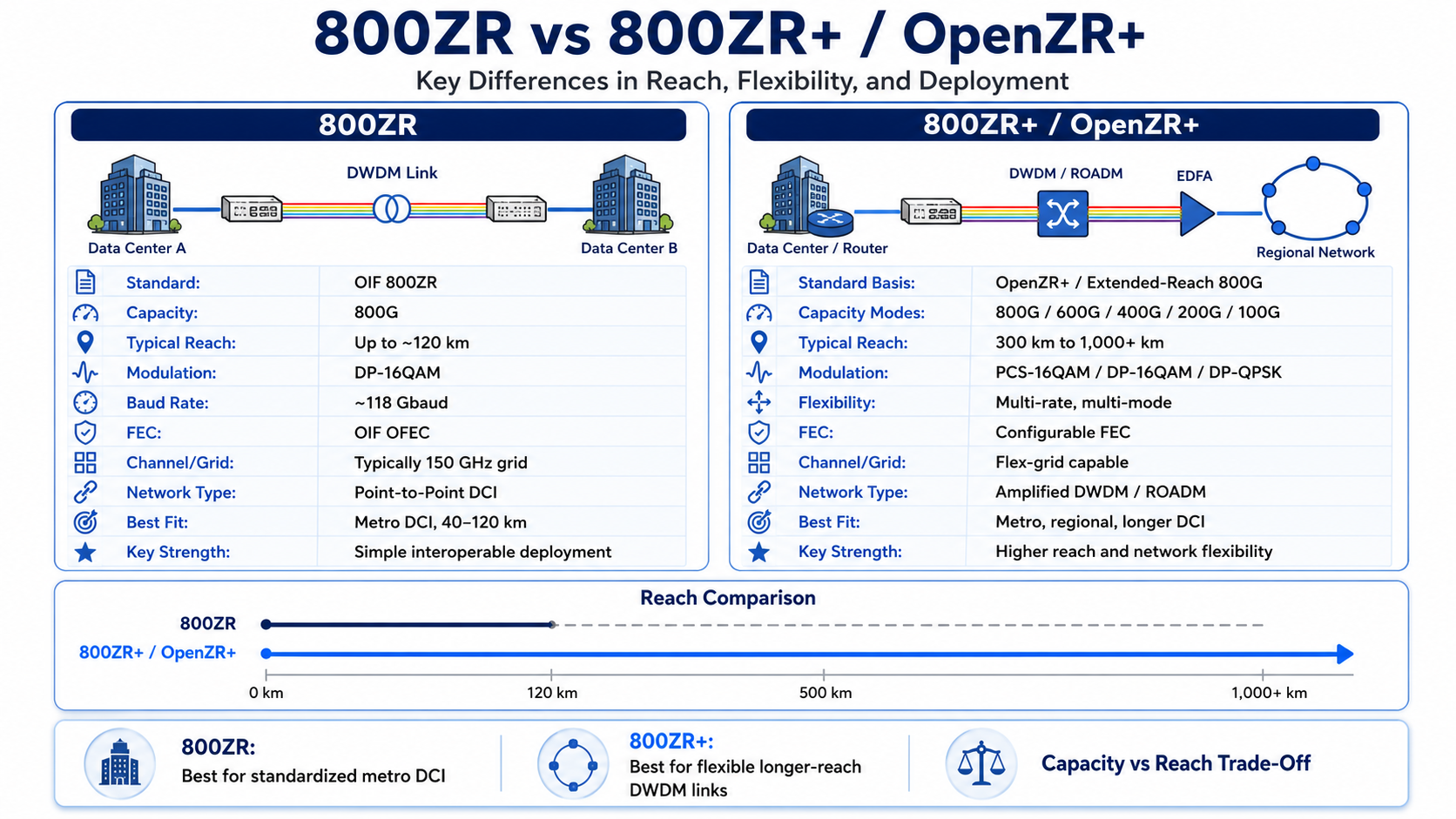
Not every 800G coherent module is built the same. Standards define the reach, modulation, baud rate, and interoperability. The two most important specifications are 800ZR and 800ZR+ / OpenZR+.
800ZR (OIF Standard)
The OIF 800ZR implementation agreement defines an interoperable 800 Gb/s coherent pluggable for amplified DWDM links up to approximately 120 km. It uses dual-polarization 16QAM (DP-16QAM) at roughly 118 Gbaud and OIF OFEC forward error correction.
800ZR is essentially the next generation of the widely deployed 400ZR standard. It keeps the same reach target while doubling capacity per wavelength, making it ideal for standard DCI links between data centers in the same metro region.
800ZR+ and OpenZR+
800ZR+ is an industry term for extended-reach 800G coherent modules based on the OpenZR+ MSA. The 800ZR+ is commonly used to describe extended-reach 800G coherent solutions based on OpenZR+ principles or implementations. These modules support multiple line rates and modulation formats, allowing operators to trade capacity for reach. Typical modes include:
- •800G for high-capacity, shorter spans
- •400G with DP-16QAM for metro distances
- •200G / 100G with DP-QPSK for long-haul and ultra-long-haul
OpenZR+ modules can reach 600–1,000+ km, and sometimes much farther at reduced rates. They also support higher transmit output power and flex-grid tuning, making them compatible with existing ROADM-based optical networks.
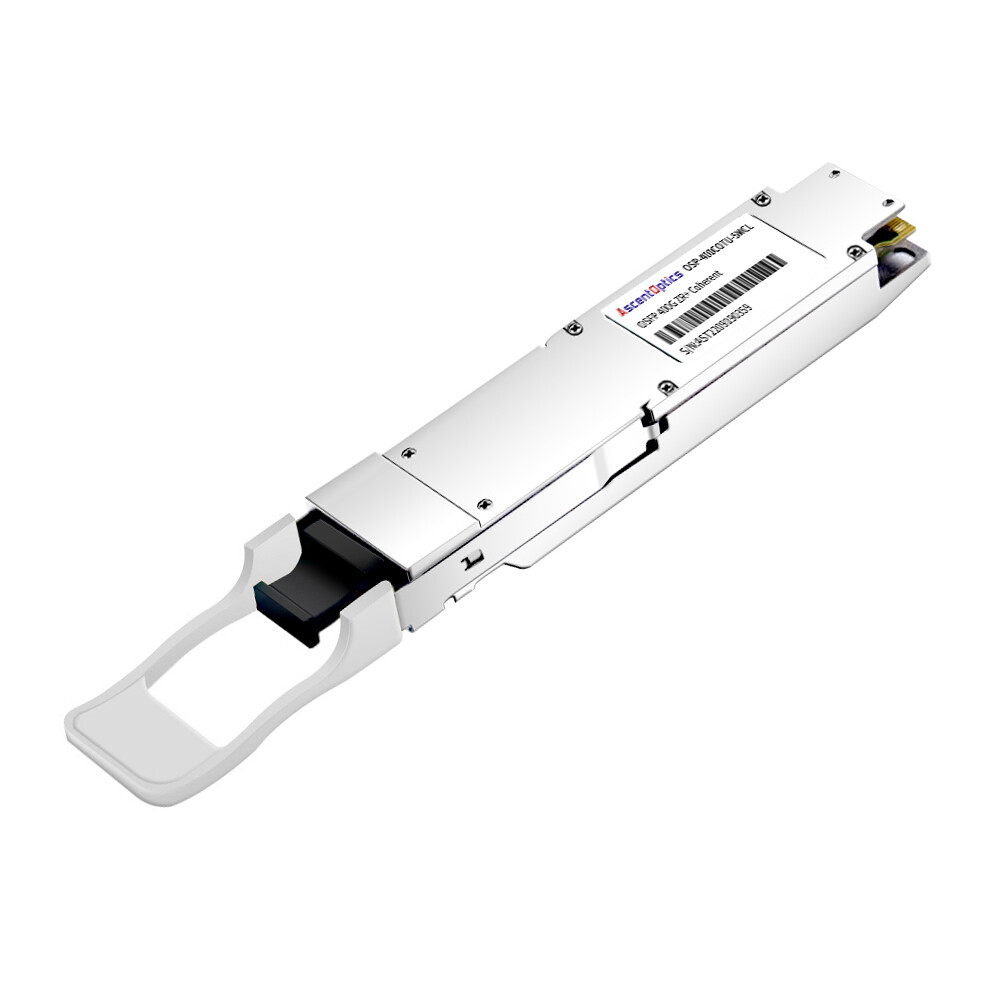
Form Factors: OSFP vs QSFP-DD
800G coherent modules are available in two main pluggable form factors:
- •OSFP (Octal Small Form-factor Pluggable): Larger thermal envelope, integrated heatsink, and better support for 25W+ modules. OSFP is increasingly preferred for 800G ZR+ because it handles heat more effectively.
- •QSFP-DD800 (Quad Small Form-factor Pluggable Double Density): Slightly higher port density in a 1RU switch, but thermal headroom is more constrained. QSFP-DD is common for 800ZR DCI deployments where power is closer to 24–25W. QSFP-DD remains attractive for operators prioritizing port density and backward compatibility with existing QSFP ecosystems.
- •CFP2-DCO: A larger, higher-power form factor still used for performance-optimized coherent modules in some telecom applications.
800G Coherent vs 400G Coherent: Key Differences
Migrating from 400G to 800G coherent is not simply a matter of doubling the line rate. The host interface, baud rate, power envelope, and form-factor preferences all change.
| Parameter |
400G Coherent |
800G Coherent |
| Line rate |
400 Gbps |
800 Gbps |
| Host SerDes |
56G PAM4 |
112G PAM4 |
| Host interface |
400GAUI-8
8 × 53.125 GBd |
800GAUI-8
8 × 106.25 GBd |
| Typical modulation |
DP-16QAM @ ~60 Gbaud |
DP-16QAM @ ~118 Gbaud |
| 800ZR / 400ZR reach |
~120 km |
~120 km |
| ZR+ reach |
300–1,000+ km |
600–1,000+ km |
| Typical power |
~8–16W |
20–32W |
| Dominant form factor |
QSFP-DD |
OSFP |
On a per-bit basis, 800G coherent modules are generally more efficient. A 25W 800G module delivers 32 Gbps per watt, while an 18W 400G module delivers 22 Gbps per watt. That efficiency matters at scale: a fully populated 32-port switch with 800G coherent modules can save significant rack-level power compared to an equivalent 400G deployment.
Technical Specifications and Performance
When evaluating an 800G coherent optical module, the datasheet tells only part of the story. The following parameters determine whether a module will work in your specific link.
Host Interfaces and Client Mapping
800G DCO modules typically support flexible client mappings:
- •1 × 800GbE
- •2 × 400GbE
- •4 × 200GbE
- •8 × 100GbE
Because the optical side is a single coherent wavelength, you cannot physically break out the optical signal with a breakout cable. Traffic separation happens electrically after the receiver DSP demodulates the carrier.
Modulation Formats and Reach
| Line Mode |
Modulation |
Typical Reach |
| 800G |
DP-16QAM |
~120 km (800ZR) |
| 800G |
PCS-16QAM |
300–500 km |
| 600G |
PCS/interop PCS |
400–700 km |
| 400G |
DP-16QAM |
600–1,000 km |
| 200G / 100G |
DP-QPSK |
1,000–2,000+ km |
Probabilistic constellation shaping (PCS) improves OSNR tolerance by shaping the modulation toward lower-energy constellation points. That can add 50–150 km of reach compared to standard 16QAM. The trade-off is reduced net data rate compared with maximum-capacity modulation modes.
Wavelength Tuning and Channel Spacing
800G coherent modules use tunable C-band lasers, and some variants also support L-band. Channel spacing depends on the mode:
- •800ZR: Typically 150 GHz grid
- •OpenZR+ / OpenROADM: Flex-grid tuning down to 6.25 GHz
Flex-grid operation is important in existing DWDM networks where spectrum is already allocated.
Power, Latency, and FEC
- •Power consumption: 24–32W depending on mode and vendor
- •Latency: Typically <1 microsecond of DSP processing latency
- •FEC: OIF OFEC for 800ZR; OpenZR+ supports configurable FEC for interoperability
Applications and Use Cases
Data Center Interconnect (DCI)
DCI is the largest application for 800G coherent optical modules. Cloud providers and enterprises use 800ZR modules to connect data centers within a metro area, typically 40–120 km apart. The ability to plug directly into router ports simplifies the network and removes standalone optical line systems.
AI and Hyperscale Networks
Distributed AI clusters are creating a new class of demand. GPU clusters sometimes span multiple buildings or campuses, requiring high-bandwidth, low-latency links. Inside large AI clusters, short-reach 800G and 1.6T direct-detect optics remain dominant. Coherent optics mainly target campus-scale and metro-scale AI interconnect. Coherent DSP latency under 1 microsecond is acceptable for most AI training workloads, and 800G per wavelength matches the bandwidth density these environments require.
Metro and Regional Transport
Telecom operators use 800ZR+ modules for metro aggregation and regional backbones. The multi-rate flexibility lets engineers optimize each span: 800G for short, high-capacity links; 400G or 200G for longer paths where OSNR is constrained.
Power, Thermal, and Deployment Considerations
Power and heat are the biggest practical constraints when deploying 800G coherent modules. A single 800ZR+ module can draw 30W or more, and a fully loaded 32-port switch can approach 900W of optical power alone.
Switch Thermal Requirements
Before ordering 800G coherent modules, verify that your switch or router supports the required power class and airflow:
- •Power class: High-power OSFP and QSFP-DD slots
- •Airflow: Typically 400–500 linear feet per minute (LFM)
- •Thermal design: Sufficient heatsink contact and chassis ventilation
OSFP generally provides more thermal headroom than QSFP-DD, which is why many 800G ZR+ deployments favor OSFP.
Link Budget and Amplification
Even with coherent DSP, every span has an OSNR budget. For 800ZR links up to 120 km, a single inline amplifier is usually sufficient. For 800ZR+ distances, engineers must account for:
- •Fiber loss and span length
- •Amplifier noise figure
- •ROADM pass-through losses
- •Required OSNR for the chosen modulation format
Compatibility and Interoperability
Multi-vendor interoperability is a key benefit of OIF 800ZR and OpenZR+. However, field interoperability still depends on:
- •Matching standards implementation (OIF 800ZR or OpenZR+)
- •Compatible firmware revisions
- •Correct CMIS management configuration
- •Consent among vendors on channel plan and amplification
How to Choose an 800G Coherent Optical Module
Selecting the right module comes down to matching your use case to the standard, form factor, and vendor. Use the following decision matrix as a starting point.
| Use Case |
Recommended Standard |
Form Factor |
Reach |
| Metro DCI, 40–120 km |
800ZR |
QSFP-DD or OSFP |
~120 km |
| Longer DCI / regional, 120–500 km |
800ZR+ / OpenZR+ |
OSFP |
300–500 km |
| Metro aggregation, flexible rates |
800ZR+ / OpenZR+ |
OSFP |
400–700 km |
| Long-haul / ultra-long-haul |
OpenZR+ at 200G/100G |
OSFP or CFP2-DCO |
1,000+ km |
| AI cluster campus interconnect |
800ZR or 800ZR+ |
OSFP |
40–120 km |
Vendor Selection Checklist
When evaluating suppliers, consider:
- 1. Standards compliance: OIF 800ZR and/or OpenZR+ MSA certification
- 2. Compatibility testing: Validation with your switch/router platform
- 3. Thermal specifications: Power draw and case temperature range
- 4. Quality assurance: Incoming inspection, burn-in, and reliability data
- 5. Supply chain stability: Manufacturing capacity and lead times
- 6. Technical support: Pre-sales engineering and post-deployment assistance
Future Outlook: 800G to 1.6T Coherent Migration
The optical industry is already moving toward 1.6T coherent pluggables. Early 1.6T coherent pluggable solutions are under development and are expected to target future high-capacity DCI and transport applications. 1.6T modules will likely use even higher baud rates, more advanced DSPs, and possibly new modulation schemes, further pushing the power-per-bit curve downward.
For network planners, this means two things:
- 1. 800G coherent is the right near-term upgrade for most DCI and metro networks.
- 2. Form-factor choices matter for future-proofing. OSFP is widely seen as the more scalable path to 1.6T because of its larger thermal envelope.
Organizations planning multi-year network refreshes should consider whether their platform choice will support future 1.6T optics without a full chassis replacement.
Conclusion
The 800G coherent optical module has become the workhorse of next-generation DCI, AI cluster interconnect, and metro transport. It doubles wavelength capacity compared to 400G coherent, supports interoperable 800ZR and extended-reach 800ZR+ standards, and plugs directly into routers and switches to simplify IP-over-DWDM architectures.
Key takeaways:
- •800ZR is the right choice for standard 120 km DCI links.
- •800ZR+ / OpenZR+ adds multi-rate flexibility and reach beyond 500 km.
- •OSFP is generally preferred for high-power 800G ZR+ modules; QSFP-DD remains viable for 800ZR DCI.
- •Power and thermal design are critical: expect 24–32W per module.
- •Vendor compatibility and quality assurance matter as much as raw specifications.
As AI networking and hyperscale DCI continue to grow, 800G coherent optics will move from early adoption to mainstream deployment. Choosing the right module now can simplify upgrades, reduce cost per bit, and prepare your network for the 1.6T era.
FAQ About 800G Coherent Optical Module
What is an 800G coherent optical module?
An 800G coherent optical module is a pluggable transceiver that uses coherent detection, advanced modulation, and DSP technology to transmit 800Gb/s over a single optical wavelength. It is mainly used for DCI, metro networks, and long-distance optical transport.
What is the difference between 800ZR and 800ZR+?
800ZR is designed for standardized 800G coherent transmission over shorter DWDM links, typically up to around 120 km. 800ZR+ and OpenZR+ extend the reach by supporting flexible modulation and line-rate options for longer metro and regional networks.
Can 800G coherent modules replace 800G SR8 or DR8 modules?
No. 800G coherent modules and direct-detect 800G modules target different applications. SR8 and DR8 are optimized for short-reach data center connections, while coherent modules are designed for longer-distance links such as DCI and metro networks.
Should I choose OSFP or QSFP-DD for 800G coherent modules?
The choice depends on the application and platform requirements. QSFP-DD is suitable for high-density 800ZR deployments, while OSFP provides more thermal headroom and is often preferred for higher-power 800ZR+ applications.
How much power does an 800G coherent optical module consume?
Most 800G coherent modules consume around 24–32W depending on the modulation mode, reach requirement, and vendor implementation. Therefore, switch thermal design and airflow capability are important considerations.
What modulation format is used in 800G coherent modules?
Most 800G coherent modules use dual-polarization 16QAM (DP-16QAM) or PCS-enhanced modulation. These formats improve spectral efficiency and enable higher capacity over existing fiber infrastructure.
Are 800G coherent modules suitable for AI networks?
Yes, but mainly for campus-scale or metro-scale AI interconnects where longer reach is required. Inside AI data centers, short-reach 800G and 1.6T direct-detect optics are typically used for GPU cluster connections.
Do 800G coherent modules require DWDM systems?
Most 800G coherent modules are designed for DWDM environments and use tunable lasers to operate on different wavelength channels. However, deployment requirements depend on the optical architecture and network design.
Post Views: 2,125