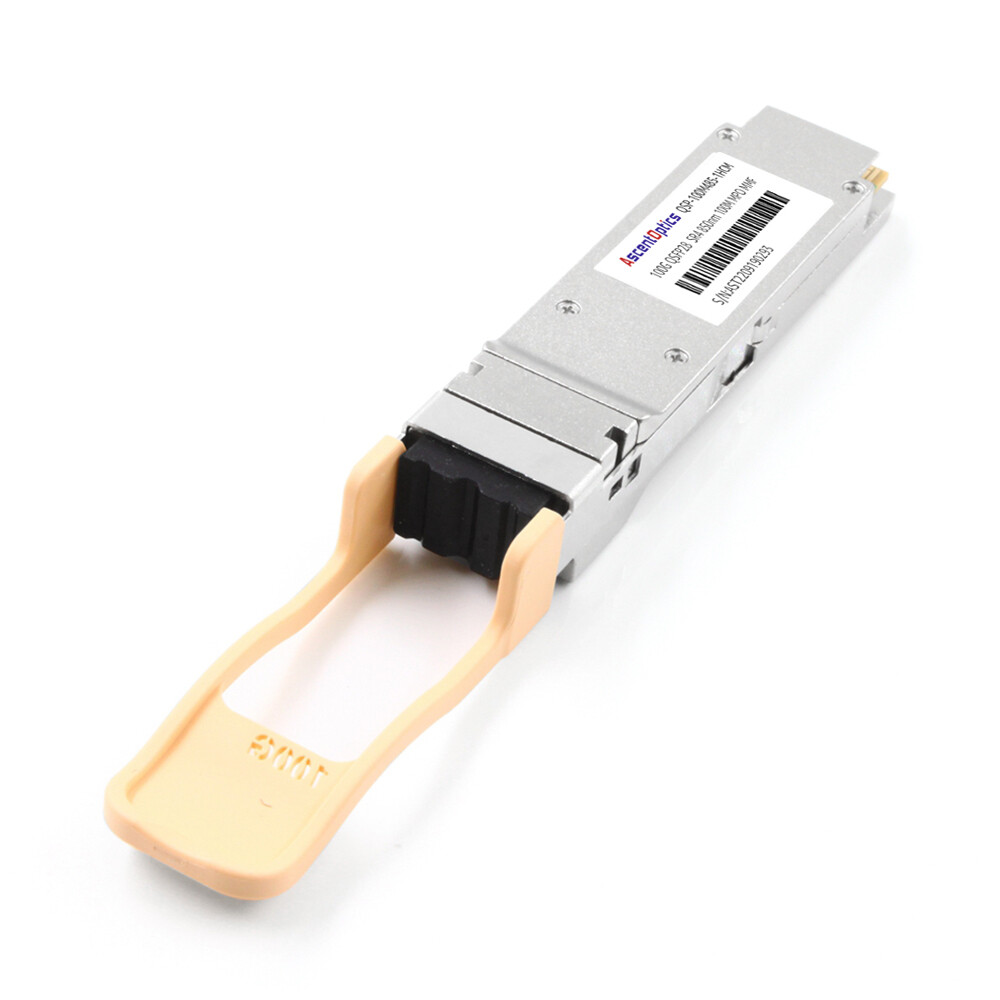
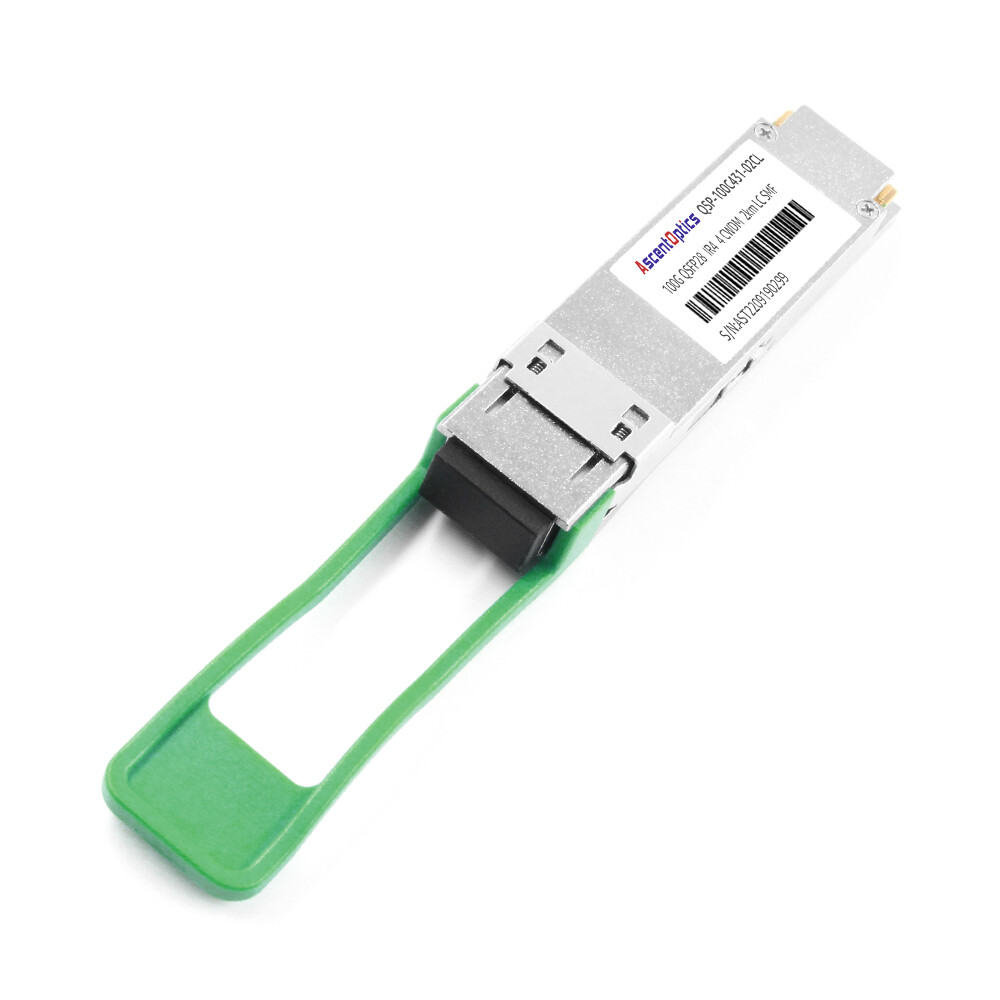
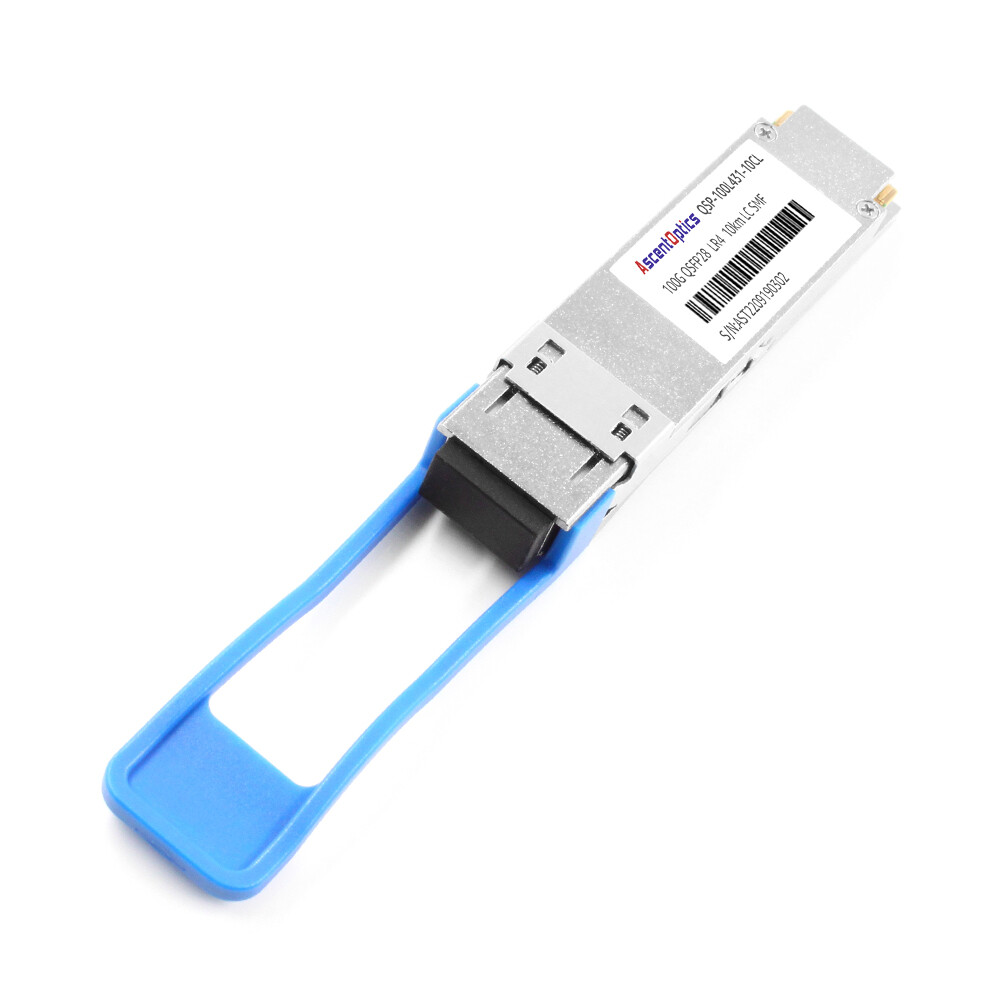
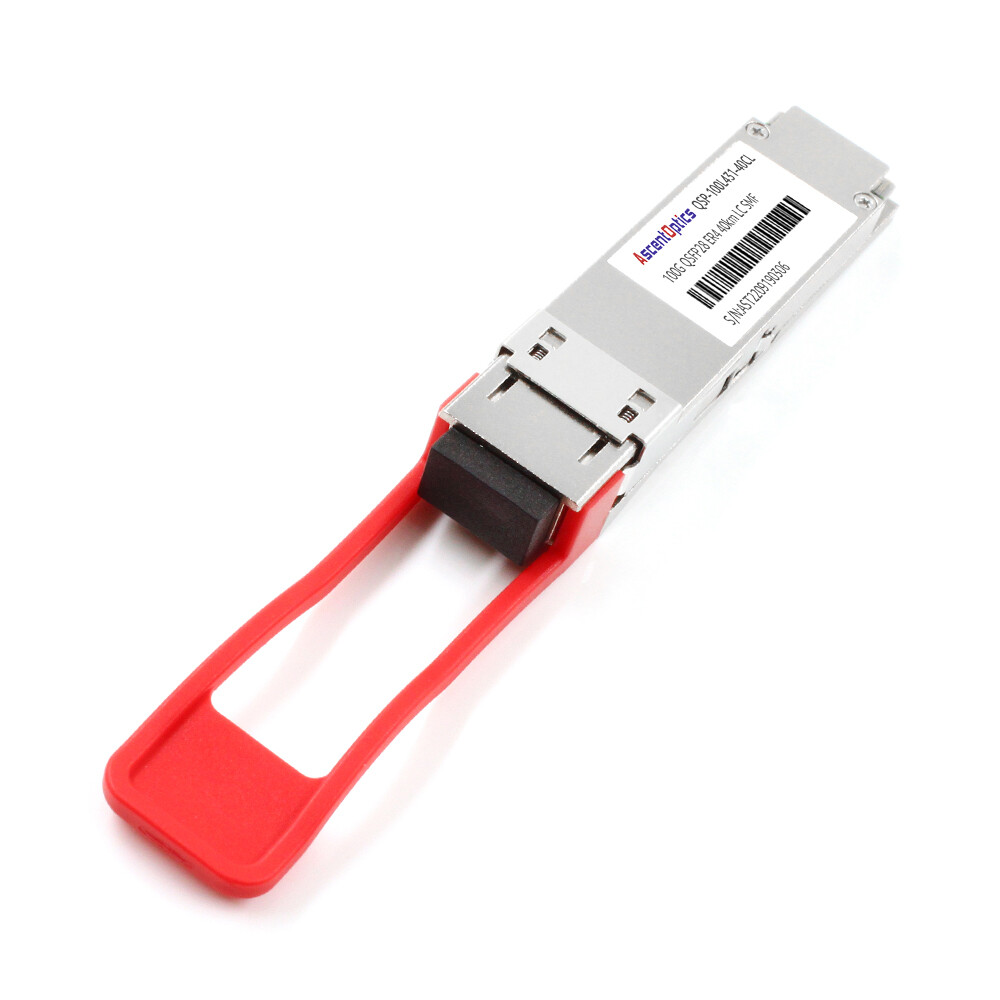
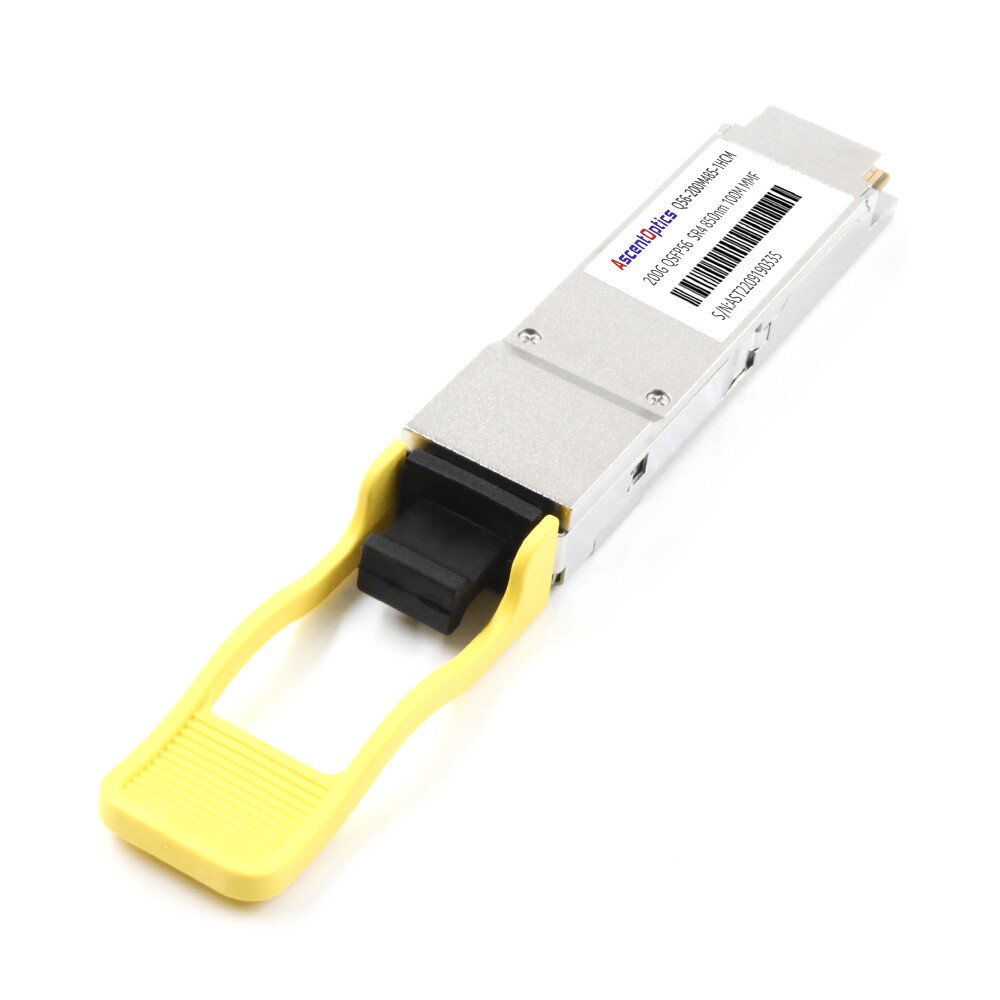
A single data center switch faceplate today might need to support 40G legacy links, 100G standard uplinks, 400G spine connections, and 800G AI cluster interfaces — all within the same rack. Network engineers who can classify QSFP module types quickly make better procurement decisions, avoid compatibility failures, and build cleaner upgrade paths.
What Is a QSFP Module?
A QSFP module, or Quad Small Form-factor Pluggable module, is a hot-swappable optical transceiver that connects switches, routers, servers, and storage over fiber optic or direct-attach copper cables. The “Quad” designation originated from the four-lane electrical architecture used by early QSFP modules. Modern QSFP variants such as QSFP-DD extend this concept by supporting up to eight electrical lanes while maintaining a similar front-panel footprint.
QSFP modules support multiple data transmission rates and protocols. They are commonly used in Ethernet, Fibre Channel, and InfiniBand environments. Their compact size allows high port density on modern networking equipment, while their pluggable design simplifies maintenance and upgrades.
Because they balance density, speed, and flexibility, QSFP modules have become the dominant optical transceiver form factor in data center networking and telecom infrastructure. If you are comparing quad-lane modules against single-lane alternatives, our QSFP vs SFP guide breaks down the density and bandwidth trade-offs.
QSFP Module Types by Form Factor and Generation
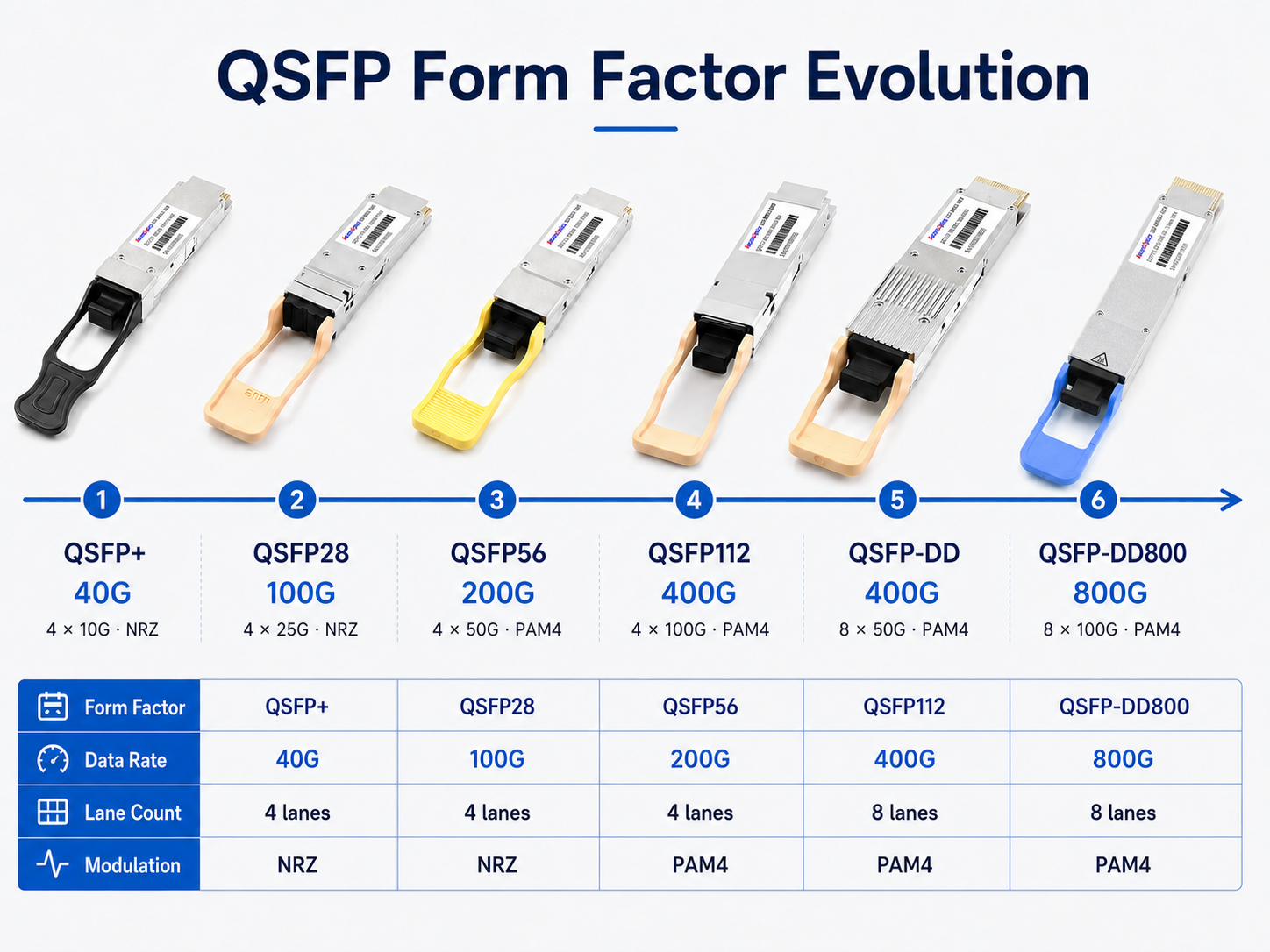
The QSFP family spans from 40G to 800G. Each generation keeps the same front-panel width or uses a backward-compatible cage, which protects hardware investment during upgrades.
| Form Factor |
Data Rate |
Electrical Lanes |
Lane Rate |
Modulation |
Common Use |
| QSFP+ |
40 Gbps |
4 |
10 Gbps |
NRZ |
Legacy aggregation, 40G Ethernet |
| QSFP28 |
100 Gbps |
4 |
25–28 Gbps |
NRZ |
Data center spine-leaf, 100G Ethernet |
| QSFP56 |
200 Gbps |
4 |
50 Gbps |
PAM4 |
AI/HPC, cloud upgrades |
| QSFP112 |
400 Gbps |
4 |
100 Gbps |
PAM4 |
Compact 400G high-density switches |
| QSFP-DD |
400/800 Gbps |
8 |
50/100 Gbps |
PAM4 |
Hyperscale, AI clusters, DCI |
QSFP+ (40G)
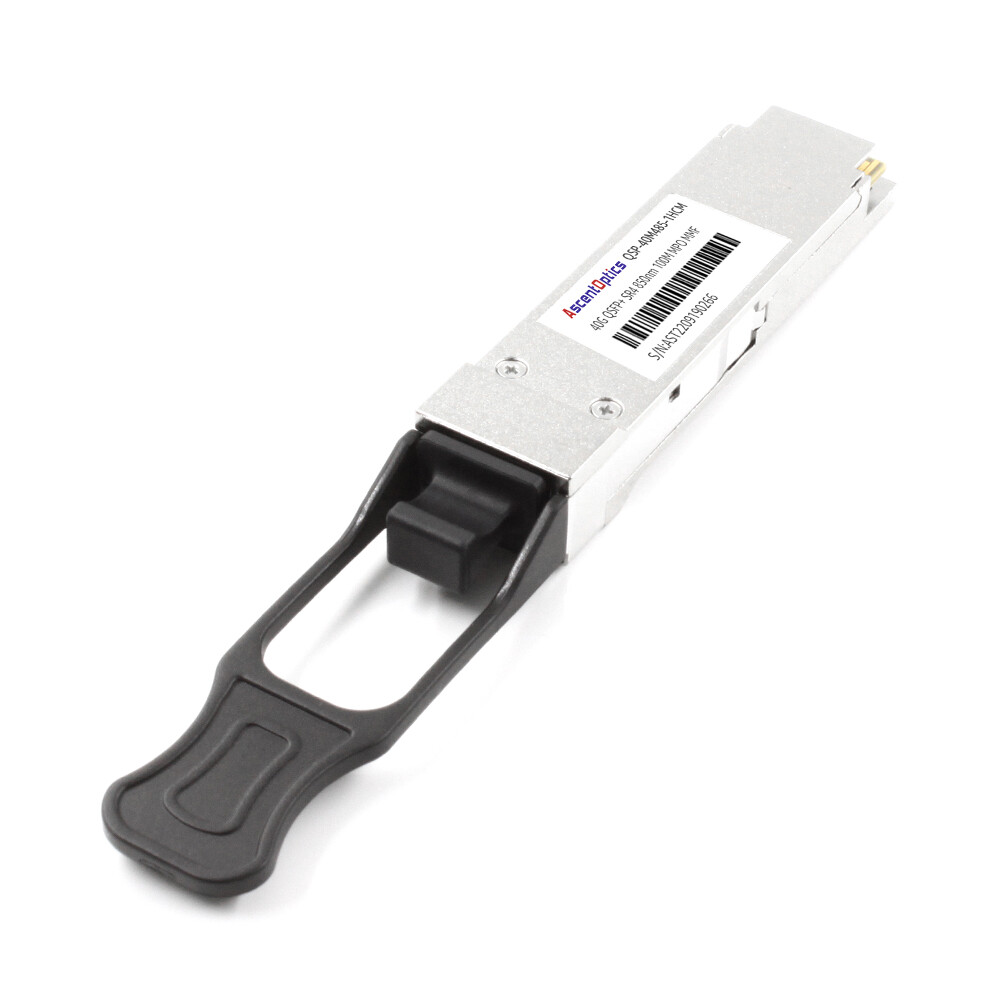
QSFP+ modules deliver 40 Gbps over four 10 Gbps lanes using NRZ modulation. They remain common in legacy aggregation layers and older data center fabrics.
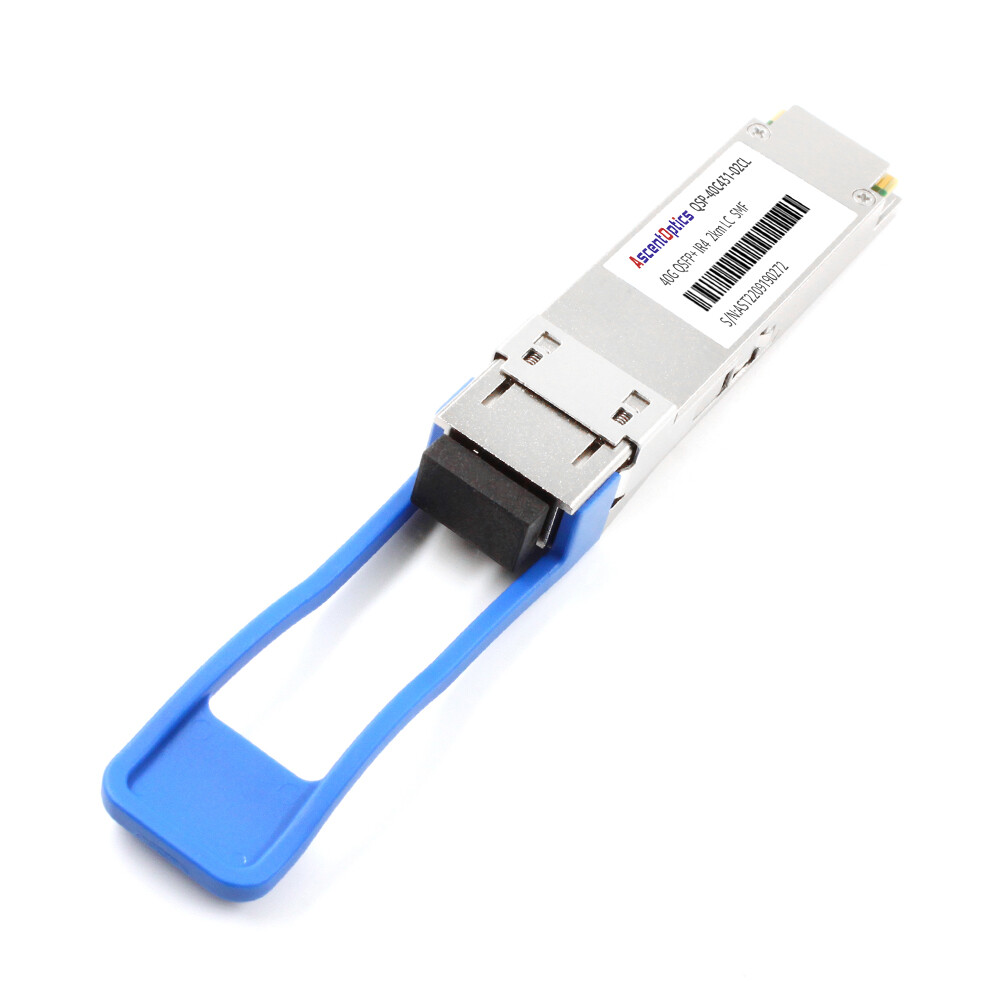
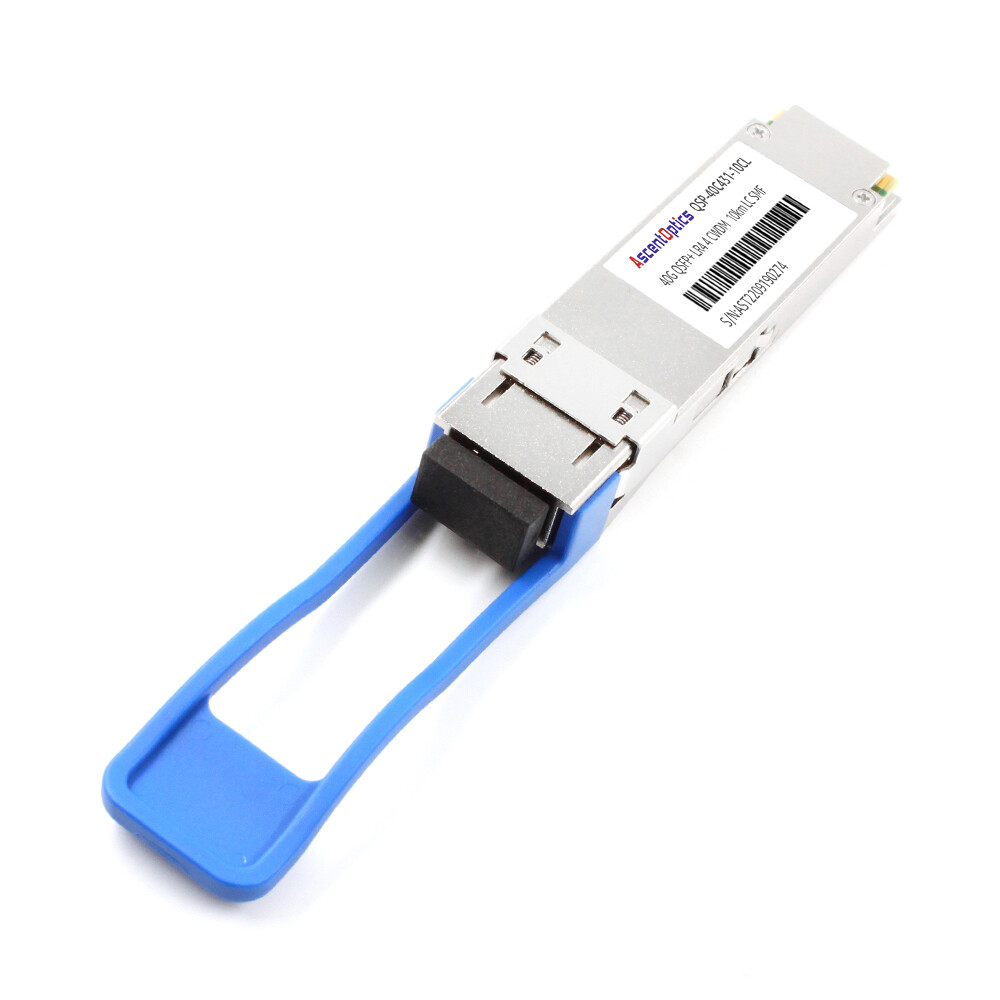
Common QSFP+ variants include SR4 for short-reach multimode links, LR4 for 10 km single-mode connections, and PSM4 or CWDM4 for medium-reach applications. Most new builds have moved to 100G, but QSFP+ still appears in enterprise refreshes where 40G capacity is sufficient.
QSFP28 (100G)
QSFP28 modules are the current workhorse for 100G Ethernet. They use four 25–28 Gbps lanes and support standards such as 100GBASE-SR4, 100GBASE-LR4, and 100GBASE-CWDM4.
QSFP56 (200G)
QSFP56 doubles the lane speed to 50 Gbps using PAM4 modulation, reaching 200 Gbps total. It serves as a bridge between 100G and 400G, especially in AI and high-performance computing networks where bandwidth per port matters more than legacy compatibility.
QSFP112 (400G)
QSFP112 keeps the four-lane form factor but pushes each lane to 100 Gbps PAM4, delivering 400 Gbps. It is attractive for high-density switches where operators want 400G capacity without moving to the larger QSFP-DD cage.
QSFP-DD (400G / 800G)
QSFP-DD, or Quad Small Form-factor Pluggable Double Density, adds a second row of electrical contacts to support eight lanes. It enables 400G (8 × 50 Gbps) and 800G (8 × 100 Gbps) transmission while remaining backward compatible with QSFP28 and QSFP+ modules.
This backward compatibility is a major advantage. A QSFP-DD port can accept older modules during migration, so operators do not need to replace every transceiver when upgrading switch hardware.
QSFP Module Types by Distance and Fiber
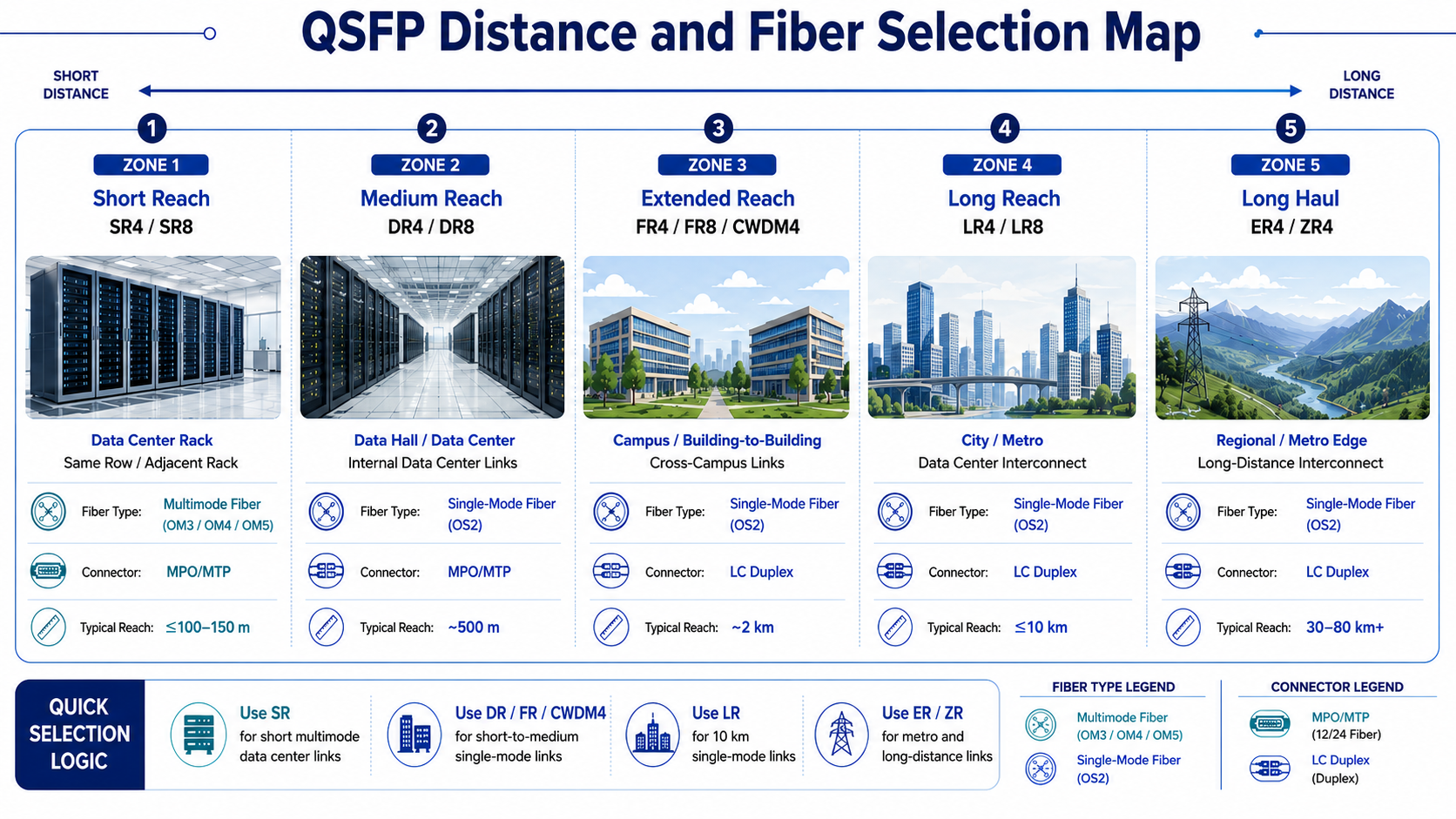
Distance is usually the fastest way to narrow down a QSFP module type. The same letters appear across generations, but the exact specifications scale with lane count and modulation.
| Distance Class |
Fiber Type |
Typical Reach |
Connector |
Common Standards |
| SR4 / SR8 |
Multimode (OM3/OM4/OM5) |
≤100–150 m |
MPO/MTP |
40GBASE-SR4, 100GBASE-SR4, 400GBASE-SR8 |
| DR4 / DR8 |
Single-mode (OS2) |
~500 m |
MPO/MTP |
100GBASE-DR4, 400GBASE-DR4 |
| FR4 |
Single-mode (OS2) |
~2 km |
LC duplex |
100GBASE-FR4, 400GBASE-FR4 |
| LR4 / LR8 |
Single-mode (OS2) |
≤10 km |
LC duplex |
40GBASE-LR4, 100GBASE-LR4, 400GBASE-LR8 |
| ER4 / ZR4 |
Single-mode (OS2) |
30–80 km+ |
LC duplex |
100GBASE-ER4, 100GBASE-ZR4 |
Short-Reach QSFP Modules (SR)
SR4 and SR8 modules use multimode fiber and MPO connectors. They are ideal for top-of-rack to aggregation links, intra-row connections, and short-reach data center fabrics. Their lower cost and simple cabling make them the default choice when the distance is under 100 meters.
Medium-Reach QSFP Modules (DR, FR, PSM4, CWDM4)
DR4 modules support roughly 500 meters over single-mode fiber with MPO connectors. FR4 and CWDM4 extend that to around 2 kilometers using LC duplex connectors. These modules suit campus links, data center interconnects, and leaf-spine fabrics that span multiple rooms or buildings.
Long-Reach QSFP Modules (LR, ER, ZR)
LR4 modules reach 10 kilometers, while ER4 and ZR4 variants extend to 40 kilometers or more. Telecom operators and large enterprises use these for metro aggregation, mobile backhaul, and long-distance data center interconnects.
QSFP Module Types by Cable and Connectivity
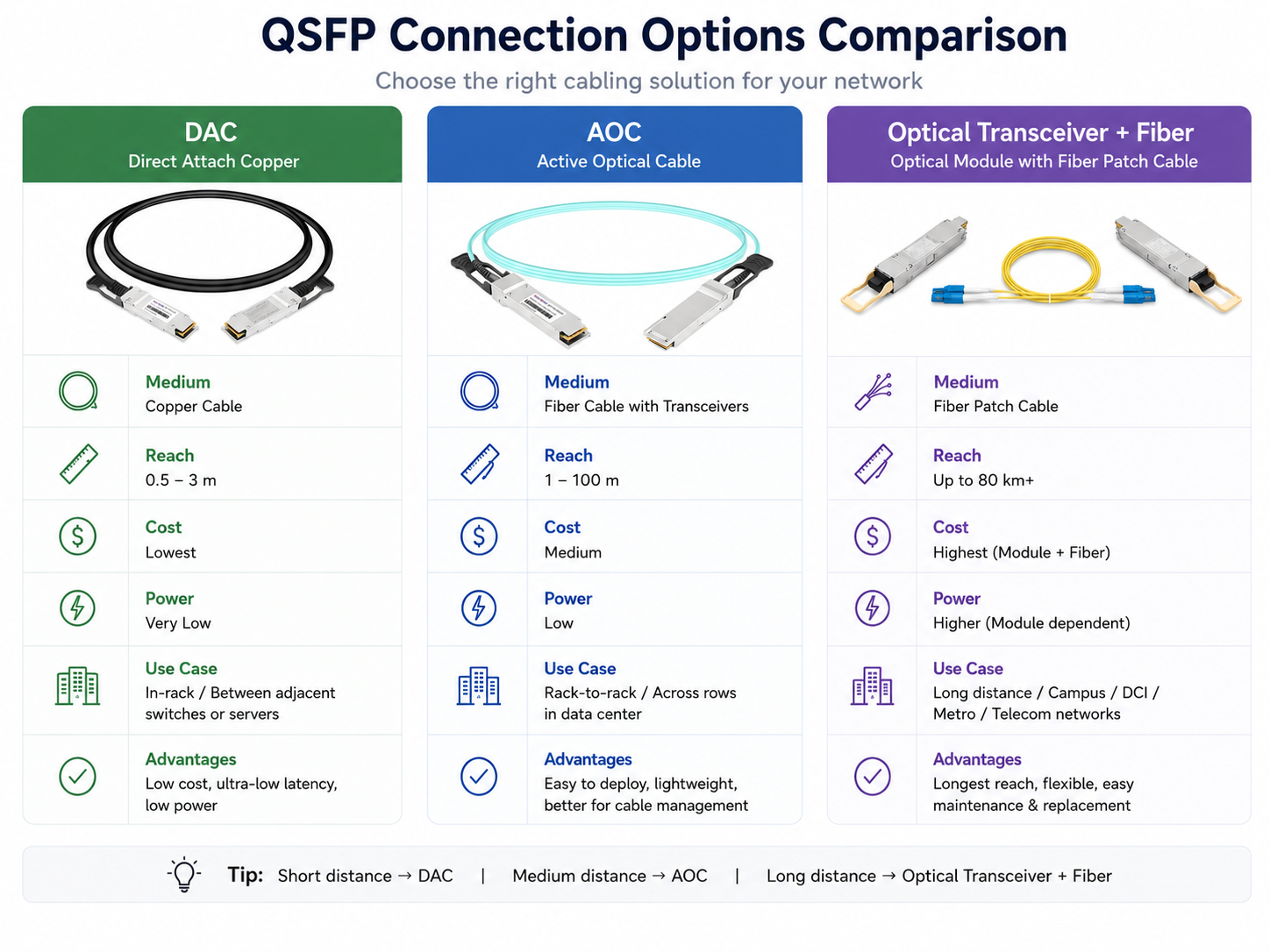
Not every QSFP connection uses a discrete optical transceiver and separate fiber cable. Direct Attach Copper (DAC) and Active Optical Cable (AOC) assemblies are also classified as QSFP module types.
Direct Attach Copper (DAC)
DAC cables integrate the QSFP electrical connector and copper conductors in one assembly. Passive DACs work for very short distances, typically up to 3 meters. Active DACs include signal conditioning and can reach 5–7 meters.
DAC cables are cost-effective for in-rack or adjacent-rack connections where the switch and server are close together.
Active Optical Cable (AOC)
AOC cables embed optical transceivers at both ends of a factory-terminated fiber cable. They support longer distances than DACs — often up to 100 meters — and are lighter and more flexible than copper for dense cabling.
Breakout Cables
Breakout cables split one QSFP port into multiple lower-speed ports. Common configurations include:
- •QSFP+ to 4×SFP+: splits 40G into four 10G links
- •QSFP28 to 4×SFP28: splits 100G into four 25G links
- •QSFP-DD to 4×QSFP28: splits 400G into four 100G links
- •QSFP-DD to 8×SFP56: splits 400G into eight 50G links
Breakout cables help maximize switch port utilization and simplify migration from lower-speed servers to higher-speed switches.
QSFP Module Types by Application
Different network layers favor different QSFP module types. Matching the module to the application reduces cost, power consumption, and deployment risk.
Data Center Spine-Leaf Fabrics
Modern data centers use spine-leaf architectures with high east-west traffic between servers. QSFP28 SR4 is common for top-of-rack to leaf links, while QSFP28 CWDM4 or LR4 connects leaf switches to spine switches over longer distances.
When network architect Priya upgraded her company’s 10G leaf layer, she standardized on QSFP28 SR4 for intra-rack links and QSFP28 CWDM4 for cross-row spine uplinks. The clear separation by reach simplified procurement and kept per-port costs predictable.
Data Center Interconnect (DCI)
DCI links connect separate data centers or data halls. These links typically require single-mode modules such as QSFP28 LR4, ER4, or QSFP-DD LR4/FR4. Distance, latency, and power budget drive the selection.
Telecom and 5G Networks
Telecom operators use QSFP28 LR4 and ER4 for mobile backhaul and aggregation. As 5G traffic grows, 400G QSFP-DD modules are increasingly deployed in aggregation and transport layers.
AI and High-Performance Computing Clusters
AI training clusters demand extremely high bandwidth between GPUs and switches. QSFP56, QSFP112, and 800G QSFP-DD modules are now standard in these environments.
AI clusters generate massive east-west traffic between GPUs, requiring low-latency and high-bandwidth optical interconnects. Today, 400G QSFP-DD, 800G QSFP-DD, and 800G OSFP transceivers are widely deployed in NVIDIA-based AI fabrics, large-scale HPC systems, and hyperscale cloud infrastructures.
How to Choose the Right QSFP Module Type
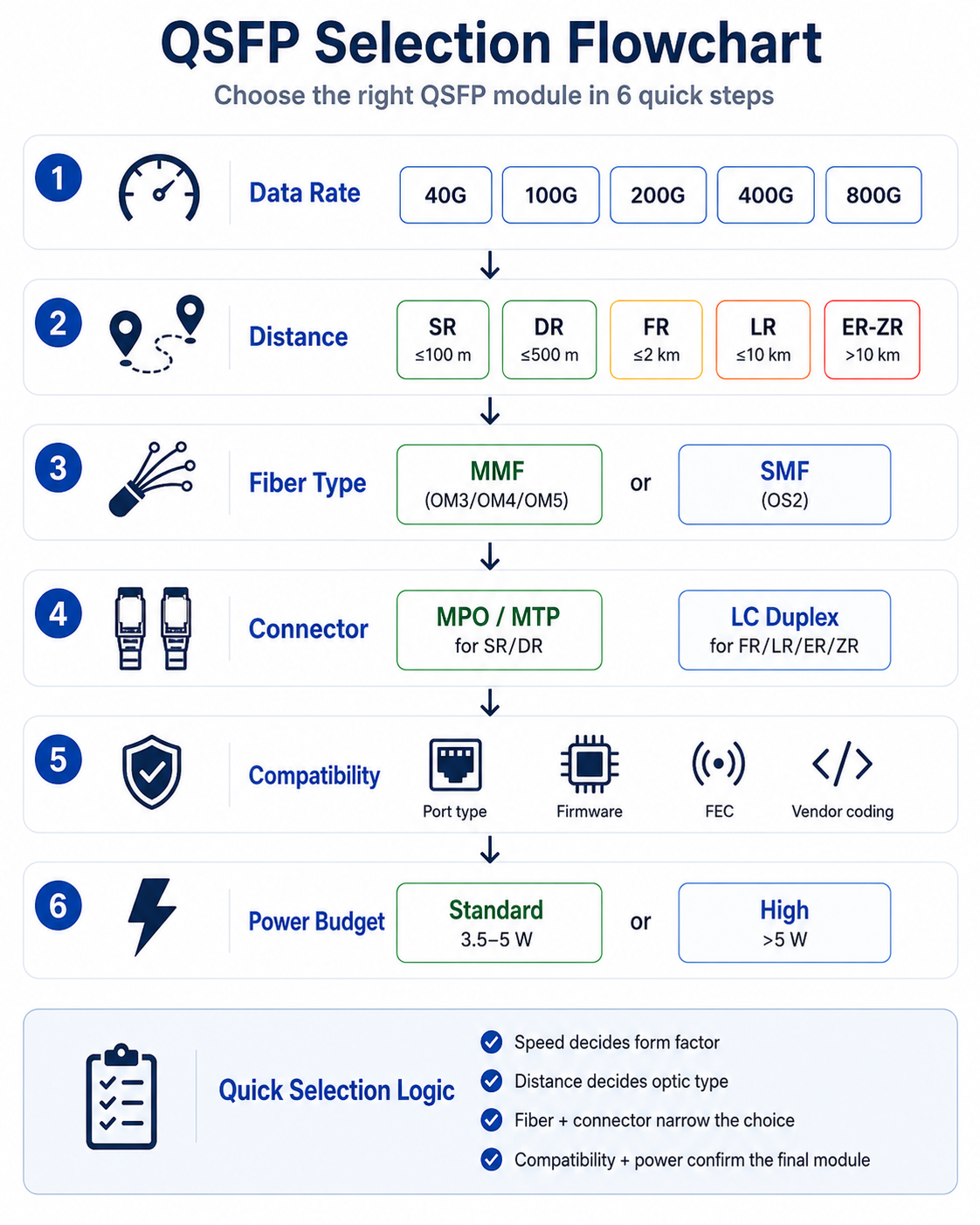
Selecting a QSFP module type becomes straightforward when you answer six questions in order.
What data rate does the link require?
Match the form factor to the port speed: QSFP+ for 40G, QSFP28 for 100G, QSFP56 for 200G, QSFP112 or QSFP-DD for 400G, QSFP-DD800 for 800G.
What is the link distance?
Use SR variants for short-reach multimode, DR/FR/LR for single-mode distances, and ER/ZR for long-haul links.
What fiber type is installed?
Multimode fiber limits you to SR variants. Single-mode fiber opens DR, FR, LR, ER, and ZR options.
What connector does the cable plant use?
MPO/MTP connectors are common for parallel optics, while LC duplex connectors are standard for duplex single-mode links.
Is the switch port compatible?
Verify MSA compliance, vendor EEPROM coding, firmware support, and FEC requirements. QSFP-DD ports accept QSFP28 and QSFP+ modules, but older QSFP+ ports cannot run QSFP28 at full speed.
What is the power and thermal budget?
QSFP28 modules typically consume 3.5–5 watts, while 400G QSFP-DD modules can consume 10–15 watts or more. Dense switches need careful thermal planning.
QSFP Compatibility and Migration Considerations
Backward compatibility is one of the strongest reasons to stay within the QSFP ecosystem. A QSFP-DD cage accepts QSFP+ and QSFP28 modules, so organizations can upgrade switch hardware first and replace optics later.
However, compatibility is not automatic. Switch firmware may reject third-party modules that do not carry the correct vendor code. Forward Error Correction (FEC) settings must match on both ends of a link, especially for PAM4-based modules such as QSFP56, QSFP112, and QSFP-DD.
When Marcus, a data center operations lead, migrated his spine layer from 100G QSFP28 to 400G QSFP-DD, he tested a small pod first. He discovered that some switches required a firmware update before they would recognize QSFP-DD modules at the expected speed. The pilot saved his team from a full-fabric outage.
Conclusion
QSFP module types cover a wide range of speeds, distances, and applications. From 40G QSFP+ for legacy links to 800G QSFP-DD for AI clusters, each variant solves a specific networking problem. The right choice depends on data rate, link distance, fiber type, connector, switch compatibility, and power budget.
Frequently Asked Questions
Q1. What is the difference between QSFP28 and QSFP56?
QSFP28 supports 100G using four 25G NRZ lanes, while QSFP56 supports 200G using four 50G PAM4 lanes.
Q2. Is QSFP-DD backward compatible?
Yes. QSFP-DD ports can typically accept QSFP28 and QSFP+ modules, allowing gradual network upgrades.
Q3. Which QSFP module is best for AI networks?
400G QSFP-DD, 800G QSFP-DD, and 800G OSFP are currently the most common choices for AI and HPC deployments.
Q4. What connector types do QSFP modules use?
QSFP modules commonly use MPO/MTP connectors for parallel optics and LC duplex connectors for wavelength-division multiplexing (WDM) applications.
Post Views: 1,838