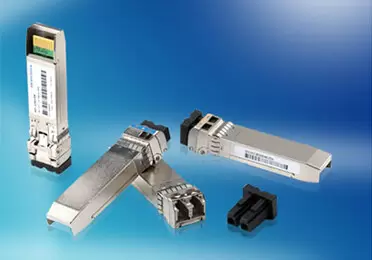
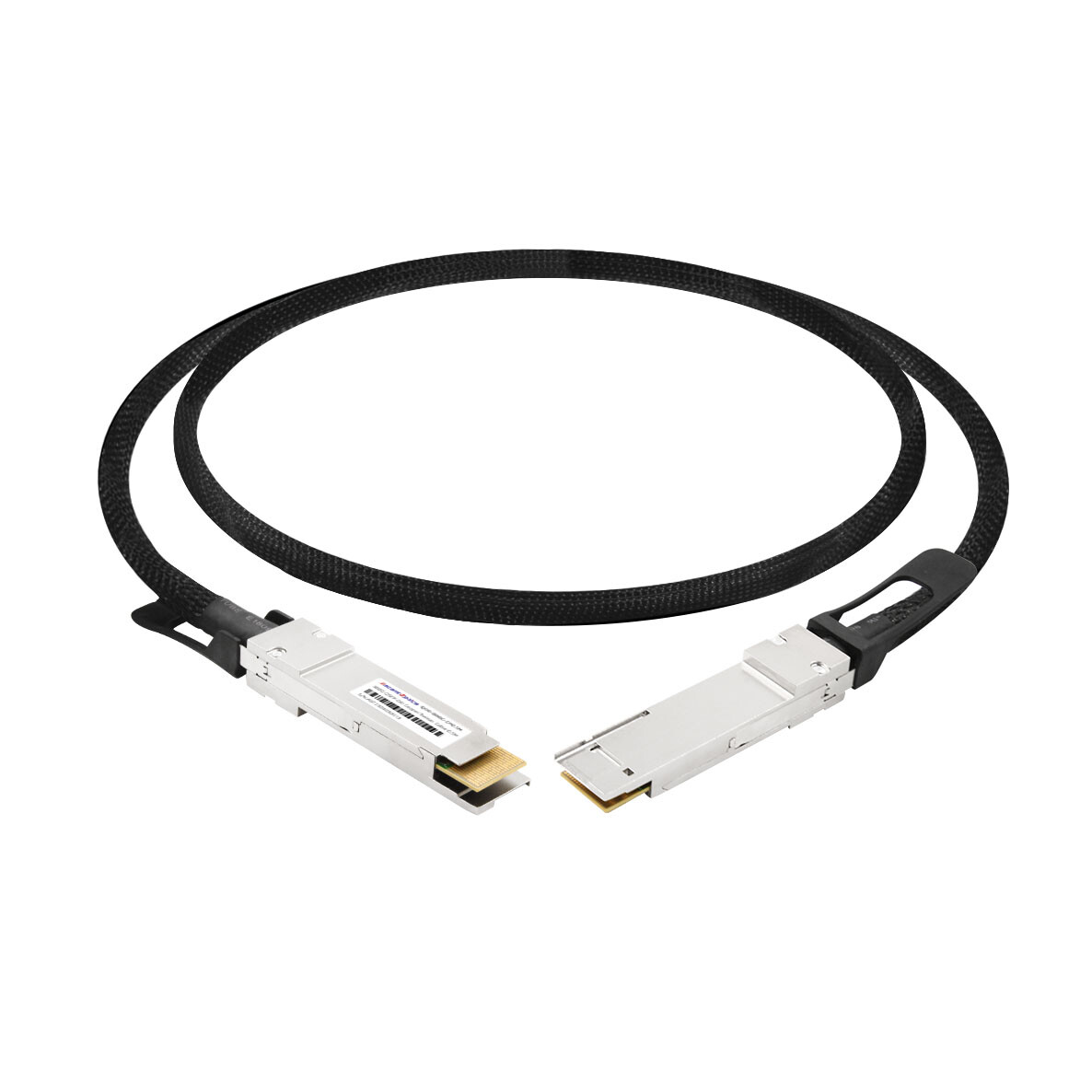
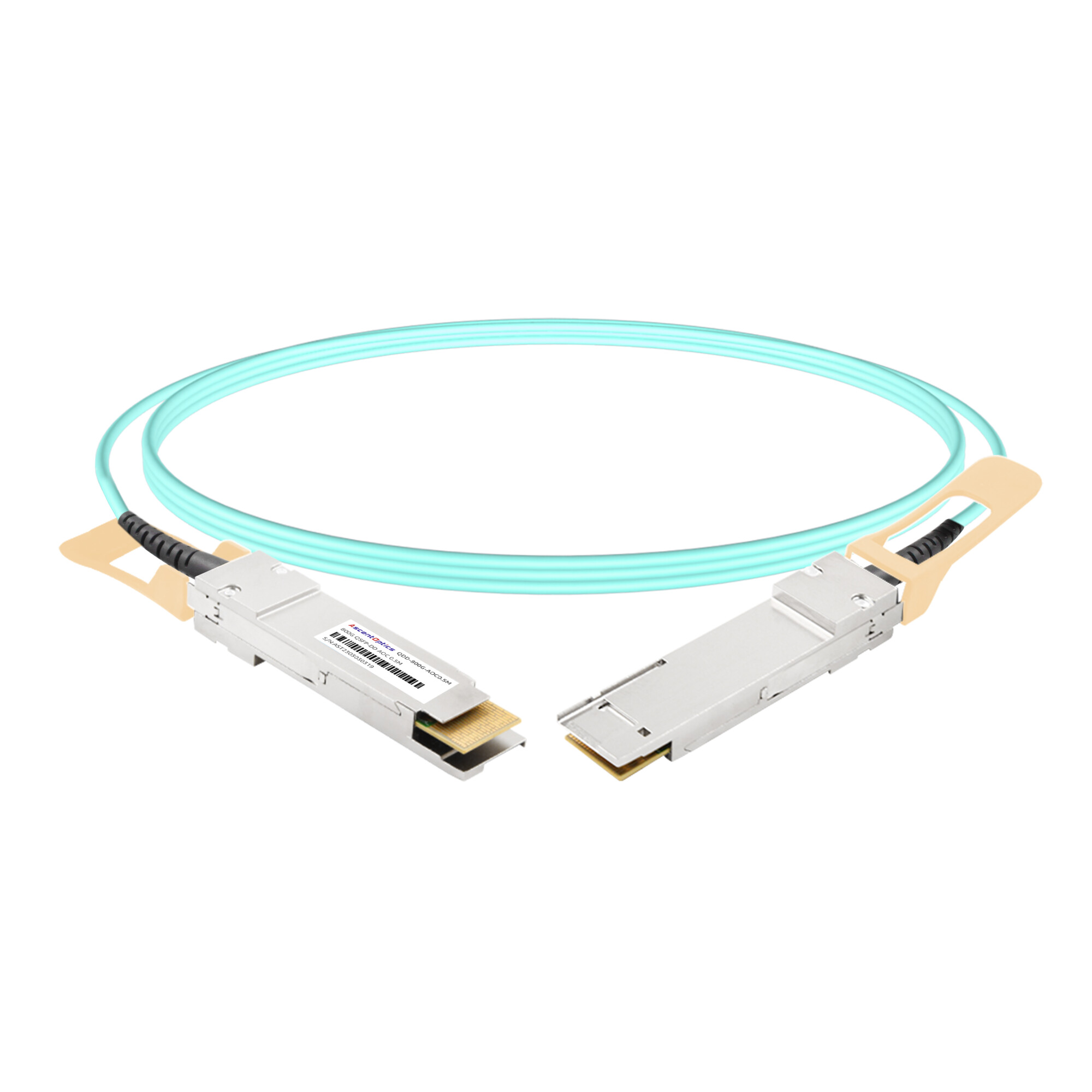
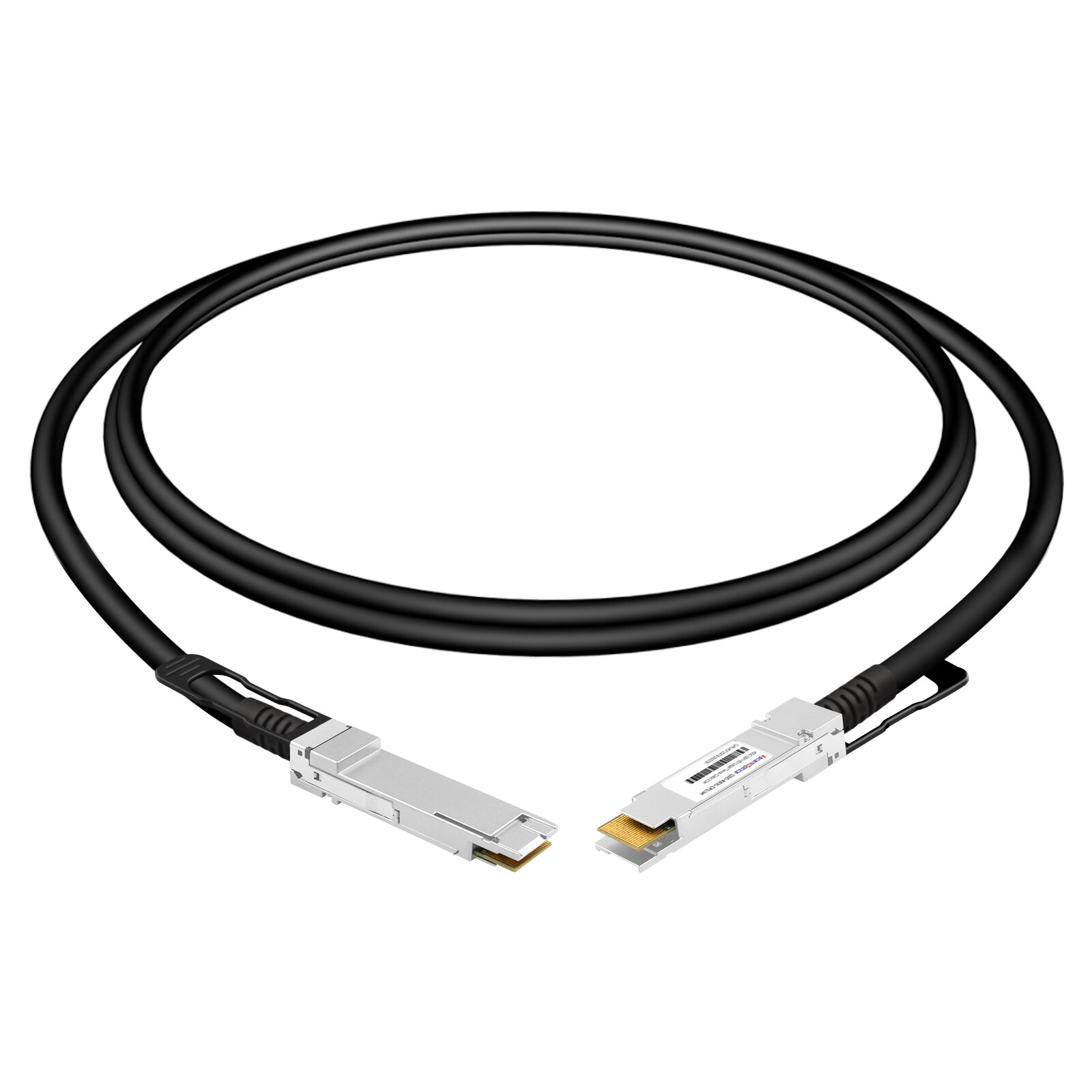
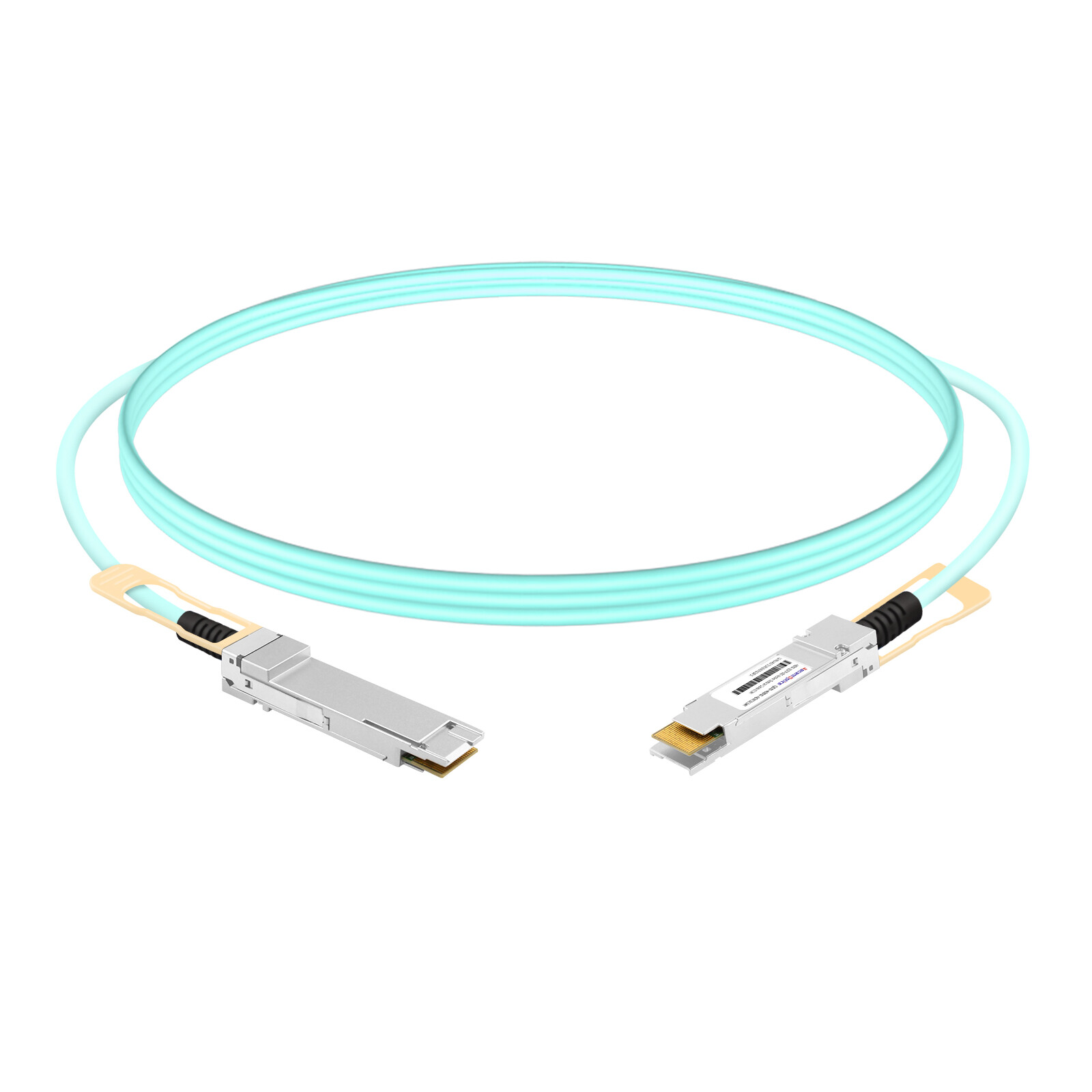
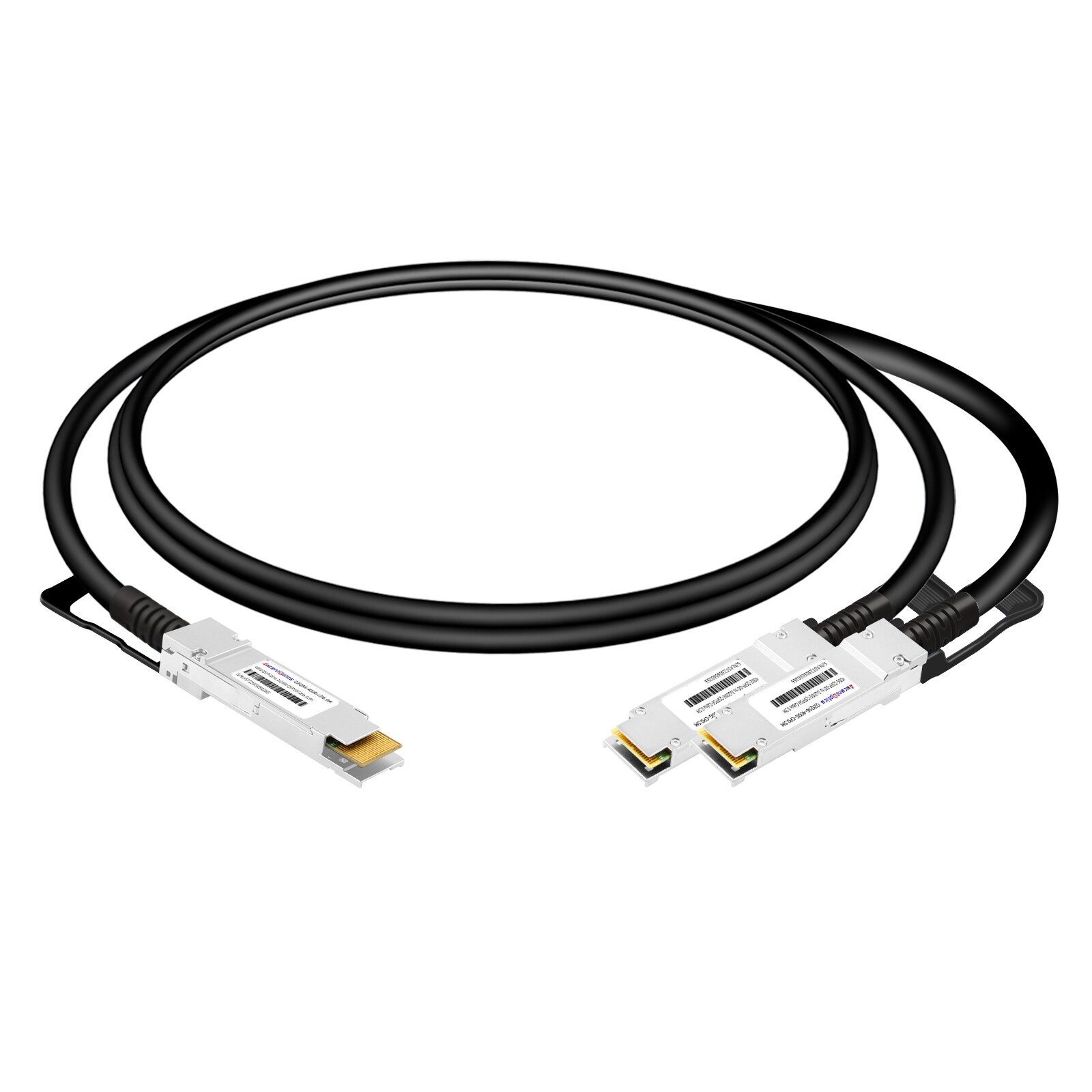
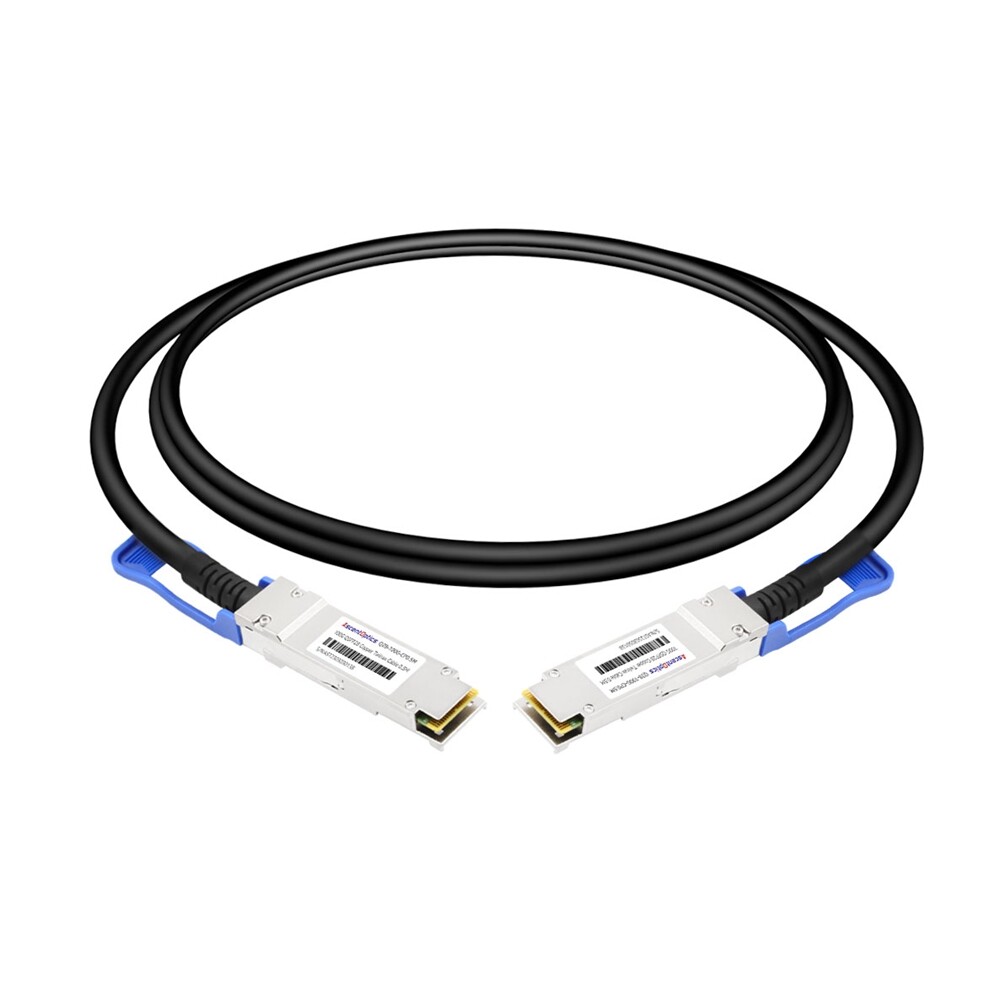
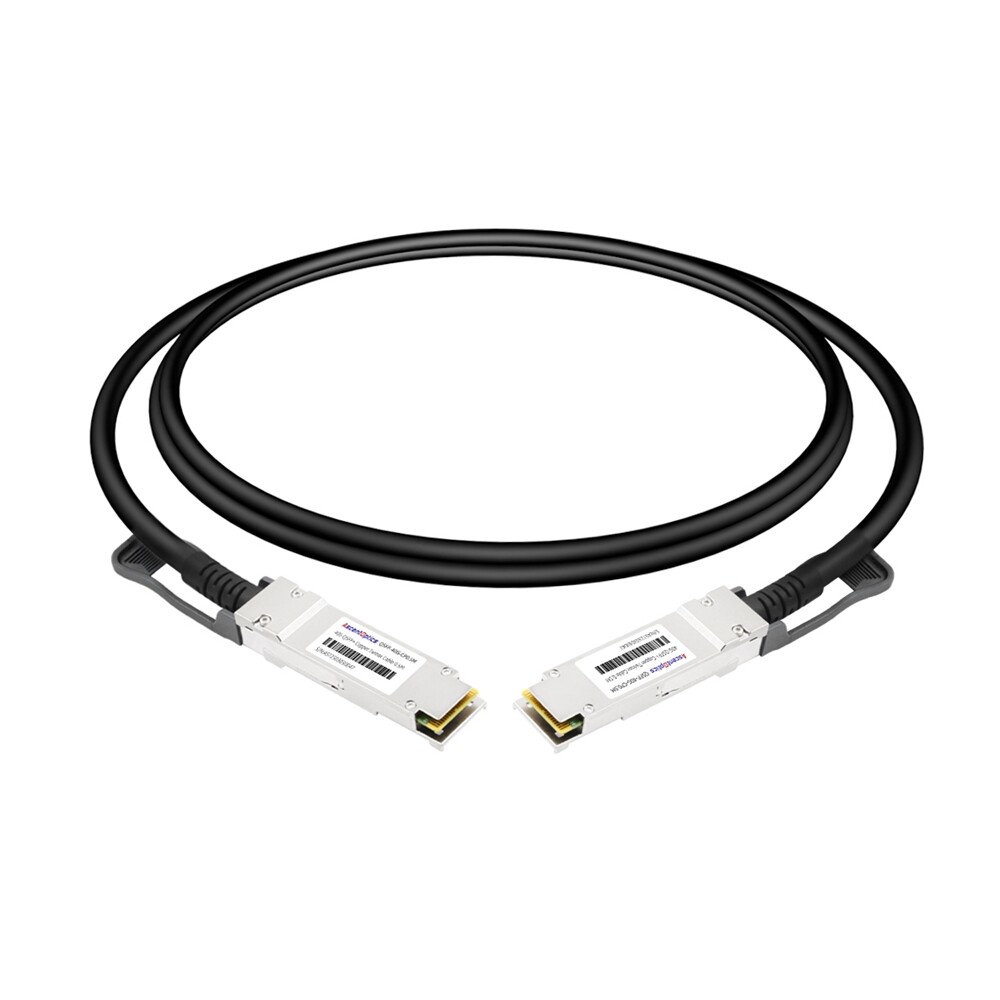
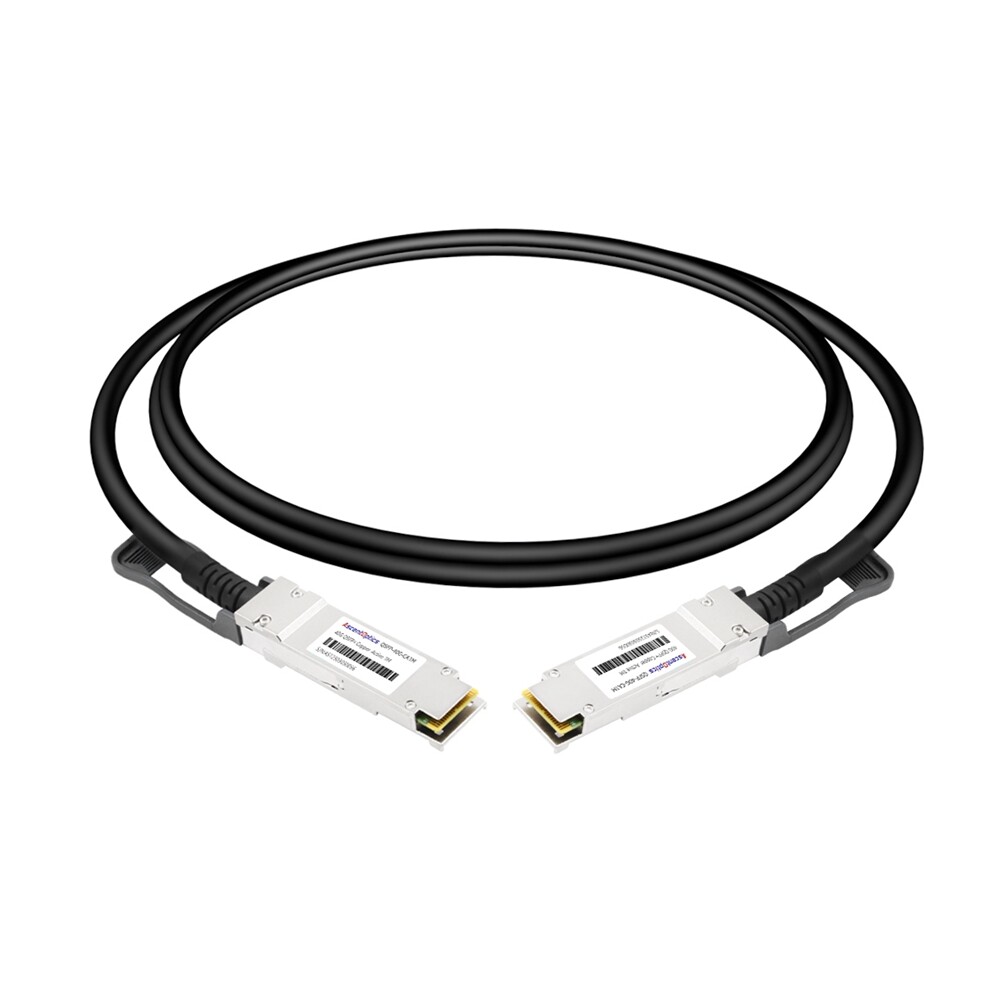
A QSFP cable is a high-speed interconnect solution that uses QSFP-series (Quad Small Form-factor Pluggable) interfaces, including QSFP+, QSFP28, QSFP56, QSFP112, and QSFP-DD. It is widely used for server, switch, and storage connectivity in modern data centers.
In the context of being a high-density interconnect technology, there are various types of QSFP cables that encompass different technical streams, which include DAC direct attach copper cables, AOC active optical cables, and breakout split cables. DAC cables offer such benefits as low latency, low power consumption, and reduced costs, thus making them more suitable for applications where distance is not a factor. AOC optical cables ensure that signals can travel farther without interference and are therefore more suitable for use across rows and racks.
What Is a QSFP Cable?
A QSFP cable is a high-density interconnect cable that uses a Quad Small Form-factor Pluggable (QSFP) connector on one or both ends. It carries multiple data lanes in a single compact housing, which lets switches, routers, servers, and storage systems push far more bandwidth per port than older single-lane formats.
The key distinction is this: a QSFP cable is a fixed assembly, while a QSFP transceiver is a pluggable module that accepts a separate fiber patch cord. QSFP optical transceiver modules plug into a port and give you flexibility over fiber type and distance. A QSFP DAC or AOC has the cable permanently attached to the connector, making it simpler to deploy for short, standardized links.
Because QSFP cables are hot-pluggable, you can install or replace them without powering down the host equipment. That matters in live data centers where every minute of downtime has a cost.
What Does QSFP Stand For?
QSFP stands for Quad Small Form-factor Pluggable. The “Quad” refers to the four parallel lanes inside the connector. Each lane operates as an independent channel, so a QSFP28 cable can carry four 25G lanes to reach 100G total bandwidth. Modern QSFP-DD interfaces extend the architecture to eight lanes while maintaining backward compatibility with earlier QSFP generations, enabling 400G and 800G.
The QSFP form factor is governed by industry Multi-Source Agreements (MSAs), which means multiple vendors build to the same mechanical and electrical specifications. That is why MSA-compliant cables from one supplier often work in equipment from another, though firmware-level vendor locks can still block third-party optics.
QSFP Cable Types Explained
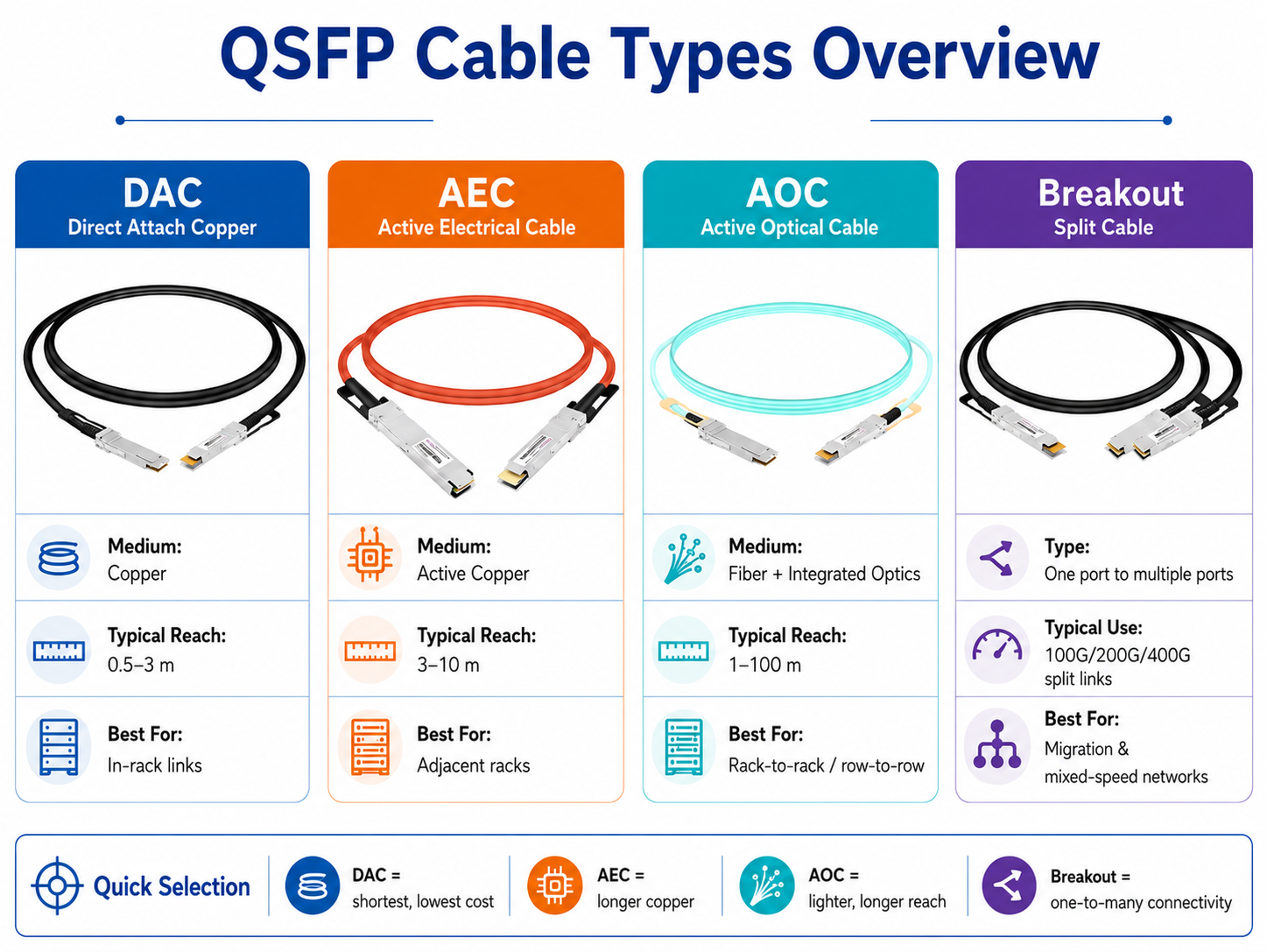
Not every network link needs the same physical layer. The four main categories of QSFP cable are DAC, AEC, AOC, and breakout. Each solves a different reach, power, and cost problem.
DAC uses twinax copper cable with QSFP connectors molded directly onto each end. There is no separate transceiver module; the cable itself contains the electrical interface.
There are two subtypes:
- •Passive DAC: Pure copper connection with no signal conditioning. It is the lowest cost, lowest latency, and lowest power option. Reach is shorter, especially at higher speeds.
- •Active DAC incorporates signal-conditioning components such as equalizers or retimers to improve signal integrity and extend reach.This extends reach slightly but adds a small amount of power and cost.
At 40G/100G, a passive DAC can often reach 5–7 m. At 400G/800G with PAM4 signaling, passive DAC reach typically shrinks to about 1–3 m. Active DAC may stretch that to 5 m.
DAC is the right choice when:
- •The link stays inside the same rack
- •Latency must be minimized
- •Power budget is tight
- •Cost per link is the priority
AEC is sometimes called an active electrical cable or active copper cable. It uses copper like a DAC but includes stronger equalizers and retimers to push the signal farther than a passive or active DAC can manage.
Modern AEC solutions typically support 3–10 m, with some advanced designs extending beyond 10 m depending on the data rate and host platform. It’s useful for adjacent racks or longer in-rack runs where DAC falls short but AOC is still too expensive. It is heavier and less flexible than AOC, but it consumes less power and avoids optical complexity.
AEC is the right choice when:
- •You need a bit more reach than DAC allows
- •You want to avoid the cost of optics
- •The run is not long enough to justify AOC
AOC uses multimode fiber with integrated optoelectronics inside the QSFP connector. It converts electrical signals to optical at one end, transmits over fiber, and converts back at the other end.
AOC reach typically ranges from 1 m to 100 m, depending on speed and fiber grade. It is lighter and more flexible than copper, immune to electromagnetic interference (EMI), and easier to route through crowded cable managers.
AOC is the right choice when:
- •The link runs between racks or rows
- •Cable weight and flexibility matter
- •EMI from nearby power cables is a concern
- •You need a longer reach than copper can provide
The trade-off is power and cost. AOC consumes roughly 2–3 W per end, while a passive DAC consumes nearly zero.
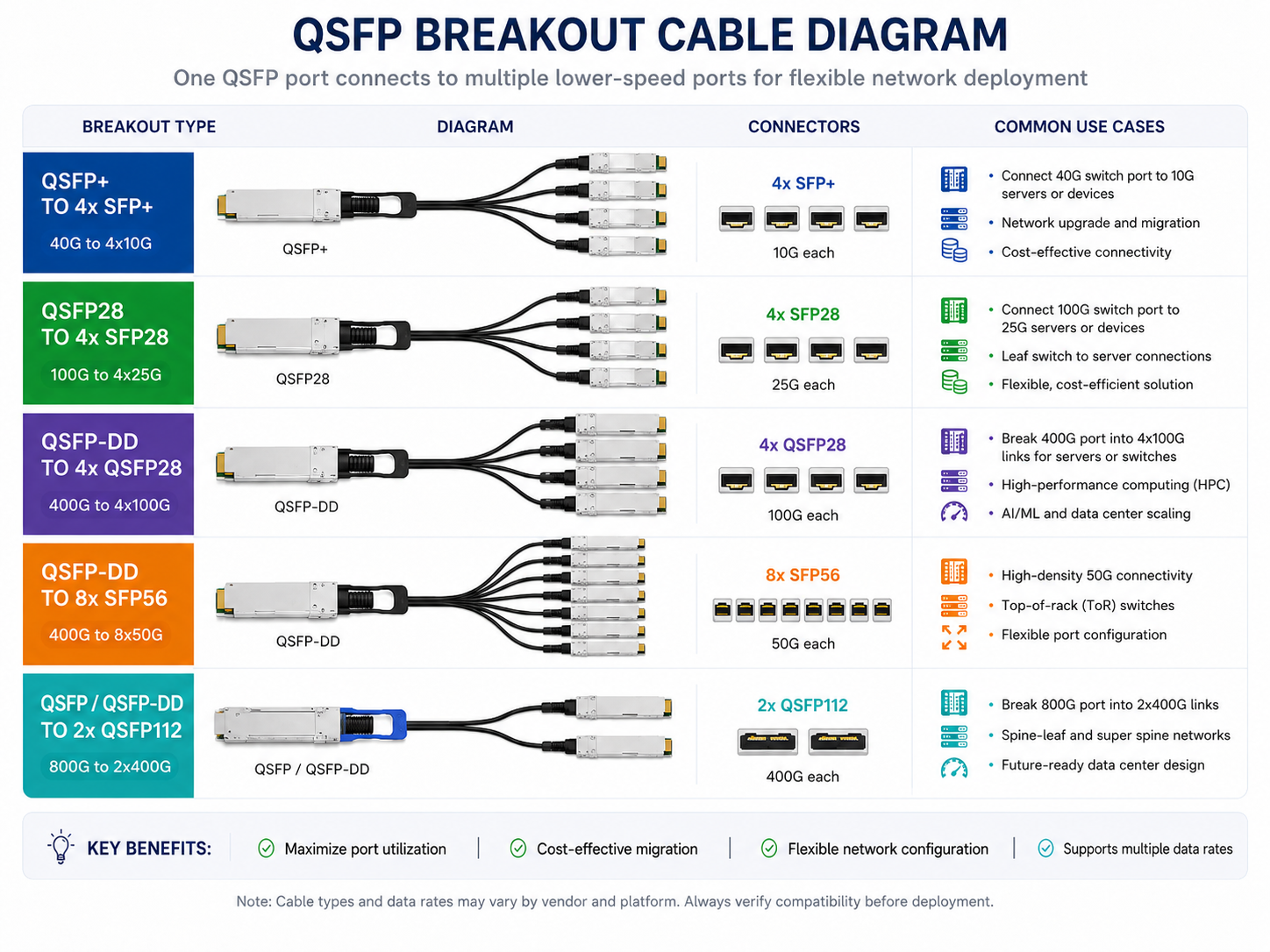
A breakout QSFP cable splits one high-speed QSFP port into multiple lower-speed ports. This is one of the most practical tools for mixed-speed networks.
Common breakout configurations include:
- •QSFP+ to 4×SFP+: 40G aggregate split into four 10G lanes
- •QSFP28 to 4×SFP28: 100G aggregate split into four 25G lanes
- •QSFP-DD to 4×QSFP28: 400G aggregate split into four 100G lanes
- •QSFP-DD to 8×SFP56: 400G aggregate split into eight 50G lanes
- •800G OSFP to 2×400G QSFP112: one 800G port split into two 400G ports
Breakout cables let you upgrade spine or aggregation switches while keeping existing server or leaf equipment. They also help maximize port utilization when not every endpoint needs the full aggregate speed.
QSFP Cable Generations and Speeds
QSFP cables follow the same speed roadmap as QSFP transceivers. Each generation increases lane speed and sometimes lane count.
| Generation |
Total Speed |
Lanes |
Lane Speed |
Modulation |
Typical Cable Types |
| QSFP+ |
40G |
4 |
10G |
NRZ |
DAC, AOC, breakout |
| QSFP28 |
100G |
4 |
25G |
NRZ |
DAC, AEC, AOC, breakout |
| QSFP56 |
200G |
4 |
50G |
PAM4 |
DAC, AEC, AOC |
| QSFP112 |
400G |
4 |
100G |
PAM4 |
DAC, AEC, AOC |
| QSFP-DD |
400G/800G |
8 |
50G/100G |
PAM4 |
DAC, AEC, AOC, breakout |
The move from NRZ to PAM4 signaling is what makes 200G and above possible in the same physical footprint. PAM4 encodes two bits per symbol, but it is more sensitive to signal degradation. That is why higher-speed copper cables get shorter, and why AEC and AOC become more important at 400G and 800G.
DAC vs AEC vs AOC: Which QSFP Cable Should You Choose?
The fastest way to narrow the field is to start with distance, then layer in power, cost, and environmental factors.
| Factor |
Passive DAC |
Active DAC / AEC |
AOC |
| Typical reach |
1–7 m |
3–7 m (AEC up to ~7 m) |
1–100 m |
| Power per end |
~0 W |
0.5–2 W |
2–3 W |
| Latency |
Lowest |
Very low |
Slightly higher |
| Relative cost |
Lowest |
Low–moderate |
3–6× higher than DAC |
| Weight/flexibility |
Heavy, stiff |
Heavy, stiff |
Light, flexible |
| EMI immunity |
Good |
Good |
Excellent |
| Best use |
In-rack server-to-ToR |
Adjacent rack / longer in-rack |
Inter-rack, row-to-row, EMI-sensitive |
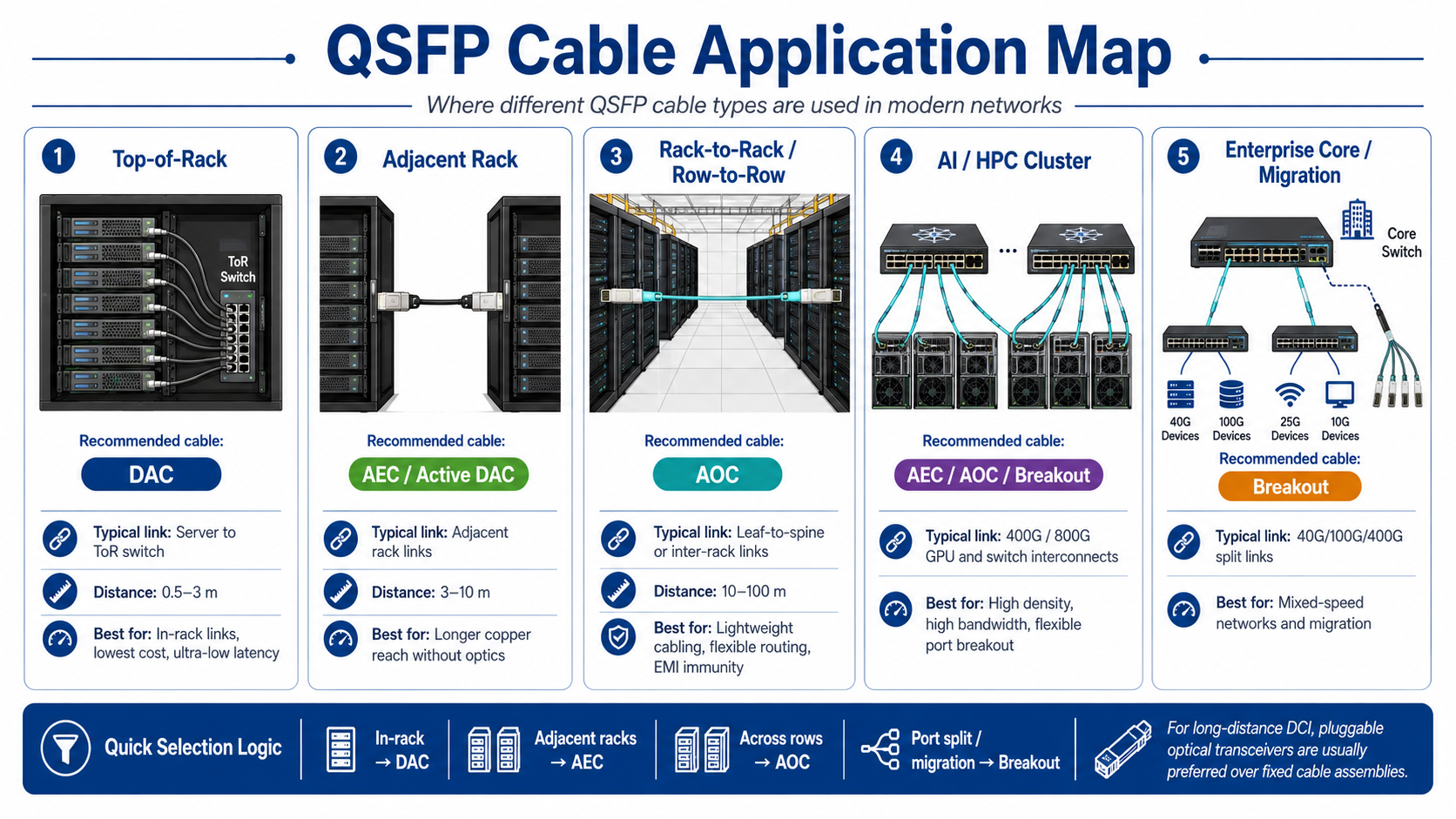
A useful rule of thumb is: DAC inside the rack, AEC between adjacent racks, AOC between rows.
QSFP Cable Applications in Modern Networks
QSFP cables appear wherever high-density, high-speed links are needed.
Data Center Top-of-Rack and Spine-Leaf Fabrics
Server NICs connect to top-of-rack (ToR) switches with QSFP28 or QSFP56 DACs. Leaf-to-spine links may use AOC or AEC depending on distance. This is the largest single-use case for QSFP cables today.
AI/HPC GPU Clusters
AI training clusters demand massive east-west bandwidth between GPU servers. 400G/800G QSFP-DD optical modules and cables are now standard in these environments. Breakout cables such as 800G OSFP to 2×400G QSFP112 are common for connecting GPUs with 400G NICs to 800G switches.
Modern AI clusters generate enormous east-west traffic between GPUs, storage systems, and switches. As network speeds increase from 400G to 800G, AEC and AOC solutions are becoming increasingly important for maintaining signal integrity while reducing deployment complexity.
Telecom and 5G Aggregation
Telecom operators use QSFP28 LR4 and ER4 AOC or transceiver-based links for 10 km to 40 km aggregation and backhaul. The higher speed and longer reach make QSFP28 the preferred format over SFP+ for these aggregation points.
Enterprise Core Networks
Enterprise data centers use QSFP+ and QSFP28 cables for core switching, storage connectivity, and campus aggregation. Breakout cables are especially valuable here because they let IT teams keep older 10G or 25G equipment while upgrading core switches.
Data Center Interconnect (DCI)
For DCI applications, cable assemblies are generally replaced by pluggable optical transceivers such as 400G ZR, OpenZR+, or 800ZR modules, which use the same QSFP-DD form factor but support much longer transmission distances.
QSFP Cable Compatibility and Selection Considerations
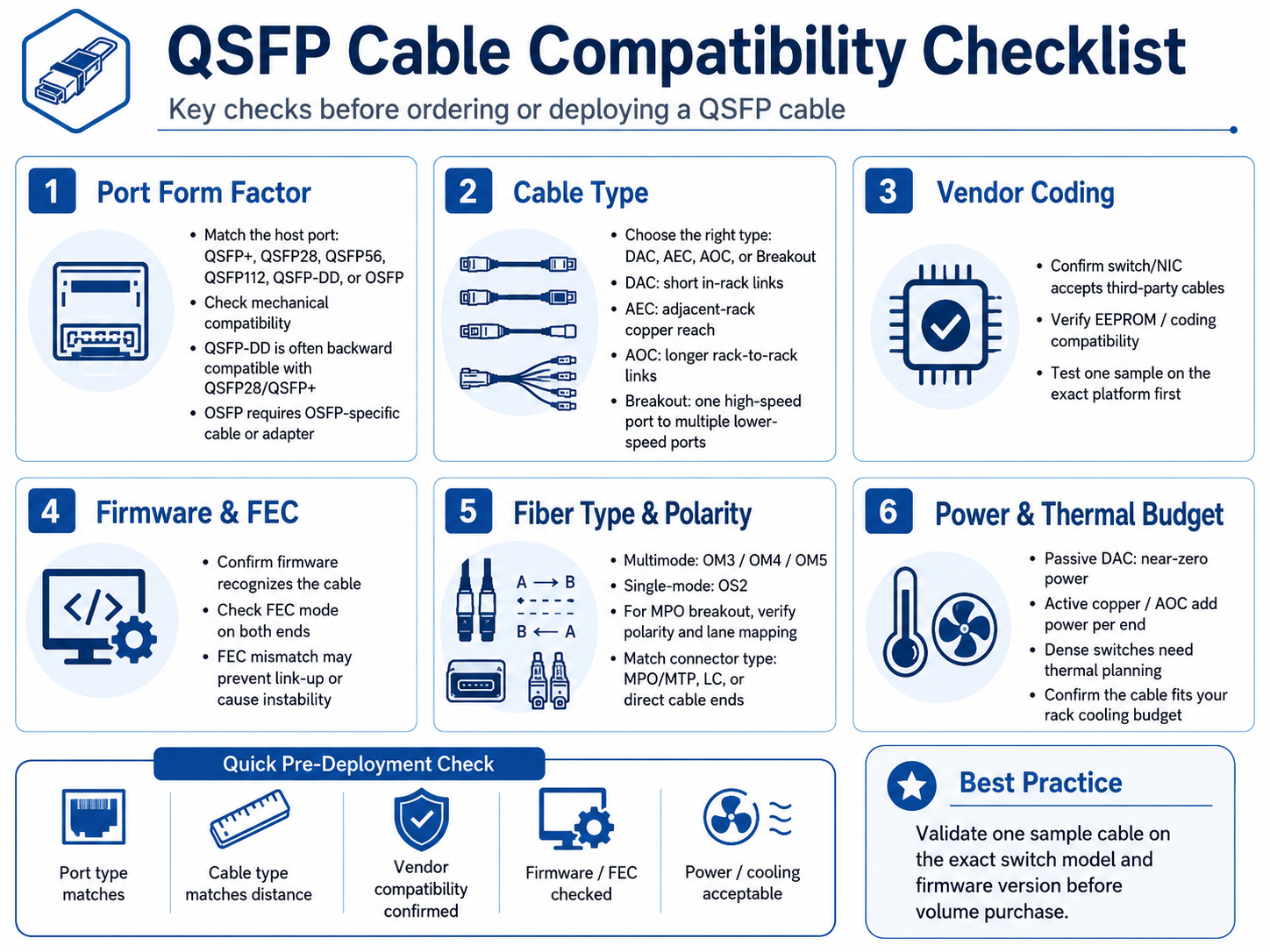
Even the right cable type will fail if it does not match the host port. Before ordering, confirm these points.
Port Form Factor
QSFP+, QSFP28, QSFP-DD, and OSFP are not mechanically interchangeable in every direction. QSFP-DD ports are often backward compatible with QSFP28 and QSFP+ modules, but the reverse is not true. OSFP is a different mechanical package and requires OSFP-specific cables or adapters.
Vendor Lock-In
Some switch vendors block third-party modules unless you explicitly allow them through CLI commands. If you plan to use MSA-compliant cables from a manufacturer like Ascent Optics, test one sample on the exact switch model and firmware version first.
Firmware and FEC
Higher-speed links often require Forward Error Correction (FEC). Both ends of the link must agree on the FEC mode, or the link will not come up. Firmware version also affects whether newer module EEPROMs are recognized.
Fiber Type and Connector Polarity
For AOC and optical transceivers, match the fiber type to the module. Multimode modules use OM3/OM4/OM5 fiber. Single-mode modules use OS2. MPO breakout cables require correct polarity, usually Method B, or lanes will not align.
Power and Thermal Budgets
AOC and active cables add heat at each end. In a fully loaded 32-port 400G switch, those watts add up. If your rack cooling is already near its limit, copper may be the safer choice for short links.
QSFP Cable Installation and Troubleshooting
Proper handling extends cable life and prevents link instability.
Installation Best Practices
- •Respect the manufacturer’s bend radius, especially for fiber AOC
- •Use a strain relief so connector tabs do not carry the cable weight
- •Keep copper DAC away from high-current power cables to reduce EMI pickup
- •Label both ends of breakout cables to avoid lane-mapping confusion
- •Clean optical connector faces before first use if you are using AOC with exposed MPO interfaces
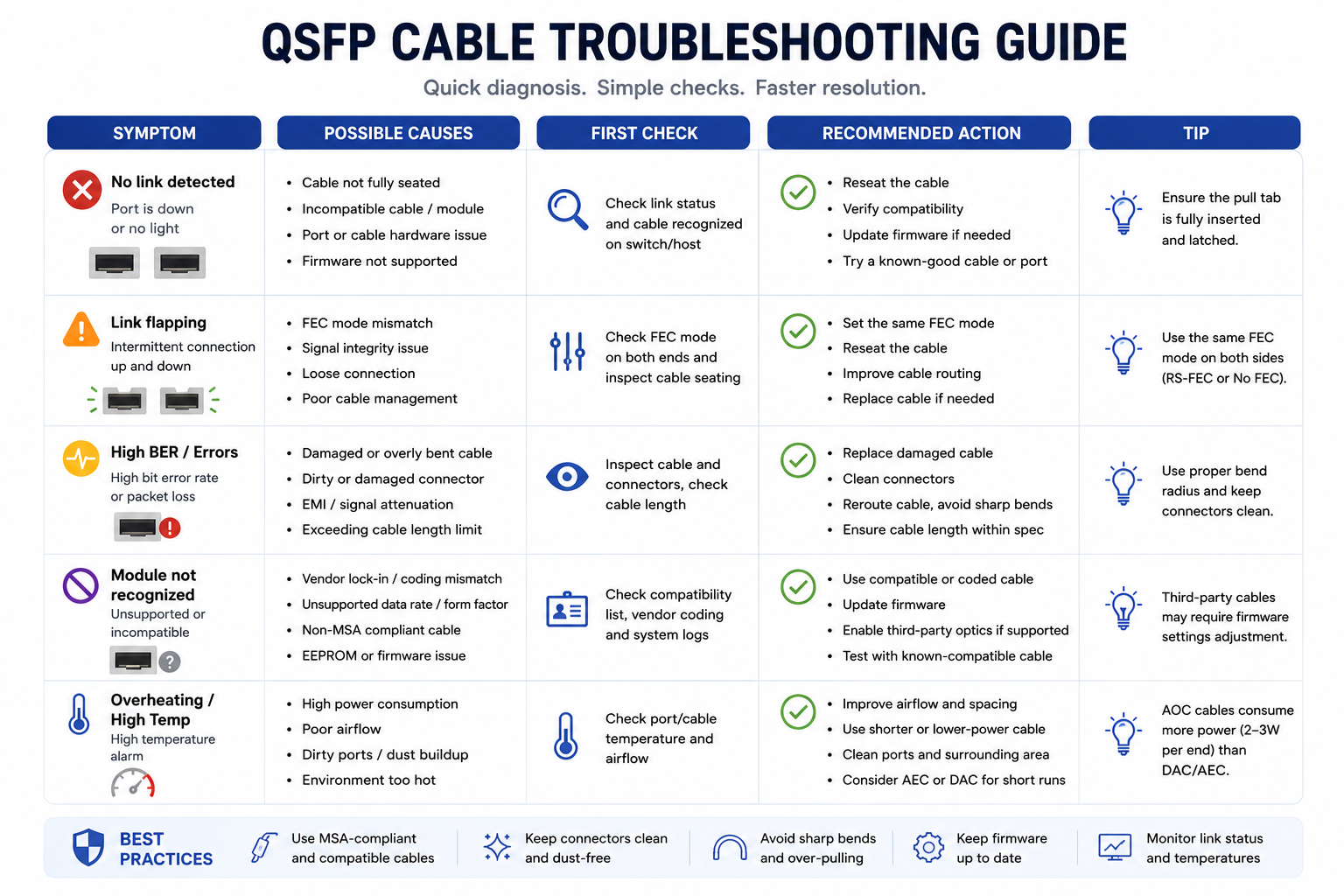
Common Issues and Fixes
| Symptom |
Likely Cause |
First Step |
| No link detected |
Loose connection or unsupported firmware |
Reseat the cable and check the switch recognizes the module |
| Link flapping |
Signal integrity or FEC mismatch |
Check FEC mode and try a known-good cable |
| High bit error rate |
Cable damage or excessive bending |
Inspect the cable and replace if damaged |
| Module not recognized |
Vendor lock-in or incompatible EEPROM |
Confirm vendor compatibility and required firmware version |
| Intermittent connectivity |
Poor cable management or movement |
Secure the cable and add strain relief |
When in doubt, isolate the problem. Swap the cable first, then the port, then the module. A methodical approach saves hours of guessing.
2026 Trends in QSFP Cabling
The QSFP ecosystem is not standing still. Three trends are reshaping cable selection this year.
400G/800G Migration
Hyperscale and AI data centers are moving to 400G now and evaluating 800G for new builds. According to industry analysis, QSFP-DD/QSFP112 is the fastest-growing form factor, with a projected CAGR of 35.62% through 2031. AI data center upgrades are accelerating demand for both QSFP-DD and OSFP cabling.
QSFP-DD remains popular because it is backward compatible with QSFP28. OSFP is gaining ground in AI clusters because its larger body handles the thermal load of 800G and 1.6T modules more effectively. Your choice of switch platform determines which form factor you cable for.
LPO and CPO as Emerging Alternatives
Linear pluggable optics (LPO) and co-packaged optics (CPO) are emerging as lower-power alternatives to traditional DSP-based transceivers. These are not yet mainstream for general data centers, but they are worth monitoring if you are designing a 2027–2028 refresh.
Emerging Role of LPO
Linear Pluggable Optics (LPO) is gaining attention in AI data centers because it reduces power consumption by eliminating DSP chips. Compared with traditional DSP-based optics, LPO can lower power usage by 30–50%, making it attractive for large-scale GPU clusters.
Frequently Asked Questions
What is a QSFP cable, and where is it primarily used?
The QSFP (Quad Small Form-Factor Pluggable) is the name given to high-speed and high-density optical or copper cables that are deployed for high-speed interconnections in data centers, switches, servers, and storage solutions.
What are the main categories of QSFP cables?
The classifications include three main types: DAC (Direct Attach Copper), AOC (Active Optical Cable), and Breakout Cables, which are then classified according to their high-speed form factor, namely QSFP-DD and OSFP for 400G/800G applications.
What transmission distances are suitable for AOCs? In what scenarios are AOCs essential?
Typical range: 10m to 100m; AOCs are essential for inter-rack connections, long-distance runs within the server room, environments with limited cabling space, and areas with strong electromagnetic interference.
Do AOCs support 40G, 100G, and 400G speeds?
Yes, they do: QSFP+ AOC (40G), QSFP28 AOC (100G), and QSFP-DD AOC (400G).
What is the difference between DAC and AOC?
DAC uses copper conductors and is ideal for short-distance connections, while AOC uses optical fiber and supports longer distances with lower cable weight and better EMI immunity.
Are QSFP-DD cables backward compatible?
QSFP-DD ports are generally backward compatible with QSFP28 and QSFP+ modules, but compatibility depends on switch hardware, firmware, and vendor coding policies.
Which QSFP cable is best for AI clusters?
For short-reach GPU interconnects, AEC is becoming increasingly popular. For longer in-row or inter-rack connections, 400G and 800G AOC solutions are widely deployed.
Post Views: 1,731