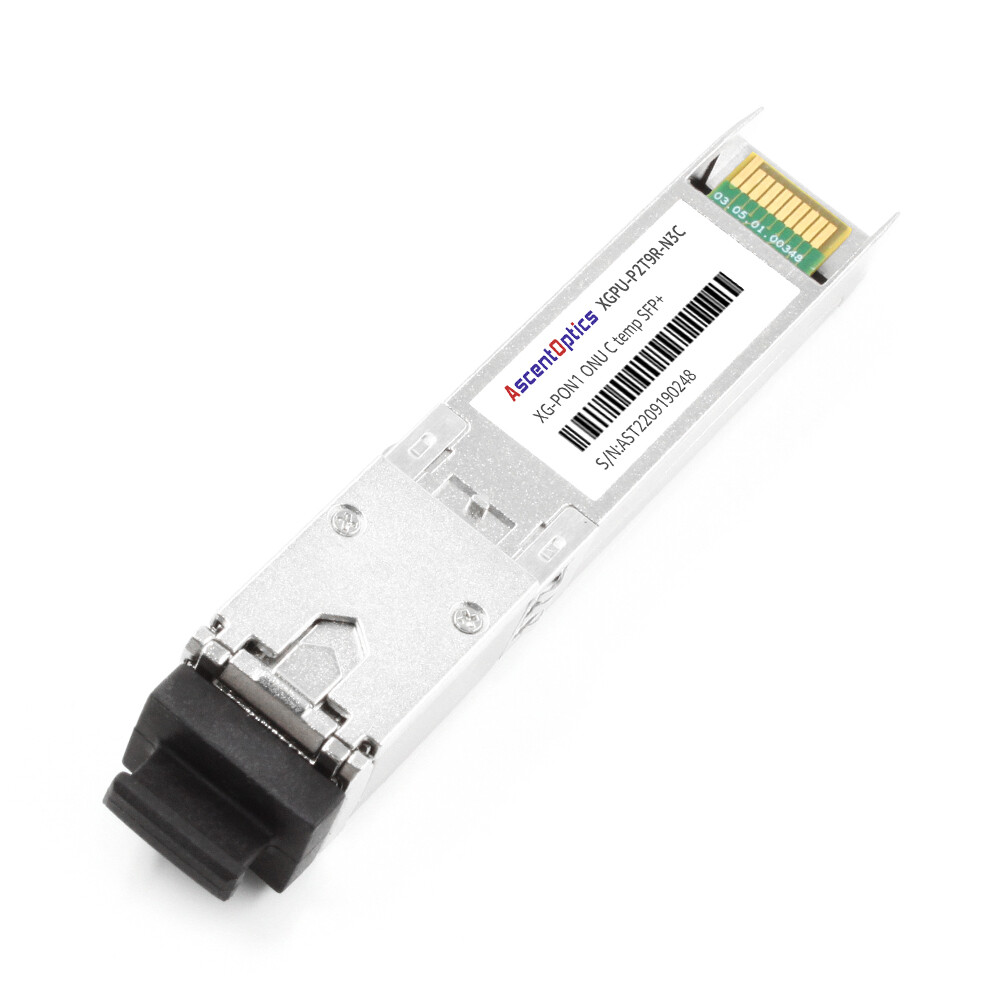
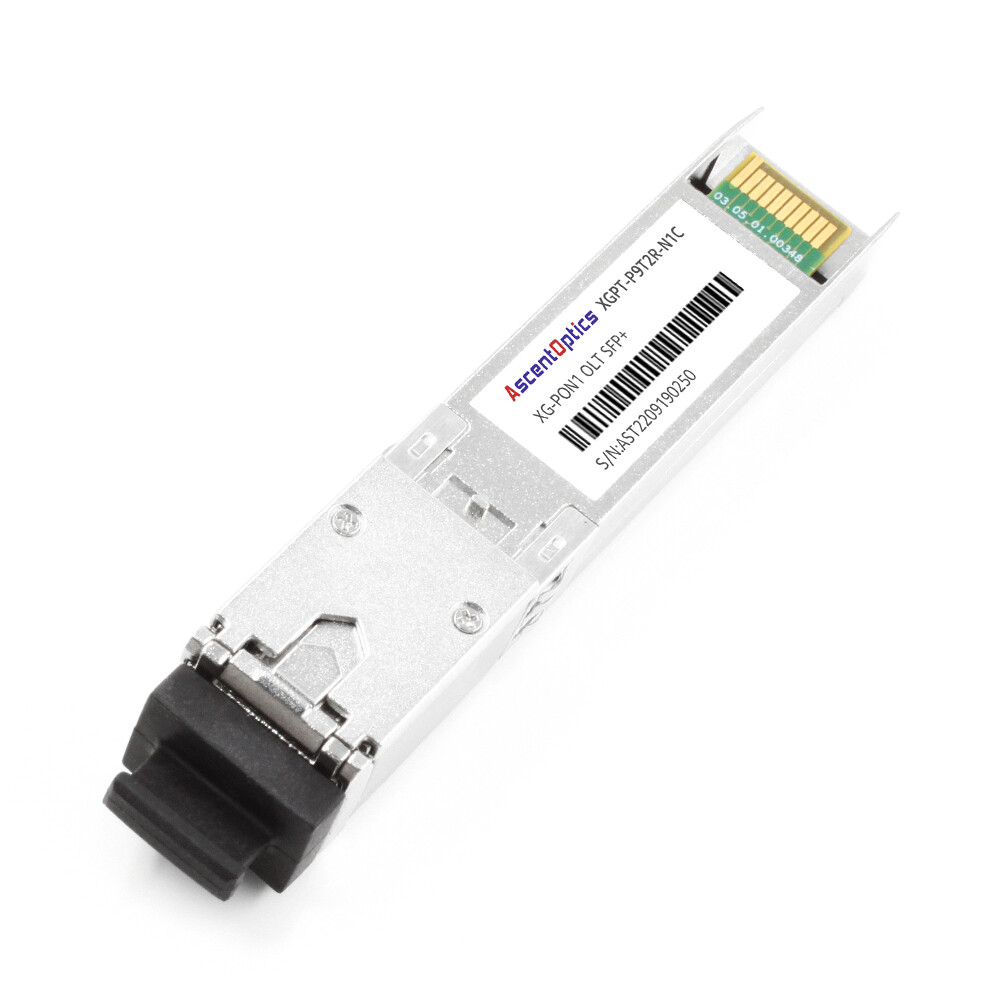
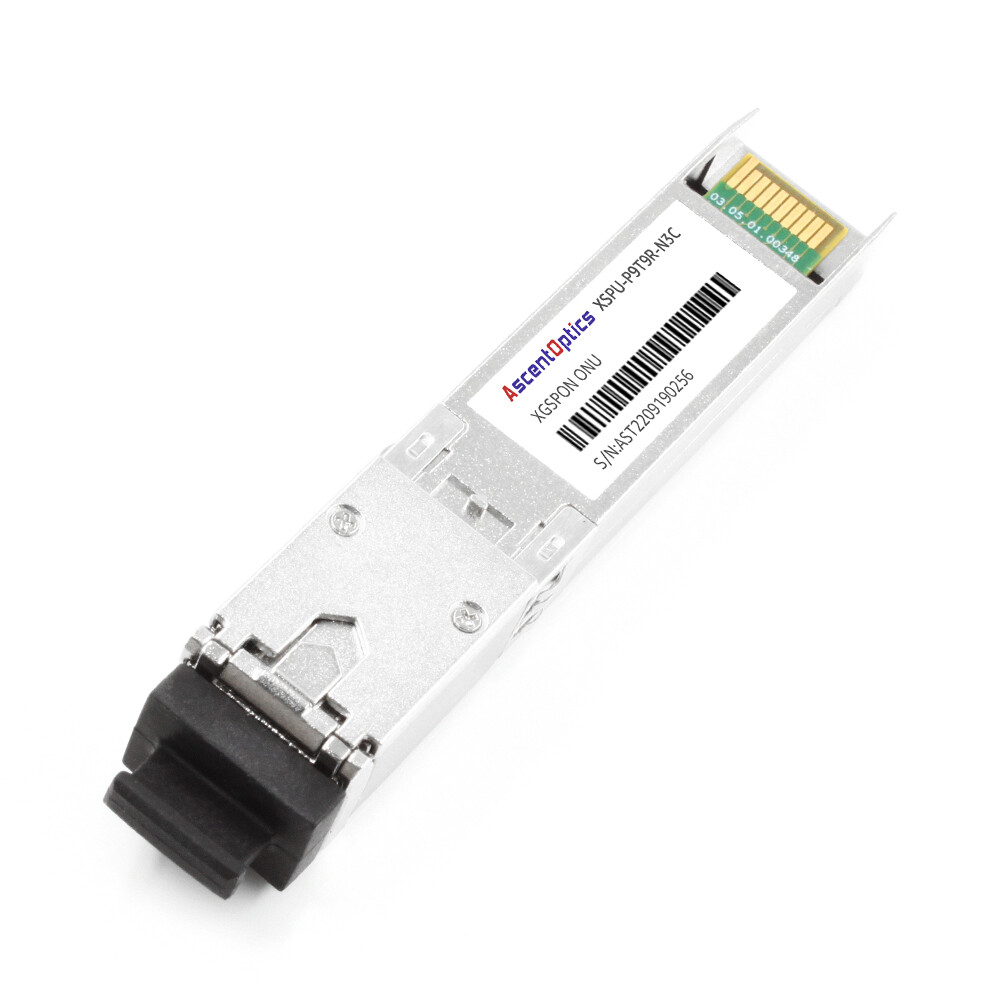
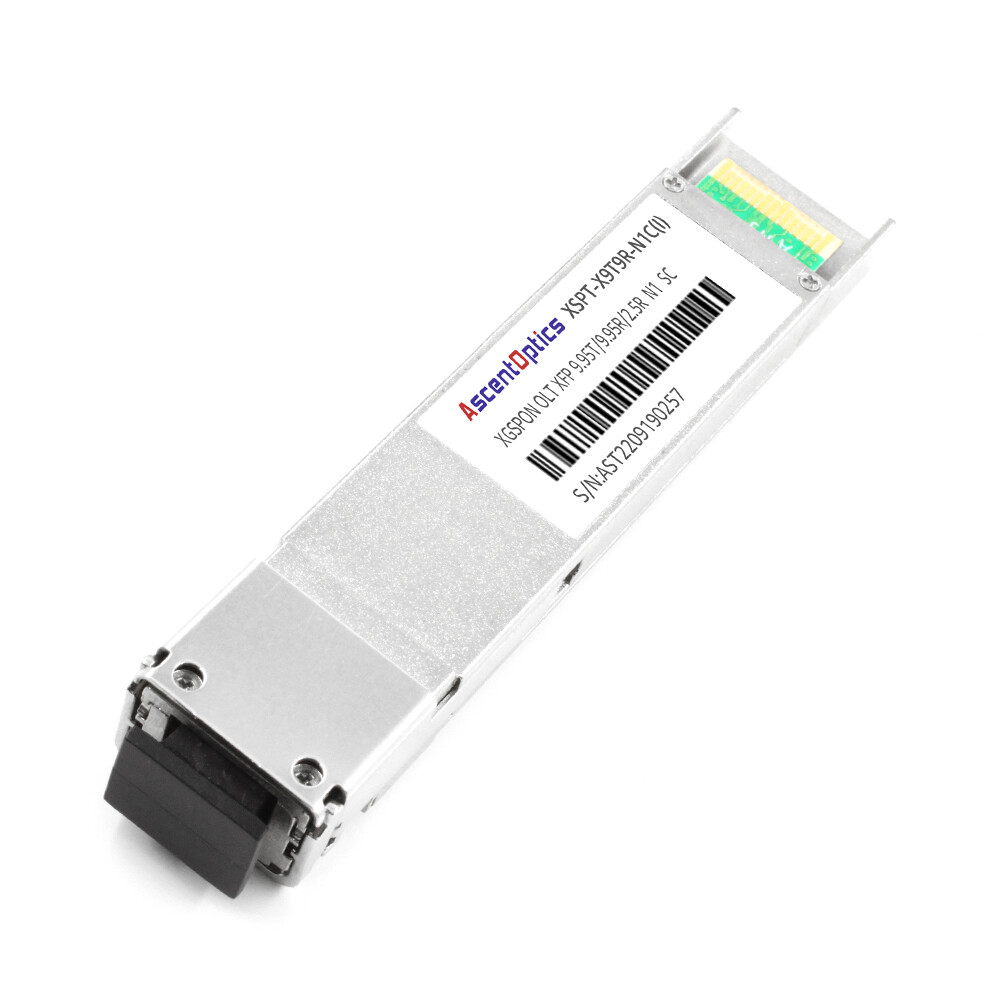
In PON and FTTx networks, the OLT is located at the central office, where it centrally manages, schedules, and aggregates subscriber traffic; the ONU is situated at the subscriber end, handling terminal access and signal conversion. The two are connected via a passive optical splitter, with the OLT controlling downstream broadcasting and upstream bandwidth allocation, while ONUs share the bandwidth, creating a point-to-multipoint fiber access architecture.
What Is an OLT? The Central Office Side of the Network
An OLT, or Optical Line Terminal, is the service-provider-side equipment in a PON. It sits in the central office, headend, or data center and acts as the controller for the entire optical access network. In the language of the ITU-T, the OLT provides the network-side interface of the optical access network (OAN) and connects to one or more optical distribution networks (ODNs).
Think of the OLT as the traffic director. Every bit of downstream data flowing toward subscribers passes through it. Every upstream transmission is scheduled by it.
Where the OLT Sits in a PON
A PON has a simple, point-to-multipoint shape. At the top is the OLT. From the OLT, a single fiber runs to a passive optical splitter. The splitter fans that fiber out to many customer locations, each with its own ONU or ONT. No active electronics sit in between. The splitter and the fiber between the OLT and the ONUs form the ODN.
Because the OLT is the central control point of a PON, a failure of an OLT system or PON interface can affect all subscribers connected to that PON segment.
Core OLT Functions
The OLT does far more than convert signals. It is responsible for:
- •Dynamic Bandwidth Allocation (DBA): deciding how much upstream capacity each ONU gets, and when
- •Ranging: measuring the distance and delay to each ONU so signals arrive without collision
- •ONU registration and authentication: accepting only authorized devices onto the PON
- •Quality of service (QoS) policy: enforcing latency and bandwidth rules per subscriber
- •Traffic scheduling: managing upstream time slots using time-division multiple access (TDMA)
In short, the OLT manages the entire PON. The ONUs follow its instructions.
What Is an ONU? The Customer-Premises Endpoint
An ONU, or Optical Network Unit, is the user-side device at the far end of the PON. It sits at the customer premises, in a building basement, or in a curb-side cabinet. Its main job is to convert the optical signal arriving from the OLT back into the electrical signals that PCs, TVs, phones, and Wi-Fi routers can use.
If the OLT is the traffic director, the ONU is the local delivery door. It receives the data addressed to its specific subscribers and forwards it into the local network.
ONU vs ONT: FTTH vs FTTB
You will often see ONT used alongside ONU, and the two are functionally identical at the transmission layer. The ITU-T itself writes them together as “ONU/ONT.” The practical distinction is placement and scope:
- •ONT (Optical Network Terminal) typically serves a single home in a fiber-to-the-home (FTTH) rollout. It is the “optical modem” in the living room or garage.
- •ONU (Optical Network Unit) is the general term defined by PON standards. In practical deployments, ONU and ONT are often used interchangeably, although ONT usually refers to a subscriber-side unit.
The terminology differs by standard body too: ONT is more common in ITU-T GPON documentation, while ONU appears more in IEEE and general usage. For most engineering purposes, treat them as the same device category.
What the ONU Does
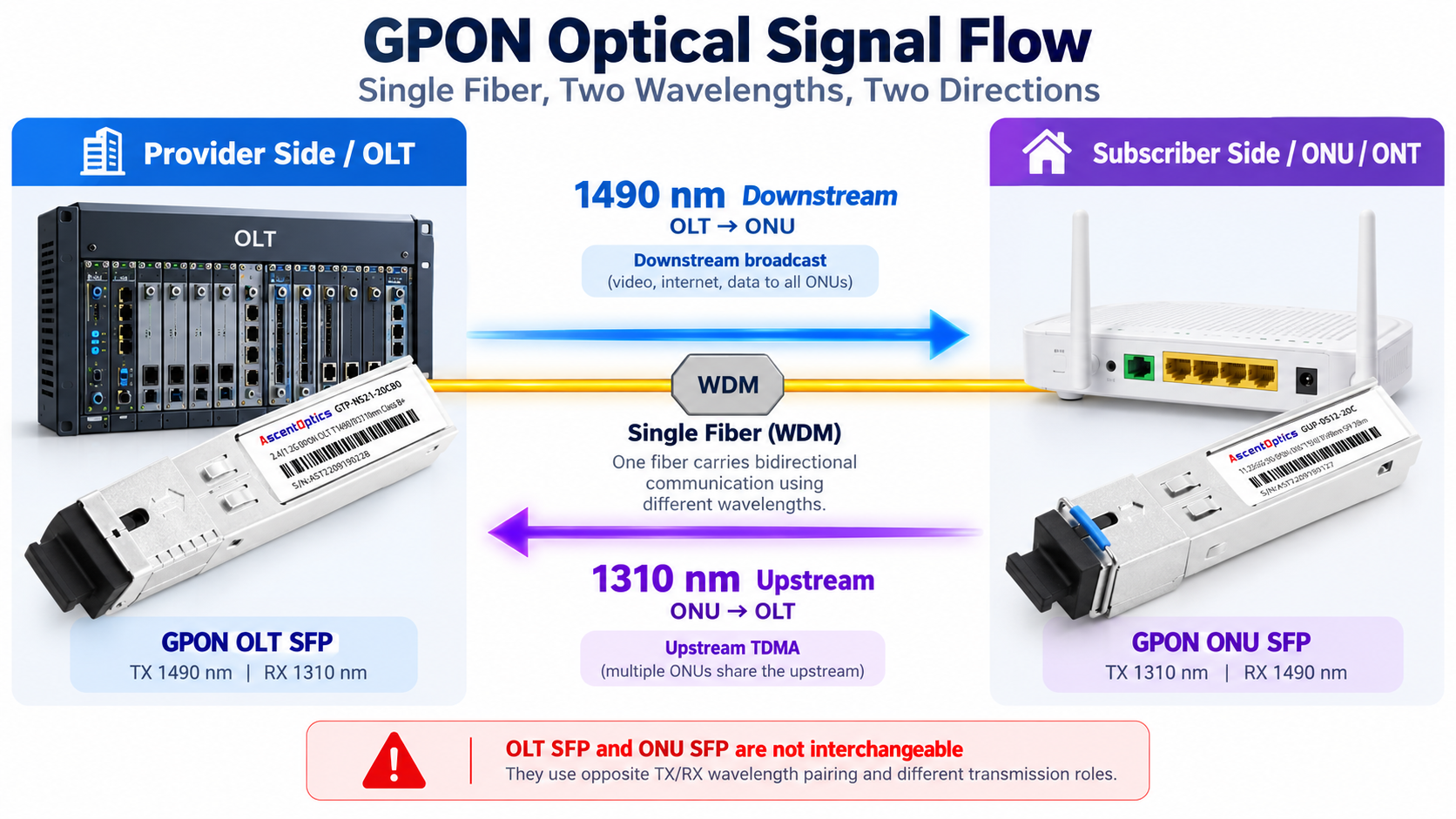
The ONU performs the reverse of the OLT’s signal conversion. It receives a 1490 nm downstream optical signal and converts it to electrical. It transmits upstream at 1310 nm. It also follows the OLT’s schedule, sending data only in its assigned time slot so it does not collide with the other ONUs sharing the fiber.
One more thing matters here: an ONU failure is local. If one ONU dies, one subscriber loses service. That is the single-apartment outage from the opening.
OLT vs ONU: A Head-to-Head Comparison
Placing the two devices side by side makes the differences concrete. The table below summarizes the core distinctions.
| Attribute |
OLT |
ONU / ONT |
| Location |
Central office, headend, or data center |
Customer premises, building, or curb cabinet |
| Role |
Central controller of the PON |
Endpoint serving one or more subscribers |
| Signal direction |
Converts electrical to optical (downstream) |
Converts optical to electrical (user side) |
| Wavelengths |
TX 1490 nm, RX 1310 nm |
TX 1310 nm, RX 1490 nm |
| Bandwidth control |
Allocates bandwidth to all ONUs |
Receives allocated bandwidth |
| Capacity |
Manages up to 64+ ONUs per PON port Typically supports 32–64 ONUs per GPON port, with higher split ratios possible depending on optical budget. |
Handles one user or building |
| Failure impact |
Entire PON segment goes down |
Only that subscriber goes down |
| Standards |
Full PON stack (GPON, EPON, XGS-PON) |
User-side device per the applicable standard |
The single most important row is failure impact. It is why operators treat OLT redundancy as non-negotiable while treating ONU replacement as routine truck-roll work.
How OLT and ONU Communicate in a PON
The relationship between the OLT and the ONUs is point-to-multipoint, and the two directions behave very differently. Understanding this is the key to understanding the whole architecture.
Downstream: One-to-Many Broadcast
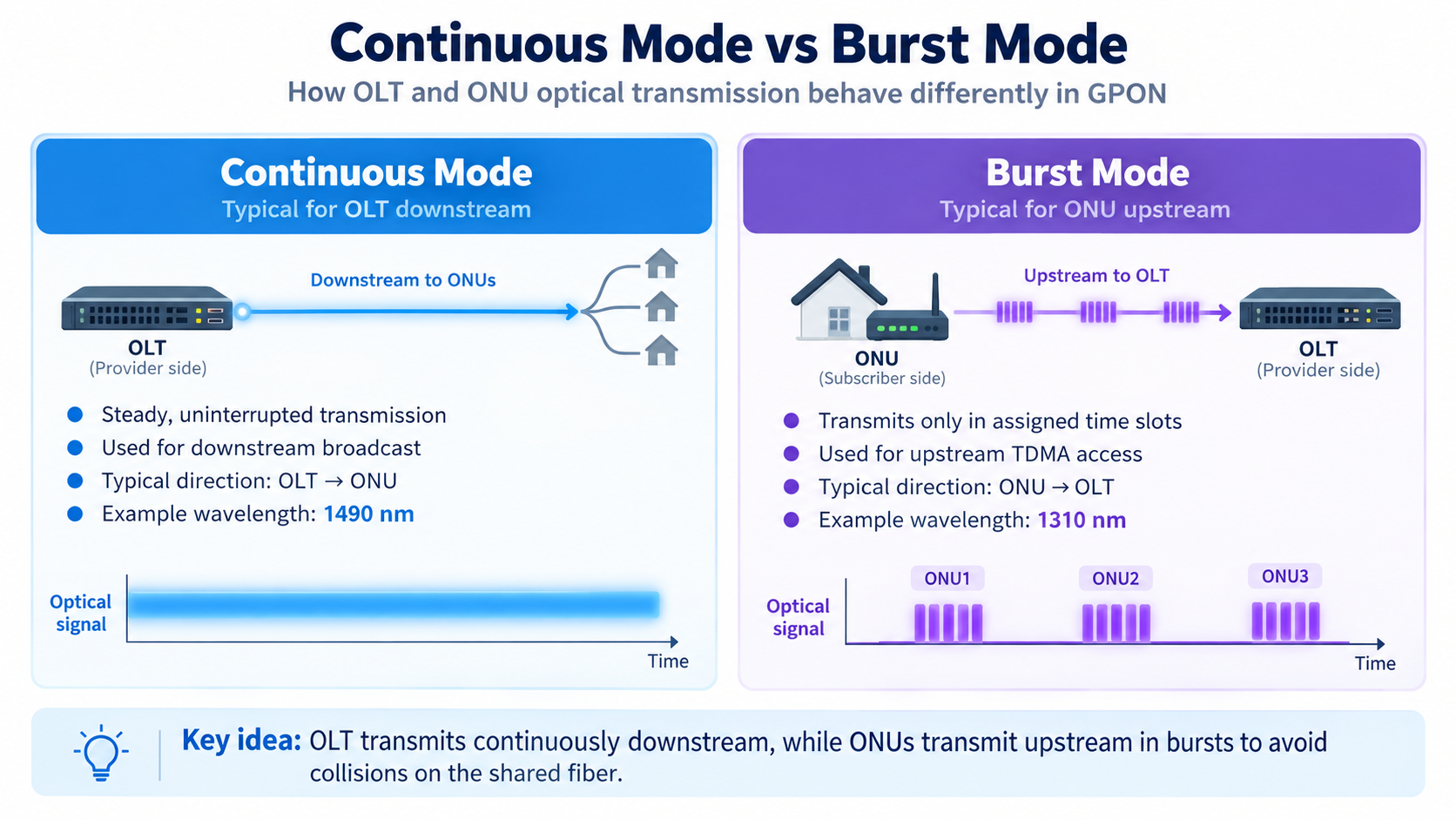
When the OLT sends data downstream, it broadcasts to every ONU on the PON through the passive splitter. Each ONU receives the full stream but only extracts the frames addressed to it, using its unique identifier. The others discard what is not theirs.
This is efficient for the provider. One downstream transmission reaches everyone.
Upstream: Many-to-One via TDMA
Upstream is the hard part. All the ONUs share the same fiber back to the OLT, so they cannot all transmit at once. The OLT solves this with TDMA, assigning each ONU a specific time slot in which it may transmit. The OLT measures each ONU’s distance through ranging so that a burst from a nearby ONU and a burst from a distant ONU arrive in their proper slots without overlapping.
The Transceiver Layer: OLT SFP vs ONU SFP
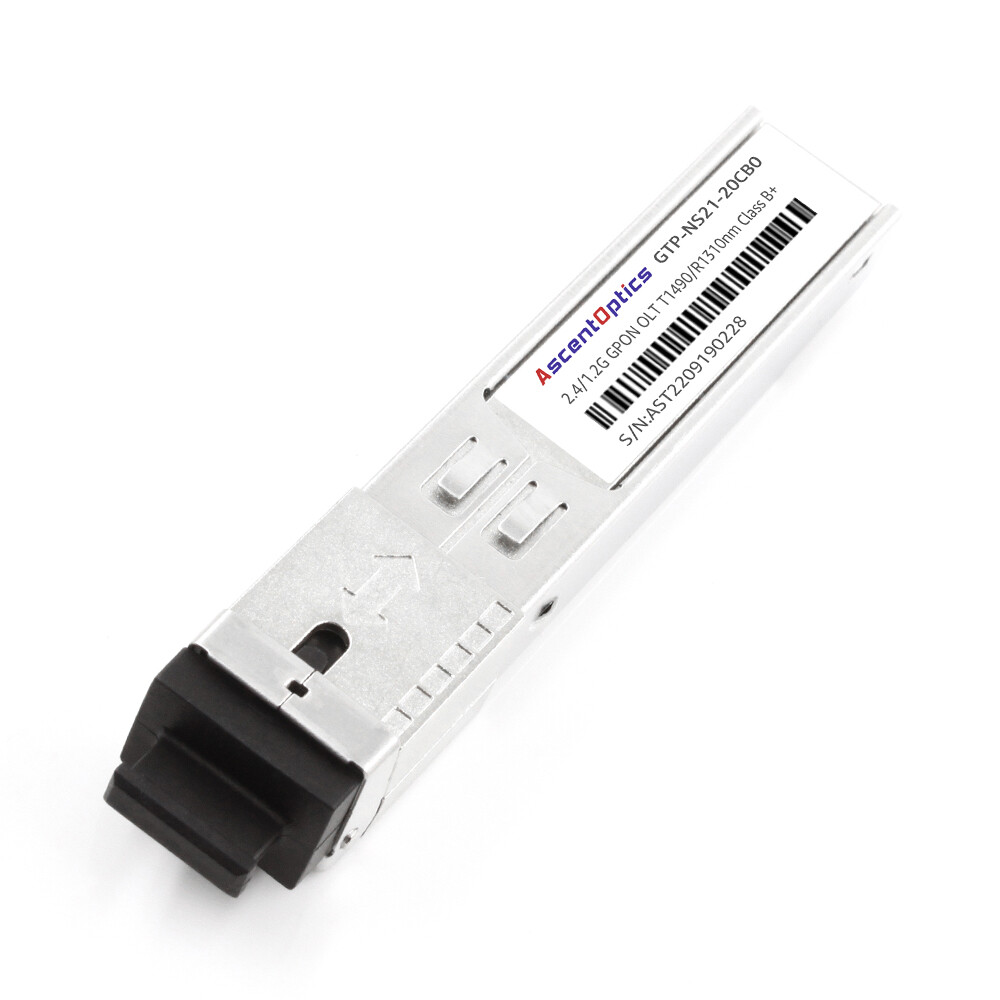
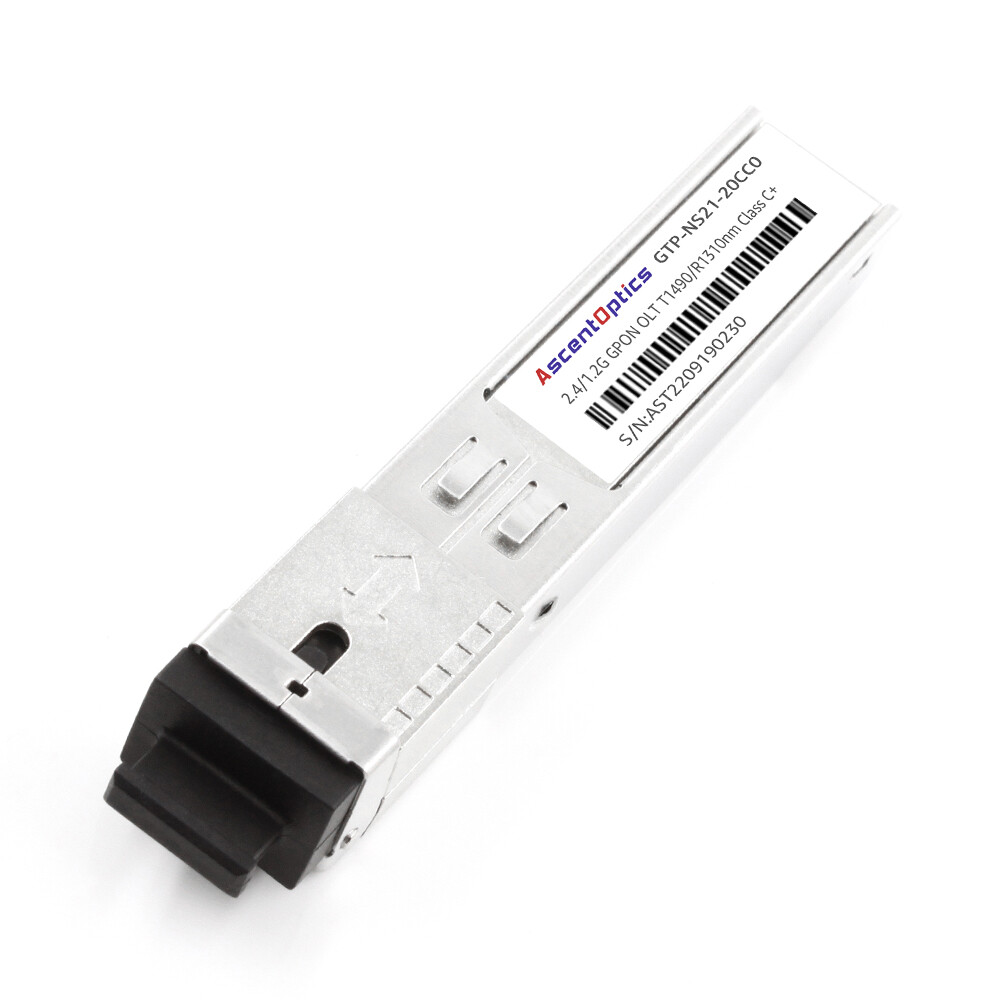
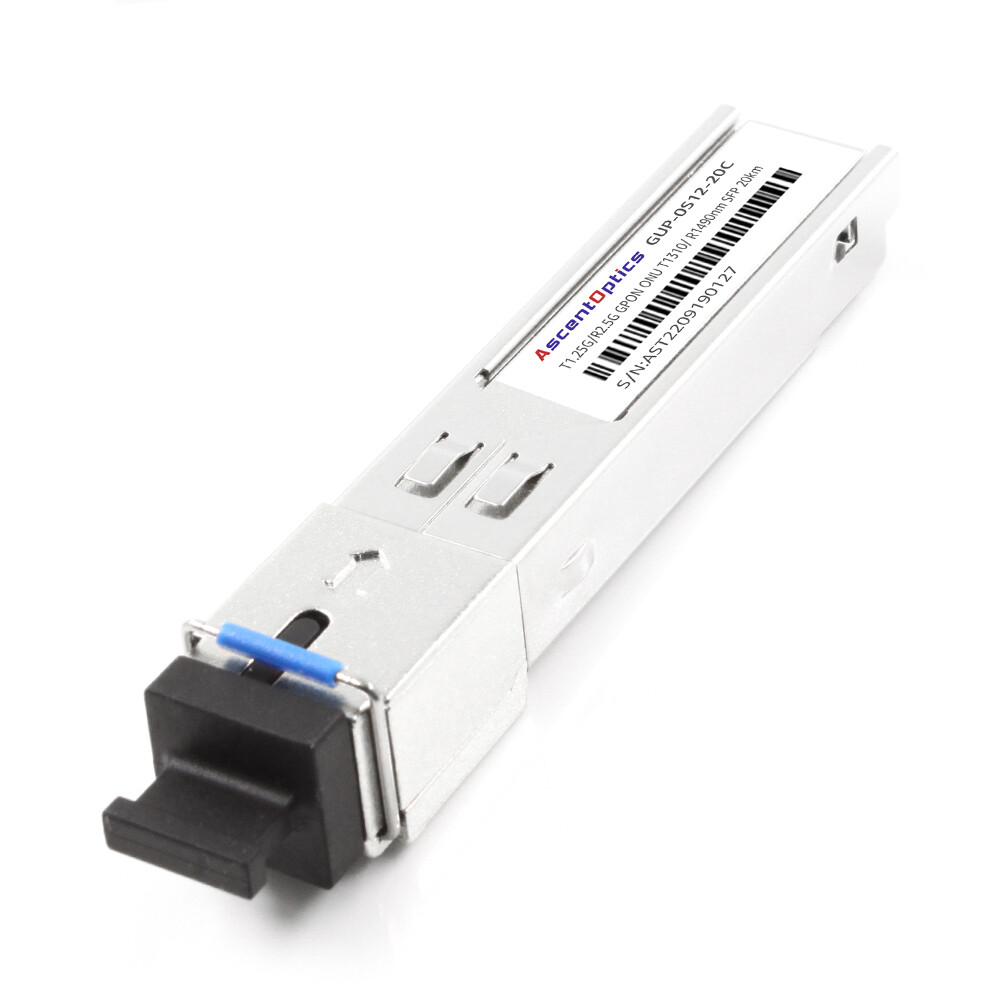
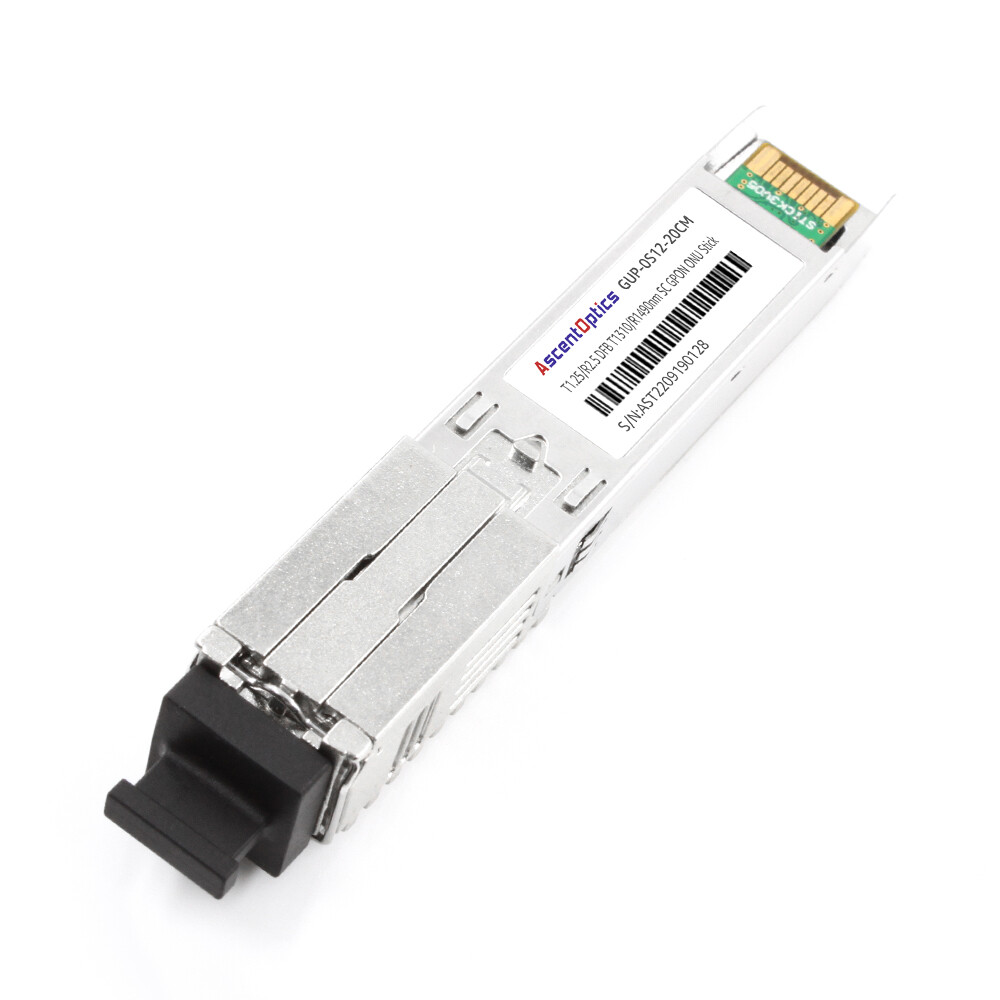
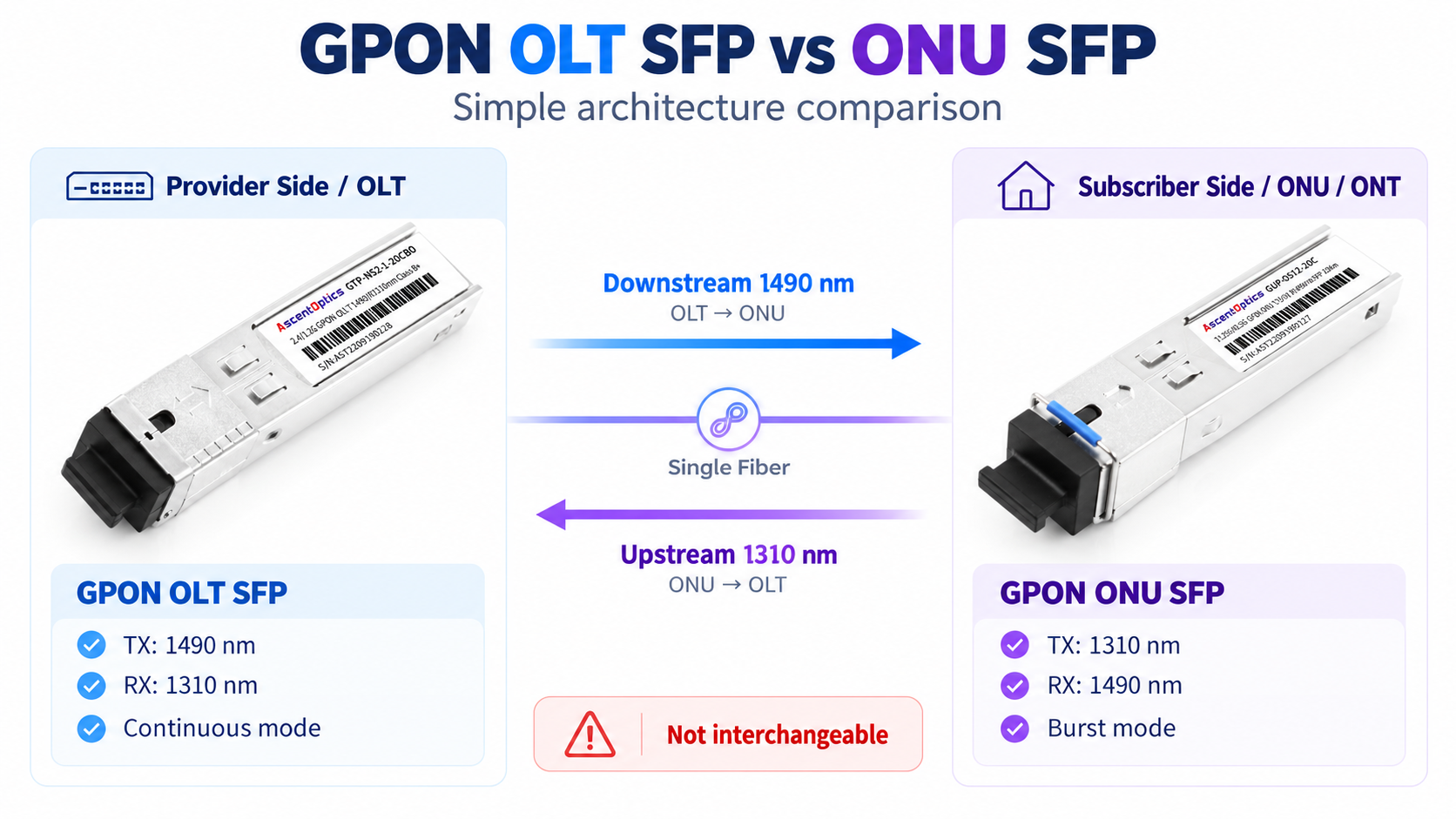
The OLT and ONU are the two endpoints of a PON, but the optical transceivers installed at each end perform different roles. Although both may use an SFP form factor, OLT SFP and ONU SFP modules are not interchangeable. They operate with opposite transmit and receive wavelengths and are designed for different positions in the PON architecture.
OLT SFP Module
The OLT SFP module is installed in the Optical Line Terminal at the service-provider side of the network. It provides the optical interface between the OLT and the Optical Distribution Network (ODN).
In a GPON system, the OLT optical module:
- •Transmits downstream data at 1490 nm
- •Receives upstream data at 1310 nm
- •Sends downstream traffic toward all ONUs connected to the same PON
- •Receives upstream traffic from multiple ONUs through the shared fiber infrastructure
The OLT is responsible for coordinating upstream access, so the optical interface must support traffic arriving from multiple subscriber-side devices according to the timing controlled by the OLT.
ONU SFP Module
The ONU SFP module operates at the subscriber side of the PON and provides the optical connection between the ODN and the ONU or ONT equipment.
In a GPON system, the ONU optical module:
- •Transmits upstream data at 1310 nm
- •Receives downstream data at 1490 nm
- •Sends upstream traffic only during the transmission opportunities assigned by the OLT
- •Receives the downstream stream and processes the traffic intended for that ONU
Because multiple ONUs share the same upstream fiber, their transmissions must be coordinated so that signals do not overlap. The OLT uses TDMA scheduling and ranging to control when each ONU is allowed to transmit.
OLT SFP vs ONU SFP at a Glance
| Feature |
GPON OLT SFP |
GPON ONU SFP |
| Network position |
Service-provider / OLT side |
Subscriber / ONU or ONT side |
| TX wavelength |
1490 nm |
1310 nm |
| RX wavelength |
1310 nm |
1490 nm |
| Primary TX direction |
Downstream |
Upstream |
| Primary role |
Connects the OLT to the ODN |
Connects the ONU/ONT to the ODN |
| Traffic relationship |
Communicates with multiple ONUs |
Communicates with the OLT |
The wavelength pairing is complementary: the OLT transmits on the wavelength that the ONU receives, while the ONU transmits on the wavelength that the OLT receives. GPON can also reserve 1550 nm for an optional RF video overlay.
Why OLT and ONU SFP Modules Are Not Interchangeable
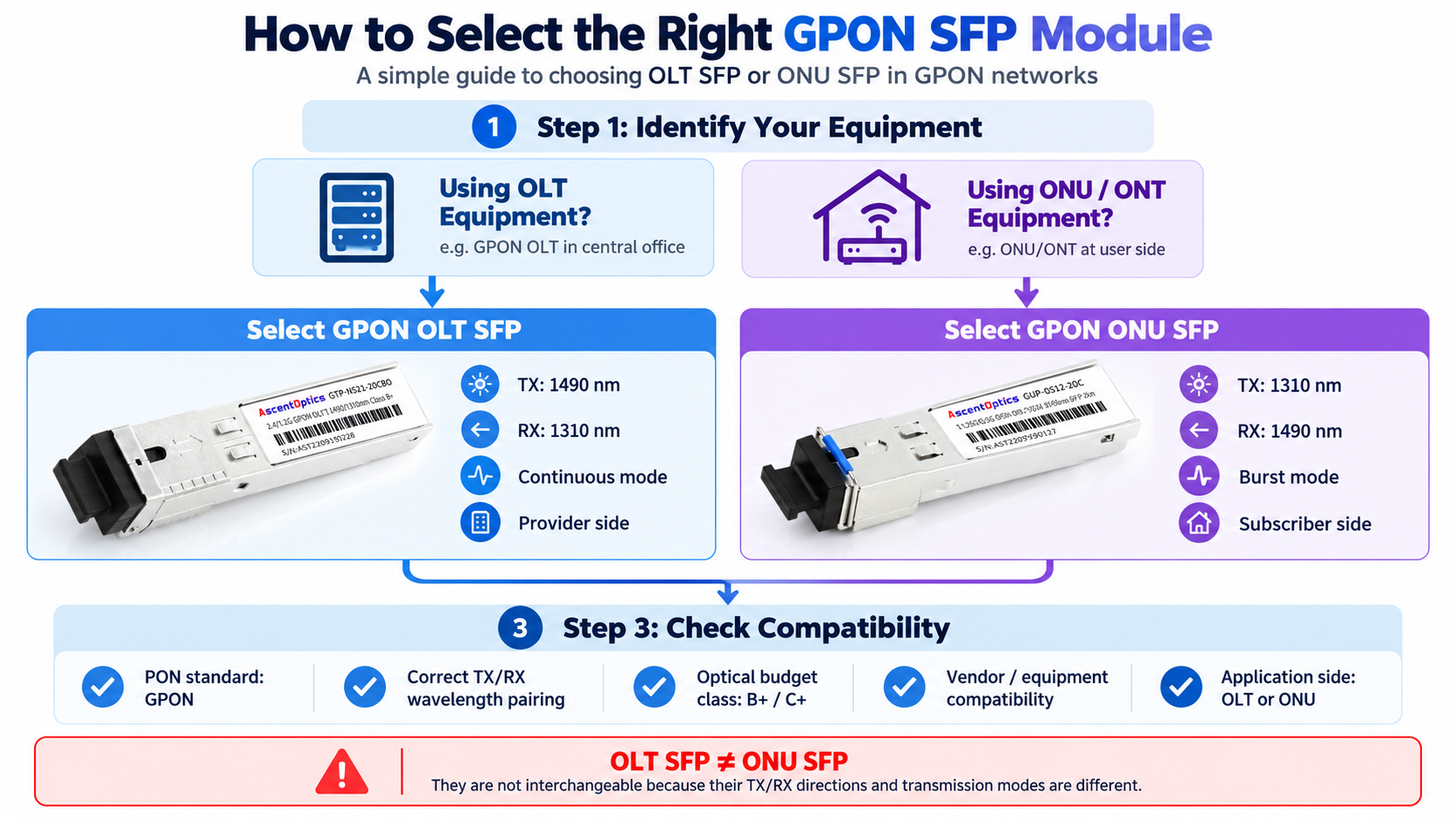
An OLT SFP cannot simply be installed in place of an ONU SFP, or vice versa. Their transmit and receive directions are reversed, and each module is designed for a different role in the PON.
When selecting a GPON transceiver, engineers should verify:
- •PON standard compatibility
- •TX/RX wavelength pairing
- •Optical budget class, such as B+ or C+
- •OLT or ONU-side application
- •Compatibility with the target OLT or ONU equipment
Correct module selection is especially important in multi-vendor deployments, where matching the wavelength and optical budget alone does not necessarily guarantee interoperability. The transceiver should also comply with the applicable PON specification and be validated with the target equipment. The article already makes this compatibility point in its selection section.
GPON, EPON, and XGS-PON: Choosing the Standard
OLT vs ONU is only part of the picture. The two devices also have to speak the same PON standard. The three most common are:
- •GPON(ITU-T G.984): 2.488 Gbps downstream and 1.244 Gbps upstream. The dominant global standard for FTTx, with mature optics and a wide ONU ecosystem.
- •EPON(IEEE 802.3ah): symmetric 1.25 Gbps. Common in parts of Asia and some enterprise/campus networks.
- •XGS-PON(ITU-T G.9807.1): symmetric 10 Gbps. The current upgrade path for providers moving beyond GPON.
The OLT sets the standard for the PON, and every ONU on that PON must match it. You cannot mix a GPON OLT with XGS-PON ONUs. This is why operators standardize on one technology per access region and plan migrations carefully.
How to Choose the Right OLT and ONU for Your Network
Selection comes down to four questions. Answer them in order, and the hardware largely picks itself.
- 1. What is your split ratio? The number of subscribers per OLT port drives everything else. A 1:32 split is more forgiving. A 1:64 split demands more optical budget.
- 2. What is your reach? Short urban loops tolerate more loss than long rural runs. Measure the worst-case fiber path, not the average.
- 3. What optical budget class do you need? Work the link budget backward. If the tally lands near 28 dB, B+ works. If it pushes toward 30 dB or more, you need C+ (or C++/D+ for the longest, highest-split designs).
- 4. Are your transceivers matched and compatible? The OLT and ONU must share the same PON standard and the correct wavelength pairing. The transceivers should also comply with ITU-T G.984.2 and interoperate with your chosen OLT and ONU vendor equipment.
Getting the fourth question wrong is the most common deployment mistake, and the cheapest to avoid. It is the difference between a network that turns up on day one and one that requires an emergency module swap.
Frequently Asked Questions
What is the difference between OLT and ONU?
An OLT is the service-provider-side controller at the central office, while an ONU is the customer-side endpoint that converts optical signals to electrical for subscribers. The OLT manages the whole PON; the ONU serves one or more users.
What is the difference between ONU and ONT?
Functionally, they are the same device. ONT typically serves a single home in an FTTH deployment, while ONU often serves multiple users in an FTTB deployment with an intermediate network. The ITU-T uses “ONU/ONT” together.
How many ONUs can connect to one OLT?
A GPON OLT port commonly supports up to 64 ONUs per port, with some implementations reaching 128. EPON deployments commonly use 1:32 or 1:64 splits depending on optical budget and network design. The practical limit is set by optical budget and split ratio, not by the OLT’s signaling alone.
What wavelength does an OLT use vs an ONU?
The OLT transmits downstream at 1490 nm and receives at 1310 nm. The ONU does the opposite: transmits at 1310 nm and receives at 1490 nm.
Is an OLT the same as an ONU?
No. They are opposite ends of the same network. The OLT is the central controller; the ONU is the subscriber endpoint.
Can an OLT module work in an ONU?
No. OLT and ONU optical modules use opposite transmission directions and different operating modes. They must be matched according to PON architecture.
Are GPON OLT and ONU modules interchangeable?
No. GPON OLT modules and ONU modules have different TX/RX wavelengths and transmission mechanisms.
Post Views: 892