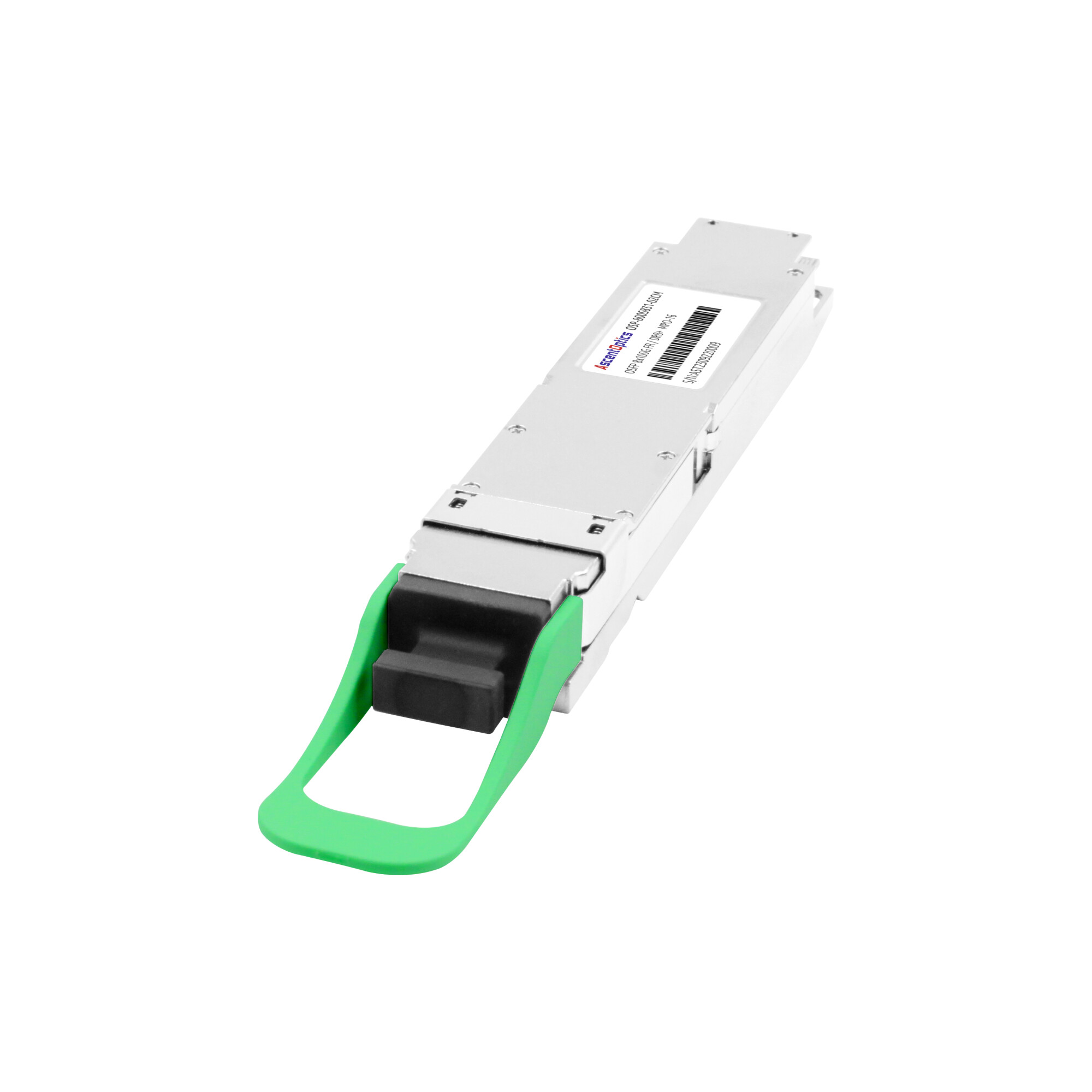
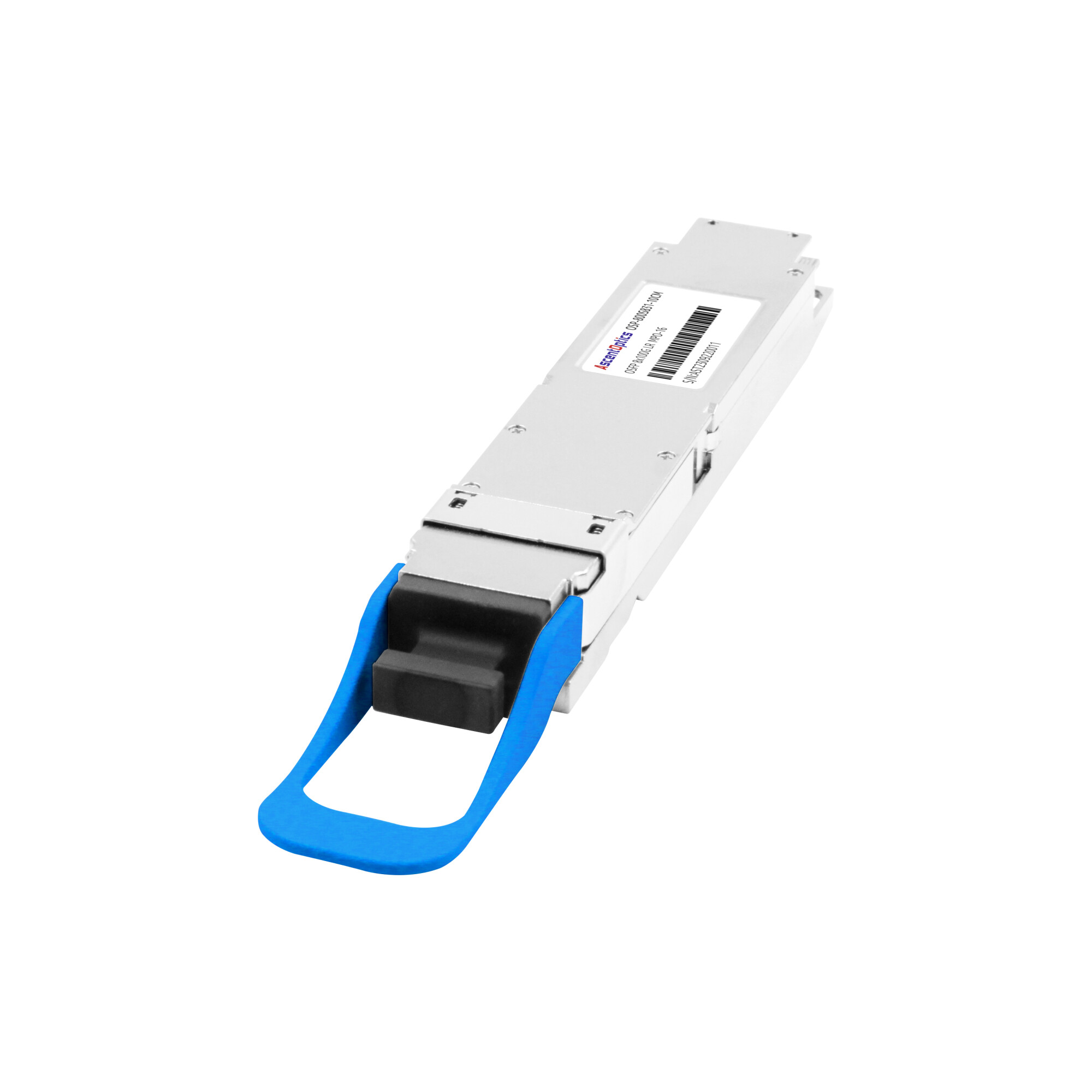
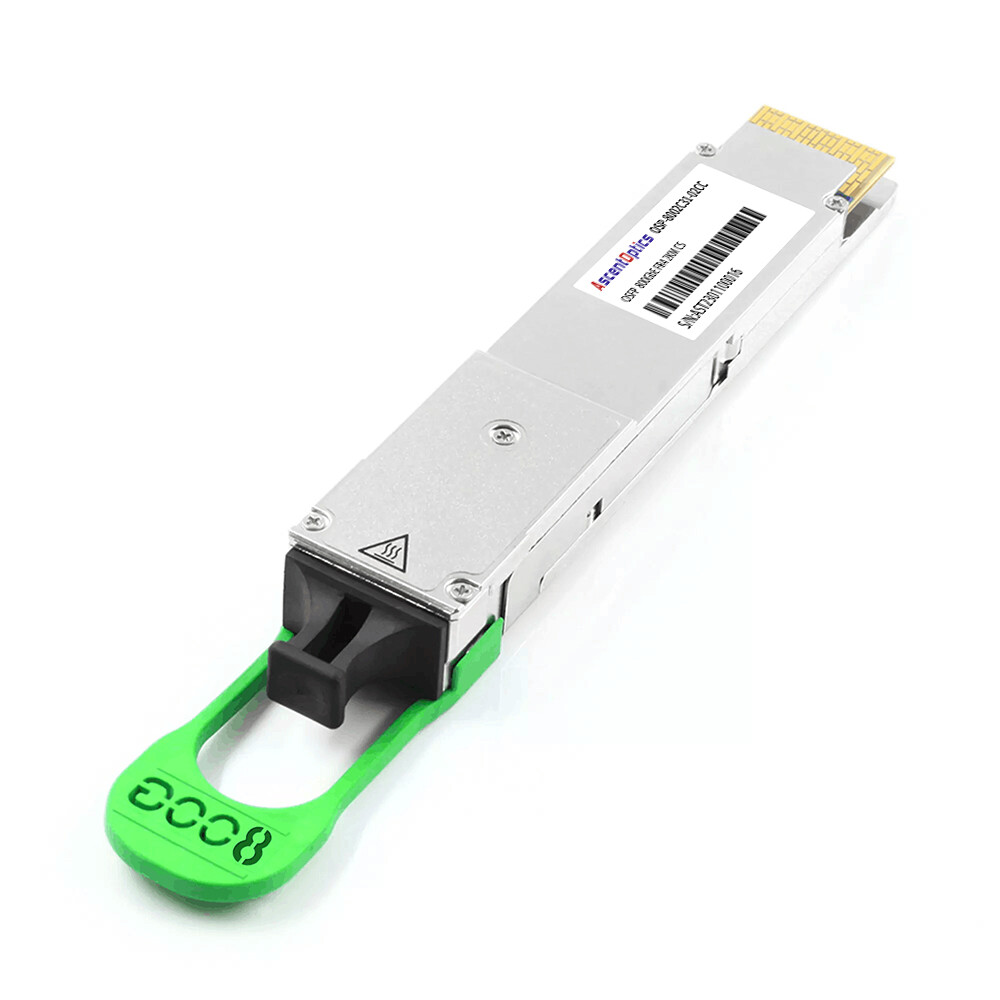
800G data center networking is becoming increasingly important for AI clusters, hyperscale cloud infrastructure, and other bandwidth-intensive workloads. By providing up to 800Gb/s per network port, 800G Ethernet can increase network capacity while reducing the number of ports, optical modules, and cables required for a given aggregate bandwidth.
Modern 800G solutions commonly use PAM4-based signaling and eight high-speed lanes, with optical implementations including parallel multimode or single-mode architectures as well as wavelength-multiplexed designs. These technologies help data center operators scale east-west bandwidth between servers, GPUs, switches, and storage systems while maintaining high port density and manageable power consumption.
What Is 800G Data Center Networking?
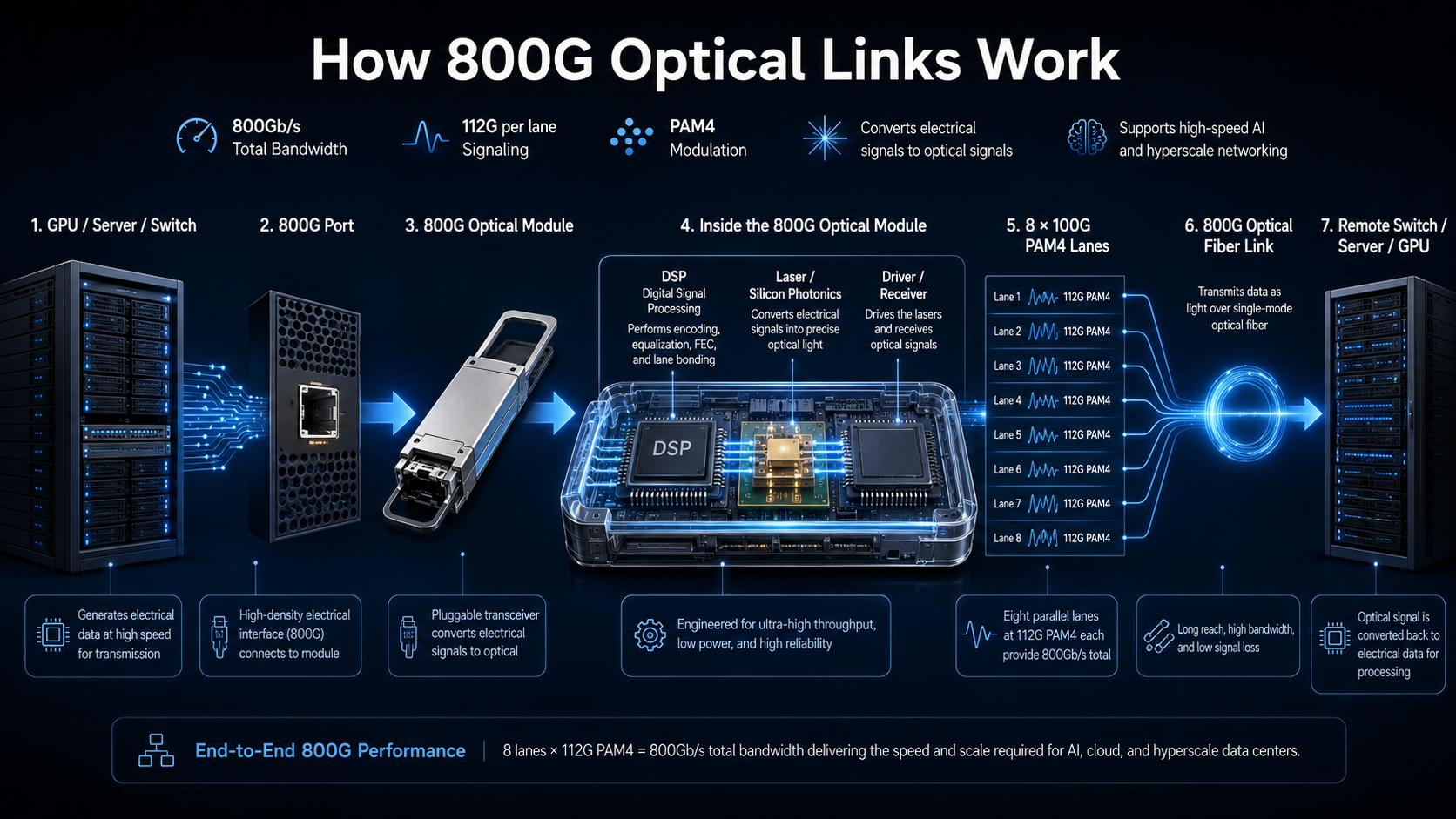
800G data center networking is the use of 800 gigabit-per-second optical links to interconnect servers, switches, and accelerators inside a modern data center. Each 800G optical transceiver module carries eight parallel 100G lanes using PAM4 signaling at 112G per lane, which doubles per-port bandwidth compared with 400G while using the same fiber count.
Inside the module, a digital signal processor (DSP) compensates for signal degradation over fiber and copper, while laser sources such as EMLs or silicon photonics generate the optical signal. This architecture is what lets a single switch port move 800 Gbps, the backbone speed for AI training clusters and hyperscale clouds through at least 2028.
Why Data Centers Are Moving to 800G
The migration to 800G isn’t driven by vendor marketing. It’s driven by four hard engineering pressures.
AI training and east-west traffic. Modern GPU clusters don’t mostly talk to the internet. They talk to each other. During an all-reduce operation, thousands of GPUs exchange gradients in lockstep, and any single slow link stalls the entire job. This east-west traffic pattern is the opposite of traditional north-south data center design, and it demands the highest per-port bandwidth available.
Hyperscaler procurement at scale. Hyperscalers are the primary buyers. Meta, Google, Microsoft, and AWS collectively account for the majority of high-speed module demand, with Meta alone expected to take millions of 800G units as it scales its AI infrastructure.
Bandwidth per gigabit and total cost. 800G delivers roughly double the capacity of 400G on the same port, which reduces the number of switches, the number of modules, and the amount of cabling required per unit of bandwidth.
The 1.6T transition is still maturing. 1.6T modules are ramping fast, but 800G is expected to remain the volume workhorse through 2026 and beyond. For most teams, 800G is the safe, cost-effective place to land now.
The result: 800G module shipments are on track to more than double again in 2026, and the 800G module market is forecast to grow from roughly 3.12 billion in 2025 to about 3.12 billion in 2025 to about 4.87 billion in 2026.
800G Data Center Network Architecture
Getting the topology right matters more than picking the fastest module. Here is how 800G fits into the three fabrics you’re most likely to build.
Leaf-Spine and Clos Fabrics
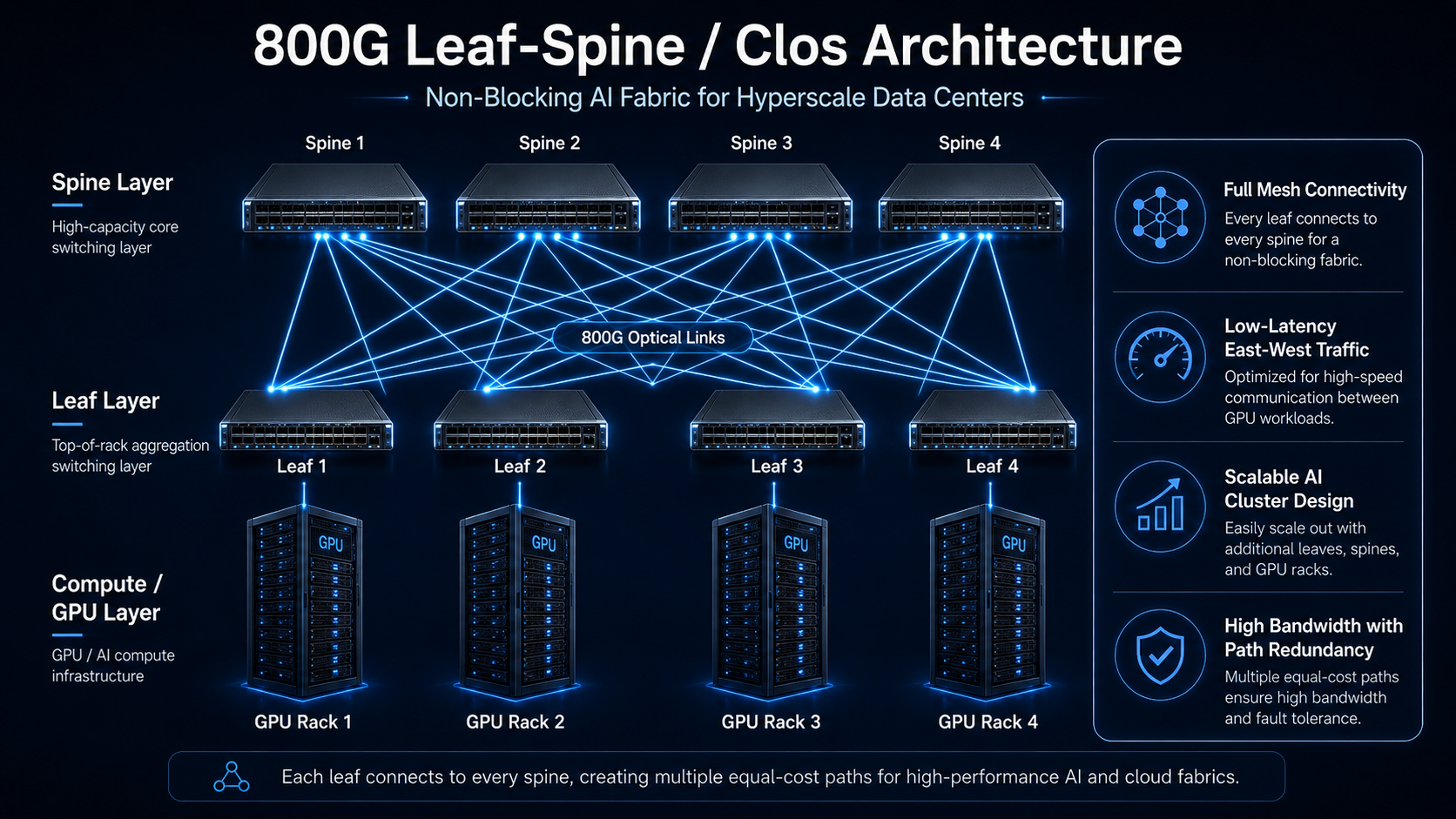
In a leaf-spine design, every leaf switch typically connects to multiple spine switches, creating multiple paths for east-west traffic. Upgrading selected leaf-to-spine links from 400G to 800G can approximately double the bandwidth per port and increase fabric capacity without proportionally increasing port count. The extent to which existing cabling can be reused depends on the transceiver form factor, fiber type, connector configuration, and breakout architecture.
For hyperscale AI, this becomes a full Clos or fat-tree. Microsoft Azure, for example, is installing 800G full fat-tree non-blocking fabrics for its GB200 and GB300 clusters, using both Ethernet and InfiniBand at 800 Gbps.
GPU Cluster Fabrics
AI clusters place specific demands on the network. All-reduce and RDMA traffic is bursty and latency-sensitive. A single congested link throttles the entire training run. At 800G, the fabric must deliver consistent, low-latency bandwidth across every GPU pair, which is why so much engineering attention goes to load balancing and congestion control.
InfiniBand vs Ethernet at 800G
At 800G, both InfiniBand and Ethernet can provide the bandwidth required by large-scale AI and HPC clusters, but they use different networking ecosystems and deployment approaches.
NVIDIA Quantum-X represents the InfiniBand path, offering 144 ports of 800G with 200G SerDes and strong in-network computing features for tightly coupled HPC and AI jobs. NVIDIA Spectrum-X represents the Ethernet path, built for multi-tenant hyperscale environments.
Spectrum-X uses a multiplane topology rather than a traditional hierarchical Clos. Each ConnectX NIC splits an 800G port into four independent 200G planes, with each plane connecting to a disjoint leaf-spine fabric through passive optical shuffle boxes at the rack edge. NVIDIA reports near-theoretical throughput, p99 latency below 9 microseconds, and roughly 98 percent utilization, with photonics switch configurations scaling from 128 by 800G (100 Tb/s) up to 512 by 800G (400 Tb/s).
For most people, the ultimate choice comes down to this: if your environment is NVIDIA-end-to-end and tightly coupled, InfiniBand remains the strongest option. If you’re building a multi-tenant cloud or prefer Ethernet’s ecosystem flexibility, Spectrum-X style 800G Ethernet is the pragmatic choice.
Choosing 800G Form Factors and Optical Modules
Once the topology is set, you choose the physical packaging and the optical reach. These two decisions drive your density, thermal budget, and cost.
OSFP vs QSFP-DD800
QSFP-DD800 and OSFP are the two dominant 800G form factors, and they are splitting the market along a clear line.
QSFP-DD800 offers higher port density and backward compatibility with existing QSFP28 and 400G QSFP-DD infrastructure. It dominates the server and accelerator side, and is the natural choice for short-reach intra-pod and top-of-rack links under 500 meters.
QSFP-DD800 maintains the compact QSFP-style footprint and can offer a useful migration path from lower-speed QSFP-based interfaces. Depending on the platform, it can also support backward-compatible deployment with appropriate modules and configurations. Its compact form factor makes it attractive for high-density network adapters and switch ports.
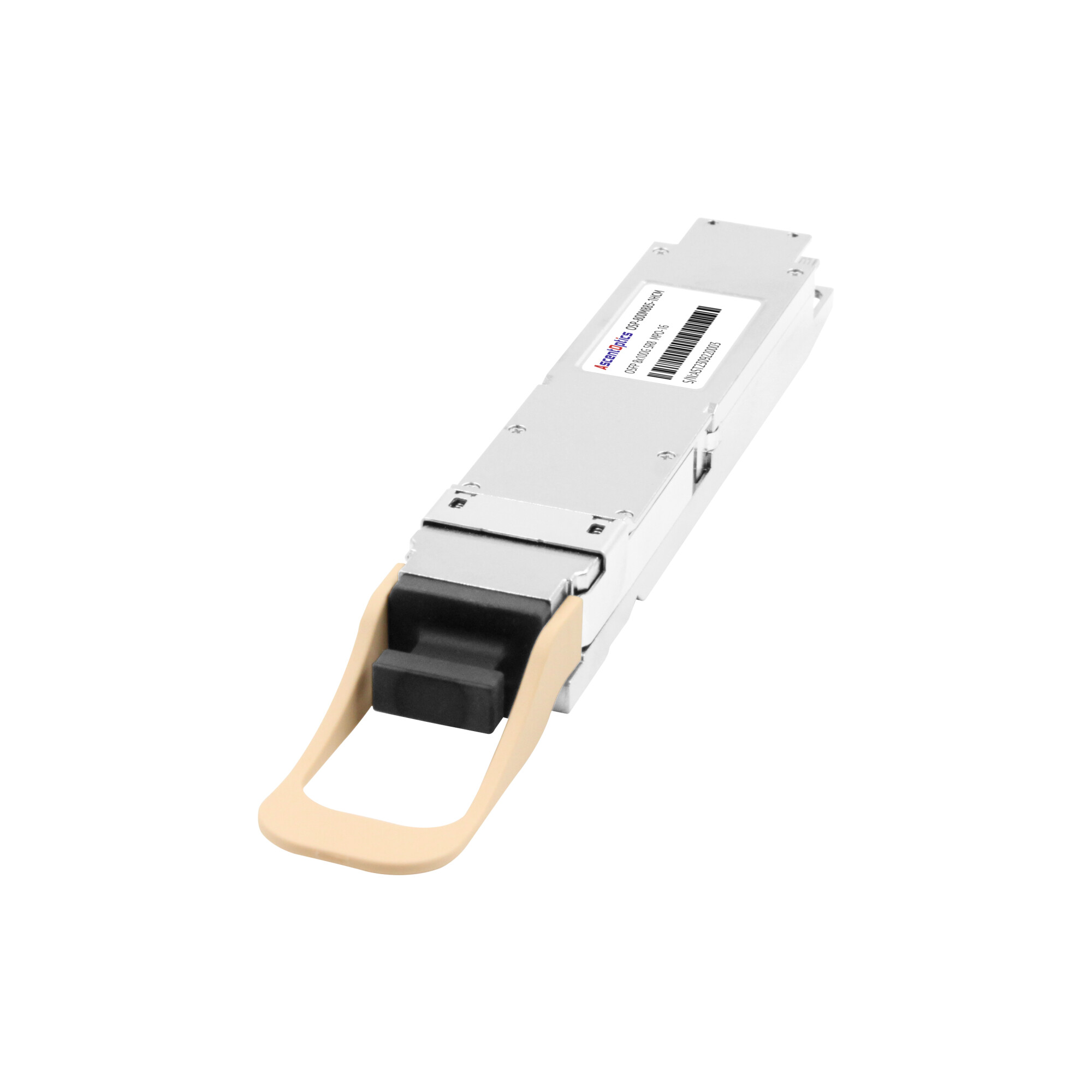
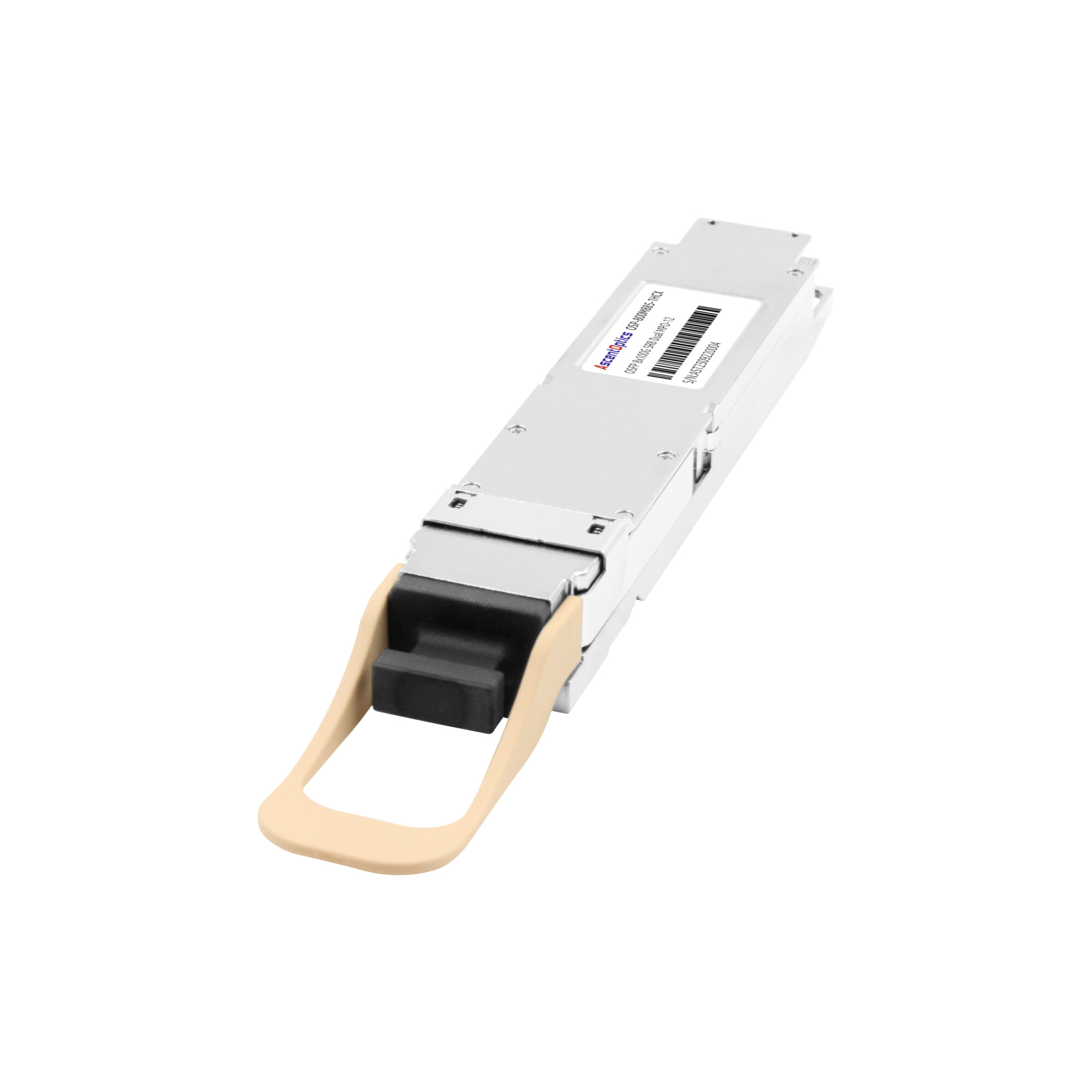
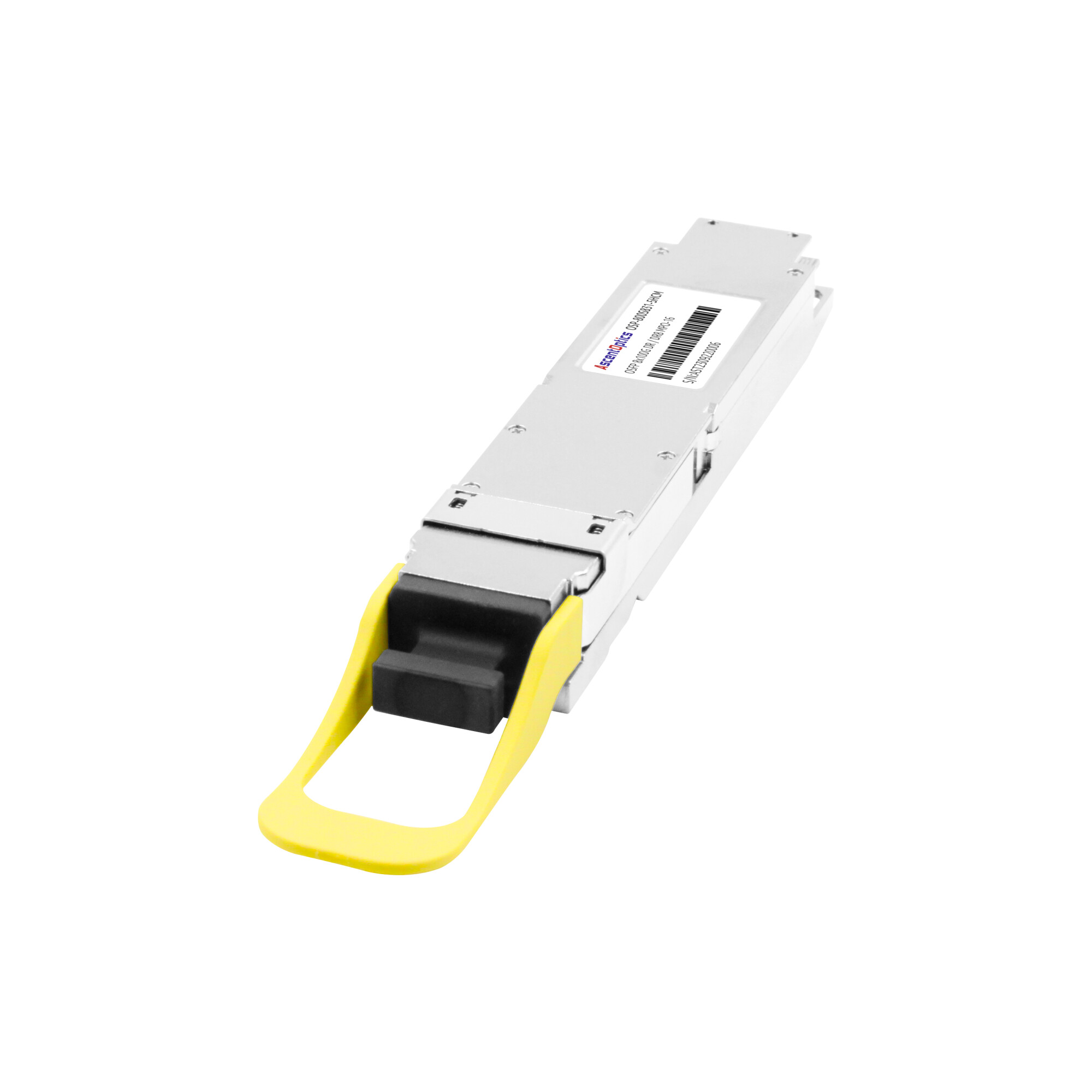
OSFP offers more thermal headroom and a cleaner path to 1.6T, which is why it leads on the switch side with about 68.3 percent share. It’s the preferred platform for high-power, long-reach, and next-generation switch ports.
OSFP provides a larger package with greater thermal headroom, which can be beneficial for high-power optical modules and future higher-speed interfaces. OSFP is widely used in high-performance switch platforms and AI networking environments.
The choice between OSFP and QSFP-DD800 should be based on switch or NIC compatibility, module power consumption, optical reach, port density, and the planned migration path rather than form factor alone.
Matching Reach to the Optical Module
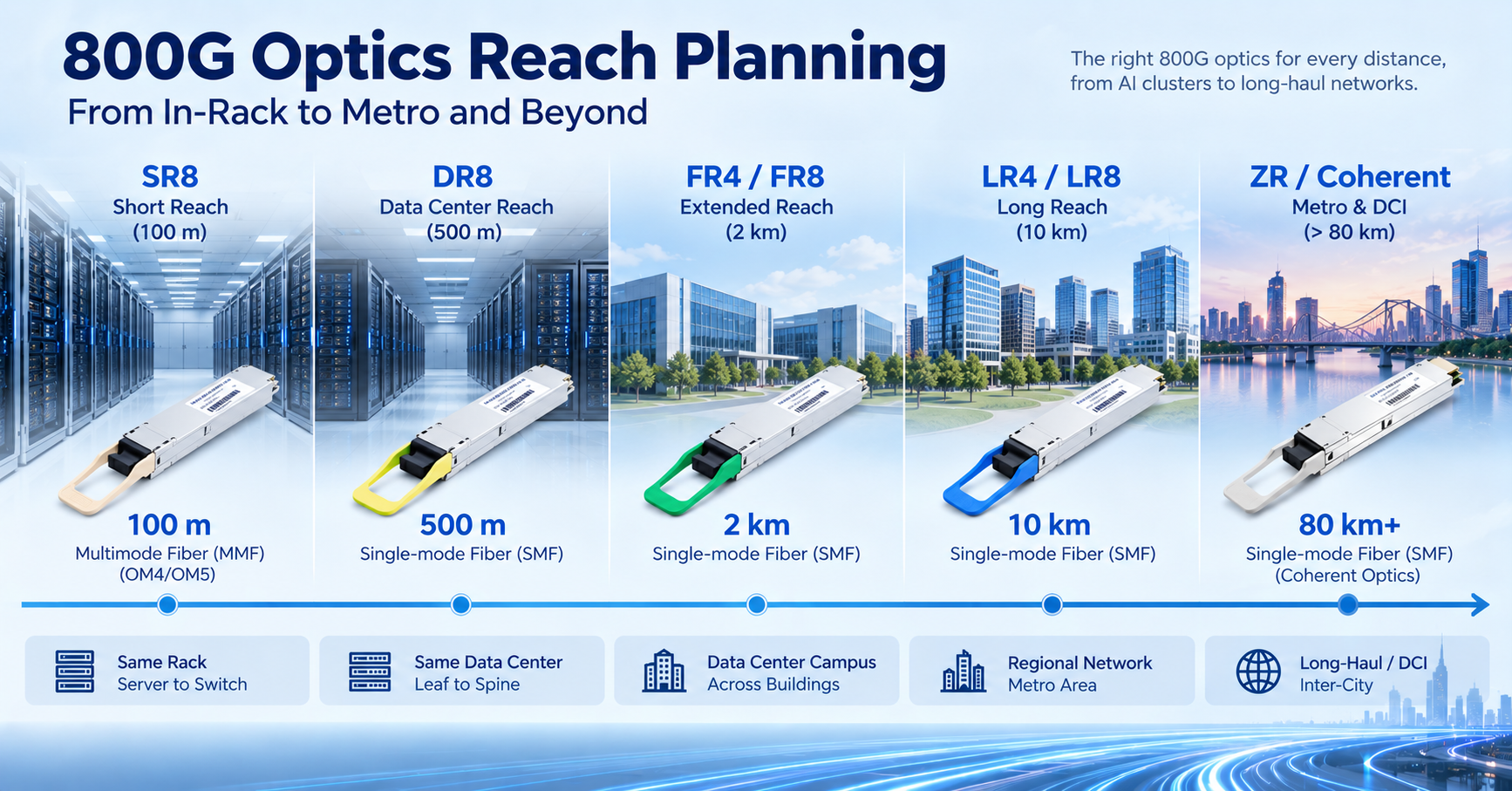
The appropriate 800G optical module depends on link distance, fiber type, connector configuration, and the networking platform.
| Module Type |
Typical Reach* |
Fiber |
Typical Application |
| 800G SR8 |
Up to 60 m on OM3 / 100 m on OM4 |
Multimode |
Intra-rack and short-reach GPU-to-switch links |
| 800G DR8 |
Up to 500 m |
Single-mode |
Intra-data-center and leaf-to-spine links |
| 800G FR4/FR8 |
Typically up to 2 km |
Single-mode |
Longer intra-data-center and campus links |
| 800G LR4/LR8 |
Typically up to 10 km |
Single-mode |
Data center interconnection |
| 800G Coherent/ZR-class |
Application-dependent |
Single-mode |
DCI and metro networks |
For AI clusters, DR8 has become the default fabric backbone, balancing 500-meter reach with single-mode fiber economics. For data center interconnect, 800G coherent ZR/ZR+ modules carry the same traffic over metro and long-haul distances, with L-Band variants nearly doubling single-fiber capacity. Actual reach depends on the module implementation, fiber characteristics, link loss, and host platform. Always check the manufacturer’s specification before deployment.
Power, Thermal, and Energy Efficiency at Rack Scale
Power consumption is one of the key considerations when deploying high-density 800G networking.
The actual power consumption of an 800G optical module varies by optical architecture, transmission distance, DSP implementation, laser technology, and operating conditions. High-performance DSP-based pluggable modules can consume significantly more power than shorter-reach or simplified optical solutions.
For example, an 800G switch with hundreds of active optical ports can consume several kilowatts in optical modules alone. Network designers therefore need to evaluate not only the bandwidth per port, but also total switch power, rack-level power density, airflow or liquid-cooling requirements, and the available thermal budget.
LPO and co-packaged optics (CPO) are emerging approaches aimed at reducing optical interconnect power by simplifying or eliminating some of the electrical signal-processing functions found in conventional pluggable architectures. Their suitability depends on the required reach, signal integrity, interoperability, and system architecture.
Deploying 800G: Migration and Breakout Strategies
You rarely build an 800G data center from a blank slate. More often, you extend what you already have.
Breakout for reuse
Breakout is one of the most practical strategies for integrating 800G ports into an existing data center network.
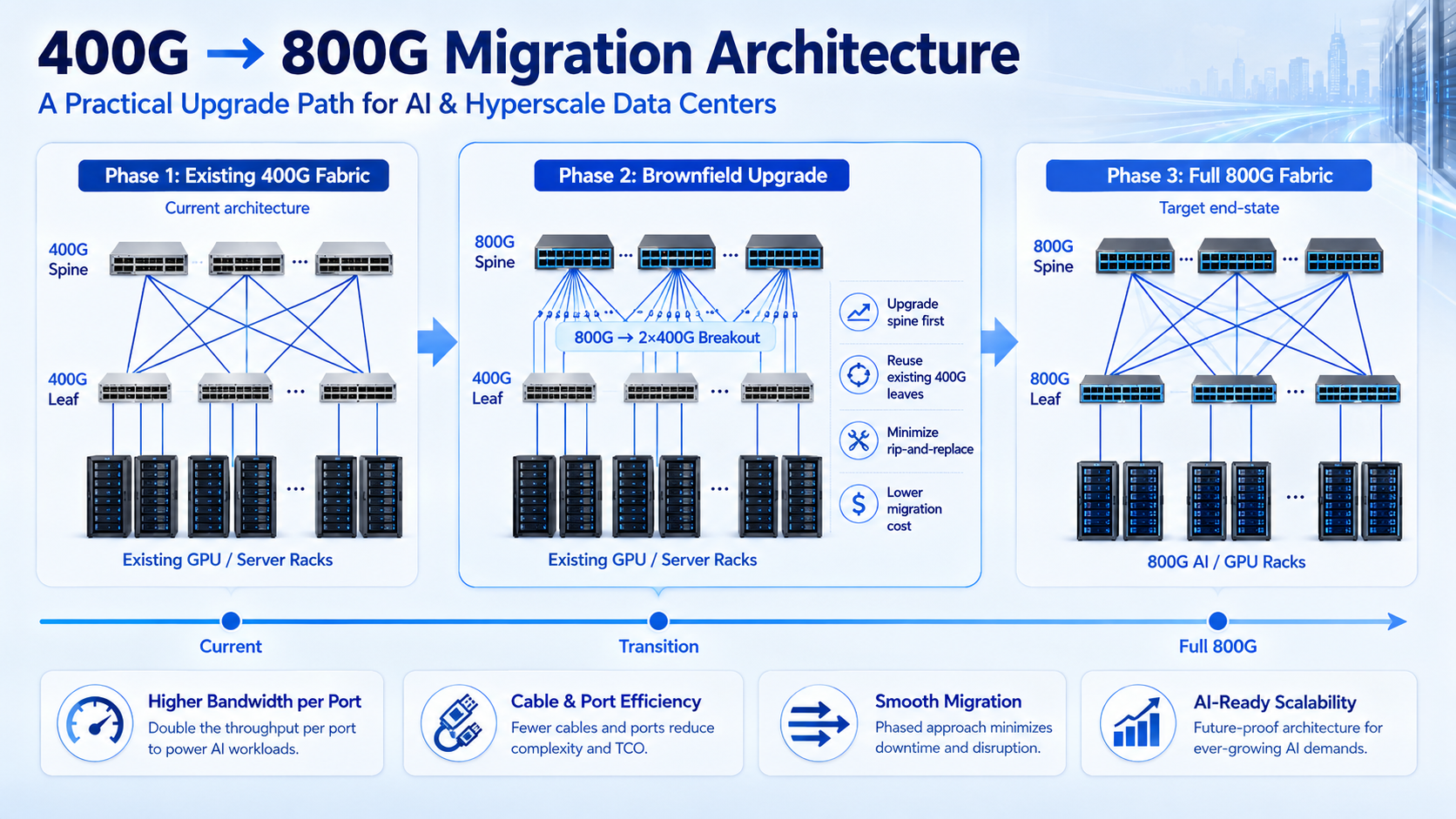
Depending on the switch and transceiver architecture, an 800G interface may support configurations such as 2×400G or, for compatible platforms, 8×100G breakout. These configurations can allow higher-speed spine or aggregation ports to connect to lower-speed downstream interfaces.
However, breakout compatibility is platform-dependent. Network administrators should verify the switch port mode, lane mapping, transceiver specifications, breakout cable type, and software support before deployment.
Brownfield vs greenfield
In a brownfield upgrade, the goal is to lift the spine and interconnect layer to 800G first, where the bandwidth is most constrained, then migrate leaves as refresh cycles allow. In a greenfield build, you design for 800G end-to-end from day one, choosing OSFP on the switch side and QSFP-DD800 or OSFP on the server side based on reach and thermal budget.
Daniel, a network architect at a mid-sized cloud provider, took the brownfield path. Instead of a full rip-and-replace, he upgraded his spine switches to 800G and used 2x400G breakout cables to keep his existing 400G leaves in place. His fabric capacity doubled in a single maintenance window, and the remaining 400G gear was retired on its normal depreciation schedule. The migration cost a fraction of a full refresh.
Choosing a Reliable 800G Data Center Supplier
The optical supplier is an important part of an 800G deployment because compatibility, optical performance, thermal behavior, and long-term supply can directly affect network reliability.
When evaluating an 800G supplier, consider the following:
- 1. Platform compatibility– Verify compatibility with the target switch, NIC, and network operating system.
- 2. Optical performance– Check parameters such as transmit power, receiver sensitivity, TDECQ, extinction ratio, and BER.
- 3. Interoperability testing– Confirm that modules have been tested with the intended host platforms and link configurations.
- 4. Thermal performance– Evaluate module power consumption and operating temperature, especially in high-density switch environments.
- 5. Quality control– Look for production testing, traceability, and reliability validation.
- 6. Supply capability– Ensure the supplier can support volume requirements and consistent product specifications.
- 7. Customization– OEM/ODM and compatibility coding may be important for large-scale deployments.
This is exactly the ground Ascent Optics occupies. Our portfolio spans 100M to 800G across OSFP, QSFP-DD, QSFP28, and SFP form factors, with modules built to MSA and IEEE standards and tested for compatibility with mainstream switching platforms.
Conclusion
800G data center networking is becoming an important foundation for AI clusters, hyperscale cloud infrastructure, and other bandwidth-intensive workloads. By doubling the bandwidth per port compared with 400G, 800G can increase network capacity while helping reduce port count and cabling requirements in large-scale deployments.
However, deploying 800G is not simply a matter of choosing a higher-speed transceiver. Network designers need to consider the overall architecture, including leaf-spine topology, InfiniBand or Ethernet, OSFP or QSFP-DD800 form factors, optical reach, fiber infrastructure, power consumption, thermal requirements, and breakout compatibility.
For existing 400G networks, a gradual migration using compatible 800G uplinks and breakout solutions can provide a practical upgrade path. For new AI and hyperscale data centers, designing the network around 800G from the beginning can provide the bandwidth and scalability needed for increasingly demanding workloads.
As 800G deployments continue to expand and 1.6T networking matures, selecting the right optical technology and deployment strategy will be essential for building scalable, reliable, and power-efficient data center networks.
Frequently Asked Questions
What is 800G data center networking?
800G data center networking uses 800Gb/s network interfaces to connect switches, servers, GPUs, and other high-bandwidth systems in modern data centers.
What are the main 800G optical module types?
Common 800G solutions include SR8, DR8, FR4/FR8, LR4/LR8, and coherent optical modules. The appropriate type depends on distance, fiber type, and application.
What is the difference between OSFP and QSFP-DD800?
OSFP provides a larger package with greater thermal headroom, while QSFP-DD800 uses a more compact QSFP-style form factor. Platform compatibility and power requirements should be considered when selecting between them.
How far can an 800G optical module transmit?
Reach depends on the module type. Typical datacenter modules range from tens of meters for SR8 to around 500 m for DR8, 2 km for FR-class modules, and up to around 10 km for LR-class solutions.
Can 800G connect to 400G switches?
Yes, in compatible deployments. An 800G interface can support 2×400G breakout in many platforms, but the switch, module, lane mapping, and breakout cable must support the configuration.
Is 800G better than 400G?
800G provides approximately twice the bandwidth per port. It can be advantageous for AI and hyperscale networks, while 400G may remain more economical for networks with lower bandwidth requirements.
How much power does an 800G optical module consume?
Power consumption varies significantly by module architecture, reach, DSP, and optical technology. High-performance DSP-based modules generally consume more power than lower-complexity optical solutions.
Is 800G suitable for AI clusters?
Yes. 800G is well suited to AI and HPC environments because distributed workloads generate substantial east-west traffic between GPUs, servers, and switches.
Post Views: 1,444