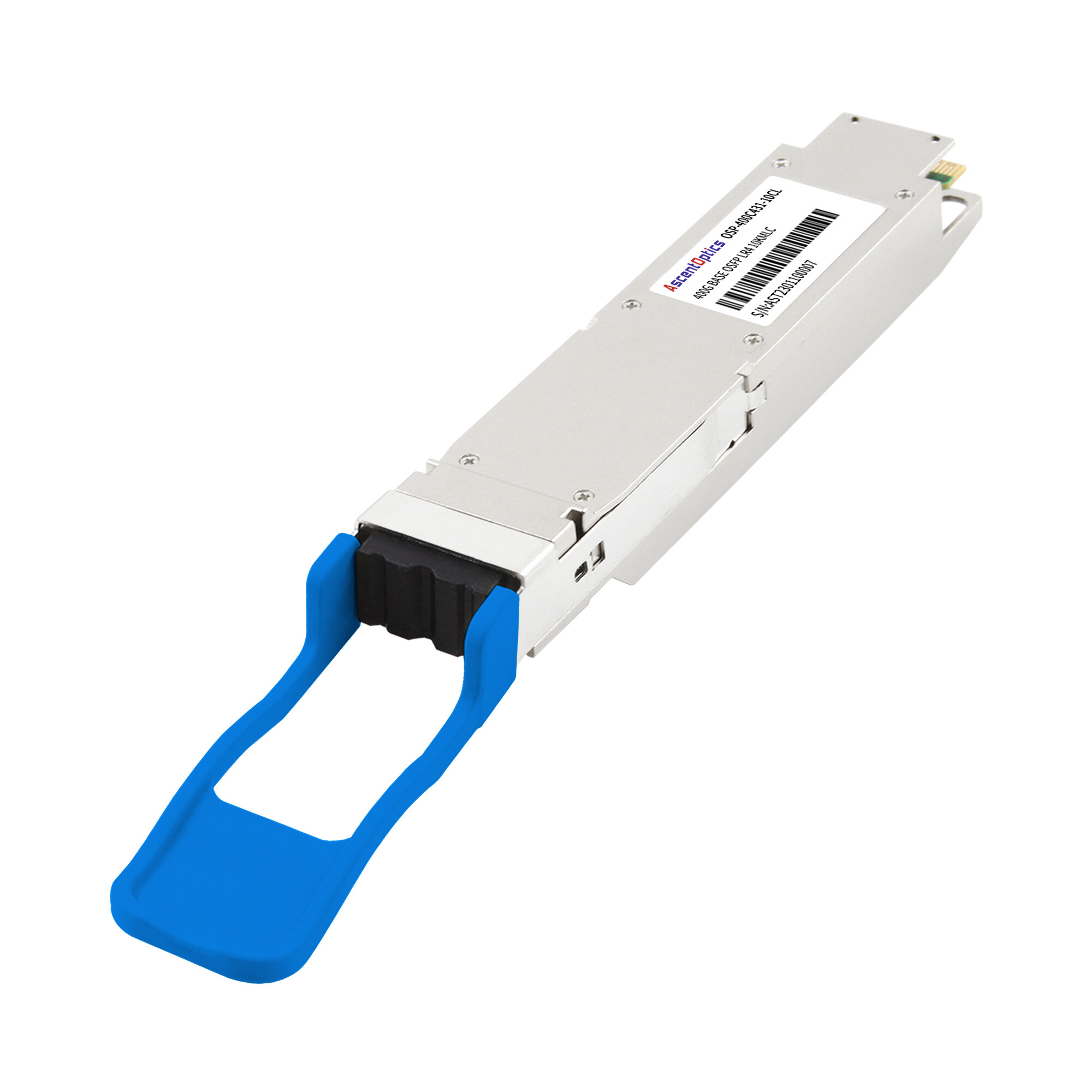
What Is 800G?
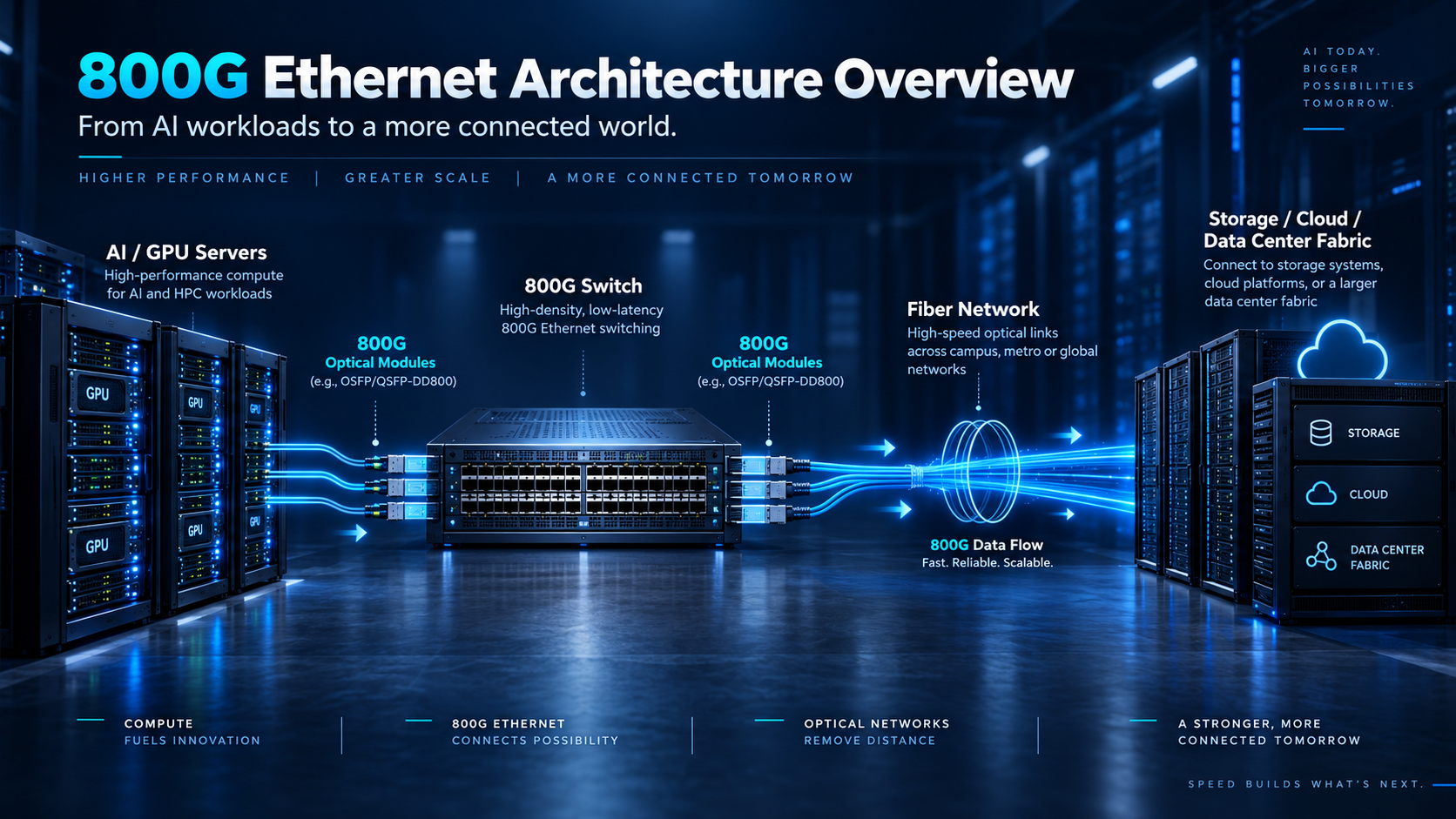
800G Ethernet represents the next major step in data center networking, providing up to 800 Gbps of aggregate Ethernet bandwidth per port. It is designed to address the rapidly increasing network traffic generated by AI, cloud computing, high-performance computing (HPC), and hyperscale data centers.
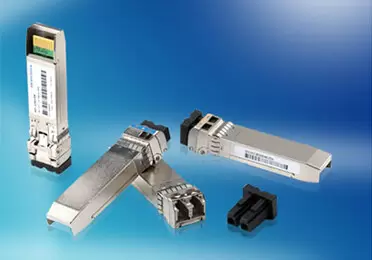
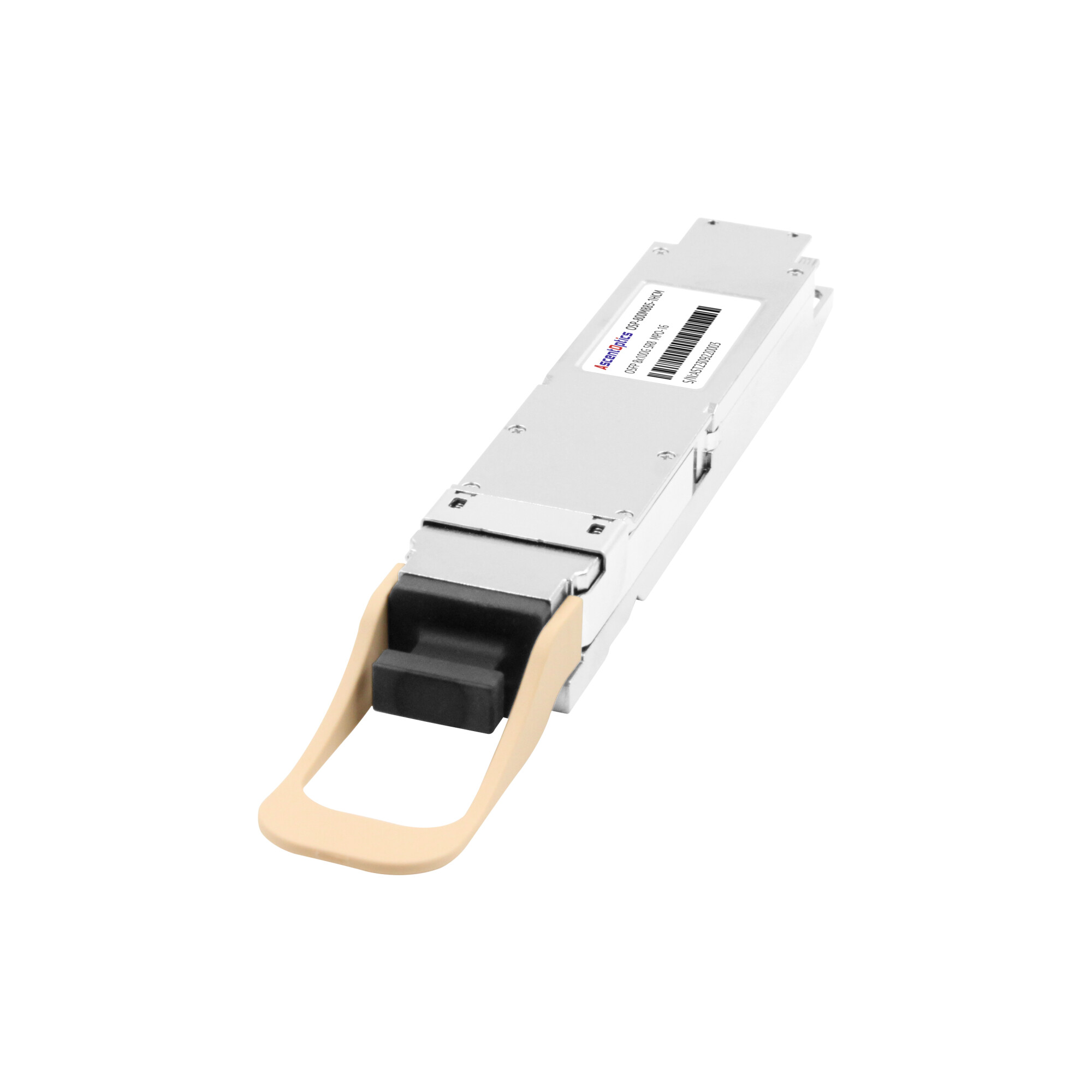
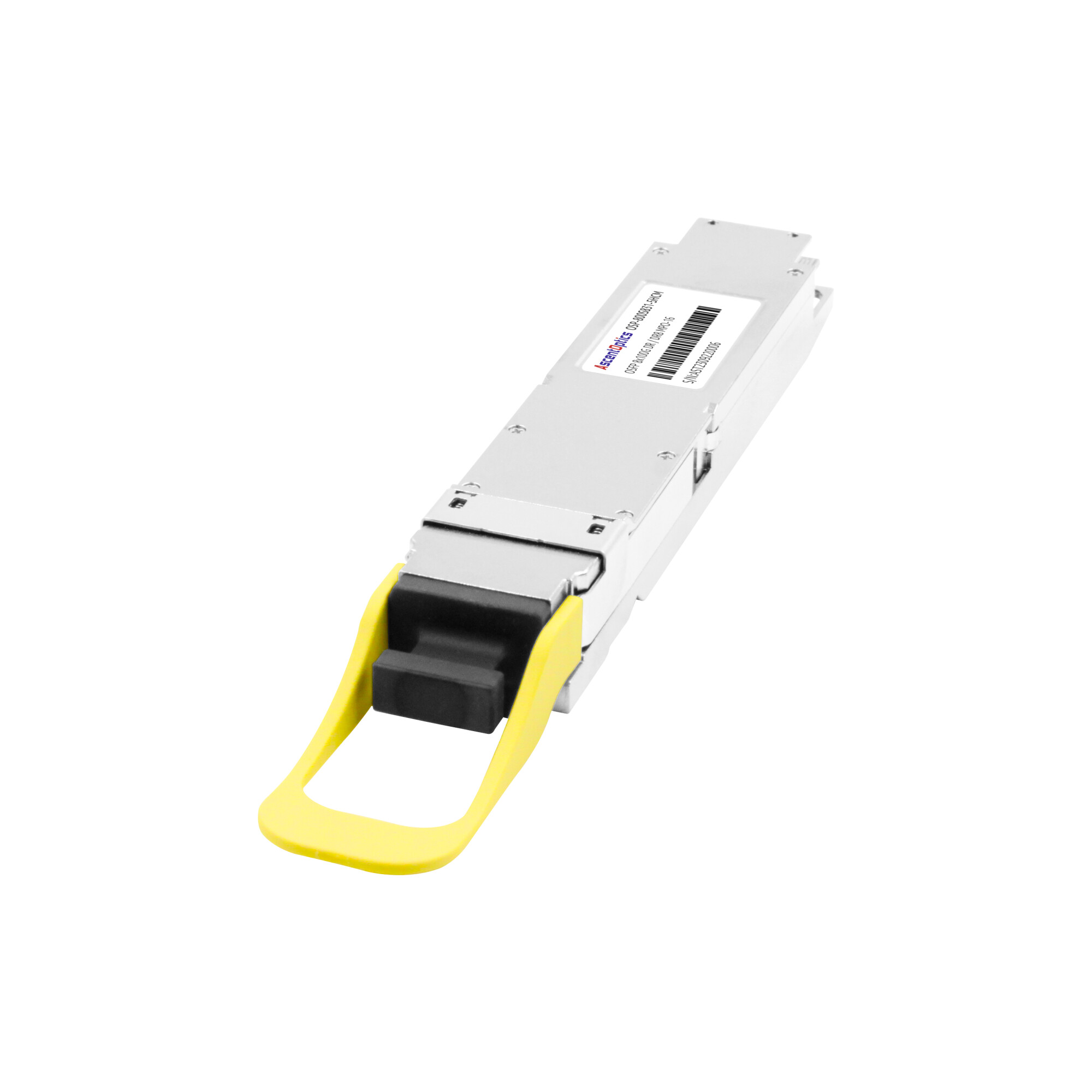
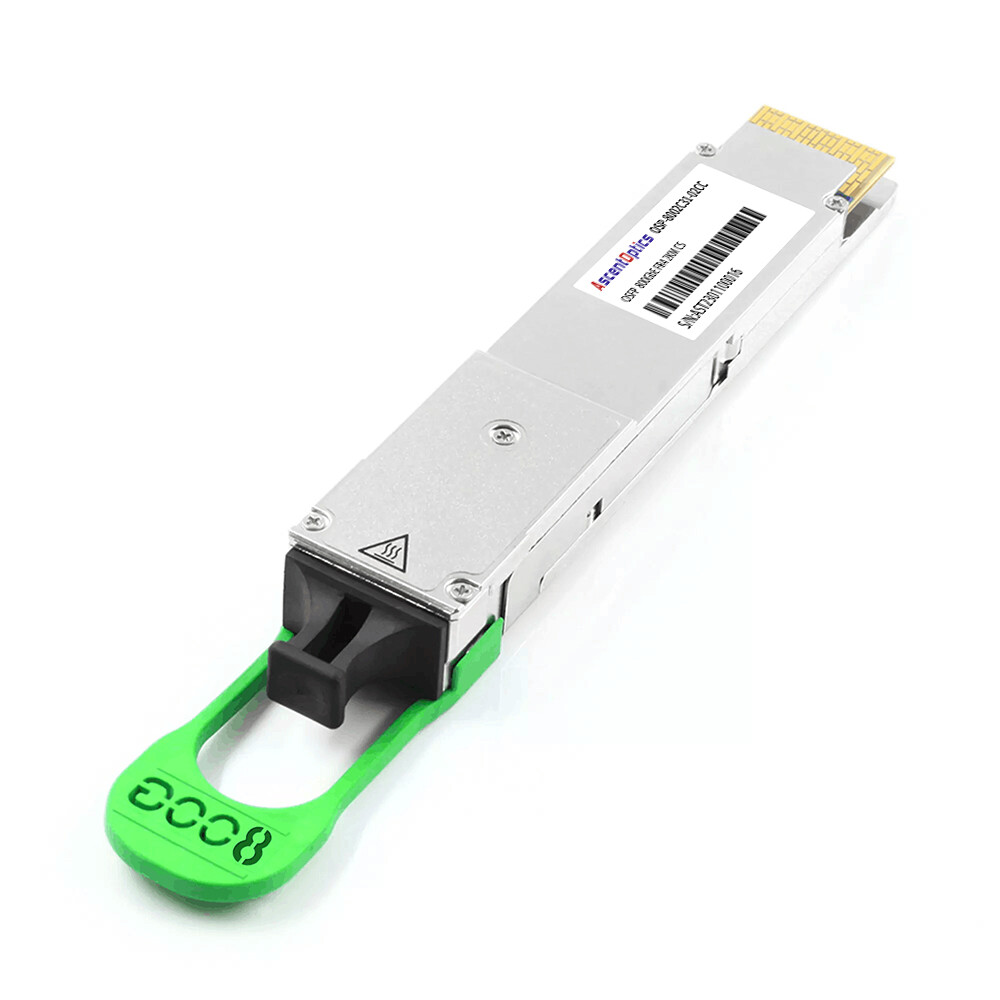
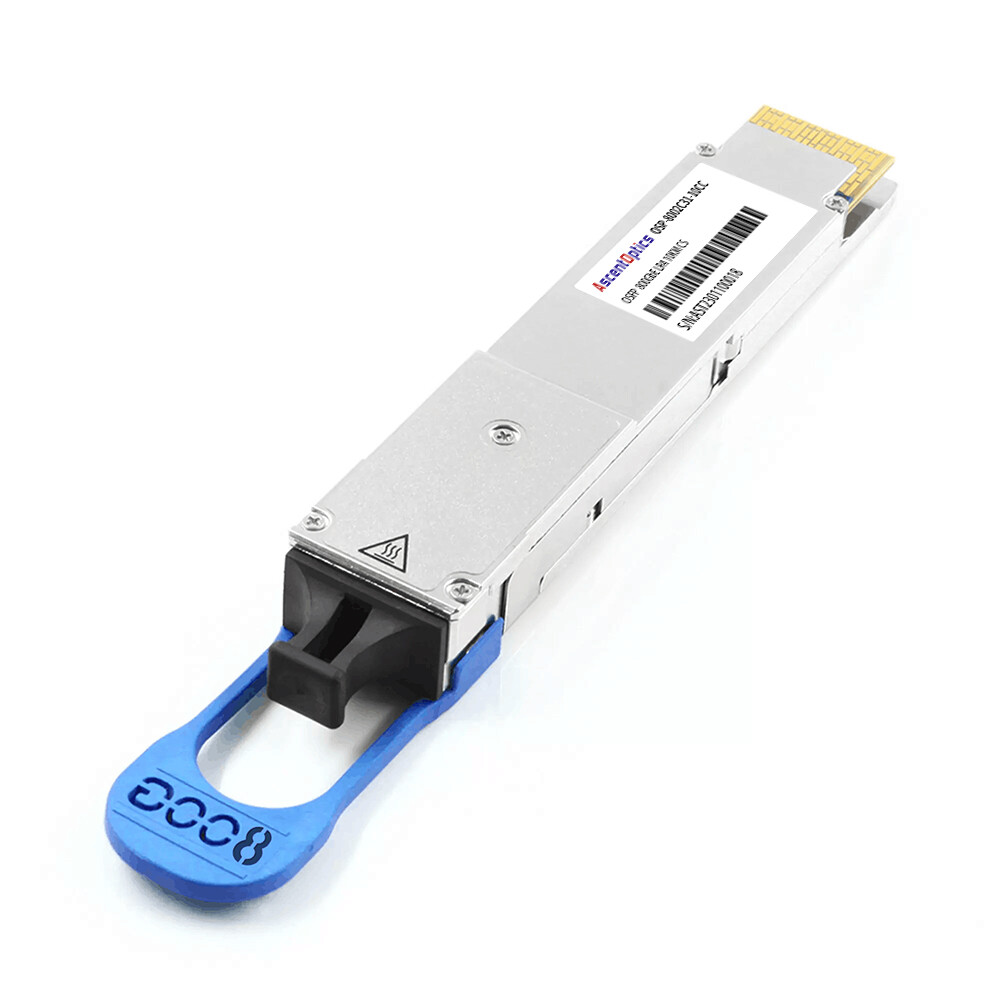
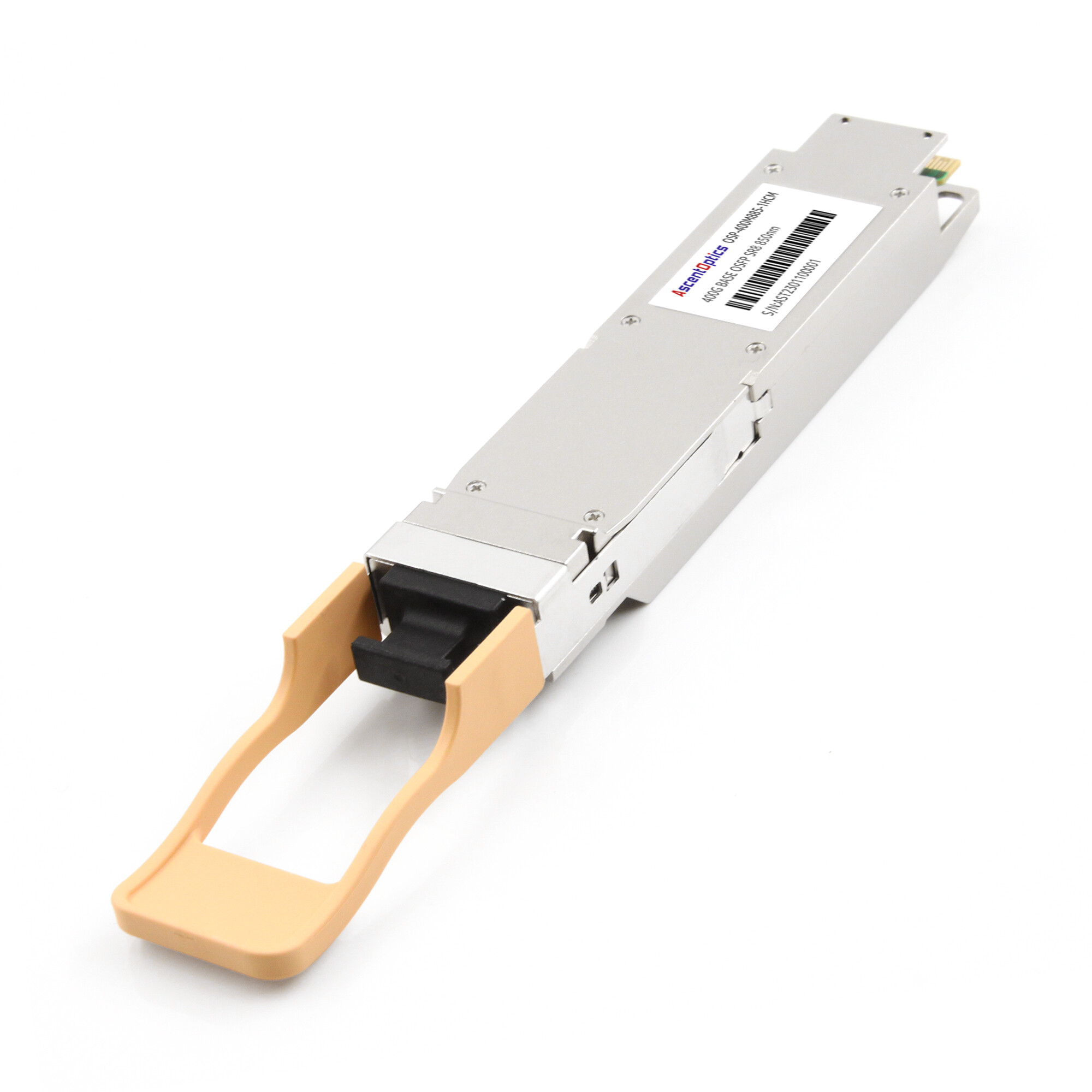
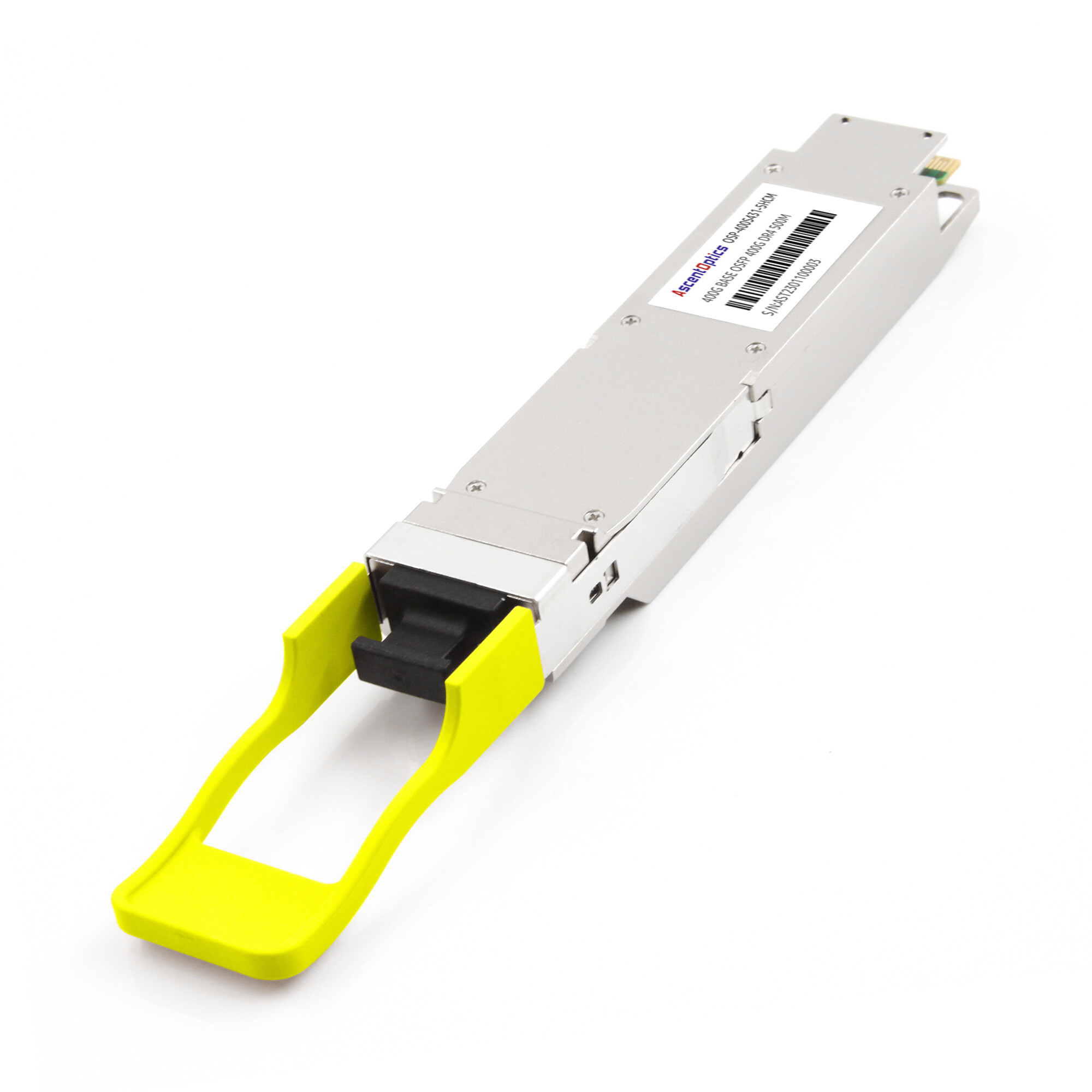
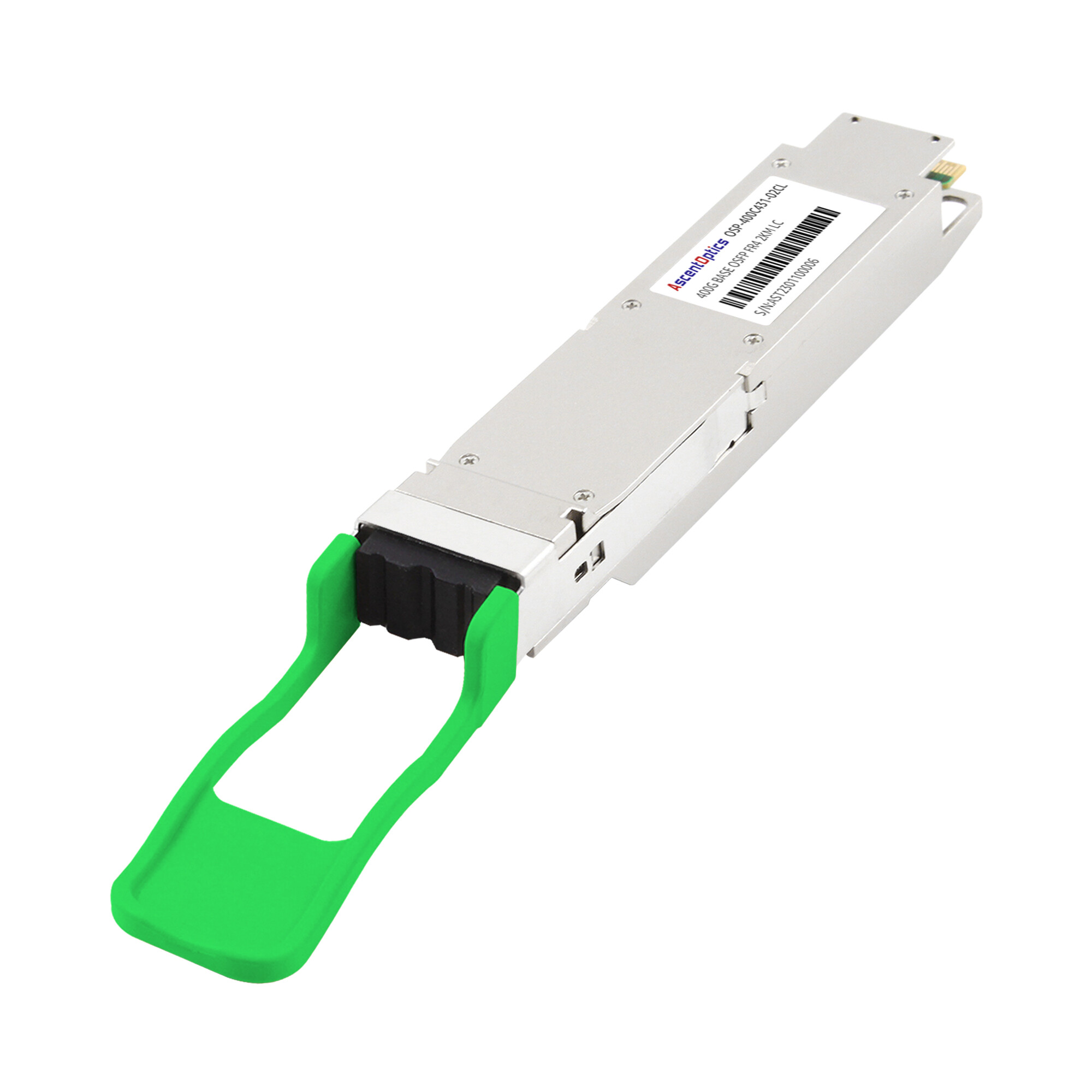
At the optical layer, 800G is supported by a growing range of transceivers, including 800G SR8, DR8, 2×FR4, FR8, and other optical solutions. These modules convert high-speed electrical signals into optical signals for transmission over multimode or single-mode fiber.
Compared with 400G, 800G can double the bandwidth per port while maintaining high port density. This makes it particularly useful for AI clusters and other applications where large amounts of data must move between GPUs, switches, servers, and storage systems.
In simple terms, 800G is a networking technology that provides approximately twice the port bandwidth of 400G, using advanced high-speed signaling and optical technologies to support increasingly demanding data center workloads.
What Is 800G Ethernet?
800G Ethernet is an Ethernet technology capable of providing an aggregate data rate of 800 Gbps. It builds on the development of 400G Ethernet and uses higher-speed electrical and optical interfaces to increase bandwidth without simply doubling the number of physical lanes.
A common architecture for 800G uses eight 100G-class electrical lanes, with PAM4 signaling enabling higher data rates per lane. Some newer implementations use 112G-class electrical interfaces, depending on the switch ASIC, host interface, and transceiver architecture.
The IEEE 802.3df standard is an important foundation for 800G Ethernet, while OIF specifications and various industry MSAs also contribute to the development of high-speed electrical and optical interfaces.
800G is primarily targeted at bandwidth-intensive environments such as:
- •AI and machine learning clusters
- •Hyperscale data centers
- •Cloud computing infrastructure
- •High-performance computing (HPC)
- •Data center interconnect (DCI)
- •High-speed storage and distributed computing
It is important to remember that 800G is not a single optical module type. It represents an ecosystem of switch ports, optical transceivers, DACs, AOCs, fiber infrastructure, and breakout solutions that operate within an 800G networking architecture.
How Does 800G Work?
The fastest way to grasp 800G is to break down how the data actually moves. There are two ideas to hold onto: lanes and PAM4.
The Lane Architecture
Each lane carries a portion of the total bandwidth, and the lanes operate in parallel to achieve the required aggregate data rate. Newer 800G platforms can also use 112G-class electrical signaling, which provides additional electrical bandwidth and supports the evolution toward higher-speed networking architectures.
The exact lane architecture depends on the switch ASIC, module form factor, optical design, and electrical interface.
This lane-based architecture also makes breakout networking possible. Depending on the capabilities of the switch and transceiver, an 800G port may be configured for applications such as 2×400G, 4×200G, or 8×100G. However, not every 800G port or transceiver supports every breakout mode, so compatibility must always be verified against the switch and module specifications.
What Is PAM4?
PAM4, short for four-level pulse amplitude modulation, is the single biggest reason 800G exists on the same footprint as 400G. Traditional NRZ signaling encodes one bit per symbol: the signal is either high or low. PAM4 encodes two bits per symbol by using four distinct voltage levels.
The result is double the data rate at the same electrical signaling speed. Where 400G used eight lanes at 50 Gbps each, 800G uses eight lanes at 100 Gbps each with PAM4. That is the leap: faster lanes, not more lanes.
Many 400G Ethernet implementations use 50G-class PAM4 lanes, while 800G implementations commonly move toward 100G-class or 112G-class electrical lanes.
The advantage is higher bandwidth density, but PAM4 also introduces greater signal integrity challenges. Because the voltage separation between four levels is smaller than the separation between two NRZ levels, PAM4 signals are more sensitive to noise, crosstalk, insertion loss, and other channel impairments.
The Role of DSP and FEC
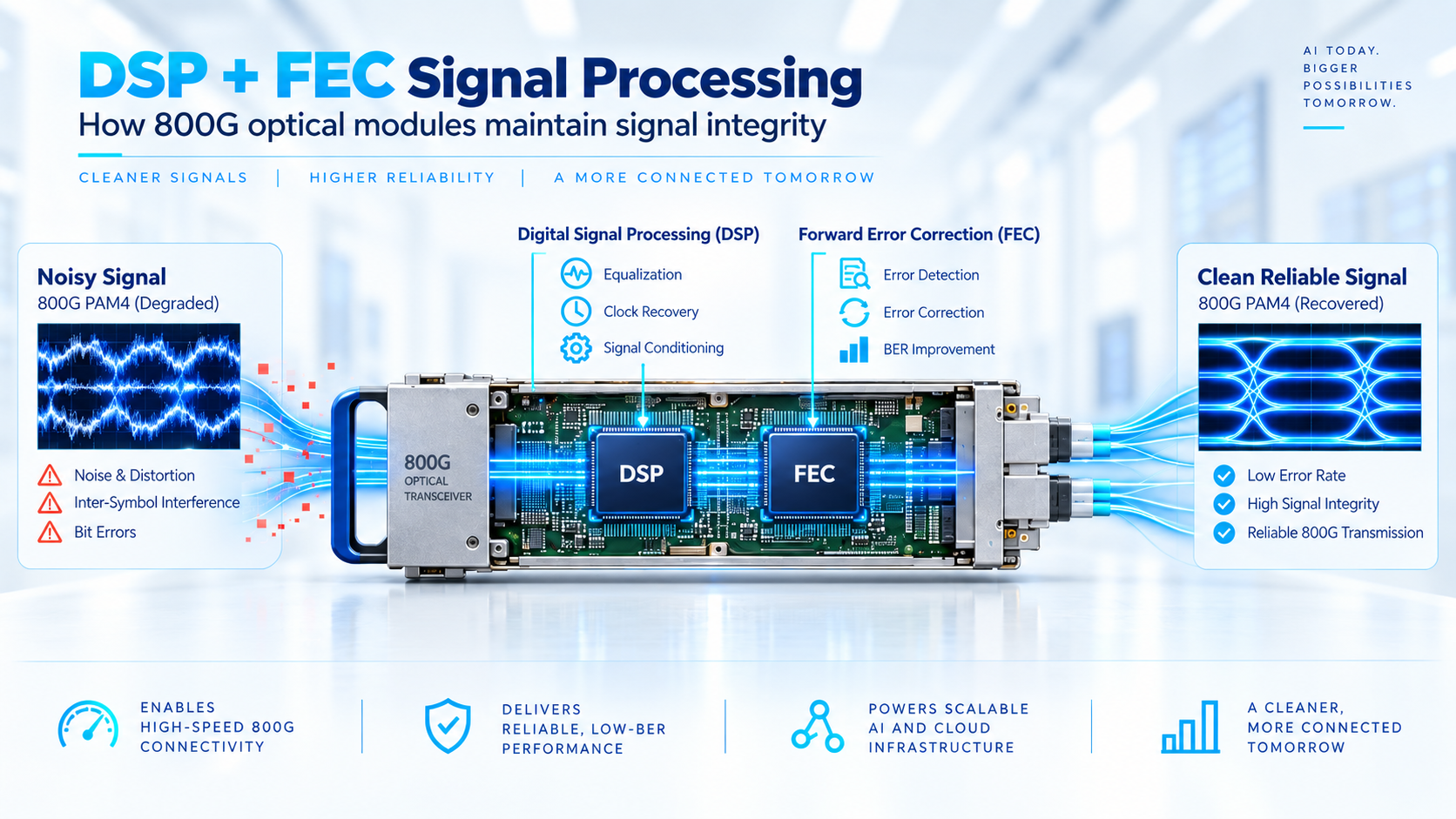
PAM4 improves bandwidth efficiency by carrying two bits per symbol, but it also reduces the noise margin compared with NRZ. At 800G speeds, signal integrity becomes more challenging because of higher symbol rates, channel loss, crosstalk, and other impairments.
Digital signal processing (DSP) and forward error correction (FEC) are therefore important in many 800G implementations:
- •DSP (Digital Signal Processing): Depending on the module architecture, DSP functions can include equalization, clock recovery, signal conditioning, and other functions that compensate for channel impairments.
- •FEC (Forward Error Correction): FEC adds controlled redundancy to the transmitted data, allowing the receiver to detect and correct a certain number of errors and improve link reliability.
Together, signal processing and error correction technologies help maintain reliable communication at very high signaling rates.
It is also important to distinguish between nominal Ethernet data rate, electrical signaling rate, and protocol/FEC overhead. For this reason, an 800G system may use signaling rates higher than the nominal 800 Gbps Ethernet payload rate.
The 400G to 800G Leap, Simplified
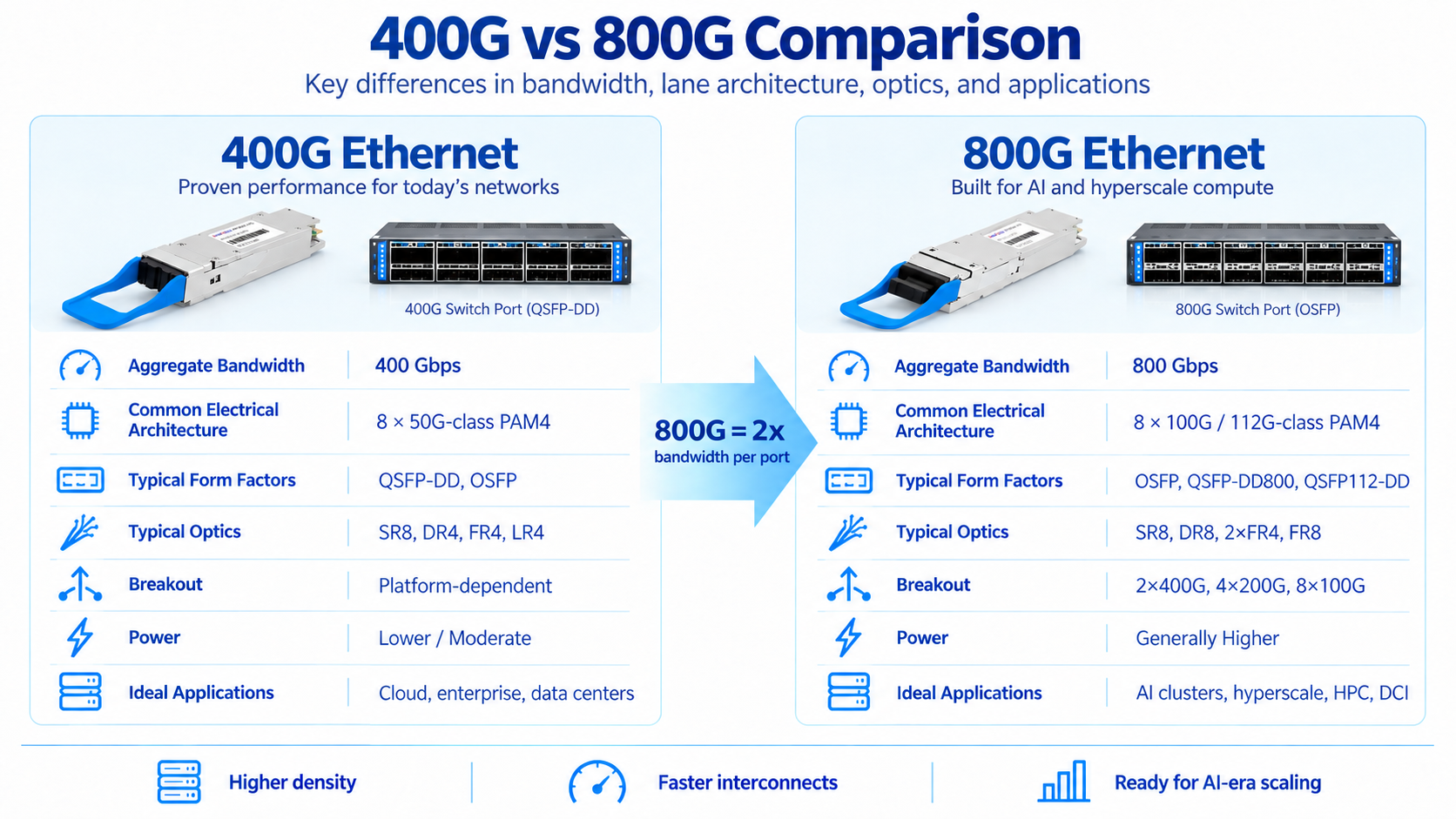
The transition from 400G to 800G is primarily about increasing bandwidth per port and per lane. A common 400G architecture uses 8 × 50G-class PAM4 electrical lanes, while many 800G implementations use 8 × 100G-class PAM4 lanes or newer 112G-class electrical interfaces.
Rather than simply doubling the number of lanes, 800G increases the bandwidth carried by each lane. This helps maintain high port density while supporting significantly greater aggregate bandwidth.
However, an 800G module is not automatically compatible with a 400G port. Compatibility depends on the switch ASIC, host electrical interface, module type, firmware, optical architecture, and cabling.
Why Do We Need 800G? The AI and Hyperscale Driver
800G is not a technology looking for a problem. It is a direct response to one specific, measurable trend: the explosive growth of AI and machine-learning workloads.
AI Training and GPU Clusters
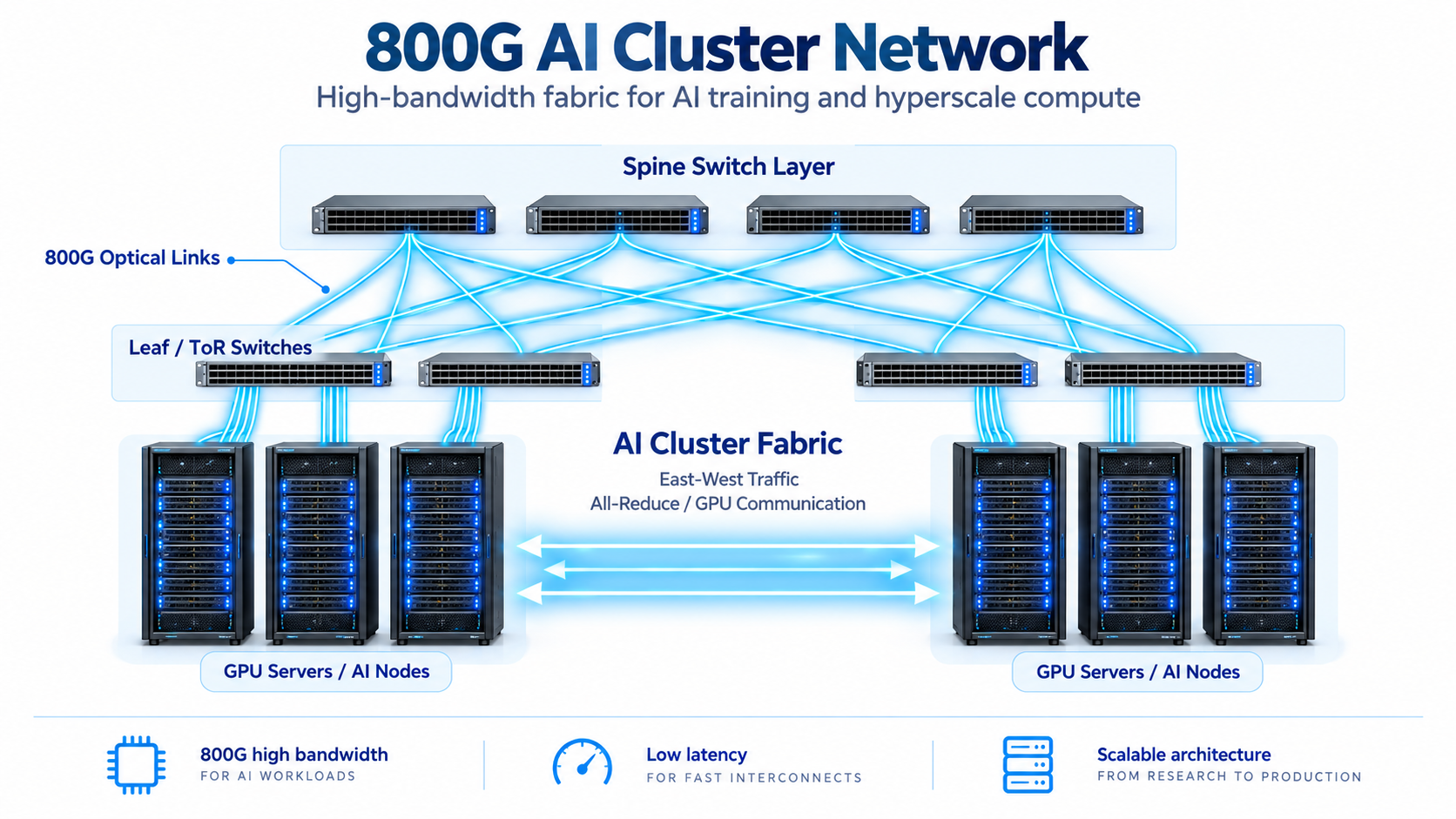
Modern AI training runs on clusters of thousands of GPUs that must constantly exchange data. A technique called all-reduce synchronizes gradients across every GPU during each training step. When the network between GPUs is too slow, those GPUs sit idle waiting for data instead of computing.
That idle time is money. At the scale of a large training run, a network that is 10% too slow can add days to a job and millions of dollars to its cost. 800G shortens the path between GPUs and keeps them working.
Hyperscale Data Centers and 2026 Momentum
The market numbers tell the same story from the supply side. According to TrendForce, 800G-and-above optical transceivers are forecast to exceed 60% of global shipments by 2026, up from just 19.5% in 2024. That is a faster mainstreaming than any previous optical speed generation.
The driver is concentrated at the top of the market. Google’s Ironwood TPU architecture alone, which pairs a 3D Torus network with an all-optical circuit switch, is expected to consume more than six million 800G-plus optical modules in 2026, according to the same TrendForce analysis. One architecture, from one hyperscaler, is pulling a significant slice of the entire industry’s 800G output.
Where 800G Is Used
800G networking is primarily used in environments with very high bandwidth requirements.
AI Training and Inference
800G links can provide high-bandwidth connectivity between GPU servers, switches, and other components of AI infrastructure.
Hyperscale Data Centers
Large cloud providers can use 800G to increase spine-leaf network capacity while maintaining high port density.
High-Performance Computing
HPC environments generate large volumes of data between compute nodes and storage systems. Higher-speed networking can help reduce communication bottlenecks.
Data Center Interconnect
800G coherent optical modules can be used for high-capacity DCI applications. Depending on the optical technology and network architecture, coherent solutions can support significantly longer distances than short-reach data center optics.
800G vs 400G: What’s the Difference?
The honest answer is that 800G is a doubling of bandwidth, not a fundamentally different physics. The reach classes stay familiar because they were designed that way.
| Attribute |
400G Ethernet |
800G Ethernet |
| Aggregate bandwidth |
400 Gbps |
800 Gbps |
| Common electrical architecture |
8 × 50G-class PAM4 |
8 × 100G-class / 112G-class |
| Common form factors |
QSFP-DD, OSFP |
OSFP, QSFP-DD800, QSFP112-DD |
| Short-reach optics |
SR4/SR8-class solutions |
SR8-class solutions |
| Single-mode optics |
DR4, FR4, LR4, etc. |
DR8, 2×FR4, FR8, etc. |
| Breakout |
Platform-dependent |
Platform-dependent |
| Power |
Depends on module design |
Generally higher, but implementation-dependent |
| Main applications |
Data centers, cloud, AI |
AI clusters, hyperscale, HPC, DCI |
The most important difference is simple:
800G provides twice the aggregate bandwidth of 400G per port.
However, upgrading from 400G to 800G requires more than simply replacing the optical module. Switch ports, electrical interfaces, transceivers, fiber, connectors, power budgets, and thermal design all need to be considered.
800G Form Factors: OSFP, QSFP-DD800, and QSFP112-DD
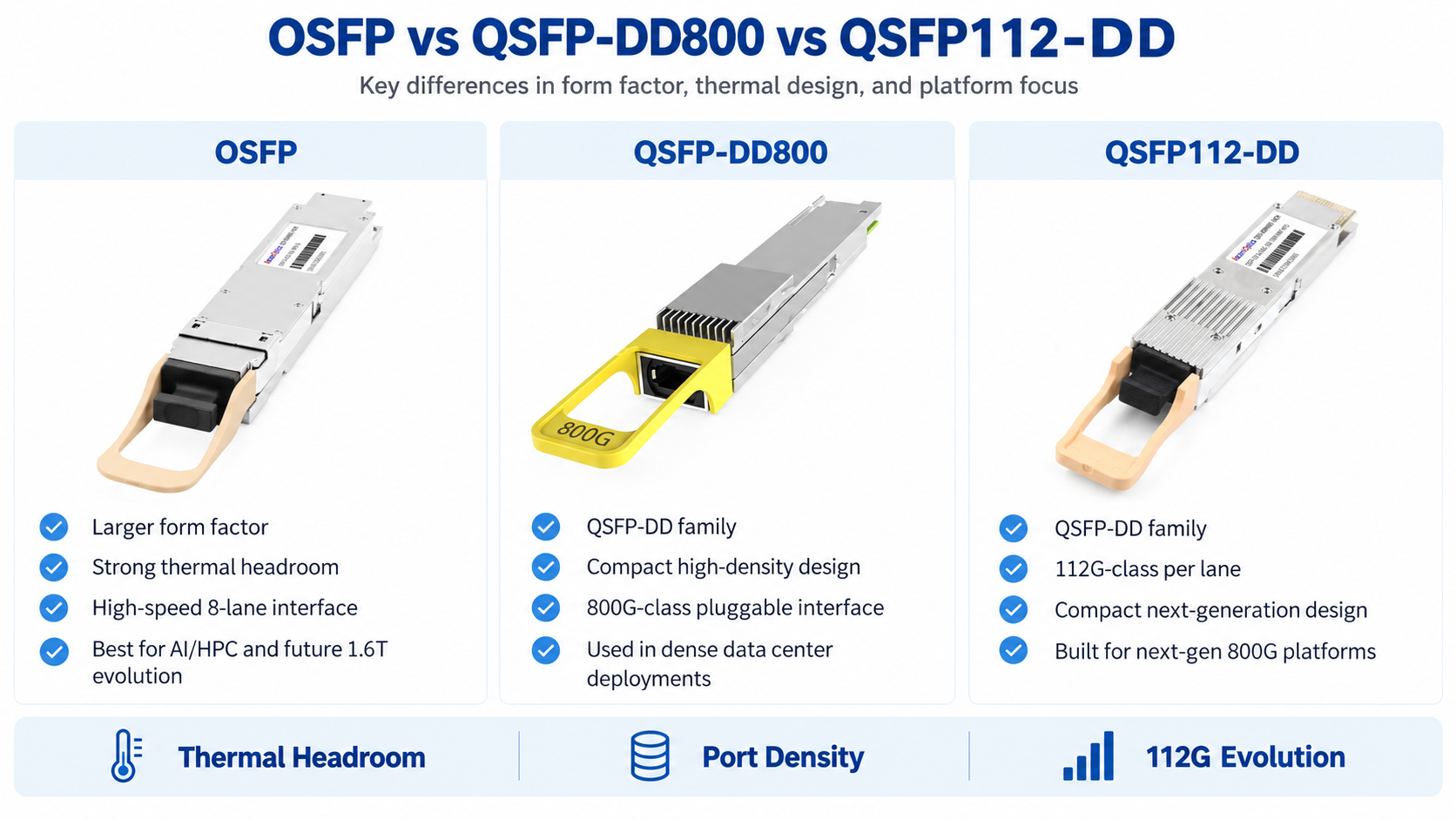
Several pluggable form factors are being used or developed for 800G networking. Three important architectures are OSFP, QSFP-DD800, and QSFP112-DD.
OSFP
OSFP (Octal Small Form-factor Pluggable) provides a relatively large module footprint and strong thermal headroom.
Its larger thermal capacity makes OSFP well suited to high-bandwidth applications such as:
- •AI clusters
- •HPC systems
- •High-density data center switches
- •High-performance networking
OSFP is also closely associated with the evolution toward 1.6T networking, making it attractive for platforms designed with future bandwidth upgrades in mind.
QSFP-DD800
QSFP-DD800 builds on the QSFP-DD form-factor family and is designed for 800G-class networking.
Its compact form factor is attractive for high-density data center applications. Depending on the switch platform, QSFP-DD800 systems may also support lower-speed operation and breakout configurations.
However, compatibility should not be assumed simply because two modules belong to the QSFP family. The switch port, electrical interface, module specification, and software support all need to be considered.
QSFP112-DD
QSFP112-DD is an evolution of the QSFP-DD family designed around 112G-class electrical signaling per lane.
An 800G implementation can use eight 112G-class electrical lanes:
8 × 112G-class lanes → 800G-class Ethernet
The additional signaling bandwidth provides the electrical headroom required to account for encoding, FEC, and other overheads while supporting an 800G Ethernet data rate.
QSFP112-DD provides a compact alternative for platforms designed around 112G-class SerDes technology and is particularly relevant to next-generation data center and AI networking architectures.
OSFP vs QSFP-DD800 vs QSFP112-DD
| Feature |
OSFP |
QSFP-DD800 |
QSFP112-DD |
| Form factor family |
OSFP |
QSFP-DD |
QSFP-DD |
| 800G support |
Yes |
Yes |
Yes |
| Typical electrical architecture |
High-speed multi-lane |
8-lane high-speed interface |
112G-class per lane |
| Thermal headroom |
High |
Moderate to high, depending on design |
Depends on implementation |
| Typical applications |
AI/HPC, high-density switches |
Data centers, high-density networking |
Next-generation 800G platforms |
| 1.6T evolution |
Strong |
Platform-dependent |
Platform-dependent |
The best choice depends on the switch platform, port density, power budget, thermal requirements, electrical interface, and migration strategy.
800G Power Consumption and LPO
Power consumption becomes increasingly important as data center networks move from 400G to 800G and beyond.
Traditional DSP-based 800G optical modules can consume significantly more power than lower-speed modules because they operate at higher signaling rates and require advanced signal-processing components.
LPO (Linear-drive Pluggable Optics) is one approach intended to reduce power consumption.
Unlike conventional DSP-based architectures, LPO moves toward a simpler linear electrical path and reduces or eliminates some of the DSP functions in the optical module.
Potential advantages include:
- •Lower module power consumption
- •Reduced thermal load
- •Lower latency in some implementations
- •Improved power efficiency
However, LPO also places greater requirements on the host electrical channel and system signal integrity.
Therefore, LPO is not simply a lower-power replacement for every DSP-based 800G module. Its suitability depends on the switch ASIC, electrical channel, link distance, optical architecture, and system design.
Conclusion
800G Ethernet is becoming an important networking technology for AI, hyperscale data centers, HPC, and other bandwidth-intensive applications. Its evolution is based on several key technologies, including PAM4 signaling, high-speed SerDes, DSP, FEC, advanced optical modules, and higher-density pluggable form factors.
Compared with 400G, 800G doubles the bandwidth available per port, helping data centers increase network capacity without simply doubling the number of physical ports. The 800G ecosystem now includes multiple form factors and optical solutions, including OSFP, QSFP-DD800, and QSFP112-DD, as well as SR8, DR8, 2×FR4, FR8, and coherent optical modules for different reach requirements.
For network operators planning an upgrade, the right 800G solution should be selected based on switch compatibility, lane architecture, optical reach, fiber infrastructure, power consumption, thermal requirements, and future scalability.
As AI clusters continue to grow, the transition from 400G to 800G and eventually 1.6T will play an increasingly important role in building higher-bandwidth, more scalable data center networks.
Frequently Asked Questions
How fast is 800G?
800 Gbps is roughly enough to download the equivalent of 25 HD movies in under a second. In practical terms, it doubles the per-port bandwidth of 400G.
What hardware do I need for 800G?
You need an 800G-capable switch, matching OSFP or QSFP-DD800 transceivers, and the appropriate fiber. Short-reach links use multimode fiber, while longer reaches use single-mode.
Is 800G backward compatible?
Not in the sense of plugging an 800G module into a 400G port. But 800G ports commonly support breakout to 2×400G, 4×200G, or 8×100G, so you can reuse existing slower infrastructure as you migrate.
What is the difference between 800G and 400G?
800G doubles bandwidth by raising each of its eight lanes from 50G to 100G using PAM4, on roughly the same form factors and fiber types.
What comes after 800G?
1.6T is next, with 200G-per-lane signaling and early deployments already ramping in 2026. It will reuse much of the 800G ecosystem, which is one reason OSFP was designed with that headroom in mind.
Post Views: 1,245