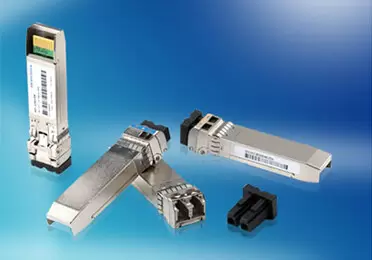
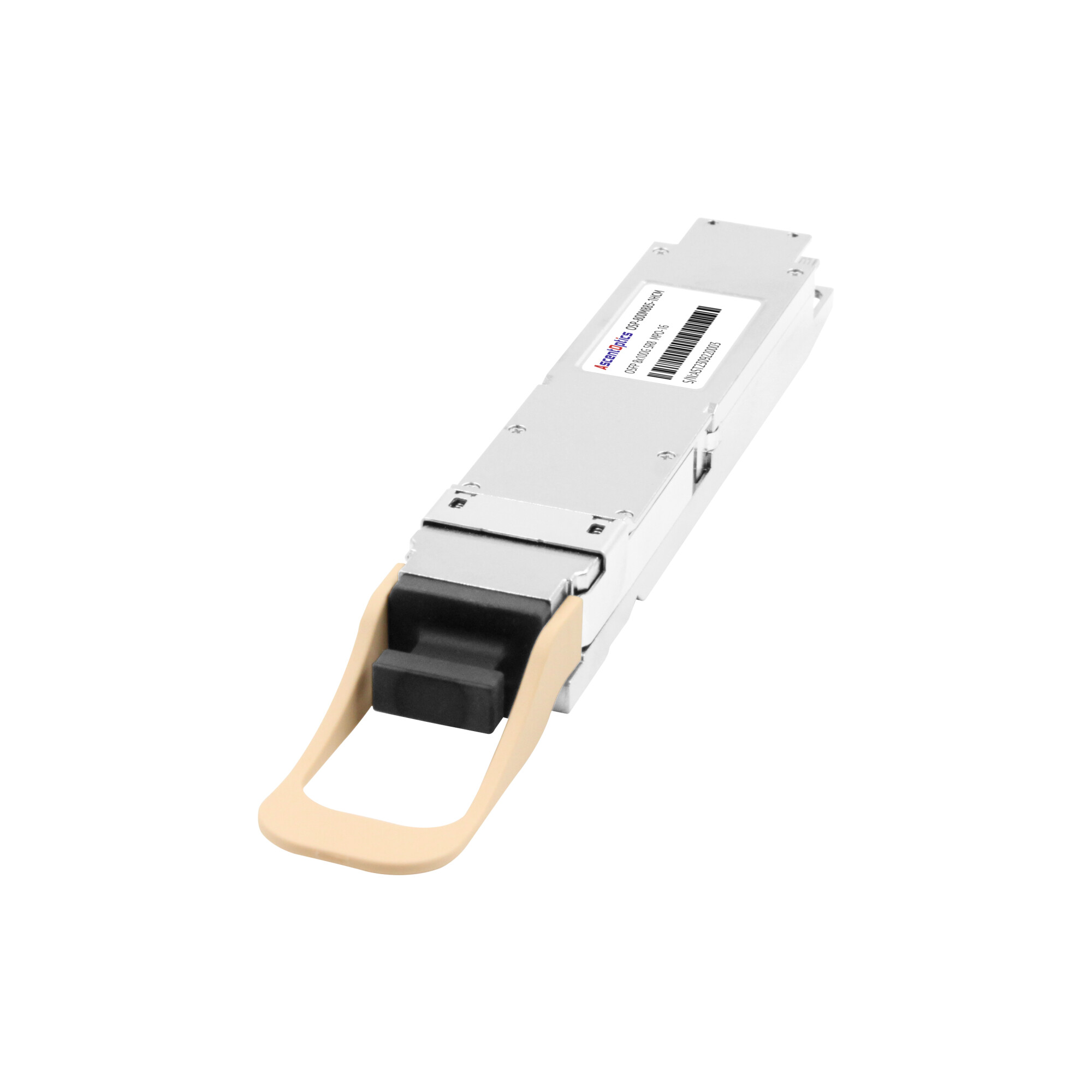
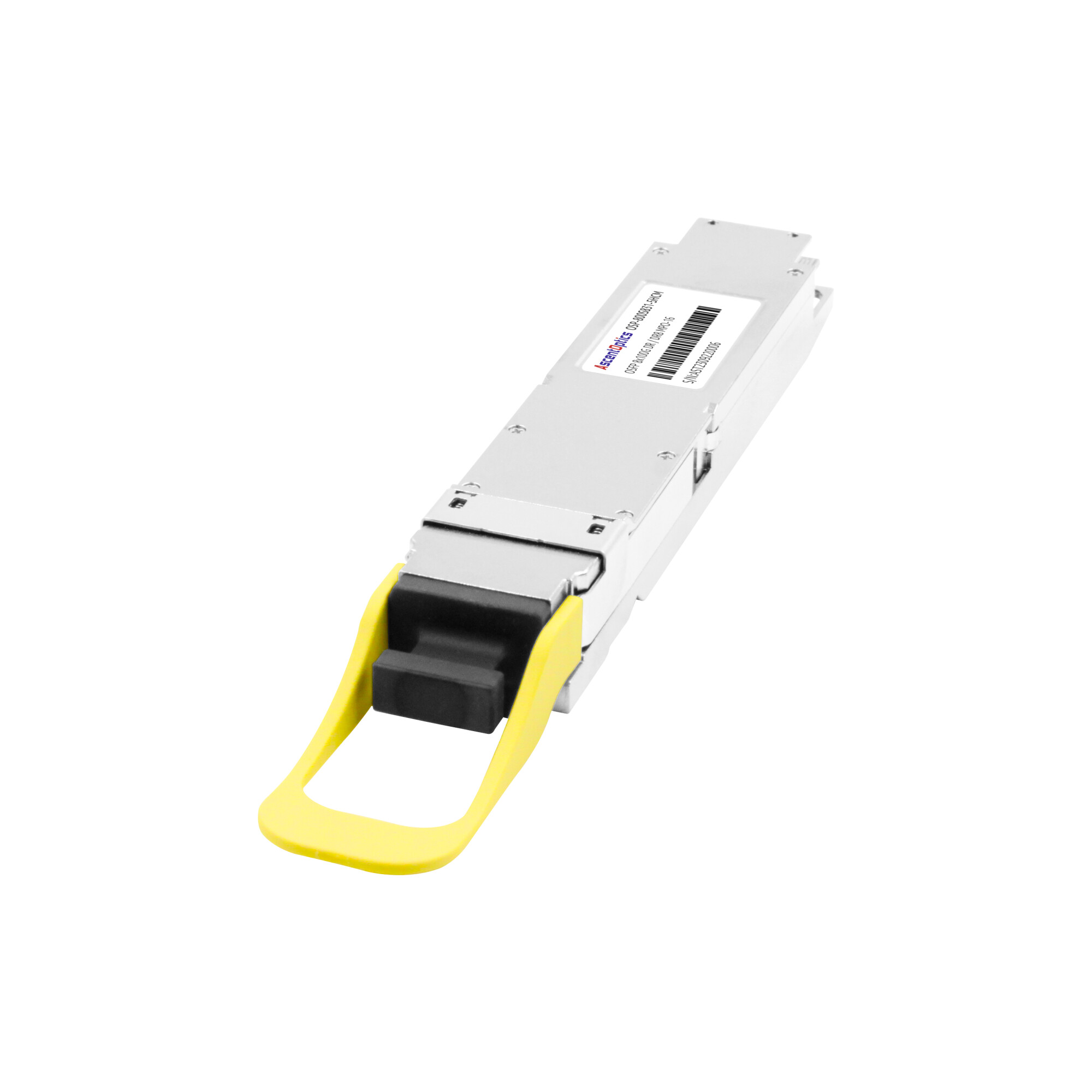
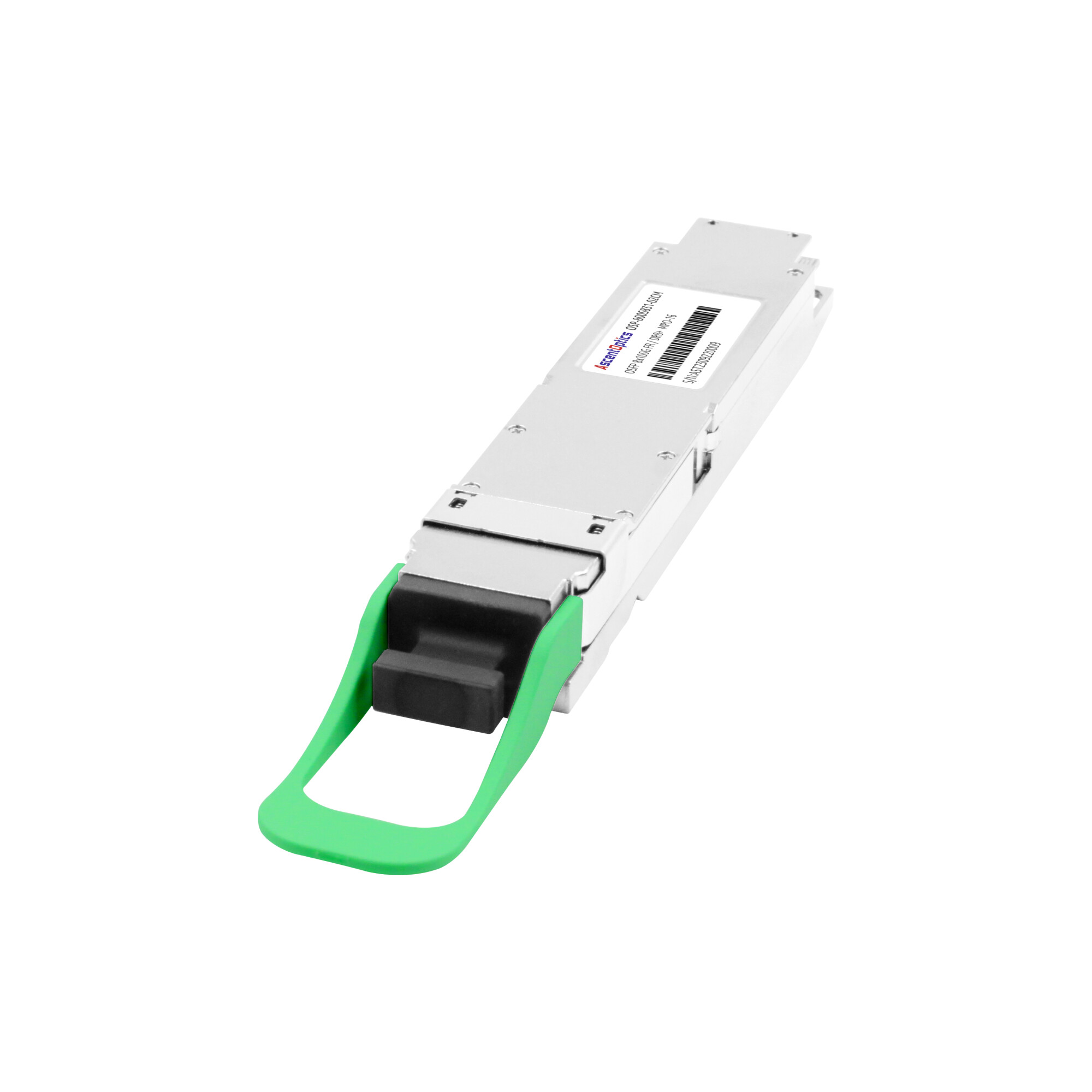
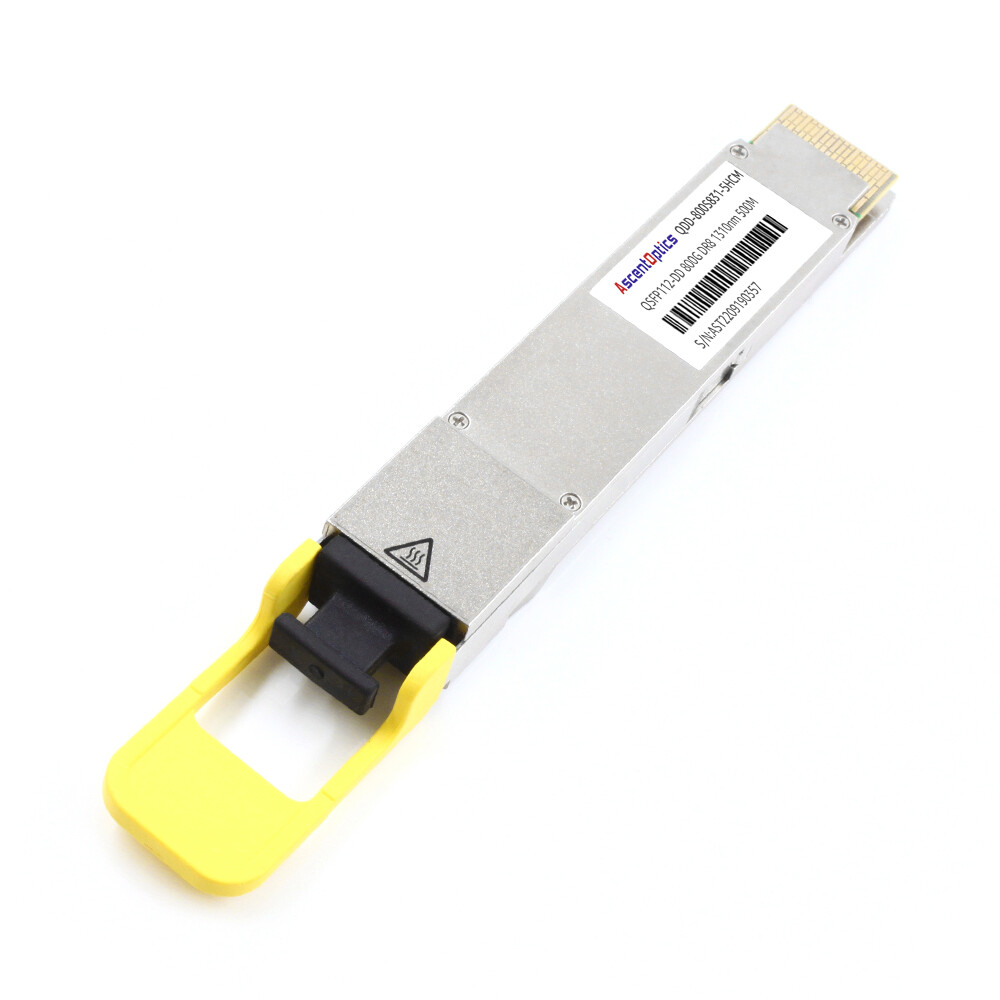
The 800G SR8 transceiver is a short-reach multimode optical module designed for high-bandwidth data center connectivity. As one of the short-reach options in the broader family of 800G optical transceivers, SR8 uses approximately 850 nm VCSEL technology and PAM4 modulation, making it well suited for short-distance connections over multimode fiber.
The module supports flexible breakout applications, allowing an 800G port to be split into two 400G or four 200G connections. Unlike the 800G DR8, which is designed for 500-meter single-mode transmission, the SR8 is specifically intended for short-reach interconnect scenarios, such as within a rack.
What Is an 800G SR8 Transceiver?
An 800G SR8 transceiver is a hot-pluggable optical module that transmits and receives data at 800 gigabits per second over multimode fiber. It uses eight parallel lanes of 100G PAM4 signaling, each driven by an 850 nm VCSEL laser, and connects through an MPO-16 or dual MPO-12 connector.
That’s the definition in a single breath. The “SR” stands for short reach, and the “8” tells you the module uses eight optical lanes in parallel. That parallel structure is what lets SR8 hit 800G using low-cost multimode optics instead of the more expensive single-mode lasers that DR8 and FR8 require.
Because SR8 runs on multimode fiber, it is the most economical 800G variant to build and operate. The tradeoff is distance. Multimode fiber supports shorter runs than single-mode, so SR8 is designed for the first 100 meters of the fabric rather than the spine.
800GBASE-SR8 Standards and Architecture
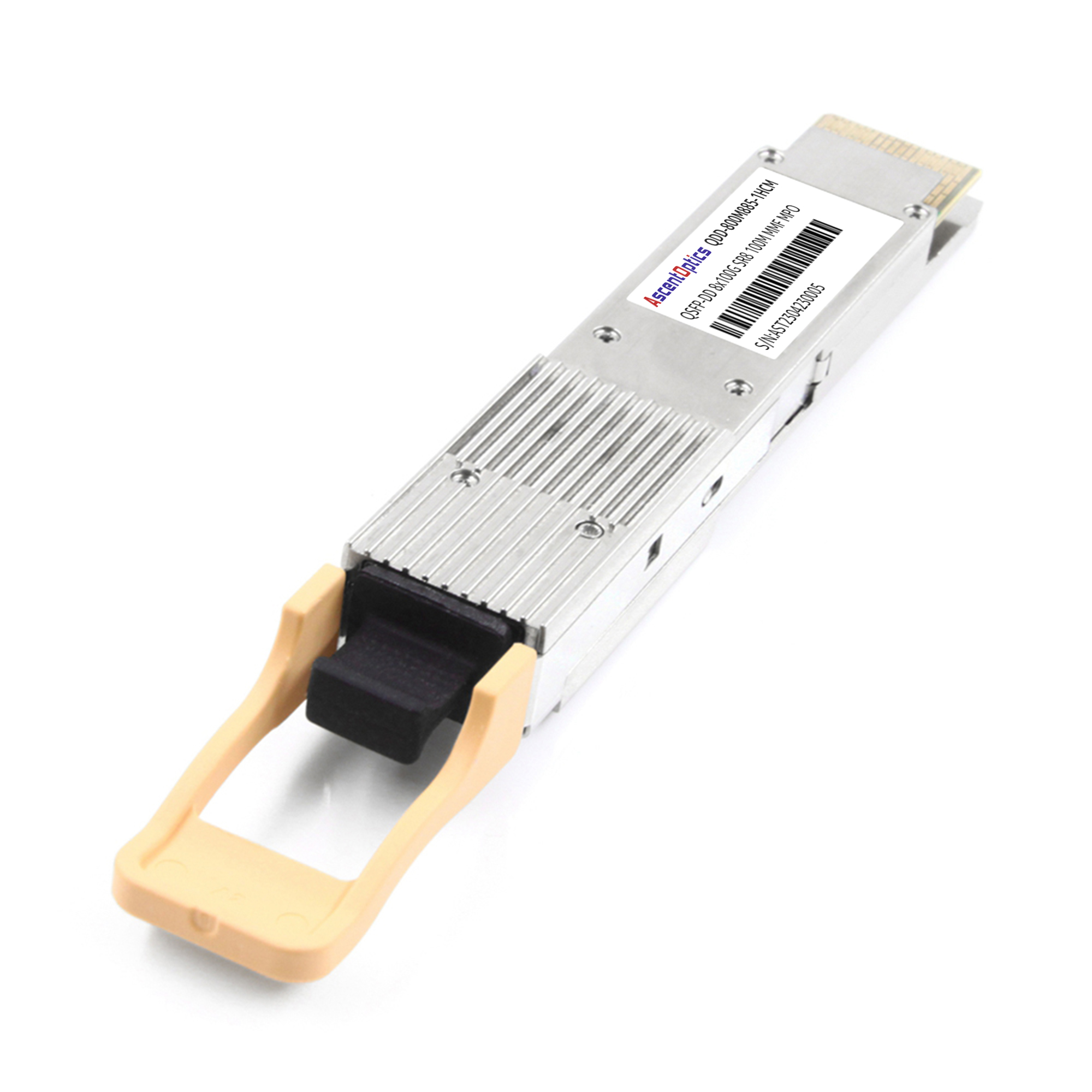
800GBASE-SR8 is an IEEE-defined Ethernet optical interface for 800G short-reach multimode connectivity. The electrical host interface and module management requirements are defined through the applicable IEEE specifications, MSA requirements, and CMIS implementation.
Standards compliance improves interoperability, but successful deployment still depends on the switch platform, module coding, firmware, cage, and host-side compatibility.
Under the hood, eight transmit lanes and eight receive lanes run in parallel. The 800G SR8 transceiver uses eight 100G-class PAM4 optical lanes operating around 850 nm. Each optical lane carries a 100G-class Ethernet signal, providing an aggregate 800G interface over multimode fiber. The optical engine pairs a VCSEL transmitter with a PIN receiver on each lane, all operating at 850 nm.
Forward error correction (FEC) is an important part of high-speed Ethernet link design and is handled within the applicable host and Ethernet architecture. The exact FEC implementation depends on the Ethernet standard and system design rather than being a user-configurable feature of the optical module itself.
QSFP-DD vs OSFP Form Factors
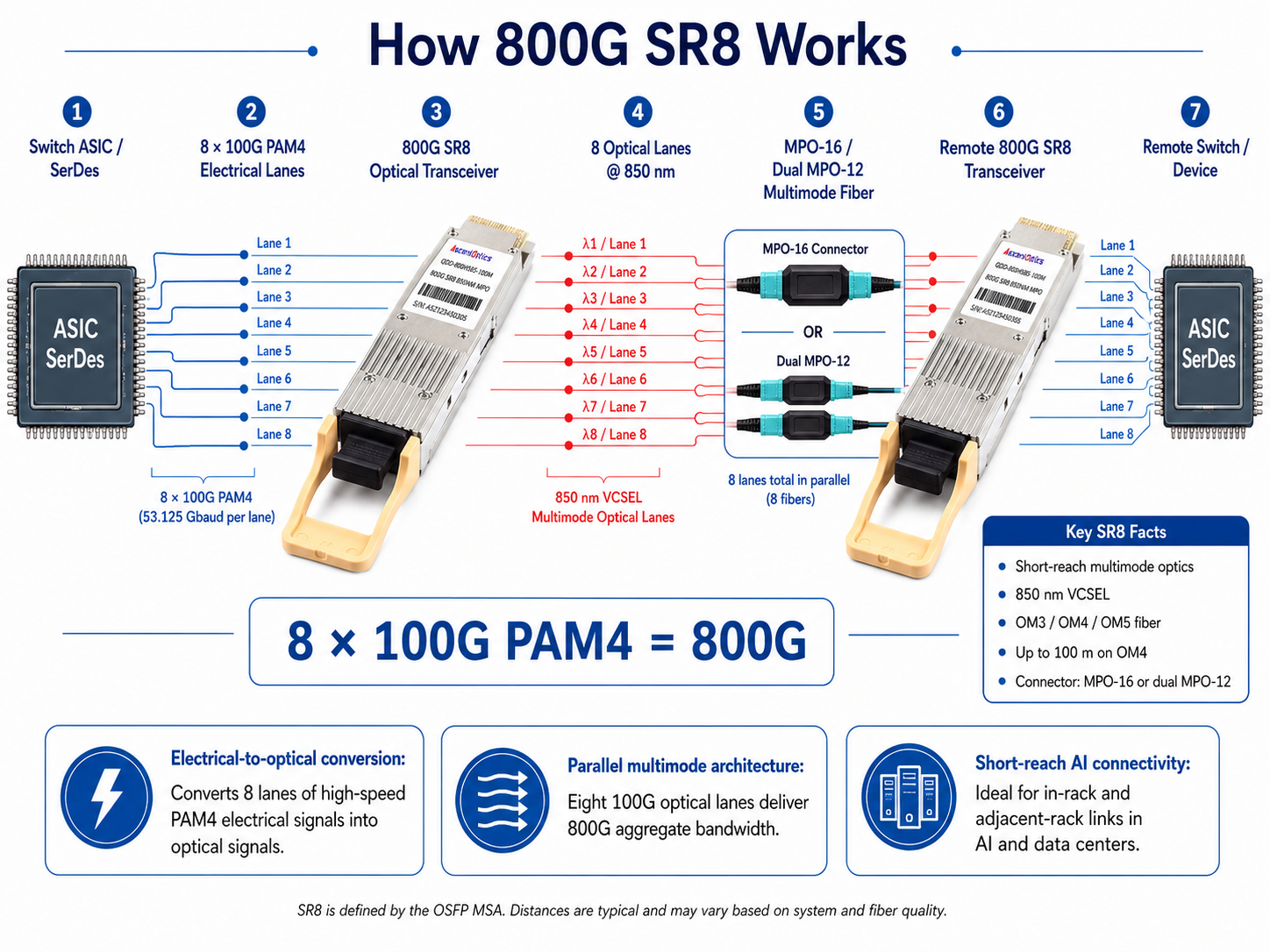
800G SR8 modules are available in both QSFP-DD and OSFP form factors, depending on the switch platform.
QSFP-DD is the density play. It keeps the same width as earlier QSFP generations, so it packs more ports per line card and preserves backward compatibility. For SR8, whose ~14 W power draw stays well within QSFP-DD thermal limits, it is often the natural choice.
QSFP-DD provides a compact form factor and high port density. Its mechanical ecosystem is compatible with earlier QSFP-family modules when supported by the host platform, making it attractive for networks that prioritize port density and platform flexibility.
OSFP is larger and purpose-built for higher power. It carries an integrated heat sink and handles 20 W and above comfortably. It is widely used in high-performance 800G platforms where higher module power and thermal dissipation need to be accommodated. You will see OSFP SR8 in high-power or mixed-vendor environments where the platform already standardizes on OSFP cages.
Neither form factor should be selected based on module size alone. The switch cage, supported module power, airflow, firmware, and validated transceiver list should all be checked before deployment.
800G SR8 Specifications at a Glance
Here is the specification sheet network teams most often ask for.
| Parameter |
800G SR8 Specification |
| Data rate |
800 Gbps aggregate (8 × 100G PAM4) |
| Standard |
800GBASE-SR8 (IEEE 802.3df) |
| Wavelength |
850 nm |
| Optical source/receiver |
VCSEL transmitter, PIN receiver |
| Fiber type |
Multimode (OM3 / OM4 / OM5) |
| Reach |
up to 70 m on OM3, 100 m on OM4 |
| Connector |
MPO-16 APC or dual MPO-12 APC |
| Form factors |
QSFP-DD and OSFP |
| Power consumption |
~12–14 W (DSP-based); ~4 W (LPO variant) |
| Electrical interface |
8 × 100GAUI-8 (IEEE 802.3ck) |
| Management |
CMIS digital diagnostics |
| Operating temperature |
0°C to 70°C (commercial) |
Two numbers deserve a second look. First, reach: 100 m on OM4 is the headline, but if your plant still uses OM3, plan for roughly 60 m. Second, power: the standard DSP-based module runs 12 to 14 W, while the emerging LPO (linear pluggable optics) variant cuts that to around 4 W by removing the module-side DSP.
800G SR8 vs DR8 vs FR8: How to Choose
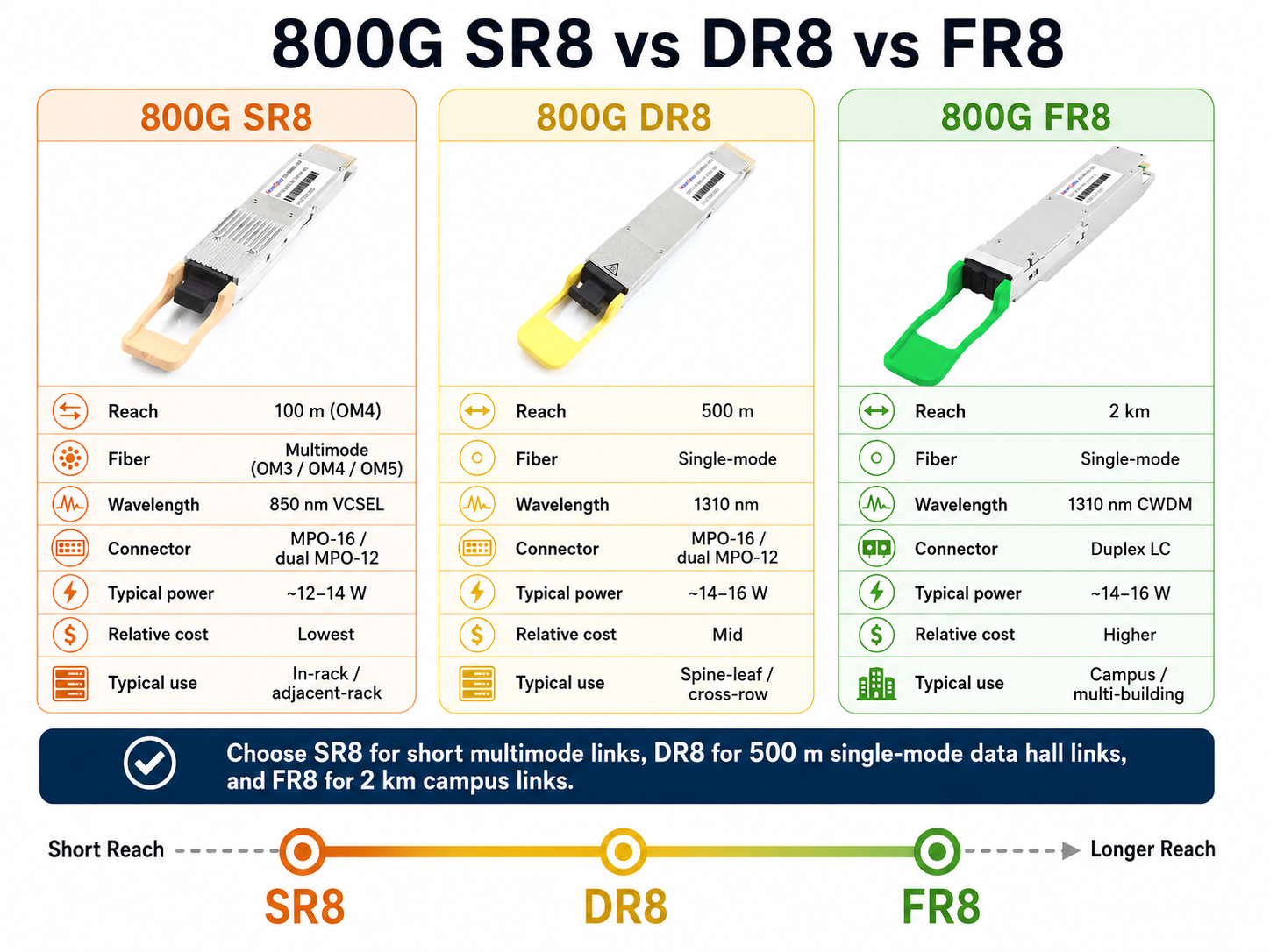
This is the comparison most buyers actually need. All three are 800G-class parallel-optics solutions, but their optical architecture and implementation can vary. They differ in reach, fiber type, cost, and power.
| Feature |
800G SR8 |
800G DR8 |
800G FR-class |
| Typical Reach |
Up to 100 m |
Up to 500 m |
Up to 2 km |
| Fiber |
MMF |
SMF |
SMF |
| Wavelength |
~850 nm |
~1310 nm |
~1310 nm / CWDM |
| Optical Interface |
MPO-16 / dual MPO-12* |
MPO-16 / dual MPO-12* |
Depends on implementation |
| Relative Cost |
Low |
Medium |
Higher |
| Typical Application |
In-rack / adjacent rack |
Intra-data-center |
Longer data center links |
SR8 is the short-reach option. It uses multimode fiber, which keeps both the module and the cabling inexpensive, but caps out at 100 m. It’s the right call for top-of-rack, in-rack, and adjacent-rack links.
DR8 is the AI fabric workhorse. It reaches 500 m over single-mode fiber using parallel optics and an MPO-16 connector, which covers nearly every intra-pod link in a data hall. If your runs exceed 100 m, DR8 is where you land.
FR8 (often sold as 2×FR4) extends to 2 km using CWDM over single-mode fiber with a duplex LC connector. It’s the choice for campus and multi-building links, and it costs more per port for reach most in-rack designs don’t need.
The selection rule is simple: match reach to your actual link lengths. SR8 is generally the most cost-effective option for short multimode links. DR8 and longer-reach solutions typically cost more because they use single-mode optics and support greater transmission distances. For short in-rack links, deploying a longer-reach module may therefore add cost without providing a practical benefit.
800G SR8 Breakout and Migration Paths
One of the most useful things about the 800G SR8 transceiver is its flexibility. Because it is eight independent 100G lanes, a single module can break out into several slower links.
- 2×400G SR4splits the 800G port into two independent 400G SR4 links.
- 8×100Gbreaks out into eight individual 100G lanes for direct server and NIC connectivity.
- 4×200Gsupports four 200G links for higher-density port configurations.
The 2×400G SR4 mode is the one that matters for migration. It lets a single 800G SR8 port connect to two existing 400G devices, so you can bring up an 800G spine and break out to the 400G leaf switches you already own. That’s how teams move from 400G to 800G without a forklift upgrade.
For 400G-to-800G migration, 2×400G breakout is particularly useful when an 800G-capable switch needs to connect to two existing 400G ports. Always verify the supported breakout modes in the switch and transceiver documentation before deployment.
800G SR8 Applications in AI and Data Centers
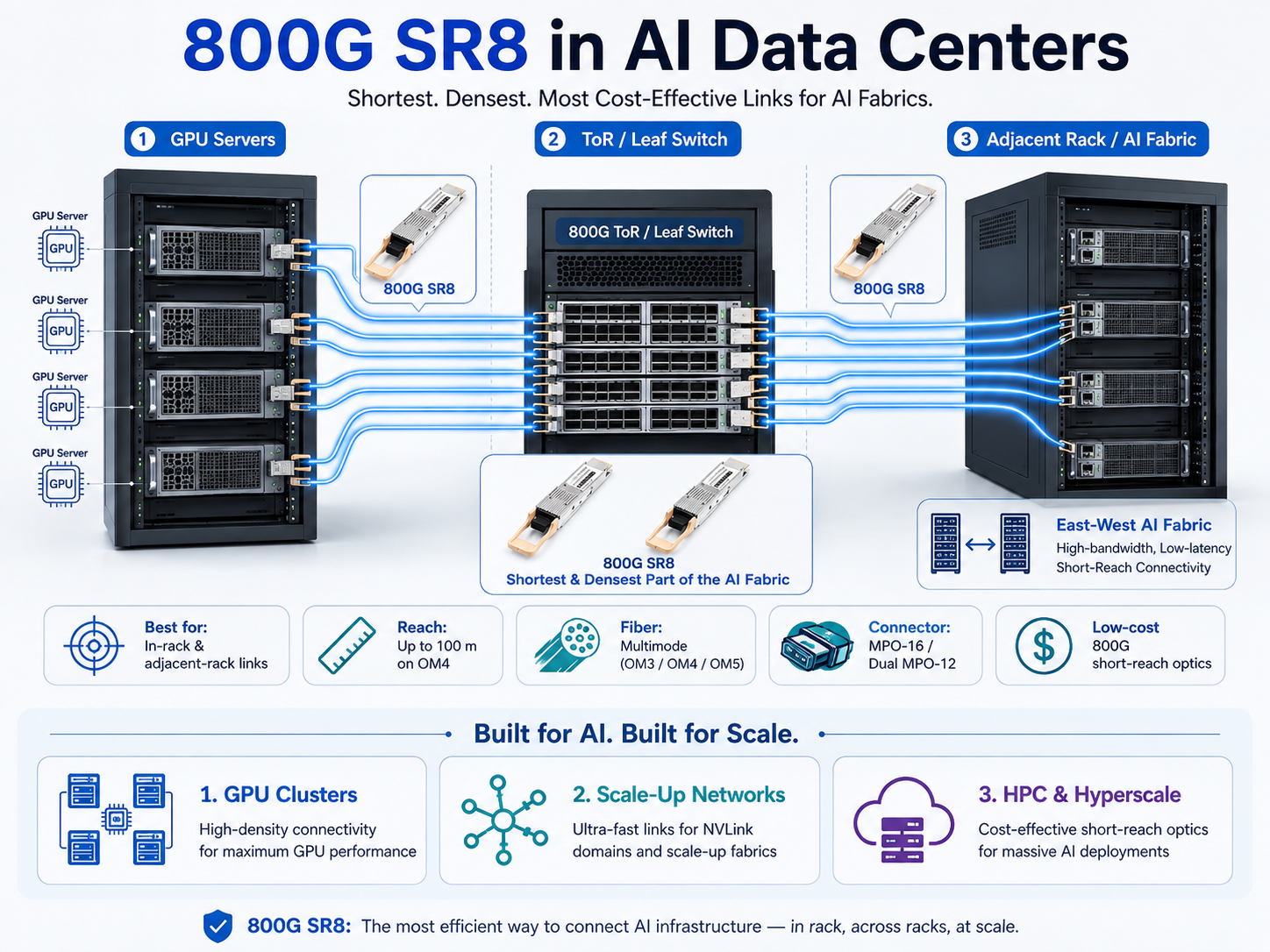
The 800G SR8 transceiver is built for the shortest, densest part of the modern data center. Its sweet spot is the east-west traffic that AI training generates.
GPU clusters and scale-up networks. Inside an AI rack, GPUs connect to top-of-rack switches over short multimode links. SR8’s low cost and low power make it the natural fit for those in-rack hops, where dozens of optics live in a single rack, and every watt competes with compute. In scale-up networks, where NVIDIA NVLink and NVSwitch connect GPUs over very short distances, SR8 is the dominant multimode module.
800G SR8 is particularly well suited to short-reach optical connections in high-density AI and HPC environments. It can be used for short switch-to-switch, switch-to-NIC, and other high-bandwidth connections where multimode fiber is supported.
For GPU scale-up architectures such as NVLink-based systems, the specific interconnect technology should be distinguished from Ethernet or InfiniBand optical transceiver links. SR8 should not be assumed to be the optical interface for every GPU-to-GPU connection.
InfiniBand NDR fabrics. 800G-class optical modules can be used in both Ethernet and InfiniBand environments when the module is specifically qualified for the target protocol and platform. The physical layer doesn’t care which protocol rides on top. If your cluster uses InfiniBand for GPU-to-GPU communication, SR8 modules connect switches and adapters over the same short multimode links.
HPC and hyperscale. High-performance computing clusters and hyperscale data centers both lean on SR8 for the dense, short links closest to the servers. The module’s 8×100G structure means one port replaces eight 100G ports, which simplifies the fabric and cuts port counts.
Choosing a Reliable 800G SR8 Module
Not all 800G SR8 transceivers are created equal. The spec sheet is the starting point; reliability, compatibility, and quality are what separate a module that works in production from one that fails in the field.
Compatibility and coding. The module must comply with the 800GBASE-SR8 and IEEE 802.3df standards to work across equipment vendors. Industry bodies like the Optical Internetworking Forum define the interfaces that keep everything interoperable, and the IEEE 802.3 standards define the electrical and optical requirements. Compatibility coding matters too: a module coded for Cisco, Arista, Juniper, or NVIDIA will be recognized by those platforms and report correctly in their management tools.
Quality and validation. A reliable 800G SR8 transceiver has been tested for optical performance under load, not just assembled to a datasheet. The metrics that matter are TDECQ (transmitter dispersion eye closure), receiver sensitivity, and channel-to-channel consistency across all eight lanes. High-temperature performance matters in dense AI racks, where a module that passes at room temperature can drift at 70°C.
LPO and immersion-cooled variants. Two emerging options are worth watching. LPO SR8 removes the module DSP and cuts power to around 4 W, at the cost of tighter host-switch compatibility. Immersion-cooled SR8 is engineered to operate submerged in dielectric fluid, which matters for the liquid-cooled AI racks now entering service. Both are signs of where the short-reach tier is headed.
Conclusion
The 800G SR8 transceiver is a practical short-reach optical solution for high-density data center, AI, HPC, and other networking environments where multimode fiber can meet the required link distance.
Its main advantages are high bandwidth, short-reach efficiency, and the ability to support dense optical connectivity over multimode fiber. Compared with longer-reach 800G solutions such as DR8 and FR-class optics, SR8 can provide a more cost-effective option when link distances remain within the supported multimode-fiber range.
Key points to remember:
- 800G SR8 typically uses eight 100G-class PAM4 optical lanes operating around 850 nm.
- SR8 is designed for multimode fiber and can support links up to around 100 m on OM4, depending on the specific implementation.
- QSFP-DD and OSFP are both available form factors, but compatibility depends on the host platform and module design.
- DR8 is generally preferred when the link exceeds the practical reach of SR8 and single-mode fiber is required.
- Some platforms support 2×400G, 4×200G, or 8×100G breakout configurations, but these modes must be validated for the specific switch, module, and cable.
- LPO-based SR8 solutions can reduce power consumption, but they require tighter host-platform compatibility than conventional DSP-based modules.
- For production deployment, verify reach, fiber type, connector, power consumption, CMIS support, module coding, and host-platform compatibility against the manufacturer’s specifications.
The right 800G SR8 transceiver is not simply the module with the lowest price. It is the solution that matches the required reach, fiber infrastructure, form factor, power budget, breakout configuration, and network platform.
FAQs About 800G SR8 Transceivers
1. What is an 800G SR8 transceiver?
An 800G SR8 transceiver is a short-reach optical module designed for 800G connectivity over multimode fiber. It typically uses eight 100G-class PAM4 optical lanes and approximately 850 nm VCSEL technology.
2. What is the maximum reach of an 800G SR8 transceiver?
An 800G SR8 transceiver can typically reach up to 100 meters over OM4 multimode fiber. The supported distance depends on the specific module, fiber grade, connector, and link-loss budget.
3. What fiber does 800G SR8 use?
800G SR8 is designed for multimode fiber (MMF), including OM3, OM4, and, depending on the implementation, OM5. OM4 is commonly used for links up to around 100 meters, while OM3 supports a shorter reach.
4. What is the difference between 800G SR8 and DR8?
The main difference is the fiber type and transmission distance. SR8 uses multimode fiber and is intended for short-reach links of up to around 100 meters, while DR8 uses single-mode fiber and typically supports distances up to around 500 meters. SR8 is generally better suited to in-rack and adjacent-rack connections, while DR8 is used for longer data center links.
5. Can an 800G SR8 transceiver support 2×400G breakout?
Certain 800G SR8 modules and switch platforms support 2×400G breakout. Some implementations may also support 4×200G or 8×100G configurations. However, breakout capability depends on the switch, module, firmware, optical lane mapping, and breakout cable, so compatibility should be verified before deployment.
6. Is 800G SR8 available in both QSFP-DD and OSFP?
Yes. 800G SR8 modules can be available in both QSFP-DD and OSFP form factors, depending on the host platform. QSFP-DD emphasizes compact size and port density, while OSFP provides a larger mechanical envelope and greater thermal-management headroom. The host switch must support the selected form factor.
7. What is the difference between DSP-based and LPO 800G SR8?
DSP-based SR8 modules perform signal processing within the optical module, while LPO (Linear-drive Pluggable Optics) moves more signal-conditioning functions to the host system. LPO can significantly reduce module power consumption, but it generally requires tighter compatibility between the module and host platform.
8. Can 800G SR8 be used for InfiniBand?
800G-class optical modules can be used in InfiniBand environments when they are specifically qualified for the target InfiniBand platform. Optical specifications alone do not guarantee protocol-level interoperability. For InfiniBand deployments, verify the supported transceiver type, module coding, management interface, and switch or adapter compatibility.
Post Views: 1,232