As AI workloads become increasingly distributed across large GPU clusters, the network fabric connecting compute nodes has become a critical part of overall system performance. Two technologies are widely used for high-performance AI and HPC networking: InfiniBand and RDMA over Converged Ethernet (RoCE).
Both technologies support Remote Direct Memory Access (RDMA), allowing applications to transfer data between systems with low CPU overhead and low latency. However, they take fundamentally different approaches to networking.
If you are building a GPU cluster right now, you are almost certainly weighing InfiniBand vs RoCE. Both move data between GPUs using Remote Direct Memory Access, or RDMA. Both carry the collective operations that make distributed training possible. But they differ sharply in latency, cost, and the optical hardware each one demands.
What Is InfiniBand?
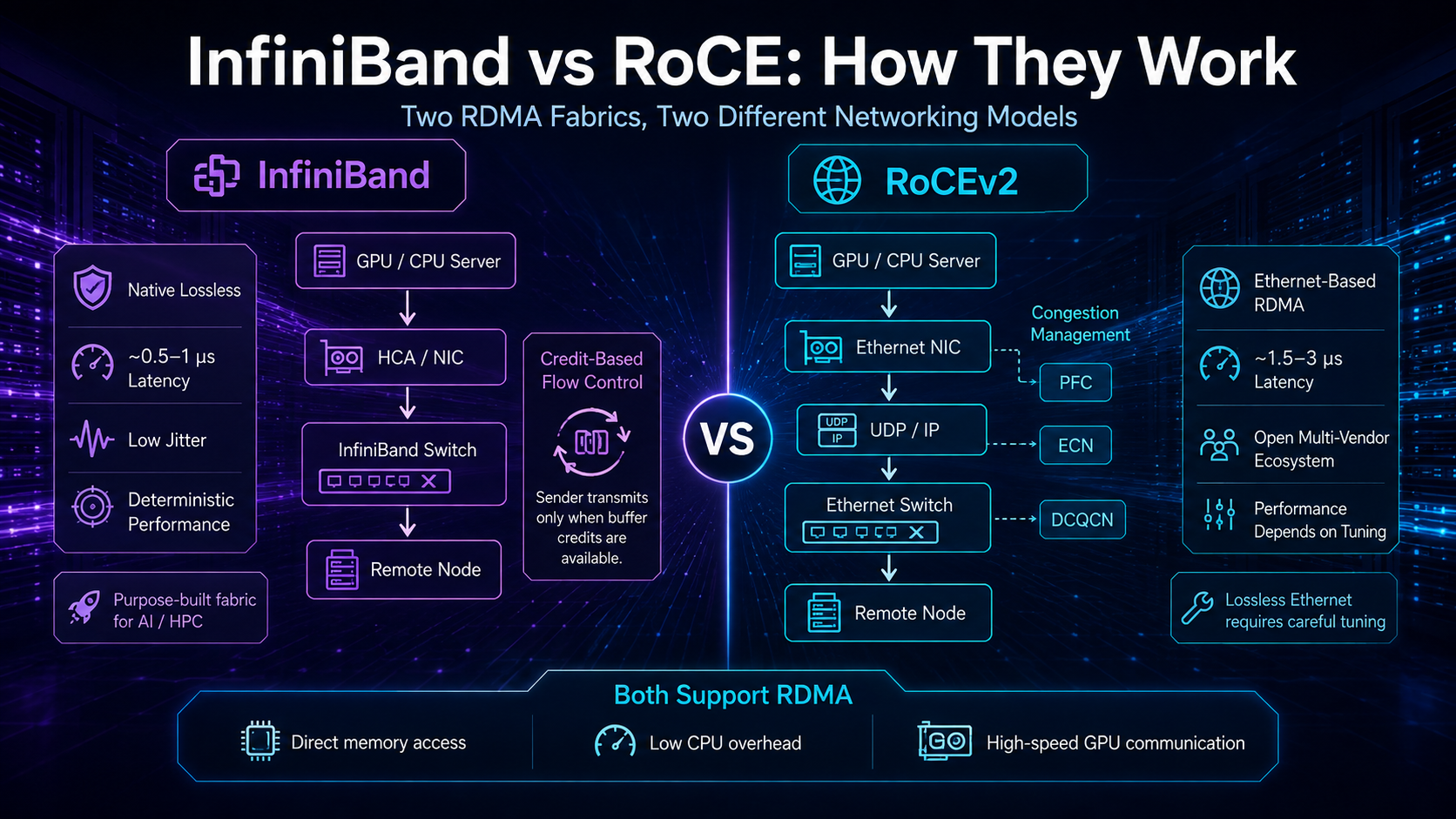
InfiniBand is a purpose-built, high-performance interconnect designed from the ground up for low-latency, lossless data movement. It carries its own link and transport layers, uses dedicated Host Channel Adapters (HCAs), and connects through InfiniBand-specific switches from NVIDIA and its Mellanox line.
The defining trait is credit-based flow control. A sender only transmits data when it has been granted credits, which represent available buffer space on the receiver. Nothing gets dropped, ever. That makes InfiniBand lossless by design, with no tuning required to achieve it.
End-to-end NIC-to-NIC latency sits around 0.5 to 1 microsecond, and switch hops add only hundreds of nanoseconds. Under heavy load, InfiniBand holds that low latency with minimal jitter. It is the reason the technology has dominated the TOP500 supercomputing list for years.
A Subnet Manager handles fabric management, routing, and discovery. That simplicity has a cost. InfiniBand is a more tightly controlled and vendor-integrated ecosystem, and the switches, NICs, and cables all come from a tightly coupled stack.
What Is RoCE and RoCEv2?
RoCE, or Remote Direct Memory Access over Converged Ethernet, enables RDMA capabilities over Ethernet networks.
The version most commonly used in modern data centers is RoCEv2. Unlike the original RoCE implementation, which operates at Layer 2, RoCEv2 uses UDP/IP, allowing RDMA traffic to operate across Layer 3 networks. Instead of a dedicated fabric, it rides on the same Ethernet switches and cabling already in most data centers.
RoCEv2 can therefore leverage Ethernet switching infrastructure and networking technologies that are already widely deployed in enterprise and cloud data centers.
However, achieving predictable and low-loss performance with RoCEv2 requires careful network engineering. Ethernet traditionally uses best-effort forwarding, so AI and HPC deployments commonly use congestion-management technologies such as:
- PFC (Priority Flow Control, IEEE 802.1Qbb) sends pause signals upstream when a buffer fills, preventing drops but risking head-of-line blocking.
- ECN (Explicit Congestion Notification) marks packets before congestion causes drops so endpoints can slow specific flows.
- DCQCN coordinates end-to-end congestion control on top of ECN.
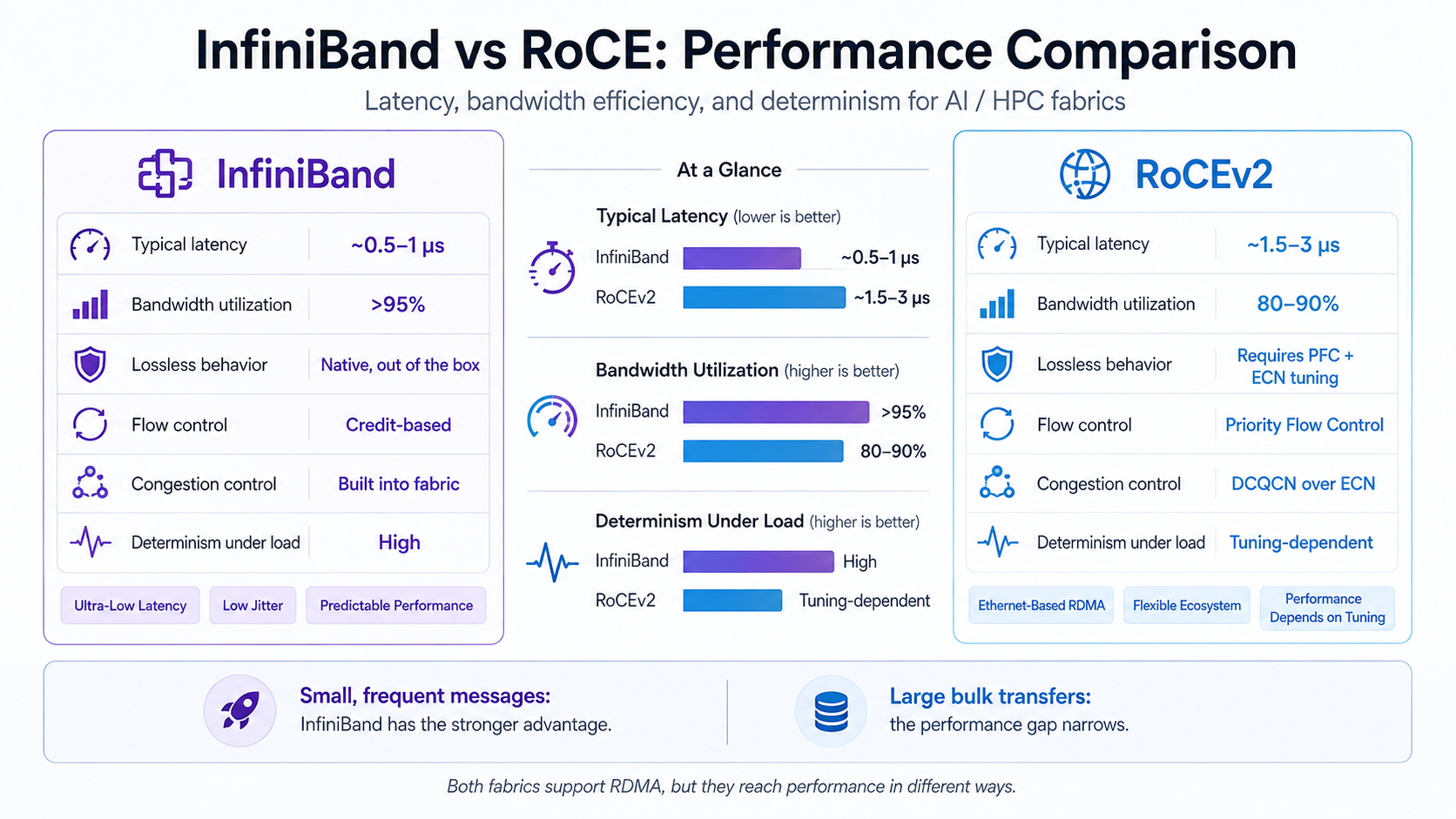
When these are tuned correctly, RoCEv2 delivers 85 to 95 percent of InfiniBand’s throughput. The catch is the word “tuned.” A misconfigured RoCE fabric can be twice as slow as InfiniBand.
RoCEv2 runs on multi-vendor hardware. Arista, Cisco, Broadcom, and Juniper switches all support it. That openness is the main reason hyperscalers have embraced it.
InfiniBand vs RoCE: Latency, Bandwidth, and Throughput
Performance is where the two fabrics reveal their different design philosophies.
InfiniBand’s credit-based flow control keeps latency near the theoretical floor. RoCEv2’s Ethernet stack adds encapsulation, PFC signaling, and congestion-control overhead. The result is a consistent gap:
| Metric |
InfiniBand |
RoCEv2 |
| Transport |
InfiniBand transport |
RDMA over UDP/IP |
| Flow Control |
Credit-based |
PFC / ECN-based |
| Congestion Management |
Fabric-integrated mechanisms |
ECN + congestion-control algorithms |
| Latency |
Very low and predictable |
Very low when properly engineered |
| Lossless Operation |
Designed for lossless operation |
Requires careful network configuration |
| Ecosystem |
More tightly integrated |
Broad multi-vendor Ethernet ecosystem |
| Multi-tenancy |
Supported through InfiniBand mechanisms |
Strong Ethernet integration, including EVPN/VXLAN environments |
The latency delta of roughly 50 to 200 percent matters most for small, frequent messages, the kind that dominate tightly coupled HPC and large synchronous training runs. For large bulk transfers, the gap narrows considerably.
Cost Comparison: Why RoCE Costs Less to Deploy
Cost is RoCEv2’s strongest argument, and the gap is substantial.
InfiniBand switches run roughly two to four times the price of equivalent Ethernet switches per port. Dedicated InfiniBand cabling adds roughly double the cost of standard fiber. RoCEv2, by contrast, reuses the Ethernet switches, NICs, and optics you likely already buy at volume.
There is a hidden cost on the RoCE side, though. Lossless Ethernet expertise is scarce. Sources estimate two to three engineer-weeks to tune a fabric end-to-end, and four to six months to reach a fully stable production cluster. If your team lacks that skill, the capex savings can quietly become opex spending.
Scalability, Operations, and the 2026 Market Shift
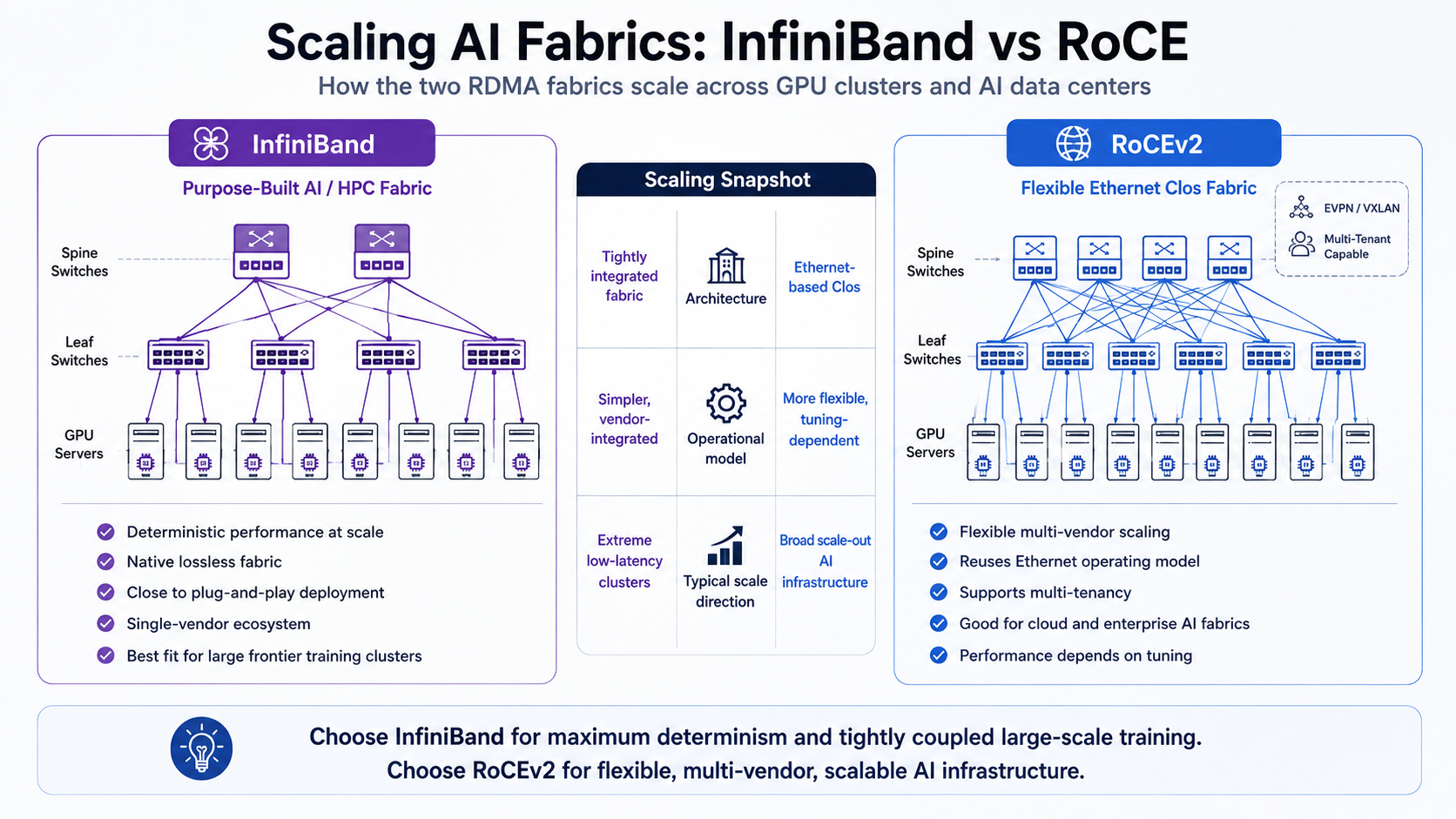
Both InfiniBand and RoCEv2 can be used to build large-scale AI and HPC networks. The practical scalability of either technology depends on the network topology, switching platform, routing architecture, workload, and operational design.
InfiniBand Scalability
InfiniBand is widely used for large GPU and HPC clusters because its architecture is optimized for high-performance node-to-node communication.
Dedicated fabric management and integrated flow-control mechanisms can simplify the process of building a predictable communication environment.
Its main consideration is that organizations are adopting a more specialized networking ecosystem, which may reduce flexibility compared with conventional Ethernet environments.
RoCEv2 Scalability
RoCEv2 benefits from the scalability and flexibility of Ethernet.
It can be deployed using common data-center network architectures such as leaf-spine and Clos topologies. It can also integrate with broader Ethernet technologies and operational practices.
This makes RoCEv2 attractive for organizations that want to combine AI infrastructure with existing Ethernet environments or support multiple types of workloads within the same overall networking strategy.
However, large-scale RoCE deployments require careful congestion management. As cluster size and traffic intensity increase, the interaction between topology, routing, queue behavior, ECN, PFC, and congestion-control mechanisms becomes increasingly important.
What the Choice Means for Optical Transceivers and Cables
This is where most InfiniBand vs RoCE comparisons stop, and where the physical layer actually decides your bill of materials.
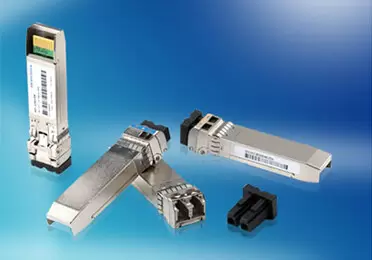
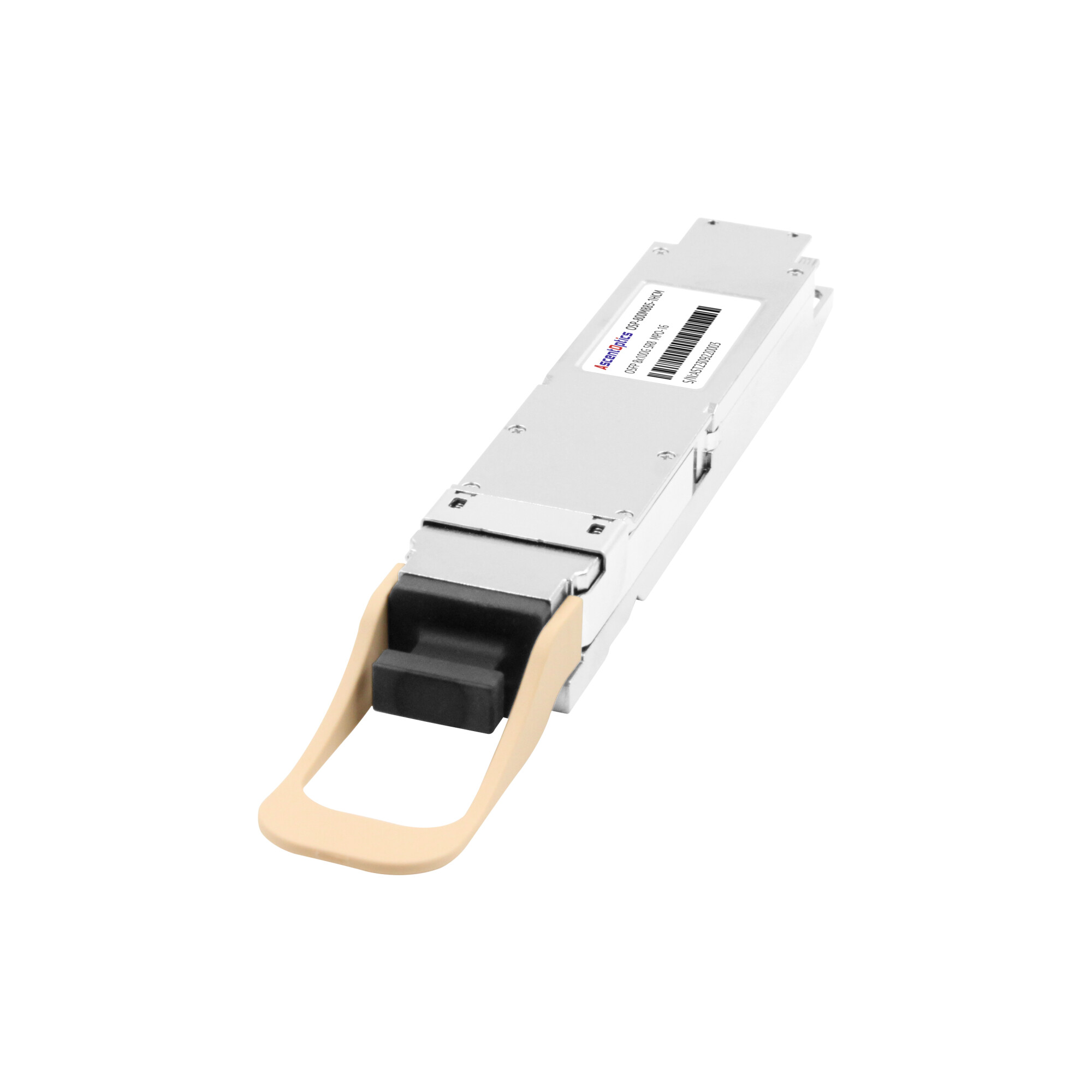
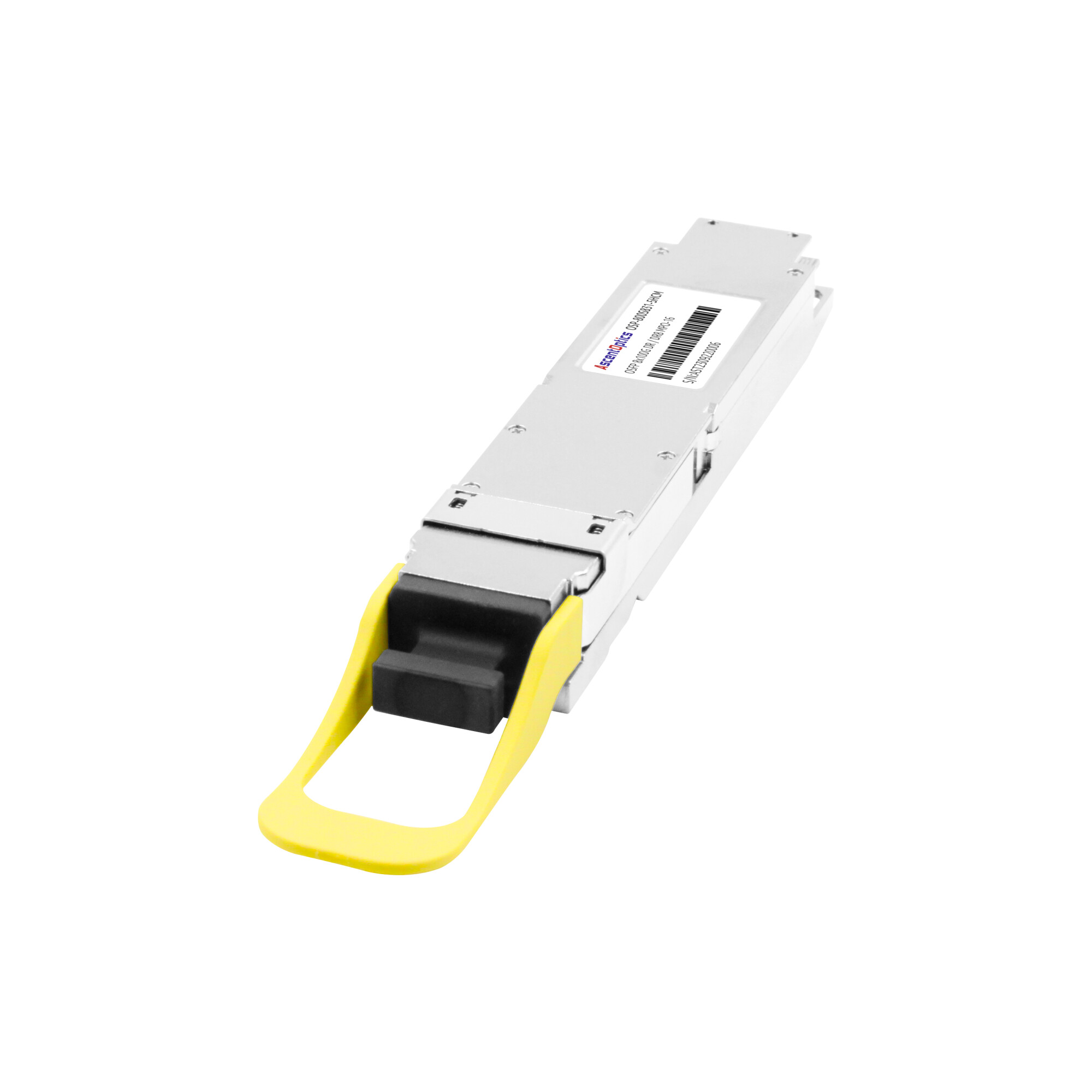
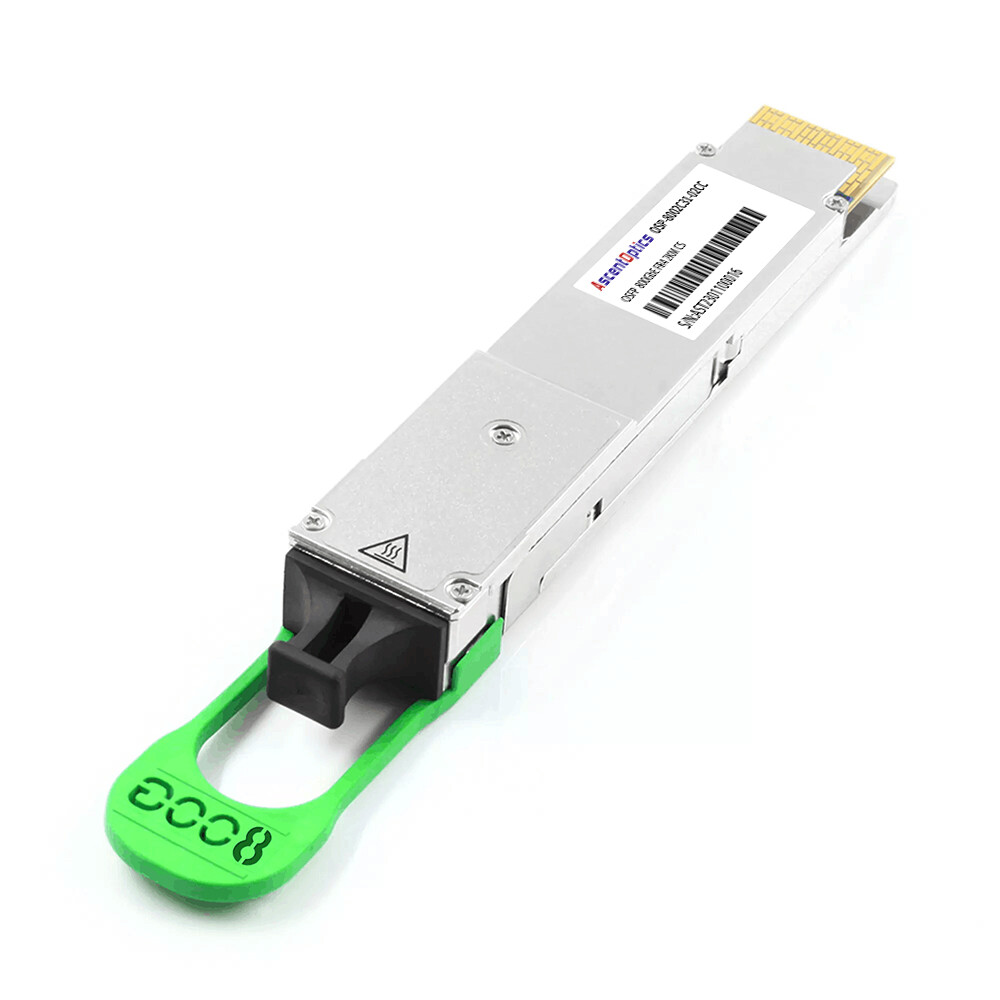
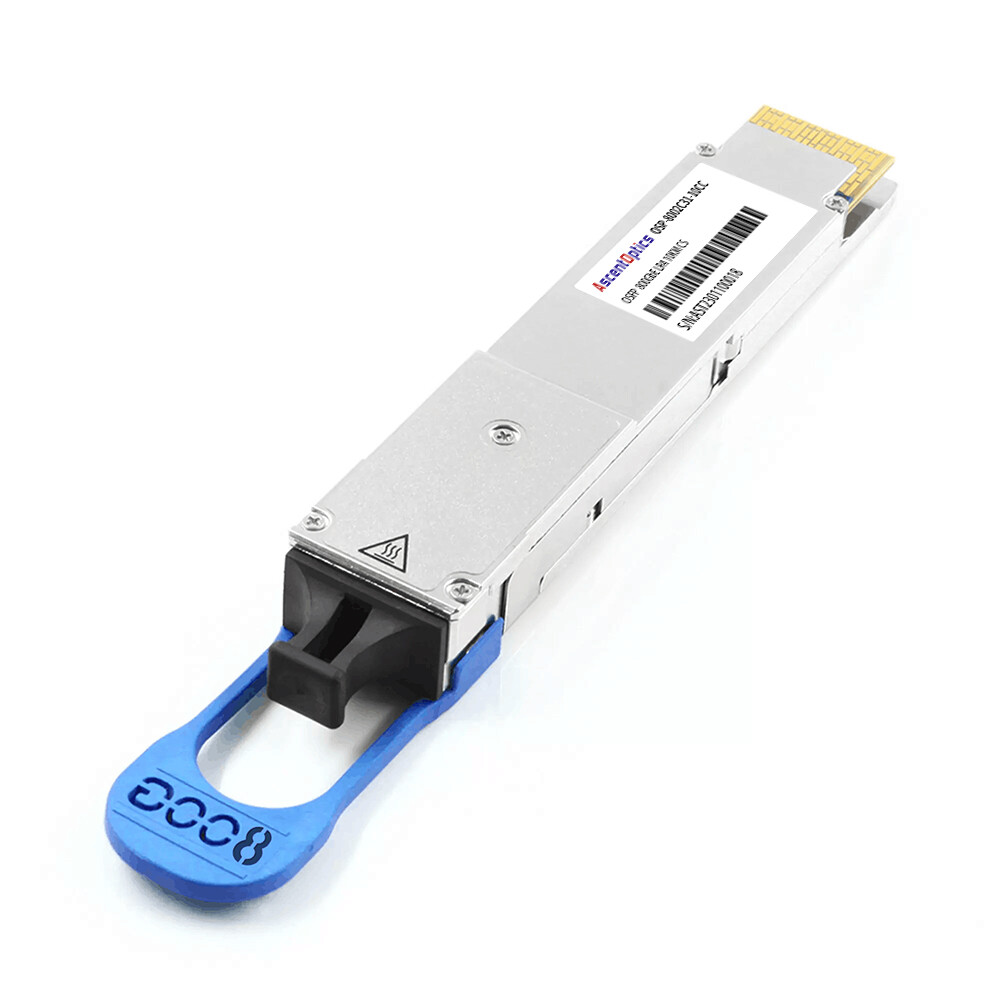
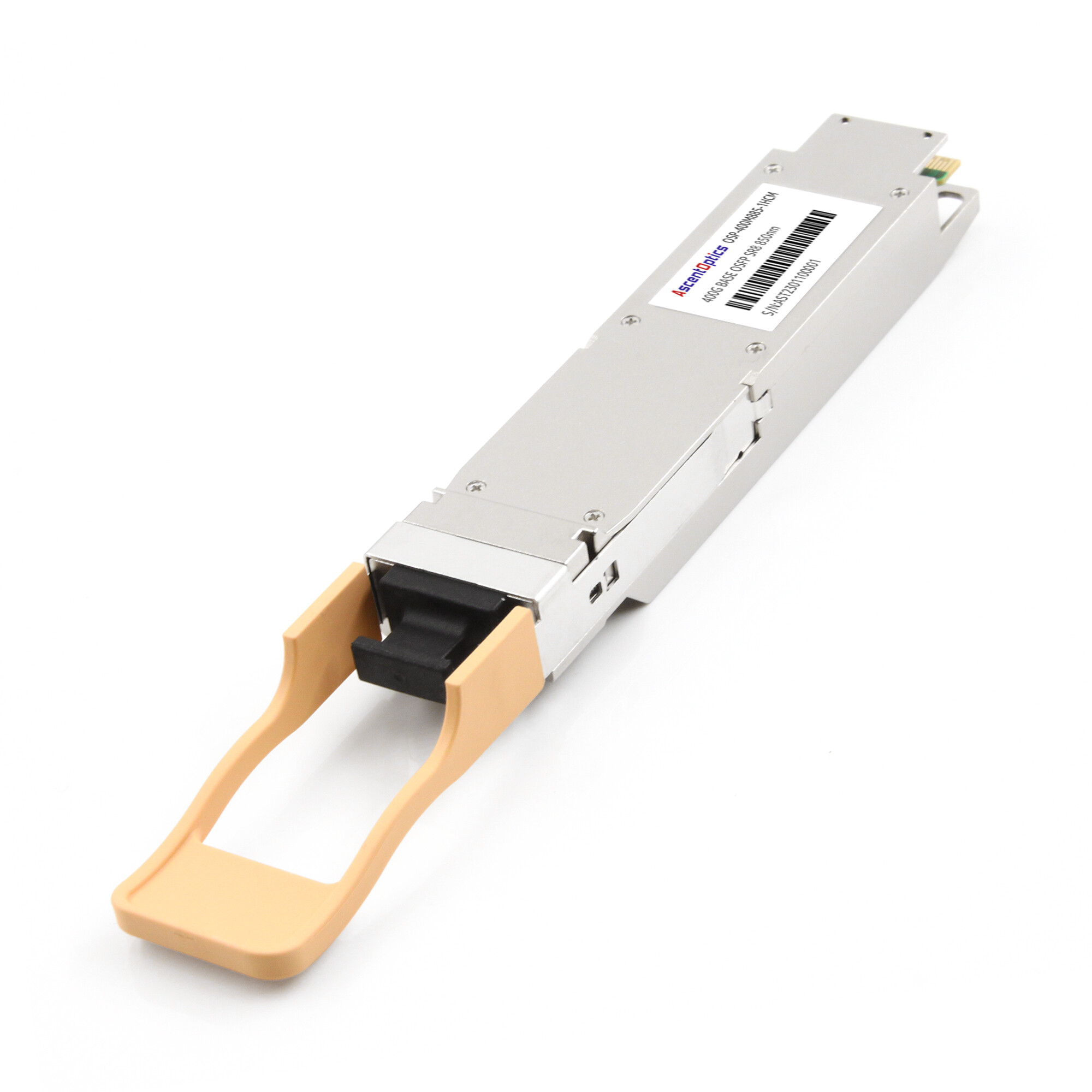
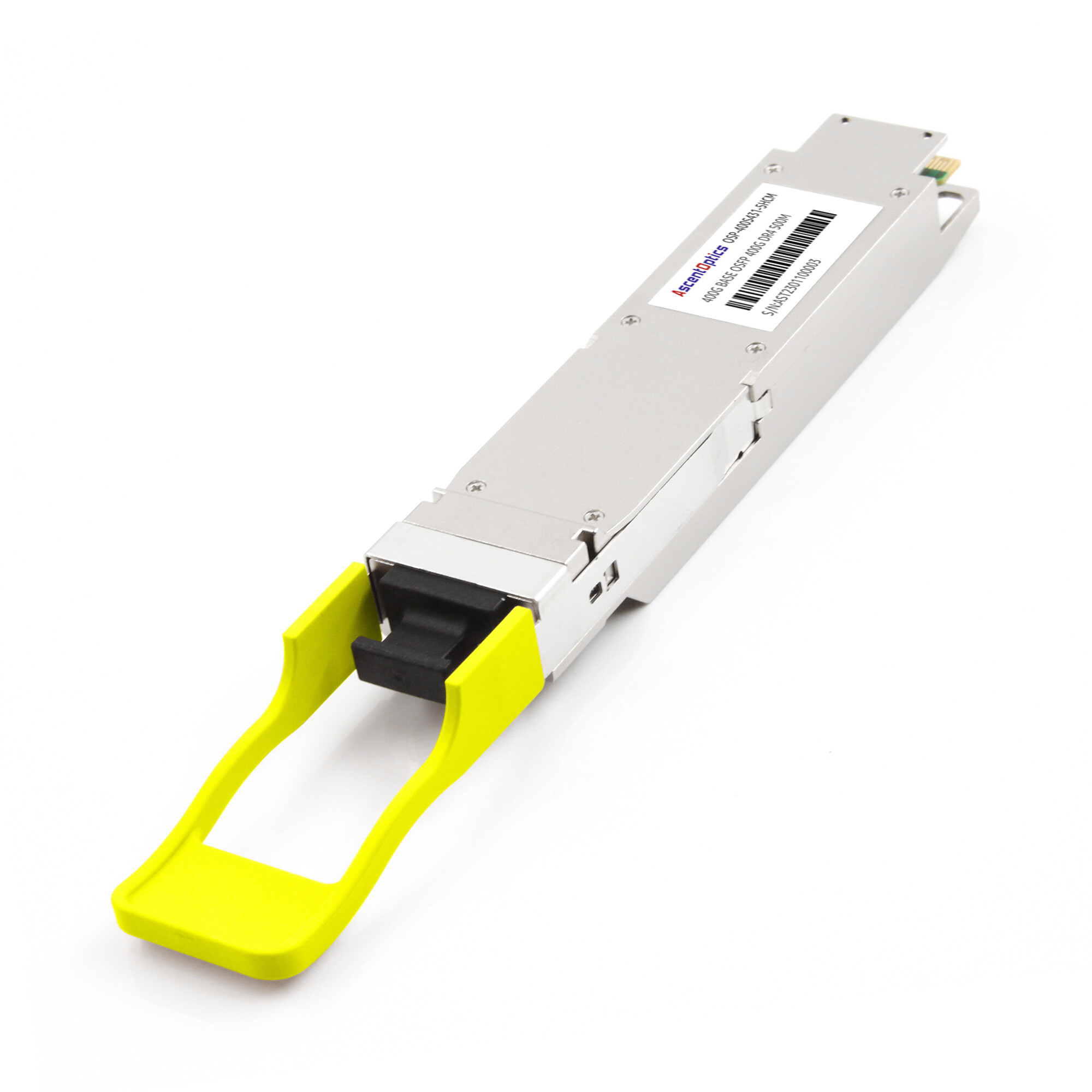
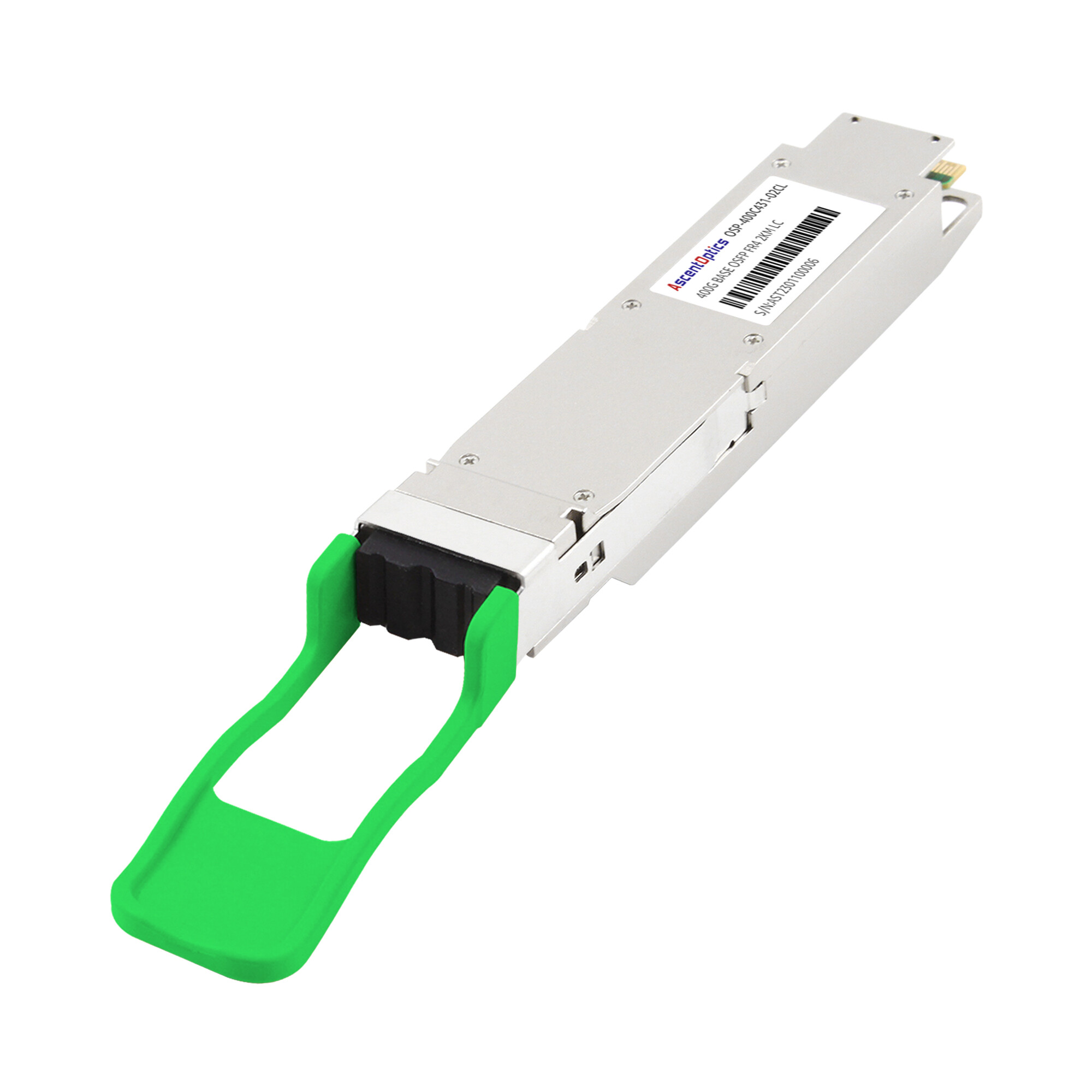
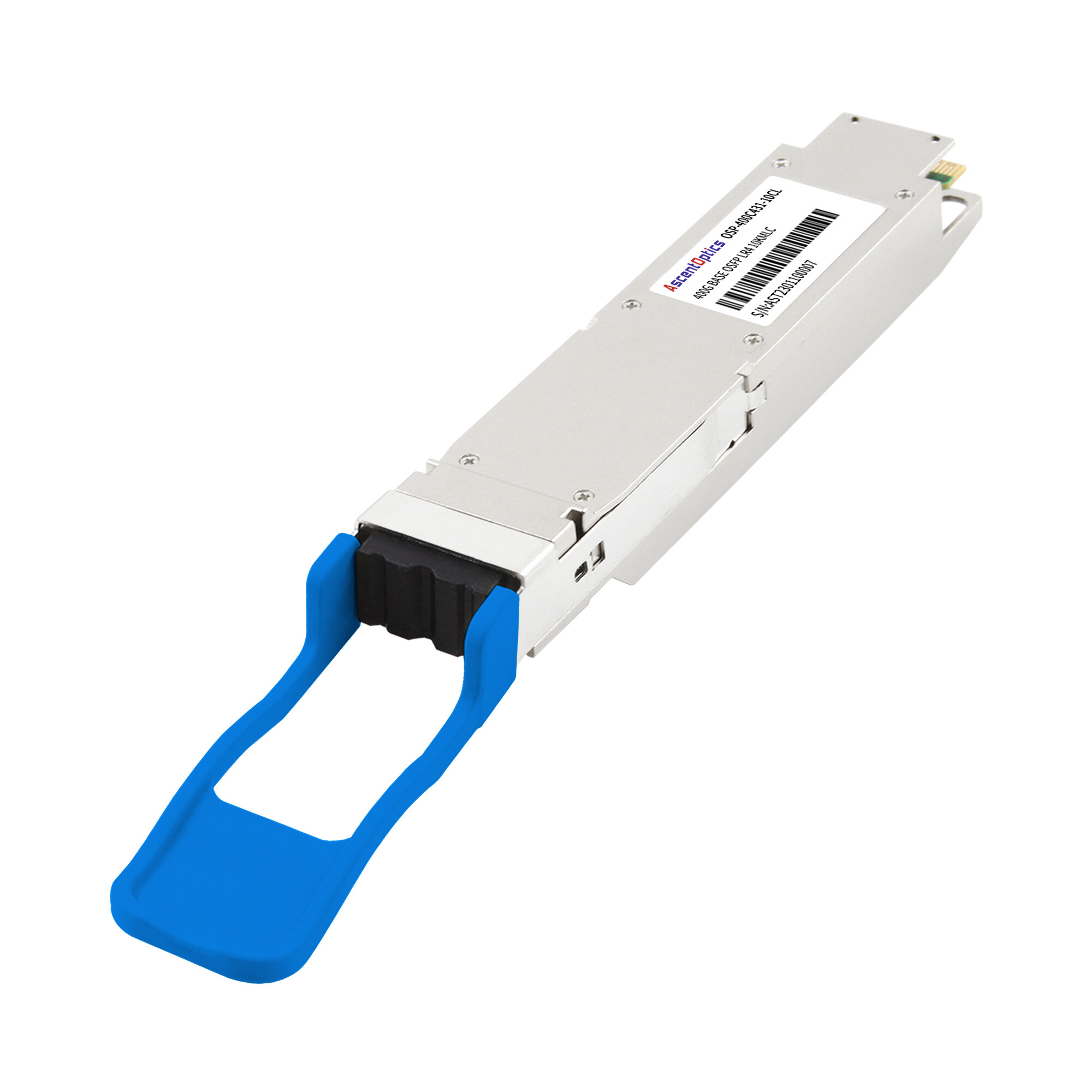
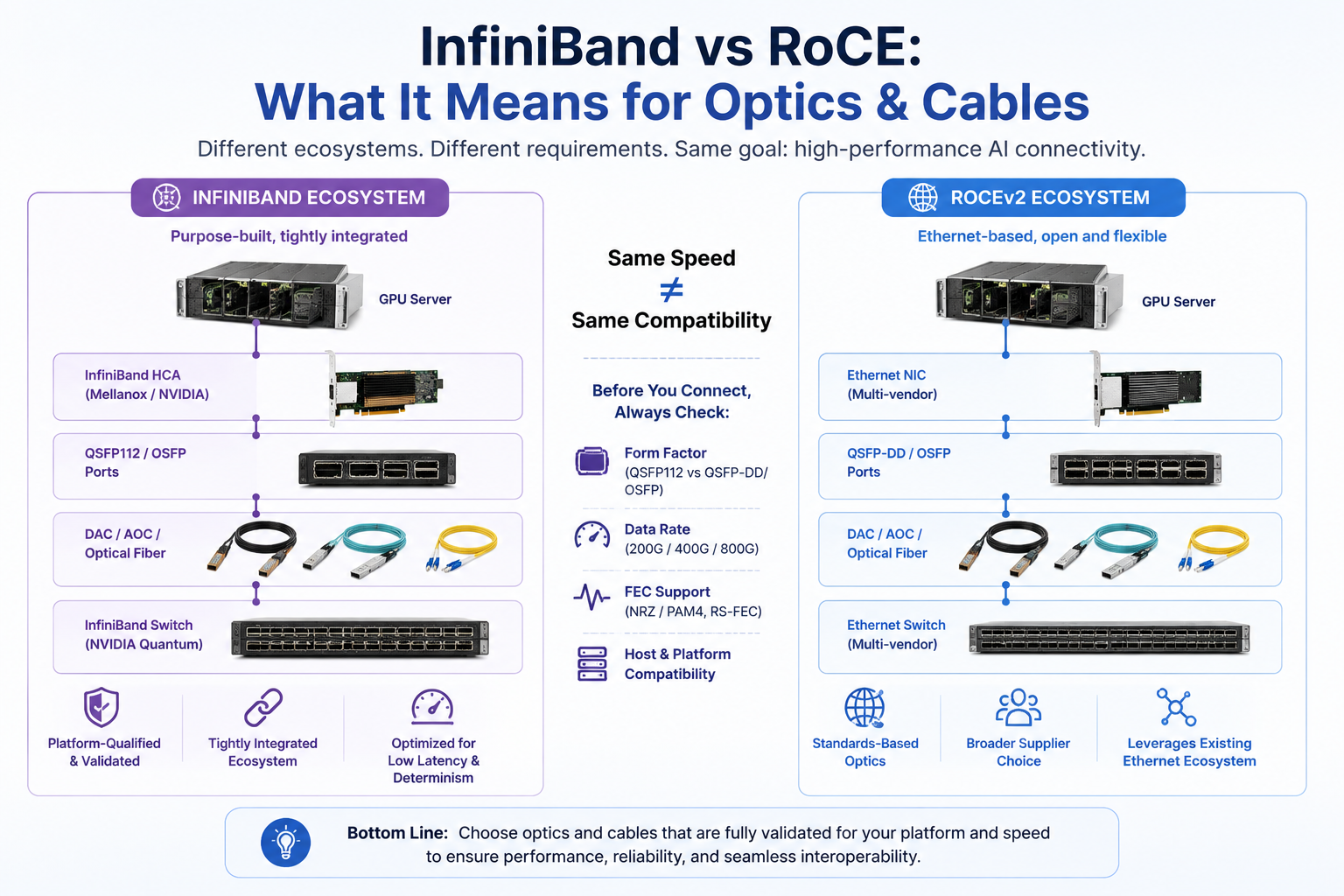
The choice of networking fabric also affects optical transceivers and cabling. InfiniBand platforms typically use vendor-qualified optical transceivers, DACs, and AOCs designed and validated for specific switch and HCA platforms. Ethernet-based RoCEv2 networks can leverage a broader ecosystem of standards-based and MSA-compliant optical solutions, including 400G and 800G modules in QSFP-DD and OSFP form factors.
However, physical form-factor compatibility does not always guarantee platform interoperability. Optical modules should be checked against the switch, NIC, link speed, FEC requirements, and vendor compatibility list before deployment.
QSFP-DD vs OSFP for AI Ethernet Networks
That difference has real consequences. When you scale an InfiniBand fabric, every transceiver and cable is a single-source purchase. When you scale an Ethernet fabric, you can mix vendors, negotiate on optics, and reuse spares across the data center.
Form factor also matters. 400G and 800G Ethernet optics come in QSFP-DD and OSFP packages, with the industry consolidating around OSFP for 800G. If you are planning an Ethernet-based AI fabric, you should be evaluating 400G OSFP and QSFP-DD modules now, plus the direct attach copper (DAC) and active optical cable (AOC) options for short intra-rack links.
For high-speed Ethernet AI fabrics, 400G and 800G optical connectivity is increasingly important. Depending on the network architecture and link distance, deployments may use multimode SR optics for short-reach connections, parallel single-mode DR/DR8 solutions for data-center links, or WDM-based FR/LR optics for longer reaches. DACs and AOCs remain useful for short intra-rack and adjacent-rack connections where power, cost, and distance requirements allow.
For AI clusters, optical selection should be considered together with port architecture, lane configuration, FEC, insertion-loss budget, power consumption, and switch/NIC compatibility.
InfiniBand vs RoCE: When to Choose Which
There is no universal winner. The right choice depends on your workload, scale, and existing infrastructure.
Choose InfiniBand when:
- You are training frontier models at 256 GPUs and up, where tail latency and determinism decide wall-clock time.
- You run tightly coupled HPC workloads where every collective counts.
- You want a single-vendor, centrally supported stack and can accept the premium.
- You need the lowest absolute NIC-to-NIC latency with no tuning effort.
Choose RoCE when:
- You are building small to mid-size clusters, or an inference-heavy fleet.
- Cost per GPU is a primary constraint.
- You already operate Ethernet and want one network model across the data center.
- You need multi-tenancy, hybrid cloud, or cross-region connectivity.
- You want to avoid vendor lock-in and keep a multi-vendor supply chain.
A useful rule of thumb from practitioners: if your NCCL communication-to-compute ratio exceeds 25 percent, consider InfiniBand. Below 10 percent, Ethernet is almost certainly fine.
There is also a middle path. NVIDIA Spectrum-X pairs Spectrum switches with BlueField SuperNICs to deliver InfiniBand-like behavior on Ethernet, and the Ultra Ethernet Consortium released its Specification 1.0 in June 2025 to make open Ethernet fully competitive for AI and HPC.
InfiniBand vs RoCE: Frequently Asked Questions
What is RDMA?
RDMA, or Remote Direct Memory Access, lets one computer read or write another computer’s memory directly, bypassing the remote CPU and operating system. It offloads transport to the network card, enables zero-copy transfers, and keeps CPU utilization near zero. Both InfiniBand and RoCEv2 are RDMA technologies.
Is RoCE as good as InfiniBand?
For most AI workloads, a properly tuned RoCEv2 fabric delivers 85 to 95 percent of InfiniBand’s throughput. InfiniBand retains an edge in absolute latency and determinism under heavy load. The gap narrows further at 400G and 800G, and continues to close.
What is the difference between InfiniBand and Ethernet?
InfiniBand is a dedicated, lossless fabric with its own protocol stack. Ethernet is the general-purpose standard that RoCEv2 extends with RDMA. InfiniBand is simpler to operate but proprietary and more expensive. Ethernet is open, multi-vendor, and cheaper, but needs careful tuning to match InfiniBand.
Conclusion
InfiniBand vs RoCE is no longer a simple answer. InfiniBand still owns the extreme low-latency, deterministic end of the market, the fabric of choice for the largest frontier-training clusters. RoCEv2 has become the default for cost-conscious, operationally integrated AI infrastructure, validated at 24,000-GPU hyperscale.
The decision comes down to three questions: How large is your cluster? How latency-sensitive is your workload? And how much do the optics and cabling cost in each direction?
Whichever fabric you choose, the physical layer is not an afterthought. The optical transceivers, DAC cables, and AOCs you select determine both your budget and your timeline. Planning them up front is the difference between a smooth bring-up and a two-month rework.
Post Views: 1,694