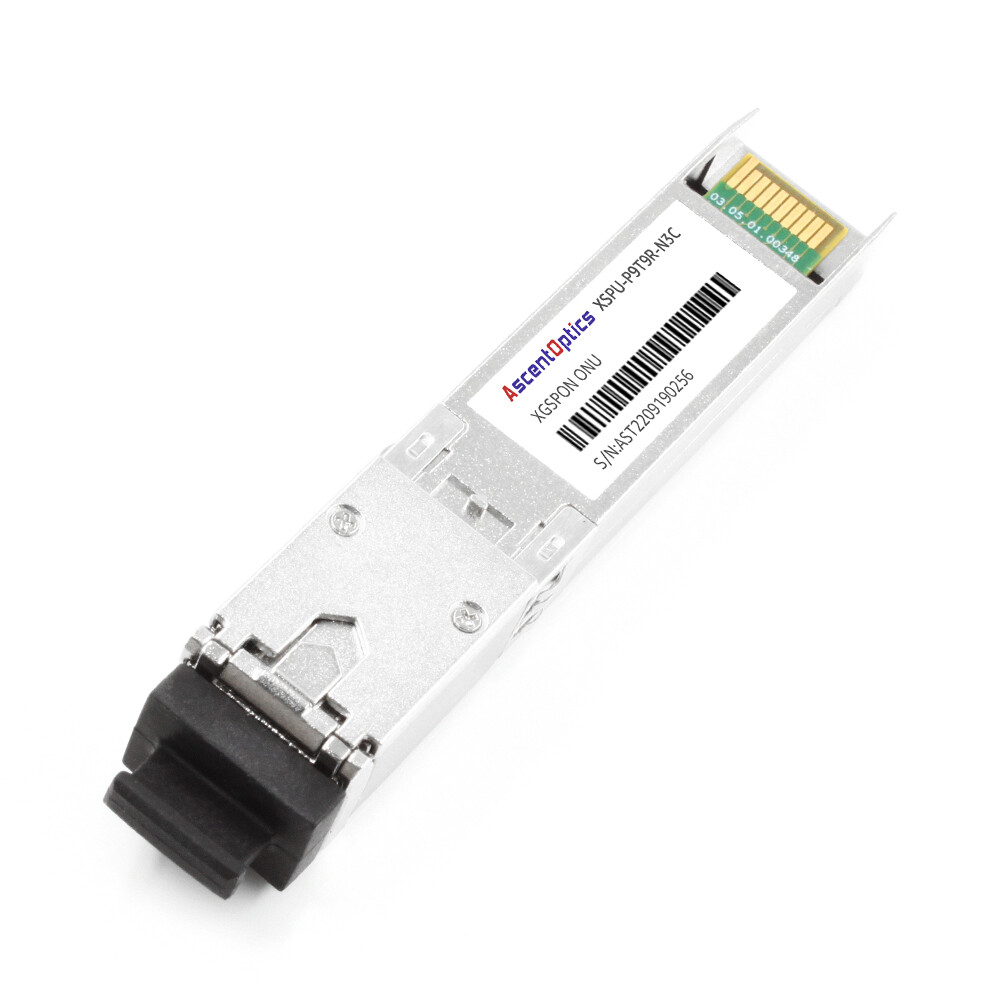
50G PON is a next-generation passive optical network technology standardized by the ITU-T G.9804 series. It provides a significant capacity upgrade over widely deployed GPON and XGS-PON networks. As a core enabling technology for 10G-capable optical networks, it can support emerging services such as 8K ultra-high-definition video, the Industrial Internet, and AI computing applications.
What Is 50G PON?
50G PON is the third-generation passive optical network standard for fiber access. It follows GPON (first generation, around 2007) and XGS-PON / 10G PON (second generation, around 2016). The ITU-T defines it in the G.9804 series, which the industry also calls G.HSP, or “Higher Speed PON.”
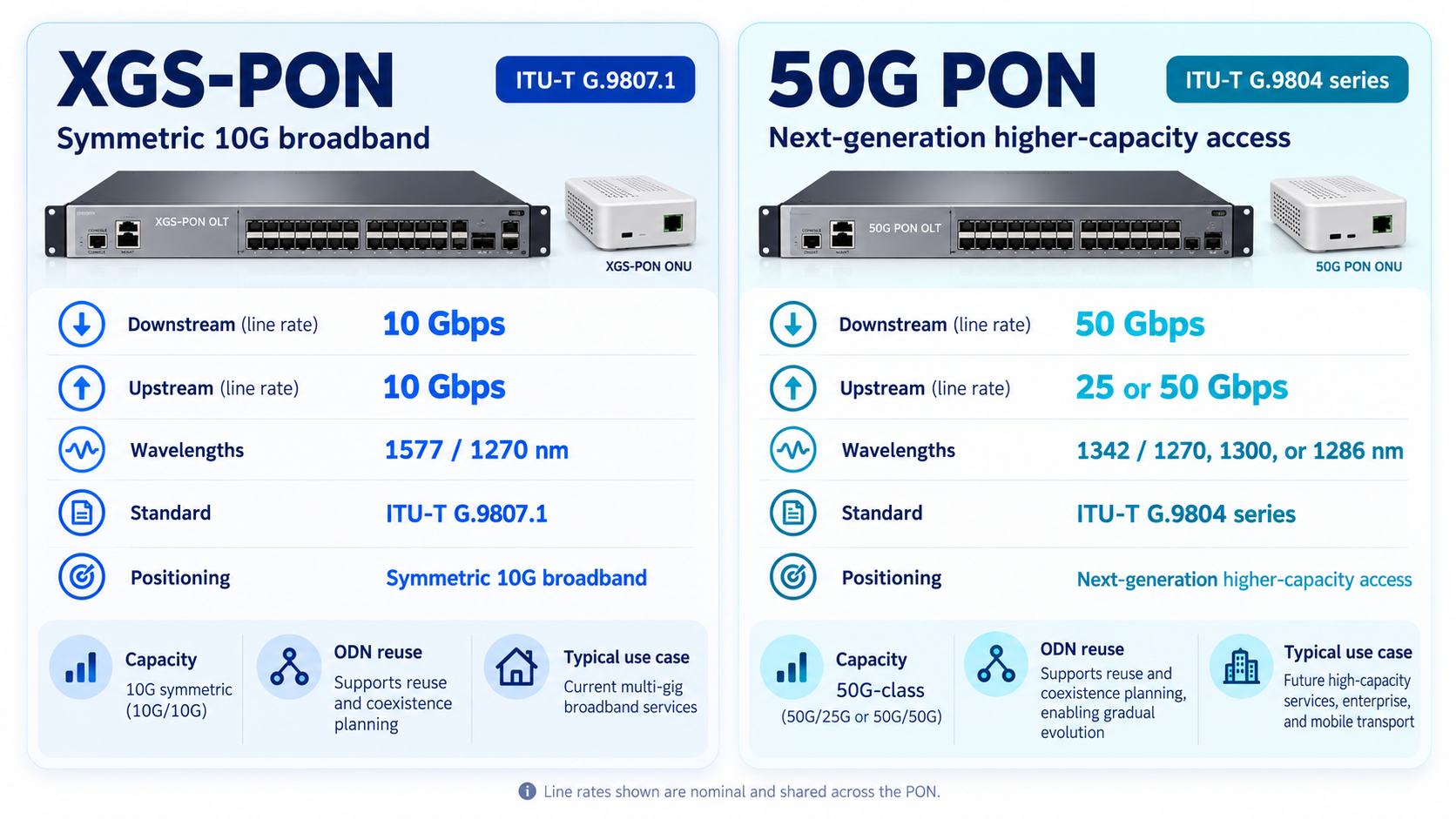
50G PON provides a nominal downstream line rate of 50 Gbps, with 25 Gbps and 50 Gbps upstream options in the current ITU-T specifications. Earlier revisions also defined a 12.5 Gbps upstream option, which was deprecated in 2026.
50G PON is designed to support coexistence with earlier PON generations through appropriate wavelength planning and coexistence components. This can allow operators to reuse existing optical distribution infrastructure while gradually introducing 50G PON OLTs and ONUs, provided the optical budget and interoperability requirements are met.
From GPON to XGS-PON to 50G PON: The Evolution of PON
Every PON generation has chased the same goal: more bandwidth per subscriber without more fiber.
GPON (ITU-T G.984) arrived in the late 2000s and gave operators 2.5 Gbps down and 1.25 Gbps up, shared across up to 64 or 128 subscribers. It powered the first mass FTTH wave.
XGS-PON (ITU-T G.9807) followed about a decade later with symmetric 10 Gbps down and up. It is the current workhorse. Analysts expect XGS-PON to stay dominant through 2026 and beyond, even as 50G PON ramps.
50G PON (ITU-T G.9804) is the next step. The standards work began in 2018, general requirements landed in G.9804.1 in 2019, and the physical layer specification G.9804.3 was approved in September 2021. The standard system was essentially complete by 2023.
The progression is not just faster rates. Each generation added features. 50G PON introduces digital signal processing (DSP) and stronger forward error correction to maintain signal quality at 50 Gbps over the same 20 km reaches and 1:64 split ratios as earlier generations.
50G PON vs XGS-PON: Key Differences
If you are planning an access upgrade, the comparison that matters is 50G PON against XGS-PON.
| Attribute |
XGS-PON |
50G PON |
| Standard |
ITU-T G.9807.1 |
ITU-T G.9804 series |
| Downstream Line Rate |
10 Gbps |
50 Gbps |
| Upstream Line Rate |
10 Gbps |
25 / 50 Gbps |
| Line Coding |
NRZ |
Scrambled NRZ |
| FEC |
RS FEC |
LDPC FEC |
| Downstream Wavelength |
1577 nm |
1342 nm |
| Upstream Wavelength |
1270 nm |
1270 / 1300 / 1286 nm options |
| ODN Reuse |
Supported |
Supported with coexistence planning |
| Typical Applications |
Residential and enterprise broadband |
Multi-gigabit access, enterprise connectivity, mobile transport |
The fivefold downstream gain is the headline, but the upstream options matter just as much. A symmetric 50/50 Gbps ONT supports business and backhaul services that asymmetric residential tiers cannot. Because the standard allows dual-rate coexistence, operators can deploy asymmetric ONTs for homes and symmetric ONTs for enterprises on the same ODN.
Latency is another differentiator. 50G PON supports latency-sensitive applications through improved bandwidth allocation and quality-of-service mechanisms. Actual latency and jitter depend on the OLT, ONU, DBA configuration, network load, and end-to-end service architecture. Cloud gaming and XR: microsecond-level latency for interactive streaming.
How 50G PON Works: Inside the ITU-T G.9804 Standard
Wavelengths and Line Rates
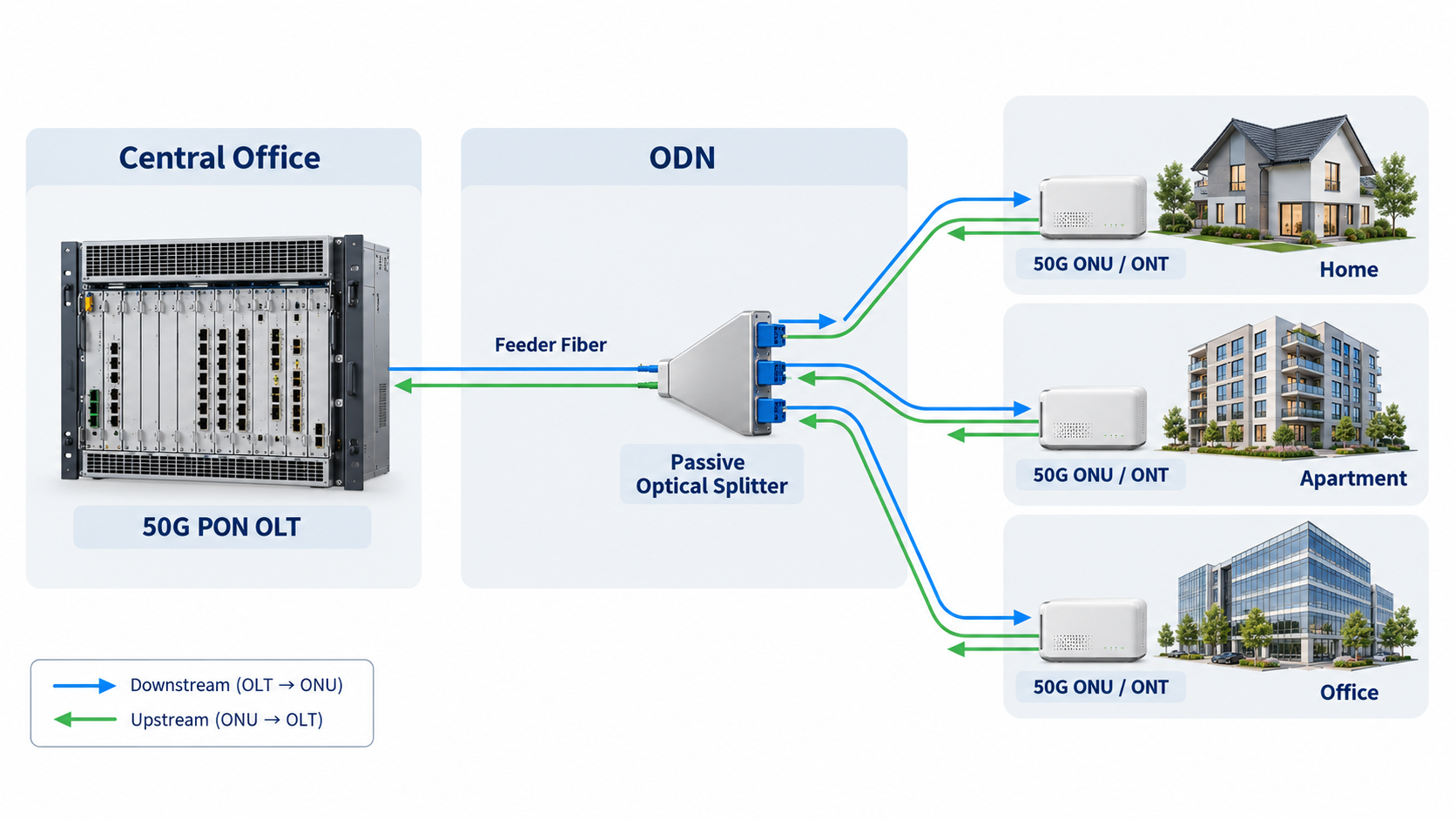
50G PON keeps the familiar point-to-multipoint (P2MP) TDM architecture. An optical line terminal (OLT) at the provider side serves many optical network units (ONUs) through a passive splitter.
Downstream uses 1342 nm (±2 nm). Upstream offers three wavelength options: 1270 nm, 1300 nm, or 1286 nm (±2 nm for the narrow option). The third upstream wavelength is a deliberate design choice. It lets GPON/EPON, XG(S)-PON/10G-EPON, and 50G PON coexist on one fiber using wavelength-division multiplexing.
50G PON uses a nominal downstream wavelength of 1342 nm and provides multiple upstream wavelength options. The 1286 nm upstream option is specifically designed to support triple-generation coexistence with GPON and XG(S)-PON on a shared optical distribution network.
DSP Equalization and LDPC Error Correction
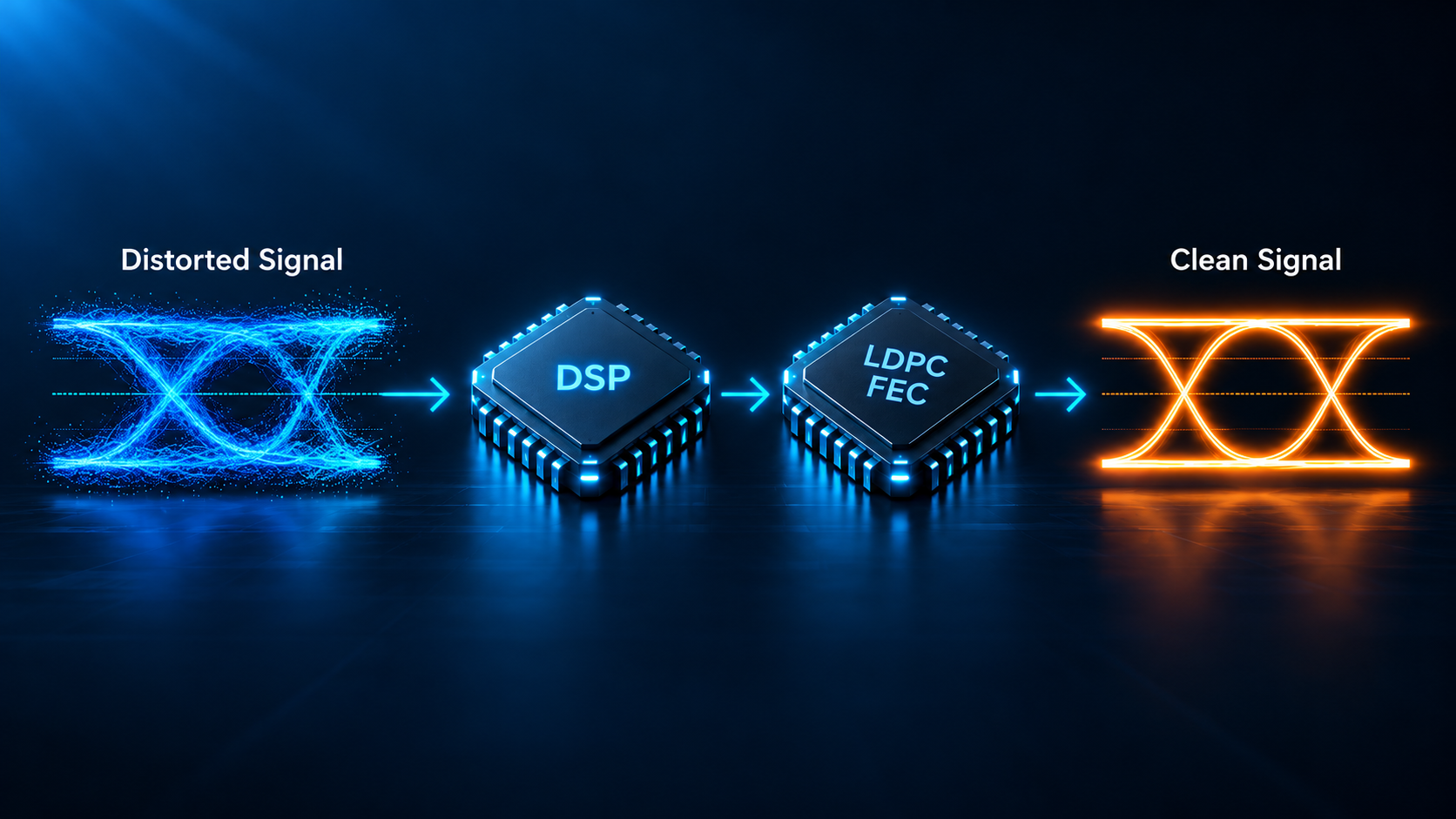
This is where 50G PON genuinely breaks from the past. 50G PON introduces receiver-side DSP equalization and advanced LDPC forward error correction to address signal impairments at higher transmission rates.
At 50 Gbps, signal distortion from chromatic dispersion and limited component bandwidth becomes a real problem. DSP equalization compensates for that distortion and improves the receiver sensitivity. Stronger low-density parity-check (LDPC) forward error correction works alongside the DSP, using soft-decision decoding to recover more signal from a noisy link.
The standard chose NRZ line coding over alternatives like PAM4. NRZ offered the best receiver performance at the high power budget PON systems require, even though PAM4 is more spectrally efficient.
Optical Power Budget and ODN Loss Classes
50G PON supports multiple optical path loss classes, with maximum ODN losses ranging from 29 dB to 35 dB depending on the optical interface class and coexistence architecture. The achievable transmission distance and split ratio depend on the selected optical class, fiber attenuation, splitter loss, connector loss, and engineering margin.
The Optical Layer Behind 50G PON
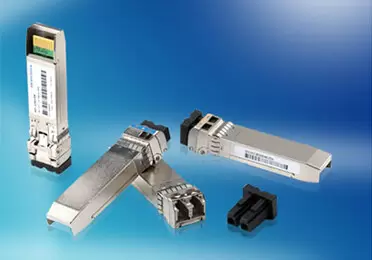
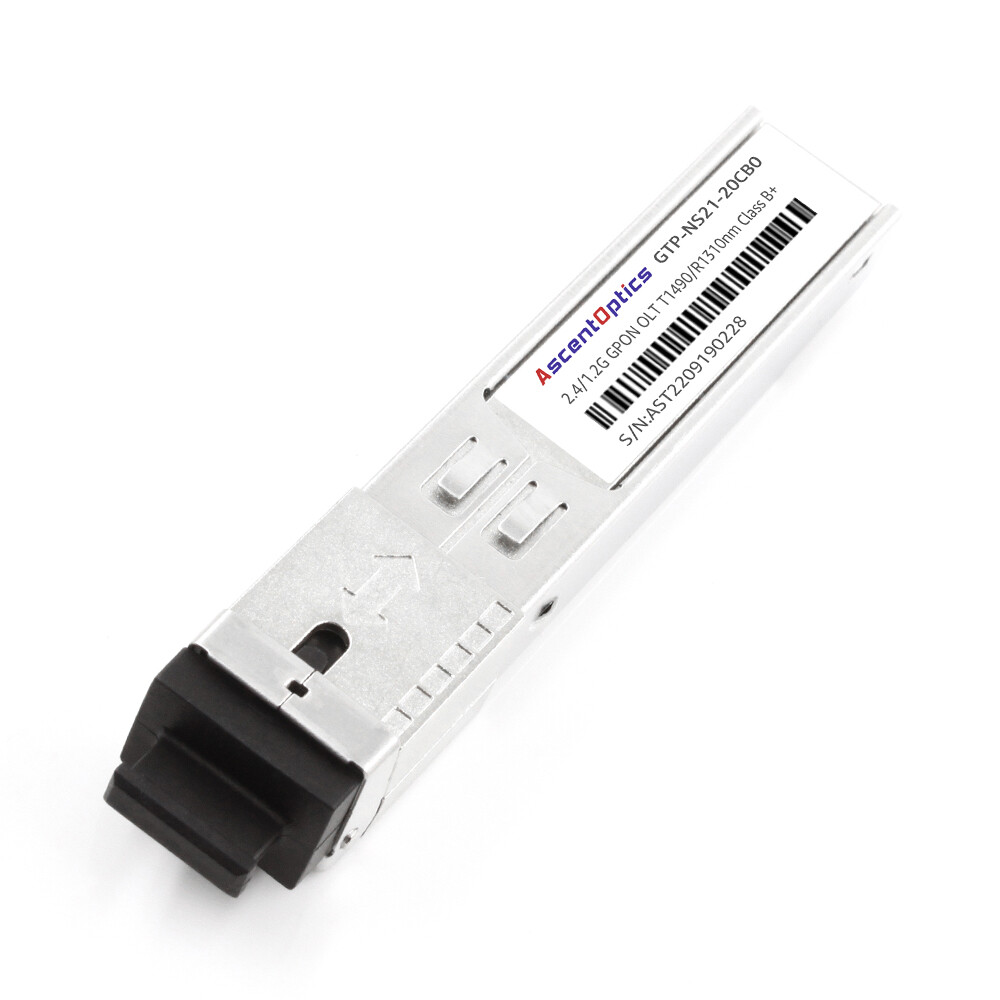
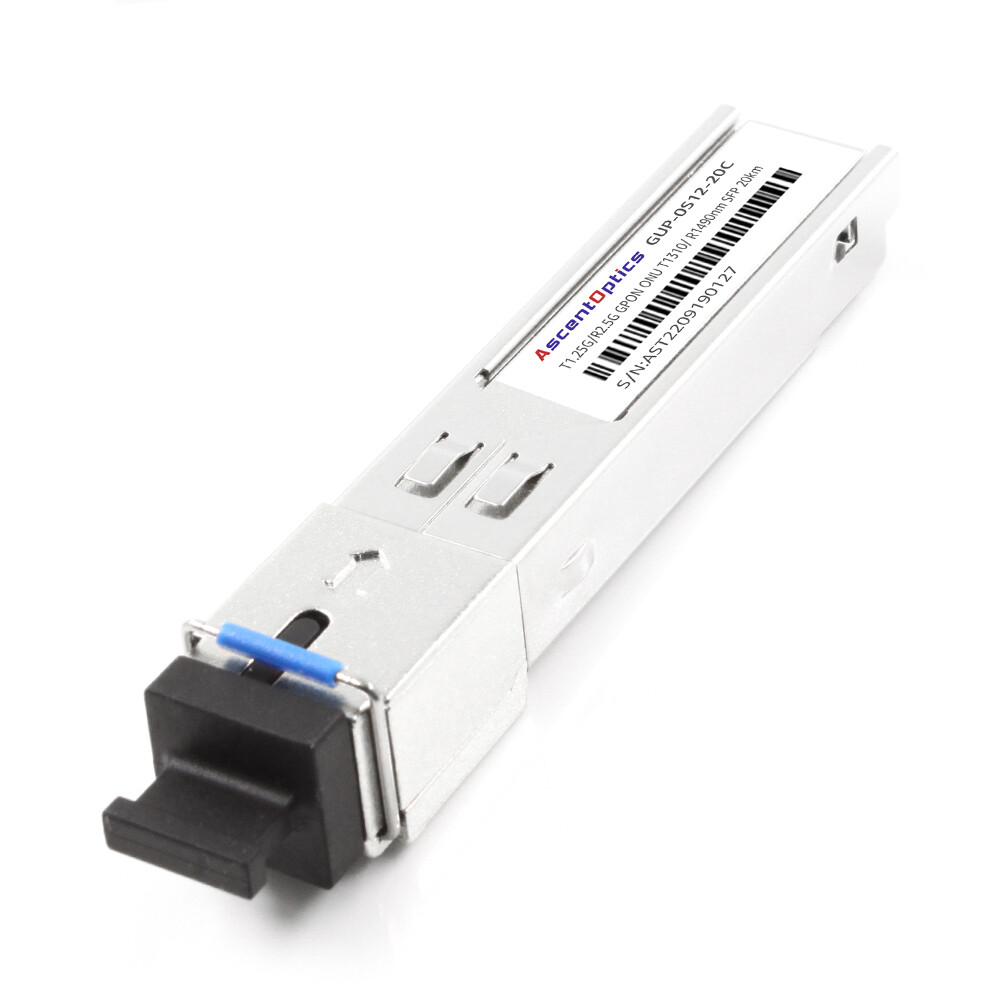
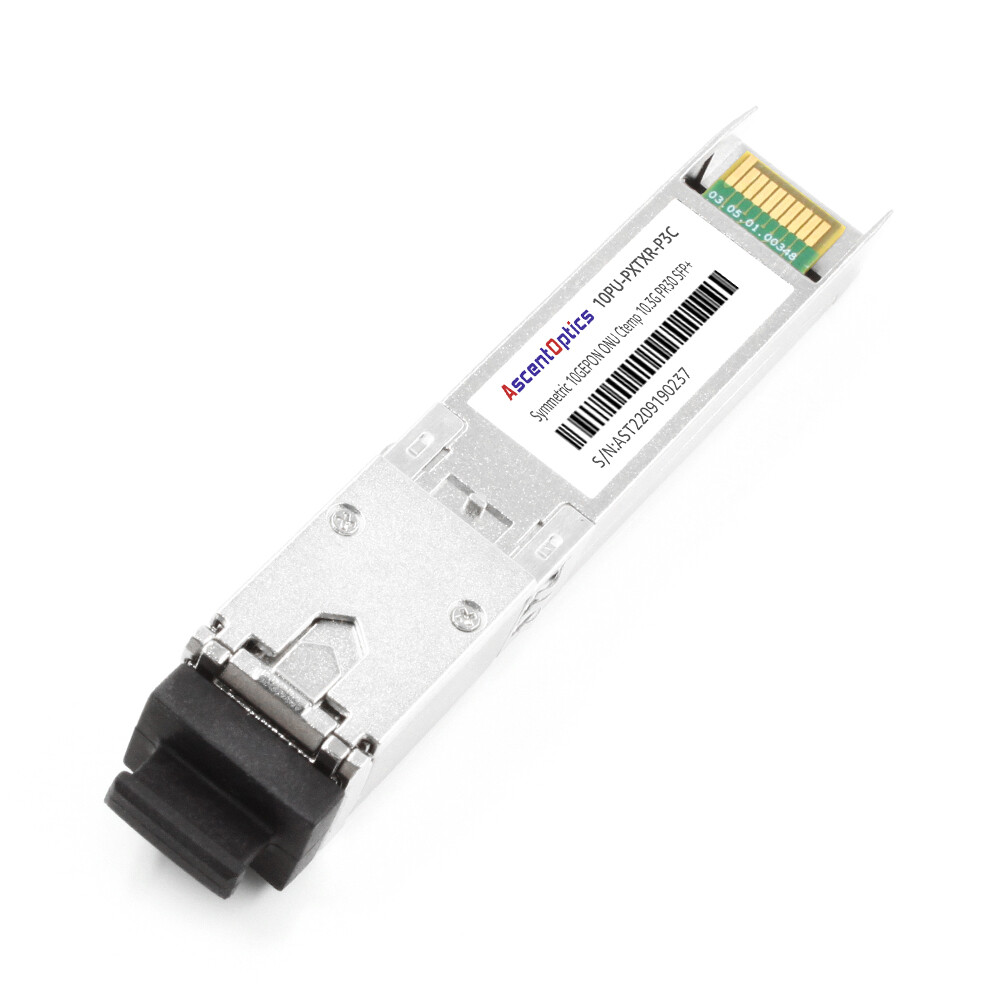
This is where the technology lives or dies, and where component suppliers like Ascent Optics focus.
OLT Transmit Side: EML-SOA Lasers
The OLT transmitter must launch enough power to survive the splitter loss. Early 50G PON prototypes using a bare electro-absorption modulated laser (EML) ran short on link budget. The solution is an EML paired with a semiconductor optical amplifier (SOA) to boost launch power.
EML-based transmitters combined with semiconductor optical amplifiers (SOAs) are one approach to achieving the high launch power required for demanding 50G PON optical budgets. Actual transmitter architectures depend on the optical class, system design, and manufacturer implementation.
ONU Receive Side: APD and 25G-Class Receivers
On the subscriber side, the ONU receiver relies on an avalanche photodiode (APD) with a transimpedance amplifier (TIA) to pull weak signals out of the noise. Vendors have used 25G-class APDs with receive-side DSP to handle the 50 Gbps downstream link.
Linear Burst-Mode Components
PON upstream is bursty. ONUs transmit in assigned time slots, so the OLT receiver must recover each burst rapidly. That requires a set of specialized components: linear burst-mode laser drivers (LDD), transimpedance amplifiers (TIA), limiting amplifiers (LA), and burst-mode clock/data recovery (BCDR) circuits. These chips are the quiet workhorses that make 50G PON’s upstream channel reliable.
Coexistence, ODN Reuse, and Applications
Coexistence and ODN Reuse
The 50G PON standard was designed so operators never rip out their existing fiber. Different PON generations use different wavelengths, so they can share one ODN. Combo-PON modules and external coexistence elements (WDM filters) let an operator add 50G PON capacity while GPON and XGS-PON continue serving existing subscribers.
This “pay-as-you-grow” path is the strongest argument for 50G PON. The alternative, a clean-slate ODN rebuild, is rarely worth the cost.
Key Applications
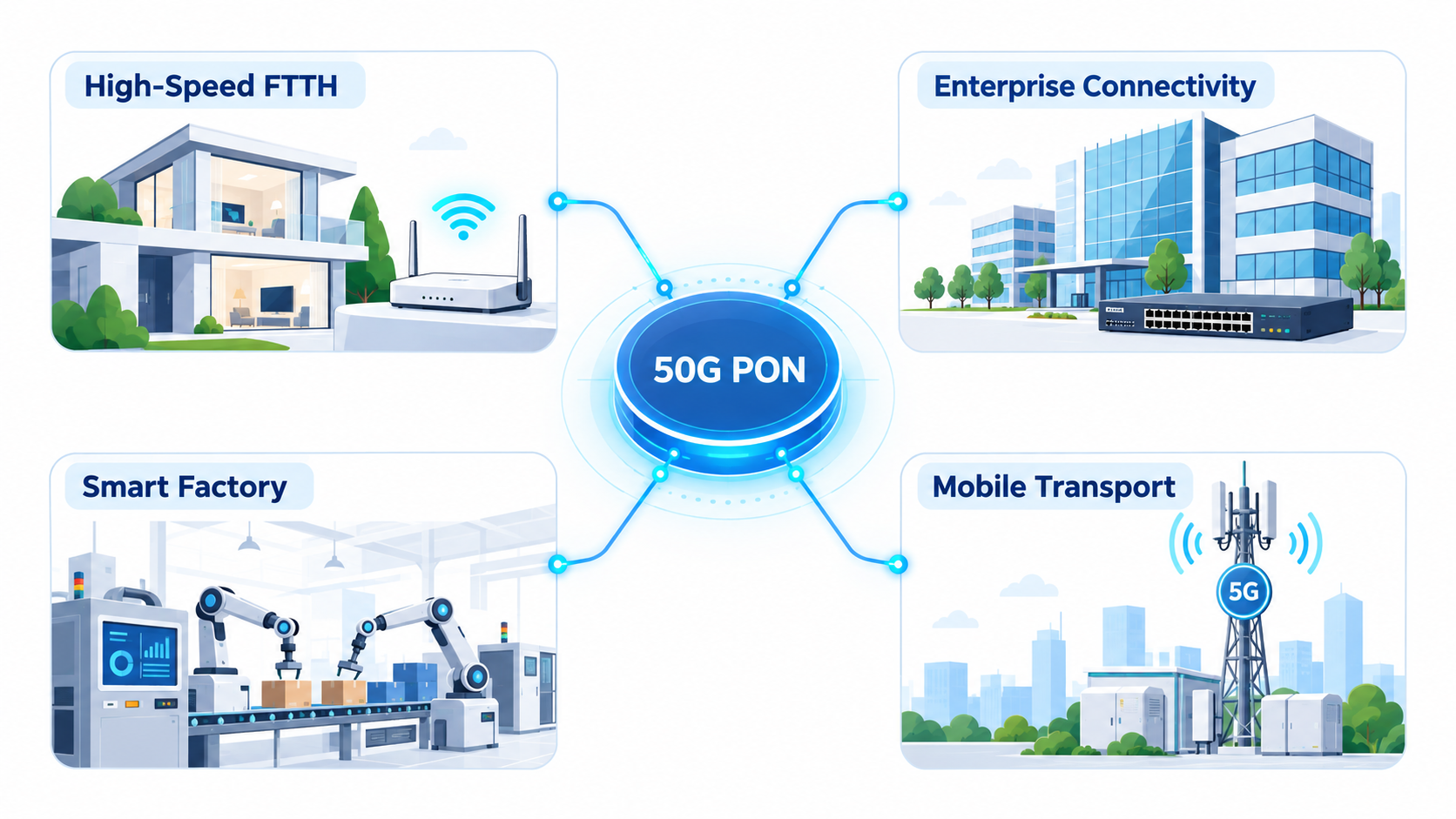
50G PON is not just faster home broadband. Its target use cases span:
- FTTR plus Wi-Fi 7: whole-home 10-gigabit coverage for 8K video, cloud PCs, and multi-device homes.
- Enterprise and smart factories: machine-vision inspection, automated guided vehicle control, and real-time sensor backhaul.
- 5G backhaul and fixed-mobile convergence: high-density backhaul for indoor small cells.
- Telemedicine and remote education: high-speed CT/MR image transfer and XR immersive teaching.
- Cloud gaming and XR: microsecond-level latency for interactive streaming.
When Should You Adopt 50G PON?
The answer depends on your market and your upgrade cycle.
Adopt early if you operate in a dense urban market, serve bandwidth-heavy enterprise or backhaul customers, or compete on multi-gigabit service tiers. The 50G PON coexistence story means you can add capacity incrementally without abandoning your XGS-PON base.
Wait if you are a residential-first operator with healthy XGS-PON capacity. XGS-PON will remain the cost-efficient workhorse for several more years. There is no urgent need to move before the component supply chain fully matures and prices fall.
Either way, the optical layer deserves early attention. The transceivers and optical modules that connect OLTs and ONUs are the parts most sensitive to the new wavelength plan and power budget.
Conclusion
50G PON is the next chapter in fiber access, but it is a careful evolution, not a rupture. The key takeaways:
- 50G PON delivers 50 Gbps downstream and up to 50 Gbps upstream, roughly five times XGS-PON.
- It is defined by the ITU-T G.9804 standard, with a 1342 nm downstream wavelength and a 32 dB optical power budget.
- DSP equalization and LDPC error correction are the technical advances that make 50 Gbps work over existing fiber.
- Coexistence is the killer feature. GPON, XGS-PON, and 50G PON can share one ODN, enabling pay-as-you-grow upgrades.
- Adoption is ramping slowly but steadily, led by China, with the wider market two to three years behind.
For engineers and operators, the practical next step is to evaluate the optical layer early, since the transceivers and modules are where compatibility and power budget get decided.
Frequently Asked Questions About 50G PON
1. What is 50G PON?
50G PON is a next-generation passive optical network technology standardized by ITU-T G.9804, providing 50 Gbps downstream capacity over a shared fiber access network.
2. What is the difference between 50G PON and XGS-PON?
XGS-PON supports symmetric 10 Gbps transmission, while 50G PON delivers 50 Gbps downstream with 25 Gbps or 50 Gbps upstream options.
3. What wavelengths does 50G PON use?
50G PON uses 1342 nm downstream, with upstream wavelength options centered at 1270 nm, 1300 nm, or 1286 nm.
4. Can 50G PON coexist with GPON and XGS-PON?
Yes. They can share the same optical distribution network (ODN) using compatible equipment and appropriate wavelength coexistence components.
5. What is the maximum transmission distance of 50G PON?
50G PON commonly targets a 20 km reach, depending on the optical power budget, split ratio, and network design.
6. Does 50G PON require new fiber infrastructure?
Not necessarily. Operators can often reuse existing ODN infrastructure if optical loss and coexistence requirements are met.
7. What are the main applications of 50G PON?
Typical applications include multi-gigabit FTTH, enterprise connectivity, industrial networks, and mobile transport.
8. Is 50G PON backward compatible with XGS-PON ONUs?
No. XGS-PON ONUs cannot directly operate in 50G PON mode. Both technologies can coexist on a shared ODN with suitable equipment.
Post Views: 93