As AI and high-performance computing continue to scale, the network connecting GPUs, CPUs, and storage systems has become a critical part of overall infrastructure performance. Two technologies dominate discussions around high-performance AI networking: InfiniBand and Ethernet.
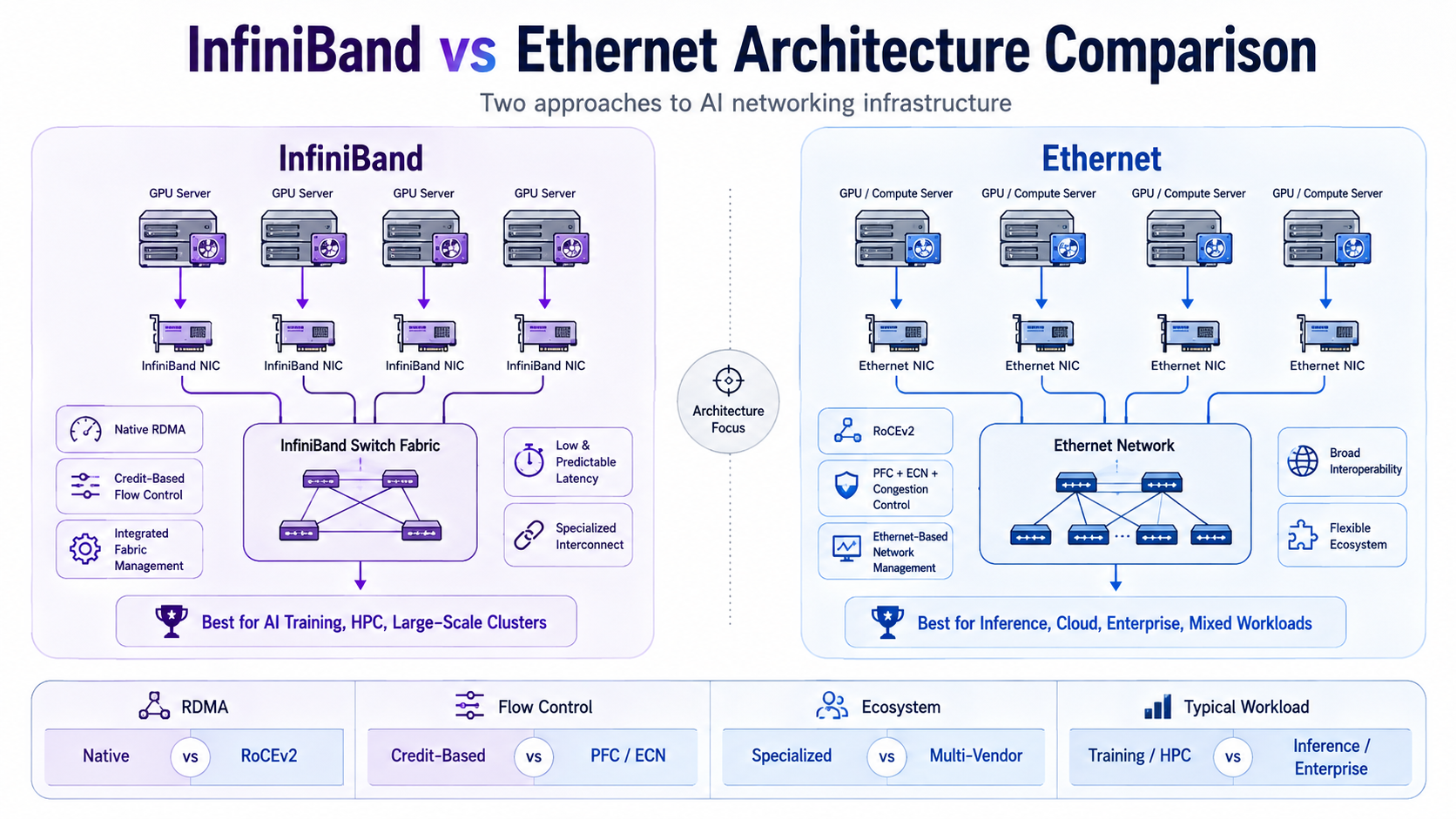
InfiniBand is a purpose-built high-performance interconnect widely used in HPC and large-scale AI clusters. It provides native RDMA, credit-based flow control, low latency, and a tightly integrated fabric architecture. Ethernet, on the other hand, is a broadly adopted networking standard with a large multi-vendor ecosystem. With technologies such as RoCEv2, ECN, PFC, and advanced congestion-control mechanisms, Ethernet has become an increasingly capable platform for AI and distributed computing.
Rather than having a single winner, the choice between InfiniBand and Ethernet depends on workload requirements, cluster scale, network architecture, interoperability, operational expertise, and cost considerations.
InfiniBand vs Ethernet: What Is the Difference?
The fundamental difference is their original design intent.
InfiniBand was developed specifically for high-performance computing and low-latency interconnects. It provides native RDMA capabilities, credit-based flow control, and a fabric architecture designed for efficient communication between compute nodes.
Ethernet was designed as a general-purpose networking technology and has evolved from enterprise and data center connectivity into a platform capable of supporting demanding AI workloads. With RoCEv2, Ethernet can provide RDMA-based communication while retaining the flexibility and interoperability of the Ethernet ecosystem.
| Factor |
InfiniBand |
Ethernet with RoCEv2 |
| Primary design |
HPC and high-performance interconnect |
General-purpose and data center networking |
| RDMA |
Native RDMA |
RoCEv2 |
| Flow control |
Credit-based flow control |
PFC, ECN, and congestion control |
| Latency |
Very low and predictable |
Low when properly engineered |
| Ecosystem |
Strong NVIDIA ecosystem |
Broad multi-vendor ecosystem |
| Interoperability |
More specialized |
Broad Ethernet interoperability |
| Network management |
Integrated fabric management |
Ethernet-based network management |
| Typical applications |
AI training, HPC, large-scale distributed computing |
AI, cloud, enterprise, inference, and mixed workloads |
There is considerable overlap between the two technologies. Modern Ethernet fabrics can deliver highly efficient AI networking when the topology, NICs, switches, congestion control, and software stack are properly designed.
How InfiniBand and Ethernet Differ Under the Hood
Latency and Congestion Control
Latency and congestion management are especially important in distributed AI training because GPUs frequently exchange data with other GPUs across the network.
InfiniBand uses credit-based flow control, in which a sender transmits data according to the receiving side’s available buffer credits. This helps prevent buffer overflow and provides predictable traffic behavior within the fabric.
Ethernet does not inherently use the same credit-based mechanism. In RoCEv2 networks, technologies such as Priority Flow Control (PFC) and Explicit Congestion Notification (ECN) are commonly used to manage congestion and reduce packet loss. Congestion-control algorithms such as DCQCN can further regulate traffic rates based on congestion feedback.
A properly engineered RoCEv2 network can therefore support high-performance, low-latency RDMA traffic. However, its performance depends strongly on network configuration, topology, switch behavior, NIC capabilities, and workload characteristics.
For this reason, comparing the two technologies solely by a fixed latency number is misleading. Actual end-to-end latency can vary considerably depending on hop count, packet size, network load, and hardware implementation.
RDMA and RoCEv2
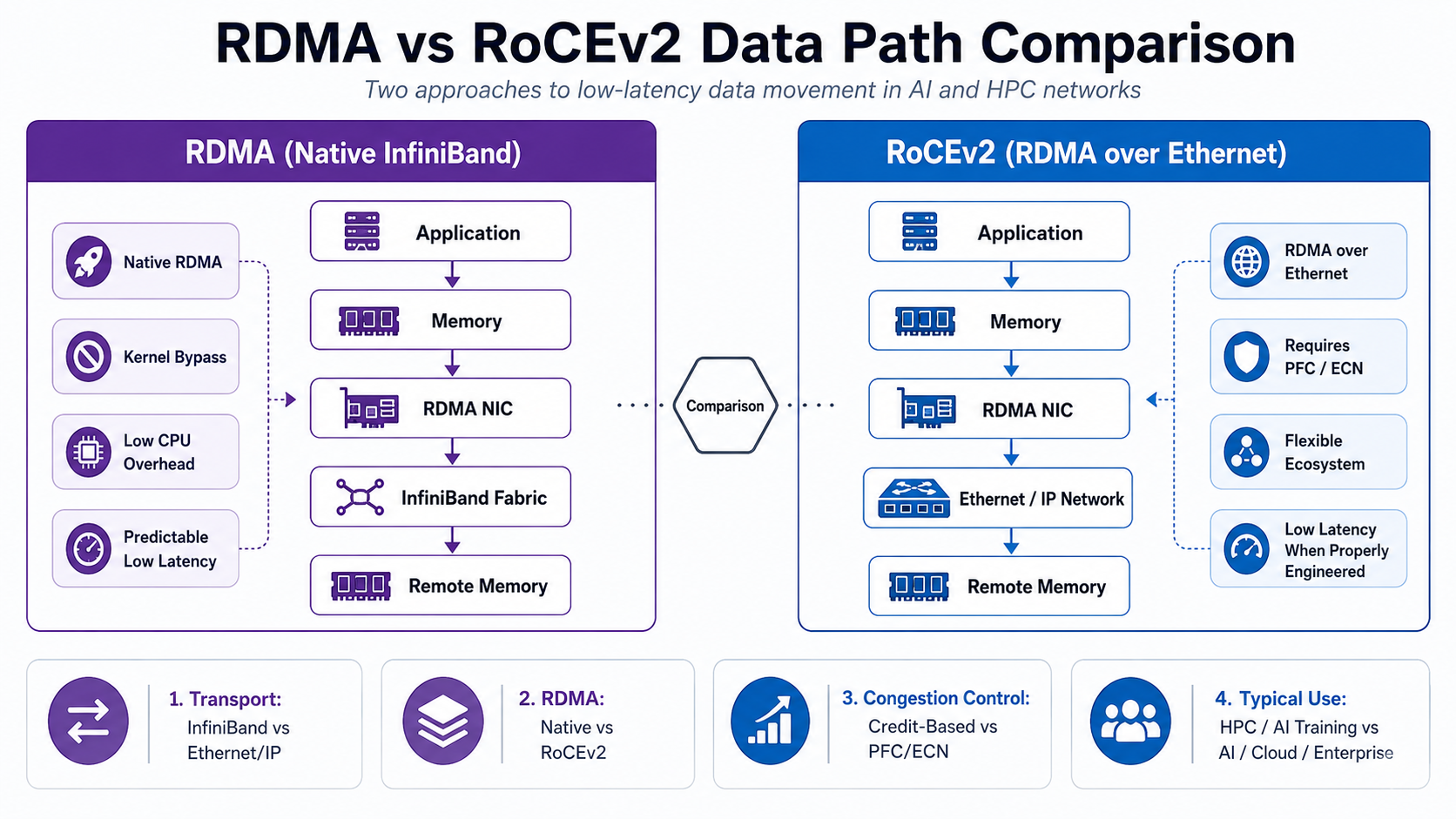
Remote Direct Memory Access (RDMA) allows a network adapter to transfer data directly between the memory spaces of different servers with minimal CPU and operating-system involvement.
InfiniBand provides native RDMA support as part of its architecture.
Ethernet can provide RDMA through RDMA over Converged Ethernet version 2 (RoCEv2). RoCEv2 transports RDMA traffic over an IP-based Ethernet network, allowing organizations to combine RDMA capabilities with the broader Ethernet networking ecosystem.
This has made RoCEv2 increasingly important for AI data centers, particularly where organizations want to combine high-performance GPU communication with existing Ethernet infrastructure and multi-vendor networking technologies.
InfiniBand vs Ethernet: Speed Evolution
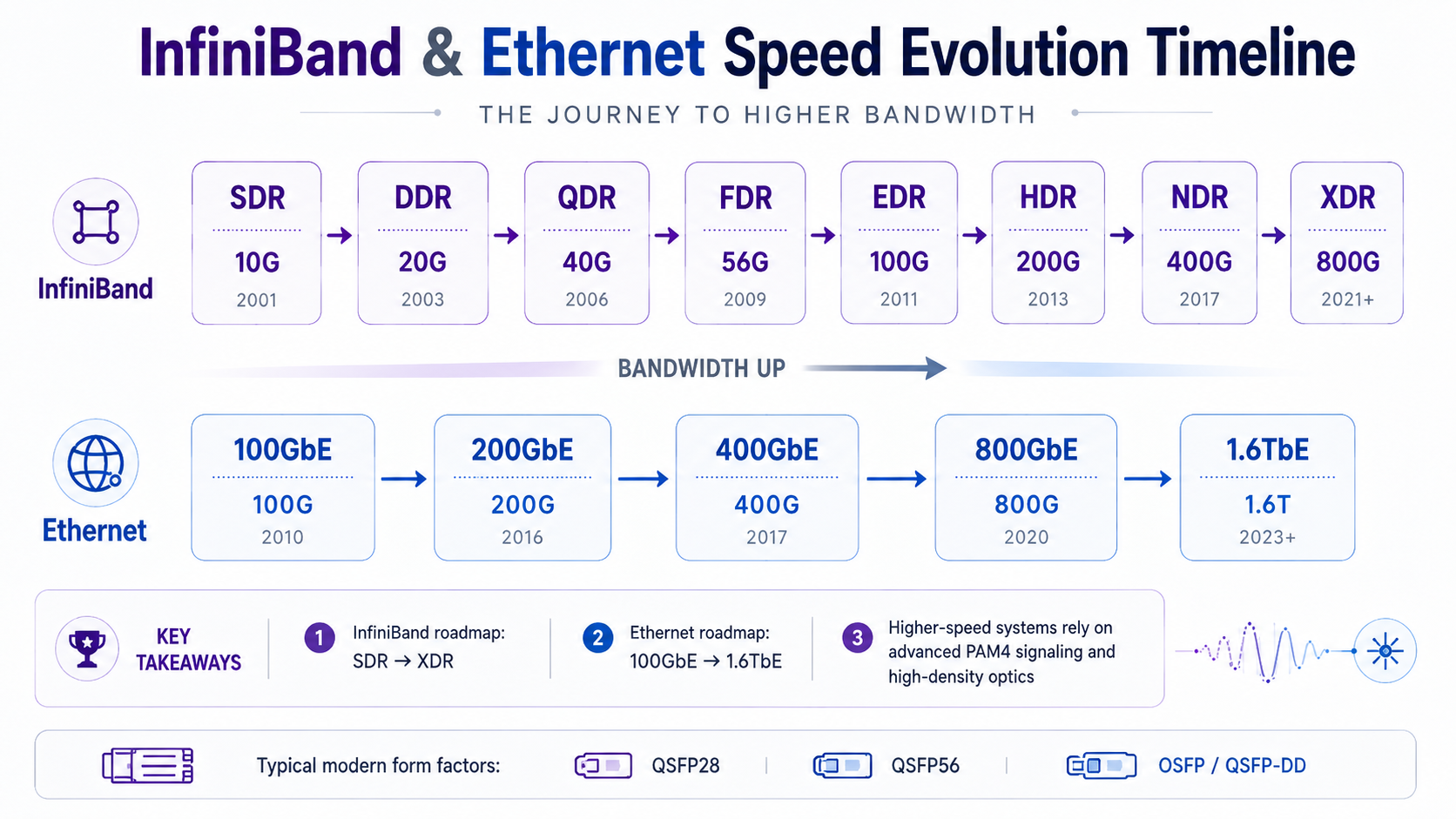
Both technologies continue to evolve toward higher bandwidth as AI clusters become larger and GPU communication requirements increase.
InfiniBand
The major generations include:
SDR → DDR → QDR → FDR → EDR → HDR → NDR → XDR
Modern generations include:
- HDR: 200 Gb/s class
- NDR: 400 Gb/s class
- XDR: 800 Gb/s class
Ethernet
Ethernet has similarly progressed through increasingly higher link speeds:
100GbE → 200GbE → 400GbE → 800GbE → 1.6TbE
At the physical layer, high-speed InfiniBand and Ethernet systems can use similar high-speed electrical signaling technologies, including PAM4-based SerDes. For example, 800G-class systems may use multiple high-speed PAM4 lanes.
However, similar electrical signaling does not mean that the two technologies are protocol-compatible. InfiniBand and Ethernet use different protocol stacks, specifications, PCS/FEC implementations, and system architectures.
The optical module must therefore be selected according to the specific switch, NIC, and networking standard rather than based solely on the nominal data rate.
InfiniBand vs Ethernet for AI Networking
The suitability of InfiniBand or Ethernet depends heavily on the workload.
AI Training
Large-scale distributed AI training generates substantial east-west traffic between GPUs. Collective communication operations such as AllReduce can make network bandwidth, latency, congestion control, and communication efficiency critical to overall training performance.
InfiniBand has a strong position in this area because of its native RDMA architecture, low latency, mature fabric management, and close integration with high-performance computing and AI platforms.
RoCEv2 Ethernet can also support large-scale distributed training when the network is carefully designed and tuned.
AI Inference
Inference workloads can have different traffic characteristics from large-scale model training. Depending on the deployment, inference may involve a combination of GPU communication, storage access, service-to-service traffic, and conventional data center networking.
Ethernet can be attractive in these environments because the same network infrastructure can support AI workloads together with storage, management, enterprise applications, and other data center services.
HPC
InfiniBand remains widely used in high-performance computing environments where predictable low latency, high bandwidth, and tightly controlled communication are important.
Ethernet is also increasingly capable of supporting HPC and technical computing workloads, particularly when organizations prioritize interoperability and integration with broader data center infrastructure.
Ethernet’s Role in the AI Networking Ecosystem
Ethernet has gained significant momentum in AI networking because of several advantages.
Open and Multi-Vendor Ecosystem
Ethernet is supported by a broad range of switch, NIC, transceiver, cable, and network software vendors. This gives data center operators greater flexibility when selecting infrastructure components.
Infrastructure Reuse
Many organizations already operate large Ethernet networks and have established operational expertise, monitoring systems, and management processes. Extending Ethernet into AI networking can simplify integration between AI clusters and existing data center environments.
RoCEv2
RoCEv2 provides a mechanism for running RDMA over Ethernet and IP networks. When combined with appropriate congestion-control and traffic-management techniques, it can support demanding AI communication workloads.
Higher Network Speeds
The Ethernet ecosystem continues to move toward 400GbE, 800GbE, and eventually 1.6TbE-class connectivity, providing a clear bandwidth roadmap for next-generation AI infrastructure.
InfiniBand and Ethernet: The Role of UEC
The Ultra Ethernet Consortium (UEC) represents an industry effort to advance Ethernet for high-performance AI and HPC workloads.
The initiative focuses on improving Ethernet transport, congestion management, scalability, reliability, and multipath capabilities for large distributed computing environments.
The development of these technologies reflects an important trend: Ethernet is no longer being considered only as a general-purpose network for AI infrastructure. It is increasingly being engineered specifically for large-scale GPU and accelerated computing workloads.
At the same time, InfiniBand continues to evolve toward higher bandwidth and remains an important technology for AI and HPC deployments.
Therefore, the competition between the two technologies is better understood as an evolution of high-performance networking rather than a simple replacement of one technology by another.
Optical Connectivity for InfiniBand and Ethernet
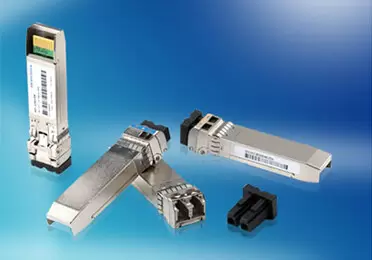
The networking protocol is only one part of an AI cluster. The physical layer—including optical transceivers, DACs, AOCs, fiber, and connectors—also has a significant impact on deployment density, reach, power consumption, and link reliability.
As link speeds increase from 200G to 400G and 800G, selecting the correct module and cabling architecture becomes increasingly important.
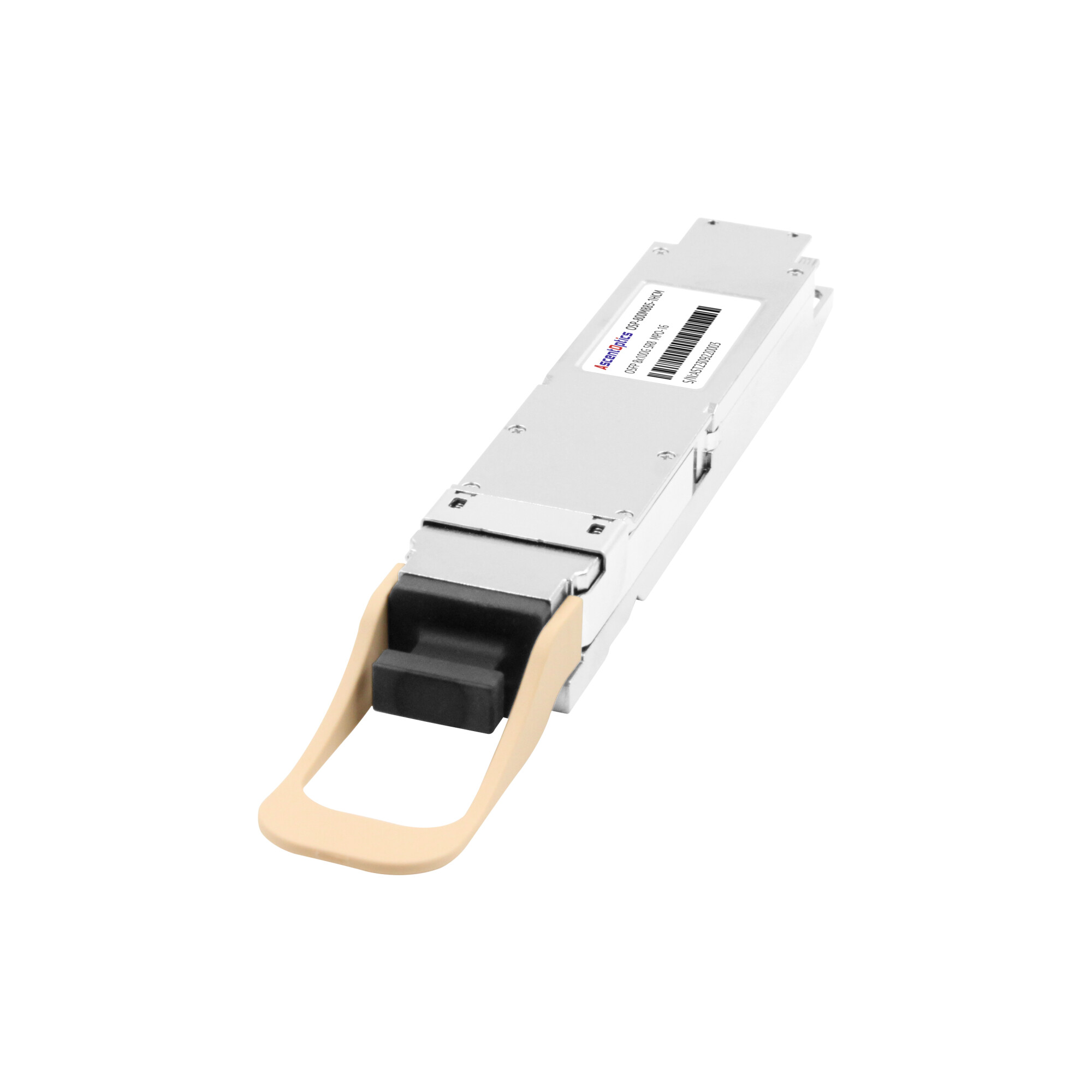
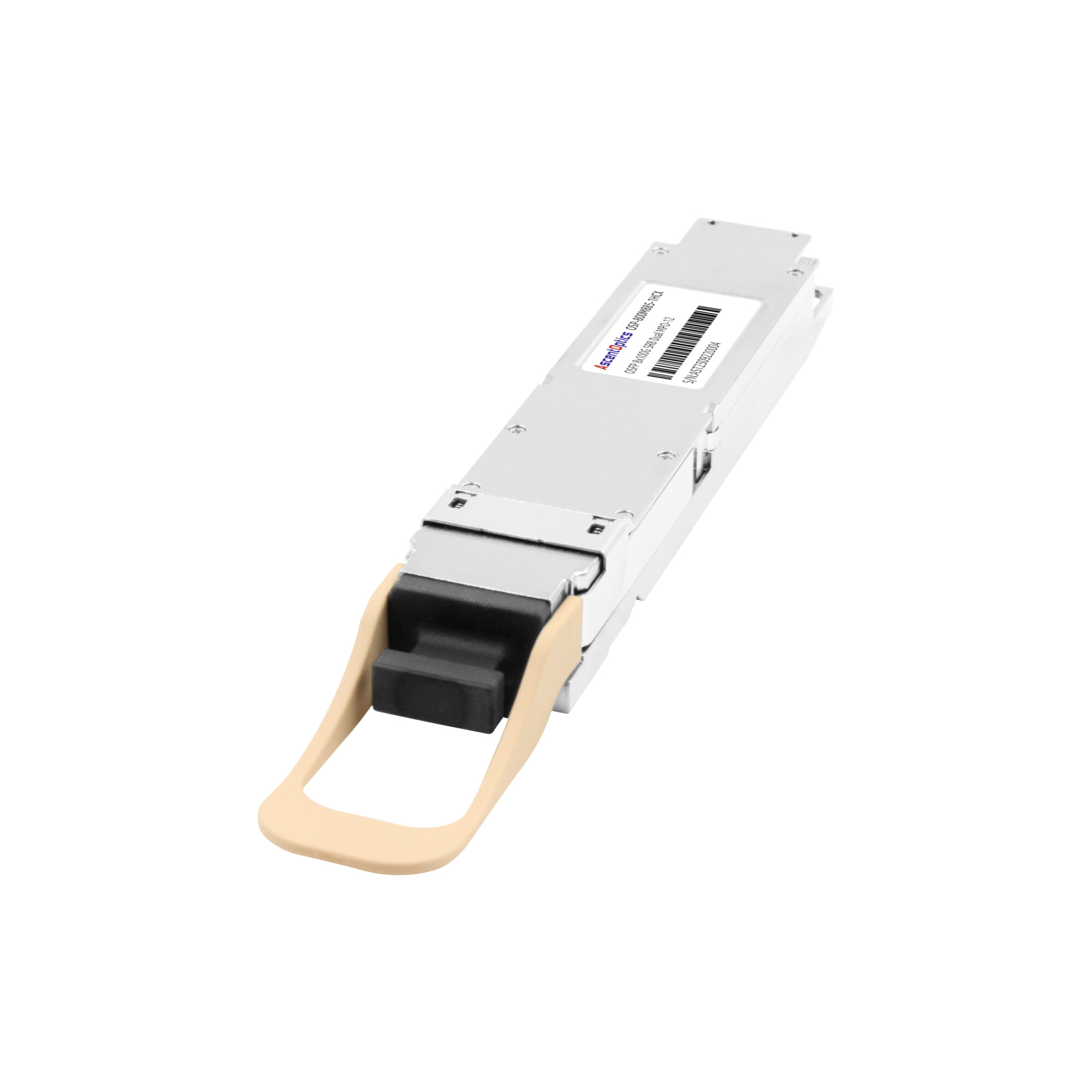
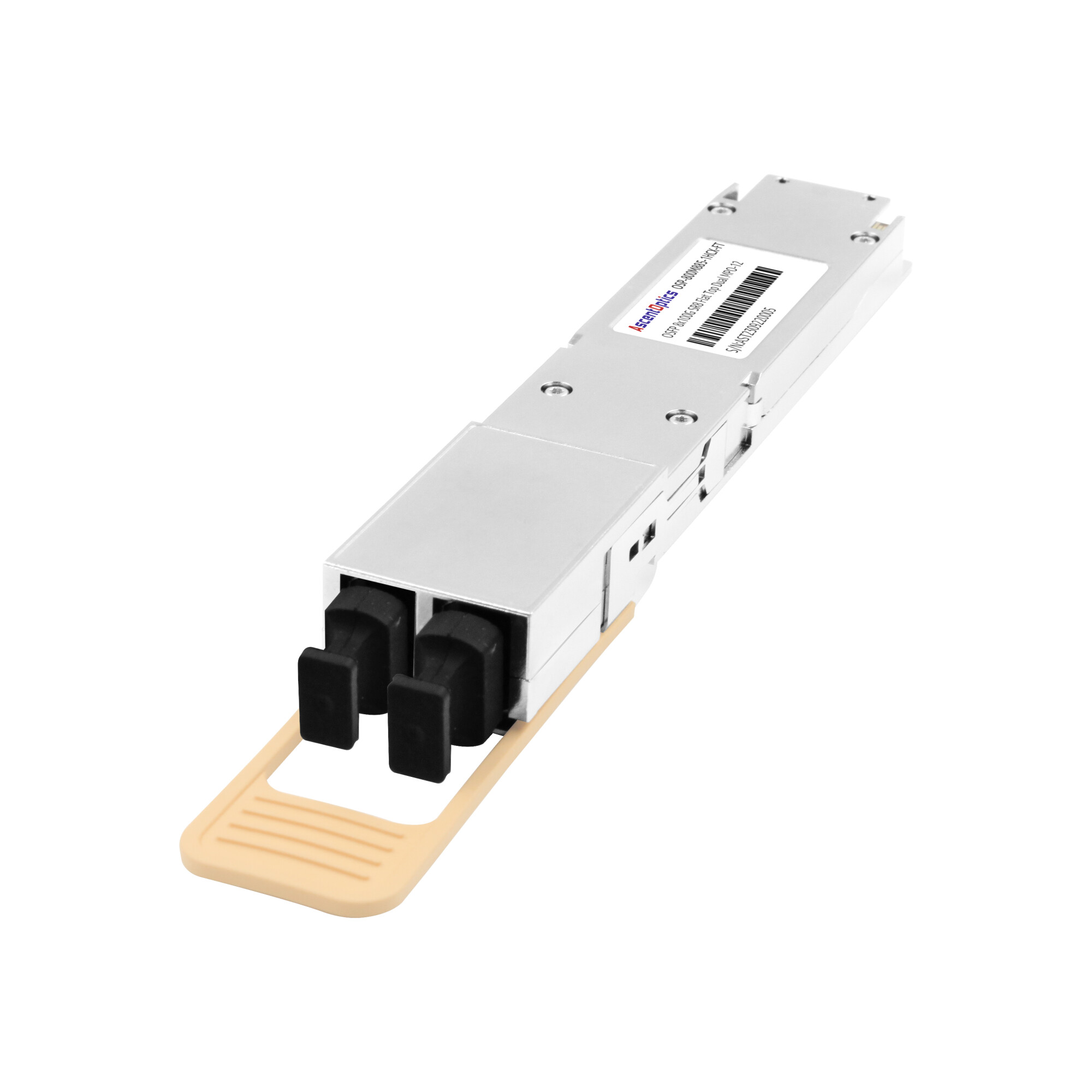
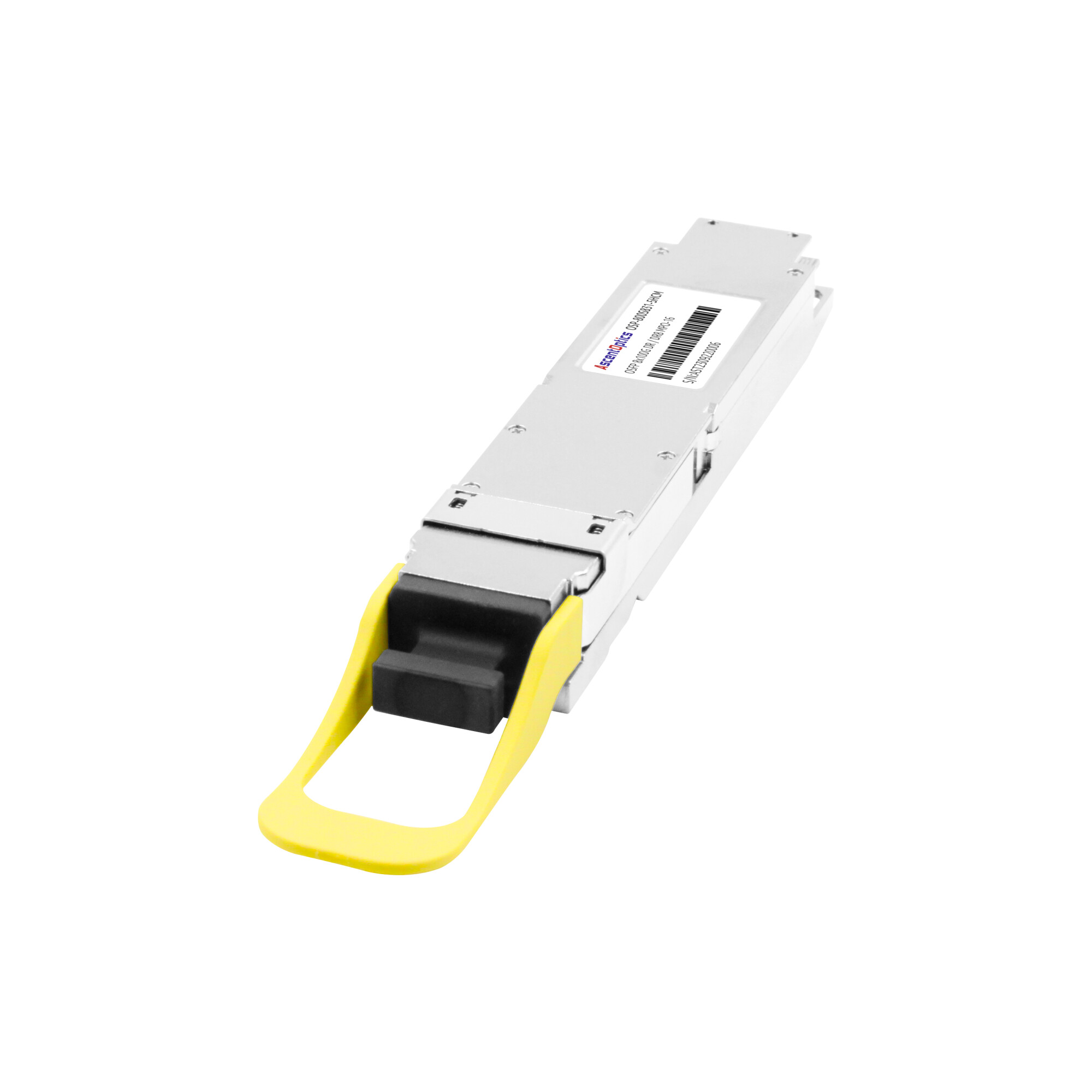
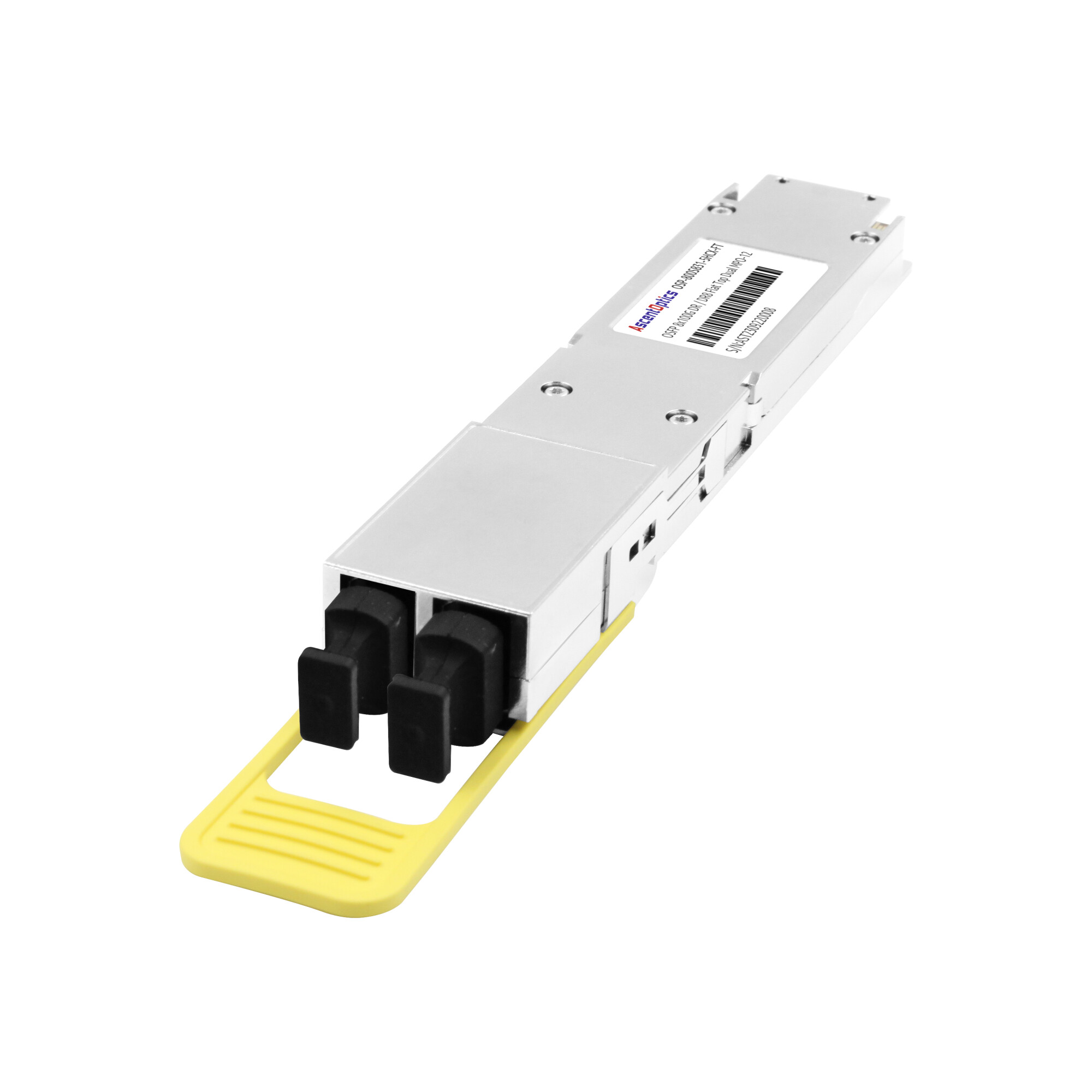
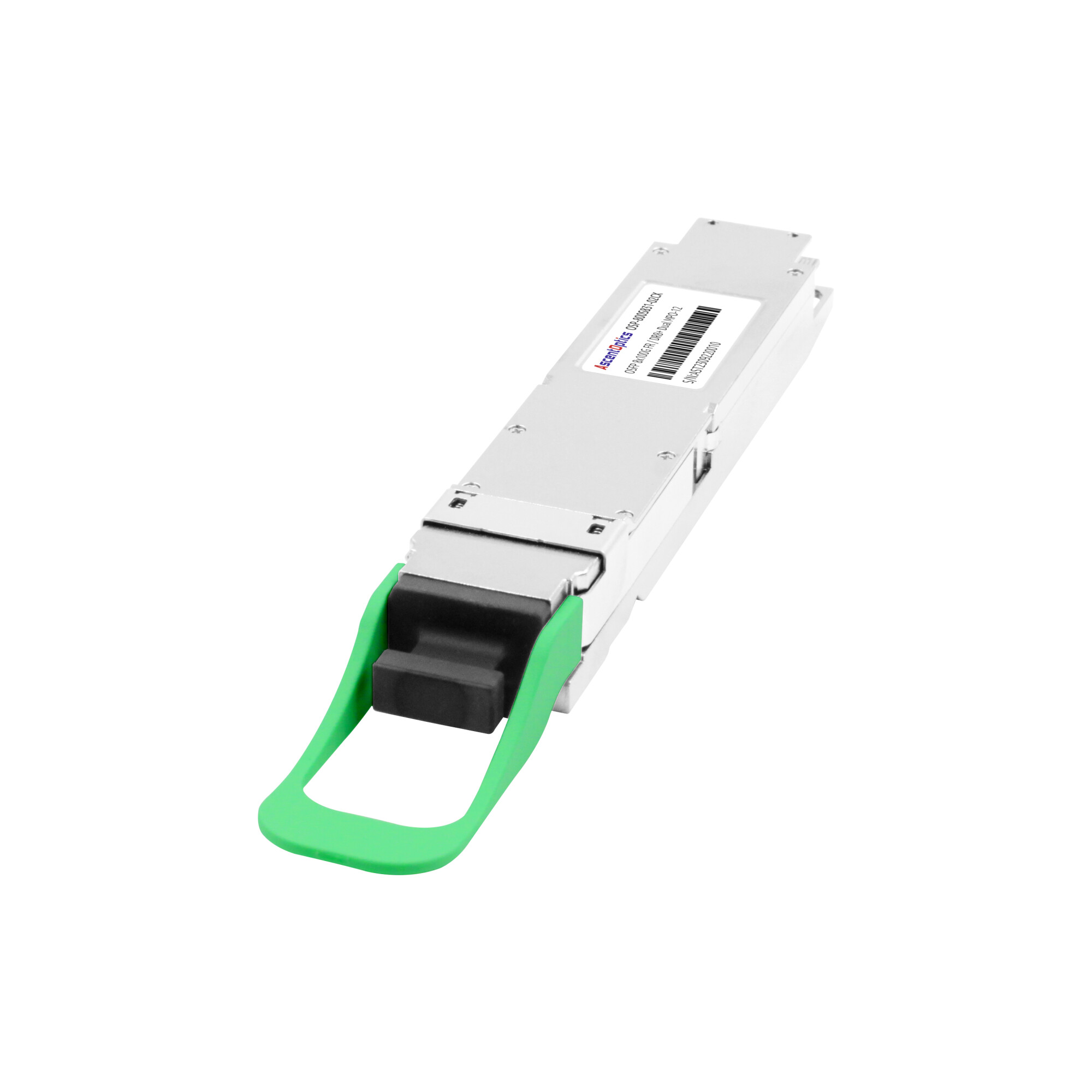
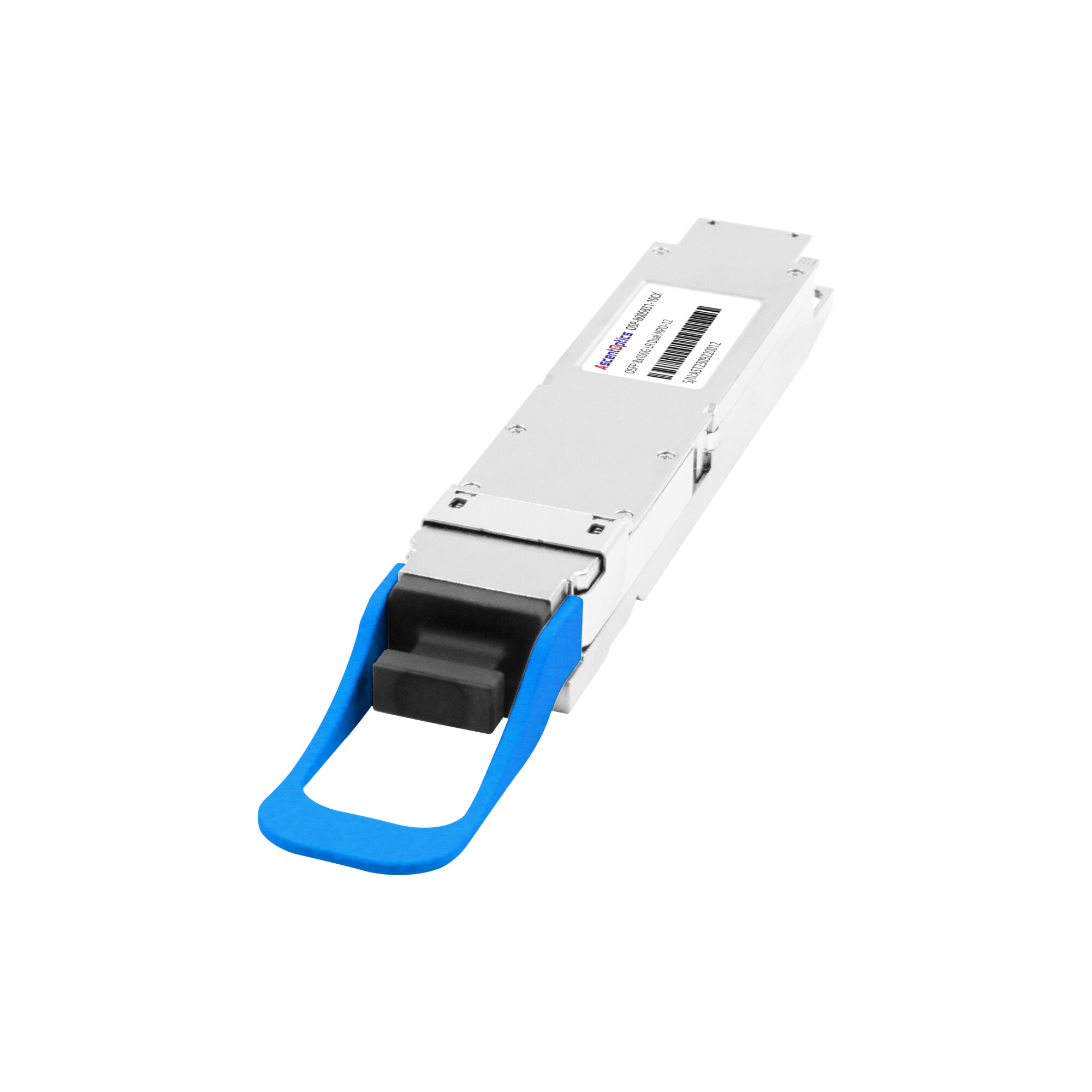
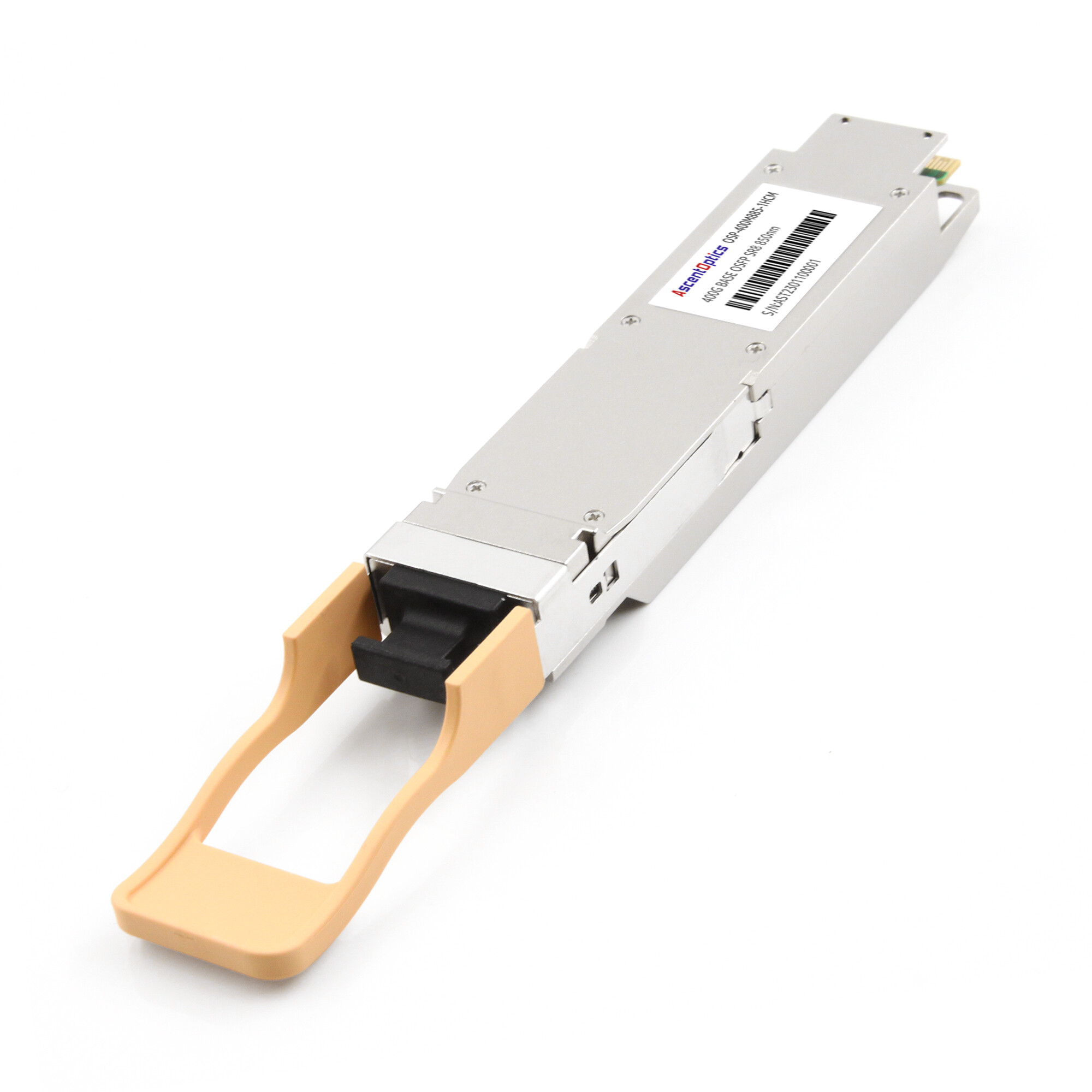
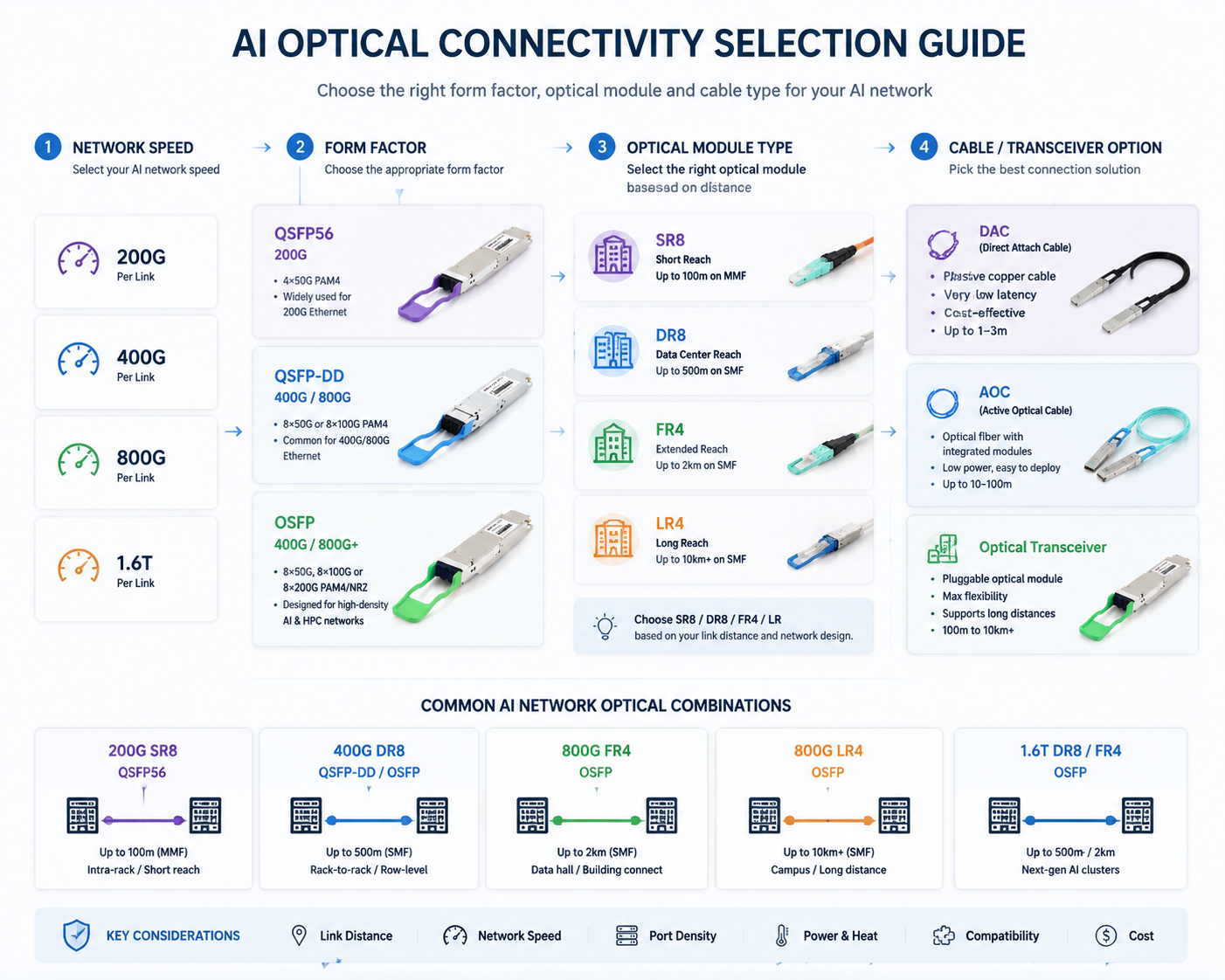
OSFP (Octal Small Form Factor Pluggable) is widely used in high-speed AI and data center networking, including many 400G and 800G platforms.
OSFP provides a larger thermal envelope than smaller form factors, making it suitable for high-speed optical modules with relatively high power consumption.
It is widely associated with high-performance InfiniBand platforms, including NDR and XDR systems, and is also used in high-speed Ethernet equipment.
OSFP modules are available in different mechanical and thermal configurations depending on the platform, including designs optimized for air-cooled and liquid-cooled systems.
QSFP-DD (Quad Small Form Factor Pluggable Double Density) provides eight electrical lanes and is widely used across high-speed Ethernet deployments.
The form factor is smaller than OSFP and is designed for high-density data center applications.
For 800G Ethernet, both QSFP-DD and OSFP are important form-factor options. The appropriate choice depends on the switch or NIC platform and its electrical and thermal design.
QSFP56 is commonly used for 200G-class Ethernet and InfiniBand HDR connectivity.
It typically uses four 50G-class PAM4 electrical lanes to achieve 200G-class aggregate bandwidth.
For organizations operating 200G AI or HPC networks, QSFP56 remains an important optical and direct-attach connectivity form factor.
QSFP112 is a four-lane interface based on approximately 112G per lane and is primarily associated with 400G-class connectivity.
Its compact form factor provides an attractive option for high-density 400G deployments. As network speeds continue to increase, QSFP112 also represents an important step in the evolution toward higher-speed single-lane signaling.
However, QSFP112 should not be treated as an 800G form factor simply because it uses 112G-class electrical lanes. 800G solutions generally require additional lanes or different high-density architectures.
How to Choose Between InfiniBand and Ethernet
There is no universal answer to the InfiniBand vs Ethernet question. The best choice depends on the architecture and priorities of the deployment.
Choose InfiniBand When:
- Large-scale AI training or HPC is the primary workload.
- Very low and predictable communication latency is important.
- Native RDMA and tightly integrated fabric capabilities are required.
- The infrastructure is closely aligned with the NVIDIA networking and software ecosystem.
- The organization prioritizes a specialized high-performance interconnect.
Choose Ethernet with RoCEv2 When:
- Multi-vendor interoperability is important.
- Existing Ethernet infrastructure should be reused.
- AI training and inference coexist with conventional data center workloads.
- Network operators already have strong Ethernet expertise.
- Flexible integration across compute, storage, and enterprise networks is required.
- The organization is prepared to properly engineer congestion control and loss-management mechanisms for RoCEv2.
In many environments, the decision is not simply about choosing the technology with the lowest latency or the lowest hardware cost. Network architecture, application performance, operational complexity, scalability, and future upgrade requirements should all be considered.
InfiniBand vs Ethernet: What About 400G and 800G?
As AI clusters move toward 400G and 800G connectivity, the physical layer becomes increasingly important.
A network upgrade may involve more than replacing a switch. Operators may also need to evaluate:
- Optical transceiver form factors
- Electrical lane rates
- Fiber type
- Connector configuration
- Insertion loss
- Link distance
- Power consumption
- Thermal requirements
- Breakout options
- Switch and NIC compatibility
For example, an 800G AI network may use OSFP or QSFP-DD depending on the platform, while the optical architecture could use SR8, DR8, FR4-based, or other configurations according to the required reach.
As link speeds increase, optical link budgets also become more demanding. Using low-loss connectors, minimizing unnecessary connection points, and selecting appropriate fiber and transceiver combinations can help maintain reliable high-speed links.
The Future of AI Networking
The future of AI networking is likely to include both InfiniBand and Ethernet rather than a single technology replacing the other.
InfiniBand continues to provide a highly optimized solution for demanding AI training and HPC environments, particularly where predictable low latency and native RDMA capabilities are priorities.
Ethernet, meanwhile, continues to evolve rapidly through RoCEv2, improved congestion control, higher-speed SerDes, and industry initiatives such as the Ultra Ethernet Consortium. Its open ecosystem and broad infrastructure base make it increasingly attractive for AI training, inference, cloud computing, and mixed data center workloads.
At the optical layer, the industry is moving from 200G and 400G toward 800G and 1.6T connectivity. This transition is driving continued development of higher-speed optical transceivers, more efficient electrical interfaces, improved thermal management, and higher-density form factors.
Conclusion
InfiniBand and Ethernet represent two different approaches to high-performance AI networking.
InfiniBand provides native RDMA, credit-based flow control, low latency, and a tightly integrated fabric architecture, making it particularly well suited to large-scale AI training and HPC environments.
Ethernet provides a broader ecosystem, multi-vendor interoperability, infrastructure flexibility, and a rapidly evolving high-performance networking stack through RoCEv2 and related technologies.
For AI infrastructure designers, the right decision should be based on the complete system rather than on protocol speed alone. Workload characteristics, cluster scale, network topology, software ecosystem, congestion management, operational requirements, and future bandwidth needs all play a role.
The optical layer is equally important. As AI networks move toward 400G, 800G, and 1.6T connectivity, choosing the appropriate OSFP, QSFP-DD, QSFP56, QSFP112, optical transceiver, DAC, AOC, and fiber architecture is essential for building reliable and scalable networks.
Ultimately, InfiniBand and Ethernet are both evolving to address the rapidly increasing communication demands of AI and accelerated computing. Understanding the strengths and limitations of each technology allows data center operators to build networking infrastructure that balances performance, scalability, interoperability, and long-term upgradeability.
Post Views: 1,369