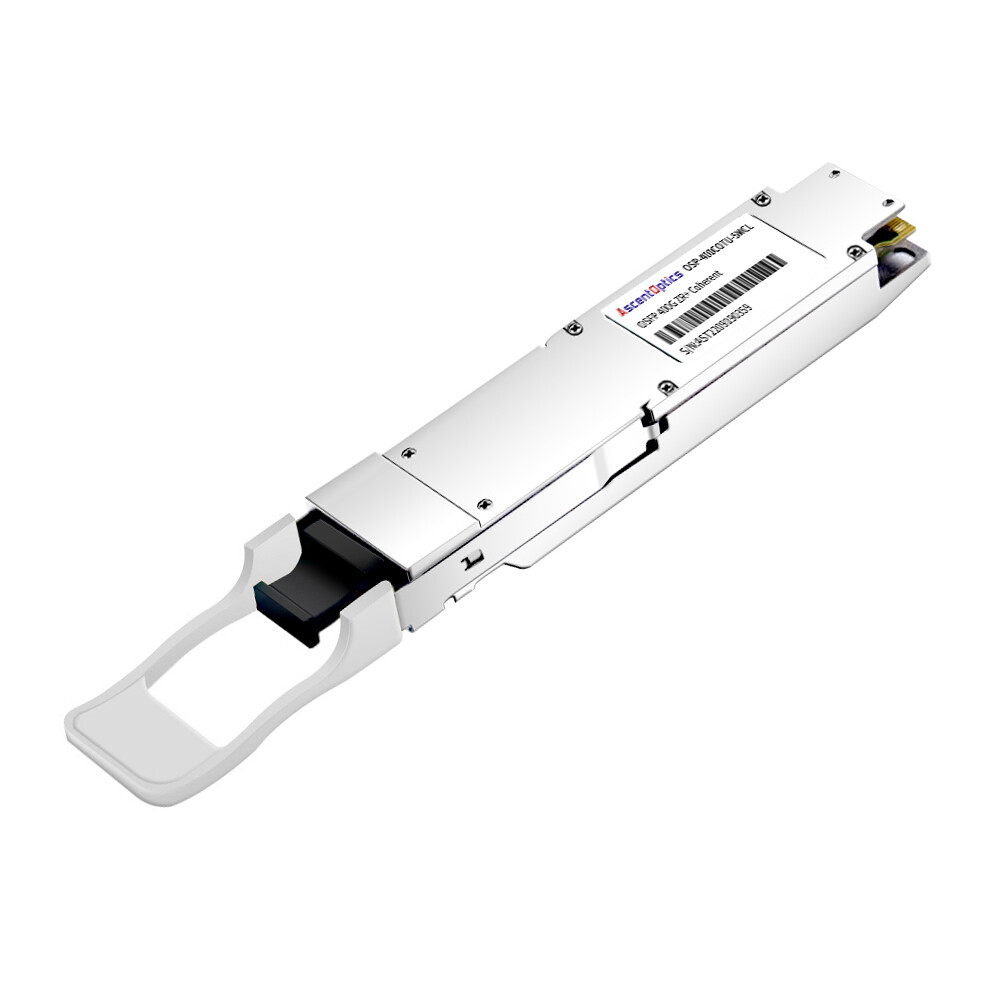
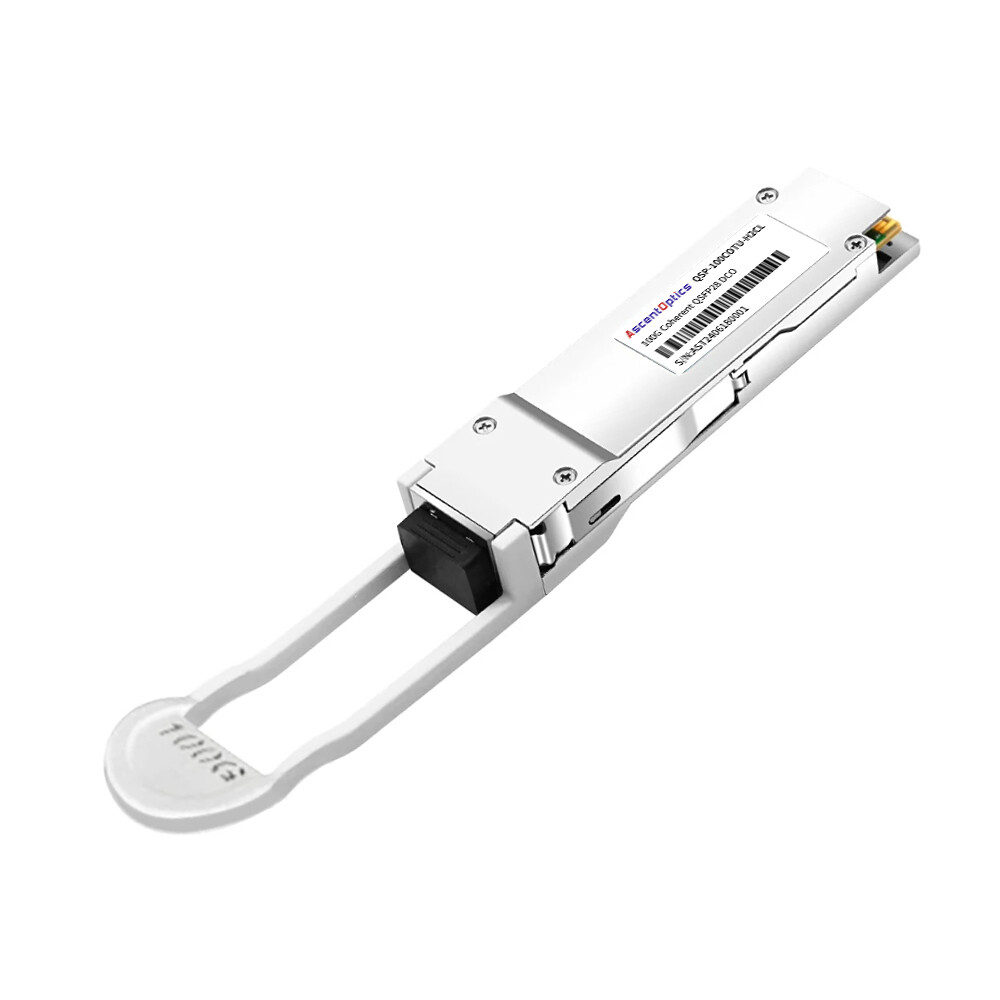
An 800G coherent module typically consumes around 25–30 watts depending on the implementation, modulation scheme, DSP generation, and thermal design. That is more power than a MacBook charger. Fill a 32-port switch with them, and the optics alone consume nearly a kilowatt before you account for the switch ASIC, power supplies, or cooling.
If you are planning a DCI deployment, scaling an AI cluster interconnect, or upgrading metro transport links, coherent optical module power consumption is not a footnote on a spec sheet. It determines which switch platforms you can use, how you design rack power distribution, and what your five-year electricity bill actually looks like.
Most engineers know coherent modules draw more power than direct-detect optics. What surprises many is how fast the numbers compound at scale, and how dramatically per-bit efficiency improves with each generation when you choose the right module for the right job.
What Determines Coherent Optical Module Power Consumption?
Three components dominate the power draw inside any coherent optical transceiver: the Digital Signal Processor, the optical engine, and the form factor’s thermal ceiling.
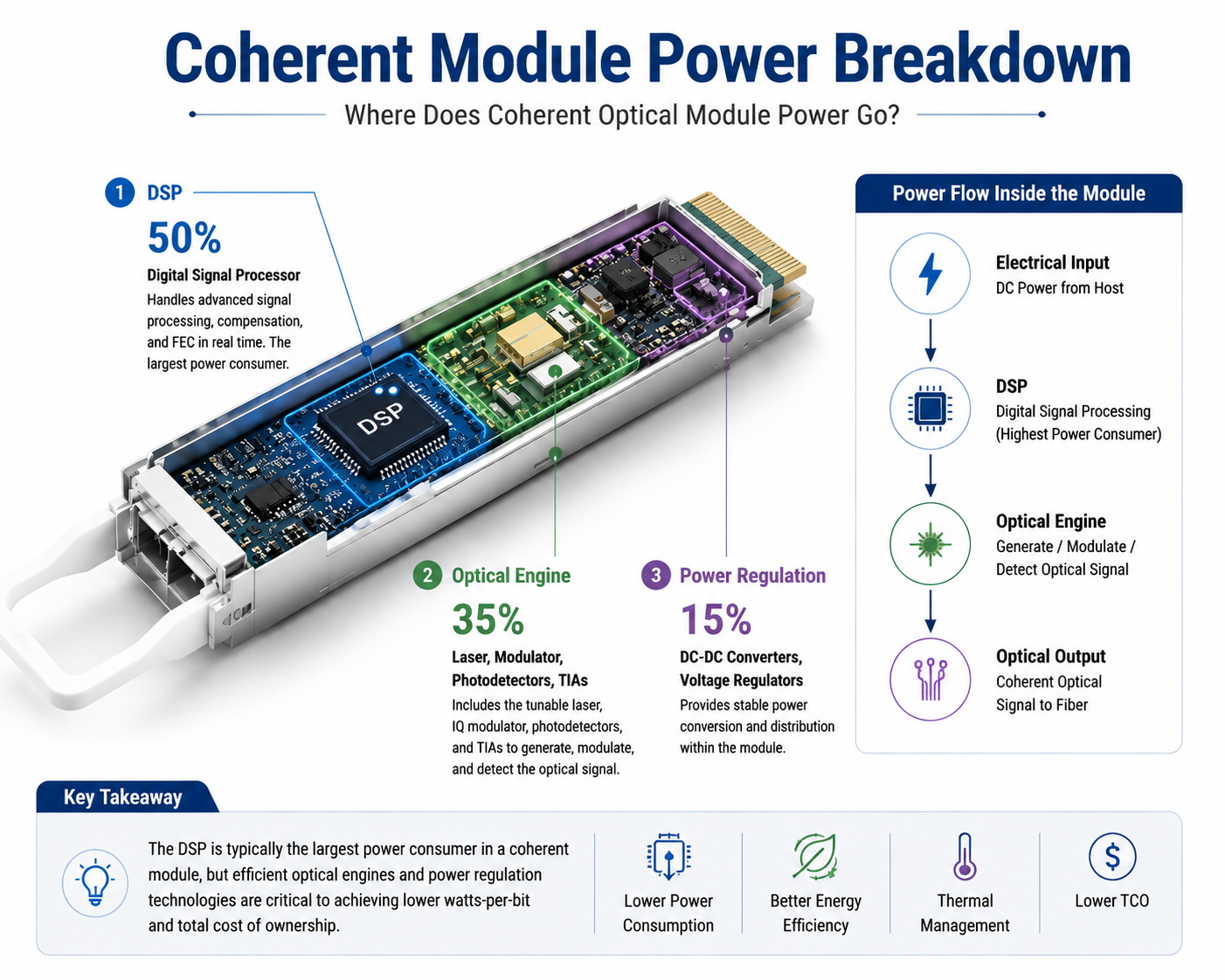
The DSP: 50 to 60 Percent of Total Module Power
The Digital Signal Processor is the single largest power consumer in a coherent module. In a typical 400ZR design, the DSP accounts for roughly 10 to 12 watts of a module’s 18 to 20 watts total. It handles chromatic dispersion compensation, polarization tracking, carrier phase recovery, and forward error correction, all in real time.
That DSP power fraction has fallen steadily as CMOS process nodes shrink. Early coherent DSPs on 28 nm consumed the majority of module power. Advanced coherent DSPs based on newer CMOS process technologies help reduce energy per bit while supporting higher-order modulation and stronger FEC algorithms. The next generation on 3 nm will drive that fraction closer to 40 percent.
Optical Engine Components: Laser, Modulator, and Receiver
The optical engine, comprising the tunable laser, IQ modulator, driver amplifiers, photodetectors, and transimpedance amplifiers, accounts for approximately 35 percent of total module power in a 400ZR design.
C-band tunable lasers are inherently power-hungry because they require precise temperature stabilization via a thermoelectric cooler. The laser alone can draw 2 to 3 watts. Indium phosphide and silicon photonics integration reduce this by combining multiple optical functions onto a single die, cutting interconnect losses and eliminating redundant temperature control loops.
The remaining 10 to 15 percent goes to power regulation: DC-DC converters, voltage regulators, and power distribution within the module. These overhead losses are difficult to eliminate but shrink as module voltages standardize and converter efficiency improves.
Form Factor Thermal Constraints
The module form factor sets a hard ceiling on how much power you can dissipate before the case temperature exceeds safe operating limits. This is where many deployment plans collide with physics.
| Form Factor |
Typical Power Budget |
Maximum Practical |
Best For |
| QSFP28 |
3.5 to 5 W |
~5.5 W |
100ZR coherent |
| QSFP-DD |
12 to 15 W |
~20 W (with Class 8) |
400ZR, some ZR+ |
| OSFP |
15 to 20 W |
25 W+ |
400ZR+, 800ZR |
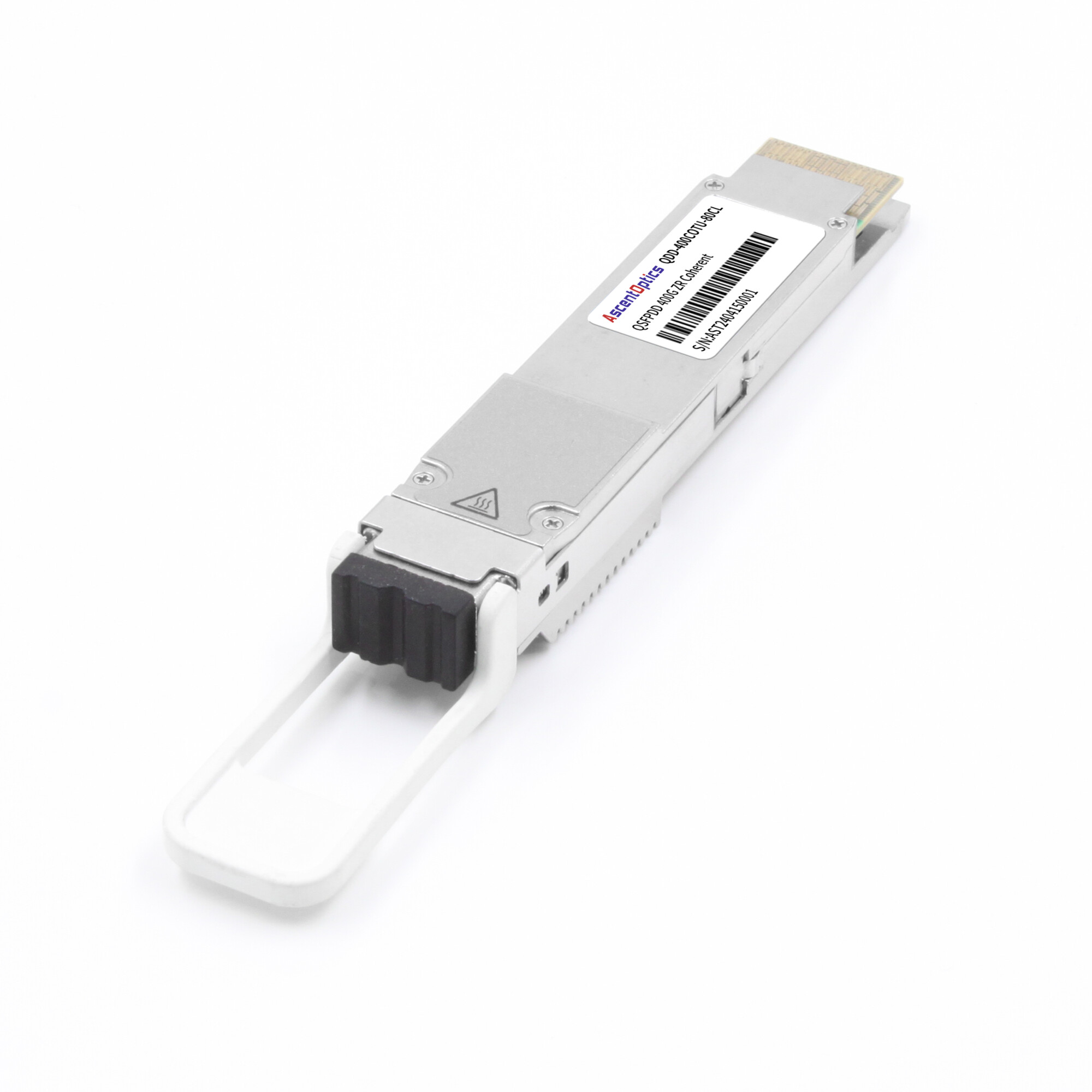
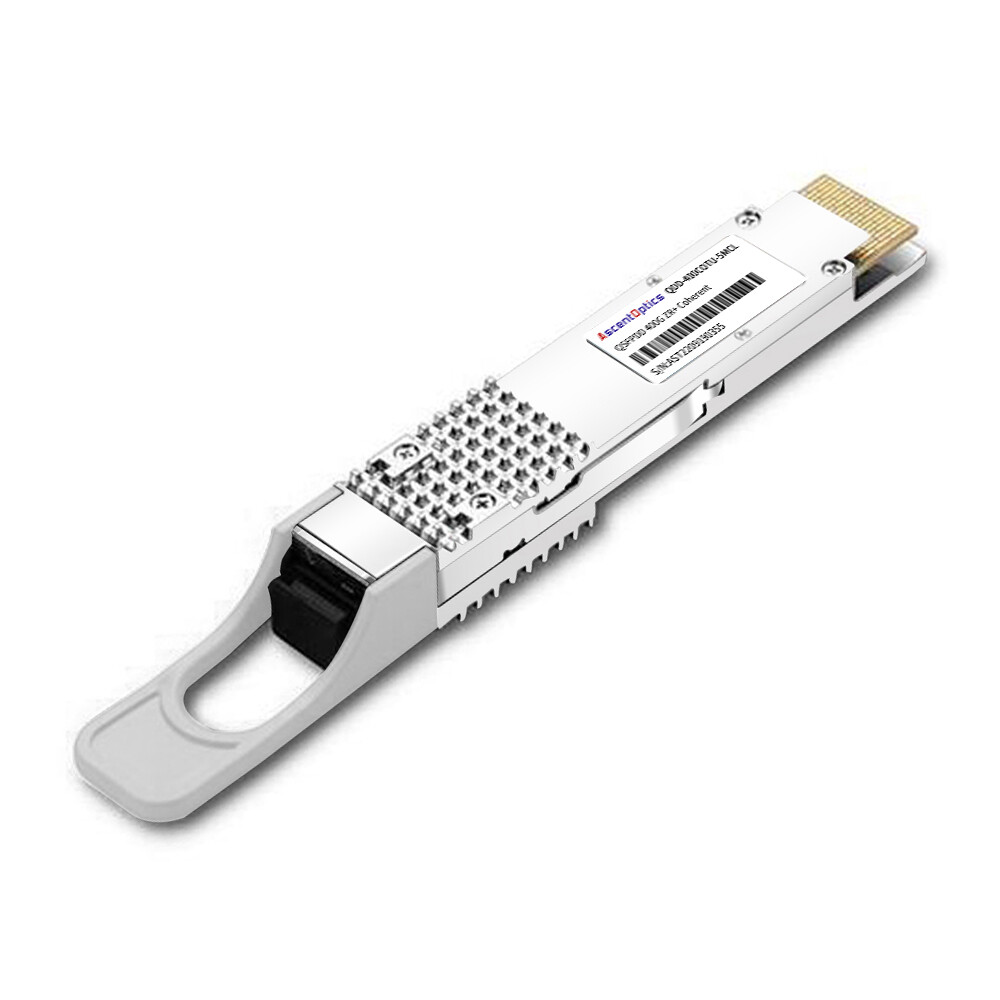
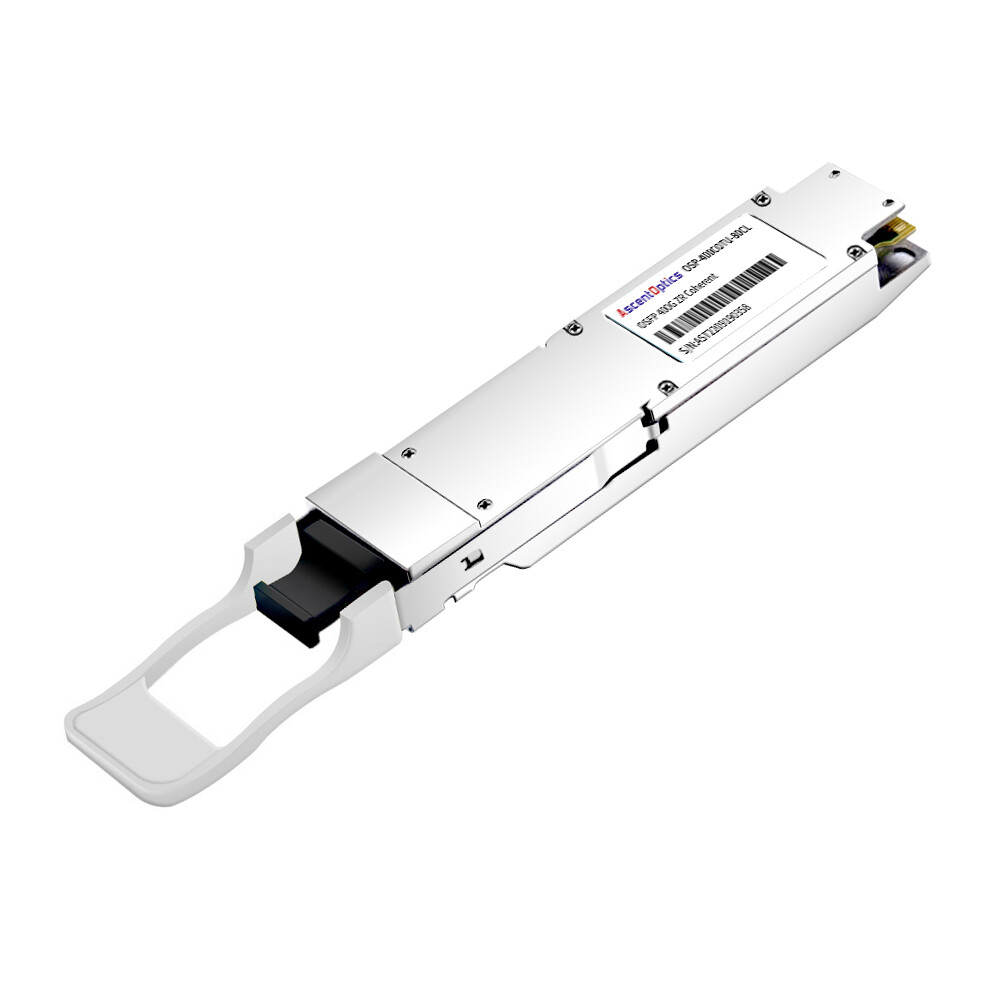
QSFP-DD is the most common form factor for 400G coherent today, but it runs into thermal limits with ZR+ modules that reach 22 to 25 watts. OSFP‘s larger physical size and integrated heatsink give it roughly 5 to 7 watts more thermal headroom, which is why most 800G coherent designs and high-power ZR+ variants ship in OSFP.
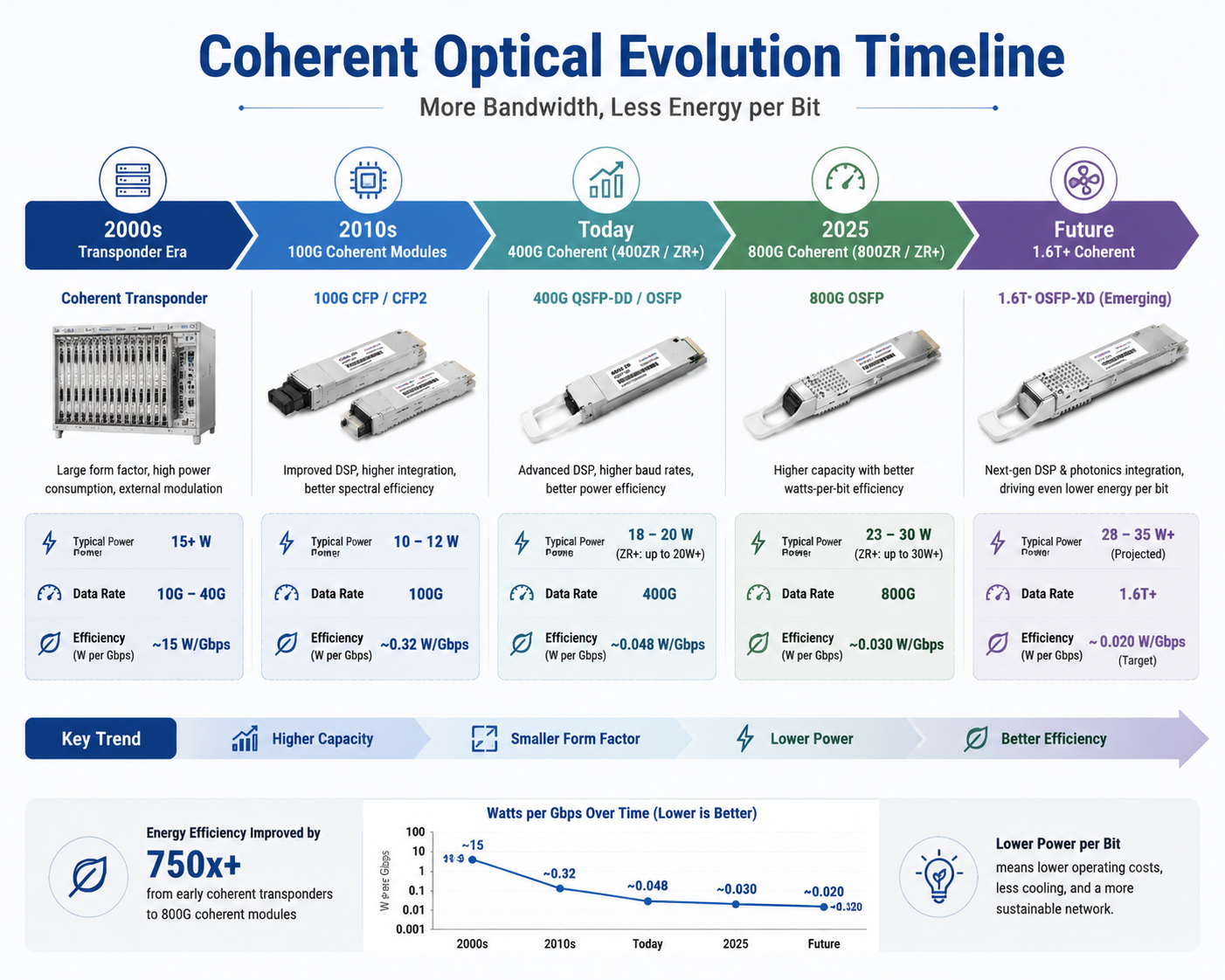
Coherent Module Power Consumption by Data Rate: 100G to 1.6T
Power scales upward in absolute watts with each data rate generation, but per-bit efficiency improves substantially. That distinction matters for both procurement decisions and sustainability reporting.
100G Coherent (100ZR QSFP28): The 5-Watt Breakthrough
The newest class of 100G coherent modules targets power consumption of approximately 5 watts in the QSFP28 form factor. Coherent Corp’s 100ZR QSFP28-DCO module, announced in late 2024, achieved this by pairing a purpose-built simplified DSP with a highly integrated silicon photonics optical engine.
Five watts is significant because it falls within the standard QSFP28 thermal budget, meaning these modules can deploy in existing switch ports without platform upgrades. A 100ZR module consumes 63 percent less energy per gigabit than aggregating ten 10G DWDM connections, which together draw roughly 30 watts.
For mobile backhaul and edge aggregation, this changes the economics. A single 100ZR module replaces an entire shelf of grey optics and a separate transponder, collapsing two rack units of equipment into one QSFP28 port.
400G Coherent (400ZR / ZR+): The Data Center Workhorse
This is where most coherent optical module power consumption questions land. 400ZR and ZR+ modules are the dominant coherent pluggable for metro DCI and are widely deployed in hyperscale networks.
| Variant |
Typical Power |
Maximum Power |
Reach |
Form Factor |
| 400ZR (Standard) |
18 to 20 W |
22 W |
80 km |
QSFP-DD / OSFP |
| 400ZR+ (Extended) |
20 to 25 W |
28 W |
120 km+ |
OSFP preferred |
Real-world data from Nokia’s deployment experience confirms 400ZR+ modules in QSFP-DD form factors draw 19 to 23 watts in production networks. The OIF 400ZR specification targeted 15 watts for optimized designs, but practical implementations with margin for elevated intake temperatures land closer to 18 to 20 watts. Energy efficiency for 400G coherent using 16QAM modulation with oFEC runs approximately 0.059 watts per gigabit. That is roughly 50 percent more efficient than using four individual 100G coherent modules.
800G Coherent (800ZR / ZR+): AI-Era Density
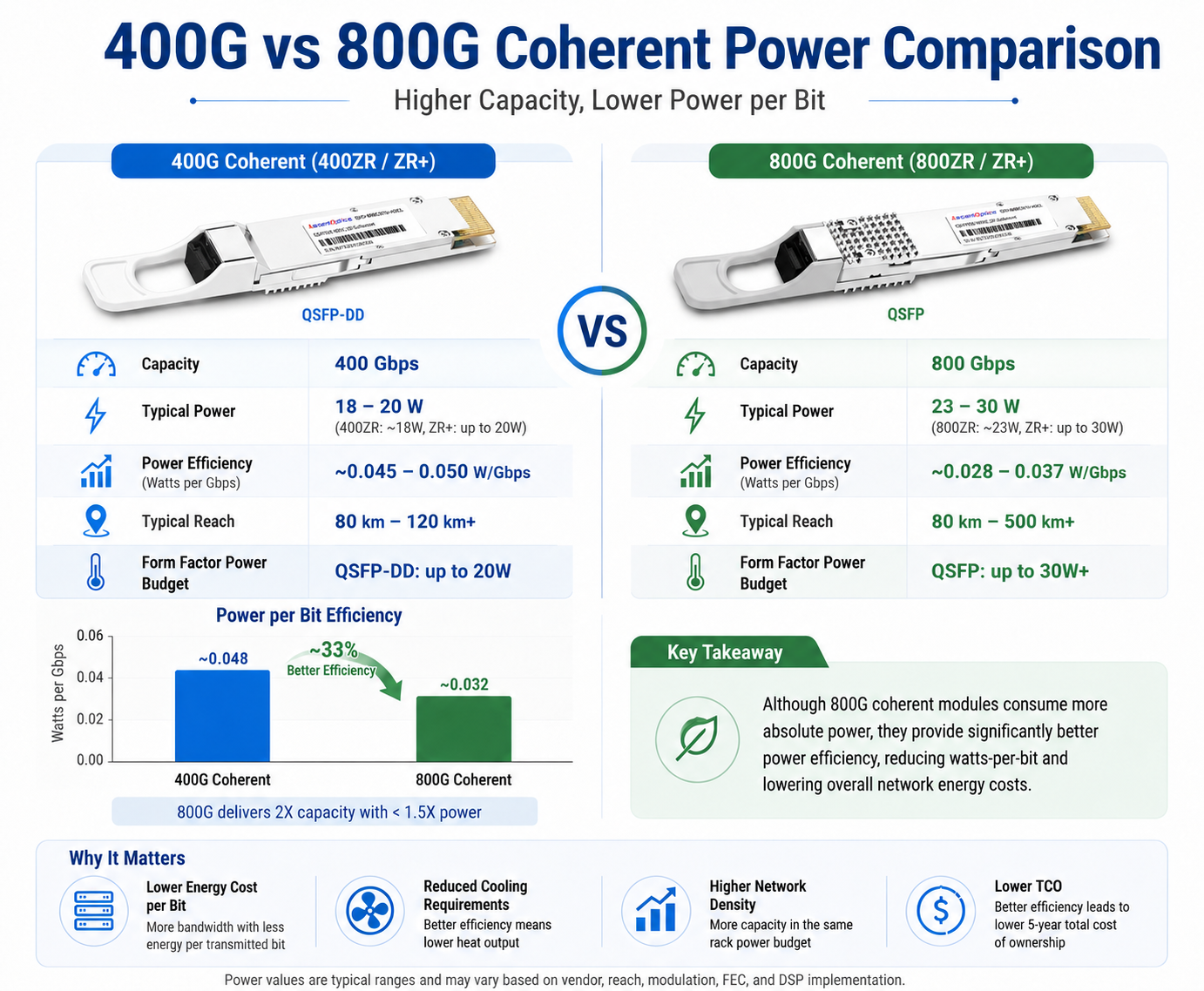
A team at a Midwest colocation provider recently compared 400ZR+ and 800ZR for a new AI cluster interconnect. Their instinct was that 800G modules, drawing 23 to 25 watts, would blow their power budget compared to 400G at 18 to 20 watts. The per-port math told a different story.
In large-scale AI and cloud networks, the comparison between 400G and 800G coherent links highlights an important efficiency trend.
At 0.038 watts per gigabit, 800G coherent delivers roughly 36 percent better energy efficiency than 400G. Two 400G links consume 36 to 40 watts to deliver 800 Gbps total. One 800G link delivers the same capacity at 23 to 25 watts, saving 11 to 17 watts per 800 Gbps of throughput. Across 32 ports, that difference compounds to 350 to 540 watts of optical power savings, before cooling multipliers.
Real-world 800G ZR+ DCO transceivers, like the Coherent FTCE33x6R1PCL, specify maximum power at 30 watts, though typical operational draw lands in the 23 to 25 watt range.
1.6T Coherent (OSFP-XD): The Frontier
Early 1.6T coherent designs in OSFP-XD form factors target 28 to 35 watts typical, with maximum ratings up to 40 watts. These modules push well past what any QSFP-DD cage can thermally support, making OSFP or OSFP-XD the only viable form factors.
A promising development is coherent-lite architectures. A demonstrated 1.6 Tbps (4 x 400G) coherent-lite transceiver published in early 2026 consumed only 39.1 watts total, just 44.2 percent of the power required by four traditional 400G coherent modules, while still achieving 40 km reach. That puts coherent-lite within 9.5 percent of equivalent IM-DD power while delivering dramatically longer reach.
Per-Bit Efficiency: The Metric That Actually Matters
Absolute module power tells half the story. Per-bit energy efficiency measured in watts per gigabit determines your total cost of ownership and sustainability profile.
Two Decades of Progress
The transition from 15 watts per gigabit in early-2000s transponder-based coherent systems to under 0.03 watts per gigabit in today’s 800G pluggables represents a 99.8 percent reduction over roughly 20 years. Most of that improvement came from CMOS process node shrinks: 28 nm to 16 nm to 7 nm to 5 nm. Each node roughly halved DSP power for equivalent throughput.
| Generation |
Module Power (Typical) |
W/Gbps |
CMOS Node |
| Legacy transponder (2000s) |
~150 W per 10G |
~15.0 |
— |
| 100G CFP (2010s) |
~32 W |
~0.32 |
28 nm |
| 100G QSFP28 DCO (2024) |
~5 W |
0.05 |
7 nm |
| 400G ZR (2024) |
~19 W |
0.048 |
7 nm |
| 800G ZR (2025) |
~24 W |
0.030 |
5 nm |
| 1.6T Coherent-Lite (2026) |
~39 W |
0.024 |
5 nm / 3 nm |
Why Higher Absolute Power Can Mean Better Efficiency
This is the point that trips up procurement teams comparing spec sheets. An 800G module at 24 watts looks worse on paper than a 400G module at 19 watts. But the 800G module is carrying twice the traffic. Per gigabit, 0.030 W/G is about 37 percent more efficient than 0.048 W/G.
DCO vs ACO vs Coherent-Lite: Technology Choices and Power
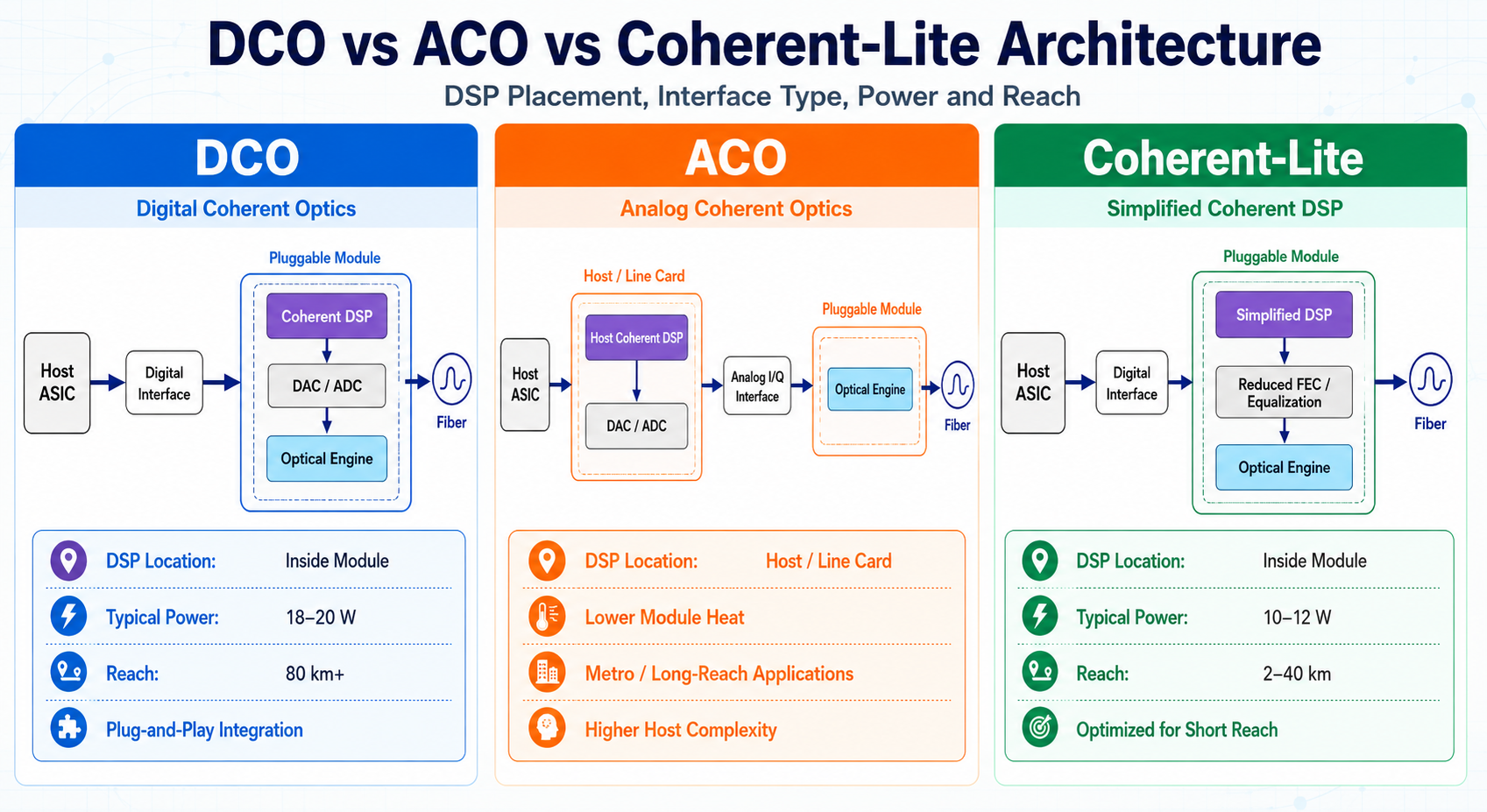
The architecture of a coherent module directly determines its power profile. Understanding the trade-offs helps match module type to use case.
DCO (Digital Coherent Optics)
DCO modules integrate the DSP directly into the module alongside the optical engine. This eliminates the power-hungry analog electrical interface between a separate DSP chip and the optics. Modern 400G DCO modules in QSFP-DD form factors have reached 18 watts or lower, with some optimized designs drawing under 8 watts.
DCO is the dominant architecture for pluggable coherent optics today because it offers the simplest deployment model: plug the module into a standard switch port and the DSP handles everything internally. The trade-off is that module power is higher than it would be if some DSP functions were offloaded.
ACO (Analog Coherent Optics)
ACO separates the optical engine from the DSP. The DSP resides on the host board, and analog electrical signals pass between the DSP and the optical module. This allows field-replaceable optics with upgradeable DSPs, but the analog interface consumes significant power and limits bandwidth density.
ACO adoption has declined as DCO provides a simpler pluggable deployment model. The power penalty of the analog interface plus the complexity of matching DSP-to-optics across vendors makes ACO harder to justify when DCO modules at equivalent data rates consume less total system power.
Coherent-Lite: Stripped-Down DSP for Campus Reach
Coherent-lite architectures target the 2 to 40 km campus DCI space by removing what consumes the most DSP power: chromatic dispersion compensation and polarization mode dispersion tracking. By operating in the O-band (1310 nm) where fiber dispersion is near zero, coherent-lite DSPs eliminate these compute-intensive functions.
| Architecture |
Typical Power (400G eq.) |
Reach |
DSP Complexity |
| Full DSP DCO (400ZR) |
18 to 20 W |
80 km |
Full CD/DGD comp. |
| Coherent-Lite |
~10 to 12 W |
40 km |
No CD comp. |
| LPO (Linear Pluggable) |
6 to 8 W |
<2 km |
No DSP |
Switch-Level Power Planning: Tally the Real Numbers
Module power is only the starting point. At the switch and rack level, those individual watts compound through port count and cooling overhead.
The Basic Formula
Total System Power = Base Switch + (Active Ports x Module Power) + Cooling Overhead
Base switch power covers the ASIC, CPU, fans, and PSU losses. For a typical 32-port 400G switch, allocate approximately 350 to 450 watts.
Module power is the per-port coherent module draw. Use the maximum rated power, not typical, for power budget planning. A module rated at 22 watts maximum will draw 22 watts under worst-case conditions, and your PDUs must handle that.
Cooling overhead is the facility cost of removing heat. A useful rule of thumb: add 40 to 60 percent of total equipment power for air-cooled data centers. For liquid-cooled environments, this drops to 10 to 20 percent.
That single switch with ZR+ optics consumes over 1.6 kilowatts at the facility level. Deploy ten of these in a metro ring and you are looking at 16.5 kW, roughly equivalent to three residential air conditioning systems running continuously.
Now factor in PUE. Every watt of optical module power carries a facility multiplier:
- PUE 1.2 (hyperscale): 1 W optics = 1.2 W facility
- PUE 1.5 (typical colo): 1 W optics = 1.5 W facility
- PUE 1.8 (older facility): 1 W optics = 1.8 W facility
At PUE 1.5, the 704 watts of optics in our example becomes 1,056 watts at the utility meter.
Thermal Design: Spacing Matters
Placing eight ZR+ modules adjacent to each other on a switch faceplate creates a heat island. Spreading high-power modules across every other port can reduce case temperatures by 10 degrees Celsius or more, as demonstrated in Nokia’s 7750 SR-s thermal validation testing.
Monitor module temperature through CMIS telemetry. Commercial-grade optics typically have a 70 degrees Celsius maximum case temperature. Set warning thresholds at 65 degrees Celsius and critical alerts at 70 degrees Celsius to catch airflow degradation before modules throttle or shut down.
Strategies to Reduce Coherent Module Power Consumption
Reducing coherent optical module power consumption is not just about picking a lower-wattage part number. The biggest savings come from matching the technology architecture to the actual reach requirement.
Linear Pluggable Optics (LPO): Eliminate the DSP
LPO removes the DSP entirely and shifts equalization to the host switch ASIC SerDes. LPO is mainly applied to short-reach Ethernet optical links rather than long-distance coherent transmission. This cuts module power by 40 to 50 percent compared to equivalent DSP-based designs. An 800G LPO module consumes 6 to 8 watts versus 20 to 25 watts for full coherent.
The catch is reach. Without DSP-based dispersion compensation, LPO links max out at approximately 500 meters over multimode fiber or up to 2 kilometers over single-mode. LPO also requires LPO-capable switch ports, which are only now entering the market.
For intra-rack and adjacent-rack GPU interconnect in AI clusters, LPO is the clear power winner. For DCI across a campus or metro, coherent remains necessary.
Co-Packaged Optics (CPO): Move Optics to the ASIC
CPO integrates the optical engine onto the same substrate as the switch ASIC, reducing the electrical SerDes distance from approximately 22 dB of trace loss in pluggable designs to 1 to 4 dB. Eliminating those long PCB traces removes the need for power-hungry retimers entirely.
The result is a dramatic reduction in optical I/O power per bit, especially for high-radix switches with hundreds of lanes. The trade-off is that CPO optics are not field-replaceable. A failed optical engine means replacing the entire switch ASIC package.
Silicon Photonics Integration
Monolithic integration of modulators, photodetectors, and waveguides onto a single silicon photonics die reduces the component count inside a coherent module. Fewer individual components means fewer interconnects, lower packaging loss, and in many cases, relaxed temperature stabilization requirements. These compounding improvements can shave 2 to 4 watts from a module’s total power budget.
O-Band Coherent for Campus DCI
Operating in the O-band (1310 nm), where standard single-mode fiber has near-zero chromatic dispersion, enables coherent links without the power-hungry dispersion compensation DSP blocks that dominate C-band coherent power budgets. O-band coherent targets the 2 to 20 km campus interconnect space, sitting between intra-data-center PAM-4 and metro DCI C-band coherent. Expect commercial O-band coherent modules to draw 30 to 40 percent less power than equivalent C-band modules at the same data rate.
Conclusion
Coherent optical module power consumption shapes every dimension of network planning: switch selection, rack power distribution, cooling design, and multi-year operational budgets. The numbers are substantial. A 400ZR+ module draws 20 to 25 watts, an 800ZR module draws 23 to 25 watts, and a fully loaded switch with coherent optics can consume over 1.6 kilowatts at the facility level.
The counterintuitive insight is that higher per-module wattage at higher data rates often means better total efficiency. 800G coherent at 0.030 watts per gigabit is meaningfully more efficient than 400G at 0.048 watts per gigabit. Choosing the right data rate for your throughput requirement is the single largest lever for reducing coherent optical module power consumption across your network.
The technology roadmap points in one direction: per-bit efficiency will continue improving through 3 nm DSPs, silicon photonics integration, coherent-lite architectures, and eventually CPO. Every generation since the early 2000s has delivered lower watts per gigabit than the last, and that trend shows no sign of flattening.
FAQ About Coherent Optical Module Power Consumption
How much power does a coherent optical module consume?
The power consumption of a coherent optical module depends on the data rate, transmission distance, form factor, and DSP architecture. A 400ZR module typically consumes around 18–20W, while 400ZR+ and 800ZR modules may require approximately 20–30W depending on the design and thermal requirements. Higher-speed modules generally consume more power in absolute terms but provide better energy efficiency per bit.
Why do coherent optical modules consume more power than direct-detect optical modules?
Coherent optical modules require advanced digital signal processing to support long-distance transmission. The DSP performs complex functions such as chromatic dispersion compensation, polarization tracking, carrier recovery, and forward error correction (FEC). These additional processing requirements make coherent modules more power-hungry than direct-detect PAM4 optical modules used for shorter-reach applications.
Is an 800G coherent module more power efficient than a 400G coherent module?
Yes. Although an 800G coherent module consumes more total power than a 400G module, it typically provides better watts-per-bit efficiency. For example, an 800G module operating at around 25W can deliver twice the capacity of a 400G module operating at around 20W, reducing overall power consumption per transmitted gigabit.
What are the main factors that affect coherent optical module power consumption?
Three major factors determine coherent module power consumption: the DSP, optical engine, and thermal design. The DSP is usually the largest power contributor because it handles complex signal processing algorithms. The optical engine, including lasers, modulators, and receivers, also contributes significantly, while the module form factor determines the maximum power that can be safely dissipated.
What is the difference between DCO and ACO in terms of power consumption?
Digital Coherent Optics (DCO) integrates the DSP inside the optical module, providing a simpler deployment model but increasing module power consumption. Analog Coherent Optics (ACO) separates the optical engine from the DSP, which can reduce module complexity but requires additional host-side processing. In modern pluggable coherent deployments, DCO has become the preferred architecture because of its easier integration and system-level efficiency.
Can LPO replace coherent optical modules?
LPO (Linear Pluggable Optics) can significantly reduce power consumption by removing the DSP from the optical module and relying on host ASIC SerDes for signal processing. However, LPO is mainly designed for short-reach Ethernet applications, such as AI cluster interconnects and data center links. It is not a direct replacement for coherent optics used in metro and long-distance DCI applications.
How can network operators reduce coherent optical module power consumption?
The most effective way to reduce power consumption is to select the appropriate optical technology for the required reach. Short-distance links can use lower-power solutions such as direct-detect optics or LPO, while longer DCI connections require coherent solutions. Additional improvements can come from silicon photonics integration, newer DSP architectures, improved cooling, and optimized rack-level power planning.
Why does thermal design matter for coherent optical modules?
High-speed coherent modules generate significant heat because of their DSP and optical components. As module power increases from 400G to 800G and beyond, thermal limitations become a key factor when selecting form factors such as QSFP-DD and OSFP. Proper airflow management, port spacing, and temperature monitoring help maintain reliable operation in high-density networking environments.
Post Views: 1,843