Jennifer Park had thought of everything when planning her data center in anticipation of tomorrow. In January 2025, she specified AOCs for each 100G link in a brand-new spine switch deployment. She liked the lighter fiber cables with longer reach and cleaner cable management. What she did not account for was the power difference. Her fully loaded 64-port switch running AOCs pulled an extra 180 watts compared to passive DACs. Her racks were designed around a 40G thermal profile, and thermal alarms started ringing on the top-of-rack switches just three weeks after launch.
This is the real confusion in the QSFP28 DAC vs AOC debate: If you make the wrong choice based on distance, power budget, thermal design, or environment, you’ll face infrastructure issues or unexpected cost overruns.
This guide will teach you precisely how to choose between QSFP28 DAC and AOC. You’ll learn how each performs in terms of distance, power, latency, and cost, so you can make the right decision for your deployment.
Need help choosing cables? Explore Ascent Optics’ QSFP28 connectivity solutions or contact our engineers for a free cable assessment.
What Is QSFP28 DAC?
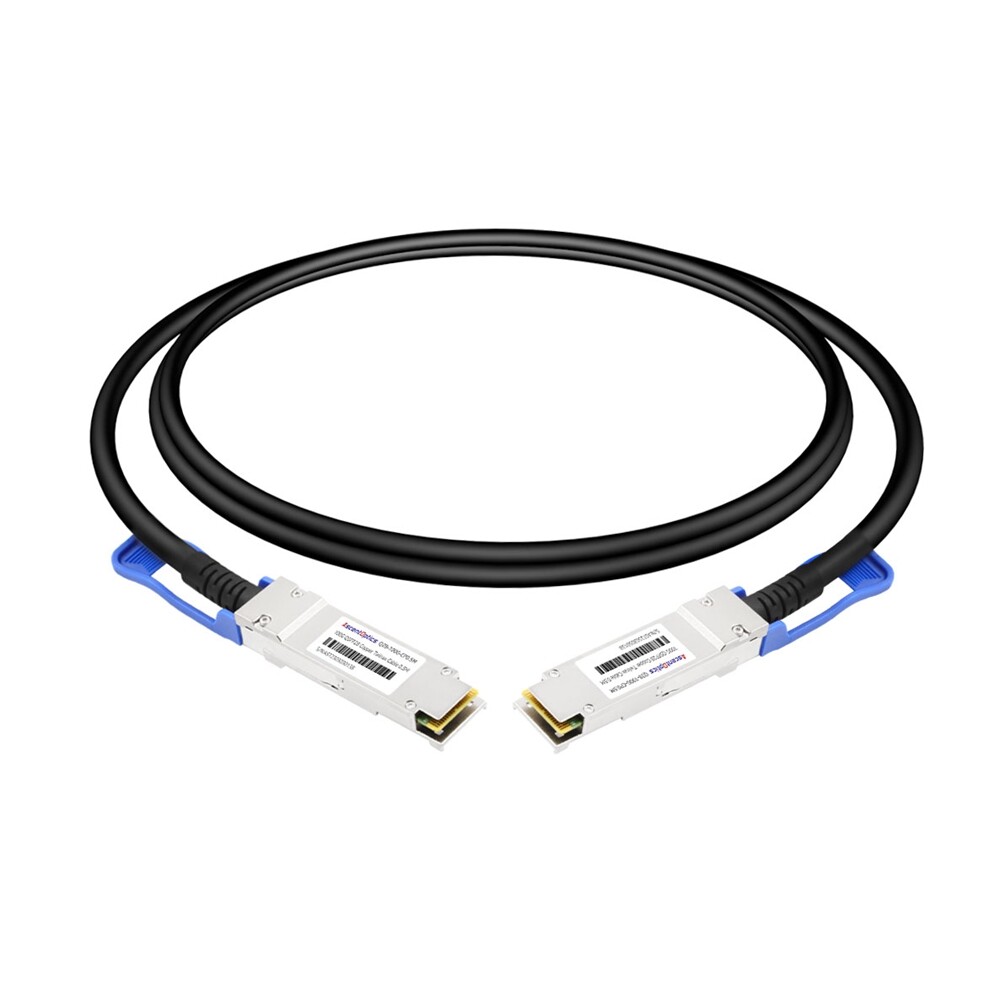
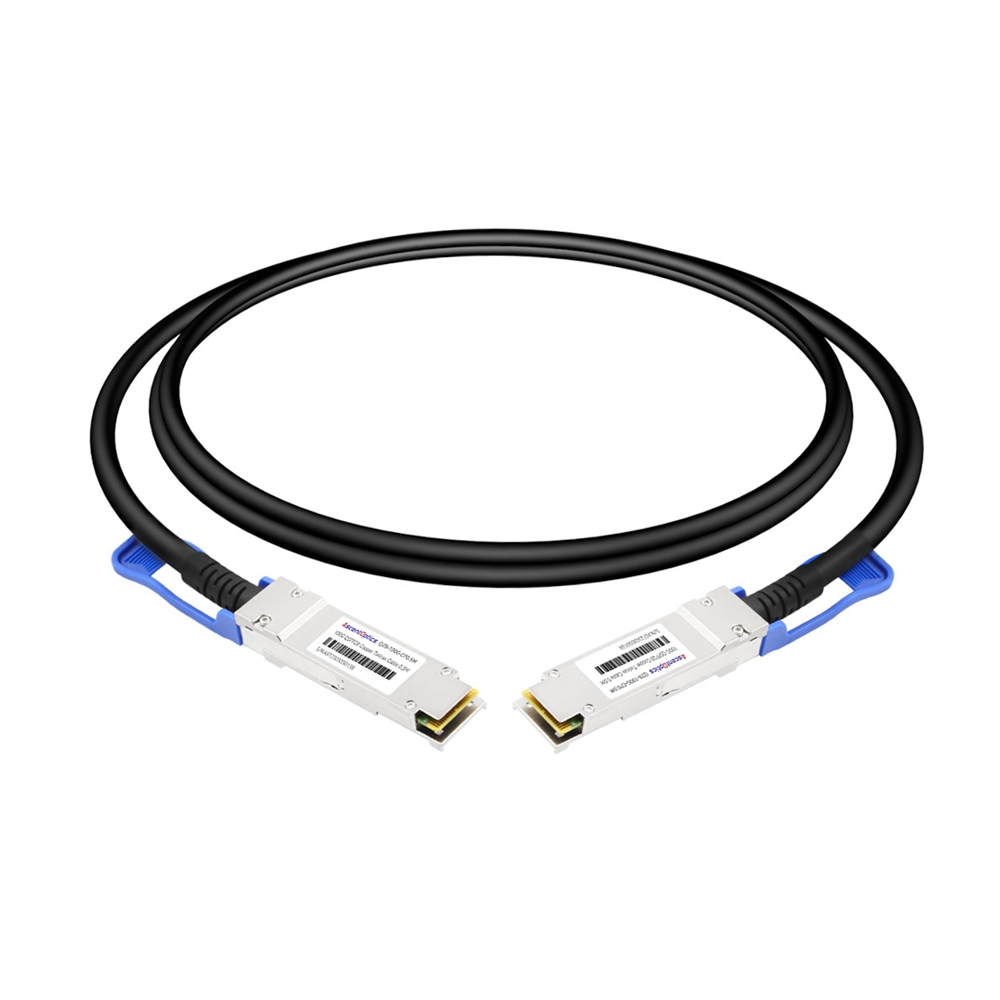
DAC stands for Direct Attach Copper. QSFP28 DAC (Direct Attach Cable) is a copper-based interconnect with integrated QSFP28 connectors on both ends, transmitting electrical signals with very low cost, low power consumption, and minimal latency, making it ideal for ultra-short distances (typically within 5 meters) such as intra-rack or adjacent rack connections.
Passive DAC Construction and Signal Path
Passive DACs use shielded twinaxial copper cables to transmit electrical signals directly between QSFP28 ports. With no active components, amplifiers, or optical engines in the connectors, they rely purely on the cable’s physical properties. Such electrical signals are then dispatched along the copper cable as current.
This passive situation does not involve any conditioning, hence is primarily limited by the cable’s attenuation. The most commonly referred-to range is between 1 to 3 meters, depending on the manufacturer. Some advice indicates it could reach up to 5 meters if you are adventurous enough.
Active DAC: When Copper Needs a Boost
The QSFP28 connectors have small conditioning chips inside them that help to amplify and balance electrical signals. In copper cables, the active DAC will then extend the range to between 7 to 10 meters.
Comparing active DACs with passive DACs, a given design of active DAC will require slightly more power yet still manage to draw much less power than AOC cables. Anecdotally speaking, an active DAC can idealize a good compromise between cost and power-efficient far-end connection.
Typical QSFP28 DAC Specifications
| Specification |
Passive DAC
|
Active DAC
|
| Reach |
1–5 m (up to 7 m in some cases)
|
5–10 m
|
| Power draw |
<0.5 W(often <0.15–0.5 W)
|
1.5 W–2.5 W
|
| Latency |
<0.1 μs(~10–50 ns)
|
~0.1–0.3 μs
|
| Weight |
Heavier
|
Heavier
|
| Cost |
Lowest
|
Low
|
What Is QSFP28 AOC?
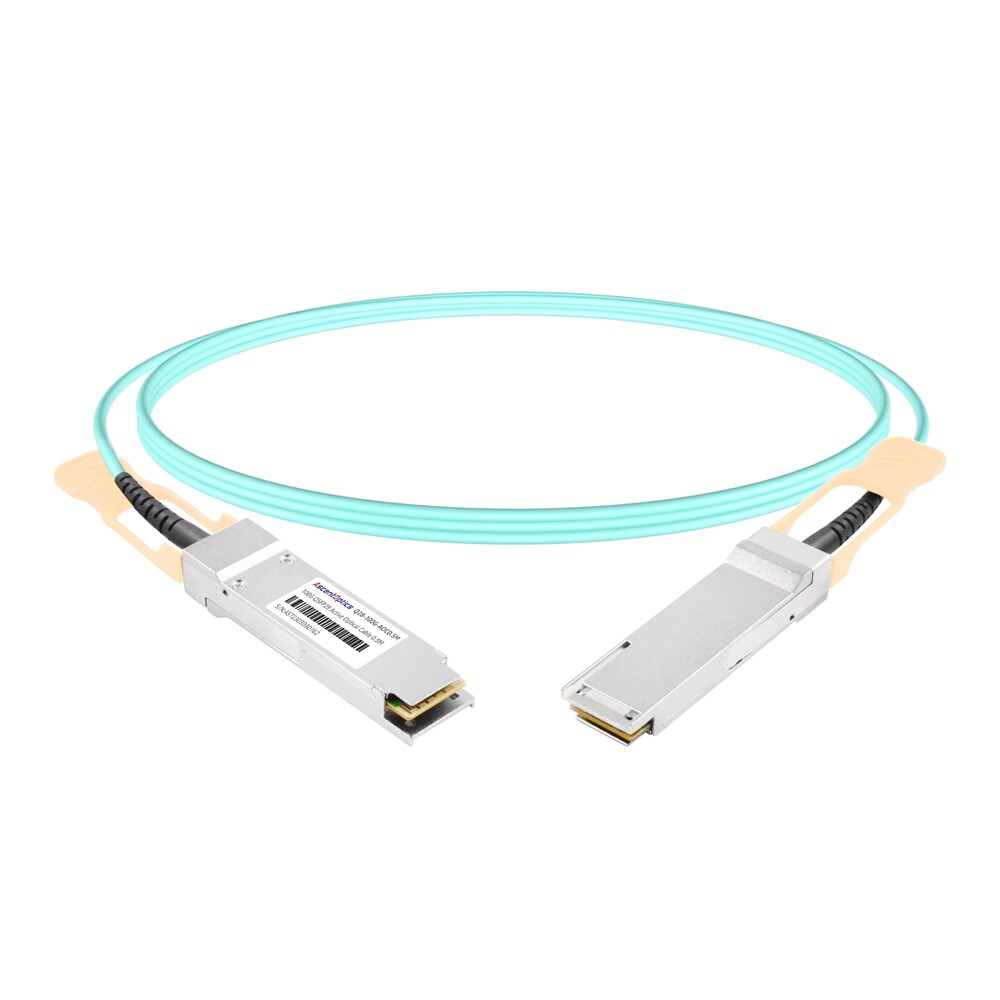
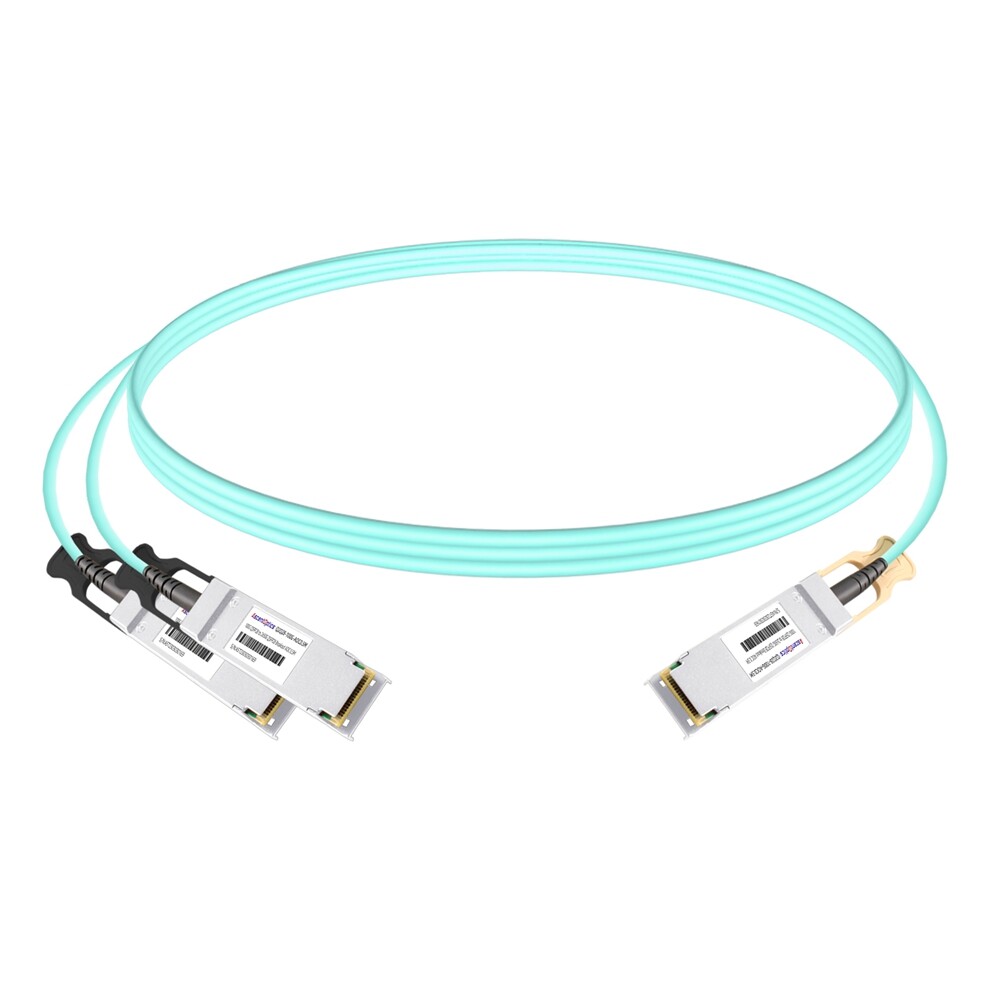
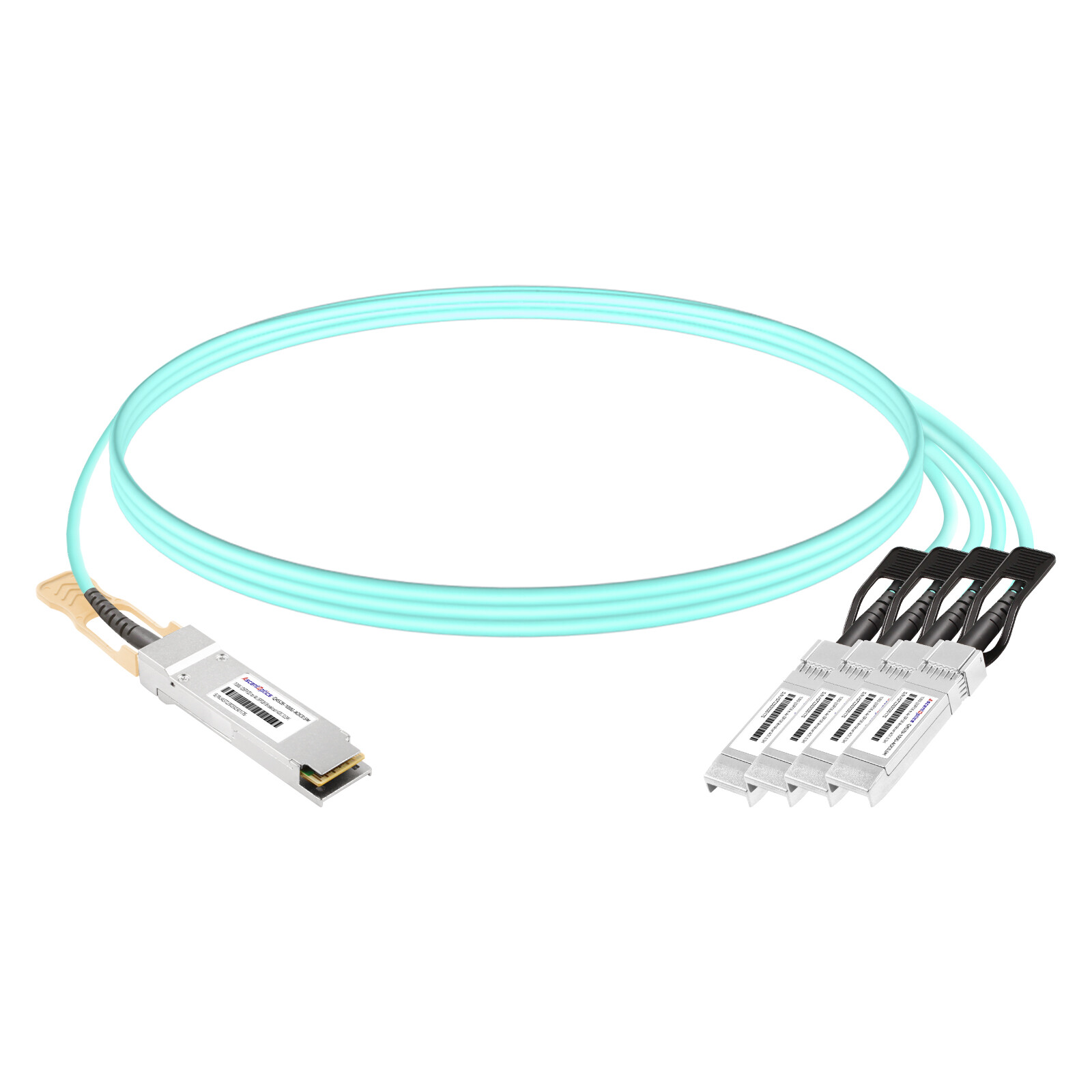
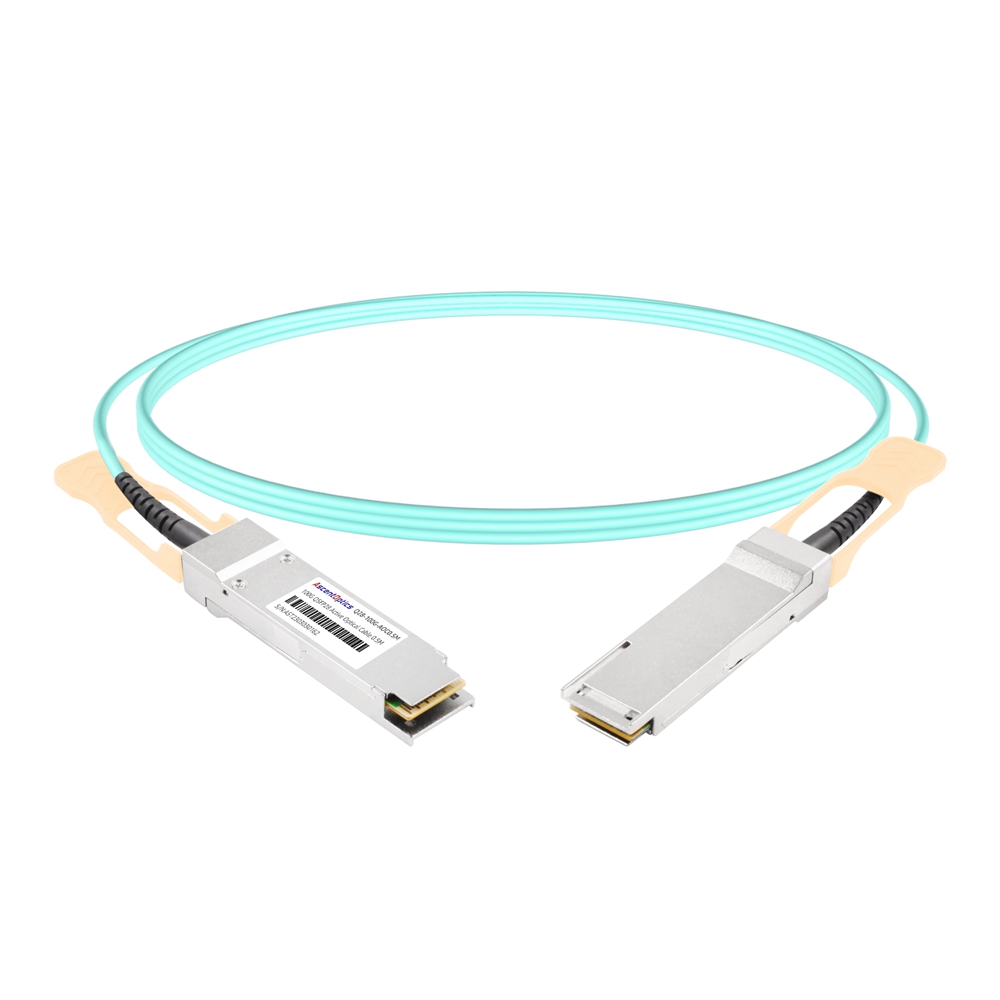
AOC (Active Optical Cable) integrates optical transceivers directly into the connectors at each end. Electrical signals are converted to optical signals inside the housing, transmitted over fiber, and converted back to electrical signals at the receiving end.
QSFP28 AOC enables signal conversion from electrical to optical and back, which supports longer transmission distances (up to 100 meters), better immunity to electromagnetic interference, and more flexible, lightweight cabling.
AOC Construction and Optical Engine
Each QSFP28 AOC connector contains a compact optical engine with lasers and photodetectors. It converts the four 25G electrical lanes into parallel optical signals. The multimode fiber provides excellent immunity to electromagnetic interference (EMI) and much lower signal loss than copper, enabling longer reaches.
Typical QSFP28 AOC Specifications
| Specification |
QSFP28 AOC |
| Reach |
30–100 m(OM3/OM4) |
| Power draw |
2–3.5 W (typically) |
| Latency |
~50–100 ns total |
| Weight |
Light |
| Cost |
Higher |
How AOCs Handle Longer Distances
Fiber’s low attenuation makes AOCs ideal for links beyond 10 meters, such as cross-aisle connections, distant server rows, or environments where copper performance degrades. For a broader view of 100G connectivity options, see our QSFP28 transceiver guide.
For a broader view of 100G connectivity options, see our QSFP28 transceiver guide.
QSFP28 DAC vs AOC: Head-to-Head Comparison
Here is how the two cable types compare across the factors that matter most in real-world deployments.
Distance and Reach
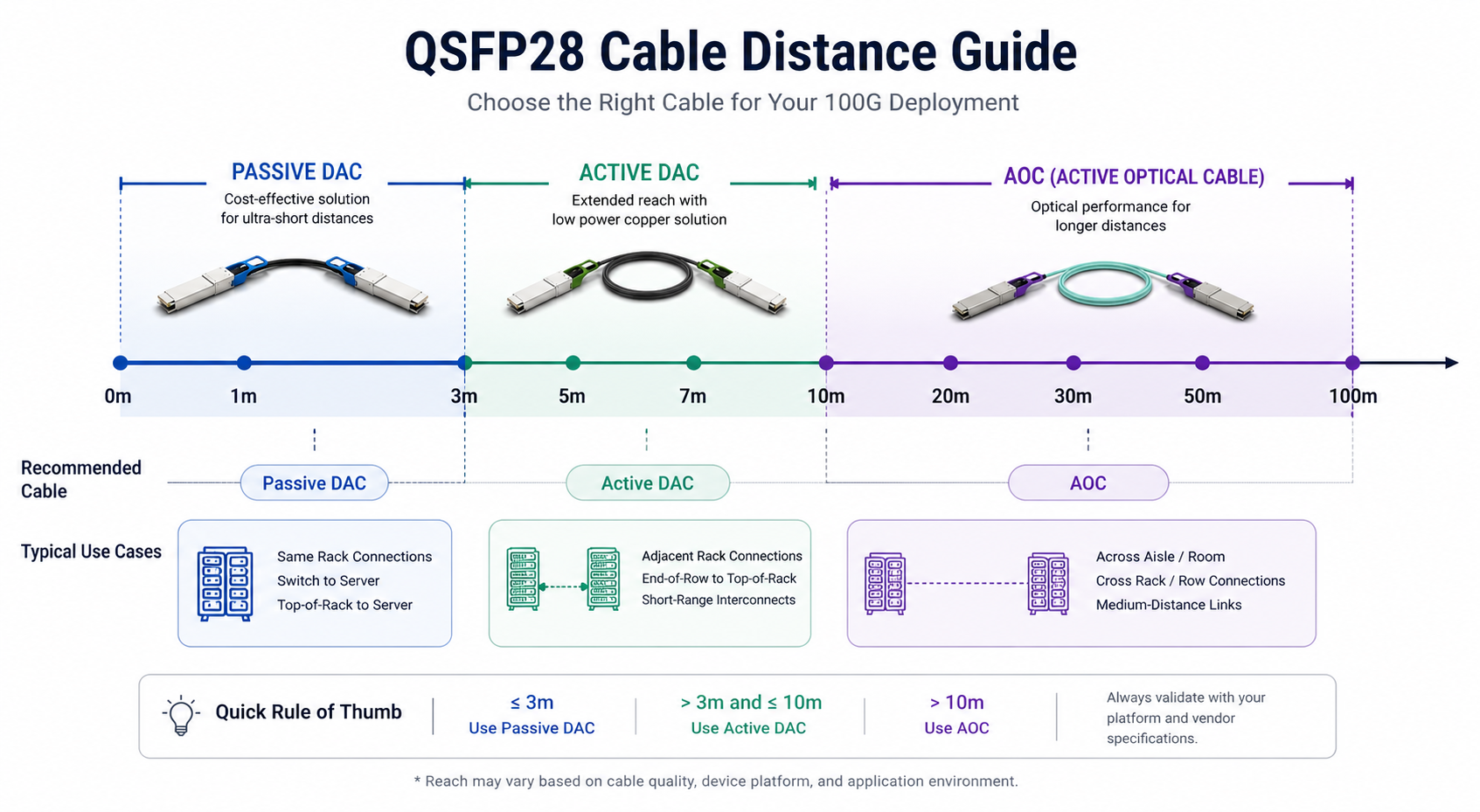
Copper physics limits DACs: passive versions are best under 5 meters, while active DACs can reliably reach 5–10 meters. AOCs are unaffected by copper’s limitations and support 30–100 meters reliably.
For a run of less than 3 meters, passive DAC seems to be the inevitable option to opt for. For 3 to 10 meters, active DAC usually strikes the best deal. For more than 10 meters, AOC is a decided requirement.
Power Consumption and Thermal Impact
Power is critical in high-density environments. A 64-port spine switch fully loaded with passive DACs adds very little cable power (often <32 W total). The same switch with AOCs can add 128–224 W or more. This delta can push thermally marginal racks into alarm territory, as Jennifer Park experienced.
Her AOC choice resulted in an extra ~180 W per 64-port switch, leading to inadequate cooling and the need for additional in-row units—erasing any upfront cable cost savings.
Latency and Signal Integrity
Passive DACs deliver the lowest latency (typically under 50–100 ns) with minimal signal processing. Active DACs add slight conditioning latency. AOCs introduce optical-electrical conversion delay (~50–150 ns total), but fiber propagation delay is negligible inside a data center. For HPC and high-frequency trading, passive DACs remain the preferred choice for ultra-short links.
Cost Comparison
Passive DACs offer the lowest cost per 100G link. Active DACs are moderately higher (20–50% more). AOCs typically cost significantly more (often 2–5x passive DACs for equivalent lengths), though the gap narrows when factoring in long-term cabling and management benefits.
Cable Weight and Rack Strain
Copper DACs are noticeably heavier. Bundles of 64 DACs can strain port cages and cable management arms. AOCs are roughly 1/3 to 1/2 the weight per meter, making them more flexible and easier to route in dense cabinets.
Environmental Resilience (EMI, Temperature, Vibration)
Copper DACs are susceptible to electromagnetic interference from nearby power cables, motors, or industrial equipment, which can cause bit errors or link flapping. AOCs are completely immune to EMI. They also offer better tolerance to temperature fluctuations and vibration, suiting manufacturing floors or telecom environments.
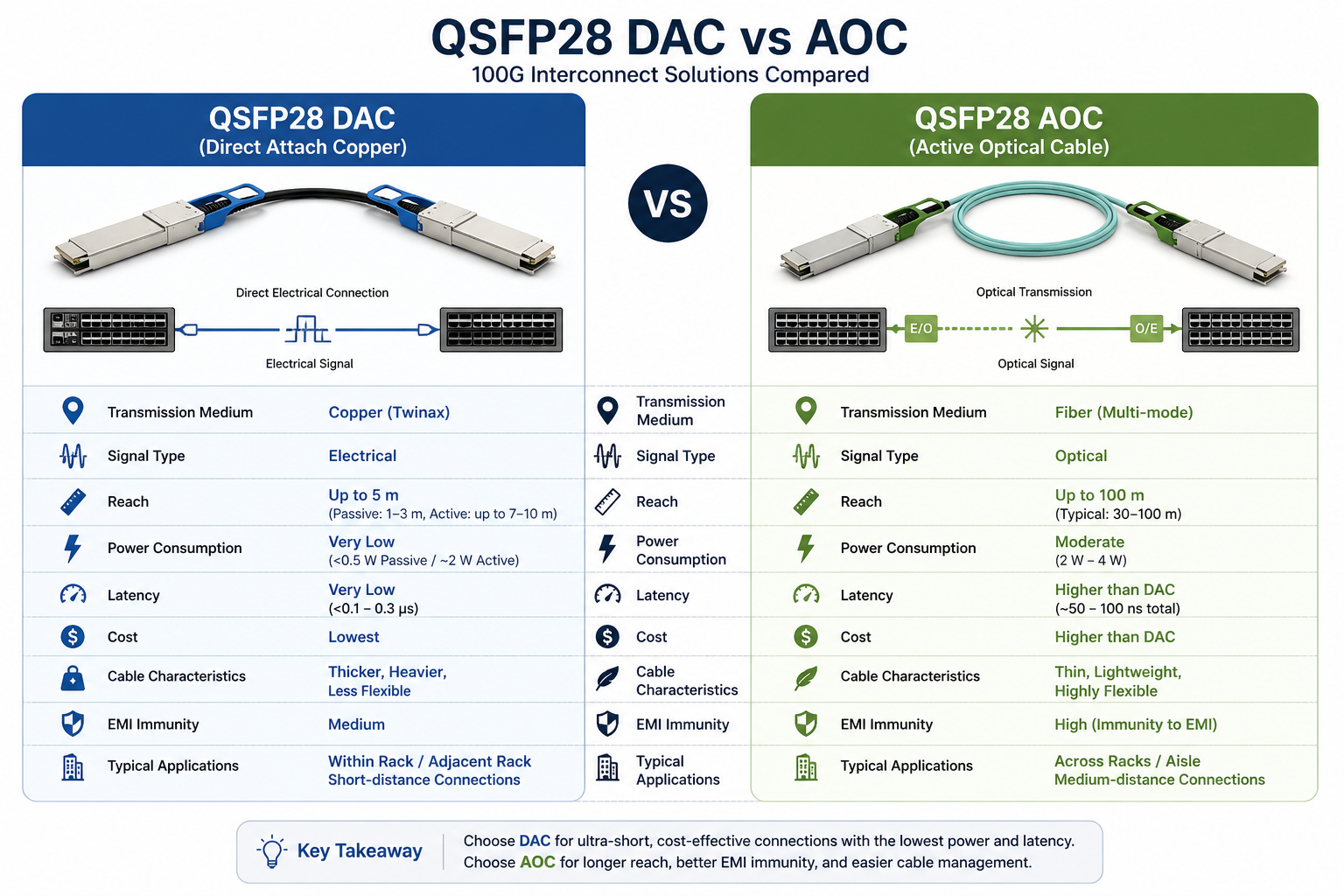
QSFP28 DAC vs AOC Quick Reference
| Factor |
Passive DAC
|
Active DAC |
AOC
|
| Distance |
1–3 m
|
5–10 m |
30–100 m
|
| Power draw |
<0.5 W
|
1.5 W–2.5 W |
2 W–3.5 W
|
| Latency |
<0.1 μs
|
~0.1–0.3 μs |
~50–150 ns
|
| Cost |
Lowest
|
Low |
Higher
|
| Weight |
Heaviest
|
Heavy |
Light
|
| EMI resistance |
Low
|
Low |
High
|
| Best for |
Same rack
|
Nearby racks |
Long runs / EMI
|
When to Choose QSFP28 DAC
DAC is the right choice in several common scenarios.
Same-Rack and Adjacent-Rack Deployments
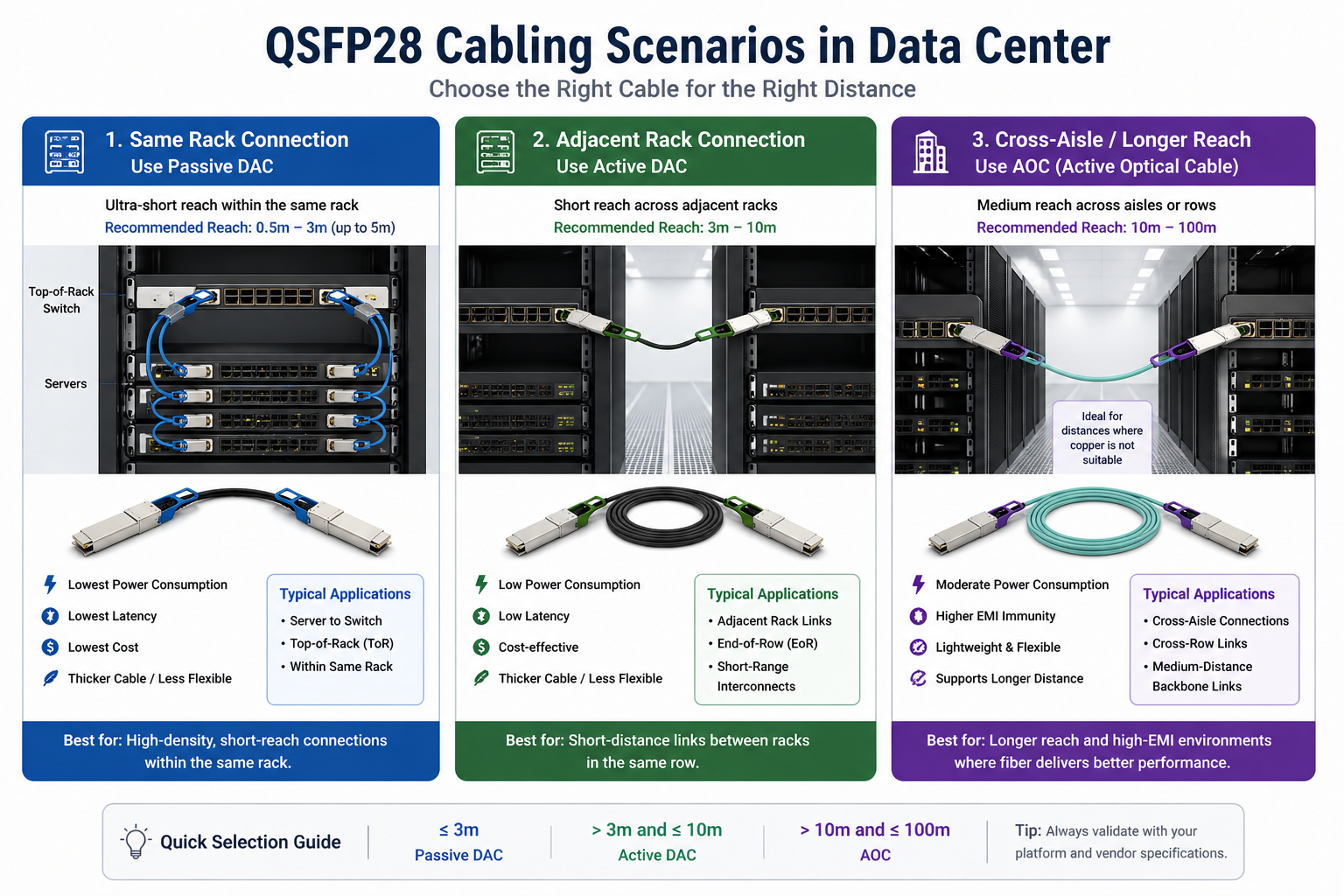
Generally, when the switch-to-server or switch-to-switch line is from the same rack or an adjacent rack, the passive DAC almost certainly makes the most sense. The distance is very small; the costs are the lowest, and the optics are not warranted.
Power-Constrained Environments
To keep the optical power draw as low as possible means that the power draw is quite limited in certain applications. This becomes crucial particularly for spine switches as in high-density configurations where it is critically essential for every watt.
Cost-Sensitive Projects
When deploying hundreds or thousands of links simultaneously, the rapidly escalating cost gap between DACs and AOCs is multifold, which ever increases compared to the price of AOCs that have about 60%-80% more on them.
Low-Latency Requirements
For applications where nanoseconds matter, such as high-frequency trading or HPC fabrics, passive DAC offers the lowest possible latency.
When to Choose QSFP28 AOC
AOC is the better choice when copper limitations become constraints.
Longer Distances Beyond 10 Meters
Going beyond a 10-meter range of transmission, active DACs are no longer sufficiently reliable and only AOCs can work. The longer run lengths are typically seen in massive data centers, cross-aisle interconnects, and rack laydowns.
Dense Cable Management
AOCs are thinner, lighter, and more flexible than copper cables. In dense leaf switches with 48 or 64 ports, AOCs are easier to route, place less mechanical stress on connectors and cables, and are the better option.
High-EMI Environments
Manufacturing floors, power substations, and telecom central offices often have high electromagnetic interference. AOCs are immune to EMI, while DACs may experience bit errors or link flapping.
As of 2024, David Chen is in charge of a network deployment scheme in a manufacturing plant based in Shenzhen. The production shop is equipped with CNC machines and welding robots. The team was using passive DACs, initially implemented purely on grounds of cost. Link flapping went haywire, especially during the night, when far-axis equipment ran full blast. They eventually switched to AOCs, and the EMI immune glass fibers settled the link-sway problem the moment they were in place.
Switch and Platform Considerations
Not all switches treat DAC and AOC identically. Understanding platform behavior can prevent surprises.
Do Some Switches Prefer DAC or AOC?
Many modern QSFP28 switches natively support both DAC and AOC. However, there are quirks in certain platforms’ firmware. Some switch ASICs auto-negotiate more or less reliably with AOCs over active DACs or vice versa. Always go through your switch model’s cable compatibility list from the vendor.
Firmware and Auto-Negotiation Differences
AOCs tend to announce respective functionalities using the QSFP28 EEPROM, which authenticates the switch negotiation of link parameters automatically. Certain active DACs may also employ an EEPROM that is much simpler and will necessitate the manual speed or FEC settings to be made on specific platforms.
Vendor-Specific Cable Validation
Cisco, Arista, and Juniper all publish validated cable lists. While third-party MSA-compliant cables usually work, using vendor-validated cables reduces the risk of link issues or support disputes.
For detailed switch-specific guidance, see our QSFP28 compatible switches guide.
Common DAC vs AOC Mistakes
Here are the mistakes we see most often in the field.
Assuming AOC Is Always “Better”
AOCs are not universally superior. For a 2-meter link in the same rack, an AOC wastes money, adds unnecessary power, and creates more cable bulk than a thin passive DAC.
Stretching DAC Beyond Its Rated Distance
A 5-meter passive DAC will sometimes link at 7 meters in a cold lab. In a hot data center with electromagnetic noise, that same cable may show CRC errors or flap under load. Do not exceed the manufacturer-rated distance.
Sarah Kim realized this in Los Angeles. She needed 6m from the leaf uplink to the row of nodes. In order to save on the budget, she decided to use 5m passive DACs. The links came up, passed the basic ping test, but under production load, three of the four lanes on multiple cables showed continuously rising CRC errors. The configuration was replaced with 7m active DACs which resolved the problem immediately. The “savings” in pushing to use passive DACs eventually cost her team four days of troubleshooting.
Ignoring Power Budgets in High-Density Switches
As Jennifer Park discovered, AOC power adds up fast. Always recalculate rack-level thermal load when moving from DAC to AOC at scale.
Forgetting Bend Radius on AOCs
AOCs are less stiff than Direct Attached Copper Cables (DACs), although they still possess critical minimum bend radii. The sharp 90-degree bends in a tangled cabling could damage inner fibers and cause dark lanes or intermittent errors.
QSFP28 DAC vs AOC Decision Framework
Use this framework to make the right choice quickly.
Decision Flowchart in Text Form
- 1. Is the link 5 meters or shorter? → Use passive DAC.
- 2. Is the link 5–10 meters? → Use active DAC unless EMI is severe.
- 3. Is the link beyond 10 meters? → Use AOC.
- 4. Is EMI or vibration a concern? → Use AOC regardless of distance.
- 5. Is power or thermal a tight constraint? → Prefer DAC where distance allows.
- 6. Is latency absolutely critical? → Prefer passive DAC for shortest links.
- 7. Is cable weight or density a problem? → Prefer AOC where distance requires it.
Quick-Reference Decision Matrix
| Scenario |
Recommended Cable |
Why |
| Same rack, ≤3 m |
Passive DAC |
Lowest cost, lowest power, lowest latency |
| Adjacent rack, 3–10 m |
Active DAC |
Best balance of distance and cost |
| Cross-aisle, >10 m |
AOC |
Only reliable option at distance |
| High EMI environment |
AOC |
Immune to interference |
| HPC / low-latency |
Passive DAC |
Minimal signal processing delay |
| Dense cable management |
AOC |
Lighter and more flexible |
| Power-constrained rack |
Passive/active DAC |
Lowest thermal load |
For breakout-specific cable guidance, read our QSFP28 breakout cable guide.
Conclusion
The QSFP28 DAC vs AOC decision is not about which technology is superior. It is about matching the right cable to your distance, power budget, environment, and cost constraints.
Key takeaways:
- •Use passive DAC for same-rack links under 5 It is the lowest cost, lowest power, and lowest latency option.
- •Use active DAC for links from 5to 10 meters. It extends copper reach without the cost and power of optics.
- •Use AOC for links beyond 10 meters or anywhere EMI, vibration, or cable weight is a concern.
- •Calculate power and thermal impact at scale. AOCs can add 100+ watts per high-density switch.
- •Respect rated distances. Stretching a DAC beyond its spec creates intermittent errors that are hard to diagnose.
Ready to choose the right QSFP28 cables? Explore Ascent Optics’ QSFP28 connectivity solutions and request a quote for your project.
Frequently Asked Questions
Q1. How do QSFP28 DAC cables differ from QSFP28 AOC cables?
DAC uses copper to transmit electrical signals directly, while AOC uses integrated optical engines and fiber to convert signals to light and back. DACs excel in short reach, low power, and low cost; AOCs provide longer reach, lighter weight, and EMI immunity.
Q2. When is DAC preferred over AOC for 100G?
For links under 10 meters where cost, power, and latency are priorities. Passive DAC is ideal for same-rack connections (<5 m), while active DAC suits up to ~10 m.
Q3. Do AOC cables require more power than DAC?
Yes. A typical QSFP28 AOC consumes 2–3.5 W per cable, compared to <0.5 W for passive DAC and 1.5–2.5 W for active DAC. In high-density switches, this can add over 100 W per chassis.
Q4. Is AOC better than DAC?
Not always. AOCs are superior for long distances, dense cabling, and high-EMI areas. DACs win for short links where cost, power, and latency matter most. The best choice depends on your specific use case.
Q5. Can I mix DAC and AOC in one switch?
Yes. Most QSFP28 switches support mixing different cable types across ports, as long as each link meets compatibility and performance requirements.
Q6. What is the latency difference between AOC and DAC?
Passive DACs offer the lowest latency (typically <100 ns). Active DACs add minor processing delay. AOCs add optical conversion latency for a total of ~50–150 ns—still negligible for most data center applications.
IEEE 802.3bm standards
Cisco Data Center Cabling Best Practices
Post Views: 1,643