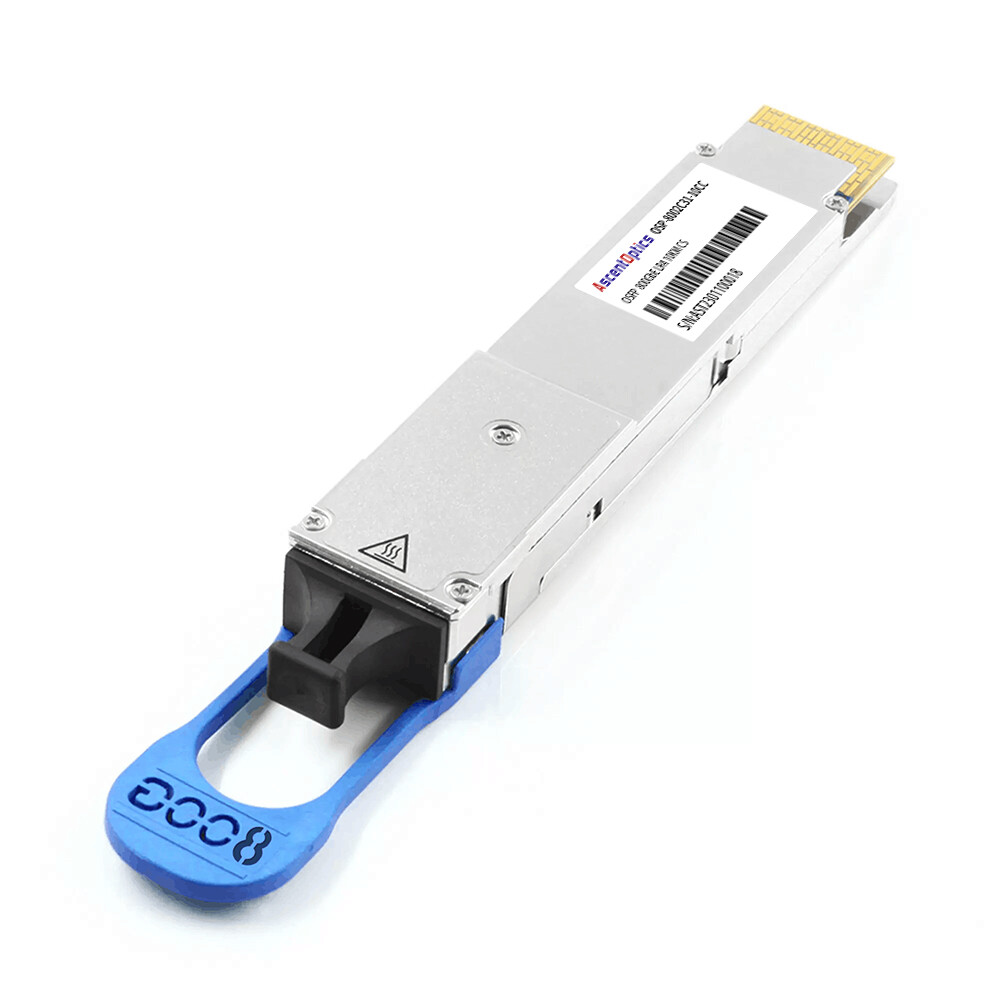
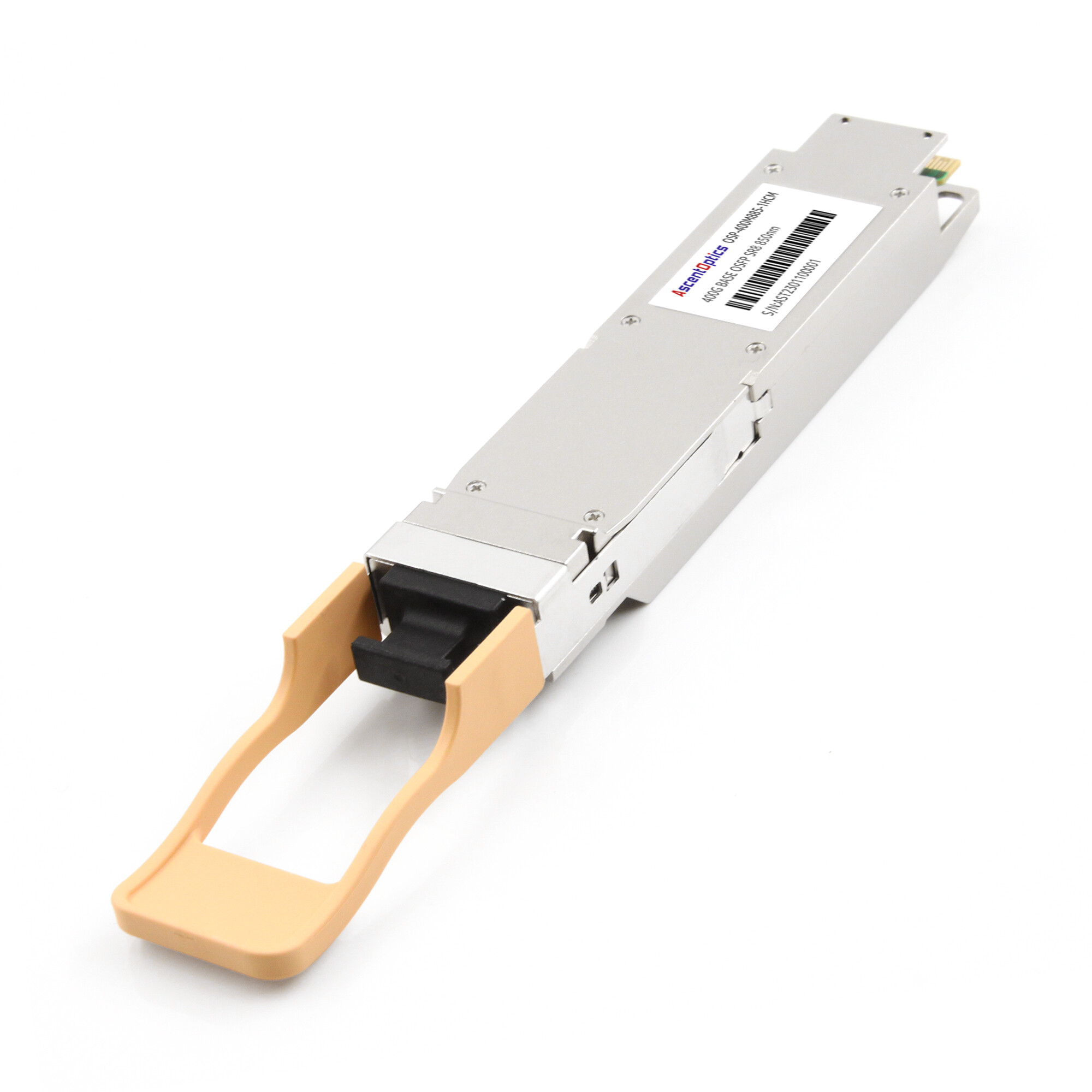
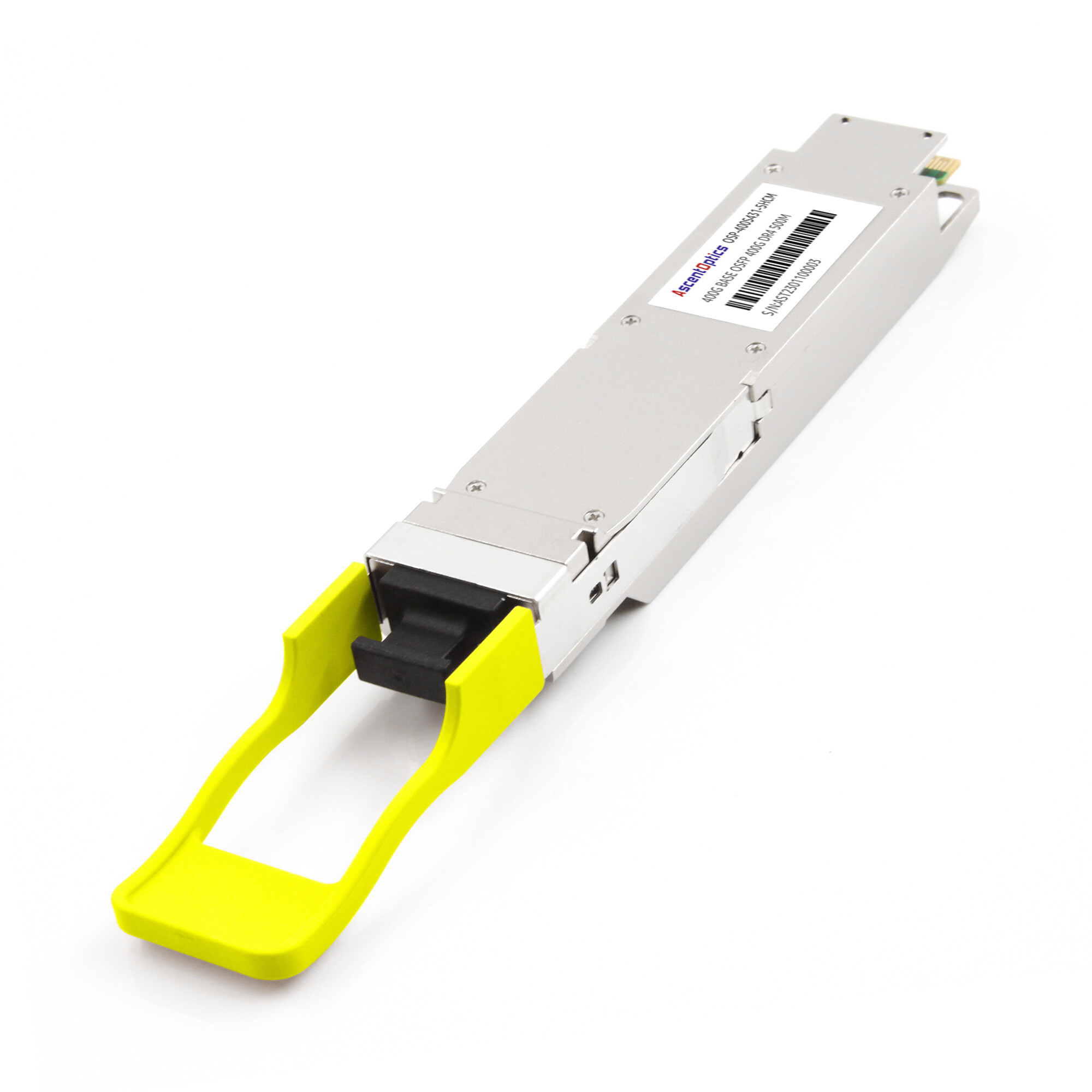
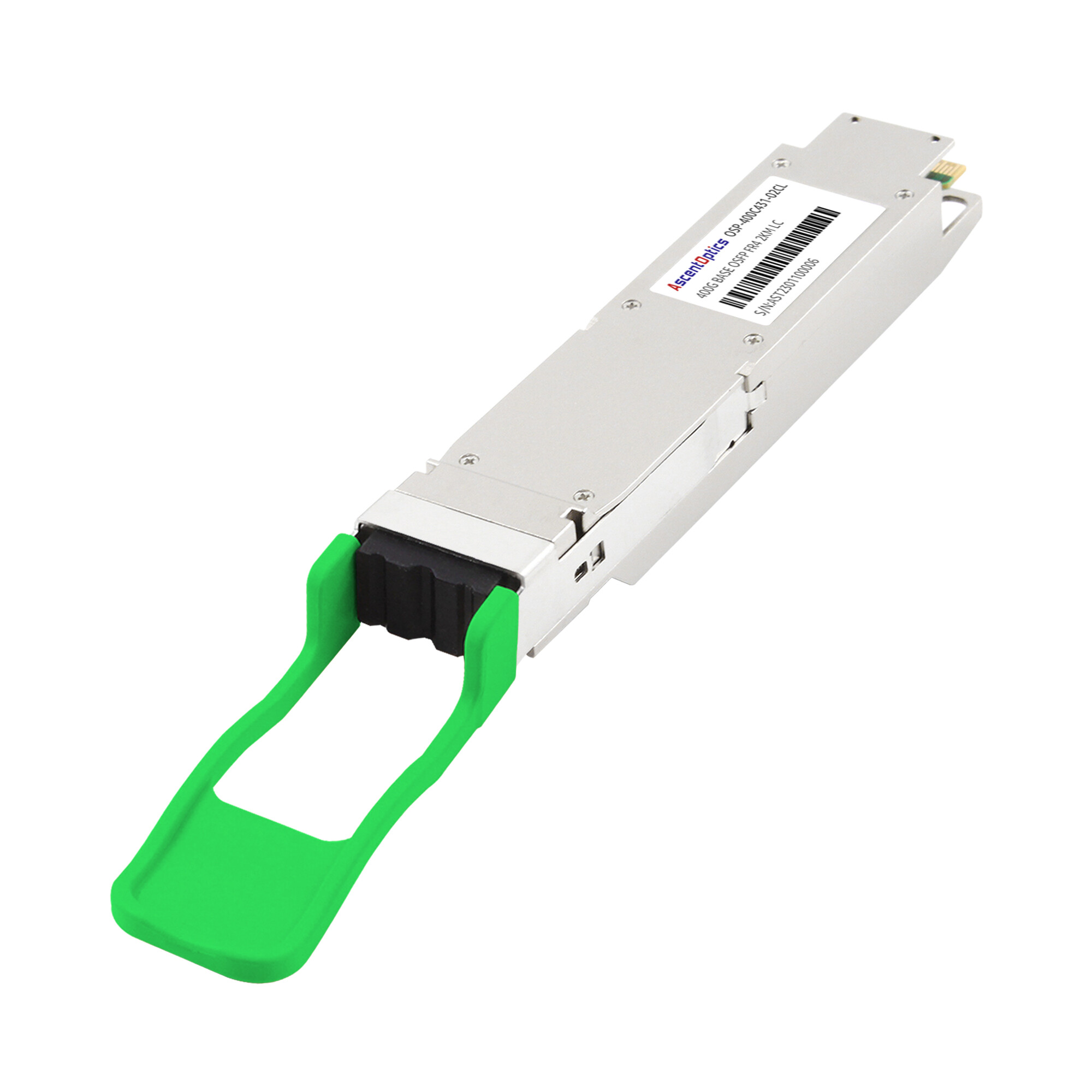
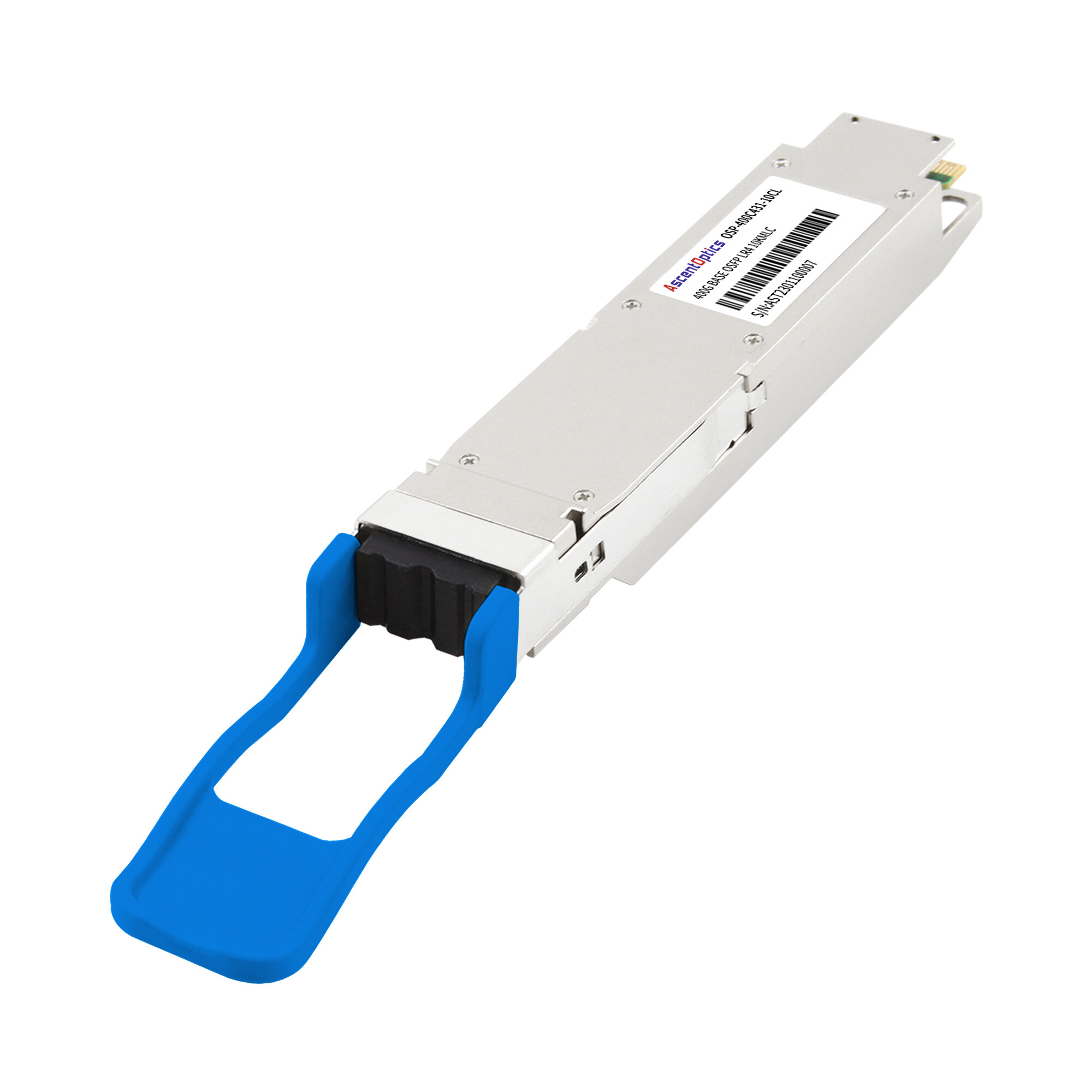
The price of an 800G optical module can vary significantly depending on the optical technology, transmission distance, form factor, fiber type, vendor, and order volume. A short-reach 800G SR8 module may cost substantially less than a 2 km or 10 km single-mode solution.
This guide explains the main factors that affect 800G optical module prices in 2026, compares different 800G variants, and looks at the total cost of deploying 800G compared with 400G and 100G solutions.
What Is an 800G Optical Module?
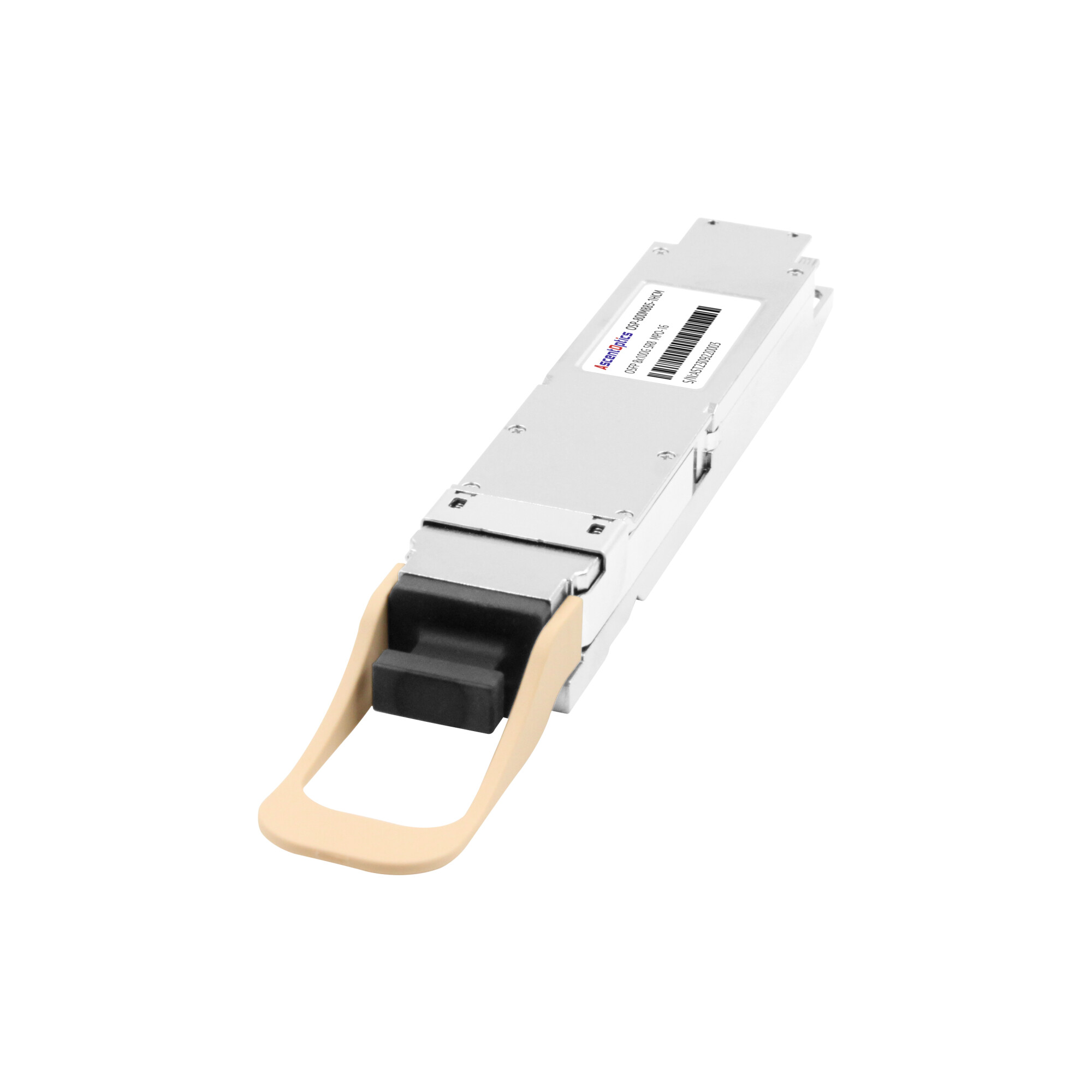
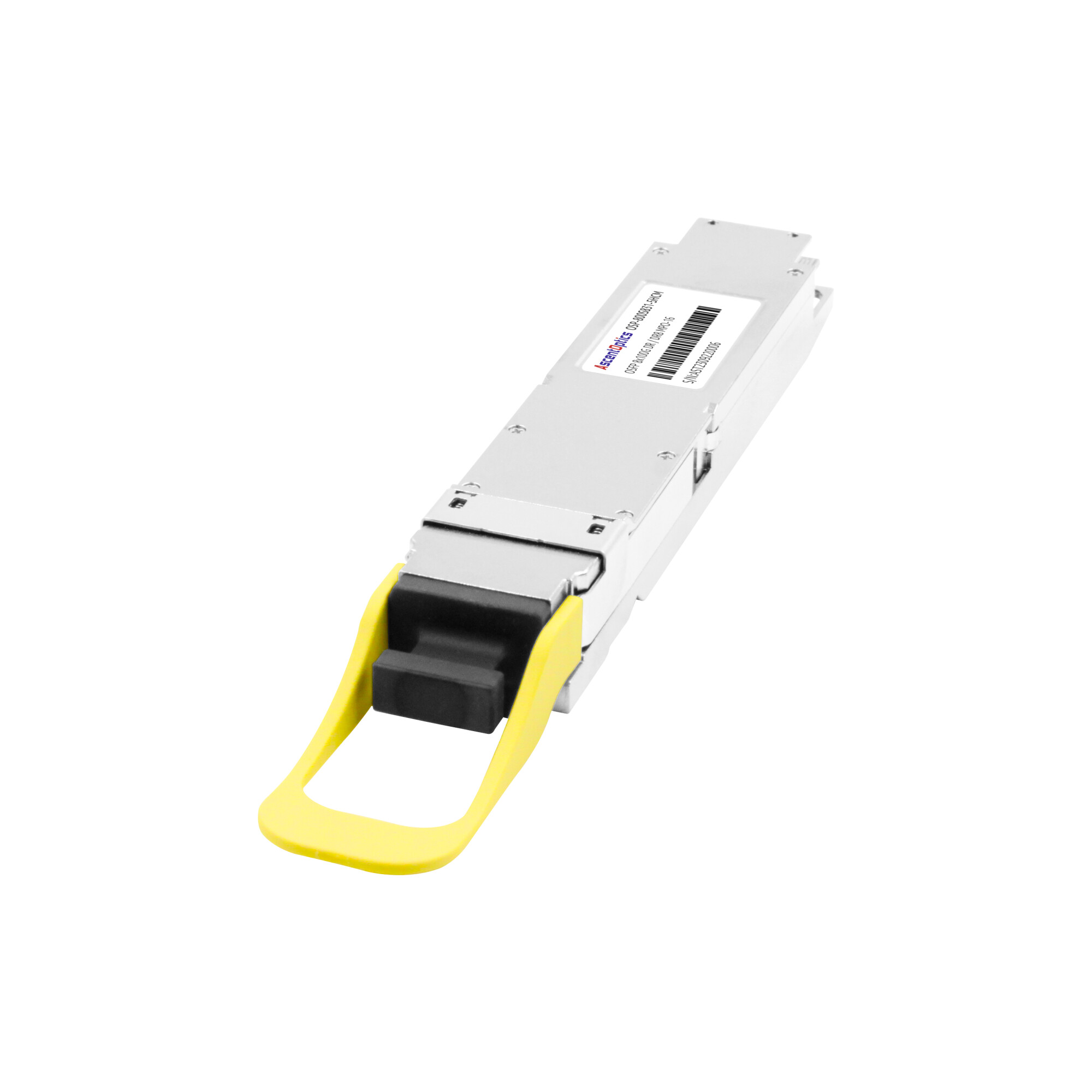
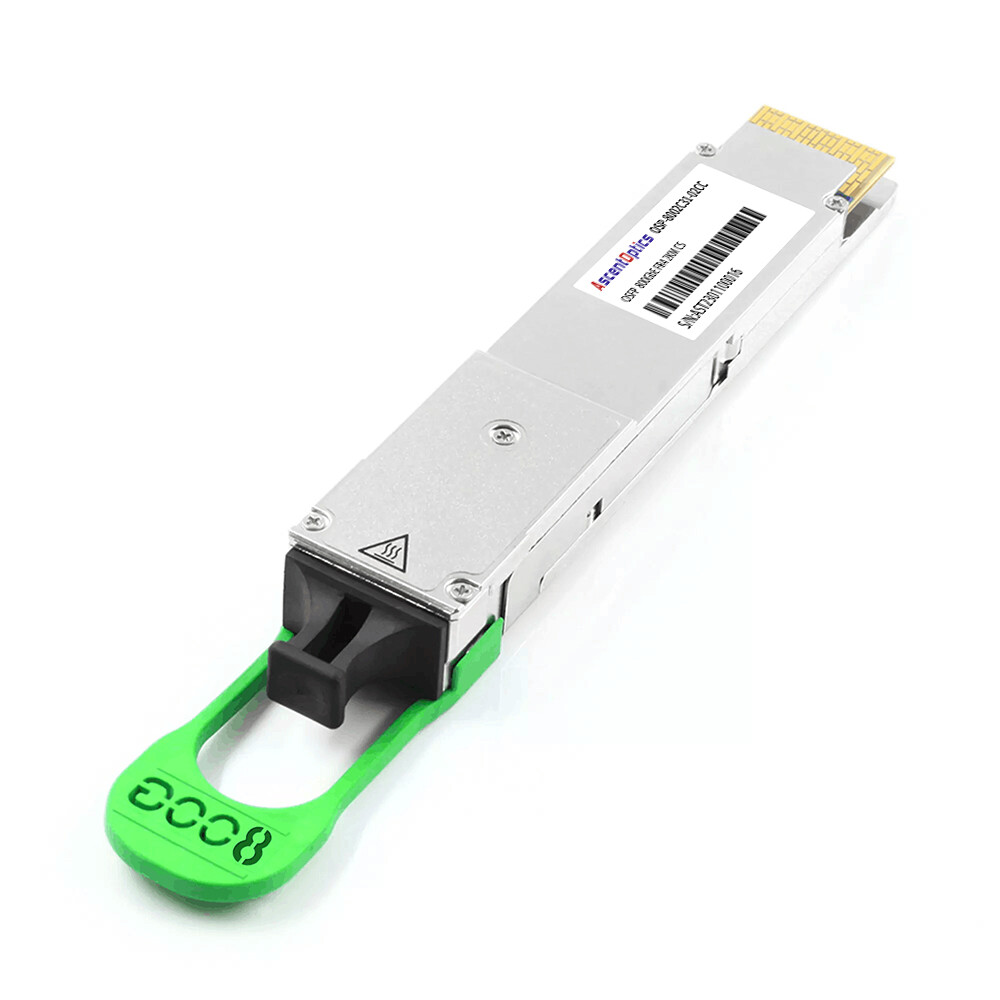
An 800G optical module is a high-speed pluggable transceiver designed to provide up to 800 Gb/s of aggregate data transmission. Depending on the module architecture, 800G solutions may use multiple 100G PAM4 lanes or higher-speed electrical/optical lanes.
Common 800G modules are available in form factors such as OSFP and QSFP-DD800, while specific products may use different electrical lane configurations and optical interfaces.
Depending on the optical design, 800G transceivers can support short-reach multimode links as well as longer single-mode fiber connections ranging from several hundred meters to several kilometers.
These modules are increasingly used in AI clusters, hyperscale data centers, high-performance computing, and high-bandwidth spine-leaf networks, where higher port speeds can reduce the number of switch ports and physical connections required.
Why 800G Optical Module Prices Vary
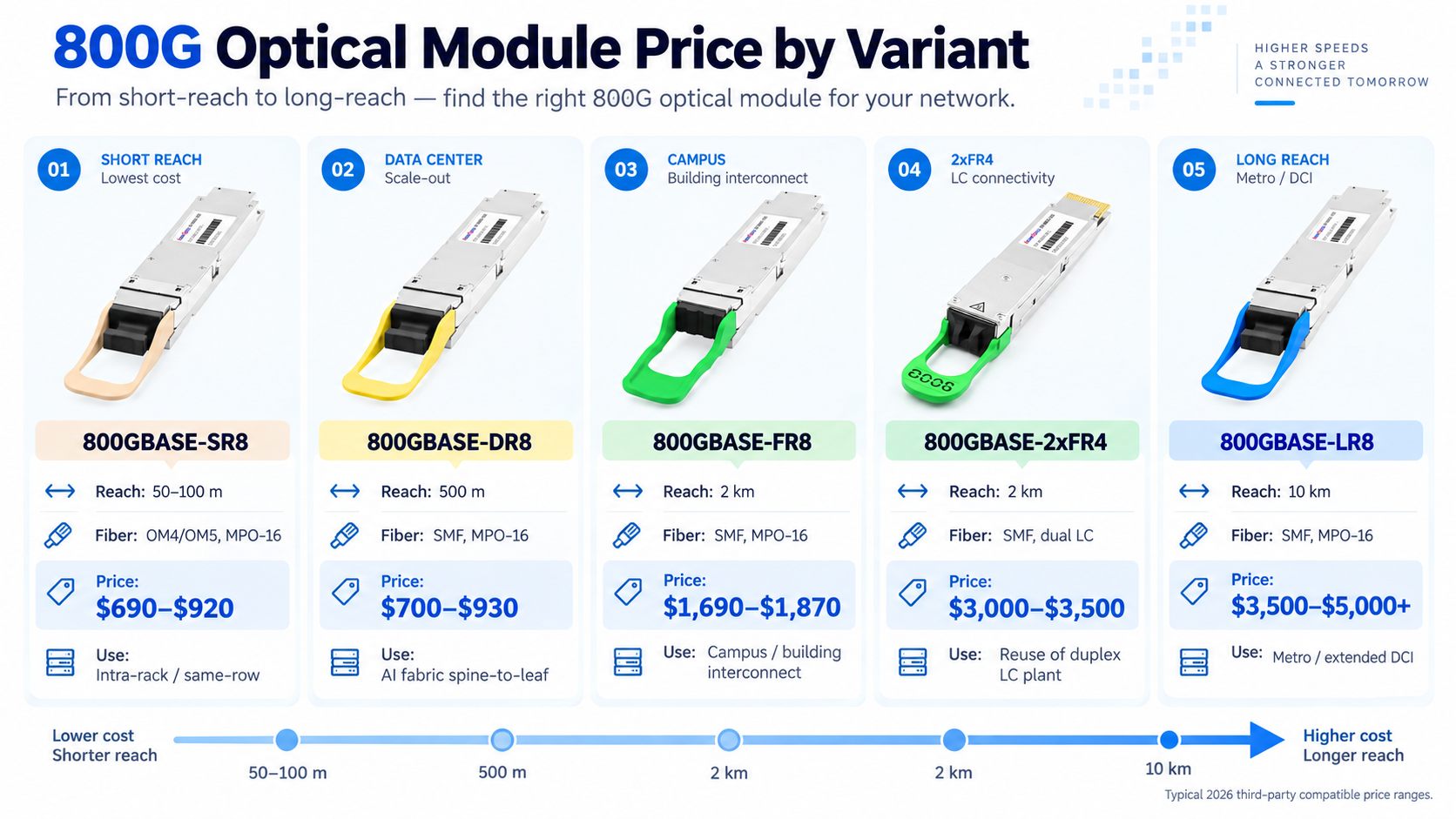
There is no single market price for an 800G optical module. The price difference between two 800G products can be substantial because of several factors.
Transmission Distance and Optical Technology
Transmission distance is one of the most important cost factors.
Short-reach solutions such as 800G SR8 are designed for multimode fiber and relatively short data-center links. They generally use simpler optical components than longer-reach single-mode solutions.
By comparison, DR8, FR8, and LR8 solutions are designed for longer single-mode transmission and may require more sophisticated laser, wavelength, and optical components. As reach increases, optical complexity and manufacturing cost generally increase as well.
Fiber Type and Connector
The fiber infrastructure also affects the overall cost.
Short-reach 800G solutions commonly use multimode fiber and high-density MPO/MTP-style connectors. Longer-reach solutions generally use single-mode fiber and may use MPO/MTP or duplex LC interfaces depending on the optical architecture.
Existing cabling should therefore be considered before selecting an 800G module. Choosing a module that matches the installed fiber and connector infrastructure can reduce the need for additional cabling.
Form Factor
The form factor can also influence both module price and system-level cost.
OSFP is widely used for high-density 800G networking and provides a relatively large thermal envelope. It is also positioned for future higher-speed networking applications.
QSFP-DD800 provides high port density and maintains a compact QSFP-based form factor, making it attractive for applications where rack density and compatibility with existing equipment are important.
The best choice depends on the switch platform, thermal design, port density, and network architecture rather than module price alone.
Vendor and Supply Chain
Vendor positioning has a major impact on the final purchase price.
The same 800G optical technology may be available through an original equipment manufacturer (OEM), an authorized distributor, or a third-party compatible supplier. Their pricing structures can differ considerably because they include different levels of validation, support, inventory, and warranty.
For this reason, buyers should compare actual quotations rather than relying only on public list prices.
Order Volume and Lead Time
Purchase volume is another important factor.
A small enterprise order may receive a substantially different quotation from a data-center deployment involving hundreds or thousands of modules. Volume commitments, forecast agreements, and long-term supply contracts can often improve pricing and supply availability.
Lead time can also affect the effective cost. During periods of constrained component supply, buyers may face higher prices or longer delivery times, particularly for specialized or longer-reach 800G products.
800G Optical Module Price by Variant
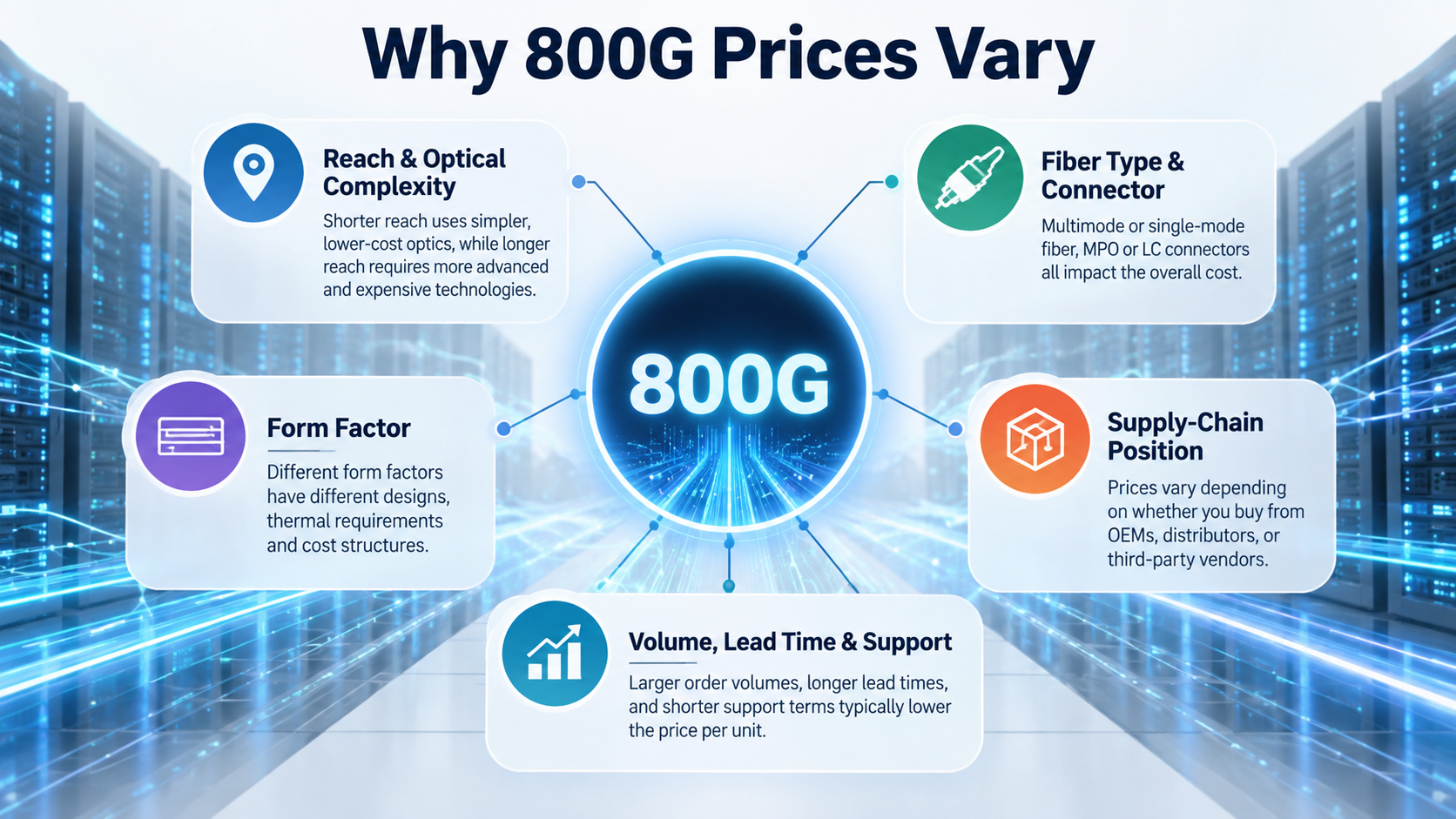
The following ranges should be treated as indicative market ranges rather than fixed prices. Actual quotations vary by vendor, compatibility coding, order quantity, warranty, region, and supply conditions.
| 800G Variant |
Typical Reach |
Fiber / Interface |
Relative Price |
Typical Application |
| 800G SR8 |
Up to 100 m |
MMF, MPO/MTP |
Lower |
Intra-rack and short data-center links |
| 800G DR8 |
Up to 500 m |
SMF, MPO/MTP |
Lower–Medium |
AI fabric and data-center spine-leaf links |
| 800G FR8 |
Up to 2 km |
SMF, MPO/MTP |
Medium–High |
Data-center and campus interconnects |
| 800G 2×FR4 |
Up to 2 km |
SMF, duplex LC |
High |
Applications requiring duplex LC connectivity |
| 800G LR8 |
Up to 10 km |
SMF, optical interface depends on design |
Higher |
Extended data-center and DCI applications |
In general, shorter-reach 800G modules are more cost-effective, while longer-reach solutions command a premium because of their more complex optical components.
For AI data-center networks where the link distance is within the supported reach, DR8 can offer an attractive balance between transmission distance and cost.
OEM vs. Third-Party 800G Optical Modules
One of the most important purchasing decisions is whether to use OEM-branded optics or qualified third-party compatible modules.
OEM modules typically include platform validation, vendor support, warranty coverage, and compatibility assurance. These services contribute to a higher purchase price.
Third-party compatible modules can reduce acquisition costs, particularly when the network platform is well established and the supplier provides appropriate coding, testing, and warranty support.
However, price should not be the only consideration. Buyers should evaluate:
- •Switch and transceiver compatibility
- •Optical performance
- •DOM/DDM support
- •Firmware and coding requirements
- •Interoperability testing
- •Warranty and replacement policy
- •Supplier production capacity
- •Lead time and long-term availability
For large-scale deployments, validating samples before placing a high-volume order can significantly reduce compatibility risks.
800G Cost per Gigabit: 800G vs. 400G vs. 100G
Comparing module prices only on a per-unit basis can be misleading.
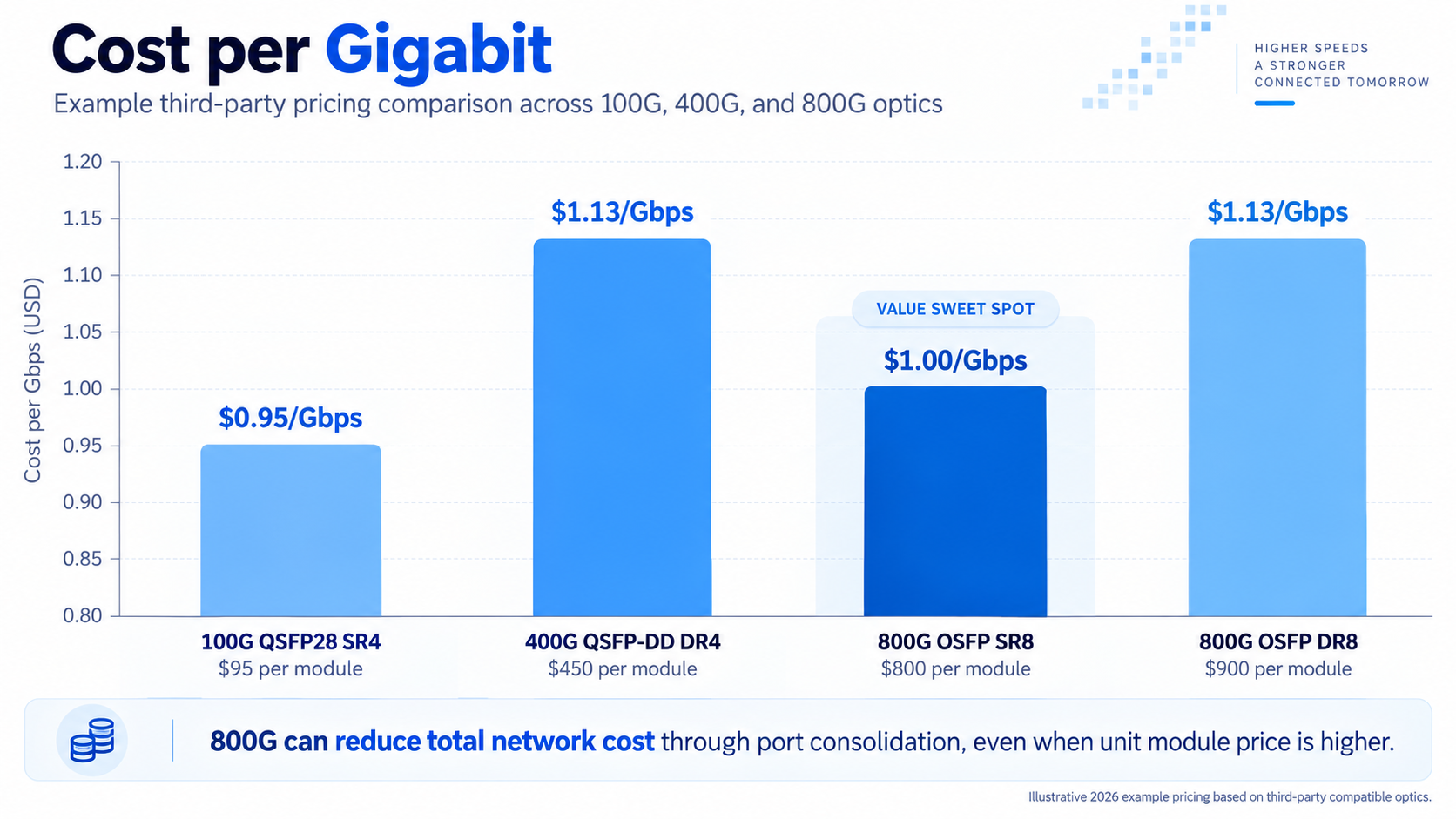
For example, suppose an 800G module costs $800. Its simple cost per gigabit is:
$800 ÷ 800 Gb/s = $1.00/Gb/s
A 400G module priced at $450 would have:
$450 ÷ 400 Gb/s = $1.13/Gb/s
A 100G module priced at $95 would have:
$95 ÷ 100 Gb/s = $0.95/Gb/s
This shows why cost per gigabit alone is not enough to determine the most economical solution.
An 800G port provides twice the bandwidth of a 400G port and eight times the bandwidth of a 100G port. As network speeds increase, port consolidation can reduce the number of switch ports, transceivers, cables, and physical connections required.
| Speed |
Example Module |
Example Price |
Simple Cost per Gb/s |
| 100G |
QSFP28 SR4 |
$95 |
$0.95 |
| 400G |
QSFP-DD DR4 |
$450 |
$1.13 |
| 800G |
OSFP SR8 |
$800 |
$1.00 |
| 800G |
OSFP DR8 |
$900 |
$1.13 |
These figures are examples for illustrating the calculation, not fixed market prices.
Why 800G Can Reduce Total Network Cost
The main financial advantage of 800G is not necessarily a lower module price.
Consider two networks with equivalent aggregate port bandwidth. A 32-port 800G switch provides the same theoretical port bandwidth as a 64-port 400G switch.
Using 800G can therefore reduce the number of high-speed switch ports and associated optical connections required for the same aggregate bandwidth.
This can affect several areas of the total cost of ownership (TCO):
- •Optical module count
- •Switch port requirements
- •Fiber and cable count
- •Rack space
- •Power consumption
- •Network complexity
- •Installation and maintenance
As a result, a more expensive 800G module can still provide a lower system-level cost per bit than a larger number of lower-speed modules.
Volume Pricing and Procurement Strategy
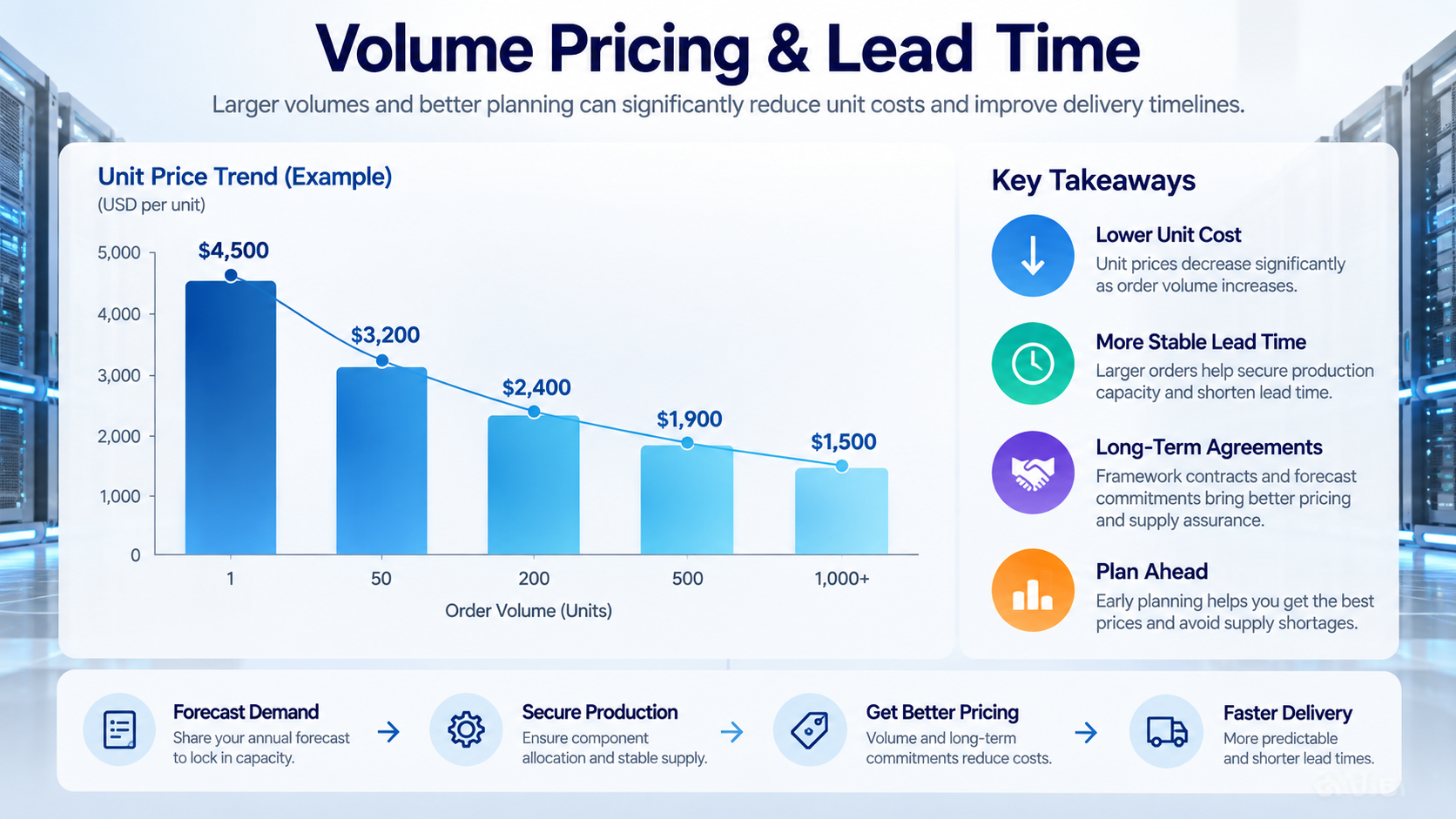
For large 800G deployments, purchasing strategy can have a significant impact on the final cost. Instead of comparing only one-unit or small-quantity prices, buyers should request quotations at several volume levels to understand how pricing changes with order size.
For example, suppliers can be asked to quote different quantities such as 50, 200, 500, and 1,000 units. Larger orders may provide better unit pricing, while long-term forecasts can help suppliers plan component procurement and production capacity.
Buyers should also consider lead time, warranty, compatibility testing, and supply continuity when evaluating quotations. A slightly higher unit price may be worthwhile if it comes with shorter lead times, stronger technical support, or more reliable long-term supply.
A practical procurement strategy should therefore compare unit price, volume discounts, lead time, compatibility, warranty, and total cost of ownership together rather than focusing on the initial purchase price alone.
How to Choose the Most Cost-Effective 800G Module
The lowest-priced module is not always the most economical option. Buyers should consider the required transmission distance, fiber infrastructure, switch compatibility, and deployment environment before comparing prices.
For short intra-data-center connections, 800G SR8 can be an attractive option when existing multimode fiber supports the required distance. For single-mode AI fabrics requiring several hundred meters of reach, DR8 can provide a good balance between transmission distance and cost.
For links extending to approximately 2 km, FR8 or 2×FR4 may be appropriate depending on the required fiber and connector architecture. For longer data-center interconnects, LR8 and other extended-reach solutions may be necessary despite their higher optical cost.
It is also important to consider the total deployment cost, including transceivers, fiber, cabling, power, and maintenance. The right 800G module is therefore the one that meets the network requirements while delivering the best overall value, rather than simply the lowest unit price.
Conclusion
The price of an 800G optical module depends on much more than its 800G data rate. Reach, optical architecture, form factor, fiber interface, vendor, order volume, and supply conditions can all significantly affect the final quotation.
For buyers, the best approach is to compare module price, cost per gigabit, compatibility, lead time, and total network cost together. As AI and hyperscale data centers continue moving toward higher-speed connectivity, 800G can provide an effective way to increase bandwidth while reducing port and cabling requirements.
Frequently Asked Questions
How much does an 800G optical module cost?
There is no universal price. In 2026, the cost can vary significantly by optical type, reach, vendor, compatibility, order quantity, and supply conditions. Short-reach modules generally cost less than longer-reach solutions.
What is the cheapest 800G optical module?
Short-reach 800G SR8 is generally among the lower-cost 800G options because it is designed for relatively short multimode links.
Is 800G cheaper per gigabit than 400G?
It can be. Although an 800G module normally costs more per unit, it provides twice the bandwidth of a 400G module and can reduce port, cabling, and transceiver requirements.
Are third-party 800G optical modules cheaper than OEM modules?
Generally, yes. Third-party compatible modules can offer lower acquisition costs, but buyers should verify compatibility, optical performance, warranty, and interoperability before deployment.
Can third-party 800G modules work with Cisco, Arista, Juniper, or NVIDIA equipment?
They can, provided that the specific module is compatible with the target platform and meets its coding and interoperability requirements. Compatibility should be confirmed for the exact switch and transceiver combination.
What factors have the biggest impact on 800G module prices?
Transmission distance, optical technology, form factor, fiber interface, vendor, order quantity, supply conditions, and compatibility requirements are among the most important factors.
Should I compare 800G modules by unit price or cost per gigabit?
Both should be considered. Unit price is important for procurement, while cost per gigabit and system-level TCO provide a better view of the economics of a large network deployment.
Post Views: 1,054