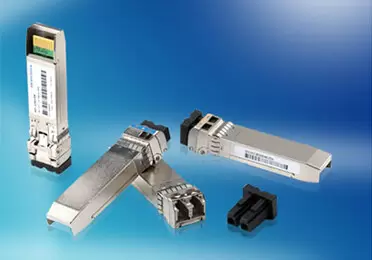
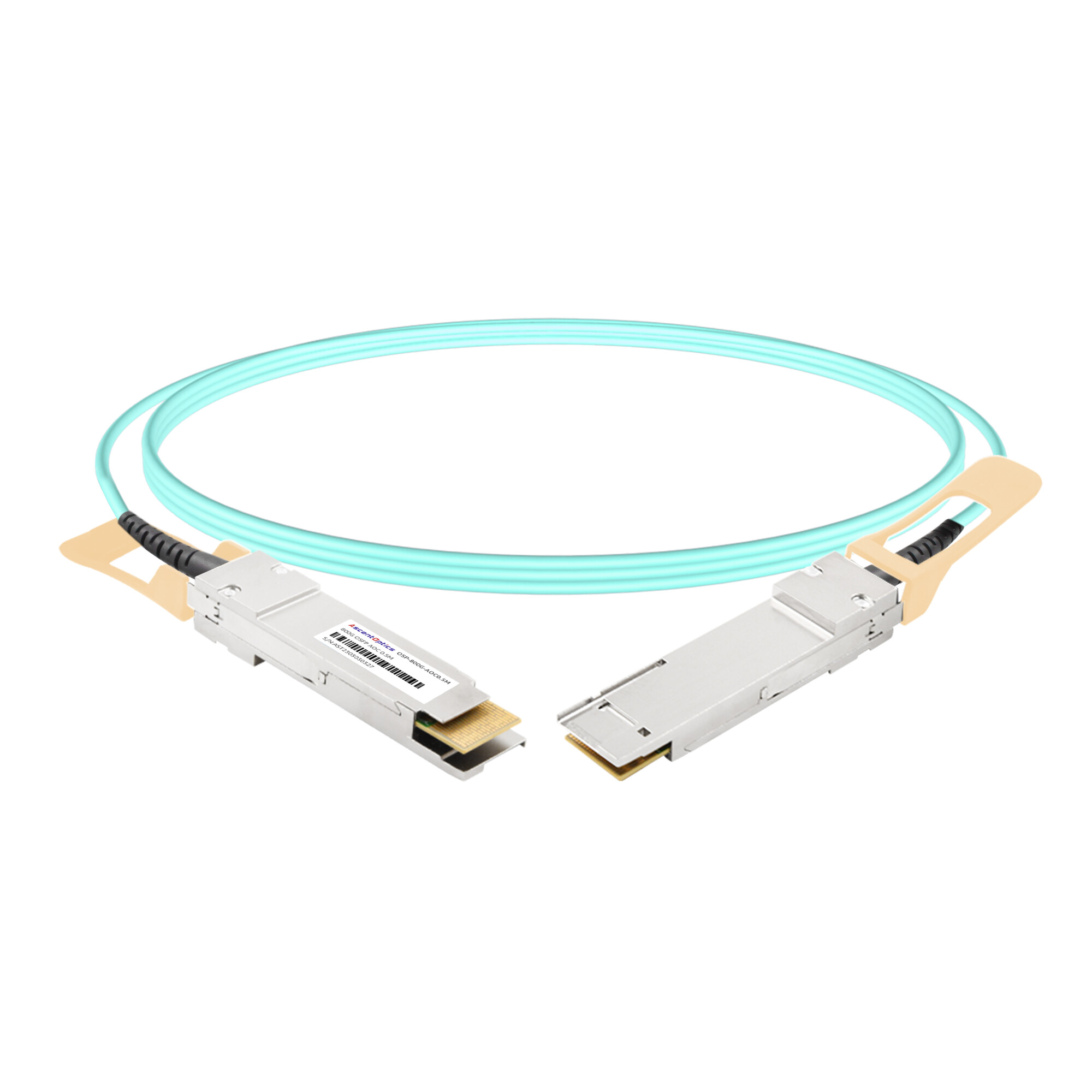
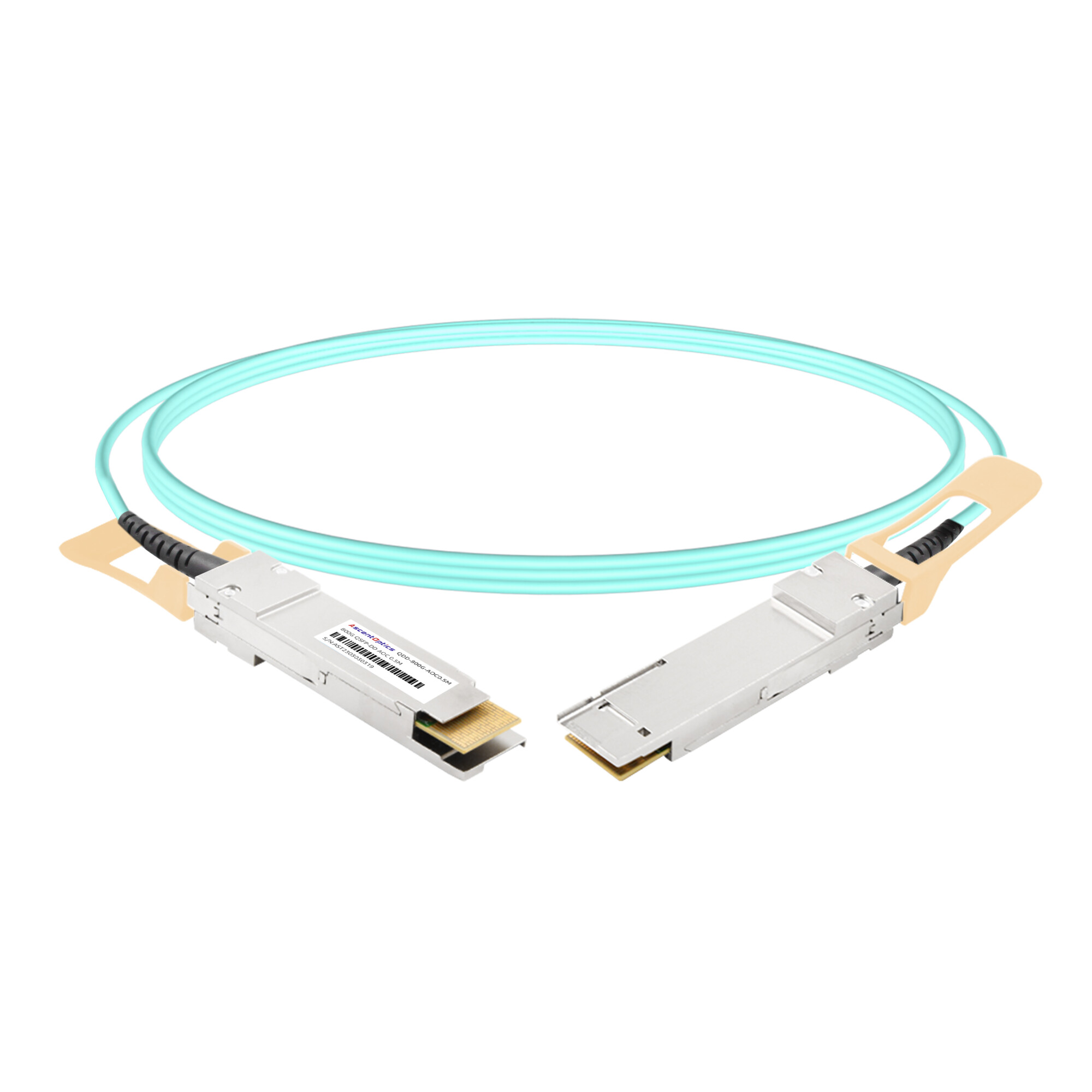
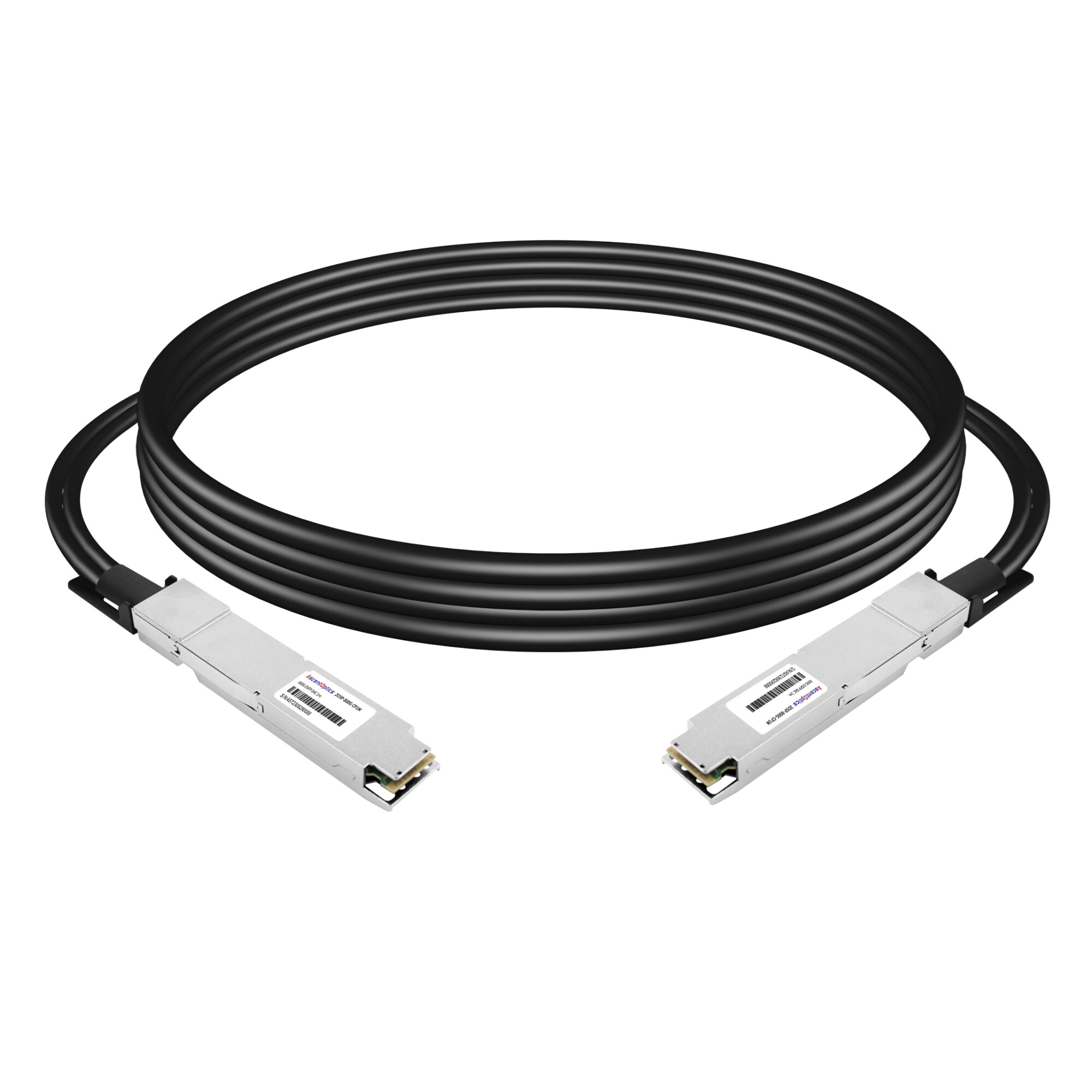
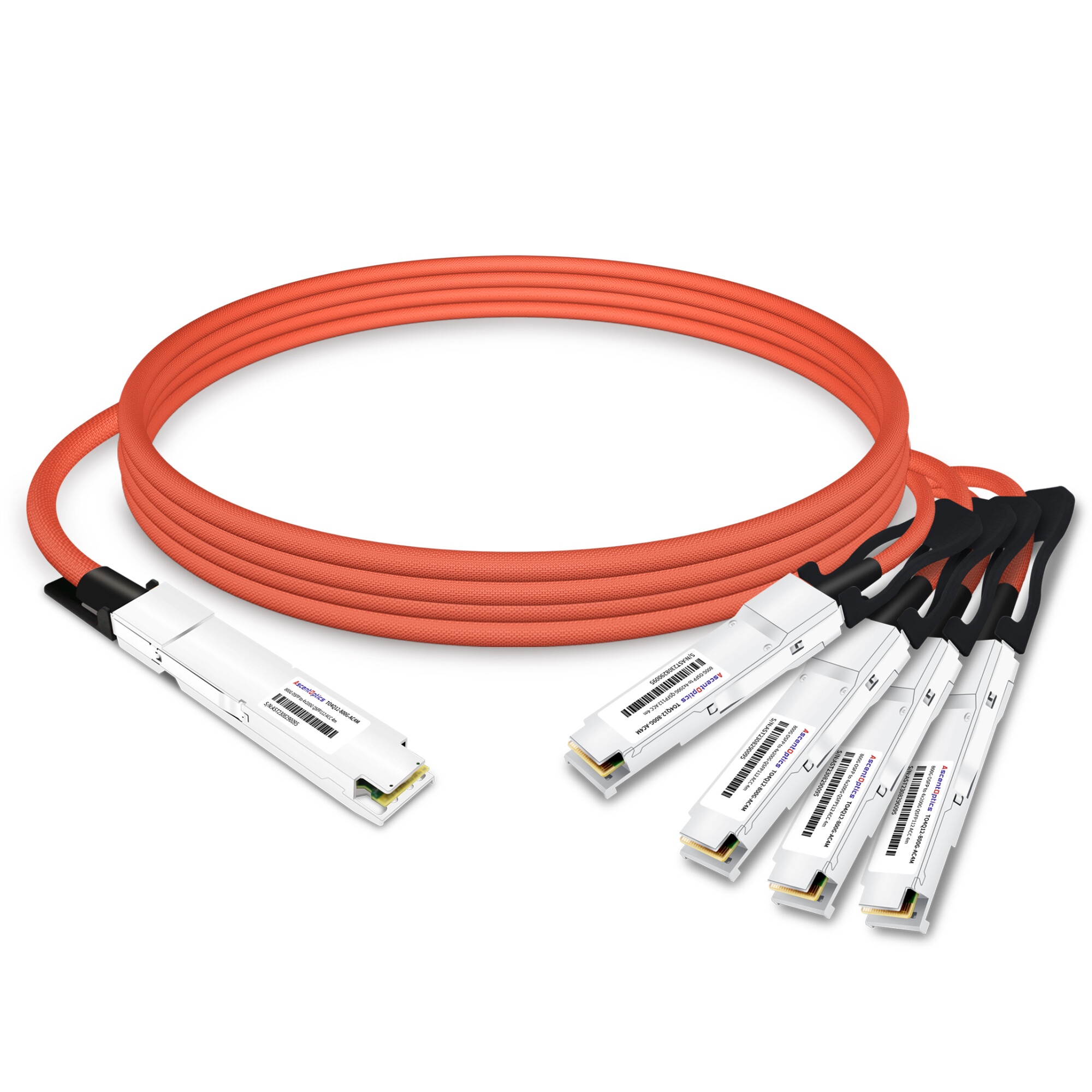
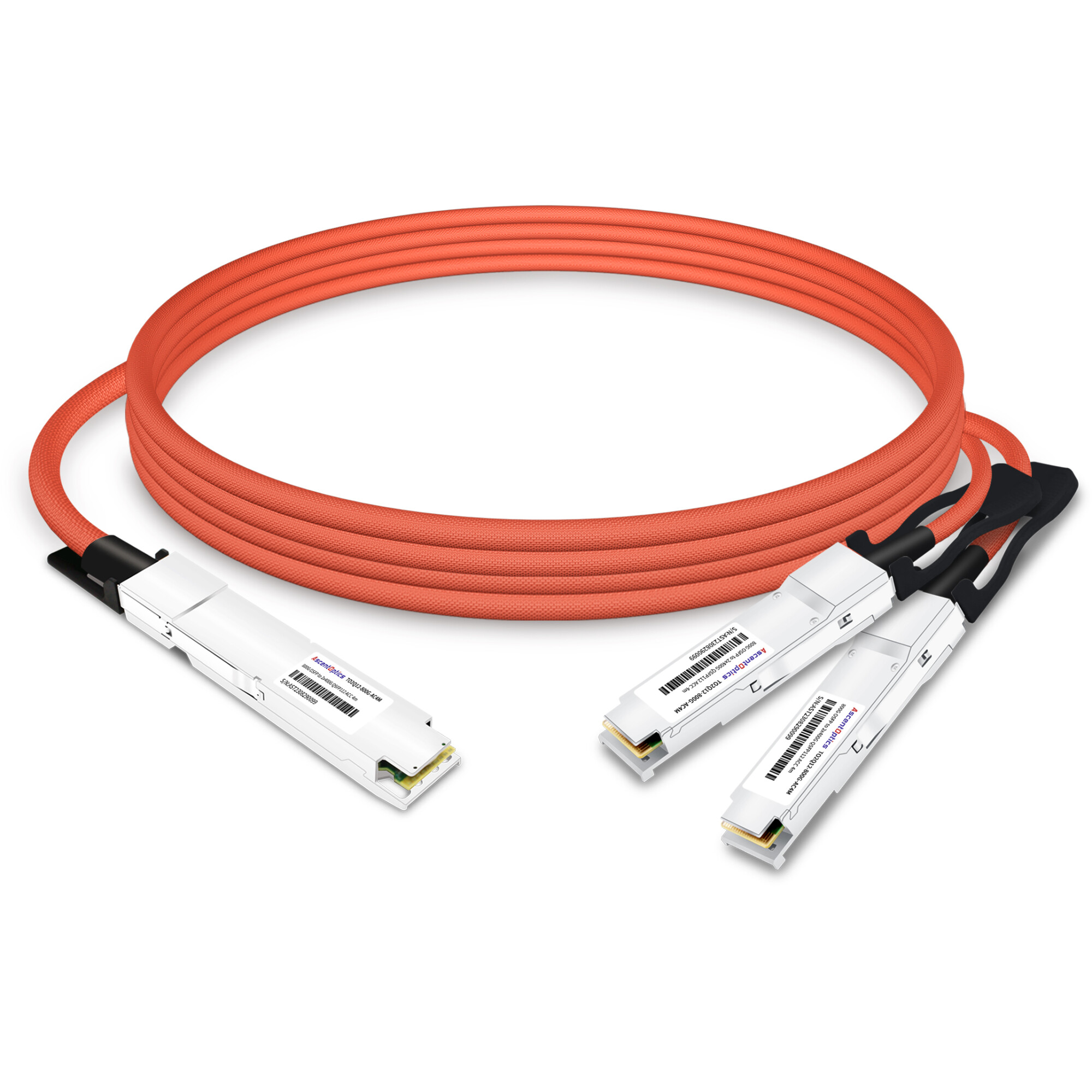
The 800G AOC is a high-speed active optical cable designed for hyperscale data centers and AI clusters; it integrates optical modules with optical fiber to support 800Gbps transmission. Offering advantages such as low latency, low power consumption, high density, and plug-and-play capability, it is suitable for short-reach interconnects between switches, GPU servers, and storage devices, helping to increase bandwidth and simplify cabling.
What Is an 800G AOC?
An 800G AOC is an active optical cable with optical transceivers permanently attached to both ends of a multimode fiber assembly. An 800G AOC can use eight parallel 100G PAM4 lanes to provide an aggregate bandwidth of 800 Gbps. The exact electrical and optical lane architecture depends on the AOC implementation and host platform. The transceivers handle electrical-to-optical and optical-to-electrical conversion inside the connector, so the host switch or NIC sees a familiar electrical interface.
Unlike a passive DAC cable, which moves raw electrical signals over copper, an AOC converts those signals to light. That conversion is what gives an 800G AOC its reach, its flexibility, and its immunity to electromagnetic interference.
The typical 800G AOC uses 850 nm VCSEL transmitters and PIN receivers over OM3, OM4, or OM5 multimode fiber. Many short-reach 800G AOCs use 850 nm VCSEL transmitters and PIN receivers over OM3, OM4, or OM5 multimode fiber. This keeps cost and power reasonable for short-reach data center links while reaching distances passive copper simply cannot.
An 800G AOC may use an 8×100G electrical architecture, commonly associated with 800GAUI-8 host interfaces. The relevant electrical and Ethernet specifications depend on the host platform and implementation. FEC may be used as part of the host Ethernet link architecture, depending on the application and platform.

800G AOC Application Scenarios
800G AOCs are designed primarily for high-bandwidth, short-reach connections where simplified cabling and high port density are important. Their integrated optical engines and fiber assembly make them particularly useful in AI clusters and high-performance data centers.
GPU Server to ToR Switch
In AI and HPC environments, GPU servers require high-bandwidth connections to the network fabric. An 800G AOC can connect a GPU or accelerator server directly to a Top-of-Rack (ToR) switch when the required distance is within the cable’s supported reach.
The integrated cable design simplifies installation and reduces the number of separate components that need to be managed.
ToR-to-Spine Connections
800G AOCs can also be used for short rack-to-rack or row-to-row connections between ToR and spine switches. Compared with high-speed copper assemblies, optical fiber provides a thinner and lighter cabling option, which can simplify cable routing in high-density racks.
AI Cluster Interconnects
Large AI clusters require many high-speed links between compute nodes and network switches. 800G AOCs can provide short-reach optical connectivity for Ethernet or InfiniBand-based AI fabrics, depending on platform and cable compatibility.
Their high bandwidth and integrated construction make them suitable for dense GPU networking environments where large numbers of links must be deployed and managed.
Storage and High-Speed Networking
800G AOCs can also be used for short-reach connections between high-speed switches and storage infrastructure. In these applications, the main considerations are the required bandwidth, link distance, host compatibility, and supported optical architecture.
Overall, 800G AOCs are best suited to environments where high bandwidth, short optical reach, simple installation, and compact cabling are all important.

800G AOC vs DAC vs AEC: Key Differences
Choosing between an 800G AOC, a direct attach copper (DAC) cable, and an active electrical cable (AEC) comes down to distance, power, and cable management. Here is how the three compare at 800G.
| Factor |
800G DAC |
800G AEC |
800G AOC |
| Reach |
2 to 3 m (passive) |
3 to 7 m |
30 to 100 m |
| Power per link |
Near zero |
Low to moderate |
~14 to 16 W per end |
| Latency |
Lowest (sub-nanosecond) |
Low |
Slightly higher (optical conversion) |
| Cable bulk |
Thick, stiff copper |
Thinner copper |
Thin 3 to 4 mm fiber |
| EMI immunity |
Limited |
Limited |
Excellent |
| Best use |
Intra-rack |
Adjacent racks |
Cross-row, spine-leaf |
The rule of thumb is simple: DAC within the rack, AEC between adjacent racks, and AOC across rows.
At 800G speeds, passive DAC reach shrinks to roughly two to three meters, down from three to five meters at 400G. As passive copper reach becomes more limited at higher speeds, AEC and AOC can provide practical alternatives for longer rack-to-rack connections.
Power tells a similar story. A passive DAC draws nothing, essentially. An AEC adds retimers that clean the signal but use real power. Power consumption varies by form factor, optical architecture, reach, and implementation. An 800G AOC draws the most, roughly 14 to 16 watts per end for an OSFP module, because it must power the optical engine on both sides. Some 800G AOC designs operate in the mid-teens of watts per end, while lower-power designs may consume less.

800G AOC vs. 800G Optical Transceiver
An 800G AOC and an 800G optical transceiver can both provide high-speed optical connectivity, but they use different deployment models.
An AOC integrates the optical transceivers and fiber into a single cable assembly. An optical transceiver, by contrast, is installed separately in the host port and connected using a compatible fiber patch cable.
| Feature |
800G AOC |
800G Optical Transceiver |
| Construction |
Optical modules and fiber integrated into one cable |
Separate optical modules and fiber |
| Installation |
Simple plug-and-play deployment |
Module and fiber installed separately |
| Cabling |
Simple and lightweight |
More flexible |
| Reach |
Primarily short reach |
Short to long reach, depending on module |
| Maintenance |
Entire cable assembly is replaced |
Module and fiber can be replaced separately |
| Flexibility |
Lower |
Higher |
| Best fit |
Fixed short-reach connections |
Flexible and scalable network links |
When Should You Choose an 800G AOC?
An 800G AOC is a strong option when the connection distance is known in advance and the deployment prioritizes simple installation, compact cabling, and high port density.
It is particularly useful for fixed short-reach connections between GPU servers, ToR switches, spine switches, and other equipment within a data center.
When Should You Choose an 800G Optical Transceiver?
A pluggable 800G optical transceiver is generally more suitable when the network requires greater flexibility in cable length, fiber type, or transmission distance. Because the module and fiber are separate, either component can be replaced or upgraded independently.
This approach is also more practical for longer-reach applications or networks that require different optical configurations.
In short, AOC prioritizes simplicity and integrated cabling, while pluggable optical transceivers provide greater flexibility and scalability. The choice should be based on link distance, platform compatibility, maintenance requirements, and future network expansion.
800G AOC Form Factors: OSFP vs. QSFP-DD
Two form factors dominate 800G AOC deployments: OSFP and QSFP-DD. They are not mechanically interchangeable, so the choice matters early in your design.
OSFP and QSFP-DD are two important form factors for 800G AOCs. They differ in mechanical dimensions, thermal characteristics, port density, and platform compatibility, so the choice should be based primarily on the target switch or NIC platform.
OSFP, or octal small form-factor pluggable, is the larger package. OSFP provides a larger module envelope and can offer greater thermal headroom, which is useful for high-power 800G and future higher-speed applications. It is widely used in high-density switch and AI networking platforms. OSFP also maps cleanly to future 1.6T migration paths.
QSFP-DD provides a more compact form factor and offers strong compatibility with existing QSFP-based infrastructure. It can be attractive for platforms where port density, mechanical compatibility, and migration from lower-speed QSFP interfaces are important.
Neither form factor is universally better. Network designers should verify the host port type, power limit, thermal requirements, connector configuration, and supported optical standards before selecting an 800G AOC.

800G AOC Reach and Breakout Configurations
For 800G multimode AOCs, reach is dependent on the optical implementation and fiber grade. A common target is up to around 30 m over OM3 and up to around 100 m over OM4 or OM5. That range covers the vast majority of cross-row and spine-leaf links inside a data hall.
For shorter links, breakout AOCs turn a single 800G port into multiple lower-speed connections. Two breakout patterns are most common.
An 800G OSFP to 2x400G breakout splits one 800G port into two 400G links, typically using QSFP112 or OSFP-RHS ends. Each 400G branch operates as an independent full-bandwidth link, so there is no shared capacity. An 800G-to-8×100G breakout AOC can split one 800G port into eight independent 100G connections, depending on the host platform and cable architecture.
Breakout AOCs are especially useful at the top of rack, where a single 800G switch port can aggregate several 100G or 400G servers without a dedicated 800G endpoint for each.

800G AOC Power and Thermal Considerations
Power consumption becomes increasingly important as data-center networks move from 400G to 800G and beyond. Unlike passive DACs, 800G AOCs contain active optical components at both ends of the cable and therefore require power from both host ports.
Actual power consumption varies with the optical architecture, form factor, reach, and module design. Some 800G AOC implementations operate in the mid-teens of watts per end, while newer designs may target lower power levels.
Power at Scale
The power consumed by a single AOC may appear relatively small, but the impact becomes significant when hundreds or thousands of high-speed links are deployed.
For example, if an AOC consumes approximately 10W per end, a fully populated 64-port switch could require roughly 1.28 kW for the two cable ends alone. This is an illustrative calculation rather than a specification for every 800G AOC.
Network designers should therefore include optical cable power in the overall switch and data-center power budget.
Thermal Management
Active optical components generate heat, making thermal design important for high-density 800G deployments. The selected AOC should operate within the host platform’s specified power and temperature limits.
Fiber-based AOCs also provide a cabling advantage over thick copper assemblies. Their smaller diameter and lower weight can simplify cable routing and reduce physical congestion around switches and GPU servers.
For large AI clusters, good cable management can improve airflow around equipment and make maintenance easier. However, AOC selection should always consider the actual thermal characteristics and airflow requirements of the target platform.
How to Choose an 800G AOC for AI Data Centers
The clearest way to select an interconnect is to anchor on distance, then verify power and compatibility.
Match distance to cable type. Use DAC for links under three meters, AEC for roughly three to seven meters, and AOC for anything from seven to 100 meters. If you are running single-mode beyond 100 meters, an AOC is no longer the right tool, and you should move to optical transceivers with patch cords.
Verify the fiber grade. Confirm OM4 or OM5 if you need to reach the full 100-meter range. OM3 will cap you around 30 meters.
Check platform compatibility. 800G AOCs must match the host switch or NIC. Verify support for NVIDIA Spectrum-4 and Quantum platforms, and confirm whether the fabric uses InfiniBand NDR or RoCE v2. AOC, DAC, and optical modules all need to match the host’s signaling and FEC settings.
Budget power and cooling. An 800G OSFP AOC draws roughly 14 to 16 watts per end. Across a large fabric, that adds up, so factor it into your power and cooling planning.
Think about airflow. In high-density GPU racks, large copper bundles can add significant weight and restrict airflow. The smaller diameter and lower weight of fiber-based AOCs can simplify cable management and improve airflow around the equipment.
Compatibility is the detail that trips up the most deployments. A cable that works on one switch may fail on another if the host expects a different electrical interface or FEC mode. Working with a manufacturer that validates against major platforms reduces that risk before it reaches your rack.
Conclusion
800G AOC provides a practical optical interconnect solution for short-reach, high-bandwidth connections in AI and data-center networks. By integrating optical transceivers with fiber into a single cable assembly, it can extend reach beyond passive copper while simplifying cabling and reducing cable bulk.
The right choice depends primarily on link distance, power requirements, form factor, and platform compatibility. Passive DAC remains attractive for very short intra-rack connections, AEC can extend copper-based connectivity over short distances, and AOC is well suited to longer rack-to-rack and row-to-row links.
For 800G deployments, network designers should also verify the host switch or NIC, optical lane architecture, fiber type, connector configuration, management support, and protocol requirements before deployment.
When these factors are properly matched, 800G AOC can provide a compact and scalable interconnect option for high-density AI and data-center networks.
FAQs About 800G AOC
1. What is the typical reach of an 800G AOC?
The reach depends on the optical architecture and fiber type. Many multimode 800G AOCs target short-reach connections, with some implementations supporting around 30 m over OM3 and up to around 100 m over OM4 or OM5.
2. Can 800G AOC be used for InfiniBand?
Yes. An 800G AOC can be used in InfiniBand-based AI and HPC networks when the cable is specifically compatible with the target InfiniBand platform, port configuration, and signaling requirements.
3. What is the difference between 800G AOC and 800G DAC?
An 800G DAC uses copper conductors and is mainly intended for very short connections. An 800G AOC uses optical fiber with active optical components, providing longer reach, lower cable weight, and better EMI immunity.
4. Does an 800G AOC consume more power than a DAC?
Yes, generally. A passive DAC does not require active optical components, while an 800G AOC requires power at both ends to operate its optical engines. Actual AOC power consumption depends on the specific design and form factor.
5. Can an 800G AOC be used for breakout connections?
Yes. Depending on the host platform and cable architecture, 800G AOCs can support breakout configurations such as 800G-to-2×400G or 800G-to-8×100G. The switch port and connected devices must support the corresponding breakout mode.
6. What should I check before deploying an 800G AOC?
Check the host switch or NIC, form factor, electrical interface, optical architecture, fiber type, cable length, connector configuration, management support, and network protocol. System-level compatibility testing is recommended before large-scale deployment.
Post Views: 870