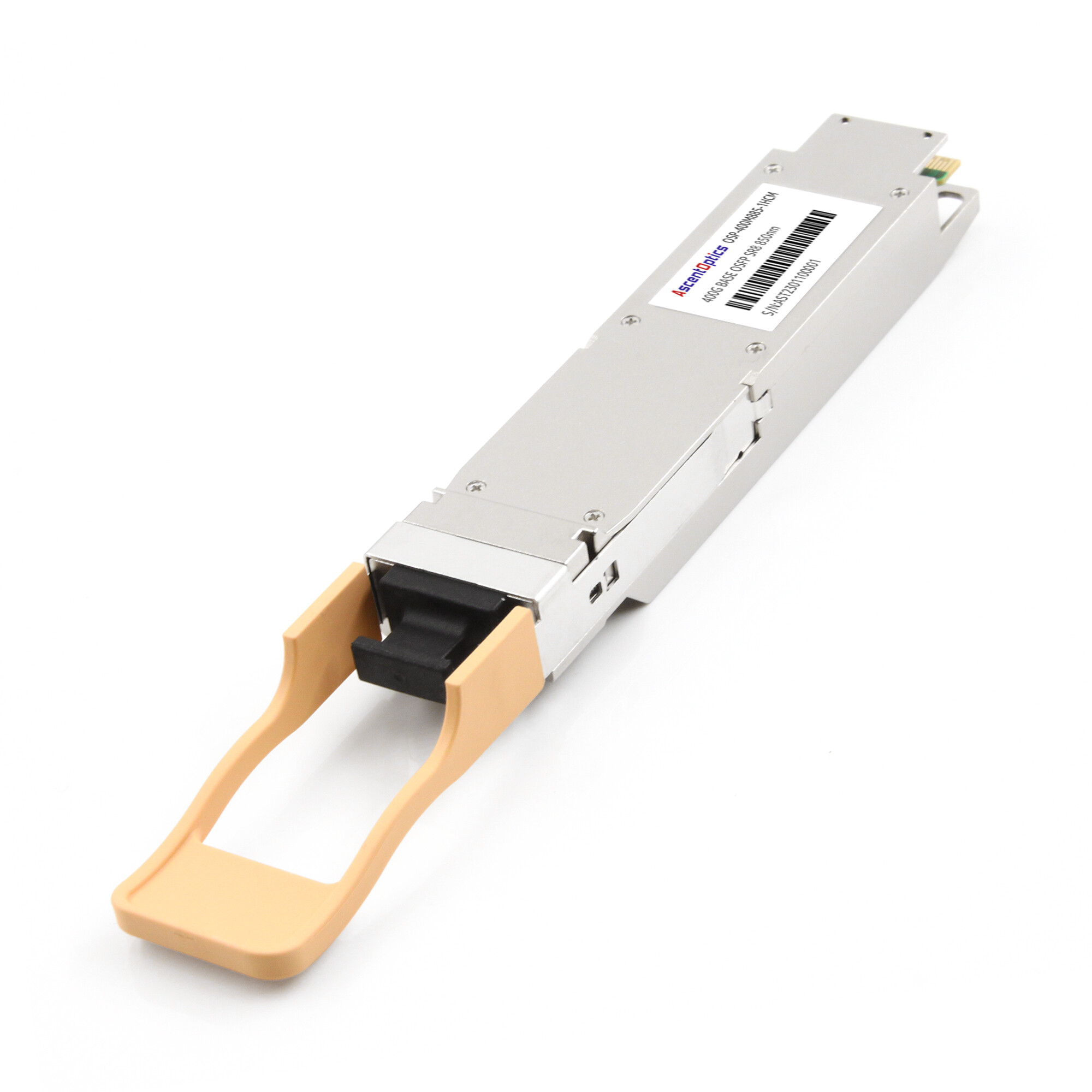
In April 2026, a procurement engineer at a North American hyperscaler placed an order for 800 OSFP transceivers, only to discover three weeks later that the destination switches required the OSFP-RHS variant rather than the standard OSFP-IHS form she had ordered. Three weeks of project delay, $40,000 in restocking fees, and an escalation with her CTO followed. The root cause: absence of a comprehensive cross-vendor OSFP reference.
This guide addresses that problem. OSFP compatible switches now ship from major networking vendors—Cisco, Arista, Juniper, and NVIDIA—each with different naming conventions, port configurations, and OSFP variants. Choosing the wrong switch or module is one of the costliest errors in 400G and 800G deployments.
In this article, you will find the complete 2026 cross-vendor reference for OSFP compatible switches, including specific models, OSFP variant requirements (IHS, RHS, XD, twin-port vs single-port), port density, breakout capabilities, and a practical selection framework for AI clusters, hyperscale fabrics, or telecom deployments.
Need OSFP modules tested for your specific switch? Browse our OSFP transceiver catalog for platform-validated modules across all major vendors.
Understanding OSFP Switch Compatibility Requirements
Before reviewing vendor-specific models, it is essential to understand OSFP form factor variants, as not every module fits every cage.
OSFP Form Factor Variants (IHS, RHS, XD)
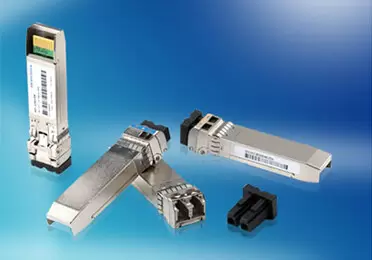
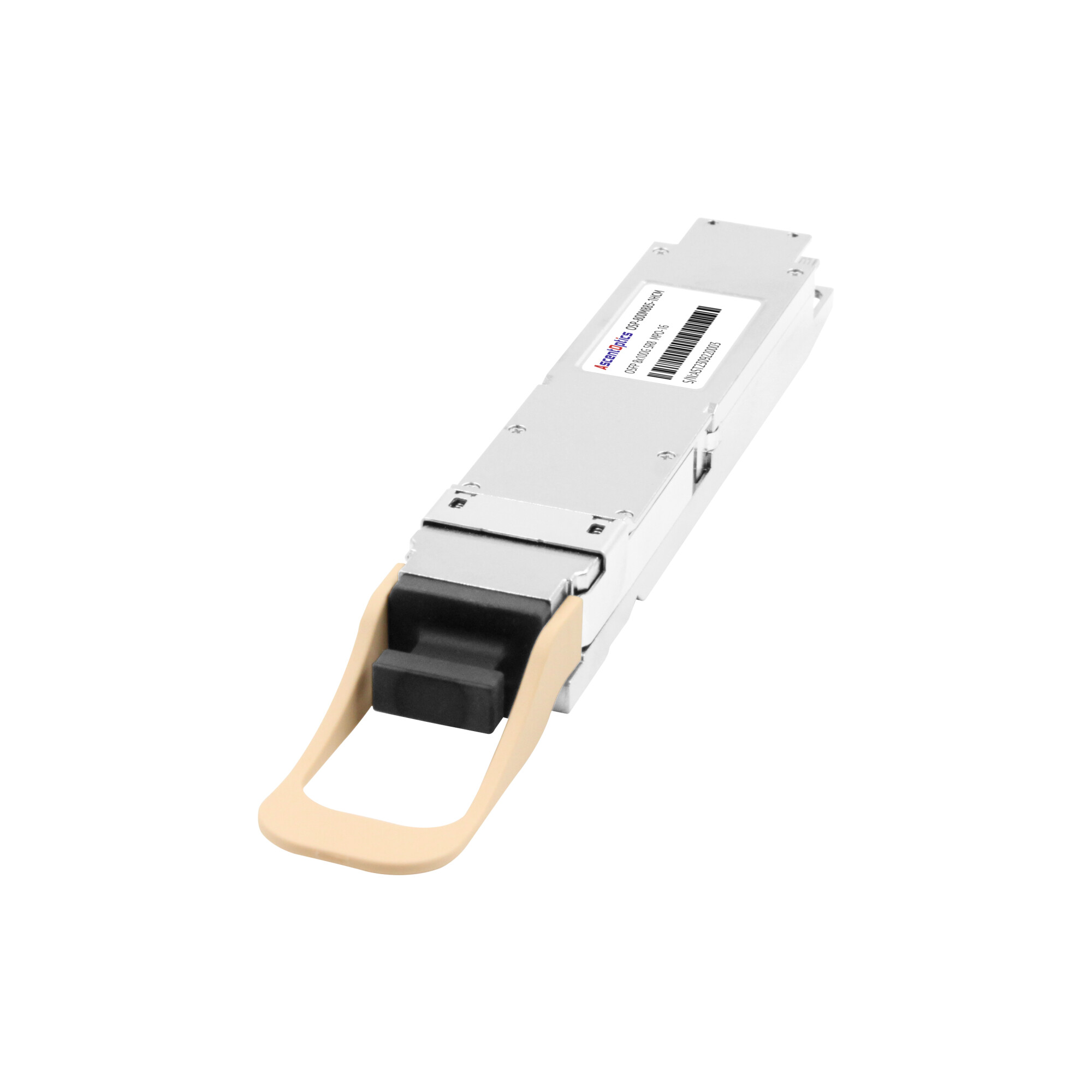
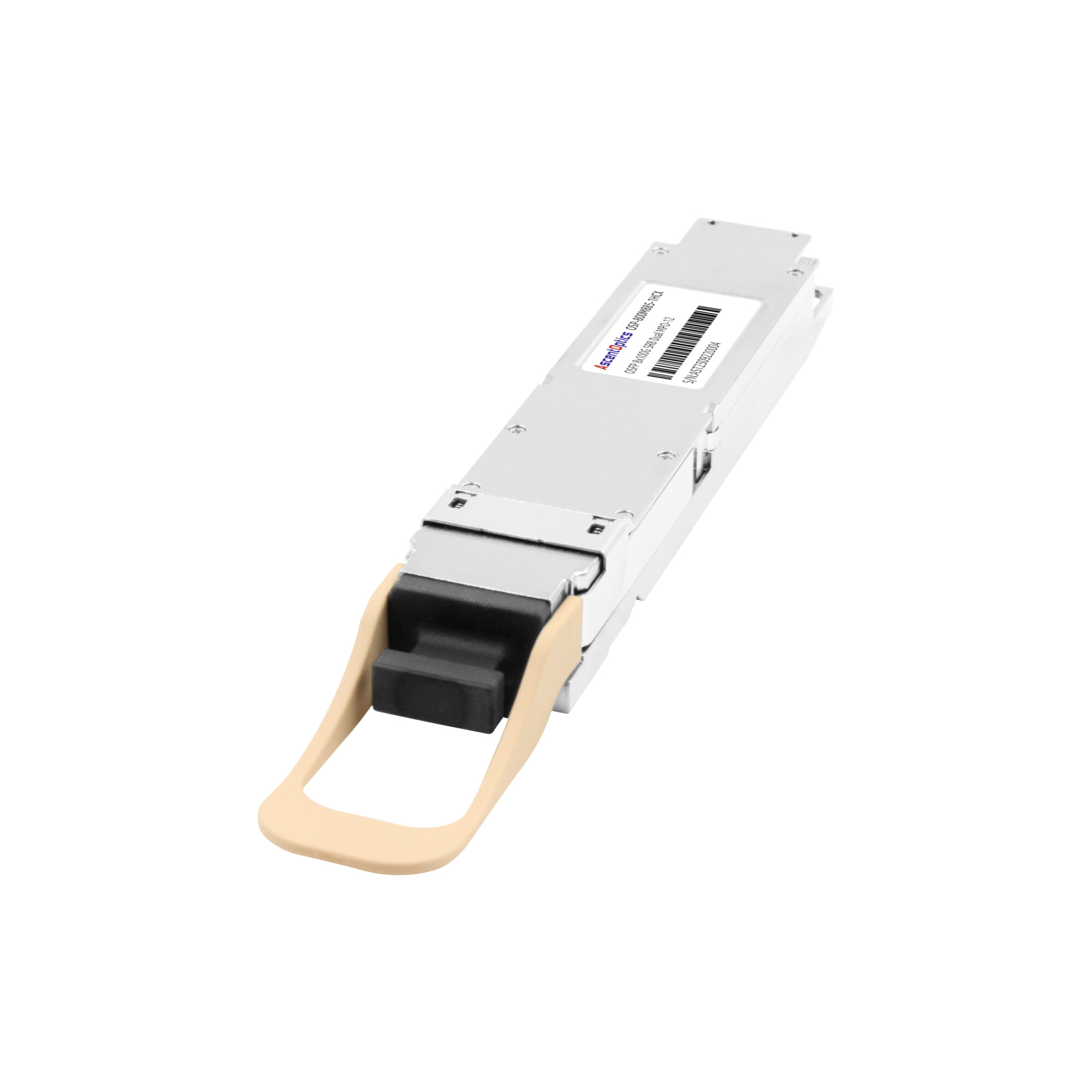
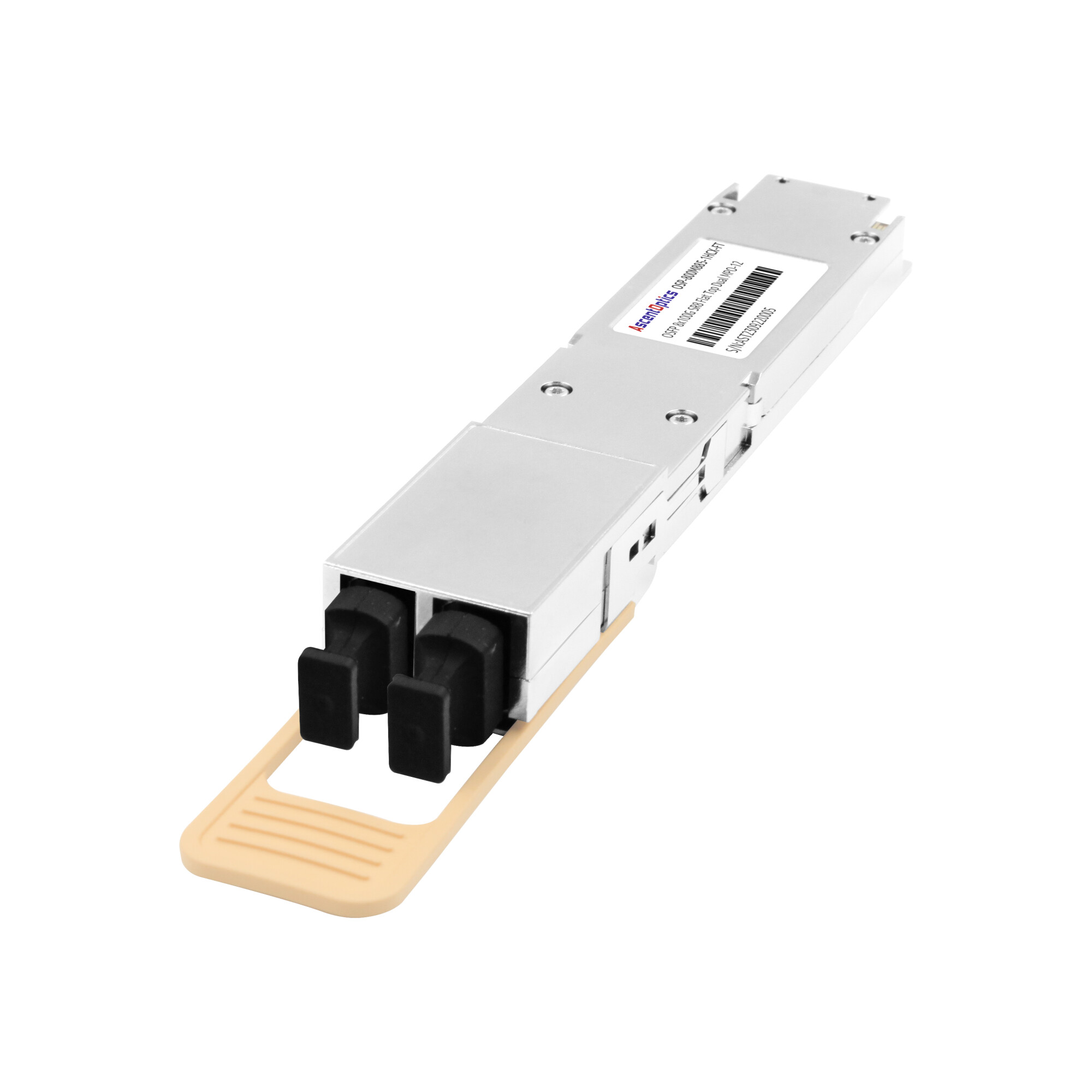
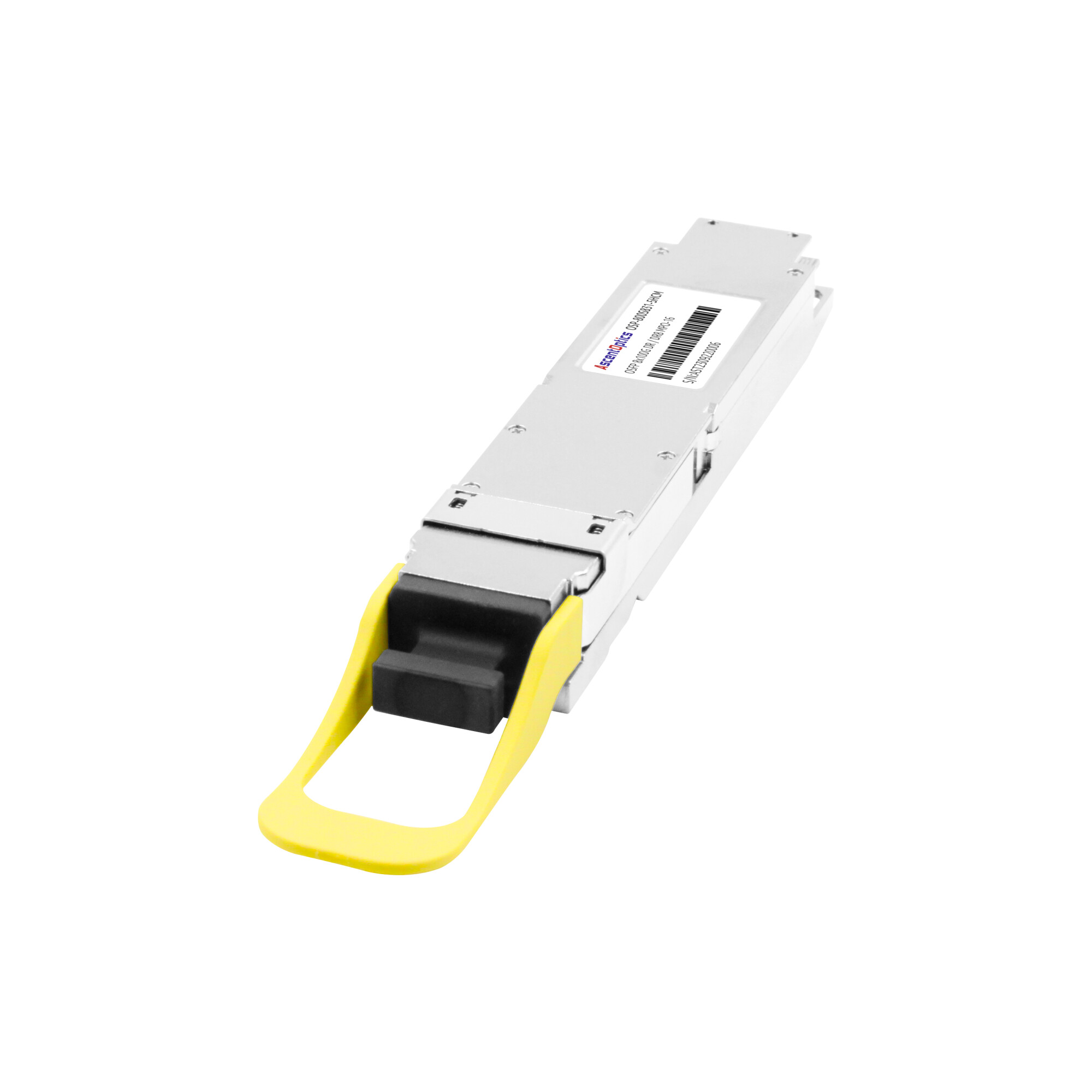
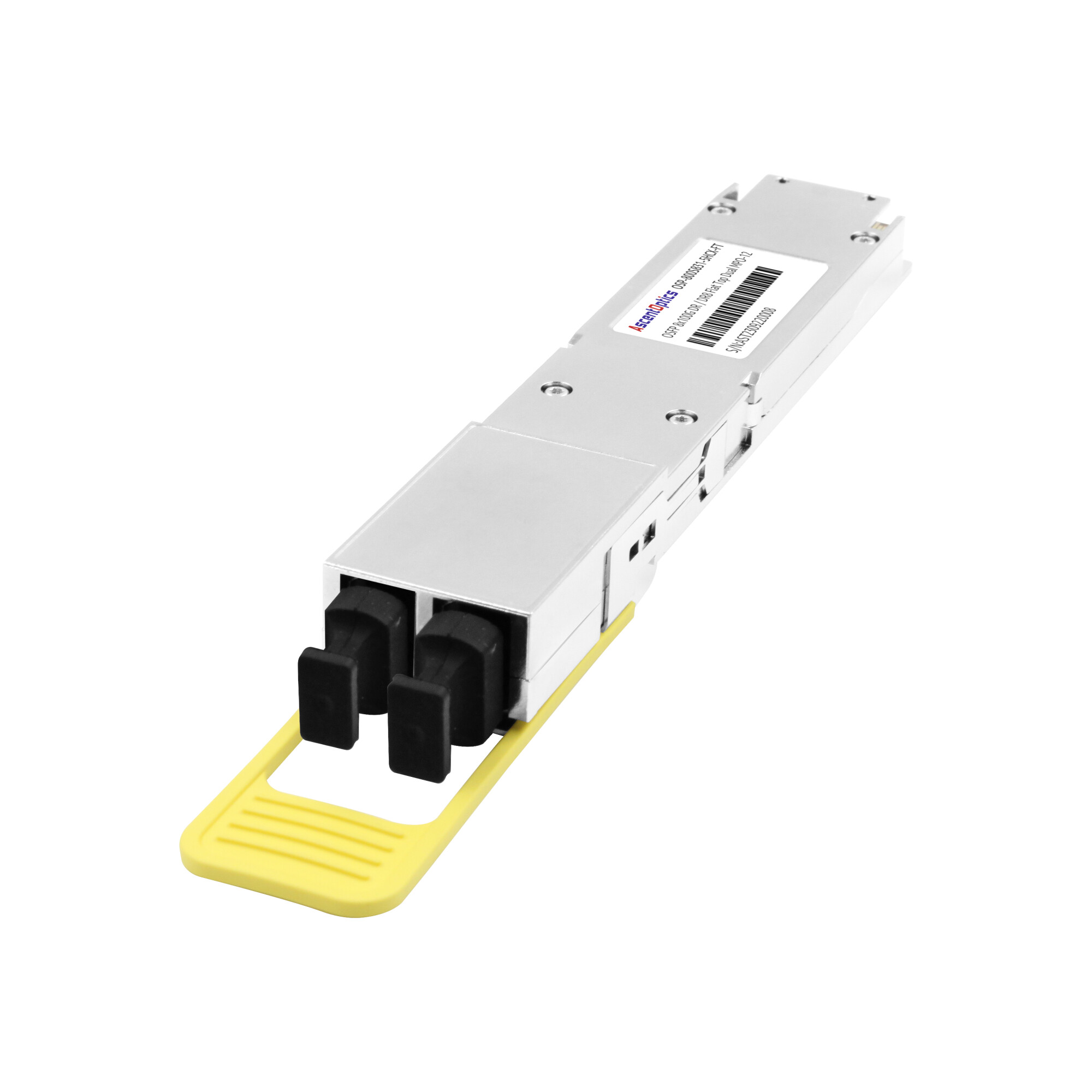
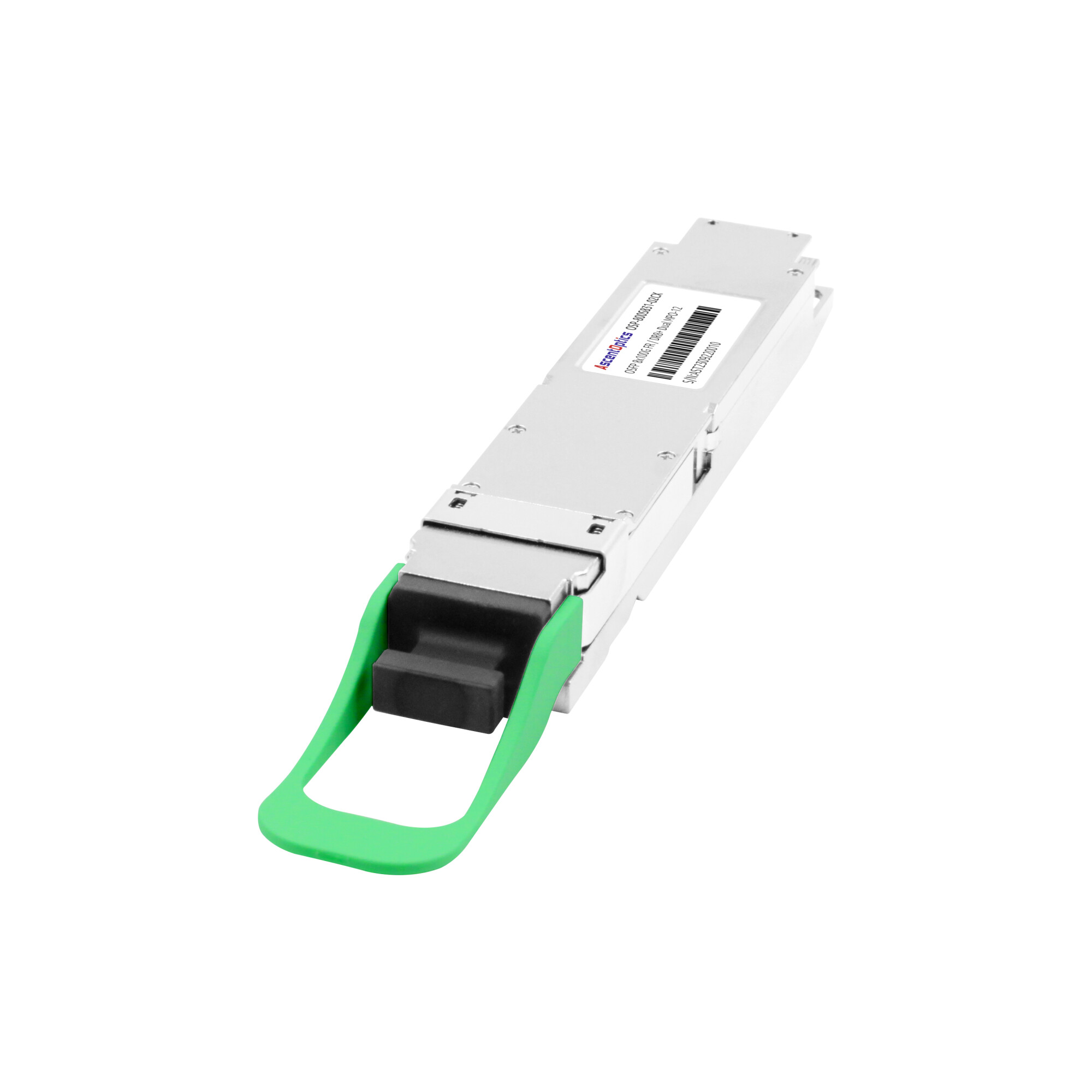
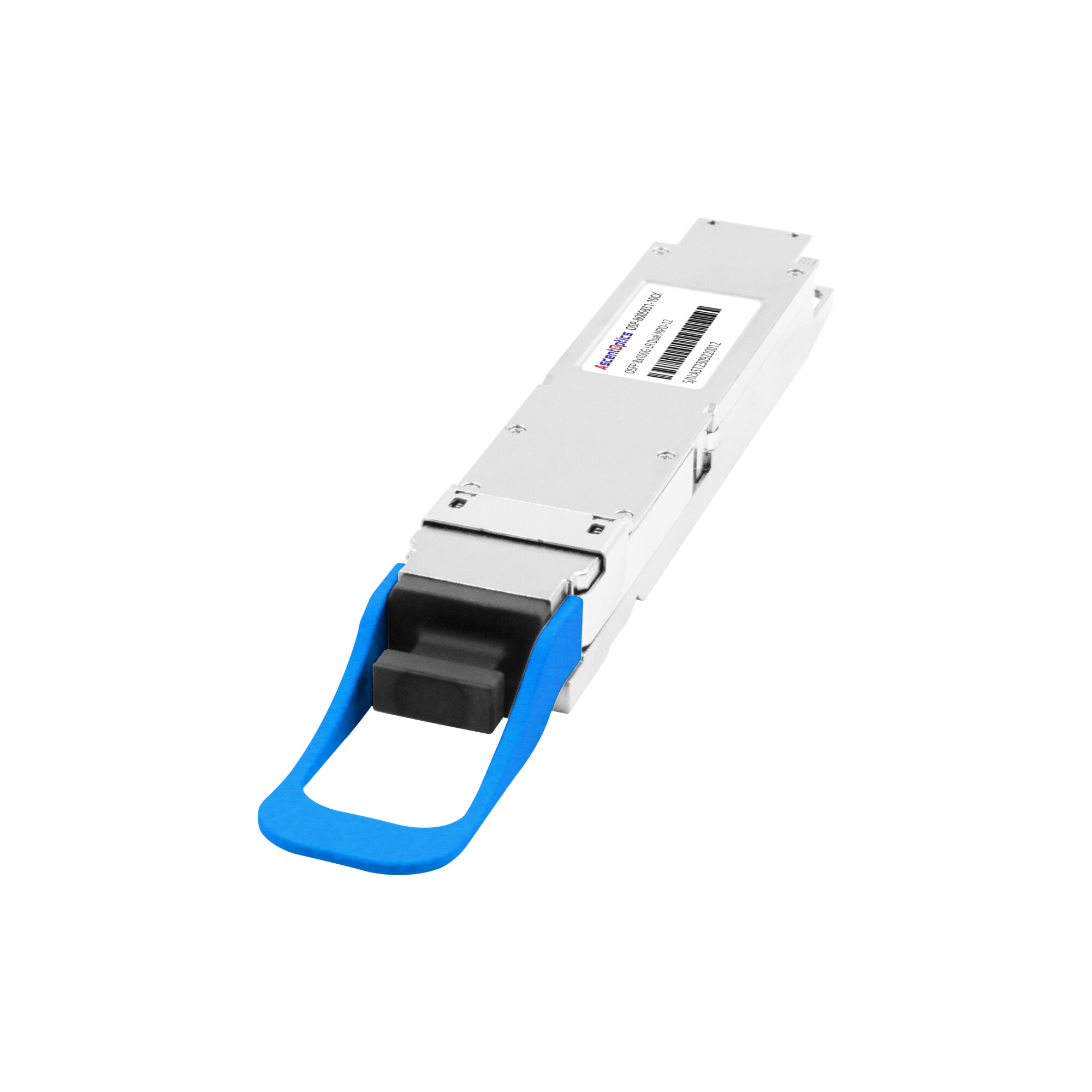
OSFP modules come in three primary thermal variants. Each variant matches a different physical cage design on the switch side.
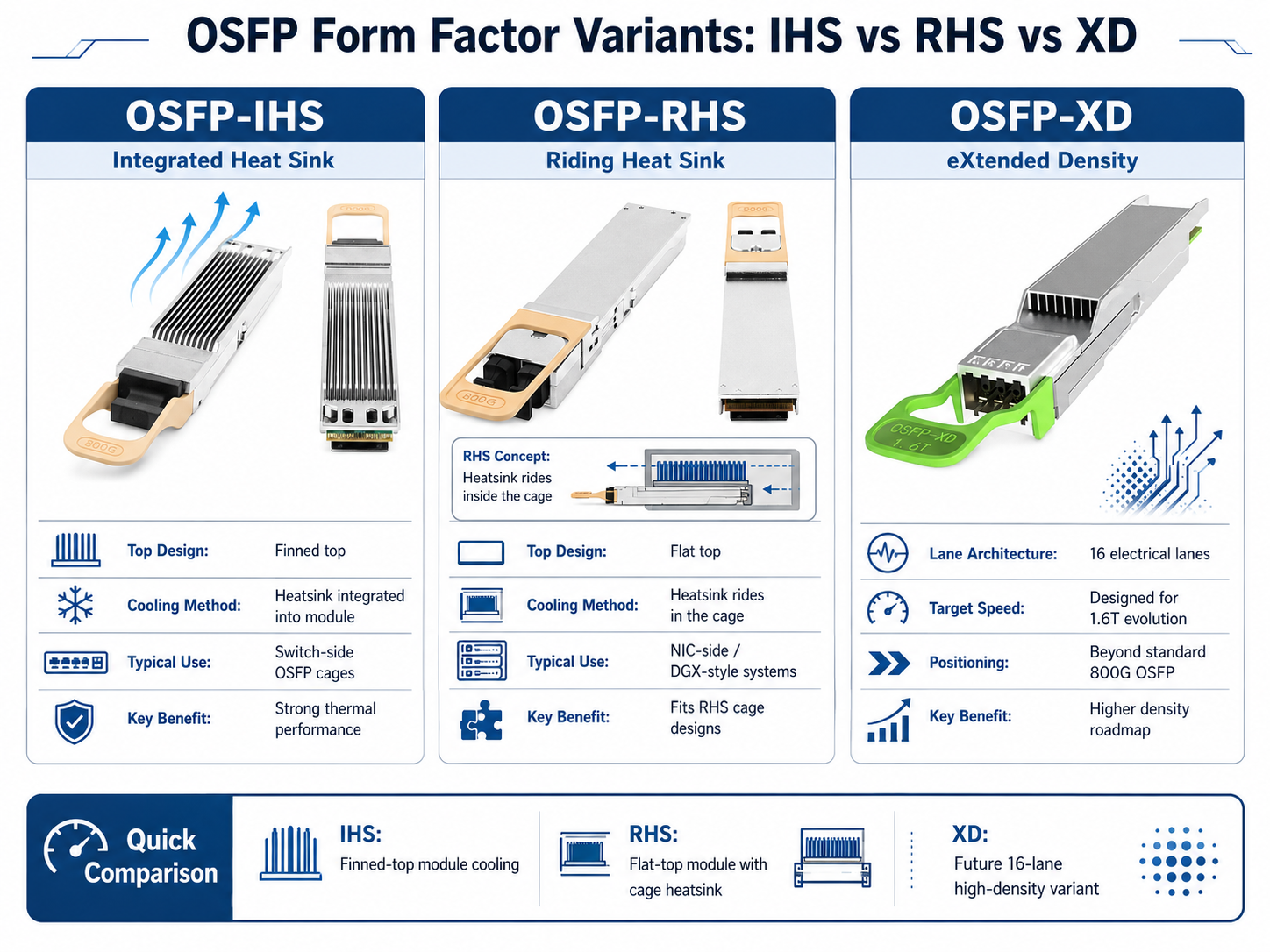
OSFP-IHS (Integrated Heat Sink): Also called “finned-top” modules. The module includes integrated cooling fins that work with the switch’s airflow. This is the standard form factor for most switch-side deployments.
OSFP-RHS (Riding Heat Sink): Also called “flat-top” modules. The module has a flat top; the heatsink is part of the switch cage and rides on the transceiver. RHS is commonly required for NIC-side connections and DGX-style server designs.
OSFP-XD (eXtended Density): OSFP-XD is an extended-density evolution of OSFP designed for future 1.6T networking generations with improved front-panel density and higher electrical lane speeds.
Twin-Port vs Single-Port OSFP Cages
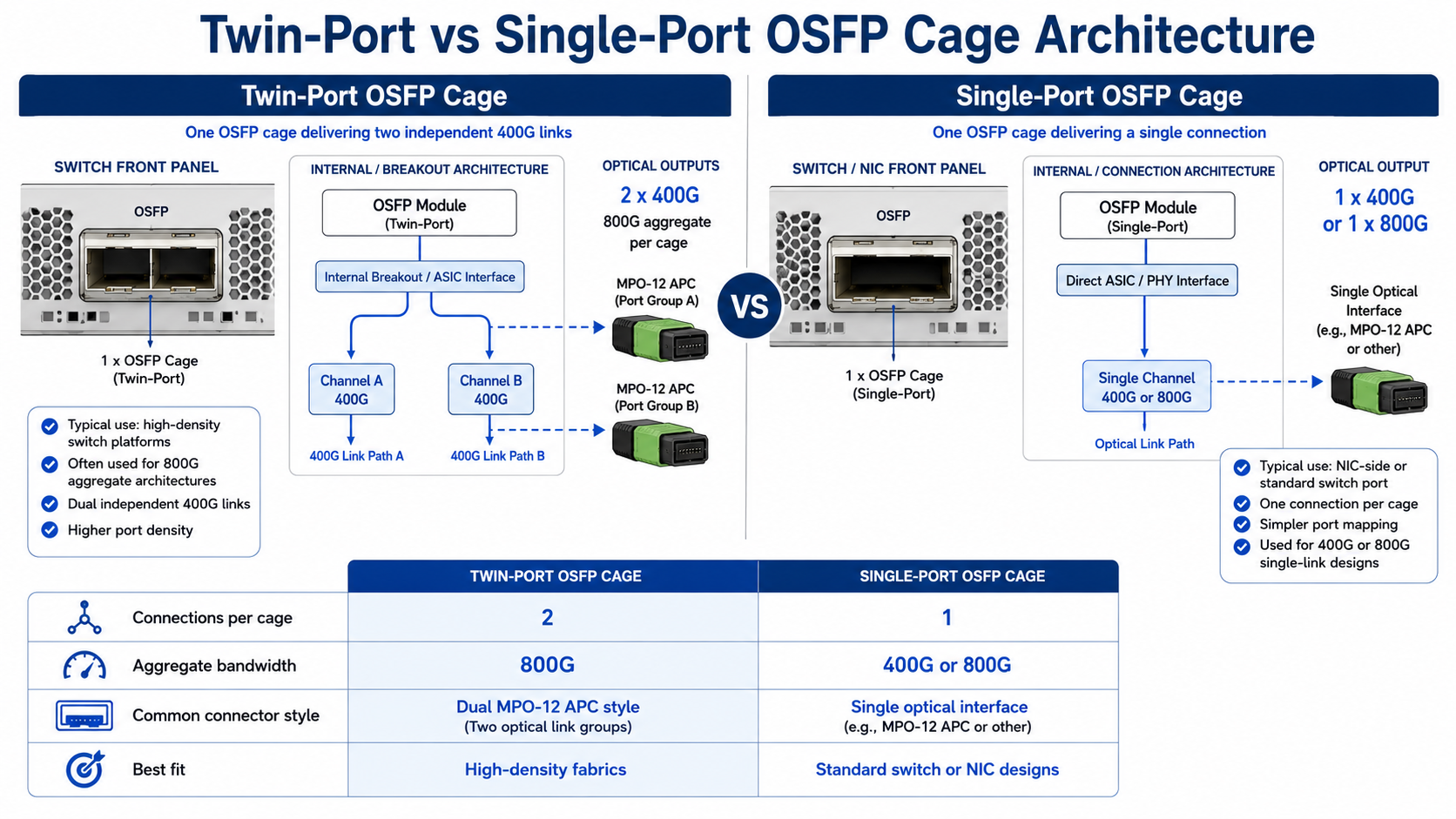
OSFP cages come in two architectures:
- •Twin-port (2x400G): Twin-port OSFP platforms expose a single 800G OSFP interface that can operate either as one 800G link or as two independent 400G logical connections.
- •Single-port (1x400G or 1x800G): One connection per cage. Typical for NIC-side platforms like NVIDIA ConnectX-7.
Port Density and 1U Configurations
OSFP enables exceptional port density:
- •32 OSFP ports per 1Uat 400G (12.8 Tbps aggregate)
- •64 NDR 400G ports per 1Uwith twin-port cages (25.6 Tbps aggregate)
- •Up to 64x800G ports in 2U configurations
OSFP generally provides improved thermal headroom compared with QSFP-DD in high-power 800G deployments.
Backward Compatibility with QSFP28
Standard OSFP cages are not mechanically compatible with QSFP+, QSFP28 and QSFP-DD, unless the platform specifically supports adapters or hybrid cage designs. Many enterprise environments use mixed QSFP-DD and OSFP deployments during migration periods to maintain backward compatibility with existing 100G infrastructure. For broader context on backward compatibility, see our QSFP28 compatible switches guide.
Cisco OSFP Compatible Switches
Cisco supports OSFP across selected high-density 400G and 800G platforms, particularly within hyperscale and service provider networking environments.
Cisco Nexus 9000 Series
Selected Cisco Nexus 9000 platforms support native OSFP interfaces through dedicated high-speed line cards.
Depending on the configuration, these platforms may support:
Not all Nexus 9000 systems use OSFP, however. Many earlier 400G Nexus deployments relied primarily on QSFP-DD. Always verify the exact line card and chassis combination before deployment.
Cisco 8000 Series
Selected Cisco 8000 Series platforms support native OSFP interfaces for high-density 800G networking.
These systems are primarily targeted at:
- •hyperscale data centers
- •cloud backbones
- •service provider transport
- •AI infrastructure
Cisco positions the 8000 family as part of its long-term 800G networking roadmap.
Cisco OSFP SKU Naming Convention
Cisco uses a structured SKU naming convention that encodes form factor and module type:
- •OSFP-XXXG-YY: Standard OSFP variant
- •OSFPR-XXXG-YY: OSFP-RHS (flat-top) variant
- •OSFP-2X400G-YY: Dual 400G breakout module
Common examples include OSFP-800G-DR8, OSFP-2X400G-FR4 and OSFP-800G-VR8. When deploying third-party optics, cross-reference vendor qualification lists carefully.
Need Cisco-compatible OSFP modules? Contact our optical engineers for SKU cross-references and platform validation.
Arista Networks OSFP Switches
Arista offers one of the broadest OSFP portfolios in Ethernet-based AI and hyperscale networking.
Arista 7060X6 Series
The Arista 7060X6 family is designed for native 800G OSFP deployments.
These switches support:
- •800G DR8
- •800G SR8 / 2×SR4
- •2×400G FR4
- •high-density breakout configurations
The 7060X6 series is widely deployed in Ethernet AI fabrics and cloud-scale spine networks.
Arista 7060X5 and 7060X4 Series
Arista’s 7060X5 and 7060X4 platforms support high-density 400G networking using OSFP and, in some configurations, QSFP-DD. These systems are popular in hyperscale fabrics, cloud data centers, spine-leaf architectures and AI Ethernet clusters. Arista’s EOS ecosystem and broad optics interoperability make these platforms attractive in multi-vendor environments.
Mixed OSFP and QSFP-DD Deployments
Many Arista platforms are available in both OSFP-based variants and QSFP-DD-based variants. This flexibility allows enterprises to balance: thermal performance, optics cost, backward compatibility and migration planning during phased 100G-to-400G upgrades.
Juniper Networks OSFP Platforms
Juniper primarily deploys OSFP support in high-capacity routing and transport platforms.
PTX Series
Selected Juniper PTX platforms support high-density 400G and 800G OSFP interfaces for:
- •core routing
- •internet peering
- •transport networks
- •metro aggregation
These systems are optimized for carrier-scale environments with very high throughput requirements.
ACX Series
Selected Juniper ACX platforms support OSFP optics for 5G transport, metro aggregation and service provider edge deployments. OSFP support varies by platform generation and interface card configuration.
MX Series
Some Juniper MX platforms support high-speed OSFP interfaces for edge routing and WAN connectivity applications.
These deployments are typically focused on:
- •enterprise WAN
- •provider edge
- •high-capacity aggregation
NVIDIA Quantum-2 and Spectrum-X OSFP Switches
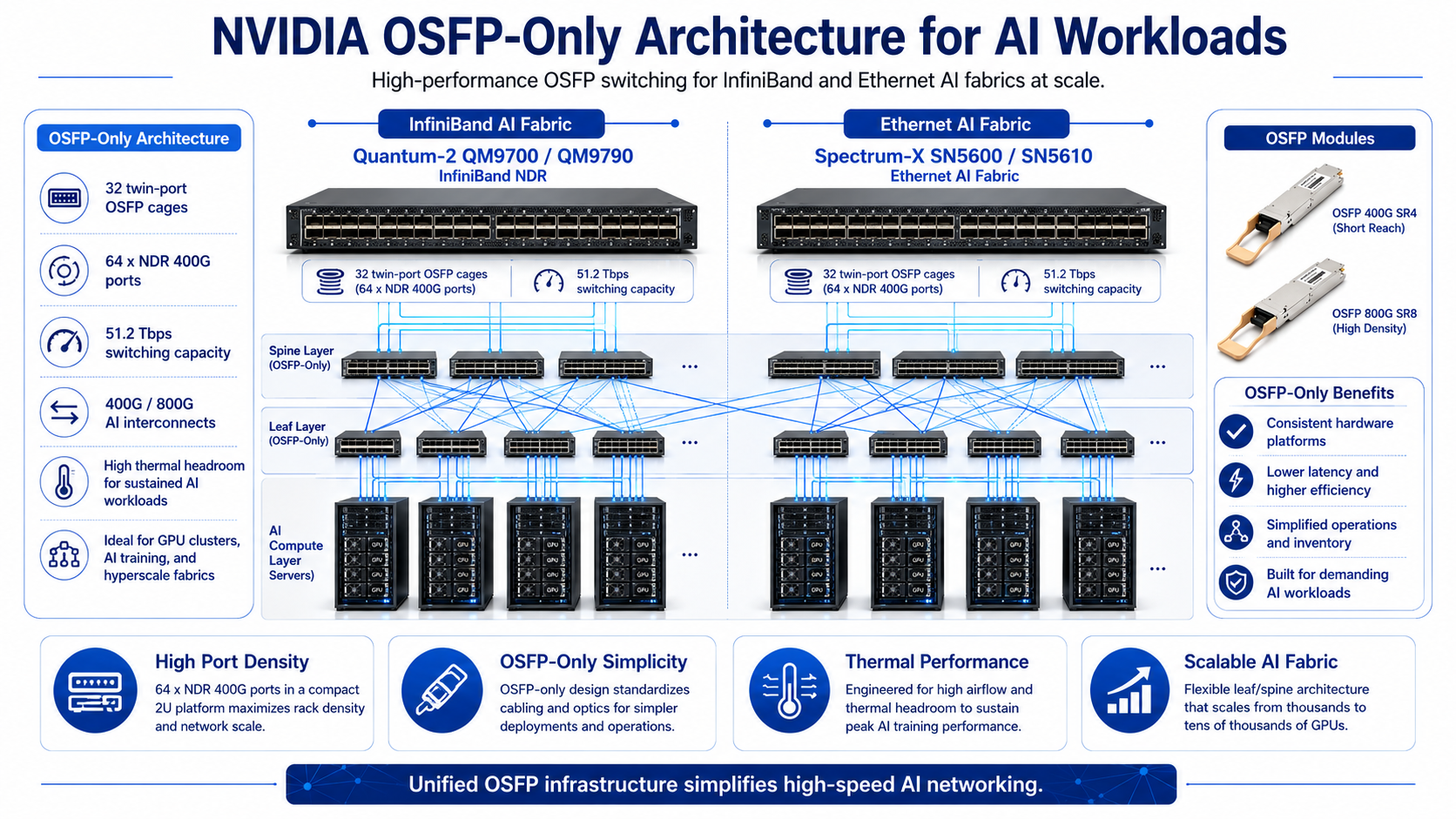
NVIDIA currently has one of the strongest OSFP commitments in the industry, especially in AI infrastructure. Both NVIDIA InfiniBand and Ethernet AI platforms rely heavily on OSFP-native architectures.
NVIDIA Quantum-2 QM9700 and QM9790
The NVIDIA Quantum-2 QM9700 and QM9790 switches are the dominant InfiniBand NDR platforms used in large-scale AI training clusters. Each switch provides 32 twin-port OSFP cages, delivering 64 NDR 400G logical interfaces or 128 NDR200 interfaces via breakout. Total aggregate bandwidth reaches 51.2 Tbps.
These systems use OSFP exclusively and do not offer QSFP-DD alternatives. If you are deploying NVIDIA InfiniBand NDR, OSFP is the standard ecosystem.
For deeper NVIDIA ecosystem guidance, see our OSFP for NVIDIA InfiniBand NDR guide.
NVIDIA Spectrum-X Platforms
NVIDIA Spectrum-X switches target Ethernet-based AI networking.
Recent Spectrum-X platforms support:
- •native 800G OSFP interfaces
- •high-density AI Ethernet fabrics
- •large-scale GPU networking
These systems are optimized for:
- AI training workloads
- east-west traffic
- low-latency Ethernet fabrics
Why NVIDIA Standardized on OSFP
NVIDIA’s AI infrastructure platforms generate sustained high-power optical loads during GPU training operations. OSFP’s larger thermal envelope and improved cooling capability make it especially suitable for:
- •800G optics
- •AI clusters
- •dense GPU fabrics
- •high-power optical interconnects
This is one reason NVIDIA standardized heavily on OSFP across both InfiniBand and Ethernet AI architectures.
OSFP Compatible Switch Compatibility Matrix
The complete cross-vendor reference for OSFP compatible switches:
| Vendor |
Platform Family |
400G Support |
800G Support |
OSFP Type |
| Arista |
7060X6 Series |
Yes |
Yes |
OSFP-IHS |
| Arista |
7060X5 Series |
Yes |
Limited |
OSFP / QSFP-DD |
| Cisco |
Nexus 9000 |
Yes |
Selected platforms |
OSFP / QSFP-DD |
| Cisco |
8000 Series |
Yes |
Yes |
OSFP |
| Juniper |
PTX Series |
Yes |
Yes |
OSFP |
| Juniper |
ACX Series |
Selected platforms |
Selected platforms |
OSFP |
| Juniper |
MX Series |
Selected platforms |
Limited |
OSFP |
| NVIDIA |
Quantum-2 |
NDR 400G |
No native 800G |
Twin-port OSFP |
| NVIDIA |
Spectrum-X |
Yes |
Yes |
OSFP-native |
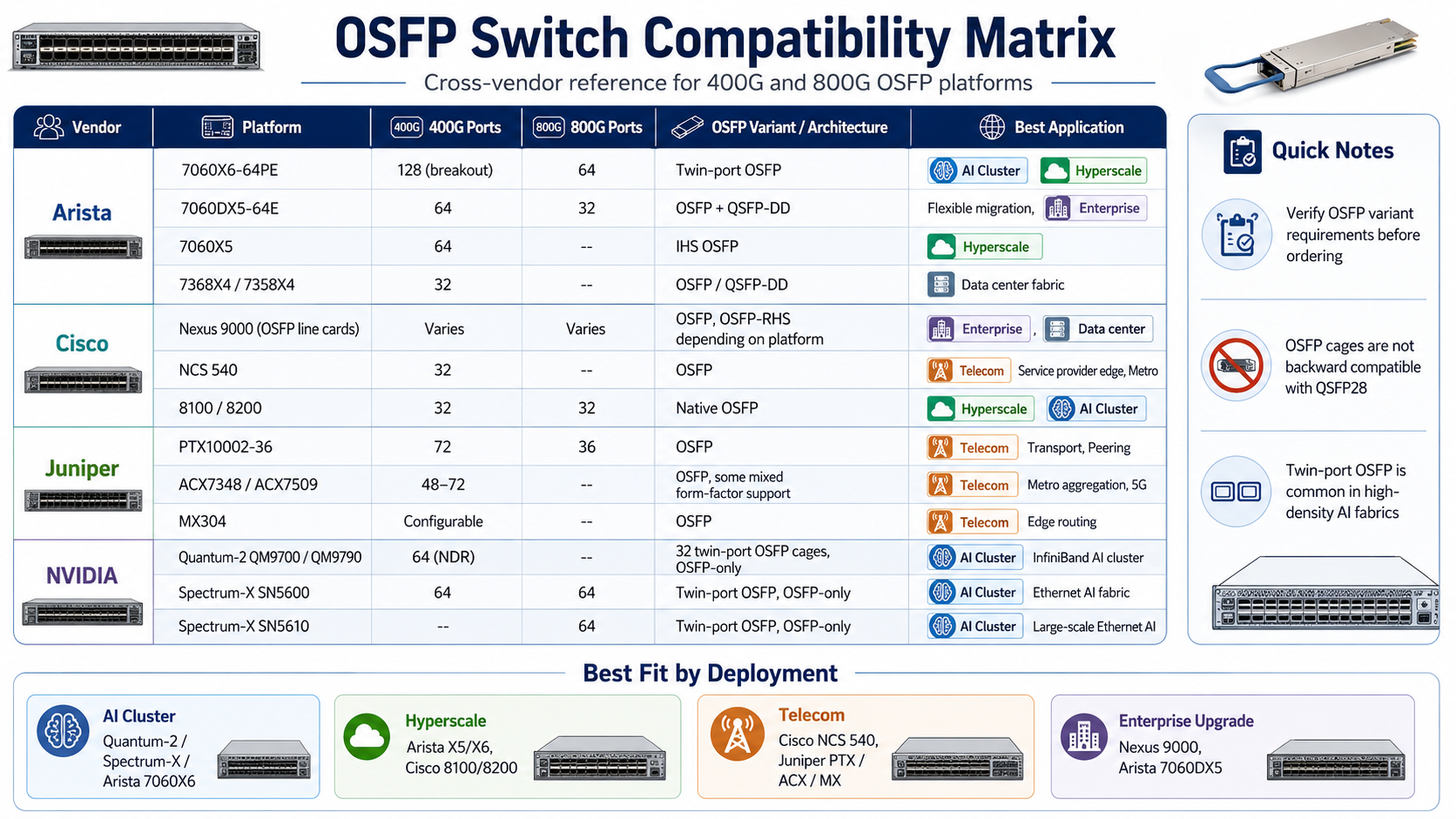
For broader form factor context, see our QSFP-DD compatible switches guide which covers the alternative form factor.
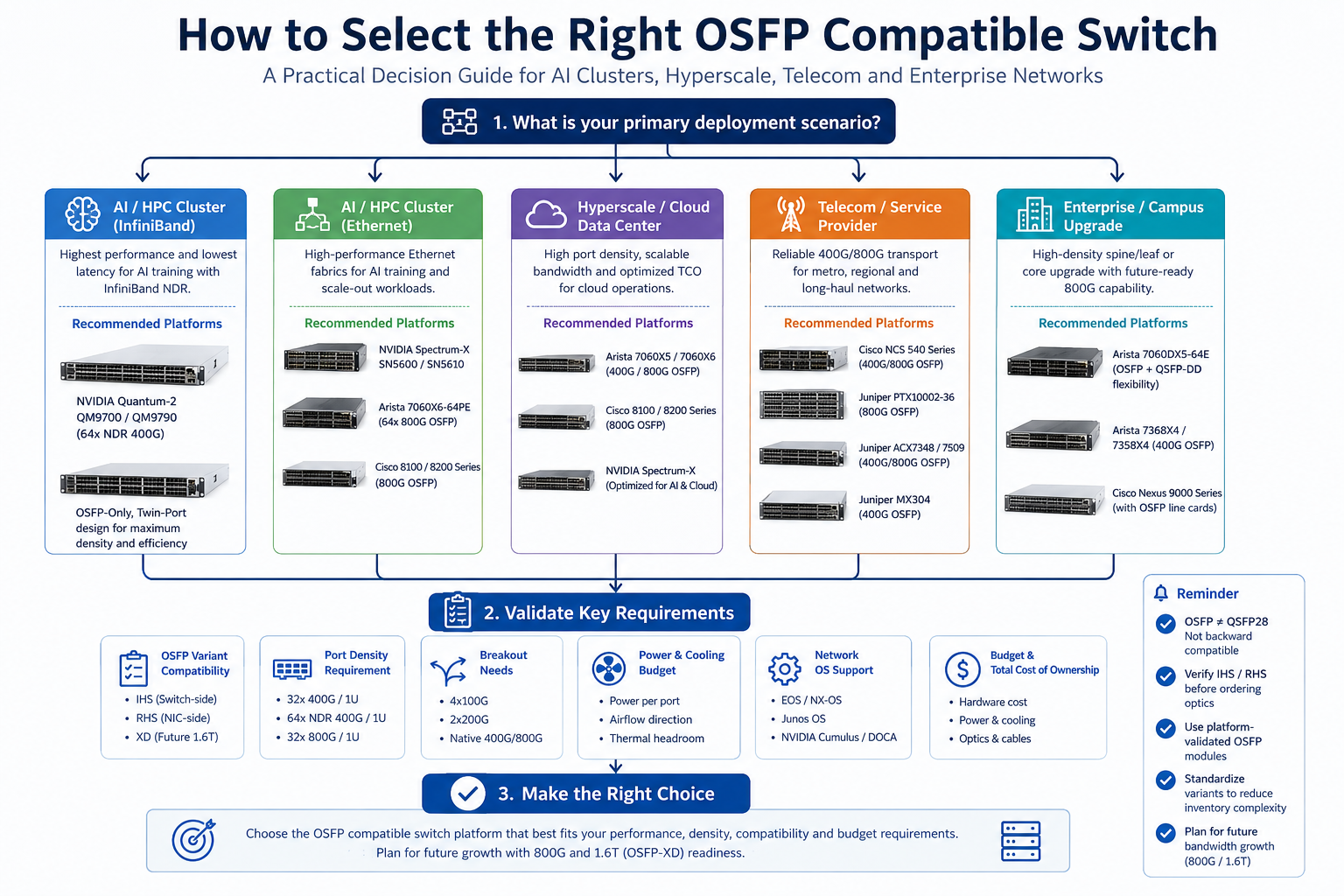
How to Choose the Right OSFP Switch
The best OSFP platform depends heavily on your workload, protocol, and migration strategy.
AI Training Clusters
For InfiniBand AI clusters, NVIDIA Quantum-2 remains the dominant platform.
For Ethernet-based AI clusters, the leading options are:
- •NVIDIA Spectrum-X
- •Arista 7060X6
- •selected Cisco 8000 platforms
Thermal performance and breakout flexibility are especially important in AI deployments.
Hyperscale Data Centers
Hyperscale operators value port density and thermal performance equally. The dominant choices are:
- •Arista 7060X5, 7060X6, 7368X4 (broad portfolio)
- •Cisco 8100/8200 (native 800G OSFP)
- •NVIDIA Spectrum-X (AI-focused hyperscale)
Avoid mixing OSFP-IHS and OSFP-RHS variants. Standardize on one variant per fabric tier to simplify cable plant and inventory management.
Telecom and Service Provider Networks
For telecom and metro deployments, OSFP is increasingly used in:
- •transport routing
- •peering networks
- •metro aggregation
- •5G infrastructure
Juniper PTX and Cisco transport platforms remain common choices.
Enterprise 400G and 800G Upgrades
Enterprise networks often migrate gradually from:
- •QSFP28 100G
- •to QSFP-DD and OSFP
Because standard OSFP cages do not directly accept QSFP28 modules, many enterprises adopt mixed-form-factor architectures during transition periods. Platforms supporting both QSFP-DD and OSFP can simplify migration planning.
Looking for OSFP modules tested for your specific platform? Request a quote and our engineers will verify compatibility before you order.
Conclusion
OSFP compatible switches are now widely deployed across AI infrastructure, hyperscale networking, and next-generation transport environments. Major vendors including NVIDIA, Arista, Cisco and Juniper, all support OSFP across selected 400G and 800G platforms.
Key considerations include:
- •choosing the correct OSFP thermal variant
- •validating breakout architecture
- •planning airflow and cooling
- •understanding platform-specific compatibility
- •balancing OSFP and QSFP-DD migration requirements
As AI clusters and 800G deployments continue scaling, OSFP is expected to remain one of the dominant high-performance optical ecosystems in the industry.
Ready to source OSFP transceivers for your switches? Contact Shenzhen Ascent Optics for MSA-compliant OSFP modules with multi-vendor platform validation, factory-direct pricing, and engineering support for any deployment scale.
Frequently Asked Questions (FAQs)
Q: What is the difference between OSFP-IHS and OSFP-RHS?
A: OSFP-IHS modules include integrated cooling fins and are commonly used in switch environments. OSFP-RHS modules use a flat-top design and rely on the host system’s riding heatsink for cooling, making them common in NICs and GPU servers.
Q: Which vendors support OSFP switches?
A: Major OSFP switch vendors include NVIDIA, Arista, Cisco, and Juniper. OSFP support varies by platform and deployment type.
Q: Where are OSFP compatible switches commonly used?
A: OSFP compatible switches are commonly used in AI clusters, cloud platforms, hyperscale data centers, and HPC networks that need very high bandwidth and low latency. They are a strong fit for environments with large-scale data movement between servers, GPUs, and storage systems. In practice, they help support demanding workloads such as AI training, scientific computing, distributed applications, and high-density data center networking.
Q: How do you choose the right OSFP compatible switches for a deployment?
A: Choose OSFP compatible switches by matching them to your required speed, port density, and hardware compatibility first. You should also review thermal design and power capacity, since high-speed OSFP deployments may need stronger cooling and rack planning. Finally, consider scalability, so the switch can support future growth without forcing an early redesign.
Q: How can you explain OSFP compatible switches to a non-technical buyer or decision-maker?
A: OSFP compatible switches are network switches built to use high-speed OSFP modules, helping businesses move large amounts of data quickly and reliably. For a buyer, what matters most is that these switches support faster connections, better scalability, and stronger performance for data-heavy environments such as AI, cloud, and modern data centers.
Q: Are OSFP switches backward compatible with QSFP28?
Standard OSFP cages are not directly compatible with QSFP28 modules unless adapters or hybrid cage designs are specifically supported by the platform.
Q: Why is OSFP popular in AI networking?
OSFP provides better thermal performance and higher power handling than many earlier form factors, making it well suited for high-density AI and GPU networking environments.
Q: Which OSFP platform is best for NVIDIA InfiniBand NDR?
NVIDIA Quantum-2 platforms are currently the dominant switches for InfiniBand NDR deployments using 400G OSFP optics.
Arista 400G Solutions page
Cisco Live BRKOPT-2699
NVIDIA Quantum-2 documentation
Juniper PTX documentation
Post Views: 2,060