In February 2025, data center architect David was struggling to select optical modules for his 32-port 400G spine switch. The datasheets listed six variants — SR8, SR4, DR4, FR4, 2xFR4, and LR4. Each had different reach, fiber requirements, connectors, and pricing. After hours of comparing supplier datasheets, he still couldn’t make a confident decision. He needed a clear, side-by-side guide covering all options.
The 400G OSFP transceiver family provides a complete portfolio engineered for every reach and application in modern data center networks — from 50-meter NVIDIA InfiniBand links to 10km DCI metro connections.
Whether you are planning a greenfield 400G deployment, upgrading from 100G QSFP28, or optimizing an existing fabric, understanding the differences between these six variants is essential. This guide walks you through each type with technical specifications, ideal applications, breakout options, and a practical selection framework.
Looking for the right 400G OSFP modules for your network? Browse our 400G OSFP catalog for SR8, SR4, DR4, FR4, 2xFR4, and LR4 variants with platform-tested compatibility.
400G OSFP Transceiver Types at a Glance
The table below summarizes the major 400G OSFP module variants currently used in modern data center and AI networking environments.
| Module Type |
Reach |
Fiber |
Connector |
Power |
Modulation |
Application |
| OSFP SR8 |
100m |
OM4 MMF |
MTP/MPO-16 |
~10W |
8×50G PAM4 |
Intra-rack Ethernet |
| OSFP SR4 |
100m |
OM4 MMF |
MPO-12 UPC |
~8.5W |
4x100G PAM4 |
InfiniBand NDR |
| OSFP DR4 |
500m |
OS2 SMF |
MPO-12 APC |
~10W |
4x100G PAM4 |
Spine-leaf, campus |
| OSFP FR4 |
2km |
OS2 SMF |
Duplex LC |
~12W |
4×100G PAM4 LAN-WDM |
DCI short-haul |
| OSFP 2xFR4 |
2km |
OS2 SMF |
Dual duplex LC |
~14W |
2×200G FR4 |
Cost-optimized DCI |
| OSFP LR4 |
10km |
OS2 SMF |
Duplex LC |
~12W |
4×100G PAM4 LAN-WDM |
Metro aggregation |
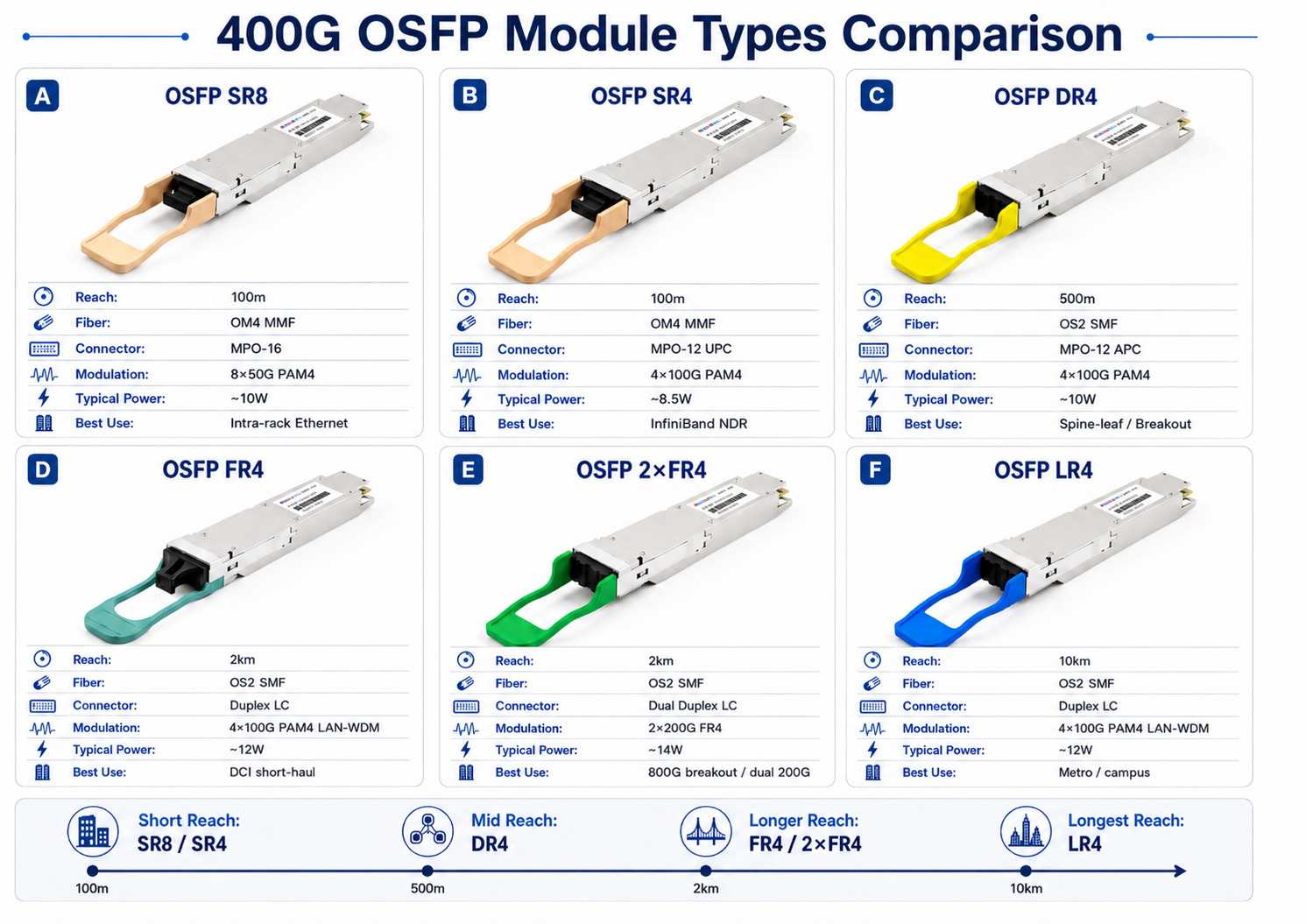
Several clear patterns emerge from this comparison.
- •Multimode variants such as SR8 and SR4 are designed for short-reach intra-data-center connectivity.
- •Single-mode modules extend transmission reach from 500 meters with DR4 up to 10 kilometers with LR4.
- •Parallel optics modules typically use MPO connectors, while wavelength-multiplexed modules use duplex LC interfaces to minimize fiber consumption.
The correct module depends on the specific combination of reach, protocol, switch platform, and existing fiber infrastructure.
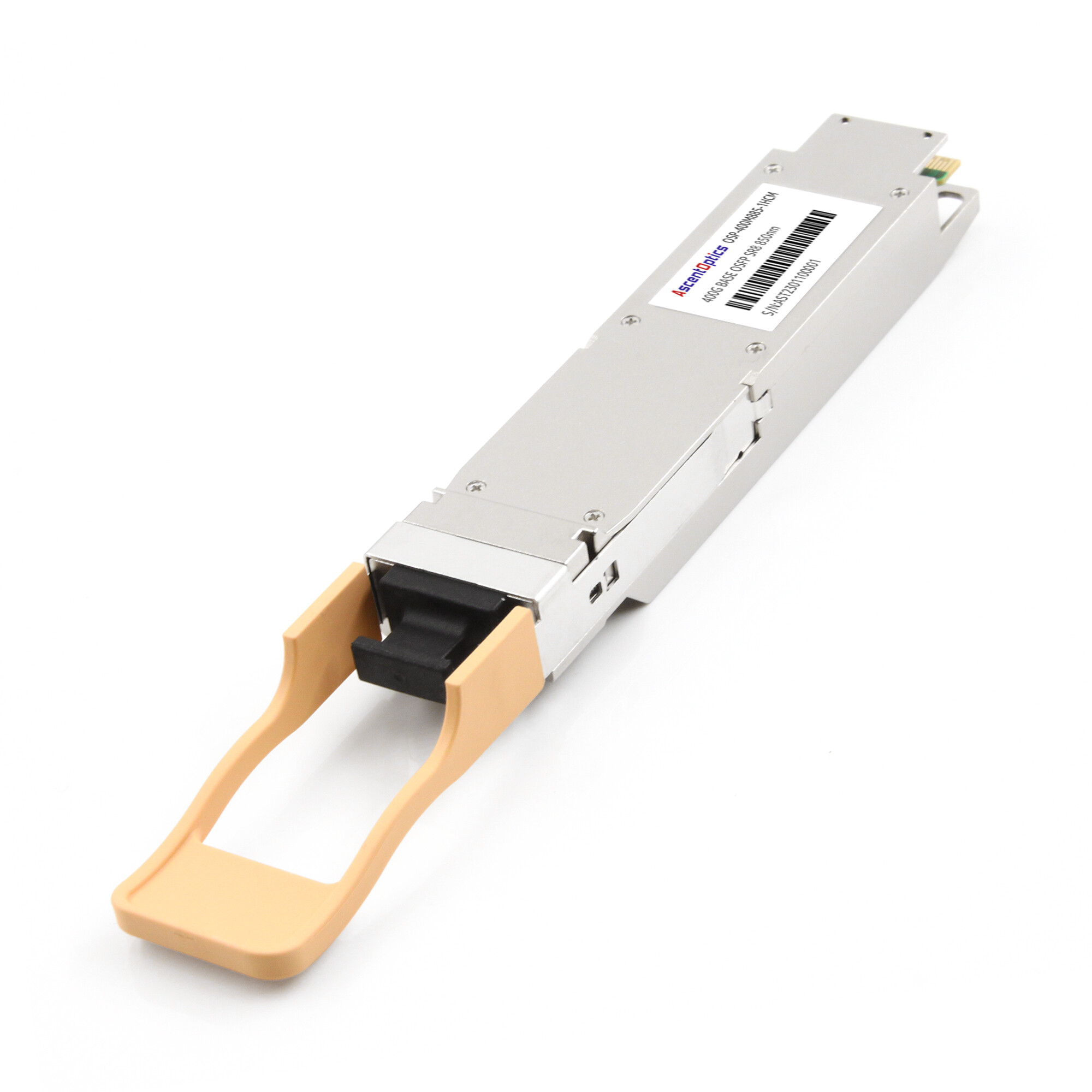
400G OSFP SR8: Short-Reach Multimode (100m)
The OSFP SR8 is the standard short-reach multimode module for 400G Ethernet networks. This module has eight 53.125 Gbps PAM4 electrical lanes that align with eight 850nm VCSEL optical lanes, appealing to 400 Gbps over multimode fiber.
Electrical and Optical Architecture
OSFP SR8 uses:
- •8 electrical lanes
- •8 optical transmit lanes
- •8 optical receive lanes
Each lane operates at 53.125 GBaud PAM4, delivering an effective data rate of 100Gbps per lane pair.
On the optical side, the module uses:
- •850nm VCSEL transmitters
- •PIN photodetectors for reception
This parallel optics architecture avoids wavelength multiplexing complexity and keeps latency and module cost relatively low.
Reach and Fiber Type
Regarding the possible link spans, OSFP SR8 supports up to 70 meters over OM3 and 100 meters over OM4 multimode fiber. Some manufacturers extended OM4 range to 150 meters through the use of improved link budgets, but 100 m is the IEEE 802.3bs standard.
Applications
For intra-rack switch-switch links and very short leaf-spine interconnects within the same row, SR8 is unmatched. For AI and HPC clusters that are using Ethernet (as opposed to InfiniBand), SR8 is preferred to links between a ToR switch and a spine switch down the same hot aisle.
Breakout Capability
OSFP SR8 commonly supports breakout into 4×100G SR2 or 8×50G connections, depending on switch ASIC support. Some platforms also support 2×200G SR4 breakout configurations.
Flat-Top vs Finned-Top Variants
OSFP SR8 modules are available in two thermal formats:
- •Flat-top modules, which rely on the switch riding heatsink (RHS)
- •Finned-top modules, which include an integrated heatsink (IHS)
Finned-top modules are typically preferred in high-power switch environments where airflow and thermal density are more demanding.
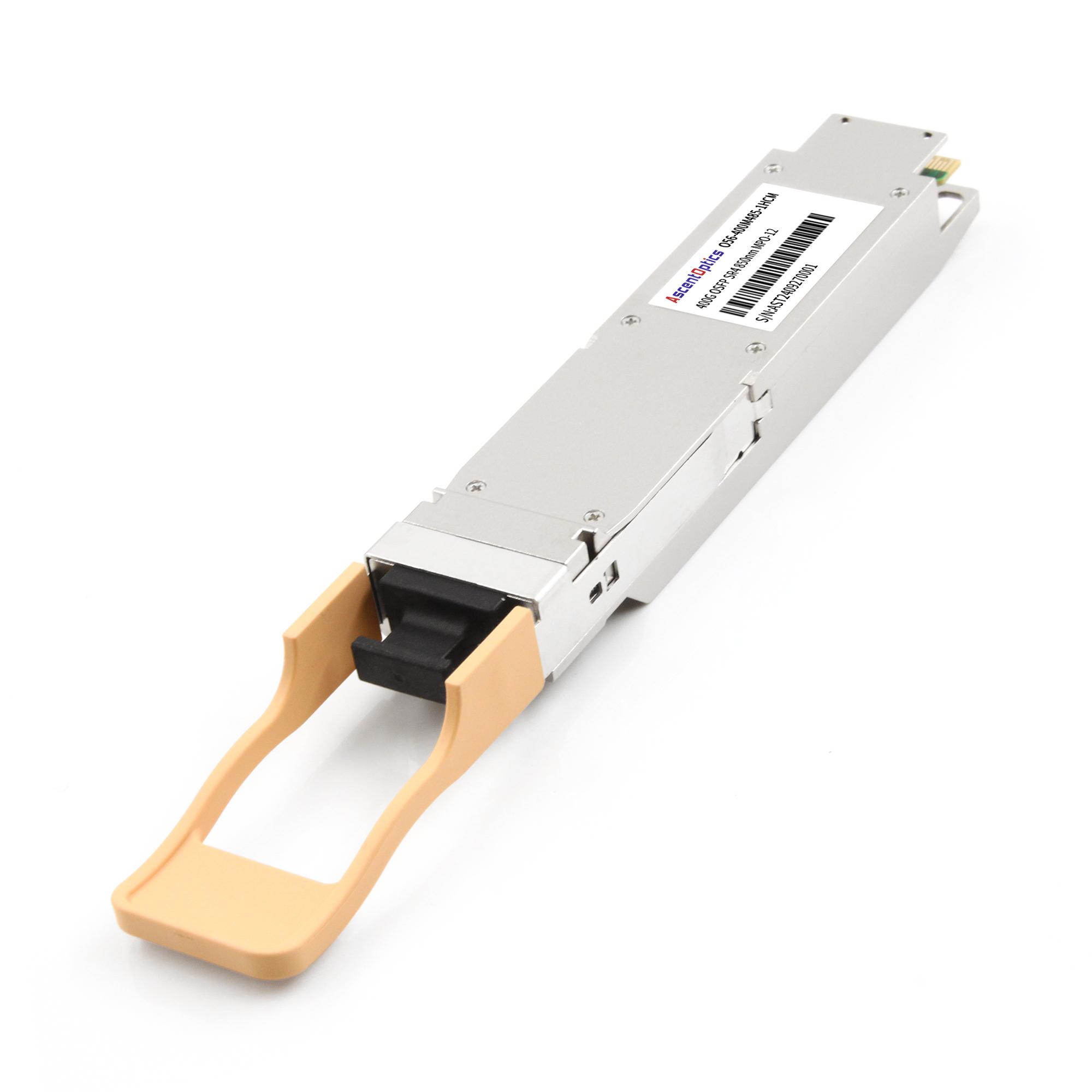
400G OSFP SR4: NVIDIA InfiniBand NDR Optics
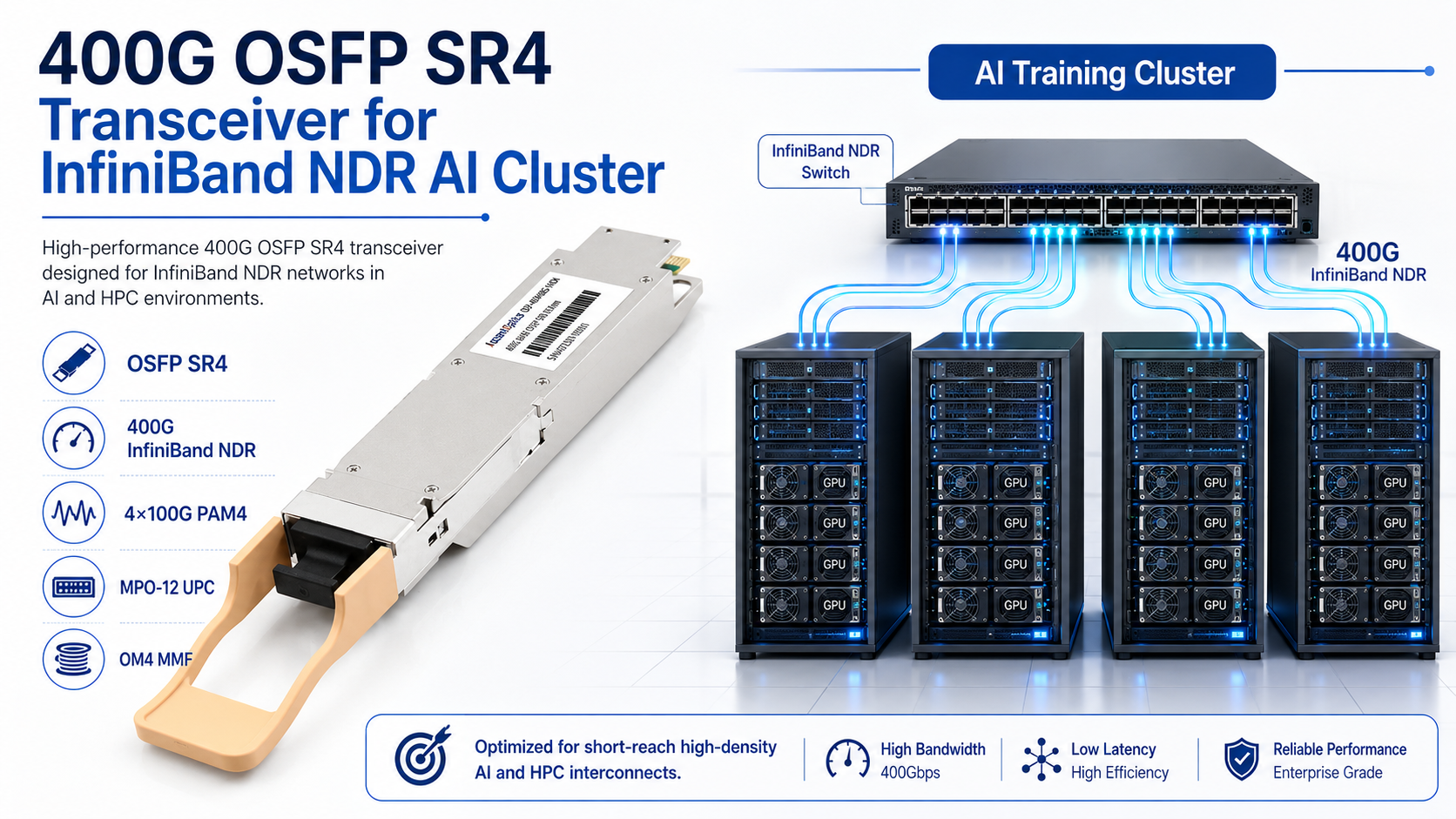
OSFP SR4 is primarily associated with NVIDIA InfiniBand NDR deployments. While physically similar to SR8, SR4 uses a different lane architecture optimized for NVIDIA’s 4×100G PAM4 InfiniBand design.
4x100G PAM4 Architecture
Contrary to the eight 50G lanes on the SR8, the OSFP SR4 deploys four 100 Gbps PAM4 lanes. Each lane operates at 53.125 GBaud using PAM4 signaling. This architecture aligns with NVIDIA ConnectX-7 adapters, BlueField DPUs, and Quantum-2 InfiniBand switches.
MPO-12 Interface
SR4 uses an MPO-12 UPC connector instead of MPO-16. This difference is important during structured cabling planning because SR4 and SR8 are not directly interchangeable at the cabling layer.
Deployment Scenarios
OSFP SR4 is commonly used in:
- •NVIDIA Quantum-2 fabrics
- •AI training clusters
- •HPC supercomputing environments
- •GPU-to-switch interconnects
- •InfiniBand NDR deployments
For NVIDIA-specific deployment guidance, see our OSFP for NVIDIA InfiniBand NDR Guide.
NVIDIA Compatibility
NVIDIA commonly references SR4 modules using part numbers such as:
- •MMA1Z00-NS400
- •MMA4Z00-NS (switch-side twin-port versions)
When deploying third-party optics, platform validation is strongly recommended. For deeper InfiniBand-specific guidance, see our OSFP for NVIDIA InfiniBand NDR guide.
Need OSFP SR4 modules tested for NVIDIA ConnectX-7? Contact our optical engineers for platform compatibility verification.
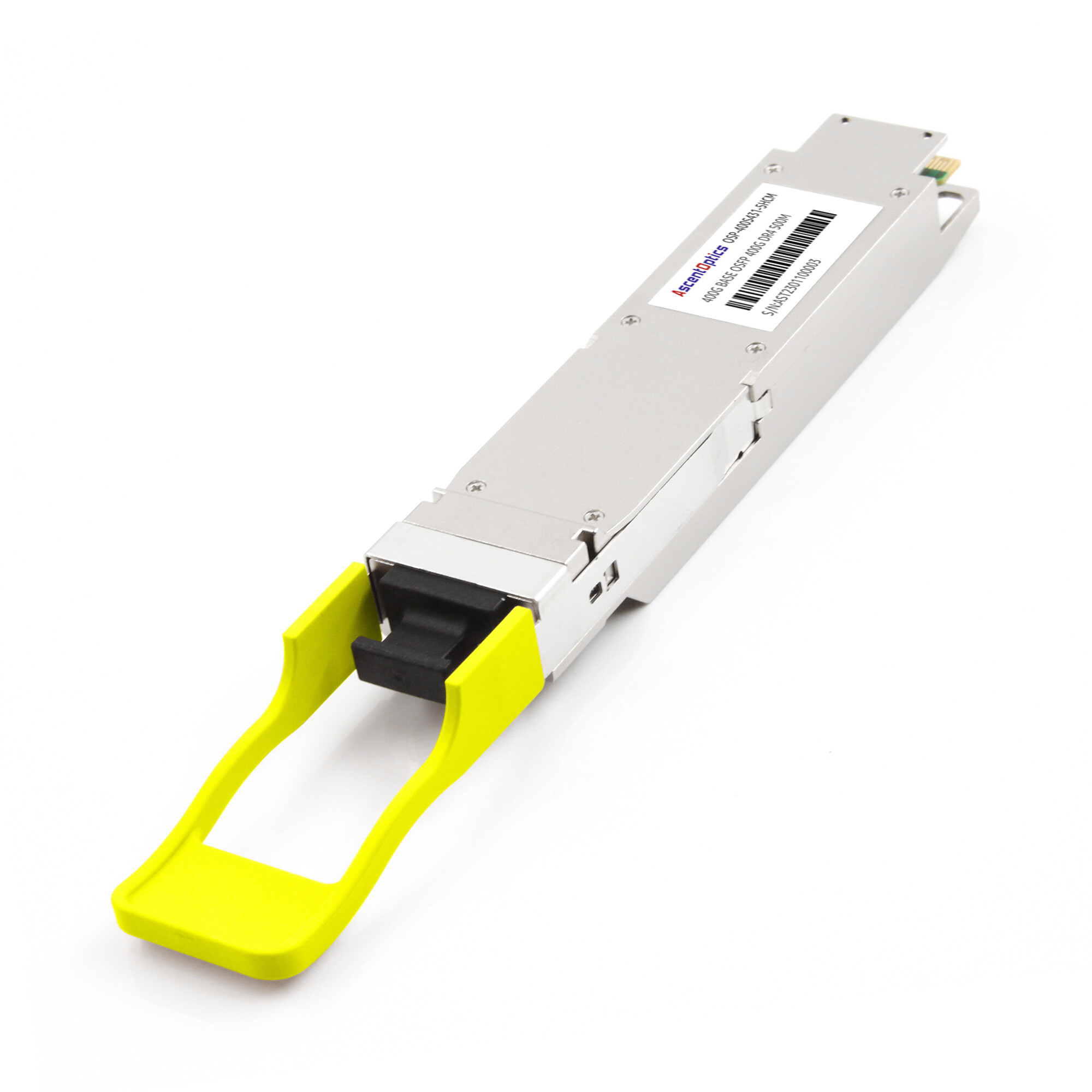
400G OSFP DR4: 500m Single-Mode Connectivity
The OSFP DR4 is the most versatile 400G OSFP module for modern data center architectures. It transmits 4x100G PAM4 over single-mode fiber, reaching 500 meters with no optical amplification.
Architecture and Specifications
DR4 transmits:
- •4×100G PAM4 optical signals
- •over single-mode fiber
- •at 1310nm wavelengths
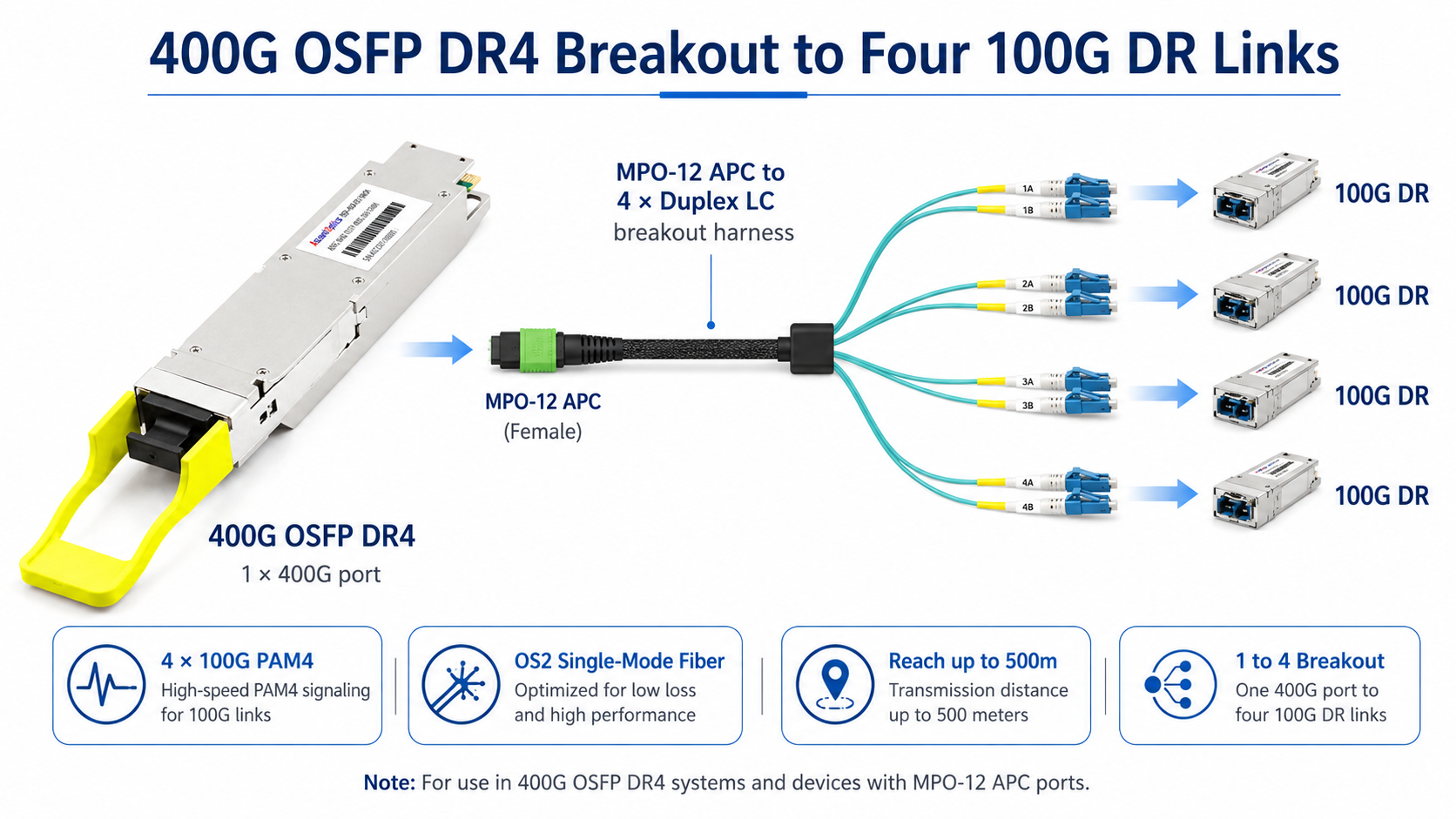
The module uses an MPO-12 APC connector with:
- •4 transmit fibers
- •4 receive fibers
for a total of 8 active fibers.
Like most 100G-per-lane PAM4 optics, DR4 requires KP4 forward error correction (FEC) to maintain signal integrity and BER performance.
Spine-Leaf and Campus Applications
OSFP DR4 is there to be in a spine-leaf architecture where racks are situated too far apart for multimode reach along with catering to last-row-to-last-row connections and point-to-point connections to campus buildings within up to 500 meters.
Breakout to 4x100G DR
One of the standout feature advancements is breakout. Using an MPO-12 to 4× duplex LC breakout harness, one 400G DR4 port can connect to four 100G DR links. This significantly improves port efficiency during 100G-to-400G migration.
400G OSFP FR4: 2km Duplex LC Optics
OSFP FR4 extends 400G connectivity to 2 kilometers while using only a duplex LC fiber pair. This makes it highly attractive for environments with limited fiber availability.
LAN-WDM Optical Architecture
FR4 multiplexes four 100G PAM4 wavelengths onto a single duplex fiber pair using LAN-WDM technology. It puts four wavelengths, 1271 nm, 1291 nm, 1311 nm, and 1331 nm, on one fiber pair. An offer of 100 Gbps PAM4 per wavelength results in an aggregated 400G.
Duplex LC Connector
The most outstanding advantage of FR4 over DR4 is that it uses duplex LC connectors. While DR4 requires MPO-12 (8 fibers active), FR4 requires just 2 fibers. For data centers with existing duplex LC infrastructure, FR4 often reduces deployment complexity and cabling cost.
Typical Applications
FR4 is commonly used for:
- •Data center interconnect (DCI)
- •Campus backbone links
- •Enterprise WAN aggregation
- •Cloud edge interconnects
- •Metro-access connectivity
Breakout Considerations
Physical optical breakout is generally not supported for FR4 because all wavelengths are multiplexed onto a single fiber pair. If 4×100G breakout is required, DR4 is typically the preferred architecture.
400G OSFP 2xFR4: Cost-Optimized Dual 200G
2×FR4 differs from the other modules in this guide because it is primarily used in 800G environments rather than standard standalone 400G switching.
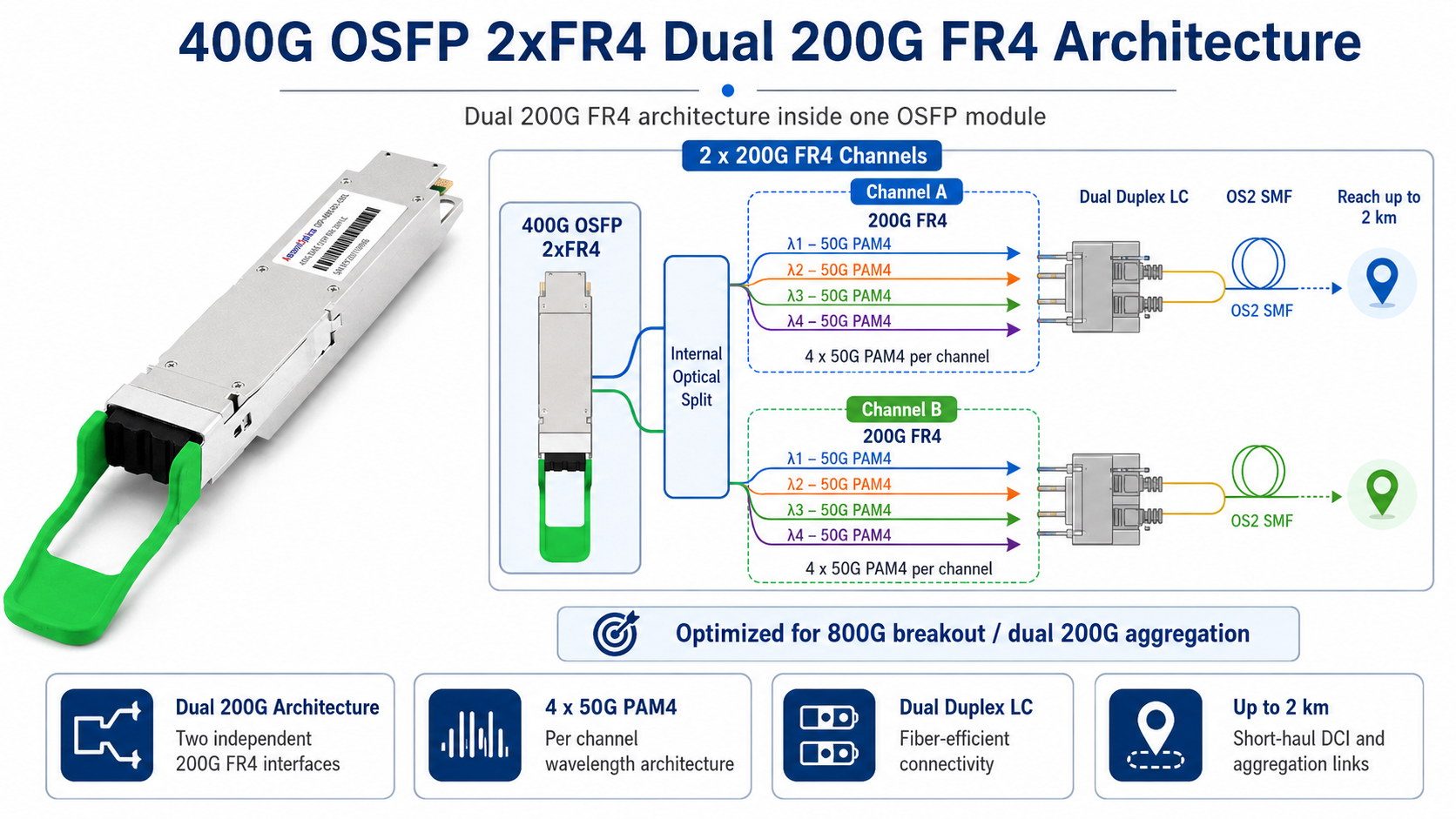
Dual 200G FR4 Structure
A 2×FR4 module contains:
- •two independent 200G FR4 interfaces
- •each using 4×50G PAM4 wavelengths
The module typically exposes:
- •dual duplex LC connectors
- •two separate 200G channels
Typical Use Cases
2×FR4 is commonly used for:
- •800G switch breakout
- •Dual 400G aggregation
- •Metro DCI architectures
- •Flexible 800G fan-out deployments
Because it consolidates multiple links into a single module, it can improve switch port utilization in high-density environments.
Power and Thermal Characteristics
2×FR4 modules are among the highest-power OSFP optics currently deployed, typically operating between 14W and 18W. Thermal planning is especially important in fully populated AI switch systems.
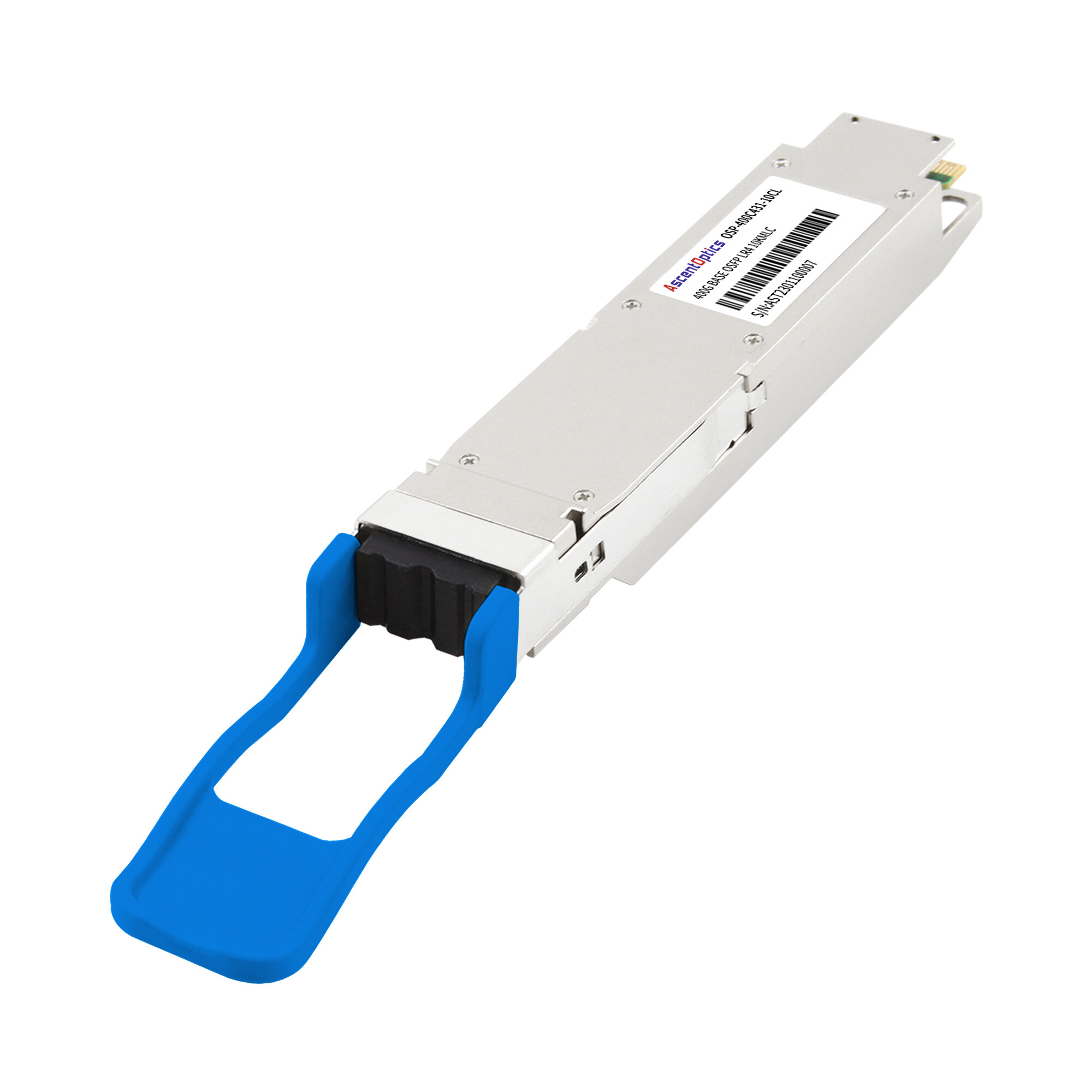
400G OSFP LR4: 10km Metro Reach
OSFP LR4 extends 400G transmission reach up to 10 kilometers over single-mode fiber. It is designed for longer-distance enterprise and metro connectivity where FR4 reach is insufficient.
Extended-Reach LAN-WDM
LR4 uses the same general wavelength approach as FR4 but with higher optical launch power, improved receiver sensitivity and larger optical link budget. This enables stable transmission across longer fiber spans.
Applications
OSFP LR4 rules the metro Ethernet aggregation, 5G transport network (backhaul, midhaul), and binds up regional data center interconnects. It’s useful for inter-building WAN connections in campuses, corporate setups, and selected government facilities.
Link Budget Considerations
At 10km distances, optical budget planning becomes increasingly important. Standard single-mode fiber attenuation is approximately 0.25 dB/km at 1310 nm. After accounting for: connector loss, splice loss and patch panel loss, most LR4 deployments still maintain sufficient operating margin under normal fiber conditions.
How to Choose the Right 400G OSFP Module
Selecting the correct 400G OSFP module becomes much easier when approached step by step.
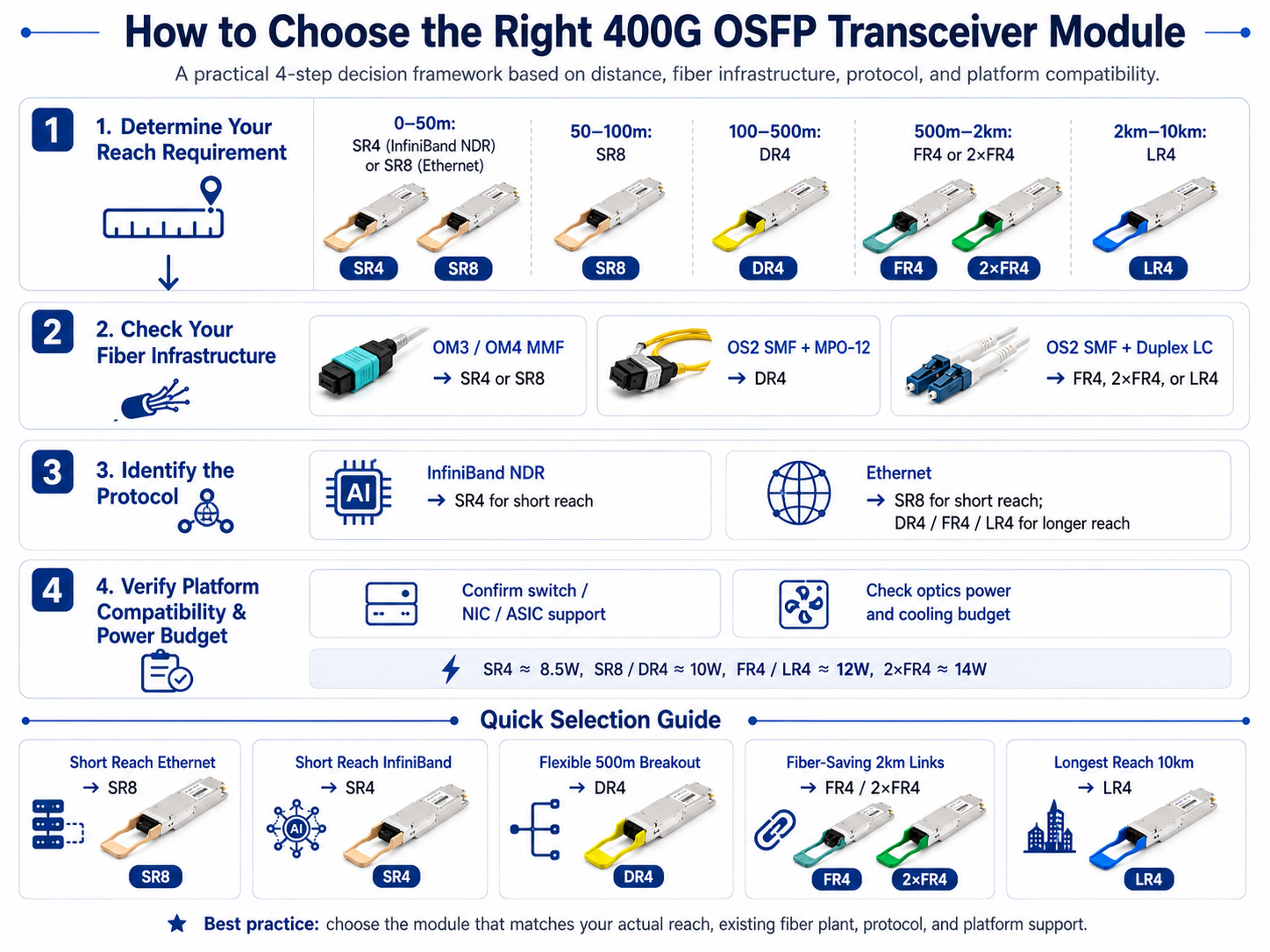
Distance-Based Selection
Reach is the primary selection criterion:
- •0-50m: OSFP SR4 (if InfiniBand) or OSFP SR8 (if Ethernet)
- •50-100m: OSFP SR8 (Ethernet only)
- •100m-500m: OSFP DR4
- •500m-2km: OSFP FR4 (single 400G) or OSFP 2xFR4 (dual 200G)
- •2km-10km: OSFP LR4
Fiber Infrastructure Considerations
Existing fiber plant constrains your options:
- •OM3 / OM4 multimode fiber: SR4 or SR8 only
- •OS2 single-mode with MPO-12 infrastructure: DR4
- •OS2 single-mode with duplex LC infrastructure: FR4, 2xFR4, or LR4
Protocol Match: InfiniBand vs Ethernet
A short reach of 50 meters with NVIDIA InfiniBand NDR deployments, SR4 OSFP is required. Ethernet deployments use SR8 for the same range.
For a long reach, the SR4/SR8 distinction is less relevant as beyond DR4. DR4, FR4, and LR4 are widely used for both Ethernet and InfiniBand environments, depending on platform support.
Power and Thermal Budget
The module consumes as much as 14W (2xFR4) in power, and as little as 8.5W (SR4). Thus, a fully loaded switch of 32 ports would need about 270W to 450W in power consumption by all of its optics. Verify the power and cooling budgets of your switch before going for a high-power variant like 2xFR4.
4-Step Decision Framework
A pragmatic approach to selection:
- 1. Determine your reach requirementfrom the table above
- 2. Check your fiber infrastructure(multimode vs single-mode, MPO vs LC)
- 3. Identify your protocol(Ethernet, InfiniBand NDR, or both)
- 4. Verify platform compatibilitywith your switch vendor
David, from our opening scenario, ended up specifying a mix: OSFP DR4 for 16 cross-row links (500m), OSFP SR8 for 12 intra-row leaf connections (under 100m), and OSFP FR4 for 4 DCI uplinks (2km). The blended approach reduced his total optics cost by 28% versus a uniform DR4 deployment while matching each port to its actual requirement.
Want a platform-specific recommendation for your 400G deployment? Request a quote and our engineers will review your switch model, link distances, and protocol requirements.
Power Consumption Across 400G OSFP Variants
Power planning is critical for dense 400G deployments. Here is the complete power comparison:
| Module Type |
Typical Power |
Max Power |
Thermal Variant |
| OSFP SR4 |
8.5W |
10W |
Flat-top or Finned-top |
| OSFP SR8 |
10W |
12W |
Flat-top or Finned-top |
| OSFP DR4 |
10W |
12W |
Flat-top or Finned-top |
| OSFP FR4 |
12W |
14W |
Flat-top or Finned-top |
| OSFP 2xFR4 |
14W |
18W |
Finned-top recommended |
| OSFP LR4 |
12W |
14W |
Flat-top or Finned-top |
For a 32-port switch fully populated with high-power 2xFR4 modules, total optics power approaches 450W. Add the switch base power (200-400W) and a single 1U switch can draw 850W just for the data plane. AI infrastructure deployments with multiple 400G switches per rack need careful power and cooling planning.
For broader context on form factor decisions, see our QSFP-DD vs OSFP comparison guide covering the trade-offs between competing 400G architectures.
Conclusion
The 400G OSFP transceiver types form a complete portfolio designed for every modern networking application. Whether you are building an AI training cluster with NVIDIA InfiniBand, expanding a hyperscale spine-leaf fabric, or extending metro DCI capacity, there is a specific 400G OSFP variant engineered for the job.
Key takeaways include:
- •SR8 is widely used for short-reach 400G Ethernet connectivity
- •SR4 is optimized for NVIDIA InfiniBand NDR fabrics
- •DR4 provides flexible 500m single-mode connectivity with breakout support
- •FR4 reduces fiber consumption for 2km duplex LC deployments
- •LR4 enables 10km metro and enterprise connectivity
- •2×FR4 supports flexible breakout architectures in emerging 800G environments
The best module is not necessarily the longest reach or highest specification—it is the module that best matches your actual network architecture, cabling infrastructure, and future scalability requirements.
Ready to source 400G OSFP transceivers? Contact AscentOptics for SR8, SR4, DR4, FR4, 2xFR4, and LR4 modules with platform validation, MSA compliance, and factory-direct pricing for deployments at any scale.
Frequently Asked Questions (FAQs)
Q1: What is the difference between OSFP SR8 and SR4??
OSFP SR8 uses eight 50G PAM4 optical lanes and is primarily deployed in 400G Ethernet environments. OSFP SR4 uses four 100G PAM4 lanes and is commonly used in NVIDIA InfiniBand NDR deployments.
Q2: Which 400G OSFP module supports the longest distance?
OSFP LR4 supports transmission distances up to 10 kilometers over single-mode fiber and is commonly used for metro aggregation and long-distance enterprise connectivity.
Q3: Can 400G DR4 break out to 100G connections?
Yes. A 400G DR4 port can typically break out into four independent 100G DR connections using an MPO-12 to 4× duplex LC breakout harness.
Q4: Is OSFP better than QSFP-DD for AI networks?
OSFP generally provides higher thermal headroom and improved power handling compared with QSFP-DD, making it popular in AI and HPC deployments, especially in NVIDIA-based environments.
Q5:Which 400G OSFP module uses the fewest fibers?
FR4 and LR4 use duplex LC connectors and require only two fibers, making them more fiber-efficient than parallel-optics modules such as SR8 and DR4.
OSFP MSA
IEEE 802.3bs
IEEE 802.3cu
NVIDIA InfiniBand documentation
Post Views: 2,590