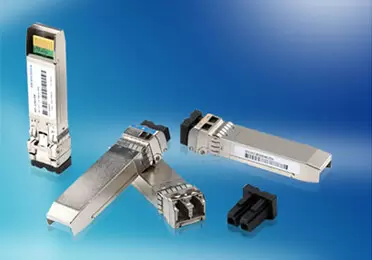
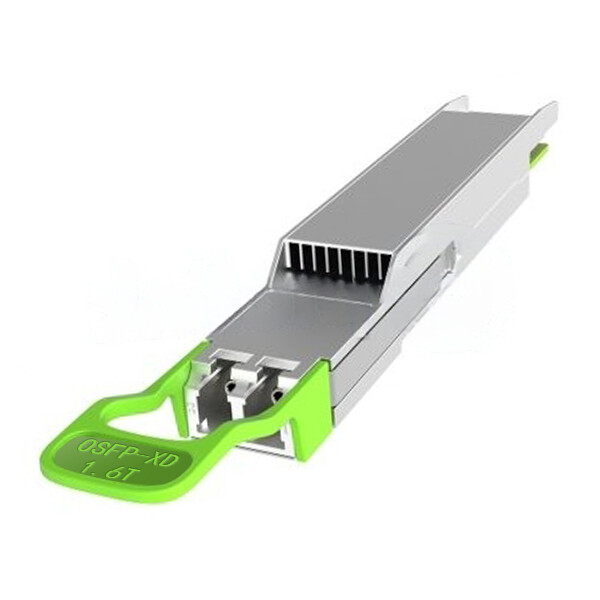
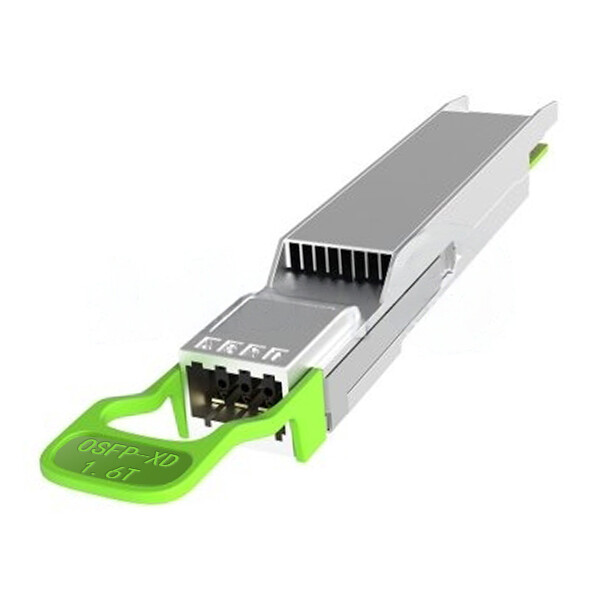
For three generations, Ethernet has doubled the bandwidth of a port without adding lanes. 400G ran eight lanes at 50 Gb/s, 800G ran eight at 100 Gb/s, and 1.6T runs eight at 200 Gb/s. At 1.6T you can finally see what the trick costs: heavier forward error correction, a thinner connector margin, shorter passive copper, and roughly 22 to 26 watts per cage before the switch ASIC draws a milliamp.
So what is 1.6T, precisely? It’s a 1,600 Gb/s Ethernet speed grade, defined in IEEE P802.3dj and already shipping in OSFP1600 modules. Most explainers stop there and hand you a number.
What Is 1.6T?
A 1.6T optical transceiver is a pluggable module that carries 1,600 Gb/s of Ethernet traffic over eight PAM4 lanes at roughly 200 Gb/s each. It doubles the per-lane rate of 800G while keeping the same eight-lane design, and it is defined in IEEE P802.3dj.
That sentence answers what is 1.6T Ethernet for the direct-detect case. The arithmetic is easy to state and easy to get wrong: 1.6T means 1,600 Gb/s, or 200 GB/s, not 1,600 GB/s. One port moves about 200 gigabytes per second in each direction, which is why a 102.4 Tb/s switch with 64 cages can saturate a large spine layer on its own.
Four things 1.6T is not:
- Not a new modulation. It’s still PAM4, with four amplitude levels and two bits per symbol. What changed is how fast those symbols are sent.
- Not more lanes, by definition. Mainstream client optics still use eight.
- Not one standard. IEEE P802.3dj governs direct-detect Ethernet optics. OIF 1600ZR governs the coherent version.
- Not a guaranteed 1.6T link. Split the port into 2×800G or 4×400G and each link carries correspondingly less.
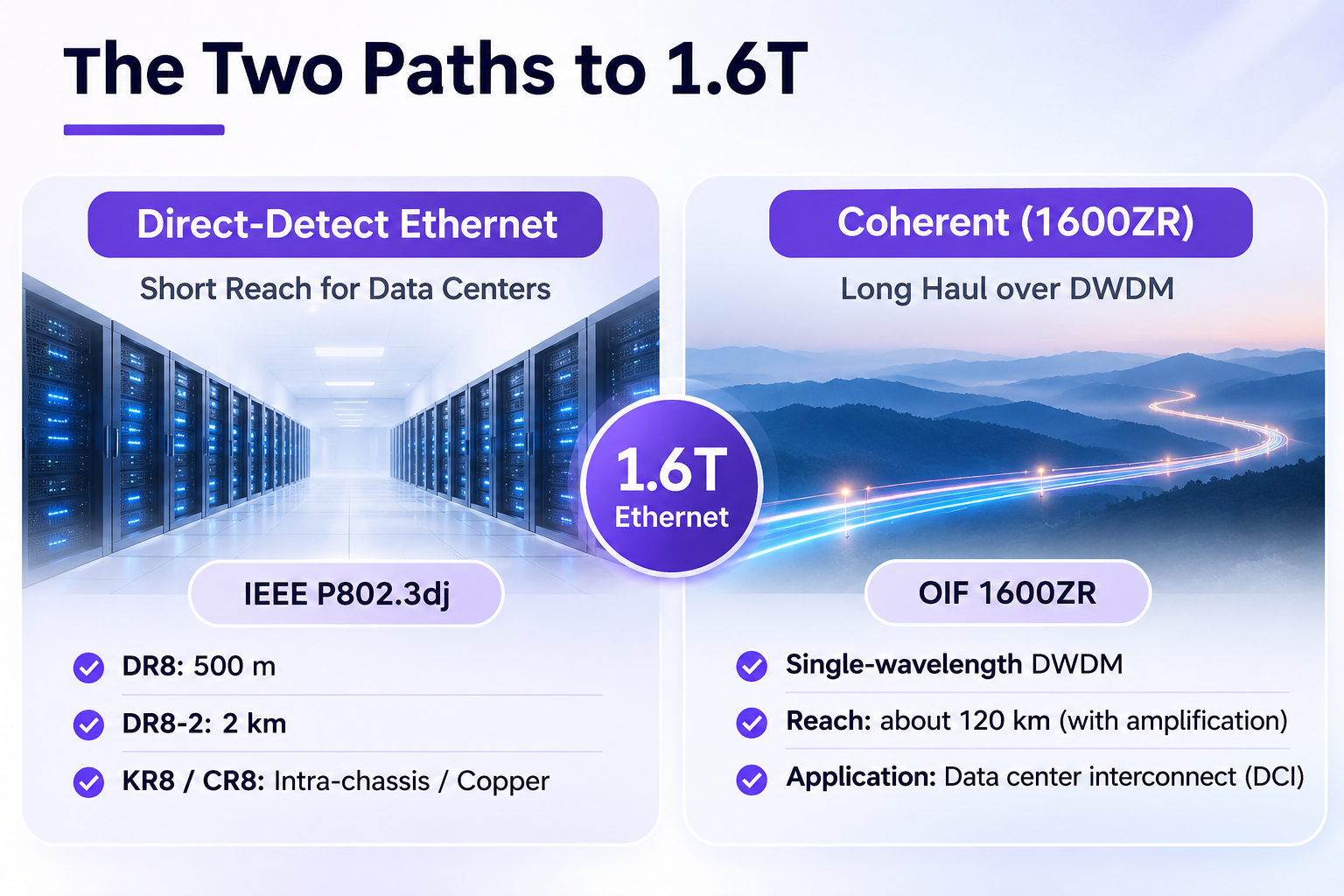
Two technologies carry the 1.6T label today. The first is a direct-detect Ethernet module that plugs into a switch cage. The second is a coherent module that moves one 1.6T Ethernet client over a single amplified DWDM wavelength for about 120 km. They share a data rate and very little else.
Why 1.6T Still Uses Eight Lanes
| Generation |
Lanes |
Per-lane rate |
Lane baud (approx.) |
Status |
| 400G |
8 |
50 Gb/s |
26.56 GBd |
Deployed |
| 800G |
8 |
100 Gb/s |
53.13 GBd |
Volume |
| 1.6T |
8 |
200 Gb/s |
106.25 GBd |
Shipping pre-standard |
| 3.2T |
8 |
400 Gb/s |
212.5 GBd |
Research, not standardized |
For mainstream 1.6T DR8 optics, bandwidth doubles through an increase in per-lane signaling rate while retaining eight parallel optical lanes. However, electrical lane count, fiber count, connector configuration, and module form factor vary across different 1.6T implementations.
The numbers are specific. A 1.6T DR8 lane runs at 106.25 GBd. At two bits per symbol, that is 212.5 Gb/s of raw line rate per lane, and roughly 200 Gb/s of payload once coding overhead comes out. The 2 km variants shift to 113.4375 GBd to buy margin for the longer reach.
If you want the modulation mechanics rather than the totals, the 800G PAM4 lane architecture behind 800G and 1.6T covers that ground.
One term causes most procurement confusion. 224G SerDes is a signaling class, not a payload rate. No 1.6T lane carries 224 Gb/s of Ethernet. The host interface is 1.6TAUI-8, and a 16×100G AUI also exists.
That 16-lane option is the second architectural branch. OSFP-XD reaches the same 1.6T by running sixteen 100G electrical lanes instead of eight 200G lanes. It works, it ships, and it’s an implementation choice rather than part of the definition. The 224G SerDes and 200G-per-lane signaling material covers the electrical layer if you need it.
A platform architect meets this the hard way: two quotes for the same 1.6T line rate, one OSFP1600 and one OSFP-XD, and neither fits the other’s cage. Compare electrical lane count and cage, not headline bandwidth.
The Two Paths to 1.6T: Ethernet Client Optics and Coherent
The Ethernet path is the one most people mean. It’s direct detect, defined in IEEE P802.3dj, and built from four physical medium dependent types:
- KR8, for backplane links inside a chassis.
- CR8, for copper cable assemblies.
- DR8, for 500 m over single-mode fiber.
- DR8-2, for 2 km over single-mode fiber.
There is no 1.6T FR8 or LR8 in the standard. When a vendor advertises a 2 km 1.6T module with eight lanes on duplex fiber, it is almost always 2×FR4, an implementation that pairs two 800G FR4 engines inside one 1.6T shell. It works, but it is not a standardized 1.6T PMD, so do not order it assuming one exists.
The coherent path is different engineering with a different owner. The OIF 1600ZR Implementation Agreement, released in September 2026, carries a single 1.6T Ethernet client over one coherent wavelength. With amplification it reaches about 120 km, and it doubles what 800ZR could put on a single wavelength.
The distinction matters for three practical reasons. Reach separates them, at 500 m to 2 km against 120 km. Power separates them, since direct-detect modules settle around 22 to 26 W while coherent parts run well above that. And the standards body separates them, which matters when a procurement template asks for IEEE compliance and the quoted part is governed by an OIF agreement.
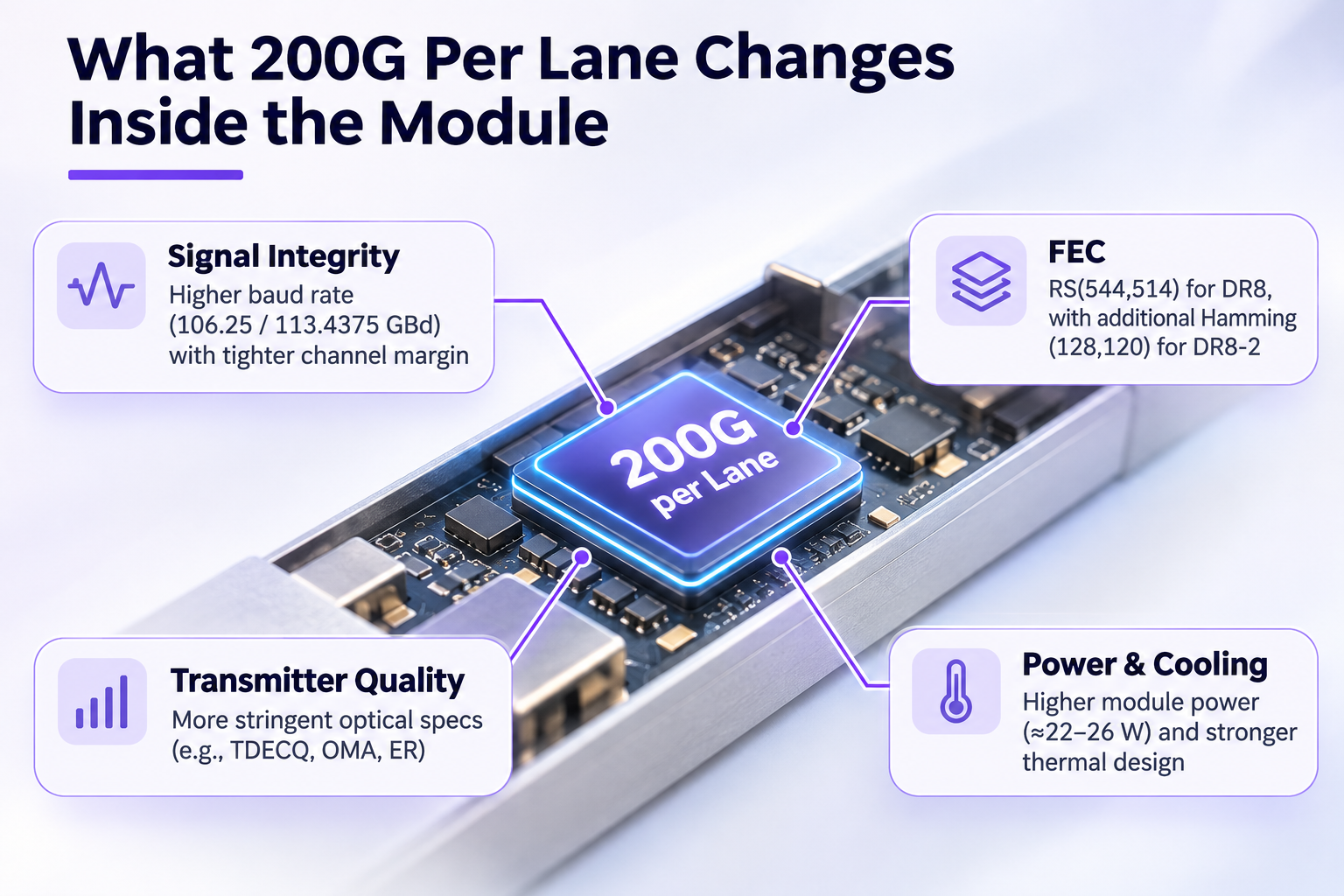
What 200G Per Lane Changes Inside the Module
Opening the shell reveals eight optical lanes, each with an EML or silicon-photonics modulator, plus a DSP, drivers and transimpedance amplifiers. The lane count looks familiar. Keeping eight lanes at 212.5 Gb/s honest does not.
FEC requirements depend on the optical PMD. The 1.6TBASE-DR8 interface uses RS(544,514) FEC, while the longer-reach 1.6TBASE-DR8-2 interface employs concatenated FEC with an additional Hamming(128,120) inner code. This increases the optical signaling rate from 106.25 GBd to 113.4375 GBd and improves error correction for the 2 km reach.
At 200G per optical lane, transmitter signal quality becomes more demanding. Parameters such as TDECQ, optical modulation amplitude (OMA), and receiver sensitivity must meet the requirements of the applicable IEEE 802.3dj PMD.
Connectors are the second cost. A connector recipe that passes at 100G per lane can fail at 200G per lane without anything else in the plant changing.
A test engineer hit exactly this in qualification: same MPO trunks, same polish, same cleaning procedure, and intermittent errors on two of eight lanes only at the higher rate. The cause was tolerance stacking across three mated pairs, invisible at 800G and fatal at 1.6T. No amount of swapping optics fixes that.
Power is the third cost, and it reshapes the rack. A finned OSFP1600 DR8 draws about 22 W typical and 23.8 W maximum. The 2×FR4 parts sit near 23.5 W typical and 25 W maximum.
Alternative architectures, including linear receive optics (LRO), linear pluggable optics (LPO), and co-packaged optics (CPO), aim to reduce optical interconnect power consumption. However, their power savings depend on the optical implementation, host-side signal processing, and system architecture. Module-level power figures should not be directly compared with system-level CPO power estimates.
Multiply by 64 cages and you carry roughly 1.5 kW of optics in a chassis before the ASIC. Air cooling stops being comfortable near 25 W per port, which is why power arrives before price in every design review.
From a manufacturing bench, the change is diagnostic depth. At 200G per lane, per-lane pre-FEC BER, TDECQ and temperature derating decide whether a module survives a hot aisle. A part that meets spec at 25°C and drifts at 70°C is a support ticket waiting to happen.
Qualifying a 200G-per-lane link? Our engineers check host firmware, cage type and fiber plant before samples ship, because most 1.6T field failures start outside the module. Talk to them before you order evaluation units.
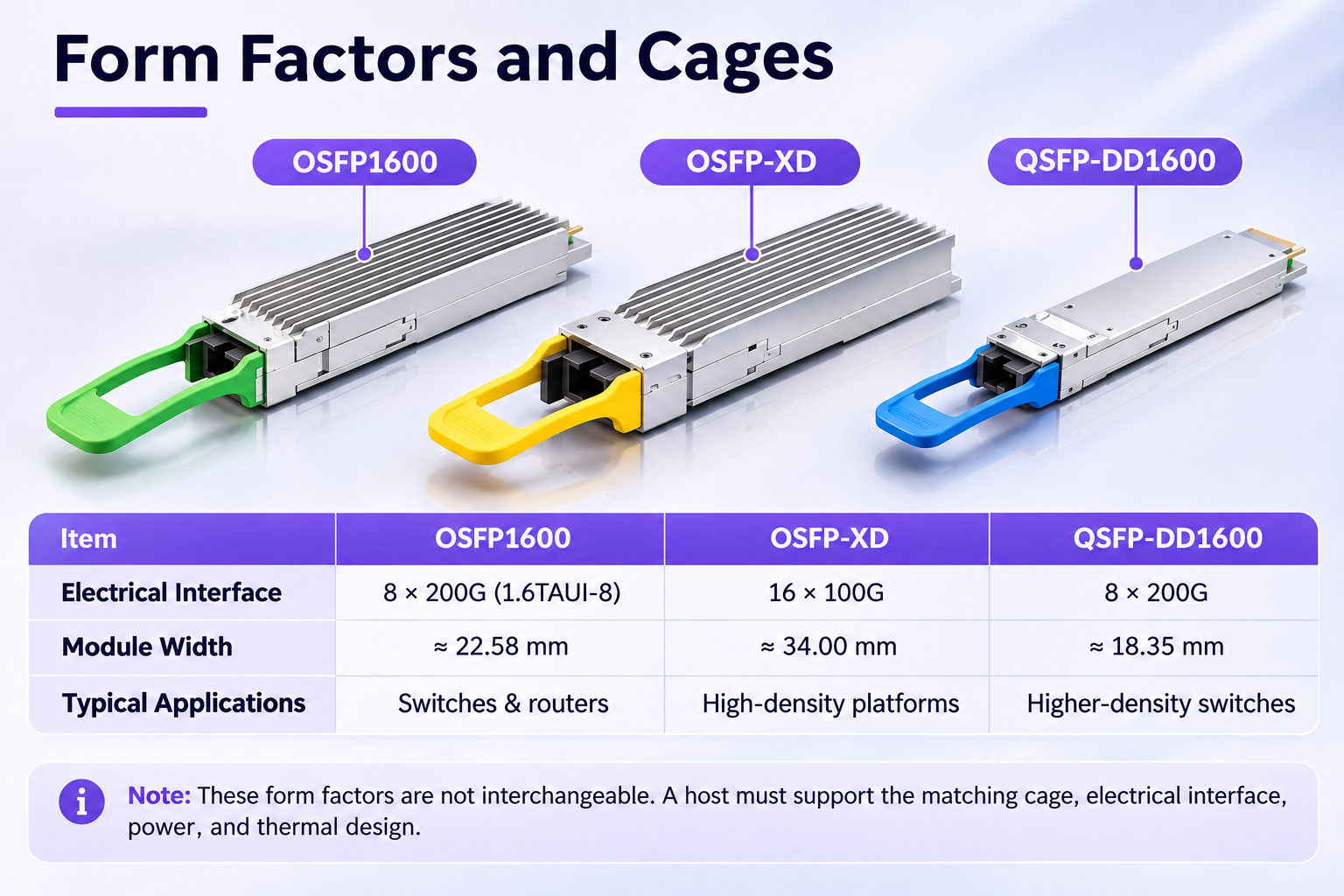
Form Factors and Cages: OSFP1600, OSFP-XD, QSFP-DD1600
Three module formats carry 1.6T today, and they are not interchangeable. The OSFP MSA defines the first two interfaces and their mechanicals.
| Module |
Electrical interface |
Width |
Cage |
Status at time of writing |
| OSFP1600 |
8 × 200G |
22.58 mm |
Same width as OSFP800 |
Shipping, mainstream |
| OSFP-XD |
16 × 100G |
28.15 mm |
Separate cage design |
Shipping |
| QSFP-DD1600 |
8 × 200G |
QSFP-DD width |
QSFP-DD cage |
MSA path, limited platform support |
The OSFP1600 technical deep dive covers the mechanics, thermal design and flat-top versus finned variants. Mechanical fit causes more wasted purchase orders than any other misunderstanding.
OSFP1600 uses the same cage width as OSFP800. It’ll physically seat.
It’ll only run if the host supports 200G per lane on that port, runs a CMIS version that recognizes the module, has firmware that agrees, and can remove about 25 W of heat from the cage. A module that seats and stays dark is not a defective module. It’s an unsupported host. Confirm all four conditions with the platform vendor before ordering, not after.
Is 1.6T Relevant to You Yet?
Every vendor page ends in a sales pitch. Here is the version you can use in a design review.
1.6T is probably right if:
- You are specifying a 102.4 Tb/s platform, where 64 cages at 1.6T replace 128 at 800G.
- Your fabric needs more than 800G per GPU or per spine uplink, and aggregation is eating your port budget.
- The row can dissipate about 25 W per cage and roughly 1.5 kW of optics per fully populated chassis.
- You can plan around 12 to 24 week lead times and hold a 10 to 15% spare pool.
Stay on 800G if:
- Your 51.2T platforms still have free ports.
- Most links are under 2 m, where copper is cheaper and passive DAC still works.
- Your fiber plant has not been audited for polish, loss and tolerance at the higher lane rate.
- Procurement cannot absorb the current cost-per-Tb/s premium. Estimated prices cluster at $1,100 to $1,500 for 1.6T against $350 to $450 for 800G, about $0.69to $0.94 per Gb/s against $0.45 to $0.56.
1.6T vs 800G in one table
| Spec |
800G |
1.6T |
| Lanes |
8 |
8 |
| Per-lane rate |
100 Gb/s |
200 Gb/s |
| Lane baud |
53.13 GBd |
106.25 GBd |
| Ports on a 102.4T switch |
128 |
64 |
| Typical module power (retimed) |
16 to 18 W |
22 to 26 W |
| Passive copper reach |
about 2.5 m |
about 1 m |
| Estimated cost per Gb/s |
$0.45 to $0.56 |
$0.69 to $0.94 |
For the same aggregate bandwidth, 1.6T ports can reduce the required number of optical modules by up to 50% compared with 800G ports. Although individual 1.6T modules consume more power, they may deliver lower module-level power consumption per bit. Actual system-level savings depend on switch architecture, port utilization, and cooling requirements.
Frequently Asked Questions
What does 1.6T mean?
1.6T means 1.6 terabits per second, or 1,600 Gb/s. In Ethernet, it is the speed grade after 800G, doubling the per-lane rate from 100 to 200 Gb/s while keeping eight lanes.
Is 1.6T Ethernet an approved standard?
Not fully, but close. IEEE P802.3dj cleared its third Sponsor Ballot recirculation in October 2026 with 97% approval and is on track for Standards Board approval in December 2026, so the ballot date isn’t the thing to plan around. Modules have shipped pre-standard for about a year, so the ballot removes a procurement objection, not a technical one.
How many lanes does 1.6T use?
Mainstream 1.6T client optics use eight PAM4 lanes at roughly 200 Gb/s each. OSFP-XD reaches the same rate through sixteen 100G electrical lanes, a different host interface.
What is the difference between 1.6T Ethernet and 1.6T coherent?
Ethernet client optics are direct detect, standardized by IEEE, and reach 500 m to 2 km inside a data center. Coherent 1600ZR is an OIF agreement that puts one 1.6T client on a single amplified DWDM wavelength for about 120 km. Different reach, different power, different standards body.
Will a 1.6T module work in an 800G OSFP cage?
It may fit, but fit is not support. The host must handle 200G per lane, run compatible CMIS and firmware, and cool roughly 25 W in the cage. Check all four with the platform vendor before you buy.
Post Views: 128