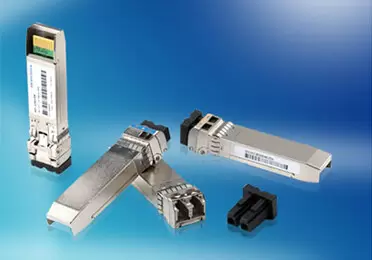
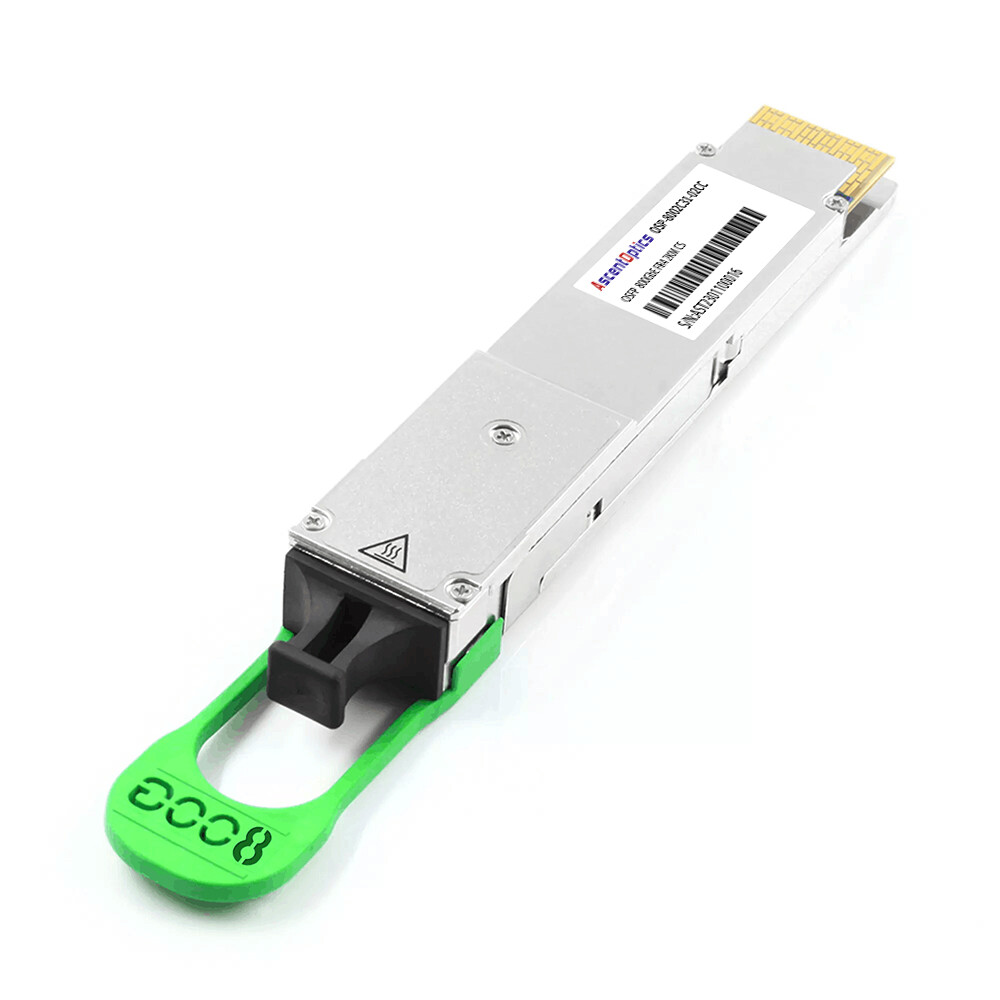
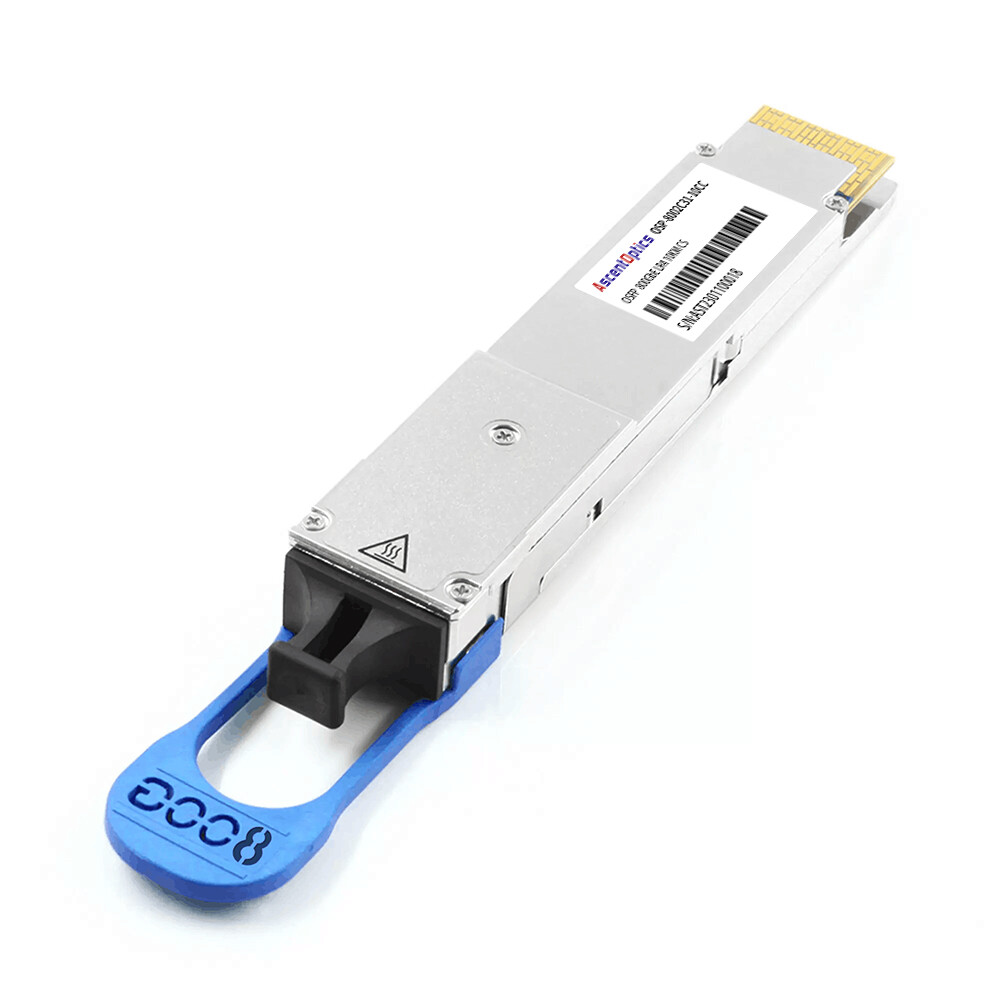
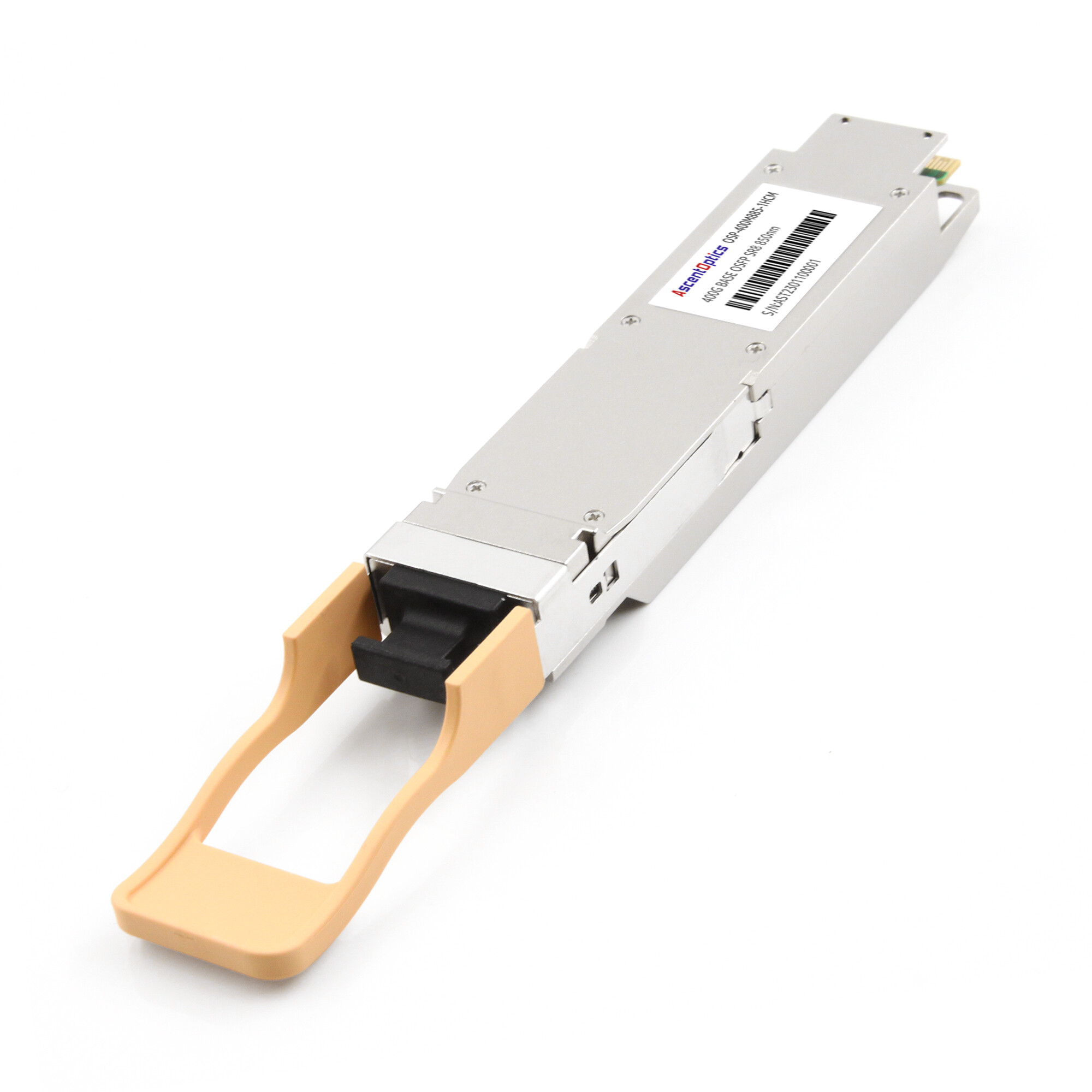
In March 2025, a Singapore data center operations team began planning an OSFP deployment for their spine upgrade. The vendor had recommended OSFP for its superior thermal headroom. Just six weeks later, they faced a major setback: their 200 existing leaf switches running on QSFP28 could not accept OSFP modules. The smooth migration path they had anticipated simply didn’t exist. They were left with two difficult options — replace all 200 leaf switches six months ahead of schedule or operate a mixed-form-factor network.
The choice between QSFP-DD vs OSFP goes far beyond technical specifications. It affects your network’s upgrade path for the next five years, switch compatibility, thermal performance, power efficiency, software management, TCO, and operational simplicity.
AscentOptics manufactures both QSFP-DD and OSFP transceivers. Because we produce both, our recommendations are truly unbiased. Our engineers will evaluate your existing infrastructure, target platforms, and 800G roadmap before suggesting the most suitable form factor for your needs.
[Get a Free Form Factor Consultation — Tell Us Your Platform]
OSFP vs QSFP-DD at a Glance
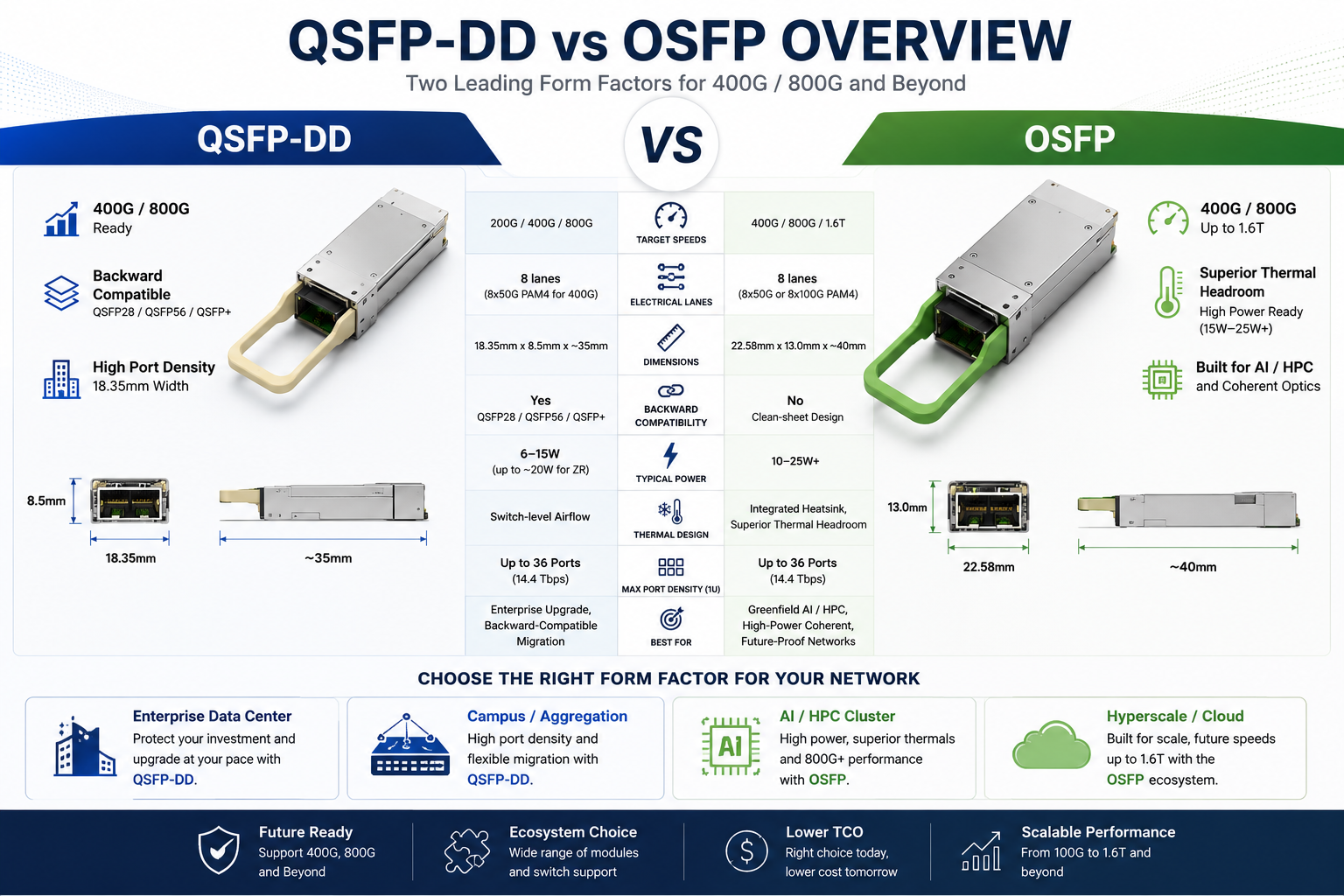
Different Design Priorities
Although QSFP-DD and OSFP both support 400G and 800G networking, they were designed for different goals. QSFP-DD emphasizes backward compatibility and smooth migration from existing QSFP28 infrastructure, while OSFP focuses on higher power capacity, stronger thermal performance, and long-term scalability for AI and hyperscale networks.
Hardware and Thermal Design
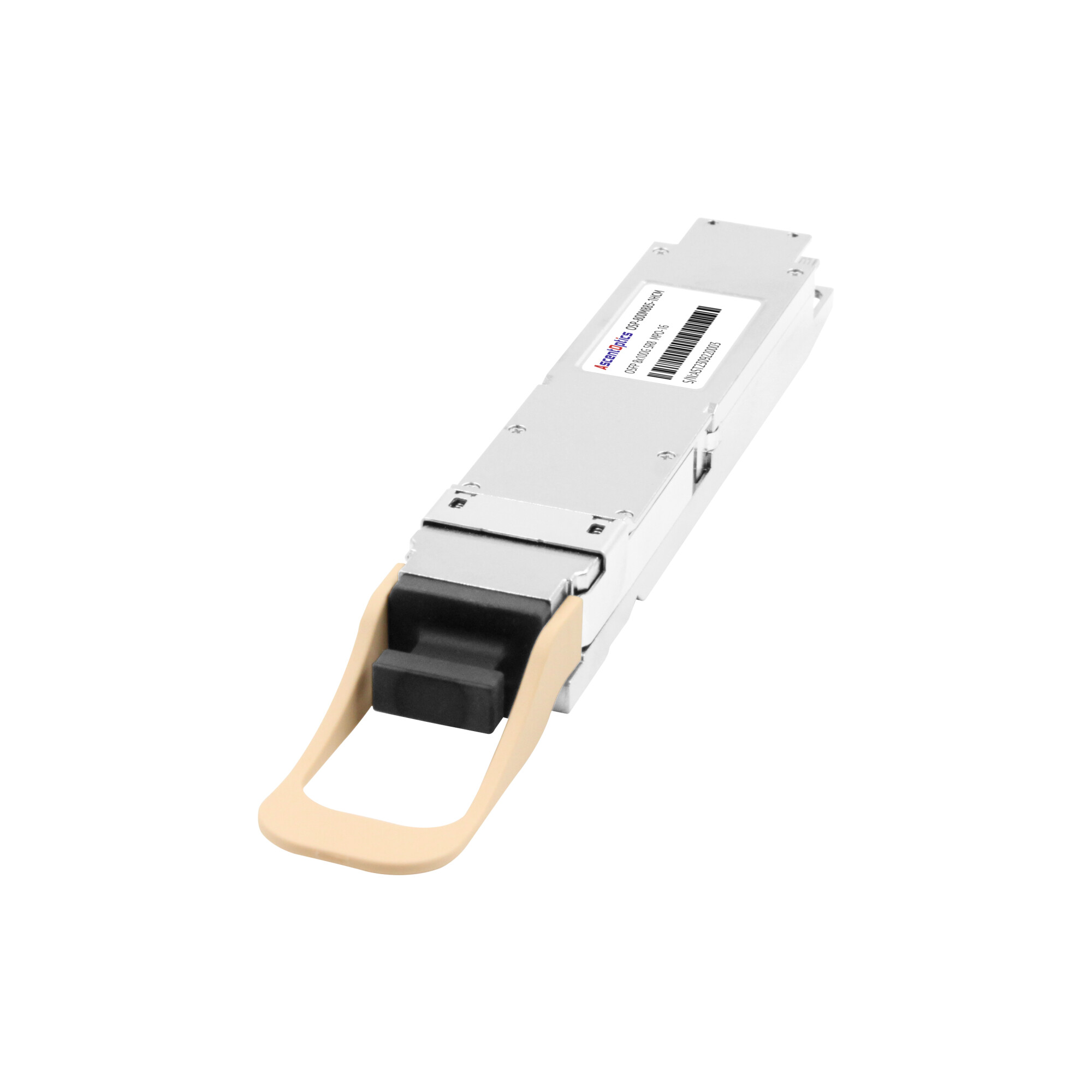
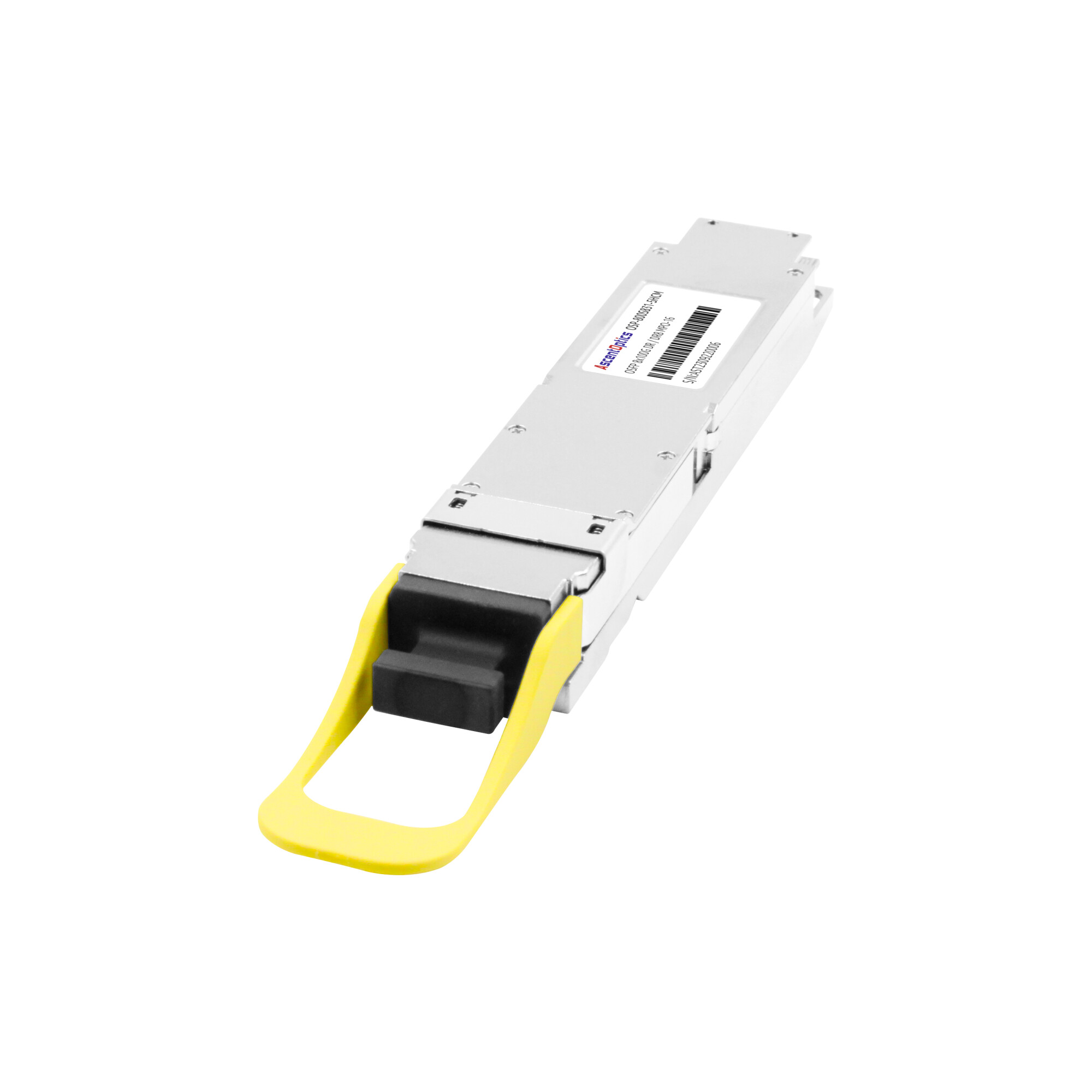
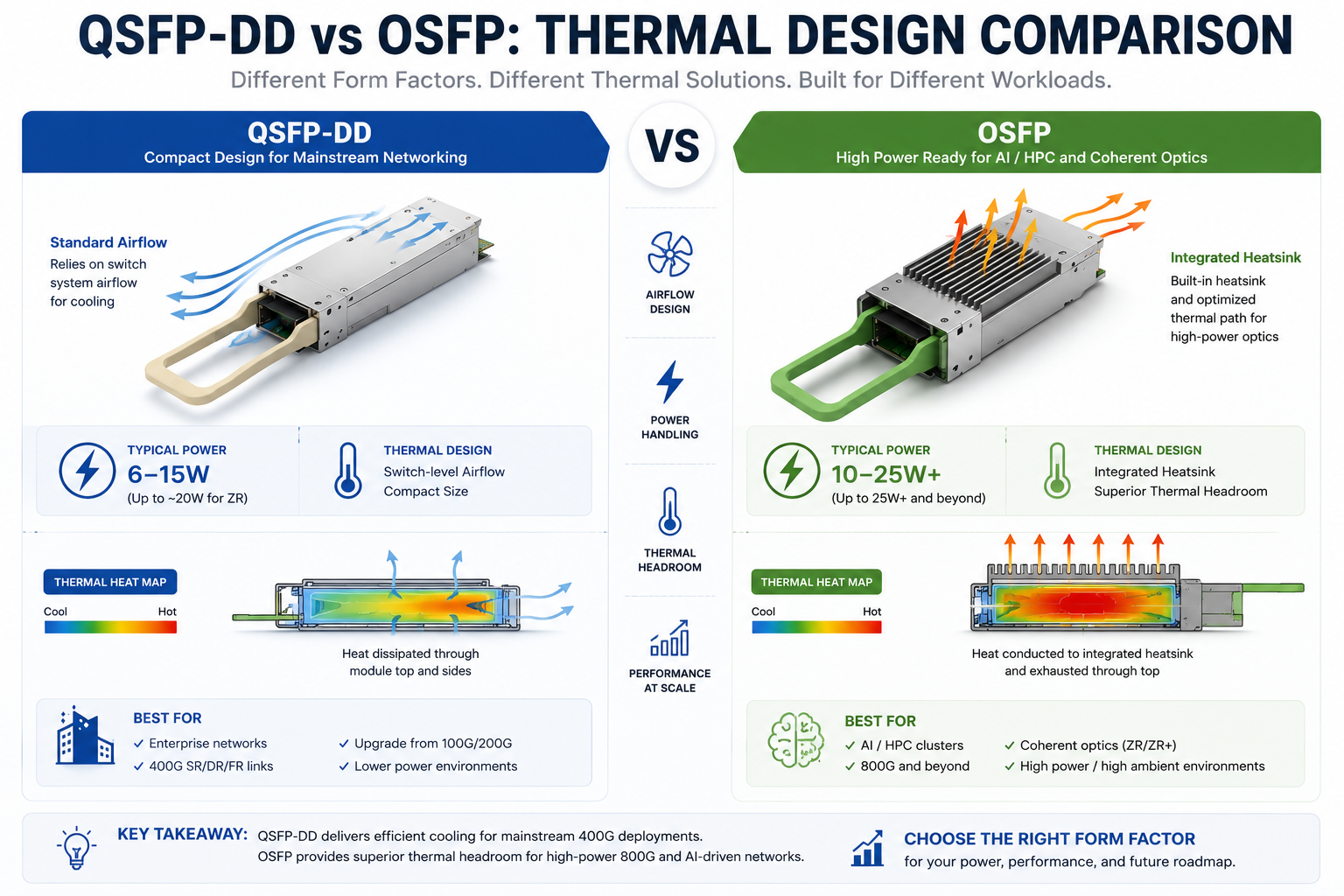
Both form factors use 8 electrical lanes for current 400G/800G implementations. However, OSFP features a larger physical design with integrated heatsink support, enabling higher power budgets and better heat dissipation. This is especially important for PAM4 DSP optics, coherent ZR/ZR+ modules, and 800G AI interconnects operating under continuous high loads.
Backward Compatibility
QSFP-DD maintains the same width as QSFP28 and QSFP56, allowing it to support earlier QSFP generations. This enables enterprises to reuse existing optics during phased upgrades, making QSFP-DD ideal for traditional data center migration projects.
Ecosystem and Platform Adoption
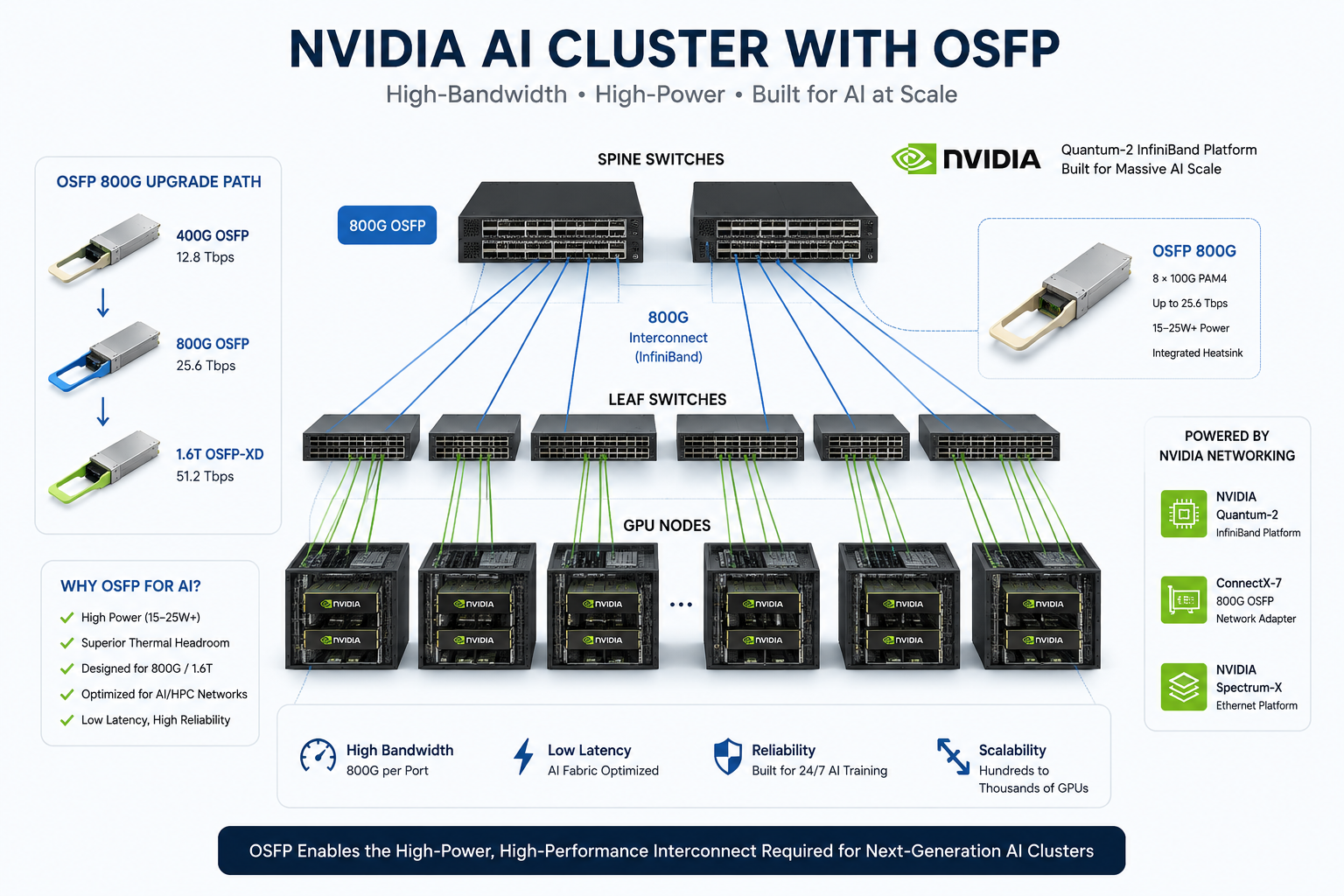
QSFP-DD is widely supported across enterprise Ethernet platforms from Cisco, Juniper, Dell, and HPE, especially in 400G deployments. OSFP has become the dominant choice in NVIDIA AI networking, InfiniBand fabrics, and hyperscale 800G environments where thermal headroom is critical.
Future Scalability
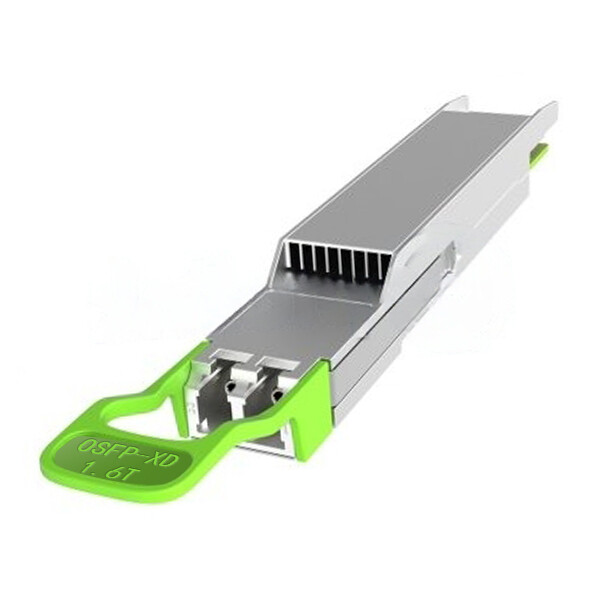
Both standards support 800G today, but OSFP was designed with future 1.6T evolution in mind. The emerging OSFP-XD architecture provides higher lane density and improved cooling capability, making OSFP more suitable for next-generation AI clusters and ultra-high-bandwidth GPU fabrics.
| Feature |
QSFP-DD
|
OSFP
|
| Full Name |
Quad Small Form-Factor Pluggable Double Density
|
Octal Small Form-Factor Pluggable
|
| Target Speeds |
200G, 400G, 800G
|
400G, 800G, 1.6T
|
| Electrical Lanes |
8 lanes (8x50G PAM4 for 400G)
|
8 lanes (8x50G or 8x100G PAM4)
|
| Dimensions |
18.35mm x 8.5mm x ~35mm
|
22.58mm x 13.0mm x ~40mm
|
| Backward Compatibility |
Yes — QSFP28, QSFP56, QSFP+
|
No — clean-sheet design
|
| Typical Power |
6-15W (up to ~20W for ZR)
|
10-25W+
|
| Thermal Design |
Switch-level airflow
|
Integrated heatsink, superior headroom
|
| Max Port Density (1U) |
Up to 36 ports (14.4 Tbps)
|
Up to 36 ports (14.4 Tbps)
|
| Best For |
Enterprise upgrade, backward-compatible migration
|
Greenfield AI/HPC, high-power coherent
|
Core Design Philosophy
- •QSFP-DD: Prioritizes backward compatibility, operational flexibility, and incremental migration.
- •OSFP: Prioritizes thermal efficiency, high-power optics, and future scalability for AI-driven networking.
OSFP Transceiver Guide — Complete OSFP technical overview
The 5 Key Differences That Drive the Decision
1. Backward Compatibility
QSFP-DD uses a stacked cage design that fully supports legacy QSFP28, QSFP56, and QSFP+ modules. This allows you to reuse existing 100G QSFP28 optics during the transition period. OSFP, by contrast, uses dedicated cages and offers no compatibility with any QSFP modules.
Bottom line: QSFP-DD stands as the only practical choice provided you have a pre-existing infrastructure for QSFP28 and want a transition with relative room for QSFP28 sharing.
2. Power and Thermal Headroom
OSFP modules can comfortably handle 20-25W+ power consumption, making them ideal for high-power 800G modules and coherent optics (400G ZR/ZR+). QSFP-DD performs well for most 400G SR/DR/FR applications under 15W but reaches thermal limits with higher-power modules.
Bottom line: For 800G deployments or coherent long-haul links today, OSFP provides essential thermal margin.
3. Physical Size and Port Density
QSFP-DD maintains the same 18.35mm width as QSFP28, enabling maximum faceplate density. OSFP is approximately 23% wider. While both can theoretically achieve 36 ports per 1U, some switch designs support fewer OSFP ports due to the larger module size.
Bottom line: When port density is the primary constraint, QSFP-DD holds a slight advantage.
4. Ecosystem and Switch Support
QSFP-DD enjoys broader support across enterprise and data center switches thanks to backward compatibility. OSFP has become the dominant choice in hyperscale and AI environments, particularly with NVIDIA InfiniBand (ConnectX-7, Quantum-2).
Bottom line: Your switch vendor may have already determined the best form factor for you. See the compatibility matrix below.
5. Future Roadmap
QSFP-DD800 is available but faces thermal and power constraints beyond 800G. OSFP was designed from the ground up for higher power and has a clear path to 1.6T with 16-lane operation.
Bottom line: For refresh cycles of 5+ years with expectations of 1.6T, OSFP is the more future-proof option.
When QSFP-DD Wins
QSFP-DD has been seen to be a promising choice in the following scenarios:
Enterprise data center refresh from 100G. Presumably, you already have hundreds of QSFP28 modules deployed. Upgrading to QSFP-DD switches lets you go step-by-step–they can recycle the QSFP28s to lower-priority ports while spines have new high-speed 400G QSFP-DDs.
Collocation and multi-tenant environments. The tenants usually supply their own optics. Backward compatibility of QSFP-DD would significantly alleviate any possible dissatisfaction from tenants and the ensuing equipment incompatibilities.
Enterprise platforms from Cisco, Juniper, and HPE. Numerous choices of enterprise-class switches from these vendors target QSFP-DDs at 400G, the reason being that the vendors intend to guard their installed bases for backward compatibility.
Standard 400G is required in within-rack and campus links. For applications with SR8 (100m), DR4 (500m), and FR4 (2km) distance under 15W, QSFP-DD is similar in performance to OSFP, but the switches cost lower.
QSFP-DD Transceiver Guide — Complete QSFP-DD technical overview
When OSFP Wins
OSFP is the preferred option in the following specific cases:
NVIDIA AI and HPC clusters. The Quantum-2 switch, ConnectX-7 NICs, and SoftIron switch use OSFP natively. If you are getting GPU clusters, then use the OSFP; it is by far the standard.
800G deployment today. Although QSFP-DD800 is available, the standard is still being set by OSFP. Most 800G switch platforms such as its 8000 series, Cisco 8100 use OSFP.
Coherent optics (ZR/ZR+I). ZR spooled 400G coherent modules are 15-20W, meaning OSFP has more than the right thermal envelope. QSFP-DD cannot maintain this due to a temperature fast-approaching the thermal limits.
Greenfield hyperscale builds. In designing an entirely new campus layout where there is no need to protect legacy QSFP28, the OSFP would be the more future-proof investment, as it is able to sustain maximum thermal headroom and affords more outlook with its 1.6T roadmap plans.
OSFP Transceivers — Browse OSFP module catalog
Platform Compatibility Matrix
Not every switch supports both form factors. Here is an overview of major platforms:
| Vendor |
Platform
|
QSFP-DD Support |
OSFP Support |
Notes
|
| Cisco |
Nexus 9000 (400G line cards)
|
Yes |
Limited |
QSFP-DD standard on most 400G cards
|
| Cisco |
8100/8200 Series
|
No |
Yes |
Native OSFP for 800G
|
| Arista |
7060X5 Series
|
Yes |
Selected models |
Check specific SKU
|
| Arista |
8000 Series
|
No |
Yes |
Native OSFP for 800G
|
| Juniper |
PTX10008
|
Yes |
Yes |
Line card dependent
|
| Juniper |
QFX10000
|
Yes |
No |
QSFP-DD only
|
| NVIDIA |
Quantum-2 (QM9700/QM9790)
|
No |
Yes |
Native OSFP
|
| NVIDIA |
Spectrum-X (SN5600)
|
No |
Yes |
Native OSFP
|
| Dell |
PowerSwitch Z9264F
|
Yes |
No |
QSFP-DD
|
| Dell |
PowerSwitch Z9732F
|
No |
Yes |
OSFP
|
Critical insight: Many switch families support only one form factor per chassis. Standardizing on a platform often locks in your form factor choice.
Hybrid Deployments: Can You Use Both?
Yes — and many networks successfully run hybrid architectures. The most common pattern is a QSFP-DD leaf layer connected to an OSFP spine layer via breakout cables or intermediate aggregation switches.
Common hybrid architectures:
- •Leaf-spine with translation: QSFP-DD leaf switches (100G/400G) connect to OSFP spine switches (400G/800G) through aggregation switches that bridge both form factors
- •GPU cluster segregation: The AI training cluster uses OSFP (NVIDIA ecosystem) while the general compute cluster uses QSFP-DD (enterprise Ethernet)
- •Migration islands: New facilities deploy OSFP while legacy facilities stay on QSFP-DD until end-of-life
AscentOptics manufactures both form factors, so we can supply QSFP-DD for the leaf layer and OSFP for the spine layer from the same production line with consistent quality control.
TCO Comparison: A Realistic Example
Here is a three-year total cost of ownership comparison for a 32-switch spine-leaf deployment (16 leaf, 8 spine, 8 border):
| Cost Component |
QSFP-DD Deployment
|
OSFP Deployment
|
| Switch hardware (32 units) |
$480,000
|
$520,000
|
| Transceiver modules (512 ports) |
$102,400
|
$102,400
|
| Power consumption (3-year) |
$28,800
|
$36,000
|
| Cooling (3-year) |
$14,400
|
$18,000
|
| 3-Year TCO |
$625,600
|
$676,400
|
Assumptions: 400G SR8 modules at $200/unit, 12W average (QSFP-DD) vs 15W average (OSFP), $0.10/kWh, PUE 1.5.
Key takeaway: For standard 400G deployments, QSFP-DD offers an ~8% TCO advantage. However, for 800G, coherent optics, or NVIDIA InfiniBand environments, OSFP is often the only viable option — making TCO secondary to technical requirements.
How to Decide: A 4-Step Checklist
Step 1: Audit the existing infrastructure. Have you got QSFP28 modules that have to remain operable? If so, go for QSFP-DD.
Step 2: Choose switch platforms wisely. Glance through the compatibility matrix above. Your switch vendor might have already made their call on their preference.
Step 3: Have a timeline established for 800G and 1.6T. If you need 800G within 24 months, OSFP will have a definite upper edge in the long run.
Step 4: Assess the heat and power budget. Your data center is power-constrained. If you are using standard 400G, then QSFP-DD performs better in terms of power consumption per port.
Still unsure? Our engineers run this analysis for customers at no charge. We review your platform list, your link distances, and your migration timeline — then deliver a written recommendation.
Ready to Choose the Right Form Factor?
The QSFP-DD vs OSFP decision does not have to be guesswork. AscentOptics manufactures both form factors, so our recommendations are based on your infrastructure — not our inventory.
What you get when you request a consultation:
- 1. Platform-specific recommendation— We analyze your switch models and tell you which form factor is compatible
- 2. Migration pathway— If you are upgrading from 100G, we map the phased transition
- 3. Pricing for both form factors— Factory-direct quotes so you can compare real costs
- 4. Sample evaluation— Test before you commit, with full compatibility guarantee
[Request Your Free QSFP-DD vs OSFP Consultation]
Frequently Asked Questions
Q1. Can we patch an OSFP up to a QSFP-DD port?
No! The OSFP and QSFP-DD are physically incompatible. The OSFP module is larger in depth and width is beyond the opening provided by the cages for QSFP-DD modules. By the same concept, the QSFP-DD modules are too narrow for the cages meant for OSFP. The two form factors cannot be mixed in the same physical port.
Q2. Which form factor is best in terms of density?
Mathematically, QSFP-DD has more room for ports, because it is slimmer (18.35mm compared to 22.58mm). In reality, both form factors can source up to 36 ports in a 1U plate when designed properly. The full difference in density lies in chassis systems that have limited faceplate size.
Q3. Does QSFP-DD Portable Backwards Compatibility with QSFP28?
Yes, and its truth comes from the argument of it additionally accepting any previous QSFP56 and QSFP+ modules by virtue of its stacked cage design. This is the primary reason why QSFP-DD frames are chosen by businesses — to protect their patches thus aiding in the move to 400G.
Q4. Which form factor should I choose for 800G?
The OSFP is the dominant form factor for 800G. QSFP-DD800 does exist but is exclusive to OSFP in most 800G switch platforms such as Arista 8000, Cisco 8100, and NVIDIA Quantum-2. Before heading towards the deployment of 800G, do check your target switch platform — it will likely dictate OSFP.
Q5. Will QSFP-DD support 1.6T?
It is not expected that QSFP-DD will support 1.6T because the current form factors do not enable that much capacity due to thermal and power constraints. OSFP-XD (eXtended Density) is engineered for 1.6T.
Q6. Can I use QSFP-DD and OSFP in the same network?
Hybrid architectural strategies make it possible to combine the two. Common patterns utilize QSFP-DD leaf switches linking to OSFP spine switches through aggregation or translation layers. AscentOptics can work with both specs and help to design the hybrid interconnects.
Q7. Which form factor is cheaper?
Module pricing is very similar. QSFP-DD switches are sometimes marginally less expensive, but the difference is typically under 10%. Platform compatibility and thermal requirements should drive the decision.
Q8. Do you have samples we can evaluate?
Yes, AsentOptics can provide QSFP-DD and OSFP samples for platform compatibility testing. This is typically a 3-5 day period from sample request approval, depending on availability. All samples come with complete test reports. Contact our team to order your sample switches.
OSFP MSA — Official OSFP Multi-Source Agreement
Post Views: 2,572