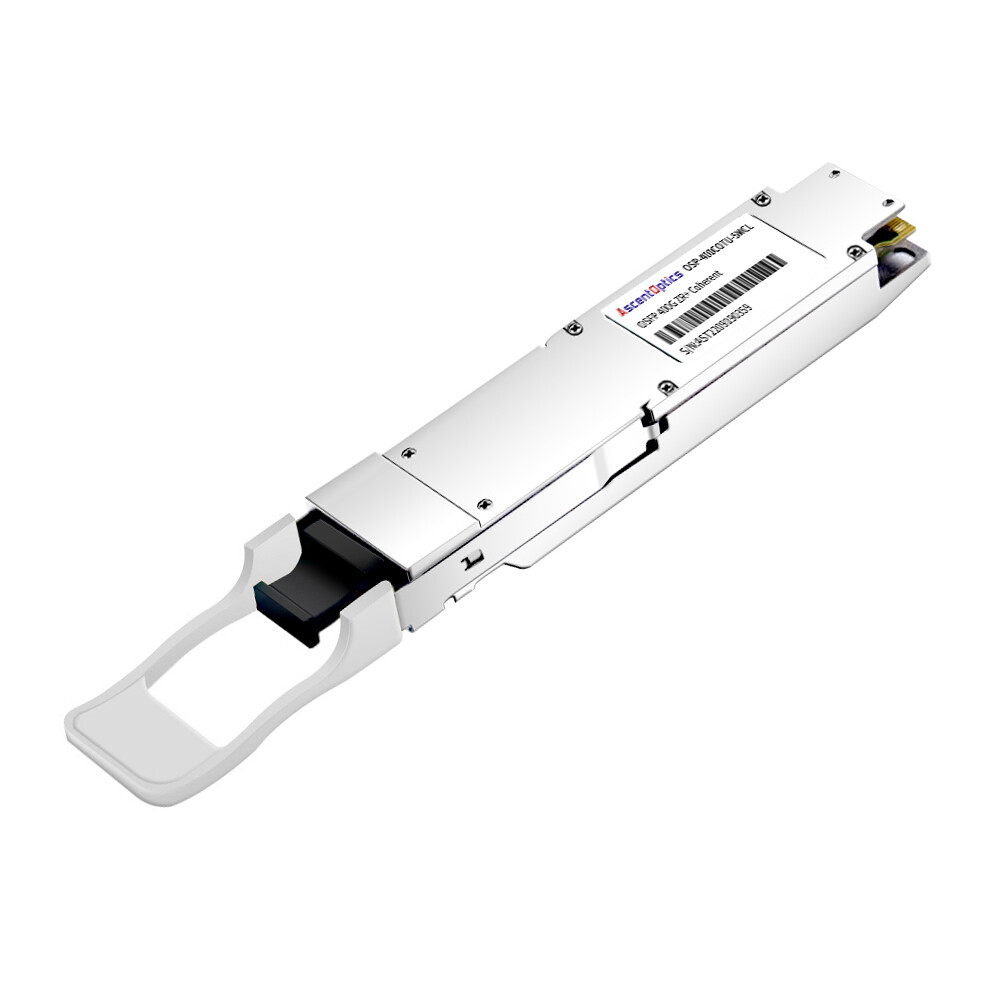
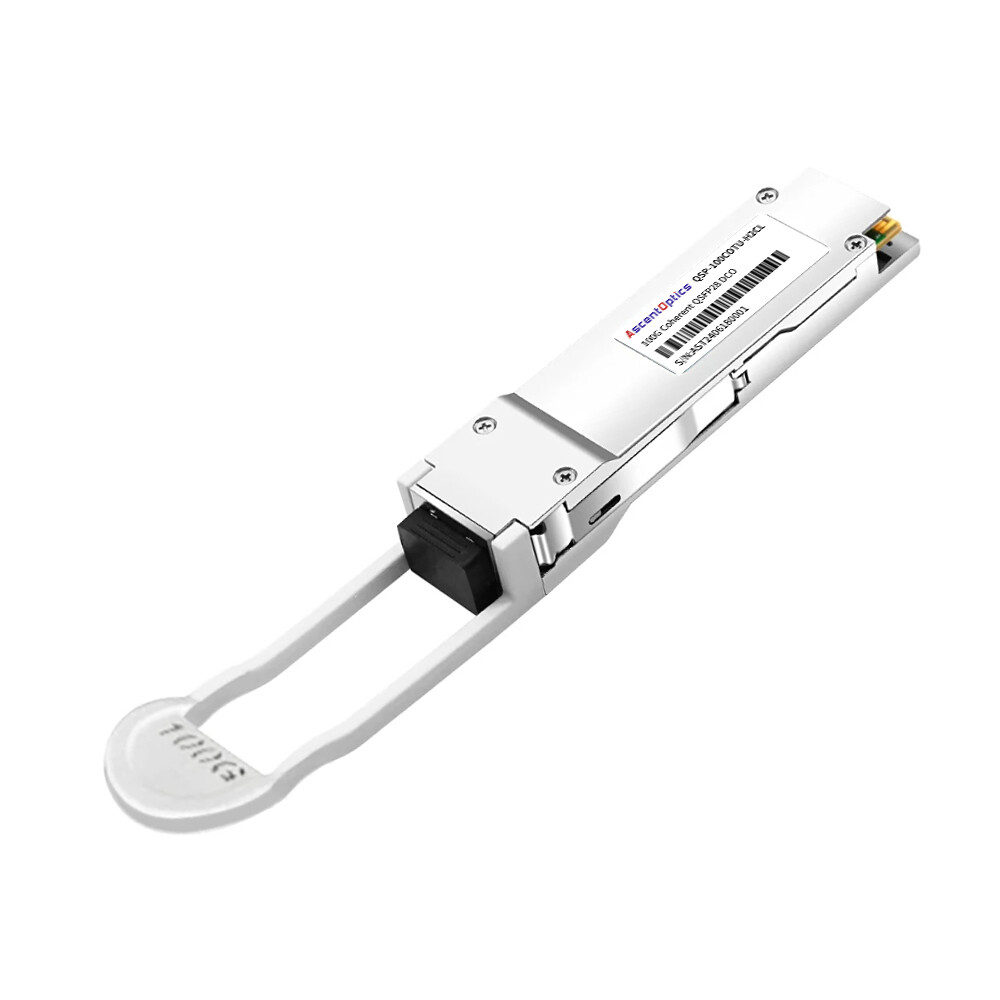
Coherent optical module standards define how pluggable coherent transceivers communicate with network platforms, including optical performance, electrical interfaces, management protocols, and interoperability requirements. As data center interconnect (DCI) and metro networks move toward 400G and 800G speeds, understanding standards such as OIF 400ZR, 800ZR, OpenZR+, and OpenROADM becomes essential for selecting compatible and scalable optical solutions.
What Are Coherent Optical Module Standards?
Coherent optical module standards are specifications that govern how pluggable coherent transceivers are built, managed, and interoperated. They cover physical dimensions, electrical interfaces, optical transport behavior, digital signal processing, management protocols, and multi-vendor interoperability.
Without these standards, every vendor could ship a different module shape, a different wavelength plan, or a different management language. Network operators would face compatibility risks, supply-chain lock-in, and unpredictable performance. Standards reduce that risk by defining a common contract between module and host platform.
The standards ecosystem splits into five layers:
- Physical and electrical form-factor standards— QSFP-DD, OSFP, CFP2-DCO
- Optical transport standards— OIF 400ZR, 800ZR, OpenZR+, OpenROADM
- Client-side Ethernet standards— IEEE 802.3 specifications for 400GbE, 800GbE, and future higher-speed Ethernet interfaces
- Module management standards— CMIS and OIF coherent CMIS extensions
- Interoperability and test standards— Multi-vendor interoperability agreements and quality certifications
A module can comply with one layer and not another. A QSFP-DD module might meet the QSFP-DD MSA mechanical spec while using a proprietary DSP implementation that breaks OIF 400ZR interoperability.
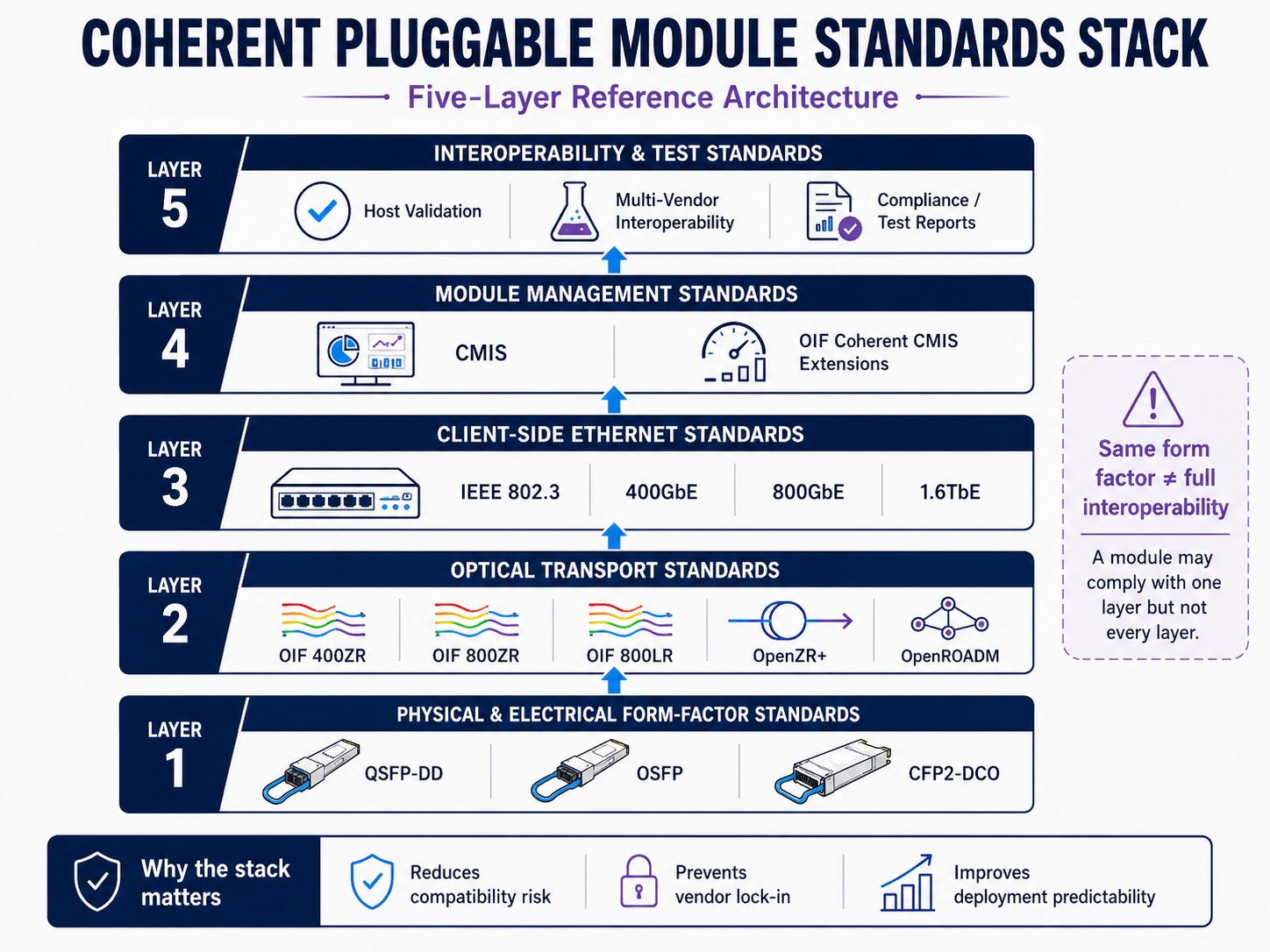
The Standards Stack for Coherent Pluggable Modules
Physical and Electrical Form-Factor Standards
Form-factor standards define size, pinout, power envelope, and thermal design. The three dominant coherent form factors are QSFP-DD, OSFP, and CFP2-DCO.
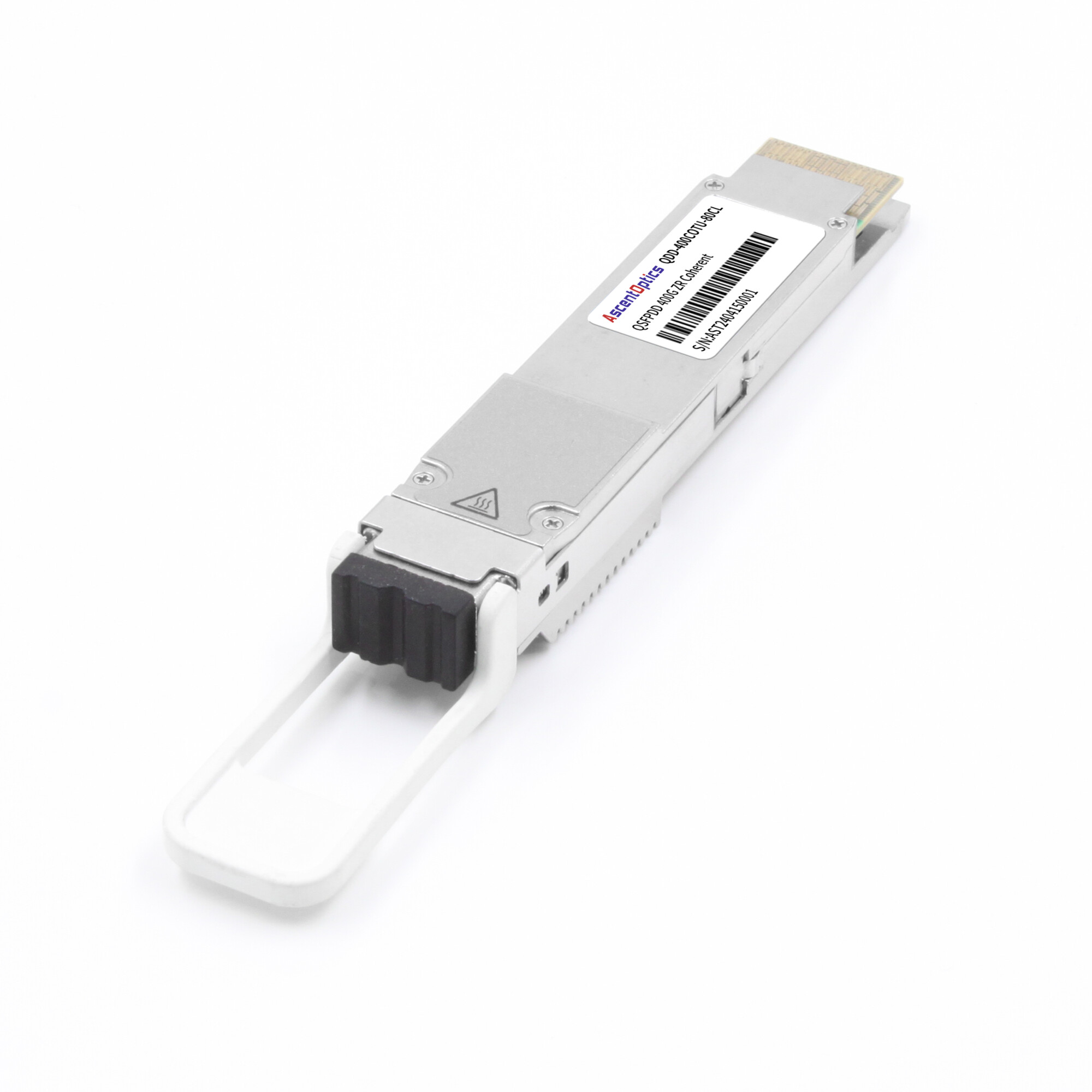
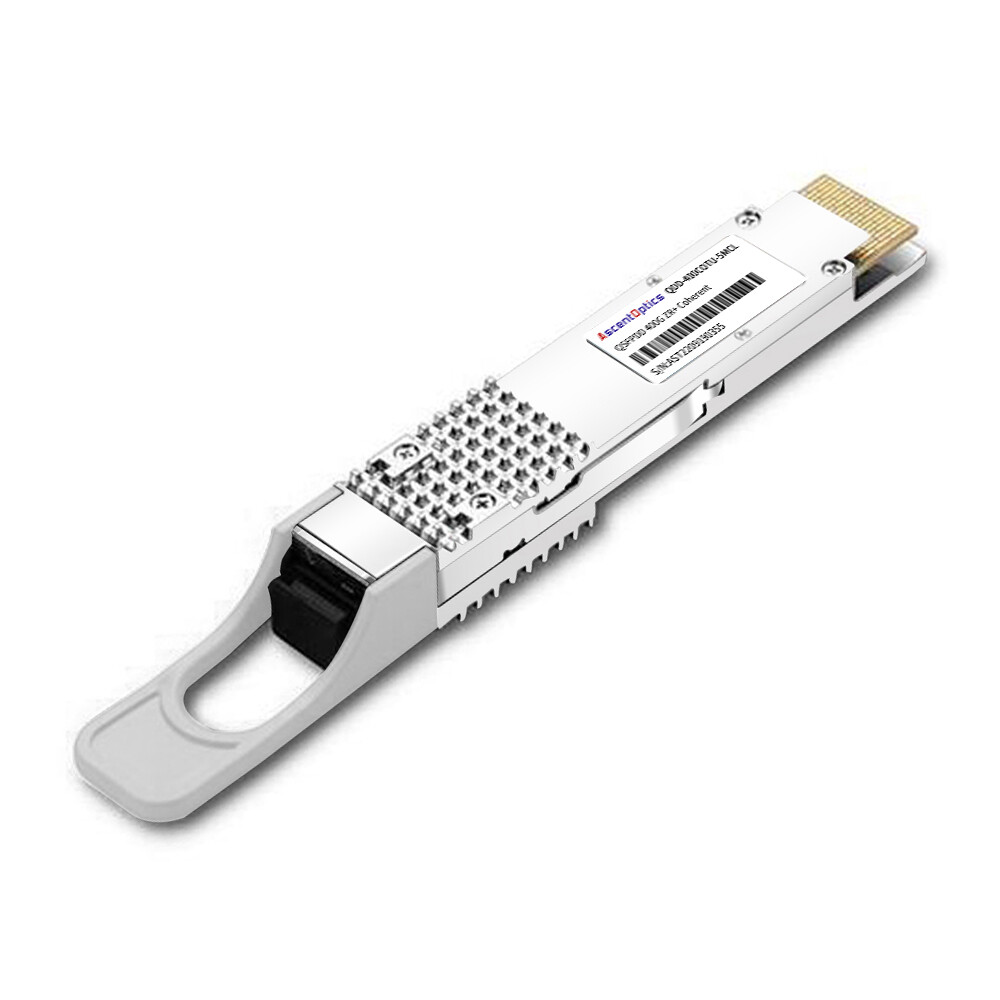
QSFP-DD (Quad Small Form-Factor Pluggable Double Density) expands the electrical interface from four lanes to eight lanes. The original QSFP-DD specification enables 400G using 8×50G PAM4 lanes, while QSFP-DD800 supports 800G using higher-speed 100G PAM4 electrical lanes. The QSFP-DD800 variant extends the spec to 800 Gb/s. QSFP-DD cages are backward compatible with legacy QSFP modules, allowing operators to continue using QSFP+/QSFP28 optics in QSFP-DD ports.
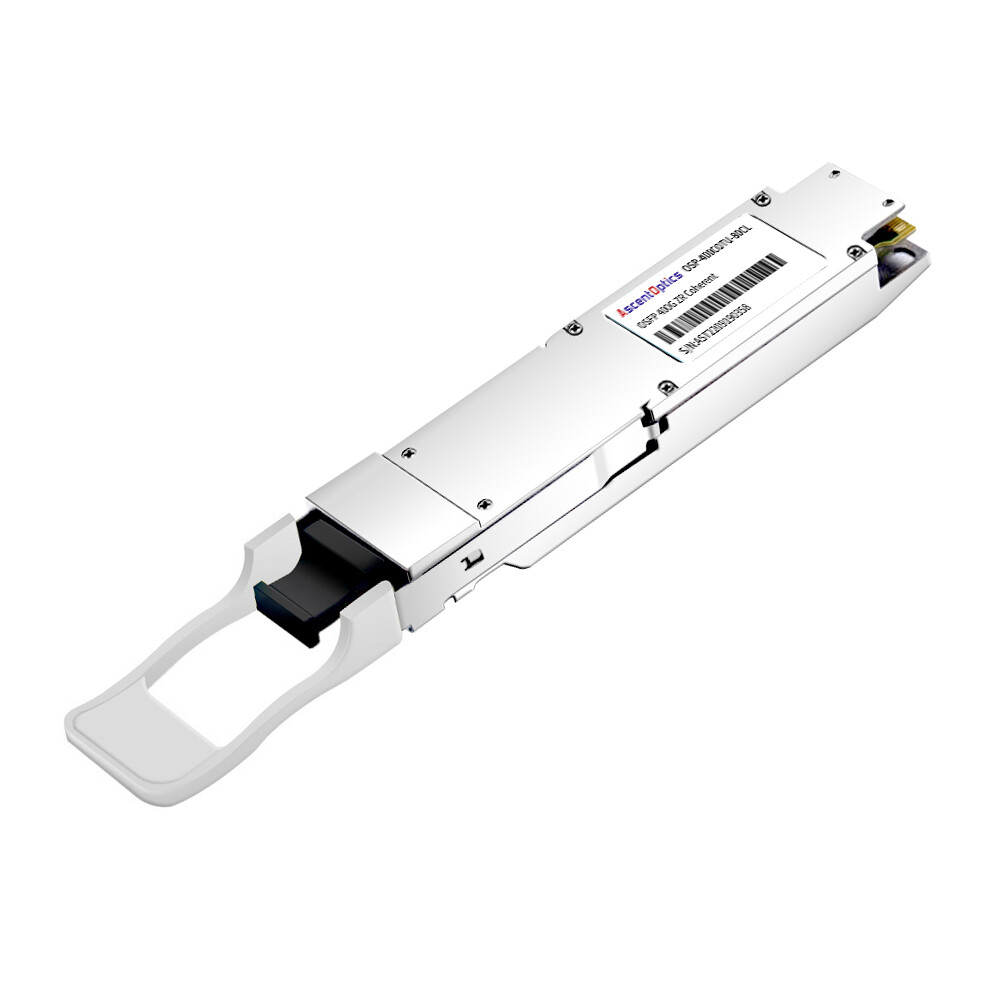
OSFP (Octal Small Form-Factor Pluggable) also supports eight lanes and targets 400G/800G coherent applications. OSFP modules are slightly longer than QSFP-DD modules and include integrated thermal management features. Due to its larger thermal capacity, OSFP has become a preferred form factor for high-power 800G and future 1.6T AI networking applications. The OSFP MSA also defines OSFP224 and OSFP-XD variants for 1.6T and higher-density applications.
CFP2-DCO (C Form-Factor Pluggable 2 — Digital Coherent Optics) is larger than QSFP-DD or OSFP. The OIF CFP2-DCO Implementation Agreement governs this form factor. CFP2-DCO modules typically support higher transmit power, larger DSPs, and longer-reach coherent modes. They appear in transponder/muxponder line cards and high-performance router platforms.
Optical Transport Standards
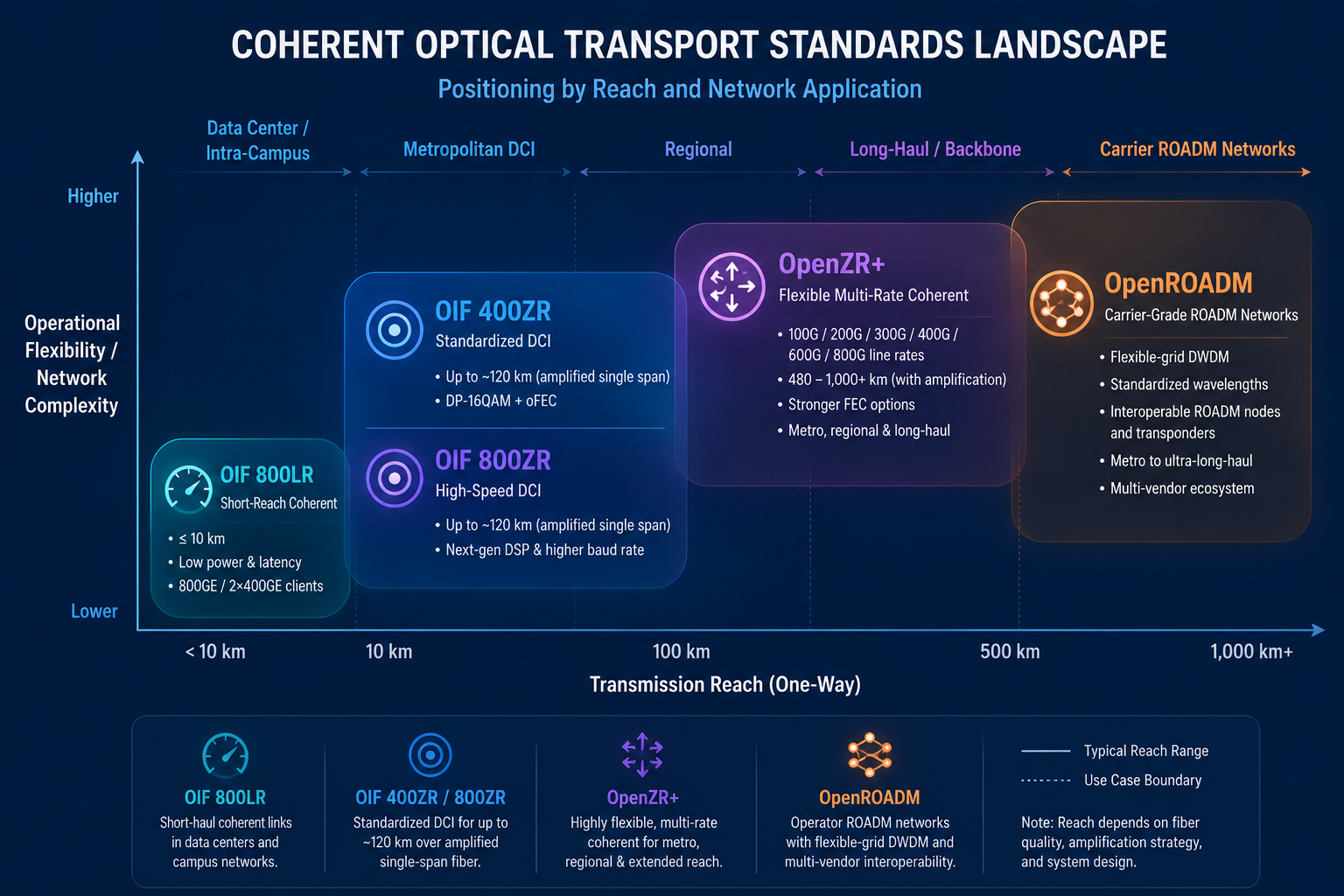
OIF 400ZR defines a single-wavelength 400 Gb/s coherent interface for data-center-interconnect links up to approximately 120 km over amplified single-span SMF (typical DCI deployment). It uses DP-16QAM modulation and concatenated FEC (oFEC) to hit that reach target.
OIF 800ZR extends the ZR approach to 800 Gb/s, targeting similar DCI reaches with next-generation DSPs and higher baud rates.
OIF 800LR is a newer short-reach coherent IA optimized for links of 10 km or less. It supports 800GE or 2×400GE client signals with lower power and latency than traditional ZR modes.
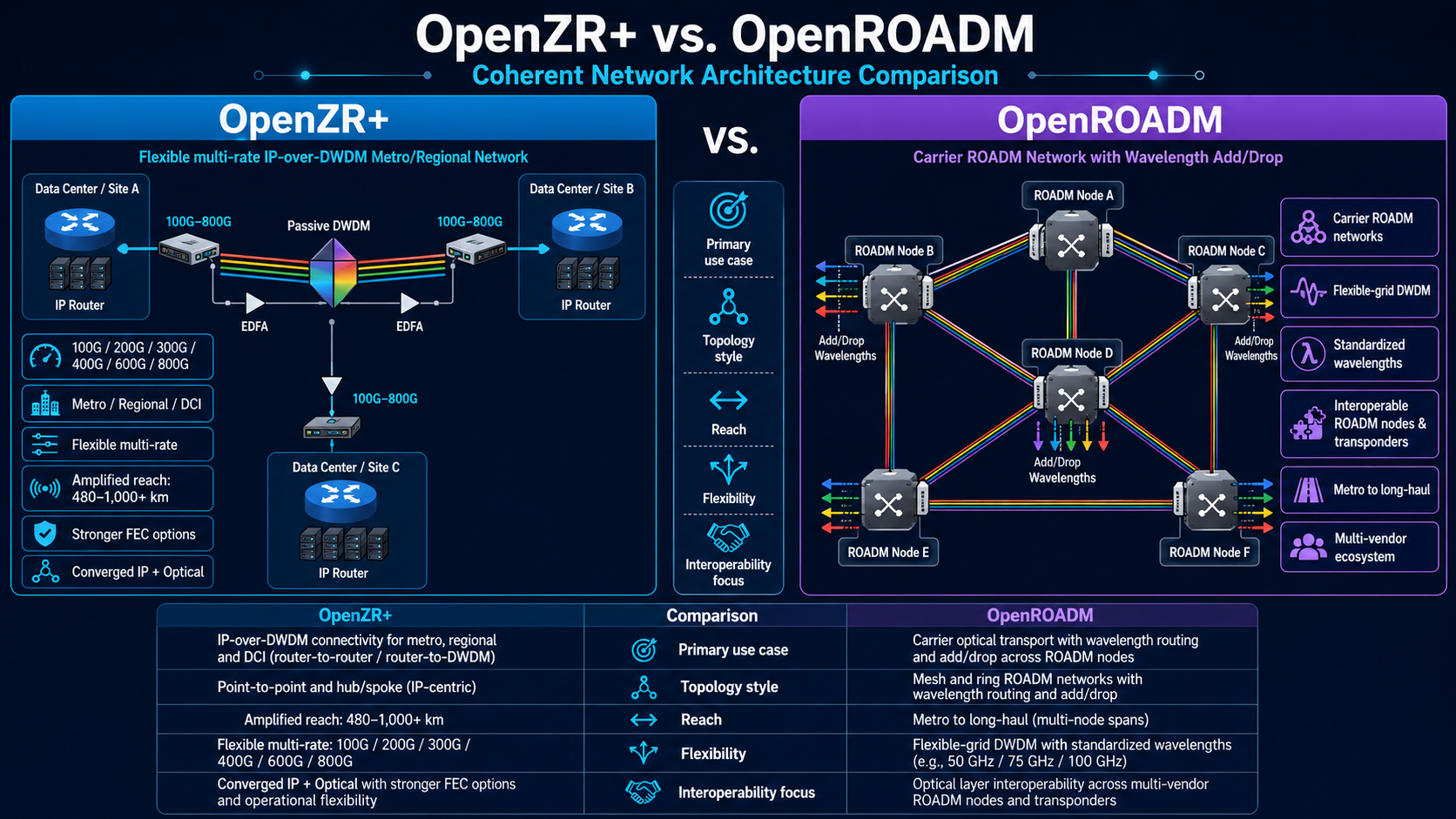
OpenZR+ MSA extends OIF ZR with multi-rate operation, stronger FEC options, and longer reach. OpenZR+ supports a range of coherent line rates, typically from 100G to 800G, including intermediate modes such as 300G and 600G, depending on vendor implementation and network requirements. Unlike OIF ZR specifications, OpenZR+ is an industry MSA that provides flexible performance profiles rather than a single fixed interoperability target. A 400G OpenZR+ module can reach 480–1,000+ km with amplification, depending on fiber quality and amplification strategy.
OpenROADM MSA focuses on carrier ROADM networks. It specifies flexible-grid DWDM operation, standardized wavelengths, and interoperability between ROADM nodes and pluggable coherent modules. OpenROADM is common in service-provider metro and regional networks.
Client-Side Ethernet Standards
IEEE 802.3 defines the Ethernet side of the equation: 400GbE (IEEE 802.3bs), 800GbE (IEEE 802.3dj), and the upcoming 1.6 TbE work. A coherent module must accept the client Ethernet signal and map it onto the coherent line-side signal according to the relevant OIF or MSA spec.
Management Standards
CMIS (Common Management Interface Specification) defines how a host reads and controls a pluggable module over the two-wire interface. CMIS 5.0 and 5.2 add support for 400G/800G modules, including coherent-specific registers for DSP status, optical performance monitoring, and modulation/FEC mode selection. Modern CMIS versions provide management support for high-speed pluggable modules, including optical monitoring, DSP status reporting, and configuration control.
The OIF Coherent CMIS Implementation Agreement extends CMIS with parameters specific to coherent optics, such as pre-FEC BER, post-FEC BER, chromatic dispersion, and polarization-mode dispersion.
OIF 400ZR and 800ZR Explained
OIF 400ZR was developed to let cloud operators deploy 400G coherent links using standard pluggable modules in router and switch ports. Before 400ZR, coherent transport required dedicated transponder shelves. 400ZR collapsed that function into a QSFP-DD or OSFP module.
The standard specifies:
- Line rate: 400 Gb/s single-wavelength
- Modulation: DP-16QAM
- FEC: oFEC (concatenated FEC)
- Reach: ~120 km over amplified single-span single-mode fiber
- Wavelength: C-band tunable, fixed grid
- Management: CMIS 5.0 with coherent extensions
400ZR modules are not intended for unamplified long-haul links. They target data-center interconnect, metro aggregation, and cloud exchange points where amplification is available.
OIF 800ZR applies the same philosophy to 800 Gb/s. It uses higher-baud-rate DSPs and advanced modulation to transport 800GbE over a single wavelength. Early 800ZR modules appeared in QSFP-DD800 and OSFP form factors at OFC 2026, with demos from Cisco/Acacia, Coherent Corp, and HGGenuine.
For a deeper comparison of 400ZR, ZR, and OpenZR+ technologies, see our detailed guide on 400ZR, ZR, and OpenZR+ coherent optical solutions.
OpenZR+ MSA vs. OpenROADM MSA
OpenZR+ and OpenROADM solve different problems, even though both use coherent modulation.
| Standard |
Main Application |
Reach |
Key Feature |
| 400ZR |
DCI |
~120km |
Low-cost coherent pluggable |
| 800ZR |
800G DCI |
~120km |
Higher bandwidth |
| OpenZR+ |
Metro/regional |
Hundreds of km |
Multi-rate flexibility |
| OpenROADM |
Carrier network |
Metro-long haul |
ROADM interoperability |
OpenZR+ emphasizes multi-rate flexibility and longer reach. A single OpenZR+ module can drop to 100G or 200G mode to extend reach, or run 400G/800G for shorter spans. That flexibility appeals to operators building converged IP/optical networks.
OpenROADM emphasizes carrier-grade interoperability with existing ROADM infrastructure. It specifies flexible-grid channel spacing, standardized optical channel parameters, and interoperability modes that let operators mix pluggable modules from different vendors inside the same ROADM network.
When should you choose each?
- OIF 400ZR/800ZR: Standardized DCI links where cost and simplicity matter more than maximum reach.
- OpenZR+: Metro and regional networks where you need multi-rate operation and longer reach than ZR provides.
- OpenROADM: Service-provider networks with existing flexible-grid ROADM deployments and strict interoperability requirements.
Form Factor Standards: QSFP-DD, OSFP, and CFP2-DCO
Form factor determines density, power, reach, and host compatibility. Selecting the wrong form factor can force a platform change.
QSFP-DD coherent modules dominate high-density 400G/800G applications. A single 1RU switch can host 32 or 36 QSFP-DD ports, enabling multi-terabit capacity in a small footprint. QSFP-DD coherent modules typically draw 15–24 W, with high-power variants exceeding that for longer-reach ZR+ modes.
OSFP coherent modules offer similar density and performance. Some vendors prefer OSFP for thermal reasons because the form factor provides more surface area and integrated heat-sinking. OSFP is also the basis for the OSFP-XD and OSFP224 variants that will carry 1.6T and 3.2T modules.
CFP2-DCO modules trade density for performance. Their larger size accommodates bigger DSPs, higher-output amplifiers, and more advanced thermal management. CFP2-DCO modules can support metro, regional, and long-haul modes that exceed the power and reach limits of QSFP-DD or OSFP. CFP2-DCO remains important in optical transport platforms where reach and optical performance are prioritized over switch-port density.
They are common in transponder/muxponder line cards where port density is less critical than reach.
Emerging Standards and 2026 Roadmap
Coherent optics continues to evolve. Several standards and form factors are moving from concept to deployment in 2026.
OIF 800LR targets short-reach coherent links of 10 km or less. It supports 800GE or 2×400GE client signals with lower power than 800ZR. Campus networks, metro edge nodes, and short data-center interconnects are the intended applications.
OSFP-XD and OSFP224 extend the OSFP family toward 1.6T and 3.2T operation. OSFP-XD increases lane count to support higher aggregate bandwidth. OSFP224 supports 200 Gb/s electrical lanes.
IEEE P802.3dj is the active Ethernet project covering 200 Gb/s, 400 Gb/s, 800 Gb/s, and 1.6 Tb/s Ethernet interfaces. It will define the client-side standards that future coherent modules must carry.
The global optical transceiver market was estimated at USD 14.8 billion in 2025 and is projected to reach USD 16.8 billion in 2026, according to 360iResearch. Coherent pluggables are a major growth driver as operators replace transponder-based systems with switch-port coherent modules.
Conclusion
Coherent optical module standards turn a confusing catalog of products into a predictable procurement and design framework. OIF 400ZR and 800ZR standardize DCI-grade coherent pluggables. OpenZR+ extends reach and adds multi-rate flexibility. OpenROADM ensures carrier ROADM interoperability. QSFP-DD, OSFP, and CFP2-DCO define the form-factor trade-offs. CMIS ties the module to your management systems.
The key takeaways:
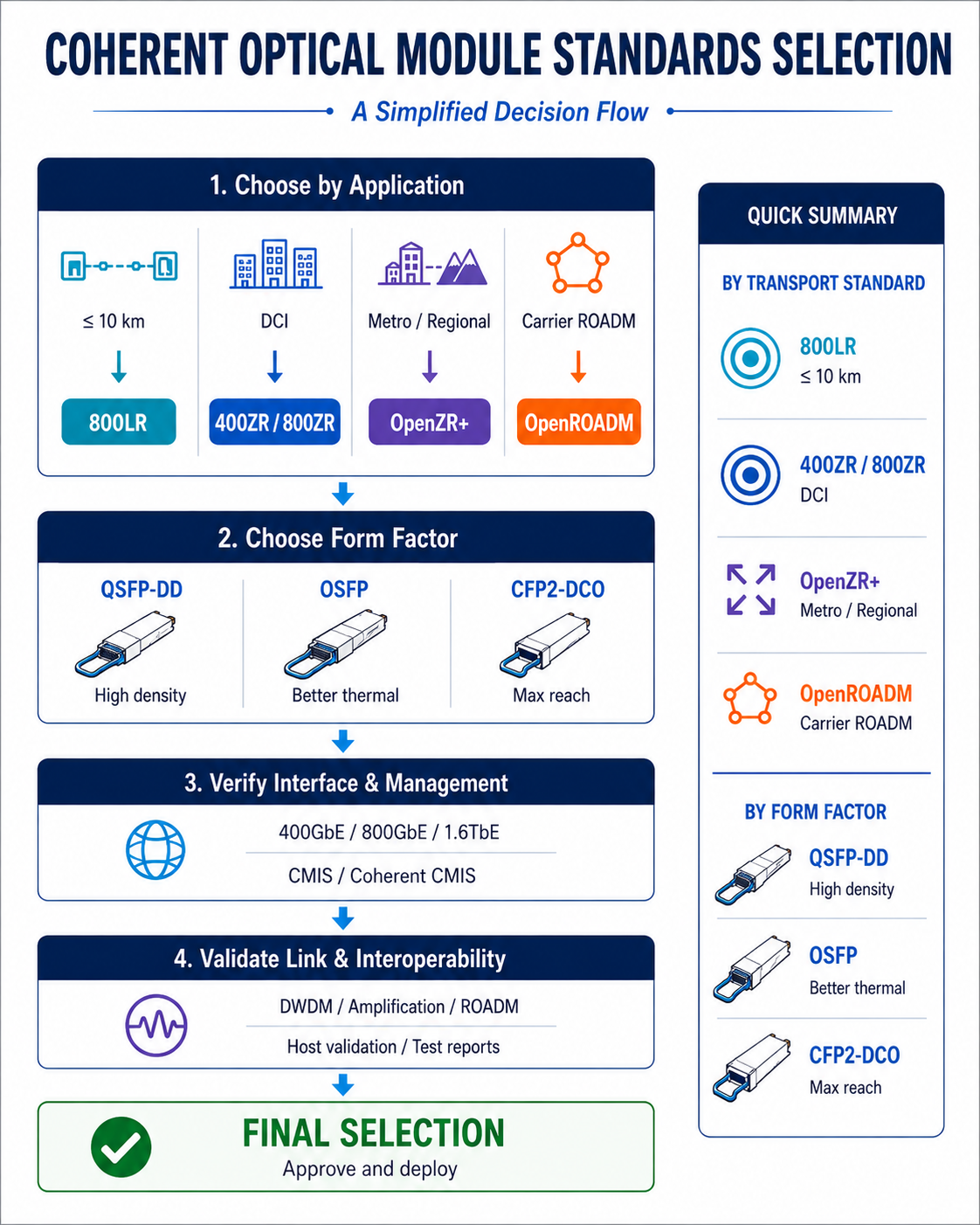
- Match the transport standard to the reach: 400ZR for DCI, OpenZR+ for metro/regional, OpenROADM for carrier ROADM networks.
- Match the form factor to the platform: QSFP-DD and OSFP for density, CFP2-DCO for long-reach performance.
- Verify management compliance: CMIS 5.0+ with coherent extensions is essential for 400G/800G operation.
- Demand documentation: Compliance statements, test reports, and host-platform validation reduce deployment risk.
Standards do not guarantee success, but they remove the guesswork. If you are planning a coherent optics deployment, start with the standards, then choose the module.
FAQ About Coherent Optical Module Standards
What are coherent optical module standards?
Coherent optical module standards define the requirements for pluggable coherent transceivers, including optical performance, electrical interfaces, management protocols, and interoperability. These standards help ensure that modules from different vendors can work with compatible network platforms while reducing deployment complexity.
Key standards include OIF 400ZR, OIF 800ZR, OpenZR+, OpenROADM, and CMIS extensions for coherent optics.
What is the difference between 400ZR and 800ZR?
The main difference is transmission capacity.
400ZR provides a 400Gb/s coherent interface for DCI networks, while 800ZR extends the same pluggable coherent approach to 800Gb/s using higher-speed DSP technology and advanced optical components.
800ZR is designed for next-generation DCI applications where higher bandwidth is required without increasing network complexity.
Which form factors are used for coherent optical modules?
The major form factors for coherent pluggable modules include QSFP-DD, OSFP, and CFP2-DCO.
QSFP-DD and OSFP are commonly used for high-density 400G and 800G applications because they provide higher port density and better compatibility with modern switches.
CFP2-DCO is larger and supports higher power consumption, larger DSPs, and longer-reach coherent applications, making it common in transport platforms and optical networking equipment.
How do I choose the right coherent optical module standard?
The selection depends on several factors, including reach requirements, network platform compatibility, bandwidth requirements, and cost considerations. The price of coherent optical modules varies significantly depending on transmission distance, DSP complexity, power consumption, and optical components.
What is the role of CMIS in coherent optical modules?
CMIS (Common Management Interface Specification) defines how a host system communicates with pluggable optical modules.
For coherent optics, CMIS provides access to module information, optical monitoring parameters, DSP status, and configuration controls. Coherent-specific extensions add monitoring features such as pre-FEC BER, post-FEC BER, and dispersion measurements.
Can coherent optical modules be used for data center interconnect (DCI)?
Yes. Coherent pluggable modules are widely used for DCI because they can provide high bandwidth over longer distances compared with traditional Ethernet optics.
OIF 400ZR is specifically designed for DCI applications, while OpenZR+ and higher-performance coherent solutions address metro and regional network requirements.
Will coherent optics replace traditional transponders?
Coherent pluggable optics are reducing the need for dedicated transponder platforms in many applications, especially DCI and metro networks.
By integrating coherent DSP technology into pluggable modules, operators can deploy high-capacity optical links directly from routers and switches. However, dedicated transponders remain important for complex long-haul networks requiring advanced optical features and maximum reach.
Post Views: 1,667