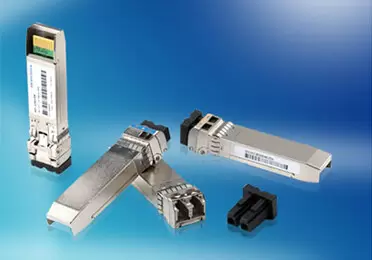
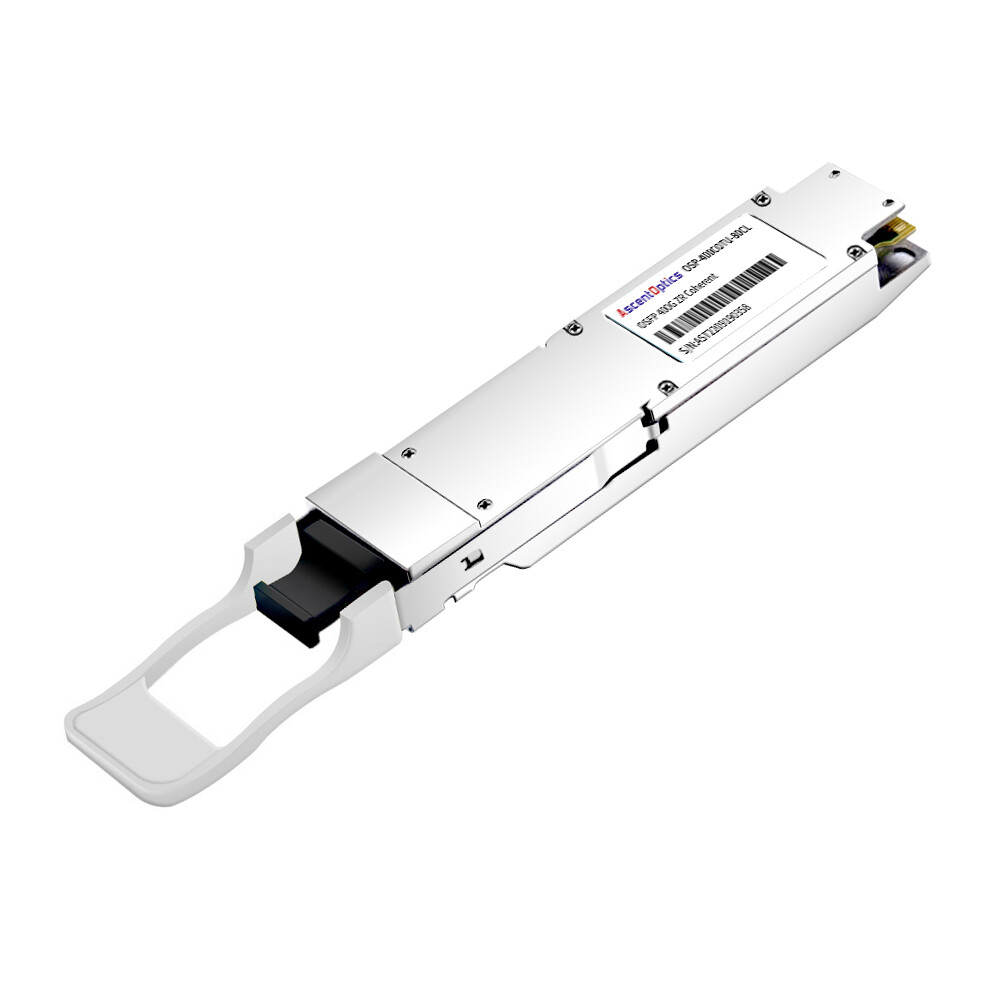
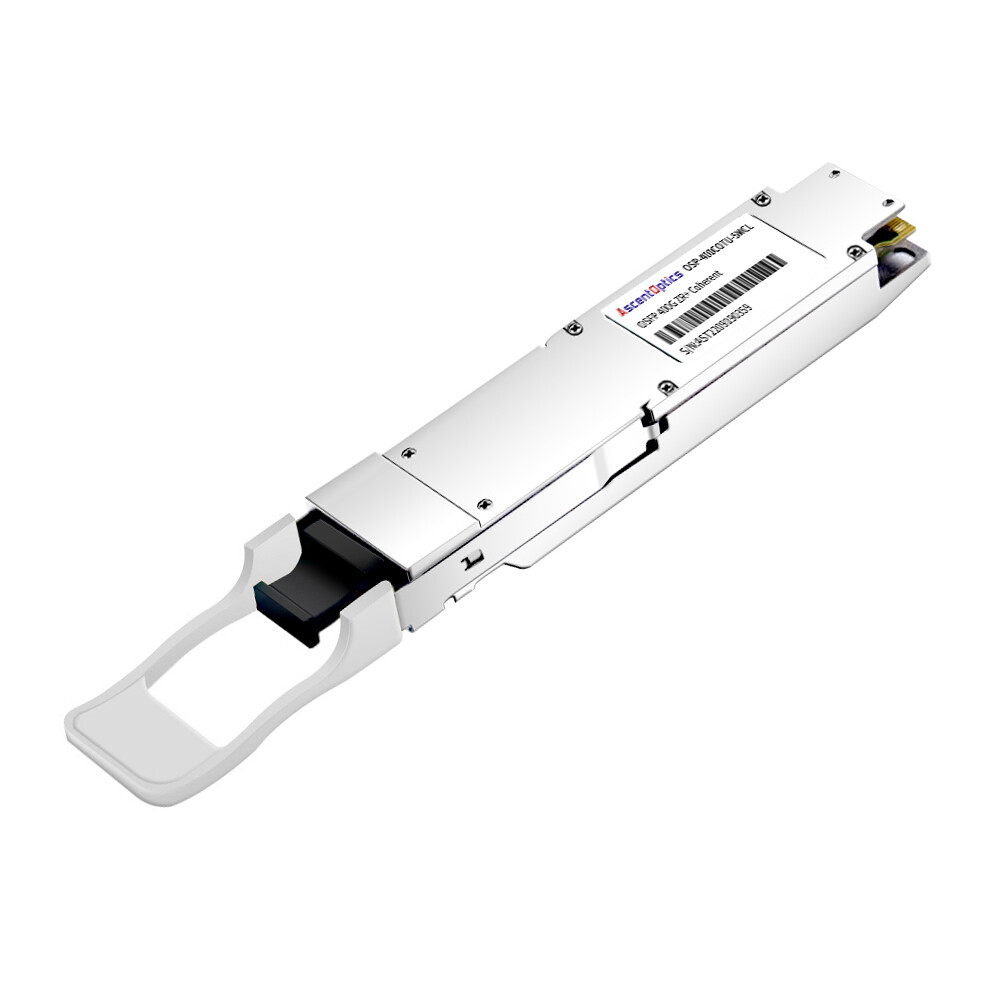
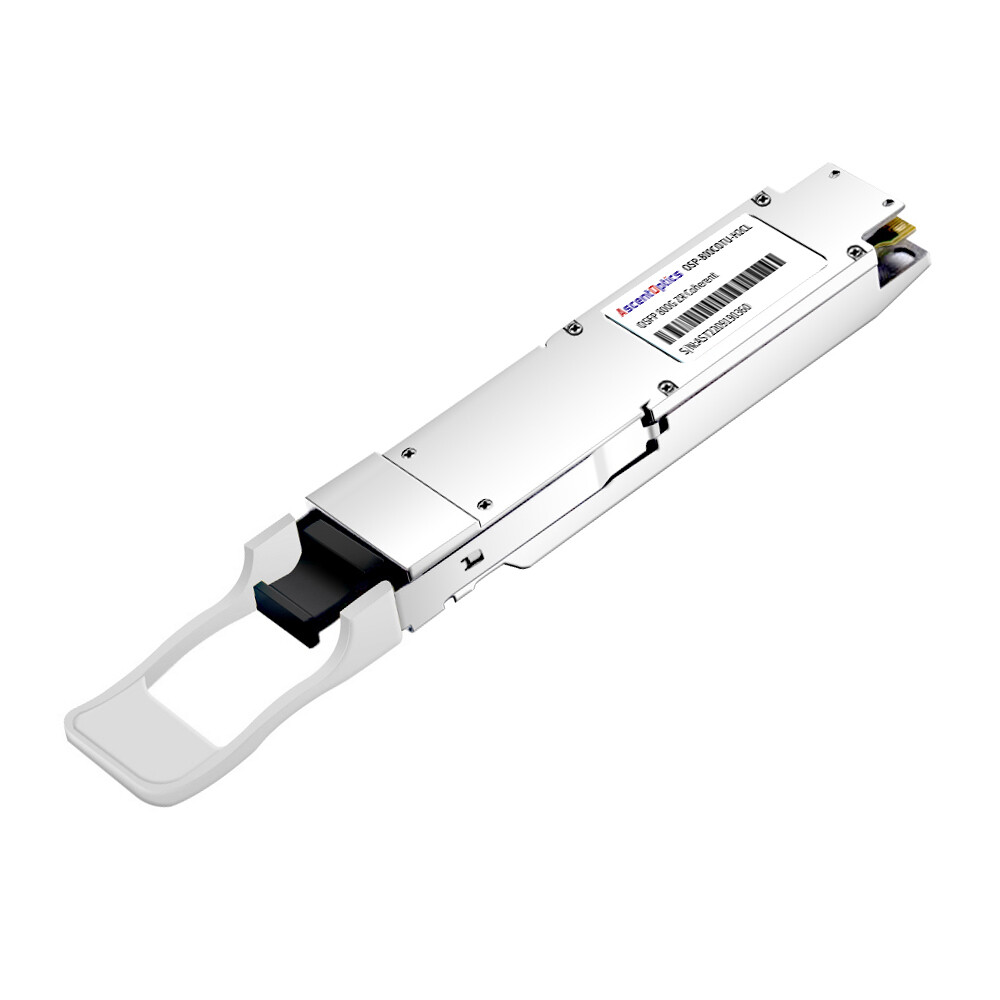
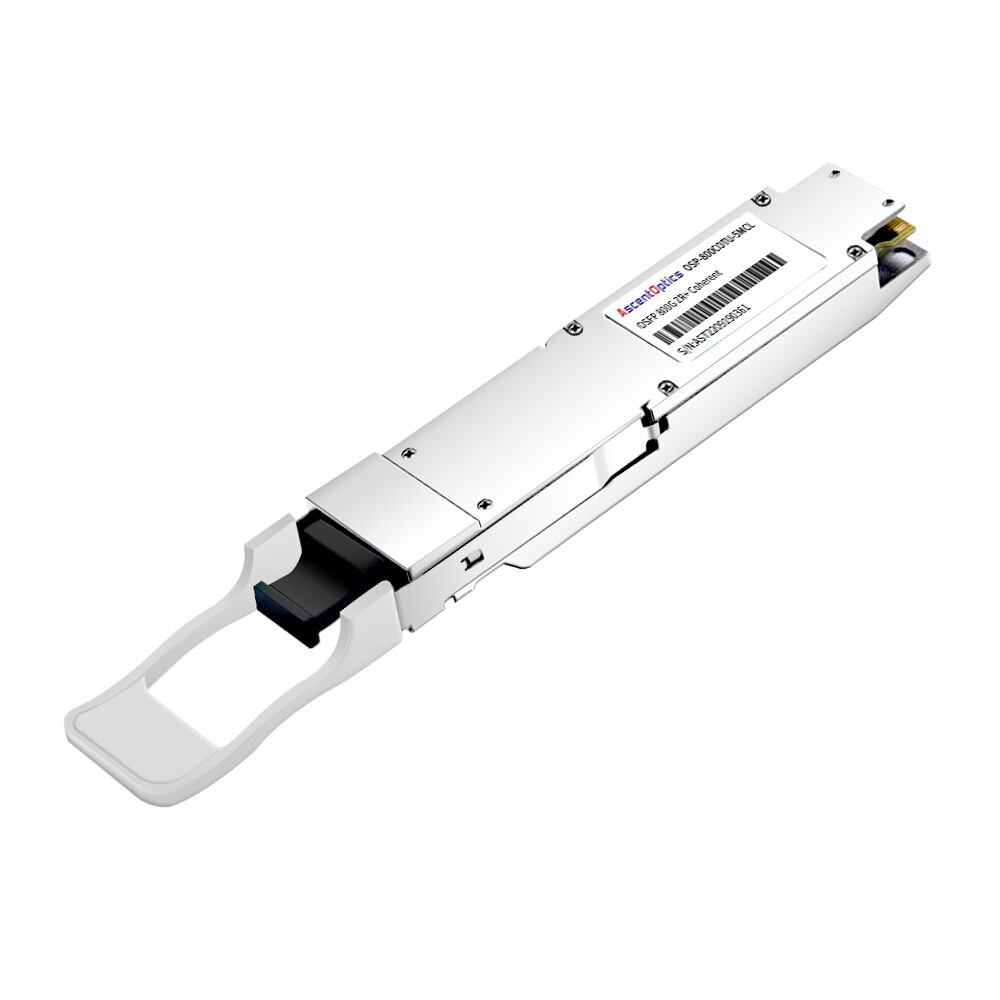
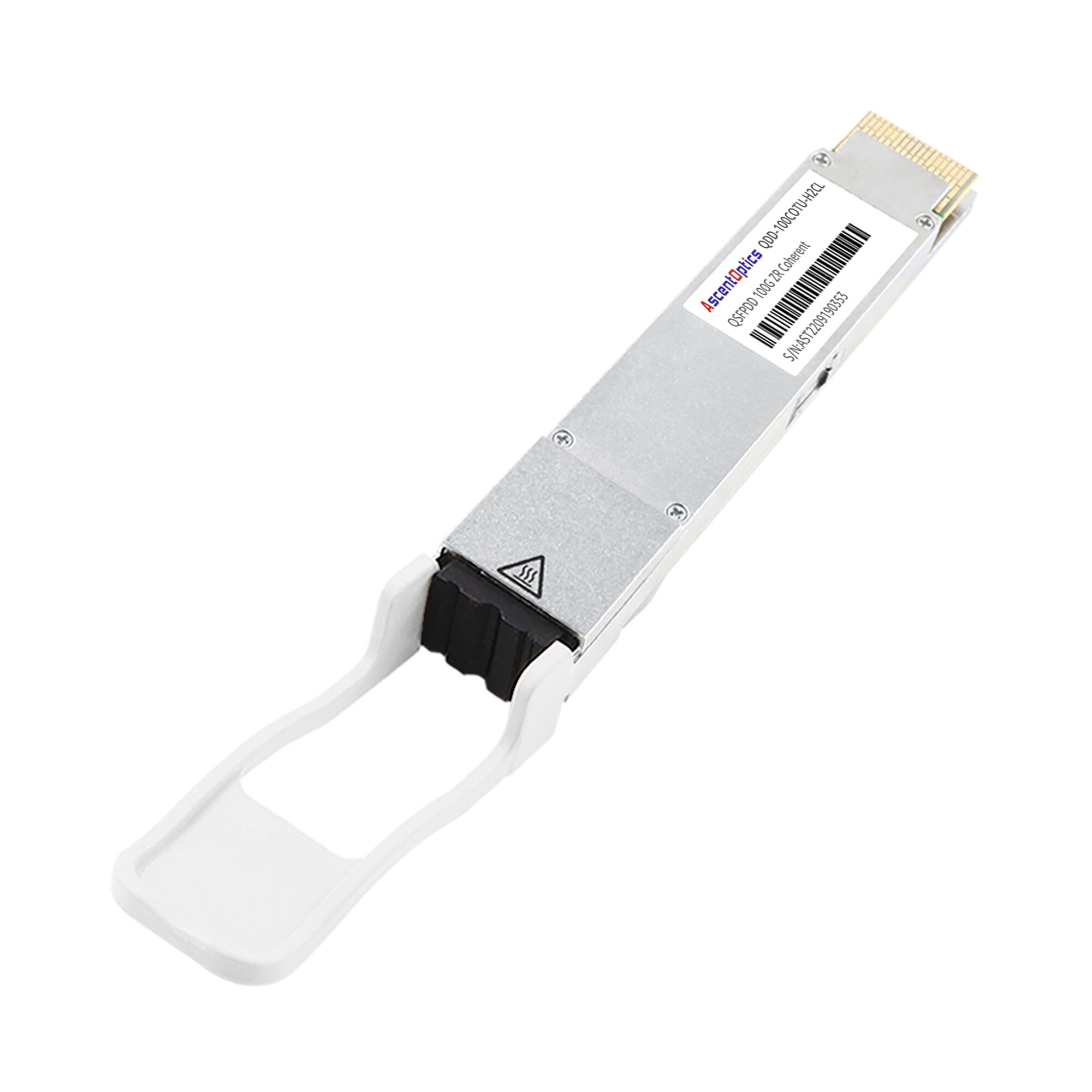
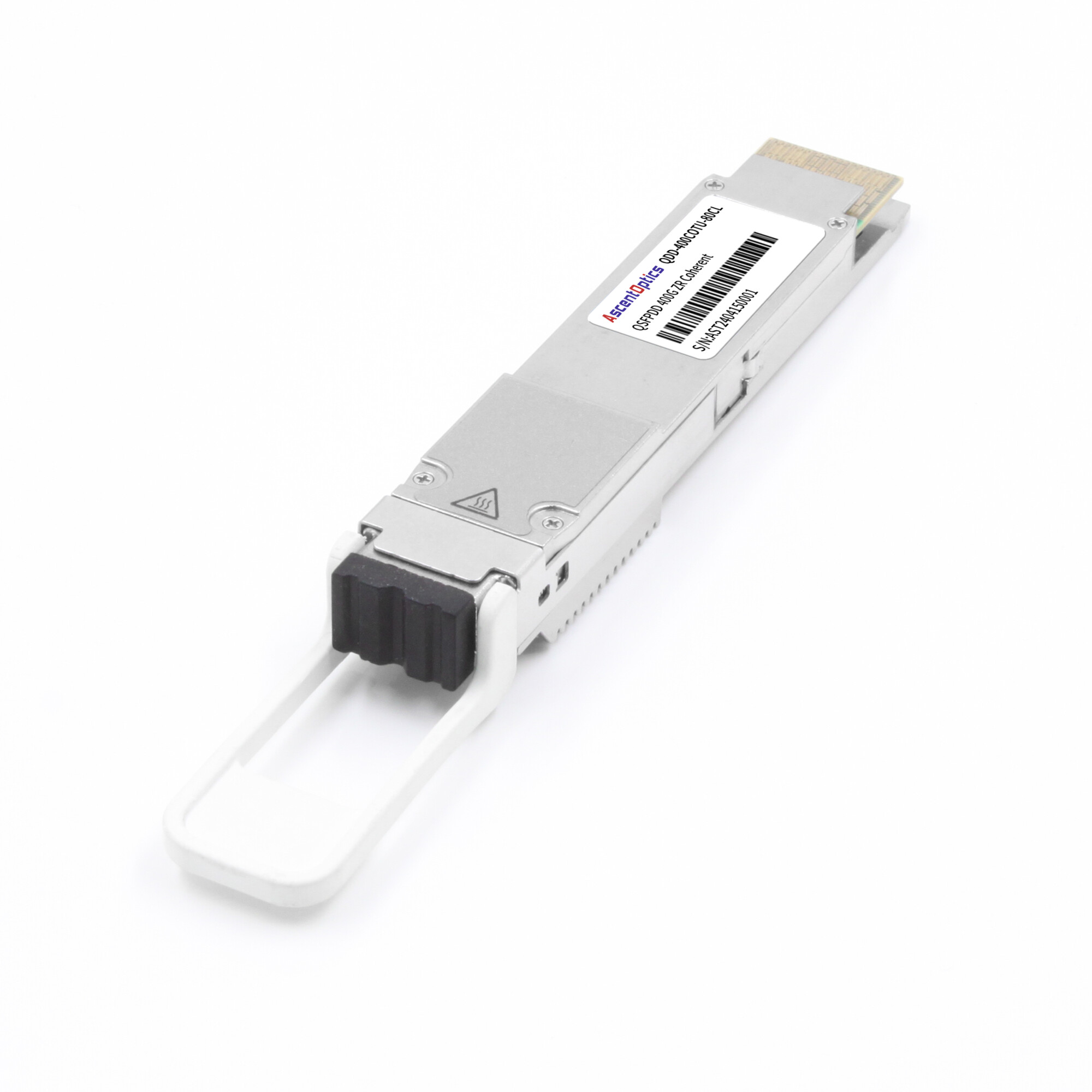
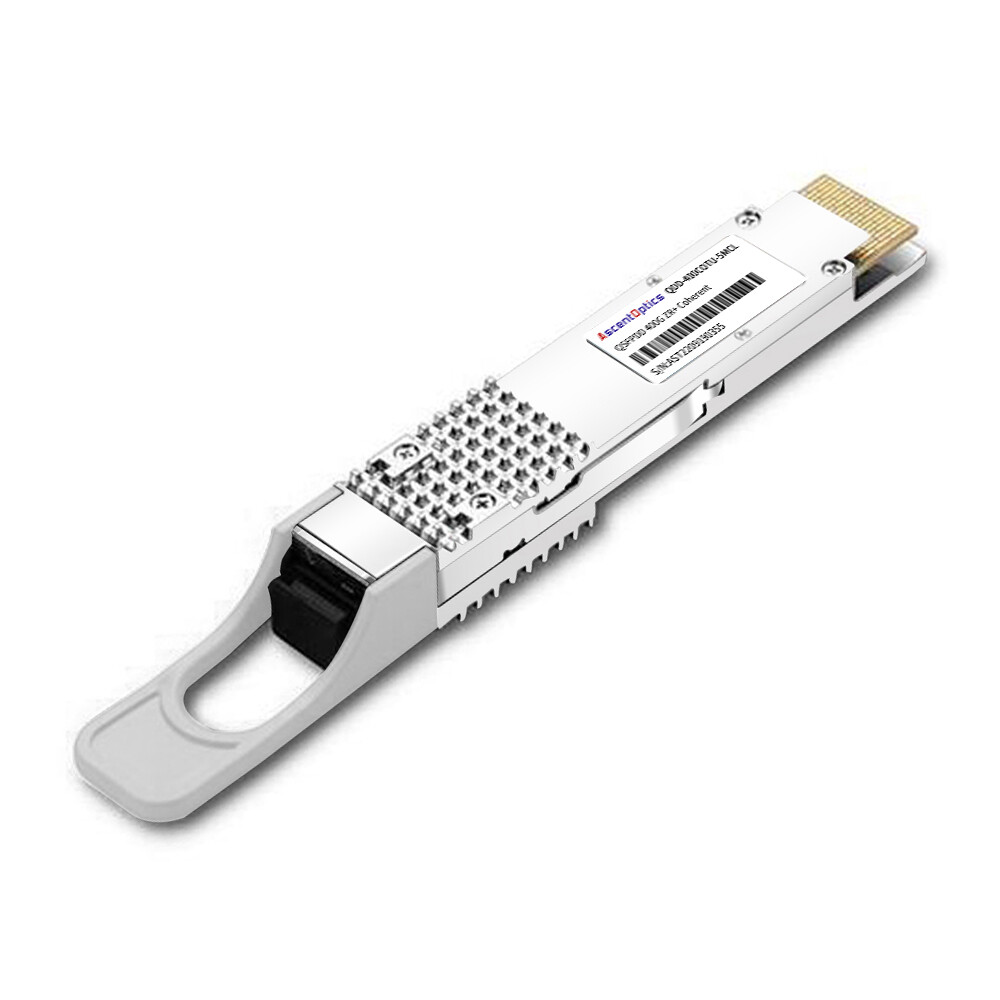
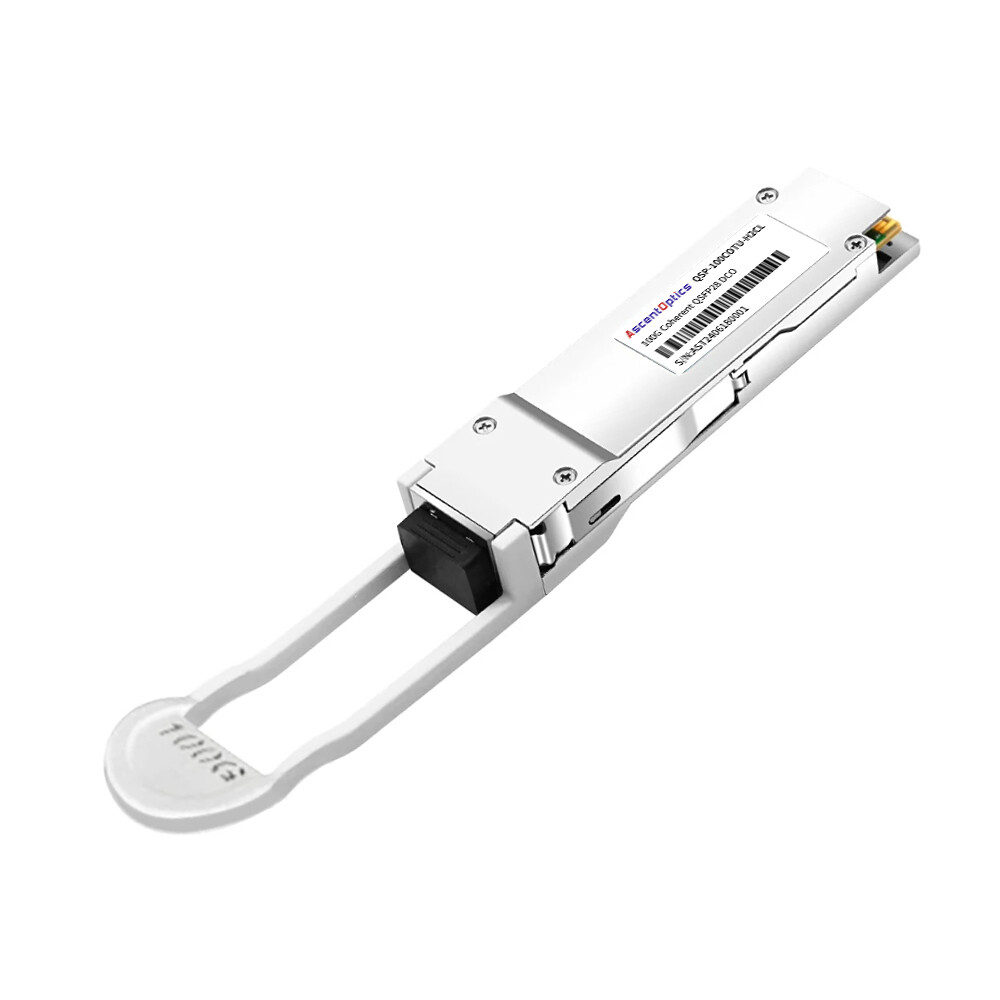
What if the same pluggable module that fits into a router faceplate could replace a full rack of external transponders? That shift is already happening. Network operators are moving from bulky, standalone coherent transponders to front-panel coherent optical modules that plug directly into switches and routers. The reason is simple: pluggable coherent optics cut complexity, save rack space, and still deliver the long-reach performance that data center interconnect (DCI), metro, and regional networks demand.
They are cheap, compact, and power-efficient. They reduce overall system cost, simplify deployment, and improve space and power efficiency compared with traditional external coherent transponders. But once a link stretches past 80 km, or once it needs to ride a WDM system, direct detect runs out of headroom. That is where coherent optical modules take over.
What Are Coherent Optical Modules?
Definition and Core Concept
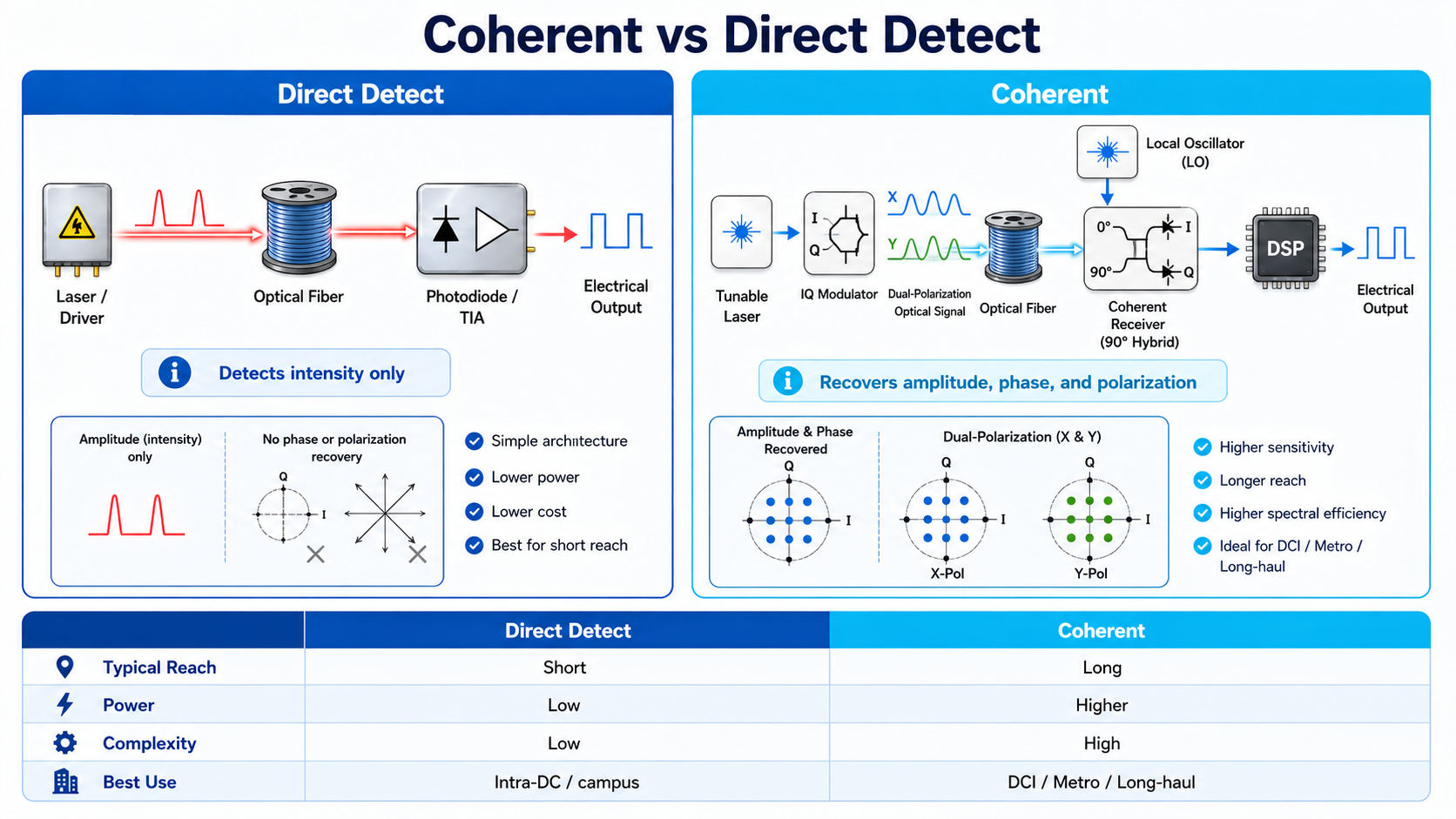
A coherent optical module is a pluggable optical transceiver that uses coherent detection and digital signal processing (DSP) to transmit and receive complex optical signals. Unlike direct-detect modules, which simply turn light on and off to represent bits, coherent optical communication encodes data onto multiple properties of the light wave: amplitude, phase, and polarization.
This approach lets a single carrier carry far more information. It also enables the receiver to recover weak signals over long distances, because coherent detection captures the full optical field rather than just intensity.
In practical terms, coherent optical modules extend high-capacity connectivity from the data center out to metro, regional, and even long-haul networks without requiring dedicated transport hardware at every node.
Key Components Inside a Coherent Module
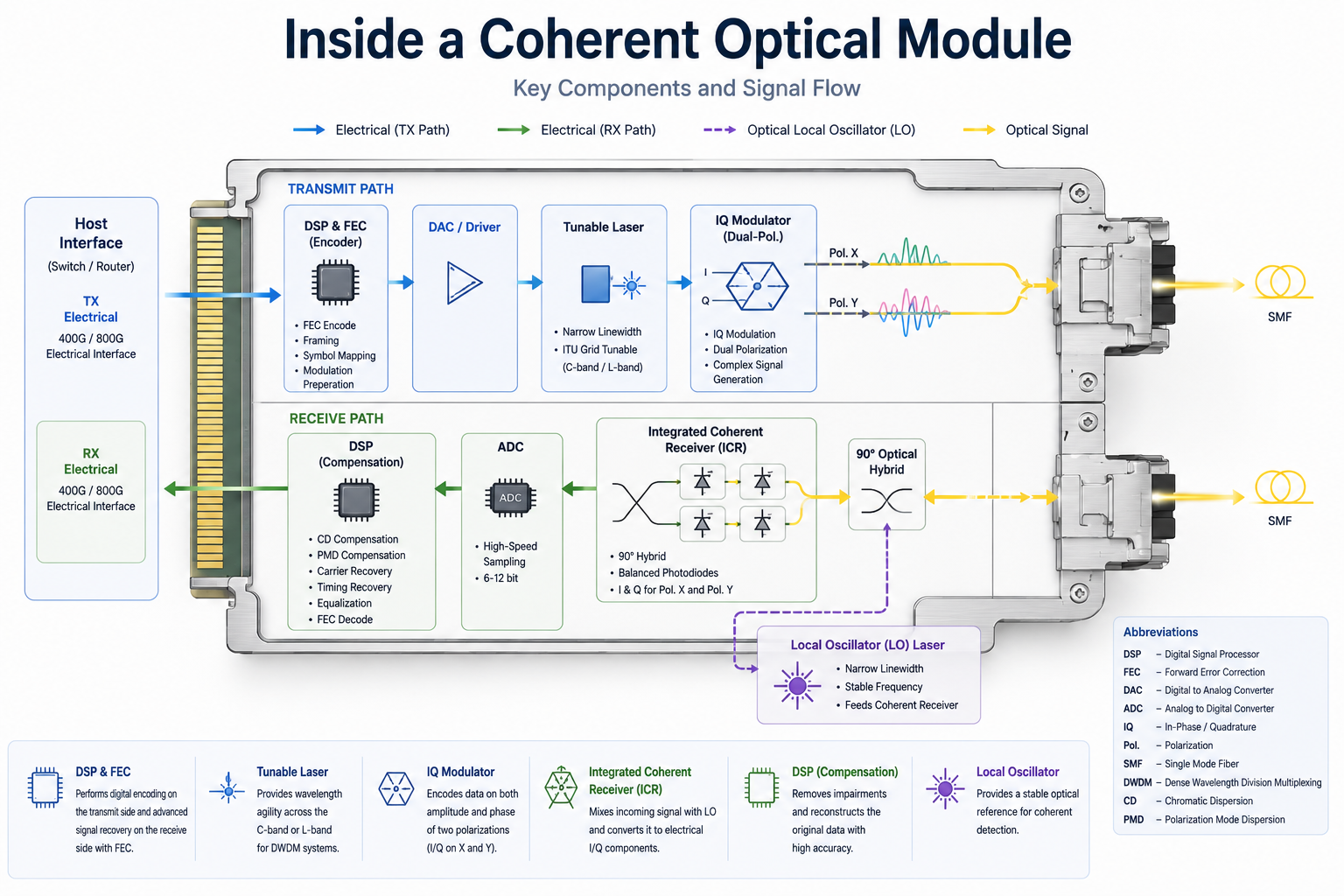
Every coherent optical transceiver depends on four core building blocks:
- •Tunable laser: Generates the optical carrier and can be adjusted across the C-band or L-band for WDM flexibility.
- •IQ modulator / dual-polarization modulator: Imprints data onto the amplitude and phase of both polarization axes of light.
- •Integrated coherent receiver (ICR): Mixes incoming light with a local oscillator and converts the optical signal into electrical waveforms.
- •Digital signal processor (DSP): Recovers the original data, compensates for fiber impairments, and runs forward error correction (FEC).
- •FEC engine: Adds redundant coding so the receiver can correct errors caused by noise and distortion.
These components work together to deliver the sensitivity and spectral efficiency that make coherent optics practical for 80 km to 1,000 km+ links.
Performance Advantage Over Direct Detect
Coherent detection significantly improves receiver sensitivity compared with direct-detect systems, enabling unamplified reaches beyond 80 km. For network engineers, that means fewer amplifiers, simpler link budgets, and the ability to use standard pluggable modules where once only external transponders would do.
How Coherent Optical Communication Works
Modulation and Polarization
Coherent optical communication encodes data using advanced modulation formats such as:
- •QPSK(quadrature phase-shift keying): two bits per symbol, robust for long reach.
- •16-QAM: four bits per symbol, higher spectral efficiency, shorter reach.
- •64-QAM: six bits per symbol, very high capacity, limited to shorter coherent links.
These formats are combined with dual-polarization modulation, which transmits two independent data streams on orthogonal polarizations of the same wavelength. The result is a dramatic increase in bits per Hz without increasing the symbol rate proportionally.
Coherent Detection
At the receiver, a local oscillator laser generates a reference optical signal. The incoming signal mixes with this reference, producing electrical signals that preserve both amplitude and phase information. The DSP then reconstructs the transmitted symbols and compensates for impairments introduced by the fiber.
This process is why coherent receivers can tolerate much lower optical signal-to-noise ratios (OSNR) than direct-detect receivers.
DSP Compensation
The DSP inside a coherent optical module performs several critical compensation functions:
- •Chromatic dispersion (CD) compensation: Reverses pulse spreading caused by different wavelengths traveling at different speeds through fiber.
- •Polarization-mode dispersion (PMD) mitigation: Corrects timing differences between the two polarization states.
- •Nonlinearity compensation: Partially counteracts Kerr effect distortions at high launch powers.
- •Carrier and timing recovery: Locks onto the received signal’s phase and symbol timing.
Because these impairments are corrected in the digital domain, coherent links can run over installed fiber that direct-detect systems would find unusable. Modern coherent DSPs also perform adaptive equalization, frequency offset compensation, and laser phase noise mitigation to improve overall transmission performance.
FEC and Latency Trade-offs
Forward error correction comes in two common flavors:
- •Hard-decision FEC (HD-FEC): Lower latency, less coding gain, common in shorter-reach coherent modules.
- •Soft-decision FEC (SD-FEC): Higher coding gain, better reach, but adds latency. Typical for long-haul and submarine systems.
For DCI applications, latency-sensitive workloads may prefer HD-FEC or minimal SD-FEC iterations. For metro aggregation, SD-FEC is usually the better choice because reach matters more than a few microseconds of latency.
Coherent Optical Module Types and Form Factors
Choosing the right coherent optical transceiver starts with matching the form factor to your reach, power budget, and switch hardware. The table below summarizes the most common options.
| Form Factor |
Speed Classes |
Typical Power |
Typical Reach |
Best Use Case |
| CFP2-DCO |
100G / 200G |
20–30 W |
1,000 km+ |
Long-haul, metro transport, submarine |
| QSFP-DD DCO |
400G |
15–18 W |
120–480 km |
DCI, metro, cloud interconnect |
| OSFP ZR / ZR+ |
400G / 800G |
18–25 W+ |
120–480 km |
Hyperscale DCI, AI clusters |
| QSFP28-DCO |
100G |
12–18 W |
80–120 km |
Metro access, edge aggregation |
ACO vs DCO
Coherent modules are also classified by where the DSP lives:
- •Analog coherent optics (ACO): The optical front-end is pluggable, but the DSP resides in the host line card. Common in early 100G coherent deployments.
- •Digital coherent optics (DCO): The DSP is integrated inside the module. This is the dominant architecture today because it allows coherent optics to plug into standard router and switch ports.
Most new deployments choose DCO modules because they simplify hardware design and support multi-vendor interoperability.
Although ACO modules offer lower module power consumption, they require host systems with integrated coherent DSPs and are therefore primarily used in transport equipment rather than standard Ethernet switches.
Front-Panel Pluggable vs Embedded Transponders
The industry trend is clear: front-panel pluggable coherent optical modules are displacing embedded transponders in many applications. A single QSFP-DD DCO or OSFP ZR module can turn a standard switch port into a 400G coherent link.
However, embedded transponders still make sense for:
- •Very long-haul and submarine systems requiring the highest performance.
- •Networks needing flexible grid WDM and advanced optical layer management.
- •Cases where power and thermal constraints at the switch faceplate are too strict.
Coherent vs Direct Detect: When to Choose Each
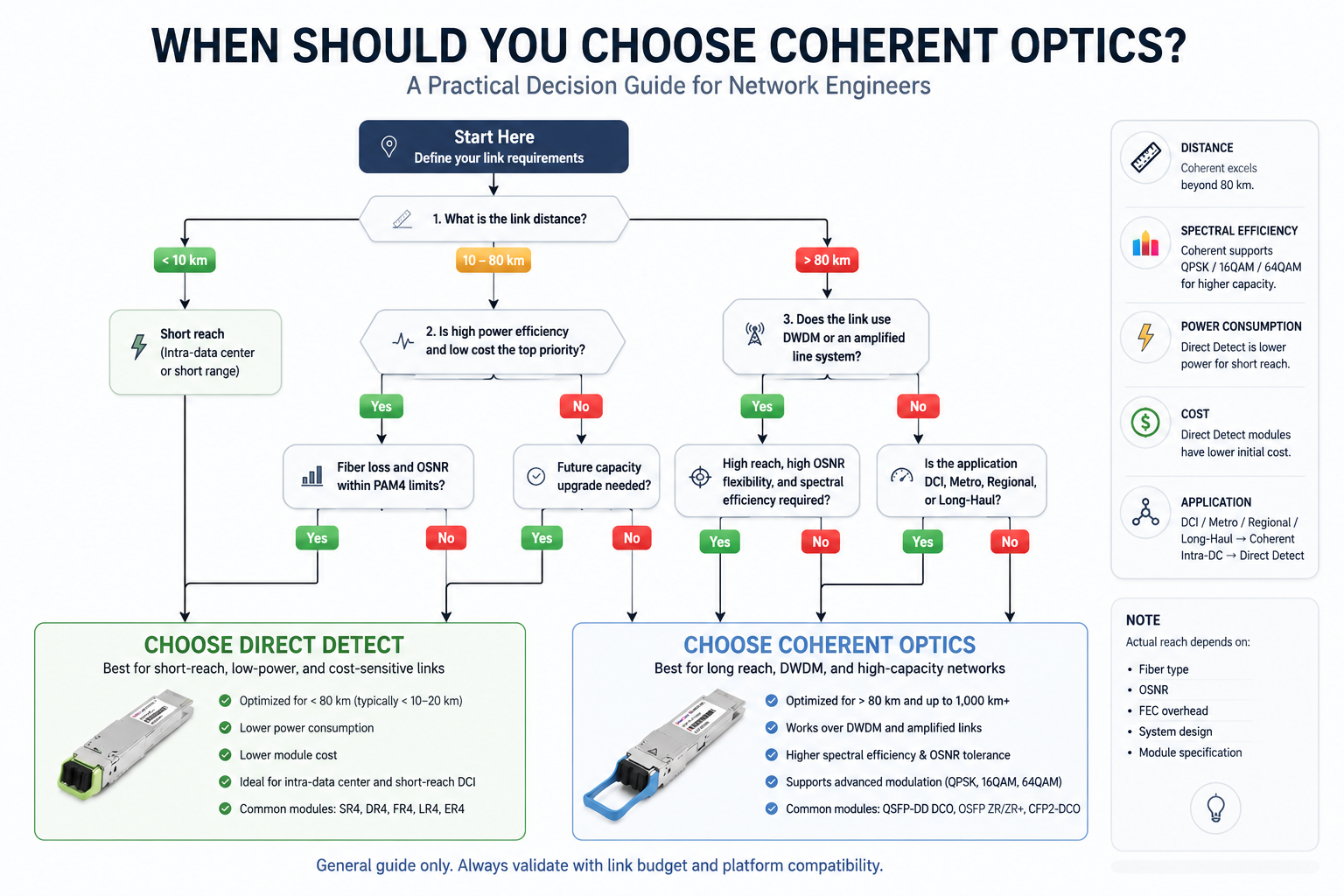
Not every link needs coherent optics. Direct-detect modules remain the right choice for many short-reach applications. The matrix below helps you decide.
| Factor |
Direct Detect (PAM4) |
Coherent |
| Typical reach |
<10 km (up to ~80 km for ZR PAM4) |
80 km to 1,000 km+ |
| Typical power |
3–6 W |
12–30 W |
| Cost per module |
Lower |
Higher |
| Spectral efficiency |
Lower |
Higher |
| Best for |
Top-of-rack, intra-DC, short DCI |
Long-reach DCI, metro, long-haul |
When Coherent Wins
Coherent optical modules are the better choice when:
- •The link exceeds roughly 80 km without amplification.
- •The link rides an amplified or open line system.
- •You need 100G, 400G, or 800G over a single fiber pair.
- •The network must scale capacity without laying new fiber.
- •You want to eliminate external transponders and simplify operations.
When Direct Detect Wins
Direct-detect modules are still preferable when:
- •The link stays within the data center or campus.
- •Power and thermal budgets are tight.
- •Cost per bit matters more than reach.
- •The application is top-of-rack, server-to-switch, or storage fabric.
Direct-detect optics remain the preferred choice for most intra-data-center Ethernet links because of their lower cost, lower power consumption, and simpler architecture.
400G ZR, ZR+, and OpenZR+ Explained
OIF 400ZR
400G ZR is an OIF (Optical Internetworking Forum) standard that defines a 400G coherent pluggable module, it’s designed primarily for point-to-point DCI applications. It targets roughly 120 km of unamplified reach over single-mode fiber using a single carrier. The standard specifies the modulation, FEC, and management interface so modules from different vendors can interoperate.
For cloud and hyperscale operators, 400G ZR became the default choice for data center interconnects up to ~120 km because it removes the need for external transport gear.
OpenZR+
OpenZR+ extends the 400G ZR concept with more flexibility. It supports:
- •Reach from 120 km up to 480 km with amplification.
- •Multiple baud rates and modulation formats.
- •Operation on open line systems and WDM platforms.
- •Multi-vendor interoperability beyond the original OIF 400ZR scope.
OpenZR+ is ideal for metro and regional networks that need longer reach than 400G ZR but still want the simplicity of pluggable optics. Unlike 400ZR, OpenZR+ is an industry agreement rather than a formal standard, providing vendors with greater implementation flexibility for metro and regional transport networks.
ZR+ High-Power Variants
Some applications need even more launch power or longer reach than standard OpenZR+ allows. High-power ZR+ variants exist for metro aggregation and regional links, though they require careful thermal and link-budget planning because power consumption can exceed 20 W per module.
Interoperability Considerations
When deploying coherent optical modules from multiple vendors, verify:
- •CMIS (Common Management Interface Specification): Ensures consistent module management and DOM/DDM reporting. CMIS 4.0 and 5.0 are common for 400G and 800G modules.
- •FEC compatibility: Both ends of a link must use compatible FEC modes.
- •Grid and wavelength plan: Tunable lasers must be set to compatible channels.
- •Amplifier settings: For amplified links, launch power and gain must match the module’s requirements.
Even when two modules support the same coherent standard, interoperability may depend on compatible DSP implementations, firmware versions, and supported operating modes.
Coherent Optical Module Applications
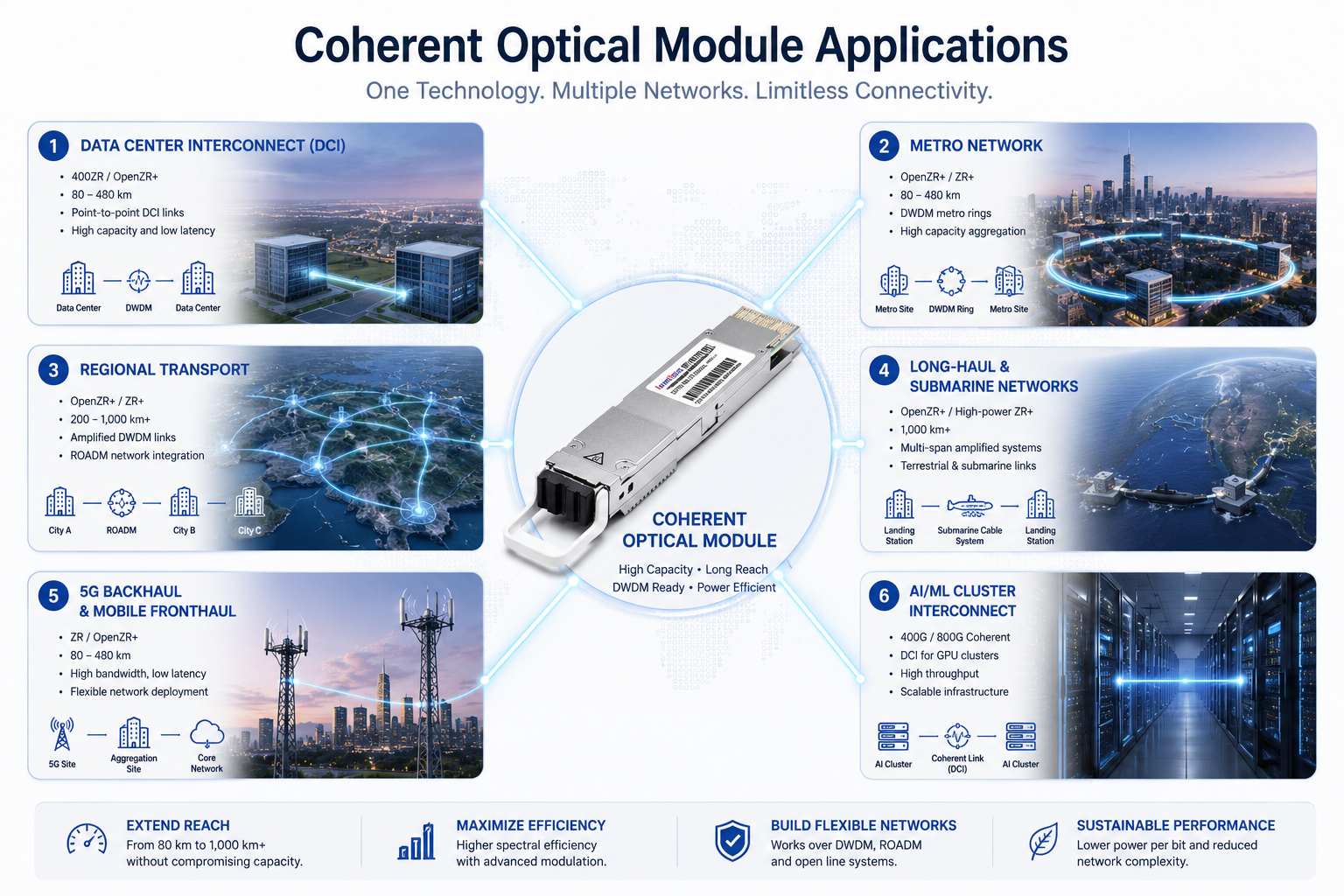
Data Center Interconnect (DCI)
DCI is the largest growth market for coherent optical modules. Cloud providers use 400G ZR and OpenZR+ modules to connect data centers across campuses and metro areas. The ability to plug these modules directly into routers and switches eliminates external transponders and reduces operational complexity.
Metro and Regional Networks
Telecom operators use 100G and 200G coherent modules for metro aggregation and regional transport. CFP2-DCO modules remain popular in these networks because they balance reach, performance, and compatibility with existing transport platforms.
Long-Haul and Submarine
For distances beyond a few hundred kilometers, high-performance coherent transponders and specialized long-haul modules dominate. CFP2-DCO and proprietary high-performance coherent engines support submarine cable systems and continental backbones where OSNR margins are tight.
5G Transport and Mobile Backhaul
5G midhaul and backhaul networks often need 25G, 100G, or 200G links with longer reach than direct detect can provide. Coherent 100G/200G pluggable optics are increasingly used for aggregation rings where reach exceeds 80 km.
AI/ML Cluster Interconnect
AI clusters are creating new demand for coherent optics. As GPU clusters scale beyond a single data center, hyperscalers need high-bandwidth, low-latency interconnects between facilities. 800G coherent optical modules in OSFP form factors are emerging for these DCI scenarios, though cost and power remain key considerations.
Power, Thermal, and Standards Considerations
Per-Module Power Ranges
Coherent optical modules consume more power than direct-detect alternatives. Typical values are:
- •QSFP-DD DCO: 15–18 W
- •OSFP ZR+: 18–25 W or more
- •CFP2-DCO: 20–30 W
- •QSFP28-DCO: 12–18 W
Rack-Level Thermal Budgeting
High-power coherent modules affect more than just the port. They raise the thermal load of the entire switch or router. Key planning steps include:
- •Confirming switch airflow direction and capacity.
- •Avoiding belly-to-belly mounting that traps heat.
- •Checking per-line-card power limits.
- •Planning cable management so fiber does not block airflow.
If a switch cannot dissipate the heat from a full set of OSFP ZR+ modules, you may need to mix coherent and direct-detect ports or choose a platform with higher thermal capacity.
Key Standards and Specifications
- •OIF 400ZR / OpenZR+: Interoperability standards for 400G coherent pluggables.
- •IEEE 802.3ct/bj/bk: Ethernet standards covering 100G and 400G coherent interfaces.
- •CMIS 4.0 / 5.0: Management interface for QSFP-DDand OSFP modules.
- •MSA form-factor specifications: QSFP-DD, OSFP, CFP2, and QSFP28 mechanical and electrical standards.
Future Trends: 800G, 1.6T, and Co-Packaged Optics
800G Coherent Pluggables
800G coherent optical modules are entering volume deployment in OSFP and QSFP-DD112 form factors. These modules support ZR and ZR+ reaches and are targeted at hyperscale DCI and AI cluster interconnect. Power consumption is the main engineering challenge, with early modules drawing 20 W or more.
1.6T Coherent Outlook
Looking further ahead, 1.6T coherent optics will require higher baud rates, more advanced DSP, and possibly new form factors. Linear drive optics and co-packaged optics are active research areas, though pluggable modules are expected to remain the mainstream choice for routers and switches through the end of the decade.
Co-Packaged Optics
Although co-packaged optics (CPO) continues to evolve, pluggable coherent modules are expected to remain the preferred solution for DCI because of their operational flexibility, serviceability, and interoperability.
AI Networking Impact
AI training clusters are driving enormous bandwidth growth. According to Data Center Dynamics, super-coherent optics are helping maximize capacity and performance for optical data center interconnection. As GPU clusters scale, coherent optics will move deeper into DCI and may even appear in certain intra-cluster applications where reach and capacity justify the power cost.
As AI training clusters expand across multiple buildings or campuses, coherent optics provide an efficient way to interconnect GPU fabrics while reducing the need for separate transport equipment. This trend is expected to accelerate with the adoption of 800G and future 1.6T coherent technologies.
Frequently Asked Questions
What is a coherent optical module?
A coherent optical module is a pluggable optical transceiver that uses coherent detection and DSP to encode data onto the amplitude, phase, and polarization of light. This enables longer reach and higher spectral efficiency than direct-detect modules.
How does coherent optical communication work?
Coherent optical communication transmits complex modulation formats such as QPSK and QAM. The receiver mixes the incoming signal with a local oscillator and uses a DSP to recover data while compensating for fiber impairments like chromatic dispersion and polarization-mode dispersion.
What is the difference between coherent and direct-detect modules?
Direct-detect modules measure light intensity and work best for short reaches under 10 km. Coherent modules capture phase and polarization information, enabling reaches from 80 km to over 1,000 km at the cost of higher power and price.
What is 400G ZR vs. ZR+ vs. OpenZR+?
400G ZR is an OIF standard for ~120 km unamplified reach. ZR+ extends reach and launch power for amplified links. OpenZR+ is a multi-vendor agreement that adds flexibility for metro and regional networks up to 480 km.
How far can coherent optical modules transmit?
Reach depends on the module. 400G ZR targets ~120 km unamplified. OpenZR+ reaches 120–480 km with amplification. CFP2-DCO and long-haul transponders can span 1,000 km or more.
What is the difference between CFP2-DCO and QSFP-DD DCO?
CFP2-DCO is larger, supports 100G/200G, and is optimized for long-haul and metro transport. QSFP-DD DCO is more compact, supports 400G, and is designed for DCI and metro router or switch ports.
How much power does a coherent module consume?
Typical power ranges are 15–18 W for QSFP-DD DCO, 18–25 W+ for OSFP ZR+, and 20–30 W for CFP2-DCO. Actual consumption depends on modulation, FEC, and vendor design.
When should I use coherent optics in my data center?
Use coherent optics for DCI links longer than ~80 km, metro connections, and any link that needs 400G or 800G over a single fiber pair. Direct detect remains better for intra-data-center and short-reach connections.
Are coherent optical modules compatible with all switches?
No. Compatibility depends on the switch’s form factor, power capacity, thermal design, and firmware support for the specific coherent standard. Always verify compatibility before deployment.
What are the main applications of coherent optical modules?
Main applications include data center interconnect, metro and regional transport, long-haul and submarine networks, 5G mobile backhaul, and AI/ML cluster interconnect.
Post Views: 1,919