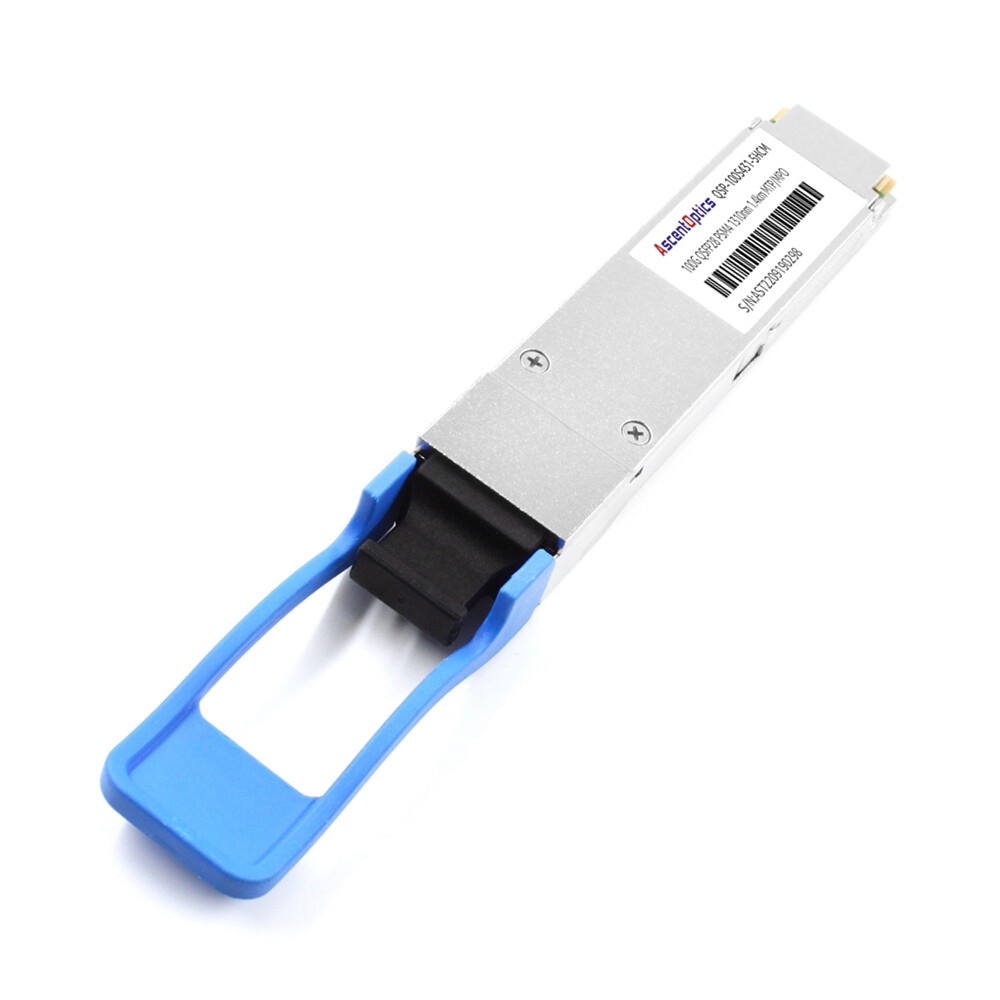
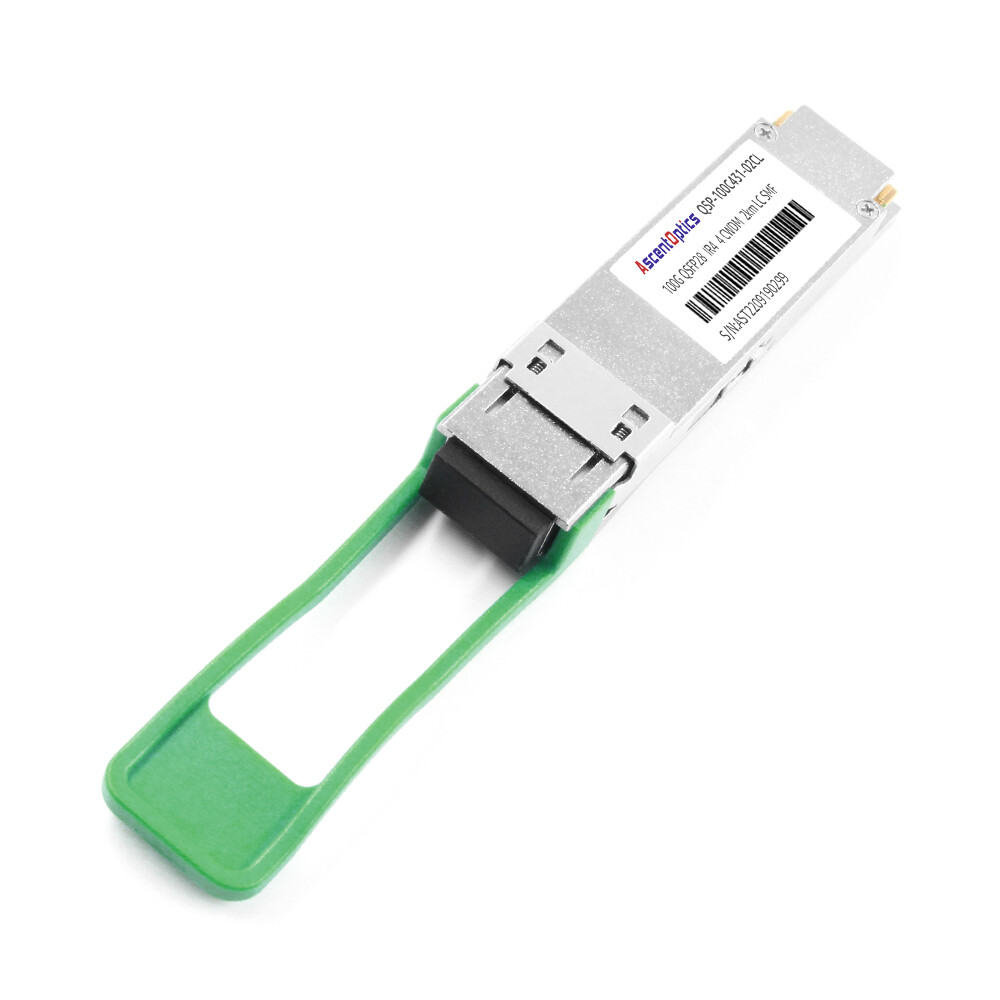
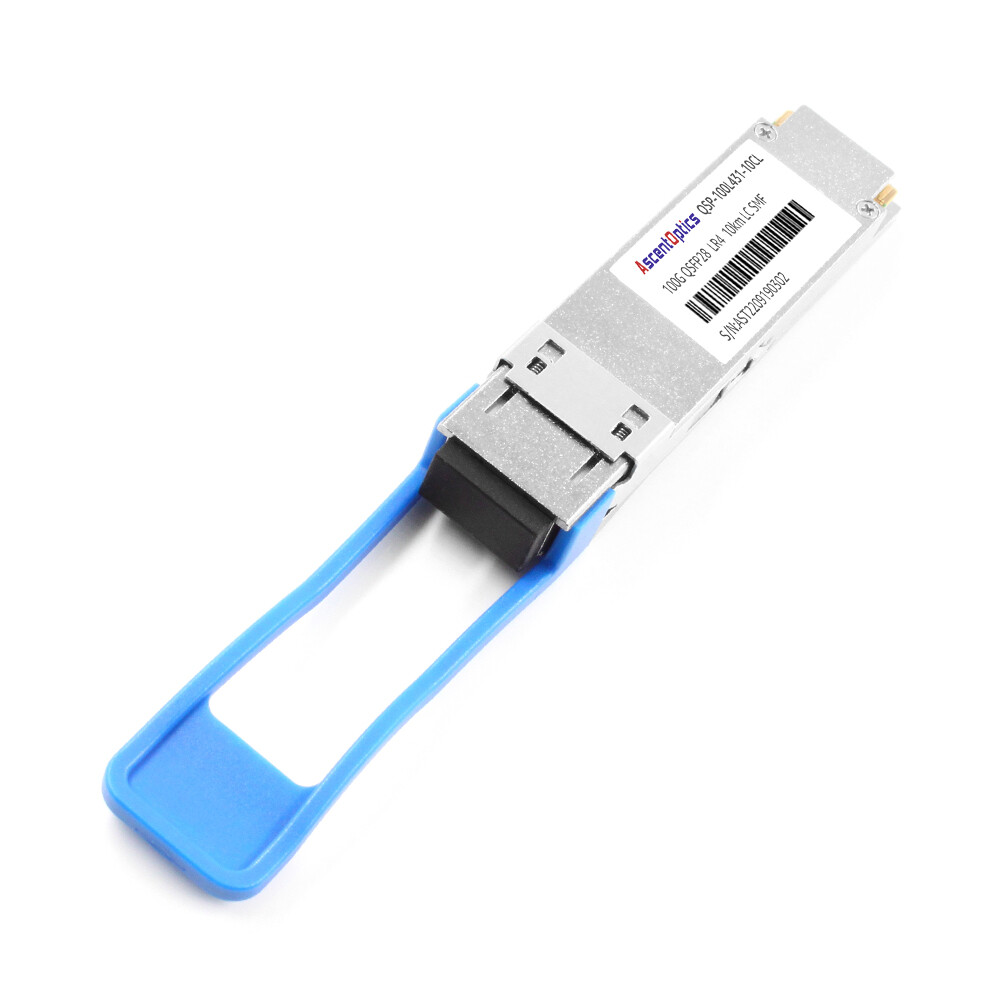
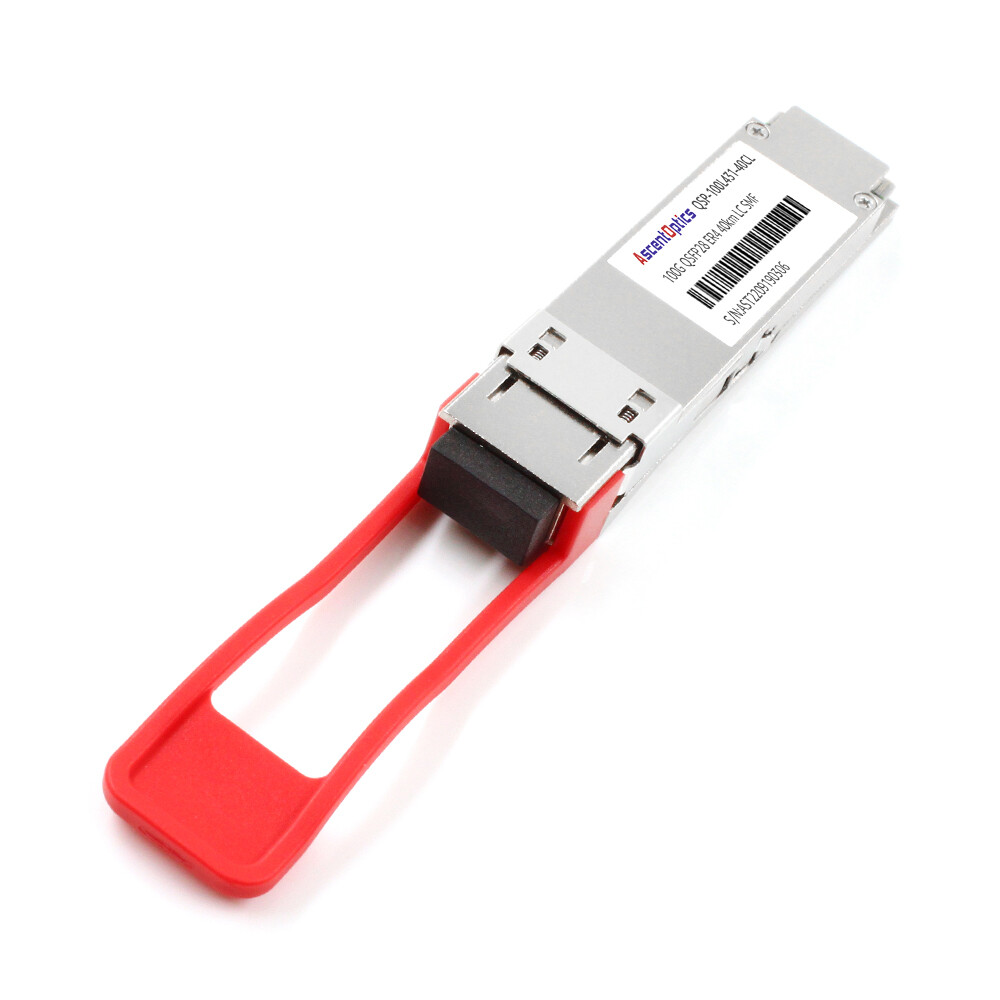
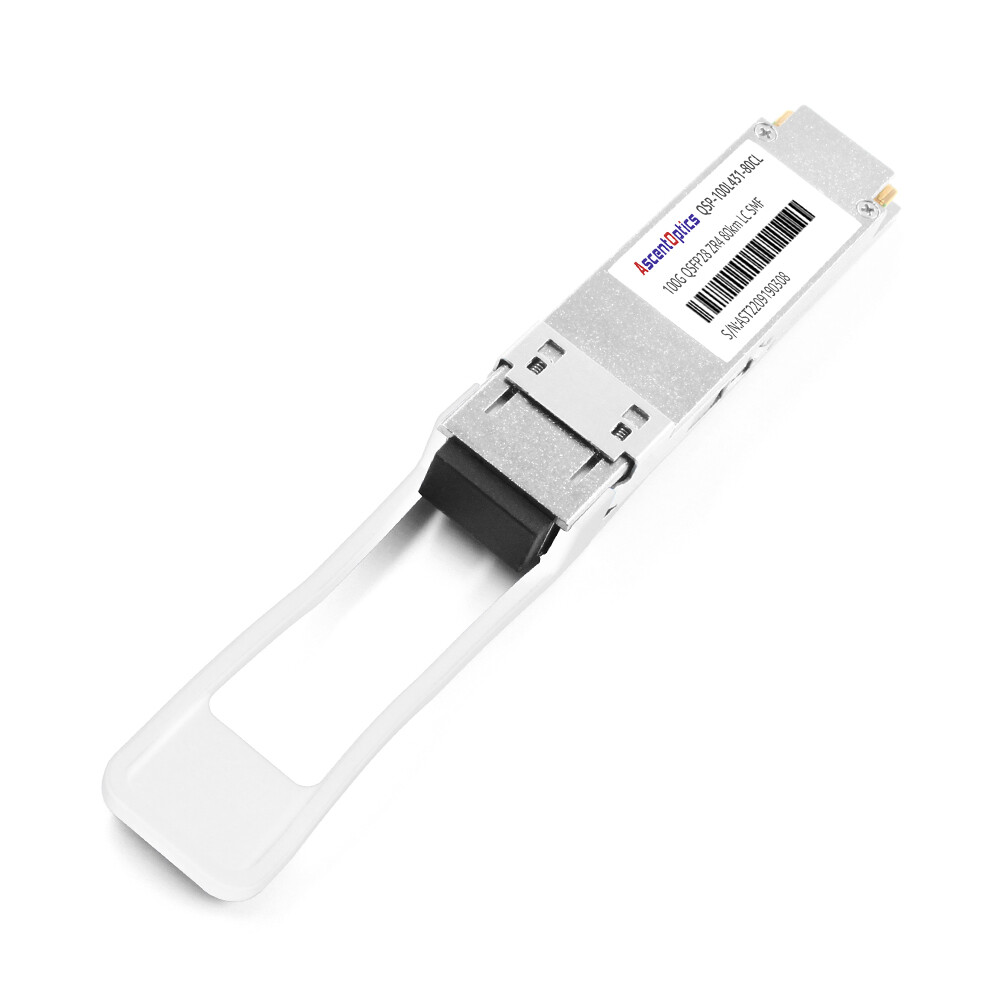
A single 200G QSFP56 module can cost anywhere from 118 to over 118 to over 3,000. That is not a typo. The exact QSFP56 price you pay depends on reach, fiber type, vendor coding, and how many units you buy. For procurement teams building a 200G fabric budget, that range creates real uncertainty.
What Is a QSFP56 Transceiver?
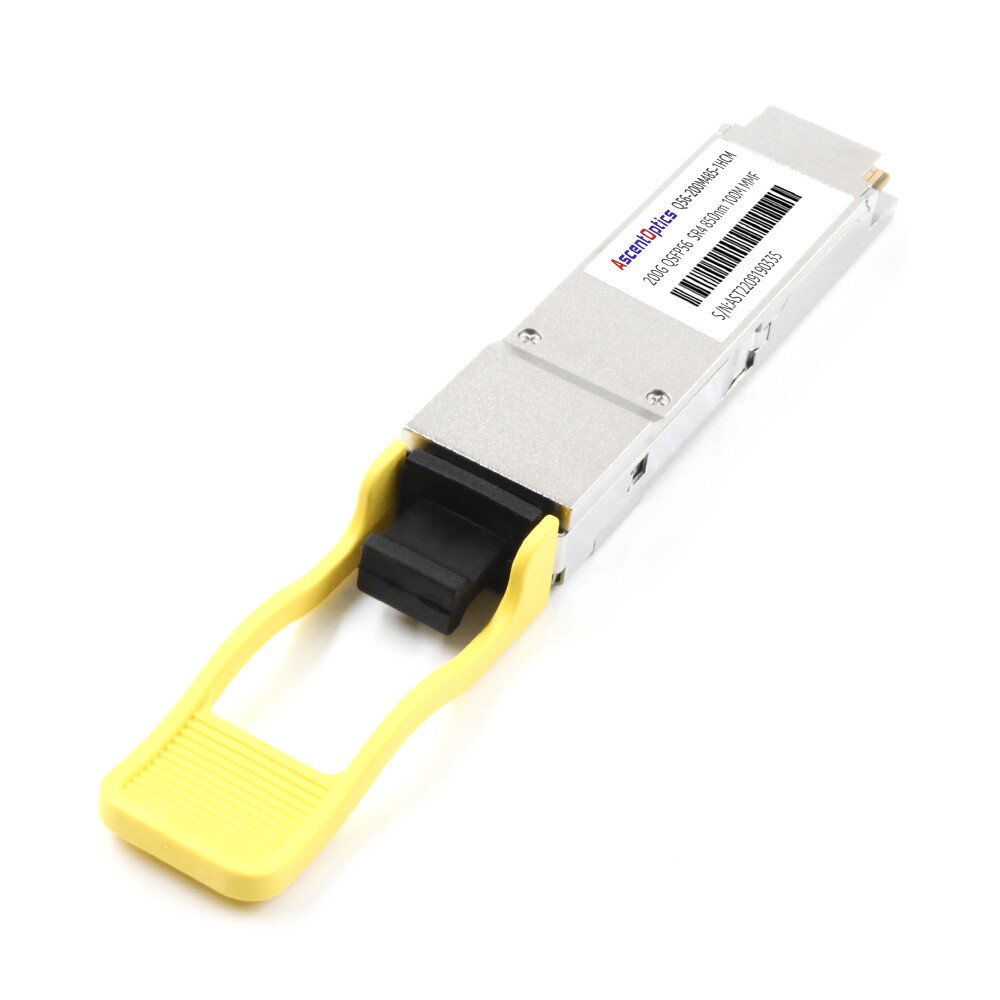
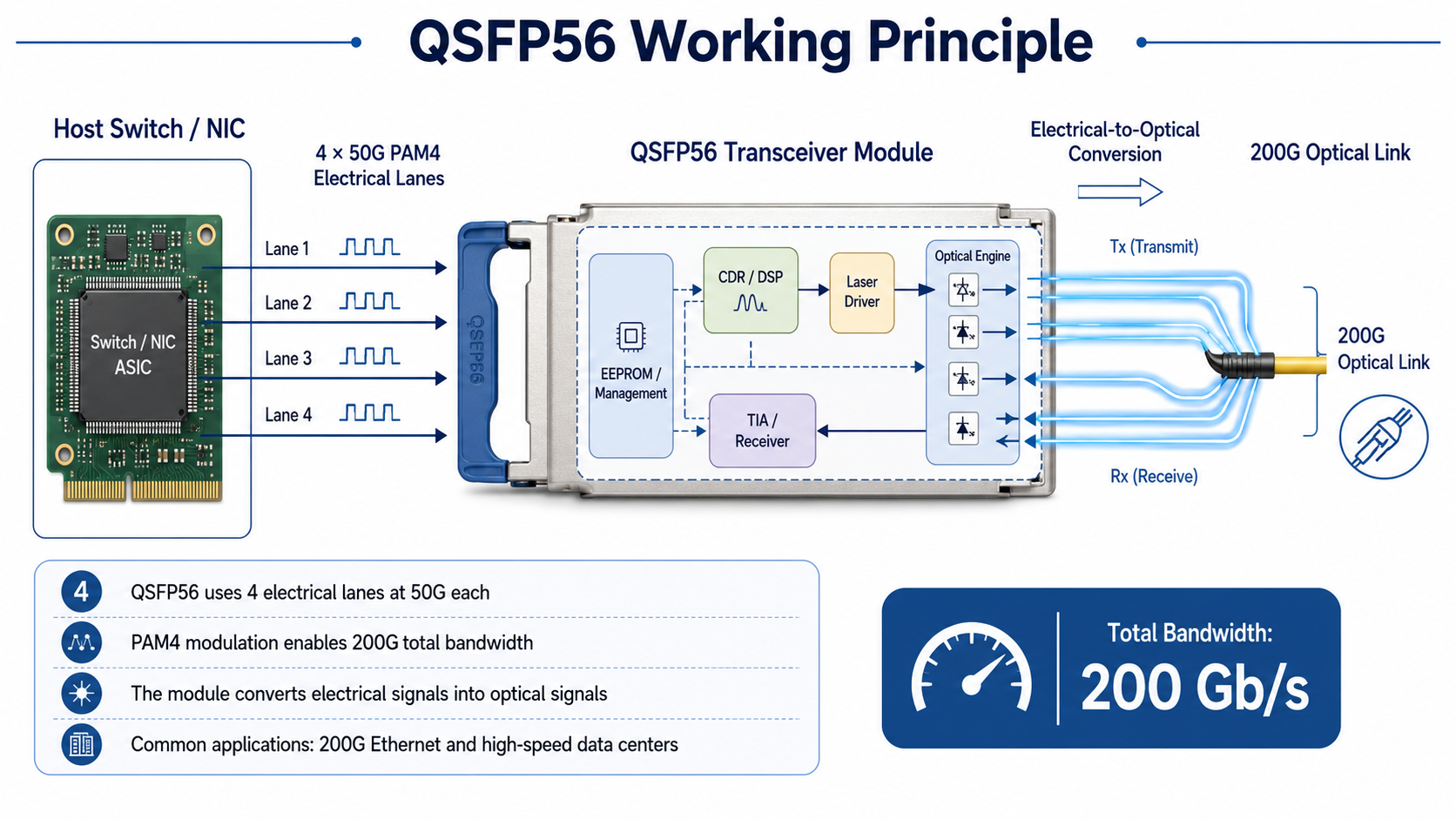
A QSFP56 transceiver is a hot-pluggable optical module that delivers 200 Gigabit Ethernet over four 50 Gbps PAM4 electrical lanes. It shares the same mechanical form factor as QSFP28 but requires host hardware capable of 200G PAM4 signaling.
The “56” in QSFP56 refers to the electrical interface generation capable of supporting approximately 56 Gbaud signaling. With PAM4 modulation, each lane carries 50GbE payload data, enabling an aggregate bandwidth of 200Gbps across four lanes.
QSFP56 is an MSA-defined form factor widely used for 200G Ethernet applications. Most 200G optical modules, including 200GBASE-SR4, DR4, and FR4, are based on IEEE 802.3cd specifications, while the QSFP56 MSA defines the mechanical and electrical interface.
What Drives QSFP56 Price?
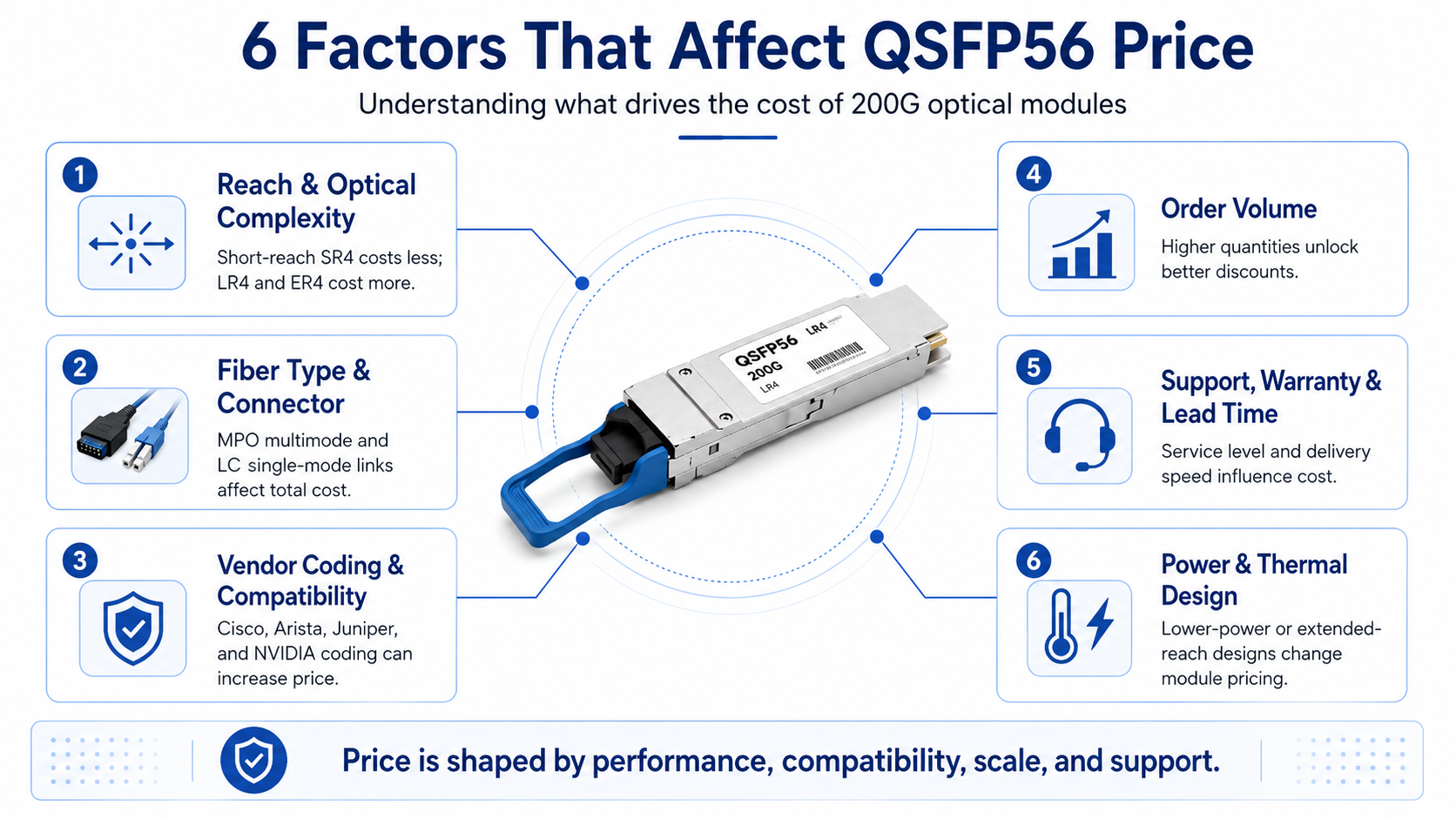
Module price is not arbitrary. Six factors move the number up or down.
Reach and Optical Complexity
Short-reach multimode SR4 modules use vertical-cavity surface-emitting lasers (VCSELs) and simple optics. Long-reach LR4 and ER4 modules use wavelength-division multiplexing, precision lasers, and more complex packaging. More complexity means higher cost.
Fiber Type and Connector
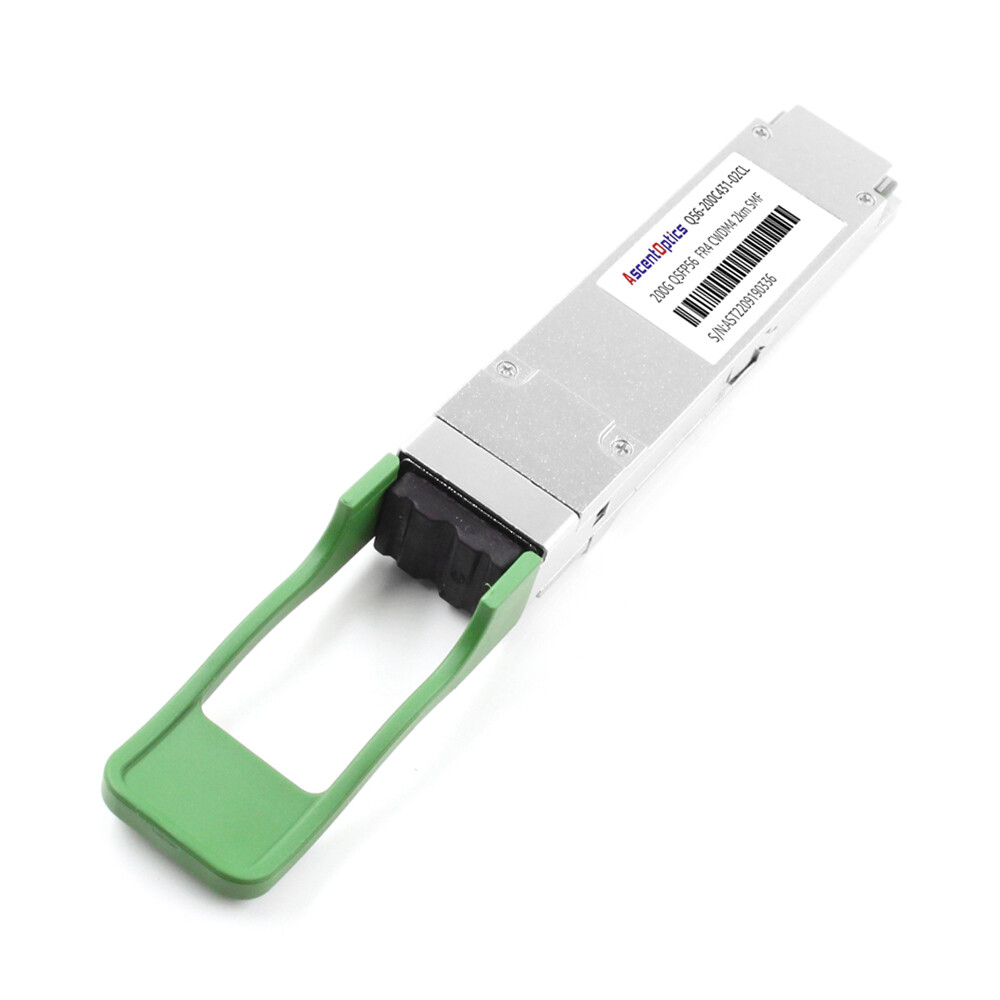
SR4 uses MPO-12 connectors with OM3, OM4, or OM5 multimode fiber. FR4, LR4, and ER4 use duplex LC connectors with single-mode fiber. Connector and fiber choices affect both module cost and the installed cable plant budget.
Vendor Coding and Compatibility
A module coded for Cisco, Arista, Juniper, or NVIDIA/Mellanox often costs more than a generic MSA module. Some vendors also require unlock commands or specific firmware revisions, which adds qualification work.
Vendor-specific coding itself has little impact on manufacturing cost. However, modules qualified and validated for major platforms such as Cisco, Arista, Juniper, or NVIDIA often command higher prices due to additional compatibility testing, certification, and support.
Volume and Contract Terms
A one-unit sample price is rarely the project price. Orders of 100, 500, or 1,000+ units unlock tiered discounts. Annual supply agreements can push pricing even lower.
Support, Warranty, and Lead Time
OEM modules include branded support and longer warranties. Third-party suppliers offer shorter lead times and competitive warranties. The trade-off affects total cost of ownership, not just unit price.
Power and Thermal Design
Standard SR4 modules draw roughly 4–5 W. Extended-reach ER4 modules can draw 8–9 W. Low-power LPO variants reduce wattage but require LPO-compatible switch ASICs. Power affects cooling costs at rack scale.
QSFP56 Price by Module Type (2026)
The table below shows realistic 2026 price ranges for third-party MSA-compatible modules and OEM-branded equivalents.
| Module Type |
Reach / Fiber |
Third-Party Range |
OEM Range |
Typical Use Case |
| DAC (passive) |
≤5 m copper |
80–80–250 |
250–250–700 |
Intra-rack, top-of-rack |
| AOC |
≤100 m MMF |
150–150–300 |
400–400–800 |
Row-to-row, flexible runs |
| SR4 |
100 m OM4 MMF |
118–118–400 |
700–700–3,000+ |
Data center spine-leaf |
| DR4 |
500 m SMF |
300–300–700 |
1,000–1,000–2,500 |
Intra-campus, parallel SMF |
| FR4 |
2 km SMF |
350–350–900 |
1,500–1,500–3,500 |
Metro DCI, campus links |
| LR4 |
10 km SMF |
500–500–1,200 |
2,000–2,000–4,500 |
WAN edge, telecom aggregation |
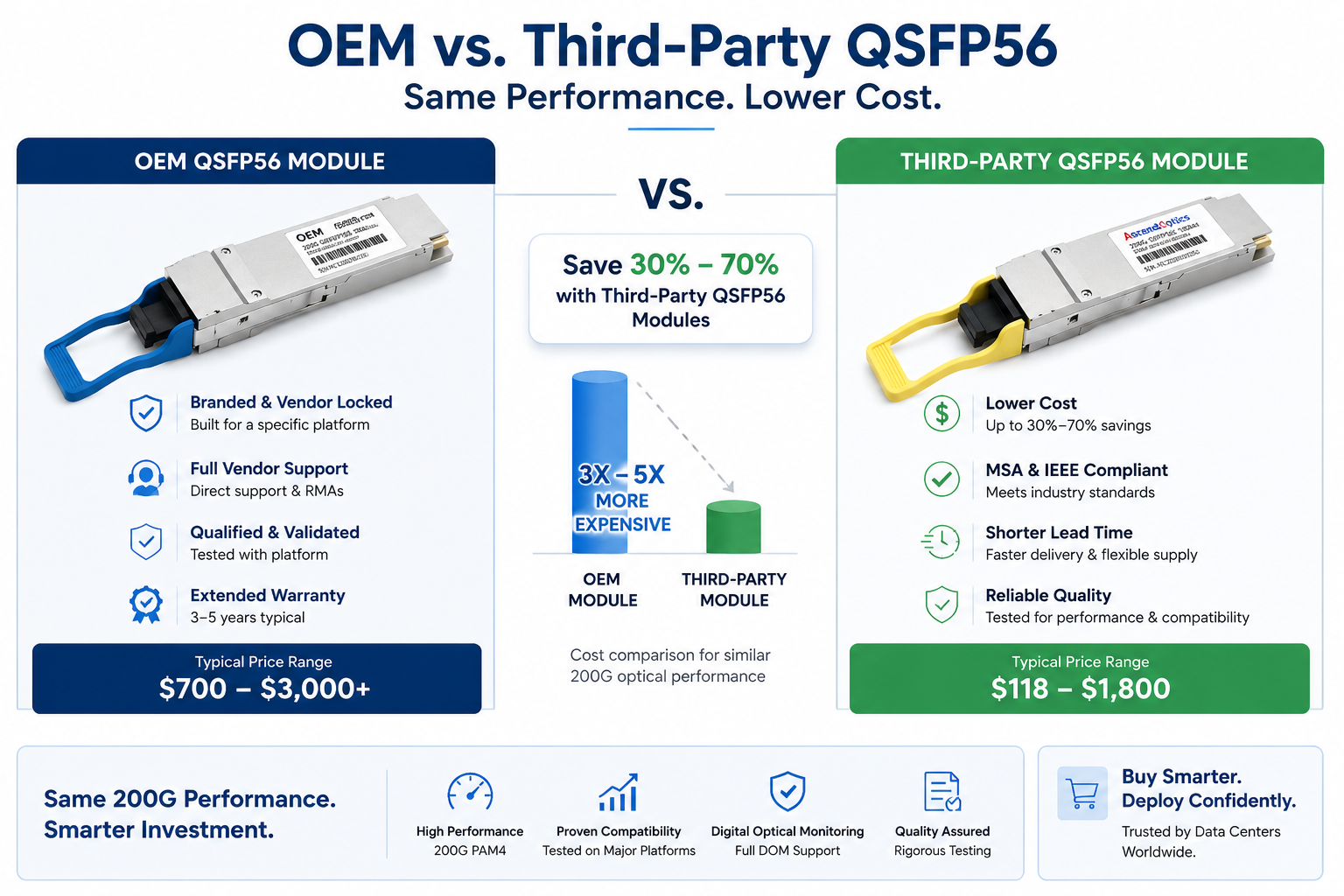
Key insight: The same 200G optical function can cost 3×–5× more when packaged as an OEM module. For many data center deployments, qualified third-party optics deliver identical performance at a fraction of the price.
The price of a QSFP56 module varies significantly depending on transmission distance, optical technology, and connector type. Short-reach options such as DAC, AOC, and SR4 are typically the most economical, while long-reach single-mode modules require more sophisticated optical components and therefore cost more. The table below provides typical 2026 market pricing for both third-party and OEM-branded QSFP56 solutions.
OEM vs. Third-Party QSFP56: Real Savings
OEM optics are not inherently better. They are inherently more expensive because they carry brand margin, support contracts, and supply-chain guarantees. Third-party modules from reputable manufacturers follow the same MSA and IEEE standards.
When Third-Party Makes Sense
- You operate a validated switch platform with known compatibility.
- You can run sample qualification before bulk purchase.
- Cost per Gbps is a primary budget driver.
- You have in-house engineering to manage firmware and DOM monitoring.
When OEM May Be Justified
- Your support contract requires OEM optics for full coverage.
- The platform is new or unvalidated with third-party modules.
- You need guaranteed next-day replacement and direct vendor escalation.
- Regulatory or audit requirements mandate OEM sourcing.
Compatibility Testing Before You Buy
Order samples. Verify link-up, digital optical monitoring (DOM) readings, FEC negotiation, and breakout behavior. Test under real traffic patterns. A 500 sample test can prevent a 500 sample test can prevent a 50,000 procurement mistake.
Module price alone does not tell the full story. Cost per Gbps normalizes the comparison.
| Form Factor |
Typical Module Price |
Bandwidth |
Cost per Gbps |
| QSFP28 SR4 |
35–35–330 |
100 Gbps |
~0.35–0.35–3.30 |
| QSFP56 SR4 |
118–118–400 |
200 Gbps |
~0.60–0.60–2.00 |
| QSFP-DD SR8/DR4 |
600–600–1,500 |
400 Gbps |
~1.50–1.50–3.75 |
QSFP56 often beats QSFP28 on cost per Gbps because it doubles bandwidth in the same form factor for less than double the price. QSFP-DD has a higher module cost but consolidates four 100G lanes into one port, reducing switch and cabling overhead.
Cost per Gbps should be considered together with switch port density, power consumption, and cabling costs when evaluating overall network deployment economics.
Looking only at the purchase price can be misleading when comparing different transceiver generations. Cost per gigabit provides a more meaningful metric by relating module cost to the available bandwidth. While QSFP56 generally offers better bandwidth efficiency than QSFP28, the overall value also depends on factors such as switch port density, power consumption, and future scalability.
Volume Pricing: What Quantity Actually Saves
Suppliers rarely publish exact volume tiers, but the following ranges reflect common 2026 discount structures for third-party QSFP56 modules:
| Quantity Tier |
Typical Discount Off List |
| 1–9 units |
List price |
| 10–49 units |
10–15% |
| 50–199 units |
20–25% |
| 200–499 units |
30–35% |
| 500–999 units |
35–40% |
| 1,000+ units |
40–50% |
Larger deployments can also negotiate annual supply agreements, custom firmware, and dedicated inventory buffers. The key is to share your switch platform, target quantities, and delivery schedule upfront. Vendors optimize pricing when they understand the full scope.
The unit price of QSFP56 modules typically decreases as order volume increases. Although discount structures vary between suppliers, larger purchases often benefit from lower manufacturing costs, simplified logistics, and long-term supply agreements. Planning purchases around future deployment needs rather than placing multiple small orders can also help reduce overall procurement costs.
Hidden Costs That Affect QSFP56 Budgets
The module price is only the visible part of the budget. Five hidden costs can shift the total significantly.
Power and Cooling
A 32-port switch fully populated with standard QSFP56 modules draws 130–250 W just for optics. In a dense data center, that adds cooling load and power cost over the equipment lifecycle.
Spares and Failure Buffering
Most operators budget 5–10% spare modules for hot swaps and failures. For a 768-module deployment, that means 40–80 additional units. Low-cost modules make spares cheaper.
Compatibility Testing
Qualification samples, lab time, and firmware validation add upfront cost. However, this cost is usually small compared to the savings from switching to third-party optics.
Fiber Plant Upgrades
Moving from QSFP28 to QSFP56 SR4 may require OM4 or OM5 multimode fiber and MPO-12 polarity verification. FR4/LR4/ER4 links may need new single-mode cabling.
Tooling and Cleaning
MPO connectors require proper inspection, cleaning, and polarity management. Budget for fiber scopes, cleaning tools, and trained technicians.
Conclusion
QSFP56 pricing in 2026 spans a wide range because it depends on reach, vendor coding, volume, and support terms. A short-reach SR4 module can cost under 150 from a third−party supplier,while an OEM ER4 module can exceed 150 from a third−party supplier,while an OEM ER4 module can exceed 3,000. The right choice is not the cheapest module. It is the module that matches your reach, switch platform, and total cost of ownership.
Frequently Asked Questions
How much does a QSFP56 module cost?
In 2026, third-party MSA-compatible QSFP56 modules range from about 118 for short−reach SR4 to 118 for short−reach SR4 to 900–$1,800 for extended-reach ER4. OEM-branded modules typically cost 3×–5× more, while volume orders of 1,000+ units can reduce third-party prices by 40–50%.
Why are OEM QSFP56 modules so expensive?
OEM modules include brand margin, support contracts, warranty coverage, and guaranteed compatibility. They also benefit from single-source convenience. For organizations with strict support terms, that premium can be justified.
Can third-party QSFP56 modules work in Cisco, Arista, or Juniper switches?
Yes, provided the modules are correctly coded and the switch accepts third-party optics. Some platforms require commands such as service unsupported-transceiver. Always test samples on the exact switch model and firmware version before bulk deployment.
Is QSFP56 cheaper per Gbps than QSFP28?
Generally yes. While a QSFP56 module costs more than a QSFP28 module, it delivers twice the bandwidth. At volume, QSFP56 SR4 often lands at 0.60–0.60–2.00 per Gbps, compared with 0.35–0.35–3.30 per Gbps for QSFP28 SR4.
Can QSFP56 modules be used in QSFP28 ports?
No. Although QSFP56 and QSFP28 share the same physical form factor, QSFP56 requires host hardware that supports 50G PAM4 signaling. A QSFP56 optical module cannot operate in a QSFP28 port that only supports 25G NRZ lanes.
Post Views: 1,196