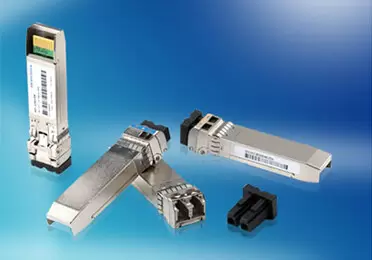
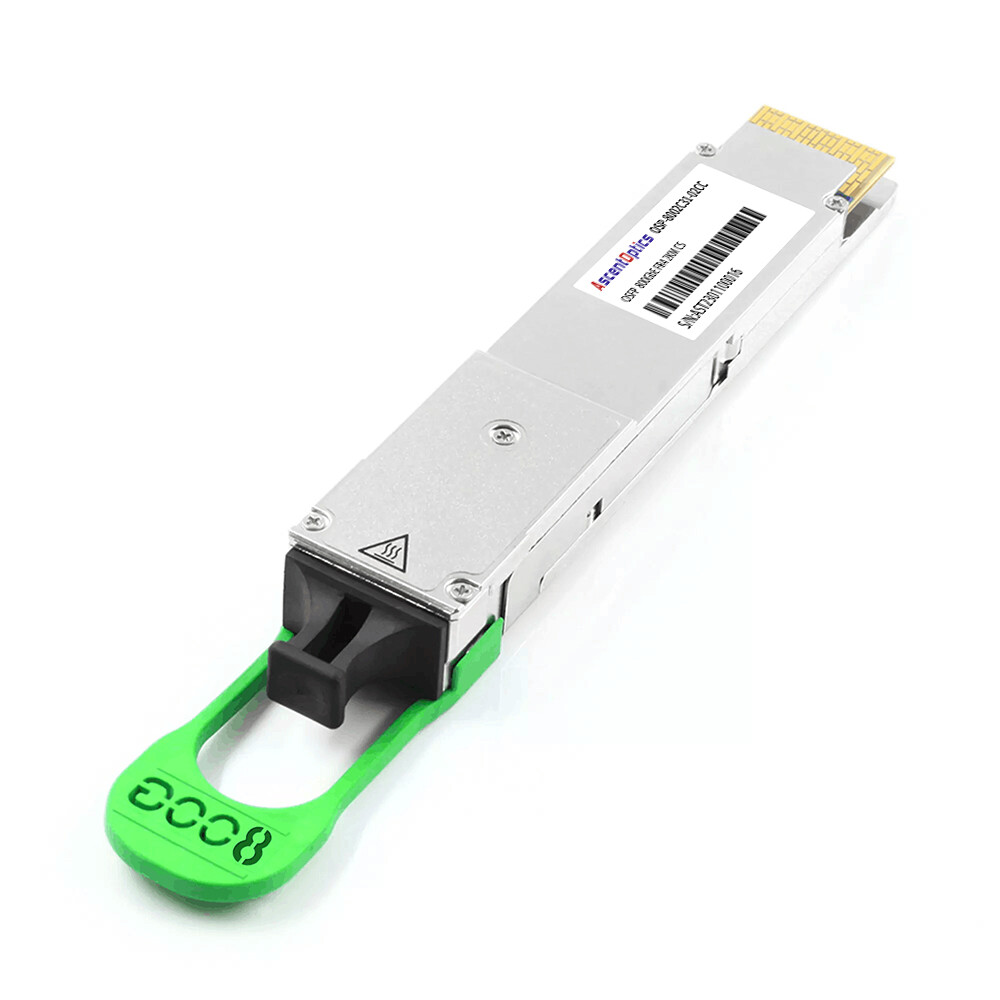
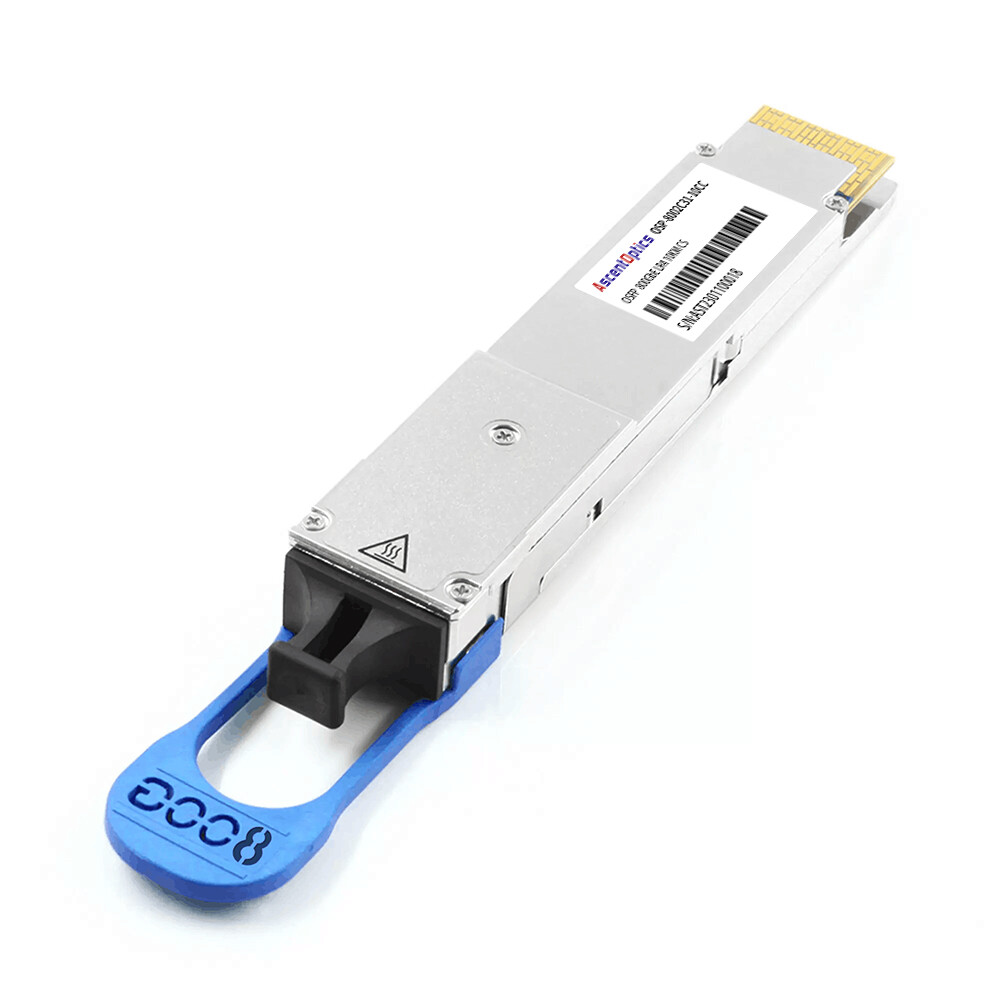
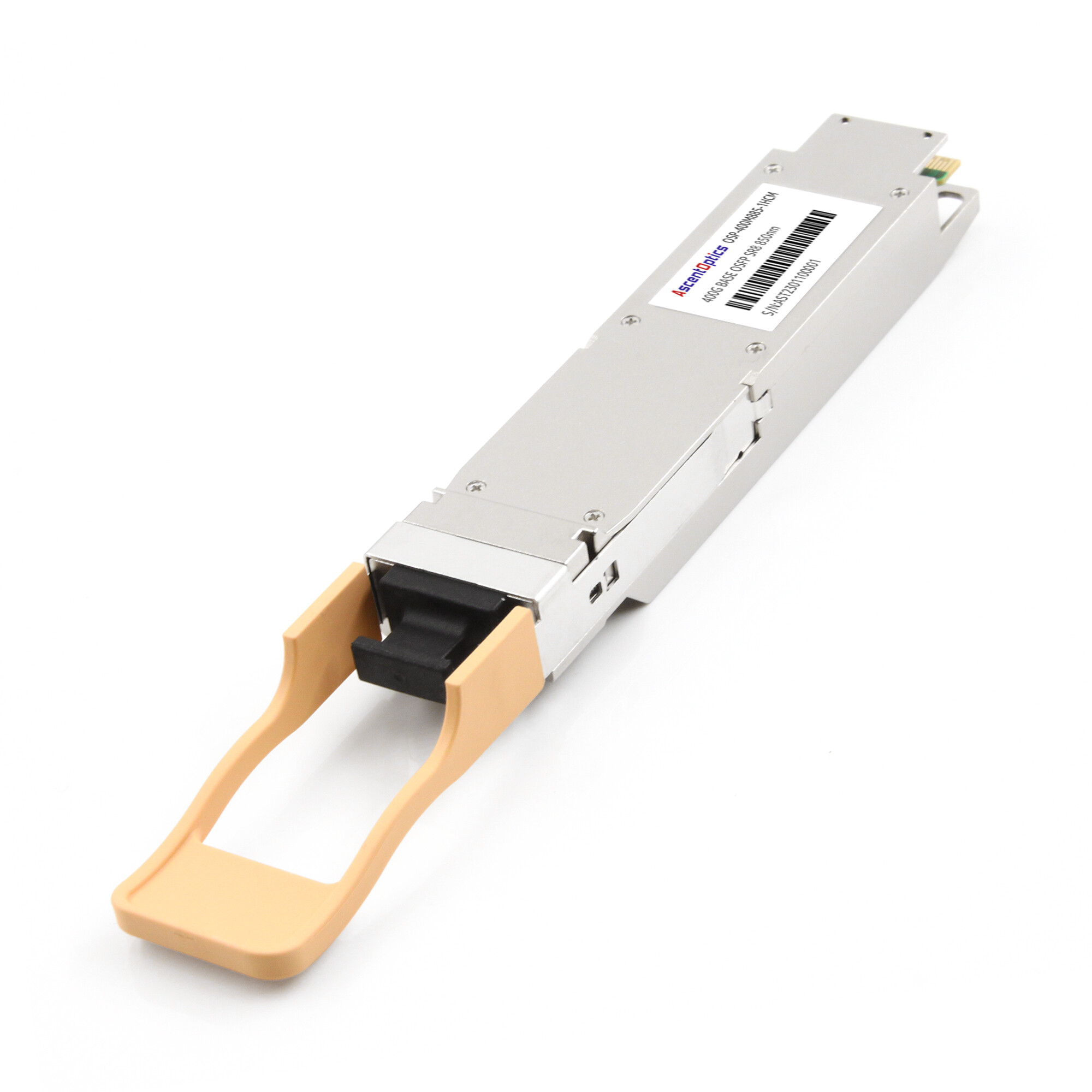
Constructing a 400G or 800G network means buying off-the-shelf transceivers from vendors that won’t fail under load, won’t require two months of compatibility work to function with your switches, and won’t cut a huge chunk out of your hardware budget before the first packet is sent.
Strangely, procurement departments usually find themselves between a rock and a hard place — constrained on the right by more-than-doubled OEM-standard hardware prices and on the left by “commodity” vendors who cannot even correctly answer rudimentary questions about the DSP architecture or derating by temperature.
AscentOptics manufactures OSFP transceivers from 400G onwards to 1.6T, fully MSA compliant, NVIDIA InfiniBand NDR testable, and offered at factory-direct prices with full support. Every module is backed by a compatibility guarantee, full DDM/DOM diagnostics, and responsive technical support.
[Request a Quote — Get Pricing in 24 Hours]
The Real Cost of Getting OSFP Wrong
One of the reasons David, a network architect, turned heresy came up when David’s team sourced a large number of 400G OSFP modules – to be deployed on top of a new spine-leaf network – from an reseller who promised him that these modules were 100% compatible with Cisco. Sixty units arrived, with twenty-three of them raising thermal alarms immediately after two days on some Arista 7060X5 switches. The root cause was that the modules were from QSFP-DD units, repackaged solely in contaminated OSFP housing, drawing up to 14W in a 12W-rated port. For reasons that are procedural but noninformative, David sacrificed upwards of three weeks troubleshooting the equipment and declared defeat after 11 extra days of downtime.
His story is definitely common-place. The OSFP market faces three technical issues for engineers and all TPWs every week:
Inconsistent Quality Control. Not everything labeled “OSFP” would meet the OSFP MSA electrical and thermal restrictions. Some do the tests at room temperatures, while others might adhere not to the BER bathtub curve. The result is that half the modules will pass the link test in the lab but fail under traffic loads.
Claims of compatibility without proof. “Compatible with Cisco, Arista, Juniper,” is easy to write up on a website, but verifying what the switch completely rejects the module at the CMIS level or that the DOM readings do not match the expected register map is a hard problem. Procurement teams waste hours validating each module when they should have been pre-tested.
OEM Selling Prices are Disconnected from Component Costs. The price of one 400G OSFP SR8 module from a premier networking OEM Network can exceed more than an entire 32-port switch. For hyperscale deployments who tend to buy in hundreds or thousands, this pricing model is not sustainable.
The AscentOptics model seeks to manufacture and control the full production chain, tests it against real switch platforms, and sells at factory-direct prices.
Why AI and HPC Networks Are Accelerating OSFP Adoption
The transition from 400G to 800G networking is being driven less by traditional enterprise traffic and more by AI training infrastructure and large-scale HPC environments.
In conventional data centers, network traffic patterns were relatively predictable. Most workloads involved north-south traffic between servers and external users. AI clusters operate very differently. Modern GPU training environments generate massive east-west traffic between accelerators, storage systems, and distributed compute nodes. In many AI deployments, network performance directly impacts GPU utilization and overall training efficiency.
A single AI training cluster may contain thousands of GPUs communicating simultaneously across high-speed fabrics. Even minor increases in latency, packet retransmission, or FEC instability can reduce cluster efficiency and extend training times significantly.
This is one of the primary reasons OSFP has become increasingly important in AI networking.
Compared to earlier transceiver generations, OSFP was designed with substantially higher thermal and power headroom, making it better suited for next-generation PAM4 optics operating at 800G and beyond.
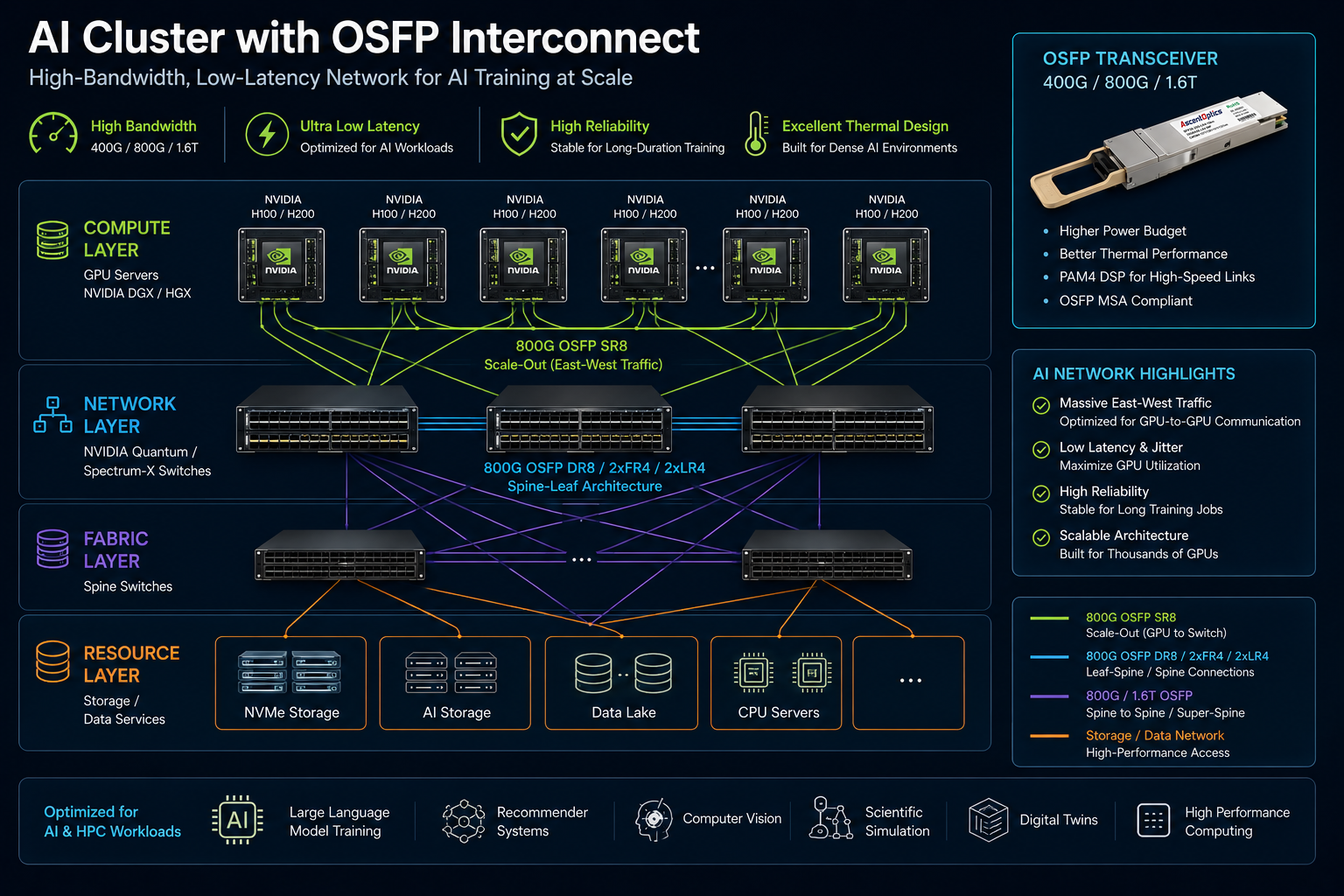
For AI and HPC environments, this matters because:
- •Higher-speed PAM4 DSPs generate significantly more heat
- •GPU fabrics require sustained low-latency operation under continuous load
- •Dense switch platforms demand improved thermal airflow
- •Long-duration training jobs cannot tolerate unstable optics
As a result, OSFP has become widely adopted in:
- •NVIDIA InfiniBand fabrics
- •Quantum-2 and Quantum-3 deployments
- •Spectrum-X Ethernet AI networks
- •GPU superclusters
- •HPC simulation environments
- •Large-scale distributed storage fabrics
In many hyperscale AI deployments, thermal stability is now just as important as raw bandwidth.
Manufacturer-Direct OSFP Transceivers: What You Get
When you buy an OSFP transceiver from AscentOptics, you are not buying from a distributor or a white-label reseller. You are buying from the factory that assembles, tests, and certifies the module.
Key Benefits:
- •Factory-direct pricing— Eliminate distributor and reseller margins. Typical savings of 40-70% compared to OEM list prices.
- •Platform-tested compatibility— Every module batch is tested against Cisco, Arista, Juniper, Dell, HPE, and NVIDIA switch platforms, not just the MSA spec.
- •Full customization capability— OEM branding, custom part numbers, firmware coding, and private-label packaging for system integrators and resellers.
- •Engineering support included— Our optical engineers provide link budget analysis, platform compatibility verification, and deployment guidance at no additional cost.
OSFP Transceiver Portfolio
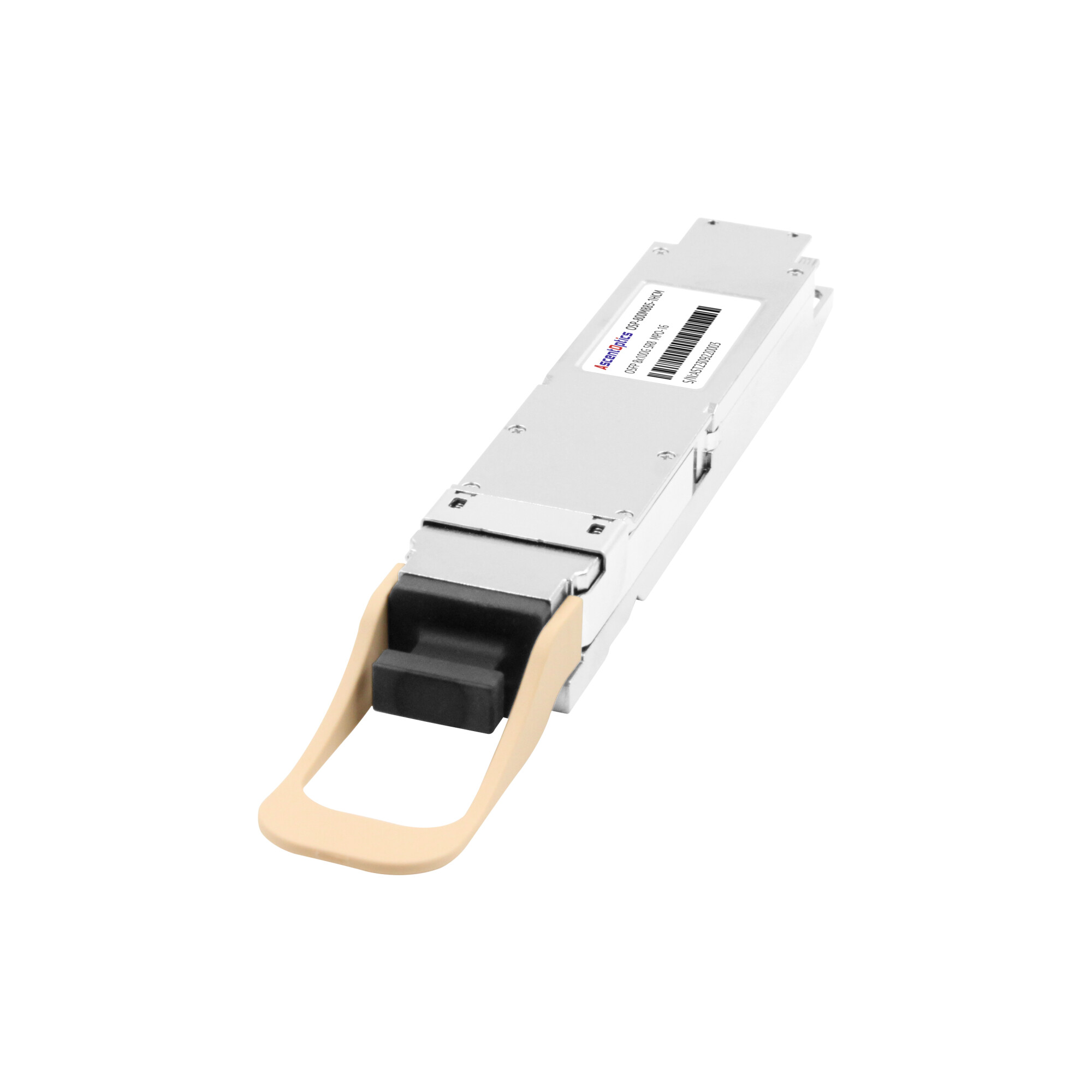
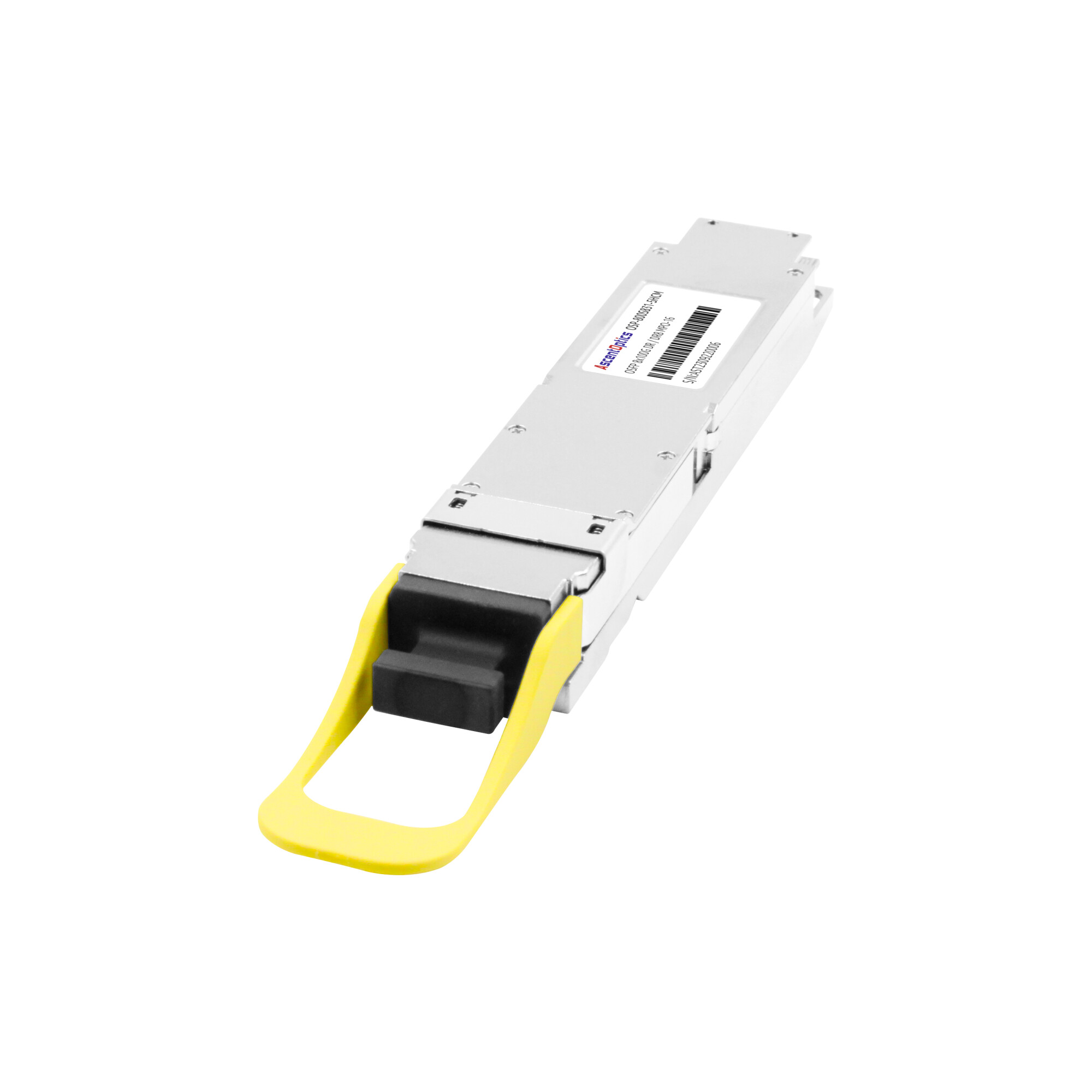
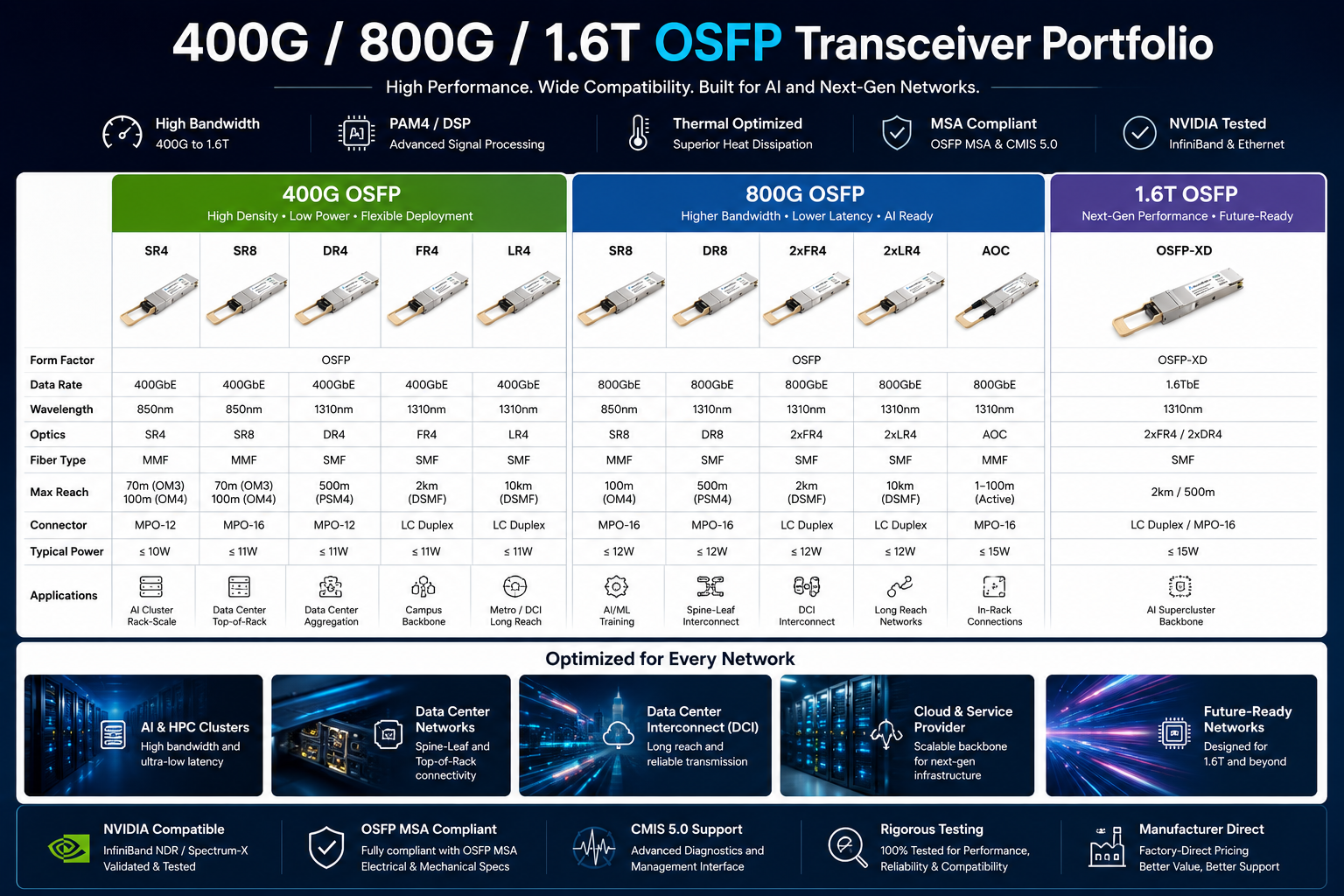
AscentOptics designs and produces the complete set of OSFP modules in the market for 400G and 800G, and are now aiming to hit the market for 1.6T. Every module is constructed upon MSA-compliant DSP platforms and comes after measurements have been performed over the entire specified operational temperature range.
| Module Type |
Reach
|
Fiber |
Connector |
Power |
Application
|
| OSFP-SR8 |
100m
|
OM4 MMF |
MPO-16/APC |
~10W |
Intra-rack, Ethernet
|
| OSFP-SR4 |
50m
|
OM4 MMF |
MPO-12/APC |
~8.5W |
InfiniBand NDR, ConnectX-7
|
| OSFP-DR4 |
500m
|
OS2 SMF |
MPO-12/APC |
~10W |
Spine-leaf, campus
|
| OSFP-FR4 |
2km
|
OS2 SMF |
Dual LC |
~12W |
DCI short-haul
|
| OSFP-2xFR4 |
2km
|
OS2 SMF |
Dual LC |
~14W |
Cost-optimized DCI
|
| OSFP-LR4 |
10km
|
OS2 SMF |
Dual LC |
~12W |
Metro aggregation
|
| Module Type |
Reach
|
Fiber |
Connector |
Power |
Application
|
| OSFP-SR8 |
100m
|
OM4 MMF |
Dual MPO-12/APC |
~17W |
AI clusters, Ethernet
|
| OSFP-DR8 |
500m
|
OS2 SMF |
Dual MPO-12/APC |
~18W |
Spine-leaf 800G
|
| OSFP-2xFR4 |
2km
|
OS2 SMF |
Dual LC |
~18W |
DCI, campus
|
| OSFP-2xLR4 |
10km
|
OS2 SMF |
Dual LC |
~20W |
Metro, long-haul DCI
|
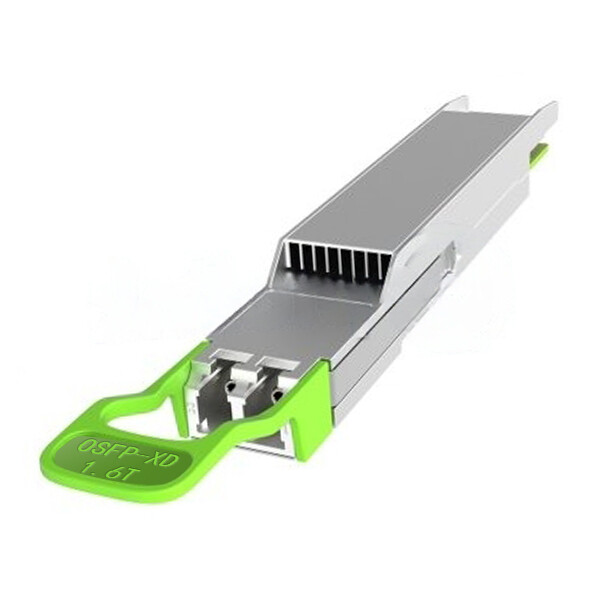
1.6T OSFP-XD (Roadmap)
- •OSFP-XD architecture with 16 electrical lanes
- •200G PAM4 per lane for 1.6T aggregate
- •Target power: 25-30W with liquid cooling support
- •Contact our engineering team for availability timeline
Complete technical overview of OSFP form factor → OSFP Transceiver Guide.
Tested for NVIDIA AI and InfiniBand Environments
The rapid growth of AI infrastructure has significantly accelerated the adoption of high-speed OSFP transceivers across NVIDIA-based networking environments. Modern AI clusters require not only massive bandwidth, but also extremely low latency, stable signal integrity, and reliable long-duration operation under continuous traffic loads.
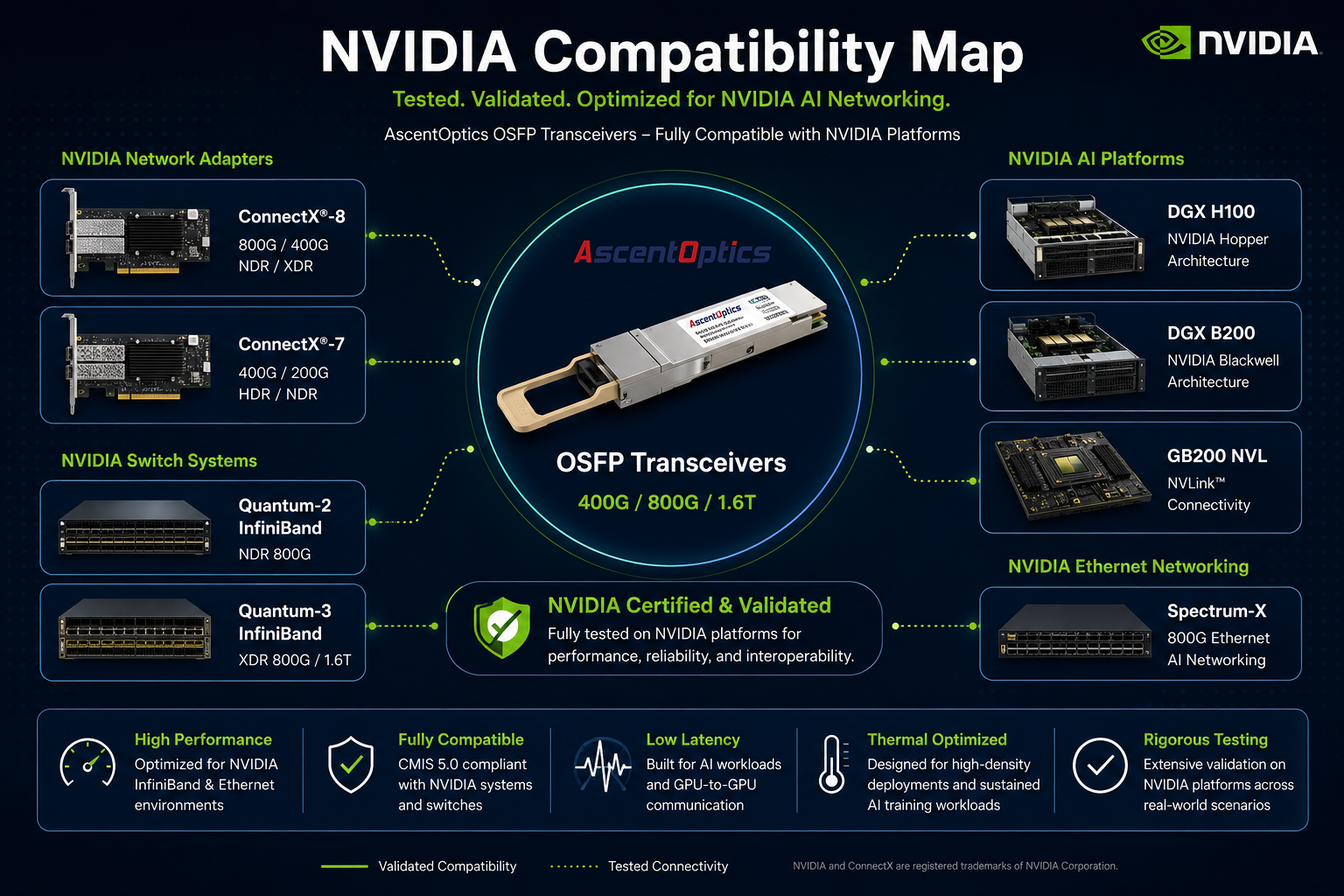
Platforms such as NVIDIA Quantum-2, Quantum-3, ConnectX-7, and Spectrum-X are designed for high-density GPU fabrics where even minor packet loss or link instability can negatively impact distributed AI training efficiency.
Unlike traditional enterprise traffic, AI workloads generate sustained east-west communication between thousands of GPUs, storage systems, and compute nodes simultaneously. In these environments, unstable optics can lead to:
- •Increased FEC correction overhead
- •GPU synchronization delays
- •Reduced cluster utilization
- •Training performance degradation
To ensure stable operation in these demanding scenarios, every AscentOptics 400G and 800G OSFP module undergoes extensive compatibility and stress validation for NVIDIA InfiniBand and Ethernet platforms.
NVIDIA Compatibility
Validated platforms include:
- •NVIDIA ConnectX-7 and ConnectX-8 NICs
- •Quantum-2 QM9700/QM9790 switches
- •Quantum-3 InfiniBand platforms
- •Spectrum-X Ethernet switches
- •DGX H100 and GB200 NVL AI infrastructures
Validation and Testing
Each module is tested for:
- •CMIS 4.0/5.0 compliance
- •PAM4 signal integrity and eye margin performance
- •Thermal stability under sustained traffic loads
- •BER and FEC performance validation
- •DOM/DDM telemetry accuracy
- •Long-duration traffic stress testing
This testing process helps ensure stable deployment in AI clusters, HPC environments, and large-scale GPU fabrics where network reliability directly impacts overall computing performance.
Why Network Engineers Choose AscentOptics
“We ordered 340 pcs of 800G OSFP-SR8 modules for our two-AI training cluster. The links have been running with 100% uptime for the last six months. All DOM telemetry matched our monitoring system perfectly. AscentOptics’ engineering team helped us calculate the link budget before ordering.”
— Marcus Chen, Senior Network Architect, Cloud Infrastructure Provider
“We needed 400G OSFP DR4 modules OEM-branded for a government integrator project. Ascent delivered custom firmware, unique serial numbers, and branded packaging within three weeks. The modules performed flawlessly on Cisco NCS 540 and Arista 7060X5 platforms.”
— Sarah Okonkwo, Procurement Director, Systems Integrator
Results our customers achieve:
- •40-70% cost reduction versus OEM transceiver pricing
- •Zero compatibility failures on pre-tested platforms
- •3-7 day lead times for standard modules
- •Custom OEM projects delivered in 2-4 weeks
- •24-hour technical response from optical engineers
OSFP vs QSFP-DD — Form factor comparison for 400G/800G networks
Quality and Testing Standards
Every AscentOptics OSFP transceiver undergoes the same testing protocol that OEMs use internally. We do not skip steps.
Incoming Component Inspection:
- •Laser wavelength verification at multiple temperatures
- •DSP die electrical characterization
- •TOSA/ROSA coupling efficiency measurement
- •PCB solder joint X-ray inspection
Module-Level Testing:
- •Full traffic BER testing at 1E-12 threshold
- •Eye diagram mask margin verification (>20%)
- •Thermal cycling from -5 to +75 degrees Celsius
- •Insertion loss and return loss verification
- •DDM/DOM register accuracy across temperature range
- •CMIS compliance verification
Platform Integration Testing:
- •Live switch port detection and negotiation
- •FEC performance under sustained 100% traffic load
- •Thermal throttling behavior verification
- •Breakout cable compatibility (where applicable)
Certifications:
- •ISO 9001:2015 Quality Management
- •ISO 14001:2015 Environmental Management
- •RoHS-10 / REACH compliance
- •CE and FCC Part 15 Class A
- •OSFP MSA compliance
OEM and ODM Services
System integrators, telecom operators, and network equipment vendors often need more than an off-the-shelf module. AscentOptics provides full OEM and ODM services for OSFP transceivers.
OEM Services:
- •Private-label packaging and documentation
- •Custom part number serialization
- •Firmware coding for vendor-specific register maps
- •Branded labels and tamper-evident seals
- •Custom cable harness integration
ODM Services:
- •Custom DSP platform selection (Marvell/Inphi, Broadcom, MaxLinear)
- •Modified power envelope for specialized cooling
- •Extended temperature range (-40 to +85 C for telecom)
- •Custom wavelength grids for DWDM integration
- •Modified optical launch power for specific link budgets
How to Order OSFP Transceivers
Step 1: Request a Quote
Provide the module type, quantity, target platform, and any customization requirements. We typically respond within one business day with pricing and lead-time information.
Step 2: Sample Evaluation
Sample testing is strongly recommended for new deployments or platform validation projects. Sample modules are usually shipped within 3–5 business days and include complete test reports.
Step 3: Production orders
Standard modules typically ship within 3–7 days. Customized OEM orders generally require 2–4 weeks depending on project complexity.
Tracking information, customs documentation, and logistics support are included.
Ready to Source OSFP Transceivers?
Whether you are building an AI cluster with NVIDIA InfiniBand, upgrading a data center spine to 800G, or sourcing OEM-branded modules for a system integration project, AscentOptics delivers manufacturer-direct quality at factory pricing.
Three reasons to request a quote today:
- 1. Pricing in 24 hours— No waiting days for a distributor to check with their supplier.
- 2. Compatibility guaranteed— If a validated module fails on a pre-tested platform, we replace it.
- 3. Engineering support included— Our optical engineers assist with link budgets, platform selection, and deployment planning.
[Request Your OSFP Quote — 24-Hour Response]
Frequently Asked Questions
What Is the Difference Between OSFP and QSFP-DD?
OSFP uses a larger form factor designed to support higher power and thermal requirements. While QSFP-DD maintains backward compatibility with QSFP+/QSFP28 modules, OSFP offers superior thermal performance for early 800G and future high-power deployments.
OSFP is particularly well suited for:
- •800G AI networking
- •High-power PAM4 optics
- •Advanced cooling architectures
Which OSFP module should I choose for my application?
It depends on distance and fiber type. For intra-data center links up to 100m over multimode fiber, SR8 or SR4 are ideal. For campus links up to 500m over single-mode, choose DR4 or DR8. FR4 or 2xFR4 suit DCI links up to 2km. For metro distances up to 10km, select LR4 or 2xLR4. Contact our engineers for a link budget review and optimal recommendation.
Are OSFP transceivers of yours compatible with NVIDIA InfiniBand?
Yes. AscentOptics 400G OSFP SR4 and 800G OSFP SR8 modules are verified for compatibility with NVIDIA ConnectX-7 NICs, Quantum-2 switches, and Spectrum-X Ethernet platforms. We conduct verification of CMIS register compliance, thermal performance, and FEC stability for NVIDIA reference designs.
What is the typical delivery time for OSFP transceivers?
Standard 400G and 800G modules are in stock and ship in 3-7 days. Custom OEM orders with private labeling or firmware customization typically take 2-4 weeks. Large volume orders (500+ units) may require 3-6 weeks depending on DSP chip availability.
Can you customize OSFP modules for our OEM brand?
Yes, AscentOptics does offer as part of its custom services a comprehensive OEM module which features private label packaging, custom part numbers, firmware coding, and branded documentation, and in addition an ODM module with custom DSP selection, modified power envelopes, and extended temperature signaling.
What is the warranty on OSFP transceivers?
AscentOptics provides a three-year limited warranty on all OSFP transceivers. The warranty includes manufacturing defects, performance losses beyond the publication of specifications, and incompatibilities failure on a pretested platform. Extended warranties are available for enterprise and telecom deployments.
OSFP MSA Specification — Official OSFP Multi-Source Agreement
Post Views: 3,141