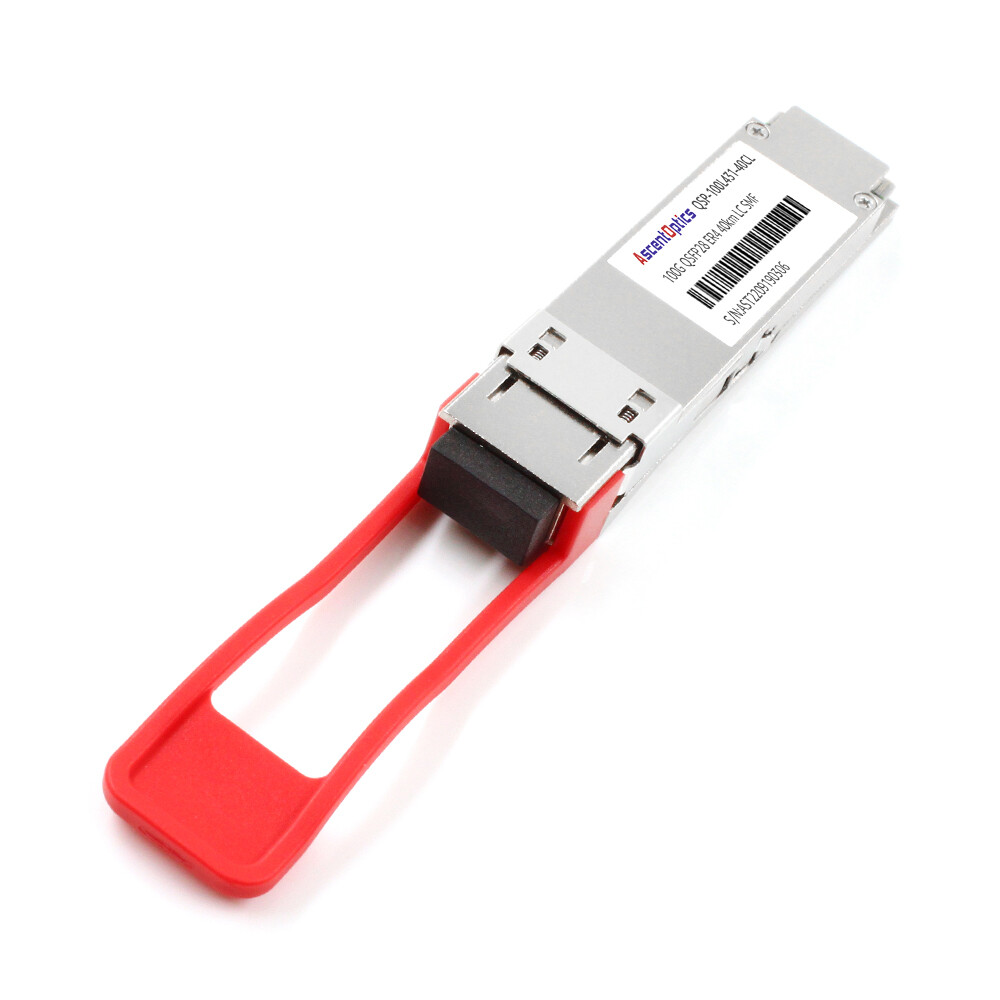
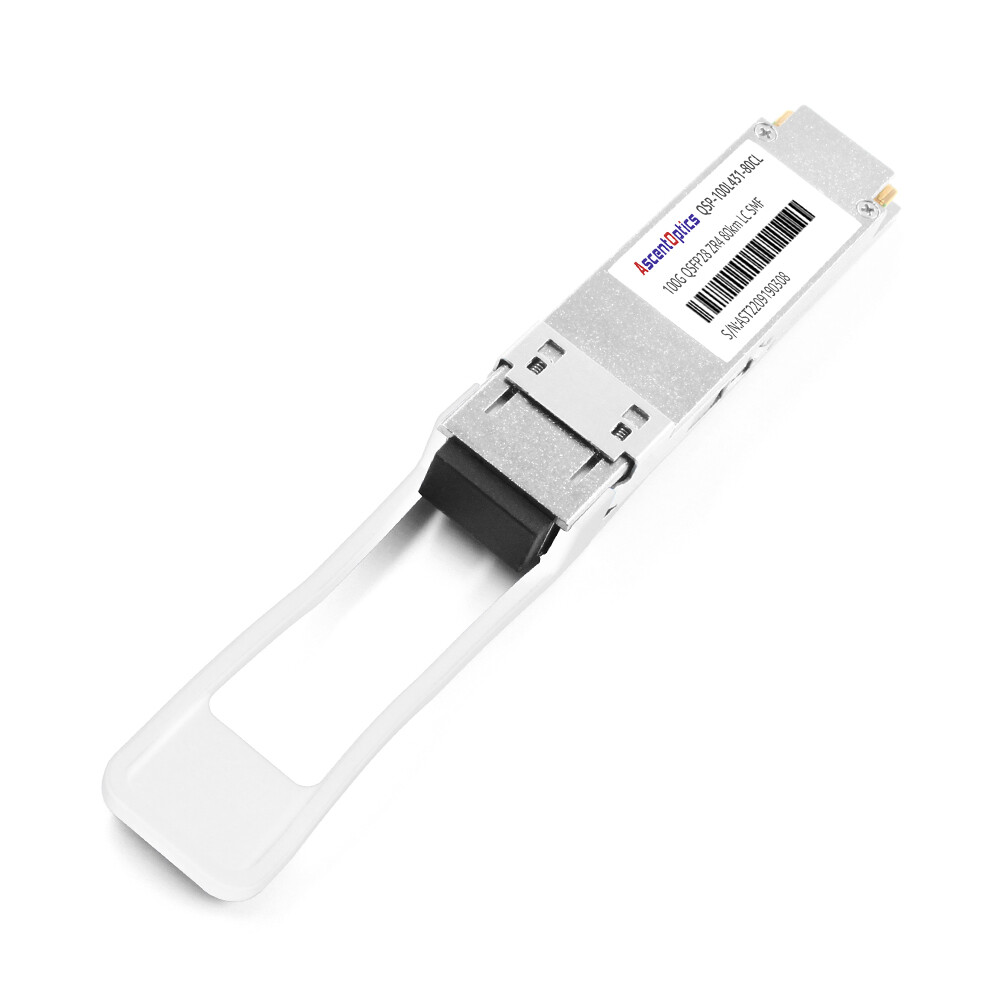
In March 2024, a network architect in Frankfurt faced a critical decision. Her team needed to connect two data centers 95 kilometers apart at 100G. The direct-detect ER4 was only rated for 40km, and the fiber link included multiple patch panels with unknown loss. Traditional transponder-based solutions could solve the distance issue, but they would consume four rack units and add €80,000 to the project budget.
This is exactly where QSFP28 ZR coherent optics change the game.
Network engineers who have been stuck between the distance limitations of direct-detect modules and the high cost and complexity of traditional coherent transponders will immediately recognize the dilemma. QSFP28 ZR coherent transceivers deliver 80km+ reach in a standard pluggable QSFP28 form factor. However, questions around technology, standards, and platform support still create confusion.
This guide explains how QSFP28 ZR coherent optics work, when they outperform direct-detect alternatives, which routing and switching platforms they support, and how to deploy them successfully in DCI, metro networks, and 5G transport. We also cover real-world link budgets, power considerations, and the evolving ecosystem of DSP vendors and module manufacturers.
Want to explore QSFP28 ZR options for your network? Contact our optical transport engineers for a link budget analysis.
What Is QSFP28 ZR Coherent Optics?
The OIF 100G ZR MSA Standard
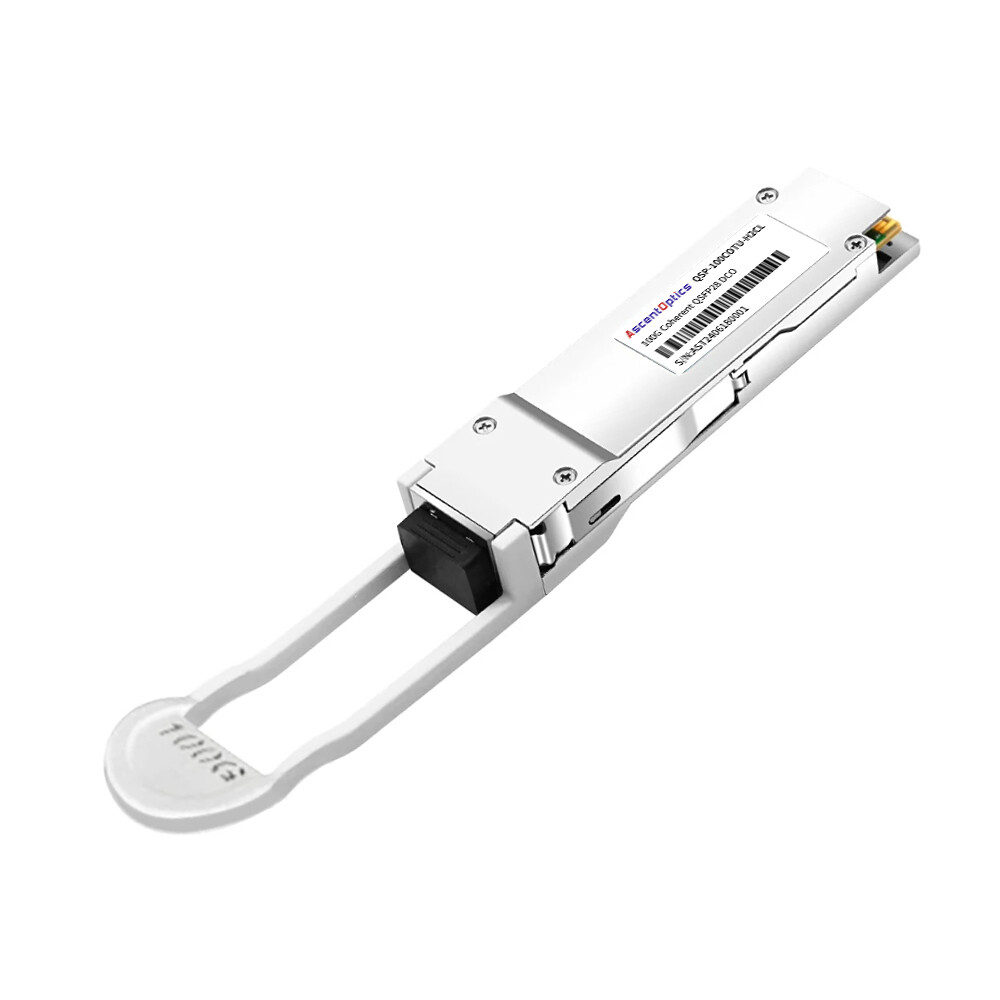
The Optical Internetworking Forum (OIF) developed the 100G ZR Implementation Agreement to define how 100G coherent technology can be integrated into a compact QSFP28 package. This standard enables 100G transmission over single-mode fiber for distances up to 80km without optical amplification.
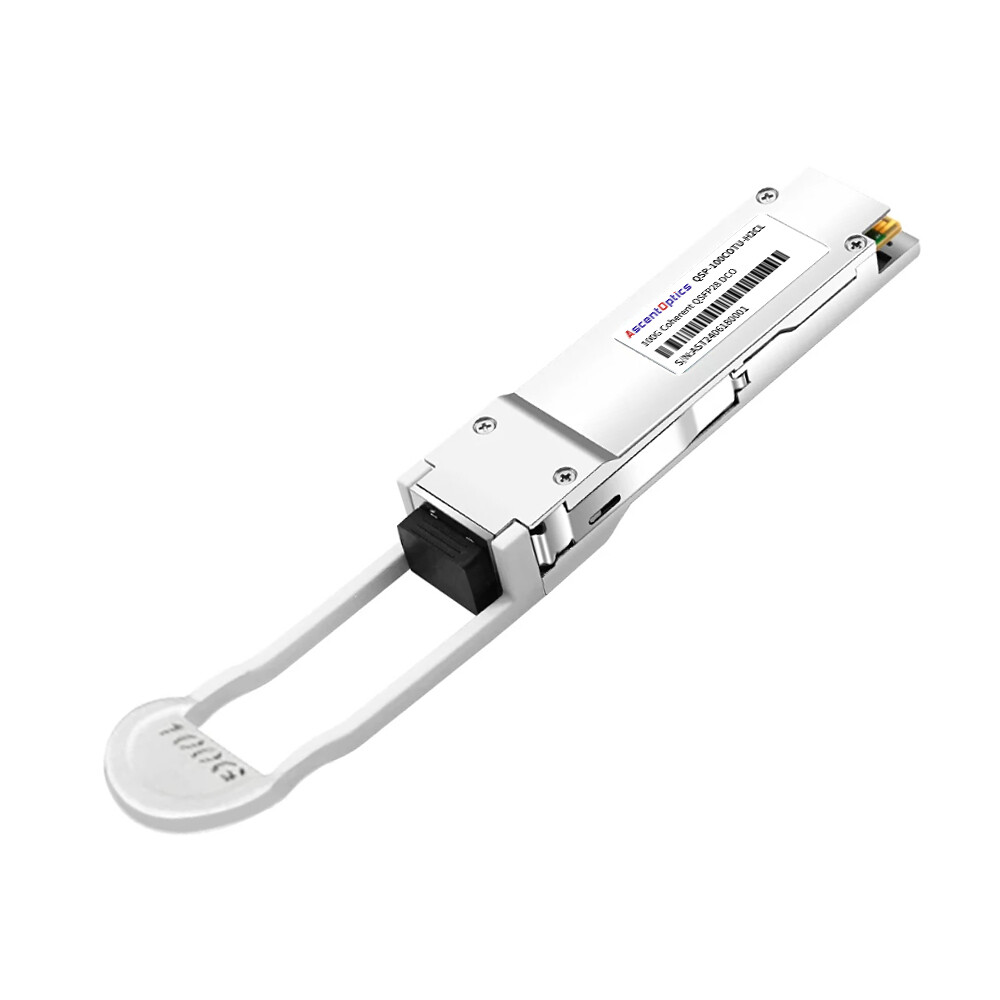
Unlike traditional direct-detect modules that simply turn the laser on and off, QSFP28 ZR coherent modules use a powerful Digital Signal Processor (DSP) with advanced modulation schemes (phase and polarization) to significantly extend reach while remaining compatible with standard QSFP28 ports.
The OIF 100G ZR MSA ensures multi-vendor interoperability — a QSFP28 ZR module from one vendor can work with another vendor’s module as long as both comply with the specification.
How Coherent Detection Works in a QSFP28 Package
Direct detect optical modules, such as LR4 and ER4, rely on simple intensity modulation. The receiver measures how bright the incoming light is. This works well for short distances, but chromatic dispersion and optical noise degrade the signal beyond approximately 40km at 100G.
Coherent detection solves this problem through three key technologies:
- 1. Dual-Polarization Quadrature Phase Shift Keying (DP-QPSK): Data is encoded onto both polarizations of light with four phase states per polarization, packing 100Gbps onto a single optical carrier.
- 2. Digital Signal Processor (DSP): A specialized chip in the module compensates for chromatic dispersion, polarization mode dispersion, and noise in real time.
- 3. Local Oscillator Laser: The receiver mixes the incoming signal with a locally generated laser reference, enabling phase-sensitive detection that recovers weak signals over long distances.
All of this advanced technology is packed into a standard QSFP28 module that typically consumes 4.5–5.5W and plugs directly into a router or switch port.
QSFP28 ZR Coherent vs Direct Detect (LR4/ER4)
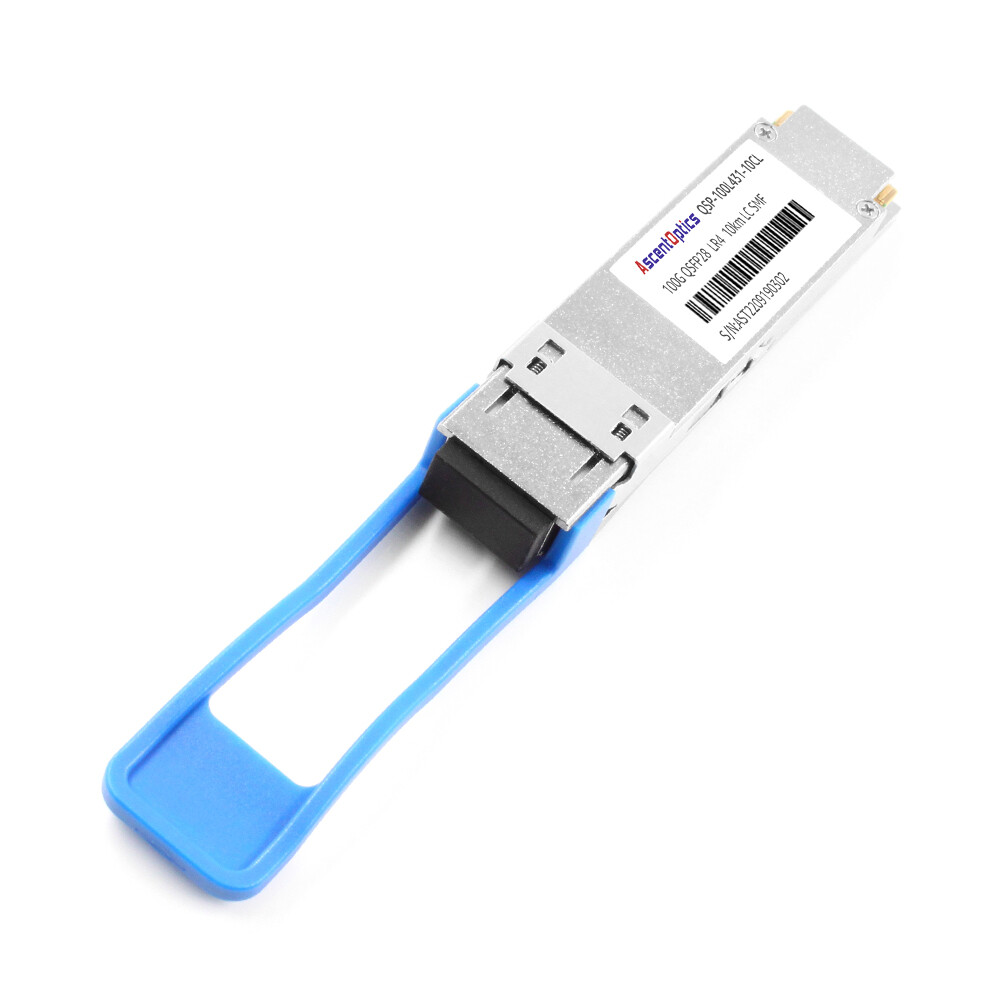
The fundamental difference lies in reach and technical complexity. While LR4 uses four 25G CWDM lasers to reach 10km and ER4 extends this to about 40km with higher launch power, both are relatively simple, low-latency, and lower-power solutions.
QSFP28 ZR coherent modules, using a tunable laser and advanced DSP, are optimized for 80km+ transmission. They come with slightly higher power consumption and added DSP processing latency, but offer dramatically better reach and DWDM compatibility.
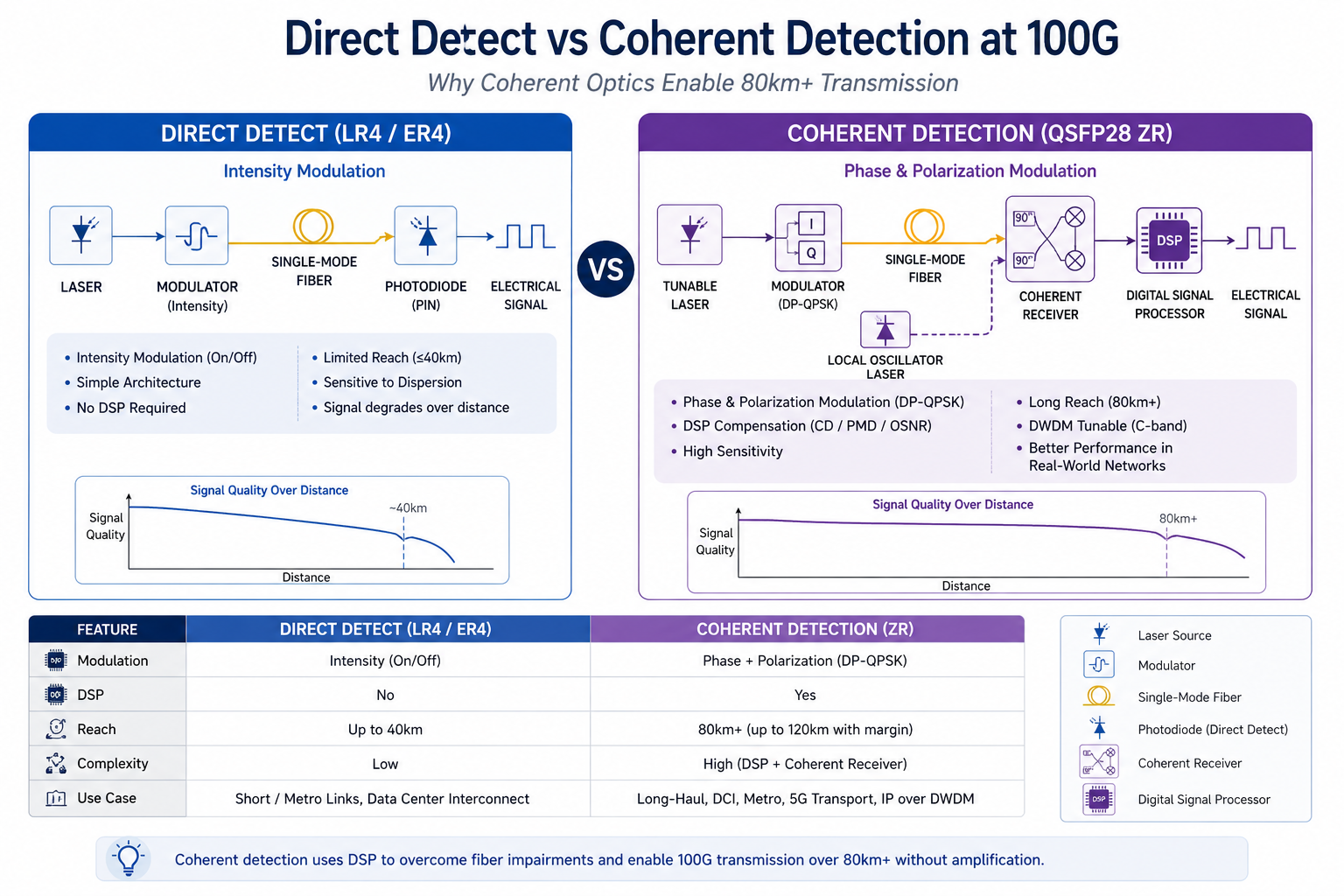
Here is a quick comparison:
| Feature |
100GBASE-LR4
|
100GBASE-ER4 |
QSFP28 ZR Coherent
|
| Reach |
10km
|
40km |
80km+(unamplified)
|
| Fiber type |
SMF(Single-mode Fiber)
|
SMF |
SMF
|
| Modulation |
4x 25G NRZ
|
4x 25G NRZ |
DP-QPSK
|
| DSP required |
No
|
No |
Yes
|
| Typical power |
3.5W
|
4.0W |
4.5-6.5W
|
| Latency |
~1 µs
|
~1 µs |
~50-100 µs
|
| DWDM ready |
No
|
No |
Yes (C-band tunable)
|
Need help choosing between direct detect and coherent for your 100G links? Explore our QSFP28 transceiver guide for a complete module selection framework.
QSFP28 ZR Coherent Technical Specifications
Reach and Distance: 80km Unamplified, 120km with Margin
On high-quality fiber with low splice and connector loss, QSFP28 ZR coherent optics can reliably achieve 80–120km without optical amplification. This makes them ideal for data center interconnect (DCI), metro aggregation, and regional backhaul applications where traditional transponders were previously required..
The link budget includes about 0.35 dB/km in G. 652 fiber attenuation at 1550 nm accounted for with margins for connectors, splices, and aging. The standard transmit power of the module is -10 to -6 dBm with a minimum receive power about -24 dBm.
Power Consumption and Thermal Design
Power consumption is amongst the foremost practical responsibilities of network engineers. The coherent QSFP28 ZR transceivers consume 4.5-6.5 watts per module, which is very much higher than LR4 or ER4, yet extremely lower than QSFP-DD coherent ZR modules for 400G, which will typically be rated for 15 to 18 watts.
Modern routers and switches must support the higher power and thermal envelope required by coherent optics. Always check the specific platform datasheet for QSFP28 coherent power and cooling specifications.
For a deeper look at power and thermal planning, see our QSFP28 power consumption guide.
OSNR Requirements and Link Budget
For coherent connections, Optical Signal-to-Noise Ratio (OSNR) is the principal entity. As a rule hedge, for the QSFP28 ZR coherent modules, the OSNR should be about 24 dB, provided that standard forward error correction (FEC) is employed. With soft-decision FEC, however, some modules can permit an OSNR of about 18-20 dB. This feature opens the door to longer reaches in links or links needing more amplification.
A major advantage of coherent technology is that the DSP compensates for chromatic dispersion in real time, eliminating the need for dispersion-compensating fiber (DCF) used in older 10G NRZ systems.
C-Band Tunable Wavelength and DWDM Compatibility
With QSFP28-ZR Coherent Transceivers, one of the greatest blessings is the acceptance of tunable wavelengths. The OIF sets the C-band standard, which is within the given DWDM grid width (typically from 191.3 THz to 196.1 THz, covering the wavelength in the region of 1528 nm to 1567 nm). This feature enables carriers to drop in QSFP28-ZR modules directly into their existing systems, doing-away with the need for an intermediate transponder.
For point-to-point links, the standard-power range (-10 to -6 dBm launch power) is apt. High-power range fingerlings (0 dBm or above) are available for integration within optical networks based on ROADM, where optical modules might pass through more than one node of optical add-drop.
FEC and Latency Considerations
What to correct bit error: Noise and dispersion seem to be the answer, and hence, coherent module QSFP28 ZR relies upon FEC to get the job done. The usual concatenated FEC chosen in such application standards-for instance, the OIF-defined standard-imposes an overhead of about 7 percent. These figures equate to a lag of 50 to 100 microseconds compared to a direct detection module.
This added latency is acceptable for most DCI and metro applications. However, ultra-low-latency environments (such as high-frequency trading) may still prefer direct-detect solutions for shorter distances.
QSFP28 ZR Coherent vs ER4 vs LR4: When to Choose Coherent
Distance-Based Selection Guide
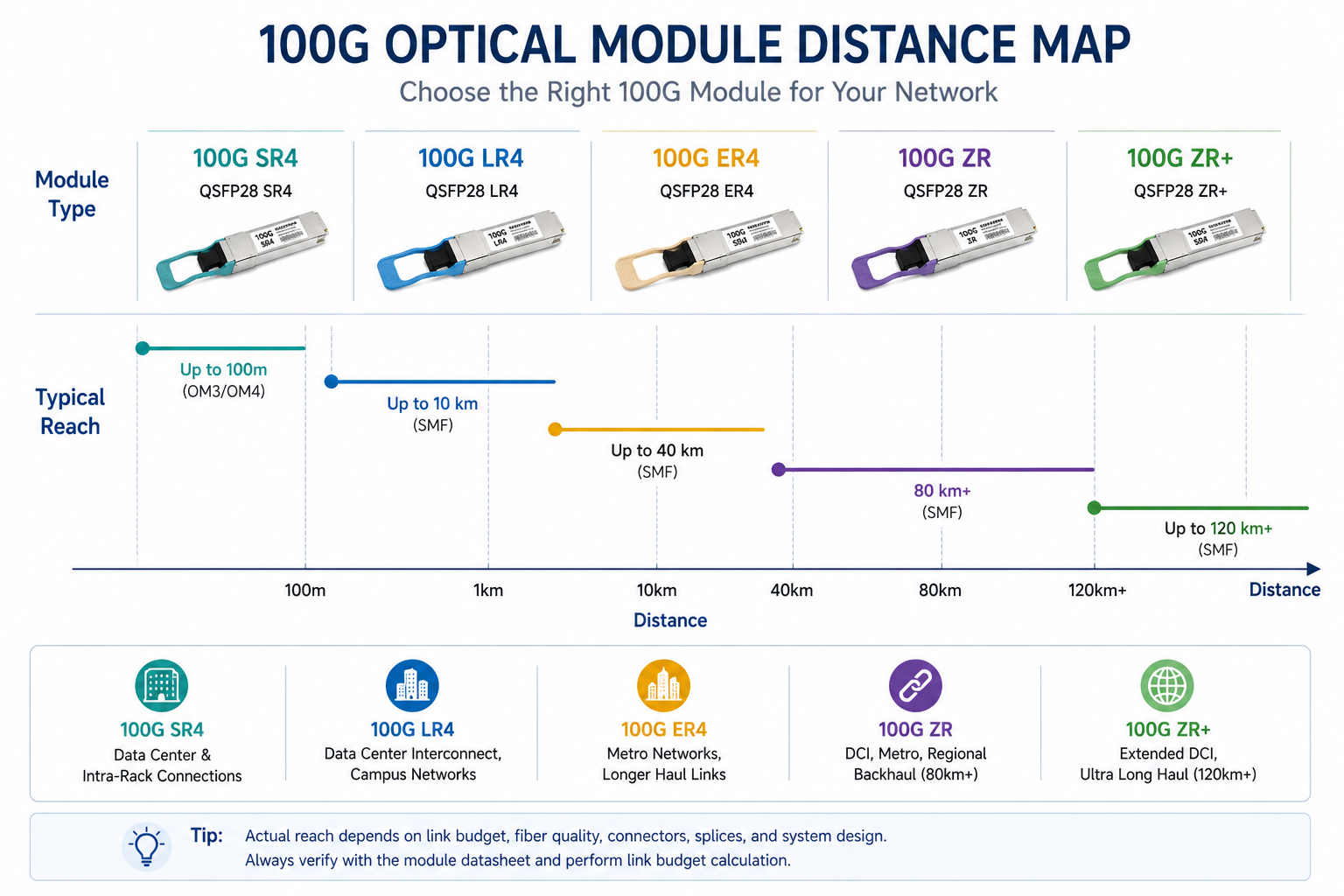
Choosing the right 100G module starts with distance. Here is a practical framework:
- •0-100 meters: 100GBASE-SR4 over multimode fiber or active optical cables (AOC)
- •100m-10km: 100GBASE-LR4 over single-mode fiber
- •10km-40km: 100GBASE-ER4 over single-mode fiber
- •40km-80km+: QSFP28 ZR coherent optics
- •80km+ with DWDM/ROADM: QSFP28 ZR coherent (tunable) or QSFP28 ZR+ extended reach
Even if a link is technically 38km, ER4 often leaves little margin for fiber aging, repairs, or connector degradation. QSFP28 ZR coherent provides comfortable headroom and future-proofs the connection.
Cost Comparison: Coherent Pluggable vs Transponder
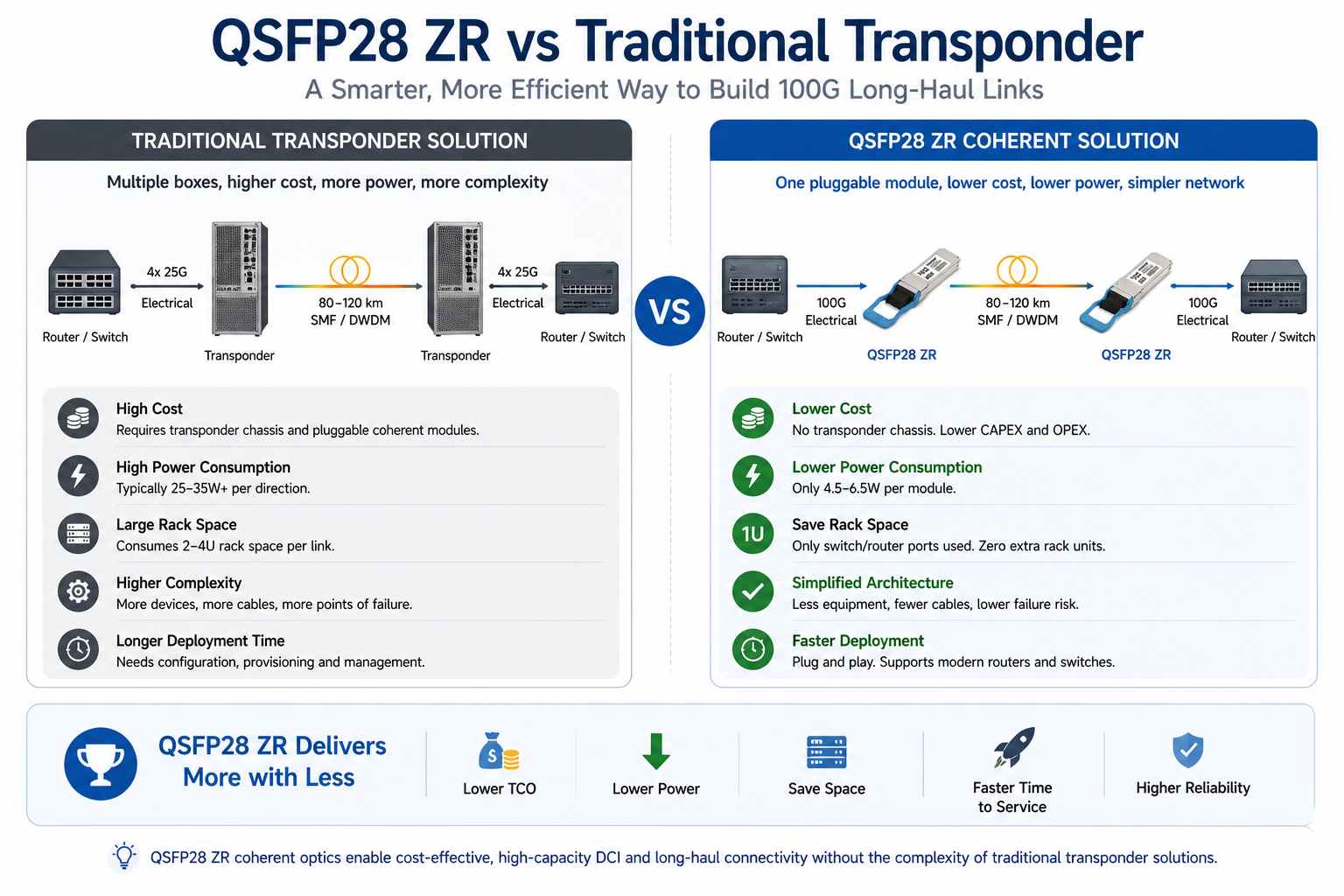
Traditionally, 100G coherent transport operates with a transponder shelf: a dedicated platform that converts router-electrical signals into optical wavelengths before feeding it into a dense wavelength division multiplexing (DWDM) line system. These systems can cost over tens of thousands of dollars per rack and consume several hundred watts.
The QSFP28 ZR coherent transceiver plugs directly into a router or switch. The cost comparison between the two modules is typically 40-60% lower than the transponder-based solution for the same distance. Over and above the general principle of drying out overheads, this liquidation disposes of expense elements such as rack space and pure bulk.
The total cost of ownership advantage is especially pronounced in:
- •Data center interconnect with 10-20 links
- •Metro rings requiring 100G aggregation
- •Rural 5G backhaul with long but low-density links
Power and Port Density Trade-offs
Two QSFP28 ZR modules consume roughly 9–11W total, compared to 200–400W for a traditional transponder pair. Compared to ER4, the per-port power increase is only about 1.5–2.5W. Most modern routers can handle this, but always verify the platform’s power budget and cooling capacity.
Router and Switch Compatibility
Cisco Platforms Supporting QSFP28 ZR
Cisco has been a leader in coherent pluggable adoption. Key supported platforms include:
- •Cisco ASR 9000 Series: Selected line cards support QSFP28 ZR for service provider edge and aggregation
- •Cisco NCS 540/5500 Series: Designed for coherent pluggable optics in metro applications
- •Cisco Catalyst 8000 Series: Enterprise and DCI routers with coherent-capable QSFP28 ports
Always verify the specific line card or fixed-configuration model. Not every QSFP28 port supports the higher power envelope required for coherent modules.
Juniper and Arista Compatibility
Juniper Networks supports QSFP28 ZR coherent optics on several platforms:
- •Juniper MX Series: MX204, MX304, and selected MPC line cards
- •Juniper PTX Series: Packet transport routers optimized for coherent pluggable deployments
Arista Networks has integrated coherent support into data center and campus routers:
- •Arista 7500R Series: Spine and WAN routers with coherent QSFP28 support
- •Arista 7280R Series: Selected models for DCI and metro Ethernet
Nokia and Other Vendor Support
The OIF 100G ZR standard is used by Nokia, Ciena, and Infinera (now part of Ciena) in their routing and optical platforms. For service provider and enterprise WAN applications, Nokia has offered low power solution using QSFP28 ZR coherent modules for platforms like 7750 SR using FP5.
Platform Compatibility Reference Table
| Vendor |
Platforms |
Notes |
| Cisco |
ASR 9000, NCS 540/5500, Catalyst 8000 |
Verify line card support |
| Juniper |
MX204, MX304, PTX Series |
Check per-port power budget |
| Arista |
7500R, 7280R |
DCI and WAN optimized |
| Nokia |
7750 SR (FP5) |
Metro and core applications |
Looking for a complete list of compatible hardware? See our QSFP28 compatible switches guide.
Network Applications and Use Cases
Data Center Interconnect (DCI) — 80-120km Campus Links
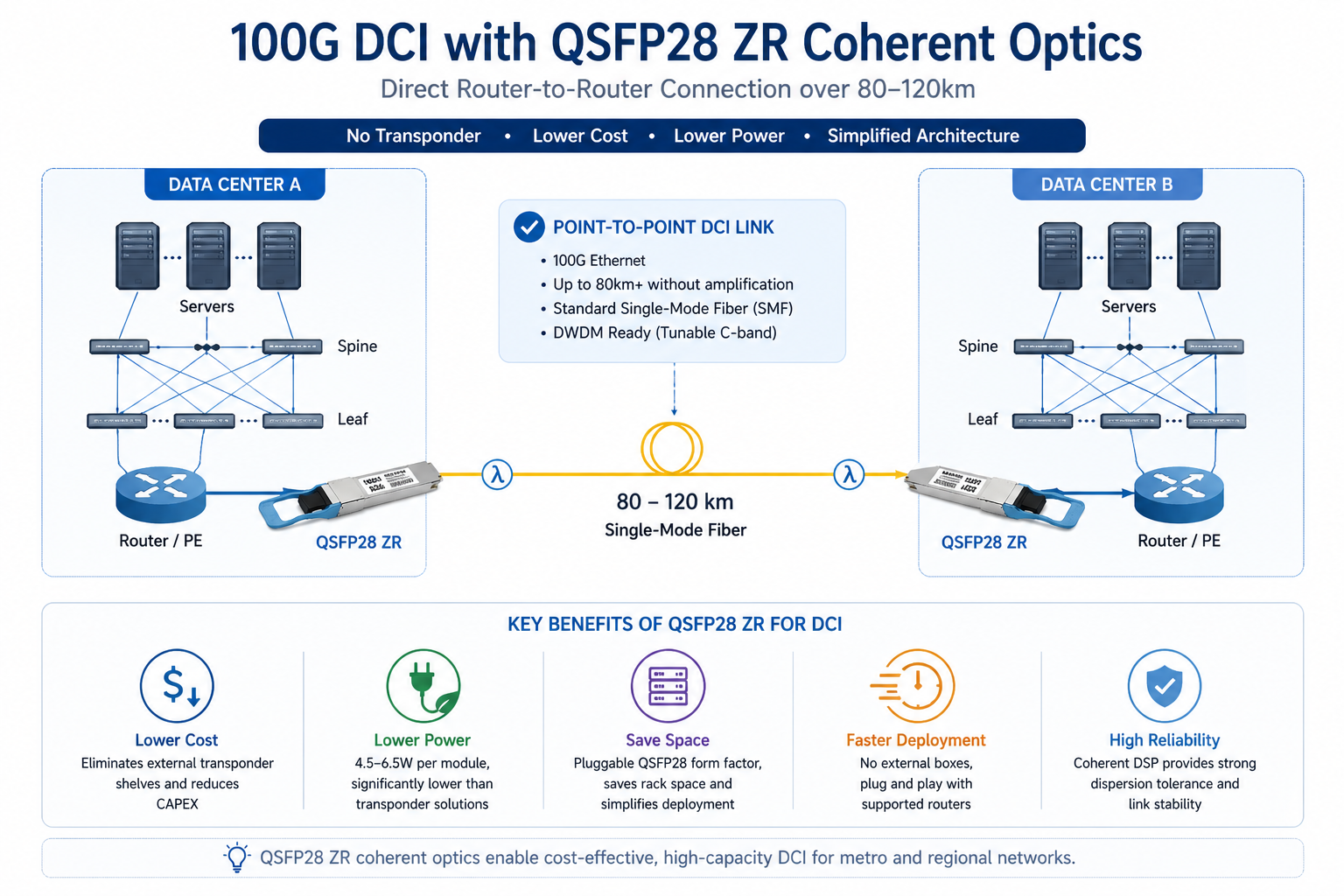
The most developing application for 100G QSFP28 ZR coherent optics is Data Center Interconnects. Enterprises and cloud providers need connections among campuses, colocation, and disaster recovery venues at transmission rates of 100G. The QSFP28 ZR interfaces directly with existing routers, rendering optical transport platforms separate and unnecessary.
In real-life system conditions, a dark-facet connection between routers can extend from 80-120 km with just two coherent modules. The tunable wavelength equally allows coarse or dense WDM to permit many DCI links to share one fiber pair.
Metro Aggregation and 5G Transport
Mobile operators are upgrading front-haul and mid-haul networks to 100G to support 5G capacity. Being 60-100 km from the aggregation hub, many cell sites currently have 10G backhaul. Such shorter distance connections do have the limitations of various large-scale joint issues when upgraded to the 100G-optical interface that is prevalent in today’s industry. The QSFP28 ZR coherent solution is uniquely positioned to provide an elegant, cost-effective mechanism to overcome limits, bypassing most of the optical transport equipment in use.
In February 2024, telecom engineer Carlos deployed QSFP28 ZR coherent modules in rural Brazil to connect three remote 5G towers. The longest link spanned 112km over aging fiber. While ER4 would have failed due to seasonal temperature variations, the coherent links have run error-free for over 14 months, with the DSP automatically compensating for varying dispersion.
Rural and Regional Backhaul
Rural broadband providers and regional ISPs encountered a distinctive issue: that of great distances to the nearest aggregation point along with too few links to justify a dedicated DWDM system. This challenge might have been overcome using QSFP28 ZR coherent optics which enable 100G over a single dark fiber pair with no intermediate equipment.
The cost for each link plummets relative to alternatives which are based on transponders. A regional ISP can now introduce 100G enterprise services for small cities and industrial parks, without setting up an optical transport layer.
IP-over-DWDM and ROADM Integration
Among the most transformative applications of QSFP28 ZR coherent technology is IP-over-DWDM. By plugging directly into a router port, any transponder layer can be easily gotten rid of by the operators. The router communicates directly with the DWDM squadron.
In March 2024, a transport engineer based in Singapore, Li Wei, pulled out an earlier pair of CFP2-ACO transponders and replaced them with QSFP28 ZR coherent modules in the new aggregation router. Its pluggable form factor saved two rack units, reduced power consumption by 70%, and it gelled well with the existing DWDM ROADM network. The previous requirement which took the form of a stand-alone shelf or two can now get its work done at just about 11 watts in each of the four router ports.
This architecture, sometimes called “router-on-a-stick” or “open line system,” is gaining traction in metro and regional networks. ROADM compatibility depends on transmit power:
- •Standard power QSFP28 ZR(-10 to -6 dBm launch power): Best for point-to-point dark fiber or single ROADM spans
- •High-power QSFP28 ZR(0 dBm): Required for multi-span ROADM networks with optical amplification
Deployment Best Practices
Link Budget Planning with Real-World Margin
When planning a QSFP28 ZR coherent link, start with the total fiber distance and add realistic margins. Here is a practical example for an 80km link:
| Parameter |
Value |
| Fiber distance |
80 km |
| Fiber attenuation (0.35 dB/km) |
28.0 dB |
| Connector/splice loss (8 connectors) |
2.5 dB |
| Repair margin |
3.0 dB |
| Aging margin |
1.5 dB |
| Total link loss |
35.0 dB |
| Tx power (standard) |
-6.0 dBm |
| Rx sensitivity |
-24.0 dBm |
| Available OSNR margin |
~17 dB |
This link would work comfortably with standard FEC. For links approaching 100-120km, or links with additional ROADM insertions, high-power variants and soft-decision FEC are recommended.
Fiber Type and Dispersion Considerations
The QSFP28 ZR coherent module goes with the standard single-mode G. 652-applicable fiber. Its DSP handles chromatic dispersion compensation- no dispersion-compensating fiber is required. This is a significant gain over 10G NRZ long-haul links.
Nevertheless, a very old fiber with high PMD or poor splice quality can still affect system performance. In case you are deploying over fiber older than twenty years, consider a fiber characterization test before confirming the link design.
DDM/DOM Monitoring for Coherent Modules
Digital Diagnostic Monitoring (DDM) in QSFP28 ZR coherent modules reports the usual parameters: temperature, supply voltage, Tx power, and Rx power. Advanced modules also report coherent-specific metrics through extended DDM:
- •Pre-FEC Bit Error Rate (BER)
- •Estimated OSNR
- •Chromatic dispersion accumulation
- •Polarization mode dispersion
- •DSP lock status
These metrics are invaluable for troubleshooting. A rising pre-FEC BER often indicates fiber degradation or connector issues before the link actually fails.
For more on transceiver monitoring and diagnostics, read our QSFP28 troubleshooting guide.
Troubleshooting Common QSFP28 ZR Issues
The most common deployment issues are platform incompatibility and insufficient power budget. If a QSFP28 ZR module is not detected, verify that the host platform explicitly supports coherent optics and can deliver the required electrical power.
Link failures are rare once the optical path is stable, but intermittent errors usually indicate:
- Dirty or damaged fiber connectors
- Excessive bending loss
- Temperature-induced fiber drift in aerial spans
- Incompatible FEC modes between endpoints
Cleaning the fiber end faces and verifying the link budget typically resolves these issues.
The QSFP28 ZR Coherent Ecosystem and Market
DSP Vendors: Marvell/Inphi, Broadcom, and Others
The DSP engine is therefore the brain of a coherent transceiver. Marvell (via its acquisition of Inphi) and Broadcom are the leaders in the field of QSFP28 ZR DSP technology. Marvell’s COLORZ II and related 100G ZR DSPs are widely accepted by module suppliers. Broadcom provides competitive DSP solutions that offer integrated drivers and amplifiers.
When combined into a single chip or tightly integrated into a chipset, the modulator driver and receiver amplifier and digital processing form these DSPs. It is this chip-level integration that makes the QSFP28 form factor real.
Module Manufacturers and Multi-Vendor Interoperability
Thanks to the OIF 100G ZR MSA and extensive plugfests, multi-vendor interoperability is now well established. Shenzhen Ascent Optics offers MSA-compliant QSFP28 ZR modules based on Marvell/Inphi DSPs, supporting standard and high-power versions, full C-band tunability, and rich DDM monitoring. Our modules are compatible with Cisco, Juniper, Arista, and Nokia platforms.
Interested in evaluating QSFP28 ZR coherent modules? Request a quote from our optical networking experts.
Interested in evaluating QSFP28 ZR coherent modules for your network? Request a quote from our optical networking experts.
100G ZR Market Outlook and Adoption Trends
The pluggable coherent optics market was valued at approximately $4.8 billion in 2025, with 100G and 400G segments driving growth. While 400G QSFP-DD ZR dominates hyperscale DCI headlines, the 100G QSFP28 ZR segment is seeing strong adoption in:
- •Enterprise DCI upgrades from 10G/40G to 100G
- •Metro Ethernet and business service expansion
- •5G mid-haul and backhaul transport
- •Rural broadband and regional ISP networks
Analysts project that 100G coherent pluggable shipments will remain significant through the late 2020s as service providers extend 100G deeper into their access and aggregation networks before upgrading to 400G.
Conclusion
QSFP28 ZR coherent optics have redefined what is possible with 100G pluggable transceivers. By combining coherent detection, integrated DSP, and C-band tunability in a standard QSFP28 package, these modules eliminate the traditional gap between direct detect reach limits and transponder complexity.
Here is what to remember:
- •Choose QSFP28 ZR coherent for links beyond 40km where ER4 becomes marginal
- •Verify platform compatibility before deployment; coherent modules need higher power and DSP-capable ports
- •Plan for 80km unamplified reach with comfortable margin for connectors, splices, and aging
- •Leverage tunable C-band wavelengths for DWDM and IP-over-DWDM architectures
- •Monitor pre-FEC BER and OSNR through extended DDM for proactive link maintenance
Whether you are building data center interconnects, upgrading metro aggregation, or extending 5G backhaul to remote sites, QSFP28 ZR coherent optics deliver the reach of coherent transport with the simplicity and cost-efficiency of a pluggable module.
Ready to deploy QSFP28 ZR coherent in your network? Contact Shenzhen Ascent Optics for detailed link budget analysis, platform compatibility checks, and MSA-compliant coherent transceiver solutions tailored to your optical infrastructure.
Frequently Asked Questions (FAQs)
Q1. What is the impact of coherent technology on 100G networks?
Coherent technology transmits data by modulating both the amplitude and phase of light, rather than simply turning the laser on and off. Combined with advanced DSP, it enables reliable transmission over much longer distances with better tolerance to fiber impairments.
Q2. How far can the 100G QSFP28 ZR reach in terms of transmission distances?
These modules can generally reach 80 kilometers over single-mode optical fiber without the need for external amplification. Should you choose to amplify the optical fibers on your network links, distances will be extended up to 120 kilometers. This level of reach makes them particularly fitting to use to connect data centers anywhere in large metropolitan cities.
Q3. Are QSFP28 ZR coherent modules recognized with existing switches?
They can be directly inserted to most standard QSFP28 ports on your existing Routers and Switches. But being Coherent, they need much more power than standard Optics; you must make sure that your network equipment can take more power and is heat-tolerant. One must always make sure to look at their hardware specifications to confirm that they sustain the high-powered transceiver modules.
Q4. For which major applications are the QSFP28 ZR optics provided?
The telecommunication giant in support has present solutions offered to network providers. With the sharing of costs due to numerous investments in the required components and gigabit-class connection-suit together with cloud systems into the enterprise entities with centralized management.
Post Views: 1,860