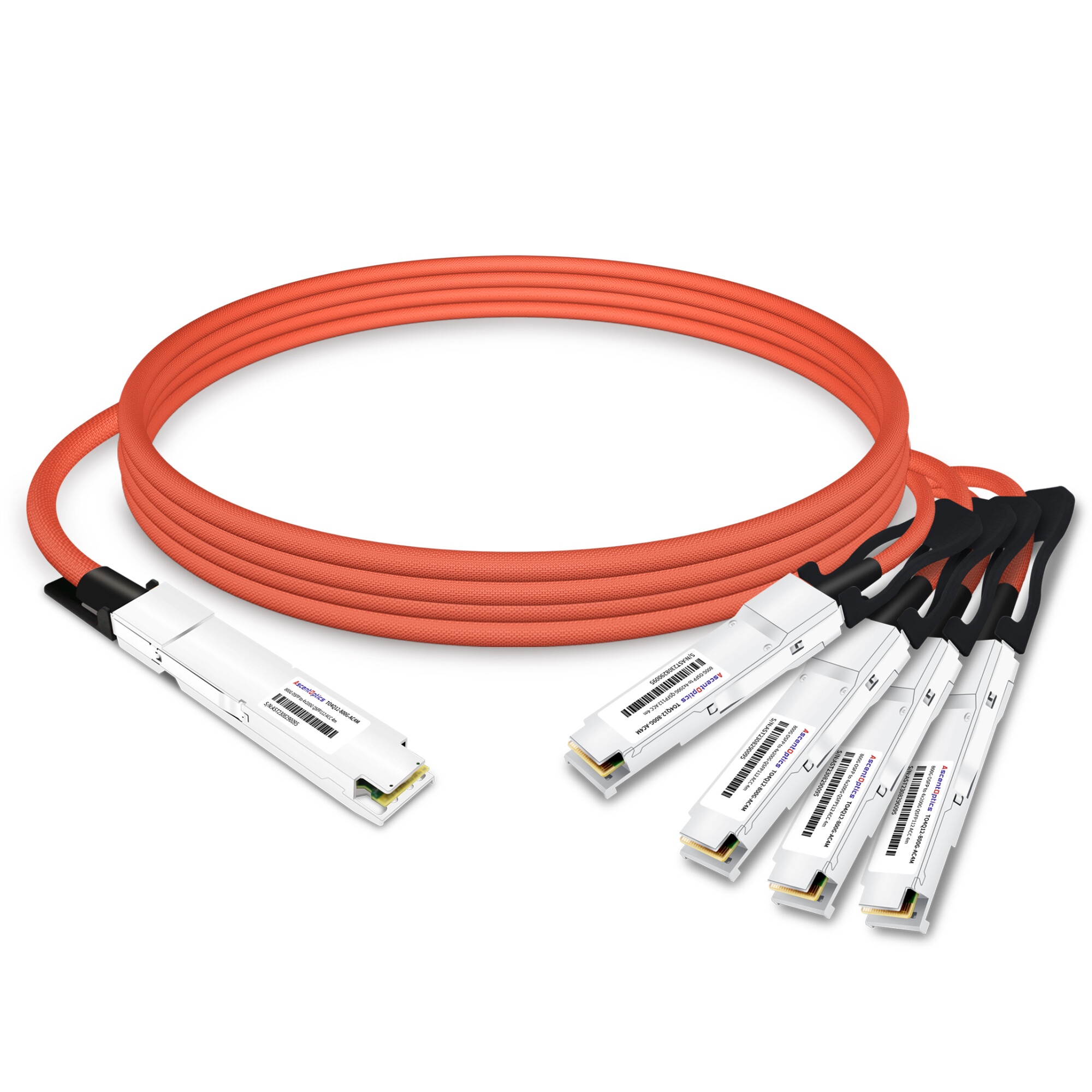
High-speed copper cables are widely used for short-reach connections in data centers, including server-to-switch and switch-to-switch links. Passive Direct Attach Copper (DAC) cables offer a simple, cost-effective solution, while active copper technologies can support more demanding electrical links.
Two common active copper cable types are Active Copper Cables (ACC) and Active Electrical Cables (AEC). ACC designs typically use analog signal conditioning, while AEC designs commonly use retimers to recover and retransmit data.
Understanding the differences between passive DAC, ACC, and AEC helps network engineers choose the right interconnect based on link distance, signal integrity, power budget, and cost.
What Is a Passive DAC Cable?
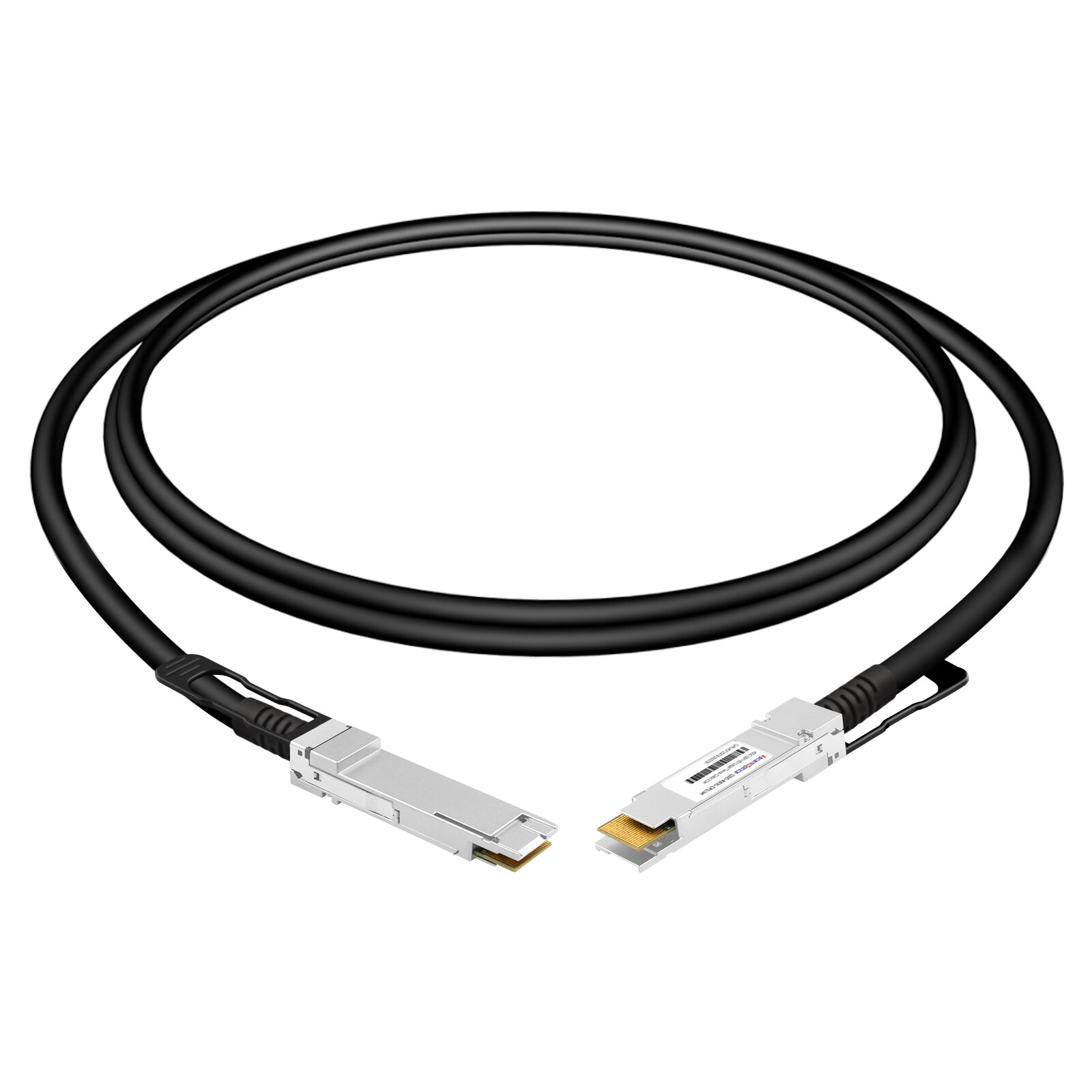
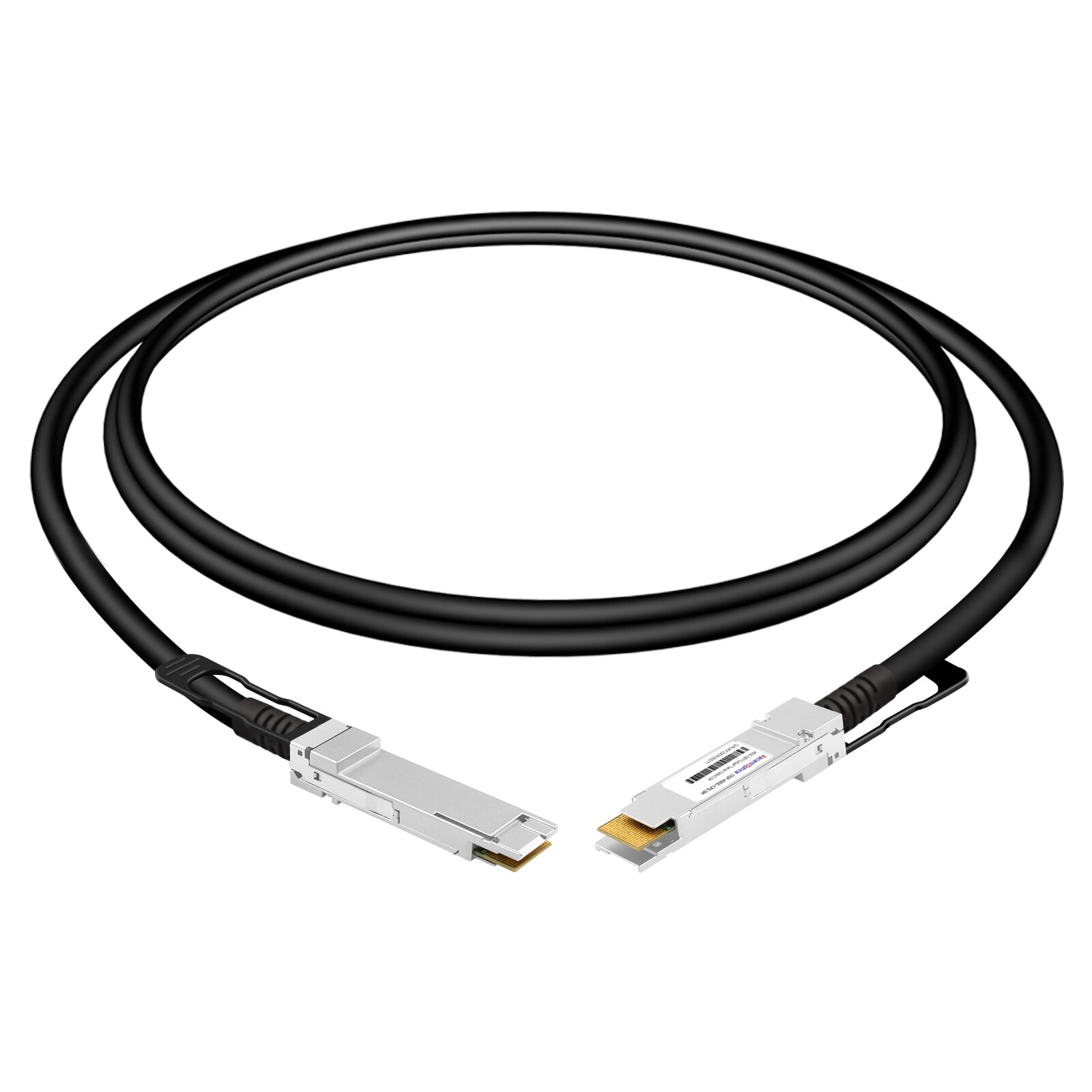
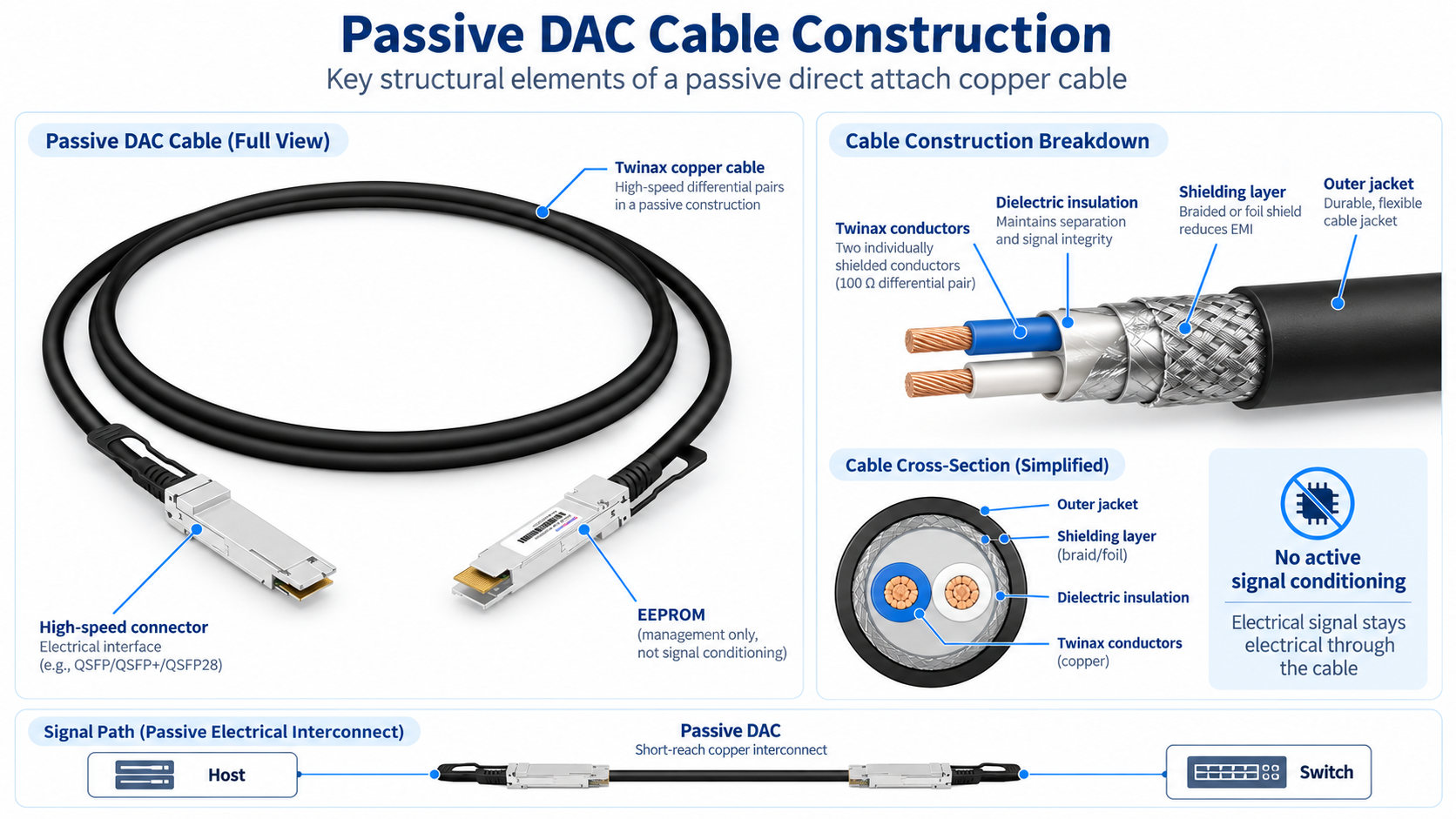
A passive DAC (Direct Attach Copper) cable is a copper interconnect with connector assemblies at both ends. It is commonly used to connect servers, network adapters, and switches over short distances.
Unlike active copper cables, a passive DAC does not use active electronics to condition or regenerate the high-speed data signal.
Twinax Construction and Signal Transmission
Passive DAC cables typically use shielded twinaxial conductors to carry differential electrical signals between two compatible ports. The signal remains electrical throughout the connection, so no optical conversion is required.
Some DAC assemblies include an EEPROM for cable identification and management. However, this component does not perform high-speed signal conditioning.
The simple construction makes passive DAC an attractive option for short connections because it generally offers low cost, low power consumption, and minimal added signal-processing latency.
Why Is Passive DAC Reach Limited?
Electrical signals lose strength as they travel through copper. This phenomenon, known as insertion loss, increases with frequency and cable length. Connectors, conductor geometry, and other channel characteristics also affect signal integrity.
High-speed links using PAM4 modulation have tighter signal margins than earlier signaling schemes. As data rates increase, maintaining an acceptable bit error rate becomes more challenging, particularly over longer copper cables.
Cable gauge also affects performance. A lower AWG number generally indicates a thicker conductor, which can help reduce conductor loss. However, thicker cables may be heavier and less flexible, making them harder to manage in dense racks.
Typical Passive DAC Applications
Passive DAC is particularly suitable for short, high-bandwidth connections where the host interfaces can support the electrical channel.
Typical applications include server-to-switch connections within a rack, connections between network adapters and switches, and short switch-to-switch links.
Supported distances vary by data rate, cable design, interface standard, and host compatibility. The cable manufacturer’s specifications should be used to confirm the maximum supported reach.
What Is an Active Copper Cable (ACC)?
An Active Copper Cable (ACC) is a copper cable assembly that incorporates active signal-conditioning electronics. Compared with passive DAC, an ACC can improve the electrical channel’s ability to support a given data rate over a particular cable length.
How Does ACC Work?
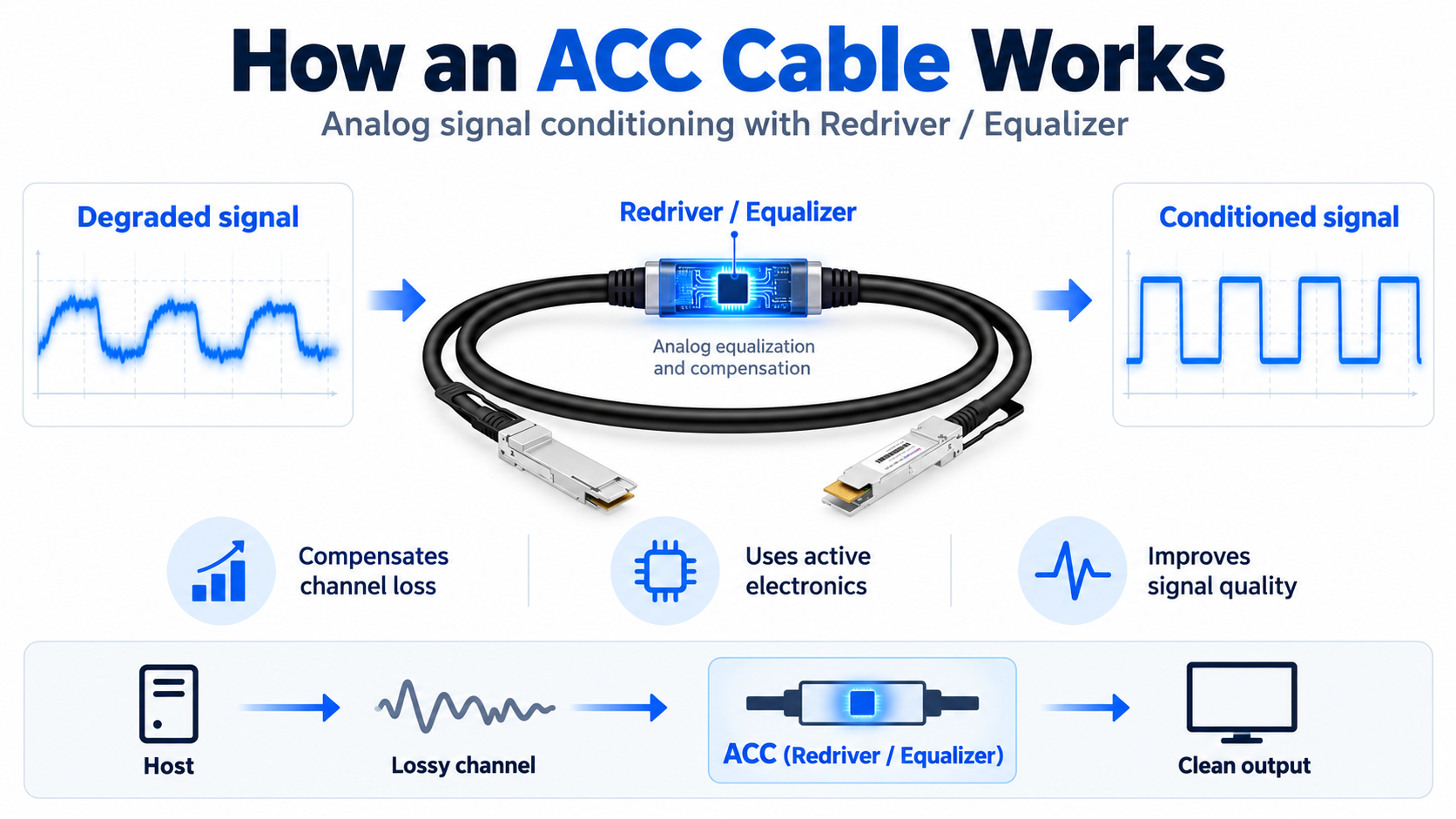
ACC designs commonly use analog signal-conditioning circuits, such as redrivers or equalizers, to compensate for channel loss.
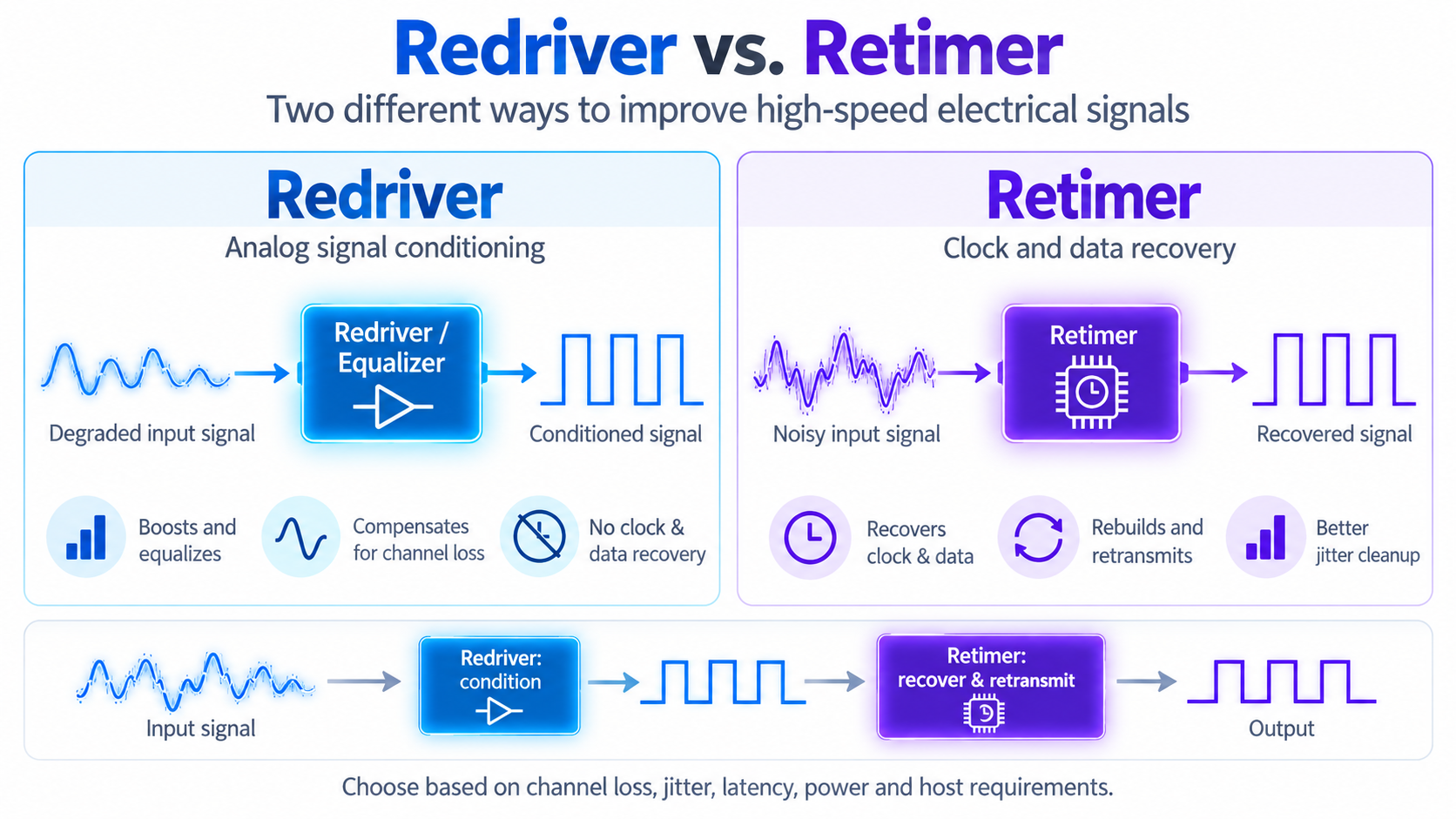
A redriver can amplify and equalize an incoming electrical signal to help compensate for frequency-dependent attenuation. This can improve the signal delivered to the receiving interface.
However, a redriver does not perform the same clock and data recovery process as a retimer. It cannot reconstruct every aspect of a degraded signal, and it does not automatically eliminate accumulated jitter or noise.
The actual implementation depends on the cable design. Not every active copper cable should be assumed to use the same circuitry.
ACC Reach, Power, and Cost
By improving signal conditioning, ACC may support longer cable assemblies than passive DAC at the same data rate. It can also enable cable designs that balance electrical performance with flexibility and cable-management requirements.
The trade-off is additional electronics, which increase power consumption and cost compared with passive DAC. Actual power requirements depend on the product, data rate, and implementation.
ACC is worth considering when a passive cable cannot meet the required link performance but a more complex retimed solution is unnecessary.
What Is an Active Electrical Cable (AEC)?
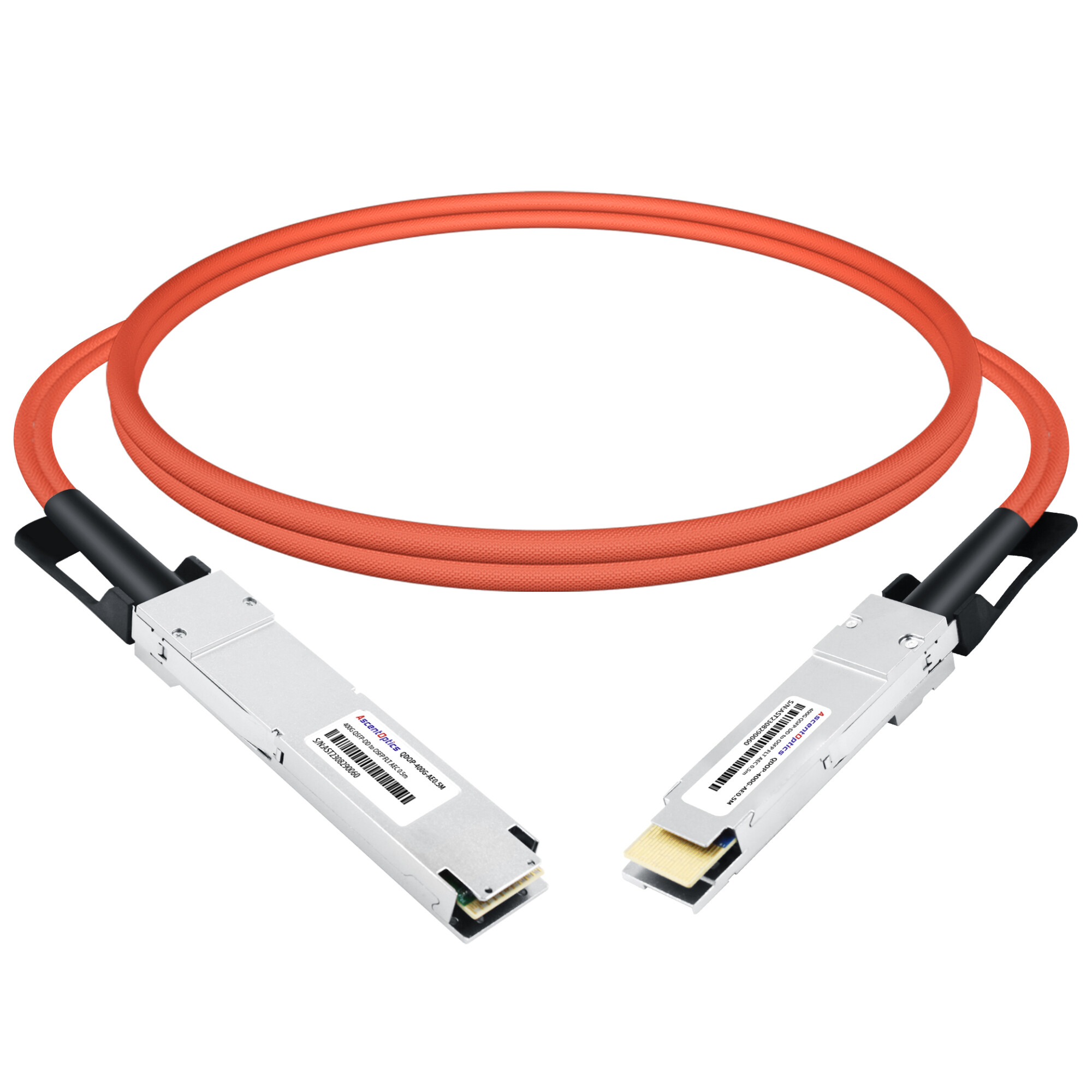
An Active Electrical Cable (AEC) is a copper cable assembly that commonly uses retiming electronics to improve high-speed signal transmission.
AEC is particularly relevant to demanding short-reach connections where the electrical channel presents greater signal-integrity challenges.
How Does AEC Work?
AEC designs typically use retimers to recover clock and data from the incoming signal and retransmit the data through a new electrical output signal.
Retiming can reduce the impact of accumulated jitter and improve signal integrity, provided the incoming signal remains within the retimer’s operating limits.
However, a retimer cannot correct every possible signal problem. Severe channel degradation, excessive noise, incompatible interfaces, or other electrical issues can still prevent a link from operating reliably.
This distinction is important: a redriver conditions the incoming waveform, while a retimer recovers and retransmits the data.
AEC Reach, Power, and Cost
AEC can support demanding high-speed copper links where passive DAC or simpler active signal conditioning may not provide sufficient margin.
However, AEC requires more complex electronics and generally has a higher power and cost profile than passive DAC. Its power consumption depends on the retimer design, supported data rate, and cable implementation.
AEC is often considered for short-reach, high-bandwidth connections in data centers and AI infrastructure, particularly when electrical performance and cable reach must be balanced against the cost and power of optical alternatives.
The supported distance should always be confirmed against the specific AEC product and host interface.
Passive DAC vs. ACC vs. AEC: Key Differences
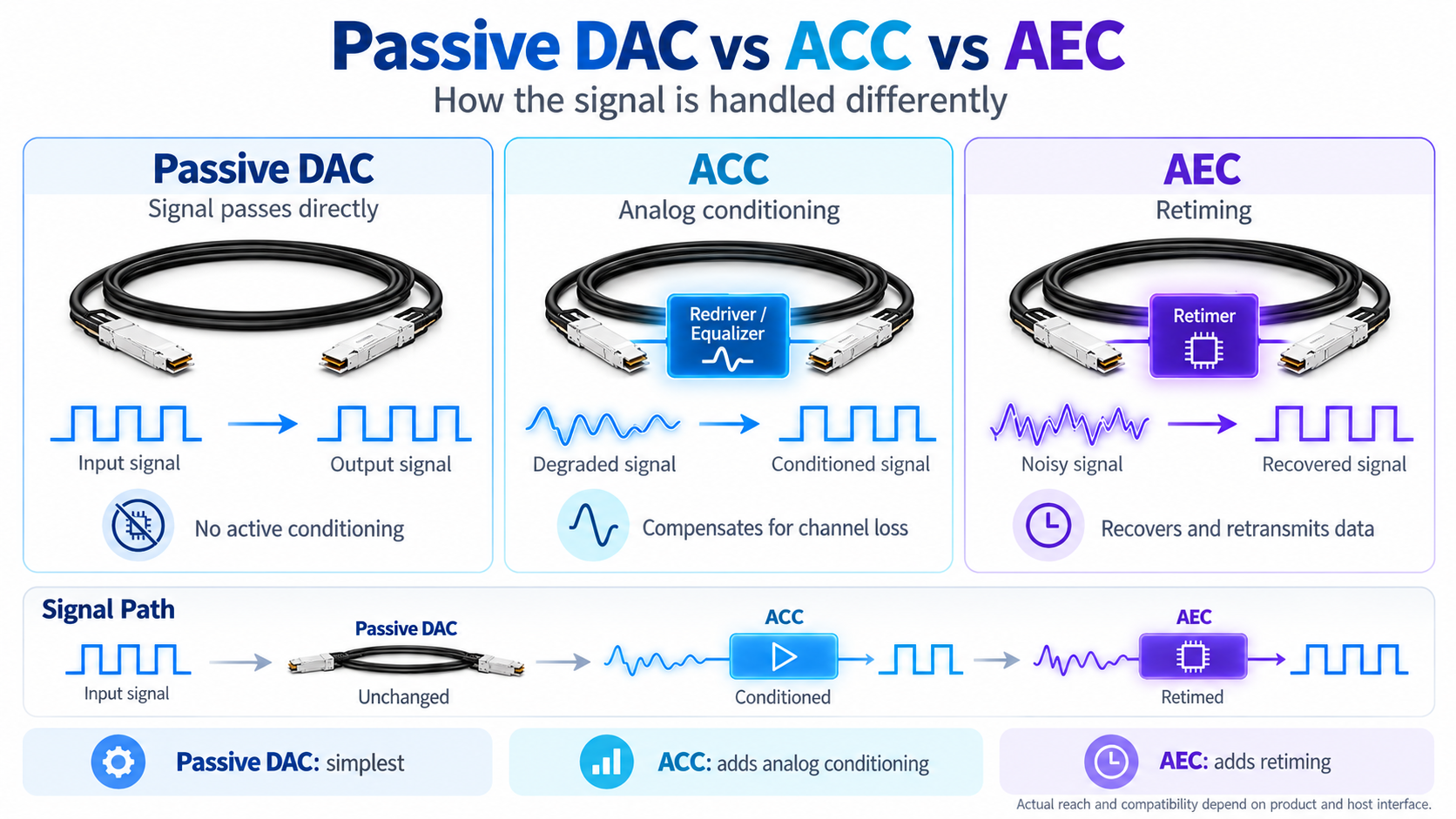
The main difference between these cable types is how they handle signal degradation.
| Feature |
Passive DAC |
ACC |
AEC |
| Signal conditioning |
None |
Typically analog conditioning |
Typically retiming |
| Active electronics |
No high-speed active conditioning |
Yes |
Yes |
| Power consumption |
Lowest |
Higher than passive DAC |
Product-dependent; often higher than passive DAC |
| Cost |
Lowest |
Higher than passive DAC |
Generally higher than passive DAC |
| Cable flexibility |
Depends on gauge and construction |
Depends on design |
Depends on design |
| Typical application |
Short, supported electrical links |
Links requiring additional signal conditioning |
Demanding high-speed links requiring retiming |
Note: ACC and AEC implementations vary. The table describes common design approaches rather than universal requirements for every product.
Distance and Reach
Transmission distance is an important selection factor, but it should not be treated as a fixed value for each cable category.
Passive DAC generally suits the shortest links. ACC may provide additional reach through signal conditioning, while AEC can support challenging electrical channels through retiming.
There is no universal distance threshold at which one category must replace another. The supported reach depends on the data rate, cable construction, interface requirements, and host compatibility.
Power Consumption
Passive DAC generally consumes the least power because it does not require active high-speed signal conditioning.
ACC and AEC require power for their active electronics. Their actual consumption varies by product, so engineers should compare manufacturer specifications using a consistent measurement basis.
For large deployments, the cumulative power requirements of many active cables can affect the overall power budget and thermal design.
Cost and Cable Management
Passive DAC usually offers the lowest acquisition cost. ACC and AEC introduce additional electronics and therefore generally cost more.
Cable construction also matters. Thicker conductors may reduce electrical loss but can increase cable weight and stiffness. Active cable designs may offer different mechanical characteristics, but flexibility should be verified from the product specifications rather than inferred from cable type alone.
Redriver vs. Retimer: What Is the Difference?
Understanding redrivers and retimers helps explain why ACC and AEC may perform differently in demanding electrical channels.
Analog Equalization: Redriver
A redriver operates on the incoming electrical waveform. It applies gain and equalization to compensate for channel loss and improve the signal presented to the next interface.
A redriver does not recover the original data through a clock-and-data recovery process. Noise and jitter already present in the signal can therefore remain a concern.
Clock and Data Recovery: Retimer
A retimer recovers clock and data from the incoming signal, then retransmits the data through its output circuitry.
This process can reduce the effect of accumulated jitter and improve the quality of the outgoing signal. However, the retimer must first receive a signal that it can successfully recover.
Why Does This Matter at 400G and 800G?
At 400G and 800G, many interfaces use high-speed PAM4 electrical lanes. The lane count, signaling rate, and electrical requirements vary by interface generation and implementation.
As signaling speeds increase, channel loss and signal-integrity constraints become more demanding. Retiming can help address these challenges, but it is not automatically necessary for every connection.
The appropriate solution depends on the specific interface, required cable reach, host capabilities, and product specifications.
Choosing Copper Cables from 10G to 800G
The preferred interconnect changes as data rates and electrical channel requirements evolve.
10G and 25G: SFP+ and SFP28
Passive DAC is often a practical choice for short server-to-switch connections at 10G and 25G. It provides a simple, low-cost connection when the cable length and host interfaces are supported.
ACC may be considered when additional reach or different cable construction is needed.
40G and 100G: QSFP+ and QSFP28
Passive DAC remains useful for short connections in racks and data center rows. ACC may be suitable for supported links that exceed the practical reach of a passive cable.
The decision should account for the cable’s electrical specifications and the compatibility of both connected ports.
200G and 400G: QSFP56, QSFP-DD, and OSFP
At 200G and 400G, electrical channel requirements become more demanding. Passive DAC, ACC, and AEC may all be relevant, depending on the interface generation and supported reach.
AEC can be useful when retiming is required to maintain signal integrity. However, it should not be assumed to be necessary for every high-speed copper connection.
800G: QSFP-DD and OSFP Implementations
800G connections place additional demands on electrical channel design. Passive DAC remains an option for suitably short, supported links, while ACC or AEC may be considered for other short-reach applications.
For links that exceed the supported reach of copper solutions, an Active Optical Cable (AOC) or optical transceivers with fiber may be more appropriate.
Always check the supported data rate, cable length, connector type, and host compatibility before selecting an 800G interconnect.
When Should You Choose Passive DAC, ACC, or AEC?
The best choice depends on the link requirements rather than distance alone.
Choose passive DAC when:
- The connection is short and within the cable’s specified reach.
- Both host interfaces support the selected cable.
- Low cost and low power consumption are priorities.
Choose ACC when:
- Additional signal conditioning is needed for the target electrical channel.
- The selected ACC supports the required data rate and reach.
- Its power, cost, and compatibility meet deployment requirements.
Choose AEC when:
- The electrical channel requires retiming to support reliable high-speed transmission.
- The cable is qualified for the target interfaces and distance.
- Its additional power and cost are justified by the link requirements.
Consider AOC or optical transceivers when:
- The required distance exceeds the supported reach of suitable copper cables.
- Cable routing, electrical channel limitations, or deployment requirements favor fiber.
- The optical solution meets the necessary data rate, compatibility, and power budget.
There is no universal 5 m, 10 m, or 15 m cutoff that applies to every interface. Use the manufacturer’s supported reach and compatibility information to make the final decision.
Passive DAC vs. Active Copper for AI and GPU Clusters
AI and GPU clusters require high-bandwidth connections between servers, network adapters, and switches. Interconnect selection affects power consumption, cable management, and signal integrity.
Power Density and Cable Management
In dense GPU environments, every component contributes to the system’s power and thermal budget. Passive DAC is attractive for short links because it generally avoids the additional power required by active signal-conditioning electronics.
However, thicker copper cables can complicate routing in densely populated racks. Cable weight, bend radius, connector access, and airflow should all be considered when designing the physical network.
ACC and AEC in InfiniBand and Ethernet Fabrics
Both InfiniBand and Ethernet networks can use copper interconnects for supported short-reach links.
ACC and AEC can help address electrical channel requirements that passive DAC cannot meet in a particular deployment. The appropriate choice depends on the NIC, switch, cable, supported data rate, and link distance.
For longer connections between racks or rows, AOC and optical transceivers may offer a more suitable solution.
Conclusion
Passive DAC, ACC, and AEC serve different roles in high-speed copper connectivity. Passive DAC offers low cost and power for short links, ACC provides additional signal conditioning, and AEC uses retiming to support demanding electrical channels.
The right choice depends on the target data rate, required reach, signal integrity, power budget, and device compatibility. Before deployment, verify the cable’s specifications and ensure that both connected interfaces support the selected solution.
Frequently Asked Questions
1. What is the difference between passive and active DAC?
Passive DAC carries electrical signals without active high-speed signal conditioning. Active copper cables use electronics to improve signal transmission and may support longer or more demanding links.
2. What is an ACC cable?
ACC stands for Active Copper Cable. It commonly uses analog signal-conditioning circuitry to compensate for channel loss and improve electrical link performance.
3. What is an AEC cable?
AEC stands for Active Electrical Cable. It commonly uses retimers to recover clock and data and retransmit the signal, helping maintain signal integrity in demanding high-speed links.
4. Is AEC better than ACC?
Not necessarily. AEC may be more suitable when retiming is required, while ACC may meet the requirements of less demanding electrical channels. The best choice depends on reach, data rate, power, and compatibility.
5. Does active copper consume more power than passive DAC?
Generally, yes. ACC and AEC require power for active electronics, while passive DAC does not require active high-speed signal conditioning. Actual power consumption varies by product.
6. Can passive DAC support 800G?
Some passive DAC products support 800G over short distances. The maximum reach depends on the cable design, interface requirements, and host compatibility. Check the product specifications before deployment.
7. When should I choose AOC instead of copper?
Consider AOC when the required reach, routing requirements, or electrical channel limitations make a suitable copper solution impractical. Compare the supported distance, power, cost, and compatibility of both options.
Post Views: 572