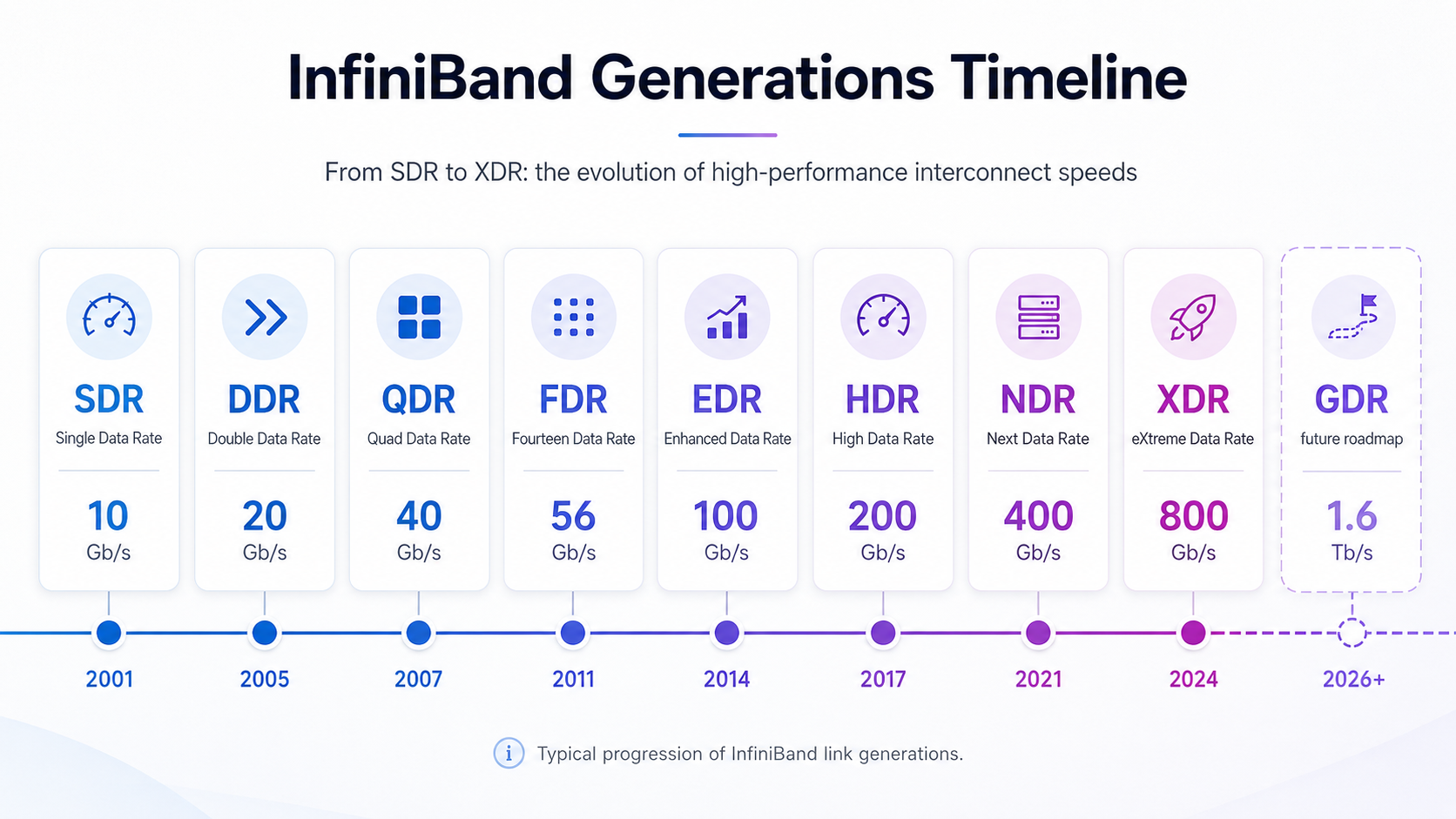
InfiniBand has evolved through multiple generations, with speeds starting at SDR (Single Data Rate) at 2.5 Gb/s and successively doubling to DDR (5 Gb/s), QDR (10 Gb/s), FDR (14.0625 Gb/s), EDR (25.78 Gb/s), HDR (50 Gb/s), and finally XDR (100 Gb/s). Each generation increases bandwidth while reducing latency, enabling high-performance computing and AI clusters to overcome performance bottlenecks.
What Is InfiniBand?
InfiniBand is a high-bandwidth, low-latency interconnect standard used to connect servers, storage, and accelerators in high-performance computing and AI data centers. RDMA allows a network adapter to transfer data directly between the memory regions of communicating hosts with minimal CPU involvement, reducing software overhead and latency.
That design is the reason InfiniBand wins. RDMA cuts latency to roughly a microsecond. A credit-based, lossless flow-control model prevents packet loss by design. No tuning, no dropped frames, no congestion collapse.
Consider a GPU cluster training a large language model. Thousands of GPUs exchange gradients and weights continuously. Every microsecond of latency adds up across the training run. InfiniBand is widely deployed in high-performance computing systems and large-scale AI clusters where low latency, RDMA, and scalable network performance are critical.
InfiniBand Generations at a Glance
The table below lists the full InfiniBand generations ladder. Each generation significantly increases per-port bandwidth, while also introducing changes in signaling, encoding, and physical-layer technology.
| Generation |
Full name |
Per-port rate |
Per-lane signaling |
Encoding |
Introduced |
Typical form factor |
| SDR |
Single Data Rate |
10 Gb/s |
2.5 Gb/s |
8b/10b |
2001 |
CX4 |
| DDR |
Double Data Rate |
20 Gb/s |
5 Gb/s |
8b/10b |
2005 |
CX4 |
| QDR |
Quad Data Rate |
40 Gb/s |
10 Gb/s |
8b/10b |
2007 |
QSFP+ |
| FDR |
Fourteen Data Rate |
56 Gb/s |
14.06 Gb/s |
64b/66b |
2011 |
QSFP+ |
| EDR |
Enhanced Data Rate |
100 Gb/s |
25.78 Gb/s |
64b/66b |
2014 |
QSFP28 |
| HDR |
High Data Rate |
200 Gb/s |
50 Gb/s |
PAM4 |
2017 |
QSFP56 |
| NDR |
Next Data Rate |
400 Gb/s |
100 Gb/s |
PAM4 + FEC |
2021 |
QSFP112 / OSFP |
| XDR |
eXtreme Data Rate |
800 Gb/s |
200 Gb/s |
PAM4 + FEC |
2024 |
OSFP |
A ninth generation, GDR, is expected to reach 1.6 Tb/s and is already appearing in early vendor roadmaps for 2026 and beyond.
The Generation Ladder, Explained
SDR, DDR, and QDR: The 8b/10b Era
The first three InfiniBand generations carried data over four lanes using 8b/10b encoding. This scheme maps every 8 bits of data into 10 bits on the wire, so 20% of the raw signaling is overhead. That is why a QDR port signals at 10 Gb/s per lane but delivers only 8 Gb/s of usable data per lane.
SDR arrived in 2001 with 10 Gb/s, roughly the speed of the fastest Ethernet of the era. DDR doubled it to 20 Gb/s, and QDR doubled it again to 40 Gb/s. These early generations used CX4 copper connectors, which limited reach to a few meters and kept InfiniBand mostly inside HPC clusters.
FDR and EDR: The 64b/66b Transition
FDR marked a quiet but important shift. It moved from 8b/10b to 64b/66b encoding, which raises efficiency to about 97% and recovers most of the overhead lost in earlier generations. FDR delivered 56 Gb/s, and EDR followed in 2014 at 100 Gb/s.
EDR was also the generation where the form factor mattered to more people. EDR ports settled on the QSFP28 module, the same compact form used for 100 Gb/s Ethernet. That convergence let network teams buy one module family for both fabrics.
HDR and NDR: The PAM4 Era
HDR introduced PAM4 signaling, which encodes two bits per symbol instead of one. That single change doubled the per-lane rate to 50 Gb/s and lifted the port to 200 Gb/s. HDR moved the connector to QSFP56.
NDR pushed further. It runs four lanes at 100 Gb/s each for a 400 Gb/s port, and it introduced forward error correction (FEC) to compensate for the tighter signal margins that come with higher speeds. NDR is the generation most current GPU clusters deploy, and it splits into 800 Gb/s per twin port using OSFP or QSFP112 form factors.
XDR and the 800 Gb/s Frontier
XDR increases the port bandwidth to 800 Gb/s and uses approximately 200 Gb/s per electrical lane with PAM4 signaling and FEC. It targets the newest GPU generations and the largest AI clusters. XDR ports use OSFP and OSFP224 form factors, and the roadmap points to 1.6 Tb/s GDR next.
How Encoding Shaped Each InfiniBand Generation
Encoding is the quiet engine behind every speed bump in the InfiniBand generations ladder. It determines how much of the raw signal becomes usable data.
The early 8b/10b scheme wastes 20% of the link. FDR and EDR switched to 64b/66b, which wastes only about 3%. HDR and later generations use PAM4, which packs more bits into each symbol but needs FEC to stay reliable at high speeds. PAM4 enables higher bit rates per lane, while FEC is used in modern high-speed InfiniBand generations to improve link reliability at tighter signal margins.
The practical result is that raw signaling and delivered bandwidth are not the same number. A 100 Gb/s EDR port signals at 25.78 Gb/s per lane and delivers about 96.97 Gb/s after encoding overhead. An NDR port signals at 100 Gb/s per lane. Keeping these two figures separate is the difference between a correct bill of materials and a surprised project manager.
The Physical Layer: Transceivers, AOCs, and DACs
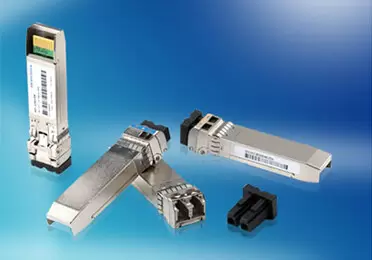
Every InfiniBand generation needs a physical connection, and that is where the optical transceiver portfolio comes in. The connector has moved steadily up the form-factor ladder as speeds climbed.
SDR and DDR used CX4. QDR and FDR moved to QSFP and QSFP+. EDR standardized on QSFP28. HDR used QSFP56. NDR and XDR now use QSFP112 and OSFP.
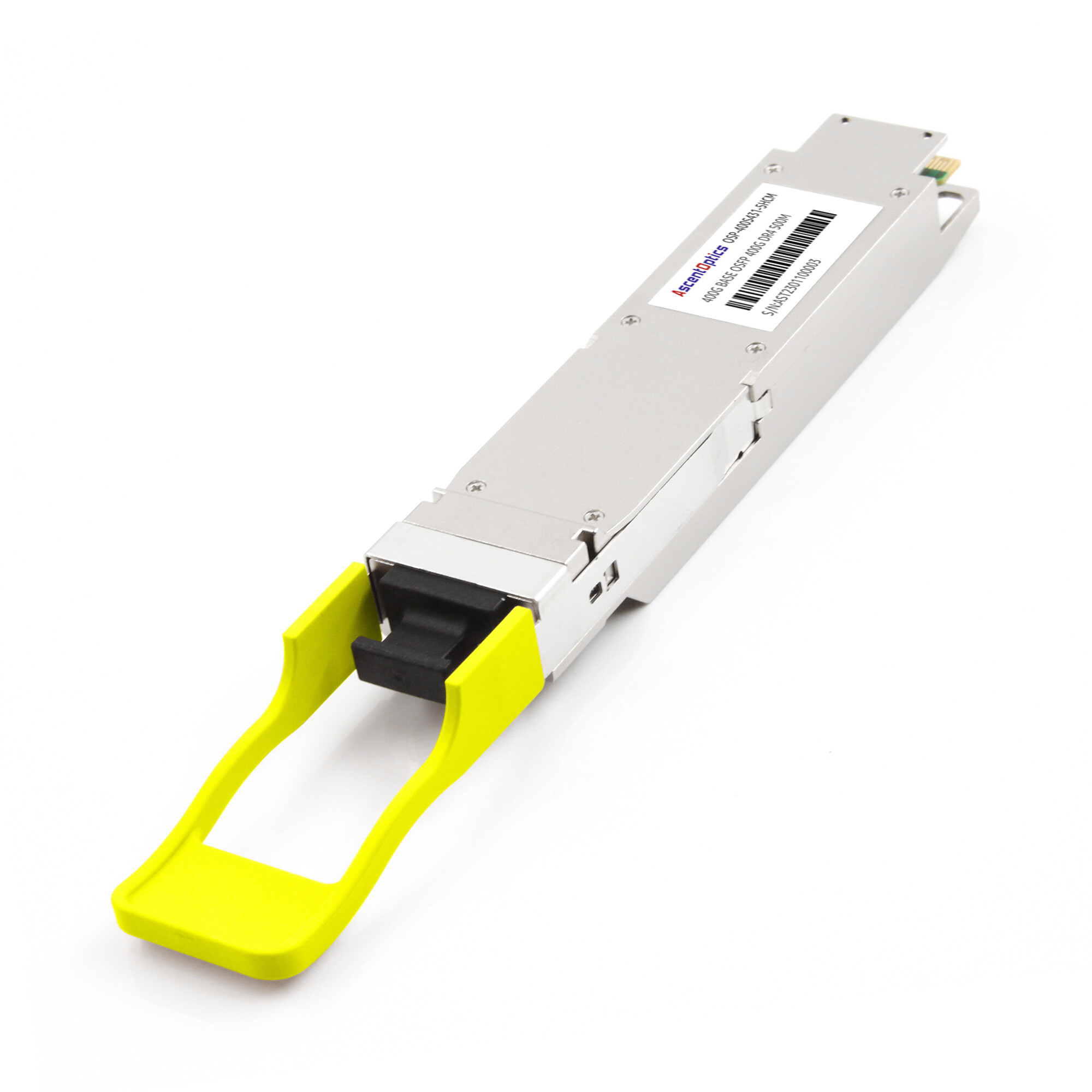
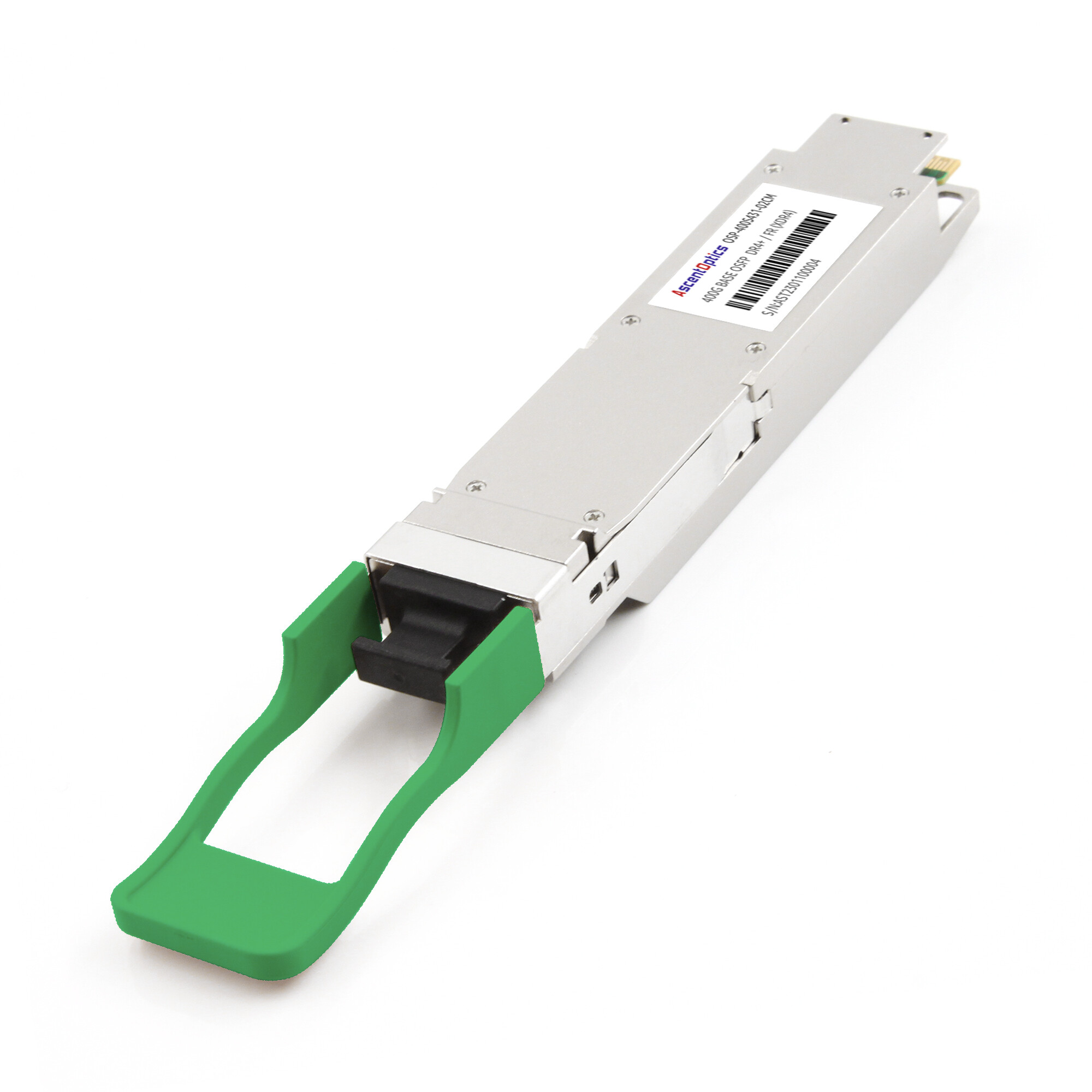
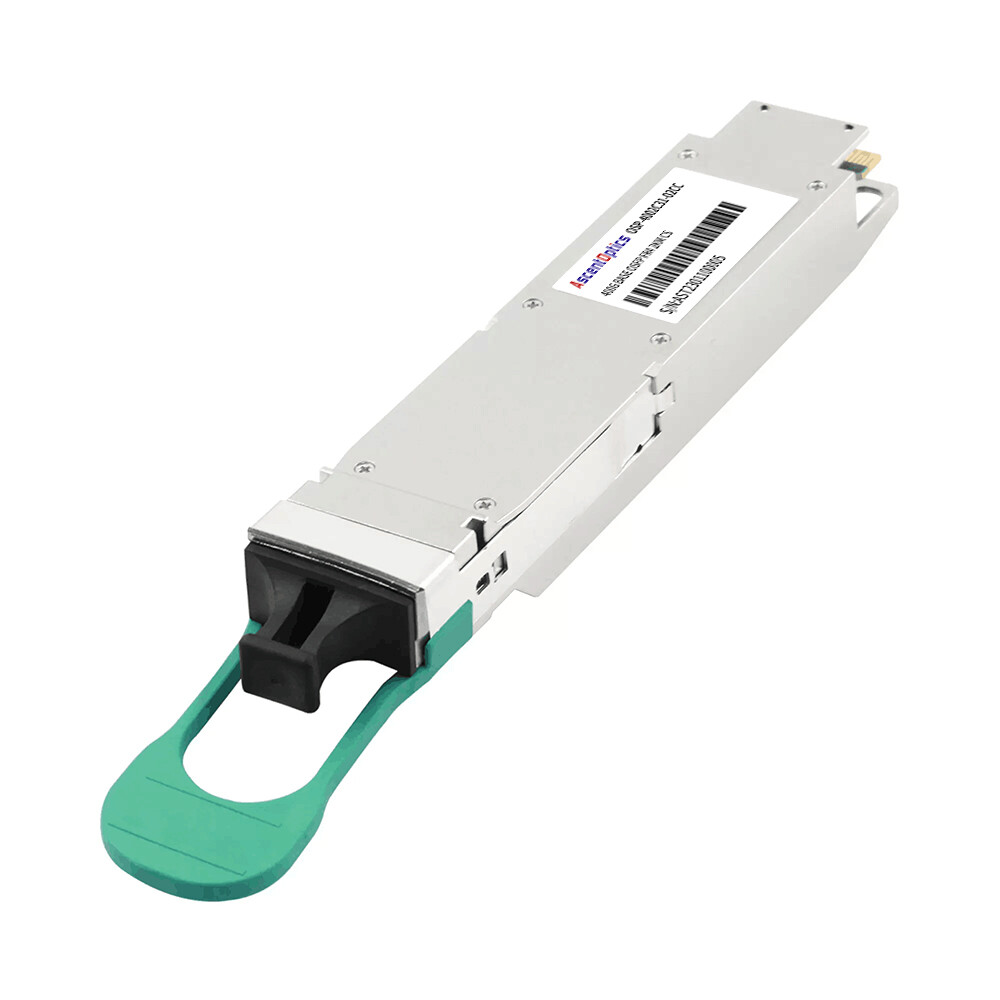
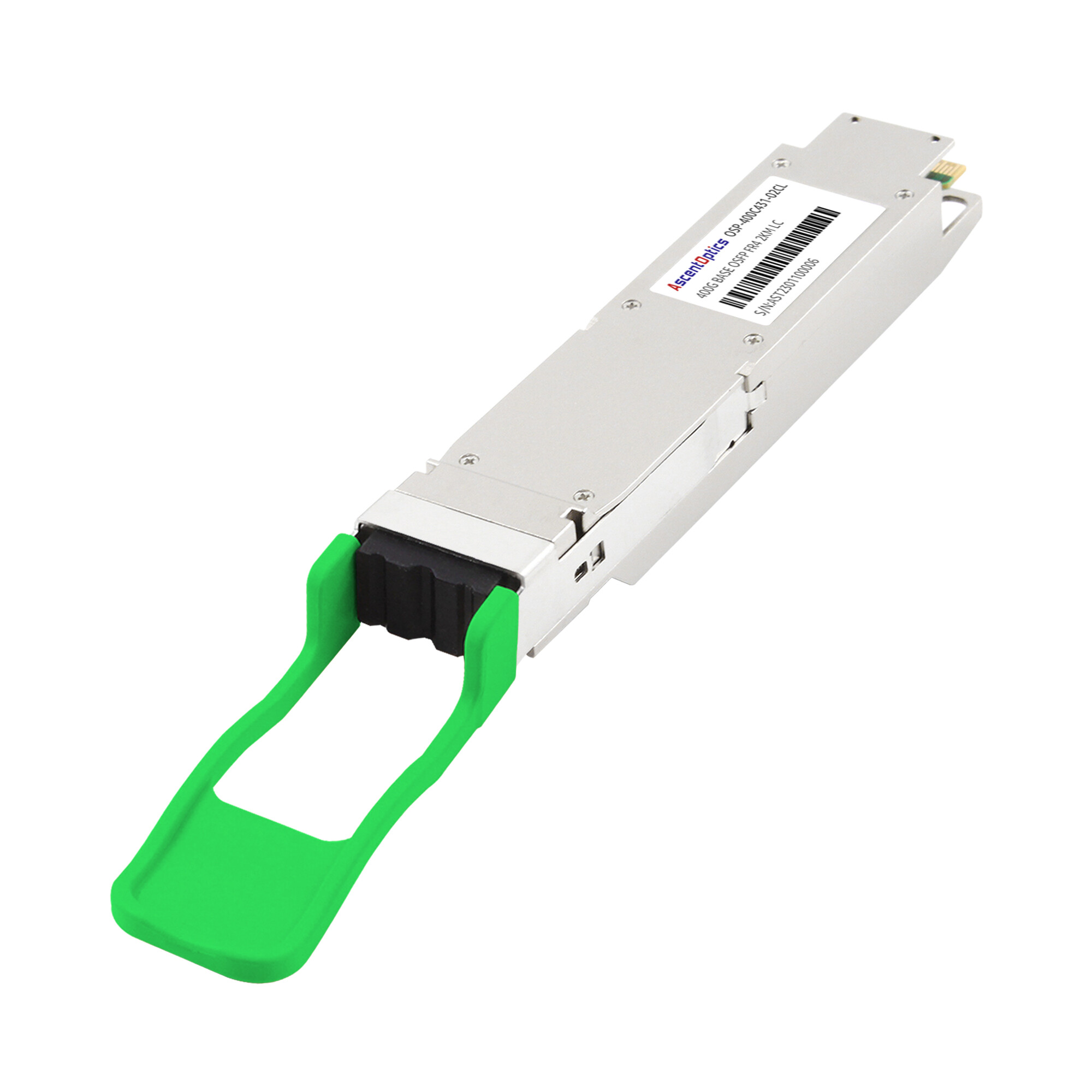
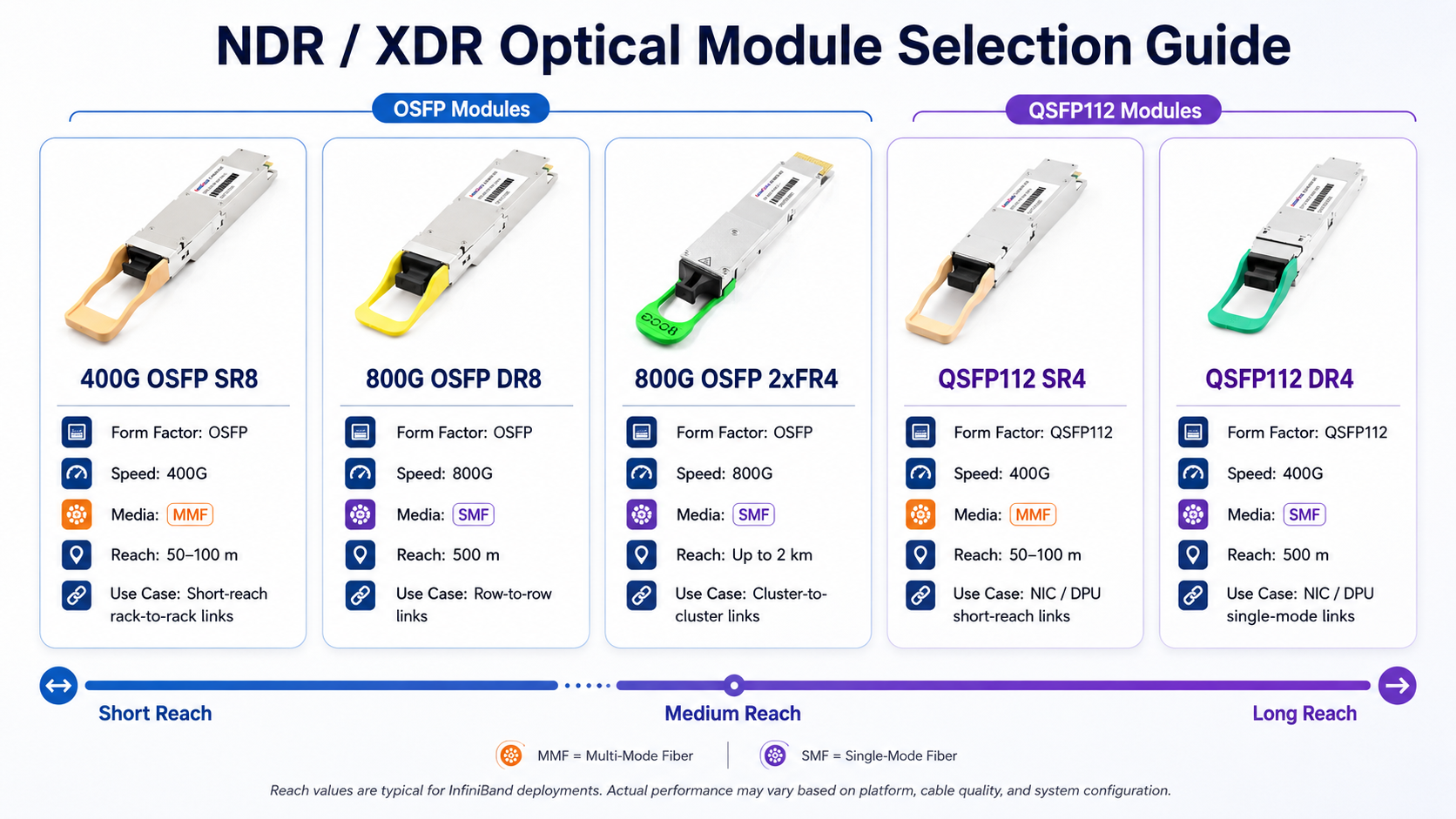
For NDR and XDR deployments, the module options break down by reach:
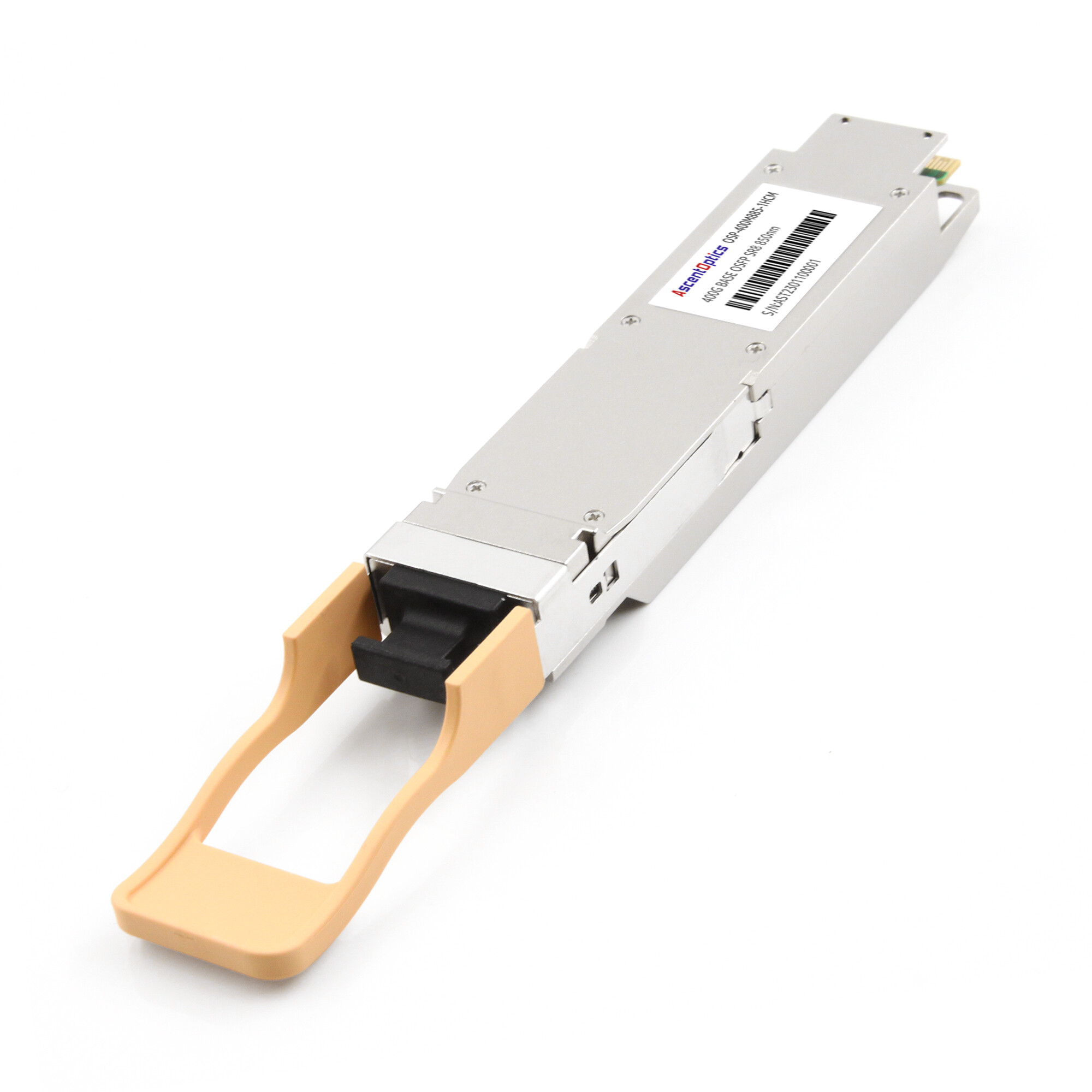
- OSFP SR8: 850 nm multimode, 50 to 100 meters, for rack-to-rack links.
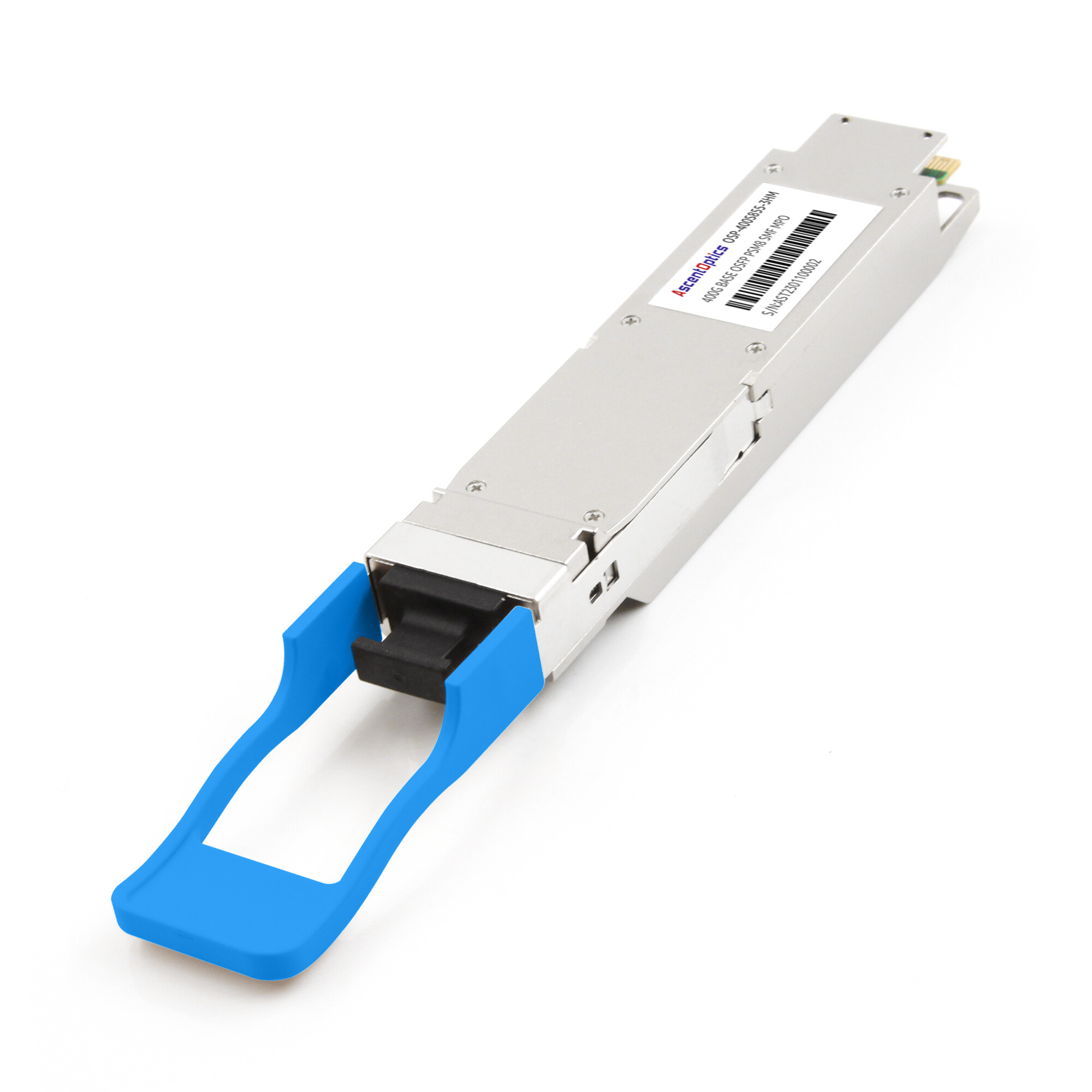
- OSFP DR8: 1310 nm single-mode, 500 meters, for row-to-row links.
- OSFP 2FR4: 1310 nm single-mode, up to 2 kilometers, for cluster-to-cluster links.
- QSFP112 SR4 / DR4: 400 Gb/s variants for NIC and DPU ports.
For short in-rack links, passive direct attach copper (DAC) cables are the cheapest option, typically under 4 meters. Active optical cables (AOC) extend that reach to about 50 meters with better signal integrity. Beyond that, pluggable optical modules on single-mode fiber carry the signal across the data center.
InfiniBand vs Ethernet for AI and HPC
The InfiniBand generations ladder now runs in parallel with Ethernet, and both fabrics have reached 800 Gb/s. The choice between them shapes most AI infrastructure decisions.
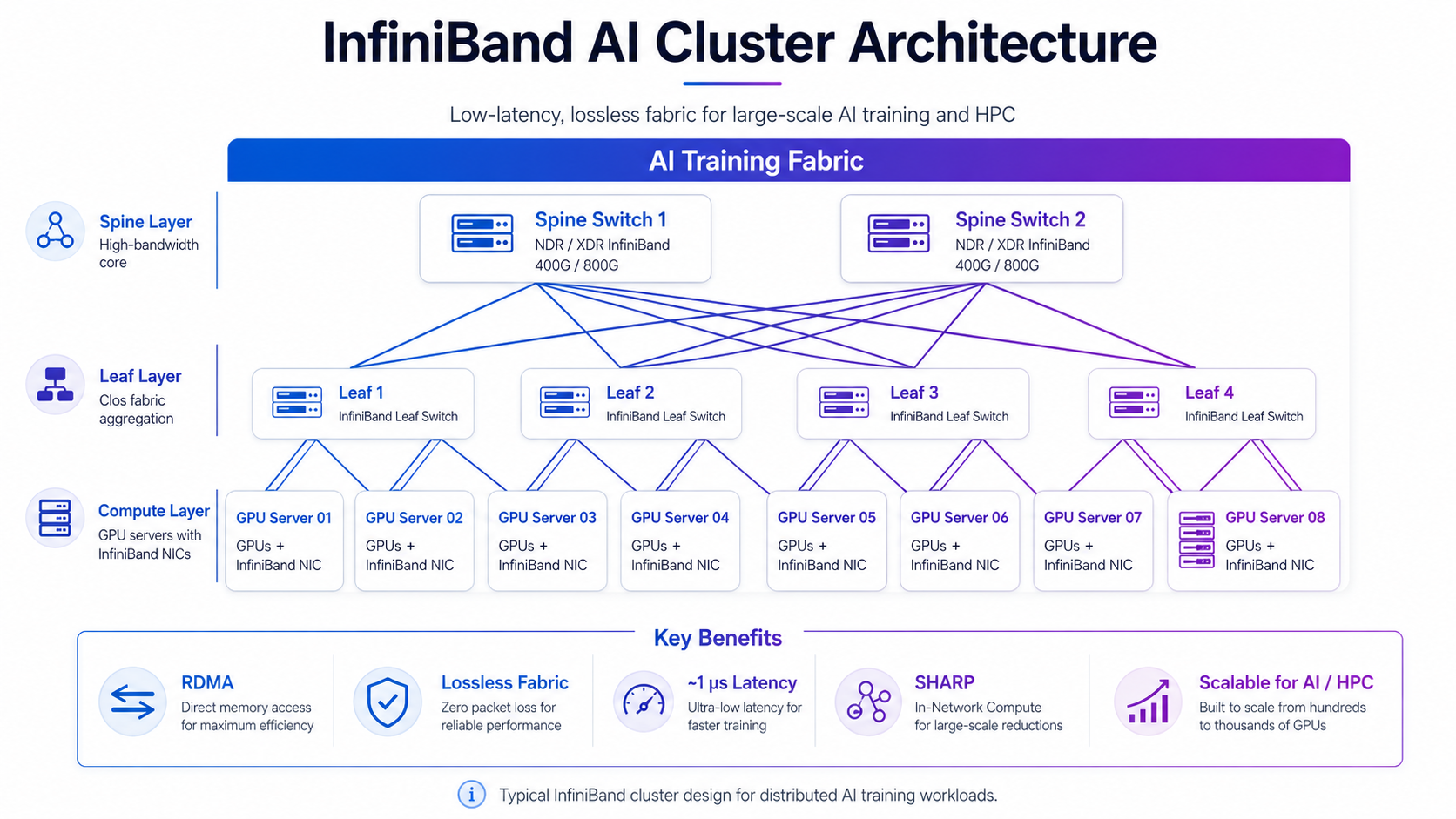
InfiniBand holds a few durable advantages. End-to-end latency sits near 1 microsecond, compared with 1.5 to 2 microseconds for a well-tuned RoCEv2 Ethernet fabric. Credit-based flow control is lossless by design, so there is no PFC or ECN tuning to get wrong. In-switch reduction, like NVIDIA’s SHARP, collapses all-reduce operations. These advantages translate to roughly 95% bandwidth efficiency, versus 85% to 92% for Ethernet.
Ethernet answers with cost and familiarity. InfiniBand hardware typically costs about twice as much as equivalent Ethernet. For a large cluster, the switching bill alone can differ by tens of millions of dollars. RoCE over Ethernet now handles the majority of AI training workloads, while InfiniBand is reserved for the largest, most latency-sensitive clusters and for traditional HPC.
The practical rule for most teams: choose InfiniBand when training models across more than a thousand GPUs, or when the workload is latency-bound. Choose Ethernet for inference, mixed workloads, or budget-constrained builds. Many operators now run a hybrid, using InfiniBand for training and Ethernet for serving.
Explore our guide InfiniBand vs Ethernet: Which Is Better for AI Networking→?
How to Choose the Right InfiniBand Generation
Selecting an InfiniBand generation requires more than comparing port speeds. Consider the following factors.
1. Network Scale and Workload
Larger GPU clusters generally generate greater east-west traffic and place higher demands on network bandwidth.
For smaller or less communication-intensive environments, HDR may provide sufficient performance. Large AI and HPC clusters may benefit from NDR or XDR to reduce network bottlenecks and provide additional bandwidth for distributed workloads.
2. Required Reach
The physical distance between network devices determines whether DAC, AOC, or optical transceivers are appropriate.
Short connections can often use DAC or AOC cables, while longer rack-to-rack, row-to-row, or cluster-level connections may require optical modules.
3. Form Factor Compatibility
The transceiver must match the physical and electrical interface of the switch or NIC.
QSFP56, QSFP112, and OSFP are different form factors and should not be treated as interchangeable simply because they may support similar aggregate bandwidths in some applications.
Always verify the platform’s supported transceiver type, optical specification, connector, coding, and firmware requirements before deployment.
4. Upgrade Roadmap
Network upgrades should consider future bandwidth requirements.
If an AI cluster is expected to transition from 400G to 800G connectivity, selecting a cabling and optical architecture that can accommodate future upgrades may reduce the amount of infrastructure that needs to be replaced later.
Conclusion
The InfiniBand generations ladder tells a clear story: 10 Gb/s in 2001, doubling step by step to 800 Gb/s today and 1.6 Tb/s on the horizon. Each generation changed the signaling, the encoding, and the optics required to carry it.
Three takeaways matter most. First, match the form factor to the hardware, since QSFP56, QSFP112, and OSFP are not interchangeable. Second, treat raw signaling and delivered bandwidth as separate numbers. Third, let the GPU scale and the workload, not the port price, drive your fabric decision.
Post Views: 1,329