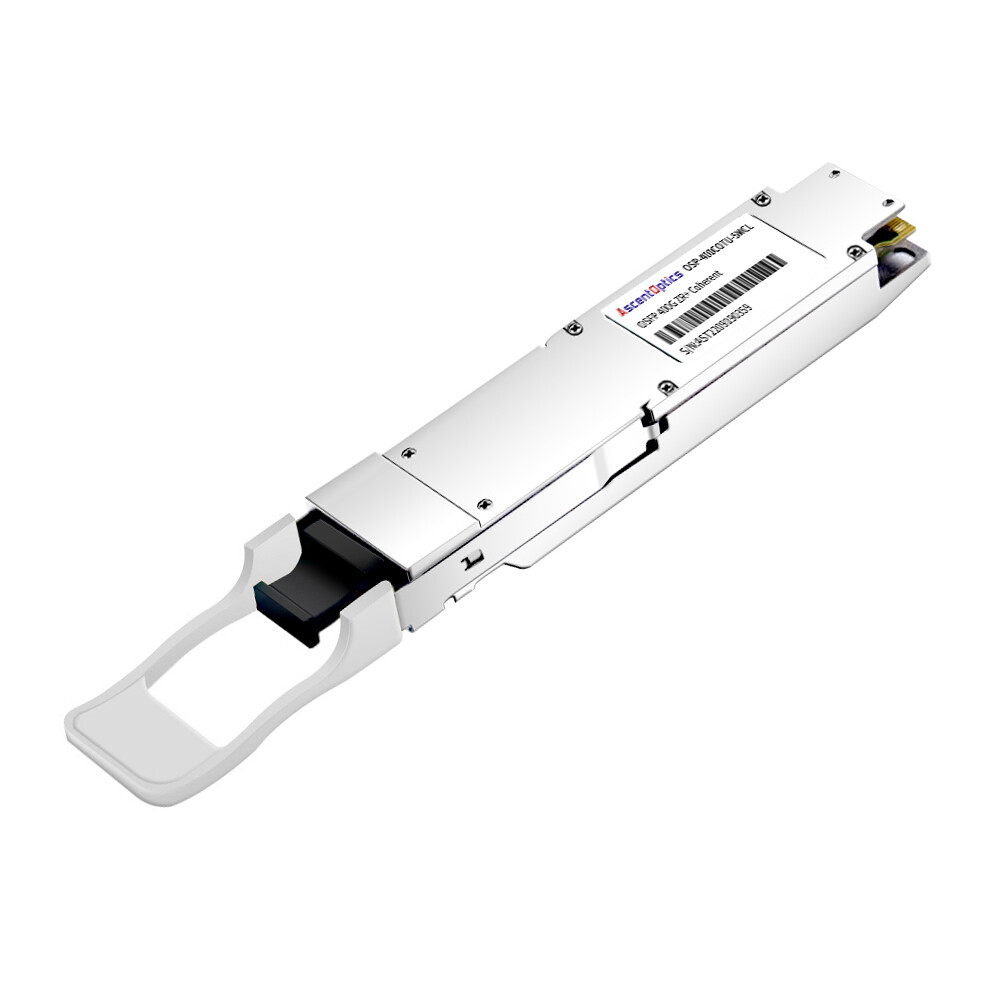
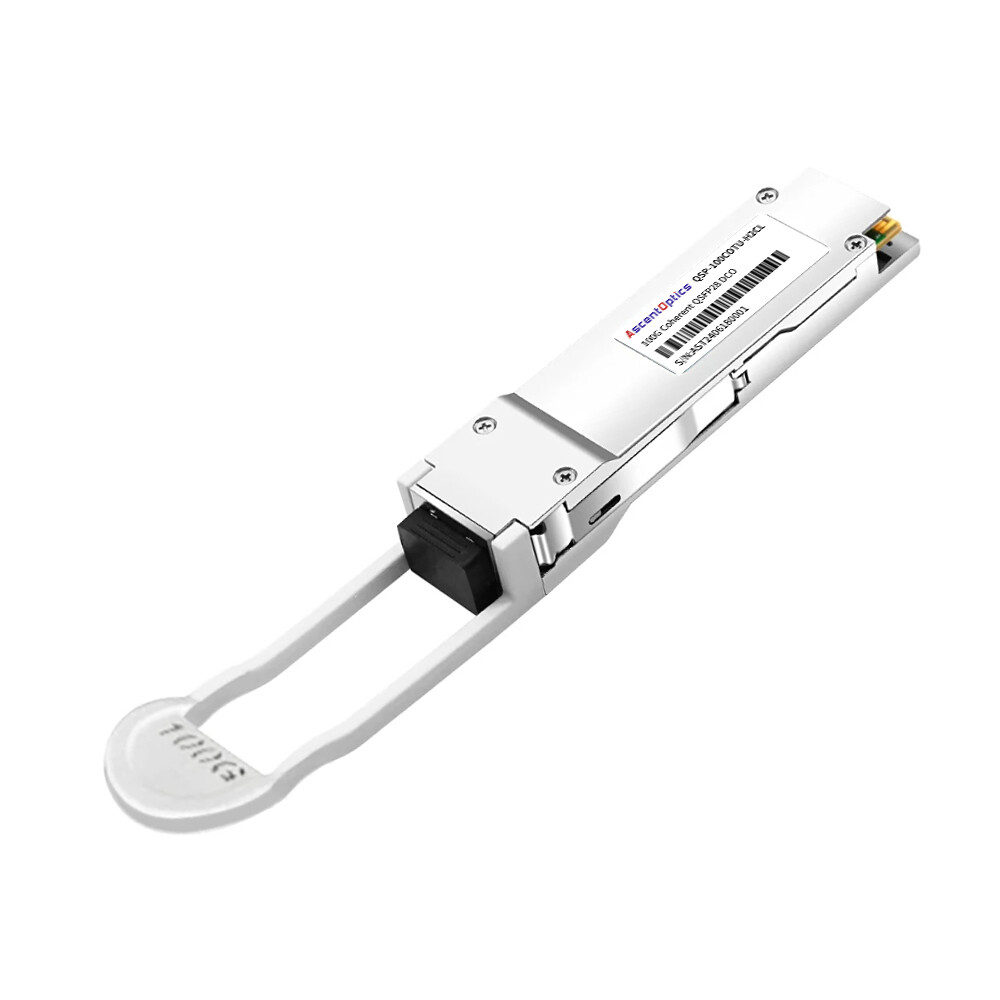
Coherent optical modules are extending from long-haul backbone networks into metro, DCI, and even edge networks, supporting high-density 400G/800G transmission. For network engineers, this entails managing greater complexities regarding chromatic dispersion, nonlinear effects, and DP-QPSK/16QAM modulation schemes. Mastering the operational logic of these modules is a core competency for managing the high-bandwidth, low-latency intelligent optical networks of the future.
This guide explores the key coherent optical module applications, explains how these solutions are used across different network scenarios, and provides practical guidance for selecting the right coherent optical technology.
Learn more about coherent optical modules and how coherent detection works.
What Are Coherent Optical Modules?
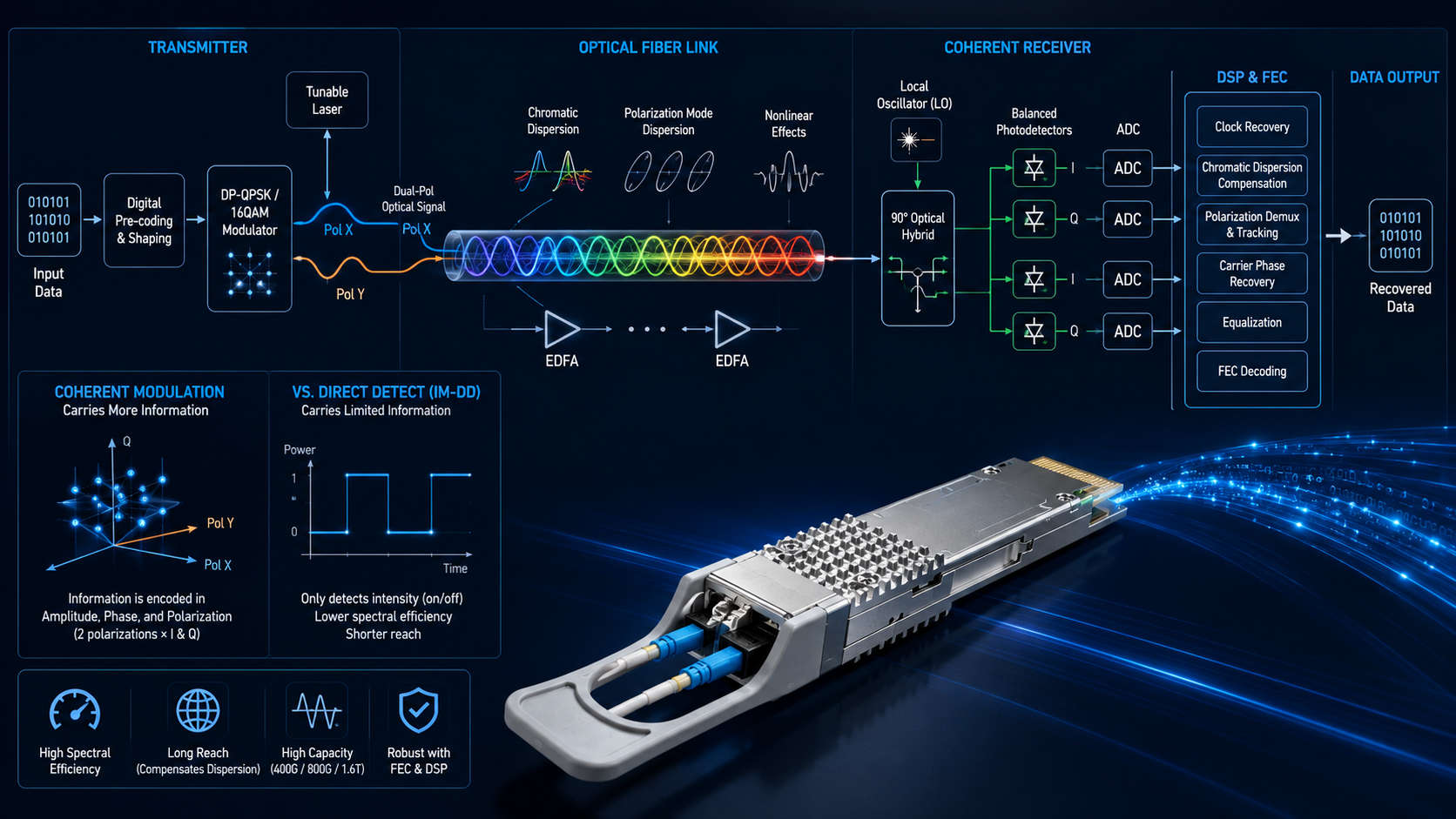
A coherent optical module is an advanced optical transceiver that encodes data onto the amplitude, phase, and polarization of light. It uses a coherent receiver with a local oscillator, analog-to-digital converters, and a digital signal processor (DSP) to recover the transmitted signal. Forward error correction (FEC), tunable lasers, and advanced modulation formats such as QPSK and 16-QAM allow these modules to compensate for fiber impairments like chromatic dispersion and polarization-mode dispersion.
In simpler terms, direct-detect modules read whether a light pulse is on or off. Coherent modules read the full waveform. That is why a coherent optical transceiver can deliver much higher spectral efficiency and longer reach than an intensity-modulation direct-detect (IM-DD) module.
According to, Coherent optics can deliver up to roughly 80 times the capacity of simple on-off keying over the same fiber pair. That capacity advantage makes coherent technology essential for high-bandwidth, long-distance optical networking infrastructure.
Compared with simple on-off keying systems, coherent optics deliver significantly higher spectral efficiency and transmission capacity by using advanced modulation formats and digital signal processing. That capacity advantage makes coherent technology essential for high-bandwidth, long-distance optical networking infrastructure.
What Are the Main Applications of Coherent Optical Modules?
The most common coherent optical module applications fall into seven categories. These range from campus data center links to transoceanic submarine cables.
- Data center interconnect (DCI): Connecting hyperscale data centers, cloud availability zones, and colocation facilities across metro and regional distances.
- Metro and regional transport networks: Aggregating traffic from access rings, enterprise customers, and mobile infrastructure across city-wide or regional fiber.
- Long-haul backbone networks: Carrying high-capacity traffic across provinces, countries, or continents using dense wavelength division multiplexing (DWDM).
- Submarine and undersea cable systems: Transmitting data across thousands of kilometers beneath oceans, where coherent optics carry roughly 99% of global data traffic.
- 5G mobile fronthaul, midhaul, and backhaul: Supporting high-capacity aggregation links from cell sites to core networks.
- Cable broadband and distributed access architecture (DAA): Extending fiber capacity for cable operators moving Remote-PHY and PON deeper into the access network.
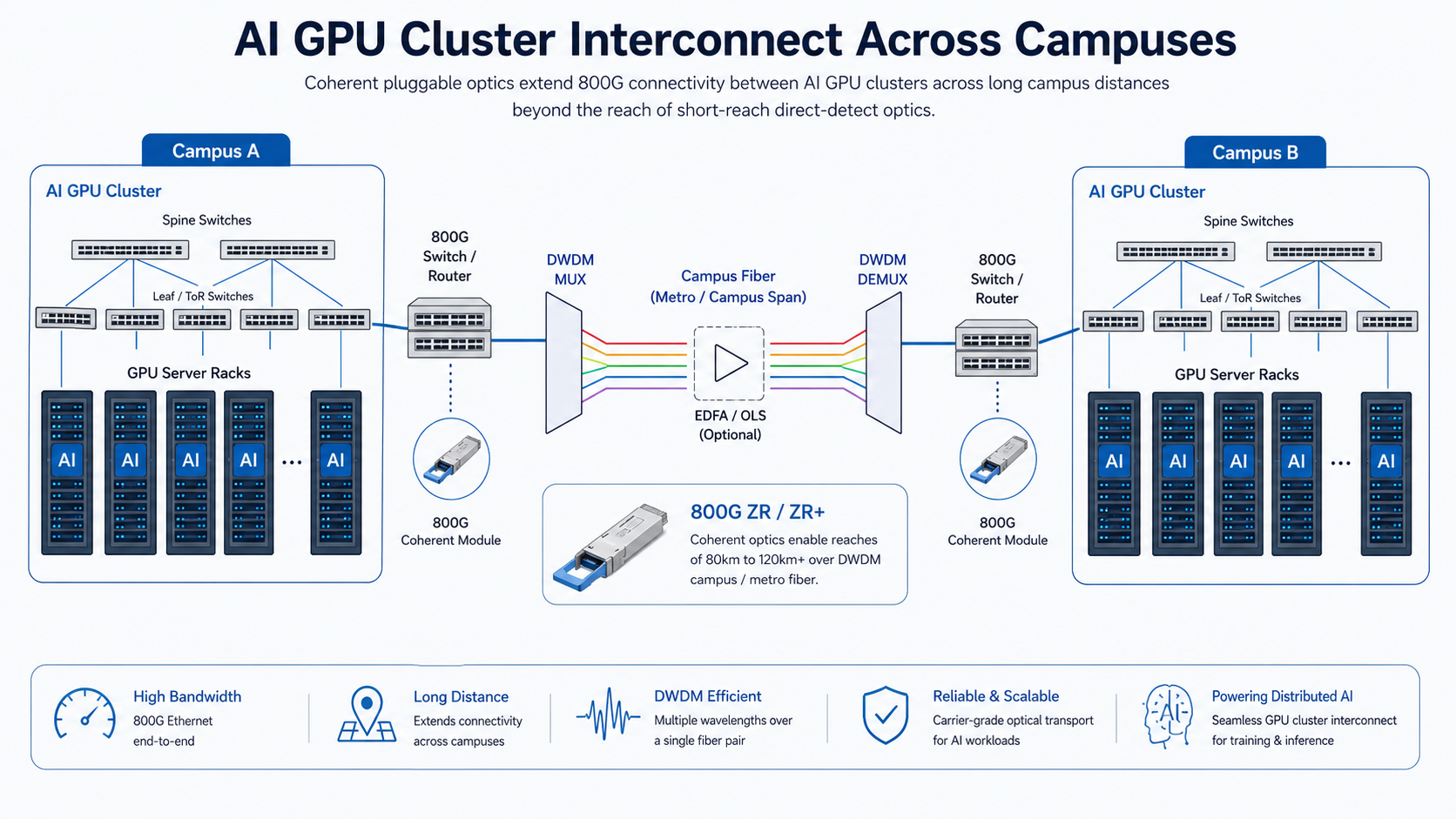
- AI/ML cluster interconnect and campus networks: Linking GPU clusters and AI training fabrics across buildings or metro areas with 800G coherent pluggables.
If your project fits one of these categories, coherent optics is likely on your shortlist.
Application Deep Dive: Where Coherent Modules Excel
Data Center Interconnect (DCI)
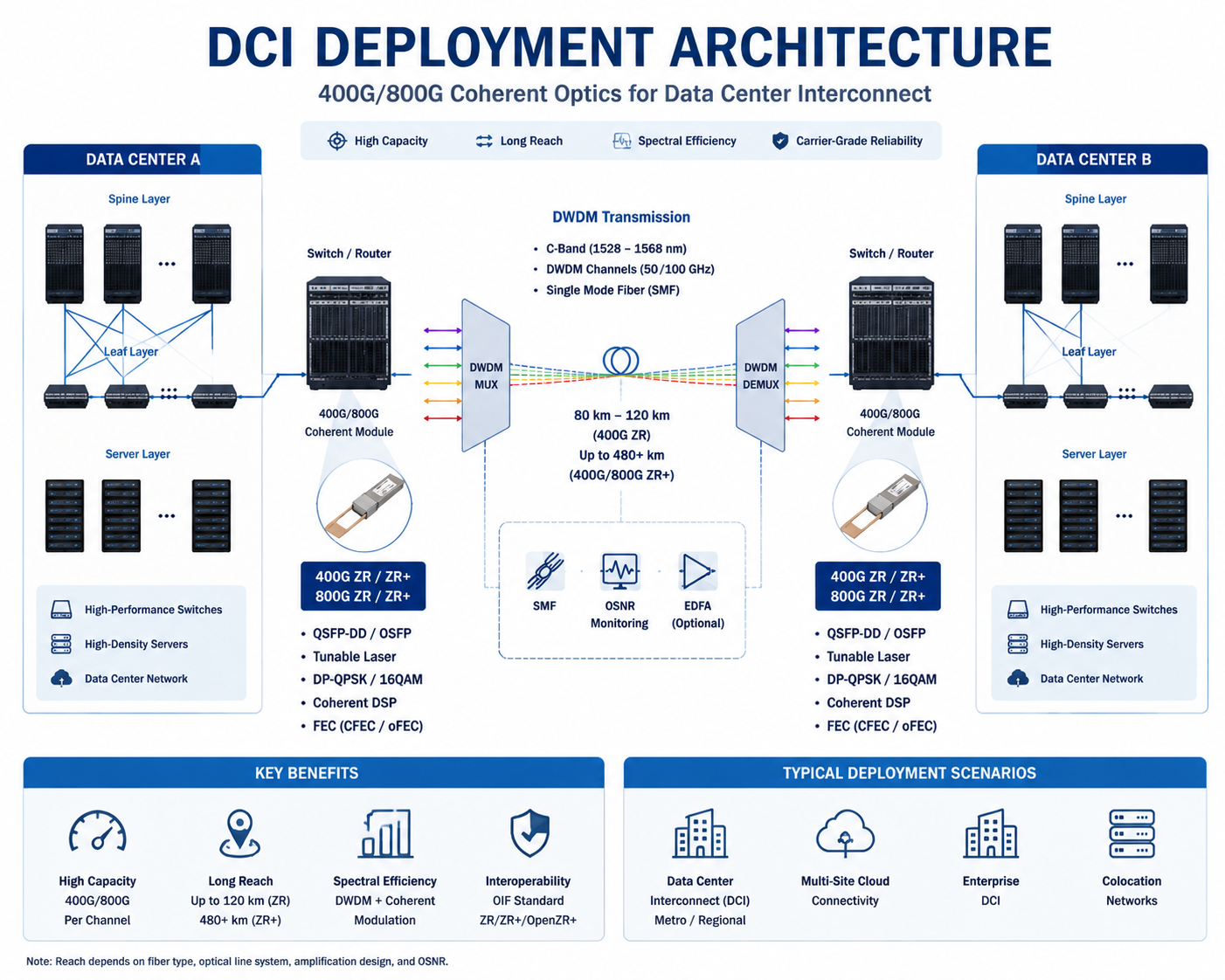
DCI is the largest and fastest-growing application for coherent optical modules. Cloud providers, content delivery networks, and enterprises use coherent pluggables to connect geographically separated data centers without deploying separate DWDM transponders.
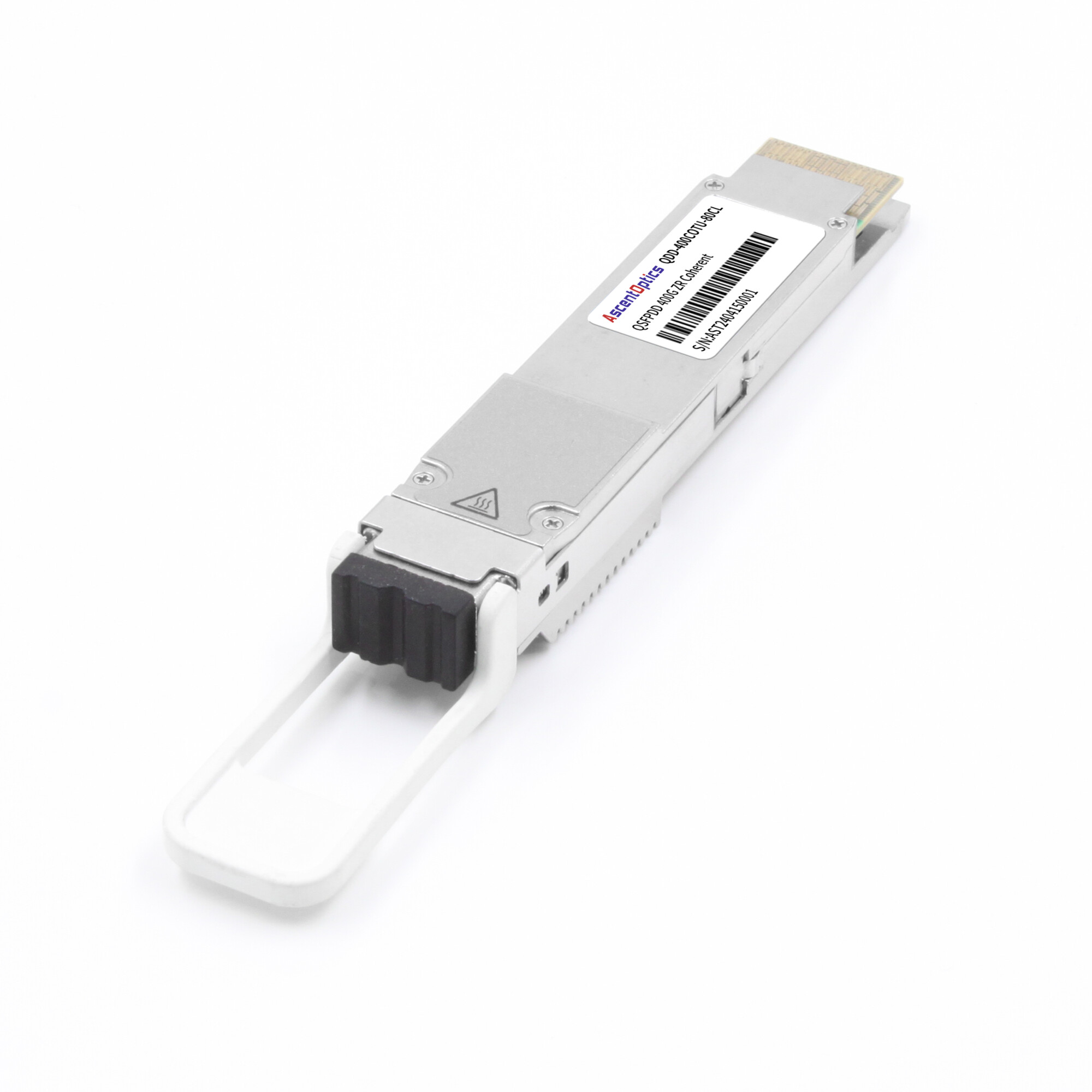
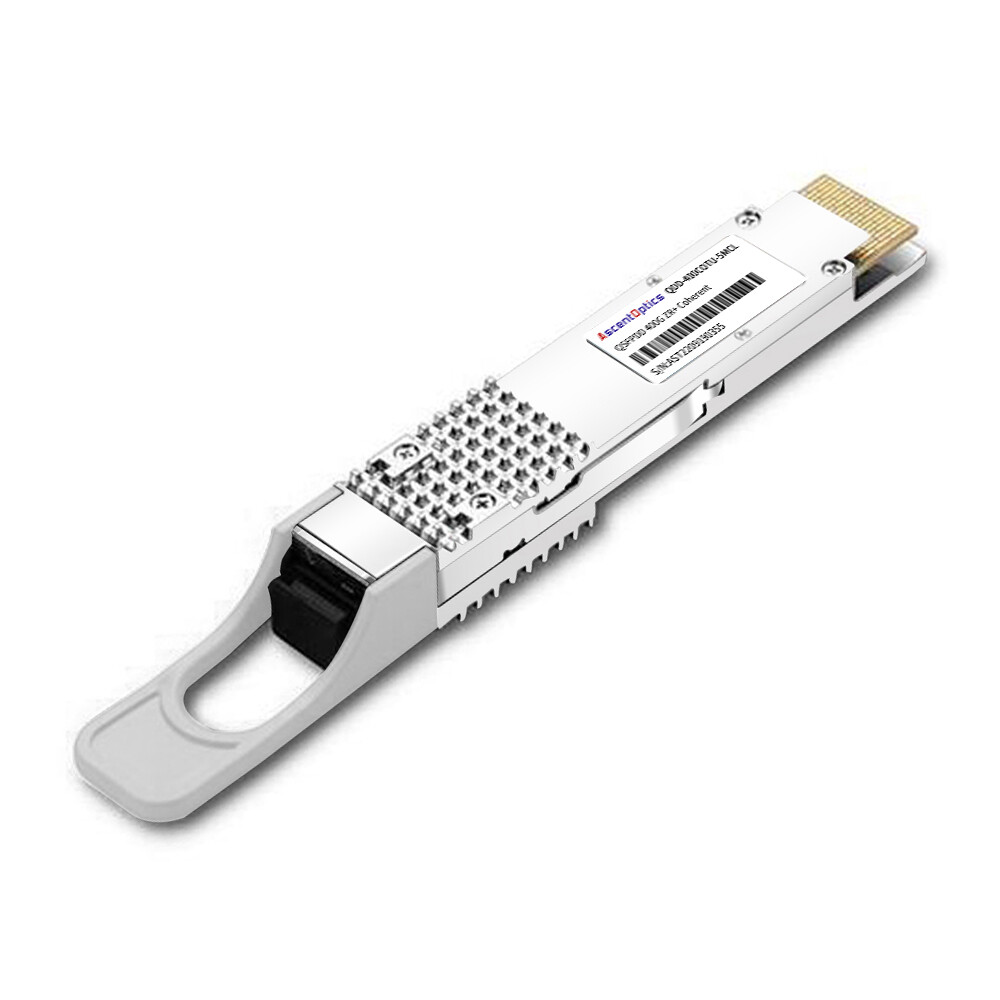
400G ZR QSFP-DD modules have become one of the most widely deployed solutions for metro DCI applications because they provide standardized interoperability and simplified deployment.
The Optical Internetworking Forum (OIF) standardized 400G ZR to ensure multi-vendor interoperability, which simplifies procurement and reduces vendor lock-in. For longer regional links, 400G OpenZR+ extends reach to roughly 480 kilometers or more by using configurable modulation and more powerful open FEC. Actual reach depends on modulation format, FEC, optical line system, amplifier design, and OSNR.
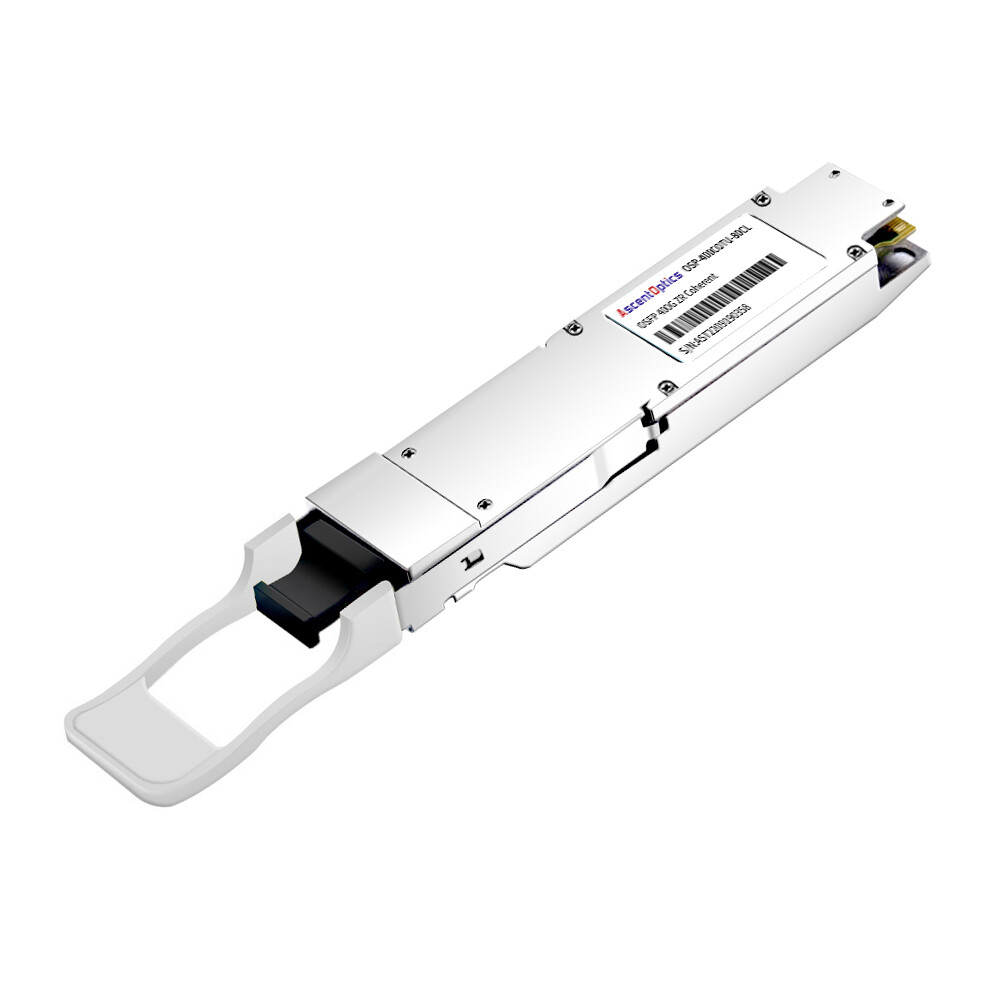
800G ZR and ZR+ modules are now entering volume deployment for next-generation DCI and AI cluster interconnect. These modules use QSFP-DD112 or OSFP form factors and are particularly attractive where switch port density and power envelope allow.
Metro and Regional Networks
Telecom operators and service providers use coherent optics to build metro rings, regional backbones, and aggregation networks. In these environments, reach typically spans 40 to 120 kilometers, but traffic must be groomed across multiple wavelengths and ROADM nodes.
100G and 200G coherent modules are common in older metro deployments, while 400G is becoming the standard for new builds. CFP2-DCO modules remain popular because their larger form factor provides greater thermal headroom and supports high-performance coherent optics for transport applications. However, QSFP-DD DCO modules are gaining ground in router-based IP-over-DWDM designs where operators want pluggable simplicity.
The key advantage in metro networks is spectral efficiency. Coherent modulation lets operators pack 400G or 800G wavelengths into existing DWDM grids without laying new fiber. That matters because fiber construction permits in urban areas are expensive and time-consuming.
Long-Haul Backbone and Submarine Networks
Long-haul coherent transceivers and transponders are designed for distances from 500 to over 2,000 kilometers on terrestrial networks and 5,000-plus kilometers on submarine cables. These systems use high-performance DSPs, advanced FEC, and sometimes Raman amplification to maintain signal integrity across vast distances.
CFP2-DCO and embedded coherent transponders dominate this space. They consume more power than pluggable DCI modules, but they deliver the optical margin and configurability that long-haul networks require. Submarine cable operators in particular rely on coherent technology because undersea systems must maximize capacity per fiber pair while operating reliably for decades.
5G Transport and Cable Broadband
5G networks require far more backhaul capacity than previous mobile generations. A single 5G macro site can generate multiple 10 Gbps streams, and midhaul links between distributed units and central units must carry synchronized, low-latency traffic. Coherent 100G and 200G modules are increasingly used in aggregation rings where distances exceed what 25G or 50G direct-detect optics can economically cover.
In many fronthaul deployments, direct-detect optics remain the preferred solution because of strict latency and synchronization requirements, while coherent optics are primarily used for aggregation, midhaul, and backhaul networks.
Cable operators face a similar challenge as they move to Distributed Access Architecture (DAA). Remote-PHY devices and high-split PON systems push fiber deeper into neighborhoods, creating high-capacity point-to-point DWDM links between hubs and fiber nodes. Coherent pluggables offer a way to scale those links without overbuilding the access network.
AI/ML Cluster Interconnect
AI training clusters are creating a new class of coherent optical module applications. When a hyperscaler needs to connect GPU clusters across multiple buildings or campuses, the distance often exceeds the reach of direct-detect 800G modules. Coherent 800G ZR and ZR+ modules provide the bandwidth and reach to build larger AI fabrics without relocating expensive compute resources.
Reports that 800G coherent pluggable optics are being deployed in routed optical networking designs for AI and cloud fabrics. These modules combine the density of pluggable form factors with the long reach of coherent detection, making them ideal for campus and metro AI cluster interconnect.
Here is where the technology is heading. According to Cignal AI, coherent module revenue neared $6 billion in 2025, and telecom coherent bandwidth grew more than 40% year-over-year. The firm expects even faster growth in 2026 as 400ZR+, 800ZR, and emerging 1.6T modules ramp.
Coherent Module Form Factors and Standards
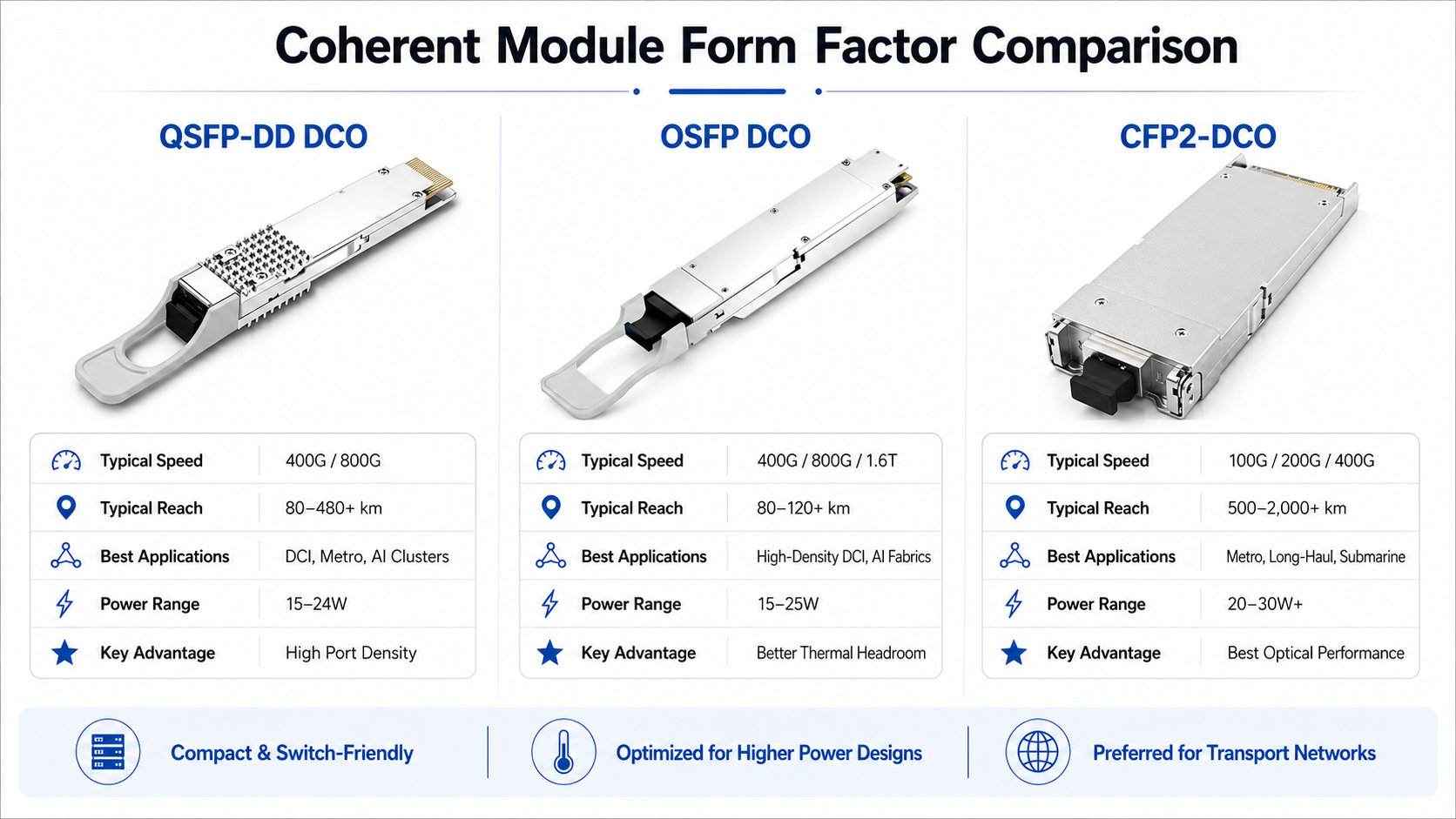
Choosing the right form factor is as important as choosing the right application. The three main options today are QSFP-DD DCO, OSFP DCO, and CFP2-DCO.
| Form Factor |
Typical Speed |
Typical Reach |
Best Applications |
Power Range |
| QSFP-DD DCO |
400G / 800G |
80–480+ km |
DCI, metro, AI clusters |
15–24W |
| OSFP DCO |
400G / 800G / 1.6T |
80–120+ km |
High-density DCI, AI fabrics |
15–25W |
| CFP2-DCO |
100G / 200G / 400G |
500–2,000+ km |
Metro, long-haul, submarine |
20–30W+ |
QSFP-DD DCO modules are backward-compatible with the QSFP ecosystem and fit into existing switch and router cages. They are the preferred choice for 400G ZR and OpenZR+ deployments where port density matters.
OSFP provides greater thermal headroom for high-power coherent modules and is expected to play an increasingly important role in future 800G and 1.6T coherent deployments.
CFP2-DCO modules are larger and consume more power, but they deliver superior optical performance for telecom transport platforms and long-haul line systems. If your application involves ROADM networks, amplified spans, or submarine cables, CFP2-DCO is usually the safer choice.
The standards landscape also matters. 400G ZR is an OIF standard optimized for simple point-to-point DCI links up to about 120 kilometers. OpenZR+ is a multi-source agreement that adds multi-rate support, longer reach, and compatibility with amplified line systems. 800ZR is the emerging follow-on for 800G coherent pluggables.
How to Choose the Right Coherent Optical Module for Your Application
When engineers call our team at AscentOptics, they usually start with one of five questions. Answering these questions will narrow the field quickly.
1. What is the required reach?
Direct-detect optics are usually cheaper for links under 10 kilometers. Between 10 and 80 kilometers, 100G ZR or 400G ZR may be the most cost-effective coherent option. Beyond 80 to 120 kilometers, OpenZR+ or CFP2-DCO becomes necessary.
2. What switch or router form factor is available?
A QSFP-DD port cannot accept a CFP2-DCO module. Verify the hardware platform, port type, and power envelope before selecting a module.
3. What is the power and thermal budget?
Coherent modules can draw 15 to 30 watts or more. At scale, that heat adds up. Make sure your switches, routers, and racks can handle the thermal load.
4. Is multi-vendor interoperability required?
OIF 400ZR and OpenZR+ MSA compliance improves the odds that modules from different vendors will interoperate. For closed transport systems, proprietary coherent modules may offer better performance.
5. What is the total cost-per-bit target?
A coherent module costs more upfront than a direct-detect module, but its cost per bit over distance is often lower. Calculate the five-year total cost, including fiber lease, power, cooling, and sparing.
6. Is the optical line system open or proprietary?
Verify whether the deployment uses an open line system or a vendor-specific transport platform, as this affects interoperability and supported coherent operating modes.
Coherent vs. Non-Coherent: When to Use Each
Not every link needs coherent optics. Direct-detect modules remain the right choice for many short-reach applications.
Use direct-detect optics when:
- The link is under 10 kilometers.
- Power consumption and latency are top priorities.
- The network does not require DWDM or amplification.
- Cost per module matters more than cost per bit over distance.
Use coherent optics when:
- The link exceeds 80 kilometers.
- You need 400G, 800G, or higher capacity over a single wavelength.
- The design uses DWDM, ROADMs, or amplified line systems.
- Fiber capacity is constrained and spectral efficiency matters.
- The application is long-haul, submarine, or metro/regional aggregation.
The boundary between the two technologies is shifting. Compact coherent pluggables are now competitive for some 80-kilometer links that previously used direct-detect 100G ER modules. At the same time, direct-detect 800G modules dominate in data centers, where reach is measured in meters or kilometers, not tens of kilometers. Learn more about direct-detect and coherent optics comparison.
Market Trends Driving Coherent Optical Module Demand
Several industry trends are expanding coherent optical module applications beyond traditional telecom transport.
First, AI infrastructure spending is accelerating. TrendForce forecasts that the AI optical transceiver market will reach $26 billion in 2026, up 57% year-over-year. Much of that growth comes from 800G and 1.6T modules used in AI data center networks.
Second, cloud providers are building larger DCI fabrics. As they distribute compute and storage across metro regions, they need high-capacity links that can be deployed in standard router ports. Pluggable coherent optics solve that problem without requiring dedicated optical transport platforms.
Third, 5G and fiber broadband deployments continue to push aggregation bandwidth higher. Telecom operators are upgrading access rings to 100G and 200G, and coherent optics are the most practical way to extend those speeds over existing fiber.
Finally, supply chain maturity is improving. More vendors now offer 400G ZR, OpenZR+, and 800G coherent modules, which increases competition and drives down costs. Cignal AI reported that optical component revenue reached nearly $25 billion in 2025, reflecting strong demand across datacom and telecom markets.
Conclusion
Coherent optical module applications now span nearly every part of the network, from undersea cables and national backbones to metro rings, data center interconnects, and AI cluster fabrics. The key to selecting the right module is matching reach, capacity, form factor, and power budget to the specific application.
Direct-detect optics still win on short links. Coherent optics win when distance, capacity, or spectral efficiency matters. For DCI, 400G ZR and OpenZR+ QSFP-DD modules offer plug-and-play simplicity. For telecom transport and long-haul, CFP2-DCO modules deliver the optical margin and configurability that line systems require.
800G coherent pluggables are increasingly being adopted for AI cluster interconnect across campuses and metropolitan areas, where transmission distances exceed the practical reach of direct-detect optics.
FAQ About Coherent Optical Module Applications
What are coherent optical modules mainly used for?
Coherent optical modules are primarily used in DCI, metro networks, long-haul transport, submarine communications, and AI cluster interconnects where high bandwidth and long transmission distances are required.
Can coherent optical modules replace direct-detect optics?
No. Direct-detect optics remain the preferred solution for short-reach Ethernet links because they offer lower cost, lower power consumption, and simpler deployment. Coherent optics are better suited for DWDM, metro, and long-distance networks.
Which coherent module form factor should I choose?
The choice depends on your application. QSFP-DD DCO is commonly used for 400G DCI, OSFP DCO targets higher-density 800G and future 1.6T deployments, while CFP2-DCO remains popular in metro, long-haul, and transport networks requiring greater optical performance.
Do coherent optical modules require DWDM?
Most coherent modules are designed for DWDM environments and use tunable lasers to operate on different wavelength channels. However, deployment requirements depend on the optical architecture and network design.
Post Views: 1,406