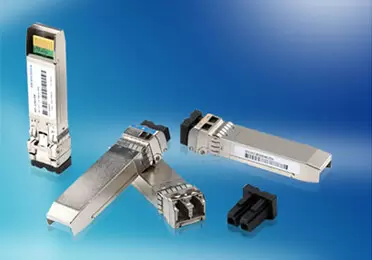
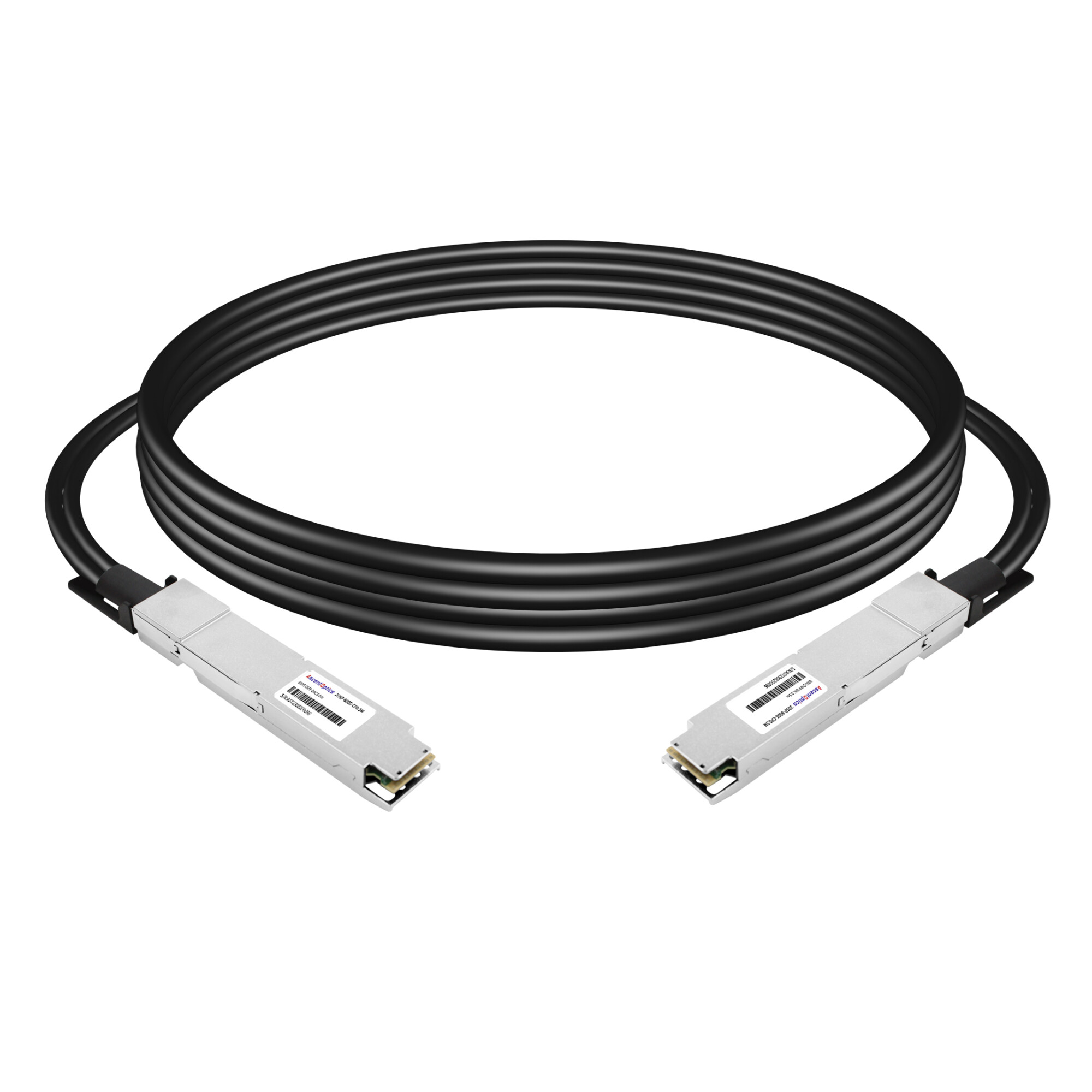
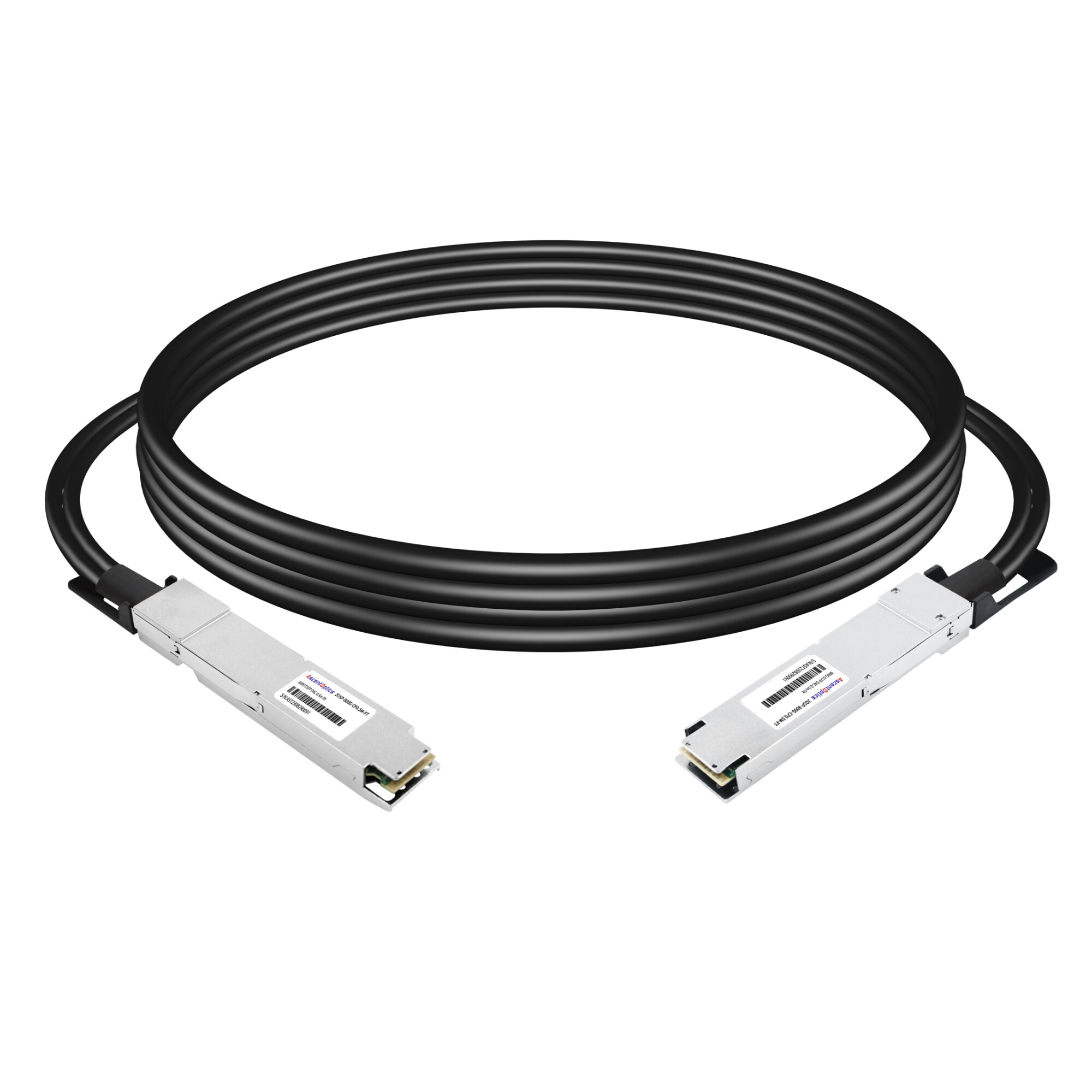
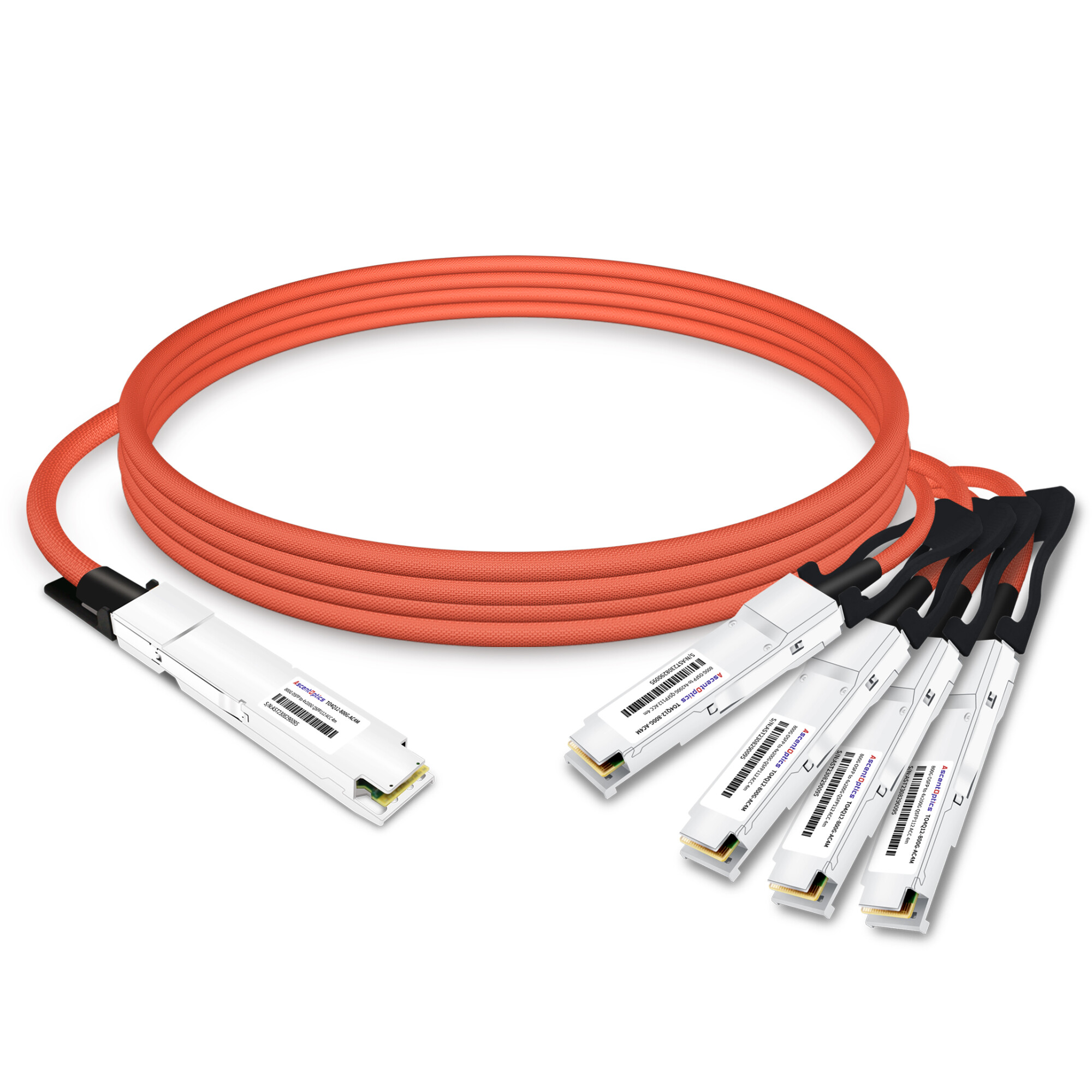
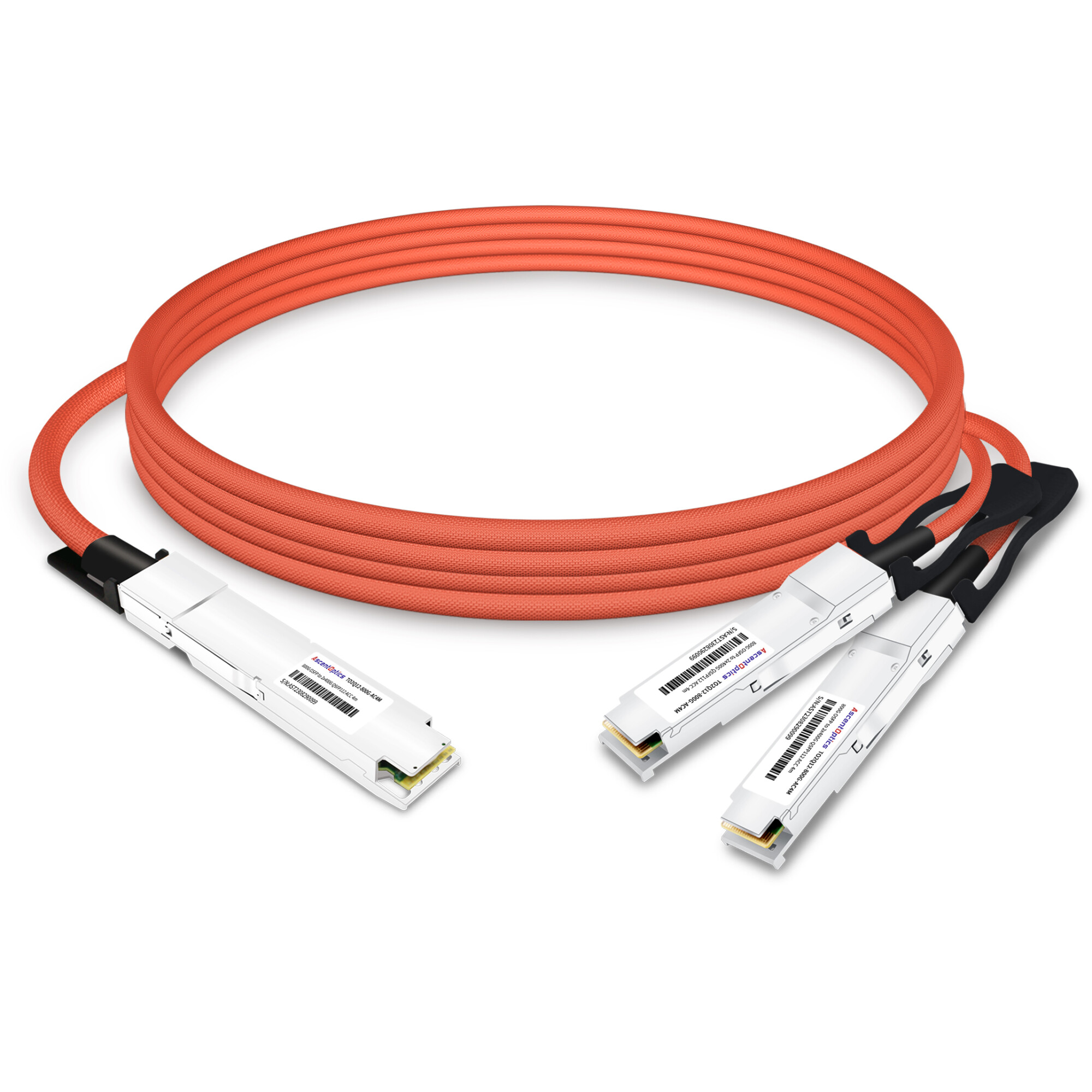
800G DACs utilize QSFP-DD800 or OSFP form factors and leverage 8×100G PAM4 technology to achieve 800Gbps transmission; passive DACs can offer power consumption as low as under 0.15W. Due to signal attenuation, the transmission distance for passive DACs at 800G speeds is limited to approximately 2–3 meters, while active DACs can extend this range to 5–7 meters. When selecting a solution, one must weigh the requirements for ultra-short-reach, low-latency connectivity within a rack against the need for slightly longer-reach connections. Thanks to their low power consumption, low latency, and cost advantages, these cables have become the primary copper-based interconnect solution for linking GPUs to Top-of-Rack (ToR) switches within AI cluster racks.
What Is an 800G DAC Cable?
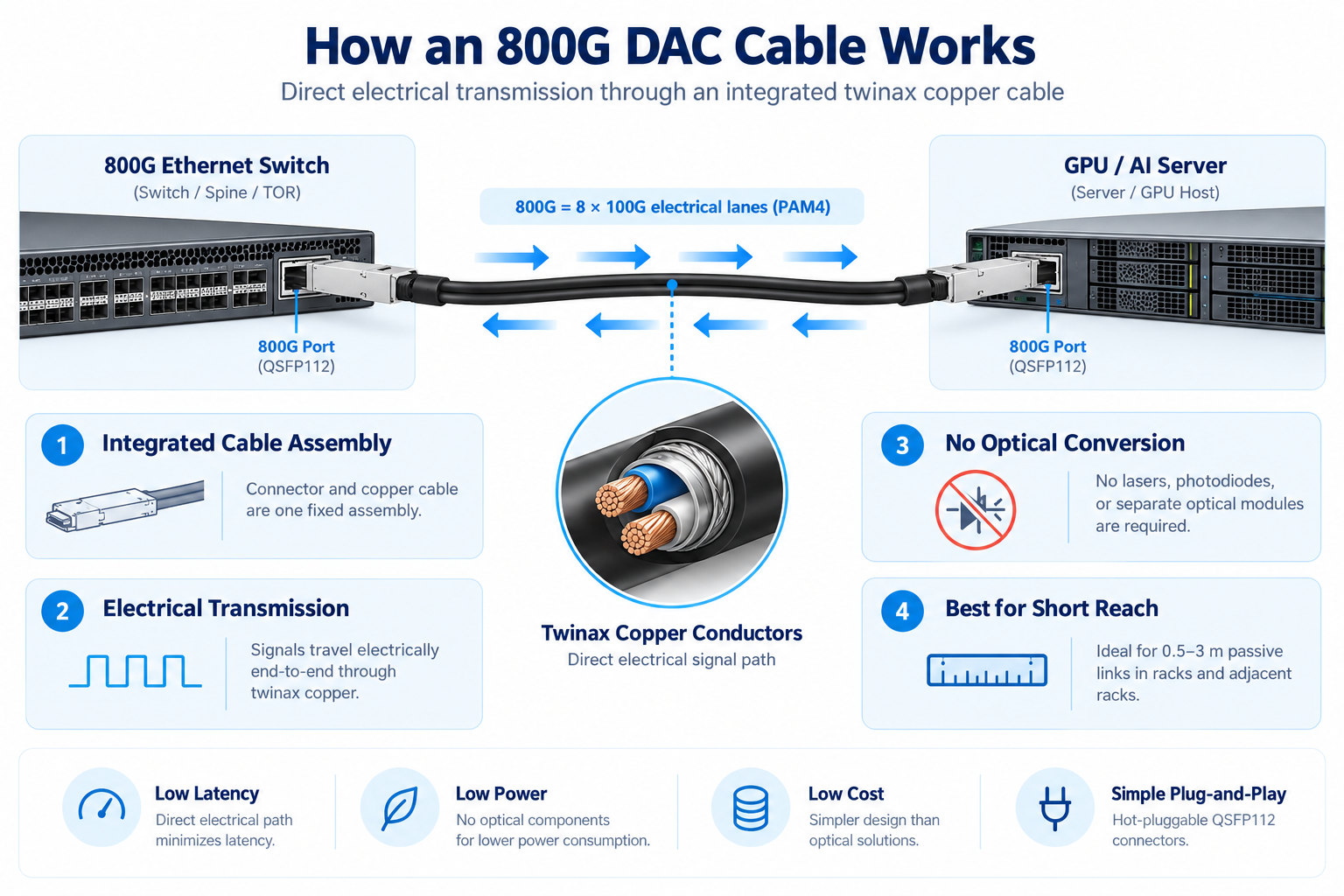
An 800G DAC cable is a fixed-length copper cable with transceiver-style connectors built onto both ends. It uses twinax copper conductors to move electrical signals directly between two ports, with no optical-to-electrical conversion anywhere in the path.
The term DAC stands for Direct Attach Copper. Unlike a pluggable optical module that needs separate fiber and cleaning, a DAC is one self-contained assembly. You plug one end into a switch, and the other into a server or another switch, and the link comes up.
Because the signal stays electrical the whole way, an 800G DAC cable delivers three things optical links struggle to match: the lowest cost per port, the lowest latency, and the lowest power draw. The tradeoff is reach. Copper loses signal integrity quickly, which is why DACs live almost entirely inside a single rack or between adjacent racks.
Key point: An 800G DAC cable is a copper interconnect with no optics. Use it where the link is short and you want minimum cost, latency, and power.
800G DAC Specifications and Standards
An 800G DAC cable isn’t a single standard product. It’s a family of cable assemblies that share the same signaling core but vary by form factor, conductor gauge, and whether they include active electronics.
Eight Lanes of 100G PAM4
At its core, 800G Ethernet is built from eight electrical lanes, each carrying 100 Gbps using PAM4 modulation. The electrical signaling rate is 112 Gbps per lane, which leaves headroom for forward error correction (FEC) overhead on top of the 100 Gbps of usable data.
The governing standard is IEEE 802.3ck, which defines 800GBASE-CR8 for copper links. This is the Ethernet baseline. The same physical DAC cables also serve high-speed InfiniBand fabrics up to XDR, so a single cable family can cover both Ethernet switching and AI/GPU cluster interconnect.
Form Factors: OSFP vs QSFP-DD800
Two form factors dominate 800G DAC cable assemblies:
- OSFP (Octal Small Form-factor Pluggable) carries eight lanes and integrates its own heatsink. It runs cooler in dense deployments and is the preferred choice for greenfield AI fabrics that plan to move toward 1.6T.
- QSFP-DD800 (Quad Small Form-factor Pluggable Double Density) also carries eight lanes but is backward compatible with QSFP ports, which makes it attractive for incremental migrations from 400G.
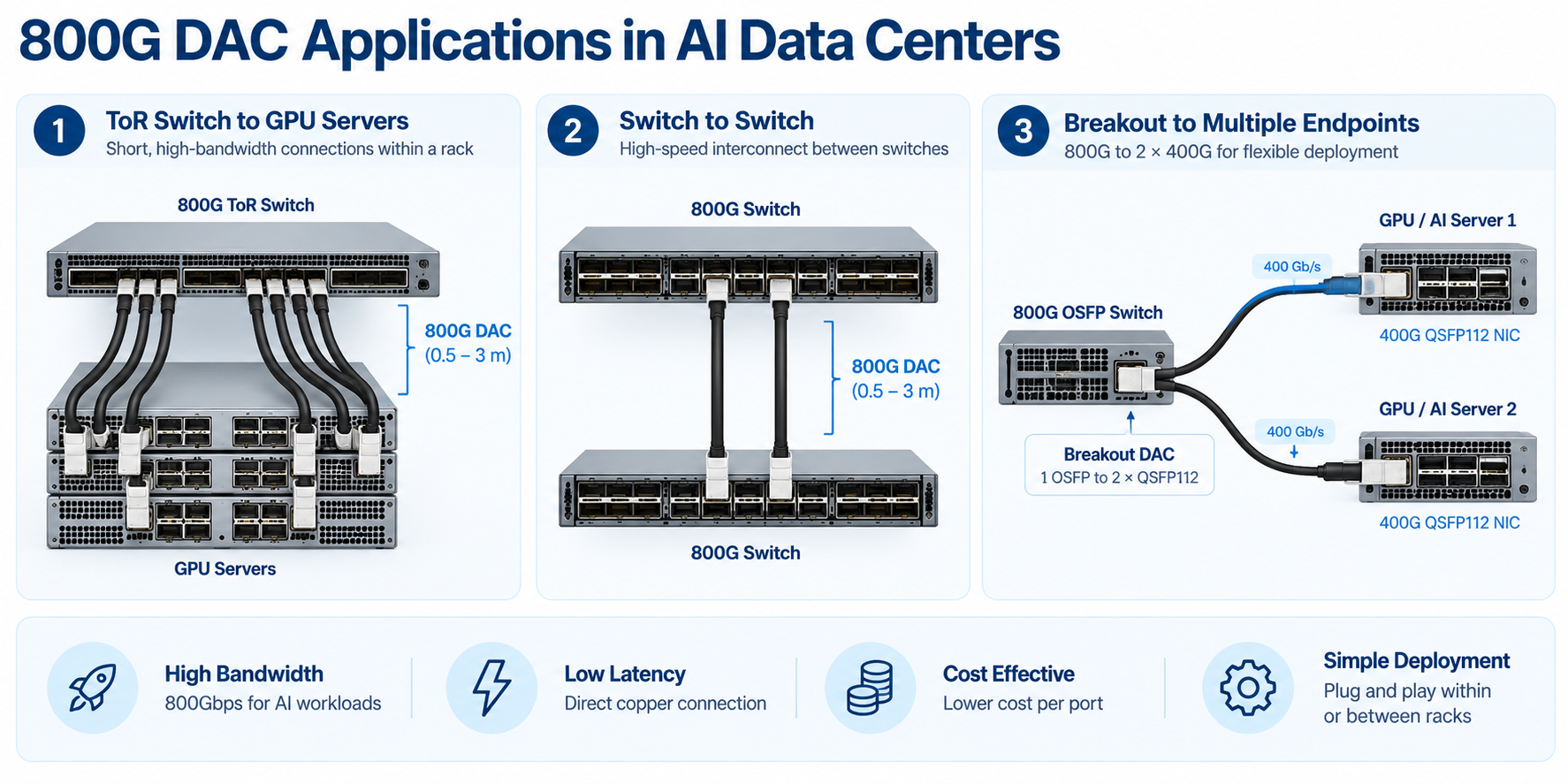
The two aren’t mechanically interchangeable without an adapter. For an 800G DAC cable, OSFP plugs into OSFP ports, and QSFP-DD800 plugs into QSFP-DD800 ports. Breakout assemblies, such as one 800G port to two 400G QSFP112 links, are also common and let you use a single high-speed port to feed multiple slower endpoints.
For a deeper look at OSFP breakout options, see our OSFP breakout cable guide.
Passive vs Active DAC vs AEC
The single biggest choice when selecting an 800G DAC cable is whether it should be passive or active.
- Passive DAC has no signal-conditioning electronics. The host equipment handles equalization. This keeps cost and power near zero, but limits reach to roughly 2 to 3 meters depending on conductor gauge.
- Active copper cable (ACC) includes active signal-conditioning circuitry, such as equalization, to help extend reach. The implementation and power draw vary by product.
- Active electrical cable (AEC) typically uses retiming or other active electronics to improve signal integrity over a longer copper reach. Architecture, reach, and power depend on the specific design.
AWG and Maximum Reach
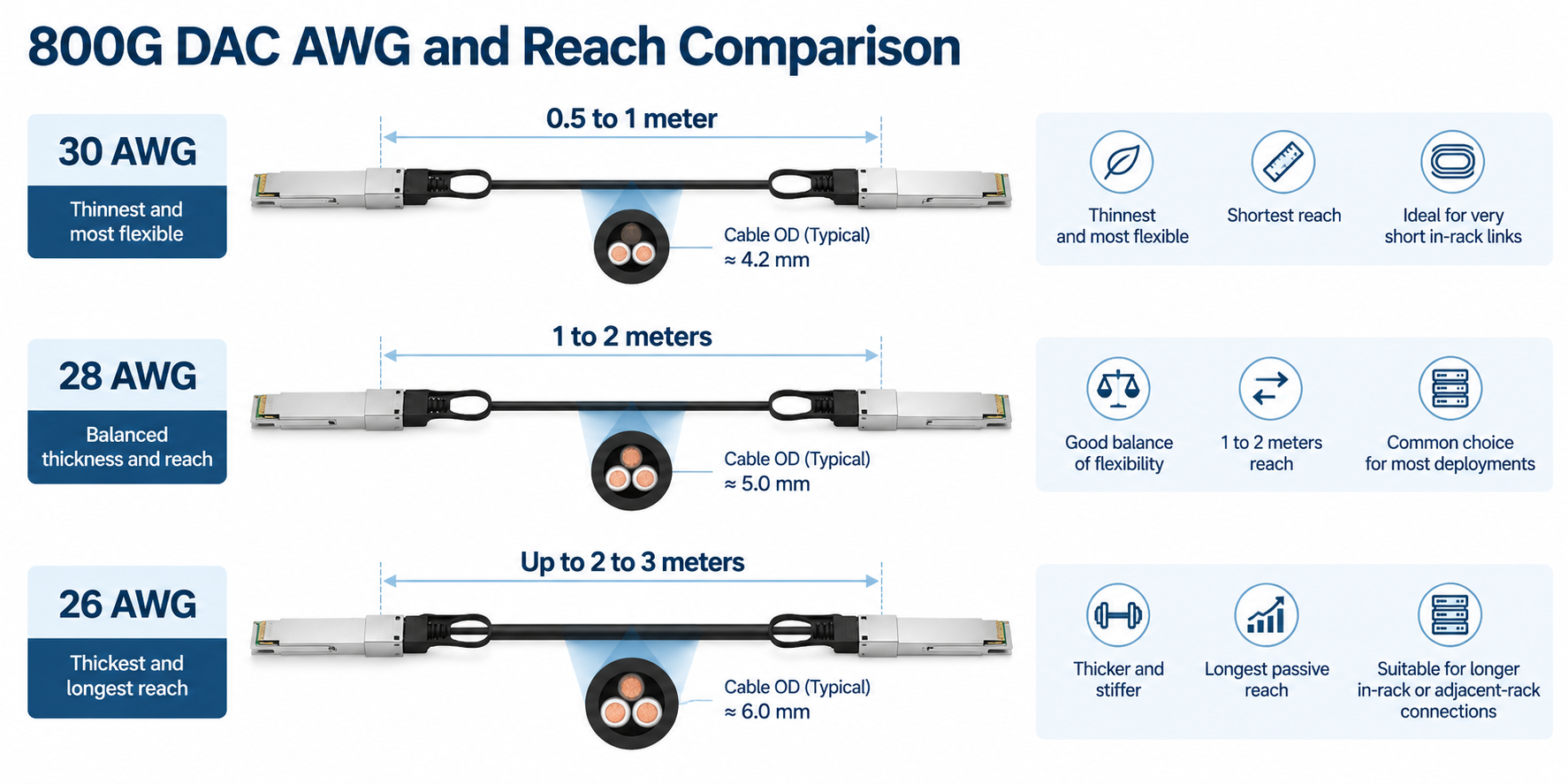
Reach on a passive 800G DAC cable is governed by conductor thickness, measured in American Wire Gauge (AWG). A lower AWG number means a thicker conductor, which carries a signal farther but makes the cable heavier and harder to manage in a dense rack.
| Gauge |
Typical Reach (Passive) |
Tradeoff |
| 30 AWG |
0.5 to 1 meter |
Thinnest and most flexible; shortest reach |
| 28 AWG |
1 to 2 meters |
Balanced thickness and reach |
| 26 AWG |
Up to 2 to 3 meters |
Longest passive reach; thickest and stiffest |
This is the table most buyers actually need. If your ToR switch sits directly above the servers, a 30 AWG passive cable is often enough. If the cable has to route through cable managers to reach a lower server, you may need 26 AWG or an active DAC.
800G DAC vs AOC vs Optical Transceiver
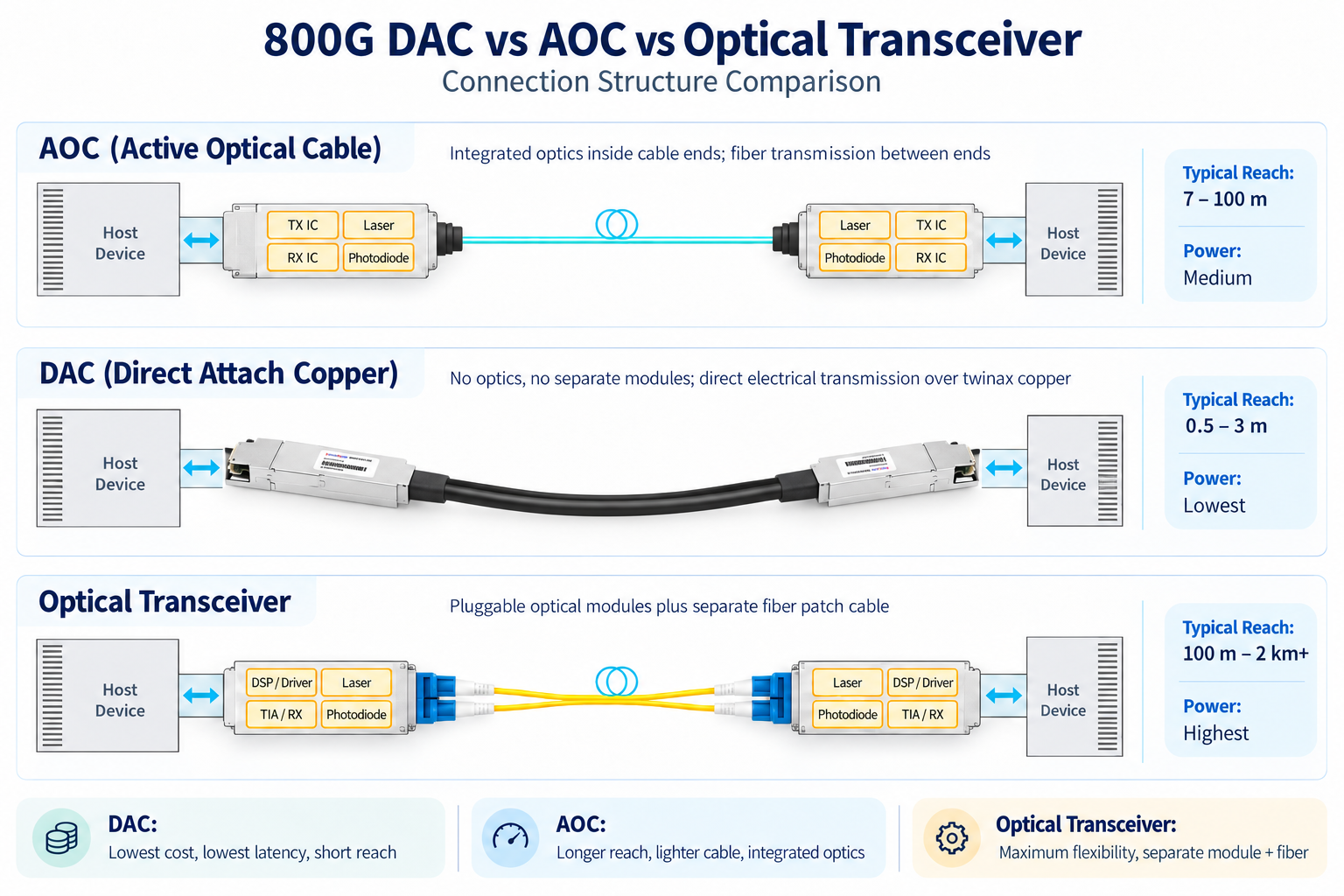
The decision between an 800G DAC cable, an AOC, and a pluggable optical transceiver comes down to distance, power, and cost. Here is how they compare for a typical 800G link:
| Attribute |
Passive DAC |
Active DAC / AEC |
AOC |
Optical Transceiver |
| Reach |
0.5 to 3 m |
3 to 7 m |
7 to 100 m |
100 m to 2 km+ |
| Power per end |
<0.15W |
~1.5W |
~12 to 20W |
~14 to 20W |
| Latency |
Lowest |
Very low |
Low |
Low |
| Cost per port |
Lowest |
Low |
Medium |
Highest |
| Weight/flexibility |
Heavy, stiff |
Heavy, stiff |
Light, flexible |
Lightest (module + fiber) |
Takeaway: for intra-rack links, a passive 800G DAC cable is the cheapest and most efficient option by a wide margin. As soon as you leave the rack, power and cost flip in favor of AOC and then optical modules.
For a complete DAC versus AOC comparison, read our 800G DAC and AOC cables guide.
How to Choose an 800G DAC Cable
Choosing the right 800G DAC cable means working through four decisions in order: length, form factor, power, and compatibility.
Start With Length and AWG
Measure the actual routing distance, not the straight-line distance between ports. Cable managers, vertical trays, and slack all add length.
Then apply this rule:
- Under 1 meter: use 30 AWG passive for the thinnest, most manageable cable.
- 1 to 2 meters: use 28 AWG passive for a balance of reach and flexibility.
- 2 to 3 meters: use 26 AWG passive, or step up to an active DAC if routing is tight.
- Beyond 3 meters: move to an active DAC, an AEC, or an AOC.
Pick the Form Factor for Your Platform
Your switch port dictates the form factor. An 800G DAC cable isn’t universal across OSFP and QSFP-DD800.
Choose OSFP when you are building a new high-density AI fabric and value thermal headroom, or when you plan to move toward 1.6T. Choose QSFP-DD800 when you are extending an existing QSFP environment and want backward compatibility and easier migration from 400G.
If you need to connect an 800G port to multiple lower-speed endpoints, look at breakout assemblies. Our QSFP cable guide covers DAC, AOC, and breakout configurations in detail.
Budget for Power and Thermals
Power is where a passive 800G DAC cable wins decisively. At under 0.15W per end, a passive DAC is essentially free from a power and cooling standpoint. An active DAC costs about 1.5W per end, still trivial. AOCs and optical modules run an order of magnitude higher.
If you’re deploying hundreds or thousands of short links, passive DACs are one of the few decisions that improve both capital and operational cost at the same time.
Verify Compatibility and FEC
An 800G DAC cable is simpler than an optical module, but it’s not immune to compatibility issues. Confirm three things before you commit:
- 1. Form factor and host support. The switch must support your cable’s OSFP or QSFP-DD800 interface.
- 2. FEC settings. 800G links rely on FEC, and the FEC mode must match on both ends. Most modern switches handle this automatically, but mismatches cause links to train down or fail.
- 3. Brand compatibility. Third-party DACs should follow MSA and IEEE standards. Ascent Optics builds 800G DAC cables to these standards, so they integrate with mainstream switch platforms.
800G DAC Applications in AI and Data Centers
The 800G DAC cable earns its keep in two places: the short hop from a top-of-rack switch to its servers, and the dense interconnect inside AI and HPC clusters.
Top-of-Rack Switch to Server
This is the classic DAC use case. A ToR switch connects to 20 to 40 servers in the same rack over 0.5 to 2 meter links. Passive 800G DAC cables are the default here because they cost the least, draw almost no power, and add no latency.
GPU Clusters and HPC Interconnect
AI clusters connect GPUs to switches over short links, and every watt of power saved on the interconnect is a watt available for compute. DACs sit between rack training switches and GPUs, where links are short, and density is extreme. The same cable family supports InfiniBand fabrics up to XDR, which is why one 800G DAC cable can serve both Ethernet and HPC roles. For more on InfiniBand cable selection, see our InfiniBand cable types guide.
Frequently Asked Questions About 800G DAC
What distance can an 800G DAC cable support?
A passive 800G DAC cable typically reaches 0.5 to 3 meters, depending on conductor gauge. An active DAC extends this to roughly 5 to 7 meters. Beyond that, use an AOC or an optical transceiver with fiber.
What is the difference between passive and active 800G DAC?
A passive 800G DAC cable has no signal-conditioning electronics, so it draws near-zero power but is limited to short reach. An active DAC adds an equalizer or retimer chip that extends reach to about 5 to 7 meters at roughly 1.5W per end.
Is an 800G DAC cable compatible with InfiniBand?
Yes. The physical cable supports high-speed InfiniBand fabrics up to XDR in addition to 800G Ethernet, provided the host ports and FEC settings are compatible.
What form factor should I choose for 800G DAC?
Choose OSFP for new high-density AI fabrics and thermal headroom. Choose QSFP-DD800 for backward compatibility and incremental migration from 400G QSFP environments.
Post Views: 135