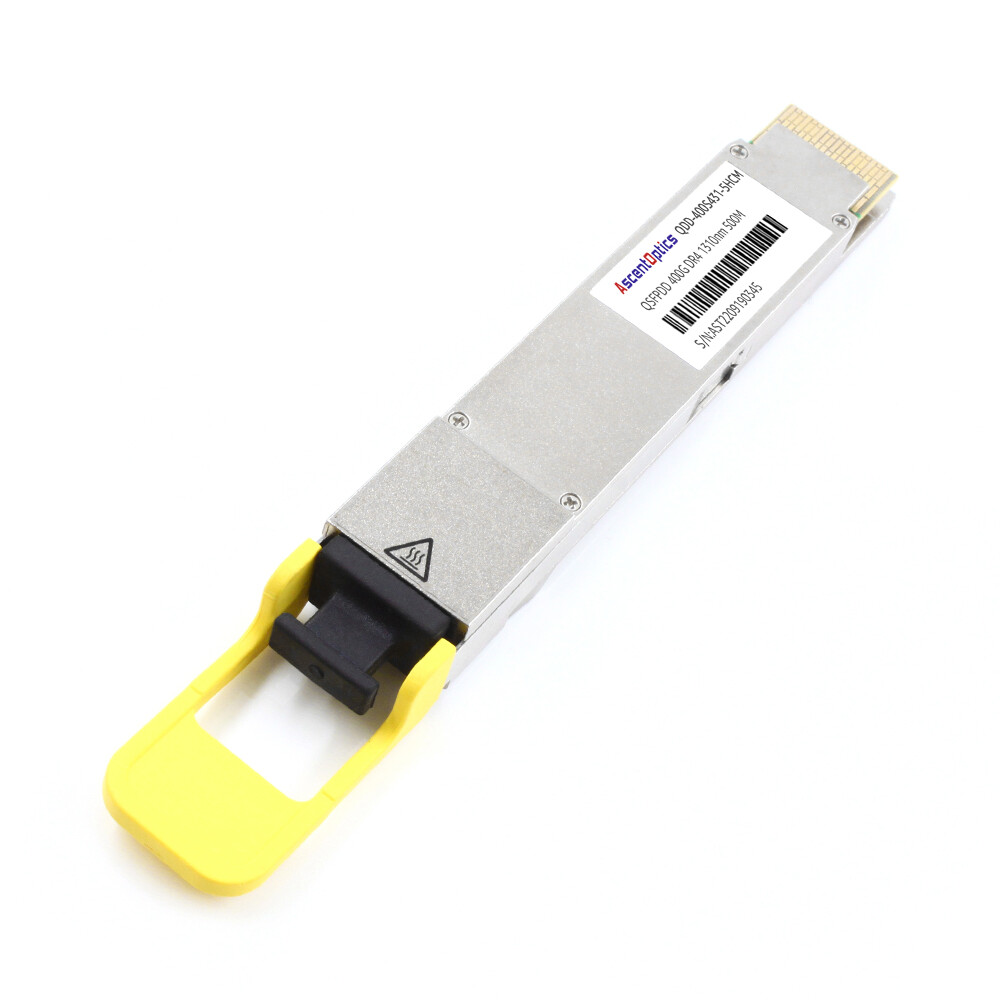
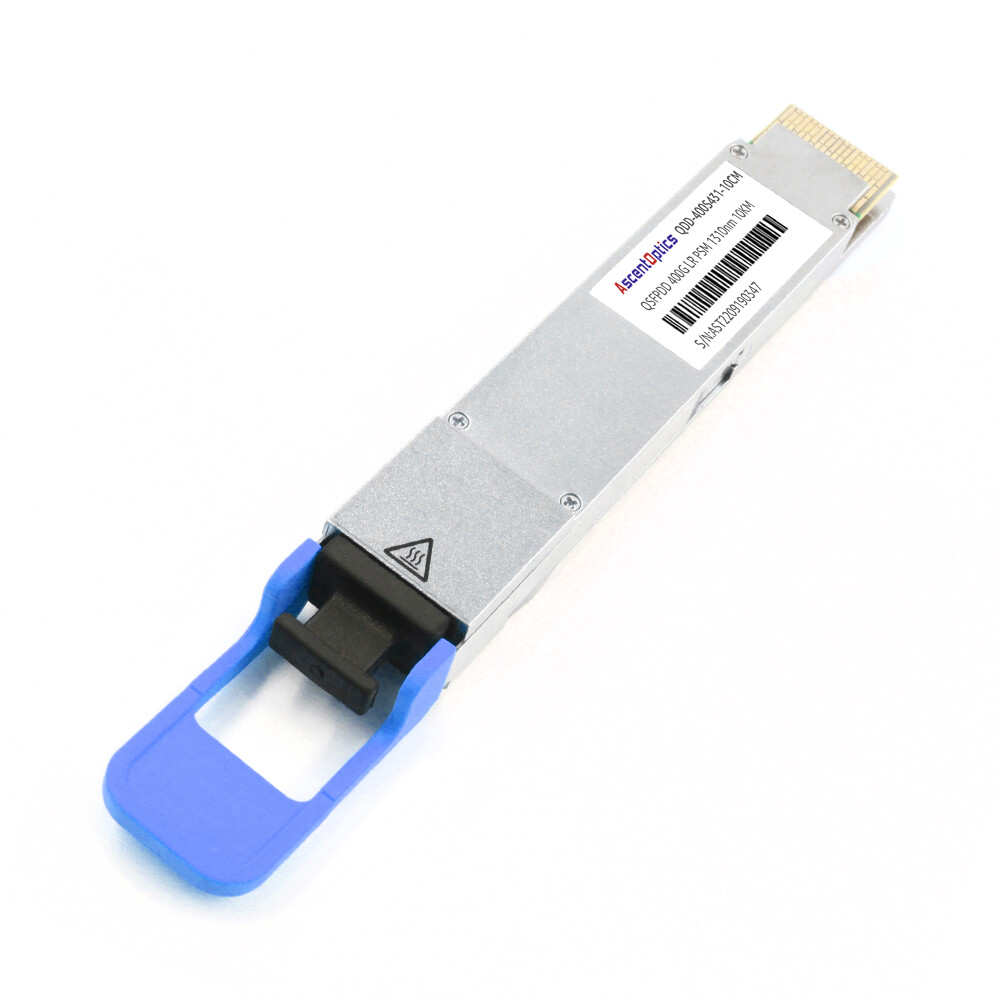
PAM4 and coherent optics represent two distinct technical approaches to optical transmission. PAM4 modulates only the light intensity—encoding data using four distinct levels—and, thanks to its low cost and low power consumption, has become the dominant solution for short- to medium-reach interconnections within data centers. Coherent optics, by contrast, manipulates the amplitude, phase, and polarization of light; it offers higher spectral efficiency and is designed for long-haul and backbone network transmission. Rather than being mutually exclusive alternatives, the two technologies serve as complementary solutions, stratified according to transmission distance and cost requirements.
What Is PAM4 Modulation?
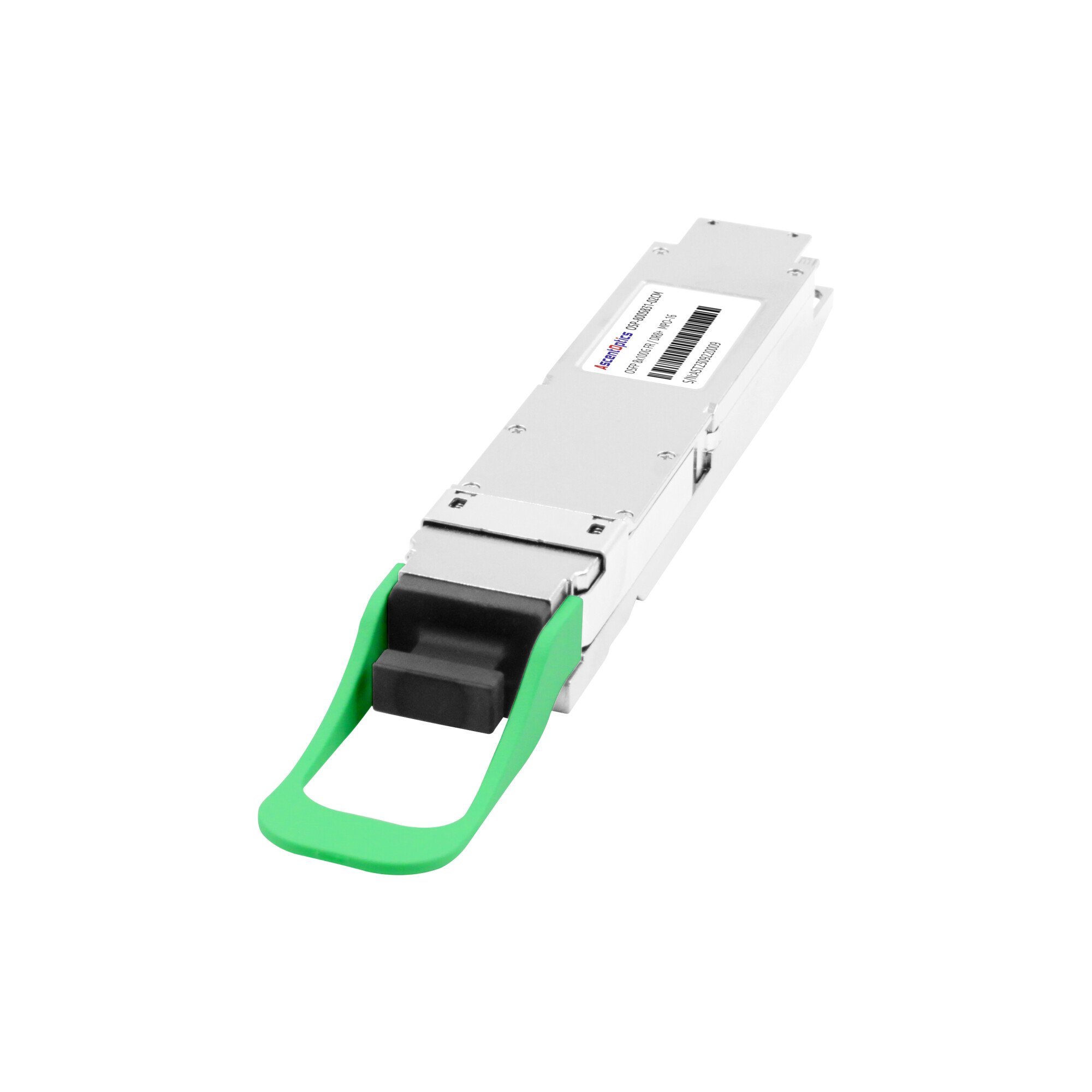
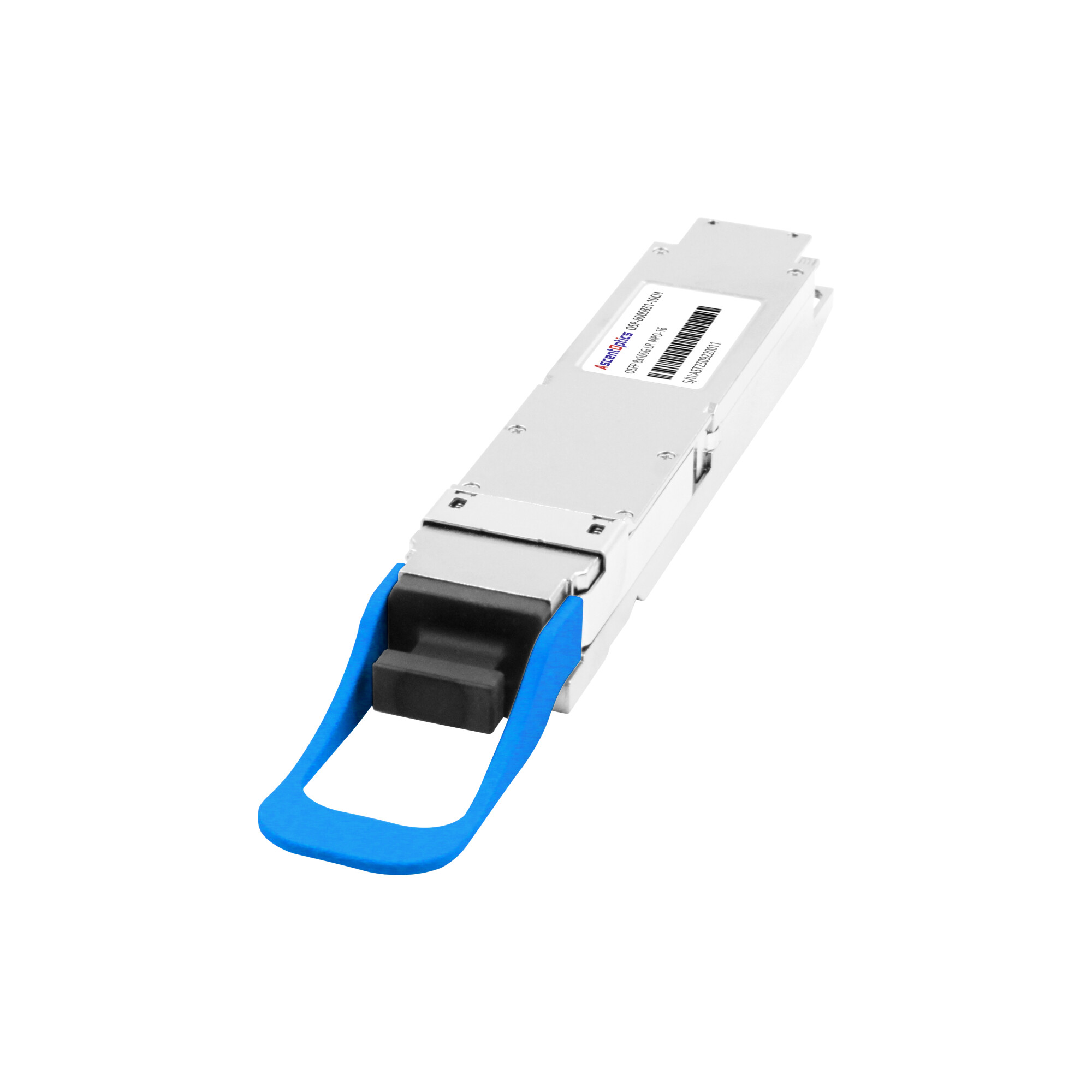
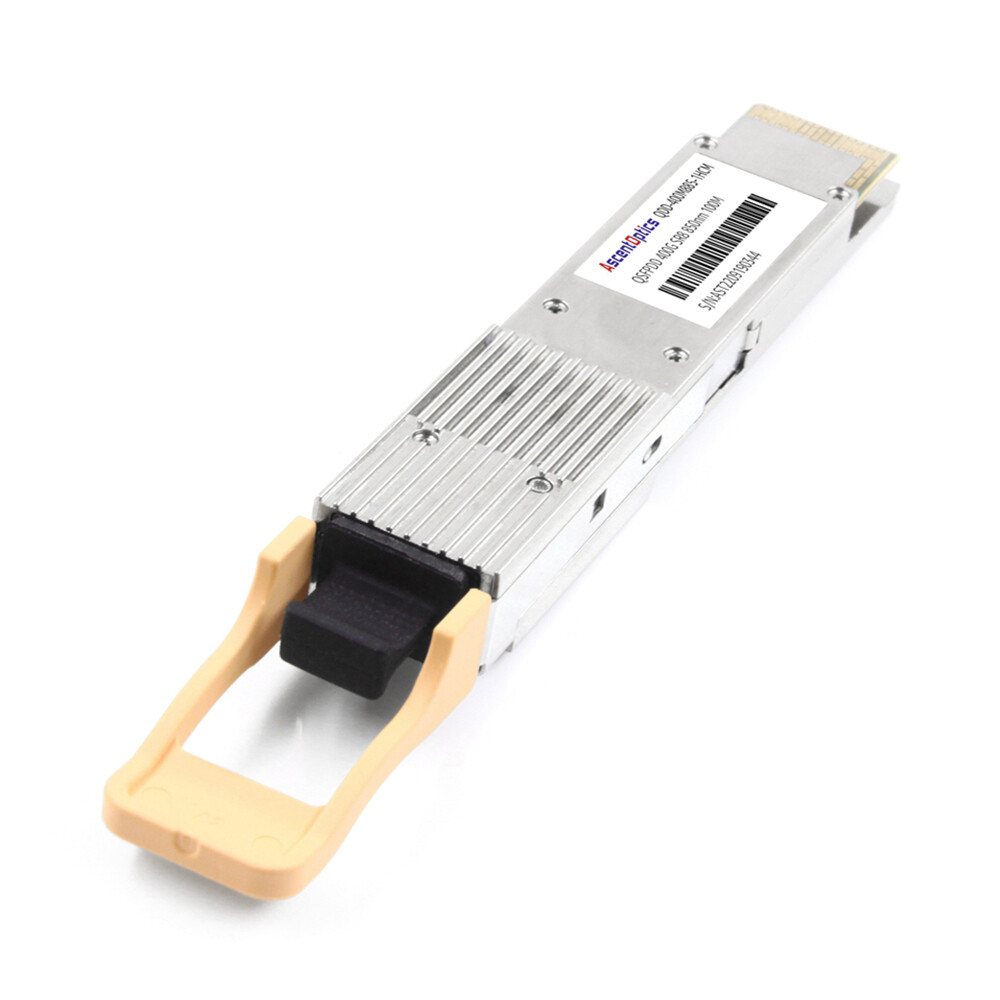
PAM4 is widely used in modern high-speed optical transceivers, including 100G single-lane optics and many 400G and 800G Ethernet modules. Common examples include 400G SR8, DR4, FR4, and LR4 optical transceivers. Earlier 100G QSFP28 PSM4 100G QSFP28 PSM4 modules, by contrast, typically use four 25G NRZ optical lanes.
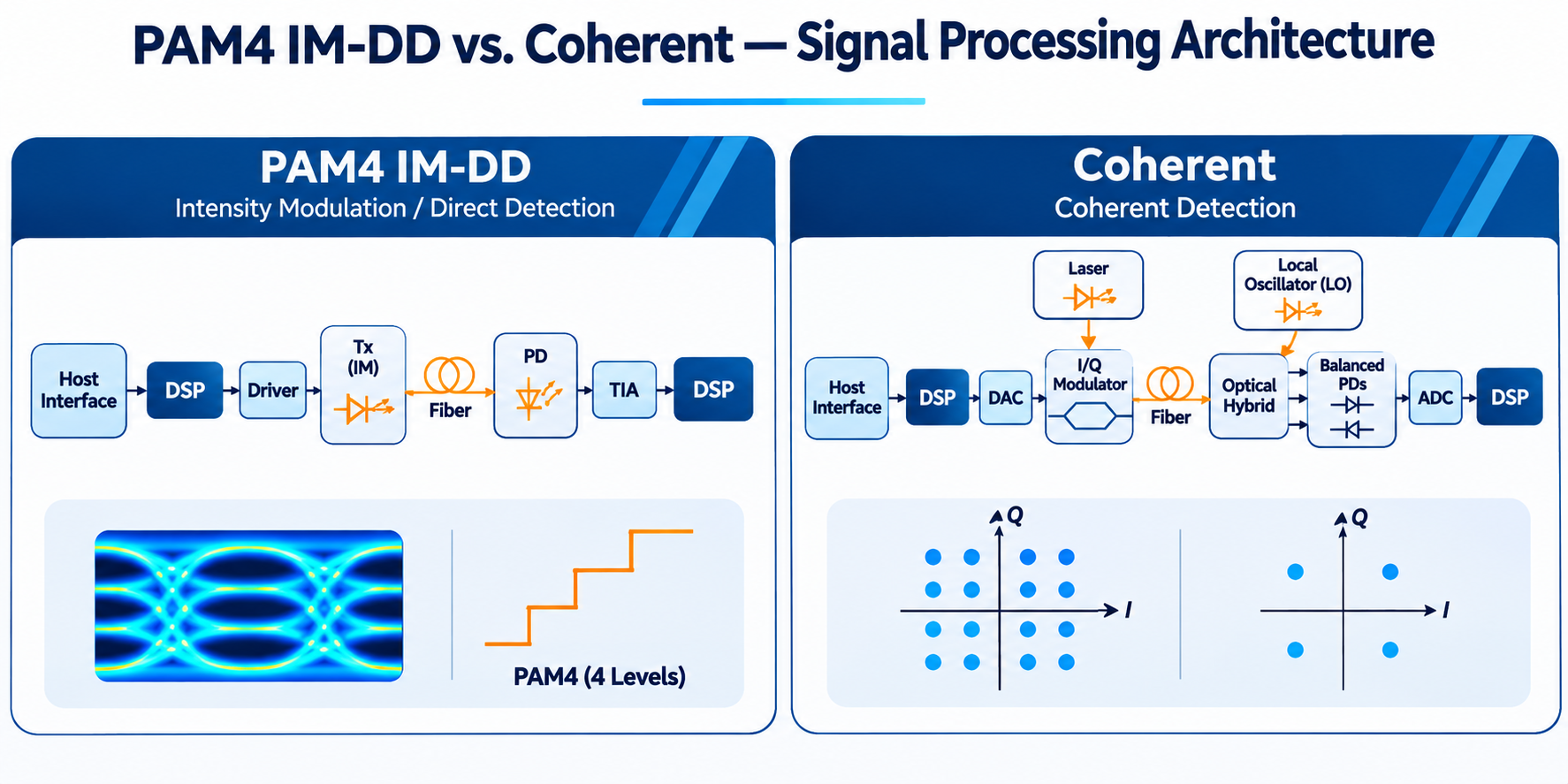
Unlike coherent optics, PAM4 uses a simpler approach called intensity modulation with direct detection, or IM-DD. The laser simply turns brighter or dimmer, and a photodetector reads that intensity directly.
How PAM4 Works: 2 Bits per Symbol
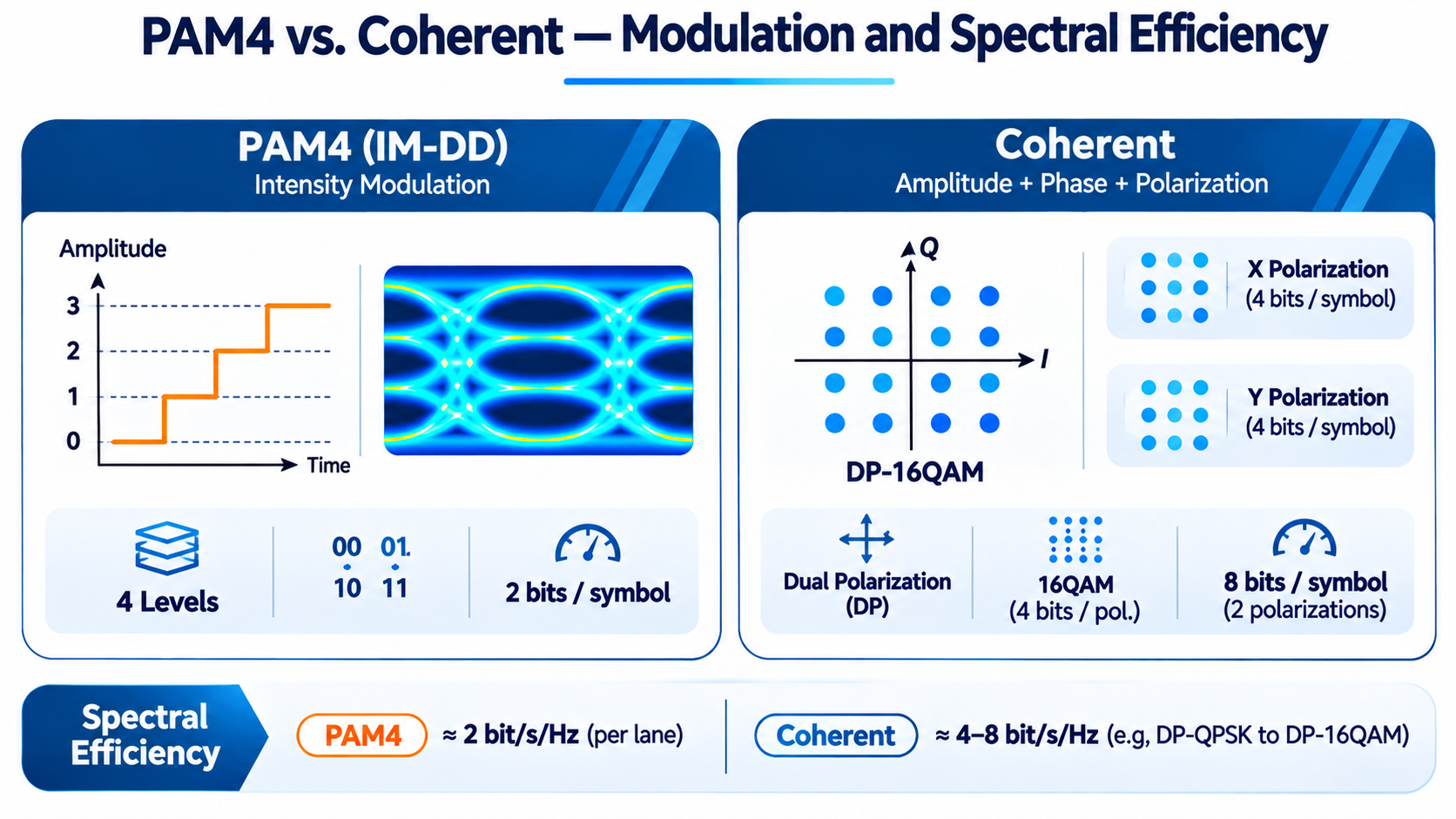
Traditional NRZ (non-return-to-zero) signaling encodes one bit per symbol using two light levels: on or off. PAM4 doubles that by using four distinct amplitude levels, which encode 2 bits per symbol.
That gain does not come free. Squeezing four levels into the same optical power budget means the eye diagram shows three smaller eyes instead of one large eye. The result is roughly a 9.5 dB signal-to-noise ratio penalty compared to NRZ.
PAM4 also relies on forward error correction (FEC) to recover the errors that a tighter eye inevitably produces. The FEC cleans up the bit stream, but it adds a small amount of latency and power. For short links, that trade is almost always worth it.
PAM4 in Optical Modules: SR, DR, FR, LR
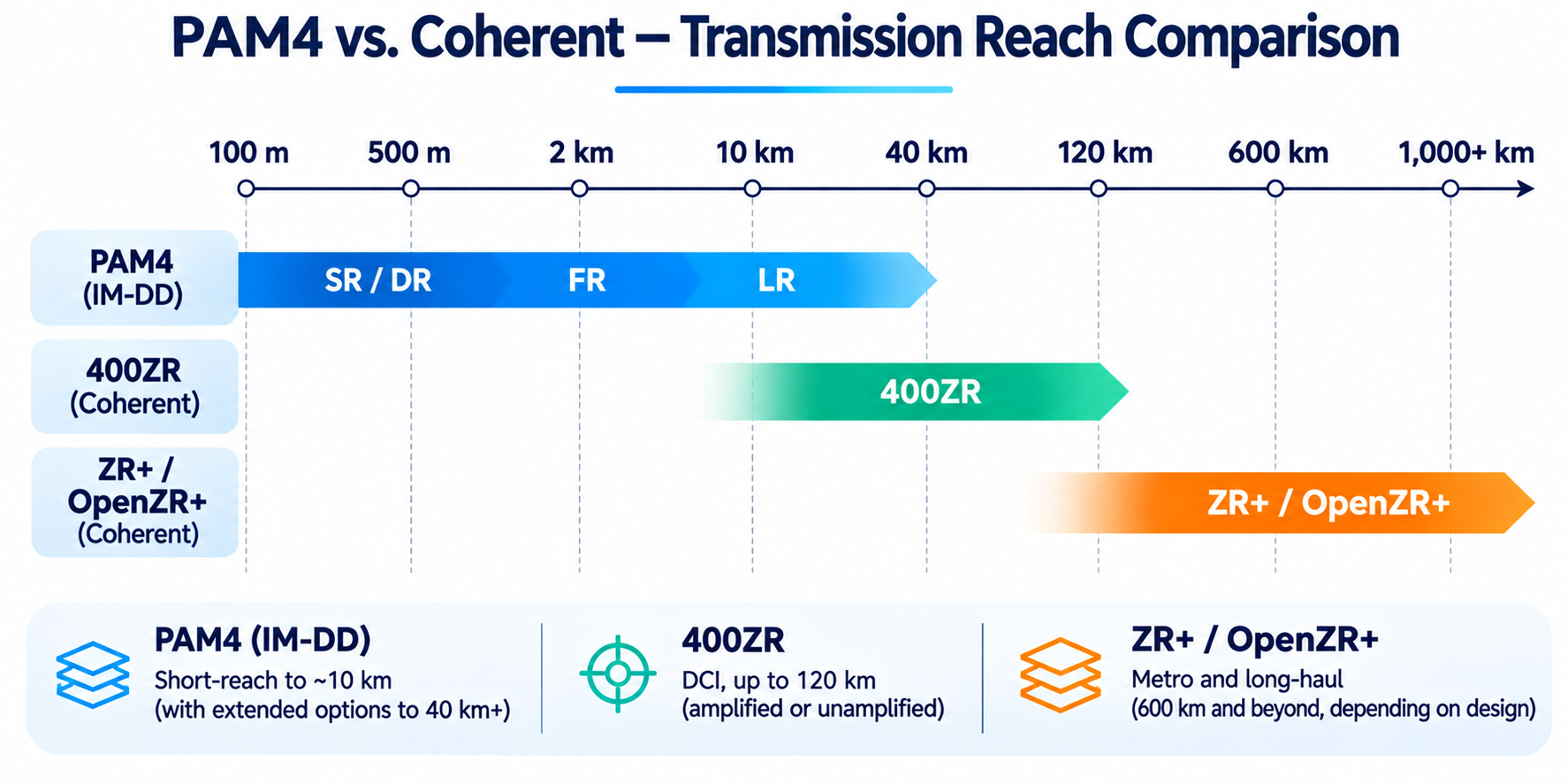
The PAM4 ecosystem maps cleanly onto distance:
- SR8 reaches about 100 m over multimode fiber, using eight lanes.
- DR4 reaches 500 m over single-mode fiber with four parallel lanes.
- FR4 reaches 2 km using four CWDM wavelengths.
- LR4 reaches 10 km, which is the practical ceiling for most PAM4 optics.
PAM4 IM-DD optics are widely deployed from short-reach data center connections to 10 km-class campus links, with specialized direct-detection solutions extending to longer distances. Their practical reach depends on chromatic dispersion, optical power budget, receiver performance, and FEC capabilities. Coherent optics become increasingly attractive as transmission distance, wavelength capacity, and optical amplification requirements increase.
Want to see how PAM4 modules fit into a broader high-speed portfolio? Explore the QSFP28 transceiver guide for form-factor and compatibility details.
What Is Coherent Optics?
Coherent optics modulate far more than light intensity. A coherent transceiver encodes data in the amplitude, the phase, and the polarization of the light, then recovers it with a digital signal processor (DSP) and a local oscillator laser.
That added complexity buys three things: much longer reach, higher spectral efficiency, and better receiver sensitivity. It is why coherent technology has carried long-haul and metro networks for over a decade.
How Coherent Detection Works
A coherent transmitter uses an in-phase/quadrature (I/Q) modulator to control both the phase and amplitude of the carrier. On the receive side, a local oscillator mixes with the incoming signal so the DSP can reconstruct the full optical field.
Common coherent formats include QPSK, 8QAM, and 16QAM. Dual-polarization 16QAM (DP-16QAM) is the workhorse for 400G coherent links, packing about 8 bits per symbol across two polarizations.
Because coherent receivers recover phase and polarization, they tolerate chromatic dispersion and polarization-mode dispersion far better than direct detection. That tolerance is what enables multi-hundred-kilometer links without regeneration.
Coherent Module Types: 400ZR, ZR+, and Coherent-Lite
The coherent family has expanded well beyond bulky line cards:
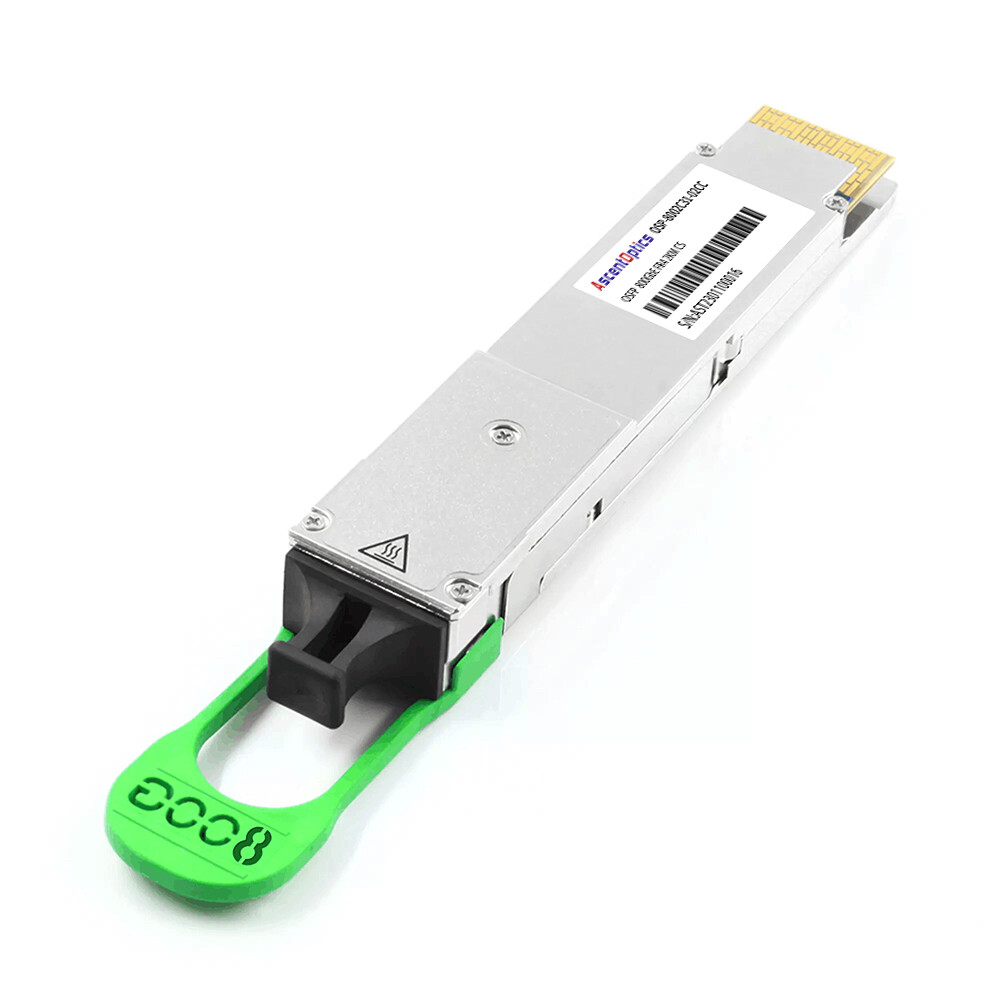
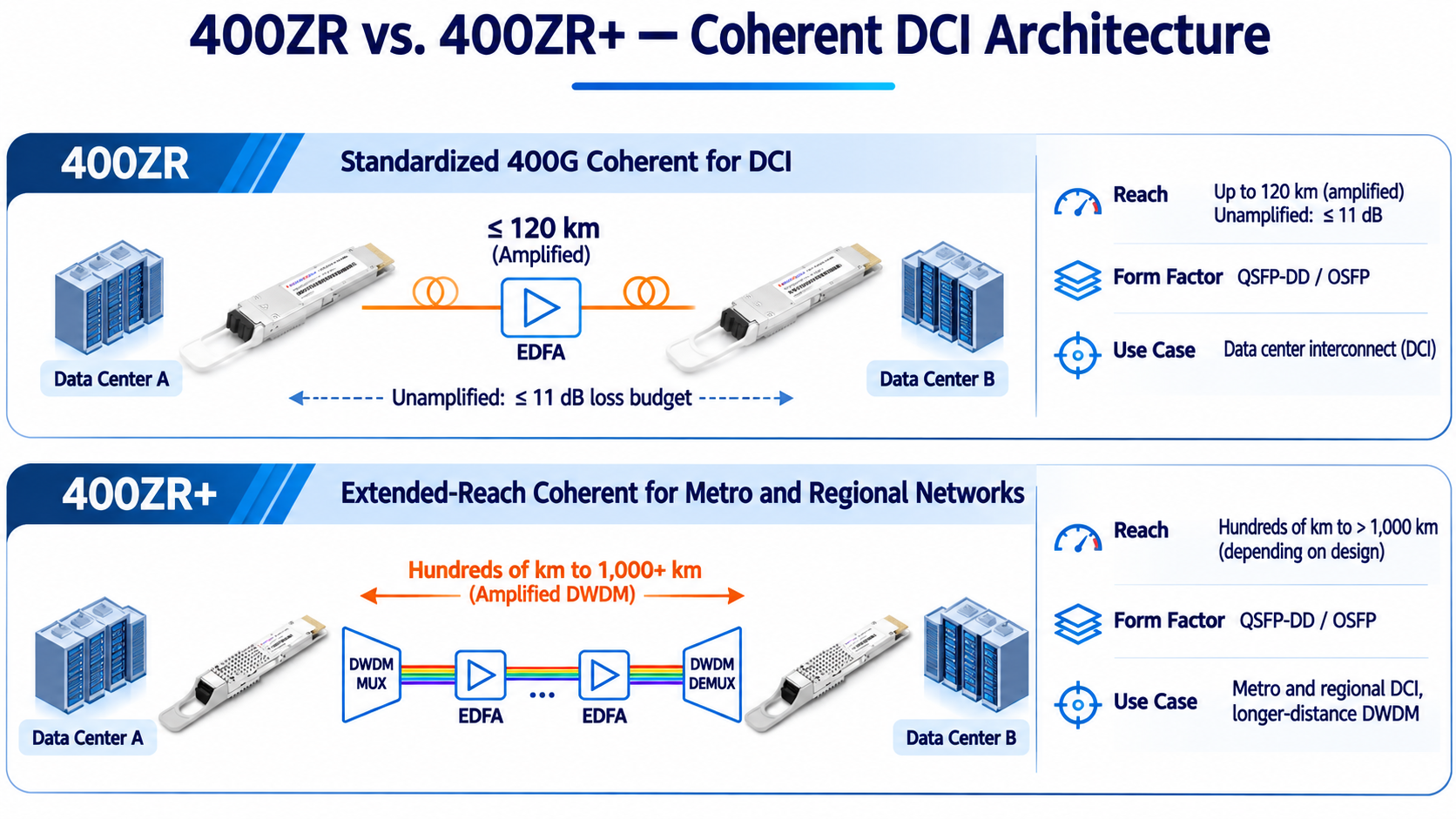
- 400ZR targets 80 to 120 km unamplified point-to-point links, in a pluggable QSFP-DD or OSFP.
- 400ZR+ extends that to roughly 600 km or more, supporting amplification and DWDM.
- Coherent-lite is the newest branch, aimed at 2 to 20 km campus and metro interconnect at 800G and 1.6T.
This expansion is why “coherent equals long-haul” is no longer the whole story. Coherent is moving down the reach curve, into territory that PAM4 used to own.
PAM4 vs Coherent: Key Technical Differences
The choice between PAM4 and coherent is not a philosophical one. It reduces to a handful of measurable trade-offs.
Modulation and Spectral Efficiency
PAM4 modulates intensity only. Coherent modulates intensity, phase, and polarization simultaneously. As a result, a single coherent wavelength can carry a full 400G link, while 400G PAM4 typically needs four parallel lanes or four wavelengths.
That difference matters at scale. Research from IEEE comparing IM-DD and coherent for intra-datacenter links found coherent PM-QAM delivers roughly 12 to 13 dB better receiver sensitivity at equivalent throughput, while using about four times fewer lasers. You can read the full comparison in the IEEE Journal of Lightwave Technology study.
Reach and Distance
| Attribute |
PAM4 (IM-DD) |
Coherent |
| Typical reach |
100 m to 10 km |
10 km to 1,000+ km |
| 400G examples |
SR8, DR4, FR4, LR4 |
400ZR, 400ZR+ |
| Amplification |
Rarely needed |
Common (EDFA, DWDM) |
| Dispersion tolerance |
Limited |
High |
The rule of thumb is simple: PAM4 dominates inside the data center and across short campus links. Coherent dominates from metro outward, wherever dispersion compensation or amplification is required.
Cost, Power, and Latency
PAM4 IM-DD modules generally offer cost and power advantages for short-reach applications because of their simpler optical and signal-processing architectures. Coherent optics require more complex DSP processing, optical components, and receiver designs, which can increase cost, power consumption, and processing latency. However, the actual differences vary significantly by module generation, data rate, and implementation. Product-level specifications should be compared before making deployment decisions.
Latency is the other underrated variable. PAM4 links carry less DSP overhead, so they typically add less delay. For AI training clusters where microseconds matter, that can tip the decision.
When to Use PAM4 vs Coherent
Here is where the decision gets practical. Consider three real scenarios.
Short-Reach Data Center Links (≤10 km)
Inside a data center, PAM4 is the default answer. Spine-to-leaf links, server-to-switch connections, and most intra-building fabric runs all fall under 10 km, and most are under 2 km.
Take Daniel, a data center engineer upgrading a pair of aggregation switches across a 1.5 km campus link. He chose 400G FR4 PAM4 modules. The optics were cheaper, drew less power, and added less latency than a coherent alternative. For that distance, coherent would have been overkill.
Data Center Interconnect and Metro (10–80+ km)
Between 10 km and about 80 km, the picture shifts. PAM4 hits dispersion limits, while 400ZR coherent handles the distance comfortably and without amplification.
This is the segment where the two technologies now compete hardest. A 40 km DCI link between two facilities sits squarely in coherent territory, but a 15 km campus link might still justify PAM4 if power and cost are the dominant constraints.
Long-Haul and DWDM Networks
Beyond 80 km, the decision makes itself. Coherent is the only practical option, especially over amplified DWDM systems carrying dozens of wavelengths on a single fiber pair.
Telecom operators and metro carriers have run coherent optics for years precisely because no other modulation can sustain 100G to 400G per wavelength across hundreds of kilometers. If your link involves a ROADM or an EDFA, you are in coherent country.
The Blurring Boundary: Coherent-Lite and 800G/1.6T
The clean “PAM4 for short, coherent for long” split is starting to blur, and the driver is AI.
Why AI Networking Is Pulling Coherent Down the Reach Curve
Hyperscale AI training no longer fits in a single building. Power and cooling limits force operators to spread GPU clusters across multiple facilities on a campus, sometimes 2 to 20 km apart, connected by massive multi-terabit fabrics.
Coherent-Lite is an emerging approach that aims to reduce the cost, power consumption, and complexity of coherent optics for short-reach, high-capacity interconnects. While 800G and 1.6T implementations have attracted industry interest, large-scale commercial adoption remains limited as of 2026. Emerging 2.4T and future 3.2T applications may create new opportunities where conventional IM-DD architectures face increasing performance and reach constraints.
800G and 1.6T: Where the Lines Cross
At 800G and 1.6T, the economics shift again. Scaling PAM4 to those rates means adding more lanes and more lasers, which erodes its cost and power advantage. Meanwhile, coherent DSPs keep shrinking.
How to Choose: A Practical Decision Framework
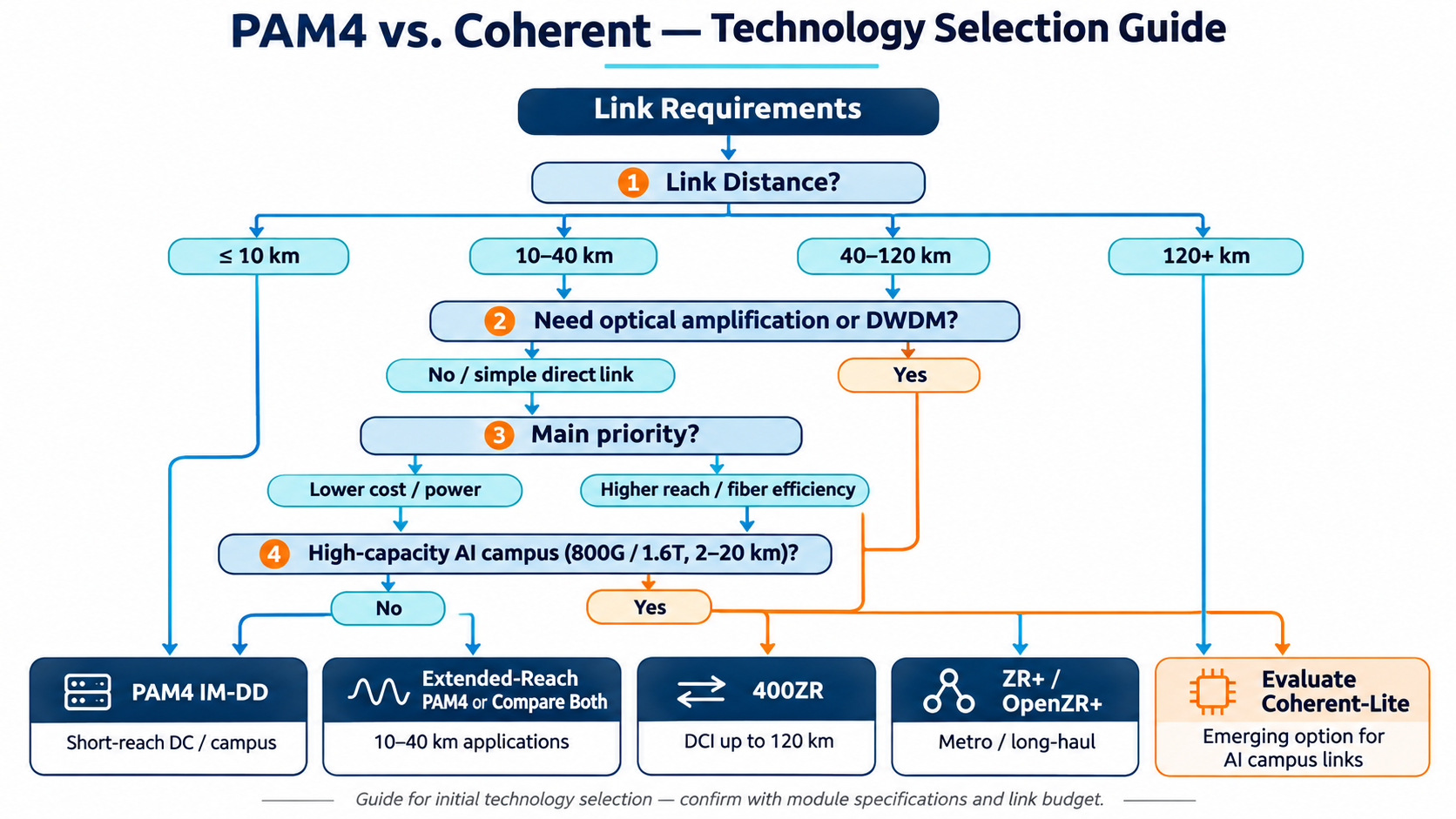
Rather than memorizing every spec, work through four questions in order.
Decision Criteria
- What is the link distance? Under 10 km, lean PAM4. Over 80 km, coherent is required. The 10 to 80 km band is contested.
- Do you need amplification or DWDM? If yes, choose coherent. PAM4 does not play well with EDFAs or ROADMs.
- What is the dominant constraint, cost or reach? PAM4 wins on capex and power; coherent wins on distance and fiber efficiency.
- What is the roadmap? For 800G and 1.6T across a campus, factor in coherent-lite rather than defaulting to PAM4.
Quick Selection Guide
| Scenario |
Recommended Choice |
| Intra-DC link, under 2 km |
PAM4 (SR8, DR4, FR4) |
| Short campus link, 2 to 10 km |
PAM4 (FR4, LR4) |
| DCI / metro, 10 to 80 km |
400ZR coherent (or PAM4 if power/cost dominate) |
| Metro / regional, 80 to 600 km |
400ZR+ coherent |
| Long-haul DWDM, 600+ km |
Coherent optics with distance-appropriate modulation and FEC |
| AI campus fabric, 2 to 20 km at 800G/1.6T |
Evaluate coherent-lite vs PAM4 |
The right choice depends on your specific architecture. Our engineers regularly help teams weigh these trade-offs against their own fiber, power, and budget constraints.
Conclusion
PAM4 and coherent are not rivals in a winner-take-all contest. They are two tools with overlapping but distinct sweet spots.
The key takeaways:
- PAM4 uses four intensity levels (IM-DD) for short reach, low cost, low power, and low latency, generally up to 10 km.
- Coherent modulates phase, amplitude, and polarization for long reach and high spectral efficiency, from 10 km to beyond 1,000 km.
- The 10 to 80 km band is contested, with 400ZR coherent increasingly competing against PAM4 on cost.
- Coherent-lite is redrawing the map for 800G and 1.6T AI campus fabrics.
- Choose on distance, amplification needs, and total cost, not on brand loyalty.
Whether your network needs PAM4 modules, coherent transceivers, or help deciding between them, Ascent Optics manufactures both.
Frequently Asked Questions (FAQ)
1. What is the main difference between PAM4 and coherent optics?
PAM4 uses intensity modulation and direct detection (IM-DD), while coherent optics use amplitude, phase, and polarization information with coherent detection. PAM4 generally suits shorter links, while coherent supports longer distances and higher spectral efficiency.
2. How far can PAM4 optical transceivers transmit?
PAM4 optics commonly support distances from a few meters to 10 km, with specialized IM-DD solutions extending to 40 km or beyond. Actual reach depends on the module and link conditions.
3. Is coherent optics better than PAM4?
Not always. PAM4 generally offers lower cost and power consumption for short-reach links, while coherent optics provide advantages in reach, spectral efficiency, and amplified DWDM networks.
4. What is the difference between 400ZR and 400ZR+?
400ZR is an OIF-standardized coherent interface for DCI applications, supporting amplified links up to 120 km. 400ZR+ offers enhanced reach and flexibility for longer metro and regional networks.
5. Can PAM4 be used for data center interconnect (DCI)?
Yes. PAM4 is widely used for short-reach DCI, particularly over distances up to 10 km. Extended-reach IM-DD solutions can support longer connections, depending on link requirements.
6. Does coherent optics consume more power than PAM4?
Generally, yes. Coherent transceivers require more complex DSP and optical components, although actual power differences depend on data rate, module design, and technology generation.
7. What is Coherent-Lite, and where is it used?
Coherent-Lite is an emerging approach designed to reduce coherent optics’ power and complexity for short-distance, high-capacity interconnects, particularly AI campus networks. Large-scale adoption remains limited.
Post Views: 83