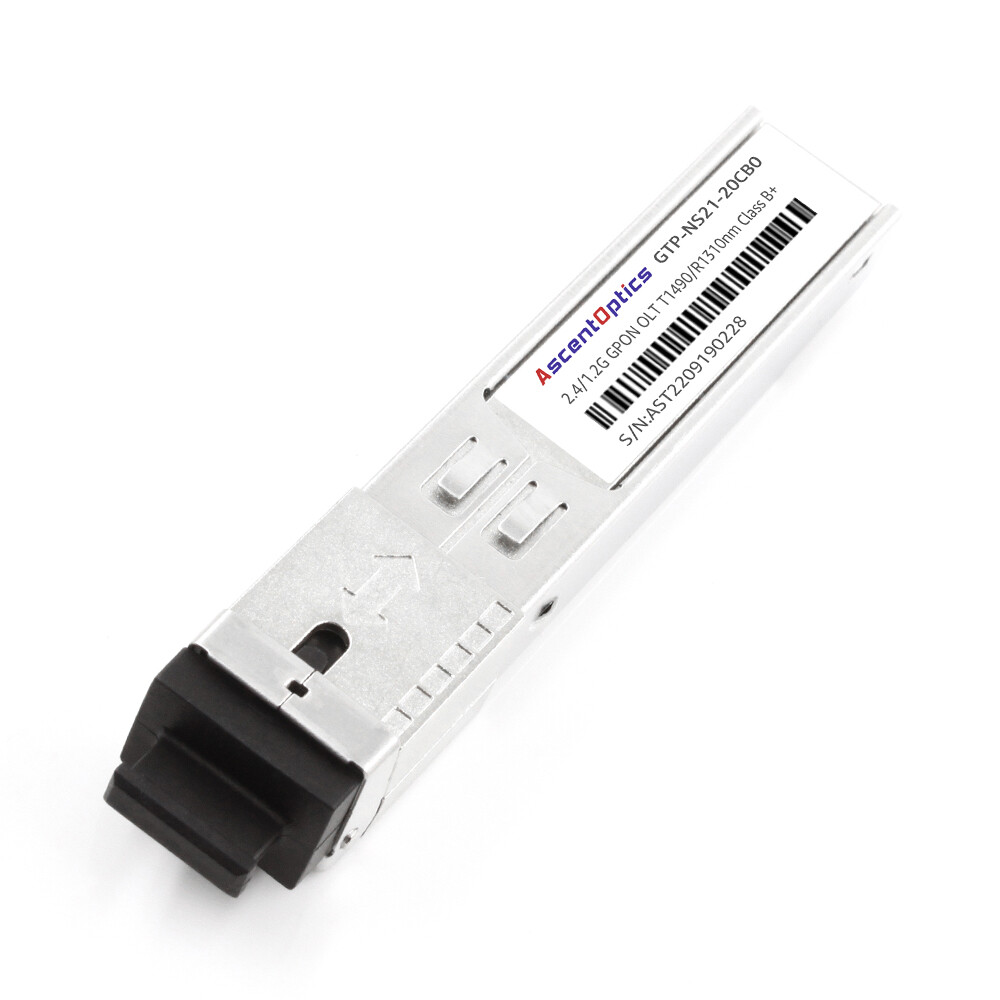
What Is XPON?
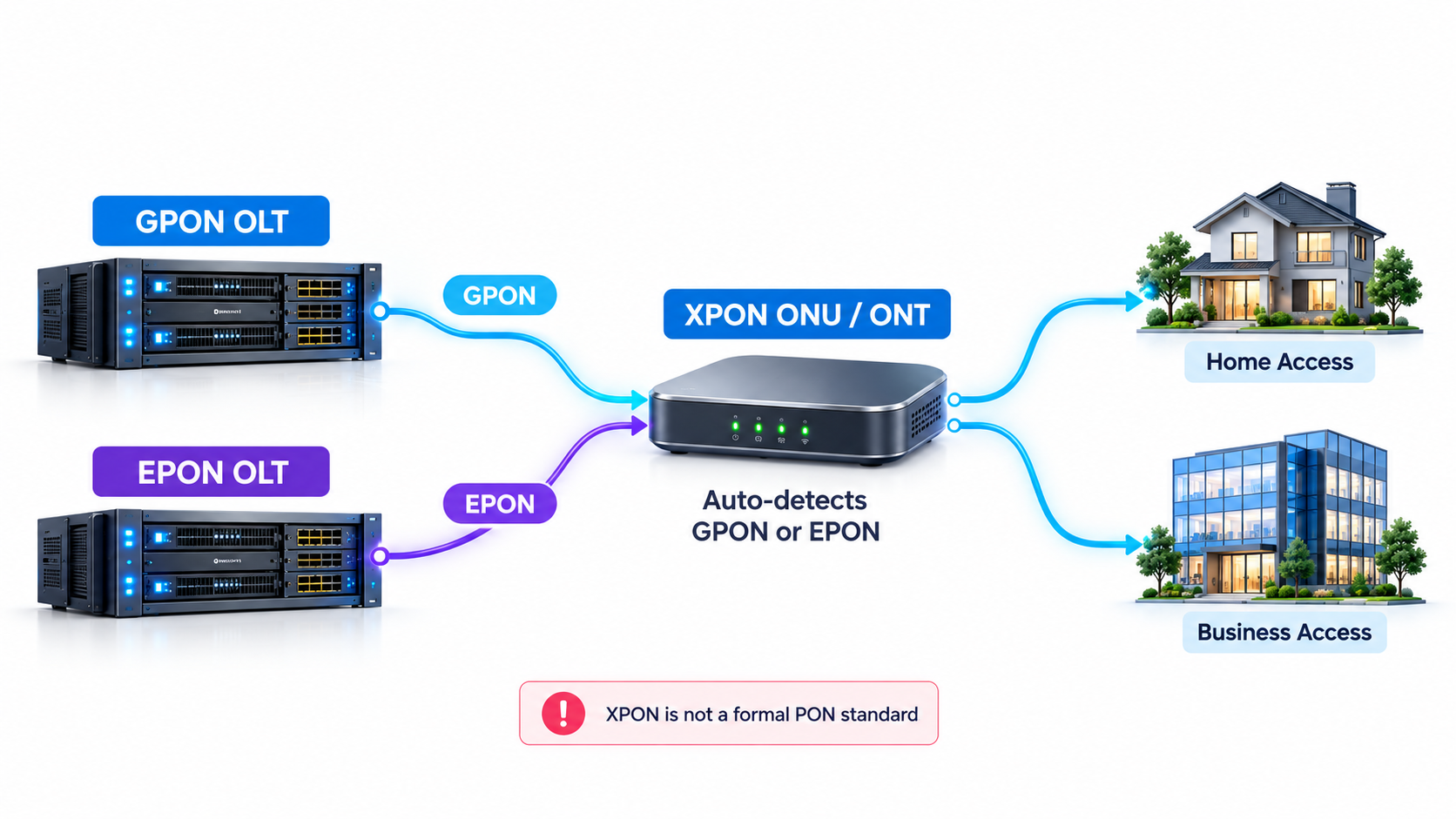
XPON is a commonly used industry term for optical network devices that support both GPON and EPON. An XPON ONU or ONT can typically operate in either mode, allowing the same device model to be deployed in networks using different PON technologies.
Unlike GPON, EPON, XG-PON, and XGS-PON, XPON is not a formal PON standard defined by ITU-T or IEEE. Its exact capabilities depend on the device design and manufacturer.
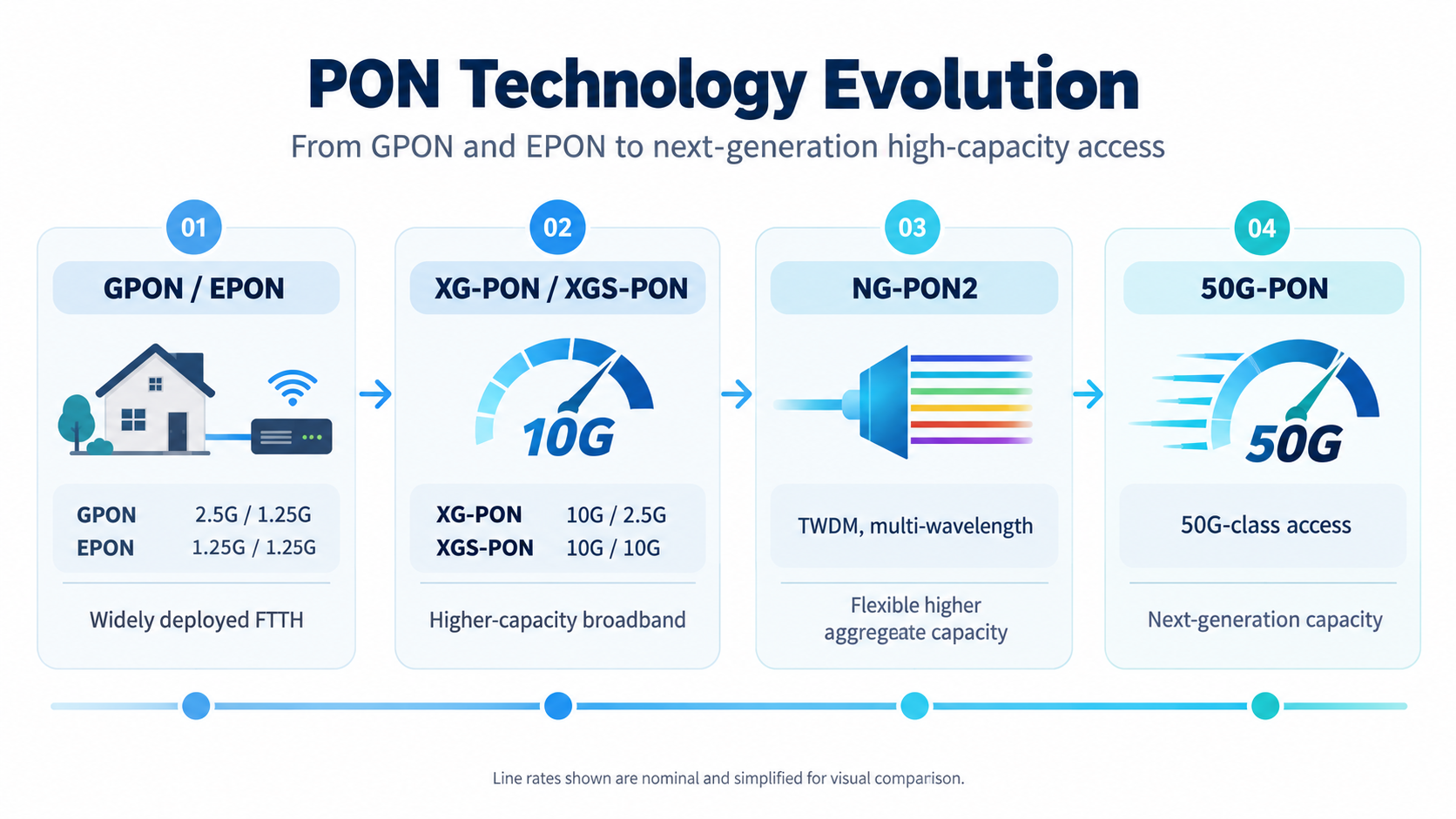
GPON and EPON are widely used for fiber-to-the-home (FTTH) broadband access. Newer technologies, including XG-PON and XGS-PON, increase capacity to support higher bandwidth requirements in residential broadband, enterprise connectivity, and mobile backhaul networks.
Understanding the differences between these technologies helps network operators choose compatible equipment and plan network upgrades.
What Is a Passive Optical Network (PON)?
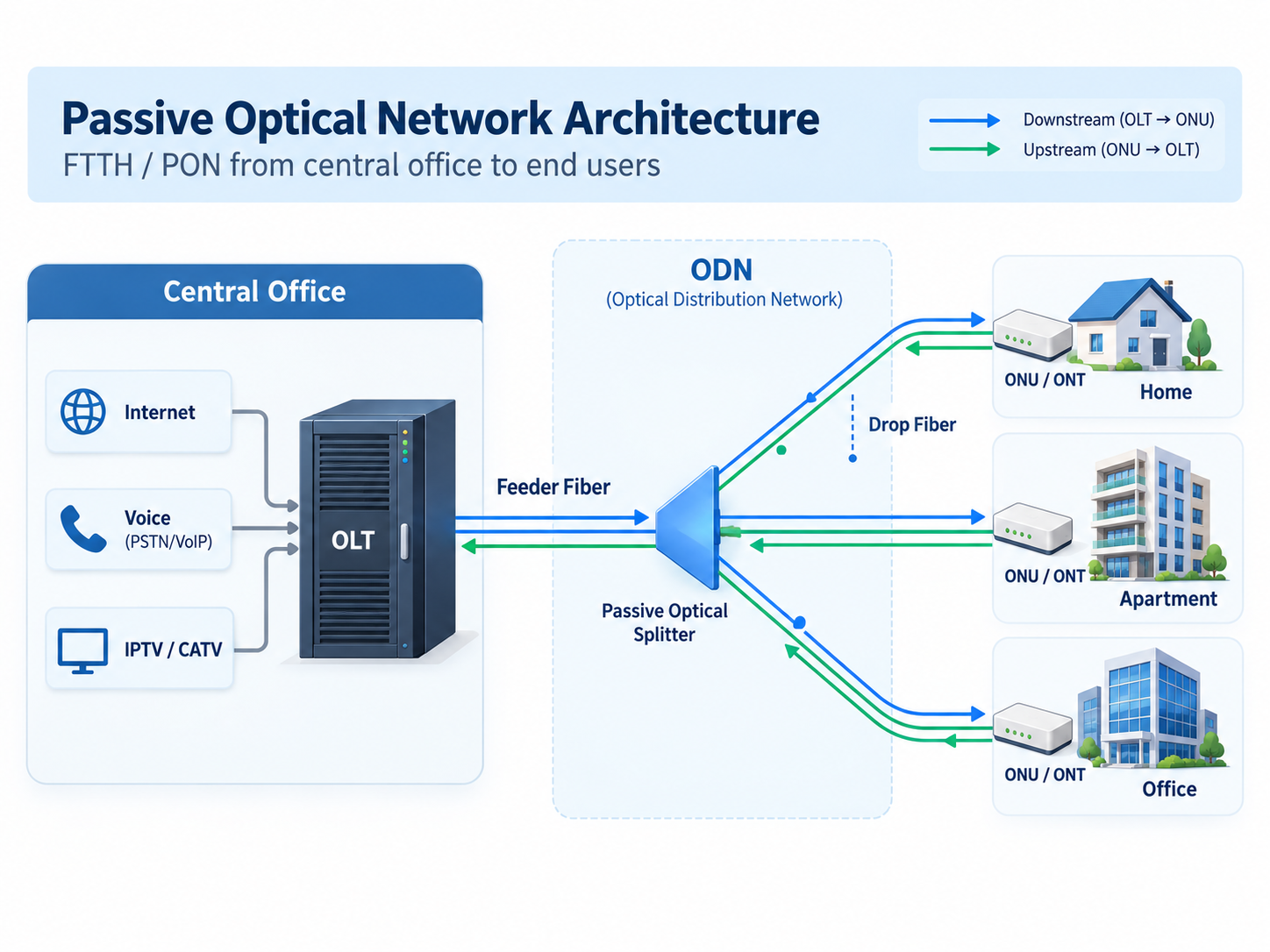
A passive optical network (PON) is a fiber access architecture that connects a service provider’s central office to multiple subscribers through passive optical distribution components.
A typical PON consists of three main elements:
- Optical Line Terminal (OLT): Located at the service provider’s central office, the OLT manages downstream transmission, upstream traffic, and communication with subscriber devices.
- Optical Distribution Network (ODN): Includes optical fiber, connectors, and passive splitters that distribute optical signals to multiple endpoints.
- Optical Network Unit (ONU) or Optical Network Terminal (ONT): Located at or near the customer premises, the ONU or ONT converts optical signals into electrical interfaces for Ethernet and other supported services.
The term “passive” refers to the distribution network between the OLT and subscriber devices. Optical splitters do not require electrical power, reducing the need for powered field equipment and helping lower deployment and maintenance costs.
PON technologies are not all the same. ITU-T defines GPON, XG-PON, XGS-PON, and other PON standards, while IEEE defines EPON and 10G-EPON.
What Is the Difference Between XPON, GPON, and EPON?
XPON is generally used to describe dual-mode GPON/EPON equipment, while GPON and EPON are specific access technologies with their own transmission and protocol specifications.
A GPON-only ONU is designed for GPON networks, whereas an EPON-only ONU is designed for EPON networks. A compatible dual-mode XPON ONU can support both technologies and operate in the mode required by the connected OLT.
Some devices can automatically detect the network type during startup, but the exact detection and switching behavior depends on the product implementation.
XPON does not automatically mean that a device supports XG-PON or XGS-PON. These are separate 10G-class technologies, and their support must be explicitly confirmed in the device specifications.
GPON vs. EPON vs. XG-PON vs. XGS-PON: Comparison
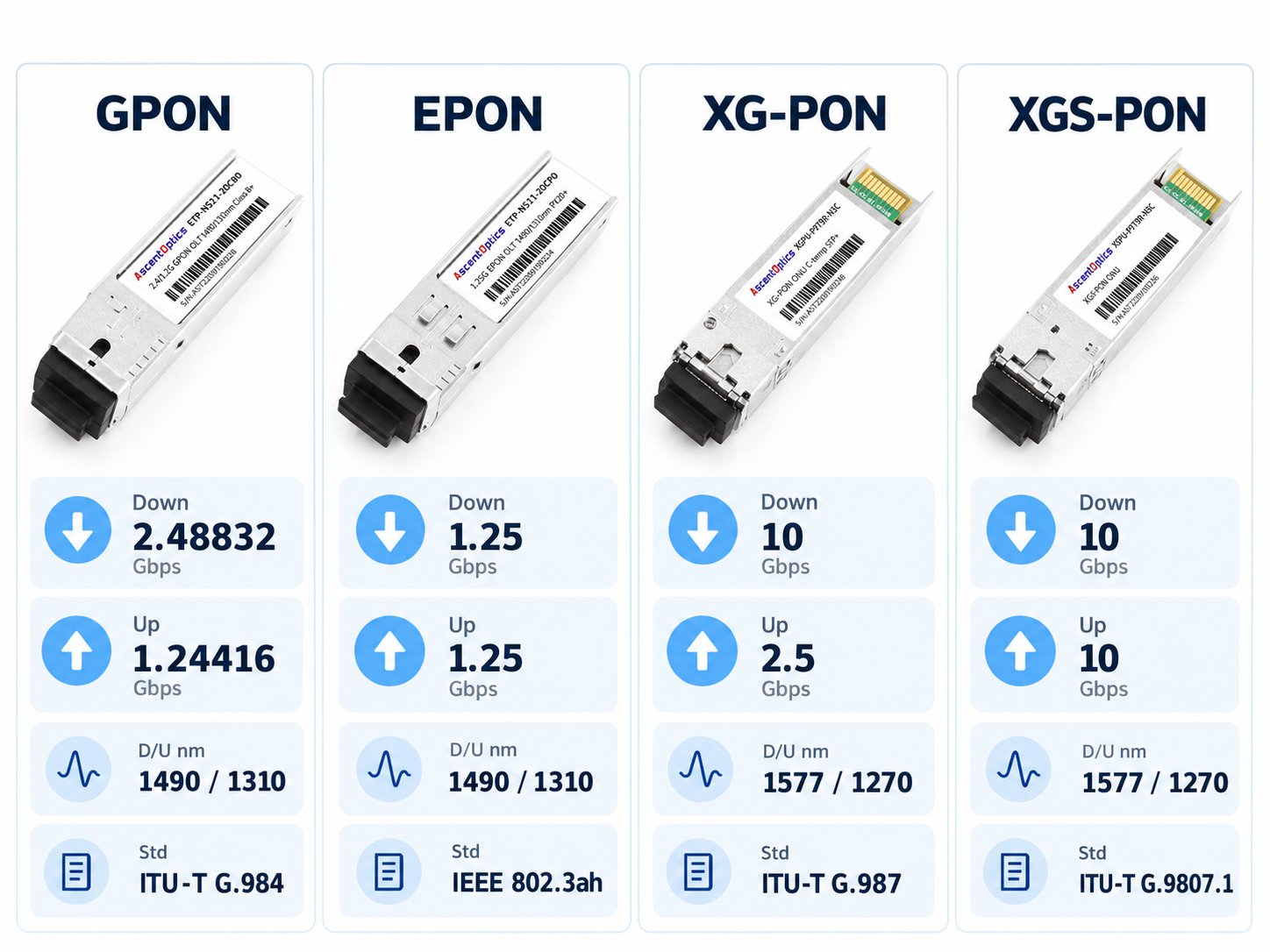
The following table summarizes the main differences between these PON standards.
| Standard |
Standard body |
Downstream line rate |
Upstream line rate |
Common wavelength plan (D/U) |
| GPON |
ITU-T G.984 series |
2.48832 Gbps |
1.24416 Gbps |
1490 / 1310 nm |
| EPON |
IEEE 802.3ah |
1.25 Gbps |
1.25 Gbps |
1490 / 1310 nm |
| XG-PON |
ITU-T G.987 series |
10 Gbps |
2.5 Gbps |
1577 / 1270 nm |
| XGS-PON |
ITU-T G.9807.1 |
10 Gbps |
10 Gbps |
1577 / 1270 nm |
| 10G-EPON |
IEEE 802.3av |
10 Gbps |
1 Gbps or 10 Gbps, depending on mode |
1577 / 1270 nm for the common 10G downstream and 1G/10G upstream wavelength plan |
Note: These are nominal line rates, not guaranteed subscriber throughput. Actual service speeds depend on protocol overhead, traffic loading, OLT configuration, and the optical network design. Wavelength values are representative nominal values; equipment specifications and the applicable standard should be checked for exact operating ranges.
GPON: A Widely Deployed FTTH Technology
GPON, or Gigabit-capable Passive Optical Network, is defined by the ITU-T G.984 series. Its nominal downstream line rate is 2.48832 Gbps, while the upstream line rate is 1.24416 Gbps. GPON uses an asymmetric bandwidth allocation that suits many residential broadband services, where downstream traffic is often greater than upstream traffic. It supports applications such as internet access, IPTV, voice services, and general-purpose FTTH connectivity.
The number of subscribers supported by a single PON port depends on the optical budget, splitter configuration, OLT and ONU capabilities, and operator requirements. Split ratios such as 1:32 and 1:64 are common, while higher ratios require careful engineering.
EPON: Ethernet-Based Optical Access
EPON, or Ethernet Passive Optical Network, is standardized by IEEE 802.3ah. Its nominal line rate is 1.25 Gbps in each direction, with Ethernet traffic carried over the optical access network. Its Ethernet-oriented architecture makes EPON suitable for service providers whose access networks are built around Ethernet technologies.
GPON and EPON differ in their framing, protocol mechanisms, and management approaches. Despite using similar nominal wavelength values in common configurations, they are not directly interchangeable. The OLT and ONU must support the same PON technology.
XG-PON: Asymmetric 10G PON
XG-PON is defined by the ITU-T G.987 series. It provides a nominal downstream line rate of 10 Gbps and an upstream line rate of 2.5 Gbps.
Compared with GPON, XG-PON offers significantly more downstream capacity. It can support bandwidth-intensive access services and help operators increase network capacity without replacing the entire fiber distribution network.
However, migration planning must account for OLT compatibility, ONU support, optical budgets, and coexistence requirements.
XGS-PON: Symmetric 10G PON
XGS-PON is defined by ITU-T G.9807.1 and provides nominal line rates of 10 Gbps downstream and 10 Gbps upstream. Its symmetric bandwidth makes it suitable for residential multi-gigabit broadband, business connectivity, cloud services, high-quality video conferencing, and other applications with substantial upstream traffic.
XGS-PON uses a different wavelength plan from GPON, enabling both technologies to coexist on the same optical distribution network when appropriate coexistence components and compatible equipment are used.
How GPON and XGS-PON Coexist on the Same Fiber
One advantage of PON evolution is that operators may be able to upgrade service capacity without replacing every section of the existing optical distribution network.
GPON commonly uses a nominal downstream wavelength of 1490 nm and an upstream wavelength of 1310 nm. XGS-PON uses a nominal downstream wavelength of 1577 nm and an upstream wavelength of 1270 nm.
These different wavelength bands allow GPON and XGS-PON signals to share the same ODN through suitable wavelength-division multiplexing and coexistence components.
In practice, coexistence requires compatible OLT ports, subscriber devices, optical modules, and any necessary coexistence elements. An ordinary GPON ONU does not become XGS-PON capable simply because both technologies share the same fiber.
Operators should verify the optical budget, filtering requirements, connector losses, and interoperability of the equipment before deploying a coexistence solution.
What Comes After 10G PON?
PON technology continues to evolve as operators seek higher access capacity.
NG-PON2, defined by the ITU-T G.989 series, uses multiple wavelengths to provide higher aggregate capacity and support flexible bandwidth allocation.
50G-PON, covered by the ITU-T G.9804 series, advances the next generation of high-capacity PON access. Its actual deployment requirements depend on the relevant specifications, optical budget, and equipment ecosystem.
For operators planning network upgrades, the choice between GPON, XGS-PON, and newer technologies should reflect current demand, expected subscriber growth, infrastructure reuse, and total deployment cost.
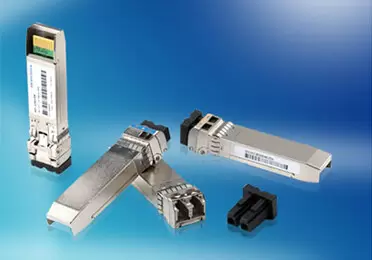
The Optical Modules Inside ONUs and OLTs
Optical modules are essential components of PON systems. Their role and form factor depend on whether they are installed in the OLT or subscriber equipment.
ONU SFP and SFP+ Devices
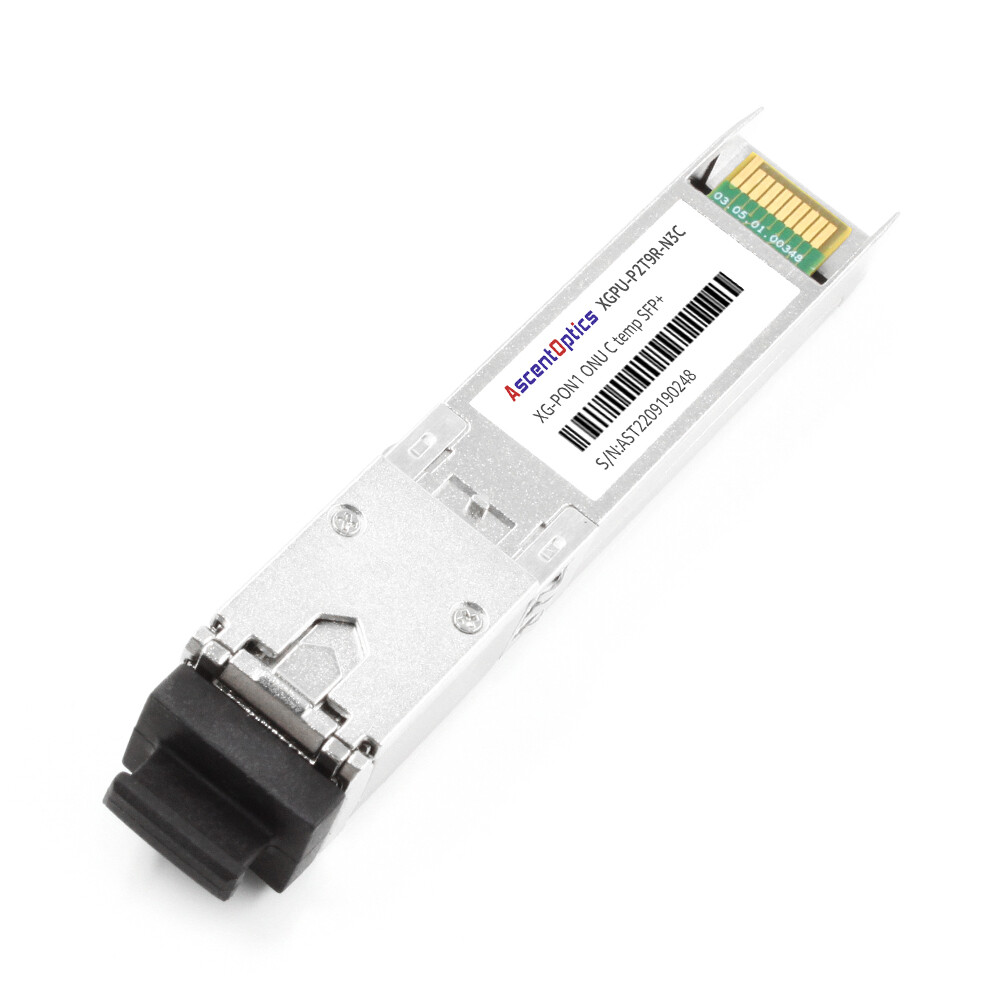
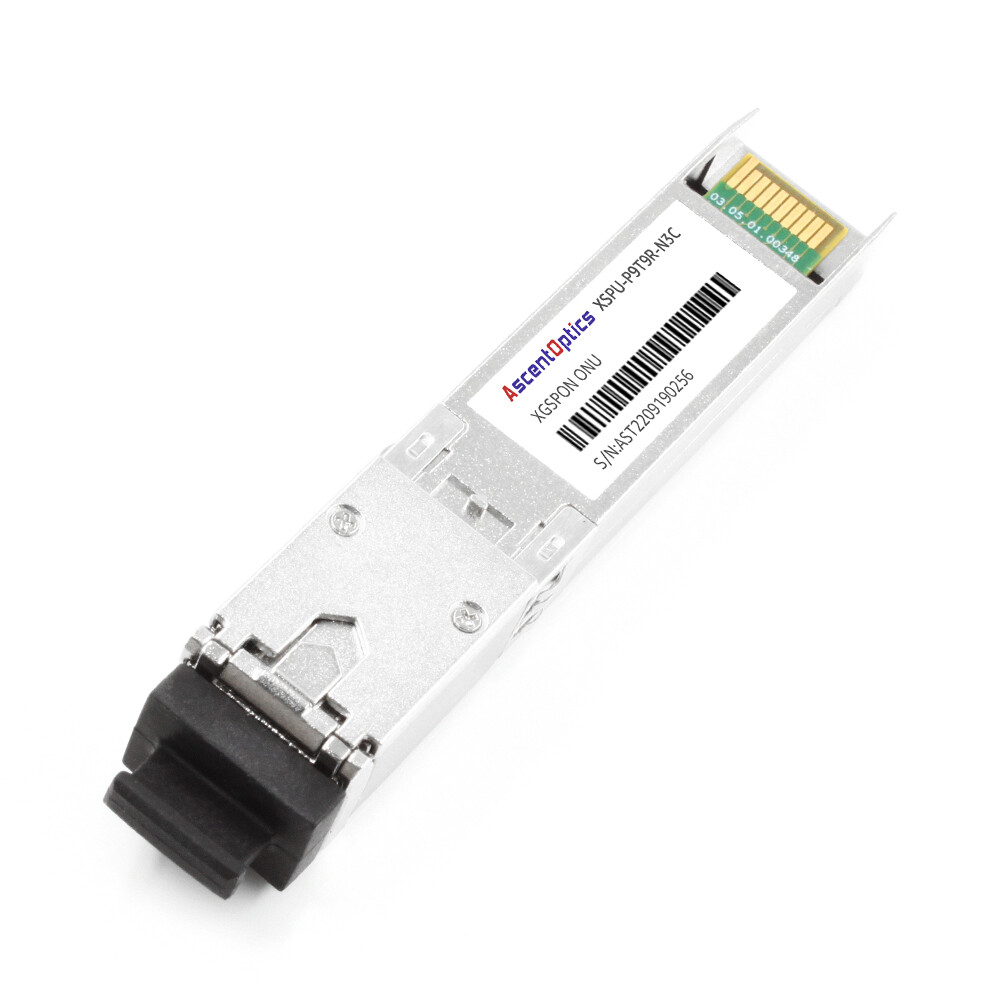
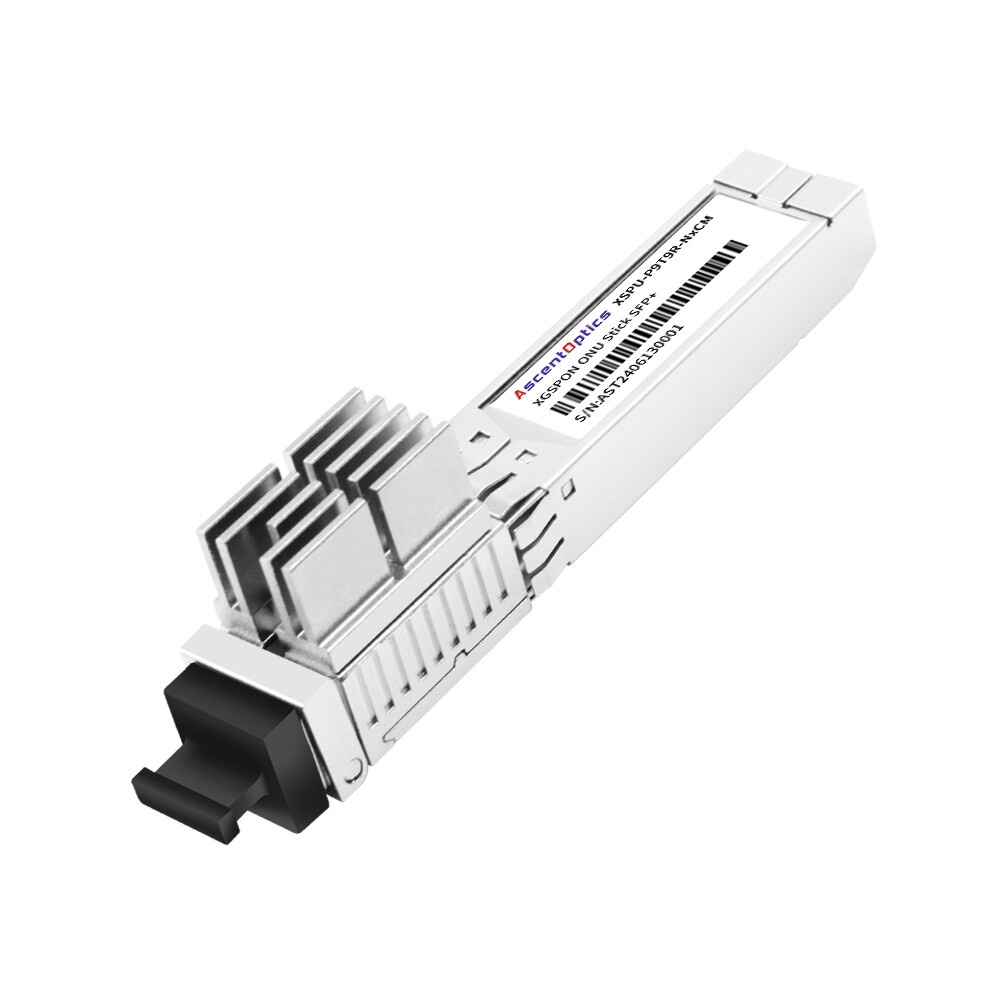
Some subscriber devices use pluggable PON modules, including ONU SFP sticks, to integrate optical access functionality into compatible routers, gateways, or other network equipment.
These products are not universally interchangeable. The host interface, supported PON standard, optical specifications, firmware, and management requirements must all match the intended application.
OLT PON Optical Modules
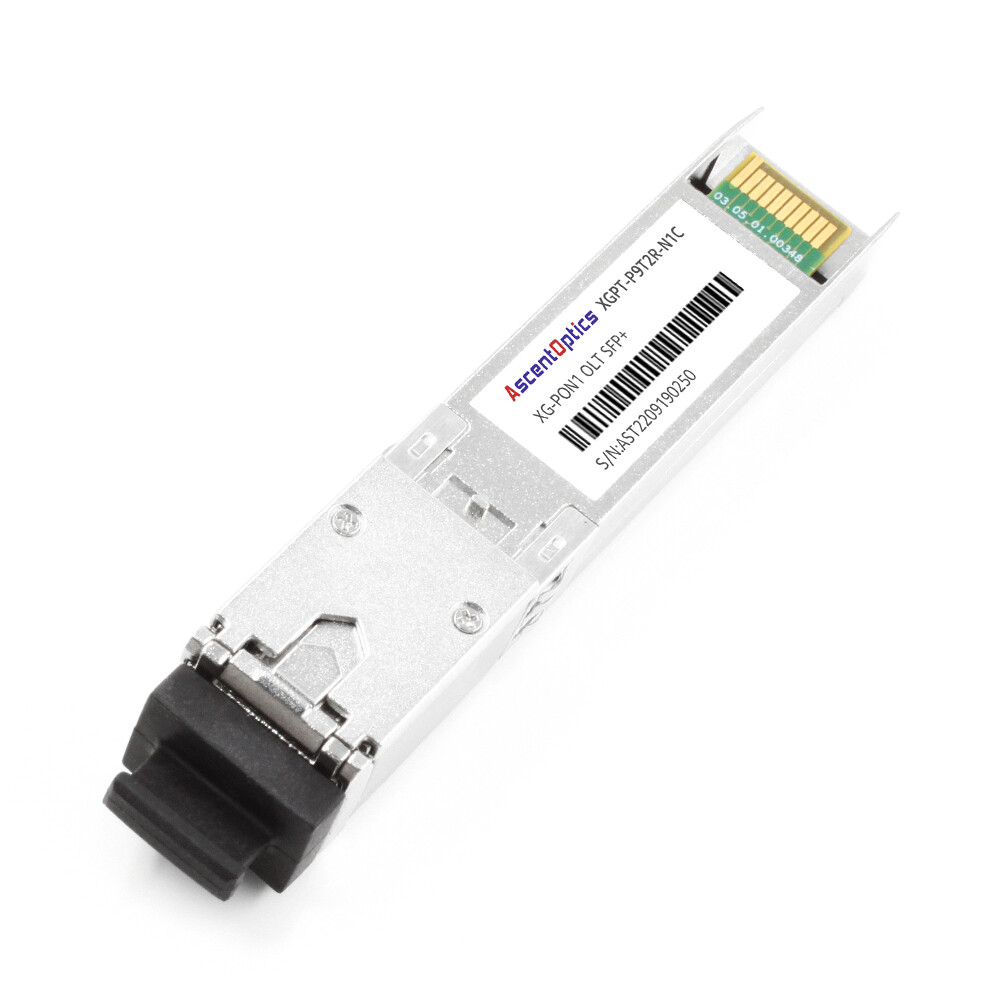
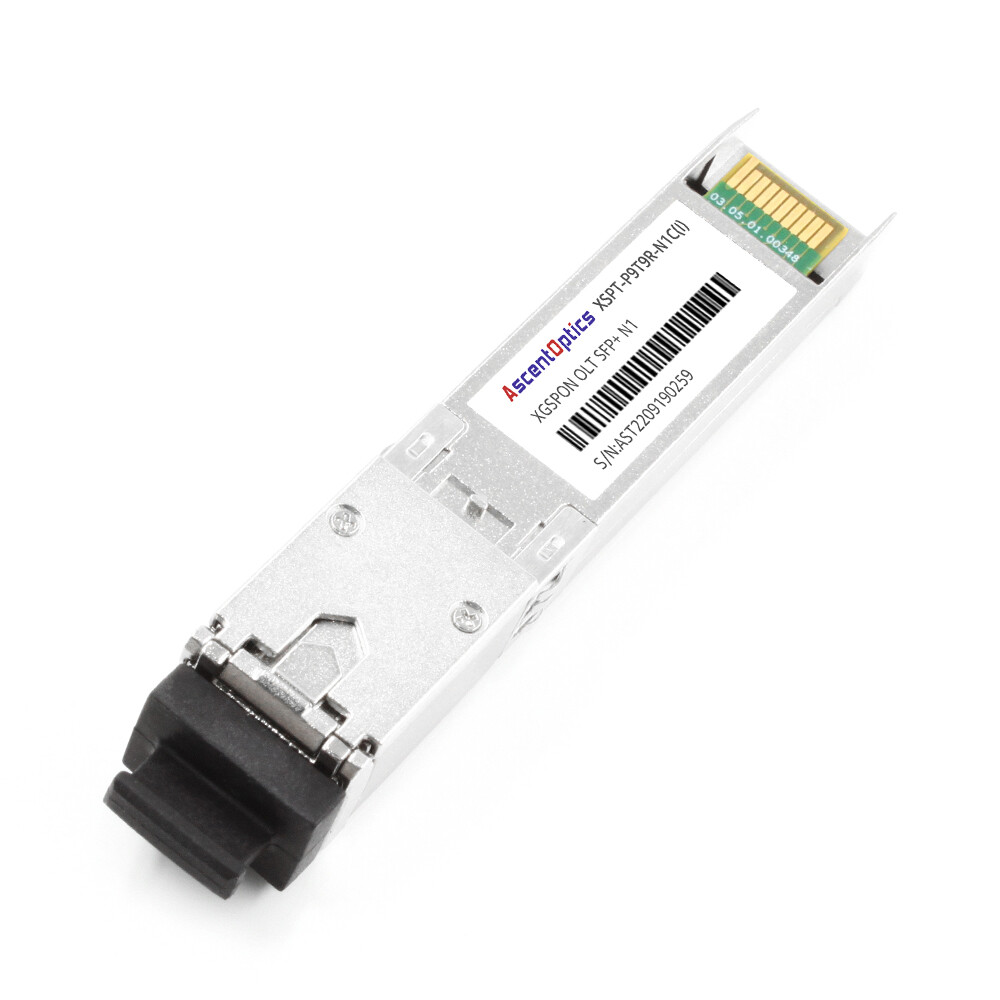
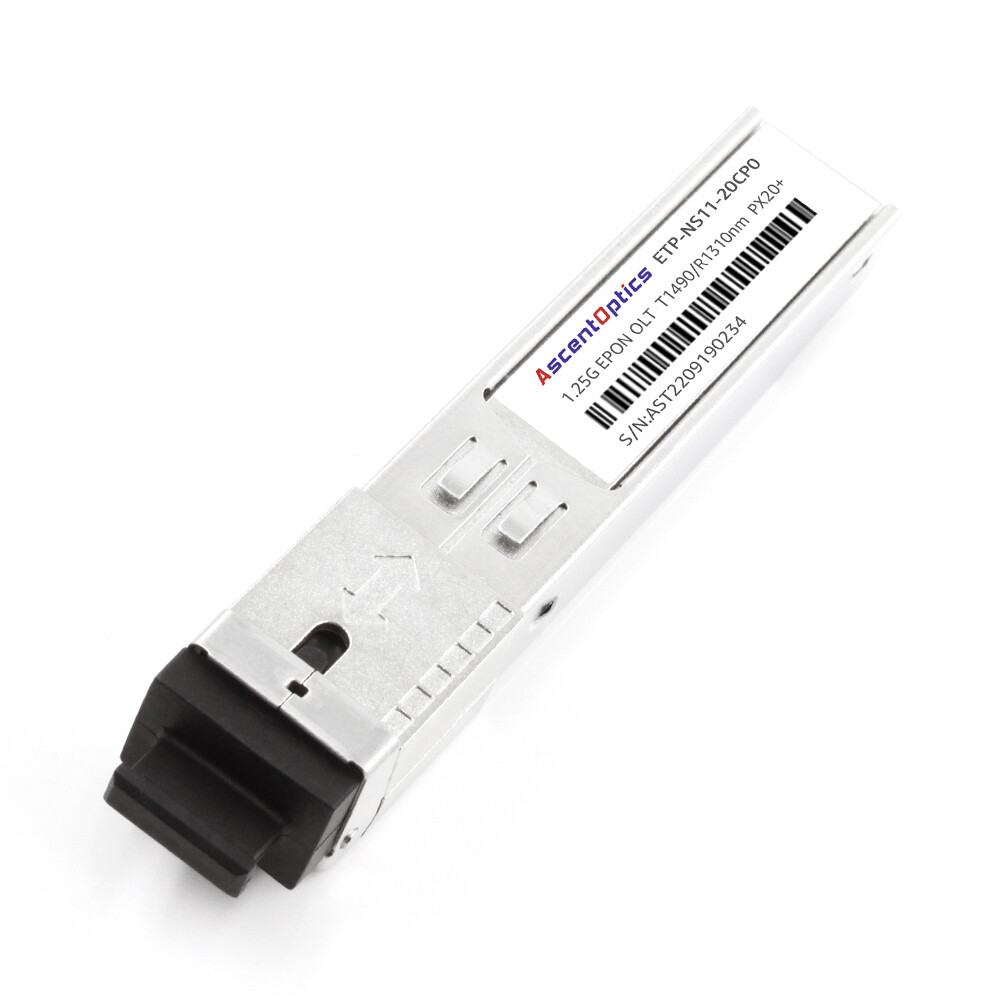
OLT optical modules are used in compatible OLT ports or line cards to transmit downstream signals and receive upstream transmissions from multiple ONUs.
Optical budget classes such as B+ and C+ are commonly associated with GPON equipment. The applicable classes and power-budget requirements vary by PON standard and product design.
Choosing a module requires checking transmit power, receiver sensitivity, overload limits, wavelength, and the total loss of the optical distribution network.
Combo-PON Modules
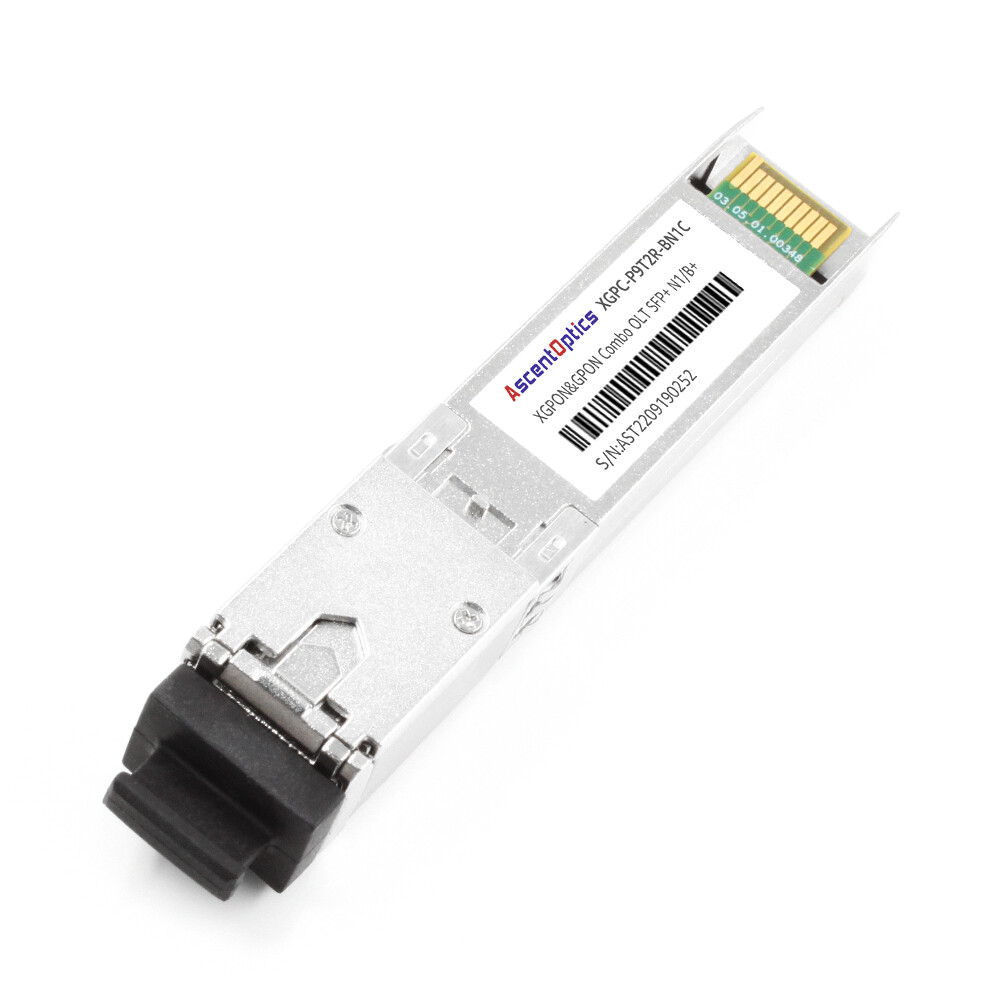
Combo-PON solutions integrate optical interfaces for multiple PON technologies, commonly GPON and XGS-PON, to support coexistence and gradual network migration.
Depending on the design, a Combo-PON solution can serve legacy GPON subscribers and newer XGS-PON subscribers through a shared ODN. The specific OLT architecture, optical filtering, module design, and ONU compatibility determine how this works in practice.
When selecting PON optical modules, operators should verify compliance with the applicable ITU-T or IEEE specifications as well as interoperability with the target OLT platform.
How to Choose the Right PON Optical Module
Selecting a suitable PON optical module requires more than matching the advertised data rate. The following factors are particularly important.
1. Match the PON Standard
First, confirm whether the OLT uses GPON, EPON, XG-PON, XGS-PON, or a multi-PON architecture.
A standard GPON ONU cannot directly replace an XGS-PON ONU. Although some devices support multiple PON technologies, this capability must be explicitly specified by the manufacturer.
2. Check the Optical Connector
SC/APC connectors are common in PON access networks, although the required connector type depends on the equipment and deployment.
Do not mate APC and UPC connectors directly. Their different end-face geometries can cause excessive insertion loss and back reflection. Always match the connector type specified for the OLT, ONU, and optical distribution network.
3. Verify Compatibility and Management Requirements
Confirm compatibility with the target OLT, including the optical interface, firmware, supported ONU profiles, and required management functions.
GPON deployments commonly use OMCI for ONU management, while EPON deployments use OAM mechanisms. TR-069 may be used for higher-level customer-premises equipment management where supported.
These mechanisms serve different purposes. Their availability depends on the device and network architecture, so optical compliance alone should not be treated as a guarantee of full end-to-end interoperability.
4. Calculate the Optical Budget and Split Ratio
The optical budget must cover fiber attenuation, splitter loss, connector loss, splice loss, and an appropriate engineering margin.
Split ratios such as 1:32 or 1:64 are common in access networks, but the practical limit depends on the optical class, fiber distance, splitter characteristics, and receiver performance. A 1:128 split may be possible in some designs but should not be assumed for every deployment.
A nominal reach of around 20 km is common for many PON systems, but the supported distance depends on the standard, optical budget, and equipment specifications.
Before ordering modules, calculate the expected path loss and confirm that both the OLT and ONU can operate within their specified transmit-power and receiver-sensitivity limits.
Conclusion
XPON commonly describes dual-mode GPON/EPON equipment, while GPON, EPON, XG-PON, and XGS-PON are distinct PON technologies with different line rates and protocol requirements. Choosing the right solution requires matching the PON standard, optical budget, connector, and equipment compatibility. For network upgrades, XGS-PON and Combo-PON can help operators increase capacity while making use of existing fiber infrastructure where the network design permits.
XPON and PON Frequently Asked Questions
Is XPON the same as GPON?
No. GPON is a specific PON standard, while XPON commonly refers to equipment supporting both GPON and EPON. XPON is not a formal standalone standard.
Is XPON the same as XGS-PON?
No. XPON generally refers to dual-mode GPON/EPON equipment. XGS-PON is a standardized 10 Gbps symmetric PON technology.
Can a GPON ONU work with an XGS-PON OLT?
Not as a standard GPON-only device. The ONU must support XGS-PON or an explicitly compatible multi-PON implementation to operate on the intended network.
What is the difference between ONU and ONT?
The terms are often used interchangeably in FTTH deployments. ONT commonly refers to the subscriber-side terminal, while ONU is a broader term used in PON architectures.
Can GPON and XGS-PON use the same fiber?
Yes, in a properly designed coexistence deployment. Their different wavelength plans allow both technologies to share an ODN when compatible OLTs, ONUs, and coexistence components are used.
What is the difference between XG-PON and XGS-PON?
XG-PON provides 10 Gbps downstream and 2.5 Gbps upstream, while XGS-PON provides 10 Gbps in both directions. XGS-PON is therefore better suited to services requiring substantial upstream bandwidth.
Does XPON automatically support 10G PON?
No. XPON generally describes GPON/EPON dual-mode capability. Support for XG-PON or XGS-PON must be explicitly stated in the product specifications.
What should I check before buying a PON optical module?
Check the PON standard, wavelength, optical budget, connector type, host compatibility, management requirements, and interoperability with the target OLT or ONU.
Post Views: 98