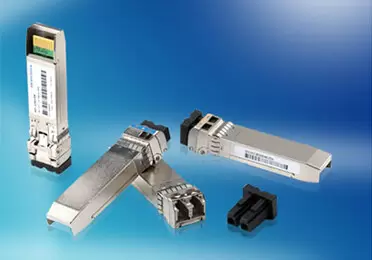
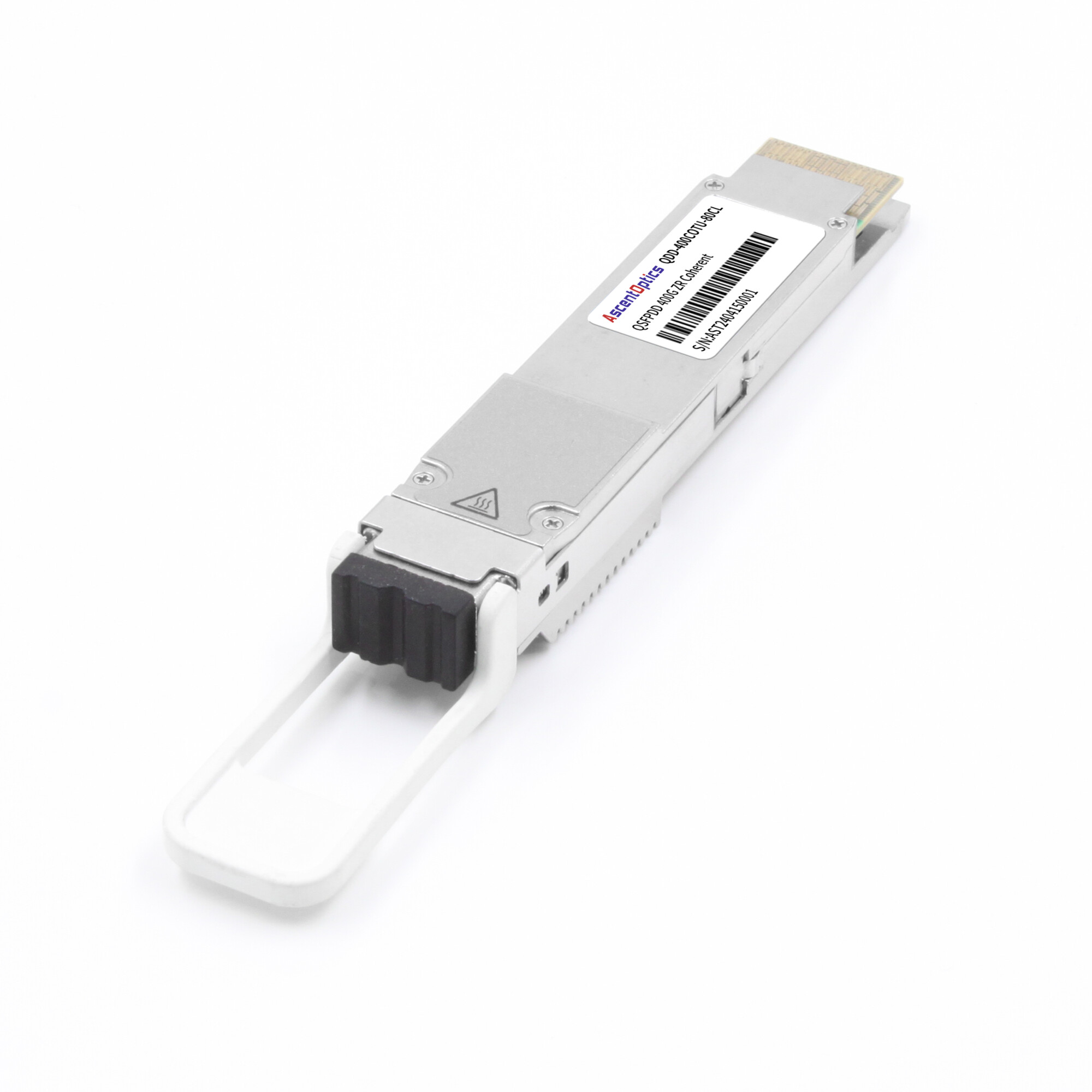
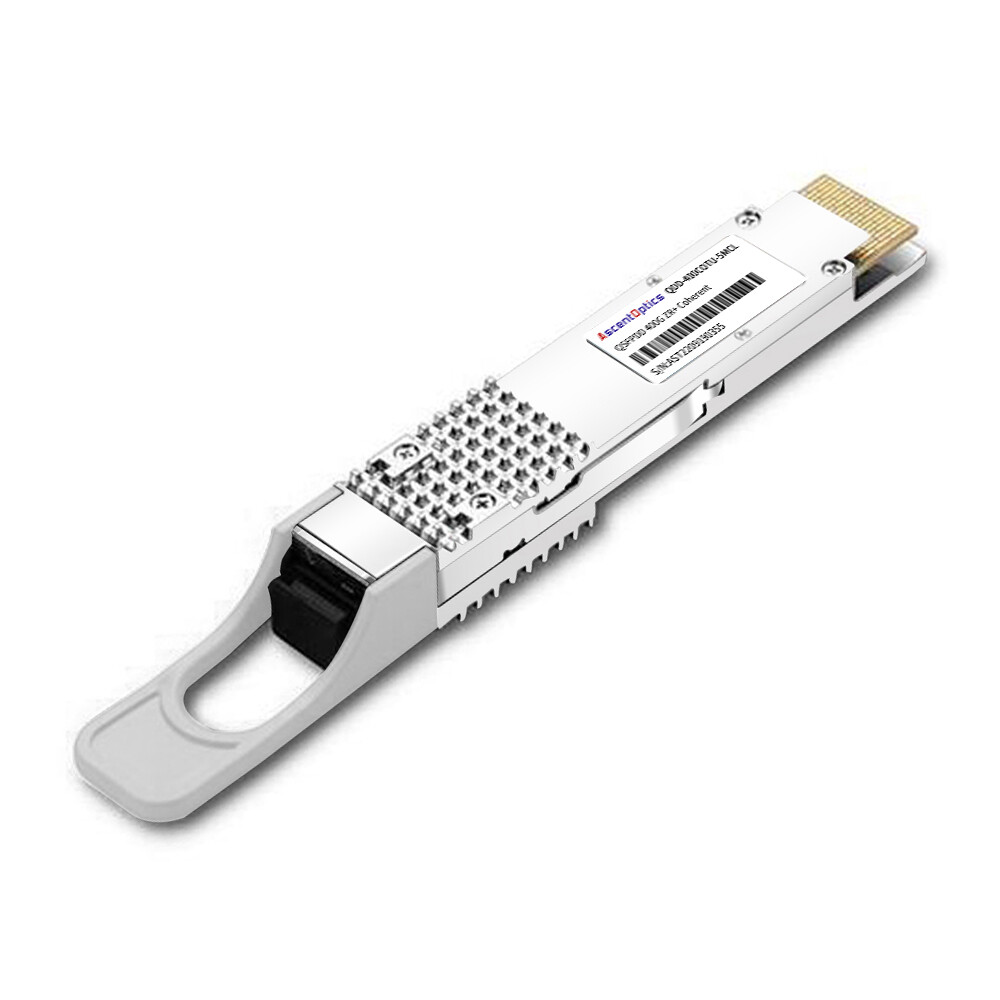
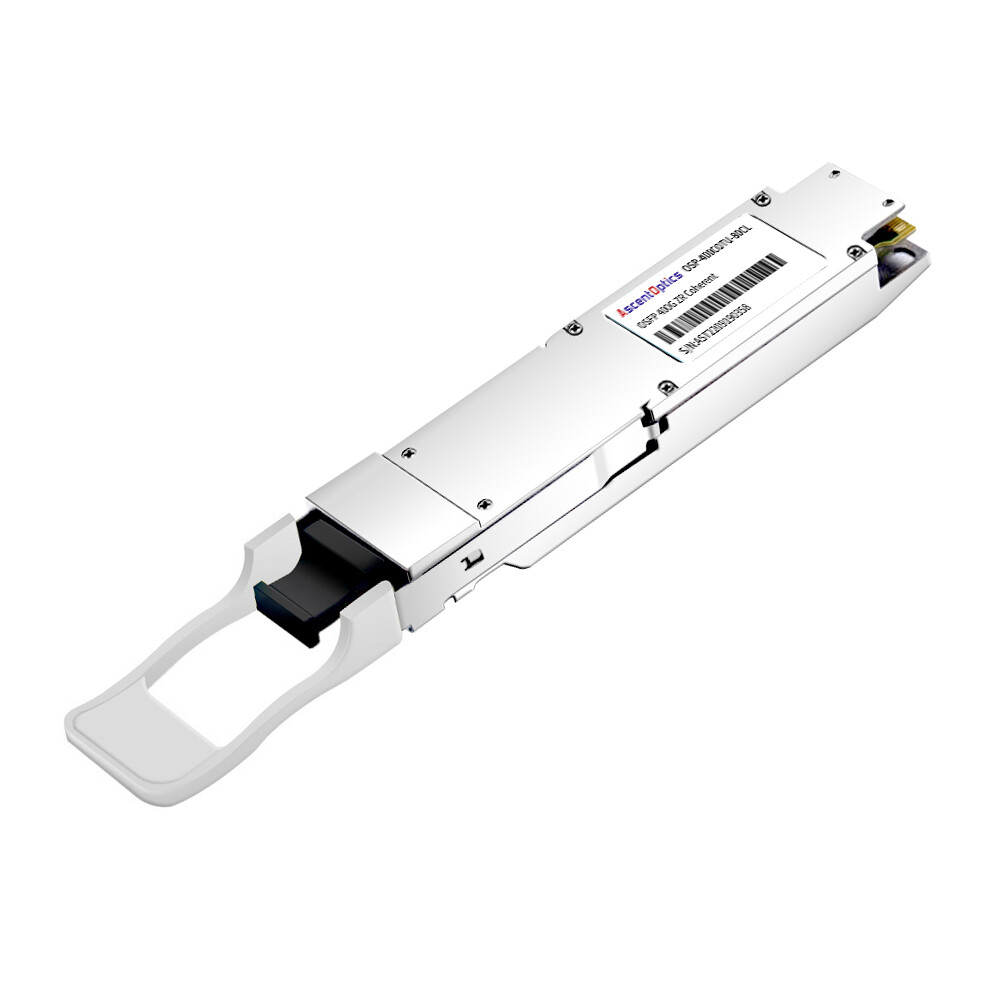
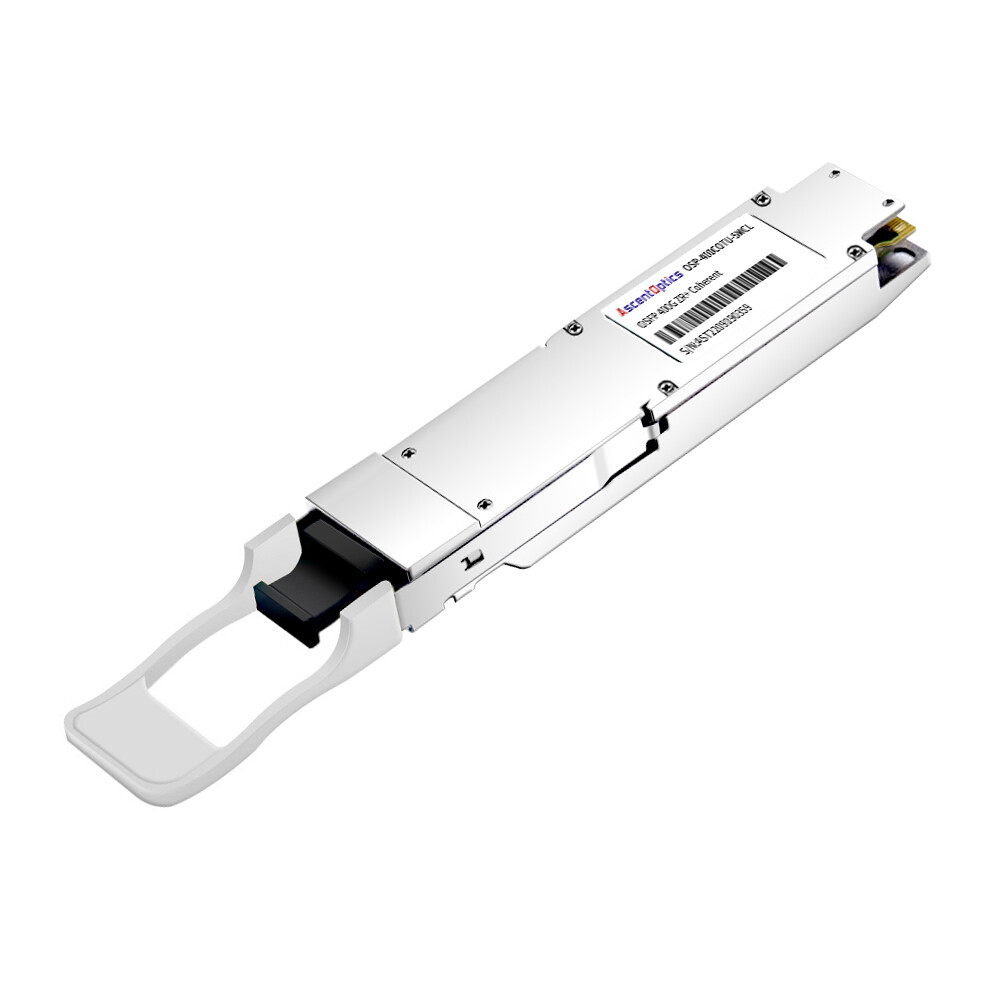
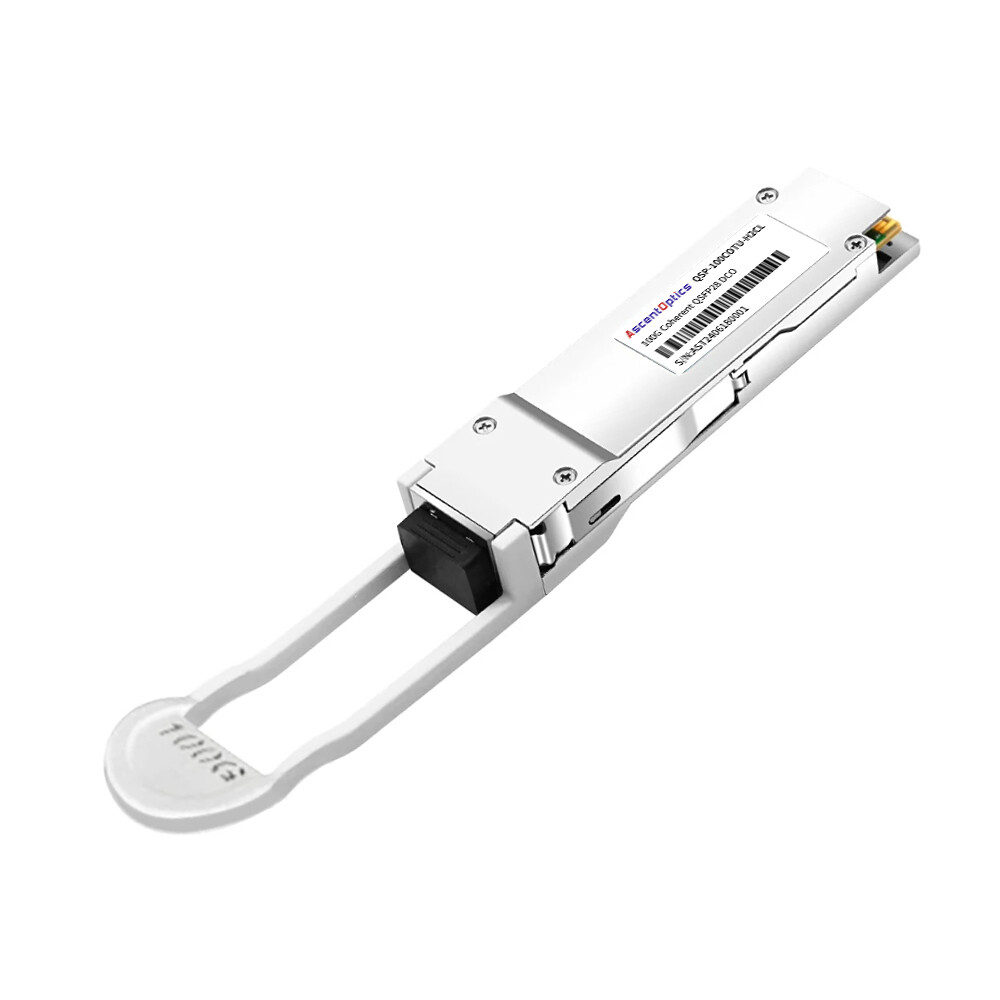
A regional telecom engineer recently faced a familiar dilemma. Her team needed to upgrade a 90 km fiber link between two data centers. The existing 100G coherent system was running out of capacity, and management wanted a solution that would not require new transponder shelves or a separate DWDM line system. After evaluating several options, she standardized on 400G ZR pluggable coherent modules. The modules plugged directly into the routers, eliminated external transport equipment, and doubled capacity on the same fiber pair.
That scenario is becoming common across data centers, metro networks, and AI clusters. Network engineers are moving away from standalone optical transport systems and toward pluggable coherent optics that fit inside standard switch and router ports.
What Is 400G ZR?
400G ZR is a standardized coherent optical transceiver defined by the Optical Internetworking Forum (OIF) 400ZR Implementation Agreement. It transmits 400 Gbps Ethernet over a single DWDM wavelength, typically using coherent detection and digital signal processing (DSP).
The standard was developed specifically for data center interconnect (DCI) and short-reach metro applications. It enables network operators to deploy high-capacity optical links without the cost and complexity of traditional transponder-based DWDM systems.
Core Technologies Behind 400G ZR
400G ZR modules pack a complete coherent transport engine into a hot-pluggable form factor. The key technologies include:
- •Coherent detection: The receiver mixes the incoming optical signal with a local oscillator laser, capturing both amplitude and phase information. This approach delivers higher receiver sensitivity and longer reach than direct detection.
- •DP-16QAM modulation: Dual-polarization 16-state quadrature amplitude modulation packs 400 Gbps onto a single optical carrier.The use of DP-16QAM provides higher spectral efficiency than QPSK, making it well suited for high-capacity DCI links, although it also requires better OSNR.
- •Digital signal processor (DSP): The DSP handles modulation, dispersion compensation, polarization-mode dispersion mitigation, and forward error correction.
- •Tunable C-band laser: A tunable laser enables operation across the C-band DWDM grid, maximizing fiber utilization.
- •Concatenated FEC (C-FEC): C-FEC is optimized to balance coding gain, latency, and interoperability for standardized 400ZR deployments.
Form Factors
400G ZR modules are available in two main pluggable form factors:
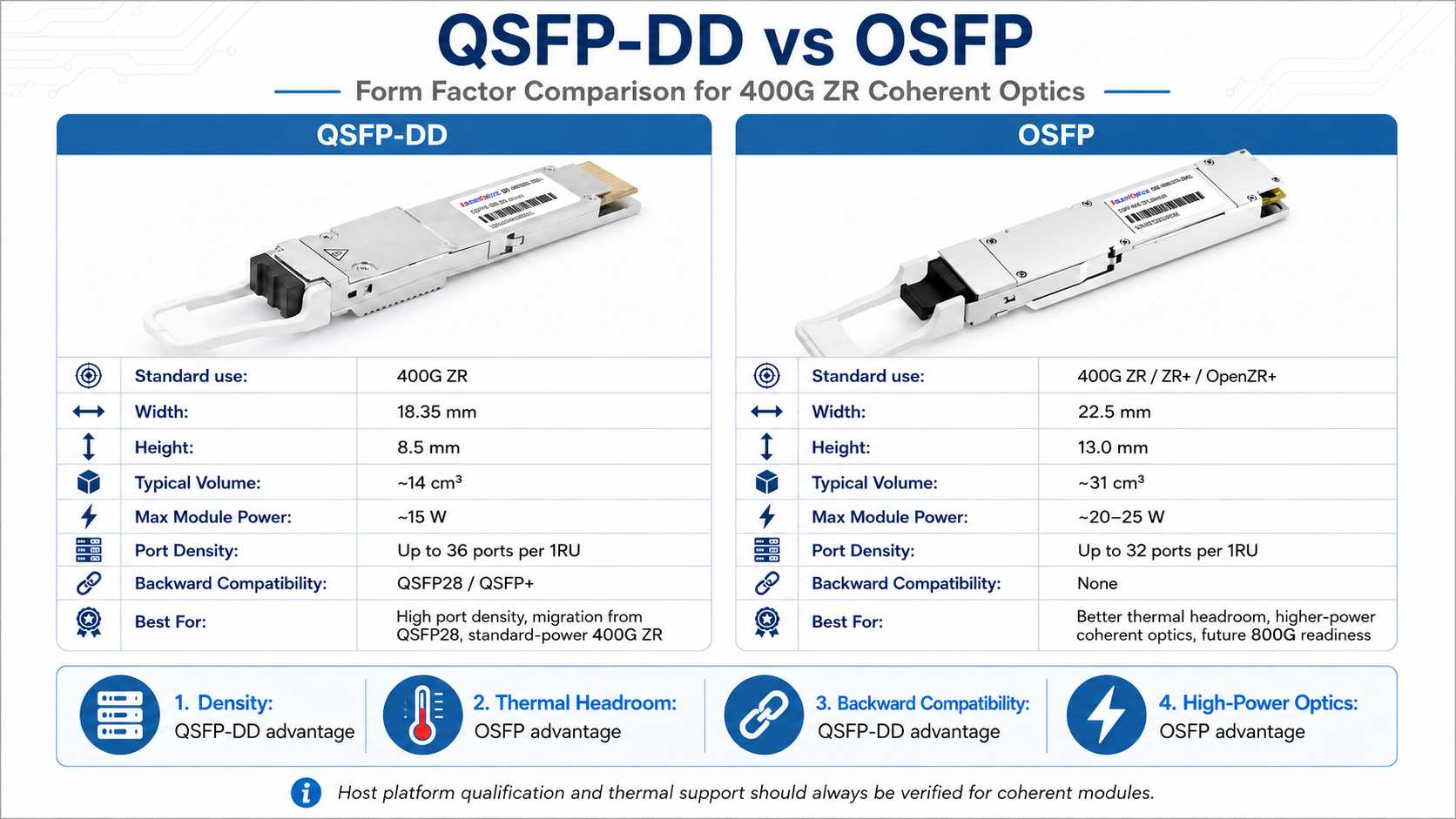
- •QSFP-DD: Backward compatible with QSFP28 and QSFP+, offering high port density for switches migrating from 100G infrastructure.
- •OSFP: A larger form factor with greater thermal headroom, often preferred for high-power coherent optics and future 800G upgrades.
Key Benefits
- •Eliminates external transponders: The coherent optic plugs directly into a switch or router port, enabling IP-over-DWDM architectures.
- •Multi-vendor interoperability: OIF 400ZR compliance ensures modules from different suppliers can interoperate when both comply with the same standard.
- •High fiber utilization: Tunable DWDM wavelengths allow multiple 400G channels to share the same fiber pair.
- •Reduced footprint and power: A QSFP-DD or OSFP moduleconsumes far less space and power than a traditional transponder line card.
How 400G ZR Works
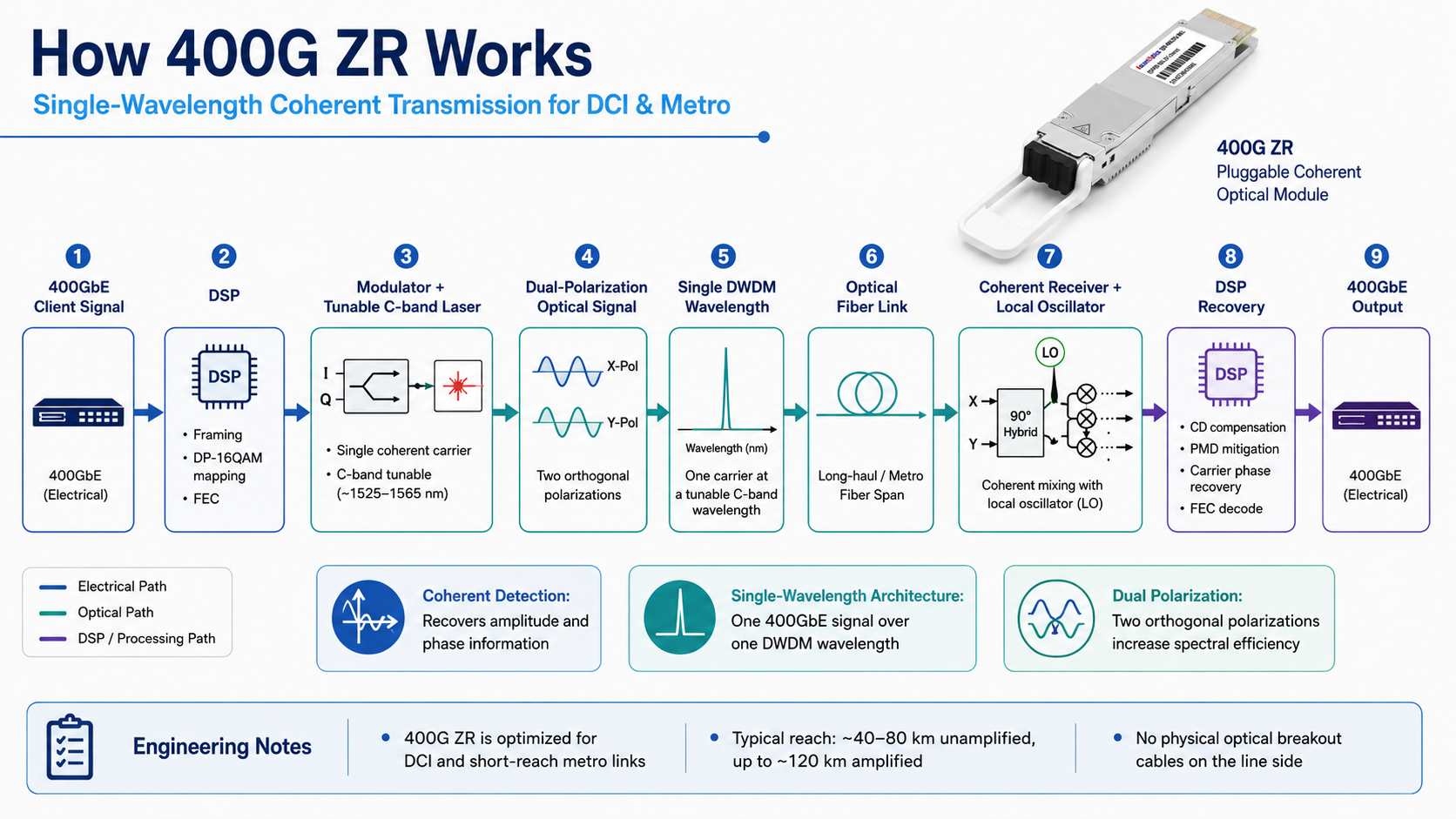
Understanding how 400G ZR works helps engineers make better deployment decisions. Unlike short-reach 400G optics that use parallel lanes, 400G ZR sends all traffic over a single coherent wavelength.
Coherent Transmission Basics
In a direct-detect optical system, the transmitter modulates light intensity, and the receiver measures that intensity. This approach is simple and power-efficient, but it is limited in spectral efficiency and reach.
Coherent optics modulate both the amplitude and phase of light. The receiver uses a local oscillator laser to mix with the incoming signal, enabling it to recover much more information from each optical symbol. Dual-polarization transmission sends independent data streams on two orthogonal polarizations of light, effectively doubling capacity.
DSP Functions in 400G ZR
The DSP inside a 400G ZR module performs several critical functions:
- •Chromatic dispersion compensation: Counteracts pulse spreading caused by the wavelength-dependent refractive index of the fiber.
- •Polarization-mode dispersion mitigation: Corrects differential delay between polarization states.
- •Carrier phase recovery: Tracks and corrects phase noise from lasers.
- •Forward error correction: Detects and corrects bit errors introduced by optical impairments.
Single-Wavelength Architecture
Because 400G ZR uses a single coherent wavelength, it does not support physical optical breakout cables. A 400G ZR module carries one 400GbE client signal over one optical wavelength. Some ZR+ and OpenZR+ implementations can electrically multiplex multiple client signals, such as 4 × 100G, onto one coherent carrier, but this happens at the client interface, not through optical breakout.
Engineering note: If your application requires splitting a 400G port into multiple 100G links, verify whether the host platform supports electrical client multiplexing or whether you need separate optics.
400G ZR vs. ZR+ vs. OpenZR+: Key Differences
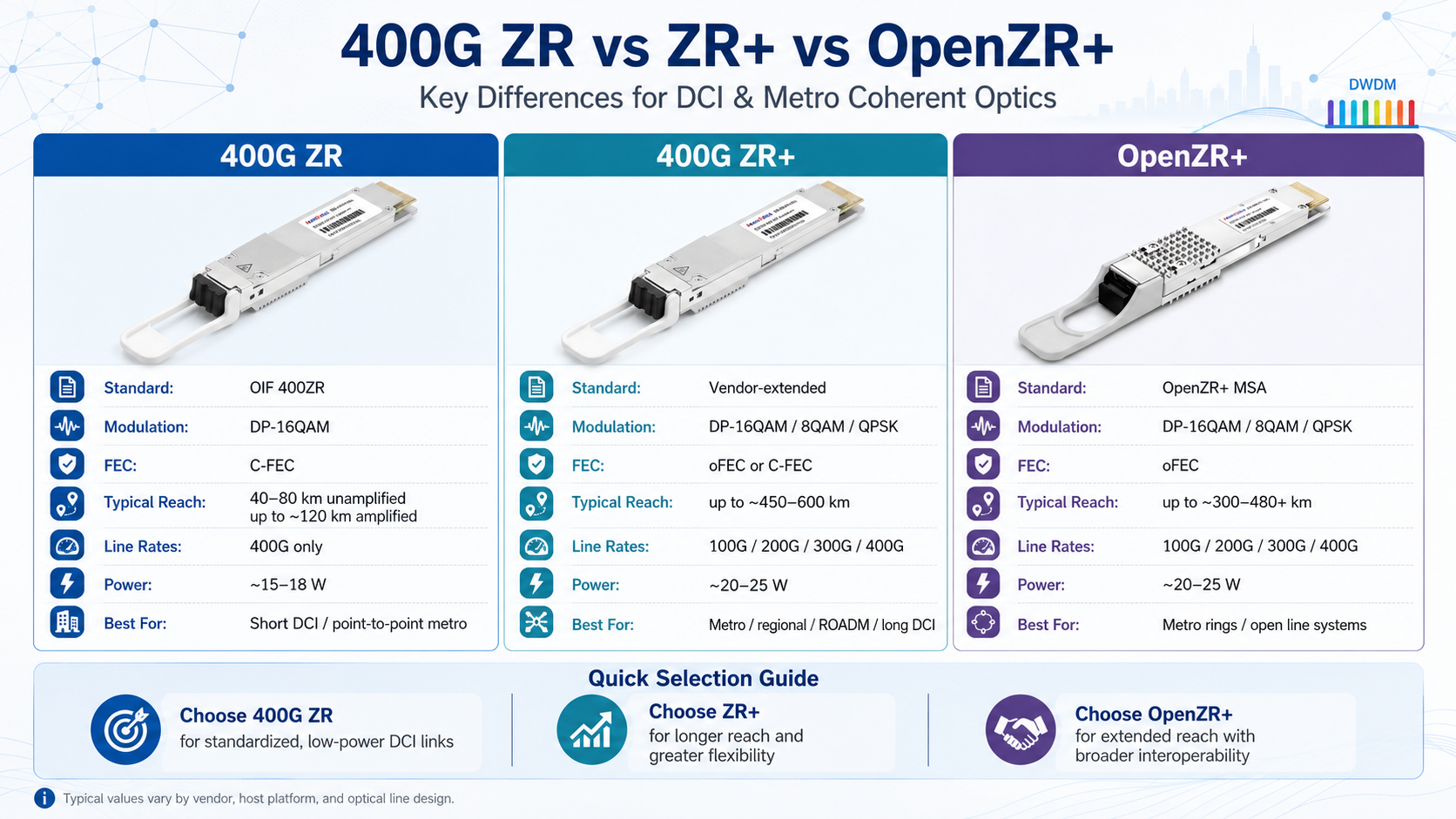
One of the most common sources of confusion is the difference between 400G ZR, 400G ZR+, and OpenZR+. These terms are related but not interchangeable.
Side-by-Side Comparison
| Feature |
400G ZR (OIF) |
400G ZR+ |
OpenZR+ |
| Standard |
OIF 400ZR Implementation Agreement |
Vendor-extended high-performance variants |
OpenZR+ MSA |
| Modulation |
DP-16QAM fixed |
DP-16QAM / 8QAM / QPSK selectable |
DP-16QAM / 8QAM / QPSK selectable |
| FEC |
C-FEC |
oFEC or C-FEC |
oFEC |
| Typical reach |
Up to ~120 km amplified |
Up to ~450–600 km |
Up to ~300–480+ km |
| Line rates |
400G only |
100G / 200G / 300G / 400G |
100G / 200G / 300G / 400G |
| Power consumption |
~15–18 W |
~20–25 W |
~20–25 W |
| Best use case |
Short DCI, point-to-point metro |
Metro/regional, ROADM, long DCI |
Metro rings, open line systems |
400G ZR: The Standardized DCI Choice
OIF 400G ZR is the right choice when you need a cost-effective, interoperable, low-power coherent optic for distances up to about 120 km. It is ideal for:
- •Campus and metro DCI links
- •Cloud availability-zone interconnect
- •Disaster recovery and storage replication
- •Any environment where multi-vendor interoperability matters
400G ZR+: Extended Reach and Flexibility
ZR+ refers to extended-reach coherent pluggable modules that go beyond the OIF 400ZR specification. These modules offer:
- •Longer reach, often hundreds of kilometers
- •Multiple modulation formats
- •Multi-rate operation
- •Higher launch power options
The modules are typically used in metro rings, regional networks, and applications requiring amplification or ROADM traversal. Because ZR+ is not defined by a single industry standard, supported modulation formats, reach, baud rates, and operating modes vary between vendors.
OpenZR+: Multi-Vendor Extended Reach
OpenZR+ is a multi-source agreement (MSA) that defines interoperable extended-reach coherent optics. It builds on the OIF 400ZR framework but adds:
- •OpenFEC (oFEC) for higher net coding gain
- •Flexible baud rates and modulations
- •Support for OTN and Ethernet client interfaces
- •Reach targets from 120 km up to 480 km or more
When selecting OpenZR+ modules, verify that both ends of the link support the same OpenZR+ implementation. While the MSA improves interoperability, matched vendor pairs are often recommended for complex optical paths.
Although OpenZR+ improves interoperability compared with proprietary ZR+ implementations, full interoperability still depends on compatible firmware, DSP implementations, and supported operating modes.
400G ZR Form Factors: QSFP-DD vs. OSFP
Form-factor selection is one of the most important decisions when deploying 400G ZR. The two main options are QSFP-DD and OSFP.
Physical and Thermal Comparison
| Specification |
QSFP-DD |
OSFP |
| Width |
18.35 mm |
22.5 mm |
| Height |
8.5 mm |
13.0 mm |
| Typical volume |
~14 cm³ |
~31 cm³ |
| Max module power |
~15 W |
~20–25 W |
| Port density |
Up to 36 ports per 1RU |
Up to 32 ports per 1RU |
| Backward compatibility |
QSFP28 / QSFP+ |
None |
When to Choose QSFP-DD for 400G ZR
QSFP-DD is attractive when:
- •You are migrating from existing QSFP28 or QSFP+ infrastructure.
- •Port density is a top priority.
- •Your 400G ZR modules operate within the standard 15 W power class.
- •You want to reuse existing cable plants and management processes.
QSFP-DD can support standard 400G ZR modules, but it operates close to its thermal ceiling. For high-power ZR+ modules or dense deployments, thermal headroom should be carefully verified. Host platform support should always be verified, as not every QSFP-DD or OSFP switch is qualified for coherent optics or high-power modules.
OSFP is the safer choice when:
- •You are deploying 400G ZR+ or OpenZR+ modules with higher power consumption.
- •You are building greenfield AI or hyperscale data center networks.
- •Future 800G upgrades are part of the roadmap.
- •Thermal headroom and reliability are more important than maximum port density.
The larger OSFP package provides better heat dissipation, which is important because coherent optics generate more heat than direct-detect modules.
400G ZR Specifications and Performance
Network engineers need accurate specifications to design reliable links. Below are the typical performance parameters for OIF 400G ZR modules.
Line-Side Specifications
- •Data rate: 400 Gbps fixed
- •Modulation: DP-16QAM
- •Baud rate: ~59.84–60 Gbaud
- •FEC: C-FEC with approximately 15% overhead
- •Reach: Up to ~120 km over amplified DWDM links; ~40–80 km unamplified depending on fiber and loss
- •Wavelength: C-band tunable DWDM
- •Grid spacing: 75 GHz or 100 GHz
- •Connector: Duplex LC
Host-Side Specifications
- Client interface: 400GbE
- Electrical interface: 8 × 53.125 GBd PAM4 (commonly referred to as 8 × 56G PAM4 electrical lanes)
- Management: CMIS 4.0 or 5.0
- Form factor: QSFP-DD or OSFP
Power Consumption
Standard 400G ZR modules typically consume 15–18 W. High-power variants and ZR+ modules may draw 20–25 W or more. When planning deployments, always confirm the power class supported by the host switch or router.
Planning tip: A 1RU switch with 32 OSFP ports populated with 25 W ZR+ modules could dissipate over 800 W just from optics. Verify airflow, power supply capacity, and rack thermal design before deployment.
Applications and Deployment Scenarios
400G ZR is designed for applications where high bandwidth, moderate reach, and pluggable simplicity matter.
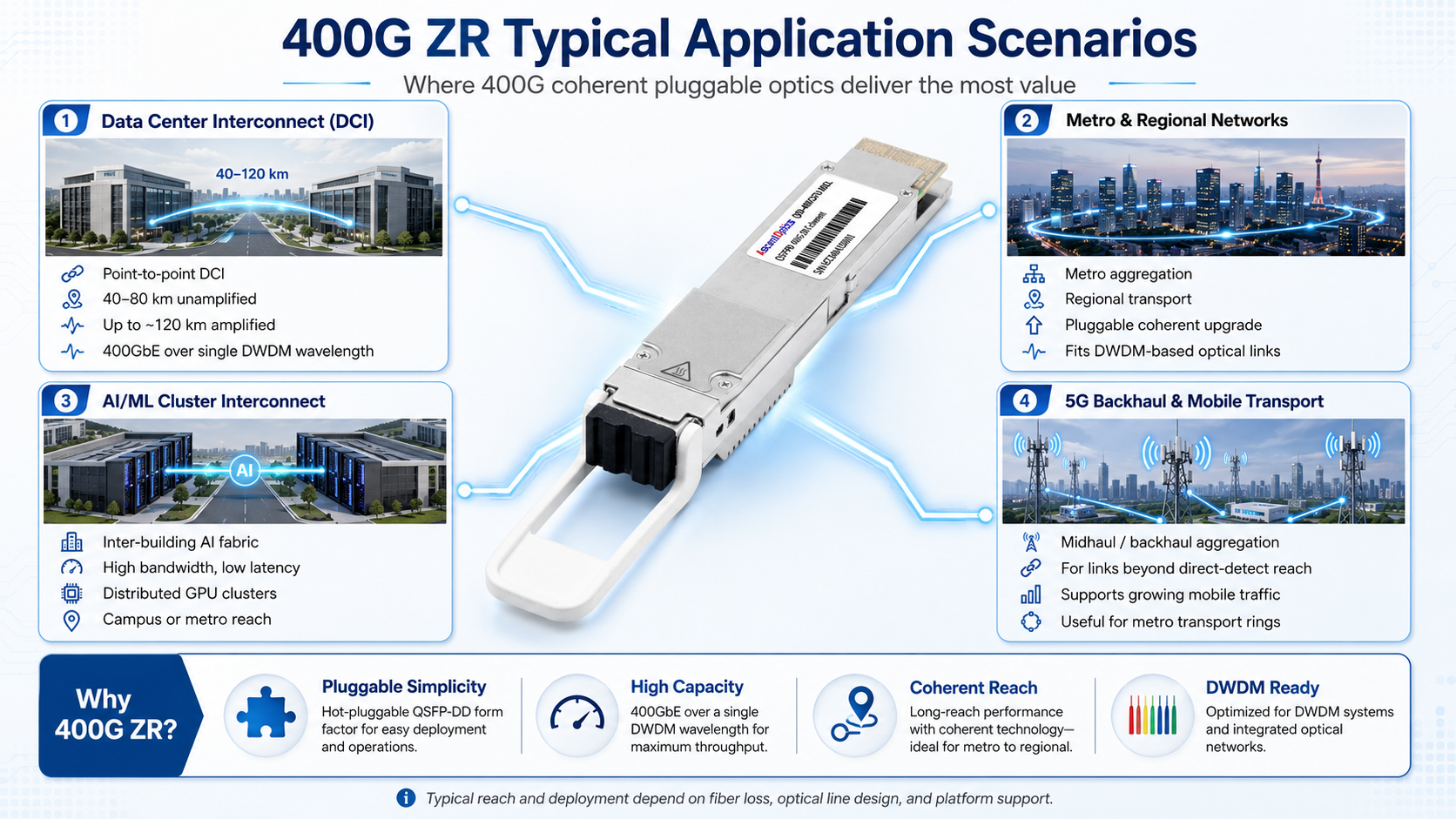
Data Center Interconnect (DCI)
The most common use case for 400G ZR is point-to-point DCI. Cloud providers, enterprises, and colocation operators use 400G ZR to connect data centers within the same metro region.
Typical DCI scenarios include:
- •Interconnection between availability zones
- •Campus links between adjacent facilities
- •Disaster recovery and backup connectivity
- •Storage replication and synchronization
Metro and Regional Networks
Telecom operators use 400G ZR and OpenZR+ for metro aggregation and regional transport. Pluggable coherent optics allow operators to increase capacity without deploying new transport shelves.
AI/ML Cluster Interconnect
AI training clusters often span multiple buildings or campuses. 400G ZR and 800G ZR coherent optics are increasingly used to provide high-bandwidth, low-latency connectivity between distributed GPU clusters. According to market research, the global 400G ZR/ZR+ coherent optical module market reached approximately USD 1.25 billion in 2025 and is projected to grow at an 18.75% CAGR, driven partly by AI networking demand.
As AI infrastructure expands across multiple buildings or campuses, coherent pluggable optics provide a practical solution for extending GPU fabrics beyond the reach of direct-detect optics while maintaining high bandwidth and simplified network architecture.
5G Backhaul and Mobile Transport
Mobile operators use coherent pluggable optics for midhaul and backhaul aggregation where distances exceed the reach of direct-detect modules. 400G ZR+ can also support regional transport rings that aggregate traffic from multiple 5G sites.
Deployment Considerations
Deploying 400G ZR successfully requires attention to link budget, interoperability, thermal design, and fiber characteristics.
Link Budget and Amplification
OIF 400G ZR is designed for links up to approximately 120 km with amplification. For shorter unamplified links, reach depends on fiber loss, connector loss, and splice loss. A typical unamplified reach is 40–80 km.
When designing amplified links, consider:
- •Total fiber loss including margins
- •Optical signal-to-noise ratio (OSNR)
- •Chromatic dispersion and PMD of the fiber span
- •Amplifier placement and gain flatness
Interoperability
Multi-vendor interoperability is one of the main selling points of OIF 400G ZR. However, interoperability requires both modules to comply with the same OIF Implementation Agreement. For ZR+ and OpenZR+, verify:
- •The exact standard supported by each module
- •FEC compatibility
- •Management interface version
- •Vendor qualification reports
Thermal and Power Planning
Coherent modules consume more power than direct-detect optics. Before deployment:
- •Confirm the power class supported by each switch port
- •Calculate total rack-level power and cooling requirements
- •Ensure adequate airflow across module heat sinks
- •Consider belly-to-belly mounting effects in dense racks
Fiber Requirements
400G ZR operates over single-mode fiber. Commonly supported fiber types include:
- •ITU-T G.652 standard single-mode fiber
- •ITU-T G.655 non-zero dispersion-shifted fiber
Verify that the fiber dispersion and PMD characteristics are within the compensation range of the module DSP.
ROADM Compatibility
When deploying ZR+ or OpenZR+ across ROADM networks, verify wavelength plans, channel spacing, amplifier gain, and supported operating modes to ensure end-to-end interoperability.
Frequently Asked Questions
What is 400G ZR?
400G ZR is an OIF-standardized coherent optical transceiver that delivers 400 Gbps over a single DWDM wavelength. It is designed for data center interconnect and short-reach metro links up to approximately 120 km.
What is OpenZR+?
OpenZR+ is a multi-source agreement that defines interoperable extended-reach coherent optics. It supports 100G to 400G line rates, oFEC, and reaches from 120 km to 480 km or more.
What modulation does 400G ZR use?
400G ZR uses DP-16QAM modulation at approximately 60 Gbaud.
Does 400G ZR support breakout cables?
No. 400G ZR uses a single coherent wavelength, so it does not support physical optical breakout. Some ZR+ implementations support electrical multiplexing of multiple client signals onto one carrier.
When should I choose QSFP-DD vs. OSFP for 400G ZR?
Choose QSFP-DD for density and backward compatibility with QSFP28. Choose OSFP for thermal headroom, high-power ZR+ modules, and future 800G readiness.
Can 400G ZR operate without a DWDM system?
Standard 400ZR is designed for DWDM transmission. Although it can be used over dark fiber in certain scenarios, its primary application is amplified DWDM-based data center interconnect.
Is 400G ZR suitable for enterprise networks?
Yes. Enterprises connecting multiple campuses or data centers within a metropolitan area can benefit from 400ZR, provided the network infrastructure supports coherent DWDM transmission.
Post Views: 1,707