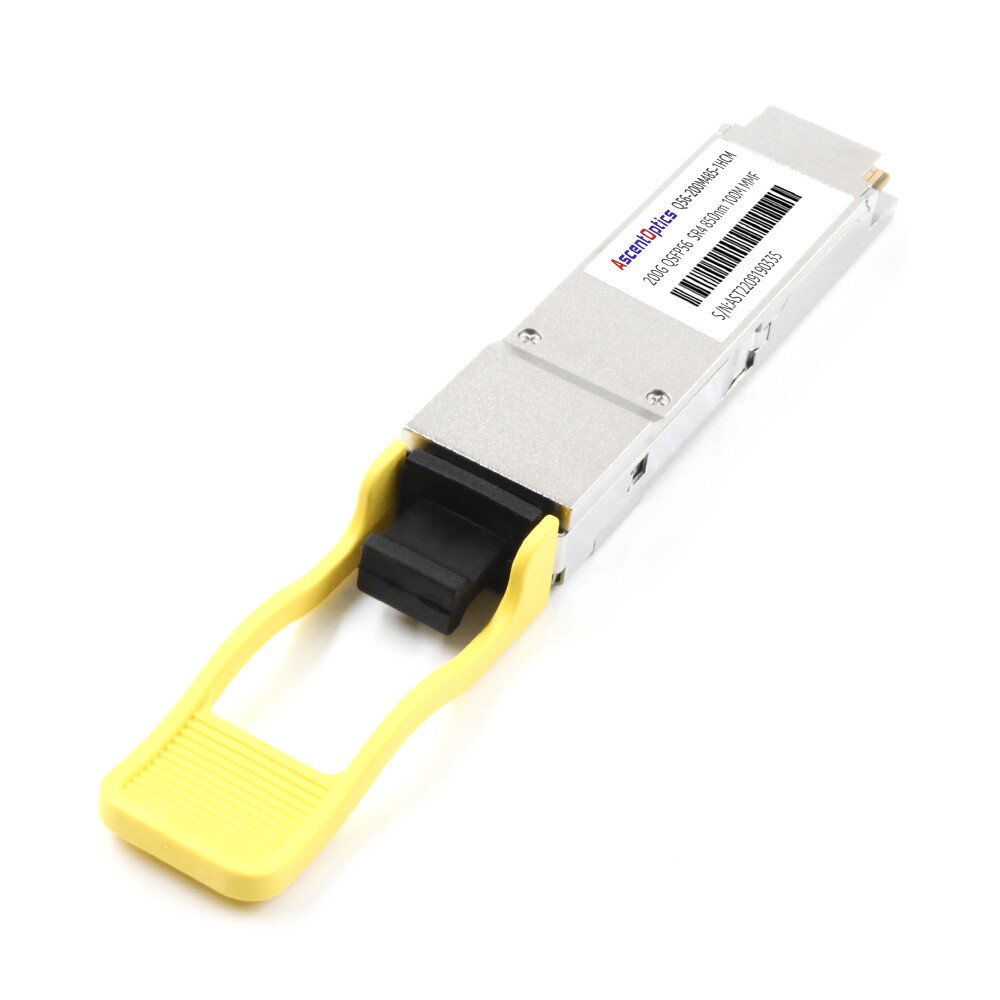
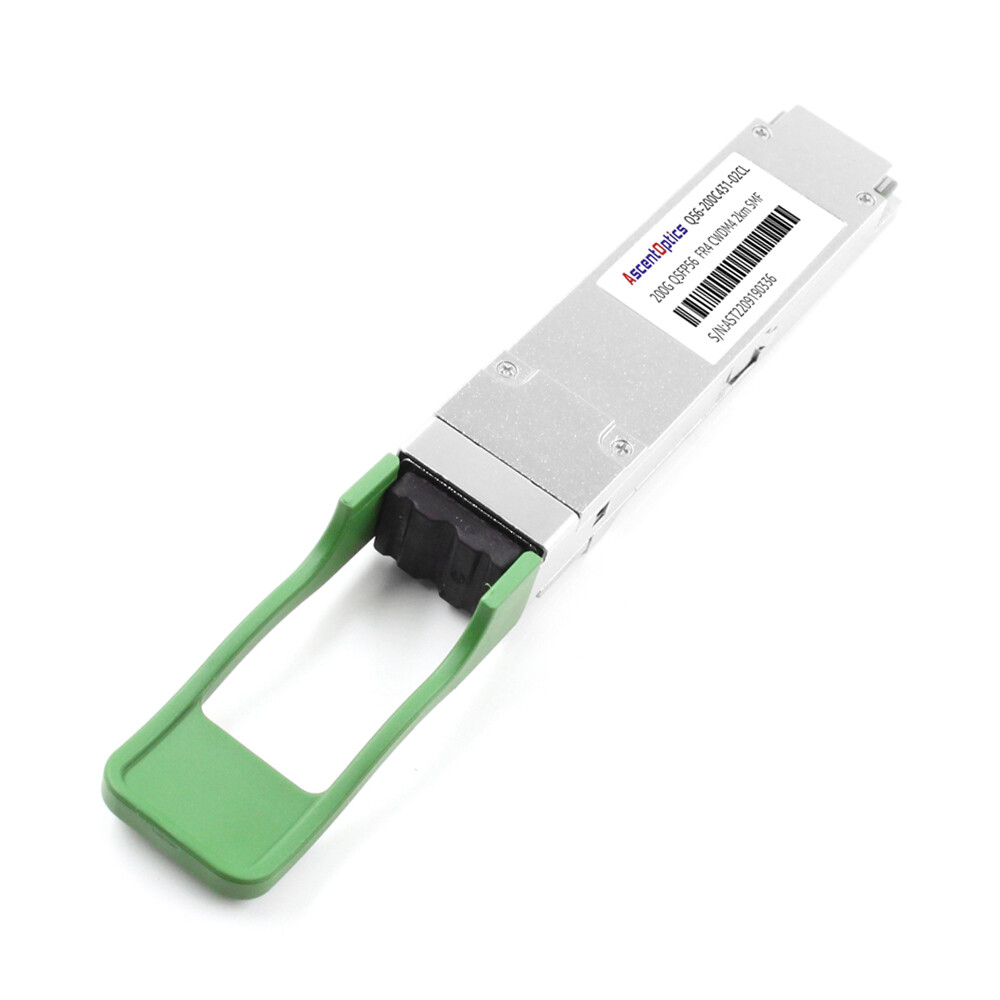
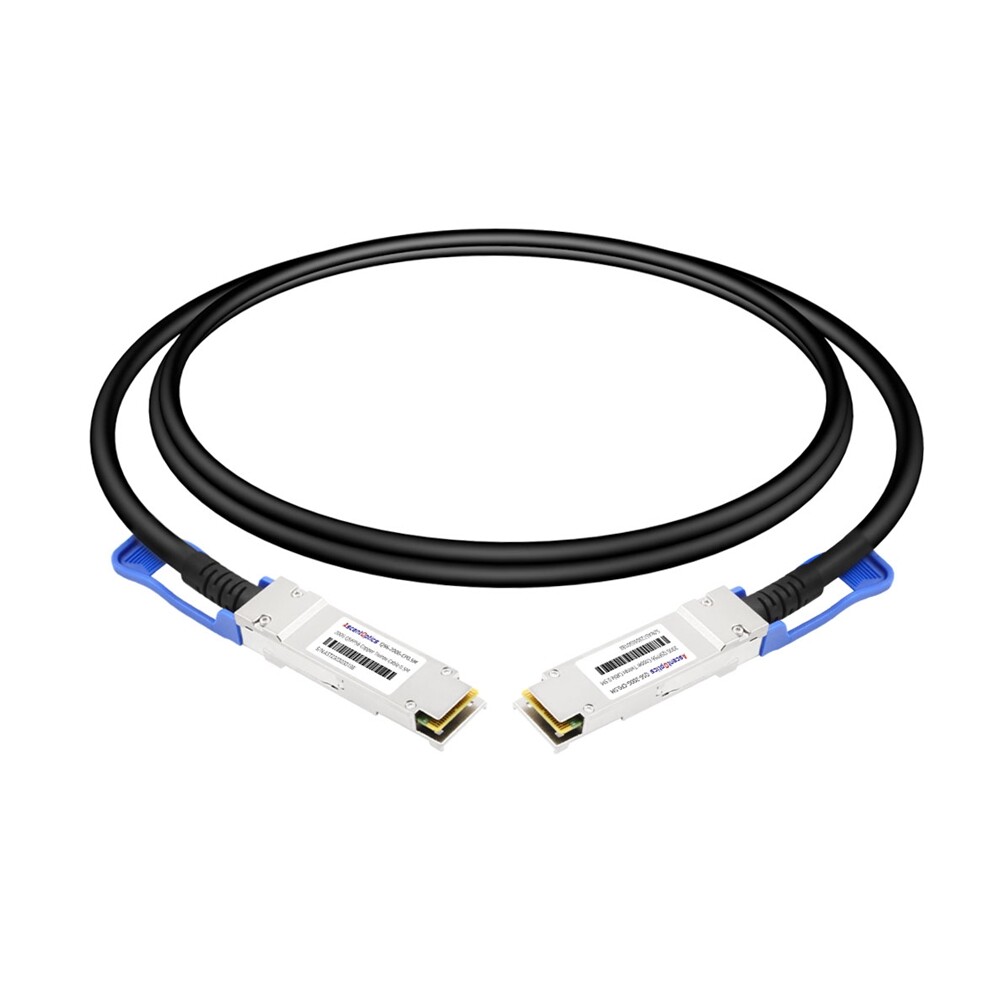
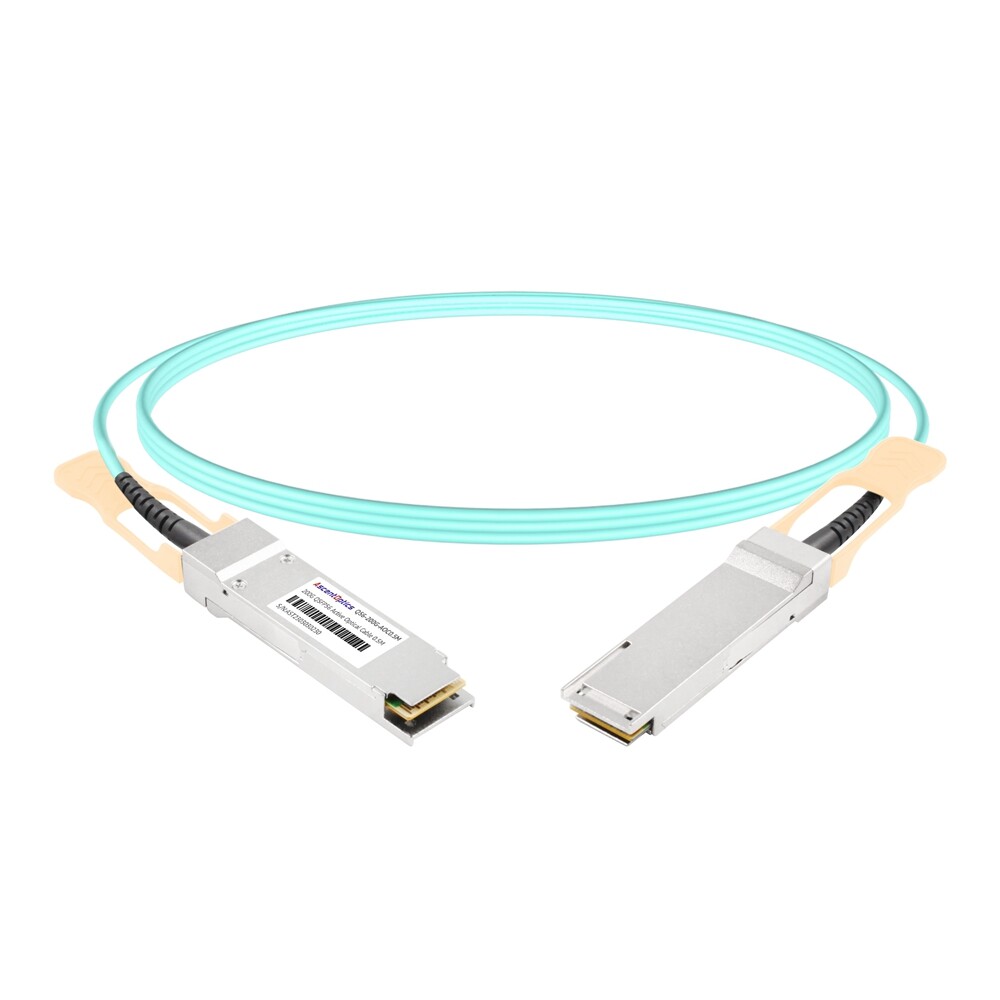
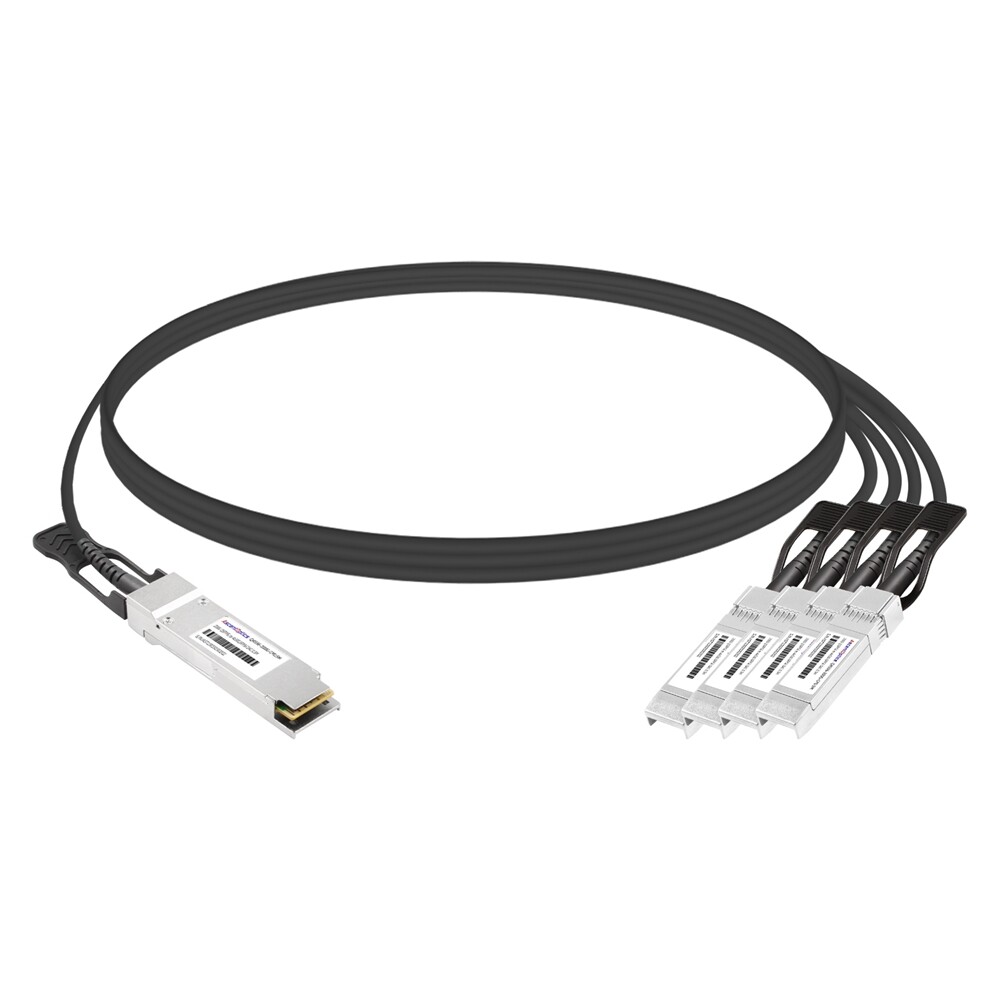
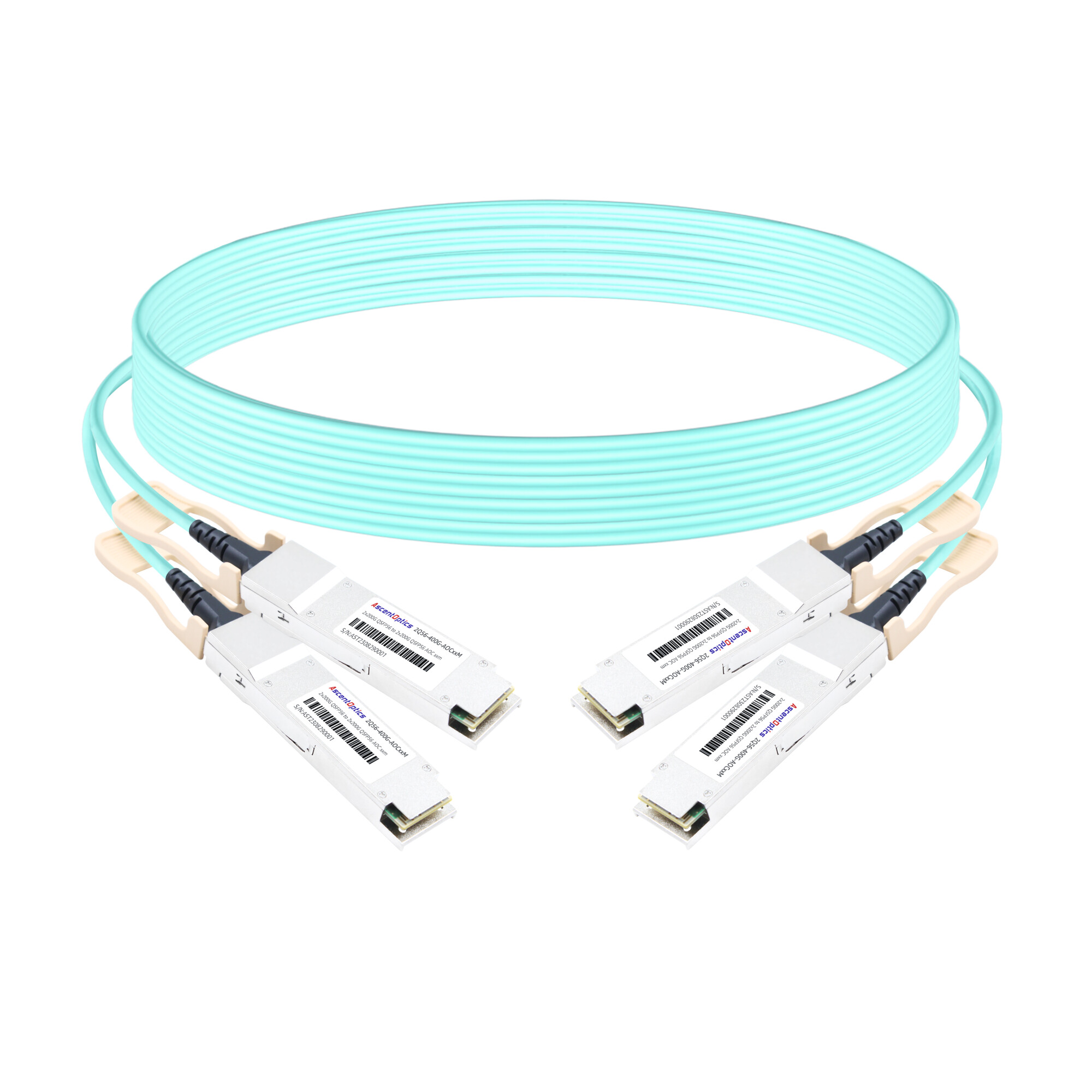
QSFP56 uses four 50 Gbps PAM4 electrical lanes to deliver an aggregate bandwidth of 200 Gbps. For applications that demand low power and low latency, the DAC cables can be used, while for others that need extended ranges of transmission and resistance against interference, AOC cables would suffice. Moreover, there is an option for the breakout of the 200G port to satisfy varying networking needs.
This guide explains the main QSFP56 cable types, their specifications, compatibility requirements, and how to choose the right option for data center, AI, HPC, and storage networks.
What Is a QSFP56 Cable?
A QSFP56 cable is a high-speed fixed interconnect that supports 200 Gigabit Ethernet using four 50 Gbps PAM4 electrical lanes. It uses the same QSFP mechanical form factor as QSFP28 but requires host hardware with 50G PAM4 SerDes, and it is available as a passive DAC, active DAC, AOC, or breakout cable.
QSFP56 stands for Quad Small Form-Factor Pluggable 56. The “56” refers to the signaling generation originally designed for approximately 56 GBaud operation, which enables 50 Gbps PAM4 data transmission per electrical lane. Unlike QSFP28, which uses NRZ modulation at 25 Gbps per lane, QSFP56 uses PAM4 modulation to transmit two bits per symbol. This doubles the lane rate without adding physical lanes.
The key distinction between a QSFP56 cable and a QSFP56 transceiver is that cables have fixed connector ends and a predetermined length. Transceivers accept separate fiber patch cords, while cables are plug-and-play assemblies. Cables are also typically lower cost and lower latency for short-reach links.
QSFP56 Cable Types and Specifications
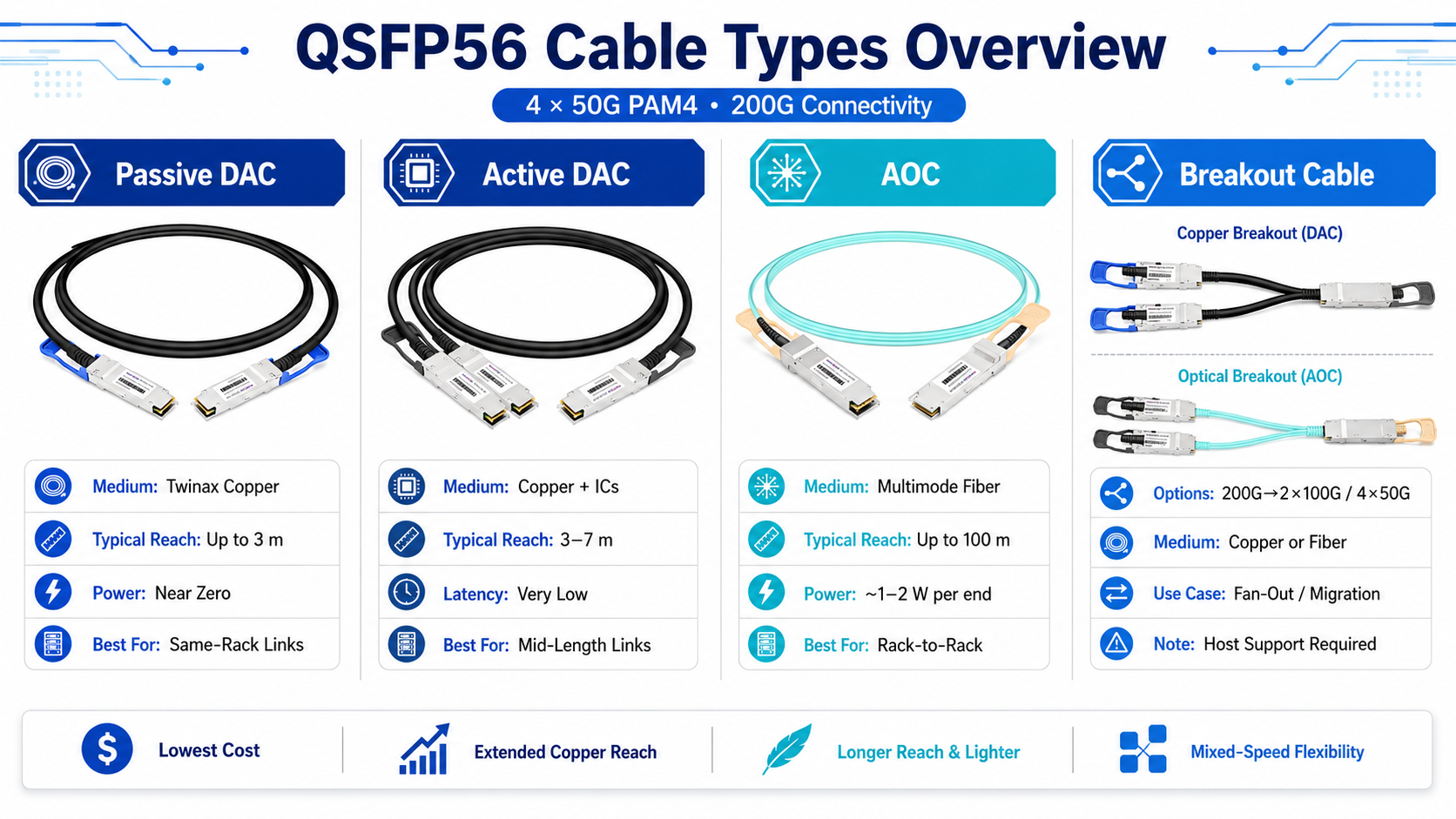
QSFP56 cables fall into four main categories. Each type balances reach, power, latency, flexibility, and cost differently.
QSFP56 Passive DAC (Direct Attach Copper)
A passive DAC uses twinax copper cable with fixed QSFP56 connectors on both ends. There are no active signal-conditioning components, so the cable relies entirely on the host’s transmitter and receiver quality.
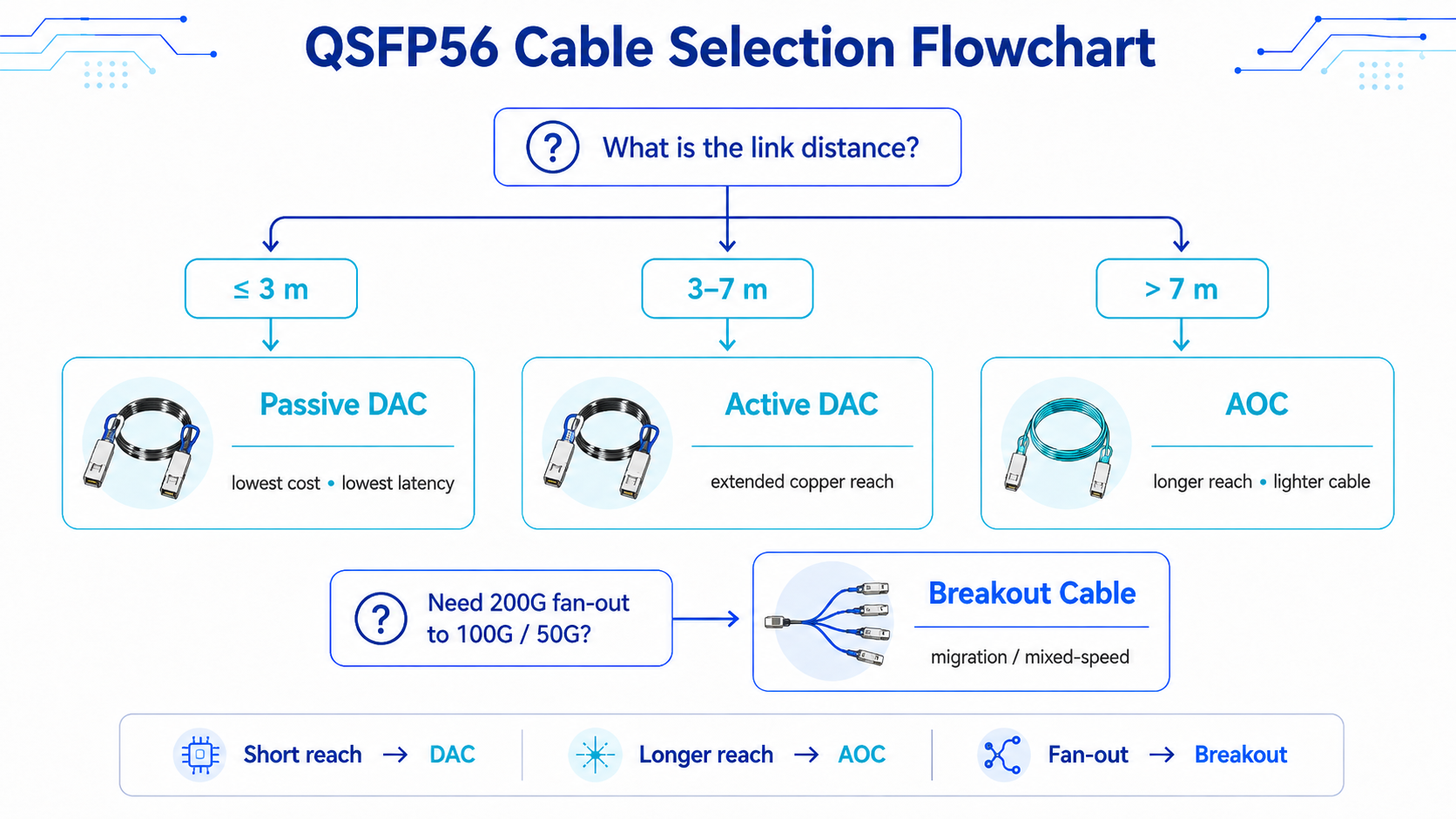
- •Typical reach: up to 3 meters, depending on cable gauge and host signal integrity
- •Power consumption: near zero
- •Latency: lowest of all QSFP56 cable options
- •Weight and flexibility: heavier and stiffer than AOC
- •Best for: same-rack or adjacent-rack links, cost-sensitive deployments, low-latency fabrics
Passive DAC is usually the first choice when the distance is under 3 meters and the budget matters. At 200G, PAM4 signaling has a lower noise margin than the NRZ used in QSFP28, so passive DAC reach is generally shorter than at 100G. Passive DACs provide the lowest latency because they contain no active signal-conditioning components.
QSFP56 Active DAC
An active DAC adds signal-conditioning integrated circuits inside the QSFP56 connector housing. This extends reach compared to passive DAC while keeping the cost lower than AOC.
- •Typical reach: 3–7 meters, vendor dependent
- •Power consumption: less than 2 W per end
- •Latency: very low, slightly higher than passive DAC
- •Best for: mid-length copper runs where a passive DAC cannot reach
Active DAC is useful when you need a few extra meters but still want copper economics. It is not as common as passive DAC or AOC, so verify availability and switch compatibility before specifying it. Active DACs are commonly used when passive DAC signal integrity becomes challenging at longer copper lengths.
QSFP56 AOC (Active Optical Cable)
A QSFP56 AOC replaces copper with multimode fiber and integrates optical engines in each connector. The cable is permanently attached, so there are no separate transceivers or patch cords to manage.
- •Typical reach: 1 m to 100 m, depending on fiber grade
- •OM3 reach: up to 70 m
- •OM4 reach: up to 100 m
- •Power consumption: approximately 1–2 W per end
- •Latency: low, slightly higher than DAC due to electrical-to-optical conversion
- •Weight and flexibility: lighter and thinner than DAC, improving airflow and cable management
- •Best for: rack-to-rack, row-to-row, leaf-spine, and high-density deployments
AOCs are immune to electromagnetic interference, which matters in dense racks with power supplies and motors nearby. Unlike transceiver-based optical links, AOCs cannot be disconnected from their integrated fiber assemblies, simplifying deployment but reducing flexibility.
QSFP56 Breakout Cables
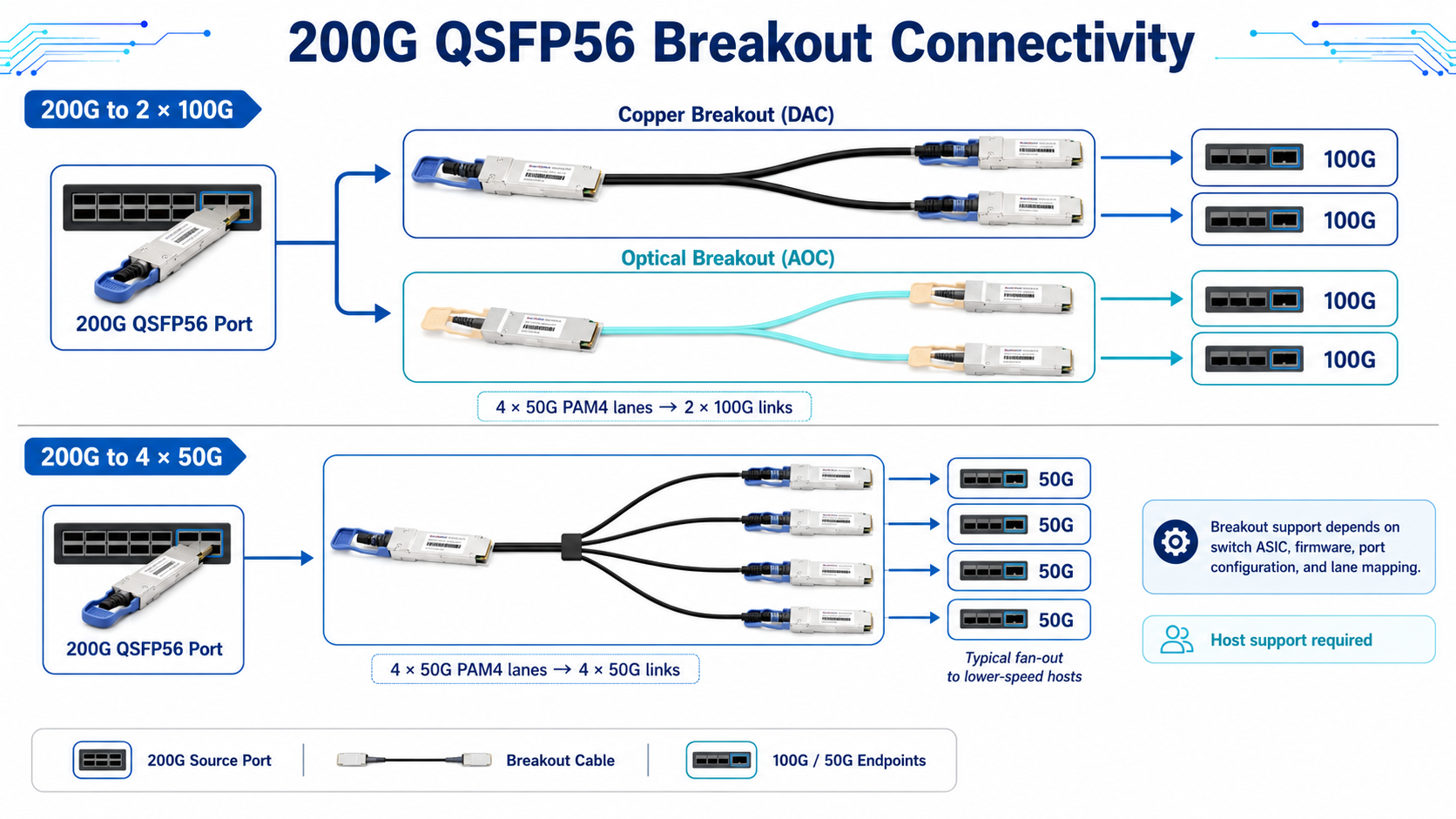
Breakout cables split one 200G QSFP56 port into multiple lower-speed ports. They are useful during migration or when connecting high-speed switches to existing lower-speed hosts.
- •200G to 2×100G: splits one QSFP56 200G port into two 100G ports
- •200G to 4×50G: splits one QSFP56 200G port into four 50G ports
- •Medium: twinax copper or fiber, depending on configuration
- •Best for: mixed-speed fabrics, server fan-out, staged migration from 100G
Breakout support depends on the switch ASIC, firmware, and lane mapping. Always confirm split-mode capability before ordering. Breakout cables are widely used during network migration, allowing higher-speed switches to connect to existing lower-speed servers or appliances without immediate infrastructure replacement.
QSFP56 Cable Comparison Table
| Cable Type |
Medium |
Typical Reach |
Power per End |
Latency |
Best Use Case |
| Passive DAC |
Twinax copper |
Up to 3 m |
Near zero |
Lowest |
Same-rack, cost-sensitive, low-latency |
| Active DAC |
Twinax copper + ICs |
3–7 m |
< 2 W |
Very low |
Mid-length copper runs |
| AOC |
OM3/OM4 fiber |
1–100 m |
~1–2 W |
Low |
Rack-to-rack, high density, EMI immunity |
| Breakout DAC/AOC |
Copper or fiber |
Same as base type |
Varies |
Varies |
Mixed-speed migration, fan-out |
QSFP56 DAC vs AOC: How to Choose
When engineers ask whether to use a QSFP56 DAC or AOC, the answer usually comes down to distance, power, and rack logistics.
Use a passive DAC when:
- •The link is within the same rack or an adjacent rack.
- •Reach is 3 meters or less.
- •You want the lowest cost and lowest latency.
- •Power and heat budgets are tight.
Use an active DAC when:
- •You need 3–7 meters of reach.
- •Passive DAC signal integrity is marginal at the required length.
- •You still prefer copper economics over fiber.
Use an AOC when:
- •Reach exceeds 7 meters or runs between rows.
- •You need lighter, more flexible cabling for airflow.
- •The environment has high electromagnetic interference.
- •You want plug-and-play fiber without separate transceivers.
Cost and TCO Considerations
Passive DAC is the least expensive per meter, followed by active DAC, then AOC. However, the total cost should include switch port utilization, power, cooling, and installation labor. A passive DAC that is too long for the signal budget can cause intermittent errors that cost far more than upgrading to an AOC.
QSFP56 Cable Standards and Compliance
Reliable 200G cabling depends on standards compliance. The most relevant specifications for QSFP56 cables include:
- •IEEE 802.3cd-2018: defines 200GBASE-CR4 for direct-attach copper and 200GBASE-SR4 for multimode optical links.
- •IEEE 802.3bs-2017: addresses 200GbE and 400GbE signaling frameworks.
- •SFF-8665 / QSFP56 MSA: defines the mechanical form factor, electrical interface, and thermal requirements.
- •CMIS 4.0 or later: the Common Management Interface Specification used for DOM/DDM reporting and module configuration.
- •InfiniBand HDR: the 200 Gbps InfiniBand standard used in many AI and HPC clusters.
- •RoHS / REACH / UL: environmental and safety compliance for data center deployments.
QSFP56 Cable Compatibility and Interoperability
Compatibility is the most common source of problems with 200G cabling. Physical fit does not guarantee electrical compatibility.
Host Port Requirements
A QSFP56 cable requires a host port with:
- •50G PAM4 SerDes capability
- •Firmware support for 200G operation
- •RS(544,514) FEC support for 200G Ethernet
- •CMIS 4.0 management support for DOM/DDM
Backward Compatibility Rules
QSFP56 cables share the same 38-pin connector as QSFP28, but they are not backward compatible at 200G. A QSFP56 cable will not operate at 200 Gbps in a QSFP28 port because QSFP28 lacks 50G PAM4 SerDes. Conversely, many QSFP56 ports can accept QSFP28 modules and run them at 100G, but this depends on the switch ASIC and firmware.
QSFP56 Cable Applications
QSFP56 cables are deployed wherever 200G bandwidth is needed in a compact, cost-effective form.
Data Center Top-of-Rack and Leaf-Spine
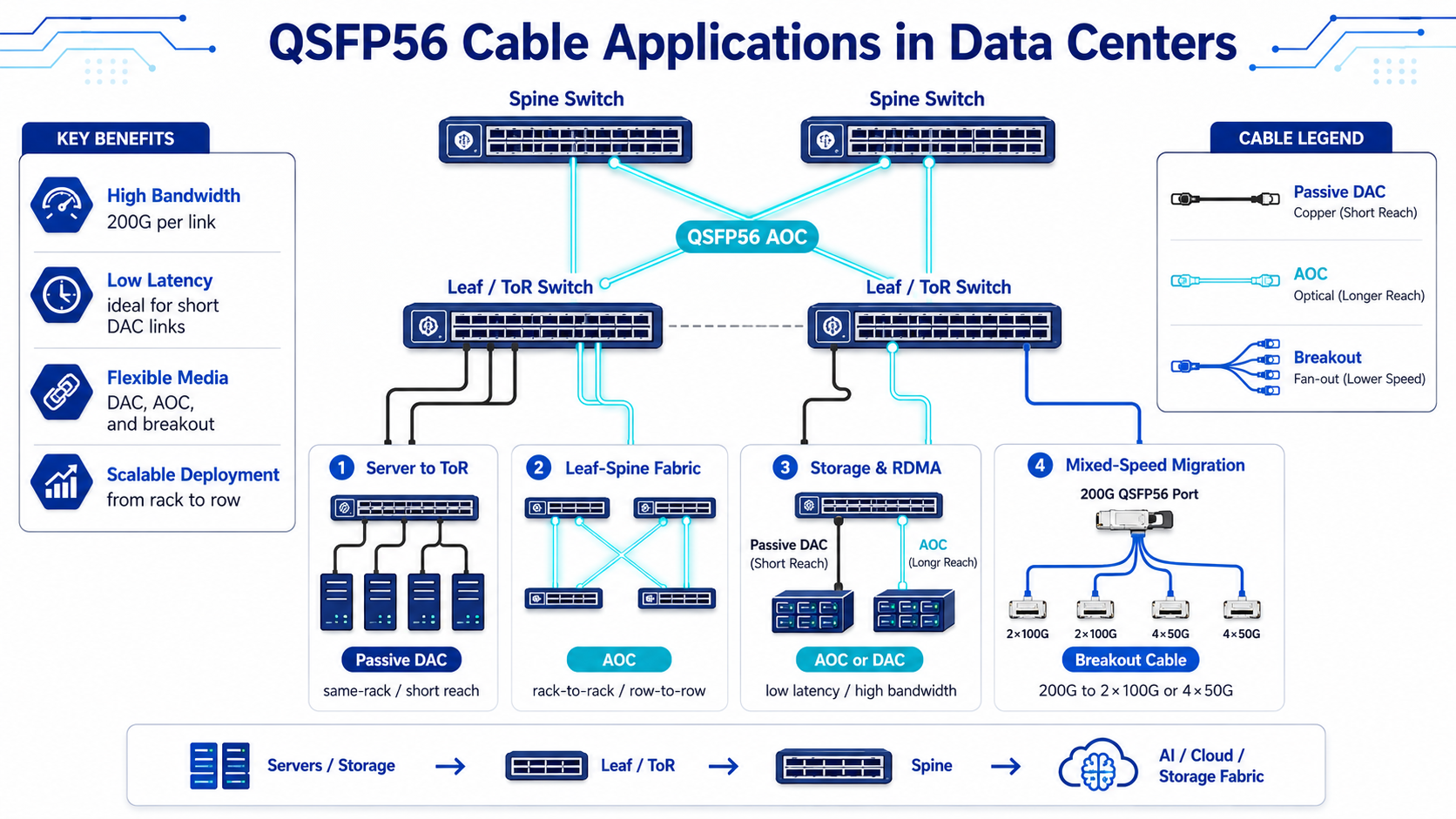
Passive DACs connect servers to ToR switches within the same rack. AOCs connect leaf switches to spine switches across rows. This combination minimizes cost where distance is short and maximizes flexibility where distance grows.
AI and HPC Clusters
AI training clusters generate massive east-west traffic between GPUs. QSFP56 AOCs and DACs support InfiniBand HDR and 200GbE RoCEv2 links in fat-tree and rail-optimized topologies. For more on this use case, see our QSFP56 in AI clusters guide.
Storage and RDMA Networks
Low-latency DACs are ideal for storage fabrics using NVMe over Fabrics or RDMA over Converged Ethernet. AOCs extend the same 200G connectivity across storage rows.
Enterprise and Telecom Aggregation
Enterprises upgrading campus cores and telecom operators aggregating cell site traffic both use 200G links. Breakout cables help bridge 100G and 200G equipment during phased upgrades.
Installation and Cable Management Best Practices
Poor installation practices are a leading cause of cable-related link failures. Follow these guidelines for reliable 200G cabling.
Bend Radius
Maintain the manufacturer’s minimum bend radius. A good rule of thumb is approximately four times the cable diameter for AOC and six times for DAC. Tight bends increase insertion loss and can damage fiber inside AOCs.
Strain Relief and Routing
Avoid pulling cables across sharp edges or suspending them by the connector. Use cable managers and strain-relief bars in high-density racks. Route heavier DACs along supported pathways to reduce stress on switch ports.
Connector Handling
Insert QSFP56 connectors with the latch aligned correctly. Do not force the connector if resistance is high. Remove dust caps only when ready to connect, and keep unused ports covered.
Polarity and Cleaning
For AOCs with MPO-style optical sections, verify polarity before commissioning. Clean fiber end-faces with appropriate tools and inspect with a fiber microscope when possible.
Labeling and Airflow
Label both ends of every cable with source and destination ports. Keep cable bundles neat to preserve front-to-rear airflow in switches and servers.
For high-density deployments, plan cable routing before installation to avoid airflow obstruction and simplify future maintenance.
Troubleshooting Common QSFP56 Cable Issues
Even with the right cable, links can fail to come up or run with errors. Here is a diagnostic checklist.
Link Does Not Come Up
- •Confirm the port is configured for 200G and not auto-negotiating to 100G.
- •Verify FEC mode matches on both ends.
- •Check that the switch firmware recognizes the cable vendor ID.
- •Reseat the cable and inspect for bent pins or debris.
High Error Rate or CRC Errors
- •Look for an FEC mismatch between the two ends.
- •Check bend radius and cable gauge for passive DAC runs near the length limit.
- •Clean optical connectors if using AOC.
- •Verify that the cable length and type match the port specification.
Intermittent Link Flaps
- •Review thermal logs; overheated switches can cause optical instability.
- •Check for loose connectors or vibration in the rack.
- •Move copper cables away from power cables or motors if EMI is suspected.
- •Update switch firmware if known bugs affect QSFP56 link training.
DOM/DDM Not Reporting
- •Confirm CMIS 4.0 support on the host.
- •Verify the cable EEPROM is programmed correctly.
- •Test with a known-good cable to isolate the fault.
Breakout Mode Not Working
- •Confirm the switch ASIC supports the desired split configuration.
- •Check lane mapping in the switch configuration.
- •Verify the breakout cable matches the split mode, such as 200G to 2×100G.
Conclusion
QSFP56 cables deliver 200G in the same compact QSFP footprint used for 100G, but they require careful matching between cable type and application. Passive DAC remains the lowest-cost choice for short links. Active DAC extends copper reach by a few meters. AOC covers rack-to-rack and row-to-row distances with lighter, EMI-immune fiber. Breakout cables bridge 200G switches to legacy 100G or 50G hosts during migration.
The right choice depends on reach, power budget, latency target, rack density, and switch compatibility. Standards compliance and vendor interoperability testing are just as important as cable specifications.
Frequently Asked Questions About QSFP56 Cables
Can QSFP56 DAC cables work with QSFP28 ports?
QSFP56 and QSFP28 cables share the same QSFP mechanical form factor, but they are not fully interchangeable. A QSFP56 cable requires host equipment with 50G PAM4 SerDes capability to operate at 200G, while QSFP28 ports are designed for 25G NRZ signaling. Therefore, a QSFP28-only port cannot run a QSFP56 cable at 200G. However, some QSFP56-capable switch ports may support QSFP28 modules at 100G depending on the switch ASIC, firmware, and port configuration.
What is the maximum distance of a QSFP56 DAC cable?
The maximum reach of a QSFP56 DAC cable depends on the cable design and signal-conditioning technology. Passive QSFP56 DAC cables typically support distances up to 3 meters, while active DAC versions can extend reach to approximately 3–7 meters depending on the vendor implementation. For longer connections, QSFP56 AOCs can support distances up to 100 meters using multimode fiber. Passive DAC remains the preferred choice for short, low-cost connections, while AOC is better suited for longer rack-to-rack and row-to-row deployments.
Should I choose QSFP56 DAC or AOC for a 200G network?
The choice between QSFP56 DAC and AOC depends mainly on transmission distance, power requirements, and cable management needs. DAC cables are ideal for short-reach connections because they provide lower cost, lower power consumption, and minimal latency. AOCs are better suited for longer links because they are lighter, more flexible, and easier to manage in high-density data center environments. In many AI clusters and cloud data centers, DAC cables are commonly used for server-to-switch connections, while AOCs are deployed for longer switch-to-switch links.
Do QSFP56 breakout cables work with all 200G switches?
QSFP56 breakout cables do not work with every 200G switch automatically. Breakout capability depends on the switch ASIC, firmware support, port configuration, and lane mapping. Some platforms support 200G to 2×100G or 200G to 4×50G breakout modes, while others may only support native 200G operation. Before deployment, it is important to verify the switch vendor documentation and test the breakout configuration with the target hardware.
Are QSFP56 AOCs better than DAC cables?
QSFP56 AOCs and DAC cables are designed for different applications rather than one being universally better. DAC cables provide the lowest cost and lowest power consumption, making them suitable for short connections inside racks or between nearby devices. AOCs provide longer reach, improved flexibility, and better airflow management, which makes them useful in larger data center environments. The right choice depends on the network topology, cable distance, rack density, and operational requirements.
What should I check before deploying QSFP56 cables?
Before deploying QSFP56 cables in a production network, verify that the switches and NICs support 200G PAM4 signaling, the firmware supports the required operating modes, and the FEC configuration is compatible between both ends of the link. It is also important to confirm cable length, breakout capability, vendor interoperability, and thermal requirements. Testing cables in the actual hardware environment before large-scale deployment can help prevent link instability and compatibility issues.
Post Views: 880