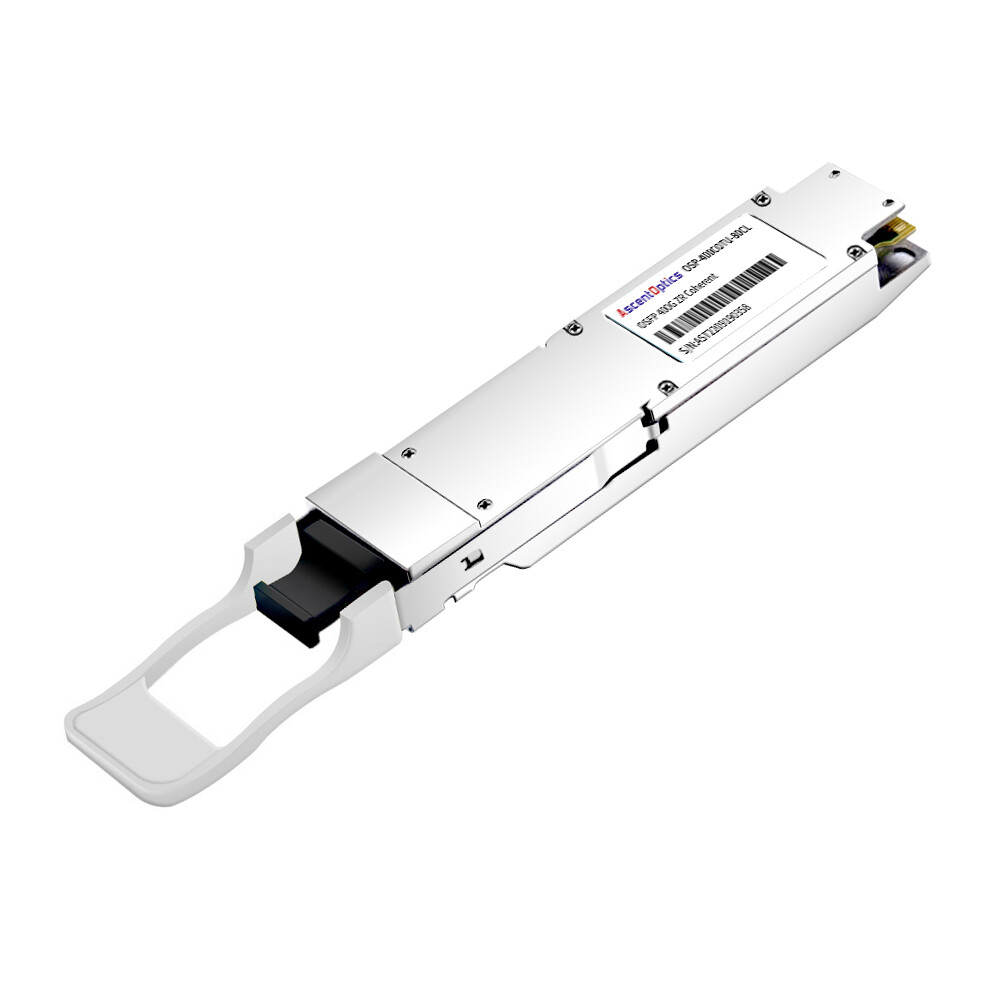
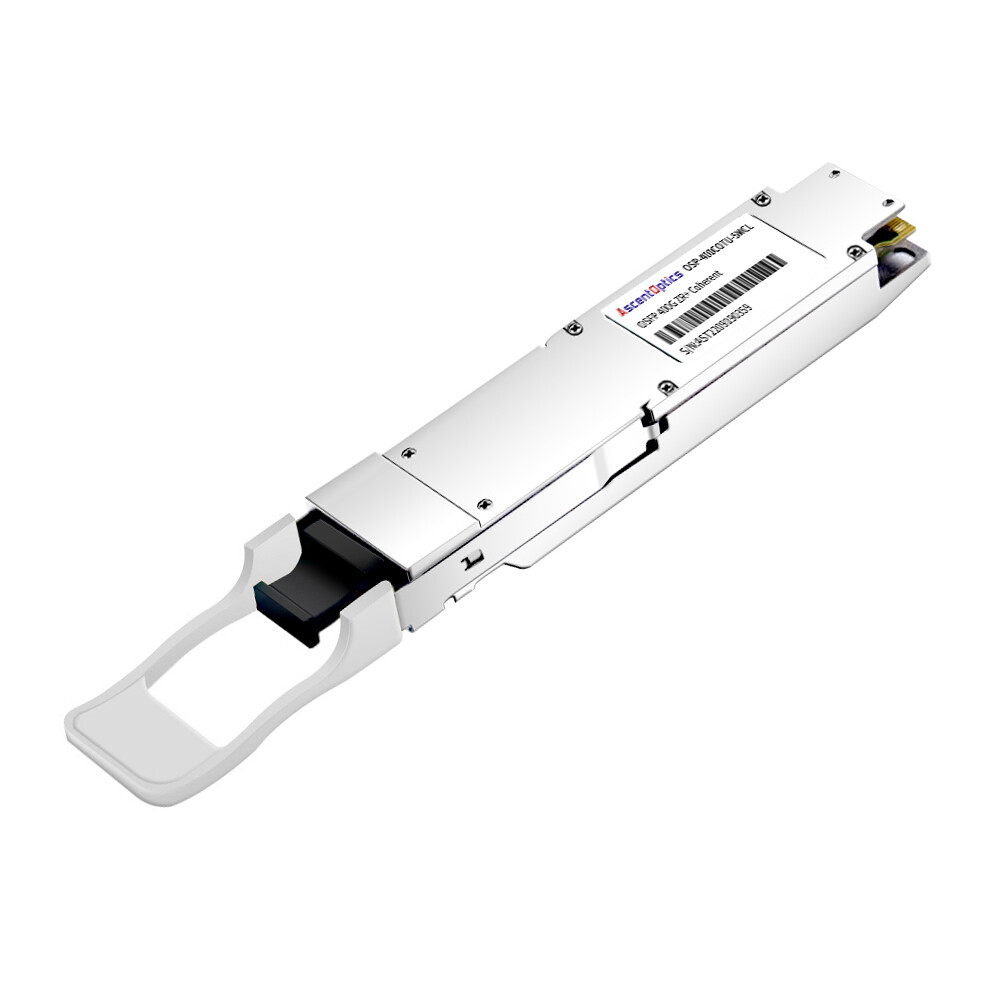
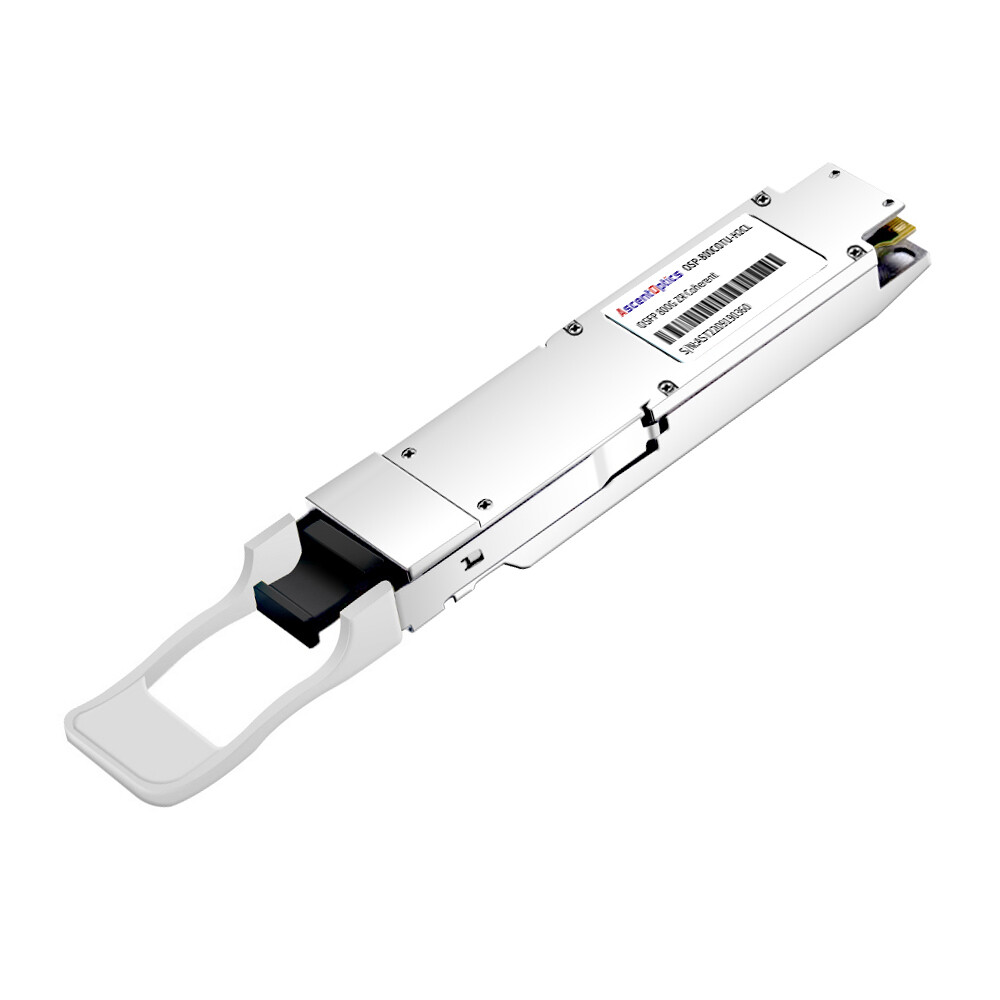
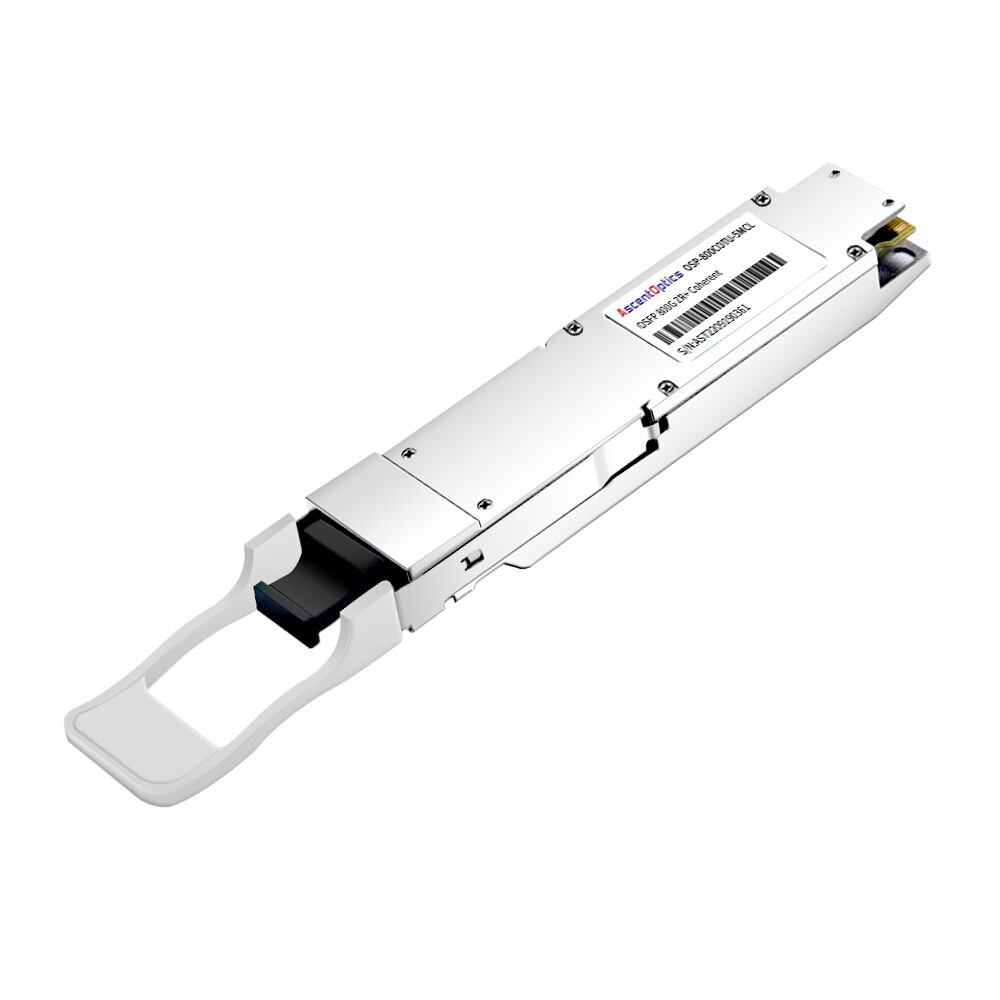
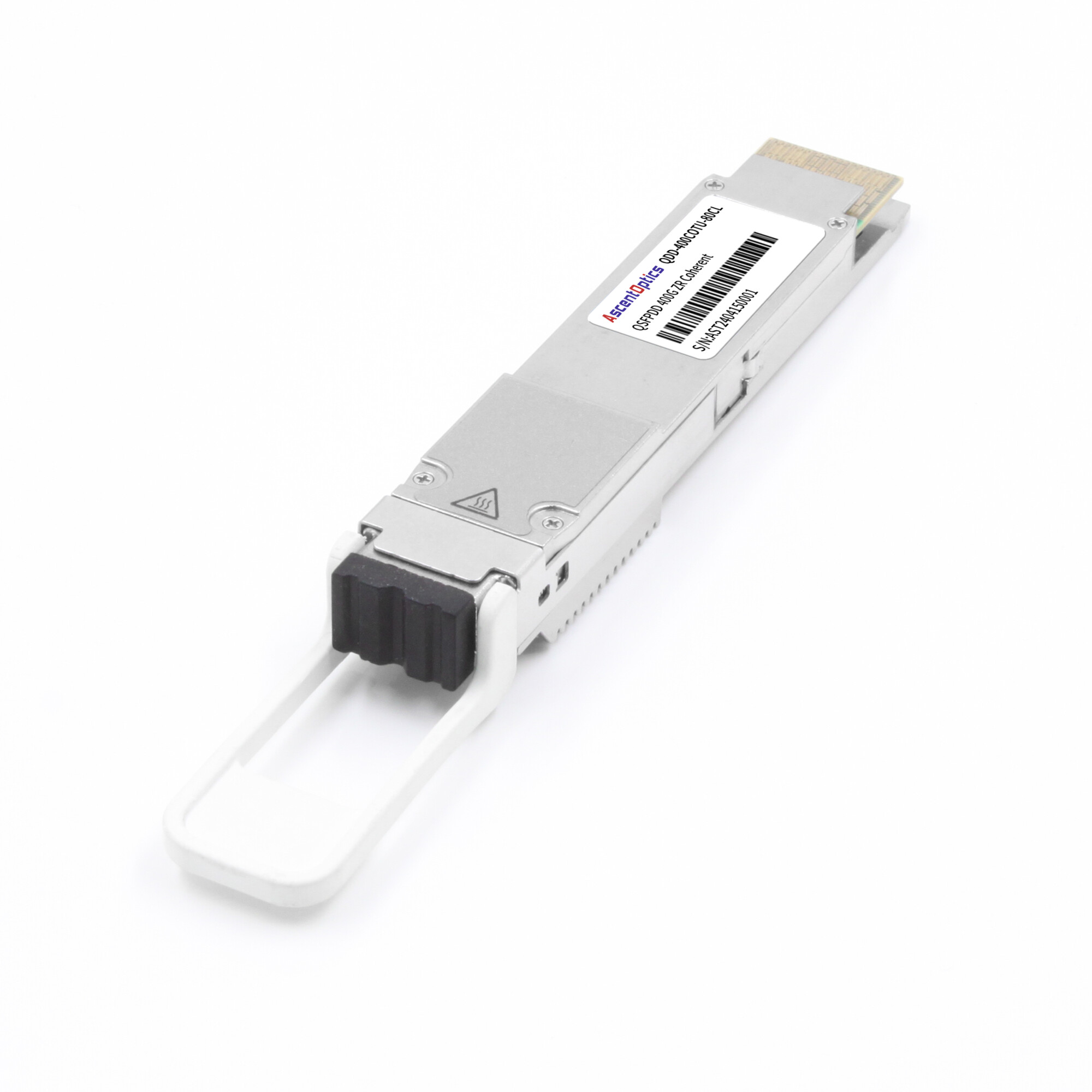
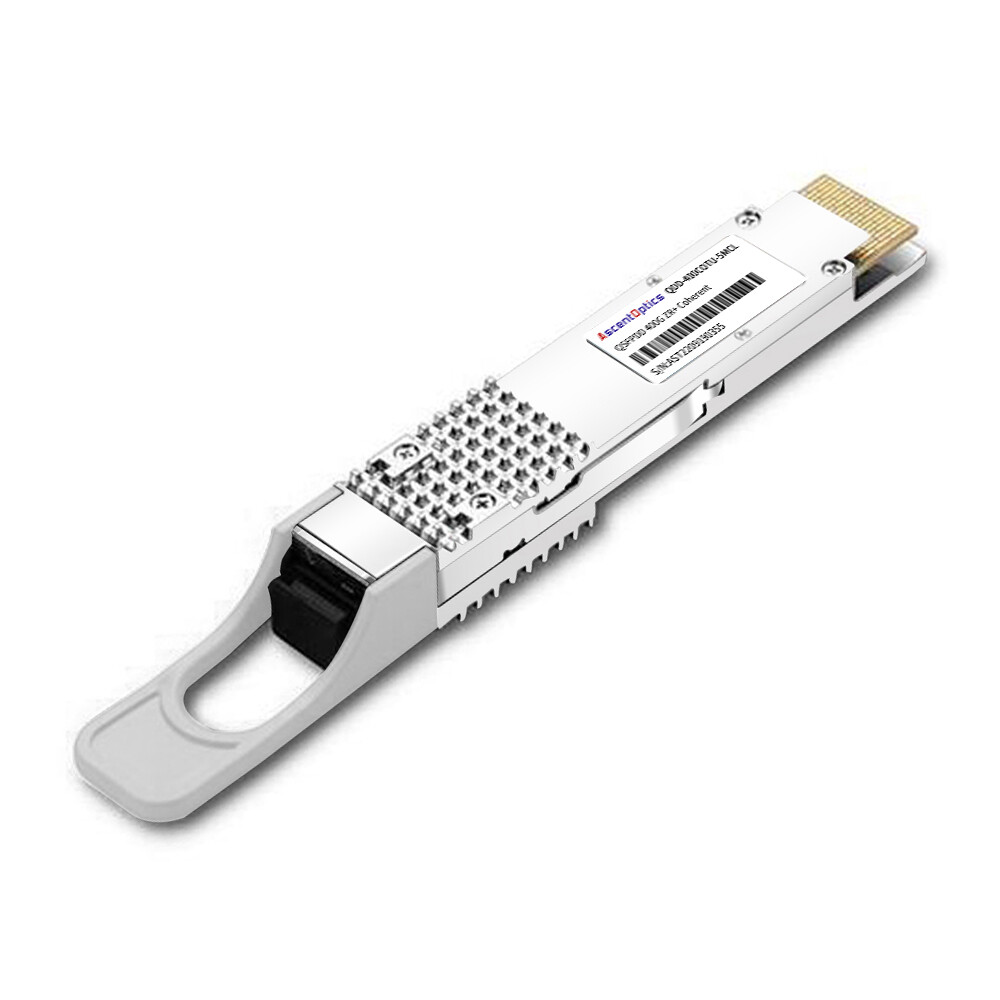
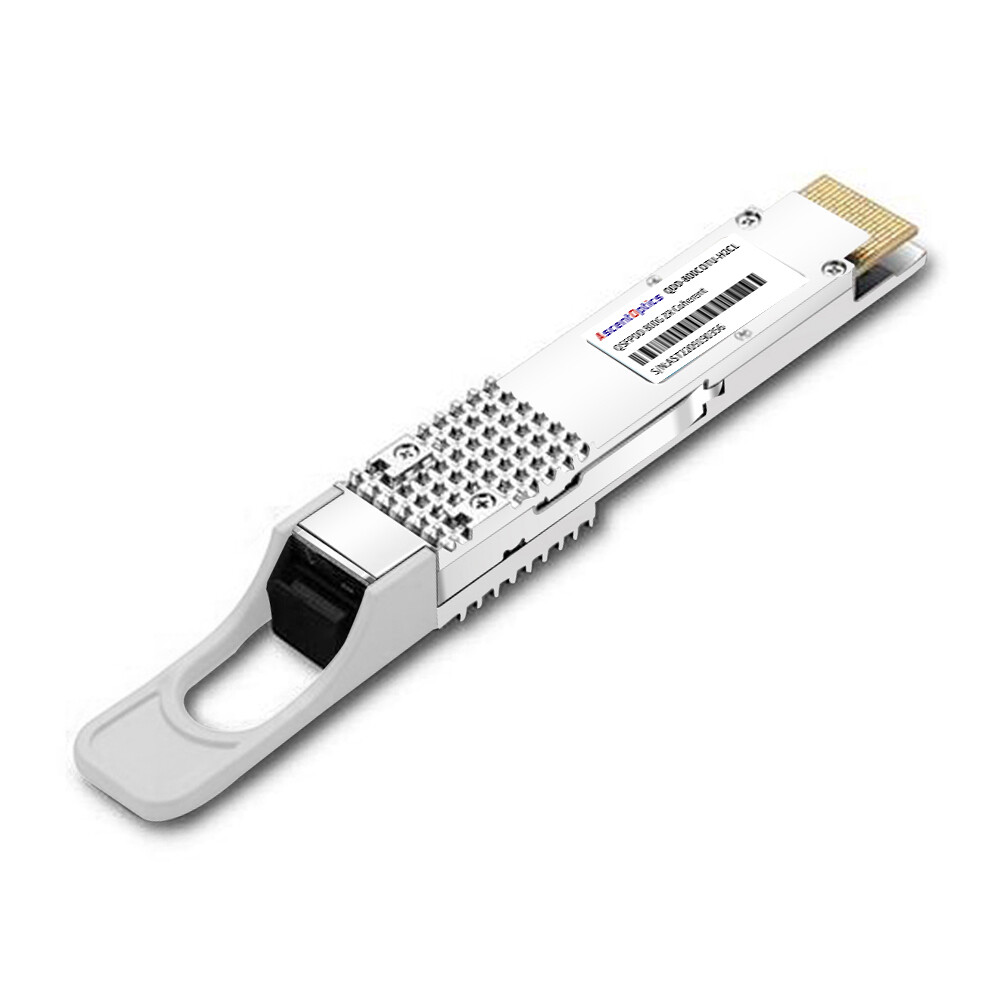
As data center traffic continues growing, traditional direct-detect optics are no longer sufficient for many long-distance interconnect applications. While standard 400G FR4 or DR4 modules are typically limited to short-reach deployments, modern cloud and AI networks increasingly require 400G and 800G connectivity across metropolitan and regional distances.
OSFP ZR coherent optics address this challenge by integrating coherent DSP technology directly into pluggable transceivers. This allows routers and switches to transmit high-speed traffic over DWDM networks without requiring separate transponder systems, helping reduce both deployment complexity and infrastructure cost.
Today, 400G ZR modules are widely used for metro DCI links up to approximately 120 km, while OpenZR+ and emerging 800G ZR platforms extend coherent transmission to several hundred kilometers or more depending on network conditions.
This guide explains how OSFP ZR coherent technology works, the differences between 400 ZR, OpenZR+, and 800 ZR, and why OSFP is becoming increasingly important for high-power coherent networking deployments.
What Is Coherent Optical Technology
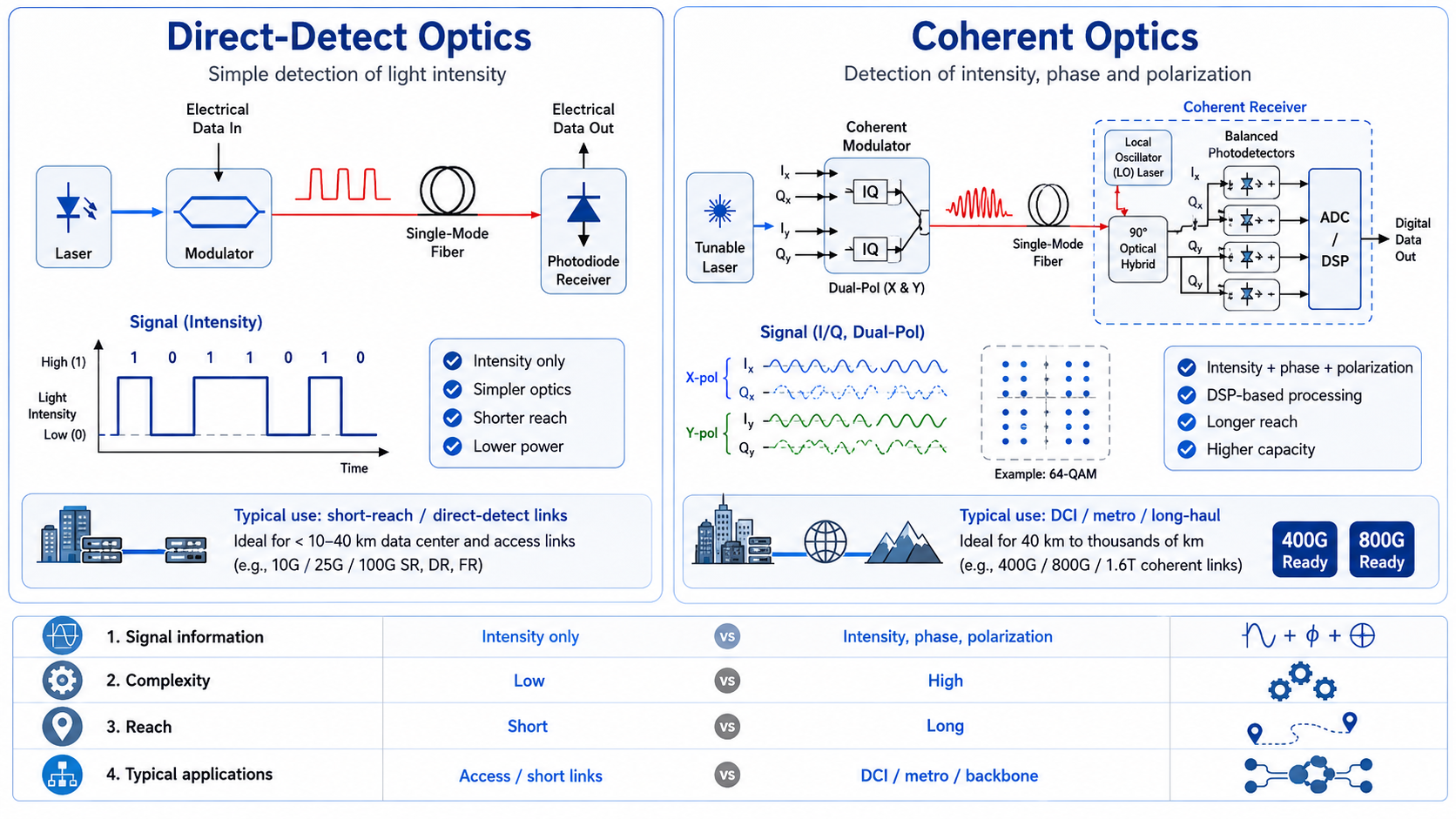
Coherent optical detection is a technology that uses the phase and polarization of light to encode data, enabling significantly higher data rates and longer transmission distances than traditional direct-detect methods. While direct-detect modules simply measure the intensity of light to determine whether a bit is a one or a zero, coherent transceivers decode four dimensions of the optical signal: in-phase and quadrature components on each of two orthogonal polarizations.
This four-dimensional encoding allows coherent systems to use advanced modulation formats such as Dual-Polarization 16-QAM (DP-16QAM), carries four bits per symbol on each polarization, for a total of eight bits across dual polarizations.. Combined with high baud rates, this approach achieves 400 Gbps and 800 Gbps over a single wavelength. The trade-off is complexity. Coherent modules require sophisticated Digital Signal Processors (DSPs) to perform chromatic dispersion compensation, polarization mode dispersion correction, and forward error correction in real time.
The key advantage for network engineers is reach. Where a 400G direct-detect module such as FR4 might reach 2 kilometers, a coherent module can span 120 kilometers or more. This makes coherent optics the only viable technology for Data Center Interconnect (DCI), metro networks, and long-haul applications at 400G and above.
Need to understand coherent fundamentals at lower speeds first? Our QSFP28 ZR coherent guide covers the underlying DSP, OSNR, and link budget concepts that apply across all coherent speeds.
Understanding the OSFP ZR Ecosystem
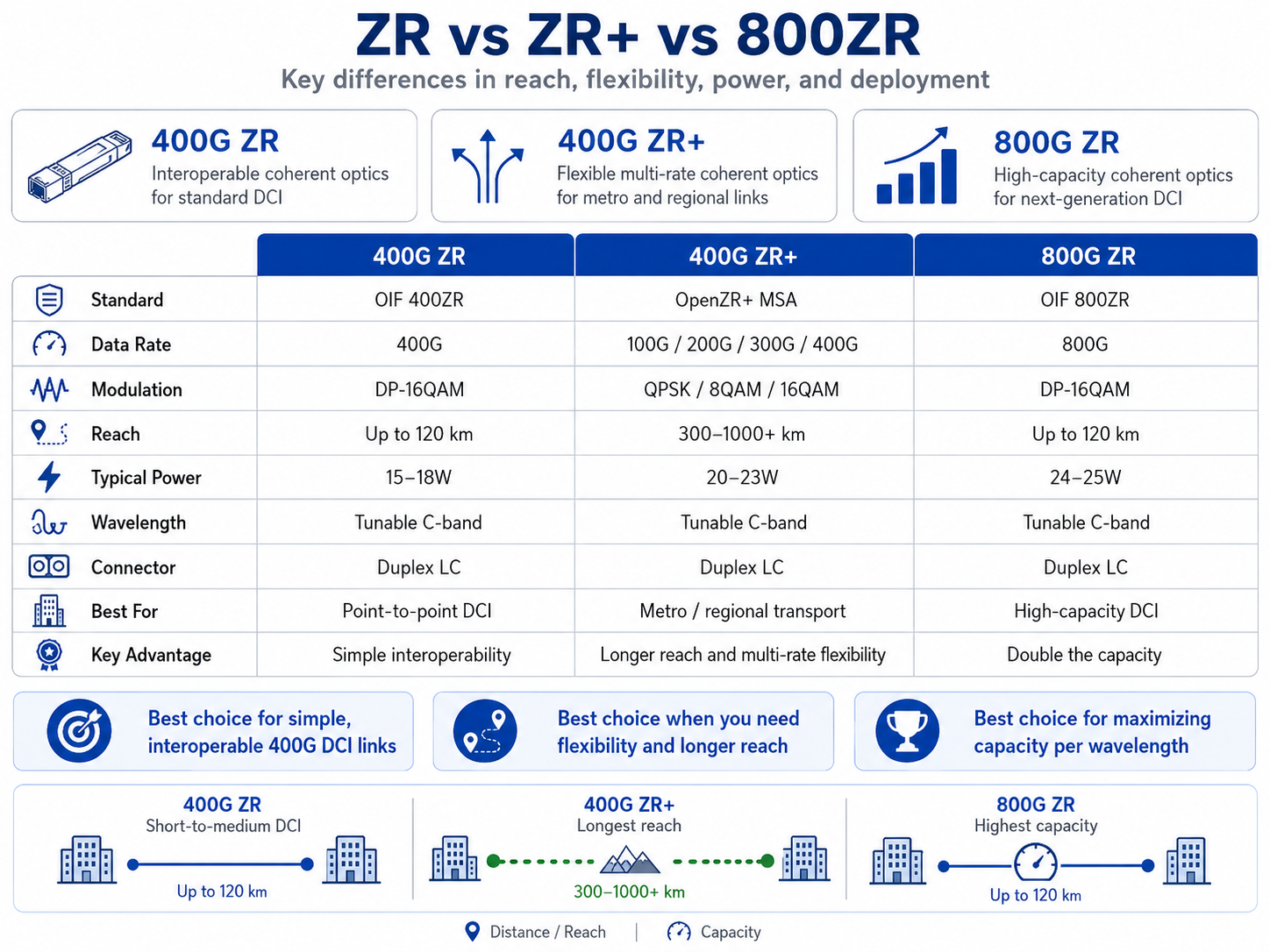
The OSFP ZR ecosystem spans three primary standards and several multi-rate variants. Understanding the differences is essential for selecting the right module.
The 400G ZR Standard (OIF)
The OIF 400ZR Implementation Agreement defines the baseline for interoperable 400 Gbps coherent pluggable optics. Key specifications include:
| Parameter |
400G ZR Specification |
| Data rate |
400 Gbps |
| Modulation |
DP-16QAM |
| Baud rate |
~60 Gbaud |
| Reach (amplified) |
Up to 120 km over amplified DCI links |
| Reach (unamplified) |
Up to 40 km |
| FEC |
Concatenated FEC (C-FEC) |
| Tx output power |
-10 to -7 dBm |
| Wavelength |
Tunable C-band |
| Connector |
Duplex LC |
| Typical power |
15-18W |
The 400G ZR standard was designed for simplicity and interoperability. The standard was designed to enable multi-vendor interoperability across DCI links. This plug-and-play interoperability is a significant advantage for DCI deployments where equipment from multiple vendors may be involved.
ZR+ extends the capabilities of base ZR through the OpenZR+ Multi-Source Agreement. OpenZR+ is an industry MSA rather than a formal OIF standard. The key differences are flexibility and reach:
| Parameter |
400G ZR+ Specification |
| Data rates |
100G / 200G / 300G / 400G (software-selectable) |
| Modulation |
DP-QPSK / 8QAM / 16QAM (software-selectable) |
| Reach at 400G |
300-600 km |
| Reach at lower rates |
1000+ km |
| FEC |
Open FEC (oFEC) |
| Tx output power |
0 to +5 dBm (high-power variants) |
| Wavelength |
Tunable C-band (L-band optional) |
| Typical power |
20-23W |
The multi-rate capability is particularly valuable for network operators who need to transport mixed traffic across a common optical infrastructure. A 400G ZR+ module can be configured to carry four 100 Gbps client signals, each independently routable, or operate as a single 400 Gbps pipe depending on traffic requirements.
The OIF finalized the 800ZR Implementation Agreement in October 2024, and early commercial products began appearing in 2025. This standard doubles the capacity of 400ZR while maintaining the same 120-kilometer reach target:
| Parameter |
800G ZR Specification |
| Data rate |
800 Gbps |
| Modulation |
DP-16QAM |
| Baud rate |
~118 Gbaud |
| Reach (amplified) |
Up to 120 km |
| Client interfaces |
800GbE / 400GbE / 200GbE / 100GbE |
| FEC |
OIF OFEC |
| Wavelength |
Tunable C-band (L-band optional) |
| Typical power |
24-25W |
The 800G ZR+ variant extends this to 600-1000+ kilometers through advanced modulation, probabilistic constellation shaping (PCS), and higher transmit power. Power consumption climbs to 26-30 watts, pushing the thermal envelope of any pluggable form factor.
When Sarah Park’s team at a regional cloud provider needed to upgrade their metro ring from 400G to 800G in March 2025, they evaluated both QSFP-DD and OSFP form factors for the coherent optics. The QSFP-DD switches they initially considered could not reliably cool 800G ZR+ modules at 28 watts in a 36-port 1RU configuration. They switched to OSFP-based platforms with larger thermal interfaces and integrated heatsinks, achieving stable operation even during summer peak temperatures. The deployment completed without thermal throttling incidents, and the ring now carries 800 Gbps per wavelength across twelve nodes spanning 890 kilometers.
OSFP vs QSFP-DD for Coherent Optics
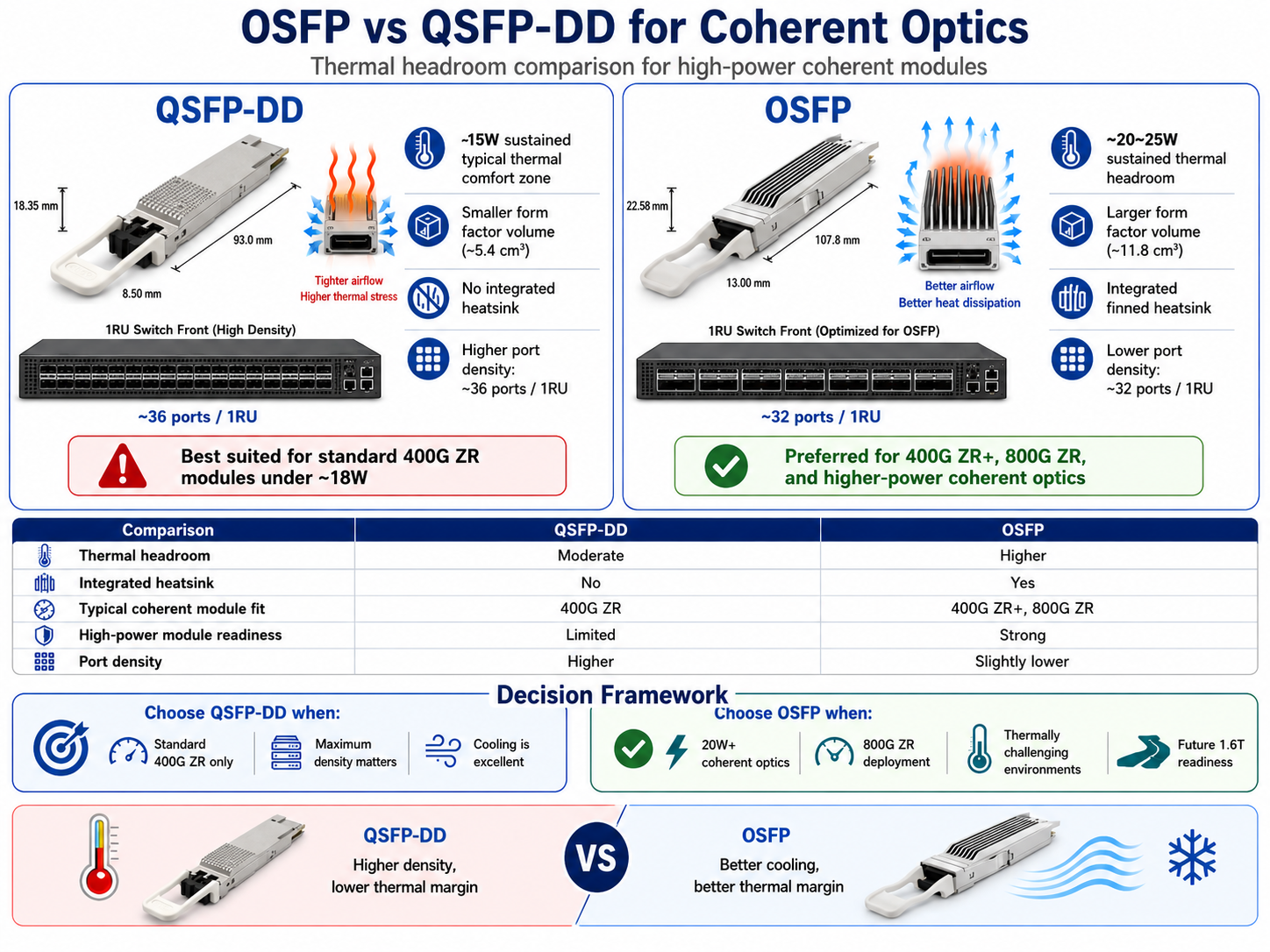
The choice between OSFP and QSFP-DD is particularly important for coherent optics because of the high power consumption and thermal density involved.
Thermal Headroom Comparison
| Specification |
QSFP-DD
|
OSFP
|
| Maximum power (typical) |
~18–20W sustained
|
~20-25W sustained
|
| Form factor volume |
~5.4 cm³
|
~11.8 cm³
|
| Integrated heatsink |
No
|
Yes (finned top standard)
|
| Thermal surface area |
Smaller
|
larger
|
| Ports per 1RU |
~36
|
~32
|
The thermal advantage of OSFP becomes critical with ZR+ and 800G ZR modules. A 400G ZR+ module at 22 watts or an 800G ZR module at 25 watts operates near or beyond the sustained thermal capacity of many QSFP-DD switch platforms. OSFP’s larger form factor and integrated heatsink provide the margin needed for reliable long-term operation.
Port Density vs Power Trade-off
QSFP-DD offers approximately 12% higher port density per rack unit. For deployments using standard 400G ZR modules at 15 watts, this density advantage may justify the form factor choice. However, for ZR+ or 800G coherent optics, the density advantage becomes a liability. Packing 36 high-power coherent modules into 1RU creates a cooling challenge that many data center facilities cannot solve.
Decision Framework
Choose OSFP for coherent when:
- •Deploying ZR+ modules (20W+) or 800G ZR (24W+)
- •Operating in thermally challenging environments
- •Planning for future 1.6T coherent upgrades
- •Long-haul or metro applications requiring maximum reach
Choose QSFP-DD for coherent when:
- •Deploying standard 400G ZR modules only (under 18W)
- •Maximum port density is the top priority
- •The deployment environment has excellent cooling infrastructure
- •Budget constraints favor the lower-cost QSFP-DD switch platforms
Need a detailed form factor comparison? Our complete QSFP-DD vs OSFP guide covers dimensions, compatibility, density, and migration strategies beyond the coherent-specific considerations here.
OSFP ZR Technical Specifications
400G OSFP ZR and ZR+ Specifications
| Parameter |
400G ZR
|
400G ZR+
|
| Standard |
OIF 400ZR
|
OpenZR+ MSA
|
| Data rate |
400 Gbps
|
100G-400G (multi-rate)
|
| Modulation |
DP-16QAM
|
QPSK / 8QAM / 16QAM
|
| Baud rate |
~60 Gbaud
|
~60-70 Gbaud
|
| Reach |
120 km
|
300-1000+ km
|
| Tx output power |
-10 to -7 dBm
|
0 to +5 dBm
|
| FEC |
C-FEC
|
oFEC
|
| OSNR requirement |
<26 dB
|
>22.5-24 dB
|
| Power consumption |
15-18W
|
20-23W
|
| Connector |
Duplex LC
|
Duplex LC
|
800G OSFP ZR and ZR+ Specifications
| Parameter |
800G ZR
|
800G ZR+
|
| Standard |
OIF 800ZR
|
OpenZR+ MSA
|
| Data rate |
800 Gbps
|
100G-800G (multi-rate)
|
| Modulation |
DP-16QAM
|
QPSK / 8QAM / 16QAM / PCS-16QAM
|
| Baud rate |
~118 Gbaud
|
~118-131 Gbaud
|
| Reach |
120 km
|
600-1000+ km
|
| Tx output power |
-7 to 0 dBm
|
0 to +4 dBm
|
| FEC |
OIF OFEC
|
oFEC + enhanced
|
| Power consumption |
24-25W
|
26–32W (vendor-dependent)
|
| Connector |
Duplex LC
|
Duplex LC
|
Power and Thermal Considerations
Coherent modules require significantly more power than their direct-detect counterparts. A 32-port switch fully populated with 800G ZR+ modules at 28 watts each would draw 896 watts from optics alone. Combined with switch base power and cooling overhead, such a deployment can approach 1.5 kW per switch.
The OSFP MSA defines Power Class 8 for modules consuming up to 25 watts, with some vendor implementations extending this to 30 watts for high-power ZR+ variants. Switch platforms must explicitly support these power classes and provide adequate airflow. Most switches that support OSFP ZR coherent modules specify minimum airflow rates of 400-500 linear feet per minute across the module face.
Planning power budgets for coherent switches? Our OSFP power consumption guide provides detailed calculations for switch-level and rack-level power planning.
Applications and Use Cases
Data Center Interconnect (DCI)
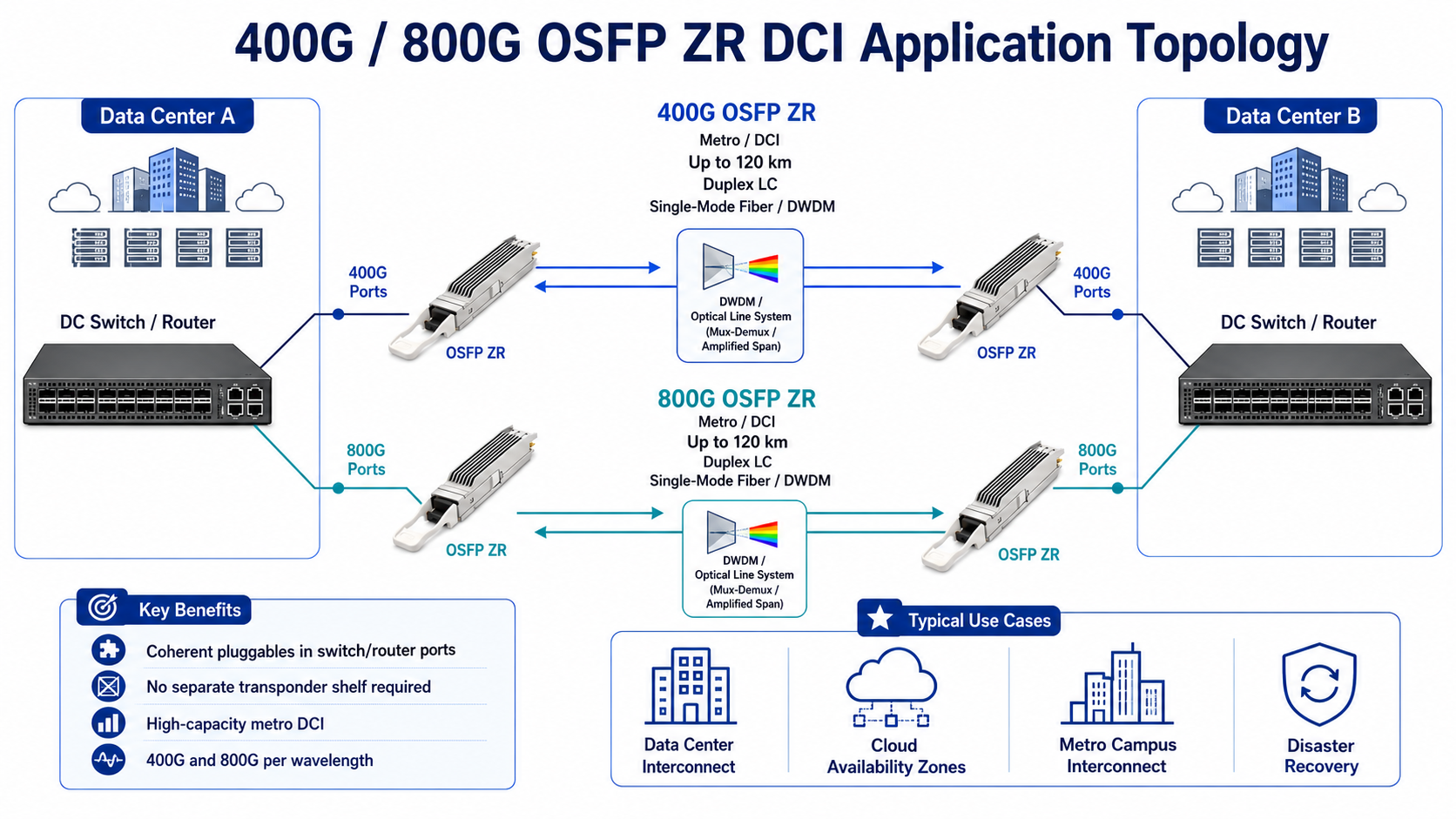
The primary application for OSFP ZR modules is point-to-point data center interconnect. Organizations with multiple facilities in the same metropolitan area use 400G ZR or 800G ZR modules to connect facilities at distances up to 120 kilometers. The plug-and-play nature of ZR optics eliminates the need for separate optical transport equipment, reducing both capital expenditure and operational complexity.
Typical DCI scenarios include:
- •Primary and disaster recovery data centers
- •Cloud availability zones
- •Content delivery network nodes
- •Colocation facility interconnection
Metro and Regional Networks
For service providers and enterprises with metropolitan or regional fiber infrastructure, OSFP ZR+ modules enable 400G and 800G transport across hundreds of kilometers. The multi-rate capability allows operators to optimize capacity versus reach based on fiber conditions and traffic demands.
A 400G ZR+ module configured for 200 Gbps using QPSK modulation can reach 800-1000 kilometers, making it suitable for regional backbone rings. When traffic grows, the same module can be reconfigured to 400 Gbps using 16QAM, trading reach for capacity without hardware replacement.
AI/ML Cluster Interconnect
The explosive growth of AI training clusters is creating new demand for coherent optics. Large AI deployments such as NVIDIA DGX systems often span multiple buildings or campuses. The inter-GPU communication fabric requires high bandwidth and low latency across distances that exceed the reach of direct-detect optics.
800G ZR modules are increasingly used for multi-building or campus-scale AI deployments, providing 800 Gbps per wavelength across campus distances. The low latency of coherent DSP processing, typically adding less than 1 microsecond, is acceptable for most AI training workloads.
Long-Haul Backbone
For national and international backbone networks, ZR+ modules in QPSK mode provide cost-effective 100G and 200G transport over thousands of kilometers. While traditional long-haul systems using CFP2-DCO modules still dominate the highest capacity links, pluggable ZR+ optics are displacing them in the 100G-400G range due to lower cost and simpler deployment.
Deployment Considerations
Link Budget Planning
Successful coherent deployment requires careful link budget analysis. The three critical parameters are:
Optical Signal-to-Noise Ratio (OSNR): The ratio of signal power to amplified spontaneous emission noise. Base 400G ZR requires greater than 26 dB OSNR. ZR+ modes require 22.5-24 dB depending on the modulation format.
Chromatic Dispersion: The spreading of optical pulses due to wavelength-dependent propagation speed. Coherent DSP compensates for dispersion electronically, but the total accumulated dispersion must be within the DSP’s compensation range. 400G ZR typically compensates for up to 24,000 ps/nm, although actual transmission reach is limited by OSNR and nonlinear effects long before this theoretical compensation limit is reached.
Fiber Nonlinearities: At high launch powers, the optical signal interacts with the fiber medium, creating distortions. ZR+ high-power variants must balance the need for high launch power (better OSNR) against nonlinear penalties.
Fiber Requirements
OSFP ZR coherent modules require standard single-mode fiber (ITU-T G.652.D). The duplex LC connector is standard across all ZR and ZR+ modules. For DWDM deployments, the tunable laser must be set to the correct channel on the 50 GHz or 100 GHz ITU grid.
Key fiber considerations:
- •Connector cleanliness is critical; coherent receivers are more sensitive to reflections than direct-detect
- •Polarization-maintaining fiber is not required; the DSP handles polarization changes
- •Older fiber with higher loss may reduce achievable reach
Switch and Router Compatibility
Not all switches support coherent optics. Key compatibility requirements include:
- •Form factor support: OSFP cage with adequate thermal design for ZR/ZR+
- •Power delivery: Support for Power Class 7 (15W) or Class 8 (25W+) per port
- •CMIS management: CMIS 5.0 or later for coherent module management
- •Electrical interface: Support for 112G PAM4 SerDes (required for 800G)
Platforms from Arista, Cisco, Juniper, and NVIDIA that support OSFP typically list coherent optics compatibility in their datasheets. Always verify that the specific switch model supports the power class of the intended module.
Looking for compatible switch platforms? Our OSFP-compatible switches guide lists routers and switches that support OSFP ZR and ZR+ modules.
Conclusion
OSFP ZR coherent transceivers represent a fundamental shift in optical networking, integrating transport-grade coherent technology into router and switch ports. A single 400G ZR module can replace an entire transponder shelf for DCI links up to 120 kilometers. ZR+ extends this capability to metro and regional distances up to 1000+ kilometers. The 800G ZR standard, finalized in late 2024, doubles capacity while maintaining the same reach, with products now shipping from multiple vendors.
Key takeaways for network architects:
- •Coherent detection enables 400G and 800G transport over distances that direct-detect optics cannot achieve
- •400G ZR provides interoperable, low-power DCI connectivity up to 120 kilometers
- •400G ZR+ and 800G ZR+ add multi-rate flexibility and extended reach for metro and regional networks
- •OSFP’s thermal headroom makes it the preferred form factor for ZR+ and 800G ZR modules
- •Power consumption is the primary deployment consideration: 15-18W for ZR, 20-23W for ZR+, 24-30W for 800G ZR+
- •The OIF 400ZR and 800ZR standards ensure multi-vendor interoperability for DCI applications
- •Always verify switch power class support and thermal design before deploying high-power coherent modules
Selecting the right OSFP ZR module requires matching the standard (ZR vs ZR+), rate (400G vs 800G), and form factor to the specific link requirements. For short DCI links, standard ZR offers the lowest power and simplest deployment. For metro and regional networks, ZR+ provides the flexibility to optimize capacity versus reach based on fiber infrastructure.
AscentOptics provides a comprehensive range of coherent optical transceivers including 400G ZR, 400G ZR+, and 800G ZR modules in OSFP form factor. Our engineering team helps customers evaluate link budgets, select appropriate modules, and verify compatibility with their switch platforms. Request a quote for your next coherent optics deployment.
Frequently Asked Questions About OSFP ZR Coherent
What is the difference between 400G ZR and 400G ZR+?
400G ZR is a fixed-configuration standard (OIF) optimized for DCI links up to 120 kilometers. It uses DP-16QAM modulation and C-FEC. 400G ZR+ is a flexible standard (OpenZR+ MSA) supporting multiple line rates (100G-400G), multiple modulation formats (QPSK/8QAM/16QAM), and reaches from 300 to 1000+ kilometers. ZR+ modules consume more power (20-23W vs 15-18W) but offer significantly greater flexibility.
How far can OSFP ZR coherent modules transmit?
Base ZR modules reach up to 120 kilometers over amplified DWDM links. ZR+ modules extend this to 300-600 kilometers at 400G/800G, and 1000+ kilometers at lower rates using QPSK modulation. Actual distance depends on fiber quality, amplification, and the number of optical add-drop multiplexers in the path.
Can OSFP ZR modules interoperate between vendors?
Yes, when compliant with the same standard. OIF 400ZR and OIF 800ZR modules from different vendors are designed to interoperate across the specified reach. OpenZR+ modules also interoperate when both comply with the OpenZR+ MSA. Some vendor-specific high-power extensions may require matched pairs for optimal performance.
What power class do OSFP ZR modules require?
400G ZR typically requires high-power OSFP thermal classes (up to 15-18W). 400G ZR+ and 800G ZR require Power Class 8 (up to 25W+). Some 800G ZR+ implementations push beyond the standard OSFP power envelope, requiring switches with enhanced thermal design. Always verify switch power class support before deployment.
Do coherent ZR modules support breakout like parallel optics?
No. Coherent optics transmit over a single wavelength, so the optical signal cannot be physically split into multiple ports like 800G DR8 or 400G SR8. However, ZR+ modules support electronic multiplexing of multiple client signals (e.g., 4x100G) onto a single coherent wavelength, which is handled at the electrical layer rather than the optical layer.
What is the latency of OSFP ZR coherent modules?
Coherent DSP processing adds approximately 0.5 to 1.5 microseconds of latency depending on the DSP architecture and compensation algorithms. For DCI and metro applications, this is negligible. For ultra-low-latency trading or HPC fabrics where every nanosecond matters, direct-detect optics within their reach limitations remain preferable.
When should I choose OSFP over QSFP-DD for coherent optics?
Choose OSFP when deploying ZR+ modules (20W+), 800G ZR (24W+), or operating in thermally constrained environments. Choose QSFP-DD when deploying standard 400G ZR modules only (under 18W) and maximum port density is the priority. OSFP’s superior thermal headroom makes it the safer choice for high-power coherent applications.
Reference:
OIF
OpenZR+
Post Views: 2,959