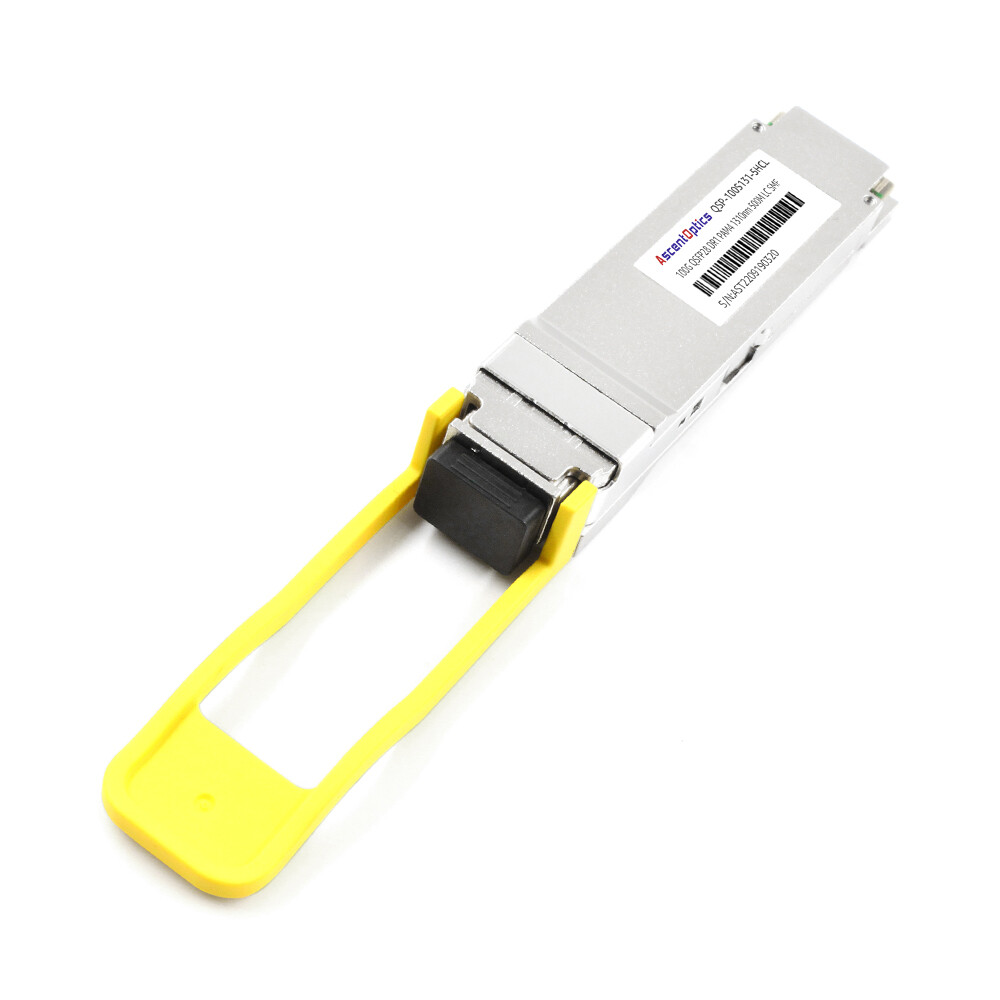
David Park stared at twelve almost identical QSFP28 part numbers on the purchase screen. They looked nearly the same, shared the same form factor and 100G data rate, yet ranged in price from $80 to $1,200. Some required MPO-12 fiber, while others used standard LC connectors.
Selecting the wrong 100G QSFP28 module can become one of the most expensive mistakes in data center networking, potentially inflating project costs by tens of thousands of dollars due to fiber-type mismatches or insufficient reach.
This guide brings clarity. If the labels SR4, LR4, CWDM4, ER4, and PSM4 still feel confusing, the explanations below will answer your questions. After reading, you will understand exactly what each QSFP28 module type does, when to use it, and how to match it to your specific fiber infrastructure and switch platform.
Need help selecting the right module for your network? Explore Ascent Optics’ QSFP28 transceiver portfolio or contact our engineers for a free compatibility review.
What Is QSFP28? (Quick Technical Foundation)
The 4×25G NRZ Architecture
QSFP28, or Quad Small Form-factor Pluggable 28, is the industry-standard form factor for 100 Gigabit Ethernet. It uses four electrical lanes to deliver a total throughput of 103.1 Gbps, with each lane operating at 25.78 Gbps.
This 4×25G design is what separates QSFP28 from its 40G predecessor, QSFP+. While the physical dimensions are identical, the electrical signaling and optical architectures are fundamentally different. For a deeper comparison, see our QSFP28 vs QSFP+ guide.
Form Factor and Power Specifications
The QSFP28 modules have the dimension of 18.35 millimeters wide and 72.4 millimeters long. They support hot-pluggable insertion and removal, enabling network upgrades without powering down switches. Commercial-grade modules operate from 0°C to 70°C, while industrial models are designed for carrier deployments.
Power consumption varies significantly. QSFP28 DAC cables may consume less than 1.5 W, while ER4 or ZR4 modules can draw up to 5.5 W. On a high-density 1U switch, this difference matters when every port is populated.
MSA and IEEE Standards Compliance
Most QSFP28 modules comply with the QSFP28 MSA and IEEE 802.3bm standards, ensuring compatibility across Cisco, Arista, Juniper, NVIDIA, and other leading networking platforms. Always refer to your specific switch firmware release notes for module validation.
QSFP28 Module Types by Application
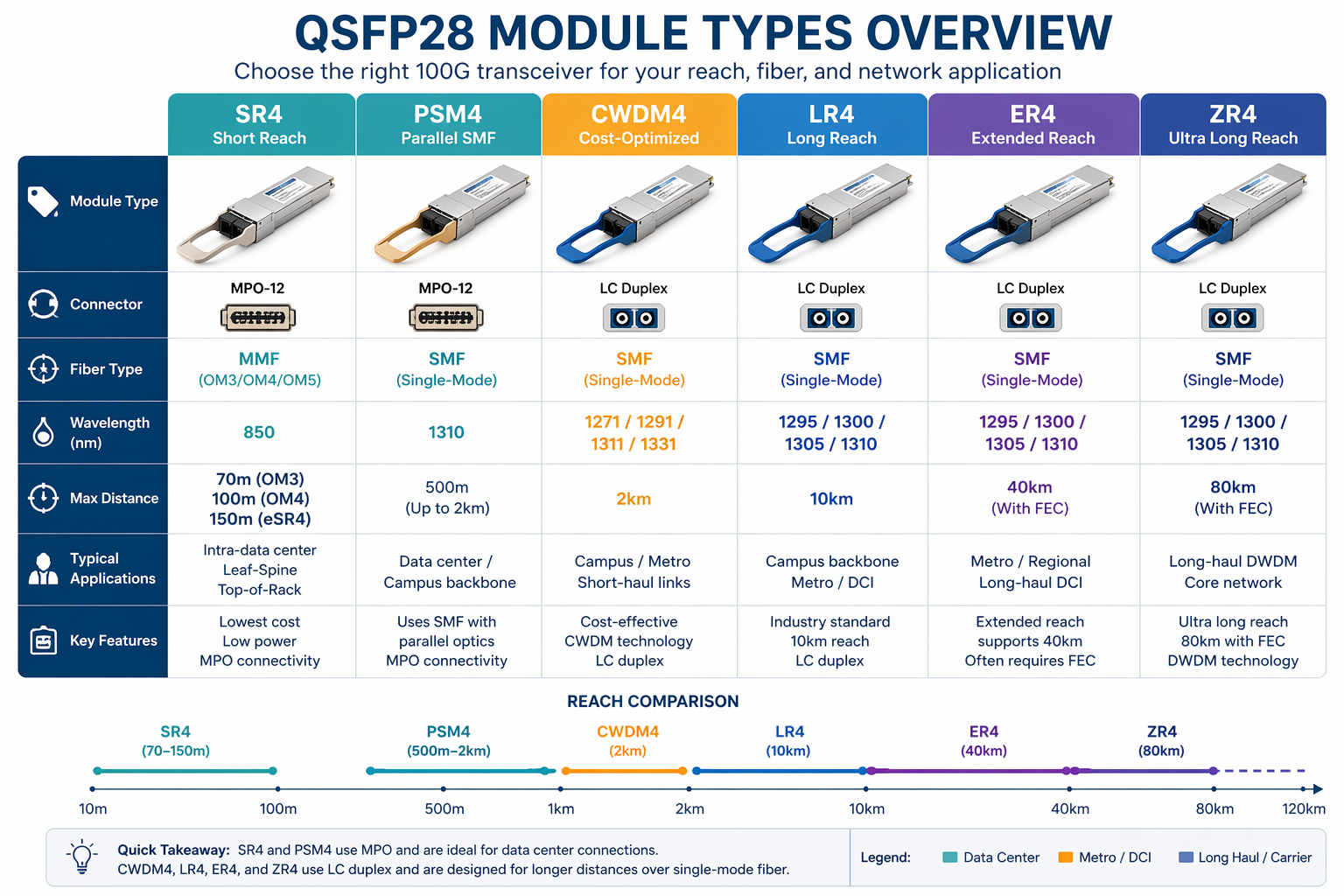
QSFP28 SR4: The Data Center Workhorse (MMF, 100 m)
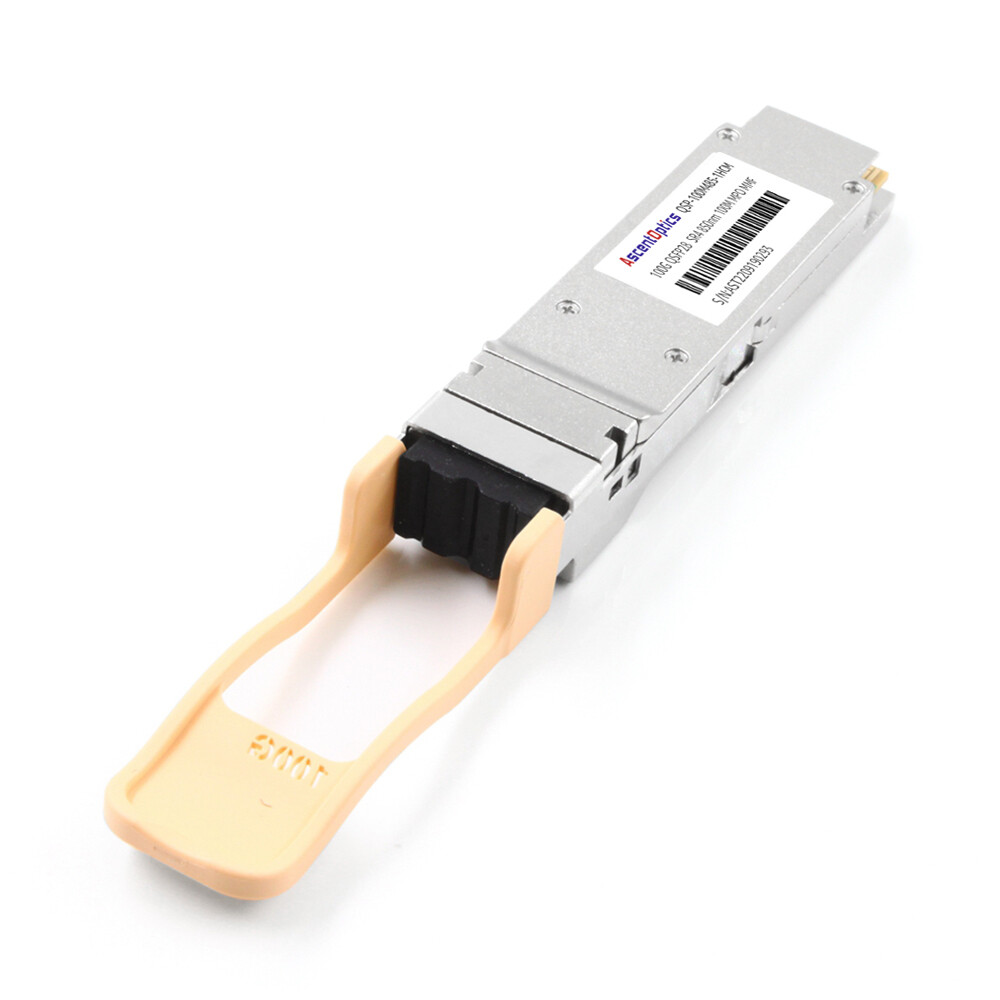
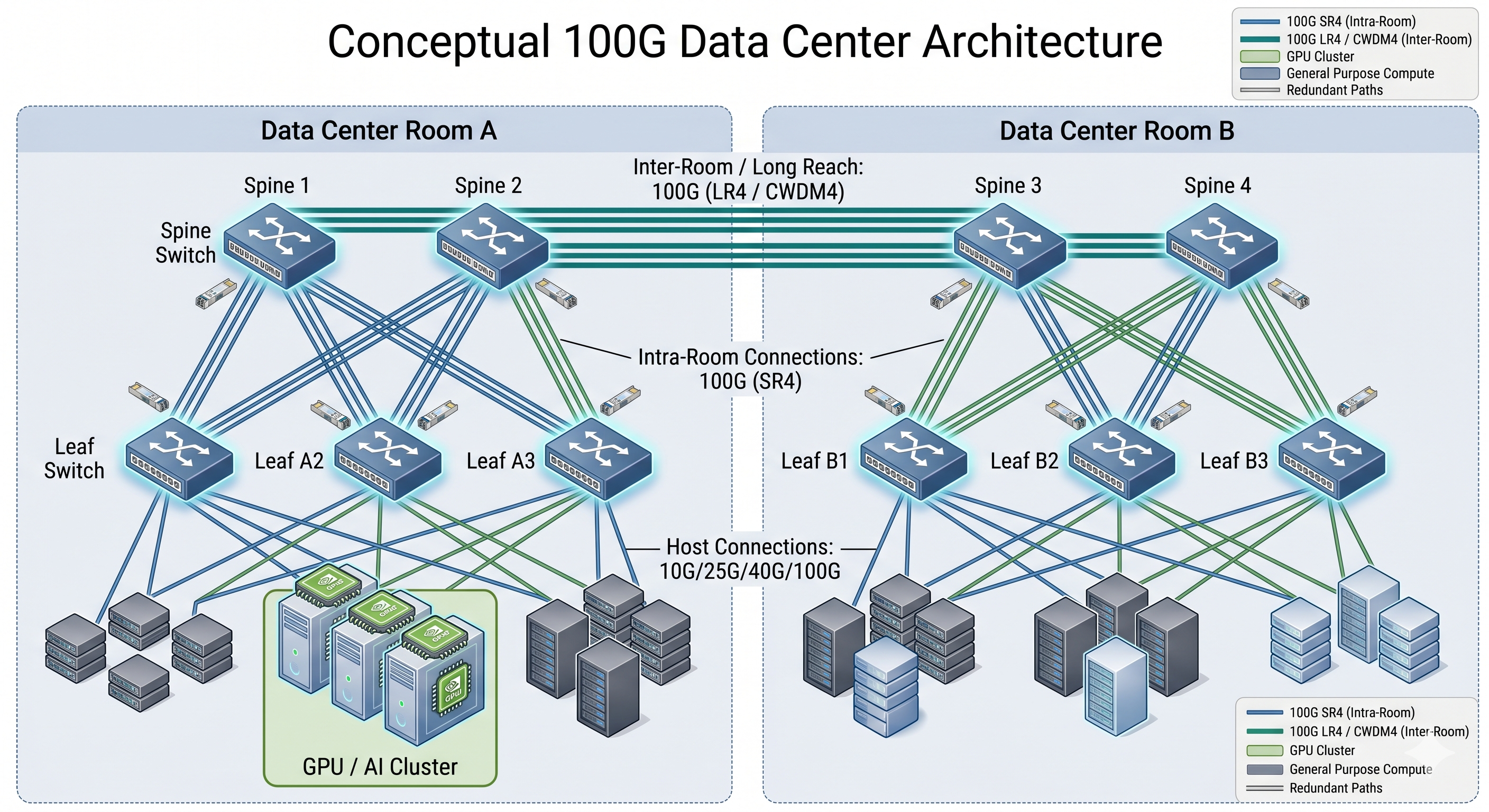
The QSFP28 SR4 is the most common 100G module for intra-data center data connections. It uses four 850 nm VCSEL-based lasers over multimode fiber and terminates with an MPO-12 connector (eight active fibers: four TX, four RX).
SR4 supports reaches of 70 m over OM3 fiber and 100 m over OM4 fiber. Some long-reach variants (eSR4) can extend to approximately 150 m over OM4/OM5. These modules are the default choice for top-of-rack to end-of-row or leaf-to-spine connections within the same data center hall.
QSFP28 PSM4: Parallel Single-Mode Alternative (SMF, 500 m–2 km)
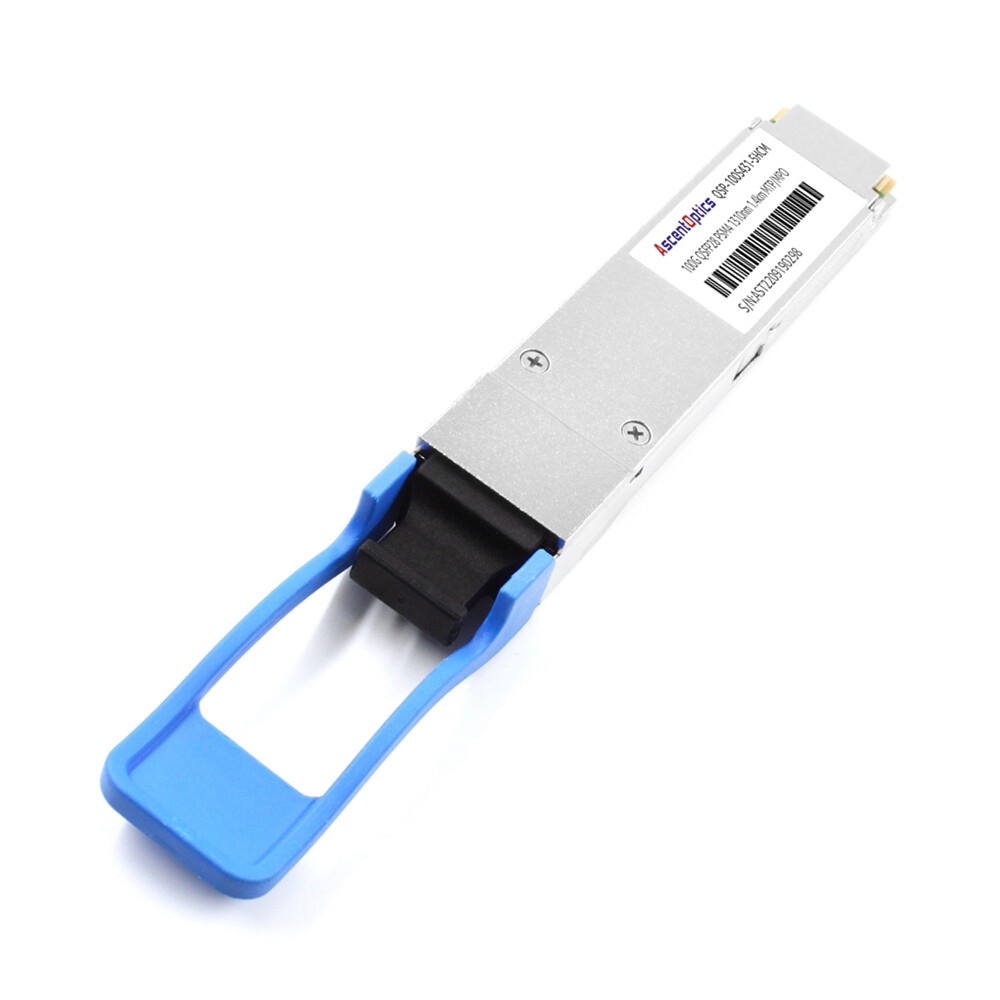
QSFP28 PSM4 uses four parallel 1310 nm DML lasers and eight strands of single-mode fiber with an MPO-12 connector (same as SR4). It supports a standard reach of 500 m, with some variants extending to 2 km.
QSFP28 PSM4 uses four parallel 1310 nm DML lasers and eight strands of single-mode fiber with an MPO-12 connector (same as SR4). It supports a standard reach of 500 m, with some variants extending to 2 km.
QSFP28 LR4: The 10 km Enterprise Standard (SMF, LC)
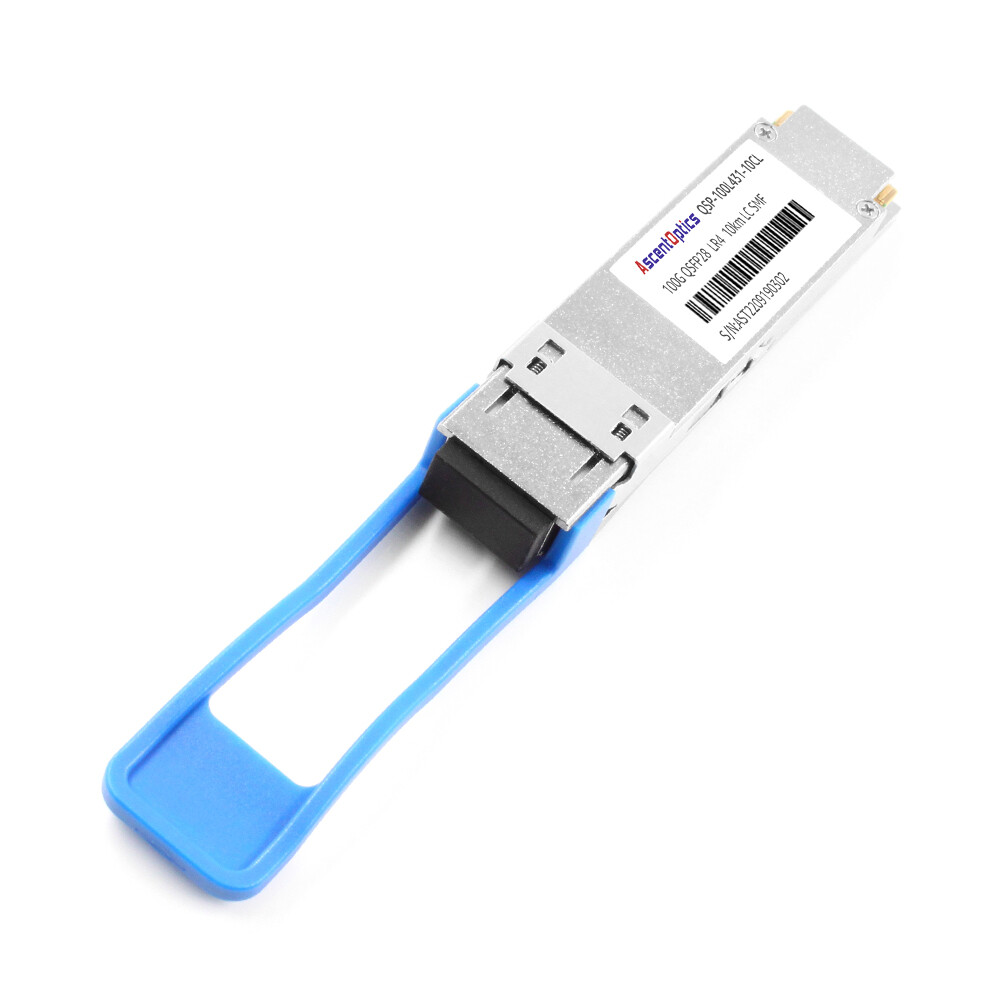
QSFP28 LR4 uses LAN-WDM technology to multiplex four 25G lanes onto a single pair of LC duplex fibers. It operates with wavelengths between 1295–1310 nm and supports up to 10 km over single-mode fiber.
LR4 is widely used for campus backbones, metro-enterprise networks, and data center interconnects where buildings are separated by several kilometers. It employs EML lasers, offering stable long-reach performance at a higher price point than SR4.
QSFP28 CWDM4: The Cost-Optimized Sweet Spot (SMF, 2 km)
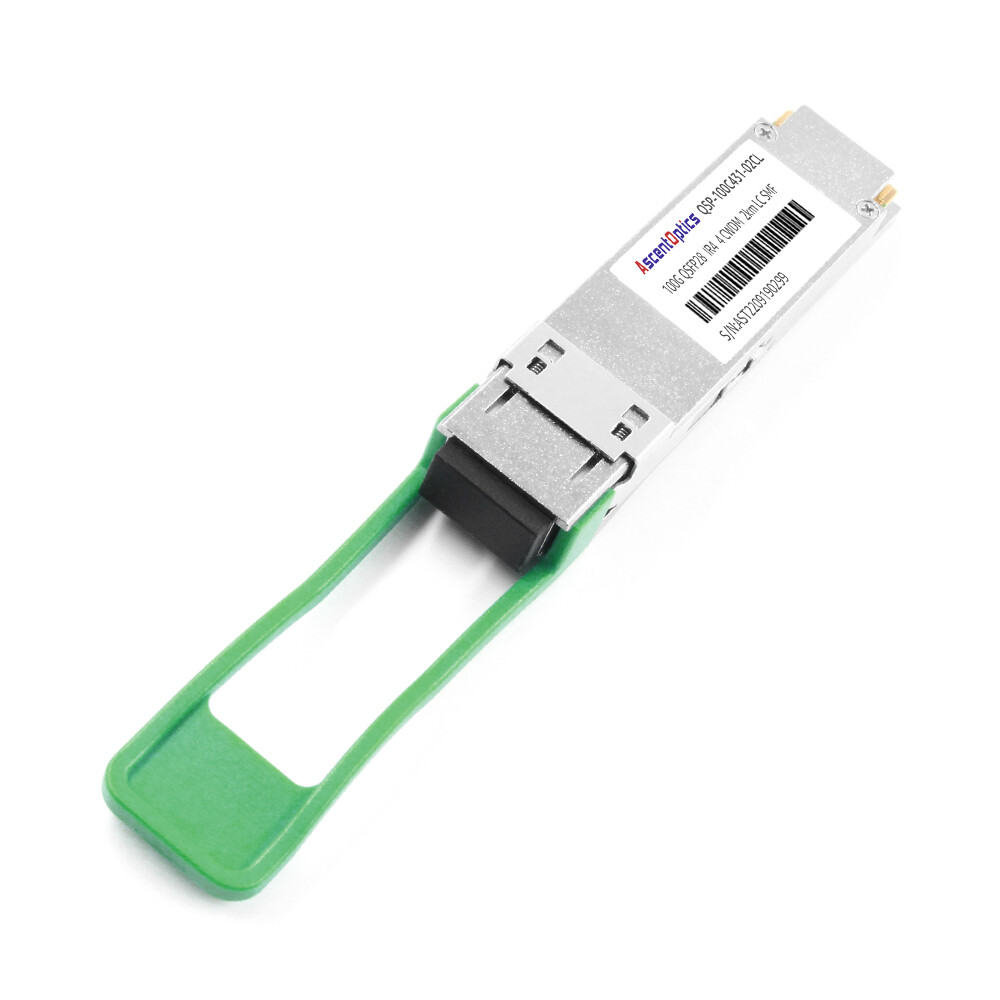
QSFP28 CWDM4 combines four uncooled CWDM wavelengths (1271, 1291, 1311, and 1331 nm) over a single LC duplex single-mode fiber pair. The MSA specification guarantees a 2 km reach.
CWDM4 sits between PSM4 and LR4 in terms of performance and price. It is the most cost-effective choice for links between 500 m and 2 km, delivering significant fiber savings compared to PSM4.
QSFP28 ER4: Extended Reach for Metro Networks (SMF, 40 km)
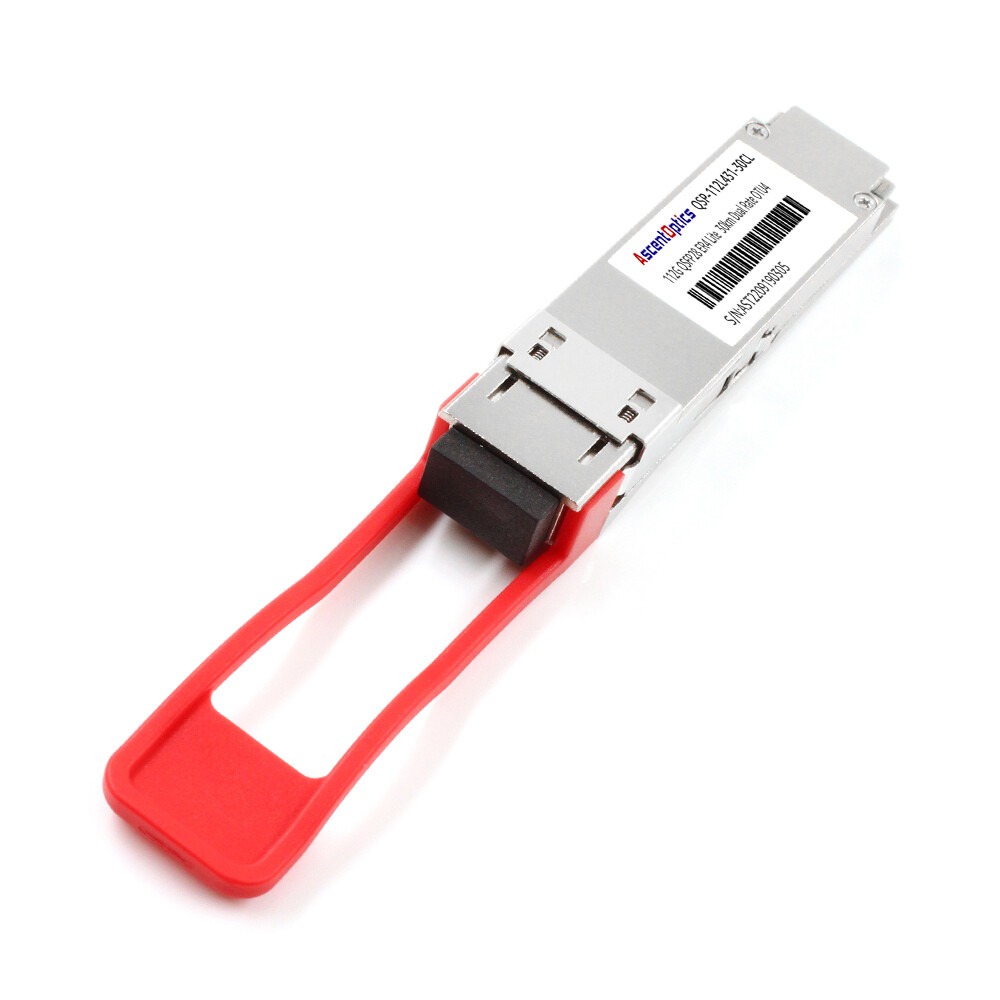
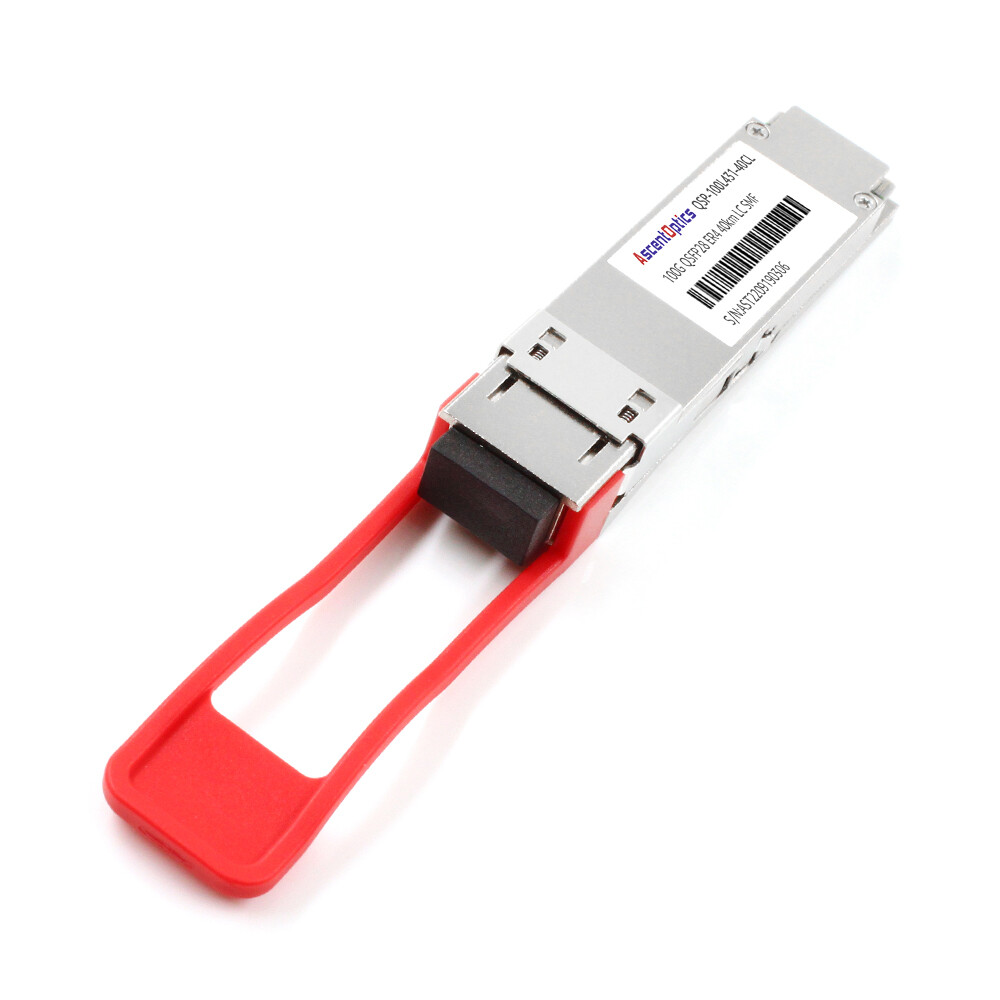
Building on the LR4 architecture with higher-power EML lasers and APD receivers, QSFP28 ER4 extends the reach to 40 km. It is ideal for carrier aggregation, regional metro rings, and long-haul data center interconnects.
In practice, many ER4 solutions require host-side FEC to achieve the full 40 km reach. Without FEC, a more realistic distance is around 30 km. Always confirm that your switch platform supports FEC before deploying ER4.
QSFP28 ZR4: Long-Haul DCI (SMF, 80 km)
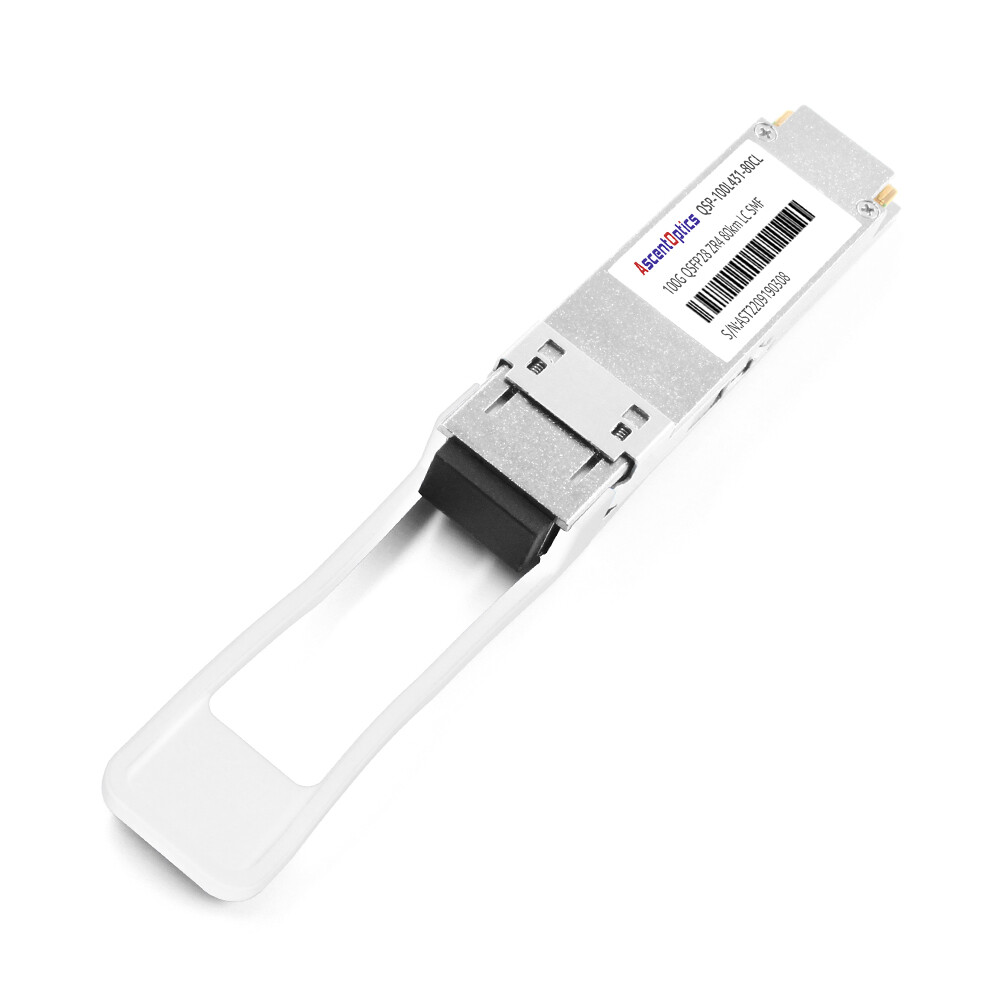
QSFP28 ZR4 extends LAN-WDM reach to 80 km or more and sits at the high end of the cost spectrum. It is used in telecom core networks and extended-distance data center interconnects.
ZR4 modules require FEC and very clean single-mode fiber with minimal dispersion. They are rarely used in typical enterprise data centers except for specific inter-city connectivity needs.
As 100G deployments continue to scale in hyperscale and AI environments, single-lambda QSFP28 modules have emerged as a simplified and cost-effective alternative to traditional multi-wavelength designs. Unlike SR4, PSM4, CWDM4, or LR4, which use four separate optical lanes or wavelengths, single-lambda modules transmit the full 100G signal over one optical wavelength using PAM4 modulation. This architecture dramatically reduces fiber count, simplifies cabling, lowers inventory complexity, and eases future upgrades.
DR1: Replacing SR4/PSM4 at 500 m
DR1 transmits 100G using a single wavelength (PAM4) over one fiber. It completely eliminates the need for the eight-fiber parallel pairs required by PSM4 and significantly simplifies cabling compared to SR4’s MPO-12 setup. With only a duplex LC or single MPO connector, DR1 is ideal for short-reach single-mode links up to 500 m.
It offers lower fiber usage, reduced patch-panel density, and easier installation while maintaining the same performance level as traditional parallel optics — making it a popular choice for new greenfield data centers and AI clusters.
FR1: The CWDM4 Alternative at 2 km
QSFP28 FR1 is a cost-effective single-lambda PAM4 module that reaches 2 km over single-mode fiber. It serves as a direct, simpler alternative to CWDM4 by using just one wavelength instead of four. This reduces optical complexity, lowers module cost, and minimizes the risk of wavelength-specific issues.
However, because it carries the entire 100G payload on a single lane, FR1 is more demanding on link budget and requires higher-quality, low-loss single-mode fiber. It performs best in modern, well-maintained fiber plants.
LR1: Simplifying 10 km Links
LR1 provides a single-lambda option for 10 km links using a 1310 nm PAM4 signal and a standard duplex LC connector. It achieves the same reach as LR4 but with far simpler optics — no need for wavelength multiplexing or multiple lasers. This results in lower power consumption, reduced thermal load, easier spares management, and lower overall operational overhead compared to multi-wavelength LR4.
LR1 is rapidly gaining traction in cloud providers and large-scale enterprise campuses seeking to streamline their 100G deployments.
When to Consider Single-Lambda Modules
In hyperscale data centers, AI clusters, or networks equipped with clean and well-documented fiber infrastructure, single-lambda modules are the best choice. However, they are not as good if there is an older fiber network or for those mixed vendor environments where proven spurious will be a criteria.
When to Consider Single-Lambda Modules
Single-lambda modules (DR1, FR1, LR1) are ideal for hyperscale data centers, AI training clusters, or any network with clean, well-documented, high-quality single-mode fiber infrastructure. They excel where fiber count, cabling simplicity, and long-term operational efficiency are priorities.
However, they are less suitable for older fiber plants, mixed-vendor environments, or deployments where maximum link margin and proven multi-wavelength stability are critical. In such cases, traditional CWDM4 or LR4 modules often remain the safer, more compatible choice.
QSFP28 Cable Options (DAC and AOC)
QSFP28 DAC: Lowest-Cost In-Rack Connectivity
A Direct Attach Copper (DAC) cable is a passive or active twinax copper assembly with QSFP28 connectors on both ends. It offers the cheapest and lowest-power 100G connection available.
Passive DACs are typically used up to 3 m; active DACs can reach 5 m or more. They are best for in-rack switch-to-switch or GPU-to-switch applications where distance is limited.
QSFP28 AOC: Flexible Intra-Data-Center Links
AOC encodes the optical transceivers’ data directly onto each end of the cable. They are lightweight and more flexible than DACs which makes it easier to deal with them.
Thirty meters is usually the shortest length to which QSFP28 AOCs can extend. Typically, these AOCs are employed for execution of data center row-to-row connection, AI/HPC clustering, and any hard-copy variance.
Active Optical Cables (AOC) integrate optical transceivers directly into the cable ends. They are lighter and more flexible than DACs.
QSFP28 AOCs typically extend up to 30 m or more and are commonly used for row-to-row connections, AI/HPC clustering, and any deployment where flexibility is important.
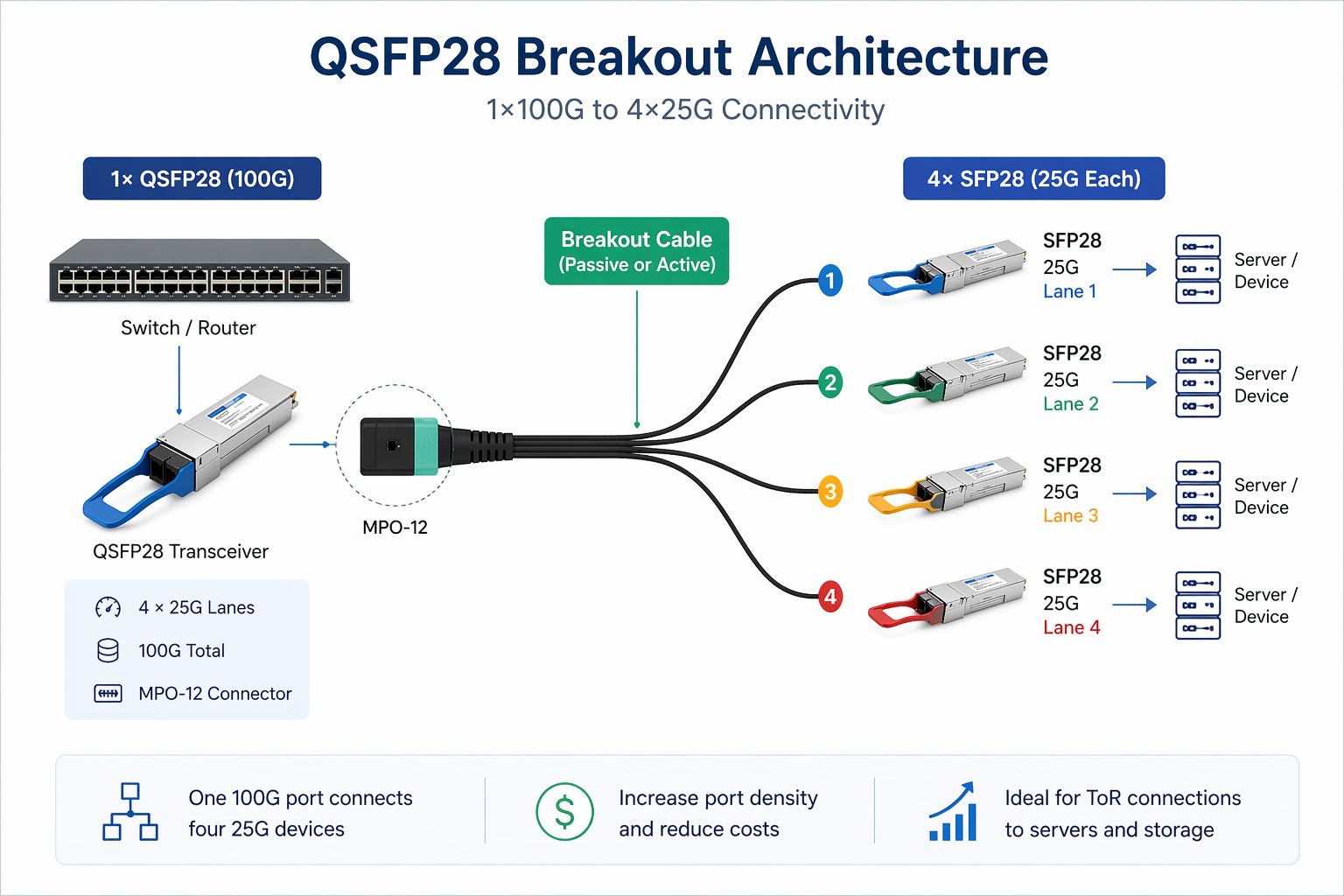
Breakout Cables: 100G to 4×25G Fan-Out
QSFP28 breakout cables divide 100G ports into four 25G SFP28 links. This fan-out pattern is one of the most common server access architectures in modern data centers.
Breakout cables come in both DAC and AOC variants. A QSFP28-to-4×SFP28 DAC is typically used for in-rack server connections, while the AOC version extends to end-of-row deployments.
QSFP28 Module Types Selection Decision Matrix
Selecting the right QSFP28 module is not just about transmission distance—it requires balancing fiber infrastructure, cost efficiency, power consumption, and future scalability. The following decision matrix provides a quick reference, while the guidelines below help you make a more informed and practical choice.
| Distance |
Fiber Type
|
Recommended Module |
Connector |
Fiber Strands
|
| ≤ 5 m |
Copper
|
QSFP28 DAC |
QSFP28 |
1 cable
|
| ≤ 100 m |
MMF (OM4)
|
SR4 |
MPO-12 |
8
|
| ≤ 500 m |
SMF
|
DR1 / PSM4 |
LC Duplex / MPO-12 |
2 / 8
|
| ≤ 2 km |
SMF
|
CWDM4 / FR1 |
LC Duplex |
2
|
| ≤ 10 km |
SMF
|
LR4 / LR1 |
LC Duplex |
2
|
| ≤ 40 km |
SMF
|
ER4 |
LC Duplex |
2
|
| ≤ 80 km |
SMF
|
ZR4 |
LC Duplex |
2
|
This matrix is the fastest way to eliminate incompatible QSFP28 module types from your short list. Match your measured distance and existing fiber plant to the table, then validate switch compatibility.
Start with Transmission Distance
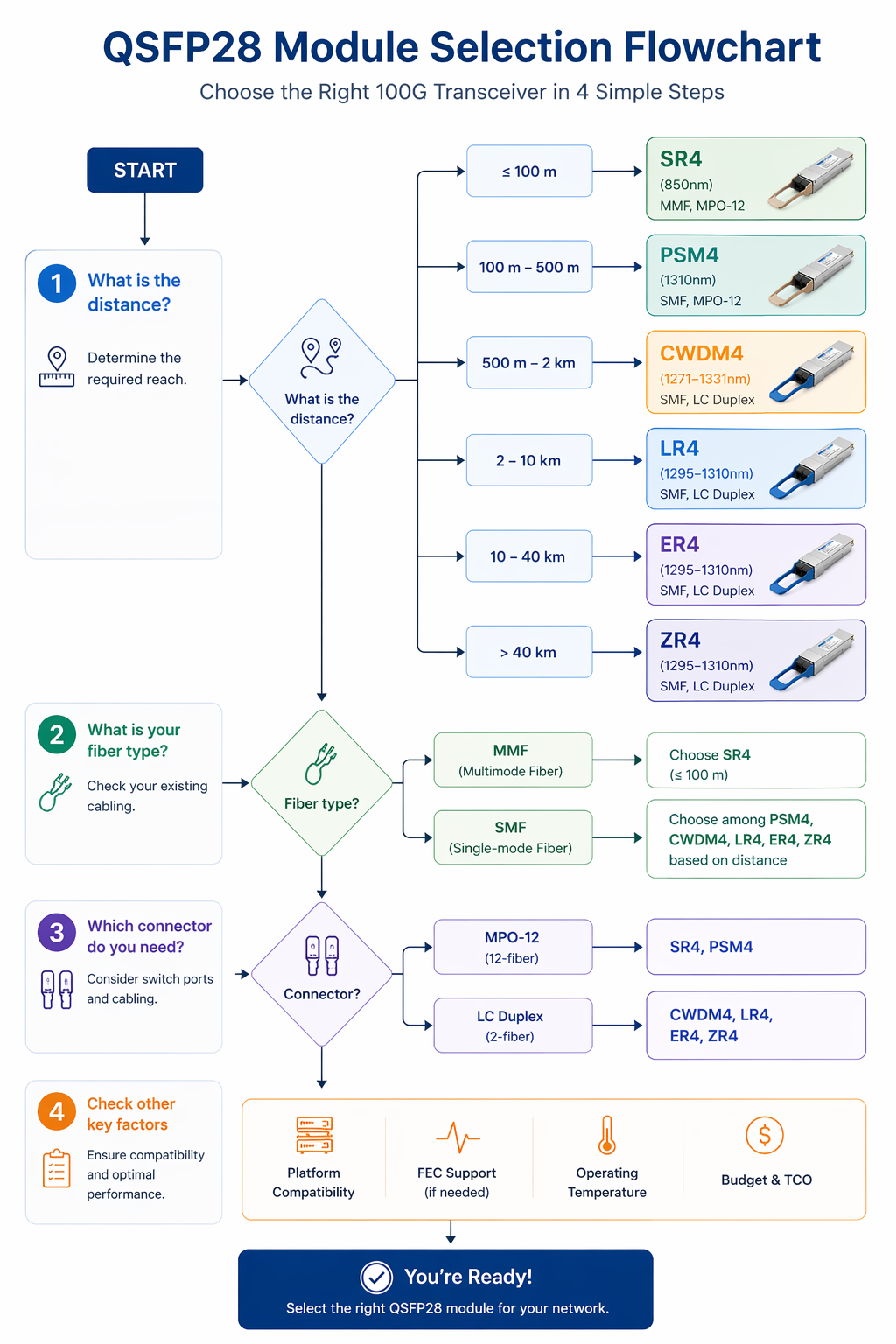
Distance is the primary factor in narrowing down QSFP28 module options:
- ≤100 m: QSFP28 SR4 is the default choice for multimode environments, offering the lowest cost and power consumption for intra-data-center links.
- ≤500 m: QSFP28 PSM4 can be considered if single-mode fiber is already deployed and parallel cabling is acceptable.
- ≤2 km: QSFP28 CWDM4 provides the best balance between cost and fiber efficiency for short-reach DCI.
- ≤10 km: QSFP28 LR4 is the standard solution for campus and metro access networks.
- ≤40 km: QSFP28 ER4 is required for long-distance transmission, typically with FEC enabled.
- ≥80 km: QSFP28 ZR4 or coherent solutions should be considered for extended reach applications.
Best practice: Always include a 10–15% link budget margin to account for insertion loss, aging, and environmental factors.
Want a tailored recommendation? Contact our optical networking experts with your distance and fiber details.
Power, Thermal, and TCO Comparison
Power draw varies significantly across QSFP28 module types:
- •DAC: Under 1.5W
- •AOC: 5W – 2.5W
- •SR4: 5W – 3.5W
- •PSM4: 5W – 3.5W
- •CWDM4: 0W – 4.0W
- •LR4: 5W – 4.5W
- •ER4: 5W – 5.5W
- •ZR4: 0W – 5.5W
- •Single-lambda (DR1/FR1/LR1): 0W – 4.5W
A fully loaded 32-port switch running ZR4 modules can draw 160W or more just for optics. Compare that to 80W for the same switch loaded with SR4 modules. This difference is critical for thermal design and rack power budgeting.
Thermal Design Considerations
Higher-power modules increase heat density inside the switch cage. Monitor DDM temperature readings during the first week of any large-scale deployment. Ensure front-to-rear airflow paths are unobstructed, especially in 1U high-density platforms.
Most of the enterprises’ switches can bear the thermal workload of standard SR4, CWDM4, and LR4 modules. But one has to be very cautious and watch out about what ER4 and ZR4 do in the edge cabinets or fragments of cooling environments.
Total Cost of Ownership (Module + Fiber + Patch Panels)
Module price is only one line item in the total cost equation. Consider these factors:
- •Fiber cost: PSM4 requires eight strands per link. CWDM4 and LR4 require two.
- •Patch panel density: MPO-12 connectors consume more panel space than LC duplex.
- •Spares inventory: Managing one module type (e.g., DR1) is cheaper than managing multiple WDM variants.
- •Installation labor: MPO trunk cables are more expensive to install and test than standard duplex fiber.
A module that looks cheaper on paper can become the more expensive choice once fiber and infrastructure costs are included.
Switch Compatibility by QSFP28 Module Types
Cisco Nexus Support Matrix
Cisco Nexus 9000 series switches support the entire range of QSFP28 module value types. The Nexus 93180YC-FX is one of 100G leaf switches that support the SR4, LR4, CWDM4, and ER4 modules. It is important to clearly cross-reference your switch model’s specific transceiver compatibility matrix with NX-uns release.
Arista 7000 Series Options
The Arista 7050X3 and 7060X4 platforms have QSFP28 assistance, with speeds now capable of being shaped individually based-on any particular port. With Arista EOS, the manual setting can be adjusted to 100G, 40G, or breakout modes. Whereas, Arista-certified optical fibers are obtainable for all key types of modules.
Juniper QFX Platform Coverage
To support SR4, LR4, CWDM4, and ER4, Juniper can use QFX5120 and QFX10000 switches. When using QFX line cards, some might obligate you to program the speed explicitly outside of the autonegotiation setting. Before you start using them, ensure that your version of the Junos OS is in the hardware compatibility list.
NVIDIA ConnectX Adapter Compatibility
NVIDIA has other adapter choices for cards like the ConnectX-5 and ConnectX-6, which have cables of QSFP28 SR4, LR4, and DAC/AOC support. These adapters are widely used in AI clusters and high-performance computing environments where low-latency 100G server connectivity is crucial.
How to Choose the Right QSFP28 Module Types
Step 1: Map Your Transmission Distance
Always measure actual fiber-path distance, trials with slack loops and patch panel glides in lazy ways are inaccurate, and a margin of 10 to 15 percent must be provided for fiber being rerouted later.
Step 2: Audit Your Fiber Infrastructure
Determine whether your fiber is multimode or single-mode. Check the connectors on both ends: if you only have LC duplex single-mode fiber, immediately rule out SR4 and PSM4.
Step 3: Match Module Type to Switch Platform
Before inserting any module, verify that your switch or adapter supports the chosen type. Review vendor compatibility matrices for firmware requirements and FEC support. Long-reach modules (ER4, ZR4) typically require host-side FEC.
Step 4: Factor in Breakout and Future Migration
If you plan to break out 100G to four 25G server links, confirm that your switch supports the required breakout mode. Also consider your migration path to 400G. When that day comes, see our guide on how to choose QSFP-DD modules for next-generation infrastructure.
Conclusion
Selecting the right QSFP28 module types comes down to three variables: distance, fiber infrastructure, and switch compatibility. Get any of these wrong, and you face costly returns, deployment delays, or thermal problems.
Key takeaways:
- •SR4 is the default for short-reach data center links over multimode fiber.
- •CWDM4 is the cost-optimized sweet spot for 500 m to 2 km single-mode links.
- •LR4 is the enterprise standard for 10 km campus and metro connections.
- •ER4/ZR4 are reserved for long-haul carrier and DCI applications.
- •Single-lambda modules (DR1/FR1/LR1) are emerging as simplified alternatives in hyperscale environments.
- •DAC and AOC cables remain the lowest-cost options for in-rack and row-to-row connectivity.
Ready to source the right modules? Explore Ascent Optics’ QSFP28 transceiver portfolio and request a quote for your next project. For a broader overview of 100G networking, read our complete QSFP28 transceiver guide.
Frequently Asked Questions
Q1. What are the different types of QSFP28 modules?
Most widely used modules for QSFP28 are SR4 (multimode, 100 m), LR4 (single-mode, 10 km), CWDM4 (single-mode, 2 km), ER4 (single-mode, 40 km), and PSM4 (parallel single-mode, 500 m-2 km). In addition, single-lambda modules such as DR1, FR1, and LR1 have gained significant popularity in recent years.
Q2. Which QSFP28 module is suitable for data centers?
For intra-data-center links up to 100 meters, SR4 is the most common and cost-effective choice. Furthermore, for campus interconnects or data center links around 2 km, CWDM4 typically offers the best balance between cost and reach, which is why it is widely adopted.
Q3. How is CWDM4 different from PSM4?
CWDM4 uses wavelength division multiplexing over two single-mode fibers with an LC duplex connector, while PSM4 transmits over four parallel lanes using eight single-mode fibers with an MPO-12 connector. Therefore, CWDM4 consumes significantly less fiber. However, PSM4 optics are usually lower in cost per module. In summary, each has its own advantages depending on your fiber resources.
Q4. Can QSFP28 LR4 be used for a 500-meter link?
Yes, it is technically possible, but in most cases it would be considered overkill. For example, for distances around 500 meters, CWDM4 or PSM4 often provides a much better cost advantage. Therefore, LR4 is best reserved for applications that truly require up to 10 km of reach.
Q5. What is a QSFP28 Module (Single Lambda Type)?
Single lambda modules, besides PAM4 modulation, also carry 100G over one optical wavelength. 3 Precisely – DR1, FR1, and LR1 modules. They shine for just one reason: These make the fiber cabling and inventory management super simple at the cost of orderly fiber connections and proper FEC support.
Q6. Does power remains the same for all QSFP28 module types?
No, it varies significantly. Power draw ranges from under 1.5 W for DAC cables to as high as 5.5 W for ZR4 modules. Therefore, it is essential to carefully verify your switch’s power budget and thermal capacity before deploying any higher-power optics.
IEEE 802.3bm standards
Cisco transceiver module documentation
Post Views: 2,270