As cloud computing, 5G, and large-scale data centers continue to evolve, networks are facing increasing demands for higher capacity and longer-reach optical transmission. The 200G Coherent CFP2 optical module, integrating coherent detection and high-performance DSP, enables higher spectral efficiency over limited fiber resources, making it a proven solution for metro, backbone, and data center interconnect (DCI) networks.
What is a 200G Coherent CFP2 Optical Module?
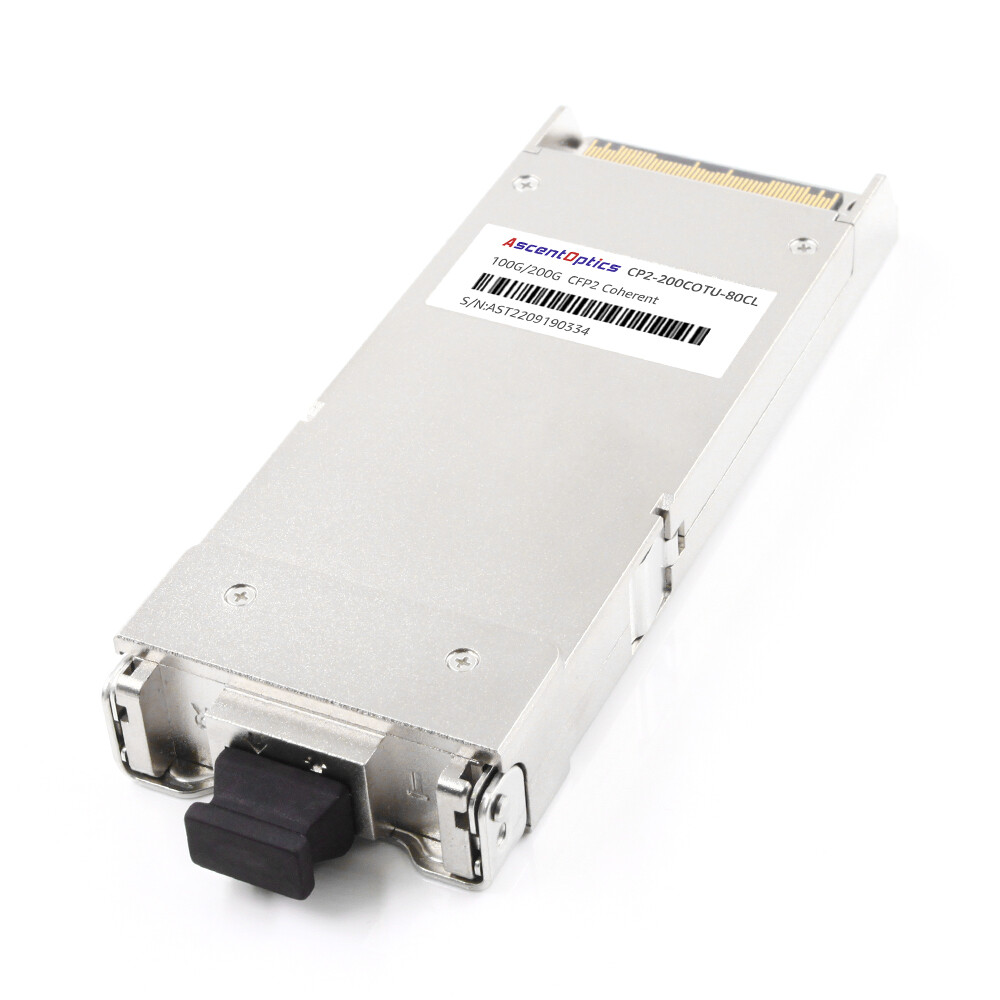
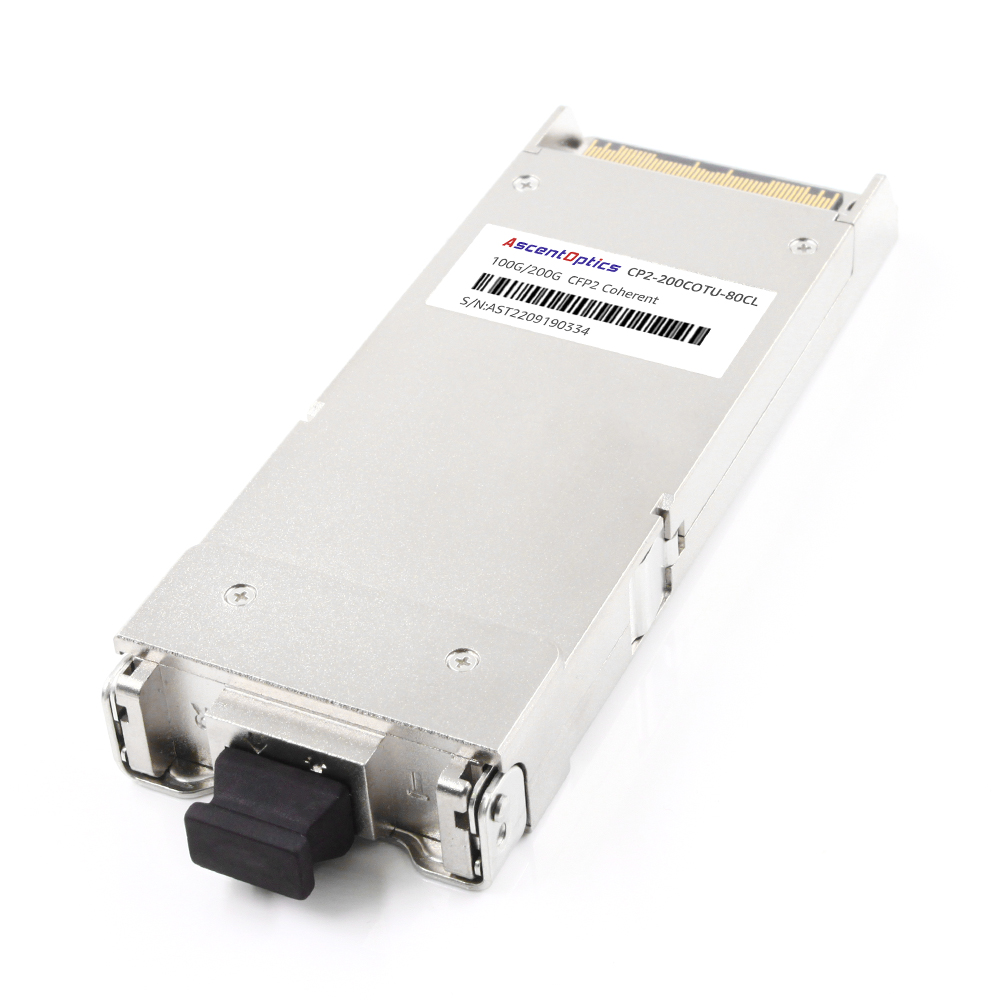
A 200G Coherent CFP2 optical module (commonly referred to as 200G CFP2-DCO, Digital Coherent Optics) is a high-performance pluggable coherent optical transceiver that adopts the CFP2 form factor (C Form-factor Pluggable 2).
It is a high-speed optical transceiver based on coherent optical communication technology, specifically designed for long-distance, high-capacity DWDM (Dense Wavelength Division Multiplexing) transmission. It is primarily used in metro networks and long-haul backbone networks for high-capacity optical transport.
The 200G Coherent CFP2 integrates advanced functions such as high-speed DSP (Digital Signal Processor), coherent modulation/demodulation, and FEC (Forward Error Correction) within the CFP2 package. It can be directly plugged into the CFP2 interfaces of optical transmission equipment, routers, or switches.
Compared to traditional IM-DD (Intensity Modulation-Direct Detection) optical modules, coherent CFP2 modules offer significantly longer transmission distances, higher spectral efficiency, and stronger resistance to chromatic dispersion.
This makes them ideal for modern high-bandwidth applications like data center interconnects (DCI), telecom backbone networks, and regional/metro DWDM systems.
Working Principle
The 200G Coherent CFP2 achieves long-distance, high-speed transmission through the following key technologies:
1.Adopts coherent modulation formats (such as QPSK / 8QAM / 16QAM)
These formats encode data into both amplitude and phase (and polarization), enabling higher spectral efficiency.
2. Uses Local Oscillator (LO) laser + coherent reception to recover amplitude, phase, and polarization information
At the receiver, the incoming signal is mixed with a local laser, allowing full recovery of the optical field’s complex information (unlike direct detection, which only captures intensity).
3. Built-in DSP for chromatic dispersion compensation, polarization demultiplexing, and error correction
The integrated Digital Signal Processor (DSP) digitally compensates for transmission impairments in real-time, including CD/PMD and applies advanced FEC for low BER over long distances.
4. Typically operates in the DWDM C-band, supporting tunable wavelengths
Full C-band tunability (e.g., 50GHz grid) allows dense channel packing in DWDM systems.
This combination enables the module to support 200G (or 100G) transmission over hundreds to thousands of kilometers in amplified DWDM networks, far surpassing traditional direct-detect modules.
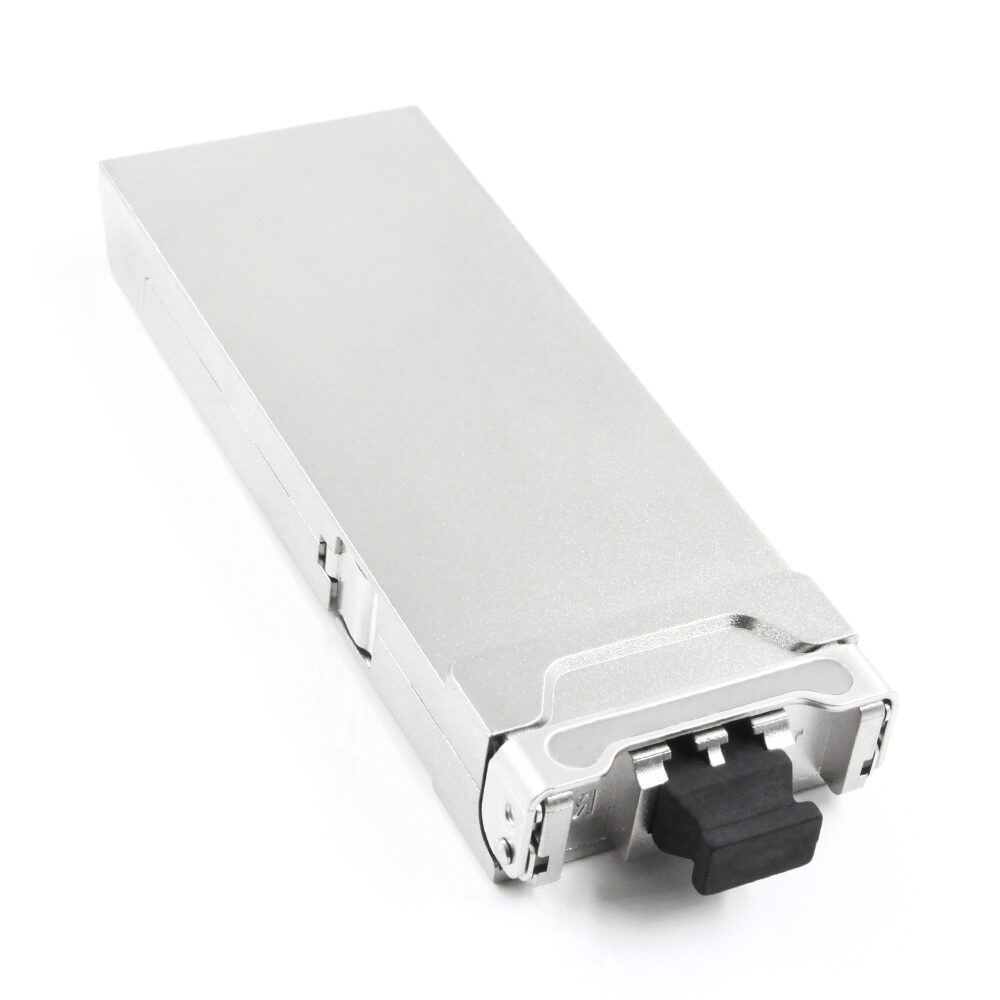
Core Features:
Data Rate: 200 Gbps
Form Factor: CFP2
Modulation Formats: QPSK / 8QAM / 16QAM (depending on vendor implementation and transmission reach)
Transmission Reach: Several hundred kilometers (QPSK), 80–200 km (higher-order modulation)
Wavelength: Tunable DWDM (C-band)
Fiber Type: Single-Mode Fiber (SMF)
Typical Power Consumption: 20–25 W (implementation dependent)
Typical Application Scenarios of 200G CFP2-DCO
200G CFP2-DCO coherent optical modules are mainly used for high-capacity, long-haul DWDM transmission. They support dual-rate 100G/200G operation, feature tunable C-band lasers, and integrate DSP-based coherent detection with advanced FEC.
Compared with short-reach PAM4 modules (such as QSFP56), CFP2-DCO modules are optimized for long-distance links affected by dispersion, attenuation, and noise, achieving transmission distances of up to 80 km without amplification and 1,000–2,000 km with EDFA amplification.

Main Application Scenarios
Data Center Interconnect (DCI)
This is the most common use case, enabling point-to-point or ring interconnection between hyperscale cloud data centers. It supports IP over DWDM, allowing direct pluggability into routers or switches for high-density, high-capacity transmission (up to several Tbps per fiber).
Typical reach: 80–120 km for metro DCI, or extended to several hundred kilometers with optical amplification.
Metro Networks and Regional Networks
Used in the metro core/convergence layer of telecom operators, supporting high spectral efficiency transmission and simplifying network architecture.
Typical distance: 100-600 km, suitable for OSNR-limited scenarios (e.g., amplified links).
Long-Haul Networks
Backbone network applications, supporting transmission over 1000 km+ (up to 2000 km+ in 100G mode).
Ideal for inter-provincial or cross-country trunk lines, requiring high-performance FEC (e.g., SD-FEC) and dispersion compensation.
5G Wireless Backhaul (including mid-haul/front-haul)
Enables high-capacity, low-latency transmission from mobile base stations to the core network, particularly in dense urban areas or regional aggregation.
Access Aggregation and Edge Applications
Examples include Remote PHY aggregation and enterprise campus interconnects, with flexible client-side interfaces (100GE/200GE/OTU4).
These scenarios have been widely deployed in products from vendors such as Acacia (Cisco) and Coherent, especially in cloud operators and telecom backbone networks. As of 2025, with the upgrade to 400G/800G, the 200G CFP2-DCO remains a mature solution for medium- to long-distance hybrid networks.
200G Coherent CFP2 vs Traditional 200G Optical Modules
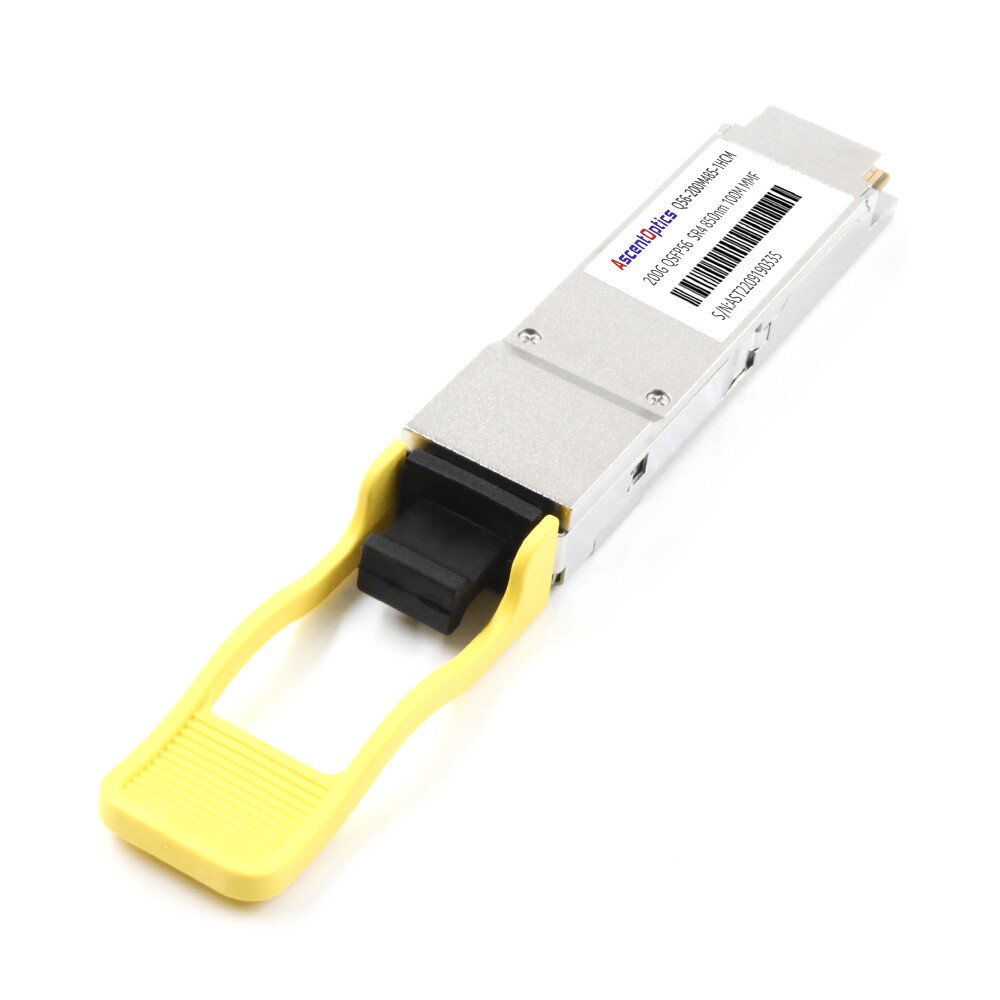
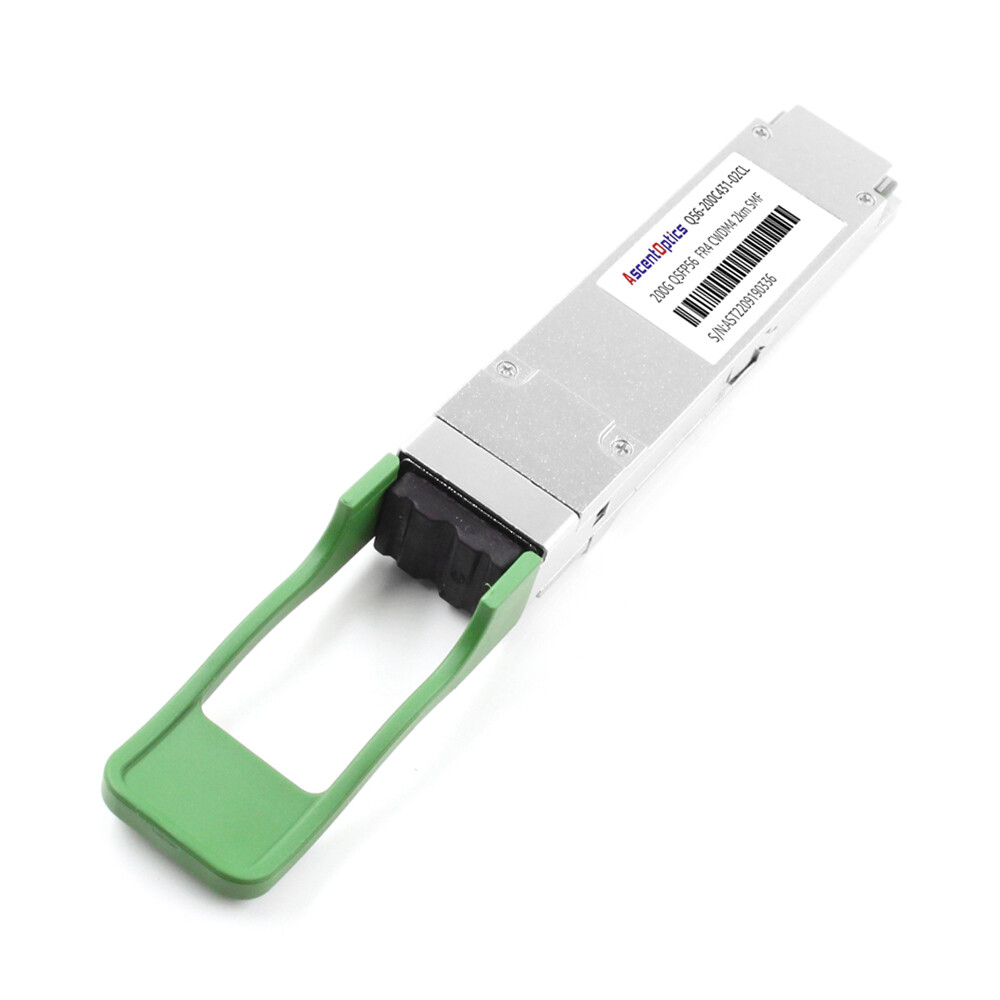
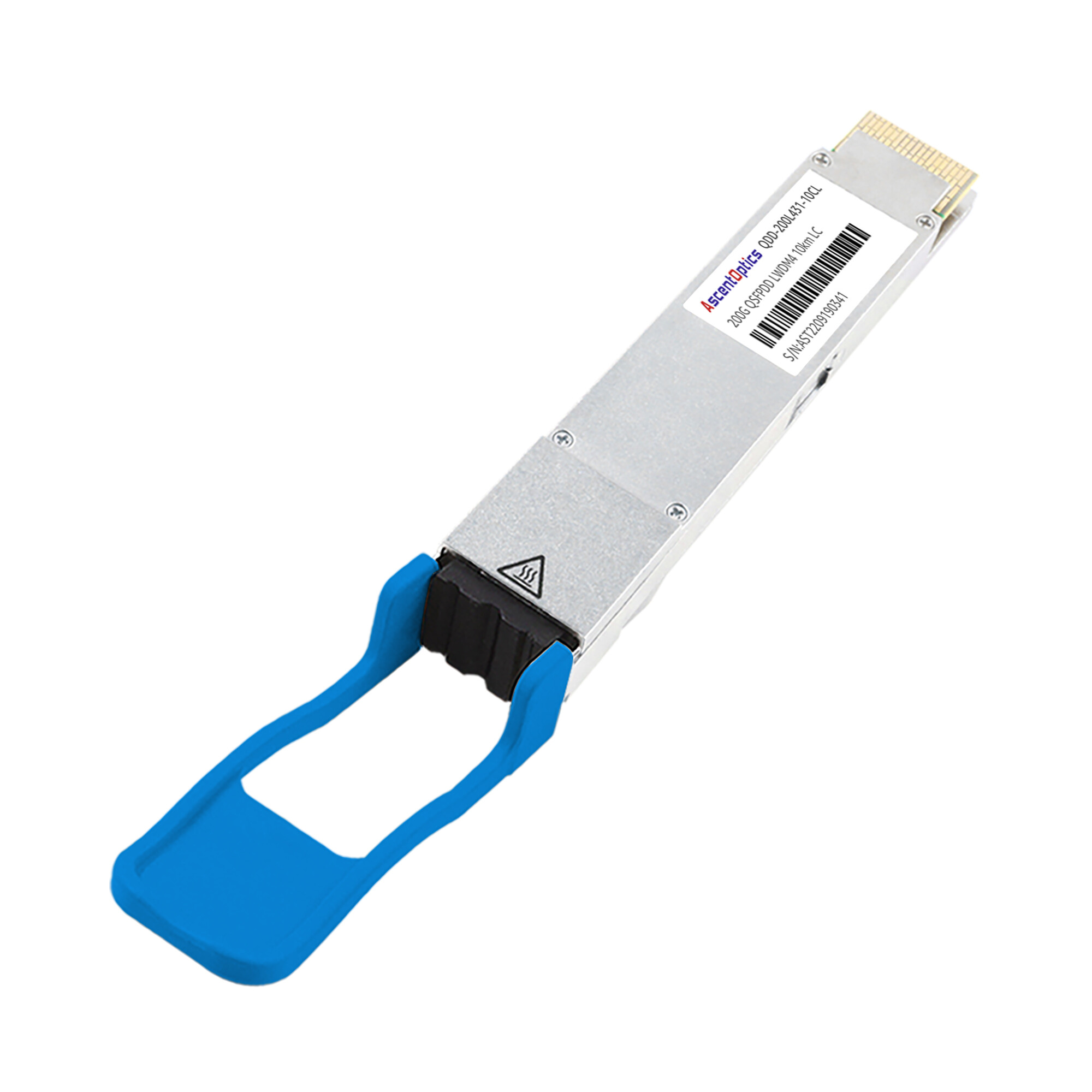
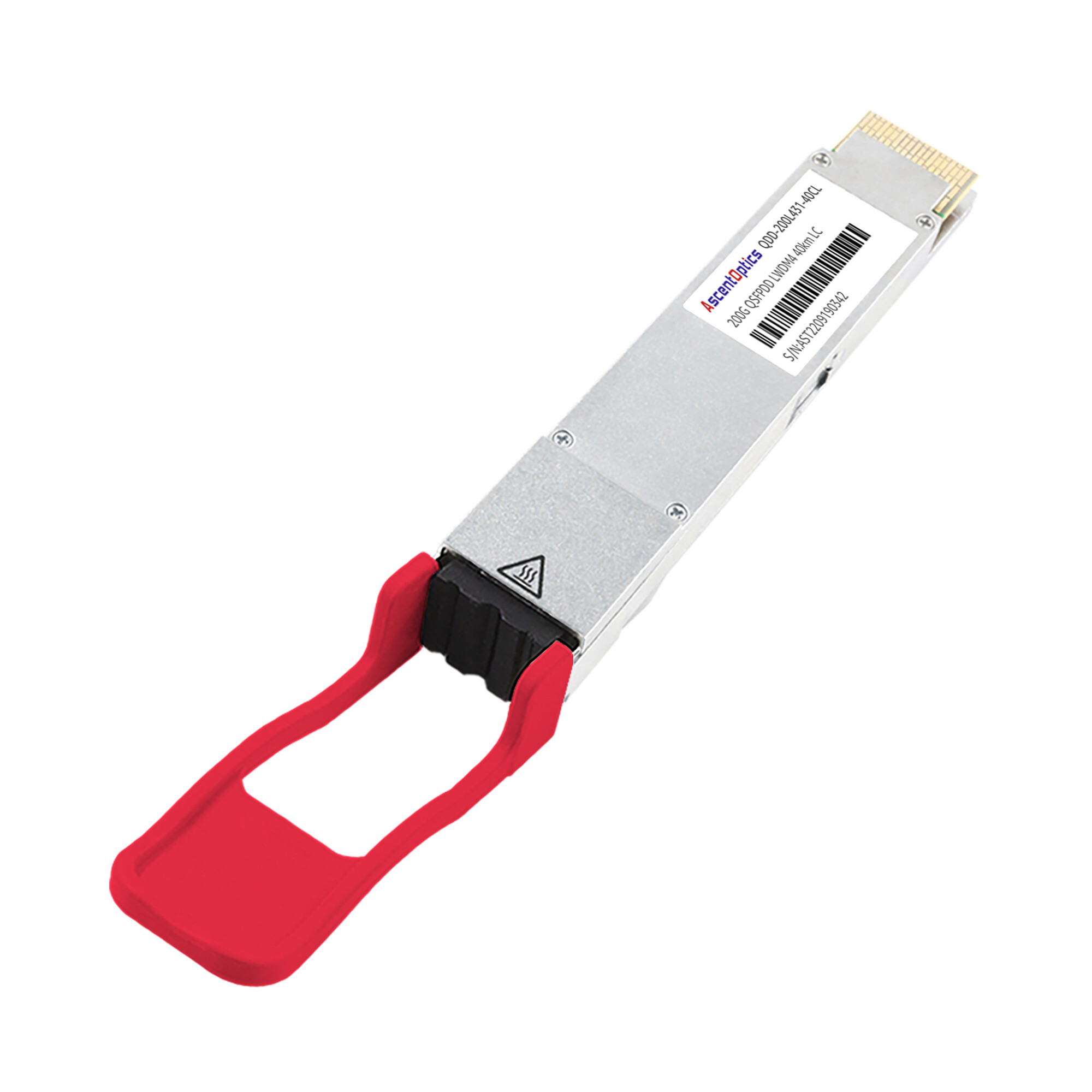
Traditional 200G optical modules typically refer to direct detection types, such as 200G QSFP56 or QSFP-DD modules, which primarily use PAM4 modulation and are suitable for short- to medium-distance data center interconnects (e.g., DR4/FR4/LR4).
In contrast, the 200G CFP2 Coherent (CFP2-DCO) is a coherent detection module with built-in DSP, supporting advanced modulation (e.g., PM-16QAM), and specifically designed for long-distance DWDM transmission.
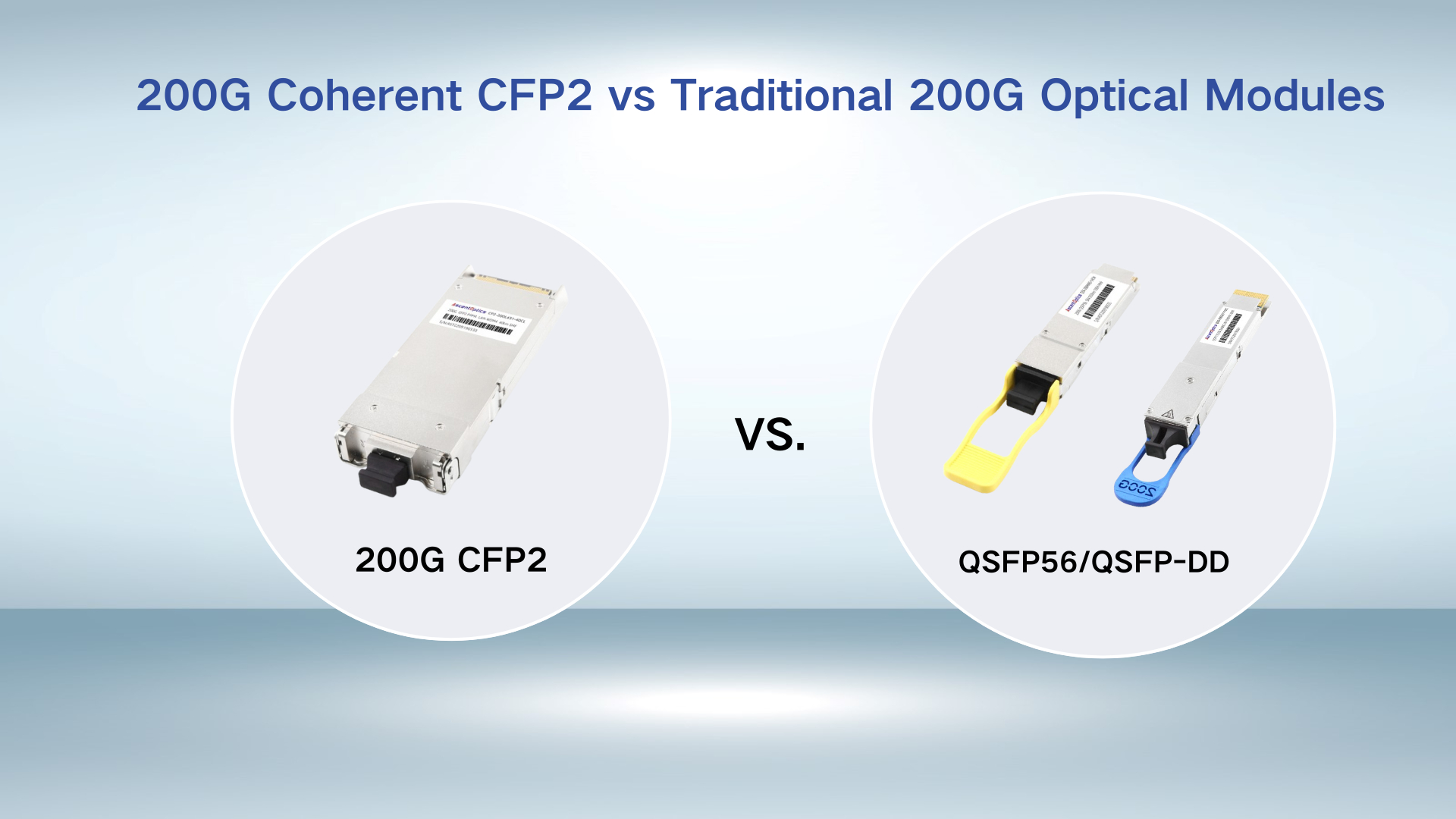
| Parameter |
200G CFP2 Coherent (DCO) |
Traditional 200G QSFP56 / QSFP-DD (Direct Detect) |
| Detection Method |
Coherent detection with integrated DSP for chromatic dispersion and polarization compensation |
Direct detection (IM-DD) with PAM4 modulation |
| Modulation Format |
PM-QPSK (100G mode), PM-8QAM / PM-16QAM (200G) |
PAM4 (4 × 50G) |
| Wavelength |
Fully tunable DWDM in the C-band (50 GHz grid, up to 96 channels) |
Fixed CWDM / LAN-WDM (e.g., 1271–1331 nm for FR4) |
| Transmission Reach |
Without amplification: 80 km; with EDFA amplification: up to 2000 km at 100G, and 800–1000 km at 200G |
SR4: 100 m (MMF); FR4: 2 km (SMF); LR4: 10 km (SMF) |
| Power Consumption |
20–30 W (higher due to integrated DSP) |
7–12 W (lower) |
| Form Factor |
CFP2 (larger size, lower port density) |
QSFP56 / QSFP-DD (compact, high density) |
| Cost |
Higher (complex DSP and coherent components) |
Lower (mature PAM4 technology) |
| Main Applications |
Long-haul / ultra-long-haul DWDM, DCI, metro and backbone networks, telecom core networks |
Intra–data center and short-reach interconnects, rack-to-rack links, high-density switching |
| Flexibility |
Software-configurable rate and modulation, supports Flex-Grid |
Fixed configuration, backward compatible with QSFP28 |
Which One to Choose?
Choose CFP2 Coherent: If you require ultra-long distances (hundreds to thousands of kilometers), high spectral efficiency DWDM (multi-wavelength per fiber), and strong ability to overcome dispersion/noise—such as in carrier backbone networks or large-scale DCI.
Choose traditional QSFP56/QSFP-DD: If the scenario involves short-distance data center interconnects (<10 km), with priorities on high port density, low power consumption, and low cost—such as internal upgrades in hyperscale cloud data centers.
Conclusion
As of the end of 2025, with the rise of 400G/800G ZR/ZR+ coherent modules (e.g., QSFP-DD DCO), the 200G CFP2 Coherent remains a mature and widely deployed solution for long-distance applications, while traditional 200G PAM4 modules continue to dominate the short-reach market.
Post Views: 4,081