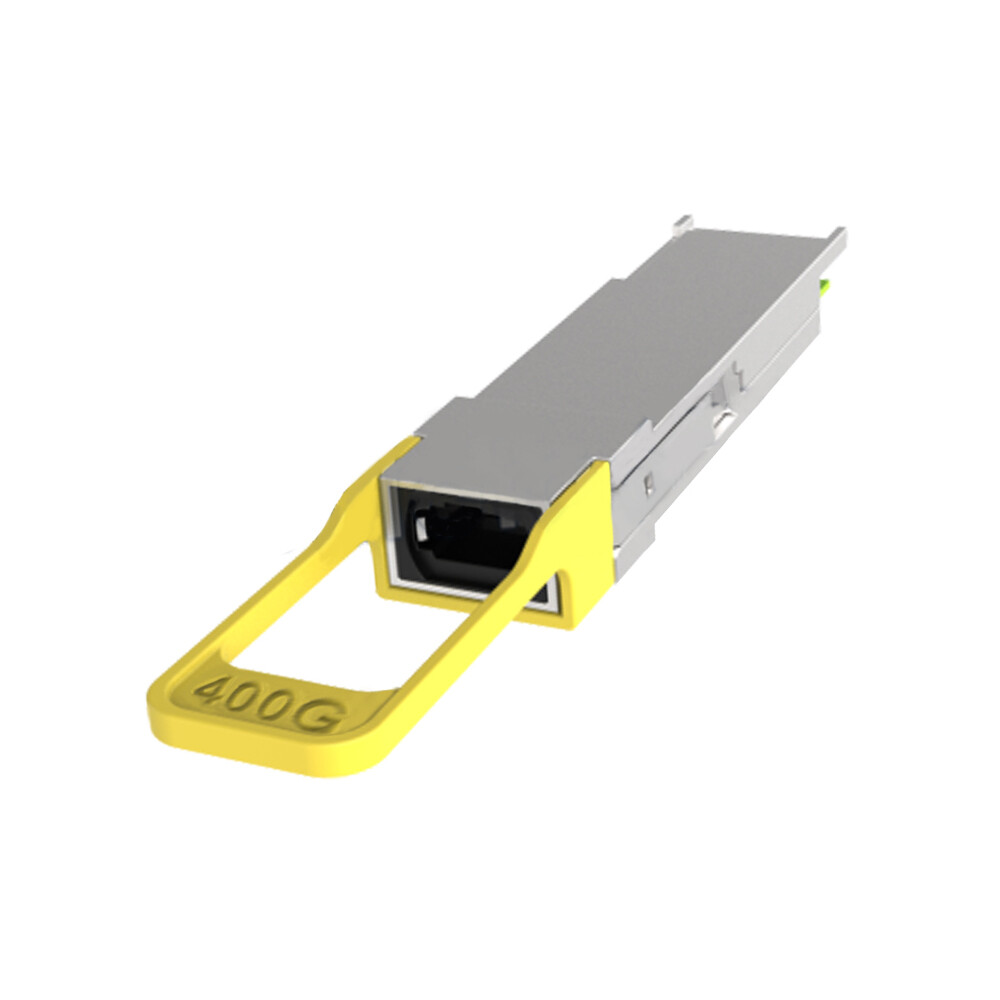
At 800G, linear drive was an efficiency argument. You removed the DSP, saved a few watts, and accepted a longer qualification list. At 1.6T, it becomes a physics argument.
The unit interval halves. A reflection the DSP used to absorb now has nowhere to go, and the switchboard that was never part of the optical budget sits inside it. Modules target about 10 W against 23 to 25 W for a retimed part, but only when the host electrical channel is clean enough to let them.
New to linear drive? Our 800G LPO guide explains what the DSP did and what removing it costs.
What Changes When Linear Drive Goes to 200G Per Lane
A 1.6T LPO module is an eight-lane 200G PAM4 transceiver with no retimer. The host SerDes provides the primary high-speed digital equalization and signal recovery functions, while the module uses linear analog circuitry for electrical-to-optical and optical-to-electrical conversion without high-speed DSP-based retiming.
Structurally, that’s identical to 800G LPO. What changed is the margin, and the fact that the host board is now part of the link.
Half the Unit Interval, Tighter Signal Integrity Requirements
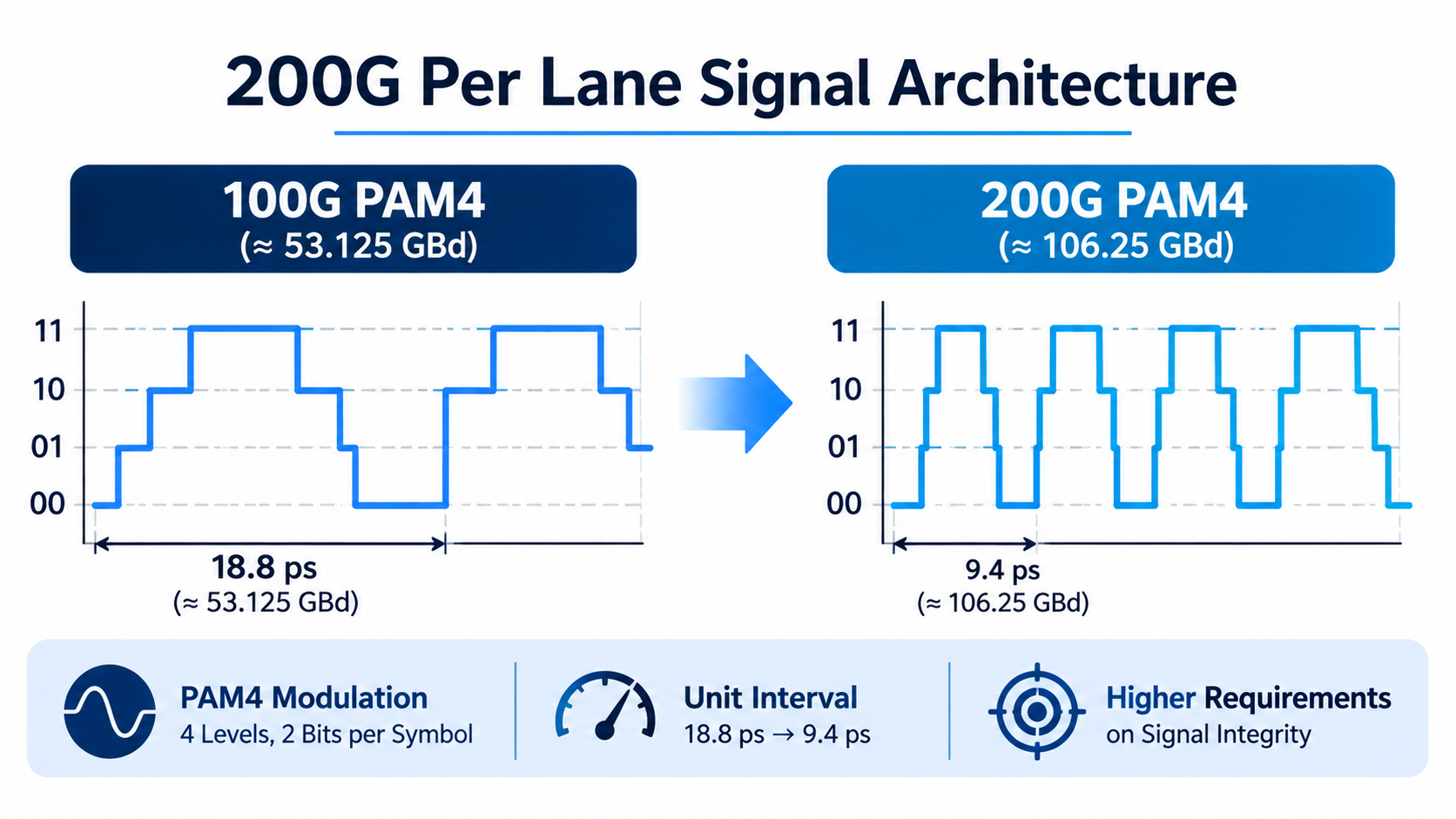
At 100G per lane, the symbol period is about 18.8 ps, and at 200G it’s about 9.4 ps. Every timing and amplitude error tolerable at 800G now has half the room.
That doesn’t break linear drive by itself. However, it means the channel has to be cleaner. A connector contributing 1 dB of excess loss at 100G per lane can contribute materially more at 200G, and there’s no DSP on the module side to compensate.
Electrical Reflections Become More Critical Without DSP
This is where the 1.6T story differs. Without module-side DSP and retiming, electrical reflections caused by impedance discontinuities in the host ASIC package, PCB traces and electrical connectors can directly degrade end-to-end signal integrity. At 200G per lane, these effects become increasingly critical to link performance.
Arista’s position, stated at DENOG and repeated at OFC 2026, is blunt: package reflections at the BGA interface will need better flyover cables or direct package attach before 200G linear drive works reliably in a switch.
On a NIC, the channel is short and manageable. On a switch, the trace from ASIC to cage can already consume the budget on its own. Your switch board is now an optical design constraint.
The mechanism is PAM4 SNR and link budget: with no retimer to restore the eye, every reflection and crosstalk term that used to be a margin question becomes a link-down question.
1.6T LPO vs LRO vs DSP: The Three Architectures Compared
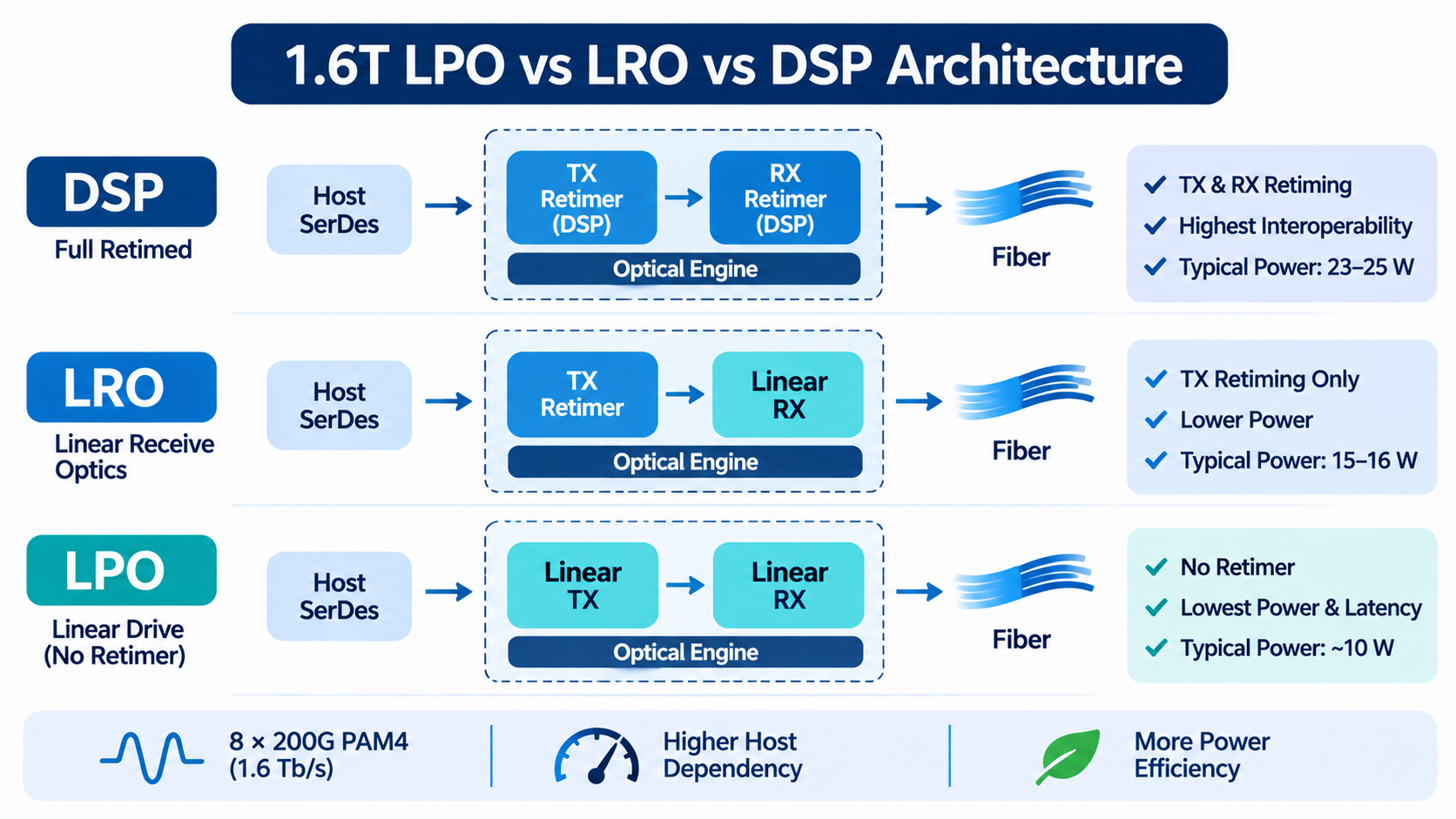
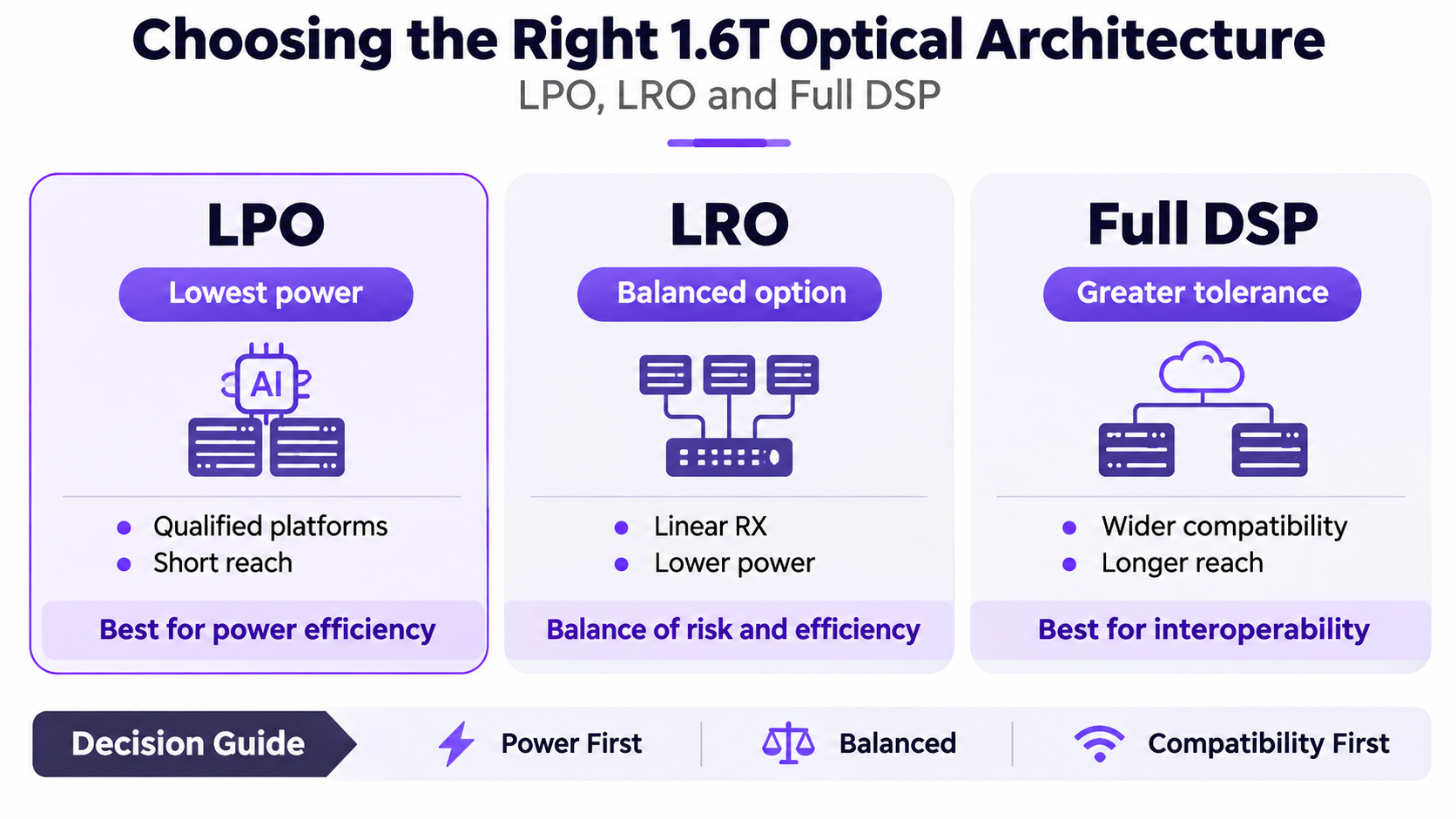
All three deliver 1.6T over eight lanes, and differ only in where equalization happens.
Full DSP, or retimed. The module contains a processor that reshapes transmit and recovers receive, so the host SerDes can be relatively forgiving. This is the mature, multi-vendor option, and it costs the most power and money.
LRO, or linear receive optics. Sometimes called RTLR. Transmit keeps its retimer; receive goes linear and relies on host equalization. You recover a meaningful share of DSP power without the full interoperability burden, because transmit still looks conventional to the network.
LPO, or linear pluggable optics. No retimer at all, with host equalization in both directions. Lowest power, lowest latency, highest host dependency, shortest qualified list.
| Parameter |
Full DSP (FRO) |
LRO (RTLR) |
LPO |
| Data Rate |
1.6 Tb/s |
1.6 Tb/s |
1.6 Tb/s |
| Lane Configuration |
8 × 200G |
8 × 200G |
8 × 200G |
| TX Retiming |
Yes |
Yes |
No |
| RX Retiming |
Yes |
No |
No |
| Typical Module Power / Target |
23–25 W |
15–16 W |
~10 W |
| Energy per Bit¹ |
14.4–15.6 pJ |
9.4–10.0 pJ |
~6.25 pJ |
| Host SerDes Dependency |
Lower |
Higher on RX |
Higher on TX and RX |
| Electrical Channel Tolerance |
Higher |
Direction-dependent |
More restrictive |
| Latency |
DSP-dependent |
Asymmetric |
Low analog-path latency |
| Optical Reach |
PMD-dependent |
PMD-dependent |
PMD and host-dependent |
| Qualification Complexity |
Relatively lower |
Intermediate |
Higher |
| Interoperability |
Established approach |
Platform-specific |
Platform-specific |
| Module Cost Potential |
Higher |
Intermediate |
Lower |
| Application |
General-purpose networking |
Power-optimized AI networks |
Qualified low-power AI interconnects |
¹ Calculated using module power divided by the nominal 1.6 Tb/s data rate. Power values are indicative and implementation-dependent.
One pattern worth knowing: LRO retains transmit-side retiming and signal conditioning while relying on the host SerDes for receive-side equalization and signal recovery. This architecture balances power efficiency with transmitter performance and interoperability.
The Power Case at 1.6T
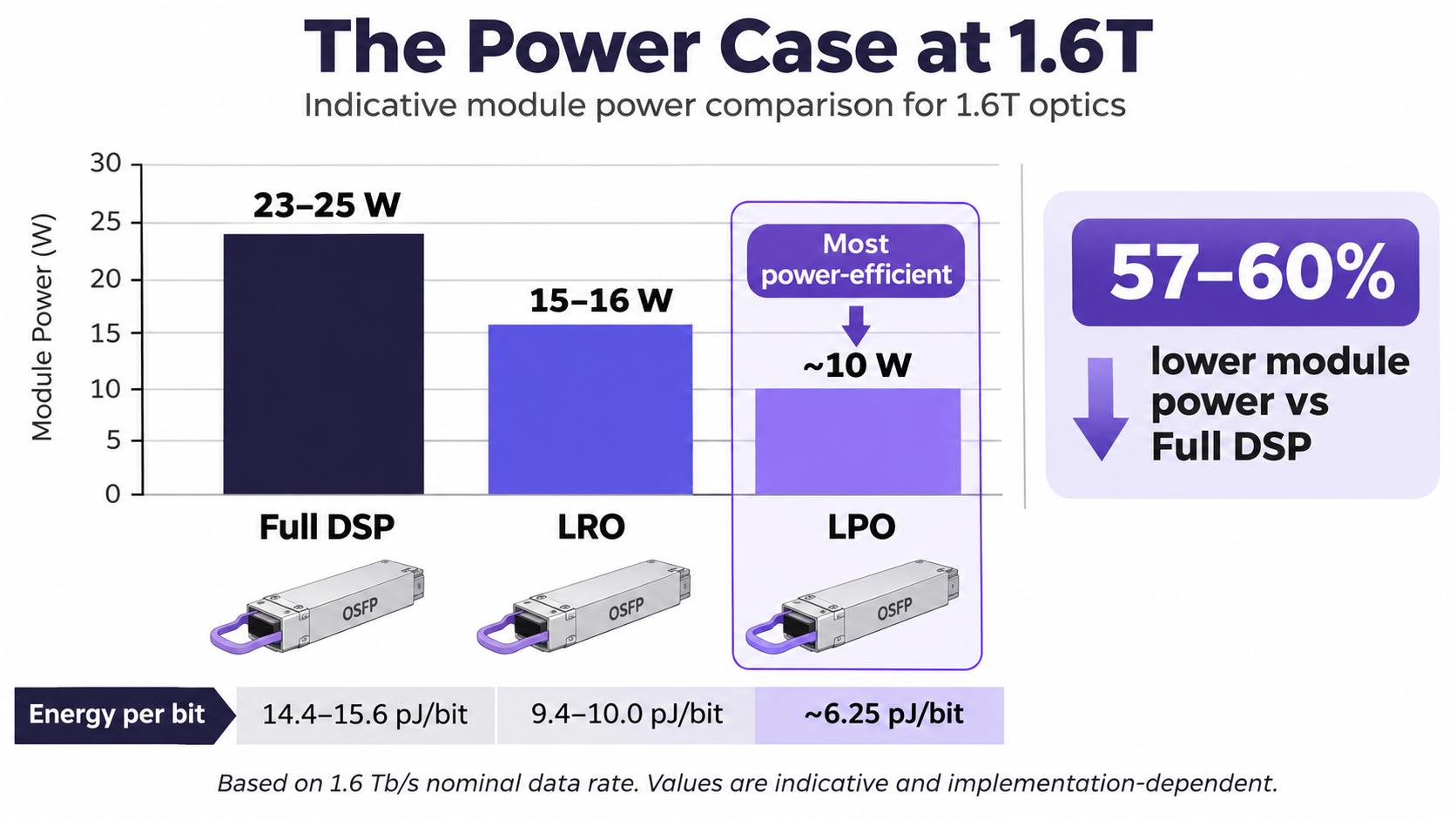
Based on a nominal data rate of 1.6 Tb/s, a 23–25 W retimed module consumes approximately 14.4–15.6 pJ/bit, while a 10 W LPO module consumes approximately 6.25 pJ/bit. This represents a module-level energy reduction of approximately 57–60%.
At 1.6T, full DSP works out to about 13.8 pJ per bit, LPO to about 7.9, and co-packaged optics to about 6.4. That’s roughly 43 percent less energy per bit for LPO against retimed, and it’s the number to use when someone claims 1.6T is inherently less efficient than 800G.
A 102.4Tbps switch ASIC can support up to 64 native 1.6T ports. Assuming 24W per fully retimed module and 10W per LPO module, the total optical module power decreases from 1,536W to 640W, representing a module-level power saving of approximately 896W.
The counter-argument matters. Arista’s platform-level measurement of the LRO saving on a 1.6T link came in closer to a third than the 50 to 60 percent some vendors quote. Module-level and system-level savings aren’t the same number, and the honest planning range sits between them.
The 1.6T LPO Electrical and Optical Budget Nobody Publishes
Vendors publish the headline loss number and skip what it means for your switchboard.
Die-to-Die Insertion Loss: 22 dB Today, 26 dB Targeted
The working budget for 200G LPO is about 22 dB of die-to-die insertion loss, from host ASIC die to module die. The industry is pushing toward 26 dB. A retimed module tolerates about 32 dB, because its DSP can equalize a much worse channel.
That 10 dB gap is the entire engineering problem in one number. Every decibel removed from the host channel buys back LPO feasibility.
Insertion loss is only half the budget. Host port return loss needs to stay at roughly 10 dB or better, and with the transmit retimer gone, reflections from the connector and package have no correction path.
Linear drive does work over real channels. A demo at 212 Gb/s ran 15 dB bump-to-bump over a 300 mm 32 AWG twinax flyover, and an emulation test held bit error rate below 1e-10 at about 30 dB bidirectional loss. It needs a channel designed for it, not inherited.
Three fixes exist, all physical: better flyover cables, direct package attach, or connector redesign. Each is a board-level change, so the LPO decision is made at switch design, not optics procurement. If your platform entered design without 200G linear in the channel budget, 1.6T LPO may not be available on it at all.
Optical Reach at 500 m
The optical budget matches the DR8 class: 500 m over single-mode at roughly 3 dB, covering the intra-row and cross-row case where linear drive lives. Up to about 2 km is possible at roughly 4 dB in low-dispersion fiber. Beyond that, the limit becomes laser power and receiver sensitivity, so anything past the DR class stays retimed or goes coherent.
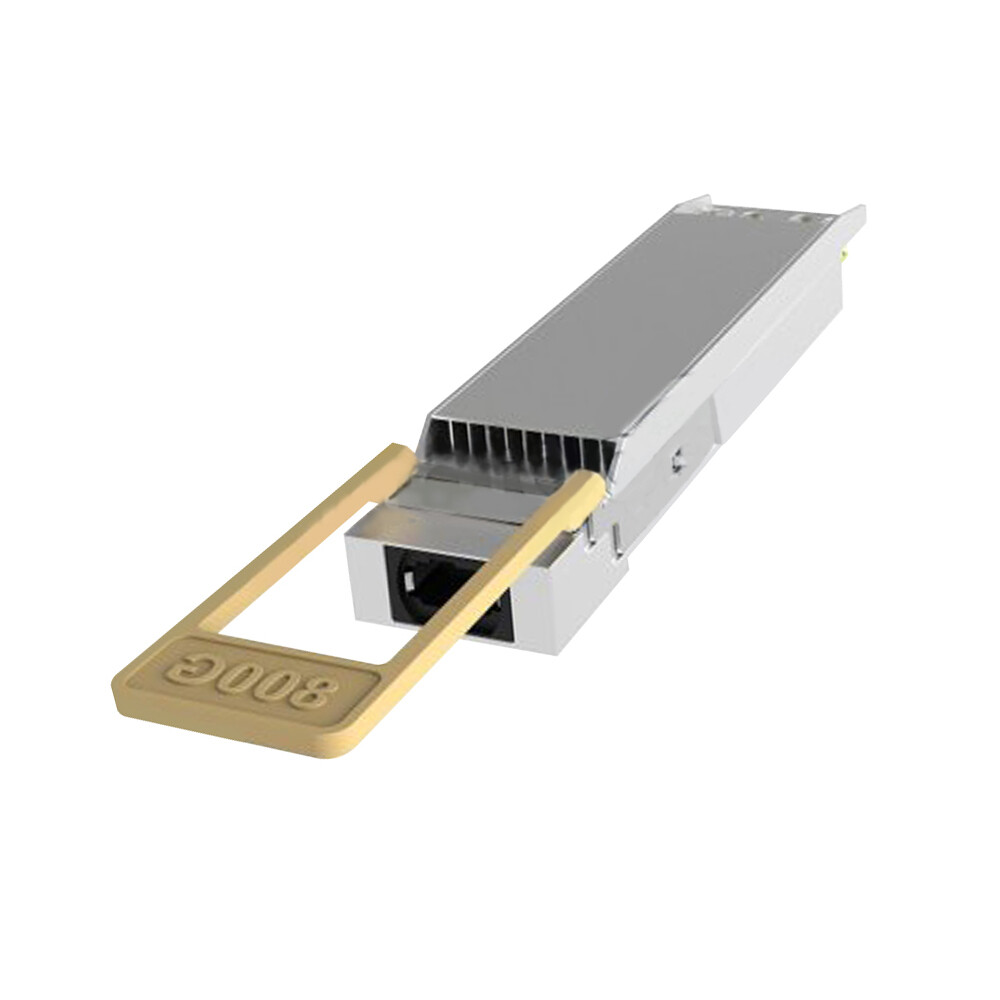
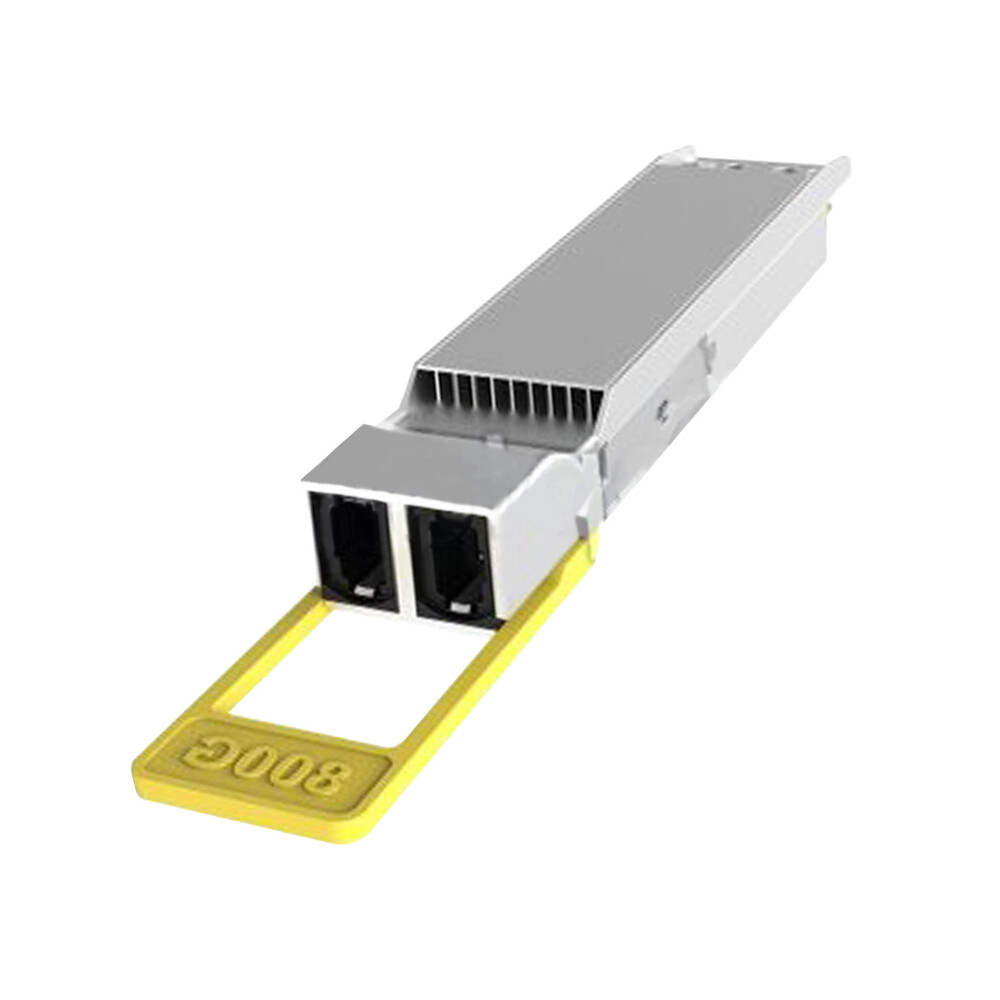
The product shape you’ll quote is the 1.6T OSFP 2xDR4, carrying 8×CEI-224G-LINEAR-PAM4 lanes, CMIS 5.4, and 500 m over dual MPO-12.
Which Hosts Can Take 1.6T LPO Today
Most guides say “it depends on your switch” and stop. Here’s what’s on the record.
| Platform |
SerDes |
Linear Optics Status |
| Broadcom Tomahawk 6 |
100G/200G |
Platform-specific LPO qualification required |
| Broadcom TH6-Davisson |
200G |
CPO architecture; supports interoperability with LPO |
| Arista 102.4T Platform |
200G |
LPO, LRO and FRO demonstrated at OFC 2026 |
| NVIDIA Spectrum-6 |
200G |
CPO available; pluggable LPO qualification requires verification |
Two cautions. “Supports LPO” describes a SerDes capability, not a validated link, and the absence of a public claim isn’t evidence of absence. A switch ASIC can be linear-capable while the platform still fails 200G LPO, because the failure lives in the board, cage, and connector. Qualification is per platform, per module, and per fiber length, so 1.6T LPO compatibility is never a single yes-or-no answer. Budget three to six months for qualification before committing to a fabric. If that timeline doesn’t fit, LRO or retimed modules are lower risk.
Standards: What the LPO MSA and IEEE Have Actually Finished
The 100G-per-lane LPO specification was published in March 2025, covering 100G through 800G parallel single-mode links. It raised the allowed host-to-module channel loss from 13 dB to 16 dB at 26.56 GHz, which is what made practical 800G LPO possible.
The 400G-FR4-LPO specification followed at ECOC 2025. Both are usable in a procurement document. The 200G-per-lane work, done with OIF and IEEE, is still in progress. A 1.6T LPO plugfest was reported for September 2026, but there’s no finalized public 200G-per-lane specification you can hold a supplier to.
That isn’t a reason to avoid the technology. It’s a reason to base acceptance criteria on measured link performance on your hardware rather than a compliance claim.
IEEE P802.3dj, which defines 1.6T Ethernet, cleared its third Standards Association recirculation ballot at D3.3 in October 2026 with 97 percent approval and received conditional approval to proceed to RevCom, targeted for December 2026. It isn’t yet a published standard, and any page calling it ratified is ahead of the process.
Two details matter. The 1.6T port types defined are KR8, CR8, DR8 at 500 m, and DR8-2 at 2 km. There’s no 1.6T FR8 or LR8 PMD, so vendor pages using those labels are using marketing names. And OIF CEI-224G-Linear sets the die-to-die loss target that makes linear drive possible.
Procurement specifications should reference the applicable electrical interface requirements, optical PMD specifications and their revision levels. End-to-end interoperability must be validated through platform-specific BER, FEC margin and environmental testing.
When LRO Is the Better Answer, and When DSP Still Wins
LRO recovers a meaningful share of the power savings with a much shorter qualification path, because transmit still looks conventional to the network. LRO may offer a lower-risk alternative to LPO, provided that the host platform supports linear receive operation and meets the corresponding electrical channel requirements.
A defensible plan: qualify LRO as the fabric baseline, then pursue LPO where the channel budget allows, holding each link to its own bit error rate test.
Conversely, full DSP remains non-negotiable in three cases: reach beyond the DR class, multi-vendor fabrics where you can’t control which module lands in which port, and brownfield platforms laid out for retimed modules. In all three, the DSP buys interoperability and channel tolerance you can’t replace with host equalization.
CPO and XPO represent parallel approaches to increasing optical interconnect density and efficiency. CPO integrates optical engines close to the switching ASIC, while XPO targets higher-density pluggable optical architectures. For a fabric going into service in 2027, the realistic menu is retimed, LRO and LPO on pluggables, with CPO on a longer horizon.
Cost and Supply
The DSP is the largest single component line in a 1.6T retimed module, at roughly 40 percent of bill of materials. Supplier commentary cites DSP pricing in the $120 to $250 range depending on generation and contract. Removing it changes the cost curve more than any other single change available.
That’s why LPO pricing is unstable. Supplier commentary suggests LPO modules land near 60 percent of an equivalent retimed part, but published 1.6T pricing in 2026 ranges from roughly $900 to over $4,000. Treat any single figure as a snapshot.
Lead times are a separate argument. Retimed 1.6T DR8 lead times ran 26 to 32 weeks through mid-2026; the DSP carries a multi-month lead, and 200G EML supply is constrained. Removing the DSP removes a constraint from the critical path as well as a cost line. Keep that separate from the performance case.
Frequently Asked Questions
Is 1.6T LPO standardized?
Not completely. The 100G-per-lane and 400G-FR4-LPO specifications are published. The 200G-per-lane work is still in progress with OIF and IEEE. IEEE P802.3dj has received conditional approval for submission to RevCom, with review targeted for December 2026. As of November 2026, it has not yet been published as a final IEEE standard.
Does LPO actually work at 200G per lane?
Yes, when the host channel is clean enough. Arista’s public position is that 200G LPO works under about 20 dB die-to-die loss, which typically requires flyover cabling on the switch side. It fails on boards laid out for retimed modules.
What does LPO need from my switch?
A linear-capable SerDes, bounded equalizer taps, per-platform CTLE calibration, 22 dB or better die-to-die loss, and host port return loss at 10 dB or better.
Is LRO better than LPO at 1.6T?
LRO is lower risk and easier to qualify. LPO saves more power, roughly 10 W against 15 to 16 W. Many operators qualify LRO first and treat LPO as a per-platform upside case.
What reach does 1.6T LPO support?
About 500 m over single-mode at roughly a 3 dB optical budget, with about 2 km possible in low-dispersion cases at around 4 dB.
Post Views: 23