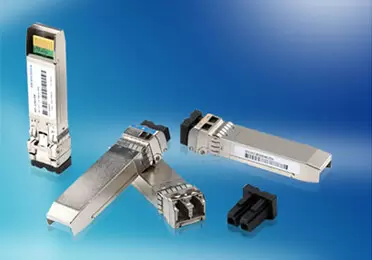
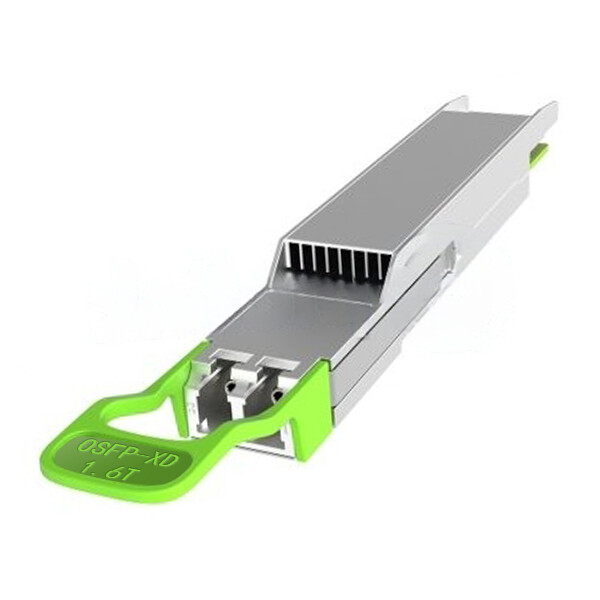
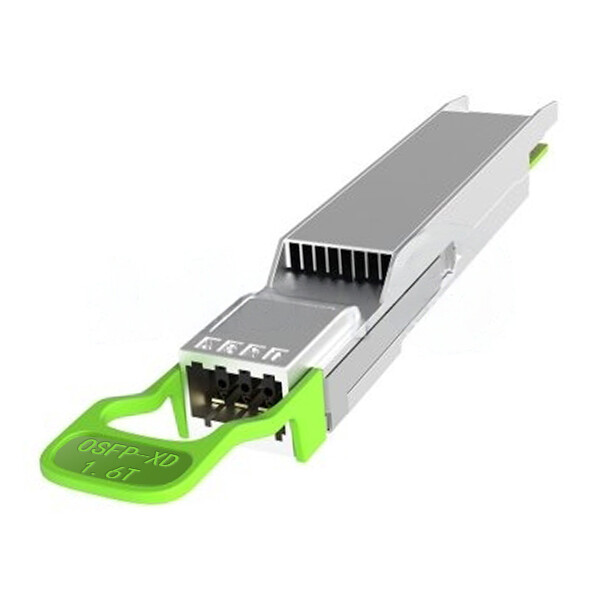
The pitch for 1.6T is simple. Twice the bandwidth in the same rack unit, half the ports, half the modules. Vendors put it on a slide in 2024, sampled it in 2025, and started shipping it in volume in 2026.
The bill isn’t simple. An 800G to 1.6T migration is decided by switch silicon, fiber plant, rack power, and laser supply, in that order. Bandwidth is the easy part.
If you’re weighing the 800G vs 1.6T decision, you already know the pressure is real. GPU clusters are pushing east-west traffic past what a 51.2T switch can carry, and nobody wants to rebuild a spine twice. You need to know what transfers, what has to be replaced, and what price makes the upgrade pay.
800G vs 1.6T: What Actually Changes
An 800G optical transceiver delivers 800 Gbps per port; a 1.6T module delivers 1,600 Gbps. How each gets there explains every downstream trade-off.
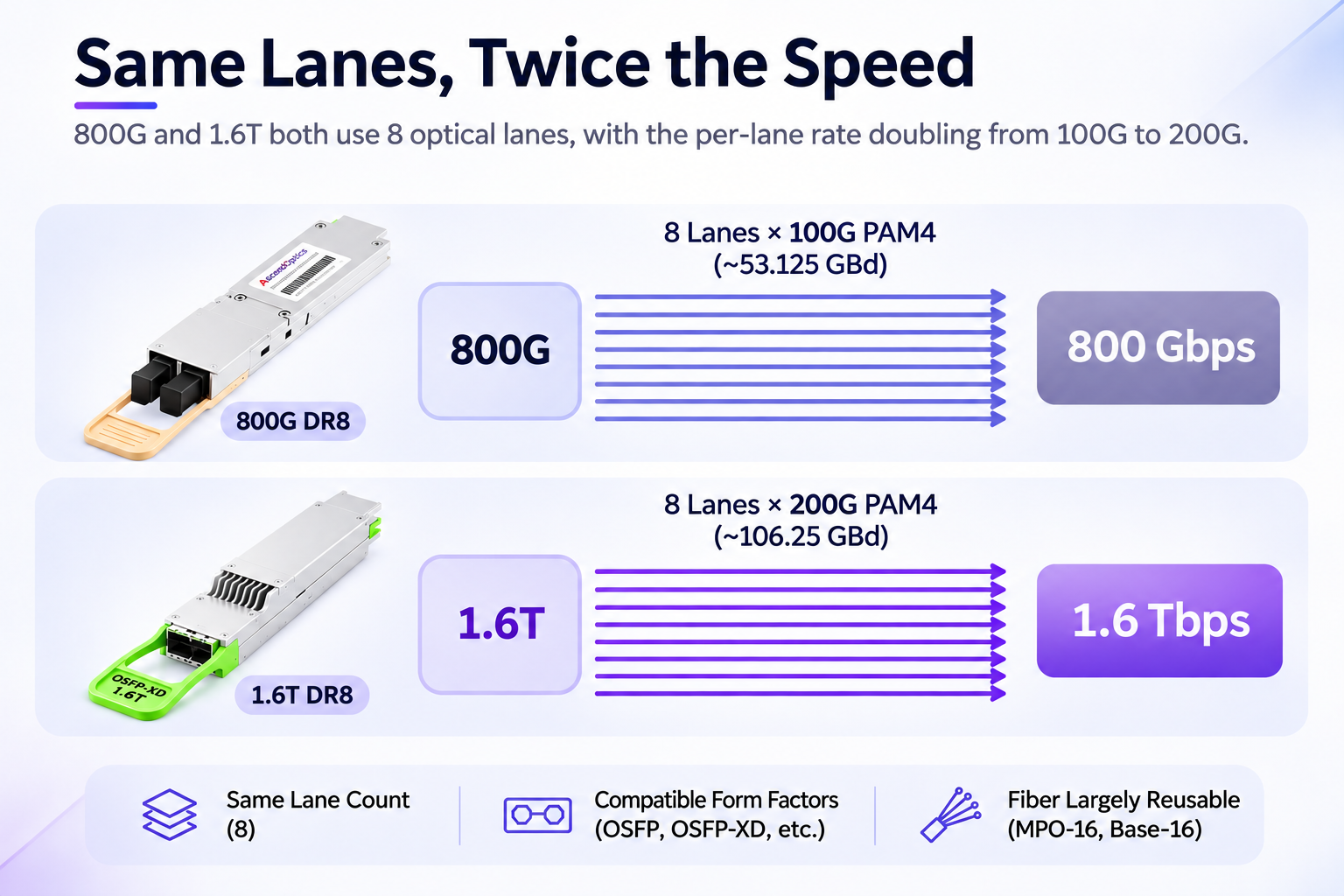
First-generation 800G optical transceivers commonly use eight 100G PAM4 optical lanes, operating at approximately 53.125 GBd per lane. These implementations are covered by the relevant IEEE 802.3df optical specifications, while their electrical interfaces are defined by applicable 100G-per-lane electrical standards.
Next-generation 1.6T transceivers are designed around eight 200G PAM4 lanes, operating at approximately 106.25 GBd per lane. Their development is associated with IEEE 802.3dj and 224G-class electrical interfaces.
Because the lane count is identical, the connector footprint and much of the fiber plant can stay the same. That’s the most useful fact here.
The following values are indicative ranges rather than universal specifications. Actual power consumption varies by optical reach, module architecture, form factor, DSP implementation, and vendor design.
| Parameter |
800G |
1.6T |
| Lanes |
8 (Gen-1) or 4 (Gen-2, OSFP224) |
8 |
| Lane rate |
100G PAM4 (~53.125 GBd) / 200G PAM4 (Gen-2) |
200G PAM4 (~106.25 GBd) |
| Electrical class |
112G SerDes (802.3ck) |
224G SerDes (OIF CEI-224G) |
| Common form factors |
OSFP, QSFP-DD800, QSFP112 |
OSFP1600/OSFP224, OSFP-XD, QSFP-DD1600 |
| Retimed power |
12–20 W |
22–30 W |
| Linear (LPO) power |
6–13 W |
8–16 W |
| Typical reach |
DR8 500 m, 2×FR4 2 km |
DR8 500 m, DR8-2 2 km, 2×FR4 2 km |
| Fiber |
MPO-16 (DR8), dual duplex LC (2×FR4) |
MPO-16 (DR8), dual duplex LC (2×FR4) |
| Switch ASIC class |
51.2T (Tomahawk 5) |
102.4T (Tomahawk 6) |
| Typical ASP, 2026 |
~$400–900 |
~$1,200–2,200 |
For the modulation detail behind those lane rates, our guide to PAM4 lane architecture at 800G and 1.6T covers Gray coding, eye diagrams, and TDECQ.
One reach caveat up front. IEEE P802.3dj defines four 1.6T port types: KR8 for backplane, CR8 for copper, DR8 for 500 m single-mode, and DR8-2 for 2 km. There’s no 1.6T FR8 or LR8. Vendor pages advertising “1.6TBASE-FR8” are using marketing labels.
The Part Most Guides Get Wrong: Your Fiber Probably Already Works
Search “800G vs 1.6T fiber” and you’ll find a popular claim: 1.6T needs twice the fiber of 800G. That’s true on a whiteboard and false in the rack most people are migrating.
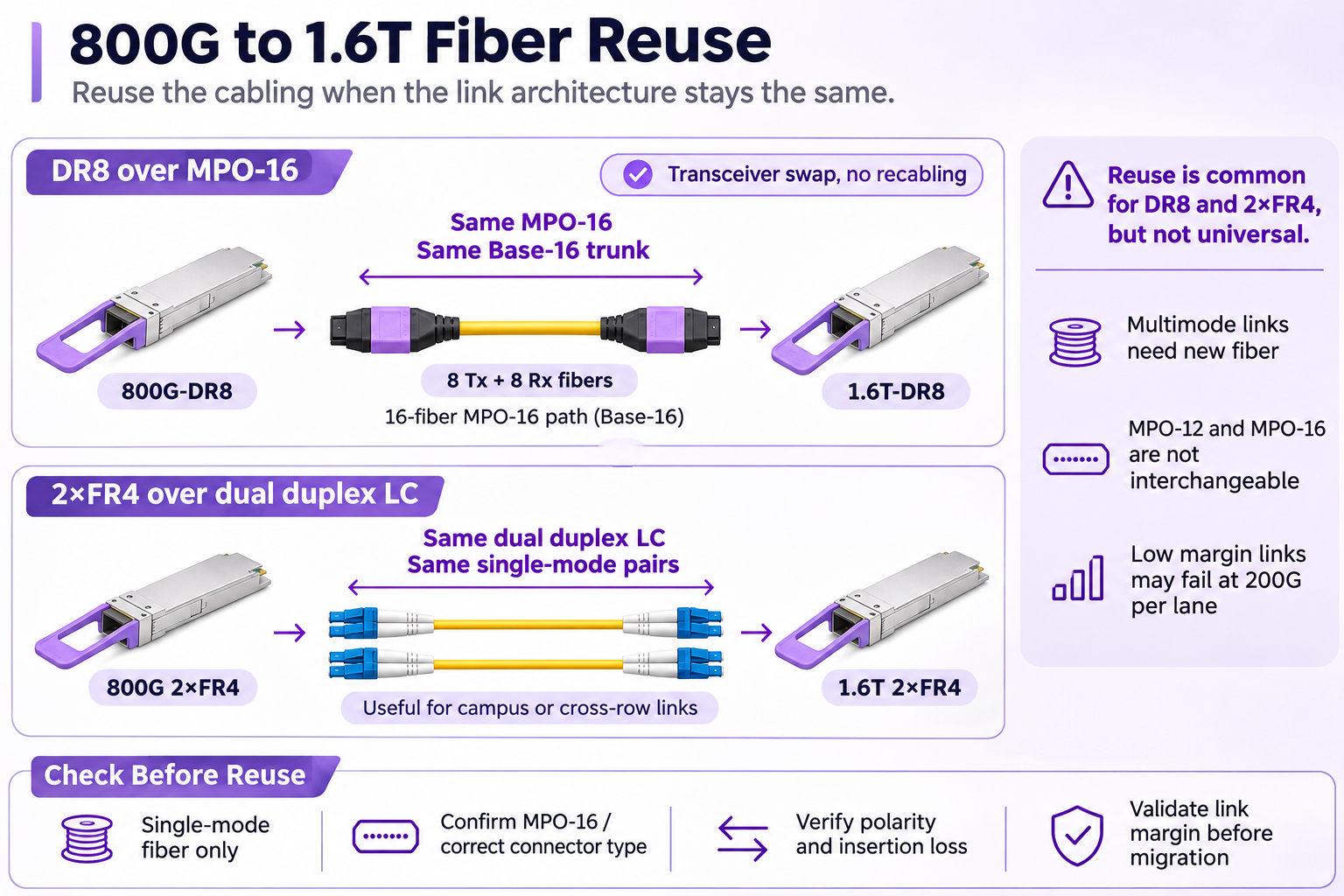
The arithmetic is simple. An 800G-DR8 link uses eight transmit and eight receive fibers on an MPO-16 connector, so 16 fibers. A 1.6T-DR8 link uses the same eight transmit and eight receive fibers on the same MPO-16 connector. The lane count is unchanged; only the lane rate doubled.
The practical result: a Base-16 trunk built for 800G-DR8 carries 1.6T-DR8 with a transceiver swap and no cabling change. Same trunk, panels, and faceplates. Base-16 is a defined fiber application space in TIA-568, and MPO-16 has been the 800G-DR8 interface under IEC 61754-7-3 for years.
If your 800G links use 2×FR4 rather than DR8, the news is similar. Both generations run 2×FR4 over dual duplex LC single-mode, so those pairs carry forward. For campus and cross-row routes, a 1.6T upgrade is a module purchase, not a cabling project.
Where reuse fails
800G to 1.6T fiber reuse is real but not universal. Three cases break it.
First, multimode. 800G SR8 runs over multimode; the 1.6T short-reach options assume single-mode. If a link depends on multimode, plan on a fiber change.
Second, keying. MPO-12 and MPO-16 don’t mate. MPO-12 and MPO-16 are different fiber-count connector configurations. Their physical compatibility depends on the connector design, ferrule configuration, polarity, and mating components. A conversion harness or connector replacement may be required when migrating between different fiber-count interfaces.
Third, margin. A 1.6T DR8 link budget is tight, around 3 dB, and it’s a margin problem more than a distance problem. A trunk that passed at 100G per lane may sit too close to the limit at 200G.
The optical link budget of a 1.6T DR8 connection must be evaluated against the applicable PMD specifications and transceiver datasheets. Because higher-speed optical lanes can impose tighter signal-quality requirements, existing fiber links should be tested for insertion loss, connector quality, and overall link margin before migration.
What to audit before you assume reuse
Run four checks. Confirm fiber type on every route, because one multimode leg invalidates that link, and verify polarity across all 16 fibers. Measure end-to-end loss on the actual route, not the design value. Then run a live per-lane power and FEC check on one representative link before scheduling the rest.
Switch Silicon Is the Real Upgrade Trigger
No part of a 1.6T migration matters more than the switch behind it. You can’t run 200G per lane into a switch built for 112G SerDes. The optics have to match the electrical interface, so the switch changes.
The port math
A 51.2T switch can support up to 64 ports of 800G, while a 102.4T switch can support up to 64 ports of 1.6T. Both configurations provide 51.2T and 102.4T of aggregate switching capacity, respectively.
For the same 102.4T aggregate bandwidth, a 102.4T switch can provide 64 ports of 1.6T instead of 128 ports of 800G. This reduces the number of physical ports and associated optical connections by half, potentially improving rack density and simplifying cabling.
200G per lane needs a 200G switch
Broadcom’s Tomahawk 6, a 102.4T part with 64×1.6T ports, reached volume in March 2026. It’s the platform that makes 1.6T deployable at scale, alongside Marvell’s Teralynx 10 and the Spectrum-6 and Quantum-X800 families from NVIDIA.
The trigger to watch isn’t the module announcement. It’s the switch line card shipping with a confirmed date. Until a 102.4T platform lands in your procurement cycle, 1.6T is a qualification exercise.
The Gen-2 800G wrinkle
800G transceivers can use different lane configurations depending on the generation and implementation. First-generation designs commonly use eight 100G lanes, while newer designs may adopt four 200G lanes. However, the module form factor and the optical lane configuration are separate specifications. An OSFP224-based implementation should not automatically be assumed to use four 200G optical lanes.
Named platforms
“Compatible” and “supported” are different words. A module may fit the cage and still fail to link if the platform’s firmware, CMIS version, or FEC mode doesn’t match. Confirm support against the vendor’s own transceiver list, not a reseller chart. Our 1.6T switch and NIC compatibility guide covers the major 102.4T platforms.
Power, Heat and the Cooling Decision
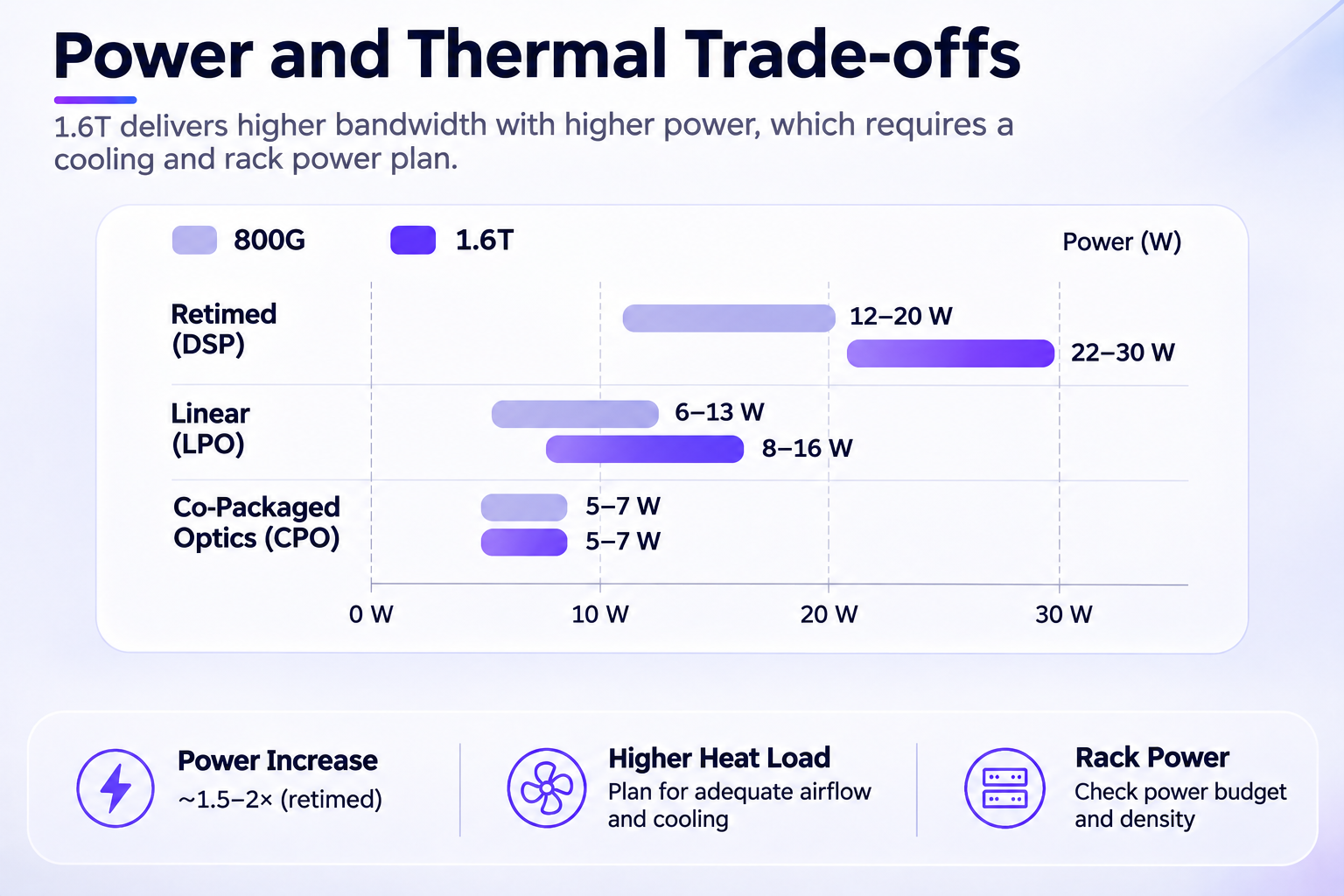
1.6T power consumption is the noisiest part of this comparison, because published figures depend on whether a module is retimed or linear.
| Architecture |
800G |
1.6T |
| Retimed (full DSP) |
12–20 W |
22–30 W |
| Linear (LPO/LRO) |
6–13 W |
8–16 W |
| Co-packaged optics |
5–7 W |
5–7 W |
You will also see a claim that 1.6T runs at 40–45 W. Treat that as an outlier. It appears in a handful of vendor posts and conflicts with nearly every other published figure, including vendors’ own datasheets for qualified parts.
At the rack, the numbers add up fast. Take 32 ports at 28 W each, and you have roughly 900 W of optics in one switch, all of it removed from a cage designed for a lower thermal load.
Where the air ceiling is
Higher-power optical transceivers place greater demands on switch airflow and thermal management. Whether a module can operate reliably with air cooling depends on its power consumption, heatsink design, chassis airflow, ambient temperature, and platform qualification. Liquid cooling may be considered for high-density deployments where conventional airflow is insufficient.
Whether liquid cooling is mandatory is contested. Some vendors say 1.6T OSFP224 requires liquid or immersion at full load; others say it air-cools fine on qualified platforms. The answer depends on your rack, your ambient, and the specific module. Model it rather than assuming.
Our OSFP power consumption guide by data rate has the per-form-factor numbers for a thermal budget.
Cost per Delivered Bit, Not Sticker Price
Module price is the wrong number to compare. Two modules at different prices can deliver bandwidth at the same 1.6T cost per bit, and that changes the business case.
The ASP spread
Published 1.6T prices in 2026 range widely: $1,200–1,500 per module in some analyses, $1,800–2,200 for DR8 parts in others, and higher early quotes. The spread reflects volume tiers, timing, and whether a quote covers optics only or a port bundle.
800G prices are more settled, around $400–900 by variant and volume. Figure on 1.6T at two to three times 800G at current volumes.
The cost-per-bit arithmetic
The overall component architecture of 800G and 1.6T transceivers shares several similarities, including optical sources, drivers, TIAs, and signal-processing components. However, 1.6T requires higher-performance components capable of supporting 200G-per-lane signaling. The transition can increase component costs and manufacturing complexity, particularly for high-speed optical engines and DSPs.
That produces a useful rule of thumb. At roughly $400 for 800G and roughly $800 for 1.6T, the cost per delivered bit is the same. Above $800, 1.6T is a premium for density and port-count savings. Below it, 1.6T is cheaper per bit.
Port halving is the hidden saving
The sticker comparison ignores the ports. Because 1.6T halves the port count for the same aggregate bandwidth, you also halve the switch ports consumed, the cages, the optics power, and the cabling runs.
A 5-year TCO calculation that includes those line items often closes the gap between module prices. One published model put 800G DSP at roughly €89,000 per 100 ports over five years against more than €300,000 for 1.6T, though its assumptions didn’t fully reconcile. Build your own with the port savings and your power cost.
Supply, Lead Time and the EML Bottleneck
The most underrated input in the 800G vs 1.6T decision is whether you can actually buy the parts. On this point the generations are not close.
800G lead times run roughly 2–8 weeks, or 4–8 weeks depending on source and variant. 1.6T lead times run 8–20 weeks, or 12–20 weeks. For non-NVIDIA buyers, 200G EML lead times can exceed 52 weeks.
The constraint is the laser. 200G EMLs are in short supply, with estimates of a 20–60% shortfall and lead times stretching into late 2027. McKinsey has warned that 800G supply runs 40–60% below demand until 2027, and that 1.6T shortfalls of 30–40% persist through 2029. Volume 1.6T capability for North American AI clusters sits with a handful of suppliers.
Capacity triggers
Move when a 51.2T leaf-spine no longer has headroom for the east-west traffic your workloads generate. GPU traffic grows faster than node count because attach ratios climb, so a fabric sized for a previous generation fills up before the switch does. The clearest signal is spine saturation at peak all-reduce while leaf ports sit idle.
Scale thresholds
A commonly cited heuristic puts break-even in GPU-port count: below roughly 10,000 ports 800G covers the requirement, and above 50,000 1.6T starts to pay on density alone. Treat that as directional. It came from one vendor’s analysis, and your fiber plant, cooling, and supply position can move the line.
Greenfield and brownfield
For a greenfield build, design the spine for 1.6T even if you populate it with 800G. Base-16 fiber, 16-fiber trunks, and cages rated for the higher thermal load cost little more at build time and save a rebuild later.
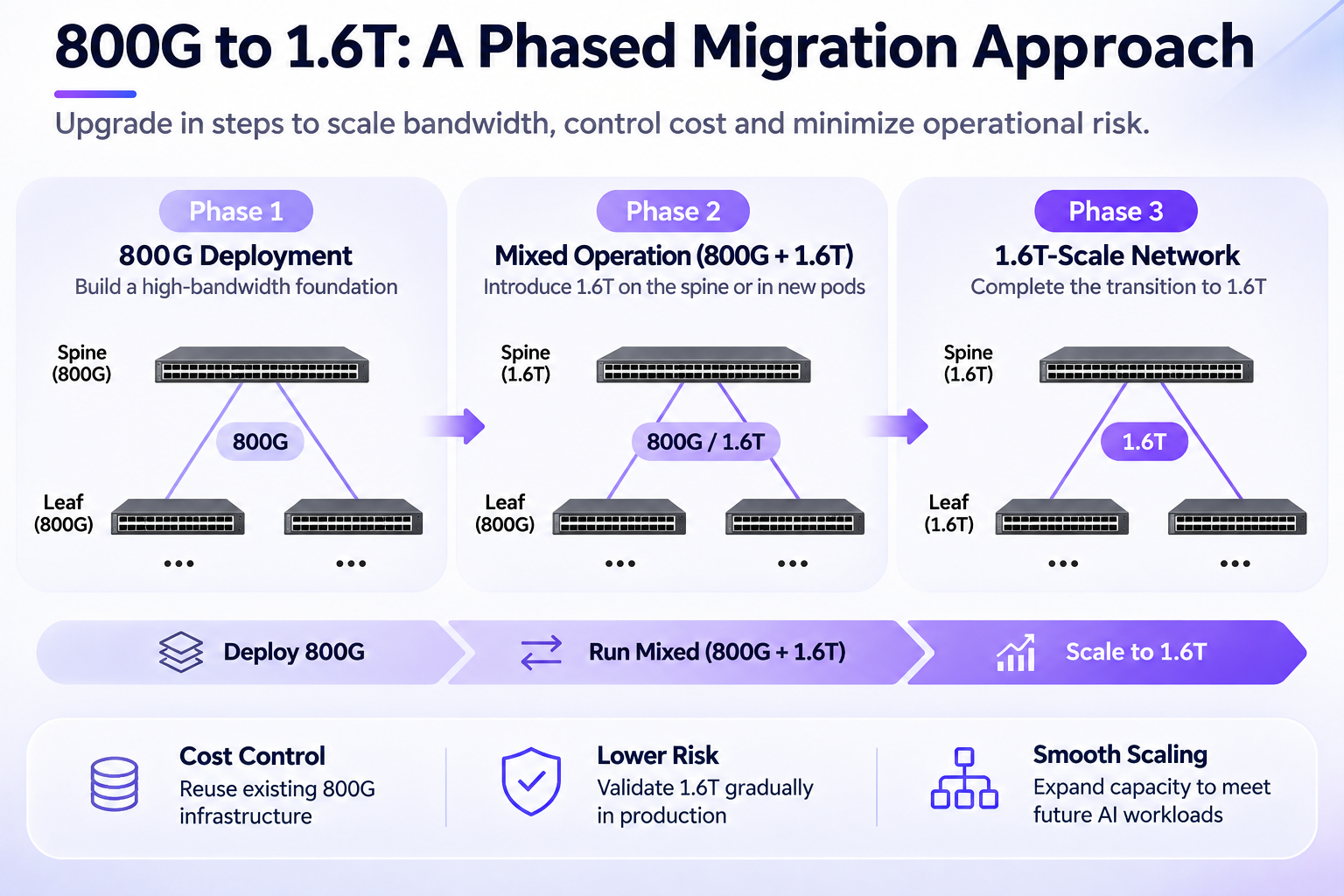
For a brownfield estate, reuse what the audit clears and accept that some links will need fiber work or stay on 800G. A hybrid 800G/1.6T fabric is a legitimate end state.
A phased migration plan
A network architect running a 51.2T leaf-spine on 800G-DR8 over MPO-16 trunks would reasonably assume a 1.6T upgrade means recabling the spine. Run the fiber audit first. If those trunks are Base-16 and the loss margin clears, the migration is a transceiver swap at the spine plus a new 102.4T line card, with the leaf untouched. The cabling budget drops to near zero.
That outcome depends on three conditions: Base-16 trunks, single-mode DR8 links, and a passing link budget. When they hold, the migration is closer to an optics refresh than a fabric rebuild. When they don’t, budget the fiber work.
For the full 1.6T picture, including variants, pricing, and compatibility, our complete 1.6T optical transceiver guide is the starting point.
800G vs 1.6T: Which Should You Choose?
When 800G still wins
Staying on 800G is often the correct answer. Stay if any of these hold:
- You have 102.4T-class headroom. If your spine isn’t saturated, 1.6T buys you nothing today.
- Your racks are forced-air. Above roughly 25 W per port you’re into cooling work.
- Your rack power budget is constrained. 6T optics draw roughly twice the power per port.
- Your estate is under about 10,000 GPU ports. Port density doesn’t pay back the premium at that scale.
- Your workloads are inference-dominated. Inference rarely stresses the spine like training all-reduce.
- You need parts soon. 800G is available in weeks. 1.6T isn’t.
- 800G LPO is a viable intermediate. Linear-drive 800G cuts per-port power without a fabric change.
A mixed 800G/1.6T fabric, with 800G at the leaf and 1.6T at the spine, is likely to be the normal state through 2027. Plan for it rather than treating it as a compromise.
The six-question decision path
Work through these in order. The first one that fails stops the upgrade.
- 1. Port count. Under about 10,000 GPU ports, stay on 800G. Above 50,000, 1.6T pays on density.
- 2. Switch silicon. No 102.4T platform in your cycle means no 1.6T. Wait for the line card.
- 3. Fiber plant. Base-16 single-mode DR8 trunks and duplex LC 2×FR4 links reuse. Multimode and MPO-12 trunks do not.
- 4. Can your racks remove 22–30 W per port without a retrofit? If not, 800G LPO is the cheaper step.
- 5. Can you accept 8–20 week lead times and a 12-month qualification? If not, 800G now with a 1.6T pilot.
- 6. Cost per bit. Compare module price against the 2:1 line, with port and power savings included.
Frequently Asked Questions
What is the difference between 800G and 1.6T optical transceivers?
Both use eight lanes. 800G runs 100G PAM4 per lane for 800 Gbps total. 1.6T runs 200G PAM4 per lane for 1,600 Gbps. The lane count is unchanged; the lane rate doubles.
Can I reuse my 800G fiber for 1.6T?
Often yes. 800G-DR8 and 1.6T-DR8 both use 16 fibers over MPO-16, so a Base-16 trunk reuses with a transceiver swap. 800G 2×FR4 and 1.6T 2×FR4 both use dual duplex LC. Multimode links and MPO-12 trunks need work.
Can an 800G module go in a 1.6T port?
An 800G transceiver cannot be assumed to work in a 1.6T port. Physical compatibility alone does not guarantee link operation. Support depends on the switch platform, host electrical interface, port configuration, module management, and FEC requirements. Some platforms may support lower-speed operation, but this must be confirmed in the vendor’s compatibility documentation.
Is 1.6T worth it for a 1,000-GPU cluster?
Usually not yet. At that scale, 800G covers the traffic pattern and the port-density saving is small.
When will 800G be phased out?
Not soon. 800G should remain the volume platform for scale-out fabrics through at least 2027. Expect overlapping generations, not a clean handover.
Is IEEE 802.3dj finalized?
IEEE 802.3dj defines the next generation of Ethernet specifications, including 1.6T Ethernet and 200G-per-lane technologies. Check the latest IEEE project status and official publication records for the current approval stage.
Post Views: 55