Two 1.6T DR8 modules can share the same fiber, connector count, and part-number family and still refuse to link. That is not a manufacturing defect. It is what happens when an industry uses four names for two standards, and one of those names is a vendor label.
If you are specifying a 1.6T link this quarter, you have already accepted the premise: eight lanes at 200 Gb/s, 1,600 Gb/s aggregate. The open question is which variant matches the fiber you own and the port mode your switch supports. DR8, DR8-2, 2×DR4 and 2×FR4 answer that question differently, and the difference shows up in connector inventory, link margin and spares planning.
What “1.6T DR8” Actually Means
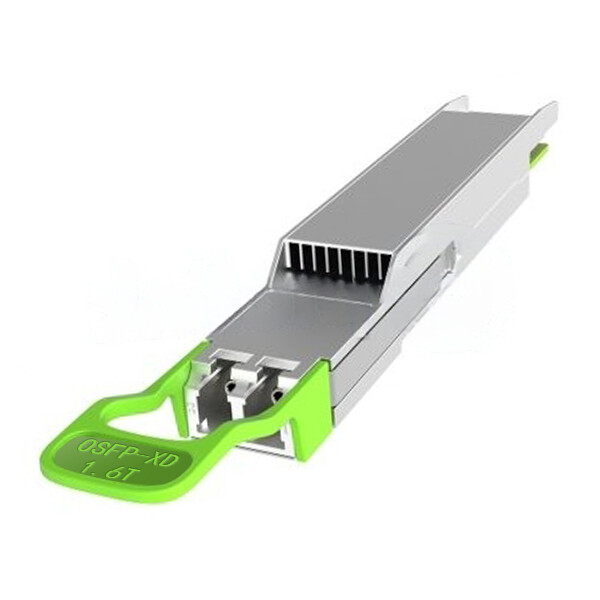
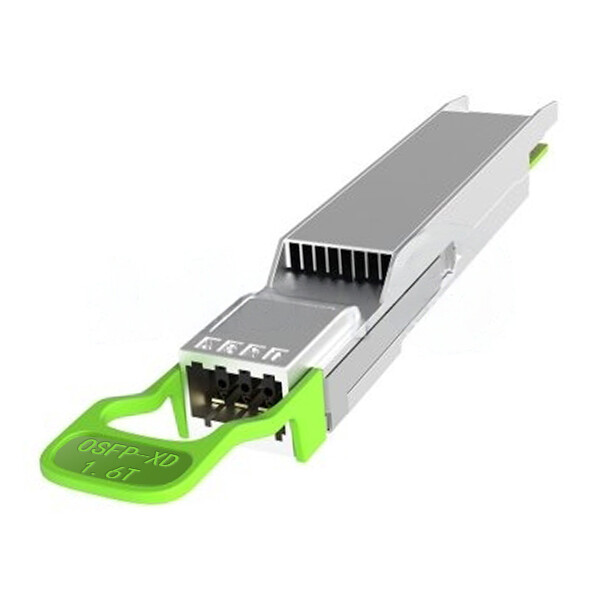
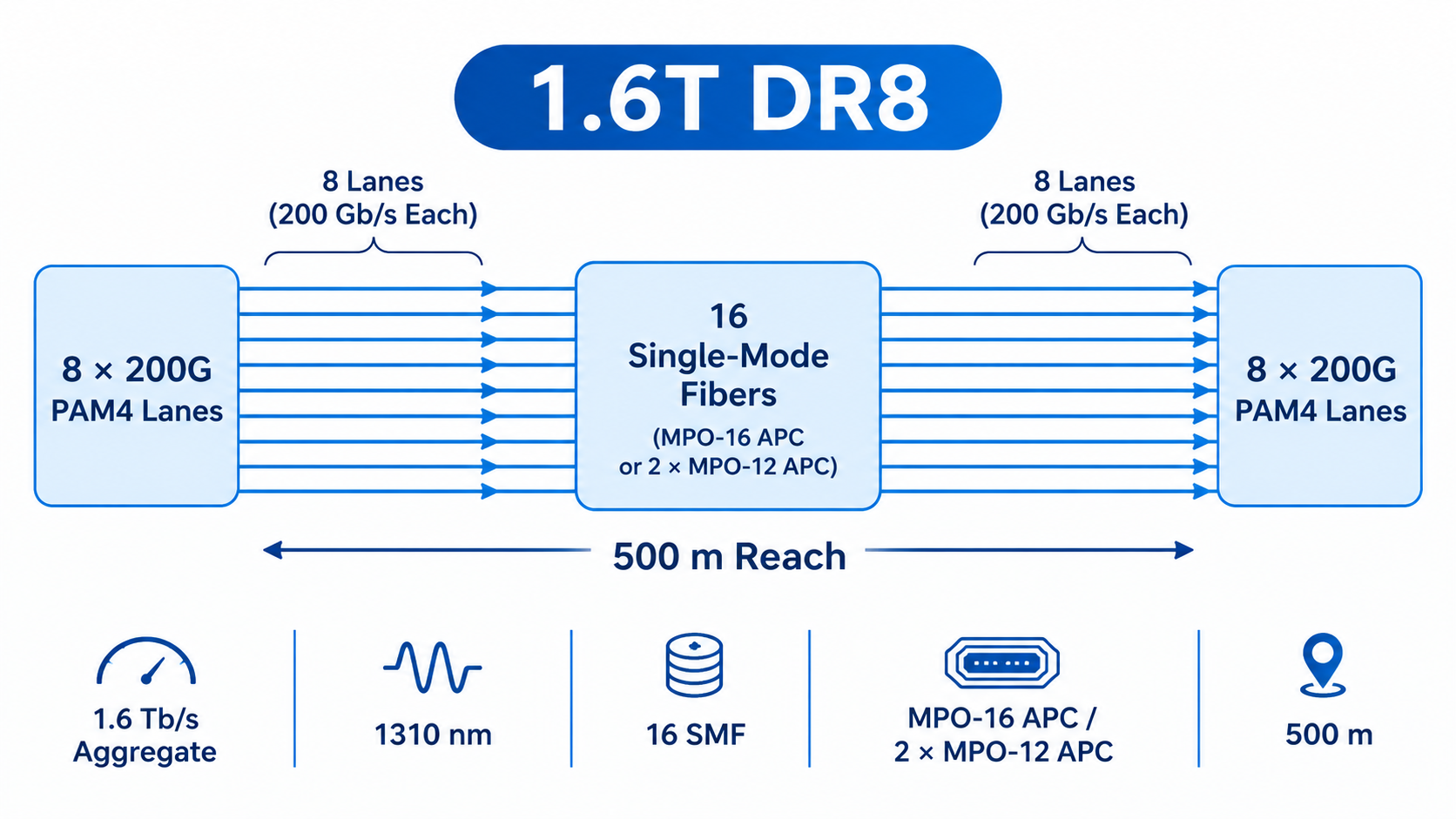
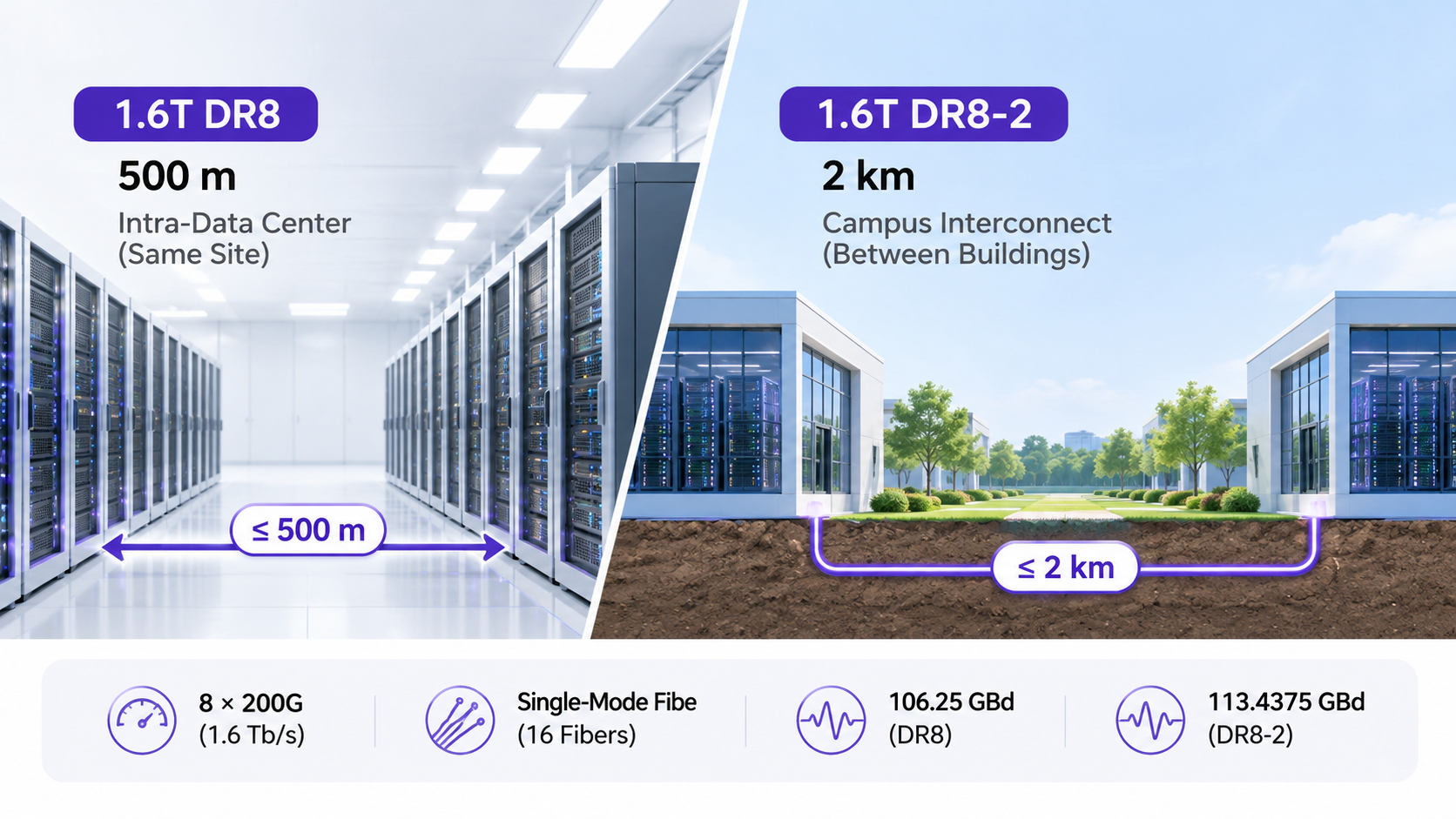
A 1.6T DR8 is an eight-lane pluggable optical module that carries 1,600 Gb/s over 16 single-mode fibers at 1310 nm, using eight 200 Gb/s PAM4 lanes at 106.25 GBd. It reaches 500 meters with a 3.0 dB channel insertion-loss allowance and is available with an MPO-16 APC or dual MPO-12 APC connector.
The name decodes into three parts: 8 is the lane count, DR is the 500-meter single-mode reach class, and 1.6T is the aggregate rate across all eight lanes.
The lane rate is where most readers trip. At 106.25 GBd and two bits per symbol, each lane carries 212.5 Gb/s raw and roughly 200 Gb/s of payload after coding overhead. That is why vendors describe the same module as “8 × 200G” and “8 × 212.5 Gb/s” without contradiction. It is also why “224G” is a signaling class, not 224 Gb/s of payload.
For the lane architecture and the 200G-per-lane transition in more depth, see our complete 1.6T optical transceiver guide.
The 1.6T Variant Matrix: Seven Types You Will Meet
Most links use one of four variants. Three more sit at the edges, and they matter as fallbacks.
| Variant |
Defined by |
Reach |
Fibers |
Connector |
Lane rate |
Channel loss |
Typical power |
| 1.6T DR8 |
IEEE 1.6TBASE-DR8 |
500 m |
16 SMF |
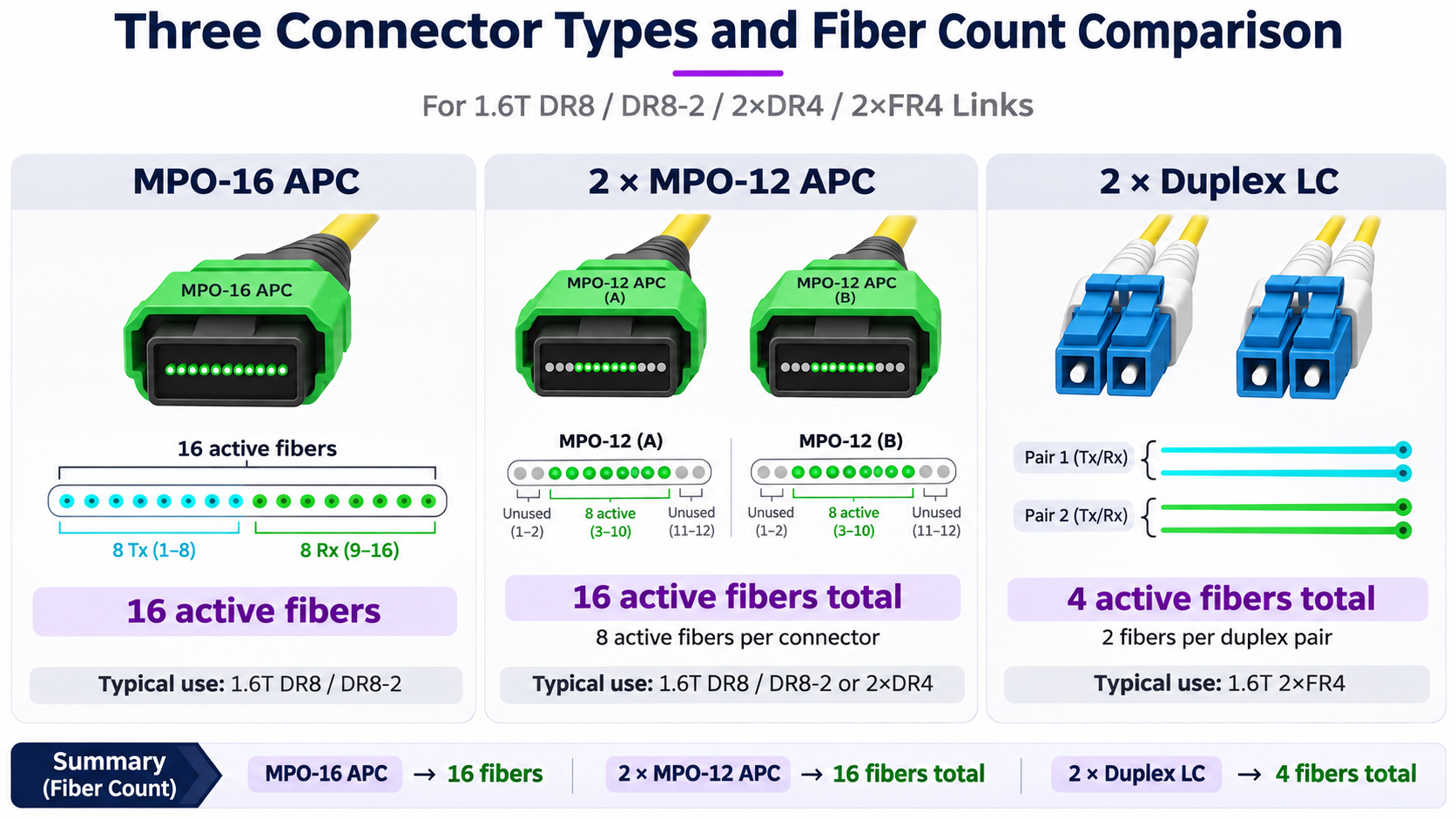
MPO-16 APC or 2 × MPO-12 APC |
106.25 GBd |
3.0 dB |
~22 W |
| 1.6T DR8-2 (“DR8+”) |
IEEE 1.6TBASE-DR8-2 |
2 km |
16 SMF |
MPO-16 APC or 2 × MPO-12 APC |
113.4375 GBd |
4.0 dB |
~23 to 26 W |
| 1.6T 2×DR4 |
Two 800GBASE-DR4 links |
500 m |
16 SMF |
2 × MPO-12 APC |
106.25 GBd |
3.0 dB per 800G |
~22 to 24 W |
| 1.6T 2×FR4 |
Two 800G FR4 engines |
2 km |
4 SMF |
2 × duplex LC |
113.4375 GBd |
4.0 dB per link |
~23.5 to 25 W |
| 1.6T VR8 / SR8 |
Supplier-defined |
~50 to 100 m |
16 MMF |
MPO-16 |
106.25 GBd |
Vendor |
Vendor |
| 1.6T 2×LR4 |
Supplier-defined |
~6 to 10 km (claimed) |
4 SMF |
2 × duplex LC |
Vendor |
Vendor |
Vendor |
| 1600ZR |
OIF implementation agreement |
~120 km amplified DWDM |
2 SMF |
Duplex LC |
Coherent |
N/A |
Higher |
Only DR8 and DR8-2 are IEEE P802.3dj port types. 2×DR4 and 2×FR4 are two 800G links in one housing, not new wavelength-multiplexed 1.6T standards. SR8, VR8 and 2×LR4 are supplier-defined, so read their reach from the datasheet. 1600ZR is coherent and belongs to the OIF agreement.
P802.3dj received conditional approval to forward to RevCom on 6 October 2026, and the third Standards Association recirculation closed on 10 October 2026 with 97% approval. RevCom action is targeted for December 2026.
DR8 vs DR8-2 vs “DR8+”: The Naming Trap
DR8 and DR8-2 are different links with different physics. DR8 reaches 500 meters at 106.25 GBd with the KP4 outer code alone. DR8-2 reaches 2 kilometers at 113.4375 GBd, because the 2 km type adds an inner code inside the module. The inner code consumes overhead, so the optical lane runs faster to keep roughly 200 Gb/s of payload per lane.
DR8+ is a vendor-defined designation commonly used for extended-reach DR8 products. Some 1.6T DR8+ modules correspond to the 2 km 1.6TBASE-DR8-2 optical configuration, but interoperability should be confirmed by checking the applicable IEEE PMD, optical signaling rate, FEC implementation, and vendor datasheet.
How to read a 1.6T part number
Four fields matter when you compare quotes:
- Lane rate. 25 GBd means 500 meters. 113.4375 GBd means 2 kilometers.
- Reach class. DR8, DR8-2, DR8+, 2×DR4, 2×DR4+ and 2×FR4 are not interchangeable.
- Connector. MPO-16 APC, dual MPO-12 APC, or duplex LC. This is the field that decides whether your plant survives.
- FEC mode. A 2 km part expects an inner code. A 500 m part does not.
Ask for the datasheet, not the quote line. A procurement engineer we worked with received quotes labelled “DR8” and “DR8+” and assumed the plus meant a higher power class. It meant 2 kilometers, a different baud rate, and a different link budget. The two parts would not link.
Why “1.6T LR8” does not exist
IEEE P802.3dj does not define a native 1.6TBASE-LR8 optical PMD. For 10 km applications, vendor-specific 1.6T 2×LR4 modules may provide two independent 800GBASE-LR4 links over two duplex single-mode fiber pairs. Native 1.6T operation, host compatibility, and interoperability must be verified against the module and switch specifications. Coherent 1600ZR is an alternative for substantially longer, amplified DWDM links.
DR8 vs 2×FR4 vs 2×DR4: Choosing by Fiber Plant
The variant decision usually starts with the fiber already in the ground.
2×DR4 is two independent 800G DR4 links on 200G lanes, on two MPO-12 connectors, 500 meters, 16 fibers. It is the brownfield bridge for an 800G DR4 plant, running as two 800G links or one 1.6T link when both halves are used.
2×FR4 is two 800G FR4 engines in one housing. Each engine multiplexes four CWDM wavelengths between 1271 and 1331 nm onto one fiber pair, so the module needs four fibers on two duplex LC connectors and reaches 2 kilometers. It is the answer when the plant is duplex LC, and re-pulling is not on the table.
| If your plant is… |
And the link is… |
Choose |
| 16-fiber parallel SMF, MPO-16 or 2 × MPO-12 APC |
500 m or less |
1.6T DR8 |
| 16-fiber parallel SMF, MPO-16 or 2 × MPO-12 APC |
500 m to 2 km |
1.6T DR8-2 |
| 16-fiber parallel SMF, two MPO-12 APC |
500 m, 800G DR4 endpoints |
1.6T 2×DR4 |
| 4-fiber duplex LC |
500 m to 2 km |
1.6T 2×FR4 |
| Multimode, MPO-16 |
50 to 100 m |
1.6T SR8 / VR8 |
| Duplex LC, outside the building |
Beyond 2 km |
2×LR4 (vendor) or 1600ZR |
A scenario flowchart
Start with distance, then fiber type, then port mode.
- 100 meters or less: For very short connections within or between adjacent racks, consider passive DAC, ACC, or AEC, subject to the supported cable length and host specifications. For longer in-building links, multimode optical solutions may be appropriate where supported.
- 100 to 500 meters, parallel single-mode: DR8
- 500 meters to 2 kilometers, parallel single-mode: DR8-2.
- 500 meters to 2 kilometers, duplex LC: 2×FR4.
- Beyond 2 kilometers: 2×LR4 on a vendor claim or coherent 1600ZR.
- Brownfield 800G DR4: 2×DR4, or twin-port 1.6T DR8.
- Brownfield 800G DR8: 6T DR8 on the same 16 fibers, but new modules at both ends.
For the previous generation’s migration story, see our 800G DR8 backbone guide and the 800G optical transceiver guide.
Connectors, Polish and Polarity: The Fiber-Plant Audit
Parallel single-mode at 1.6T requires angled physical contact (APC) endfaces. Mating APC to UPC produces a physical gap and a reflection that no amount of cleaning fixes. The link may test clean on a power meter and fail under traffic.
Fiber count is the second audit item. DR8, DR8-2, and 2×DR4 consume 16 fibers: eight transmit and eight receive. 2×FR4 consumes four. On MPO-12 plant, think in 8-fiber groups, because that is how 400G DR4 and 800G DR8 trunks were built. One 1.6T DR8 link uses two groups, one per connector.
Five measurements belong in the pre-order checklist:
- 1. Connector type and polish at every patch panel.
- 2. Insertion loss per fiber, not per cable.
- 3. Return loss, especially at field-terminated ends.
- 4. Polarity and 8-fiber group mapping.
- 5. Endface condition under inspection, with cleaning recorded.
Patch-panel and splice counts are design inputs. They consume the same budget as the fiber, and at 1.6T that budget is small.
Link Budgets: Why 500 m Is a Margin Problem, Not a Distance Problem
A 1.6T DR8 link has a 3.0 dB channel insertion-loss allowance. That is not generous once connectors enter the calculation.
Take 500 meters of OS2 fiber at 0.47 dB per kilometer: 0.235 dB. Four mated connector pairs at 0.5 dB each add 2.0 dB. Total: 2.235 dB, leaving 0.765 dB of margin.
Substitute 0.75 dB per mated pair, realistic for field-terminated ends and imperfect cleaning. Four pairs cost 3.0 dB before the fiber is counted. The link is over budget at 3.235 dB, and it is still only 500 meters long.
Add two splices at 0.3 dB each, and even the 0.5 dB connector case loses most of its margin. The link does not fail because it is too long. It fails because the connectors used up the budget.
| Scenario |
Fiber loss |
Connector loss |
Splices |
Total |
Margin vs 3.0 dB |
| DR8, 500 m, 4 × 0.5 dB pairs |
0.235 dB |
2.0 dB |
0 dB |
2.235 dB |
0.765 dB |
| DR8, 500 m, 4 × 0.5 dB pairs, 2 splices |
0.235 dB |
2.0 dB |
0.6 dB |
2.835 dB |
0.165 dB |
| DR8, 500 m, 4 × 0.75 dB pairs |
0.235 dB |
3.0 dB |
0 dB |
3.235 dB |
Over budget |
DR8-2 has a 4.0 dB allowance over 2 kilometers. Fiber contributes 0.94 dB. Four 0.5 dB pairs bring the total to 2.94 dB, leaving 1.06 dB. At 0.75 dB per pair, the total is 3.94 dB, leaving 0.06 dB. Two splices push that case over the line.
2×FR4 carries a 4.0 dB allowance per 800G link, with the CWDM multiplexing penalty inside the budget. Connector and splice allowance is what the designer controls.
The practical rule: design to 0.75 dB per mated pair, hold at least 1 dB in reserve for aging and repair, then measure the installed link. A planner who budgeted four 0.5 dB pairs and measured 0.75 dB in the field had a connector-grade problem, not a distance problem.
1.6T DR8 Port Modes, Breakout and Interoperability
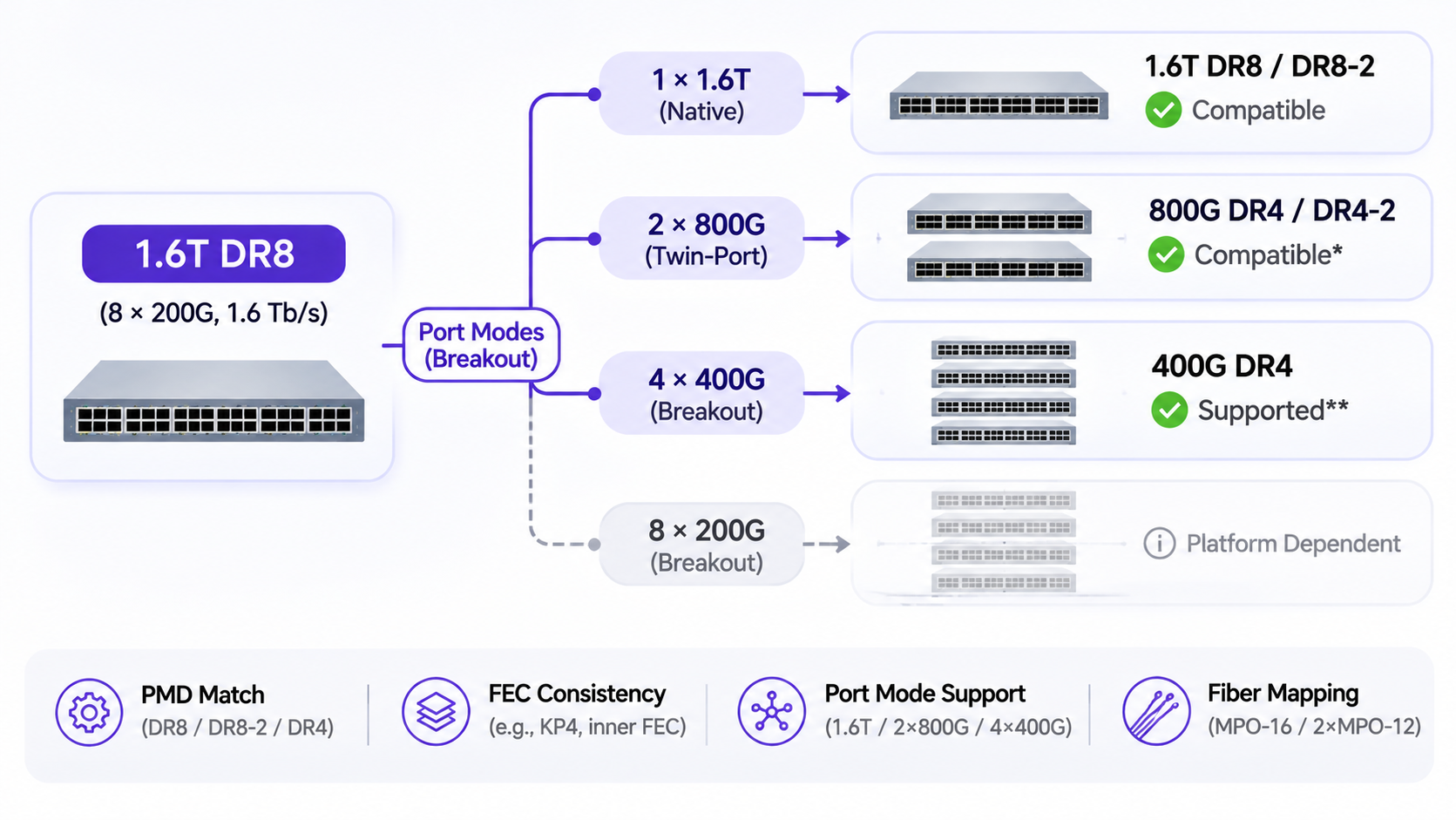
Depending on the transceiver design and switch capabilities, a 1.6T DR8 module may support native 1.6TbE operation or breakout configurations such as 2×800GbE. Some platforms may also support 4×400GbE or 8×200GbE. Supported configurations must be verified against the switch operating system, ASIC capabilities, module datasheet, and FEC requirements.
Twin-port modules carry a sparing consequence. The two links share one housing, so replacing the module takes down both links. Plan spares per module, not per link. 2×DR4 is the same mode under an 800G name. Carritech and Topnet also describe 4×400G and 8×200G breakout; confirm those in the datasheet.
What 1.6T DR8 links to, and what it does not
| Module |
Links to |
Does not link to |
| 1.6T DR8 |
1.6T DR8; two 800G DR4 (200G lanes) in twin-port mode |
800G DR8 (100G lanes), 400G DR4, 800G 2×DR4 |
| 1.6T DR8-2 |
1.6T DR8-2; two 800G DR4 (200G lanes) |
800G DR8, 400G DR4 |
| 1.6T 2×DR4 |
1.6T 2×DR4; two 800G DR4 |
800G DR8, 400G DR4 |
| 1.6T 2×FR4 |
1.6T 2×FR4; two 800G FR4 |
800G FR8, 400G FR4 |
Matching lane rates are necessary but not sufficient for interoperability. Both ends must support compatible optical PMDs, PCS/FEC configurations, port modes, and fiber mappings. Fiber type, fiber count, and connector are necessary conditions, not sufficient ones. An MPO-12 connector fits both an 800G DR8 and a 1.6T DR8 port, and the two will not link.
1.6T DR8 Power, Cooling and Cost by Variant
Power consumption varies by module architecture, optical reach, form factor, and vendor implementation. Some commercially available 1.6T DR8 modules specify typical power consumption in the low-to-mid-20-watt range, but maximum power and thermal requirements must be checked against the specific datasheet.
Finned and flat-top housings are not cosmetic. A finned module carries its own heat sink and is cooled by switch airflow. A flat-top module is cooled by a heat sink or cold plate on the host, which suits liquid-cooled switches and NIC cages. A finned module will not fit a flat-top cage, and the reverse is equally unsupported.
Cost tracks the variant. DR8 is the price baseline. DR8-2 and 2×FR4 carry a premium for the second engine or longer reach, and coherent 1600ZR is a different budget. Compare total deployed cost, including transceiver price, cost per Tb/s, switch port utilization, power consumption, fiber infrastructure, and operational requirements.
For the OSFP mechanical detail behind these power classes, see the OSFP 1.6T technical deep dive. For the lane-level signaling, see our PAM4 SerDes guide.
Frequently Asked Questions
What is a 1.6T DR8 transceiver?
A 1.6T DR8 is an eight-lane module carrying 1,600 Gb/s over 16 single-mode fibers at 1310 nm. Each lane runs 200 Gb/s PAM4 at 106.25 GBd, reaching 500 meters with a 3.0 dB channel insertion-loss allowance.
What is the difference between 1.6T DR8 and DR8-2?
DR8 reaches 500 meters at 106.25 GBd. DR8-2 reaches 2 kilometers at 113.4375 GBd and adds an inner FEC code. Both use 16 single-mode fibers and MPO-16 or dual MPO-12 APC connectors.
Is 1.6T DR8+ the same as DR8-2?
Yes in practice. “DR8+” is a vendor label for the 2 km part IEEE defines as DR8-2. Confirm the baud rate and reach on the datasheet; the label alone is not a standard.
Does 1.6T DR8 work with 800G DR8?
No. Both use 16 single-mode fibers and the same connector options, but 800G DR8 runs 100G lanes and 1.6T DR8 runs 200G lanes. They will not link.
What connector does 1.6T DR8 use?
It uses an MPO-16 APC connector or two MPO-12 APC connectors, with eight fibers used per MPO-12. APC polish is required. Mating APC to UPC creates a gap and a reflection that cleaning cannot fix.
Can 1.6T DR8 break out to 2×800G?
Yes. A twin-port module runs two independent 800G links, one per MPO-12 connector. The switch must present the cage as two 800G ports. 2×DR4 is the same mode under an 800G name.
Is there a 1.6T LR8?
No. IEEE P802.3dj defines KR8, CR8, DR8 and DR8-2. There is no 1.6T FR8, LR8, or ER8 wavelength-multiplexed PMD. For 10 km, use 2 × 800G FR4, external optics, or coherent 1600ZR.
How much power does a 1.6T DR8 module draw?
Datasheets cluster between 22 and 26 watts typical, with maximum power dissipation up to 30 watts. DR8-2 and 2×FR4 run higher because of the inner code and second engine.
Post Views: 70