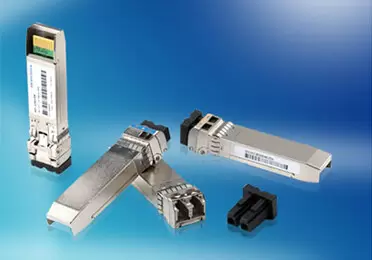
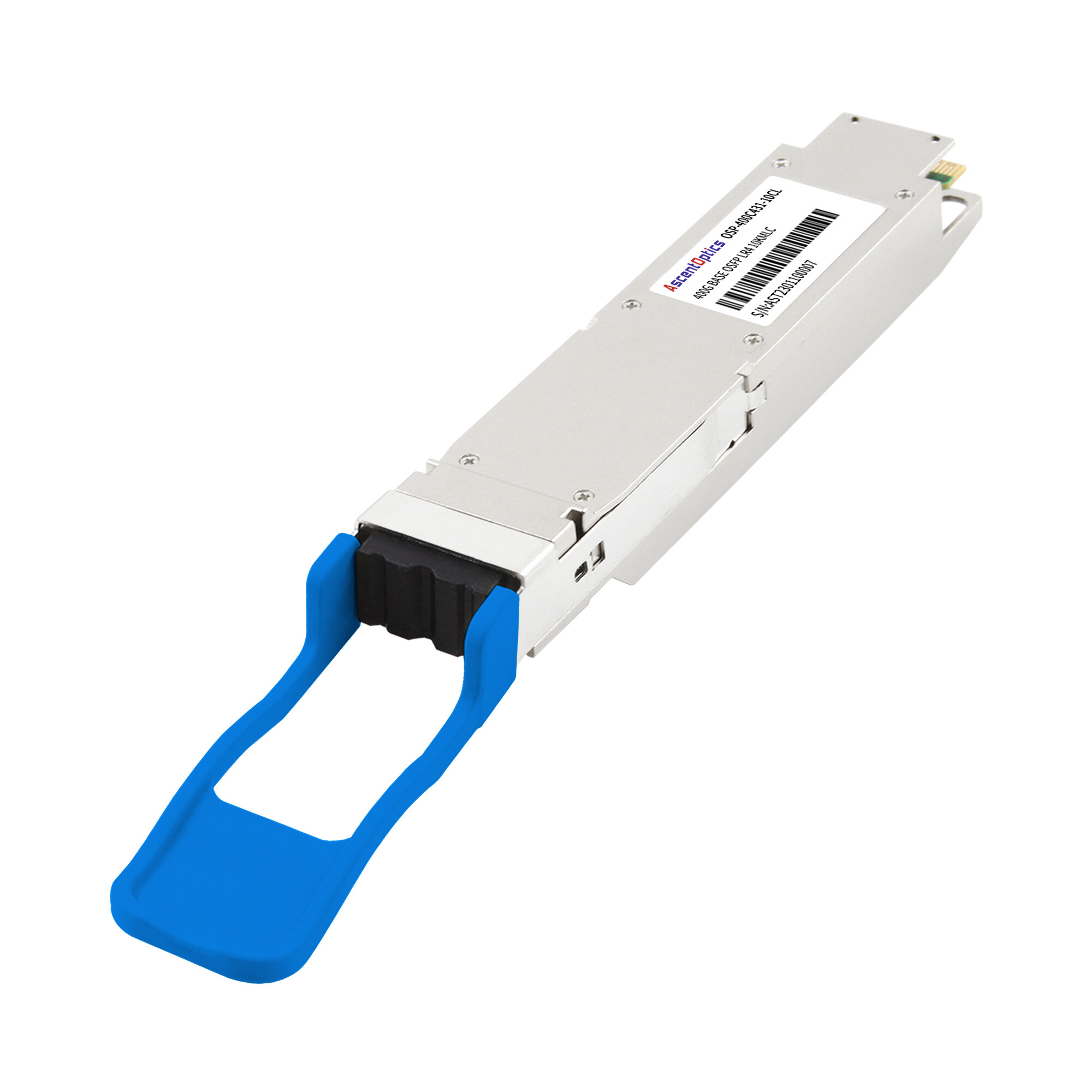
In InfiniBand deployments, optical interconnects have evolved from an optional upgrade into a decisive cornerstone. As port speeds advance toward 800G and even 1.6T, the physical limitations of copper cabling are becoming increasingly apparent, while optical modules and fiber-optic networks shoulder the critical task of delivering low latency and high bandwidth. Successful deployment hinges not only on link budgets and connector selection but also on addressing the escalating challenges of power density and signal integrity. For AI clusters and supercomputing centers, the reliability of optical interconnects is redefining the upper limits of network performance and the complexity of operations and maintenance, making it a strategic priority for architects.
What Is InfiniBand Deployment?
InfiniBand deployment is the process of planning, building, and validating a high-speed, low-latency interconnect fabric for HPC and AI clusters. Unlike conventional Ethernet networking, InfiniBand provides native RDMA capabilities and credit-based flow control. RDMA enables direct memory-to-memory data transfers between endpoints while reducing CPU and operating-system overhead.
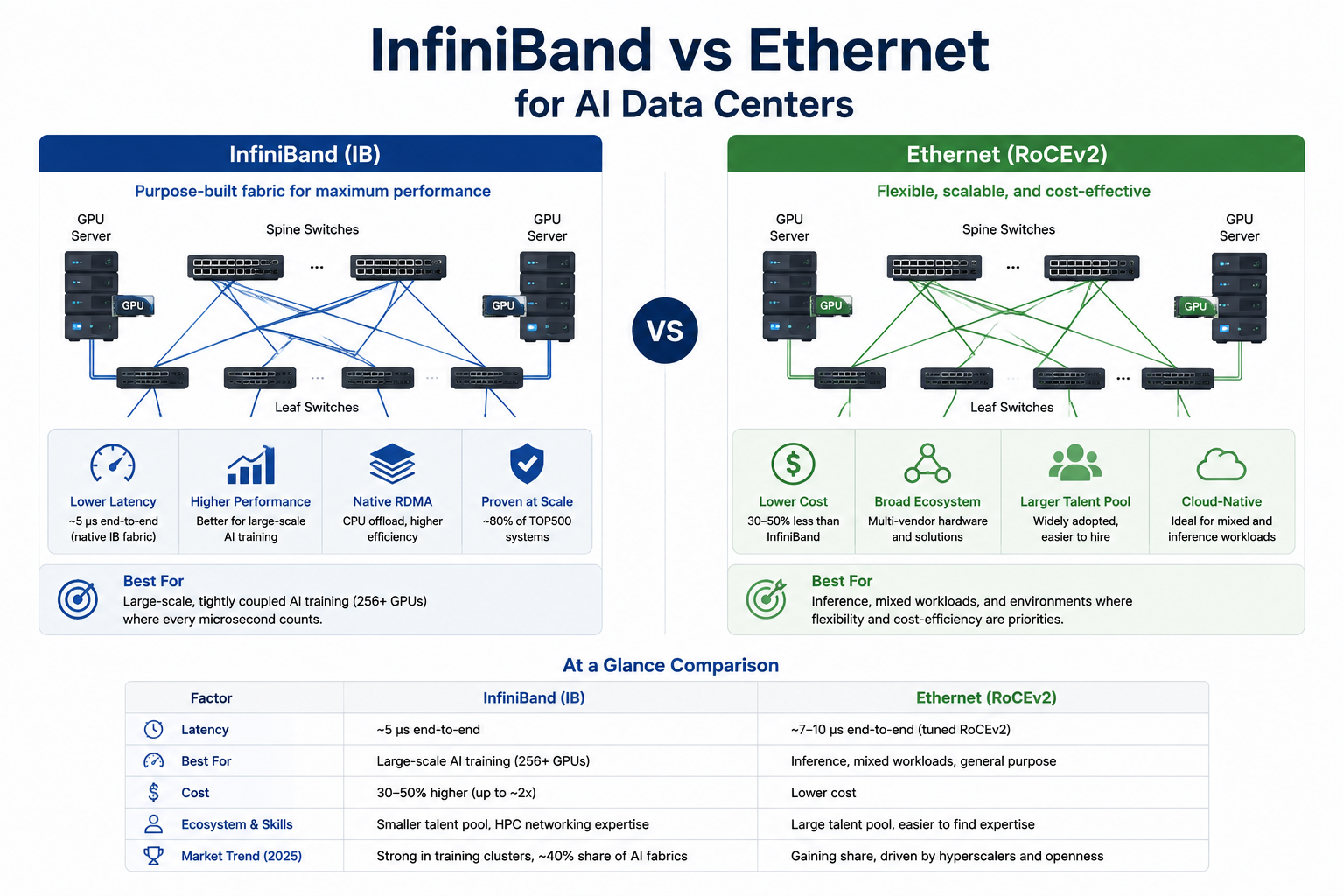
That native RDMA is the core reason the technology matters. InfiniBand can provide very low end-to-end latency, while a well-tuned RoCEv2 network can also deliver low-latency RDMA communication. Actual latency depends on the NIC, switches, topology, workload, and network configuration. A native InfiniBand fabric reaches roughly 5 microseconds of latency, compared to 7 to 10 microseconds for a tuned RoCEv2 Ethernet fabric. For tightly coupled distributed training, that gap translates directly into faster job completion.
InfiniBand is not new. It has quietly powered most of the world’s fastest supercomputers for two decades. InfiniBand has been widely adopted in HPC systems and large-scale AI clusters because of its low latency, high bandwidth, and RDMA capabilities. What changed recently is the AI boom: large language models need thousands of GPUs to exchange gradients every few milliseconds, and InfiniBand became the default fabric for those clusters.
InfiniBand vs Ethernet for AI Data Centers
The honest answer is that both now work, and the gap has narrowed. In late 2023, InfiniBand held about 80% of AI back-end network share. By 2025, Ethernet overtook it, driven by hyperscaler demand for multi-vendor hardware and lower cost. Both InfiniBand and Ethernet-based RDMA technologies are used in modern AI infrastructure. InfiniBand remains widely deployed in large-scale training clusters, while Ethernet-based solutions such as RoCEv2 offer greater interoperability with the broader Ethernet ecosystem.
The decision comes down to three factors:
- Scale and latency: For large-scale, tightly coupled AI and HPC workloads, InfiniBand can provide advantages in latency, congestion management, and predictable RDMA performance.
- Cost: InfiniBand typically adds 30% to 50% over Ethernet, sometimes close to 2x on hardware.
- Skills and ecosystem: Ethernet draws from a far larger talent pool, while InfiniBand demands HPC networking expertise.
For inference-heavy or mixed workloads, Ethernet is usually the pragmatic choice. For large-scale training clusters, InfiniBand remains the gold standard. This guide assumes you have already made that call and are moving into deployment.
InfiniBand Speed Generations: EDR, HDR, NDR, and XDR
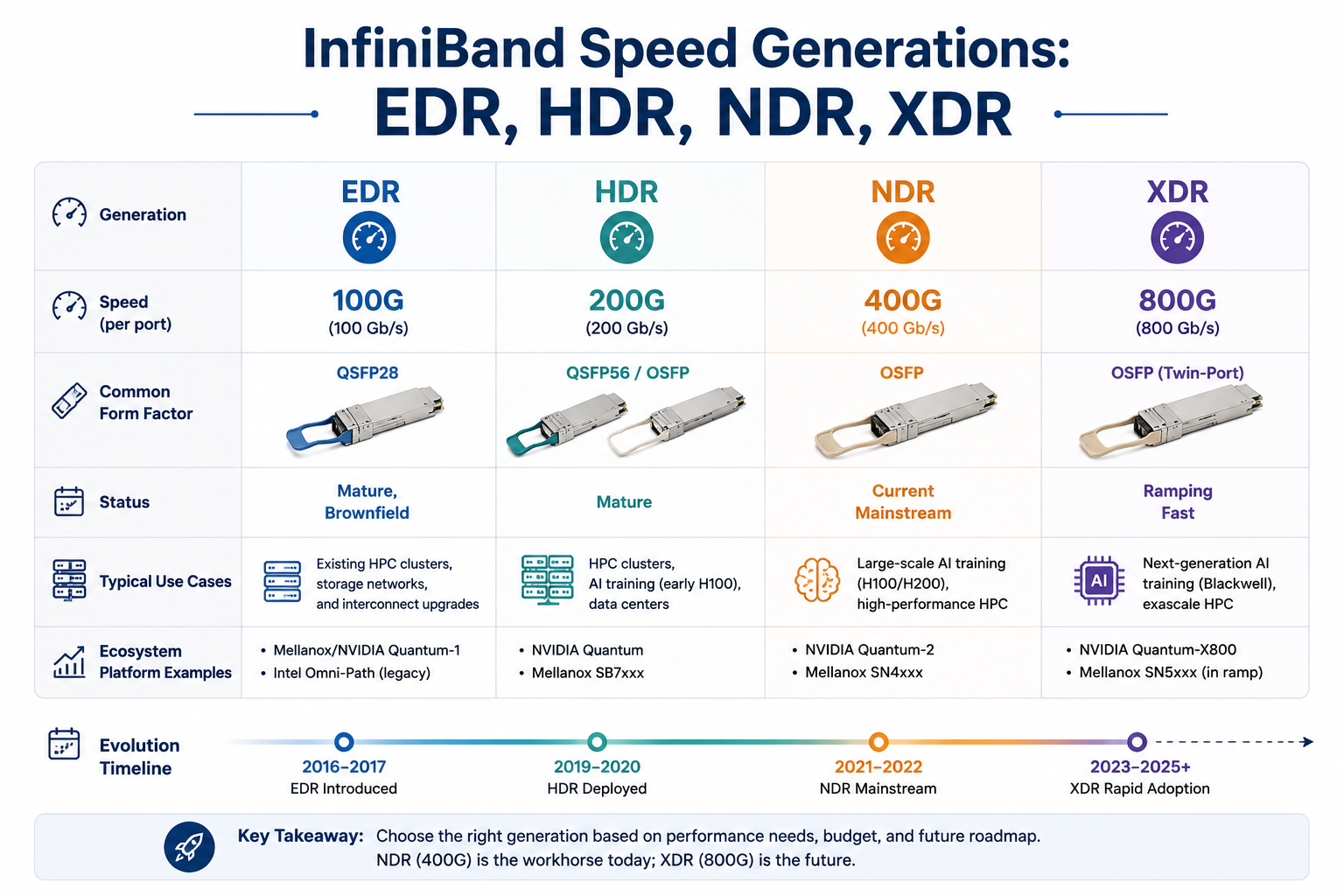
Every InfiniBand deployment starts with a generation. The generation determines the speed, and the speed determines the optical module you must buy. Get this mapping wrong and your links will not even train up.
| InfiniBand Generation |
Aggregate Port Rate |
Typical Form Factor / Implementation |
| EDR |
100 Gb/s |
QSFP28 |
| HDR |
200 Gb/s |
QSFP56 or OSFP, depending on platform |
| NDR |
400 Gb/s |
OSFP |
| XDR |
800 Gb/s |
OSFP-based implementations |
NDR at 400G is the workhorse of current training clusters. It runs on NVIDIA Quantum-2 switches and connects H100 and H200 GPUs. XDR at 800G is the emerging standard, driven by Blackwell-era systems and the Quantum-X800 switch platform. Analysts peg 800G XDR as the fastest-growing data-rate segment at roughly 40% annual growth.
One generation beyond, GDR at 1.6T is expected to reach volume production around 2027. If you are designing a fabric today, choose optics that will not need a full rip-and-replace when you scale. As InfiniBand continues to evolve toward higher port speeds, deployment planning should also consider future bandwidth requirements, cabling infrastructure, power, and thermal constraints.
InfiniBand Network Topology and Design
Topology is where InfiniBand deployment either runs clean or quietly underperforms.
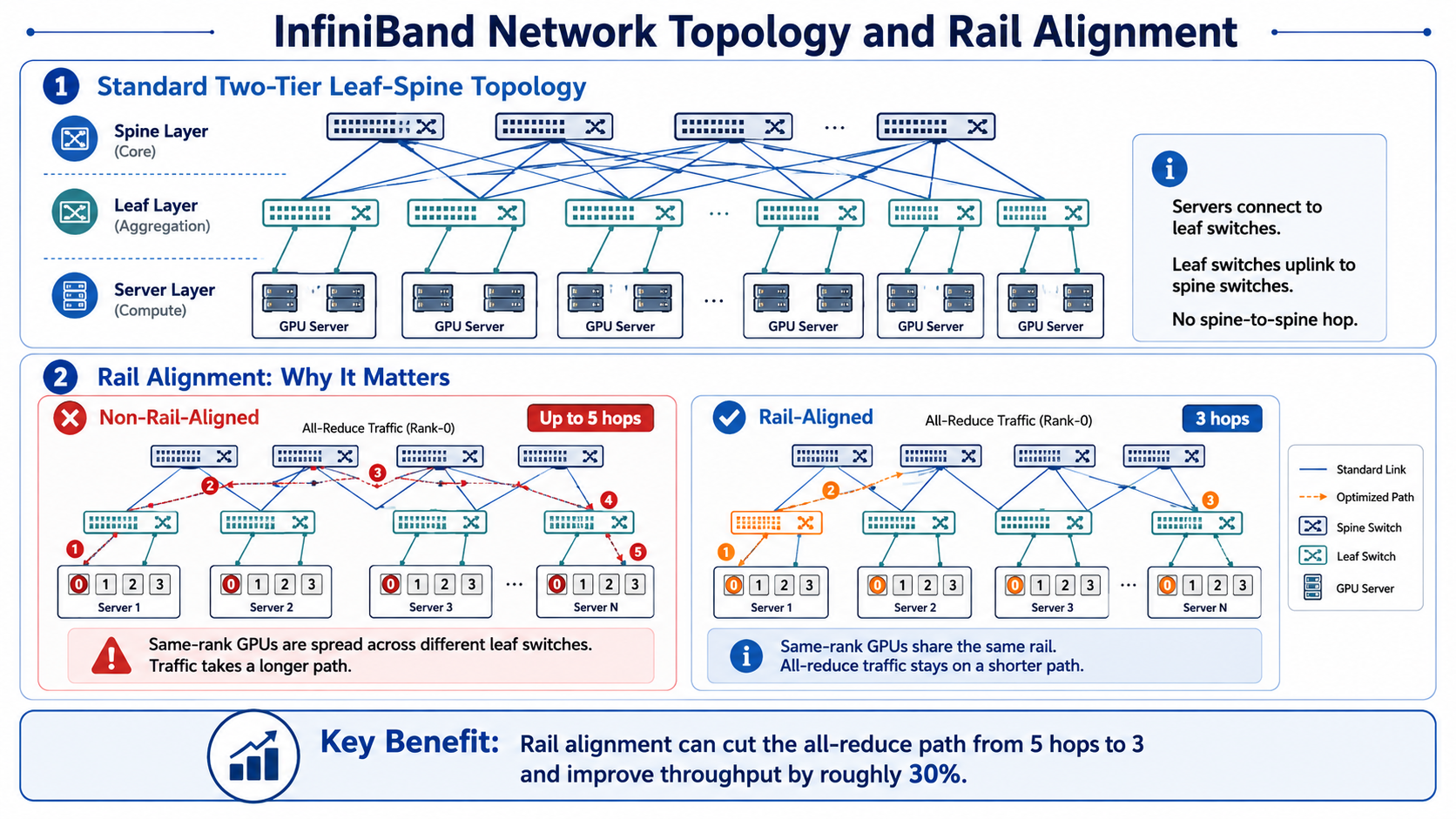
Common InfiniBand deployments use hierarchical topologies such as fat-tree or leaf-spine architectures. Servers connect to leaf switches, and leaf switches uplink to spine switches. There is no spine-to-spine hop, which keeps the path short. Large AI clusters may also use rail-optimized designs to improve traffic distribution and GPU-to-network locality.
The detail that separates good fabrics from mediocre ones is rail alignment. In a rail-aligned topology, every GPU with the same rank connects to the same leaf switch. Rank-0 GPUs across the cluster share one rail, rank-1 GPUs share the next, and so on.
Rail-aware or rail-optimized designs can improve traffic locality and reduce unnecessary network hops, which may improve collective communication efficiency in large GPU clusters. The actual benefit depends on the cluster topology and workload.
InfiniBand Optical Transceivers and Cabling
This is where most deployment mistakes live. The transceiver is not a generic part you order last. It is a compatibility boundary.
QSFP28 vs OSFP vs QSFP-DD
The form factor rules for InfiniBand are stricter than many engineers expect:
- QSFP28 is commonly used for 100G InfiniBand EDR and 100GbE applications, using four electrical lanes.It is compact, cheap, and everywhere in brownfield data centers.
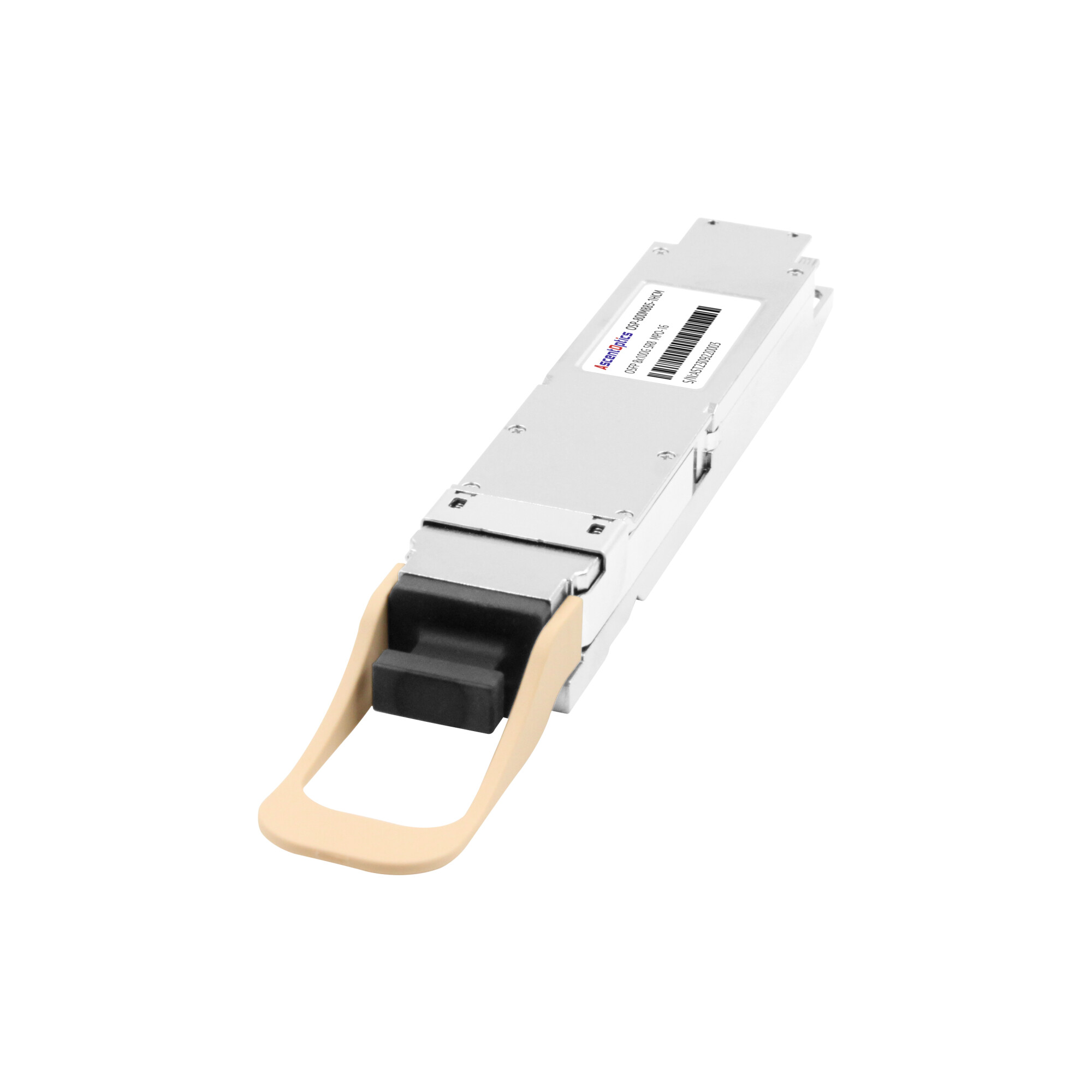
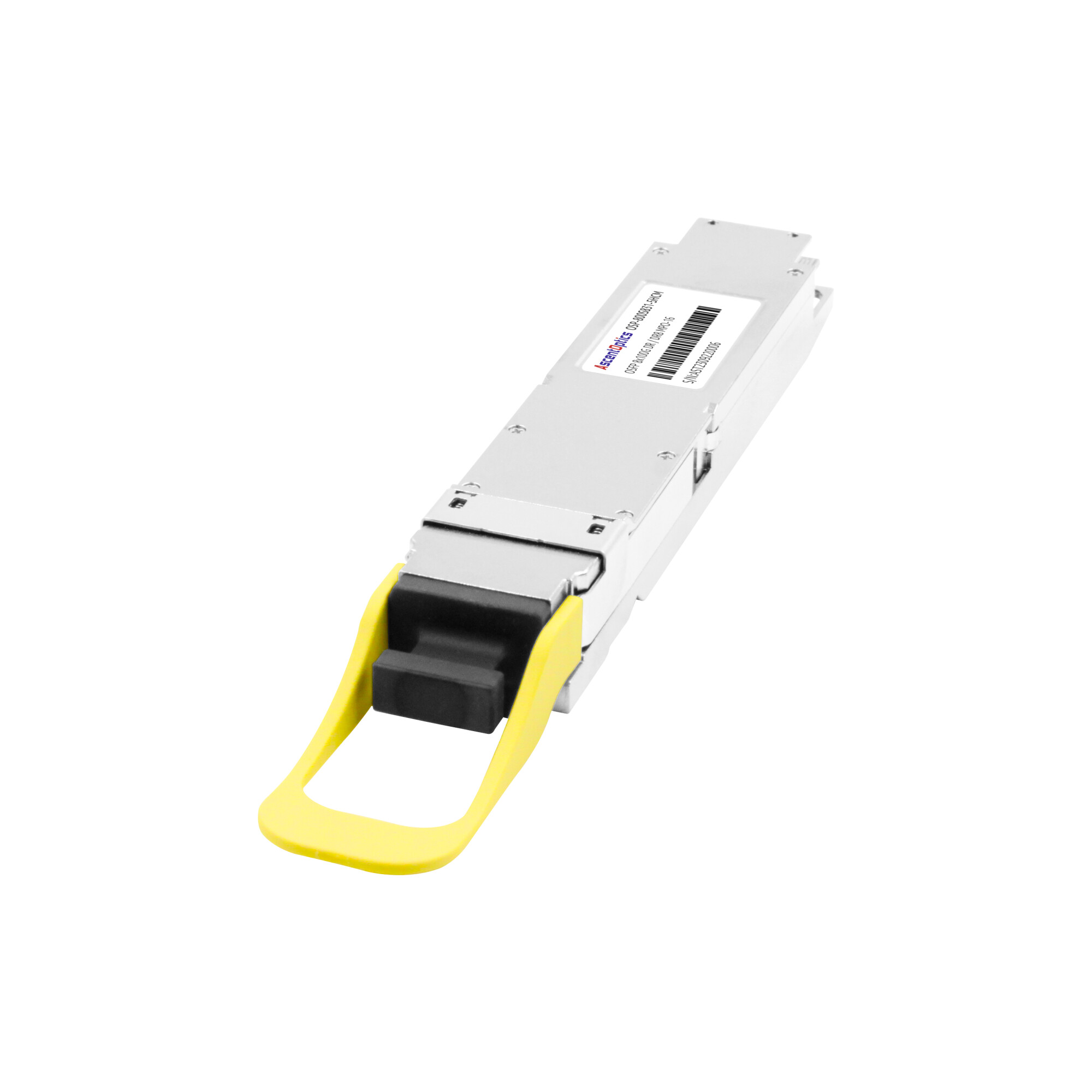
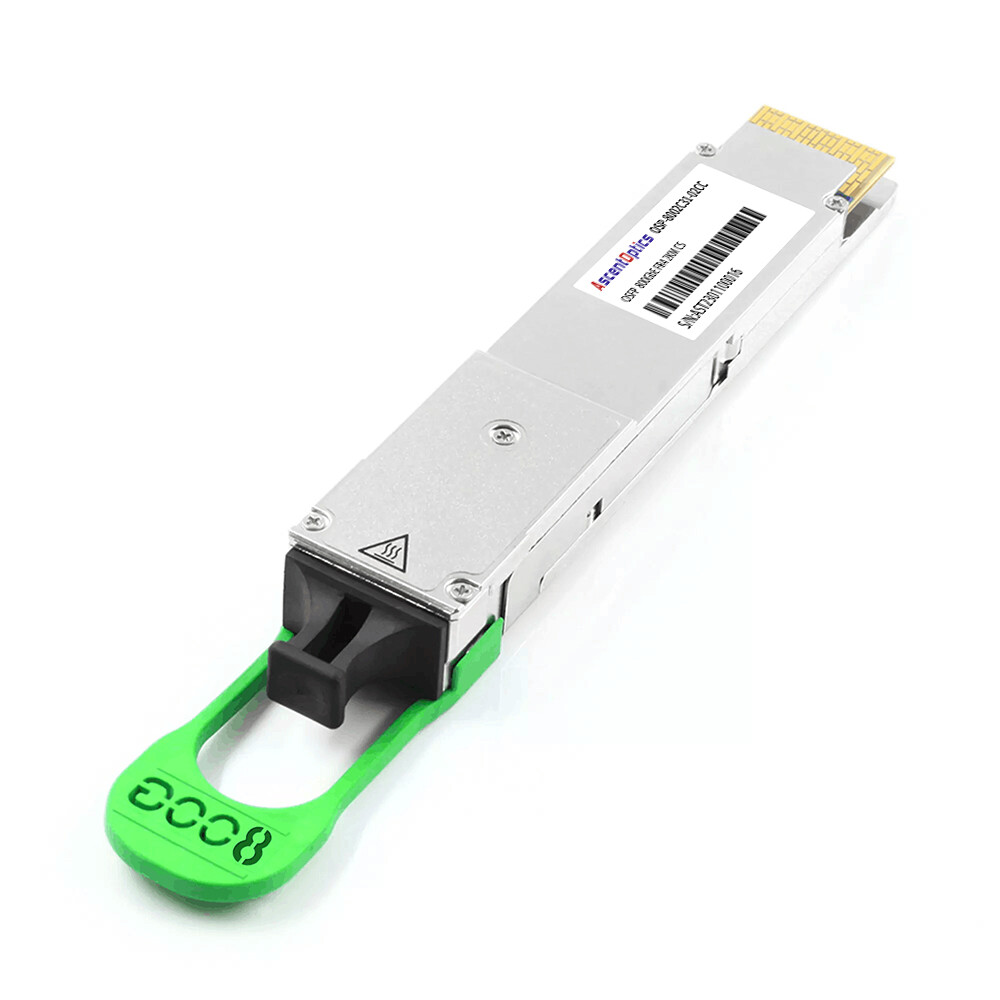
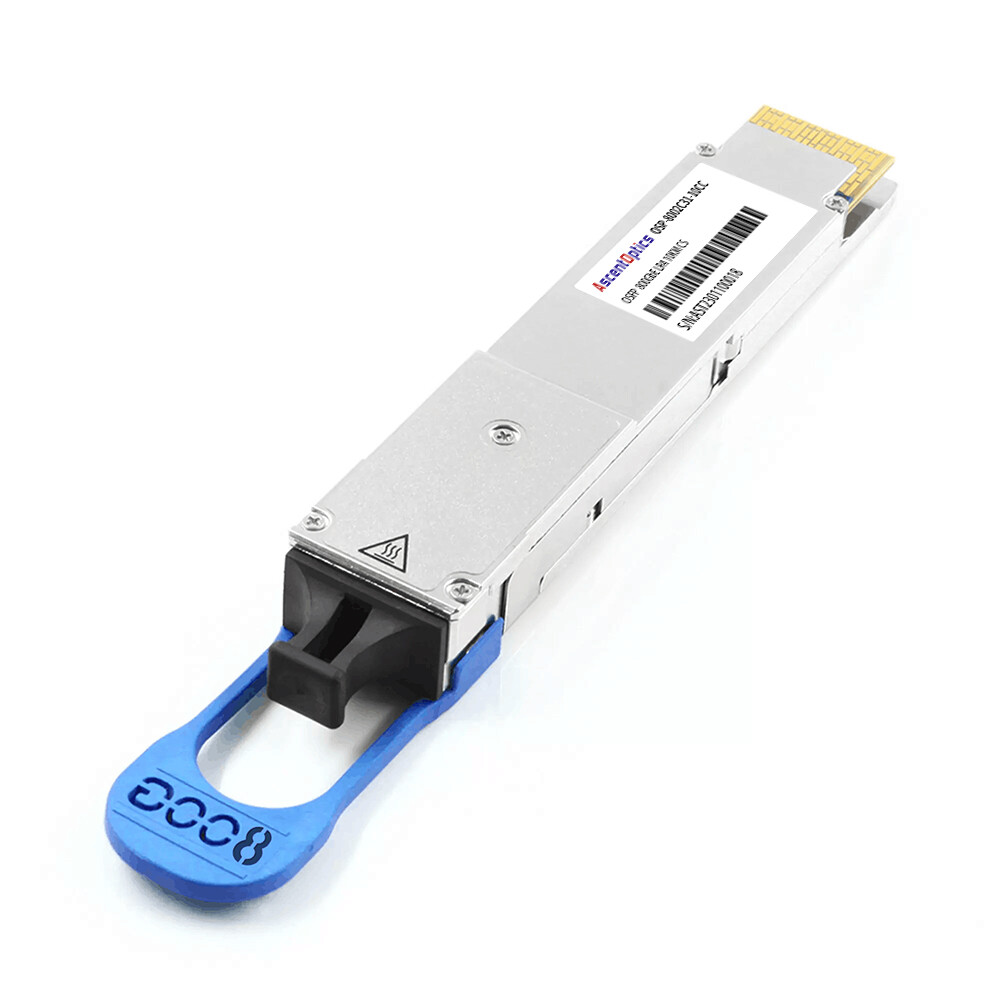
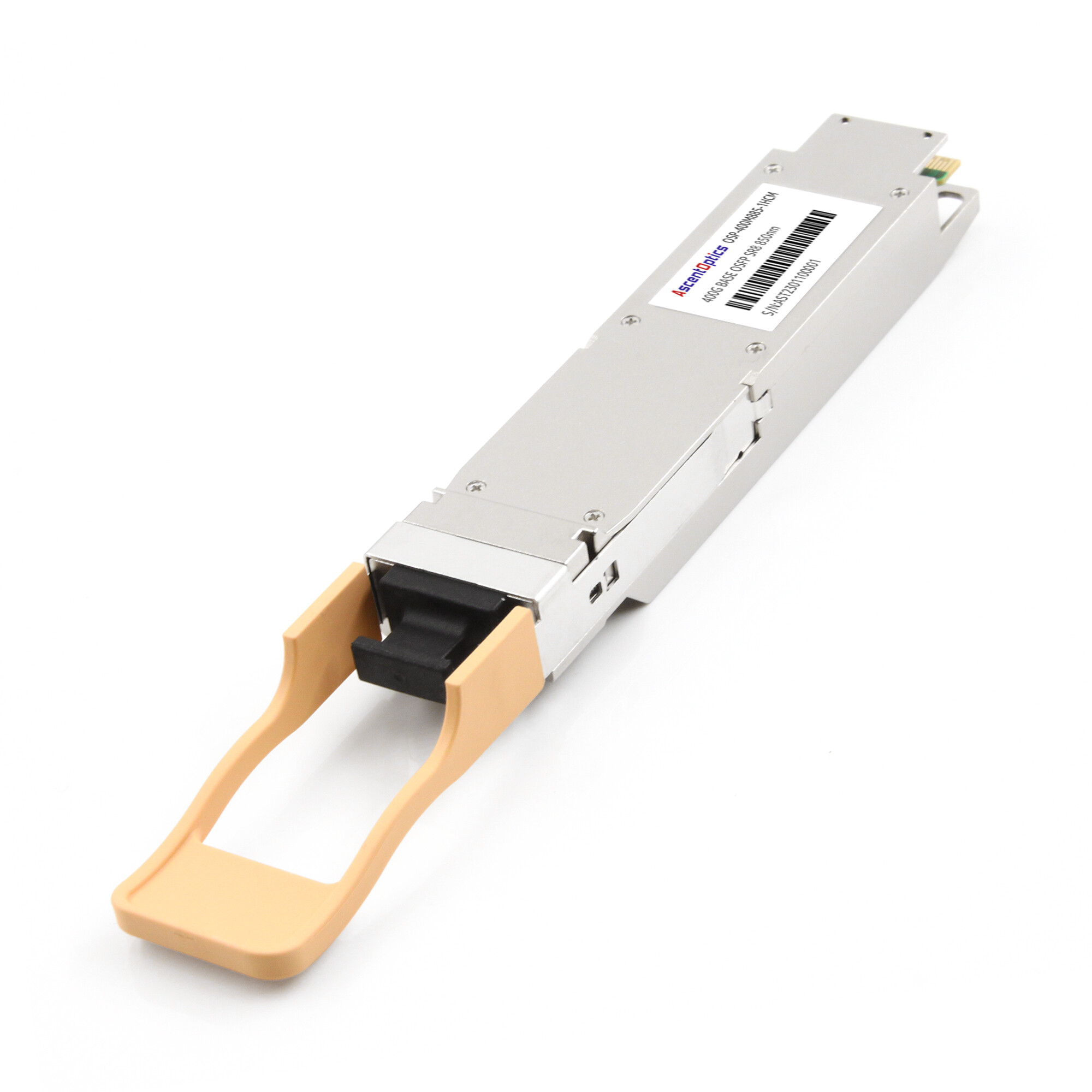
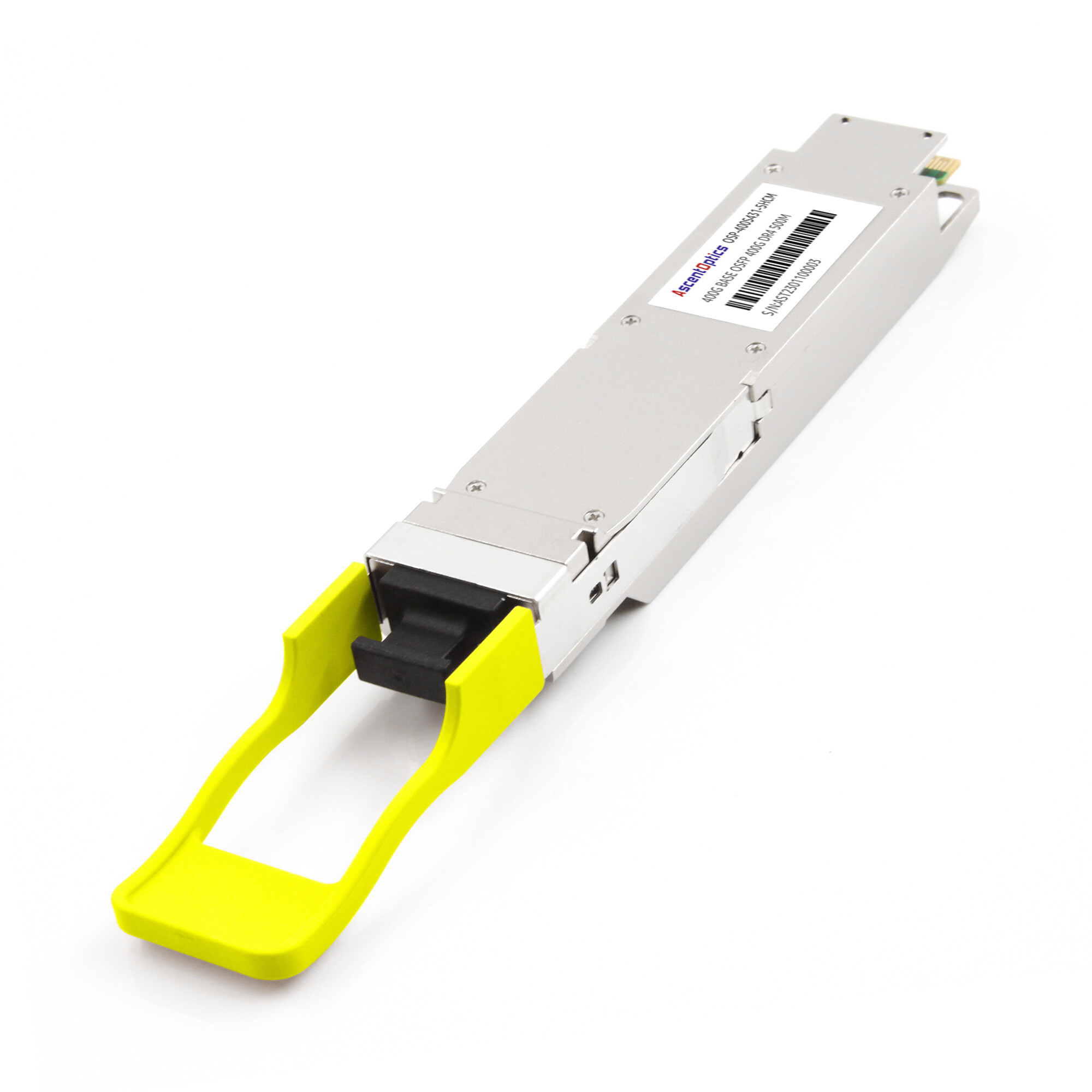
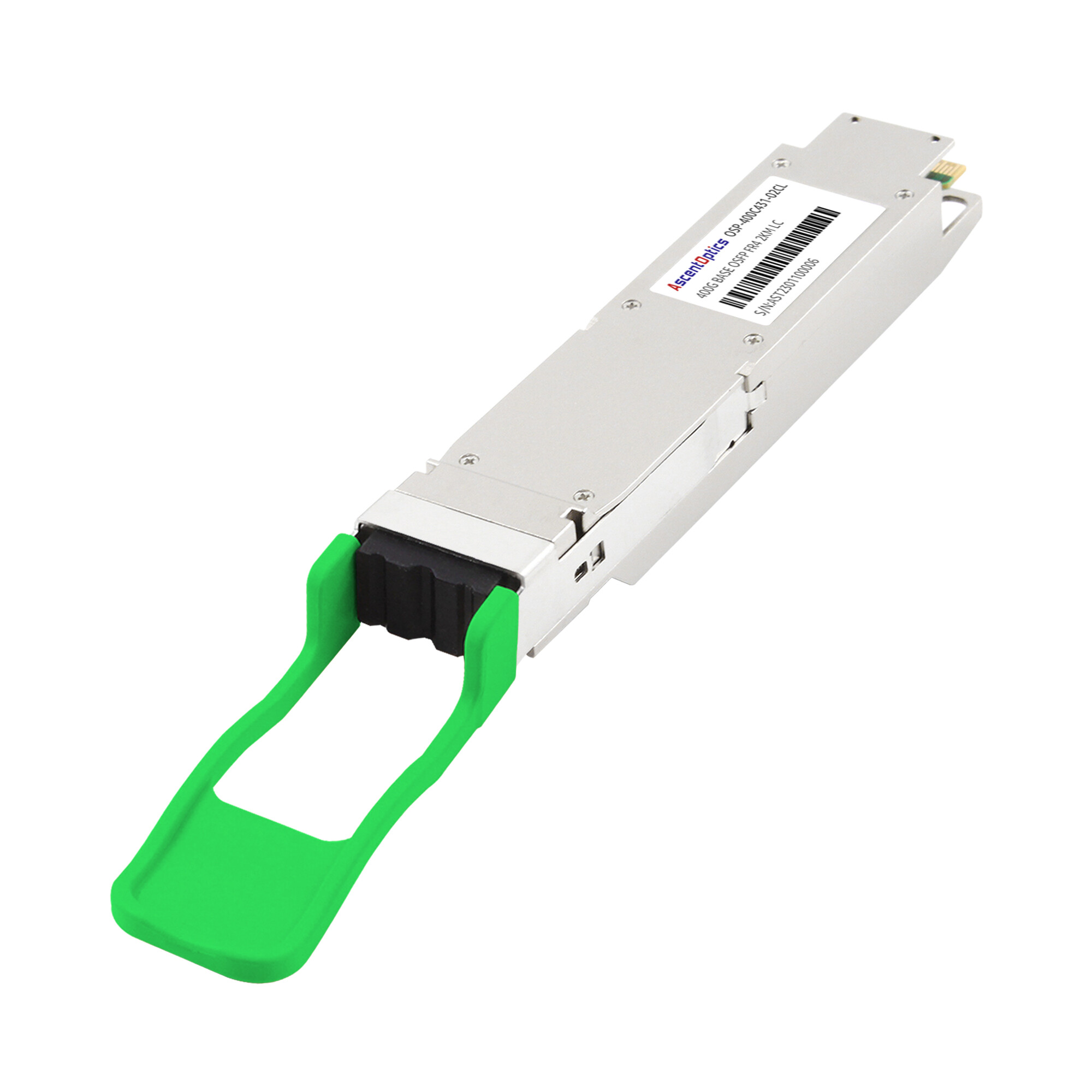
- OSFP is the InfiniBand form factor for NDR and XDR. It is larger, with better thermal headroom, and it is what NVIDIA Quantum-2 and Quantum-X800 switch ports use.
- QSFP-DD is widely used for high-speed Ethernet applications, but it is not the standard form factor used for NVIDIA’s current NDR and XDR InfiniBand switch ports. Therefore, QSFP-DD should not be assumed to be compatible with an InfiniBand port simply because the data rate is similar.
That last point trips up a surprising number of teams. A QSFP-DD module should not be assumed to work in an InfiniBand port. Always verify the switch or adapter’s supported form factor and module compatibility before deployment. If your fabric is NDR or XDR, you need OSFP. Confusing the two is a costly, easy-to-avoid error.
Reach Planning: DAC, Multimode, and Single-Mode
Reach is the second compatibility boundary. The right medium depends entirely on distance:
- DAC copper works to about 3 meters. Use it for within-rack server-to-leaf links.
- Multimode fiber with SR4 optics reaches roughly 50 to 100 meters. Use it for leaf-to-spine links within the same row.
- Single-mode fiber with DR4 optics reaches 500 meters or more. Use it for cross-row and cross-room links.
Optical Link Budget
For optical InfiniBand links, link budget should be considered alongside transmission distance. The available optical margin depends on factors such as transmitter output power, receiver sensitivity, fiber attenuation, connector loss, and the number of mated connections.
High-speed links can have tighter loss margins, so excessive patching, dirty connectors, or additional connection points may affect link stability even when the total fiber distance is within the transceiver’s rated reach. Before deployment, verify the module’s optical specifications and calculate the expected link loss to ensure sufficient margin.
Where Optical Choice Saves Budget
InfiniBand is expensive, and the optics are a real line item. Vendor-locked transceivers carry a premium that a direct optical manufacturer does not. Since OSFP and QSFP28 modules built to MSA specifications interoperate with the same switch ports, you can often cut the optics bill by 30% to 50% without touching the fabric’s reliability.
MSA compliance helps establish mechanical and electrical interoperability, but it does not guarantee compatibility with every InfiniBand switch or adapter. Module EEPROM configuration, firmware, supported signaling, power requirements, and vendor qualification should also be verified.
The key is standards compliance and burn-in testing. A transceiver that follows the MSA and passes a full link test will train up and run clean, whether it carries a premium brand or a manufacturer’s label. This is where an OEM/ODM optical vendor earns its place in your bill of materials.
InfiniBand Deployment Steps: A Practical Checklist
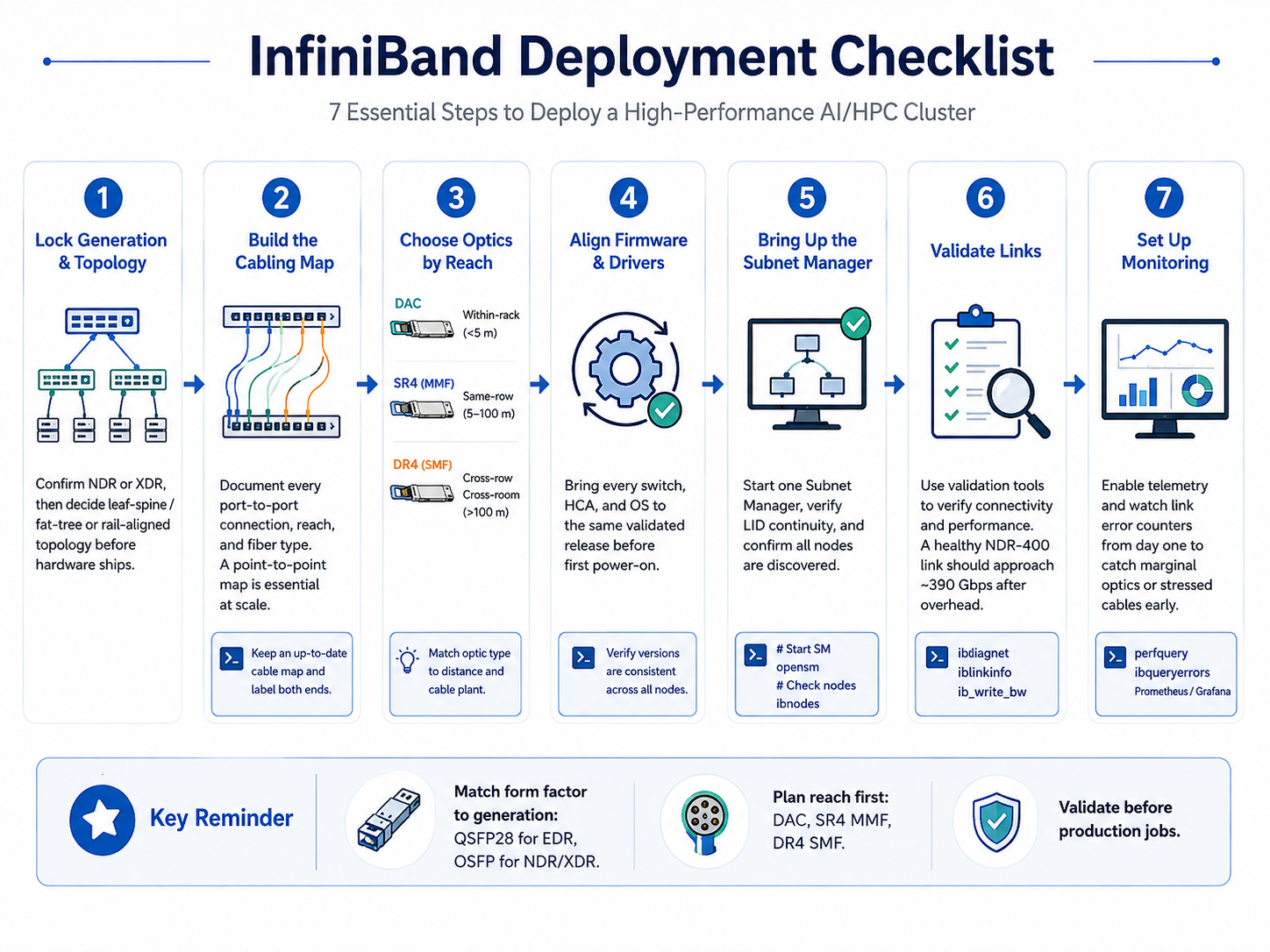
A structured checklist keeps the fabric from becoming a debugging project. Here is the sequence we recommend:
- 1. Lock the generation and topology. Confirm NDR or XDR, then decide fat-tree versus rail-aligned before any hardware ships.
- 2. Build the cabling map. Document every port-to-port connection, including reach and fiber type. A point-to-point spreadsheet is not optional at scale.
- 3. Choose optics by reach. Map DAC to within-rack, SR4 multimode to same-row, and DR4 single-mode to cross-room.
- 4. Align firmware and drivers. Align switch firmware, HCA/NIC firmware, drivers, and operating-system components with a validated compatibility matrix before deployment.
- 5. Bring up the subnet manager. Start with one subnet manager, verify LID continuity, and confirm every node is discovered.
- 6. Validate links. Run ibdiagnet, iblinkinfo, and ib_write_bw. After accounting for encapsulation overhead, a healthy NDR-400 link should approach 390 Gbps.
- 7. Set up monitoring. Enable telemetry and watch link error counters from day one, not after a training job stalls.
- 8. Verify Link Speed and Width. A link can appear Active while operating at a reduced speed or lane width. During deployment validation, check both the negotiated link rate and width on every port. A reduced-width link can significantly limit bandwidth and may indicate a cable, optic, connector, port, or configuration issue.
The validation step deserves more attention than it usually gets. Link error counters are the earliest signal of a marginal optic or a stressed cable. Watching them during bring-up catches a bad module before it costs you a training run.
InfiniBand Deployment Cost Considerations
Cost is an important factor when planning an InfiniBand deployment. The main expenses typically include switches, HCAs, optical transceivers, cables, and supporting infrastructure. For large AI and HPC clusters, switches and adapters often represent a significant portion of the initial investment, while optics and cabling provide more flexibility for cost optimization.
Optical selection is particularly important because the required form factor, reach, fiber type, and port speed can significantly affect the total cabling cost. Using DACs for short in-rack connections and selecting the appropriate multimode or single-mode optics for longer links can help avoid unnecessary expenses.
Qualified third-party transceivers and cables can also provide a cost-effective alternative to vendor-branded products. However, cost savings should not come at the expense of compatibility or reliability. Before deployment, verify the module specifications, platform compatibility, firmware support, and optical performance, and conduct appropriate link testing.
A well-planned InfiniBand deployment should therefore balance upfront hardware costs with long-term reliability, scalability, and maintenance requirements. Choosing the right topology, cabling, and optical components can help control costs while maintaining the performance required by AI and HPC workloads.
Conclusion
InfiniBand deployment requires careful coordination between topology, switches, adapters, cabling, optical modules, firmware, and fabric configuration. The optical layer is particularly important because link distance, fiber type, connector loss, module compatibility, and signal integrity can directly affect link stability and performance.
A reliable deployment starts with the correct InfiniBand generation and topology, followed by careful cable and transceiver selection, validated firmware and driver combinations, and systematic link and performance testing. By treating optical connectivity as part of the overall fabric design rather than an afterthought, organizations can build InfiniBand networks that are easier to validate, operate, and scale.
To recap the essentials:
- Match the transceiver form factor to the generation: QSFP28 for EDR, OSFP for NDR and XDR, and never QSFP-DD for InfiniBand.
- Plan reach first: DAC within rack, multimode SR4 within row, single-mode DR4 across rooms.
- Use rail-aligned topology to cut hops from five to three and recover roughly 30% throughput.
- Validate links with error-counter monitoring before the first training job.
- Compress cost on the optics, where a direct MSA-compliant manufacturer can save 30% to 50% without sacrificing reliability.
The teams that deploy InfiniBand cleanly treat the optical layer as a design decision, not an afterthought. Choose your modules the same way you chose your switches, and your fabric will scale with the cluster instead of fighting it.
FAQ
1. What should I consider first when planning an InfiniBand deployment?
Start by defining the required InfiniBand generation, port speed, network topology, and expected link distances. These factors determine the appropriate switches, adapters, optics, and cables.
2. Which optical transceiver is used for 400G InfiniBand?
400G NDR InfiniBand commonly uses OSFP-based optical transceivers. The exact module should be selected based on the switch or HCA, reach, fiber type, and platform compatibility.
3. Can I use QSFP-DD transceivers for InfiniBand?
Do not assume QSFP-DD modules are compatible with InfiniBand. Always check the specific switch or adapter’s supported form factors and qualified transceivers before deployment.
4. Should I use DAC or optical transceivers for InfiniBand?
DACs are generally suitable for short in-rack connections, while optical transceivers are better suited to longer links. The choice depends on distance, bandwidth, installation requirements, and cost.
5. How do I choose between multimode and single-mode fiber?
Multimode fiber is commonly used for shorter optical links, while single-mode fiber is preferred for longer reaches. Always match the fiber type with the transceiver’s specifications.
6. Why is optical link budget important in InfiniBand deployment?
Link budget helps ensure that total fiber and connector losses remain within the transceiver’s supported optical margin. A sufficient margin is important for stable high-speed links.
7. How can I validate an InfiniBand network after deployment?
Use tools such as ibdiagnet, iblinkinfo, and perfquery to check fabric health, link status, and error counters. Bandwidth and latency tests can then verify application-level performance.
8. Can third-party optical transceivers be used in InfiniBand networks?
They can be used when they are properly qualified and compatible with the target InfiniBand platform. Check the module specifications, EEPROM configuration, firmware support, and optical performance before deployment.
Post Views: 85