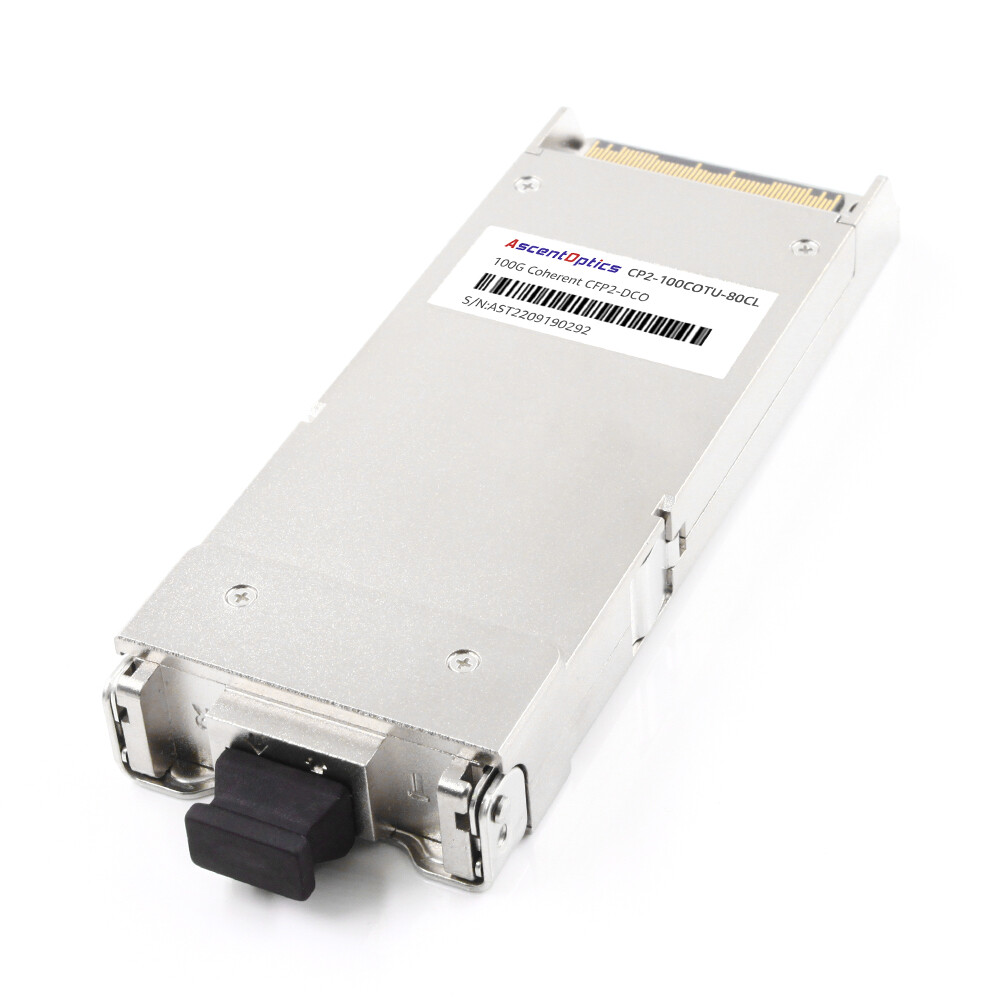
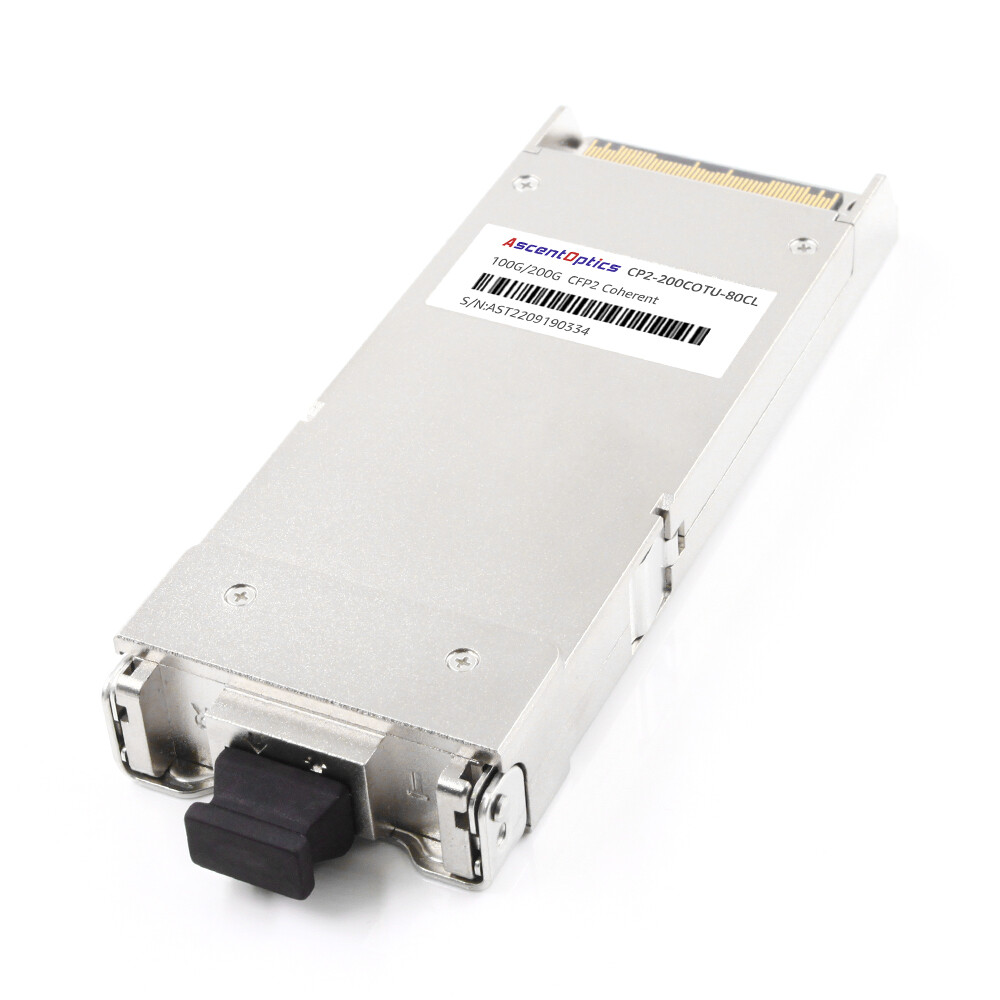
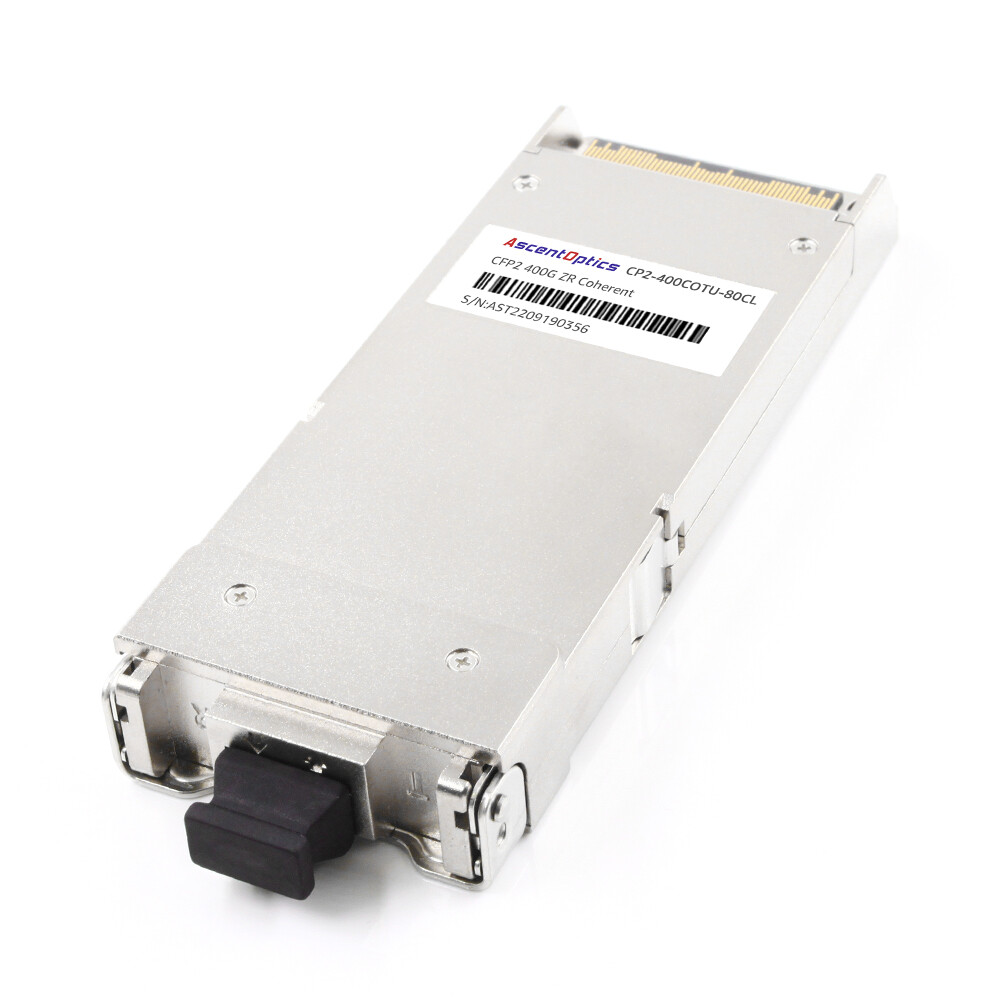
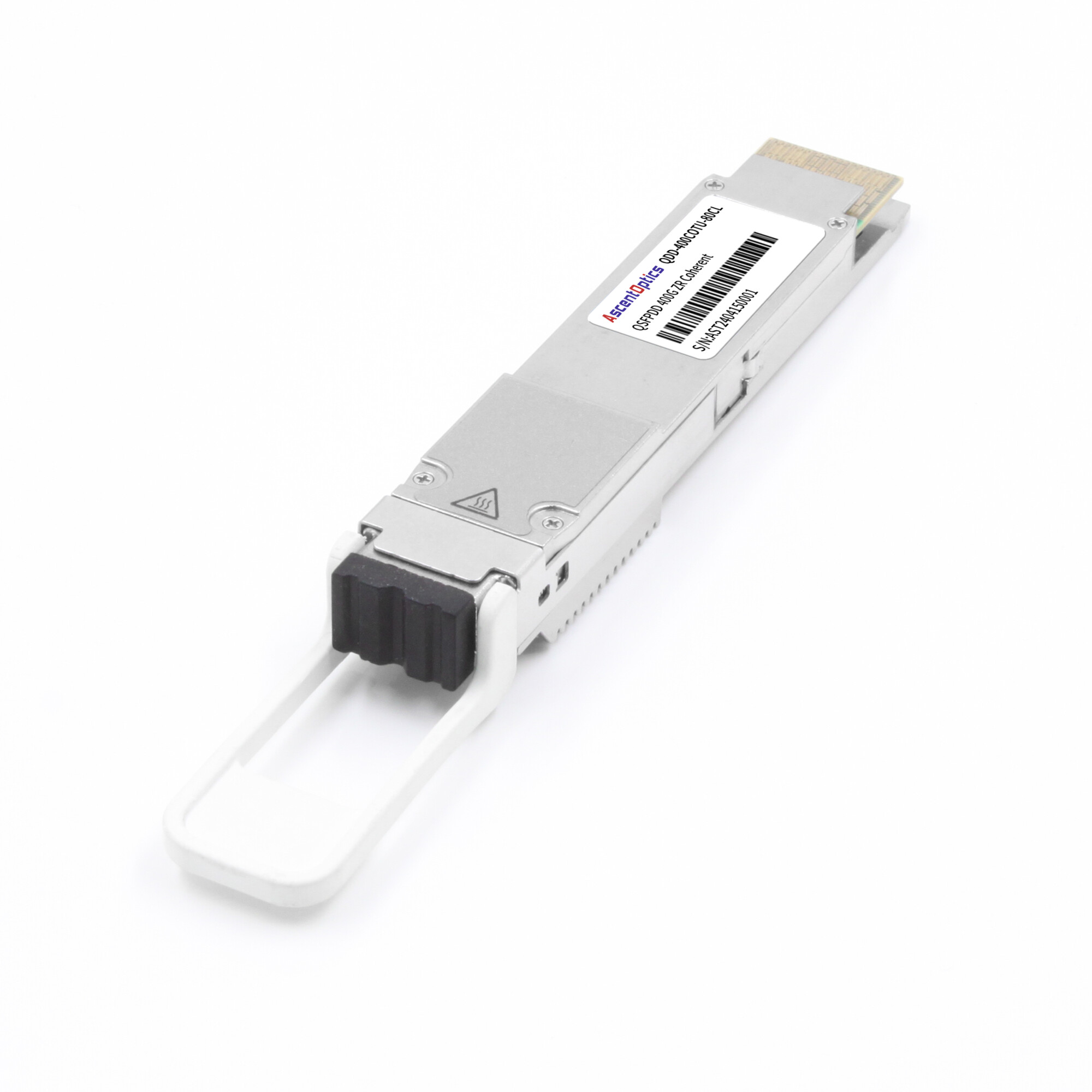
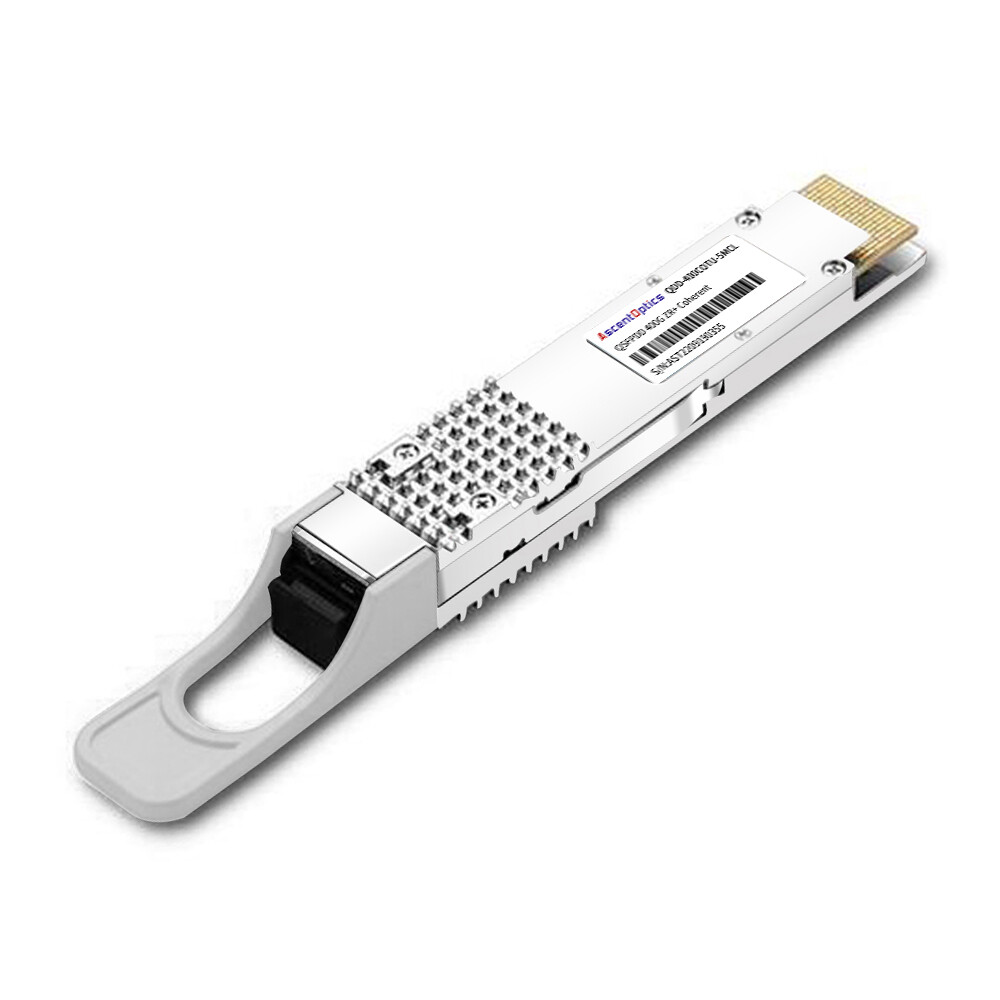
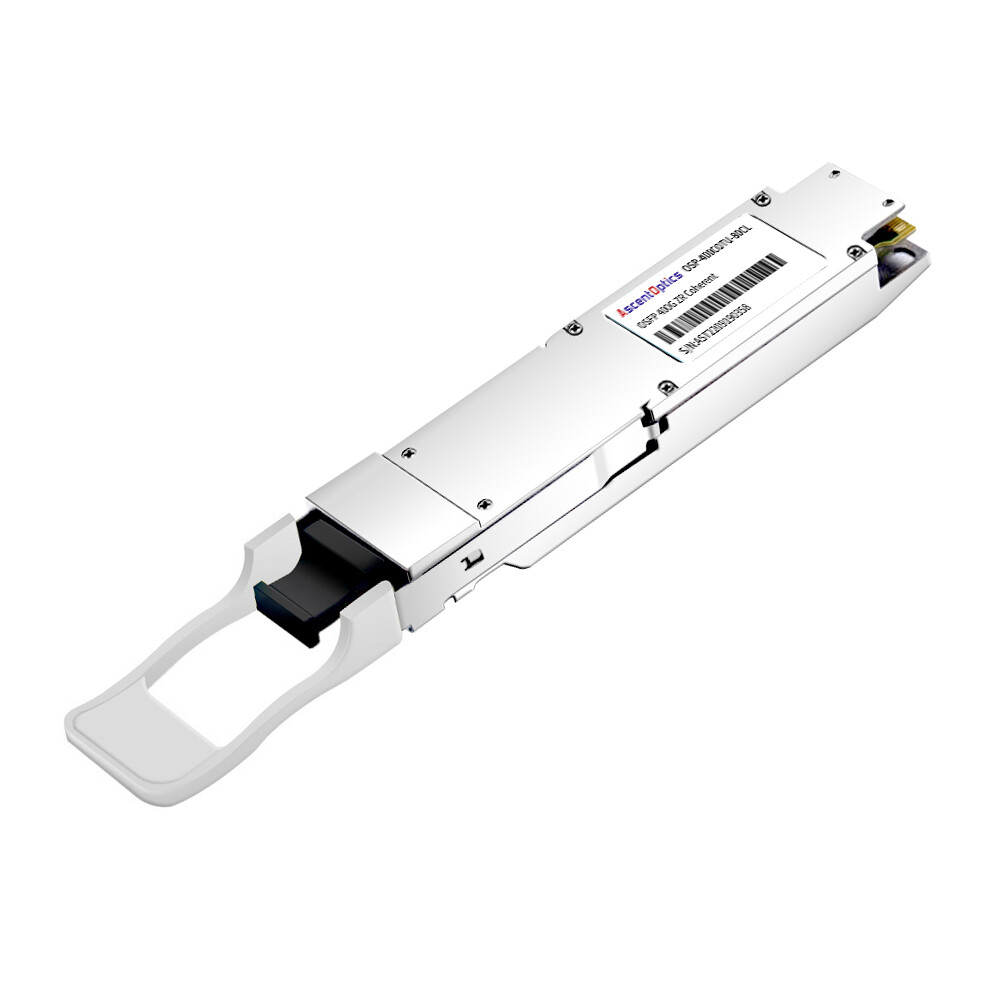
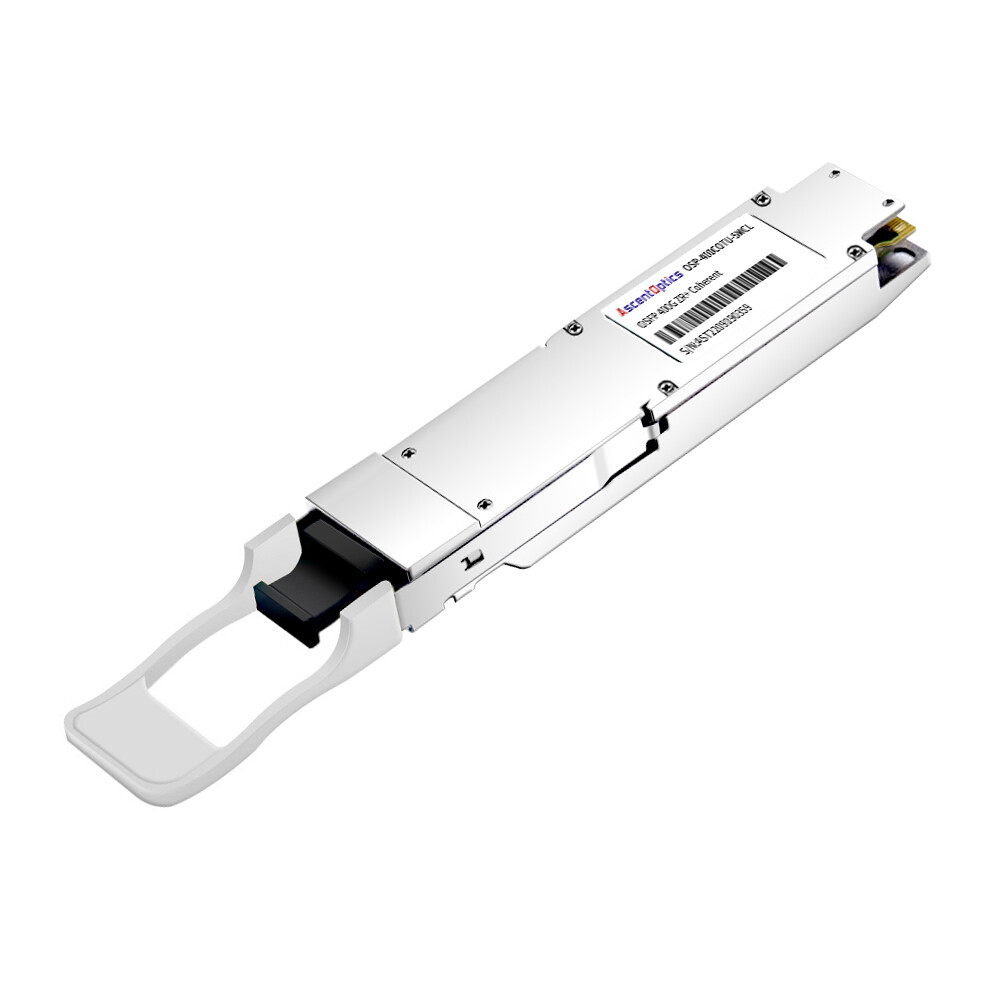
CFP2 DCO integrates DSP, coherent optics, and tunable lasers into a compact, hot-pluggable module. It enables high-capacity coherent links from metro DCI to long-haul networks, depending on data rate, modulation format, and optical line conditions.Tailored for metro, long-haul, and DCI, it supports flexible modulation and FEC, delivering software-defined performance that adapts to fiber conditions in real time.
What Is CFP2-DCO?
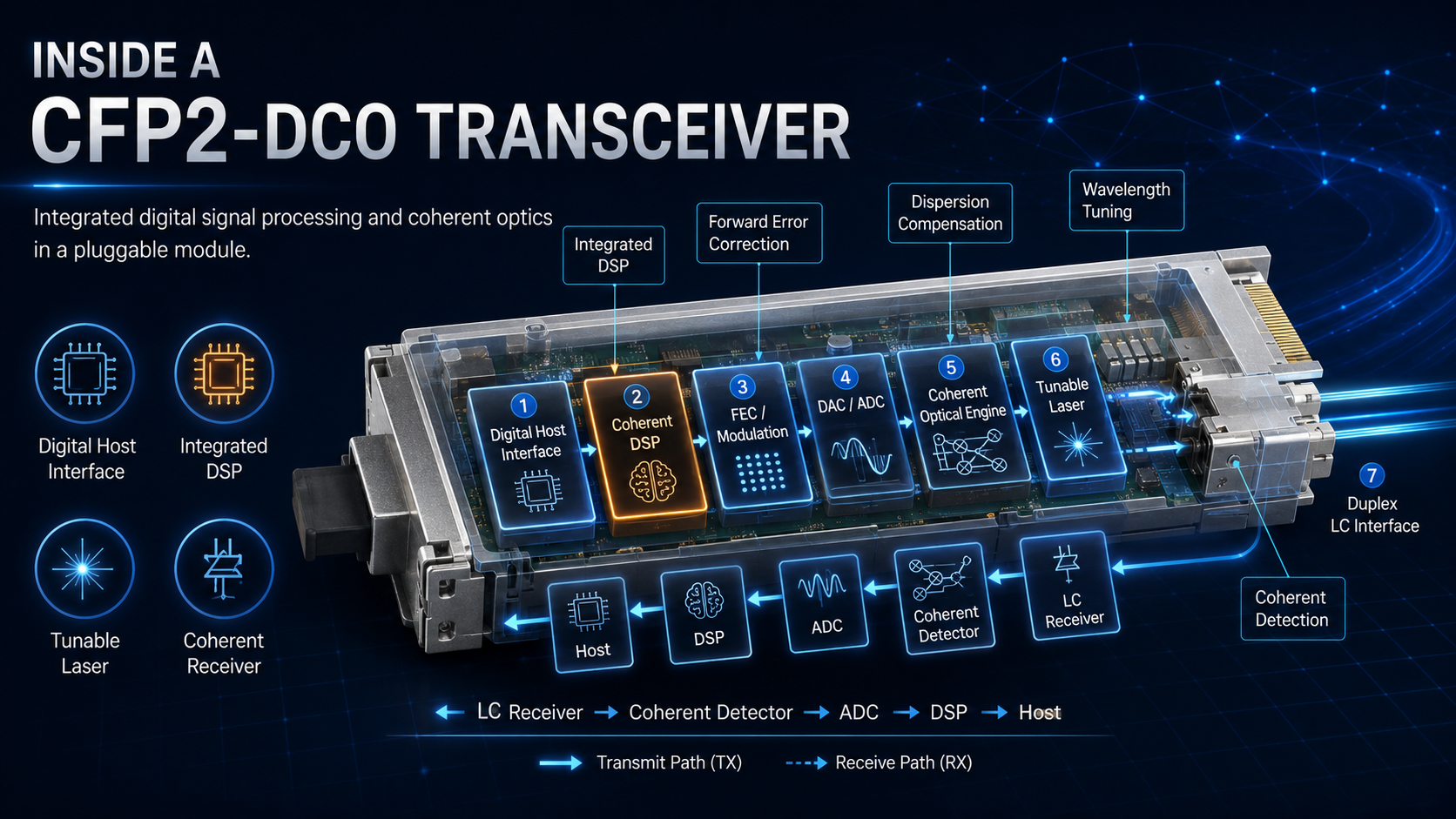
CFP2-DCO stands for C-Form-factor Pluggable 2 – Digital Coherent Optics. It is a hot-pluggable coherent optical transceiver that integrates a digital signal processor (DSP), optical modulator, receiver, and tunable laser inside a CFP2 module.
Because the DSP lives inside the module, a CFP2 DCO module can connect directly to a router or switch with a standard digital host interface. The module handles modulation, dispersion compensation, and forward-error correction (FEC) on its own. That makes it a practical way to add coherent DWDM capacity to IP-over-DWDM architectures without building a separate optical transport layer.
Key characteristics of a typical CFP2-DCO module include:
- Form factor: CFP2 MSA, ~41.5 mm wide, 104-pin electrical connector
- Data rates: 100G, 200G, and 400G, with higher-capacity coherent solutions evolving toward next-generation form factors.
- Client interfaces: 100GbE/200GbE/400GbE, OTU4, OTUCn
- Line modulation: DP-QPSK, DP-8QAM, DP-16QAM, PCS-16QAM
- Wavelength grid: C-band tunable, 50/75/100 GHz spacing. Supported channel spacing depends on the line system and spectral efficiency requirements.
- Connector: Duplex LC
- Power consumption: 100G ~21–24 W; 200G ~22–27.5 W; 400G ~22–31 W
- Standards: OIF CFP2-DCO IA, CFP2 MSA, OpenROADM, OpenZR+
How CFP2-DCO Works
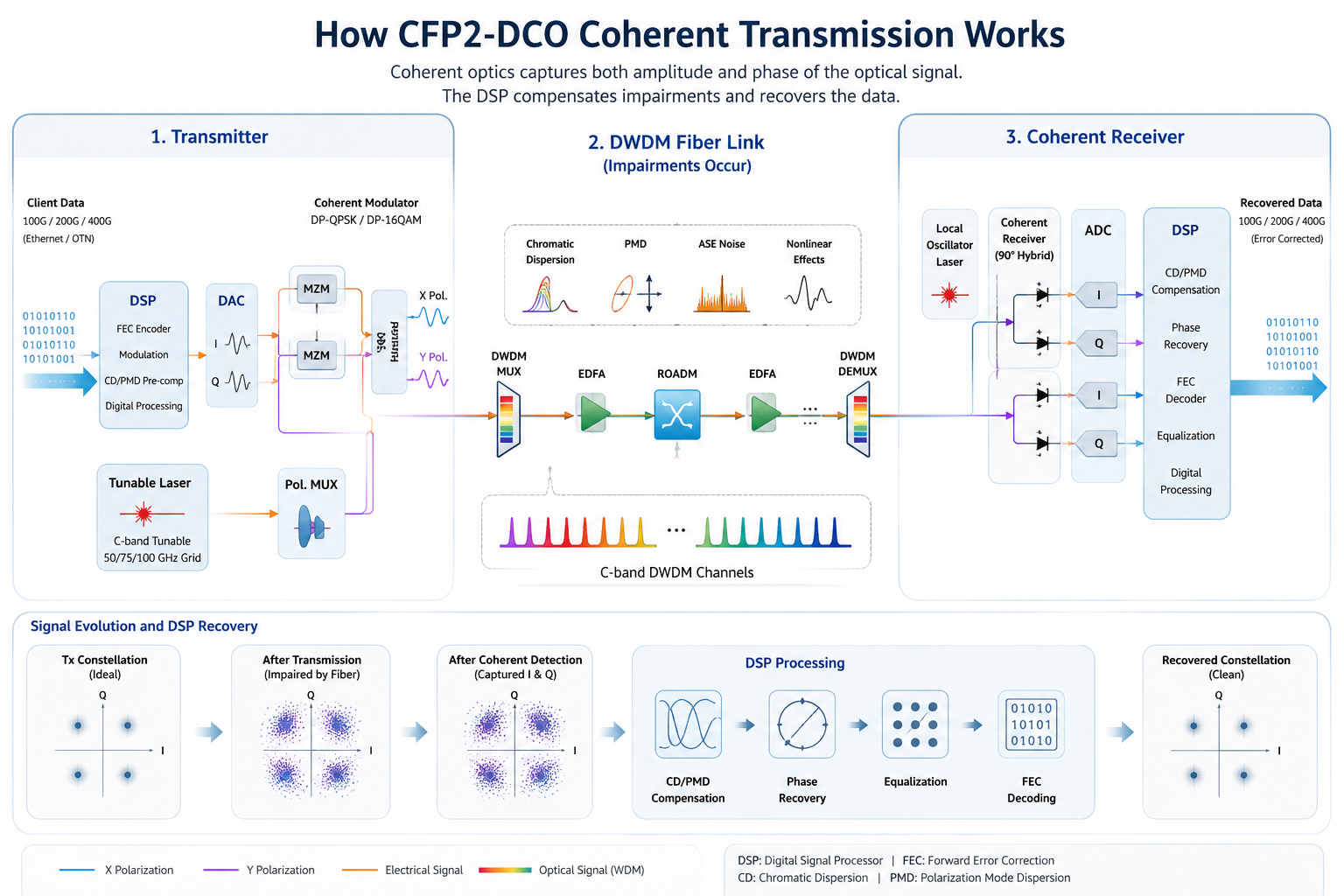
A CFP2 DCO transceiver sends and receives light using coherent detection. Unlike direct-detect modules, which simply measure light intensity, coherent optics captures both the amplitude and phase of the optical signal. This lets the receiver reconstruct the transmitted data even after the signal has traveled hundreds or thousands of kilometers.
The DSP inside the module performs several critical tasks:
- Modulation: converts electrical client signals into high-order modulation formats such as DP-QPSK or DP-16QAM.
- Dispersion compensation: reverses the effects of chromatic dispersion and polarization-mode dispersion (PMD) in the fiber.
- Forward-error correction (FEC): adds redundant data so the receiver can correct errors without retransmission.
- Wavelength tuning: locks the tunable laser onto the correct DWDM channel.
Modern coherent DSPs also perform polarization recovery, adaptive equalization, clock recovery, and nonlinear impairment mitigation.
CFP2-DCO Specifications at a Glance
Specifications vary by vendor and target reach, but the table below shows typical ranges for 100G, 200G, and 400G CFP2 DCO modules.
| Parameter |
100G CFP2-DCO |
200G CFP2-DCO |
400G CFP2-DCO |
| Modulation |
DP-QPSK |
DP-QPSK / DP-16QAM |
DP-16QAM / PCS-16QAM |
| Unamplified reach |
~80–120 km |
~80–120 km |
~80–120 km |
| Amplified reach |
Up to ~2,000 km |
Up to ~1,000 km |
Up to ~1,000 km |
| Power consumption |
~21–24 W |
~22–27.5 W |
~22–31 W |
| Wavelength grid |
C-band tunable, 50 GHz |
C-band tunable, 50/75 GHz |
C-band tunable, 50/75/100 GHz |
| Client interfaces |
100GbE, OTU4 |
100GbE/200GbE, OTU4 |
100GbE/200GbE/400GbE, OTUCn |
| FEC |
SD-FEC / oFEC |
SD-FEC / oFEC |
SD-FEC / oFEC / CFEC |
Two numbers deserve extra attention: optical budget and OSNR tolerance. The optical budget tells you how much loss the link can tolerate between the transmitter and receiver. OSNR tolerance tells you how much amplified spontaneous noise the receiver can handle. Both numbers determine whether a module rated for 1,000 km will actually deliver 1,000 km on your specific fiber and amplification plan.
CFP2-DCO vs CFP2-ACO
The biggest difference between CFP2-DCO and CFP2-ACO (Analog Coherent Optics) is the location of the DSP.
| Feature |
CFP2-ACO |
CFP2-DCO |
| DSP location |
On the host line card |
Inside the module |
| Electrical interface |
Analog I/Q signals |
Digital lanes (e.g., CAUI-4, FOIC1.4) |
| Typical power |
<12 W (module only) |
~21–31 W (module + DSP) |
| Host requirements |
Requires compatible host DSP/coherent ASIC |
Works with CFP2 host interfaces designed and qualified for DCO operation. |
| Interoperability |
Often vendor-specific |
Broader plug-and-play across vendors |
| Best for |
Dedicated coherent line cards, high-density shelves |
Router/switch upgrades, IP-over-DWDM |
ACO was developed when coherent DSPs were too hot and power-hungry to fit inside a pluggable module. Moving the DSP to the host line card solved the thermal problem but tied the optical module to a specific host design.
As DSP silicon moved to smaller process nodes, CFP2 DCO became practical. It trades a few extra watts for much greater deployment flexibility. Network operators can now add coherent capacity to standard router ports on a pay-as-you-grow basis.
CFP2-DCO vs QSFP-DD DCO / OSFP-DCO
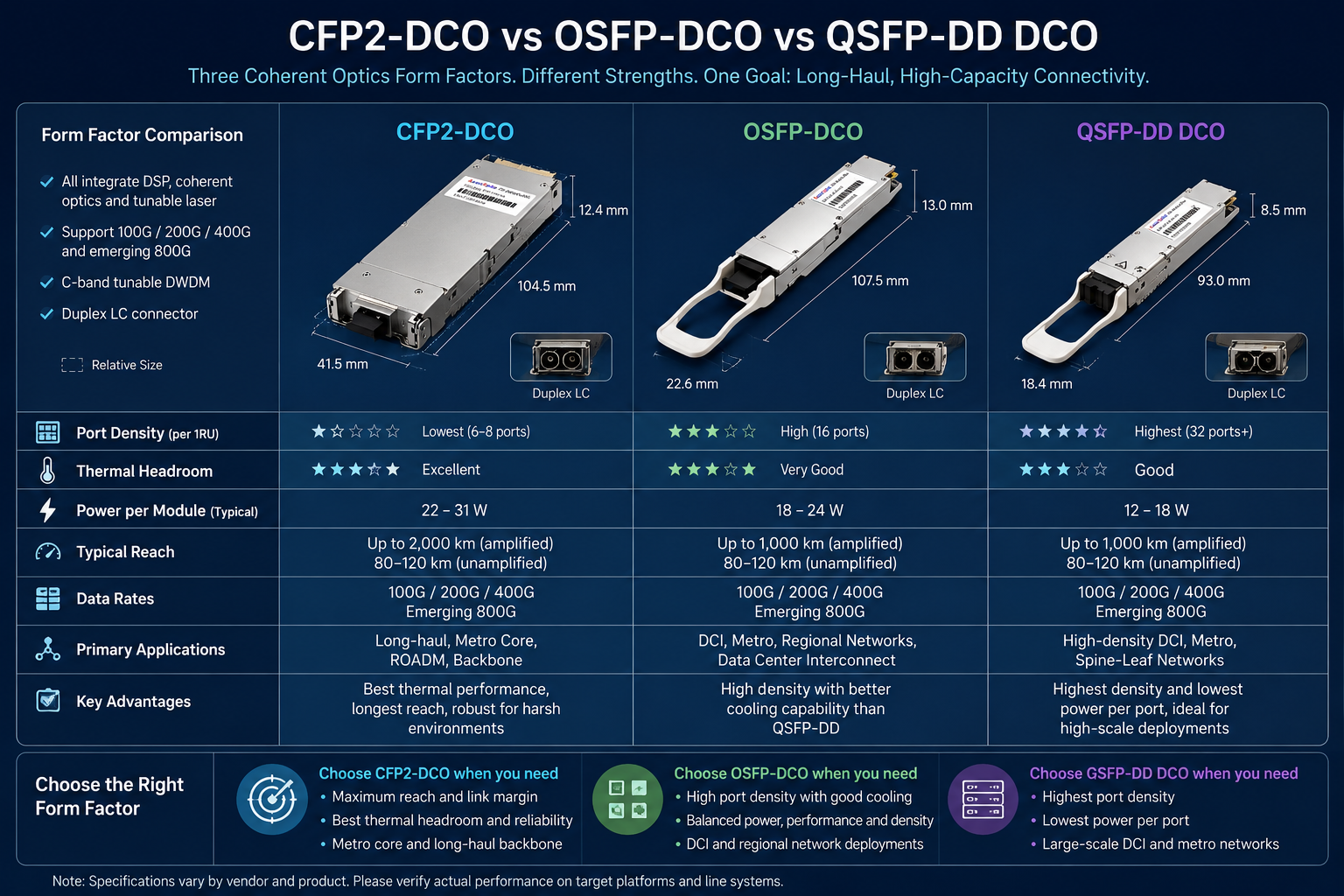
CFP2 DCO is not the only pluggable coherent form factor. QSFP-DD DCO and OSFP-DCO are smaller, higher-density alternatives aimed at data-center environments.
| Feature |
CFP2-DCO |
QSFP-DD DCO |
OSFP-DCO |
| Width |
~41.5 mm |
~18.4 mm |
~22.5 mm |
| Port density |
Lower |
Higher |
Higher |
| Typical power |
~21–31 W |
~15–23 W |
~15–25 W |
| Max data rate |
400G (800G emerging) |
400G / 800G |
400G / 800G |
| Typical reach |
Metro to long-haul |
DCI / metro |
DCI / metro |
| Primary standards |
OpenROADM, OpenZR+, OIF |
400ZR, OpenZR+ |
400ZR, OpenZR+ |
Choose CFP2 DCO when reach, optical performance, and carrier-grade thermal headroom matter most. Choose QSFP-DD DCO or OSFP-DCO when port density and power efficiency per slot are the dominant constraints.
CFP2 remains relevant in carrier and transport networks because its larger thermal envelope supports higher optical performance and more complex coherent processing.
Standards and Interoperability
Interoperability is where pluggable coherent optics either saves money or creates headaches. A CFP2 DCO module may support one or more of these standards:
- OIF CFP2-DCO IA: defines the electrical, optical, and management interfaces for CFP2-DCO modules.
- CFP2 MSA: governs the mechanical form factor, connector, and thermal envelope.
- OpenROADM MSA: focuses on carrier ROADM networks with Ethernet and OTN clients, using oFEC.
- OpenZR+: combines the simple Ethernet host interface of 400ZR with the extended reach of OpenROADM.
- CableLabs: relevant for remote PHY and distributed access architecture (DAA) deployments.
Not every module supports every standard. Some 400G CFP2 DCO modules ship with switchable firmware profiles for OpenROADM, OpenZR+, and 400ZR. Others are optimized for one mode.
Applications and Use Cases
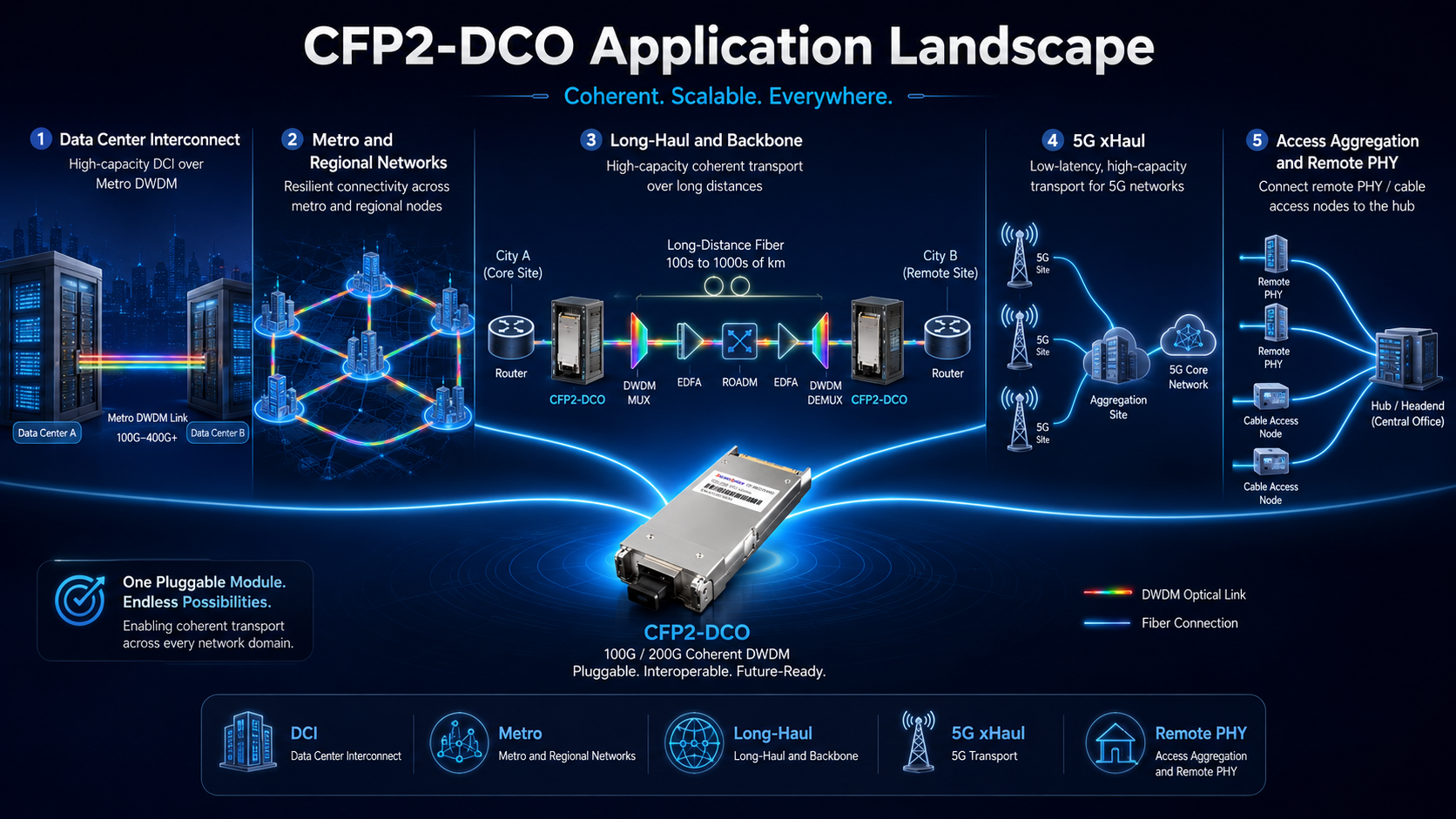
CFP2 DCO modules appear in several network roles:
Data center interconnect (DCI)
Hyperscale and enterprise data centers use 100G, 200G, and 400G coherent pluggables to connect facilities across a metro region. The modules plug directly into router ports, eliminating separate optical transport boxes.
Metro and regional networks
Carriers deploy CFP2 DCO on existing fiber to add high-capacity wavelengths. Tunable lasers let operators reuse the same spare part across many channels.
Long-haul and backbone
With amplification and strong FEC, 100G CFP2-DCO links can reach 2,000 km or more. Higher-rate modes trade reach for spectral efficiency.
5G xHaul
Mobile operators use coherent pluggables for backhaul and midhaul aggregation. The pay-as-you-grow model fits the phased rollout of 5G transport.
Access aggregation and remote PHY
Cable operators use CFP2-DCO modules in remote PHY architectures to move PHY-layer functions closer to subscribers while keeping high-capacity transport simple.
How to Choose the Right CFP2-DCO Module
Selecting a CFP2 DCO transceiver comes down to matching the module’s capabilities to your link requirements. Use this framework:
- 1. Data rate: Choose 100G for maximum reach, 200G for balanced capacity, or 400G for highest spectral efficiency.
- 2. Reach: Check both unamplified and amplified reach ratings. Verify against your actual fiber loss and amplification plan.
- 3. Modulation format: QPSK reaches farther but uses more spectrum. 16QAM carries more bits per symbol but needs a cleaner optical channel.
- 4. Client interface: Confirm whether you need Ethernet, OTN, or both.
- 5. Standards compliance: Match OpenROADM, OpenZR+, or 400ZR requirements to your line system.
- 6. Power and thermal budget: Add module power to your switch or router port budget. CFP2-DCO modules run warmer than direct-detect pluggables.
- 7. Vendor support and compatibility: Ask for compatibility matrices and burn-in test reports.
Deployment Best Practices
A successful CFP2 DCO deployment depends on more than the module itself.
Verify host equipment support. Not every CFP2 slot supports the power and thermal load of a coherent module. Check the host datasheet for CFP2-DCO compatibility and any airflow or heatsink requirements.
Plan the power budget. A fully populated line card with 400G CFP2-DCO modules can draw hundreds of watts. Confirm that your power supplies and cooling can handle the load.
Match fiber type. Most CFP2-DCO modules are characterized on standard single-mode fiber (ITU-T G.652). If you are using G.655 or G.654.E, verify dispersion and nonlinearity assumptions.
Design the DWDM channel plan. Tunable modules still need correct channel assignments, channel spacing, and guard bands. Coordinate with your mux/demux and amplification design.
Use digital diagnostics. CFP2-DCO modules expose DDM/DOM parameters such as optical transmit power, receive power, temperature, and laser bias current. Monitor these values during turn-up and in steady-state operation.
Conclusion
CFP2 DCO modules have made long-reach coherent optics as pluggable as a standard data-center transceiver. By integrating the DSP, tunable laser, and dispersion compensation into a CFP2 form factor, they let network engineers add 100G to 400G wavelengths to routers and switches without building a separate optical transport layer.
While newer coherent pluggable formats such as QSFP-DD DCO and OSFP-DCO target higher port density, CFP2-DCO continues to serve applications where optical performance and thermal margin are priorities.
Key takeaways:
- CFP2 DCO puts the DSP inside the module, simplifying host requirements and improving interoperability.
- It differs from CFP2-ACO in DSP location, power, and deployment flexibility.
- It offers longer reach and more thermal headroom than QSFP-DD DCO, at the cost of port density.
- Standards such as OpenROADM and OpenZR+ determine real-world interoperability.
- Selection should balance data rate, reach, modulation, client interface, standards, power, and vendor compatibility.
Frequently Asked Questions About CFP2-DCO
What is CFP2-DCO and how does it work?
CFP2-DCO (Digital Coherent Optics) is a pluggable coherent optical transceiver that integrates a coherent DSP, optical components, and tunable laser inside the CFP2 module. The built-in DSP performs functions such as modulation, forward error correction (FEC), chromatic dispersion compensation, and polarization impairment compensation, allowing the module to transmit high-capacity signals over metro and long-distance optical networks.
What is the difference between CFP2-DCO and 400ZR?
CFP2-DCO is a broader coherent pluggable platform supporting multiple data rates, modulation formats, and network applications. 400ZR is a specific OIF-defined implementation optimized for 400G Ethernet DCI.
What is the difference between CFP2-DCO and CFP2-ACO?
The main difference between CFP2-DCO and CFP2-ACO is the location of the coherent DSP. CFP2-DCO integrates the DSP inside the optical module, while CFP2-ACO relies on a coherent DSP located on the host line card.
CFP2-DCO provides greater deployment flexibility because it can be installed directly into compatible router or switch ports. CFP2-ACO can offer lower module power consumption but requires specialized host equipment with an integrated coherent processor.
CFP2-DCO vs QSFP-DD DCO: Which one should I choose?
CFP2-DCO is typically selected when optical performance, reach, and thermal margin are the primary considerations. Its larger form factor provides more space for coherent processing and thermal management.
QSFP-DD DCO and OSFP-DCO are designed for higher port density and data center environments, making them attractive for applications such as 400G/800G DCI and high-density switching platforms.
Does CFP2-DCO require a DWDM system?
Most CFP2-DCO deployments are designed for DWDM networks. The integrated tunable laser allows the module to operate on specific wavelength channels in the C-band, making it suitable for metro, regional, and carrier optical networks.
However, deployment requirements depend on the optical architecture, including whether the network uses amplifiers, ROADMs, mux/demux equipment, or open line systems.
Post Views: 1,369