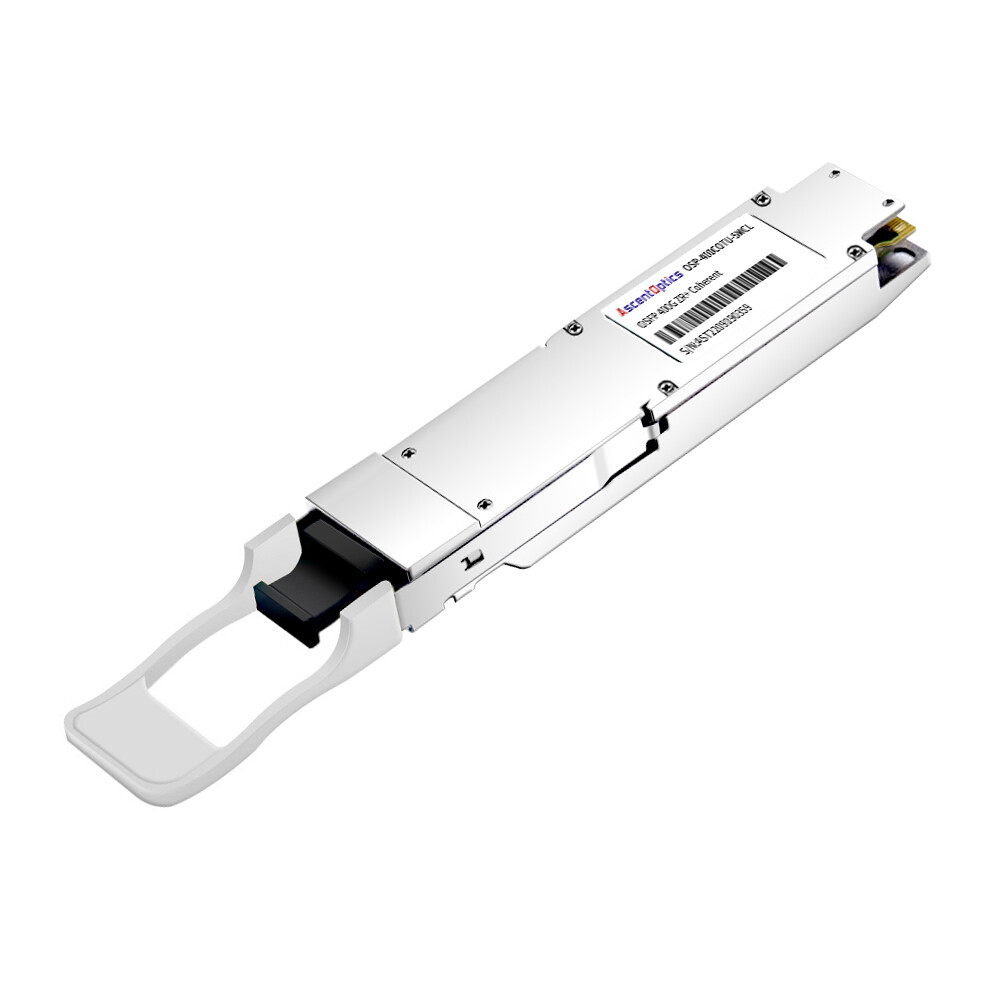
In optical transceiver technology, coherent detection dominates long-haul backbone networks thanks to its superior chromatic dispersion compensation and sensitivity, whereas direct detection leads the short-reach interconnect sector due to its advantages in low power consumption and cost-effectiveness. The two are not mutually exclusive alternatives but rather parallel options within network architectures—representing a balanced trade-off between link distance, capacity requirements, and energy efficiency budgets.
What Is Direct Detection (IM/DD)?
Direct detection, also called intensity modulation with direct detection (IM/DD), is the simplest and most widely deployed optical receiver technology.
How Direct Detection Works
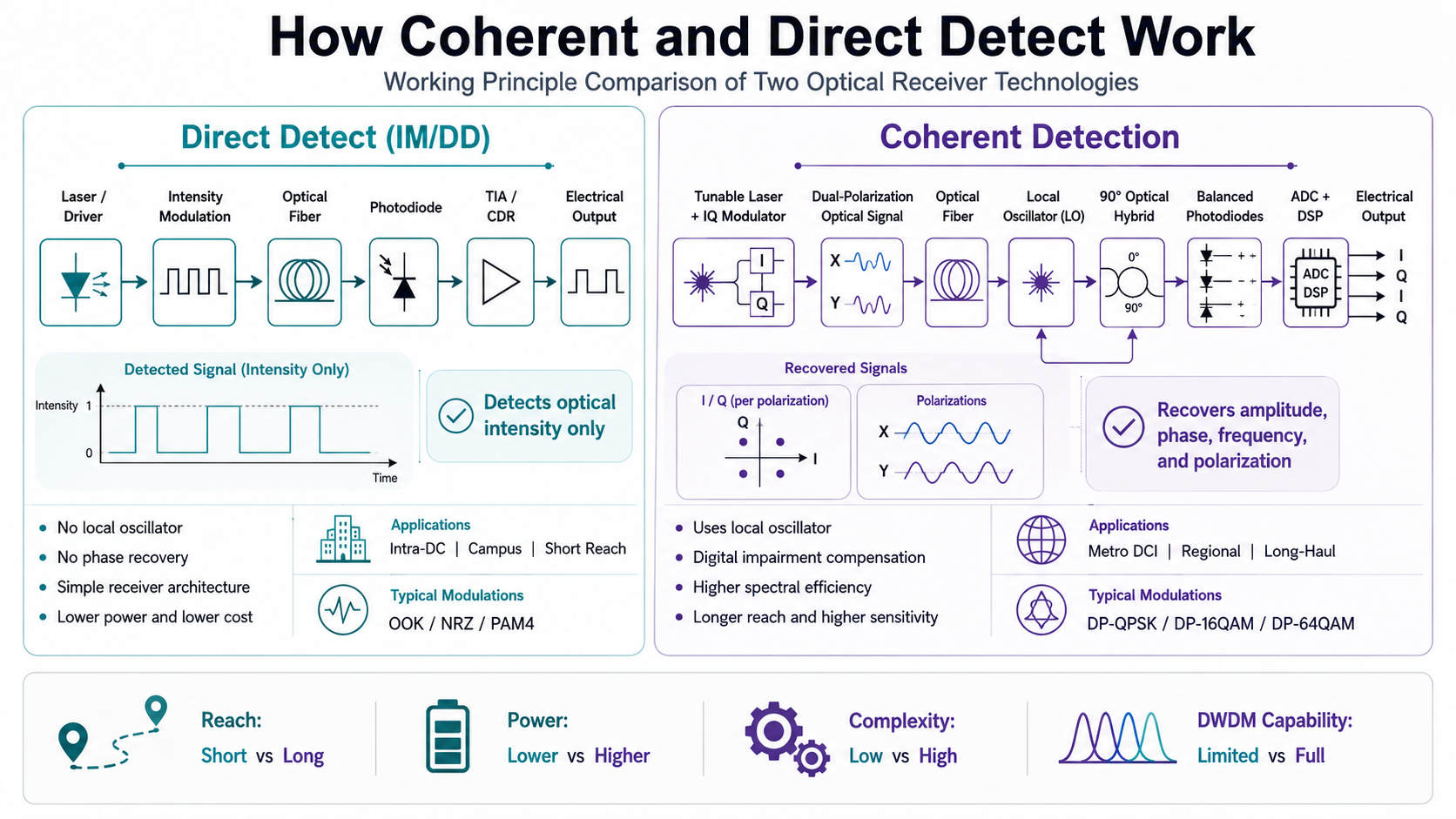
A direct-detect receiver uses a photodiode to measure the optical power of the incoming signal. When the transmitter turns the laser on and off, or varies its intensity, the receiver converts that intensity variation into an electrical current. The receiver does not capture phase, frequency, or polarization information. It only sees the envelope of light.
This simplicity is both a strength and a limitation. Because the receiver discards phase and polarization data, the modulation formats are straightforward. Common formats include on-off keying (OOK), non-return-to-zero (NRZ), and four-level pulse amplitude modulation (PAM4).
Typical Direct Detect Transceivers
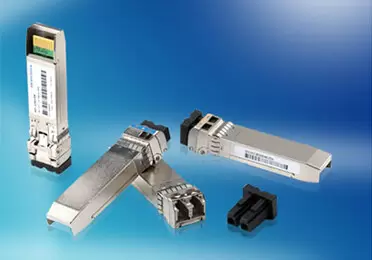
Direct detection dominates the short-reach market. You will find it in modules such as:
- •10G SFP+ SR/LR
- •25G SFP28 SR/LR
- •100G QSFP28 SR4/LR4/PSM4
- •400G QSFP-DDSR8/DR4/FR4/LR4
- •800G OSFP DR8/FR8
These modules comply with Ethernet standards such as 100GBASE-SR4, 400GBASE-DR4, and 400GBASE-FR4. They are plug-and-play, hot-swappable, and compatible with switches from major networking vendors.
Strengths and Limitations
Direct detection wins on three fronts: cost, power, and simplicity.
Lower cost. The transmitter and receiver need only a laser and a photodiode. There is no local oscillator, no 90-degree optical hybrid, and no high-speed digital signal processor (DSP).
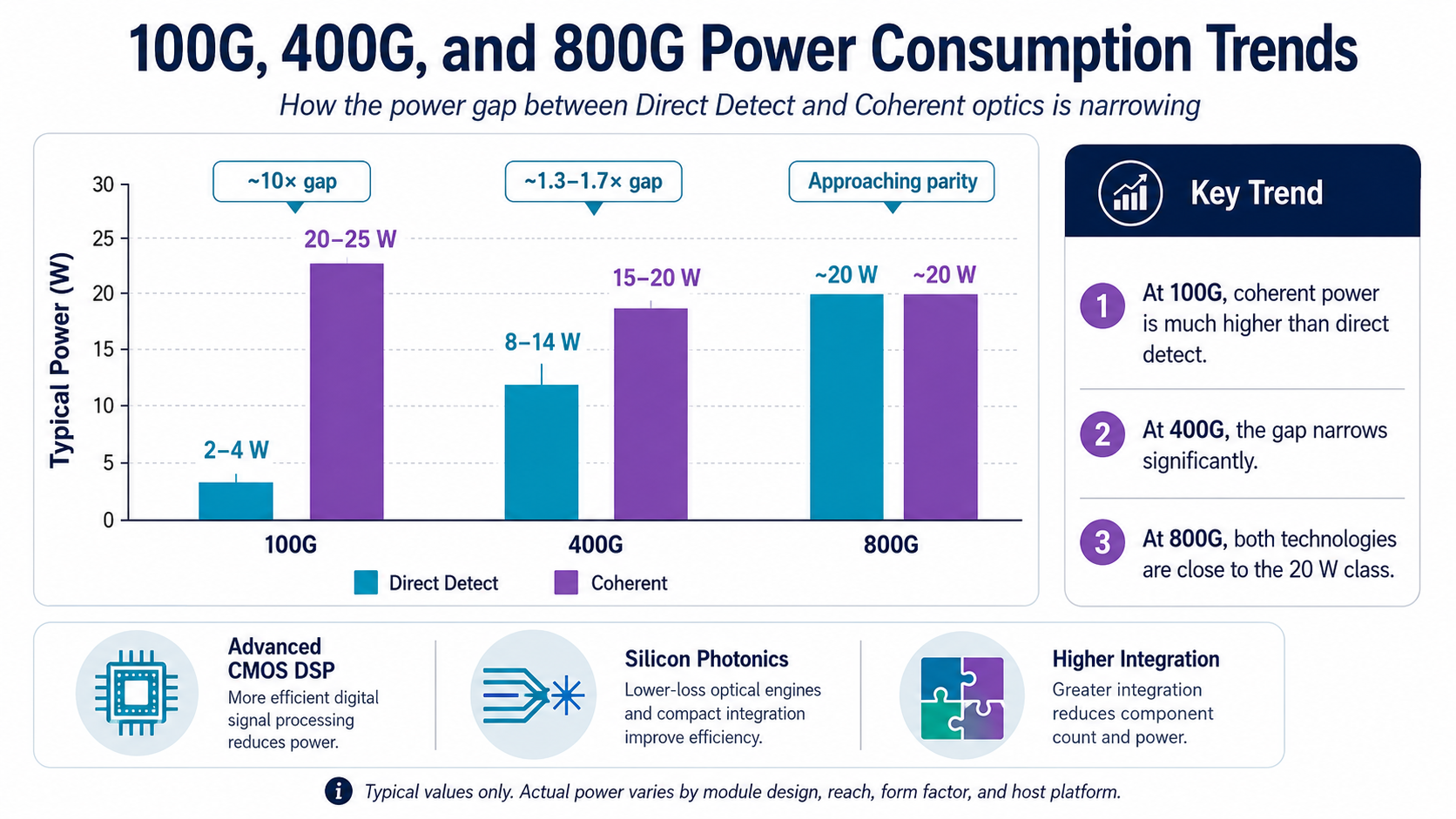
Lower power. A 400G direct-detect module typically draws 8–14 W, depending on reach and form factor.
Simpler deployment. Network engineers can treat these modules like standard Ethernet ports. There is no wavelength planning or polarization alignment.
The limitations become visible as distance and data rate grow. Direct detect has low tolerance to chromatic dispersion and polarization-mode dispersion (PMD). As transmission distance increases, chromatic dispersion and optical impairments become more challenging for direct-detect systems. While modern IM/DD technologies can support extended-reach applications in certain scenarios, coherent detection generally becomes the preferred solution for metro and long-distance DWDM networks.
What Is Coherent Detection?
Coherent detection is the technology behind long-haul, metro, and high-capacity optical networks. Instead of measuring intensity alone, it recovers the full optical field.
How Coherent Detection Works
A coherent receiver mixes the incoming optical signal with a local oscillator (LO) laser. The combined signal is fed into a 90-degree optical hybrid and balanced photodetectors. This process preserves amplitude, phase, frequency, and polarization information.
A high-speed analog-to-digital converter (ADC) digitizes the received waveform. Then a DSP chip performs compensation for chromatic dispersion, PMD, polarization crosstalk, and carrier phase noise. The result is a robust signal that can travel hundreds or thousands of kilometers without optical dispersion compensation in the line.
Typical Coherent Transceivers
Coherent technology appears in several form factors:
- •100G/200G CFP2-DCO (digital coherent optics)
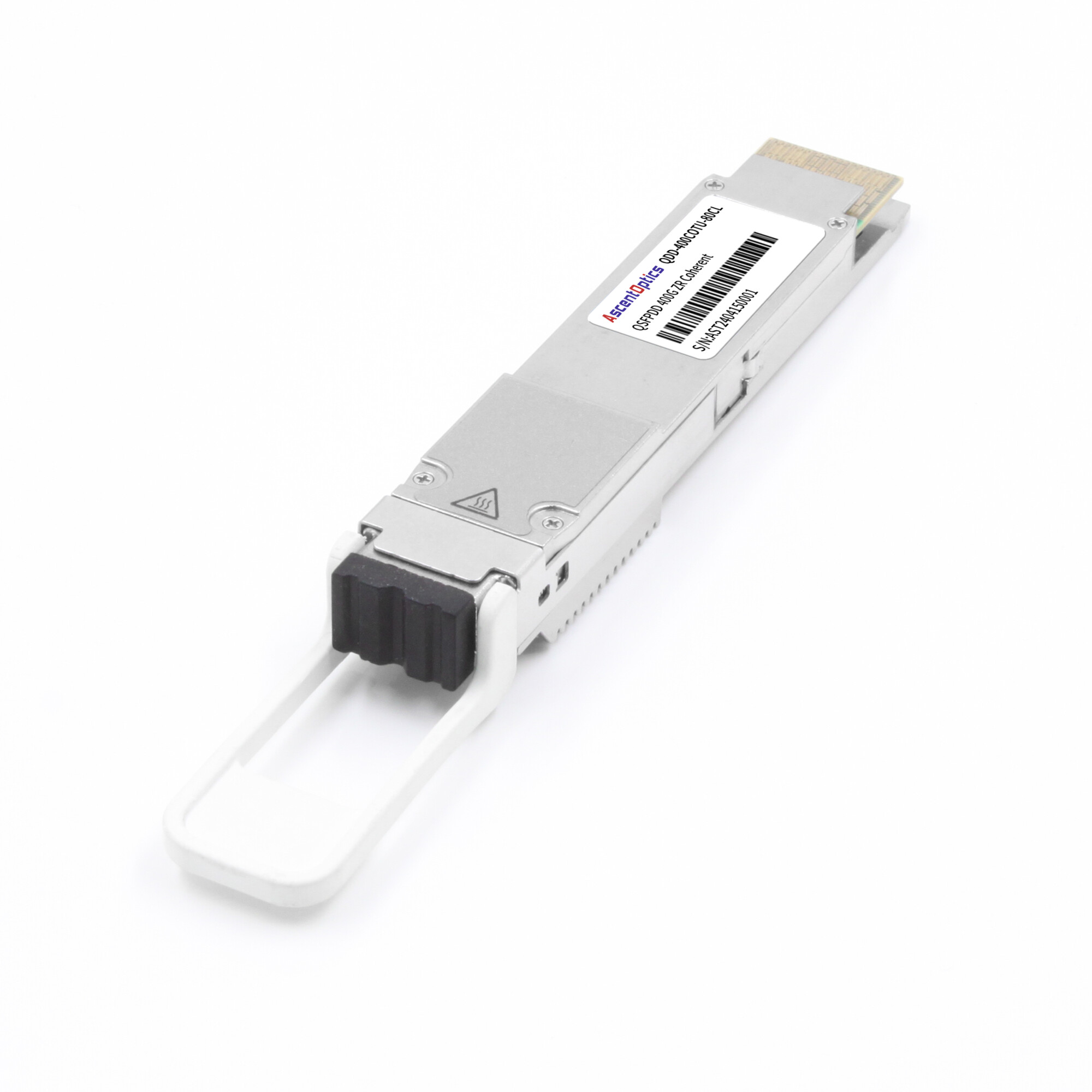
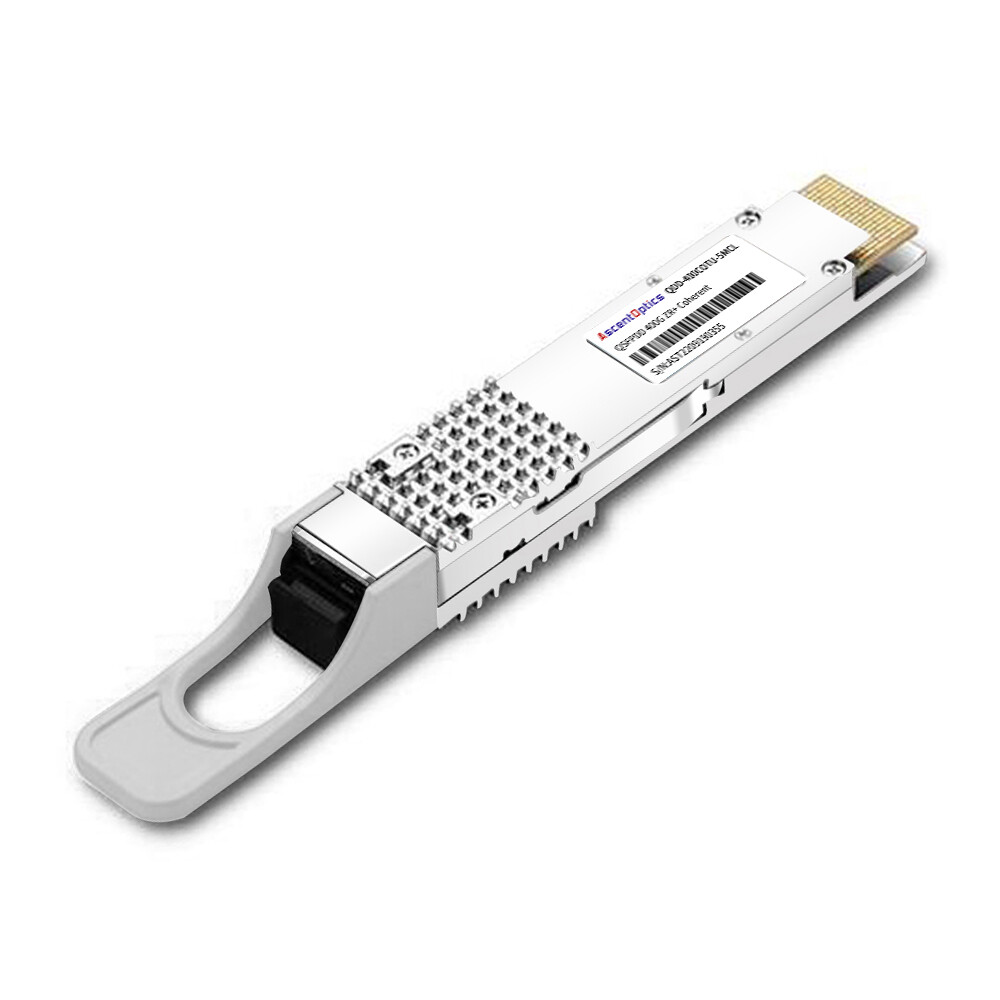
- •400G QSFP-DD ZR and ZR+
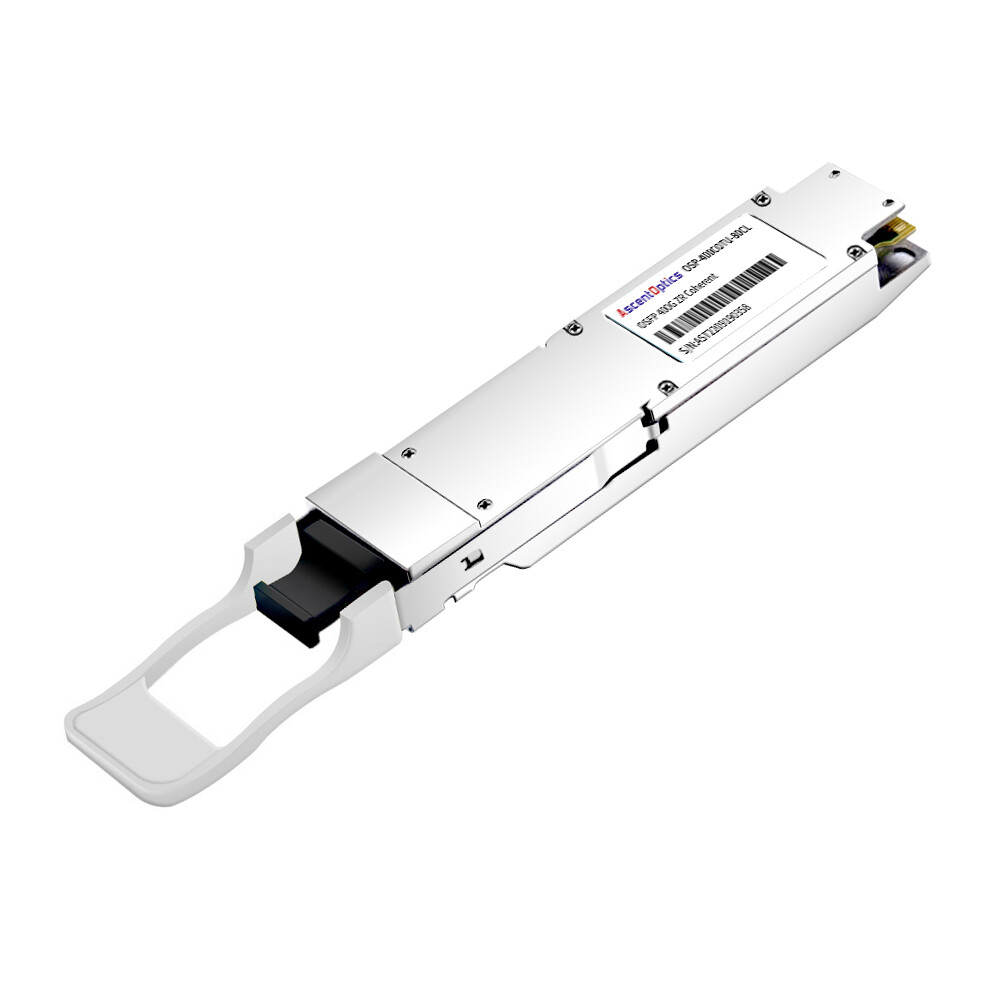
- •800G OSFP ZR and ZR+
- •Embedded coherent line cards for long-haul DWDM systems
These modules use advanced modulation formats such as dual-polarization quadrature phase-shift keying (DP-QPSK), DP-16QAM, and DP-64QAM. Each constellation point encodes multiple bits, which is why coherent systems achieve much higher spectral efficiency than IM/DD systems.
Strengths and Limitations
Coherent detection delivers three major advantages.
Long reach. A coherent receiver can operate over hundreds to thousands of kilometers. The DSP digitally compensates for dispersion that would cripple a direct-detect link.
High spectral efficiency. Coherent systems can achieve 4× to 8× higher spectral efficiency substantially higher spectral efficiency than direct-detect systems, according to industry analyses. This matters in DWDM networks where every gigahertz of spectrum has a cost.
Better receiver sensitivity. Coherent detection can offer 15–20 dB better receiver sensitivity than direct detection, reducing the need for amplifiers and repeaters on long links. Coherent detection provides significantly higher receiver sensitivity and OSNR tolerance than direct detection, enabling reliable transmission over much longer distances.
The trade-offs are higher power consumption, higher cost, and greater complexity. A 400G ZR coherent pluggable typically draws 15–20 W. The DSP, tunable laser, and precision optics add cost and thermal load. Wavelength control and firmware calibration also require more operational attention.
Coherent vs Direct Detect: Side-by-Side Comparison
The fastest way to understand the trade-offs is to compare the two technologies directly.
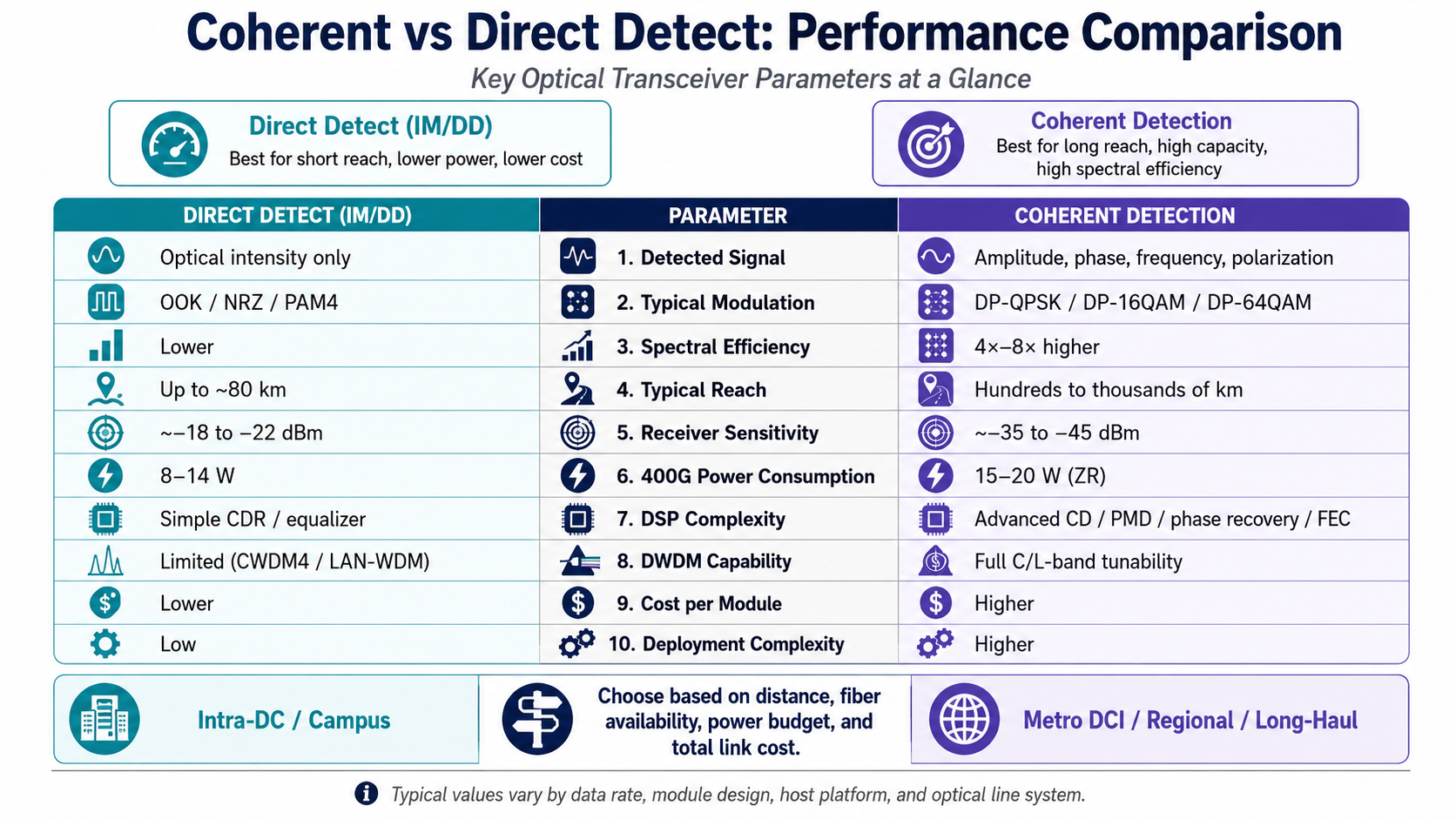
| Parameter |
Direct Detection (IM/DD) |
Coherent Detection |
| Detected signal |
Optical intensity only |
Amplitude, phase, frequency, polarization |
| Modulation formats |
OOK, NRZ, PAM4 |
DP-QPSK, DP-16QAM, DP-64QAM |
| Spectral efficiency |
Lower |
4× to 8× higher |
| Typical reach |
Up to ~80 km |
Hundreds to thousands of km |
| Receiver sensitivity |
~−18 to −22 dBm |
~−35 to −45 dBm |
| 400G power consumption |
8–14 W |
15–20 W (ZR) |
| DSP complexity |
Simple CDR/equalizer |
Complex CD, PMD, phase recovery, FEC |
| DWDM capability |
Limited (CWDM4, LAN-WDM) |
Full C/L-band tunability |
| Cost per module |
Lower |
Higher |
| Deployment complexity |
Low |
Higher |
Key Takeaways from the Comparison
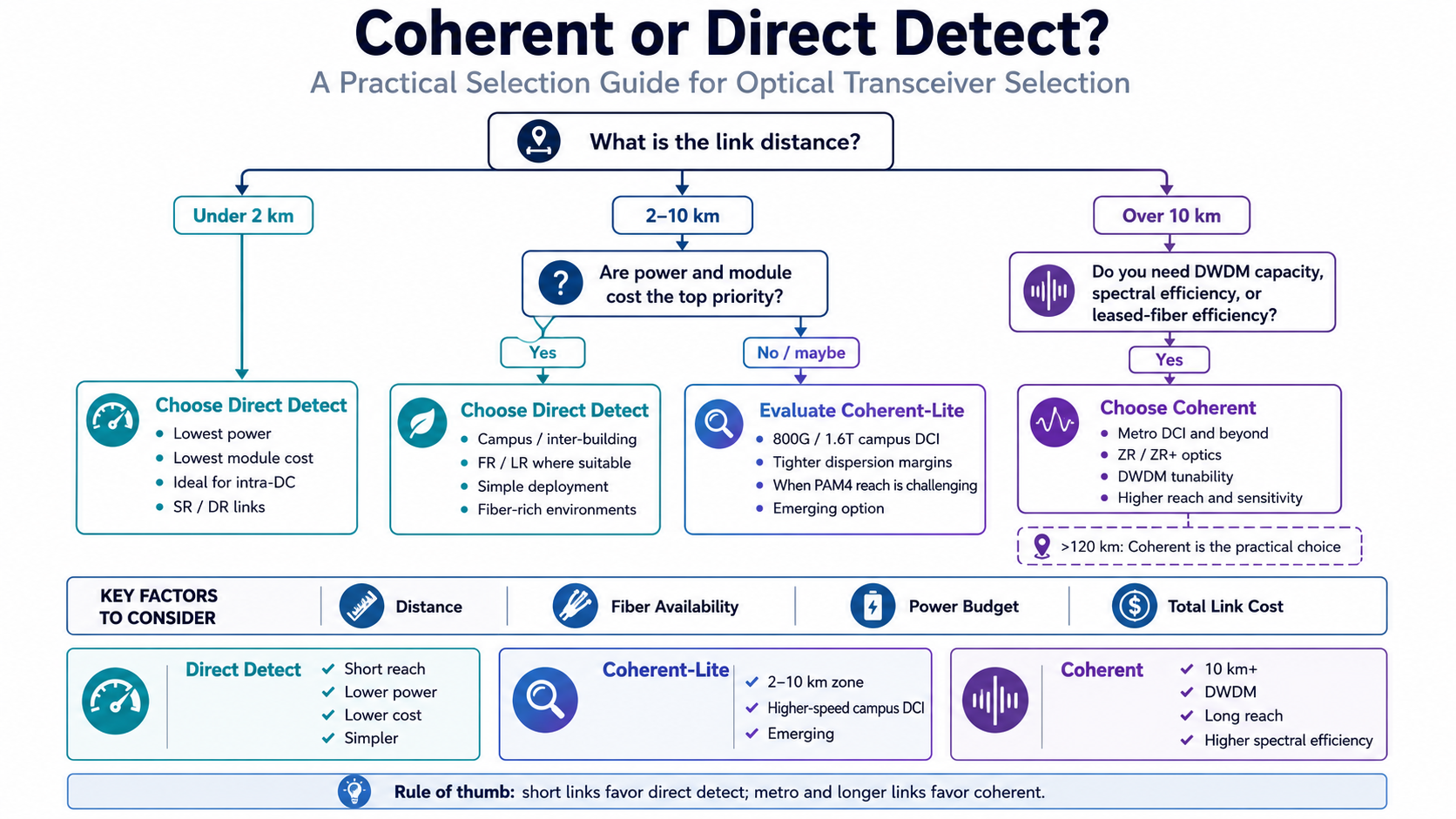
Direct detection is the right tool when the link is short, fiber is plentiful, and cost and power matter most. It is the dominant technology inside data centers and for campus interconnects under 10 km.
Coherent detection is the right tool when reach, capacity, or spectral efficiency is the priority. It dominates metro DCI, regional networks, and long-haul DWDM.
The gap between the two is not static. Over the past decade, coherent technology has moved down the reach curve while direct detect has pushed up the data-rate curve. The result is an increasingly competitive middle ground around 10 km and 400G–800G.
Application Boundaries: Where Each Technology Wins
Distance is the simplest rule of thumb, but it is not the only factor. Here is how the two technologies map to real network segments.
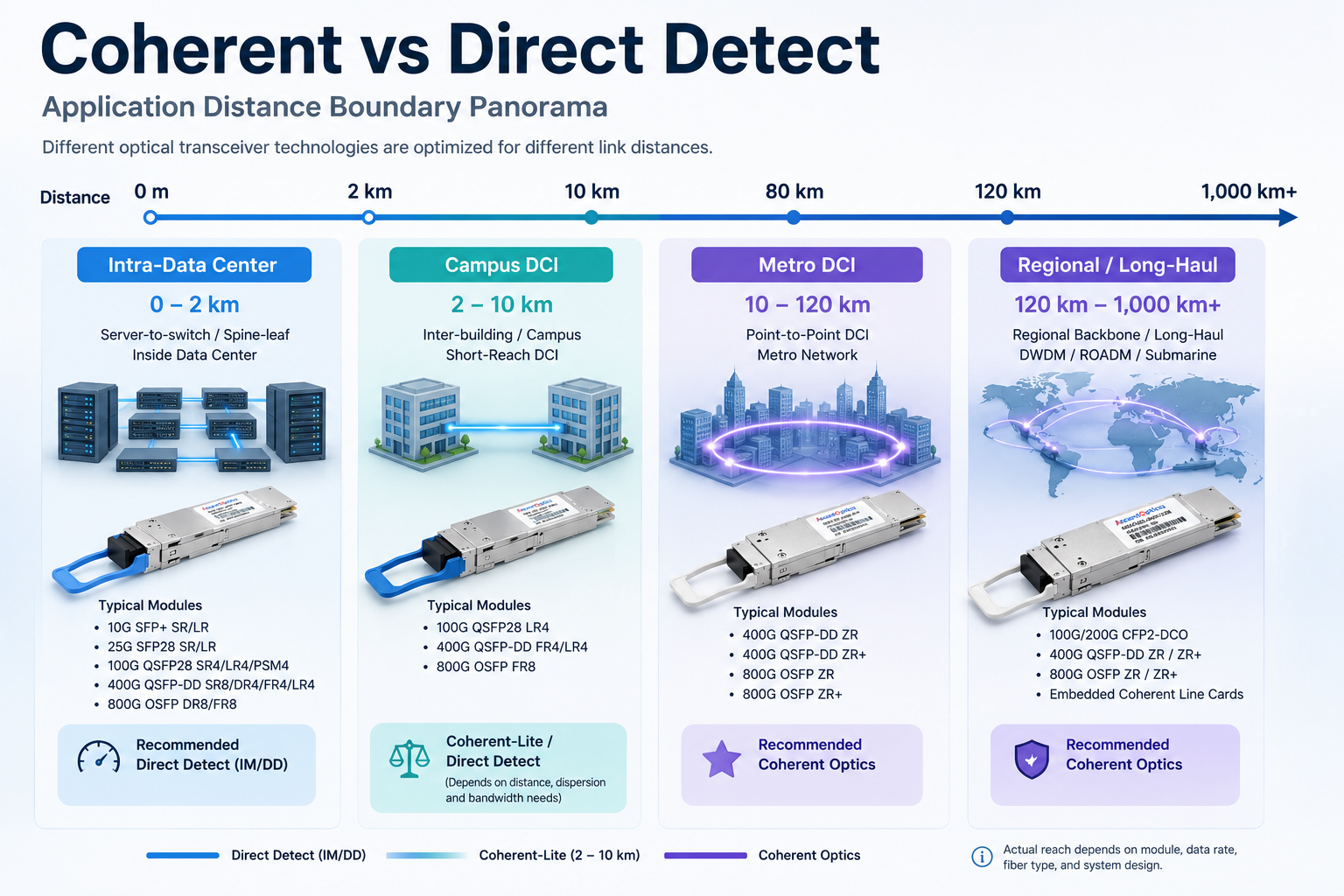
Intra-Data Center (< 2 km)
Inside the data center, direct detection is the clear winner. Spine-leaf and server-to-switch links are short, fiber is abundant, and cost per gigabit drives purchasing decisions.
Sarah, a data center operations manager, needed to upgrade her spine fabric to 400G. Her longest intra-DC link was 800 meters. She chose 400G-DR4 direct-detect modules. The lower power and lower cost were impossible to justify giving up for capabilities she did not need.
Common modules in this zone include 400G-SR8, 400G-DR4, 400G-FR4, and 800G-DR8.
Campus DCI (2–10 km)
Campus and inter-building links are traditionally direct-detect territory. 400G-FR4 and 400G-LR4 modules can cover these distances without coherent hardware.
However, a new category called coherent-lite is emerging. Coherent-lite modules target the 2–10 km range with power consumption closer to direct detect. They offer better dispersion tolerance than PAM4 direct detect, which matters when fiber quality is variable or when the link budget is tight.
At 800G and 1.6T, coherent-lite may become more attractive because PAM4 direct detect would require many parallel lanes and fibers.
Metro DCI (10–120 km)
Metro data center interconnect is where coherent pluggables have taken over. The OIF 400ZR standard made it possible to plug a coherent 400G transceiver directly into a router or switch port and reach 80–120 km without external muxponders or dispersion-compensating fiber.
This is exactly the zone where Marcus from our opening story operates. A 400G ZR coherent module gave him a single-wavelength, single-pluggable solution for his 80 km link. The alternative would have been direct-detect modules plus a managed optical line system, which would have cost more and consumed more rack space.
Regional and Long-Haul (>120 km)
For regional and long-haul transport, coherent detection is the only practical choice. Embedded digital coherent optics (DCO) and dedicated DWDM line cards use DP-QPSK or lower-order QAM to maximize reach. These systems can span thousands of kilometers across telecom backbones and submarine cables.
Power and Cost Convergence Trends
One of the most important shifts in optical networking is the narrowing power gap between coherent and direct-detect transceivers.
The Power Gap Is Closing
At 100G, the gap was enormous. A coherent transceiver might draw 20–25 W, while a direct-detect equivalent drew 2–4 W. That is roughly a 10× difference.
At 400G, the gap shrinks to roughly 1.3–1.7×. A direct-detect QSFP-DD module draws 8–14 W, while a 400G ZR coherent module draws 15–20 W.
At 800G, power consumption is approaching parity. Both direct-detect and coherent modules are in the 20 W range, driven by advances in CMOS DSP nodes and silicon photonics.
Total Cost of Ownership Matters
Module cost is only one line item. The full link cost includes fiber, amplifiers, dispersion compensation, muxponders, cooling, and operational complexity.
On a short, fiber-rich link, direct detect wins because the extra coherent capabilities add no value. On a longer link, coherent often wins because it eliminates the need for DCF, external muxponders, and additional amplification. Fewer components mean fewer failure points and simpler operations.
According to industry analysis, coherent optics frequently become the lower-TCO option at distances above roughly 10–40 km, even when the module itself costs more.
How to Choose: A Network Engineer’s Decision Framework
Use this framework to move from theory to a procurement decision.
Decision Matrix
| Factor |
Favor Direct Detect |
Favor Coherent |
| Distance |
< 10 km |
> 10 km |
| Data rate |
10G–400G short reach |
100G+ metro/regional |
| Fiber availability |
Fiber-rich environments |
Fiber-constrained or leased fiber |
| Power budget |
Strict thermal/power limits |
More flexible power budget |
| DWDM requirement |
No DWDM or simple CWDM |
Full DWDM/C-band tunability |
| Cost priority |
Lowest module cost |
Lowest total link cost |
| Fiber Utilization |
Multiple parallel fibers |
Single wavelength DWDM |
Practical Selection Rules
Choose direct detect when:
- •The link is under 10 km.
- •Power and cost are primary constraints.
- •Fiber is readily available.
- •You do not need DWDM tunability.
Choose coherent when:
- •The link exceeds 10 km.
- •You need DWDM capacity or spectral efficiency.
- •You want to eliminate DCF and external muxponders.
- •You are building metro, regional, or long-haul infrastructure.
Evaluate coherent-lite when:
- •You are planning 800G or 1.6T campus DCI.
- •Fiber quality or dispersion is a concern.
- •You need more reach than PAM4 can reliably deliver.
Coherent and Direct Detect Modules from AscentOptics
Direct-Detect Portfolio
AscentOptics supplies direct-detect modules from 100M to 800G, including SFP, SFP+, SFP28, QSFP+, QSFP28, QSFP-DD, and OSFP form factors. These modules comply with MSA and IEEE standards for plug-and-play compatibility with major switch and router platforms.
For metro DCI and high-capacity transport, AscentOptics offers coherent optical modules including 100G, 400G, and 800G options. These modules support ZR/ZR+ standards and provide the long reach, DWDM tunability, and DSP-based impairment compensation that coherent detection enables.
OEM and ODM Support
Network equipment vendors and system integrators can leverage AscentOptics OEM and ODM services for customized optical modules. Customization options include labeling, firmware, form factor, reach, and compatibility tuning for specific switch platforms.
Conclusion
The coherent vs direct detect choice comes down to a simple trade-off. Direct detection gives you simplicity, low power, and low cost for short-reach links. Coherent detection gives you reach, spectral efficiency, and digital impairment compensation for metro, regional, and long-haul networks.
Here are the key takeaways:
- •Direct detection measures optical intensity and is ideal for intra-DC and campus links under 10 km.
- •Coherent detection recovers amplitude, phase, and polarization, enabling long-reach and DWDM applications.
- •The power gap between the two technologies has narrowed from roughly 10× at 100G to near parity at 800G.
- •Coherent pluggables such as 400G ZR and 800G ZR have made coherent technology practical for metro DCI.
- •Coherent-lite is emerging as an option for 2–10 km campus DCI at higher data rates.
- •Total cost of ownership, not module cost alone, should drive the final decision.
As data rates climb toward 1.6T and AI networking reshapes traffic patterns, the boundary between these two technologies will continue to shift. Network engineers who understand both detection methods will make better procurement decisions today and be ready for the next upgrade cycle.
Rather than replacing one another, direct-detect and coherent technologies will continue to coexist, each serving different network layers as bandwidth demands grow from 400G to 800G and beyond.
Post Views: 1,342