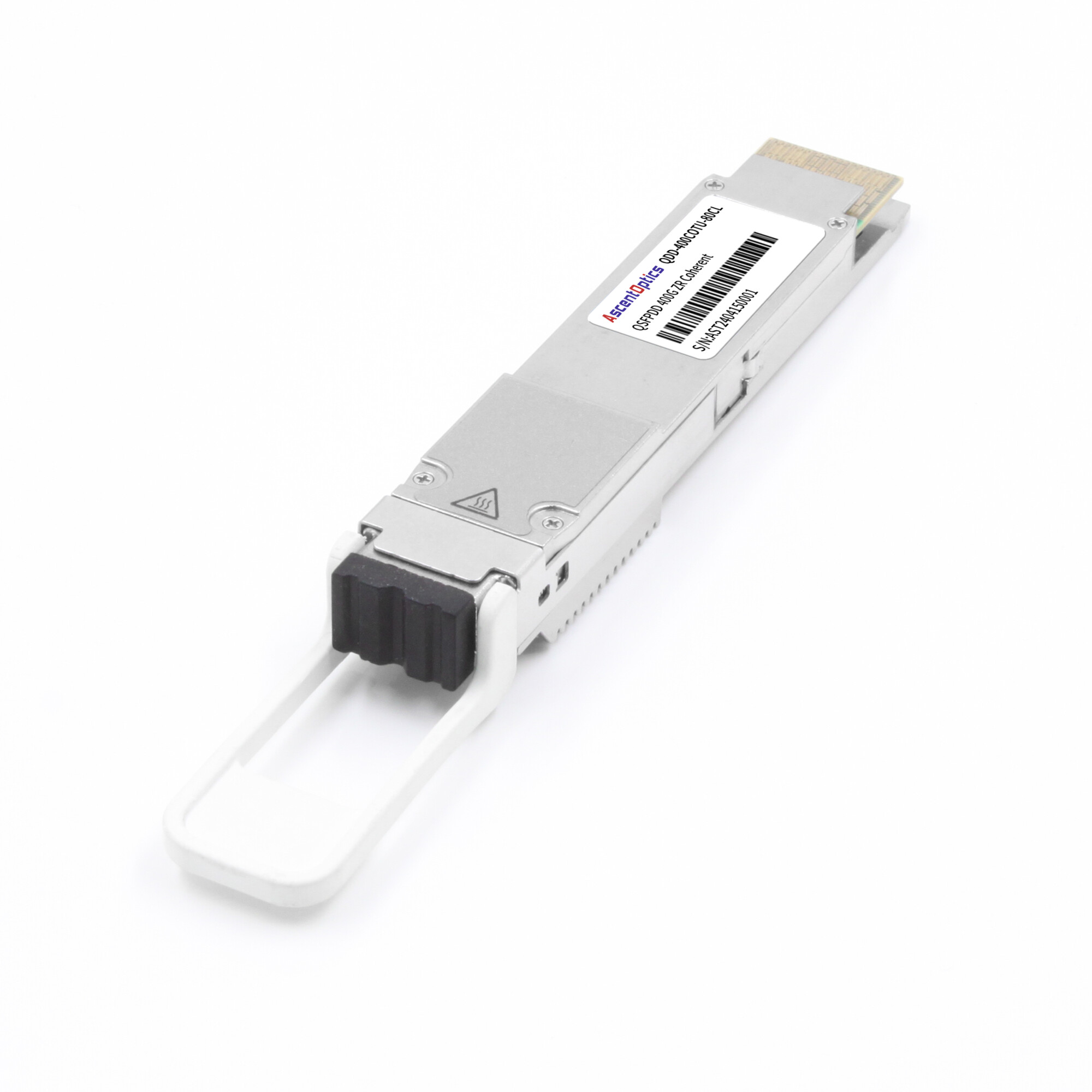
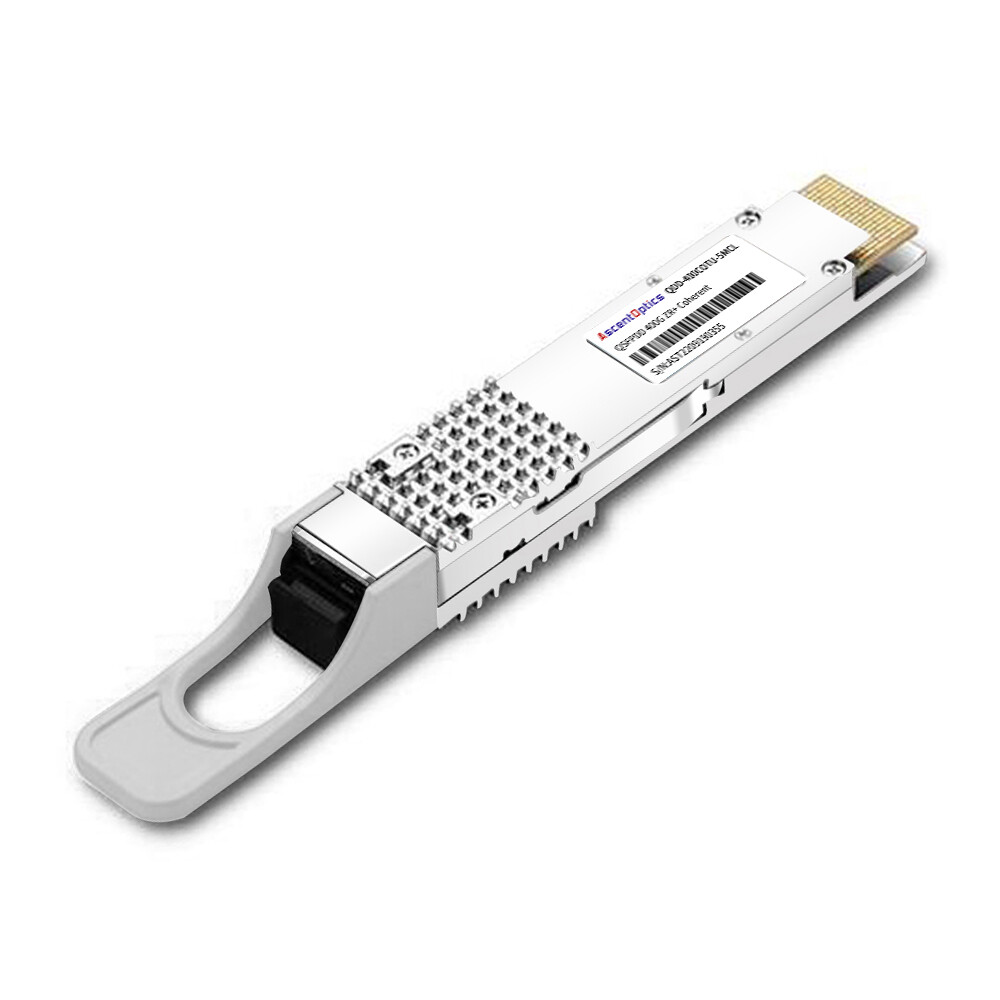
In early 2025, a regional service provider in the Midwest faced a critical network upgrade decision. They needed to increase capacity to 400G over an 85 km metro ring connecting two data centers, with three ROADM nodes in the path. The engineering team tested standard QSFP-DD ZR modules, but the -10 dBm transmit power proved insufficient to traverse the existing DWDM infrastructure.
They then trialed high-power ZR+ variants. During deployment, however, they discovered that the router vendor did not support the additional modulation modes. The result was a six-week procurement delay while the vendor performed OpenZR+ interoperability validation in their multi-vendor environment.
This real-world scenario highlights why network architects must deeply understand coherent optics standards. The differences between 400ZR, ZR+, and OpenZR+ are not just technical details — they can determine the success or failure of your deployment. This guide provides a clear overview of 400G ZR QSFP-DD standards, specifications, and selection criteria for coherent pluggable optics in metro and long-haul networks.
Understanding QSFP-DD ZR Coherent Optics Technology
QSFP-DD ZR Coherent Optics presents a sea of change in the field of optical transportation architecture. Unlike with traditional direct-detection optical modules, these coherent optical transmit-and-receive devices package Digital Coherent Optics (DCO) together with highly sophisticated Digital Signal Processors (DSPs) in the QSFP-DD form factor. Understanding digital coherent optics becomes important for network architects who are planning to upgrade a metro or long-haul network.
What Makes Coherent Optics Different from Direct Detection
The traditional optical modules encode the data by modulating the intensity of the received light, though the coherent optics alternatively depend on amplitude-and-phase modulation with further polarization multiplexing to achieve higher spectral efficiency. If we take the 400G QSFP-DD ZR module encoding data at 60 Gbaud with DP-16QAM levels, then six bits in each symbol can present 400 Gbps of performance metrics with respect to throughput per wavelength.
Coherent reception employs a local oscillator laser and advanced DSP for phase recovery. This dramatically improves optical signal-to-noise ratio (OSNR) tolerance, enabling reliable transmission over distances well beyond 100 km without regeneration.
Digital Signal Processor Integration in QSFP-DD
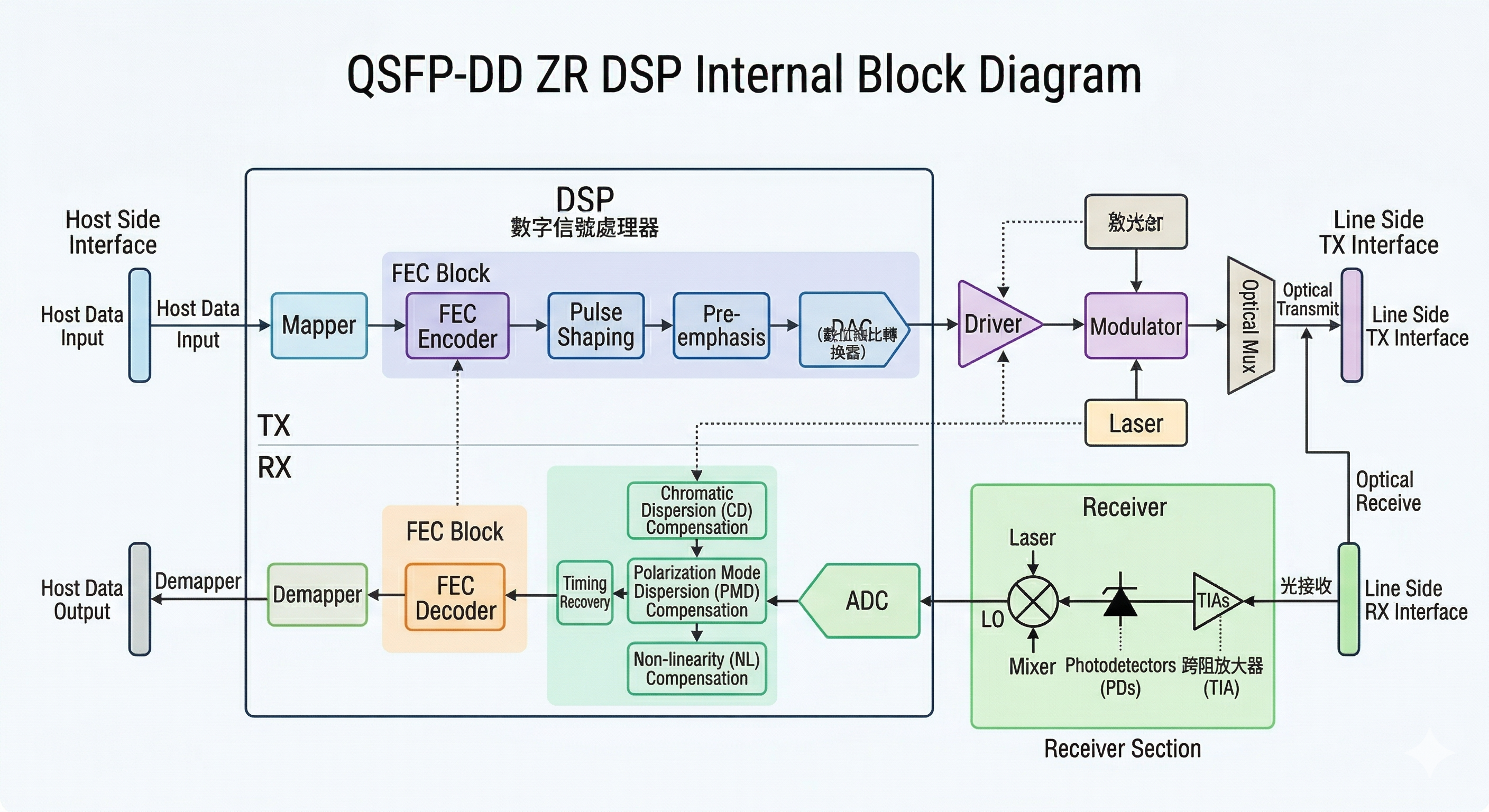
The DSP inside a QSFP-DD ZR module performs several critical functions:
- •Forward Error Correction (FEC): Implements concatenated FEC algorithms to correct transmission errors
- •Chromatic Dispersion Compensation: Electronically compensates for up to 2,400 ps/nm of accumulated dispersion
- •Polarization Mode Dispersion (PMD) Mitigation: Corrects for polarization-related signal distortions
- •Carrier Phase Recovery: Maintains synchronization between transmitter and receiver lasers
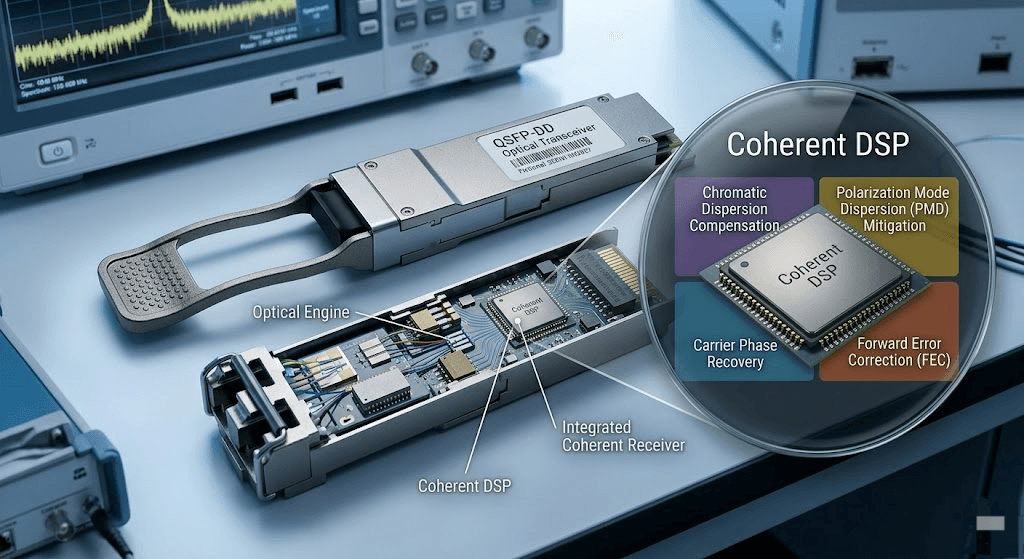
Implementing these functionalities for a QSFP-DD module demanded significant technological advances in 7nm CMOS. The very first coherent transceivers needed separate line cards; in contrast, QSFP-DD ZR modules in turn squeeze-in corresponding functionalities into a 18.35mm-wide implementable.
OIF 400ZR Standard Overview
The Optical Internetworking Forum (OIF) released the 400ZR Implementation Agreement in 2020, with commercial deployments beginning in 2021. This standard defines:
- •Physical Interface: QSFP-DD or OSFP form factor, duplex LC connector
- •Modulation: Fixed DP-16QAM at 59.84 Gbaud
- •FEC: Concatenated FEC (C-FEC) with 15% overhead
- •Reach: 80-120 km over amplified links, 40-80 km unamplified
- •Transmit Power: Standard -10 dBm, high-power 0 dBm variants
The OIF 400ZR standard guarantees multi-vendor interoperability, enabling carriers to mix equipment from different suppliers within the same network.
For a comprehensive overview of QSFP-DD form factors and specifications, see our guide to 400G/800G QSFP-DD optical modules.
400G ZR vs ZR+ vs OpenZR+: Standards Comparison
Three main standards dominate the market. Network engineers must understand their differences when selecting modules.
OIF 400ZR (Base Standard)
The original 400ZR standard targets data center interconnect and metro point-to-point applications. Key characteristics include:
- •Fixed Configuration: Single 400G rate, DP-16QAM modulation only
- •Standard Reach: 80-120 km with amplification, 40-80 km without
- •Transmit Power: -10 dBm (standard) or 0 dBm (high-power)
- •FEC: Concatenated FEC (C-FEC)
- •Client Interface: 400GE or OTU4
Most other DCI links would not require anything more challenging than the standard 400ZR since the beam quality limit, at about-10 dBm. External amplification would be required as the signal goes through ROADM nodes. It is remarkable that the fixed rate of 400G does not allow the module to be flexible enough to support native services.
ZR+ (Extended Reach)
ZR+ refers to vendor-specific extensions beyond the base 400ZR specification. Capabilities vary by manufacturer but typically include:
- •Extended Reach: Up to 400-600 km
- •Higher Transmit Power: 0 dBm standard, up to +1 dBm on some variants
- •Enhanced FEC: Soft-decision FEC (SD-FEC) or proprietary algorithms
- •ROADM Compatibility: High-power variants support multiple filter cascades
Note: The term “ZR+” lacks standardization. Some vendors use it for OpenZR+-compliant modules; others apply it to proprietary extensions. Always verify specific capabilities with the manufacturer before procurement.
OpenZR+ MSA (Multi-Source Agreement)
Developed by Microsoft, Cisco, Marvell (Inphi), and others, OpenZR+ addresses the limitations of fixed-configuration 400ZR. This open standard provides:
| Feature |
OpenZR+ Capability
|
| Multi-Rate Support |
100G, 200G, 300G, 400G (software-selectable)
|
| Modulation Flexibility |
DP-QPSK, DP-8QAM, DP-16QAM
|
| Maximum Reach |
480-1,000+ km (rate-dependent)
|
| FEC Options |
Open FEC (o-FEC), CFEC, SD-FEC
|
| Transmit Power |
-10 dBm to +4 dBm (configurable)
|
| Client Interfaces |
400GE, 4×100GE, 2×100GE, OTU4, OTUCn
|
OpenZR+ is a technique that empowers real “routed optical networking.” Thus, such fiber-optic internet connection lets coherent pluggables plug directly into router ports instead of residing on separate shelves. Multi-rates, by making it possible to do, allow the directories of network operators to sacrifice a degree of bandwidth, depending on circumstances, to improve the reach.
Key Technical Differences Summary
| Parameter |
400ZR |
ZR+ |
OpenZR+ |
| Standard Body |
OIF |
Vendor-specific |
OpenZR+ MSA |
| Multi-Vendor Interop |
Guaranteed |
Varies |
Guaranteed |
| Multi-Rate Support |
No |
Varies |
Yes (100G-400G) |
| Max Reach (400G) |
120 km |
400-600 km |
480 km |
| ROADM Compatible |
HP only |
Yes (usually) |
Yes (with HP) |
| Flex-Grid Support |
No |
Varies |
Yes |
QSFP-DD ZR Specifications and Technical Performance
Selecting the appropriate coherent module requires understanding key performance parameters beyond simple reach numbers.
400G Coherent Pluggable Optics: Overview
To grasp the essence of 400G coherent pluggable optics, one needs to comprehend how such modules are seamlessly blending together DSP functions and advanced modulation and optical components into a QSFP-DD form factor; thus, myriads of such routers with optical transport capabilities have done away with traditional transponder layers.
Reach Distances: Unamplified vs Amplified Operation
Reach varies significantly by network configuration:
Unamplified Operation
- •400ZR Standard: 40-60 km
- •400ZR High Power: 80 km
- •OpenZR+ (400G): 80-120 km
Amplified Single-Span
- •400ZR: 80-120 km
- •ZR+: 200-400 km
- •OpenZR+ (400G): 480 km
Multi-Span with Regeneration
- •OpenZR+ (200G QPSK): 1,000+ km
- •OpenZR+ (100G QPSK): 2,000+ km
Actual achievable distance depends on fiber quality, amplifier placement, and required margin for aging and repairs. Network engineers should design with at least 3 dB of margin beyond calculated requirements.
Modulation Formats: DP-16QAM, 8QAM, QPSK Trade-offs
OpenZR+ modules support multiple modulation formats, enabling flexible bandwidth-reach trade-offs:
- •DP-16QAM: 400G capacity, ~480 km maximum, requires higher OSNR
- •DP-8QAM: 300G capacity, ~600 km maximum, moderate OSNR requirements
- •DP-QPSK: 200G or 100G capacity, 1,000+ km range, most robust to noise
Selecting the appropriate modulation requires calculating link OSNR and comparing against the module’s OSNR threshold. Typical thresholds range from 23.5 dB/0.1nm for 400G 16QAM to 15 dB/0.1nm for 100G QPSK.
Power Consumption: Standard vs High-Power Variants
Power consumption directly impacts router thermal design and operational costs:
| Module Type |
Typical Power
|
Maximum Power
|
| 400ZR Standard |
15-17W
|
18W
|
| 400ZR High Power |
17-19W
|
20W
|
| ZR+ Standard |
18-20W
|
22W
|
| OpenZR+ Multi-Rate |
16-23W
|
25W
|
A fully populated 32-port router line card with OpenZR+ modules can dissipate over 700W. Thermal planning must account for worst-case power during temperature extremes, not typical operating conditions.
OSNR Requirements and Link Budget Calculations
Optical Signal-to-Noise Ratio (OSNR) determines whether a coherent link will operate reliably. The link budget calculation includes:
- •Transmitter Output Power: Standard (-10 dBm) or High Power (0 dBm)
- •Fiber Attenuation: Typically 0.20-0.25 dB/km for modern single-mode fiber
- •Connector Losses: 0.5 dB per connection
- •Amplifier Gain: EDFA typically provides 17-23 dB gain
- •Amplifier Noise Figure: 4.5-6 dB typical
- •Required OSNR: Module-dependent (23-26 dB for 400G)
Modern link planning tools automate these calculations, but understanding the fundamentals enables engineers to identify when vendor-provided estimates appear optimistic.
ROADM and DWDM Compatibility
Perhaps the most critical selection criterion for coherent modules is compatibility with existing optical transport infrastructure.
Standard vs High-Power Transmit Options
The distinction between -10 dBm and 0 dBm transmit power determines ROADM compatibility:
Standard Power (-10 dBm)
- •Suitable for point-to-point dark fiber
- •Cannot traverse ROADM filter cascades
- •Lower cost and power consumption
- •Best for simple DCI applications
High Power (0 dBm or higher)
- •Required for ROADM network insertion
- •Supports multiple filter passes (typically 3-6 ROADM nodes)
- •Enables IP-over-DWDM architectures
- •Higher cost and thermal load
A case from the real world: The metro network in Europe asked for 400G coherent pluggables. When the lowest-cost, standard-power 400ZR modules suitable for routing through existing ROADM nodes were introduced, it was found that the -10 dBm signal would dip below filter insertion losses. The retrofit with high-power modules cost 40% more than the initial version, requiring a further three-month delay in service activation.
C-Band Tunable Wavelength Support
QSFP-DD ZR coherent modules tune across the C-band (1530-1565 nm), supporting 96 50-GHz-spaced channels or 128 75-GHz-spaced channels. Tunability enables:
- •Flexible wavelength assignmentwithout module swaps
- •Dynamic wavelength switchingfor restoration and reconfiguration
- •Full C-band utilizationmaximizing fiber capacity
Tuning occurs via the CMIS management interface, typically requiring 5-10 seconds per channel change.
Flex-Grid Compatibility
Traditional DWDM systems use fixed 50 GHz channel spacing. Modern flex-grid systems support variable channel widths from 37.5 GHz to 400+ GHz. OpenZR+ modules support flex-grid operation, enabling:
- •Higher spectral efficiencyfor 400G channels (typically 75 GHz)
- •Future-proofingfor 800G and 1.6T upgrades
- •Better coexistencewith legacy traffic
Compatibility Matrix by Network Element Type
| Network Element |
400ZR Standard
|
400ZR HP |
OpenZR+
|
| Dark Fiber |
✓
|
✓ |
✓
|
| Single ROADM |
✗
|
✓ |
✓
|
| Multi-ROADM Ring |
✗
|
✗/✓* |
✓
|
| Long-Haul Line System |
✗
|
✗ |
✓
|
| Flex-Grid Network |
✗
|
✗ |
✓
|
Depends on specific ROADM filter characteristics
When selecting switches and routers for coherent optics, verify port power budgets and thermal capacity. See our QSFP-DD compatible switches guide for platform-specific guidance.
Network Applications and Use Cases
Different network applications demand different coherent optics capabilities. Understanding these requirements prevents costly mismatches.
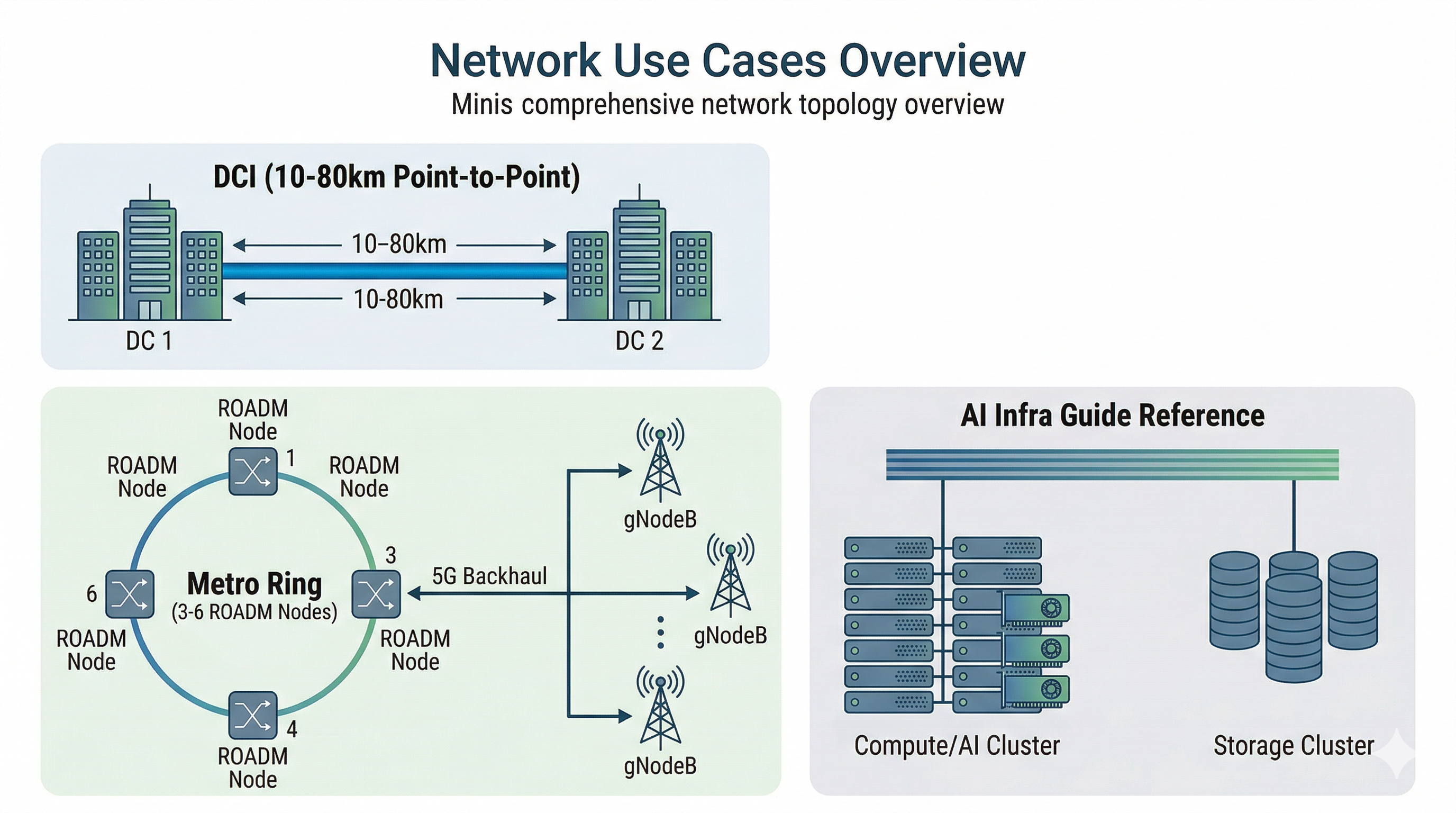
Data Center Interconnect (DCI): 10-80km Point-to-Point
DCI applications typically connect facilities within a metro area. Requirements include:
- •Distance: 10-80 km, usually over dark fiber or dedicated wavelengths
- •Capacity: 400G per wavelength, scaling to 800G
- •Latency: Minimal processing delay (sub-1μs per module)
- •Reliability: Duplex configurations with sub-50ms protection switching
The 400ZR module is generally desirable for simpler DCI links while the total reach is under 80 km. High-power ZR+ or OpenZR+ modules are required for longer reaches. They provide ease of use to the DCI community in that regard.
Metro Aggregation Networks: Ring and Mesh Topologies
Metro networks aggregate traffic from multiple points into core facilities. Key requirements:
- •Topology Support: Ring protection with sub-50ms failover
- •ROADM Integration: Multi-node traversal with consistent performance
- •Multi-Rate Flexibility: Supporting 100G, 200G, and 400G services on common infrastructure
- •Management: Advanced telemetry for proactive maintenance
OpenZR+ dominates metro deployments due to its multi-rate flexibility and ROADM compatibility. The ability to provision 100G services on 400G-capable infrastructure provides investment protection.
IP-over-DWDM Architectures: Eliminating Transponder Layers
Traditional networks use separate router and transport layers. Coherent pluggables enable IP-over-DWDM convergence:
Traditional Architecture
- •Router with gray optics
- •Transponder shelf for wavelength conversion
- •DWDM mux/demux
- •Line system amplifiers
IP-over-DWDM with Coherent Pluggables
- •Router with ZR+ or OpenZR+ modules
- •Direct insertion into DWDM line system
- •Eliminated transponder shelf
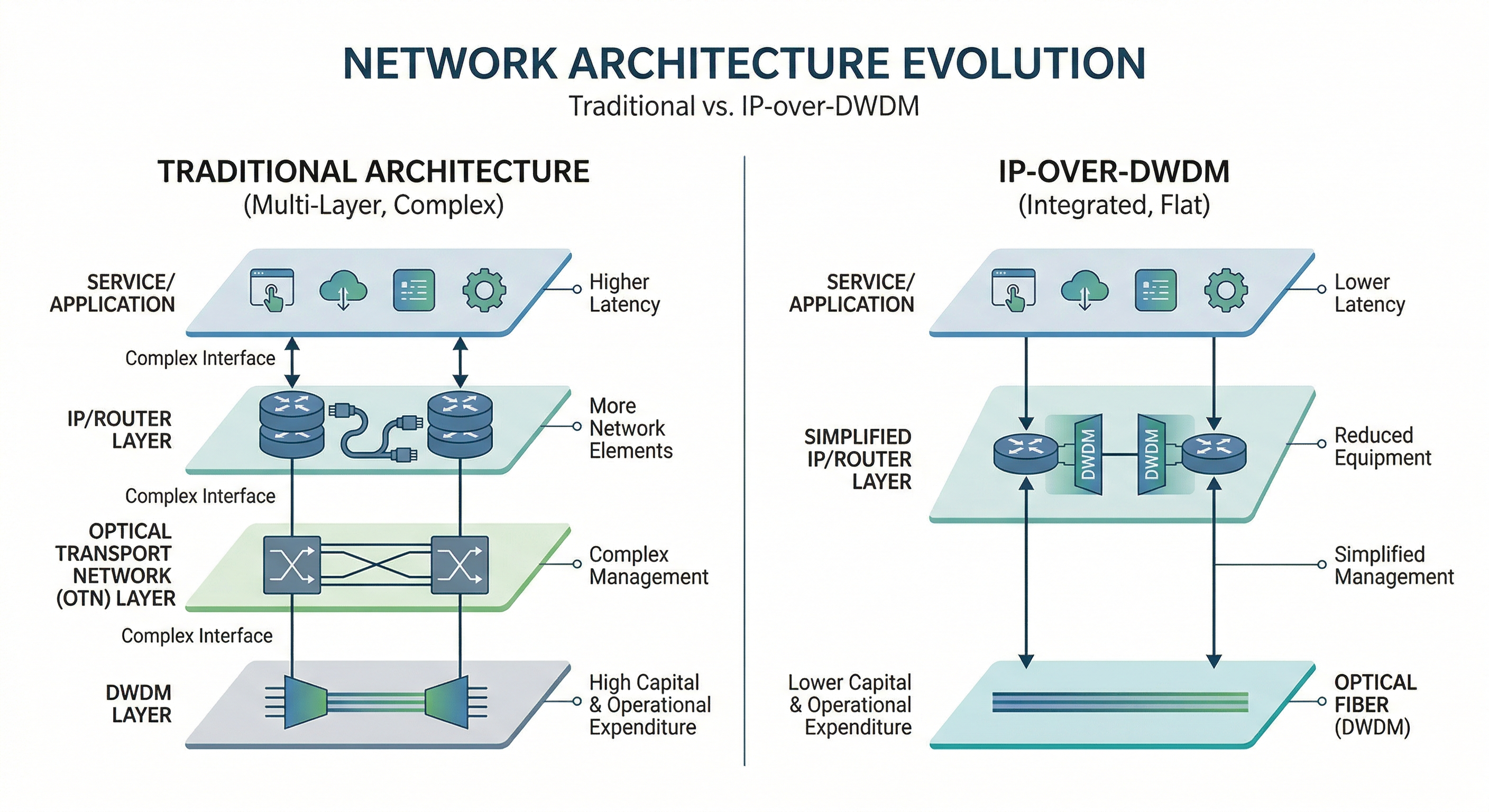
Between 30 to 50 percent savings in equipment, power, and space requirements may be possible with this brand of architecture. However, this requires careful planning of issues concerning router port density, thermal capacity, and DWDM compatibility.
5G Backhaul and Business Services
5G networks require flexible transport with varying bandwidth demands:
- •Small Cell Backhaul: 10-25 Gbps per site
- •Macro Cell Backhaul: 100-400 Gbps per site
- •Midhaul: 25-100 Gbps depending on functional split
- •Fronthaul: Specialized low-latency requirements
OpenZR+ multi-rate capability supports these varying requirements from common hardware. A single OpenZR+ module can provide 4×100GE client interfaces for small cell aggregation or native 400GE for macro sites.
QSFP-DD vs Alternative Form Factors
While QSFP-DD dominates coherent pluggable deployments, alternative form factors serve specific applications.
QSFP-DD vs CFP2-DCO
| Attribute |
QSFP-DD
|
CFP2-DCO
|
| Size |
18.35mm wide
|
41.5mm wide
|
| Power |
15-25W
|
20-30W
|
| Port Density |
32 ports/1RU
|
16 ports/1RU
|
| Maximum Reach |
480-1,000 km
|
1,000-2,000 km
|
| Power Class Support |
Up to Class 8 (25W)
|
Up to Class 6 (30W)
|
| Market Trend |
Growing
|
Declining
|
CFP2-DCO was the first widely deployed coherent pluggable form factor. Comparison points:
CFP2-DCO remains relevant for long-haul applications requiring maximum reach and performance. For metro and regional networks, QSFP-DD provides adequate performance with double the port density.
QSFP-DD vs OSFP for Coherent Optics
OSFP (Octal Small Form-factor Pluggable) offers alternative coherent packaging:
- •Thermal Capacity: OSFP supports 20-30W modules vs. 15-25W for QSFP-DD
- •Cooling: Integrated heat sink vs. cage-dependent cooling
- •Size: 22.5mm vs. 18.35mm width
- •Backward Compatibility: OSFP requires adapters for legacy modules
The choice between QSFP-DD and OSFP depends on thermal constraints and port density requirements. High-power coherent modules (25W+) may require OSFP for adequate cooling.
For detailed form factor comparisons including thermal and density analysis, see our QSFP-DD vs OSFP comparison guide.
Port Density and Thermal Considerations
Port density directly impacts thermal load per rack:
- •32× QSFP-DD ports at 20W each: 640W per line card
- •36× OSFP ports at 25W each: 900W per line card
Thermal planning must account for:
- •Maximum ambient temperature (typically 40-55°C)
- •Airflow direction (front-to-back vs. side-to-side)
- •Cooling redundancy (N+1 fan configurations)
- •Altitude derating (reduced cooling efficiency at elevation)
Selecting the Right Coherent Module for Your Network
The coherent module selection process balances technical requirements, vendor capabilities, and cost constraints.
Decision Framework by Distance and Topology
Use this decision tree to guide module selection:
Step 1: Distance Assessment
- •Under 80 km, no ROADMs: Consider standard 400ZR
- •Under 120 km with ROADMs: Require high-power variant
- •Over 120 km: Require ZR+ or OpenZR+
Step 2: Topology Complexity
- •Point-to-point: Standard modules may suffice
- •Ring or mesh: Multi-rate flexibility valuable
- •Multi-vendor: Standards compliance essential
Step 3: Service Flexibility
- •400G only: 400ZR acceptable
- •Mixed rates (100G-400G): OpenZR+ required
Future rate migration: OpenZR+ recommended
Multi-Rate Flexibility Considerations
Multi-rate capability provides operational flexibility but increases complexity:
Advantages
- •Common sparing across multiple service rates
- •Graceful capacity migration (100G to 400G)
- •Inventory simplification
Considerations
- •Higher initial cost (10-20% premium)
- •Increased power consumption at lower rates
- •More complex configuration management
For networks supporting diverse service requirements, multi-rate flexibility typically justifies the premium.
Vendor Interoperability and Testing
Standards compliance does not guarantee seamless interoperability. Best practices include:
- •Vendor qualification testingwith actual equipment
- •Firmware version alignmentacross router and transceiver
- •CMIS version compatibility(5.0, 5.2, or 5.3)
- •Performance validationunder worst-case conditions
- •Documentationof tested configurations
Major router vendors maintain interoperability matrices listing qualified transceiver part numbers. Using unqualified modules may void support agreements.
Deployment Best Practices
Successful coherent deployment requires attention to power, thermal, and monitoring details.
Power Budget and Thermal Planning
Before deployment, verify:
- •Chassis power capacityat maximum configuration
- •Power supply redundancyunder full load
- •Thermal design pointfor worst-case ambient conditions
- •Cooling airflowalignment with module heat sinks
- •Temperature monitoringat multiple chassis locations
Thermal throttling can reduce module performance or trigger alarms. Design for 80% of maximum thermal capacity to provide headroom for equipment aging.
Link Budget Calculations with Margin
Conservative link budget practice includes:
- •Fiber attenuation: Use 0.25 dB/km (worst-case) rather than 0.20 dB/km
- •Connector losses: Include all patch panels, not just endpoints
- •Aging margin: Add 2-3 dB for end-of-life degradation
- •Repair margin: Account for temporary higher loss during fiber repairs
- •Temperature variation: Fiber attenuation increases at temperature extremes
Link budget tools should model these margins automatically, but manual verification catches tool configuration errors.
DDM/DOM Monitoring for Coherent Modules
Digital Diagnostics Monitoring (DDM) provides critical operational data:
Standard Parameters
- •Temperature, voltage, bias current
- •Transmit and receive optical power
Coherent-Specific Parameters
- •Pre-FEC Bit Error Rate (BER)
- •Post-FEC BER
- •Chromatic dispersion estimate
- •Polarization state tracking
- •OSNR estimation
Monitoring these parameters enables predictive maintenance. A rising pre-FEC BER trend often indicates fiber degradation before service impact occurs.
Idea of Deployment:The monitoring operation of the pre-FEC BER on their coherent links was deployed proactively by a North American mobile operator. Over six months, they determined three fiber segments having downward slants and carried out repairs in maintenance windows. This preventive measure headed off as many as three possible days down andve impacted traffic totaling around 12 Tbps.
For comprehensive guidance on selecting optical modules for AI and cloud infrastructure, see our QSFP-DD AI data center guide.
Conclusion
QSFP-DD ZR coherent optics have fundamentally changed metro and long-haul networking by moving 400G transmission from dedicated transport platforms into compact pluggable modules. Understanding the distinctions between 400ZR, ZR+, and OpenZR+ is critical for successful deployment.
Key principles for coherent module selection:
- •Start with your network topology: Point-to-point DCI differs fundamentally from multi-node metro rings
- •Verify ROADM compatibility: Standard-power modules cannot traverse most optical networks
- •Plan for multi-rate flexibility: OpenZR+ provides investment protection as service requirements evolve
- •Account for thermal reality: High-power coherent modules challenge router thermal design
- •Validate interoperability: Standards compliance does not guarantee seamless multi-vendor operation
Whether upgrading existing infrastructure or building new coherent networks, proper module selection ensures reliable, scalable optical connectivity for years to come.
Shenzhen Ascent Optics manufactures MSA-compliant QSFP-DD ZR and ZR+ coherent transceivers compatible with major routing platforms. Contact our optical transport engineers for link budget analysis and module selection guidance.
Frequently Asked Questions (FAQs)
1. What is QSFP-ZR coherent optics-DD?
The QSFP-DD ZR Coherent Module is an important optical transceiver used in data center interconnects and metropolitan networks for high performance. In order to achieve long distance high capacity optical fiber data transmission, the 400G coherent technology is combined with QSFP-DD (Quad Small Form-factor Pluggable Double Density) form factor. This technology aims at supporting 400G Ethernet while maintaining cost- and power-efficient scalable network solutions.
2. What makes QSFP-DD ZR coherent optics different from conventional optics?
In contrast to traditional optical transceivers, QSFP-DD ZR coherent optics transcends conventional 40 Gbps or 100 Gbps Ethernet data transmission limits for higher data rates and longer transmission distances, with coherence technology. Coherent optics is adept in enhancing signal quality, eliminating errors through phase modulation techniques, and digital signal processing (DSP) techniques, with an intent to leverage the technology for long-distance calls and metro usage. Besides such coherent optics, a QSFP-DD form factor functions compatibly with most network devices, making the product a surplus of the preliminary module.
3. What Are the Primary Applications of QSFP-DD ZR Coherent Optics?
A major consumer of the QSFP-DD ZR coherent optics market is in the data center, ie DCI, in metro networks and cloud-infrastructure segments. The technology bears the long-distance connectivity of two data centers in an excess of 120 kilometers or greater. The technologies find heavy demand. Strictly high-speed Internet, video streaming, and the cloud services segment, for high-speed and reliable data transfer across the networks.
4. How Does QSFP-DD ZR Coherent Optics Support Network Scalability?
In a nutshell, QSFP-DD ZR coherent optics supports network scalability by being compact and modular for ultra-high-speed data encapsulation. This magnificently aligned plug is kept for the promises, thus, initiatives can be handed quickly to deploy such networks because it maintains a QSFP-DD installation. Neatly, there is this monstrously-eyed claim of granting 400G Ethernet compatibility, so networks bid in for a cautiously curved future of mounting data requirements with clear ambitions.
Post Views: 23