Comparison of 400G QSFP-DD with other types of optical modules
January 28, 2026
Among the various 400G optical module form factors, QSFP-DD (Quad Small Form-factor Pluggable Double Density) has emerged as a leading solution due to its high bandwidth capacity, backward compatibility, and ability to support high port density within existing infrastructure.
This article provides a detailed comparison of QSFP-DD with other mainstream optical module types, helping you understand their key differences and make informed decisions when deploying high-speed networks.
The 400G QSFP-DD (Quad Small Form Factor Pluggable-Double Density) Dual Density Quad Small Form Factor Pluggable is a package of high speed pluggable module defined by the QSFP-DD MSA group. It serves as the preferred 400G optical module package, enabling data centers to efficiently grow and scale cloud capacity as needed.
Features
It is forward and backward compatible with QSFP, and compatible with existing QSFP28 optical modules, AOC/DAC, and other compatible devices.
The QSFP-DD can achieve up to 14.4Tb/s of aggregated bandwidth in a single switch slot. It Features 8-channel electrical interfaces with rates of up to 25Gb/s (NRZ modulation) or 50Gb/s (PAM4 modulation) per channel, providing solutions for up to 200Gb/s or 400Gb/s aggregation.
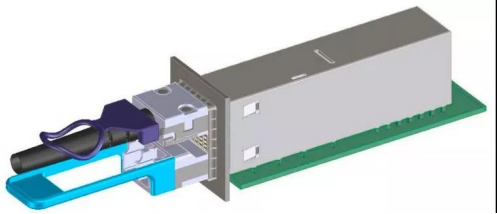
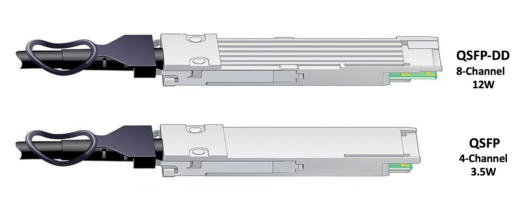
By Using SMT (Surface-Mount Technology) connectors and 1xN cages, along with cage design optimization and module housing optimization, each module can achieve at least 12 watts of thermal capacity.
The transmission media include passive copper cable (DAC), multi-mode fiber (MMF) and single-mode fiber (SMF).
SR and DR modules are mainly used for short-reach interconnects within data centers, typically using MPO connectors.
FR, LR, ER, and ZR modules are designed for medium- to long-distance transmission and usually adopt LC connectors.
Each type differs in cost, power consumption, and deployment complexity, making proper selection critical for network design.
QSFP-DD vs. QSFP (QSFP+/QSFP28)
Bandwidth
QSFP-DD offers up to ten times the bandwidth of QSFP+ or four times the bandwidth of QSFP28.
QSFP has four electrical lanes at 10Gb/s (QSFP+) or 25Gb/s (QSFP28) per lane, aggregated to provide 40Gb/s or 100Gb/s solutions.
The electrical interface of the QSFP-DD pluggable package features eight channels at rates up to 25Gb/s (NRZ modulation) or 50Gb/s (PAM4 modulation) per channel, aggregating to provide solutions of up to 200Gb/s or 400Gb/s.
Compatibility
QSFP-DD is backward compatible with QSFP+/QSFP28. Systems designed with QSFP-DD modules are backward compatible, supporting existing QSFP+/QSFP28 modules and providing flexibility for end users and system designers.
Port Density
The QSFP-DD and QSFP+/QSFP28 systems have the same port density. However, because each QSFP-DD port can accommodate eight channels instead of four, QSFP-DD doubles the number of ASIC ports it supports for existing interfaces such as CAUI-4.
The mechanical interface of the QSFP-DD on the motherboard is slightly deeper than the QSFP+/QSFP28 to accommodate an additional row of contacts.
QSFP-DD increases the bandwidth to 10x/4x of QSFP+/QSFP28 with only a slight increase in length while maintaining the same port density, and is also backward compatible, which means customers can directly deploy its systems without using QSFP, thereby reducing a significant amount of equipment costs.
400G QSFP-DD vs. OSFP
OSFP is a new pluggable package with 8 high-speed electrical channels that will initially support a transmission rate of 400Gb/s (8x50G).
QSFP-DD and OSFP are both optical transceiver form factors designed for 400G and 800G high-speed interconnects. QSFP-DD achieves higher bandwidth through a double-density electrical interface while maintaining backward compatibility with QSFP28 and QSFP56, making it well suited for data centers that require smooth upgrades and high port density.
OSFP features a slightly larger form factor with superior thermal performance, making it more suitable for higher-power 800G optical modules; however, it does not offer backward compatibility and is typically deployed in newly built hyperscale or AI-focused data centers.
Feature
400G QSFP-DD
OSFP
Full Name
Quad Small Form Factor Pluggable – Double Density
Octal Small Form Factor Pluggable
Target Data Rates
400G
800G (designed for higher-power optics)
Electrical Lanes
8 lanes
8 lanes
Form Factor Size
More compact
Slightly larger than QSFP-DD
Port Density
Higher
Slightly lower
Thermal Performance
Moderate
Superior
Typical Power Support
~15–18 W (implementation dependent)
~20–25 W (implementation dependent)
Backward Compatibility
Compatible with QSFP28 / QSFP56
No backward compatibility
Typical Deployment Scenarios
Cloud data centers, enterprise networks, smooth upgrades
Hyperscale and AI-focused data centers
Key Advantages
High density, backward compatibility, mature ecosystem
QSFP-DD prioritizes port density and backward compatibility, while OSFP excels in thermal performance and high-power 800G deployments—especially in next-generation AI data centers.
Conclusion: Choosing the Right Solution
In summary, QSFP-DD stands out as a highly practical and forward-looking solution for 400G deployments, offering a strong balance between performance, compatibility, and cost efficiency.
While OSFP is better suited for higher-power 800G applications, QSFP-DD remains the preferred choice for most current data center upgrades due to its flexibility and backward compatibility.
Choosing the right form factor ultimately depends on your network architecture and future scalability needs.