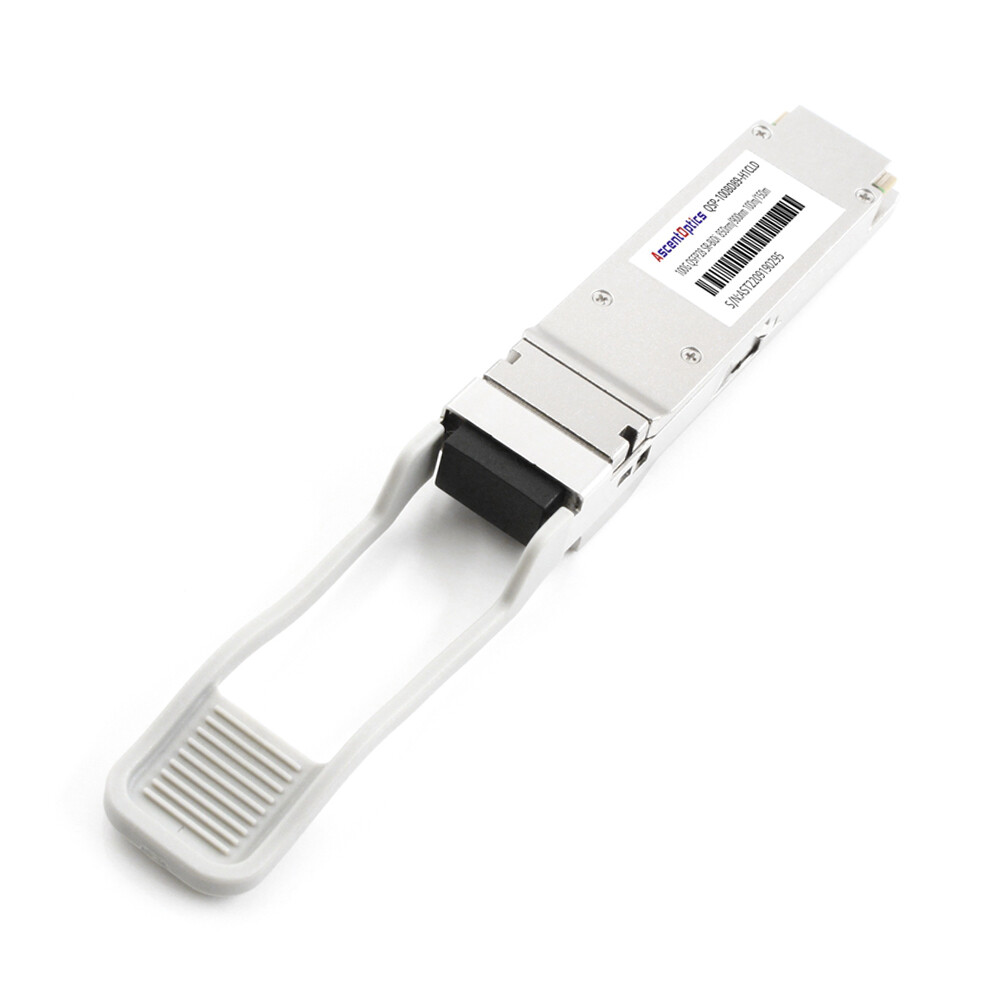
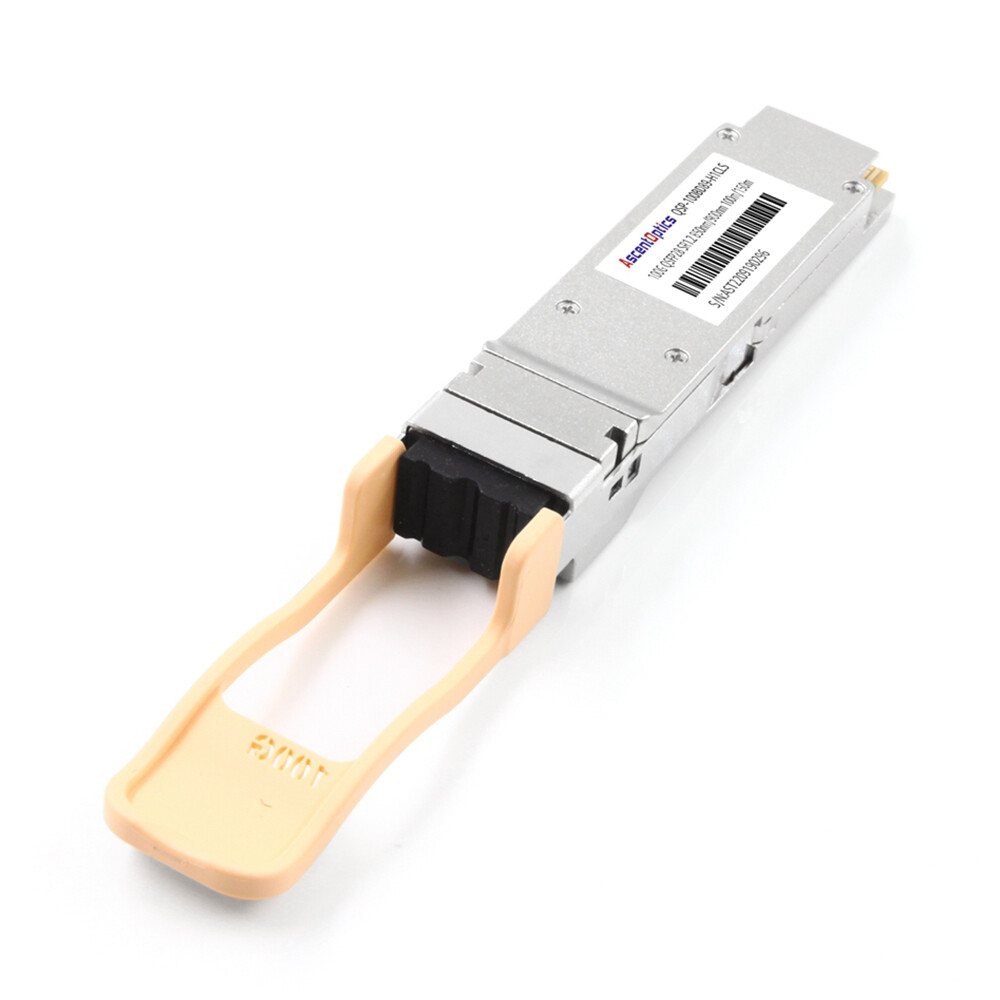
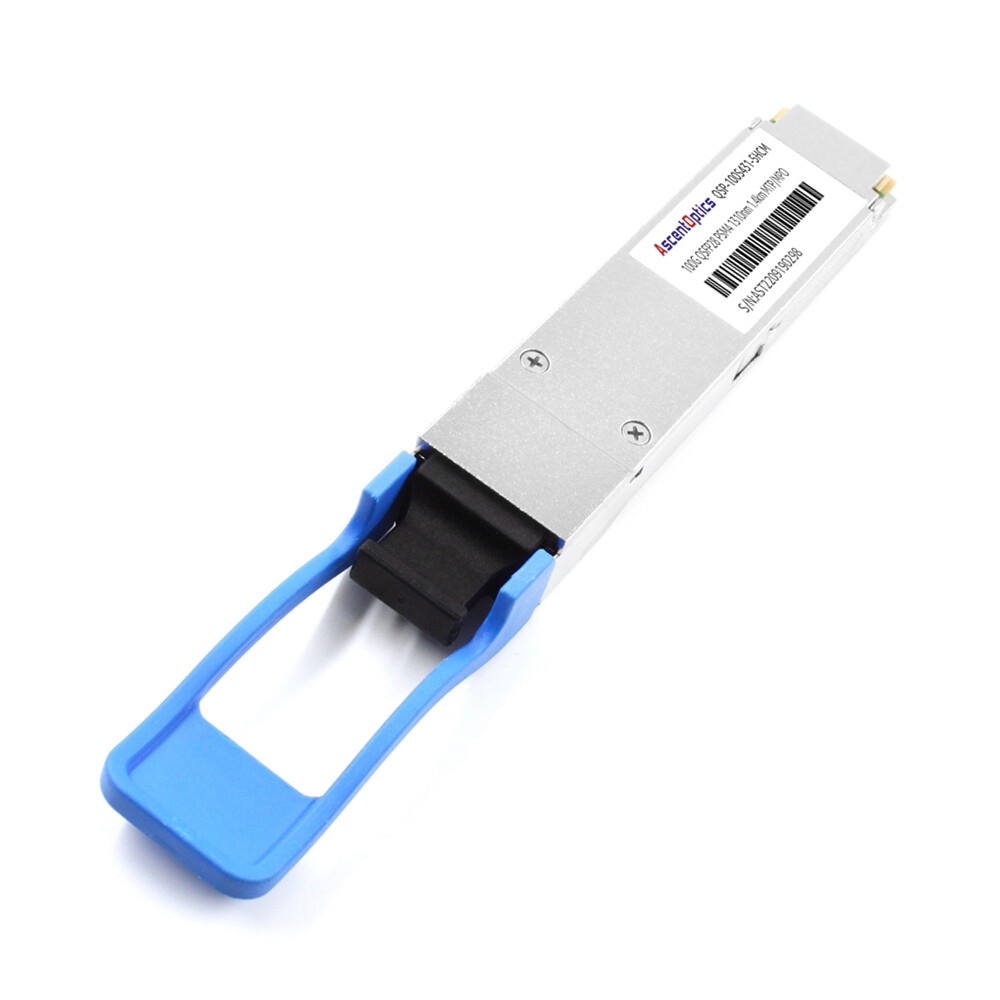
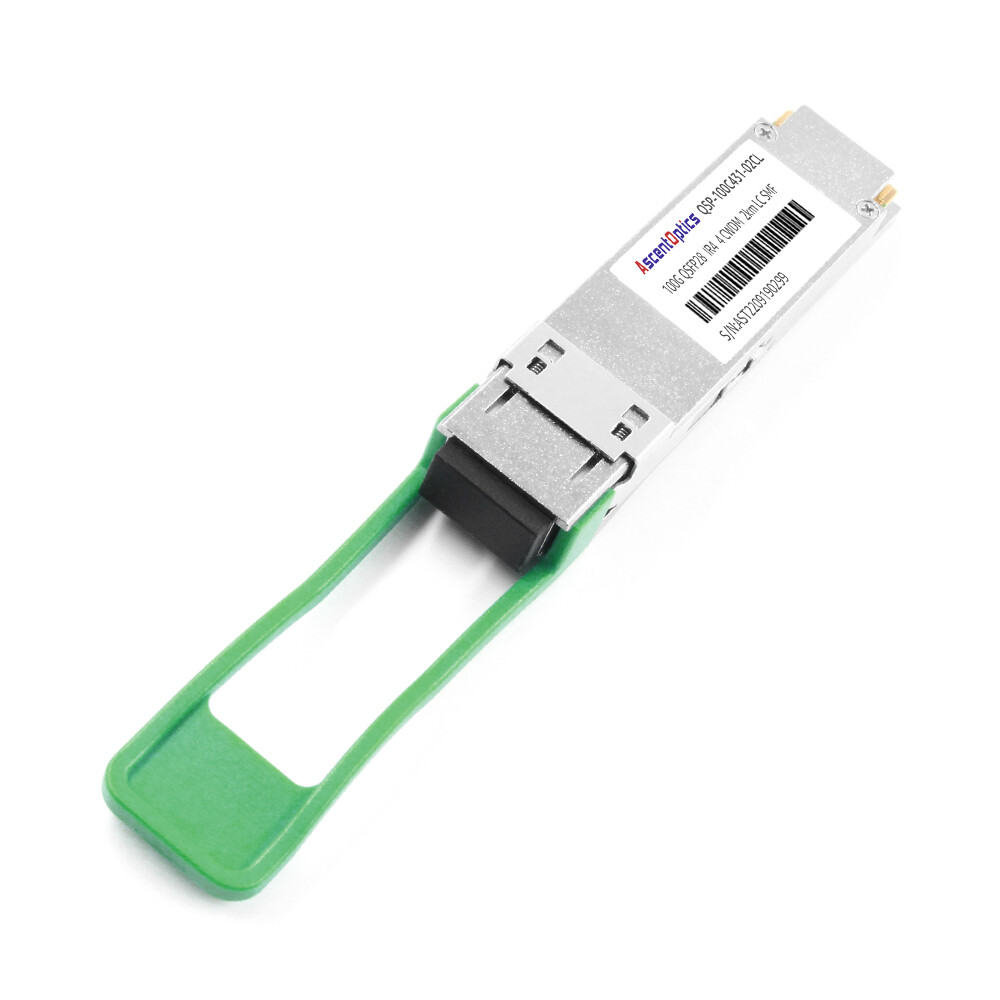
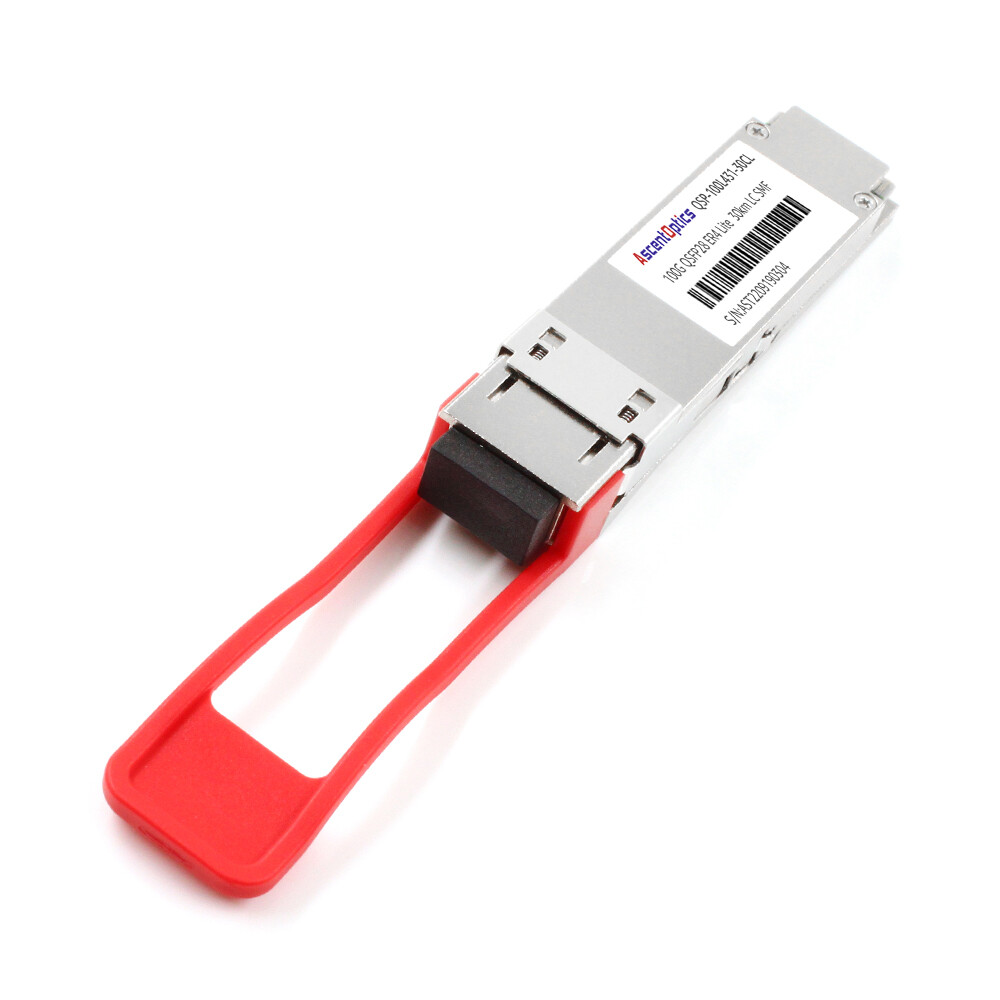
As data centers and enterprise networks evolve from 10G and 40G toward higher bandwidths, 100G QSFP28 LR4 transceivers have increasingly become a key technology in network upgrades—particularly for applications that require long-reach transmission, simplified cabling, and a smooth migration path.
In 2025, data centers—especially those powering AI, cloud computing, and high-performance applications—face exploding bandwidth demands. Upgrading from legacy 10G/40G networks to 100G Ethernet is essential for handling massive data flows efficiently. 100GBASE-LR4 QSFP28 transceivers play a pivotal role in this transition, offering a balanced mix of long reach, high density, and cost-effective migration paths.
100G QSFP28 LR4 Overview
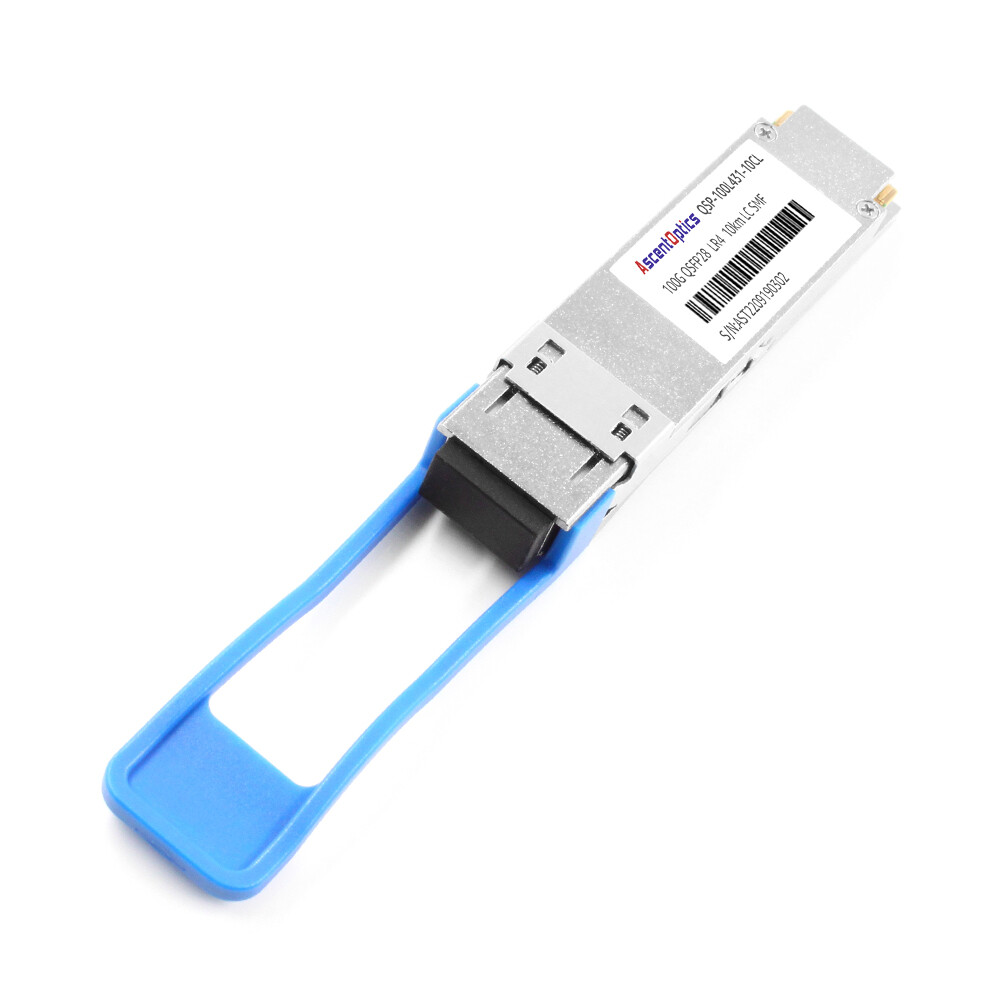
100G QSFP28 LR4 is a single-mode optical transceiver designed for 100 Gbps Ethernet transmission over duplex LC fiber. It uses four CWDM wavelengths (4×25 Gbps) to achieve an aggregate data rate of 100G, with a typical transmission reach of up to 10 km.
Compliant with the QSFP28 standard, LR4 offers high port density and mature interoperability. It is commonly deployed in data center core and aggregation layers, long-reach spine–leaf links, as well as campus and metro aggregation networks. By reusing existing single-mode fiber infrastructure, QSFP28 LR4 also enables a smooth migration from 40G to 100G without major changes to cabling.
Overall, 100G QSFP28 LR4 is a stable, well-proven long-reach 100G solution, valued for its reliability, compatibility, and predictable performance in networks where multiple generations of speeds coexist.
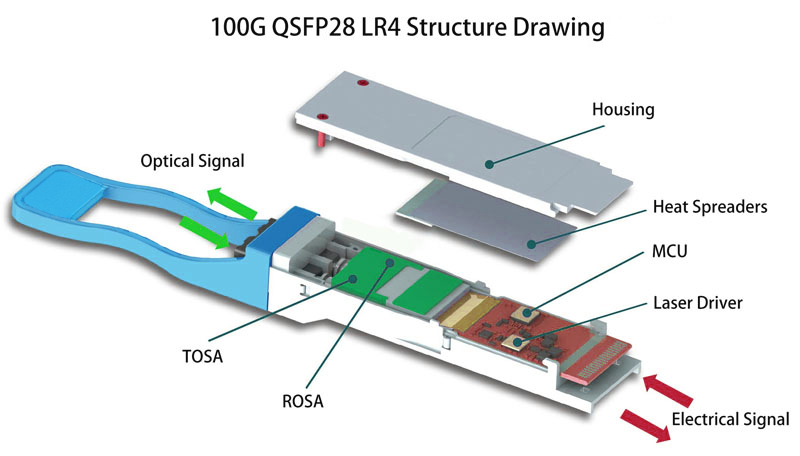
Key Specifications of 100G QSFP28 LR4 Transceivers
Data Rate — 100 Gbps (4 × 25 Gbps lanes).
Reach — Up to 10 km over single-mode fiber (SMF, G.652).
Wavelength — LAN-WDM grid around 1310 nm (typically 1295–1309 nm).
Connector — Duplex LC (only 2 fibers needed, unlike parallel optics).
Modulation — NRZ (Non-Return-to-Zero).
Power Consumption — Typically 3.5–4.5 W (low for long-reach optics).
Standards — IEEE 802.3ba 100GBASE-LR4, QSFP28 MSA compliant.
Features — Hot-pluggable, Digital Diagnostics Monitoring (DDM) for real-time parameter tracking.
How 100G QSFP28 LR4 Drives Network Upgrades
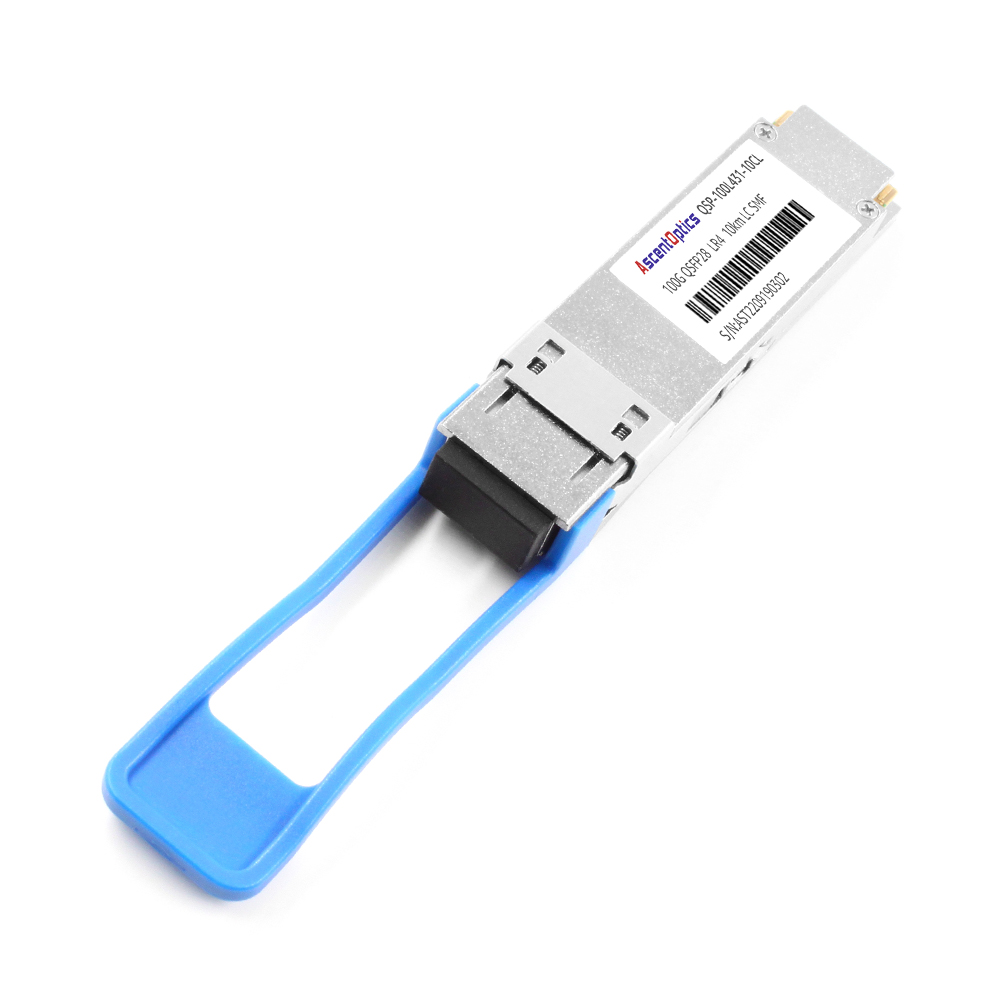
Smooth Migration from 10G/40G to 100G
Many data centers still run on 10G (SFP+) or 40G (QSFP+) infrastructures. QSFP28 ports are backward-compatible via adapters (e.g., Cisco QSA modules), allowing mixed-speed operation during phased upgrades. This minimizes downtime and CapEx by reusing existing SMF cabling.
QSFP28 LR4 transceivers enable 10 km-class 100G transmission over existing single-mode fiber (duplex LC), providing a low-risk, reusable path for network upgrades. Networks can smoothly migrate from 40G to 100G without replacing fiber or redesigning cabling, significantly reducing upgrade costs and deployment complexity.
Long-Reach Connectivity for DCI and Campus Links
Unlike short-reach SR4 (100 m over MMF), LR4 supports 10 km on duplex SMF—ideal for data center interconnect (DCI), building-to-building, or metro networks. It eliminates the need for intermediate amplifiers in many scenarios, reducing complexity and cost.
Fiber Efficiency and Scalability
Duplex LC design uses just two fibers per link, preserving fiber resources in crowded ducts. This is crucial for hyperscalers and enterprises expanding to 400G/800G, where LR4 serves as a bridge (e.g., breakout to future PAM4-based optics).
Cost-Effective Performance
LR4 strikes a balance: more reach than CWDM4 (2 km) but lower cost/power than extended ER4/ZR4 variants. In AI-driven data centers, it supports backbone/aggregation layers while preparing for higher speeds.
Reliability and Monitoring
Built-in DDM and FEC support ensure stable operation, with real-time monitoring of power, temperature, and bias—critical for dense, high-uptime environments.
Simplifying the Upgrade Path from 40G to 100G
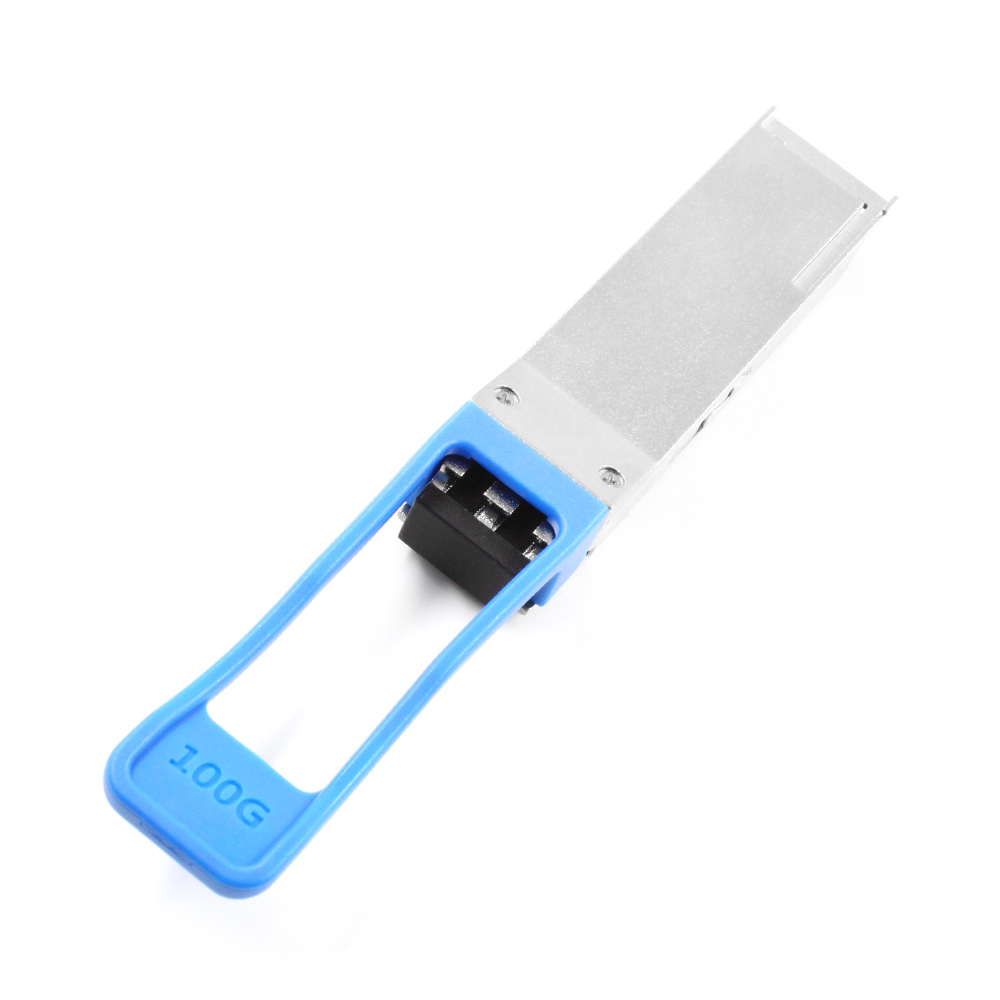
In many early deployments, 40G networks have extensively utilized QSFP+ LR4 optical transceivers. The QSFP28 LR4 maintains consistency in optical architecture and transmission distance, providing a natural and low-risk migration path for upgrading networks from 40G to 100G.
During the upgrade process:
No need to replace the fiber type
Retains the same LC duplex connection method
Link design and optical budget remain essentially unchanged
This significantly reduces the complexity and deployment risks associated with network upgrades.
Compared to Multi-Fiber Parallel Solutions like 100G SR4, LR4:
Requires only 2 fiber cores, rather than 8 cores
Supports longer transmission distances
Reduces dependency on MPO/MTP cabling
At the same time, the QSFP28 form factor enables switches to provide higher port density, allowing networks to achieve bandwidth expansion without increasing rack space.
Application Scenarios of 100G QSFP28 LR4 Optical Modules
The 100GBASE-LR4 QSFP28 optical module is currently the mainstream long-distance 100G optical interconnection solution for data center and enterprise network upgrades. It supports transmission distances of up to 10 km over single-mode fiber (SMF), uses duplex LC connectors (only 2 fibers), features low power consumption and strong compatibility, and is widely applied in scenarios requiring high bandwidth and medium distances. The following are its main application scenarios:
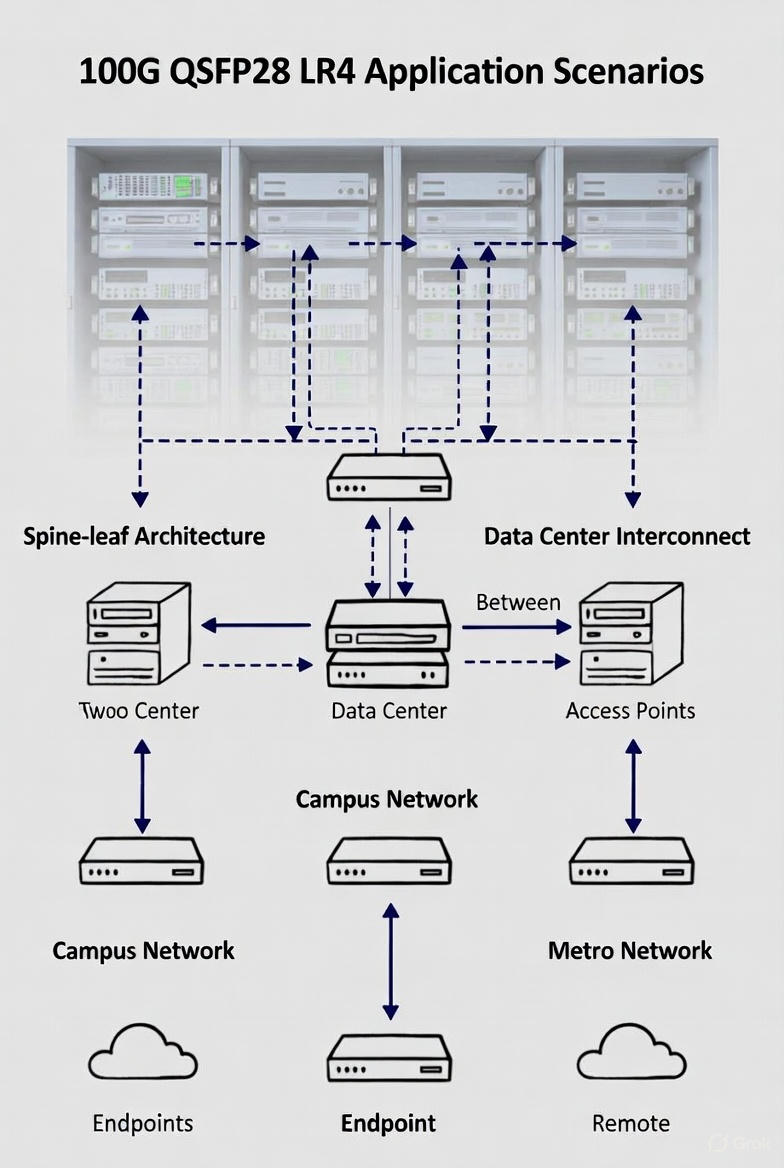
Data Center Internal Backbone/Aggregation Layer Interconnection (Spine-Leaf Architecture)
In modern Spine-Leaf (leaf-spine) topology data centers, LR4 is commonly used for Leaf-to-Spine uplink connections, especially when the distance between racks exceeds 100m (the multimode limit of SR4). Supporting distances up to 10km, it can cover all links within a large single-site data center, eliminating the frequent need for short-reach modules combined with jumpers.
Advantages: Reuses existing single-mode fiber infrastructure, simplifying cabling.
Typical Equipment: Arista, Cisco Nexus, and Juniper QFX series switches.
Data Center Interconnection (DCI, Data Center Interconnect)
The most classic scenario: Connecting multiple geographically separated data centers (e.g., primary/backup disaster recovery, load balancing). The 10km distance perfectly meets intra-city or campus DCI requirements without the need for additional DWDM equipment or amplifiers.
Suitable for hyperscalers (e.g., Alibaba Cloud, AWS regional interconnections) and enterprise multi-site architectures.
Compared to ER4 (30-40km), LR4 offers lower cost and lower power consumption.
Campus Network Building-to-Building Connections
High-speed interconnections between different buildings in enterprise or university campuses. Distances typically range from a few hundred meters to several kilometers, and LR4 provides ample margin while supporting direct single-mode fiber connections.
Advantages: Longer reach than multimode SR4, more cost-effective than longer-reach modules.
Metropolitan Network (Metro Network) Access/Aggregation
In carrier or enterprise metropolitan networks, used for high-bandwidth links within 10km (e.g., access layer to aggregation layer). Can be combined with simple DWDM for multi-wavelength multiplexing to increase capacity.
In the AI era, it supports low-latency connections between edge computing nodes and core data centers.
Due to its mature technology and stable deployment, LR4 is often the preferred solution for smooth upgrades from 40G to 100G and continues to be used long-term in networks where 100G and 400G coexist.
Why LR4 QSFP28 Remains Relevant in 2025
While single-lambda PAM4 optics (e.g., 100G LR1) emerge for 400G alignment, traditional LR4 QSFP28 modules dominate legacy upgrades due to maturity, broad compatibility (Cisco, Arista, Juniper, etc.), and proven 10 km reach. They enable rapid 100G deployment without full infrastructure overhauls, paving the way for future 400G+ migrations.
In summary, LR4 QSFP28 transceivers drive network upgrades by providing reliable, long-distance 100G connectivity that integrates seamlessly with existing fiber plants, reduces migration risks, and delivers high performance at manageable costs—making them a cornerstone for modernizing data centers in the AI era.
Summary
The QSFP28 LR4 optical module facilitates network upgrades not by pursuing ultimate density, but by lowering the upgrade threshold and enhancing deployment certainty. By enabling stable 100G transmission over existing single-mode fiber, LR4 has become an indispensable component in the evolution of data centers and enterprise networks toward higher bandwidth.
Post Views: 1,942