Introduction
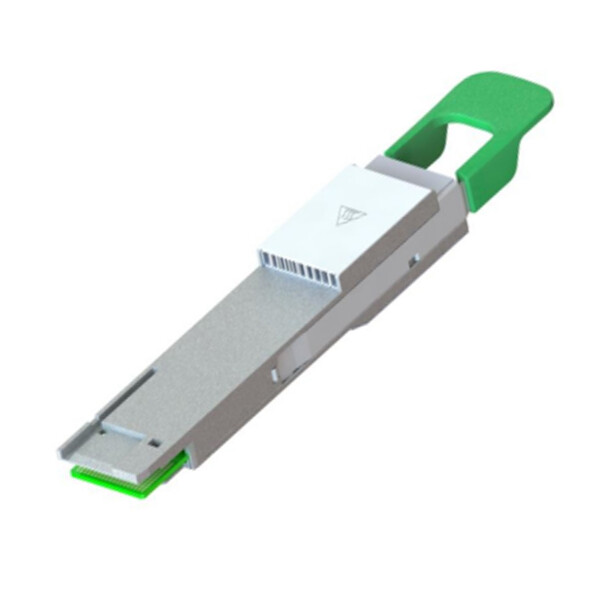
As data centers evolve toward 400G and even 800G architectures, ensuring port reliability and signal integrity has become increasingly critical. In high-speed network validation and troubleshooting, the QSFP-DD Loopback Module—often overlooked—plays a vital role.
Designed specifically for QSFP-DD ports, this module significantly improves deployment efficiency and maintenance reliability. This article provides a comprehensive overview of its working principles, types, application scenarios, and selection considerations.
What Is a QSFP-DD Loopback Module?
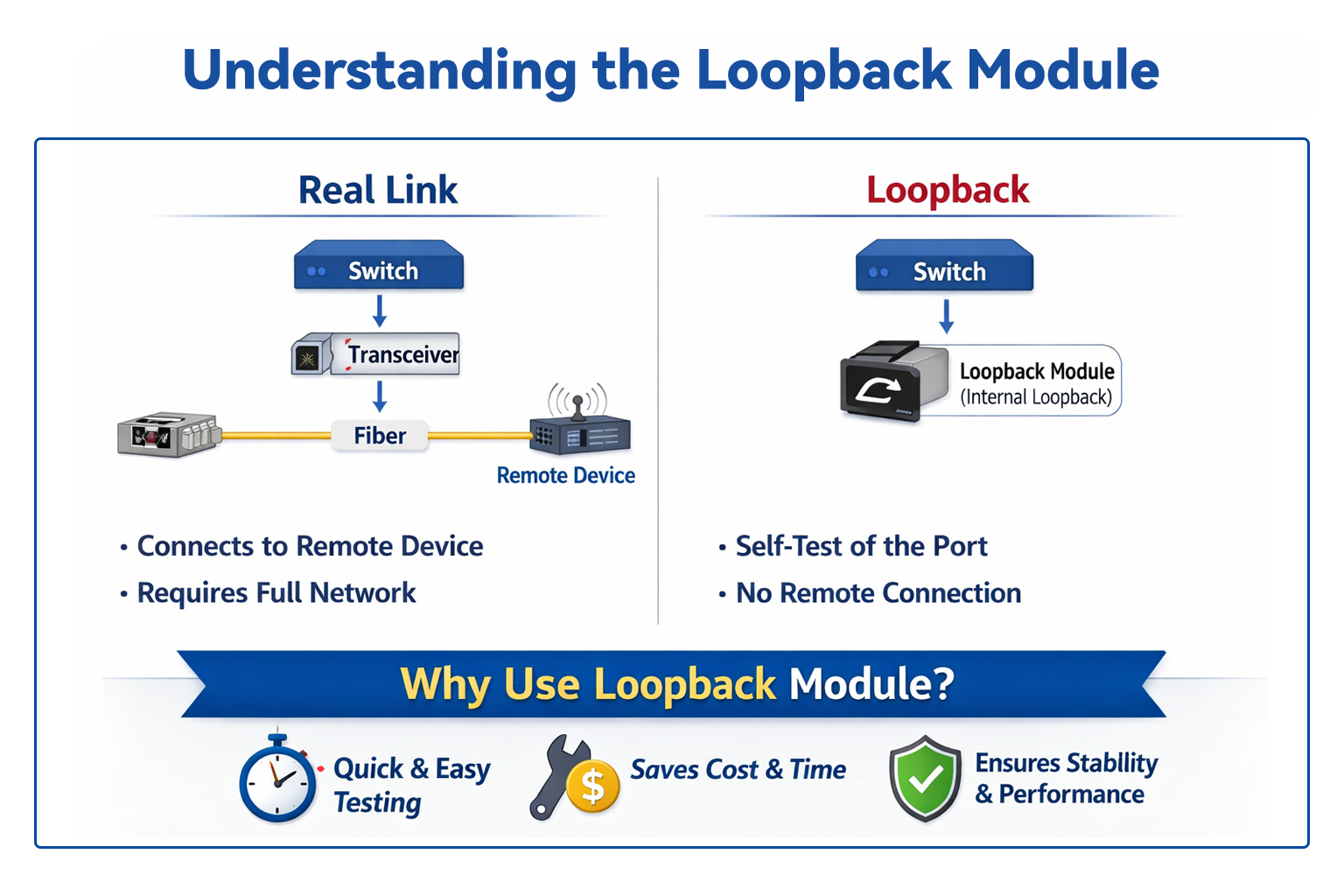
A loopback module is a dedicated testing accessory that internally routes transmitted (TX) signals back to the receiver (RX), eliminating the need for external fiber links or remote devices.
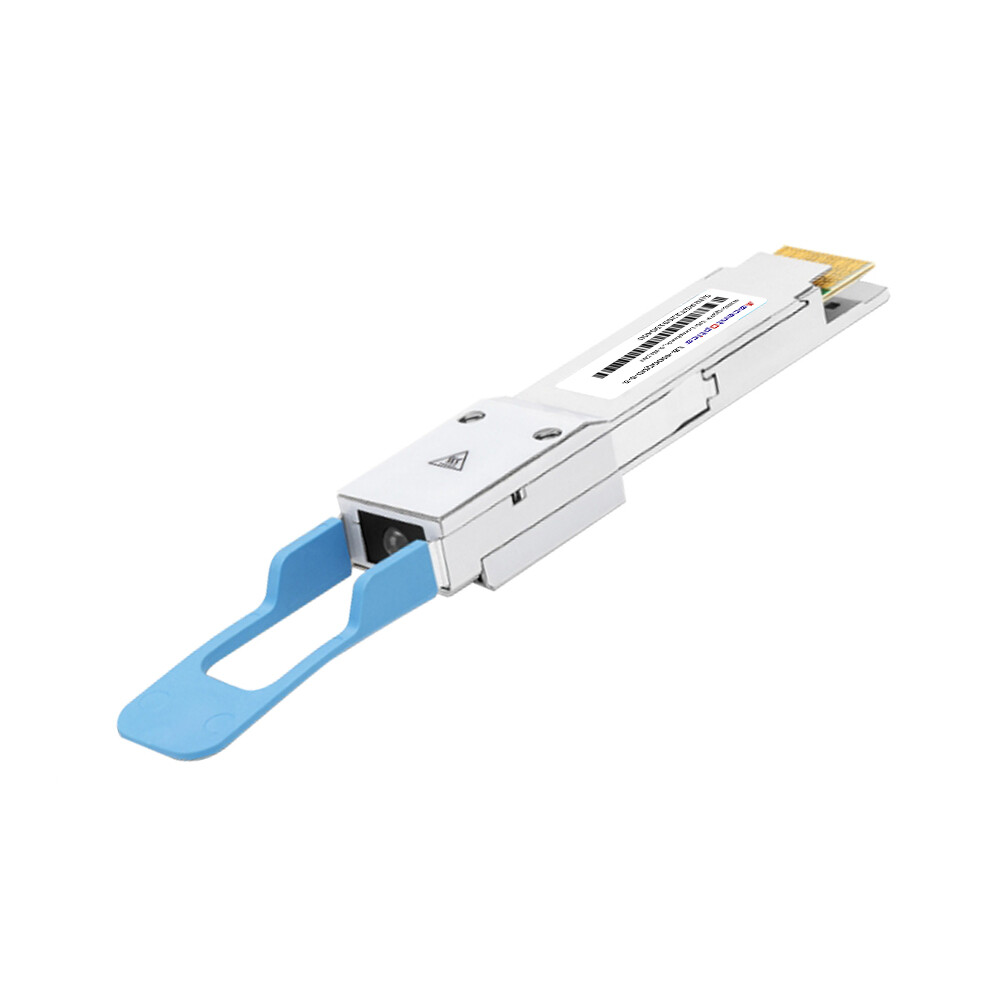
A QSFP-DD loopback module is specifically designed to test QSFP-DD (Quad Small Form-factor Pluggable Double Density) ports.
Why Is It Needed?
Traditional testing methods are costly and complex. In contrast, loopback modules:
- •Cost only 1/10 to 1/20 of real optical transceivers
- •Require no external cabling
- •Can simulate different power and thermal conditions
Unlike optical transceivers or DAC/AOC cables used for data transmission, loopback modules are mainly used for:
- •Port functionality validation
- •Signal integrity testing
- •Hardware fault diagnostics
By creating an internal closed loop, engineers can verify whether a switch or NIC port is functioning properly without external connections.
How Does a QSFP-DD Loopback Module Work?
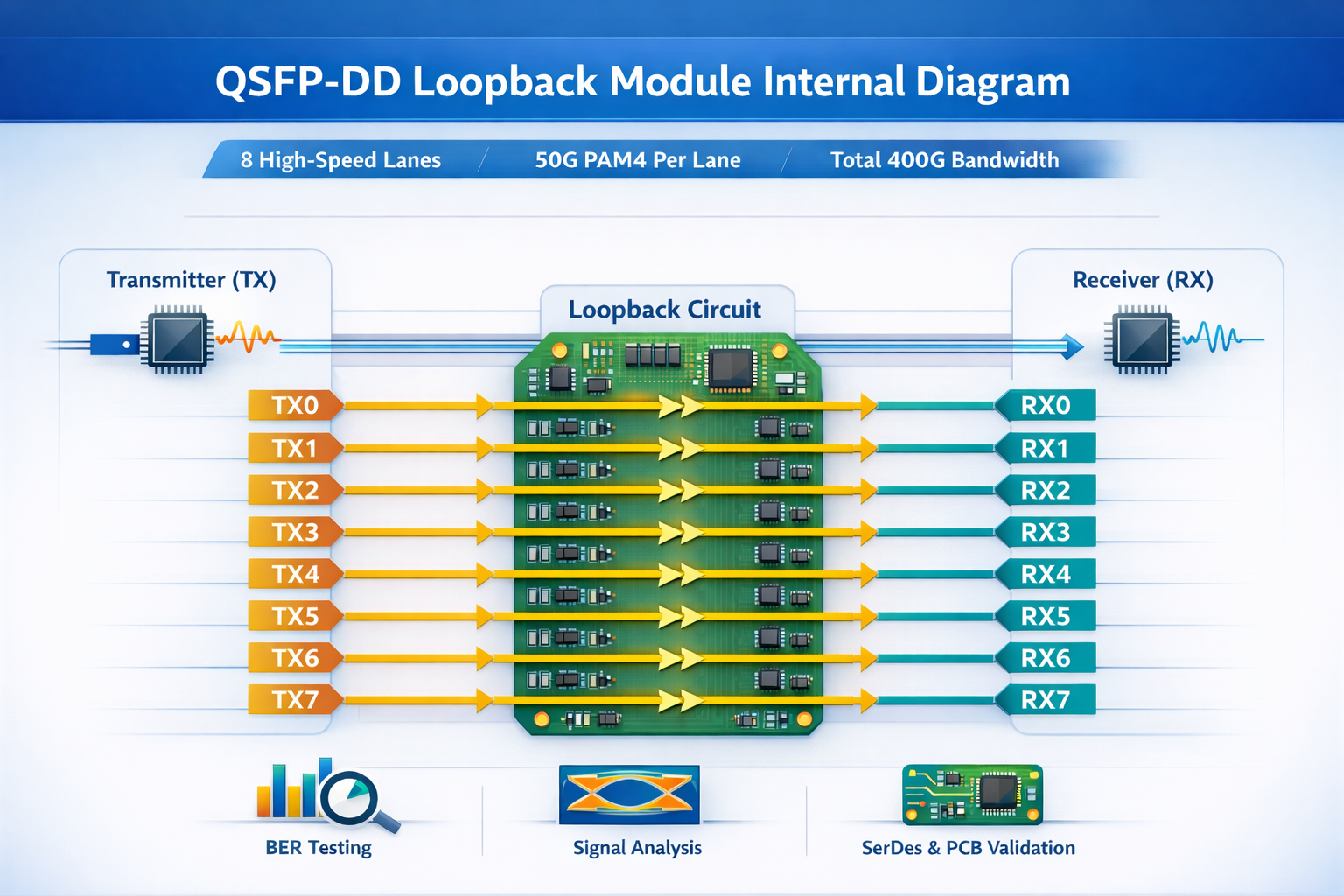
The QSFP-DD interface supports 8 electrical lanes, each operating at 25G NRZ or 50G PAM4, enabling a total bandwidth of up to 400G. These high-speed differential signals require strict signal integrity (SI) and clock data recovery (CDR) performance.
The loopback module internally connects each TX lane directly to its corresponding RX lane, forming a closed-loop path. When the host transmits test patterns (such as PRBS), the signal is immediately returned without traversing an external link.
This enables:
- •Bit Error Rate (BER) testing – Detect data transmission errors
- •Signal quality evaluation – Analyze jitter and eye diagram characteristics
- •Electrical interface validation – Verify SerDes, PCB traces, and connectors
In advanced scenarios, loopback modules can be used with BERT (Bit Error Rate Testers) for long-duration stress testing.
This internal loop mechanism effectively isolates external variables (fiber loss, remote device issues), narrowing fault domains to the local port and electrical path—making it essential for diagnosing port failures, PCB defects, and signal degradation.
Types of QSFP-DD Loopback Modules
1. Electrical Loopback Module
Electrical loopback modules operate entirely in the electrical domain without optical components.
Key Features:
- •No lasers or optics
- •Lower cost
- •Minimal power consumption
Typical Applications:
- •Basic port validation
- •Manufacturing testing
- •R&D debugging
2. Optical Loopback Module
Optical loopback modules include internal optical components to convert electrical signals into optical signals and loop them back.
Key Features:
- •Built-in optical components (TOSA/ROSA)
- •Simulates real optical transmission conditions
- •Higher cost
Typical Applications:
- •Optical link testing
- •System-level validation
- •High-precision diagnostics
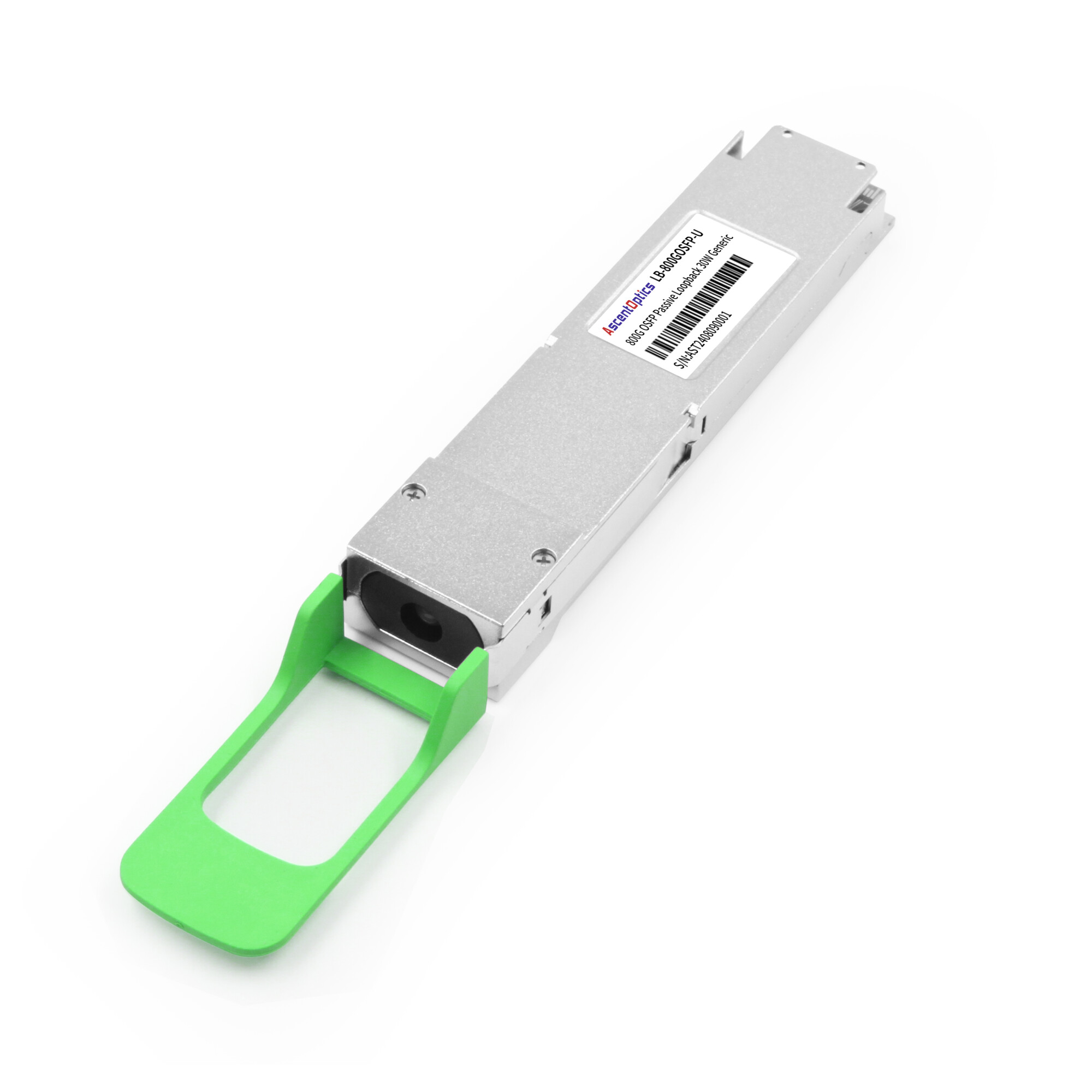
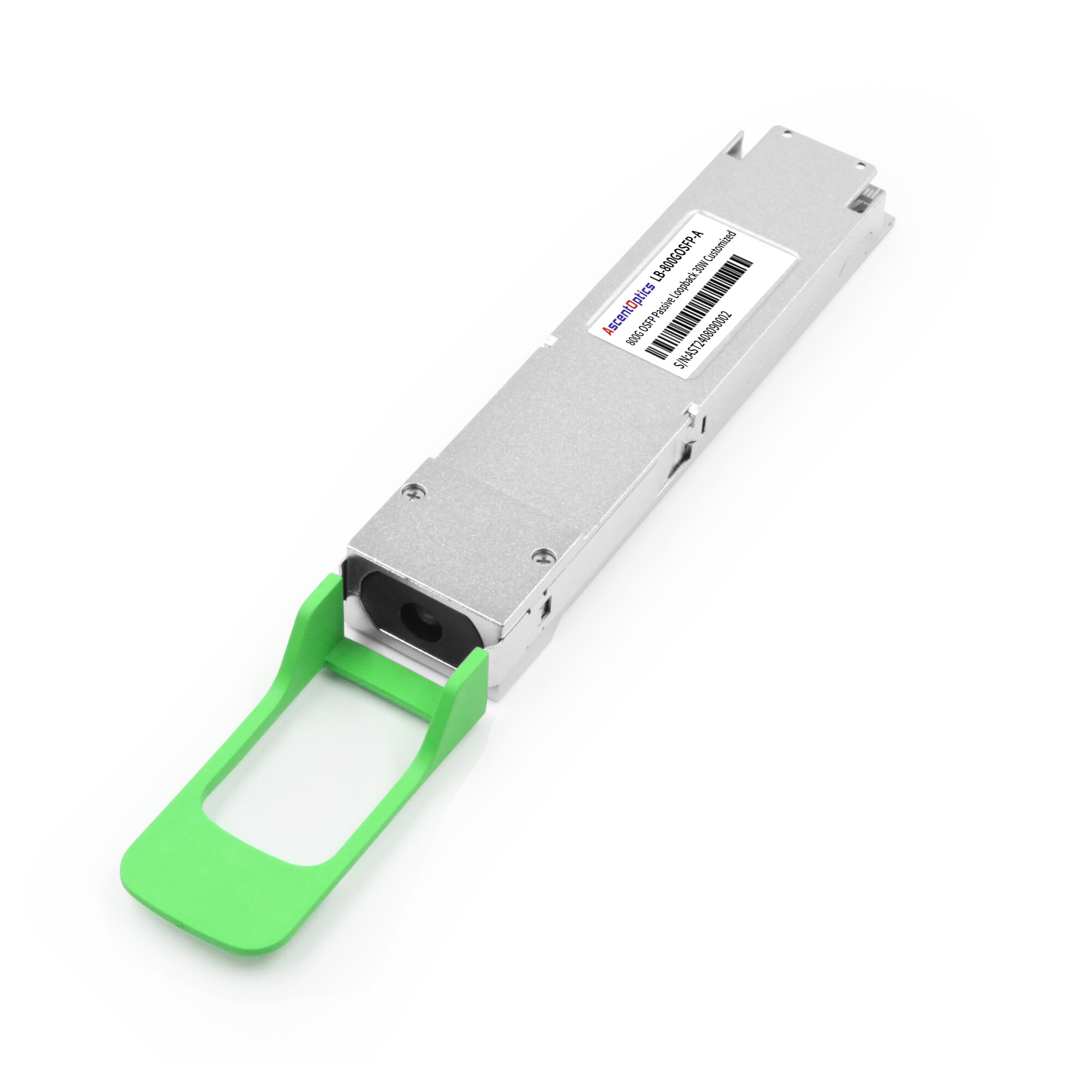
Ascent Optics 400G/800G QSFP-DD Loopback Modules Product Table
| Data Rate |
Product Description |
Attenuation |
Power Consumption |
Operating Temperature |
Key Features / Notes |
| 400Gbps |
400G QSFP-DD Passive Loopback Testing Module, 0dB, 5W |
0 dB |
5 W |
0~70°C |
Passive, Basic Signal Test |
| 400Gbps |
400G QSFP-DD Passive Loopback Testing Module, 0dB, 16W |
0 dB |
16 W |
0~70°C |
Passive, Medium Thermal Load |
| 400Gbps |
400G QSFP-DD Passive Loopback Testing Module, 0dB, 20W |
0 dB |
20 W |
0~70°C |
Passive, High Thermal Load |
| 800Gbps |
800G QSFP-DD Passive Loopback Testing Module, 30W Generic |
0 dB |
30 W |
-40~85°C |
Passive, Generic Version |
| 800Gbps |
800G QSFP-DD Passive Loopback Testing Module, 30W Customized |
0 dB |
30 W |
-40~85°C |
Passive, Customized Version |
Key Application Scenarios
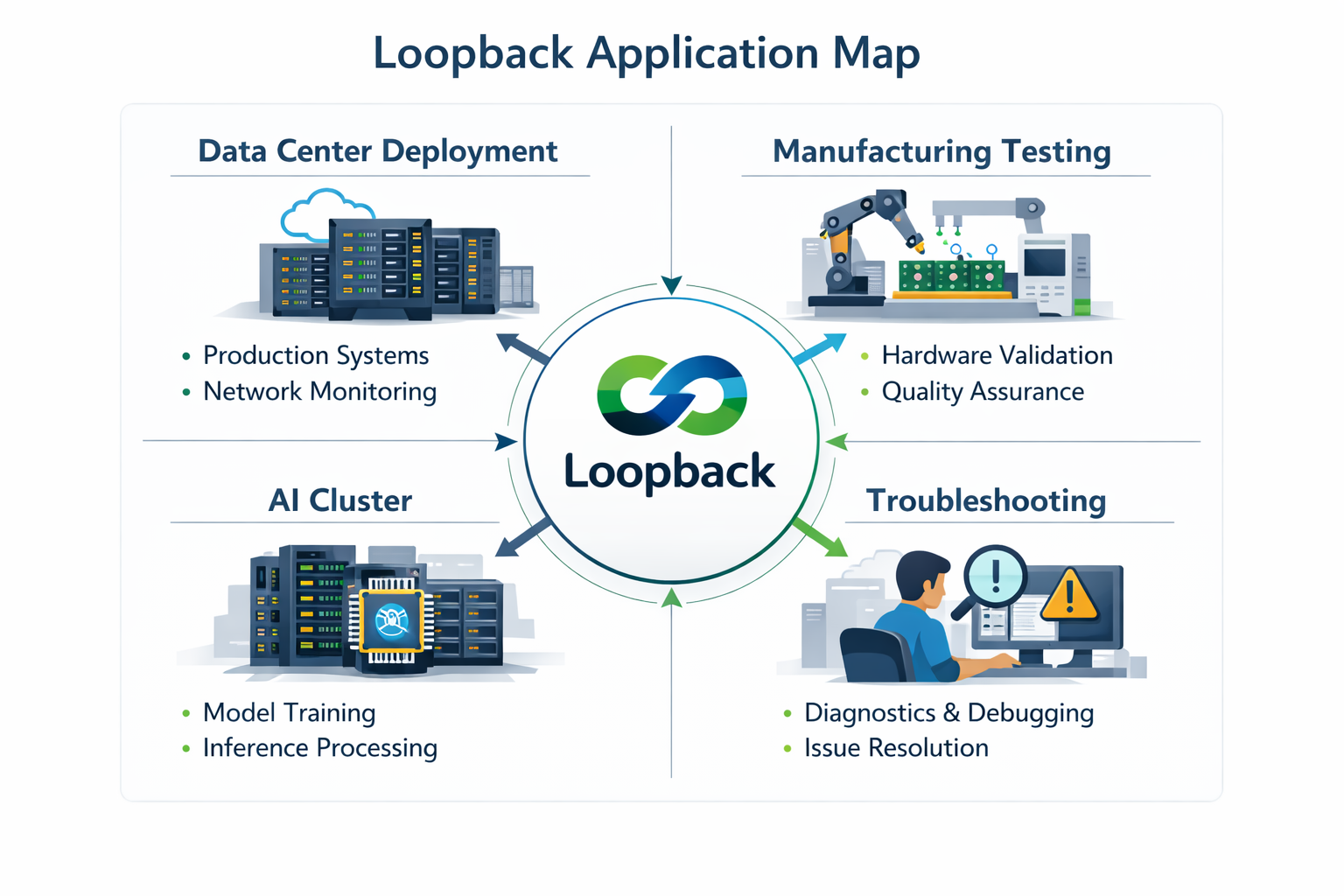
1. Data Center Deployment Testing
Before switches and servers go live, loopback modules are used to validate all high-speed ports. Engineers can quickly verify link status, BER, and basic communication performance.
Compared to traditional testing with real transceivers and fiber, loopback testing significantly reduces complexity and deployment time.
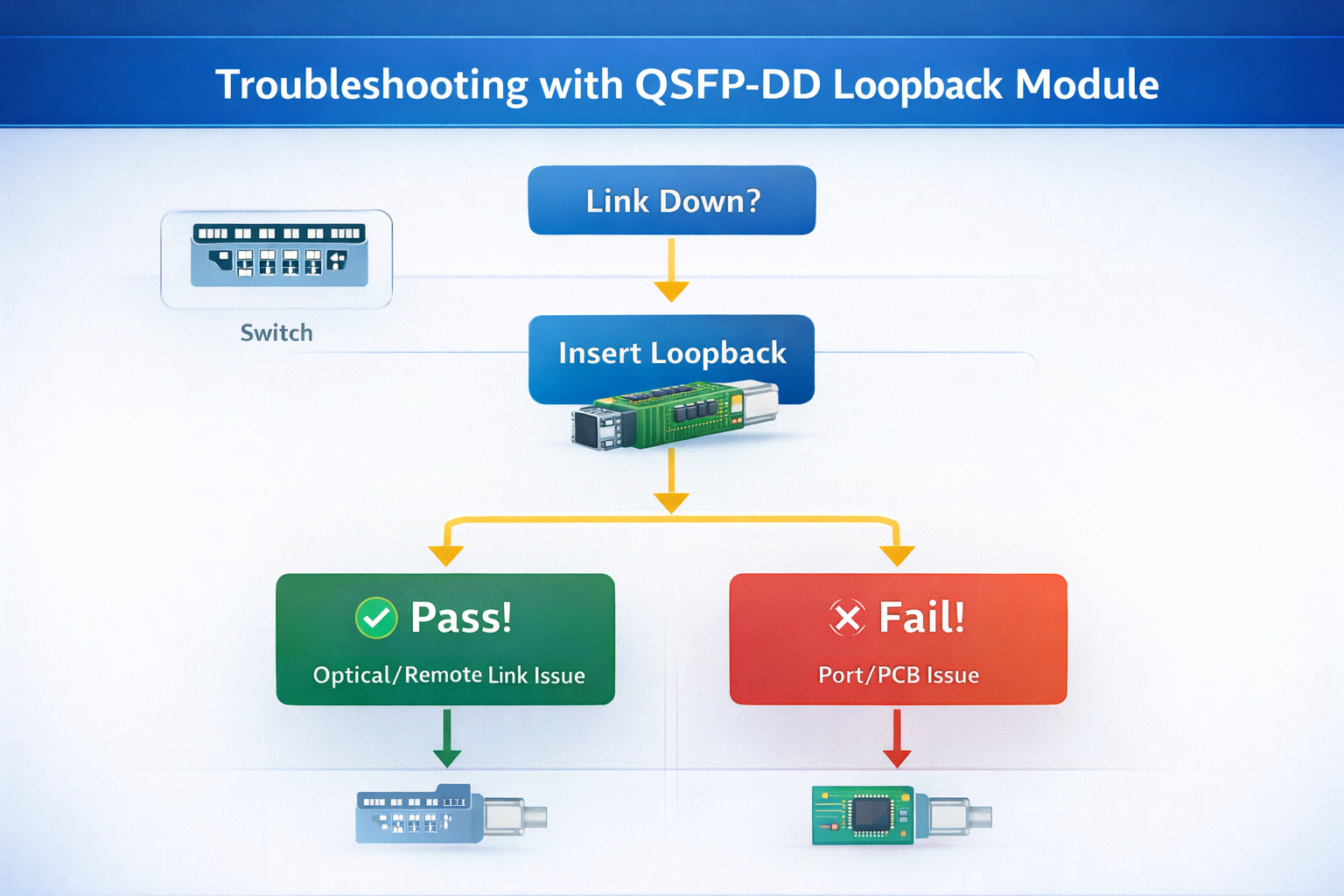
2. Fault Isolation and Troubleshooting
Loopback modules are essential for diagnosing network issues such as link failures or packet loss.
If loopback test passes → issue likely in optics or fiber
If loopback test fails → issue likely in port or PCB
This isolation method dramatically reduces troubleshooting time.
3. Manufacturing and QA Testing
During production (EVT, DVT, PVT), loopback modules are widely used for automated testing.
Typical tests include:
- •BER validation
- •Lane consistency checks
- •Long-term stability testing
This ensures product quality and improves manufacturing yield.
4. HPC and AI Cluster Validation
In AI training clusters and HPC environments, network performance directly impacts compute efficiency.
Loopback modules are used to validate high-speed interconnects between GPU nodes (e.g., NVIDIA DGX systems), ensuring InfiniBand or Ethernet fabrics operate correctly.
5. Network Maintenance and Rapid Recovery
During operations, loopback modules serve as fast diagnostic tools. Engineers can verify port health within minutes and determine whether hardware replacement is necessary.
This is especially critical in:
- •24/7 data centers
- •Large-scale port environments
- •SLA-sensitive systems
6. R&D and Protocol Testing
In lab environments, loopback modules are used for validating ASICs, SerDes, and protocol stacks.
Typical use cases:
- •SerDes tuning
- •PAM4 signal testing
- •CMIS protocol debugging
They provide a stable and repeatable test environment for high-precision validation.
Key Technical Specifications
When selecting a QSFP-DD Loopback Module, it is essential to evaluate several critical technical parameters. Below are the key factors to consider:
Data Rate Compatibility
First and foremost, confirm that the loopback module fully supports the required data rates, such as 200G or 400G QSFP-DD. In addition, backward compatibility with lower speeds can provide greater flexibility for mixed environments.
Channel Mapping
Furthermore, QSFP-DD utilizes an 8-channel design. Therefore, the loopback module must support complete and accurate channel mapping across all lanes. This ensures reliable signal loopback and prevents testing inaccuracies during validation.
Power Consumption
Power consumption is another important consideration. Typically, passive electrical loopback modules consume significantly lower power. In contrast, active or optical loopback modules tend to draw higher power. As a result, choosing the right type helps match your equipment’s power budget and thermal requirements.
Device Compatibility
Moreover, compatibility with target networking equipment is crucial. It is highly recommended to verify compatibility with major vendors, including Cisco, Arista, Juniper, and NVIDIA switches or NICs. This step helps avoid unexpected identification or link training issues in real-world deployments.
EEPROM and Diagnostic Functions
Finally, advanced models often include EEPROM support and Digital Diagnostic Monitoring (DDM). These features enable real-time monitoring of temperature, voltage, and other parameters, thereby providing more comprehensive test data and improving overall troubleshooting efficiency.
Advantages of QSFP-DD Loopback Modules
1.Simplified Testing Process
With its internal loopback mechanism, the QSFP-DD Loopback Module enables port validation without the need for external fiber links or peer devices. This significantly simplifies the test topology and reduces deployment complexity.
2. Significant Improvement in Testing Efficiency
Compared to traditional testing methods that rely on a complete end-to-end link, loopback testing allows a single port to be validated in just a few minutes. It is especially ideal for high-volume batch testing in large-scale data centers.
3. Substantial Reduction in Overall Testing Costs
QSFP-DD Loopback Modules are priced far lower than 400G optical transceivers and require no additional fiber resources. In large-scale port testing scenarios, they can dramatically reduce the Total Cost of Ownership (TCO).
4. Rapid Fault Isolation Capability
By performing isolated loopback tests, engineers can quickly determine whether the issue lies on the port side or the link side, avoiding unnecessary device replacements and repeated troubleshooting.
5. Enhanced Network Reliability
Standardized loopback testing before deployment effectively prevents “going live with defects,” reduces future operational and maintenance pressure, and improves overall network stability.
6. Support for Automated Testing
Loopback modules can be seamlessly integrated with automated test systems (such as BERT or scripted testing platforms) to enable batch port detection and automated report generation, significantly improving the intelligence level of network operations and maintenance.
7. Low Power Consumption and Green Energy Savings
Passive loopback modules consume almost no additional power, making them ideal for green data centers. Active and thermal load versions can simulate real power consumption scenarios, enabling more accurate thermal design validation.
Best Practices for Using QSFP-DD Loopback Modules
To fully leverage the value of QSFP-DD Loopback Modules, it is recommended to follow these best practices during actual use:
1.Perform Comprehensive Pre-Deployment Testing
Before bringing equipment online, conduct loopback testing on every QSFP-DD port individually to ensure all ports are functioning properly and to prevent link issues after deployment.
2. Combine with BER/BERT Test Tools
It is highly recommended to use a Bit Error Rate Tester (BERT) or the device’s built-in BER test function to perform extended stability validation on the ports, thereby improving test accuracy.
3. Establish Standardized Testing Procedures
Develop unified testing specifications (including test duration, BER threshold, and recording methods) and formalize them into standard operating procedures. This helps enhance testing consistency and traceability.
4. Clearly Label and Document Ports
Clearly mark ports that have passed or failed testing, and maintain detailed records of test results for easier future maintenance and troubleshooting.
5. Ensure Compatibility and Firmware Matching
Before use, verify the compatibility of the loopback module with the switch or NIC, and ensure the device firmware version supports the module to avoid identification or recognition issues.
6. Select the Appropriate Module Type Based on Test Scenario
Quick Detection: Use passive loopback modules
In-depth Testing: Use active or thermal load modules
Choosing the right type according to specific testing requirements will yield more accurate results.
7. Avoid Misuse That May Lead to Test Deviation
Do not equate loopback test results directly with real link performance. Always combine loopback testing with actual link testing (e.g., using real optical transceivers and fiber) for a comprehensive evaluation.
8. Perform Regular Maintenance and Calibration
For loopback modules used over long periods, regularly inspect their performance to ensure the accuracy of test results, especially in high-precision testing scenarios.
Conclusion
QSFP-DD loopback modules are indispensable tools in modern high-speed network environments. By enabling efficient port validation and rapid fault isolation, they significantly enhance the reliability and stability of 400G data center networks.
From manufacturing to deployment and ongoing operations, loopback modules play a critical role across the entire network lifecycle.
Frequently Asked Questions
Q1: Can loopback modules replace real transceiver testing?
A: No. They are ideal for electrical and port-level validation, but optical performance must still be tested using real transceivers and fiber.
Q2: Do they support 800G?
A: 800G loopback modules are emerging. It is recommended to choose forward-compatible solutions.
Q3: How to identify a faulty loopback module?
A: Check LED indicators and CMIS diagnostics. Recognition failure or abnormal BER may indicate module issues.
Q4: Passive vs Active—how to choose?
A: Passive: daily port validation
Active: signal conditioning scenarios
Thermal load: power and cooling validation
Post Views: 1,995