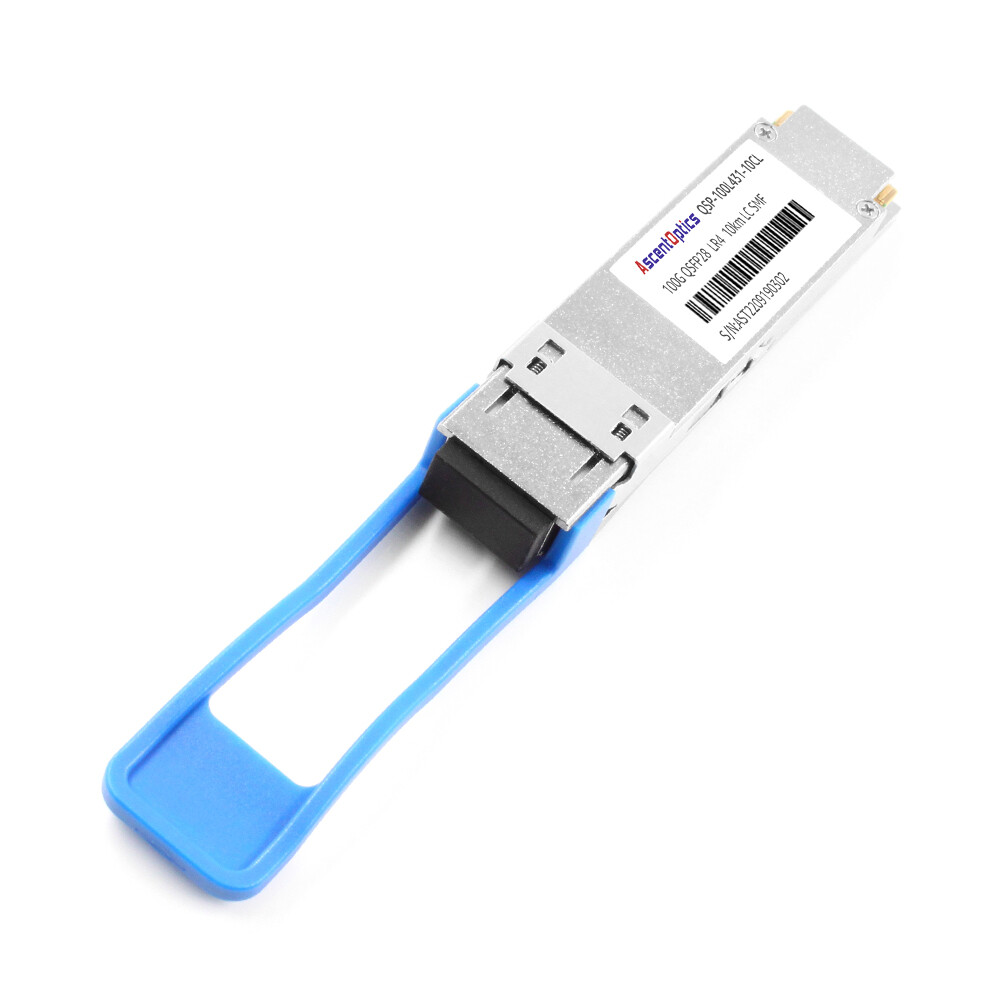
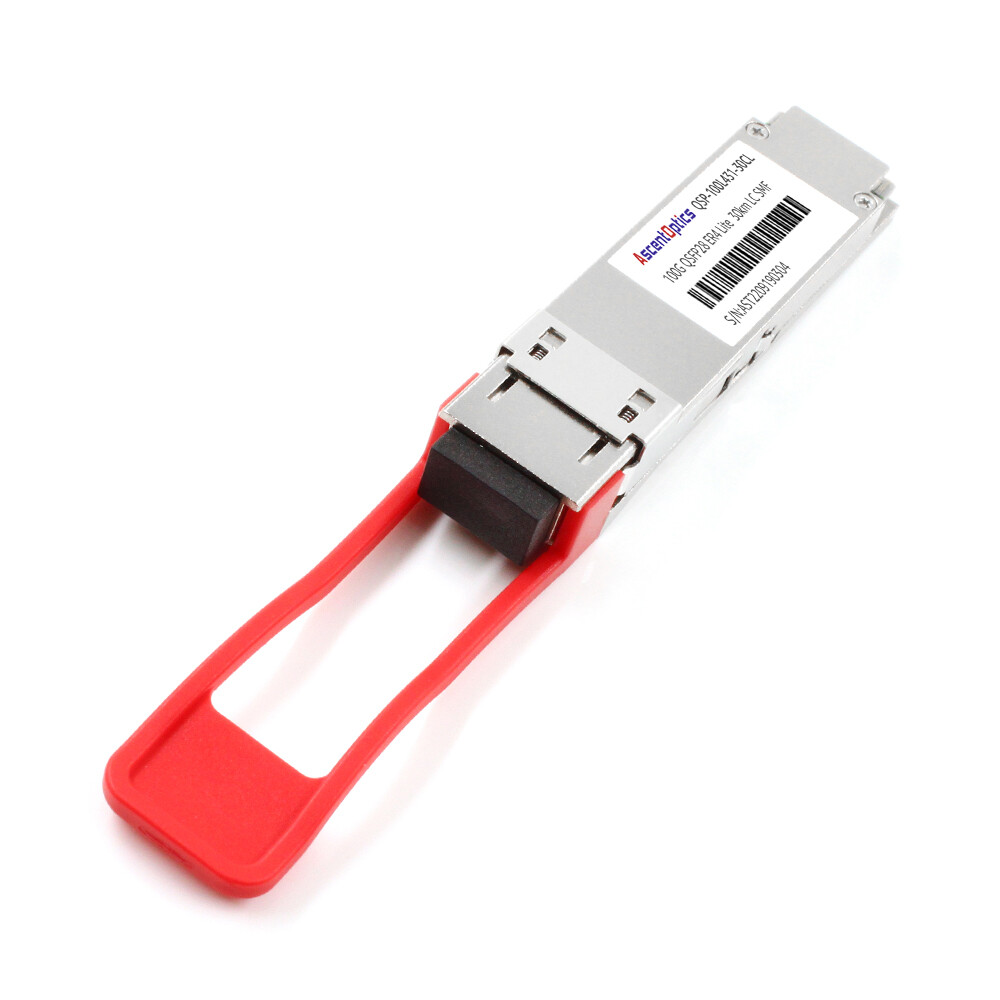
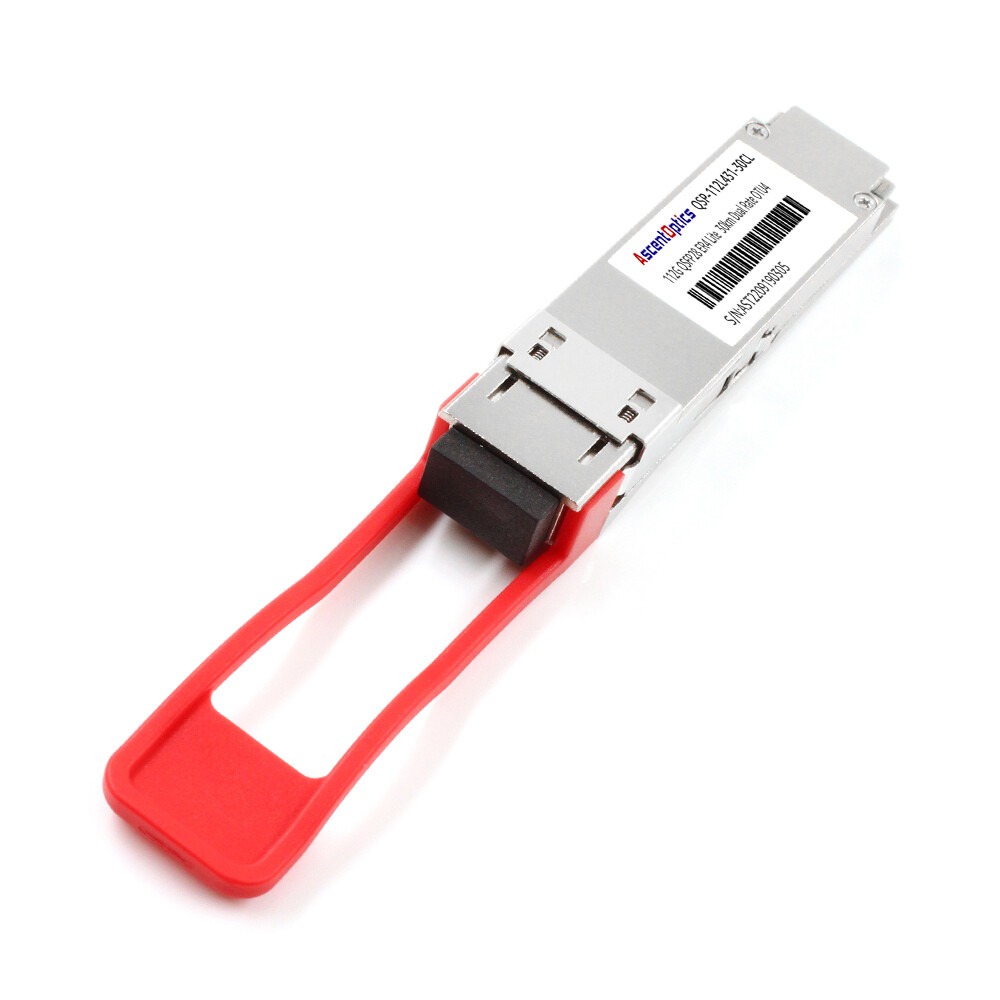
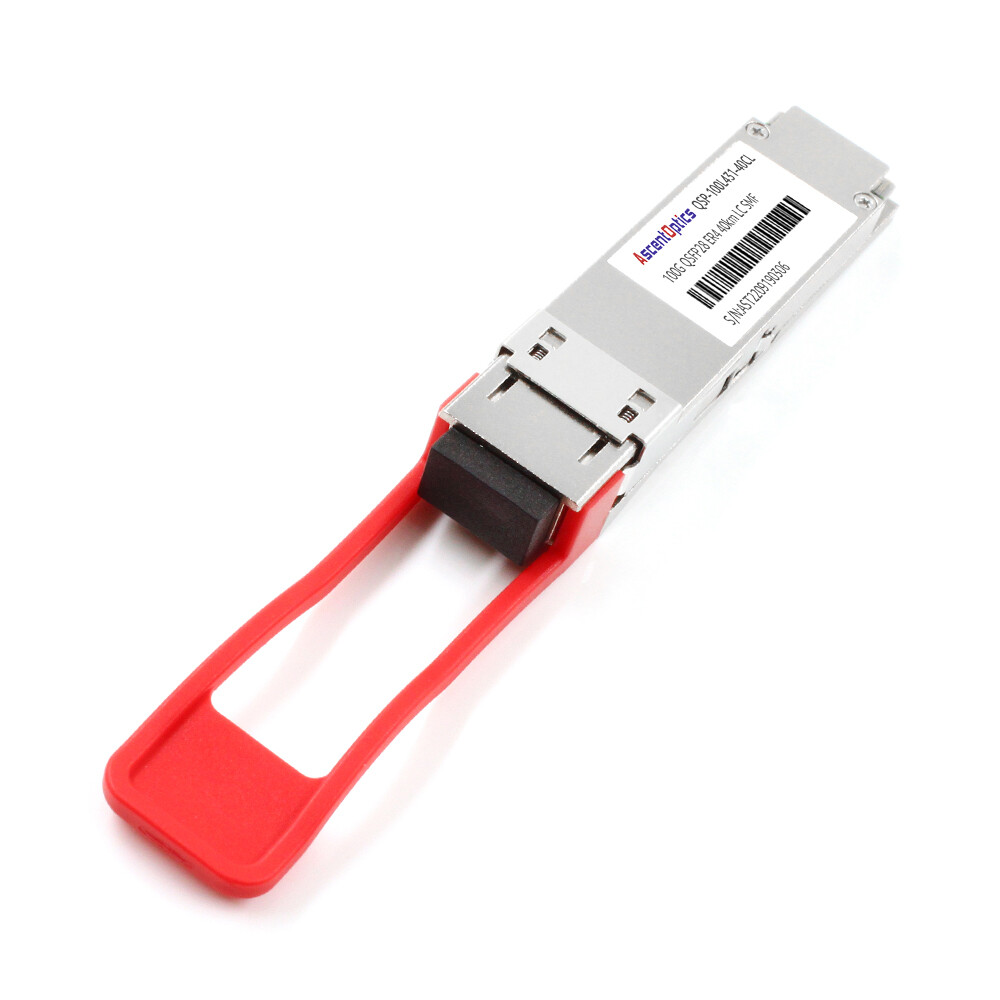
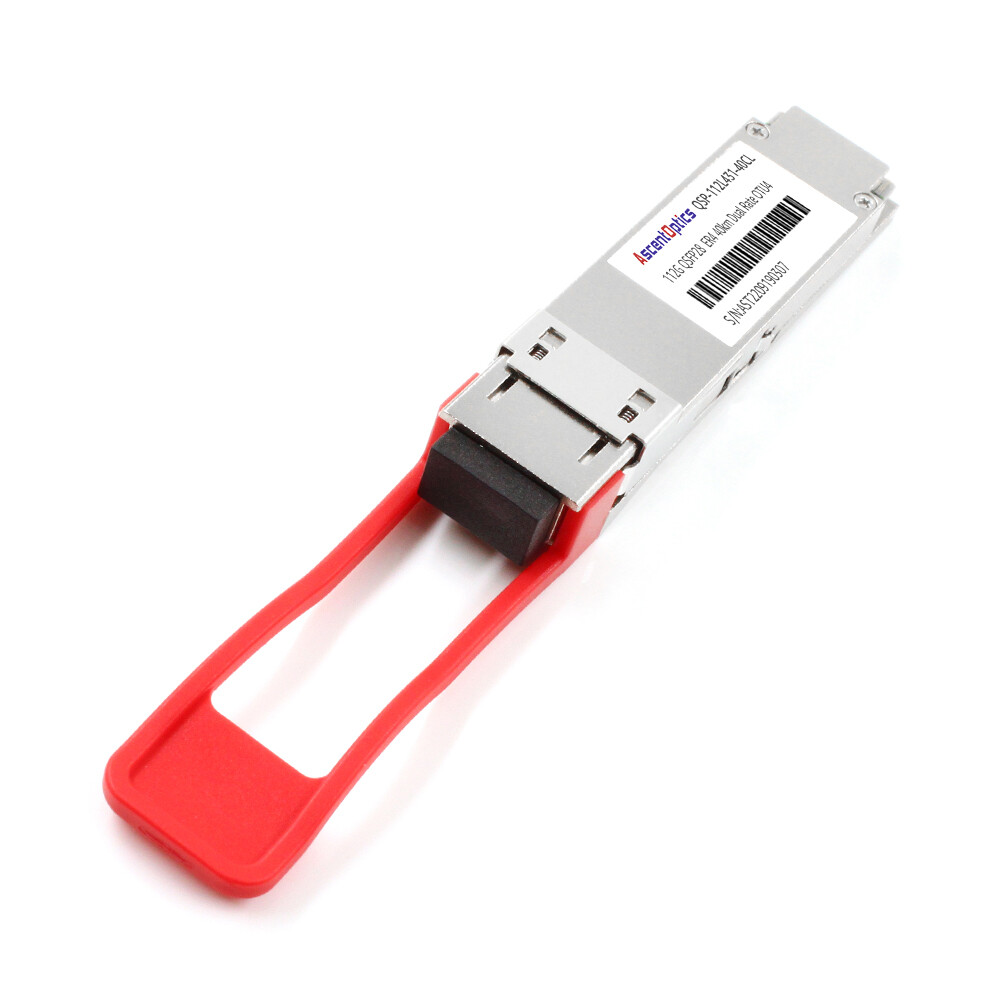
As data center networks continue to evolve toward 400G and beyond, not every DCI deployment requires an immediate migration to higher-speed optical technologies. With a large installed base of 100G infrastructure still operating reliably, 100G ER4 remains a practical solution for long-reach connectivity, bridging current network requirements with future evolution.
What is 100G ER4? Technical Overview
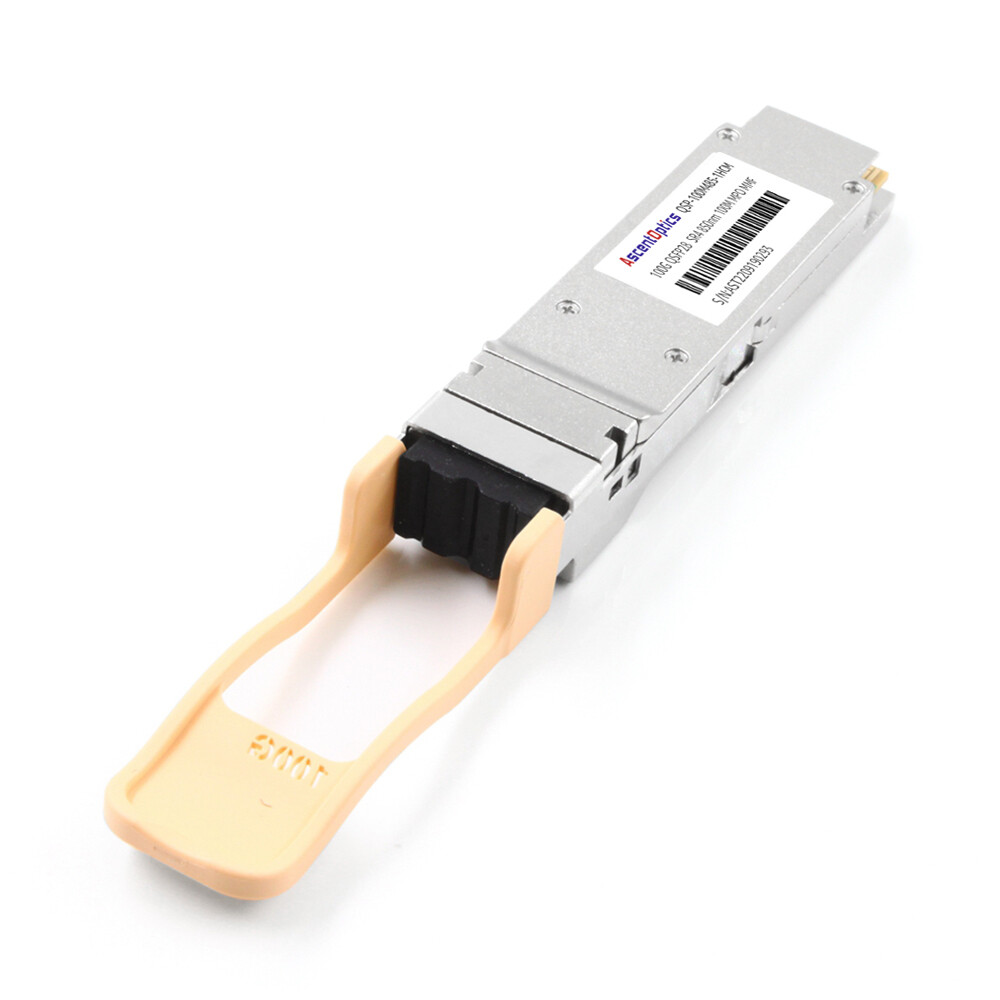
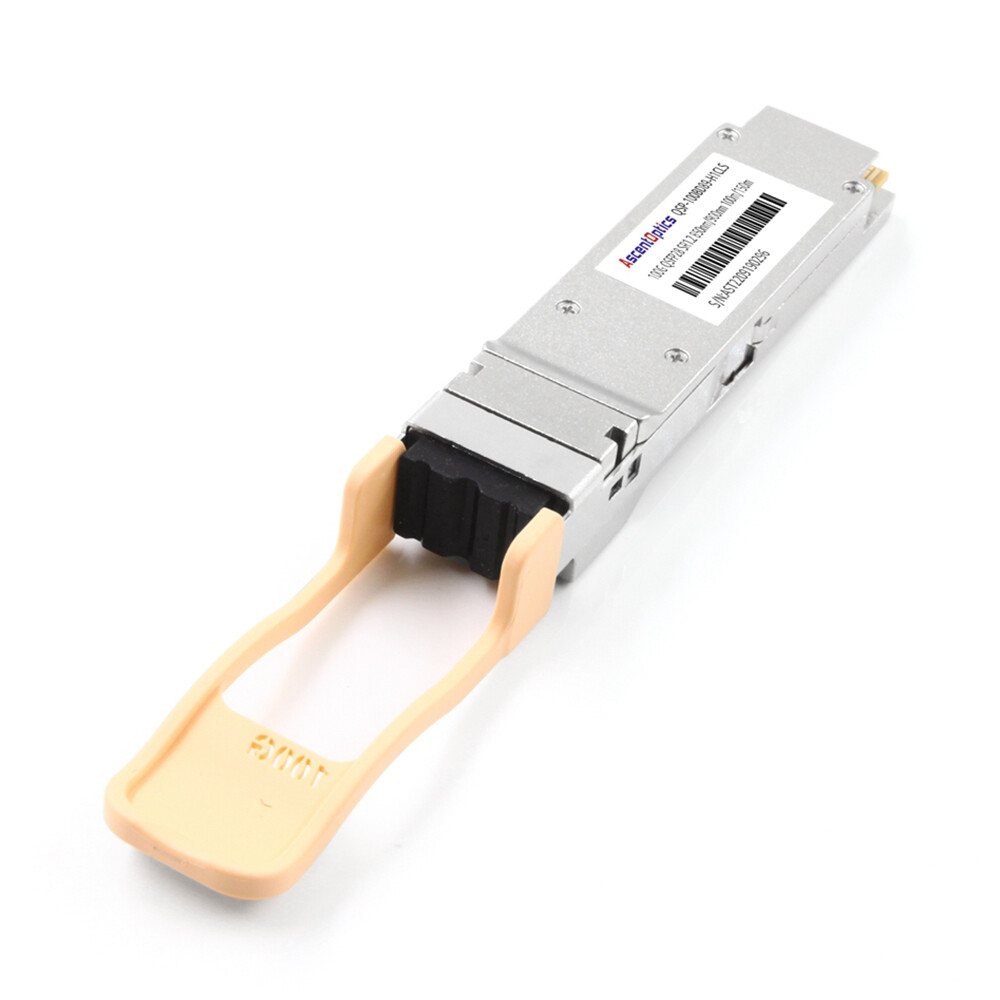
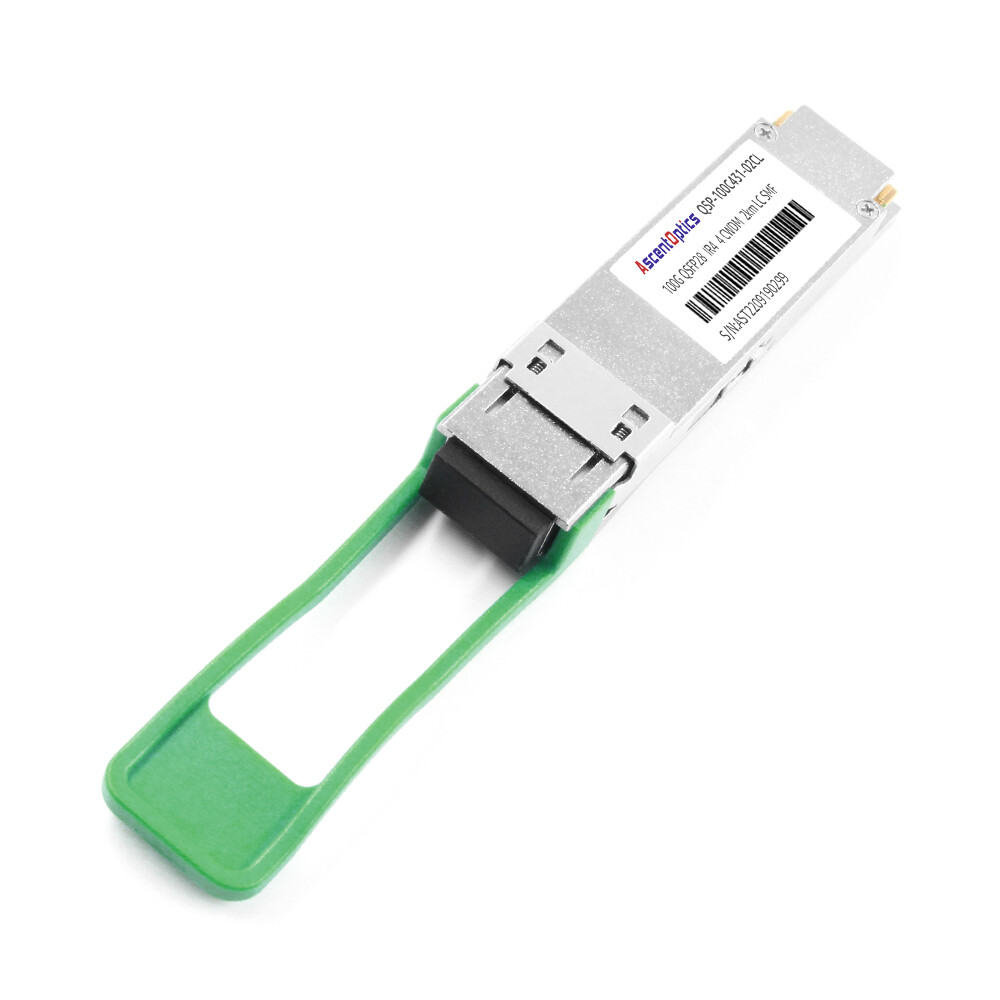
100G ER4 is a QSFP28 optical transceiver module designed for long-reach Ethernet transmission, particularly in data center interconnect (DCI), metro networks, and carrier-grade applications.
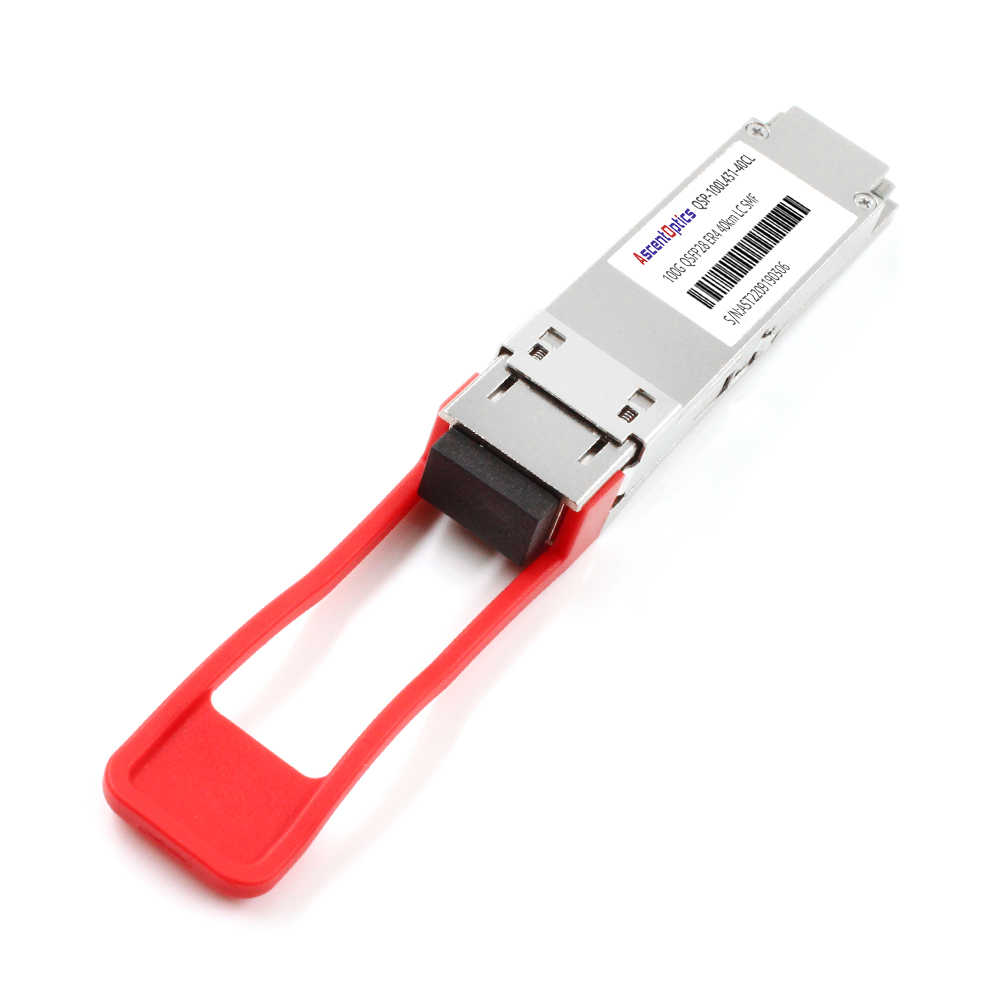
Form Factor & Data Rate
100G ER4 typically uses the QSFP28 package and supports an aggregate bandwidth of 100 Gbps. It remains one of the most mature and widely deployed optical module types for 100G long-reach interconnects today.
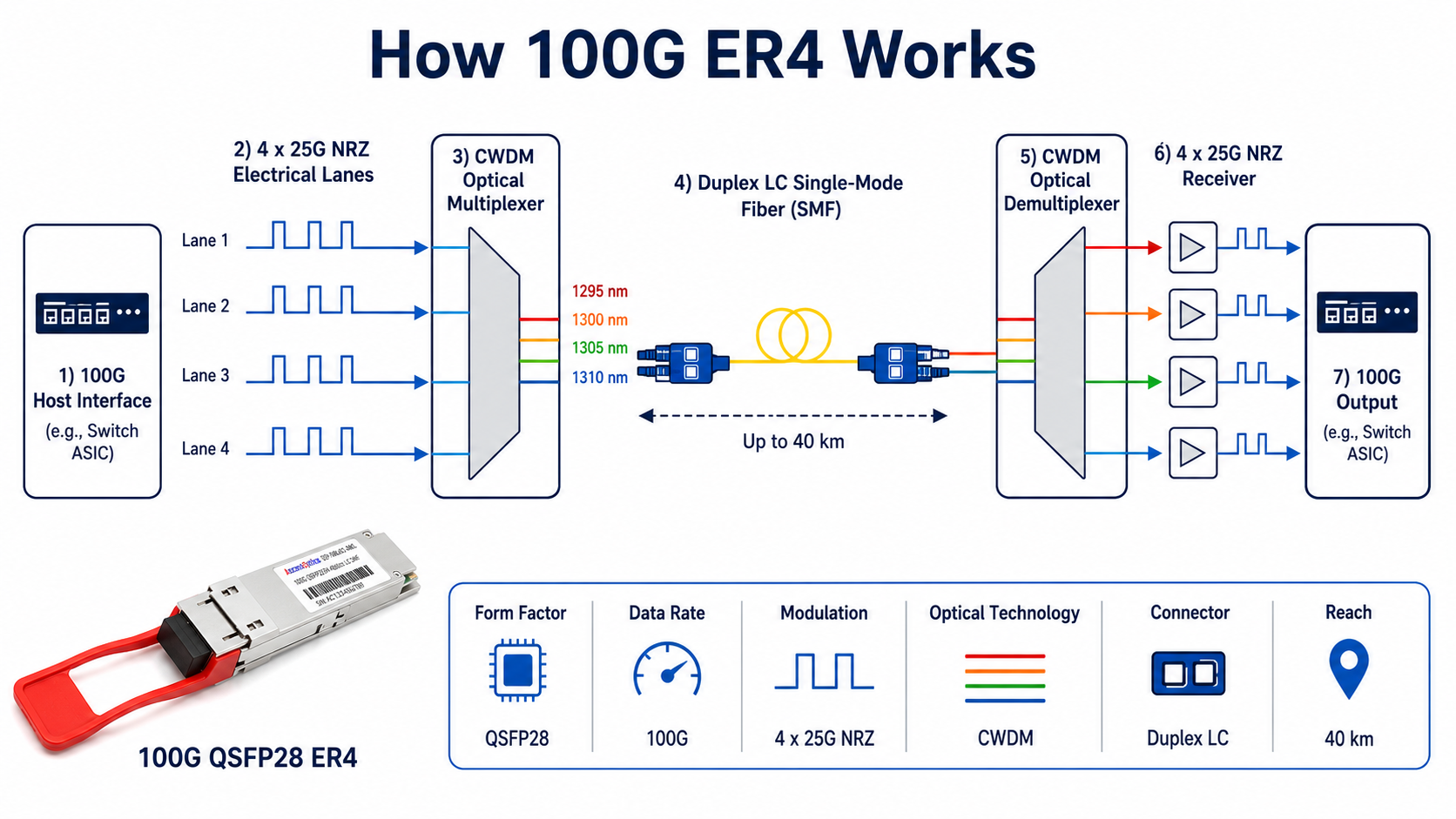
Transmission Mechanism
On the electrical interface side, it uses 4 × 25 Gbps NRZ signals. These four lanes are multiplexed onto a single fiber pair using CWDM (Coarse Wavelength Division Multiplexing) technology for transmission.
Wavelength & Interface
It operates in the 1310 nm wavelength band, with an LC duplex optical interface, which aligns perfectly with the standard cabling practices used in most data centers and telecom networks.
Transmission Distance
The typical reach is 40 km over single-mode fiber (SMF), making it well-suited for metro-area networks, inter-campus data center interconnects (DCI), and other medium-to-long-distance applications.
Standards & Compatibility
It complies with the IEEE 802.3ba standard and offers excellent multi-vendor interoperability, facilitating large-scale deployments.
Technical Advantages
Leveraging mature NRZ modulation, 100G ER4 delivers stable link performance and controllable power consumption, achieving an excellent balance between performance, reliability, and deployment cost.
Thanks to its proven NRZ modulation technology and strong link budget, 100G ER4 continues to strike a very good balance among reliability, compatibility, and total cost of ownership. It is still widely used today in metro networks, campus-to-campus DCI links, and enterprise networks that have clear requirements for transmission distance.
100G ER4 vs LR4: What Is the Difference?
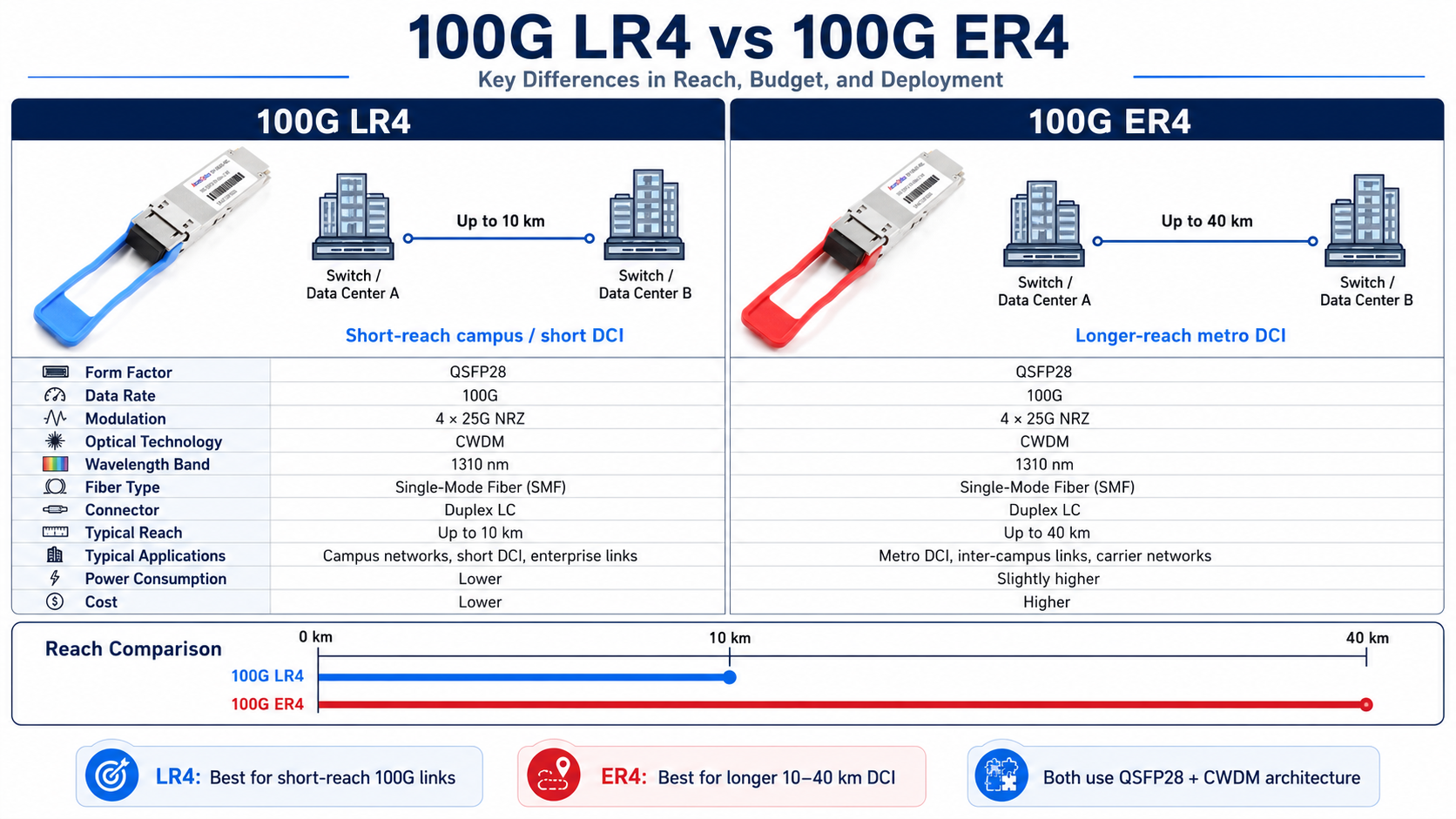
Although both 100G ER4 and LR4 optical modules are based on the QSFP28 form factor and use CWDM technology with four 25Gbps NRZ electrical lanes, they are designed for different transmission distance requirements. The primary difference between them is the optical power budget and supported reach.
100G LR4 is typically designed for transmission distances up to 10 km over single-mode fiber, making it suitable for data center interconnects within campuses, enterprise networks, and short metro links. In comparison, 100G ER4 extends the transmission distance to approximately 40 km, making it a better choice for city-level DCI and metro network applications where longer reach is required.
By providing a higher optical budget, 100G ER4 can overcome greater fiber loss and support longer point-to-point connections without requiring additional optical amplification or regeneration in typical deployment scenarios. However, this extended reach also results in slightly higher power consumption and module cost compared with LR4.
100G ER4 vs LR4 Comparison
| Feature |
100G LR4 |
100G ER4 |
| Form Factor |
QSFP28 |
QSFP28 |
| Data Rate |
100Gbps |
100Gbps |
| Modulation |
4 × 25G NRZ |
4 × 25G NRZ |
| Optical Technology |
CWDM |
CWDM |
| Wavelength Band |
1310nm |
1310nm |
| Fiber Type |
Single-mode Fiber (SMF) |
Single-mode Fiber (SMF) |
| Transmission Distance |
Up to 10km |
Up to 40km |
| Connector |
Duplex LC |
Duplex LC |
| Typical Applications |
Campus networks, short DCI, enterprise links |
Metro DCI, inter-city data center links, carrier networks |
| Power Consumption |
Lower |
Slightly higher |
| Cost |
Lower |
Higher |
When to Choose 100G ER4 or LR4?
For links within a data center campus or shorter distances below 10km, 100G LR4 is usually the more cost-effective choice due to its lower power consumption and simpler requirements. However, when the network needs to connect geographically separated data centers across a city or metropolitan area, 100G ER4 provides a more suitable solution with its extended 40km reach.
In many real-world DCI deployments, the choice between LR4 and ER4 depends mainly on transmission distance, fiber loss, and total cost of ownership. LR4 focuses on cost-efficient short-reach connectivity, while ER4 provides the additional reach required for metro-scale network expansion.
Core Requirements of Long-Distance DCI Networks
In long-distance data center interconnect (DCI) scenarios, network design typically focuses on the following key requirements.
First, transmission distance and link stability are critical. Connections between data centers often need to span 10–40 km or even farther, so the optical link must provide a reliable power budget and the ability to maintain long-term stable operation.
Second, bandwidth and latency performance are essential. With the rapid growth of cloud computing, distributed storage, and AI workloads, large volumes of data must be synchronized quickly across different data centers. The network needs to deliver sufficient bandwidth while minimizing transmission latency as much as possible.
At the same time, standardization and interoperability are extremely important. DCI networks are usually built with equipment from multiple vendors, so only optical modules that comply with mainstream standards can enable flexible deployment and large-scale expansion.
Finally, cost and deployment complexity cannot be overlooked. Enterprises prefer solutions that are technically mature, simple to deploy, and have controllable maintenance costs, in order to achieve a good balance between performance and investment.
Core Advantages of 100G ER4 in Long-Haul DCI
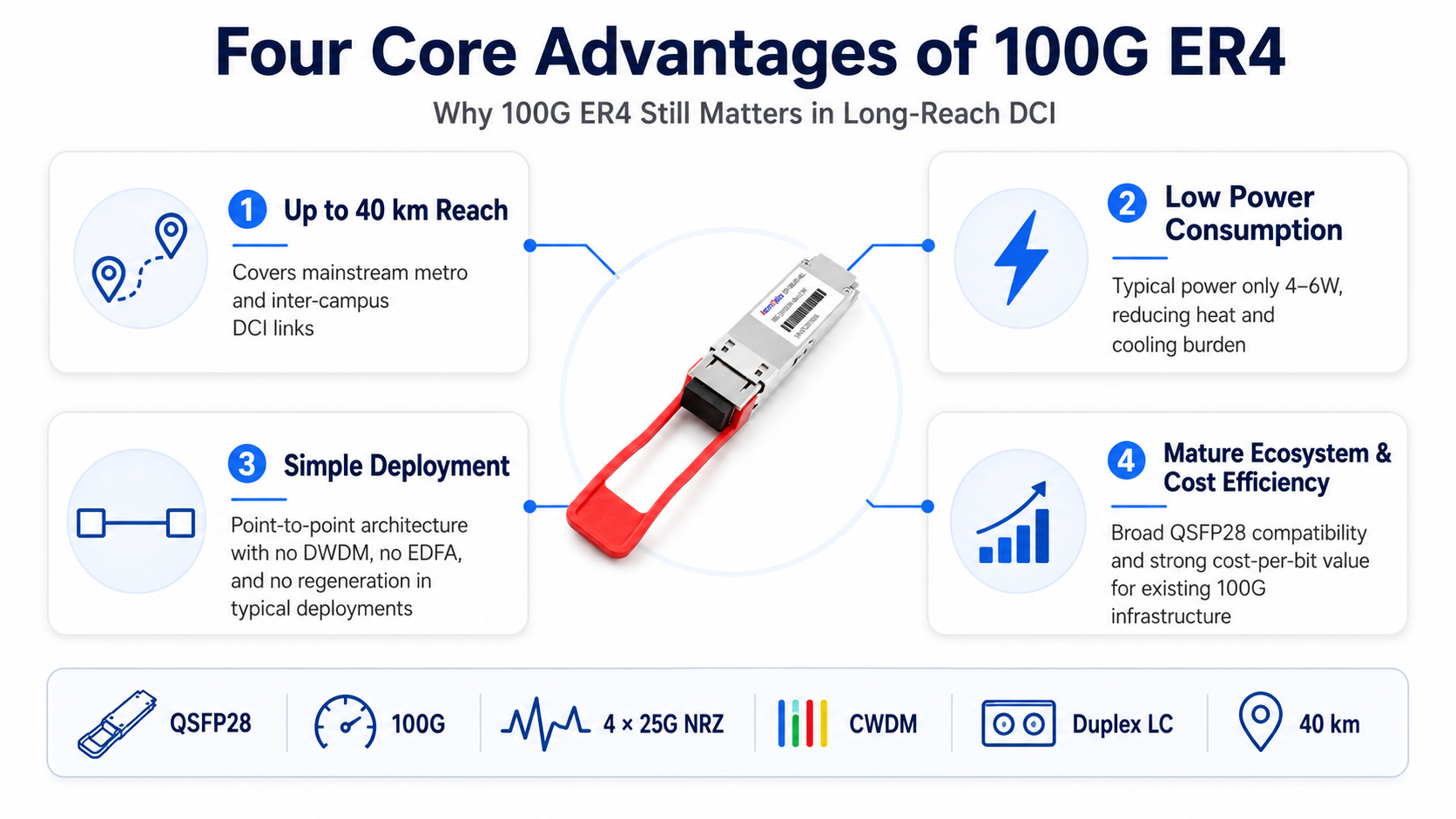
In data center interconnect (DCI) scenarios—particularly for metro and inter-city mid-range links (typically 20–40 km)—the 100G QSFP28 ER4 (100GBASE-ER4) remains highly competitive in real-world deployments. Although it is no longer the highest-speed option in 2025–2026, its unique combination of cost efficiency and deployment simplicity continues to make it a preferred choice for many DCI networks.
40 km Reach Covering Mainstream DCI Scenarios
100G ER4 enables up to 40 km transmission over single-mode fiber, making it suitable for metro-area and inter-city data center interconnect applications. For typical 40 km links, it provides direct point-to-point connectivity without the need for optical amplifiers or electrical regeneration. Compared to 10 km LR4 solutions, ER4 significantly extends DCI reach, while avoiding the higher cost and complexity associated with coherent optical technologies. This makes it an ideal solution for mainstream 10–40 km DCI links.
Low Power Consumption, Lower Operating Costs
With a typical power consumption of only 4–6 W, 100G ER4 operates far more efficiently than coherent transceivers. Lower power draw translates into reduced heat generation, lower cooling requirements, and more favorable long-term operational costs—particularly beneficial for large-scale DCI deployments.
Simple Deployment and Lower Total Cost of Ownership (TCO)
100G ER4 supports direct point-to-point connections and does not require DWDM systems, optical amplifiers, or complex optical-layer planning. Its true plug-and-play nature significantly reduces deployment complexity and overall network design effort, resulting in a lower end-to-end TCO.
Mature Ecosystem and Strong Cost Efficiency
Built on the well-established QSFP28 platform, 100G ER4 offers broad compatibility with leading switch vendors, while module pricing has been highly optimized. In the 20–40 km range, it remains one of the most cost-effective DCI solutions in terms of cost per bit, and is particularly well suited for the transition phase from 100G to 400G networks.
In long-haul DCI applications, the core value of 100G ER4 lies in its balanced combination of 40 km reach without regeneration, low power consumption, zero optical-layer complexity, and outstanding cost efficiency. For metro and mid-distance DCI scenarios that do not require capacities beyond 400G and remain within 40 km, 100G ER4 continues to be one of the most practical and economical choices in 2025, especially when total cost of ownership (TCO) is the primary consideration.
Typical DCI Use Cases for 100G ER4
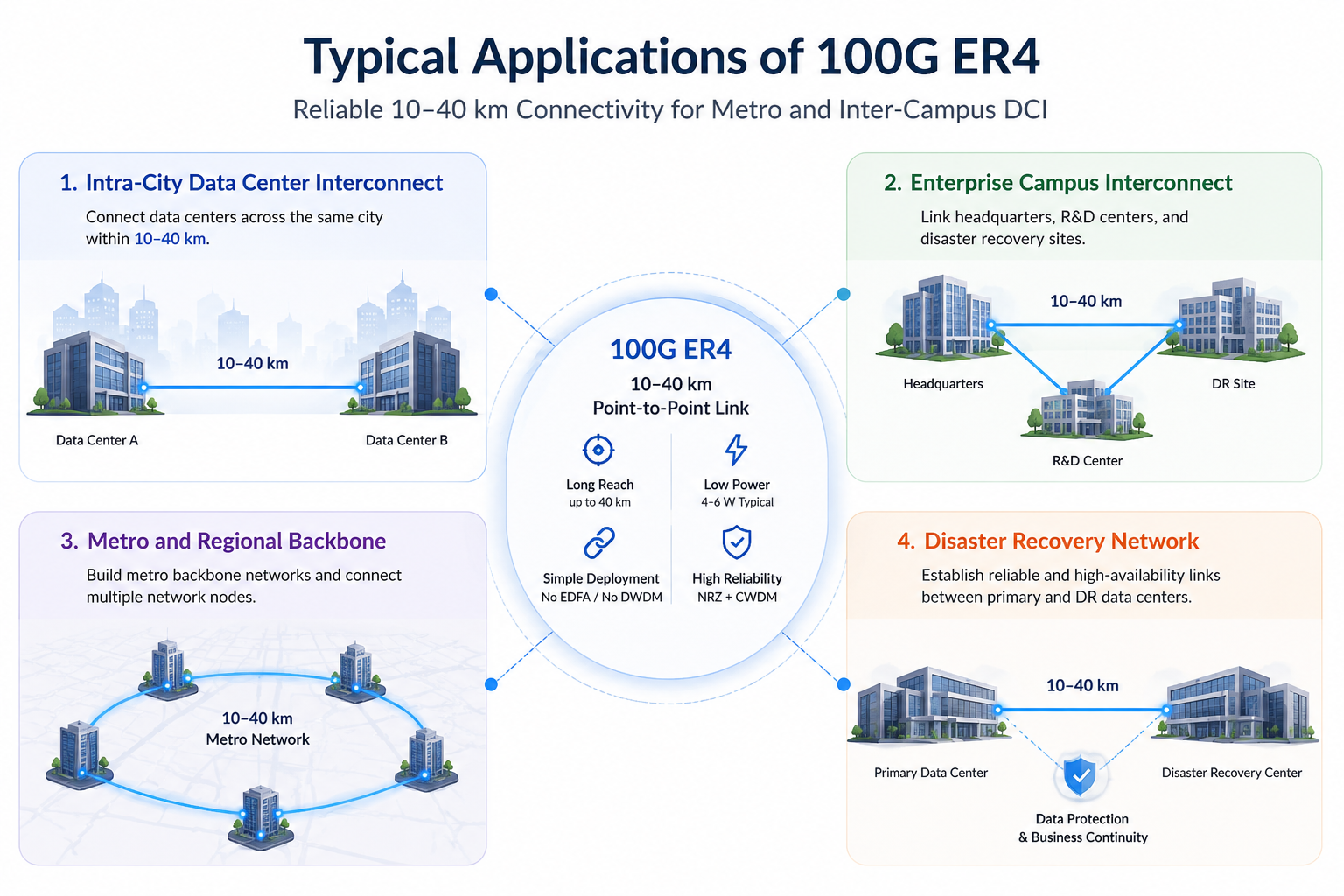
100G ER4 (100GBASE-ER4) is primarily deployed in data center interconnect (DCI) scenarios where ultra-high bandwidth is not required, but transmission distances fall within the 10–40 km range. Characterized by simplicity, reliability, low cost, and zero regeneration, it is particularly well suited for the following use cases:
1.Intra-city multi–data center interconnection
2. Regional backbone or metro-area DCI networks
3. Enterprise cross-campus or inter-building data center connectivity
4. Metro transmission upgrades for traditional telecom operators
Across these scenarios, 100G ER4 stands out as a cost-effective DCI solution, delivering stable long-reach performance, low power consumption, and straightforward deployment.
The Role of 100G ER4 in Future Network Evolution
As data center networks continue to evolve toward 400G and 800G, the role of 100G ER4 is shifting from a pure bandwidth upgrade option to a stable and reliable foundational interconnect layer. With a large installed base of 100G infrastructure expected to remain in operation for years to come, the module will continue to serve as a primary solution for metro and regional DCI links, supporting business continuity and enabling smooth, incremental network evolution.
At the same time, while 400G/800G high-speed ports are increasingly reserved for AI clusters and core backbone networks, 100G ER4—thanks to its low power consumption, cost efficiency, and mature ecosystem—remains a rational choice for edge data centers, disaster recovery networks, and mixed-speed environments. As 400G and 800G technologies become increasingly common in AI clusters and core network applications, 100G ER4 will continue serving applications where reliability, simplicity, and cost efficiency are more important than maximum bandwidth.
Conclusion
Overall, 100G ER4 is not merely a transitional technology, but a well-balanced and proven solution that optimizes performance, cost, and deployment simplicity. In the coming years, it will continue to play a vital role in metro and regional DCI networks, providing a stable and cost-effective foundation while enabling a smooth migration toward higher-speed architectures.
FAQ About 100G ER4
What is the maximum distance of 100G ER4?
It supports transmission distances of up to 40km over single-mode fiber, making it suitable for metro DCI and campus interconnect applications.
Is 100G ER4 still relevant in the 400G era?
Yes. Although 400G and 800G are becoming common for high-capacity networks, 100G ER4 remains valuable for existing 100G infrastructure, cost-sensitive deployments, and medium-distance DCI links.
What is the difference between 100G ER4 and LR4?
The main difference is transmission distance. LR4 typically supports up to 10km, while ER4 extends the reach to approximately 40km with a higher optical budget.
Does 100G ER4 require DWDM?
No. 100G ER4 is a point-to-point optical solution and usually does not require DWDM systems, optical amplifiers, or complex optical-layer planning.
Post Views: 2,704